
Judge, 1911-05-20 · page 6 of 24
Judge — May 20, 1911 — page 6: what you’re looking at
What you’re looking at
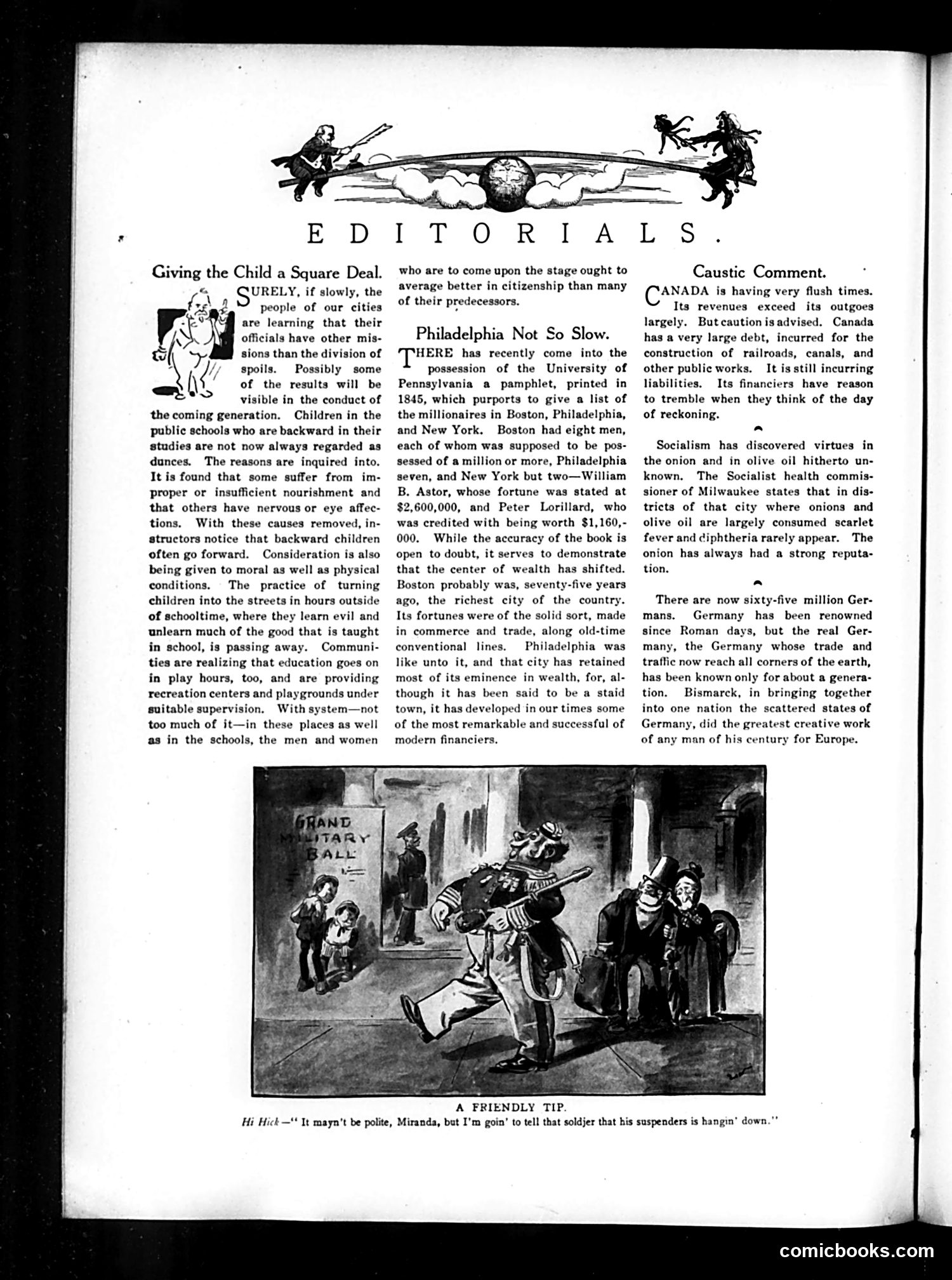
This Judge magazine page contains three distinct editorials plus one cartoon. **"Giving the Child a Square Deal"** praises progressive urban reforms: better nutrition and medical care for struggling schoolchildren, supervised playgrounds, and recognizing that education happens outside classroom hours. It reflects early-20th-century Progressive Era concern for child welfare. **"Philadelphia Not So Slow"** disputes the notion that Philadelphia has declined economically. Using an 1845 millionaire list showing Boston ahead, it argues Philadelphia has actually retained and grown its wealth through successful modern financiers—contrasting "solid" old commerce with new financial innovation. **"Caustic Comment"** warns Canada against overconfidence despite budget surpluses, citing accumulated railroad/canal debt. It also praises Milwaukee's Socialist health commissioner for noting onion and olive oil consumption correlates with fewer disease cases. The third item celebrates Bismarck's German unification as unprecedented creative statecraft. **The cartoon** ("A Friendly Tip") shows a rustic character warning a military officer that his suspenders are showing—gentle social satire about propriety and masculine dignity.
📄 Transcribed text from this page (OCR, searchable)
Machine-transcribed from the original scan — historical spelling and the odd misread are preserved.
Giving the Child a Square Deal. URELY, if slowly, the people of our cities fe Q S$ Ap*, =(c°*(4@ are learning that their & officials have other mis- (| “>- AM sions than the division of ~» spoils. Possibly some { of the results will be ~~ visible in the conduct of the coming generation. Children in the public schools who are backward in their studies are not now always regarded as dunces. The reasons are inquired into. It is found that some suffer from im- proper or insufficient nourishment and that others have nervous or eye affec- tions. With these causes removed, in- structors notice that backward children often go forward. Consideration is also being given to moral as well as physical conditions. The practice of turning children into the streets in hours outside of schooltime, where they learn evil and unlearn much of the good that is taught in school, is passing away. Communi- ties are realizing that education goes on in play hours, too, and are providing recreation centers and playgrounds under suitable supervision. With system—not too much of it—in these places as well as in the schools, the men and women who are to come upon the stage ought to average better in citizenship than many of their predecessors. Philadelphia Not So Slow. ‘THERE has recently come into the possession of the University of Pennsylvania a pamphlet, printed in 1845, which purports to give a list of the millionaires in Boston, Philadelphi and New York. Boston had eight men, each of whom was supposed to be pos- sessed of a million or more, Philadelphia seven, and New York but two—William B. Astor, whose fortune was stated at $2,600,000, and Peter Lorillard, who was credited with being worth $1,160,- 000. While the accuracy of the book is open to doubt, it serves to demonstrate that the center of wealth has shifted. Boston probably was, seventy-five years ago, the richest city of the country. Its fortunes were of the solid sort, made in commerce and trade, along old-time conventional lines. Philadelphia was like unto it, and that city has retained most of its eminence in wealth, for, al- though it has been said to be a staid town, it has developed in our times some of the most remarkable and successful of modern financiers, A FRIENDLY TIP. Caustic Comment. CANADA is having very flush times. Its revenues exceed its outgoes largely. Butcaution is advised. Canada has a very large debt, incurred for the construction of railroads, canals, and other public works. It is still incurring liabilities. Its financiers have reason to tremble when they think of the day of reckoning. a Socialism has discovered virtues in the onion and in olive oil hitherto un- known, The Socialist health commis- sioner of Milwaukee states that in dis- tricts of that city where onions and olive oil are largely consumed scarlet fever and diphtheria rarely appear. The onion has always had a strong reputa- tion, a There are now sixty-five million Ger- mans. Germany has been renowned since Roman days, but the real Ger- many, the Germany whose trade and traffic now reach all corners of the earth, has been known only for about a genera- tion. Bismarck, in bringing together into one nation the scattered states of Germany, did the greatest creative work of any man of his century for Europe. Hi Hick“ It mayn't be polite, Miranda, but I'm goin’ to tell that soldjer that his suspenders is hangin’ down."” comicbooks.com