
A complete issue · 24 pages · 1911
Judge — March 4, 1911
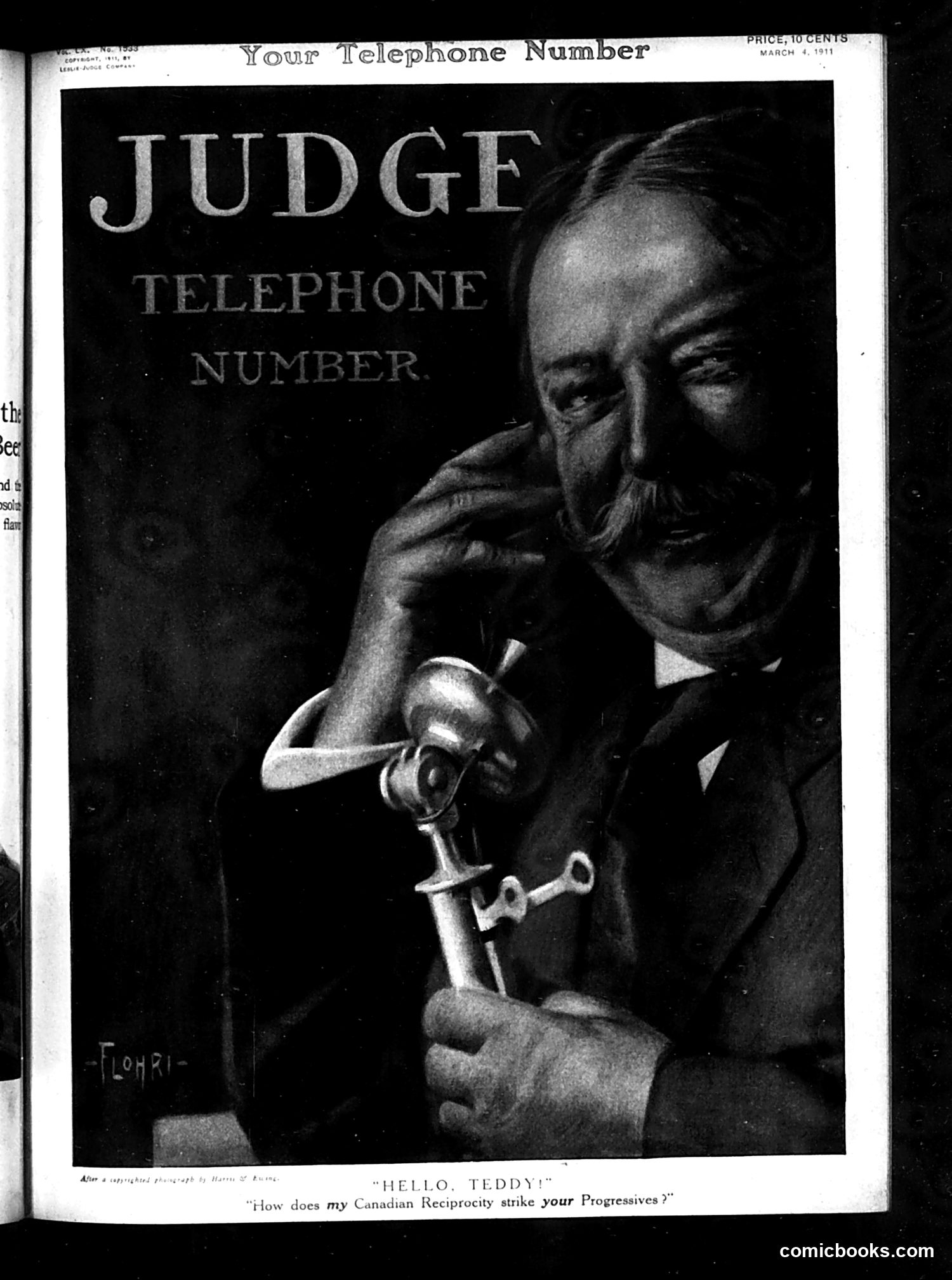
This 1911 *Judge* magazine cover depicts a man in formal dress holding an old-style telephone, with the caption "HELLO, TEDDY!" and the subtitle "How does my Canadian Reciprocity strike your Progressives?" The cartoon satirizes **Theodore Roosevelt** and American political divisions over **Canadian reciprocity** (a free-trade agreement). The "Judge" figure uses a telephone—a modern communication device—to mock Roosevelt's influence over the Progressive political movement, suggesting he remains a puppet-master despite no longer being president (he left office in 1909). The satire implies that Progressives still take orders from Roosevelt, and questions whether his endorsement affects their stance on the controversial Canadian trade deal, which was a significant political issue in 1911.
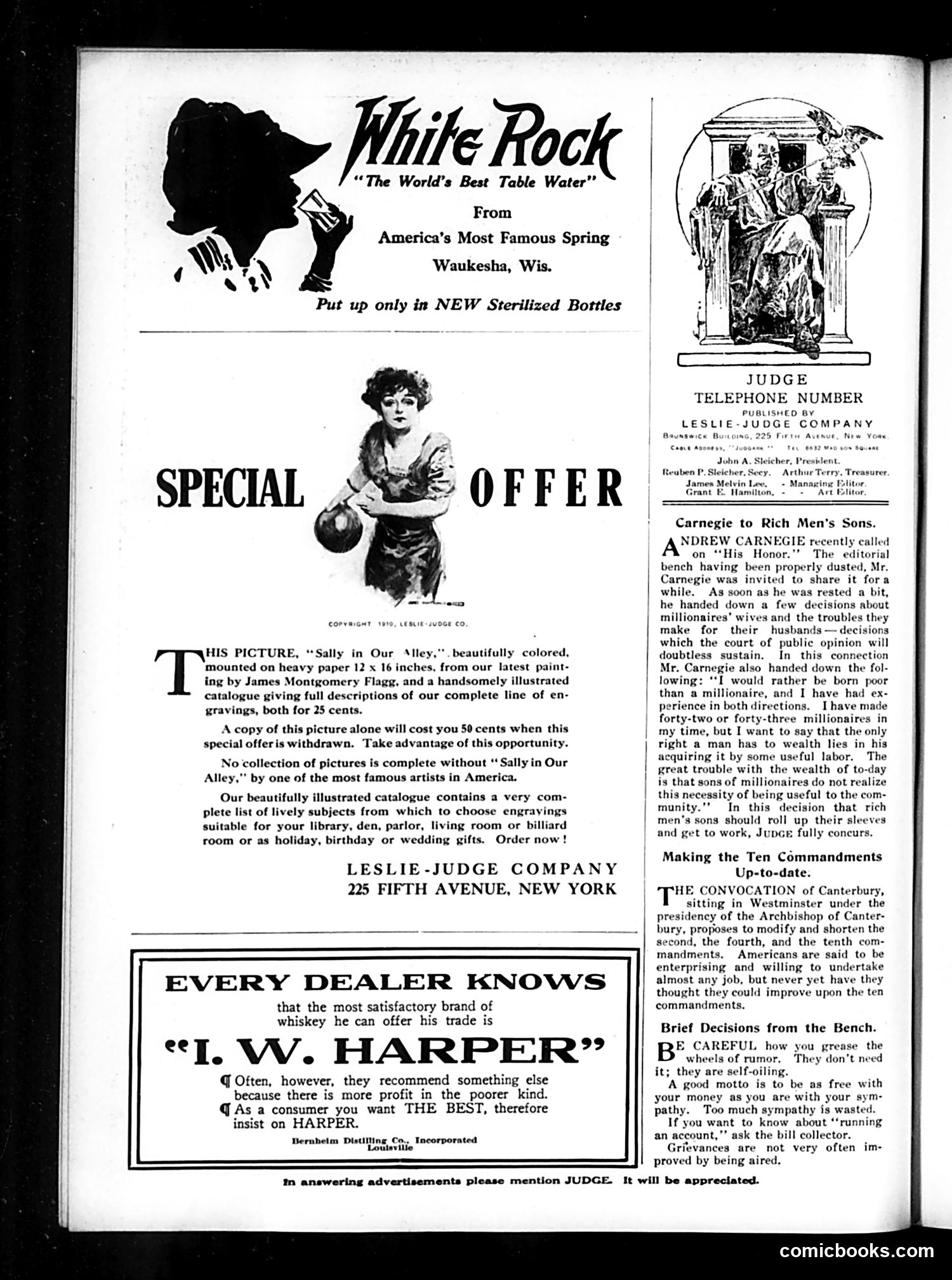
This page is primarily **advertising with minimal satirical content**. The main features are: 1. **White Rock water advertisement** - promoting bottled spring water from Waukesha, Wisconsin as "The World's Best Table Water" 2. **Leslie-Judge Company promotion** - advertising engravings, including "Sally in Our Alley" by James Montgomery Flagg, a famous illustrator 3. **I.W. Harper whiskey ad** - noting dealers often recommend cheaper brands for profit margins, but urging customers to insist on Harper brand 4. **Right column content** - includes brief articles on Andrew Carnegie's wealth philosophy and proposed changes to the Ten Commandments (appears to reference a Church of Canterbury discussion) The page reflects **early 20th-century consumer culture** and advertising practices, with minimal political satire or cartooning beyond the commercial imagery.
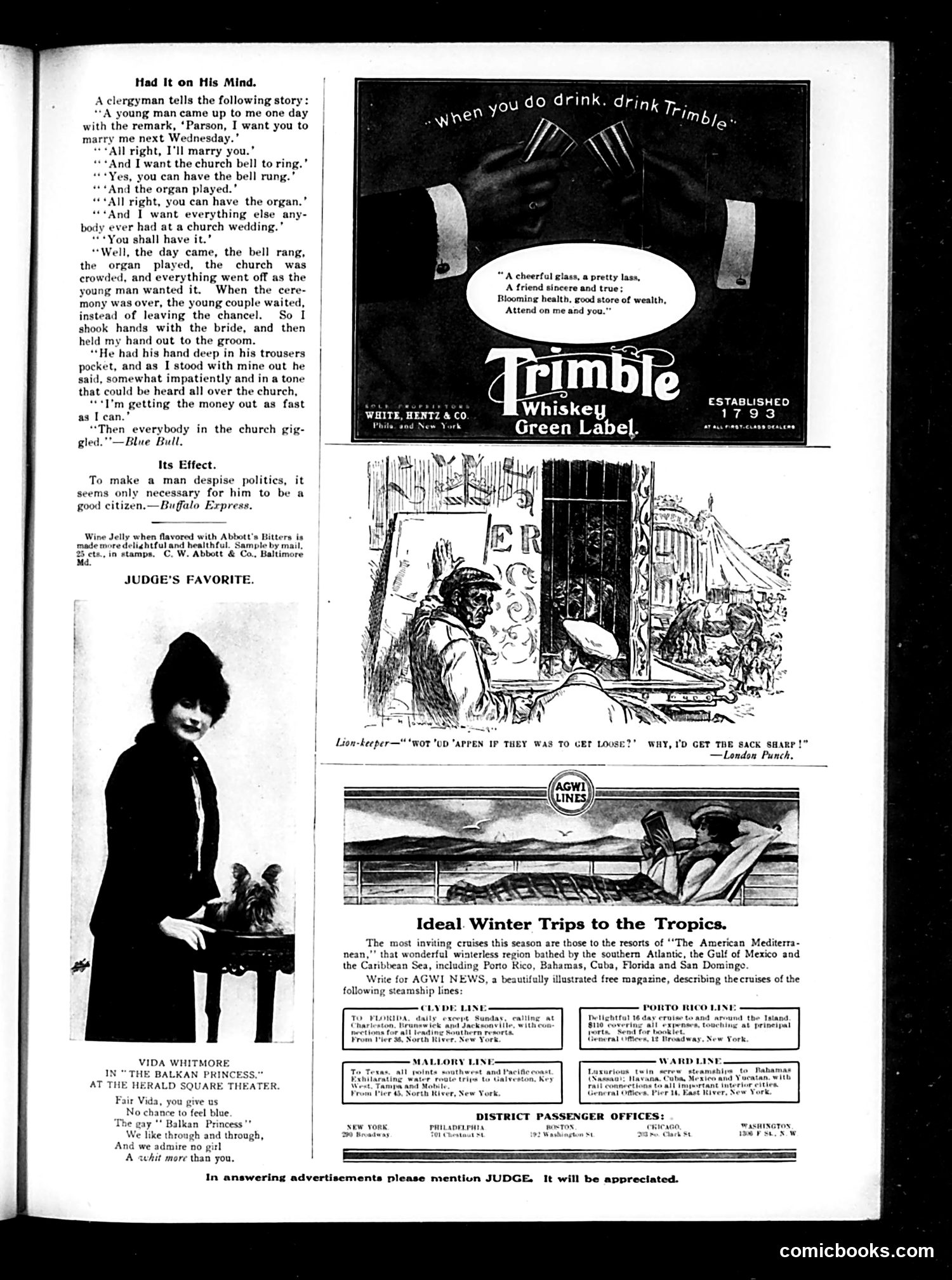
This page is primarily **advertising and entertainment content** rather than political satire. The main cartoon (middle-right) from *London Punch* shows a lion-keeper quip about getting animals "loose" versus "back sharp"—a visual pun about zoo management, not political commentary. The **Trimble Whiskey advertisement** (top) uses a drinking toast as marketing copy, a common early 20th-century approach. The **"Judge's Favorite"** section features an actress in "The Balkan Princess" theatrical production—entertainment promotion. The **AGWI Lines cruise advertisements** promote tropical winter vacations to Caribbean destinations via various steamship companies. The page reflects *Judge* magazine's mix of light humor, theatrical promotion, and commercial advertising typical of this era, rather than the sharp political satire the magazine was known for.
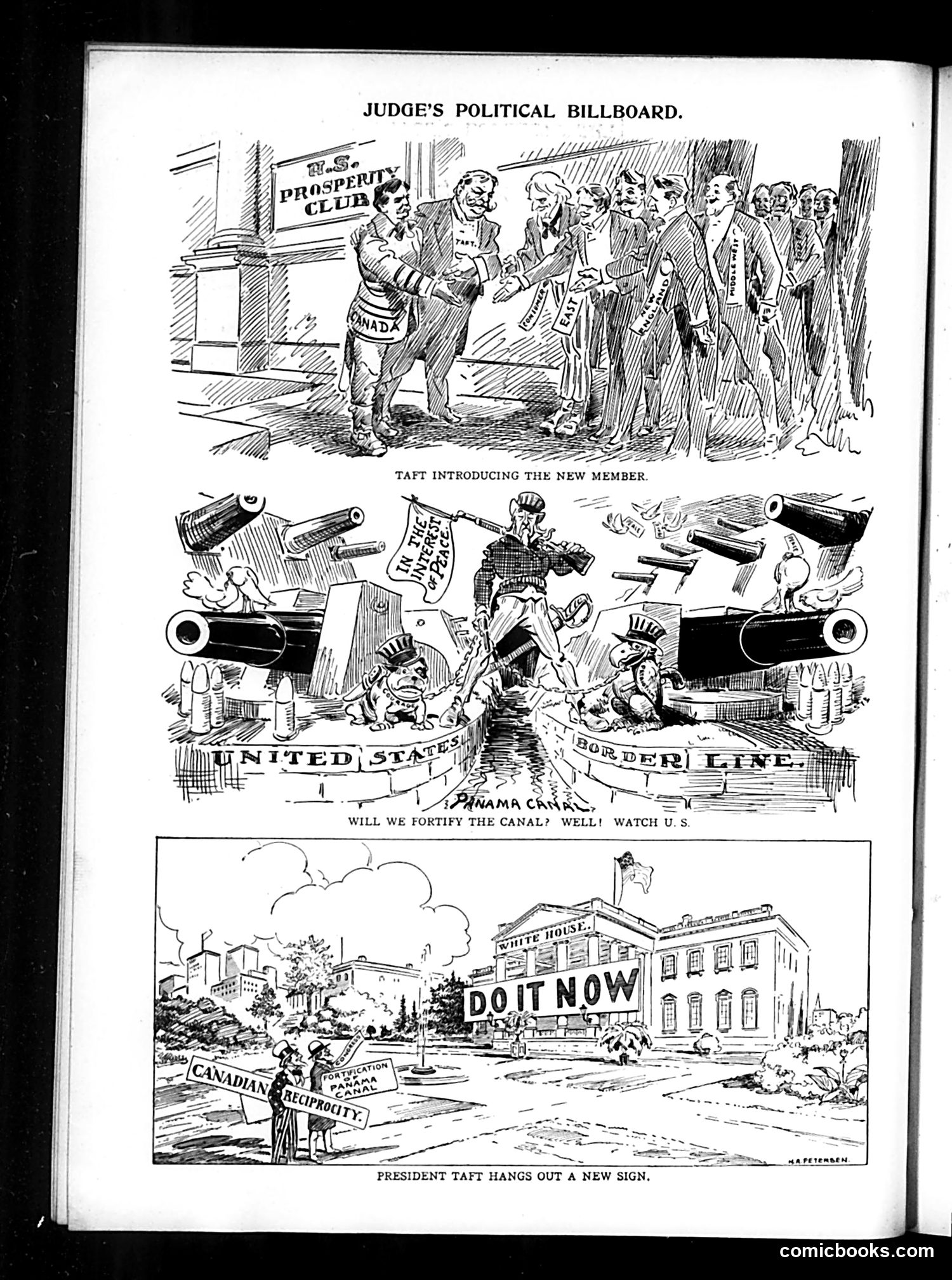
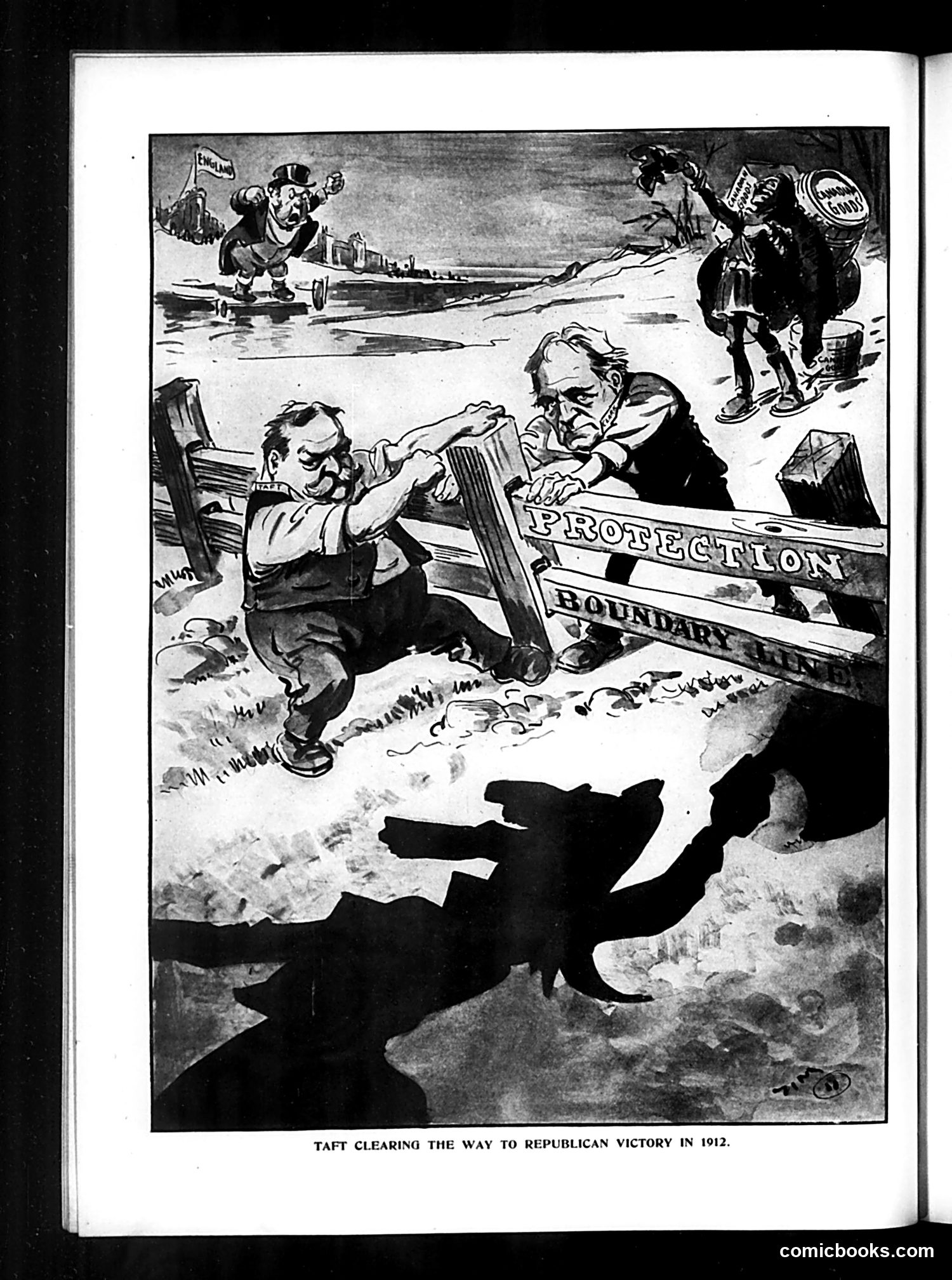
This page satirizes President William Howard Taft's political positions, particularly regarding trade policy and canal fortification. **Top cartoon** ("Taft Introducing the New Member"): Shows Taft presenting a figure labeled "Canada" to a "Prosperity Club," suggesting his promotion of Canadian reciprocal trade agreements. **Middle cartoon** ("Will We Fortify the Canal?"): Depicts military fortifications along the Panama Canal at the U.S.-border line, with Taft appearing uncertain. The satire questions whether Taft will adequately defend American interests in the canal zone. **Bottom cartoon** ("President Taft Hangs Out a New Sign"): Shows the White House with a "DO IT NOW" sign, while Canadian reciprocity agreements remain posted, suggesting Taft's contradictory or delayed policy implementation on trade and defense matters.
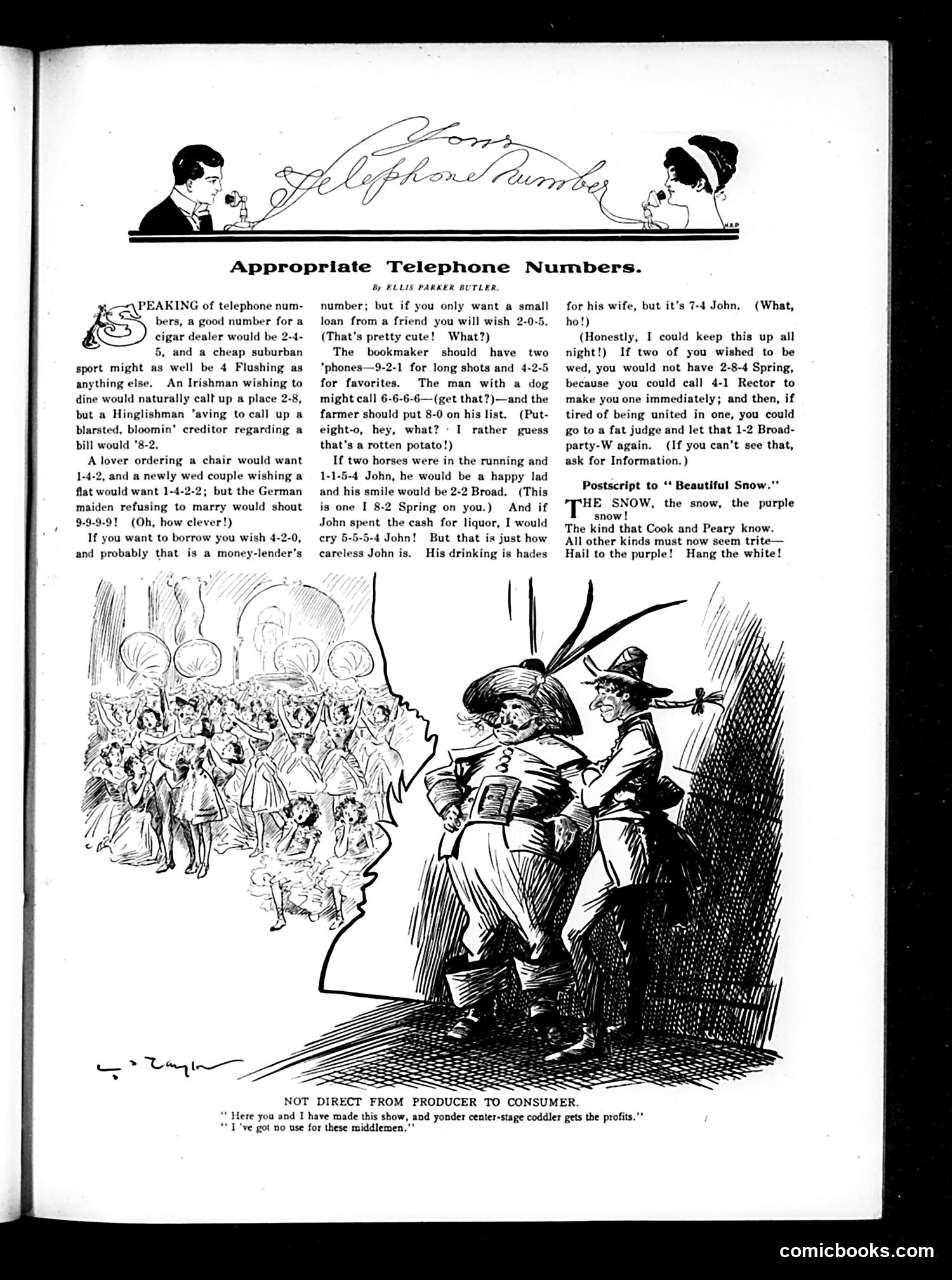
This satirical article by Ellis Parker Butler humorously assigns telephone numbers to various professions and situations based on wordplay and puns. For example: a cigar dealer gets 2-4-6 (matching "a cheap suburban sport"), a bookmaker needs 9-2-1, and a farmer should have 8-0 on his list. The accompanying cartoon critiques middlemen and profiteers in supply chains. It depicts what appears to be theatrical producers or distributors extracting profits from entertainment. The caption states: "NOT DIRECT FROM PRODUCER TO CONSUMER... Here you and I have made this show, and powder center-stage coddler gets the profits." The satire targets excessive intermediaries marking up prices between creators and consumers—a recurring economic complaint of the era.
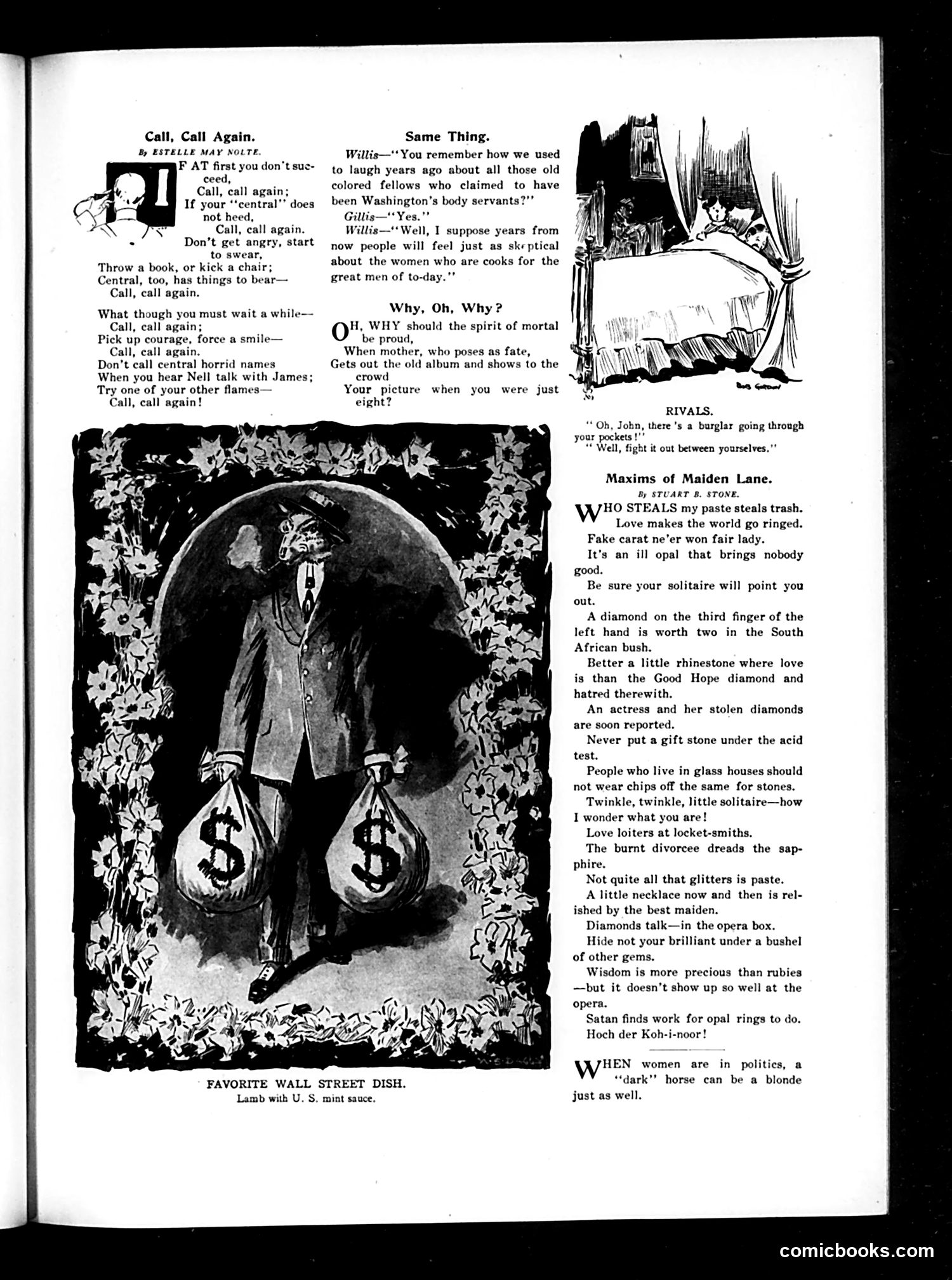
This Judge magazine page contains several satirical pieces mocking early 1900s American society: **"Call, Call Again"** satirizes the frustration of using early telephone switchboard operators ("Central"), who frequently misconnected calls or transferred callers to wrong parties—a common complaint of the era. **"Favorite Wall Street Dish"** is a political cartoon depicting a wealthy financier whose pockets are literally money bags labeled "$"—satirizing Wall Street greed and the concentration of wealth among the ultra-rich. **"Maxims of Maiden Lane"** (a jewelry district) mocks the materialism of women seeking wealthy husbands, using diamond-related puns. It suggests women value jewelry and status over genuine love, while also critiquing divorce and social climbing. **"Same Thing"** jokes that future generations will be skeptical of women claiming to cook for famous men—just as people doubted former enslaved men's claims of serving George Washington. The overall theme: satirizing American materialism, technological frustrations, and class pretension.
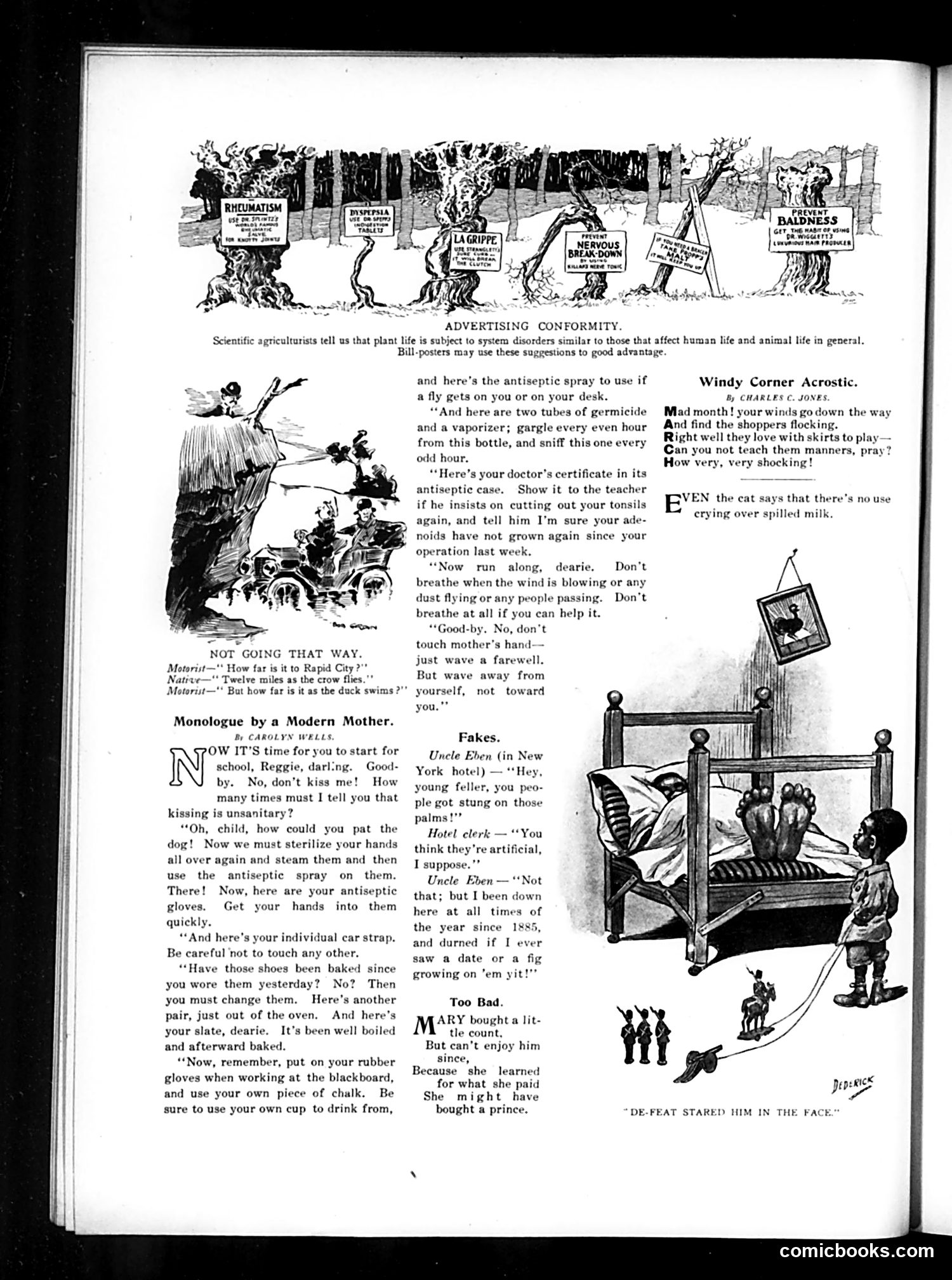
This page satirizes early-20th-century obsessions with hygiene and germ theory. The top section mocks exaggerated antiseptic parenting through a "Modern Mother's Monologue," where a neurotic parent treats her child's daily activities as contamination hazards—sterilizing hands, providing individual car straps, using germicide sprays, even baking shoes in an oven. The satire targets how contemporary scientific discoveries about germs were being taken to absurd extremes by anxious middle-class families. The smaller cartoons and verses provide social humor: "Not Going That Way" plays on rural dialect confusion; "Fakes" mocks artificial palm trees in New York hotels; "Too Bad" jokes about a woman who bought a fake count (nobleman) cheaply; and "Windy Corner Acrostic" observes women's skirts being blown about in wind. The top banner parodies product advertisements for dubious patent medicines and tonics—common Judge targets. The overall message: modern science, while valuable, was being weaponized by marketers and anxious consumers into ridiculous overcorrections.
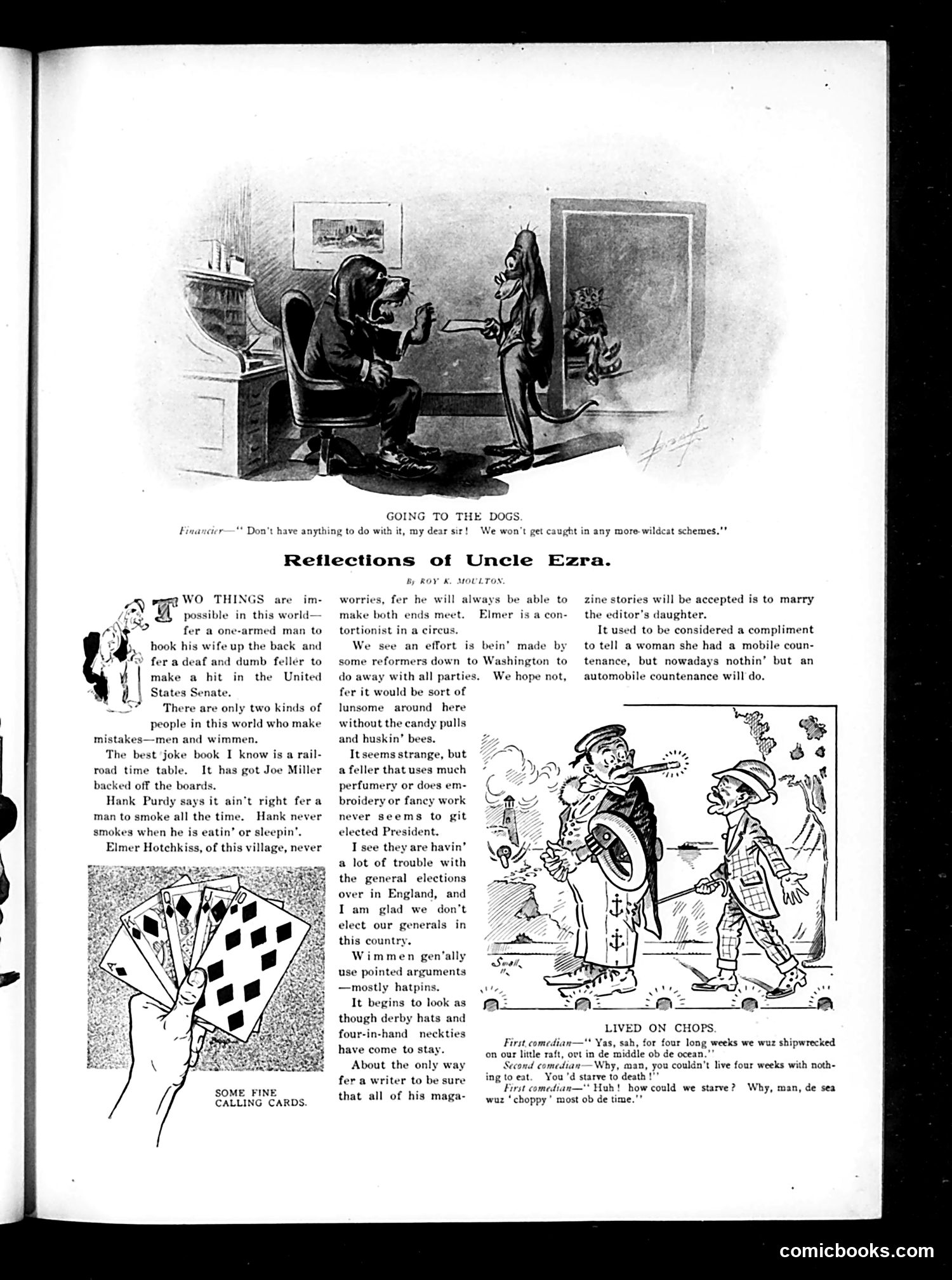
**Top Cartoon ("Going to the Dogs"):** A businessman refuses involvement in a scheme, fearing another "wildcat" venture—likely referencing failed or fraudulent business schemes common in the era. The dog characters suggest the phrase "going to the dogs" (deteriorating). **"Reflections of Uncle Ezra":** A folksy humor column by Roy Moulton featuring rural aphorisms and observations. Notable references include: - Criticism of Senate incompetence - Jabs at reformers trying to eliminate political parties - Commentary on recent English general elections - Satirical observations about presidential candidates who use perfume or do embroidery (coded as "unmanly") - Mockery of women's weapon of choice: hatpins **"Lived on Chops":** A vaudeville-style joke setup where two comedians debate survival on a shipwrecked raft. The punchline relies on a pun: "choppy" (rough seas) sounds like "chops" (food), suggesting they ate the sea itself—absurdist humor typical of early 20th-century comedy.
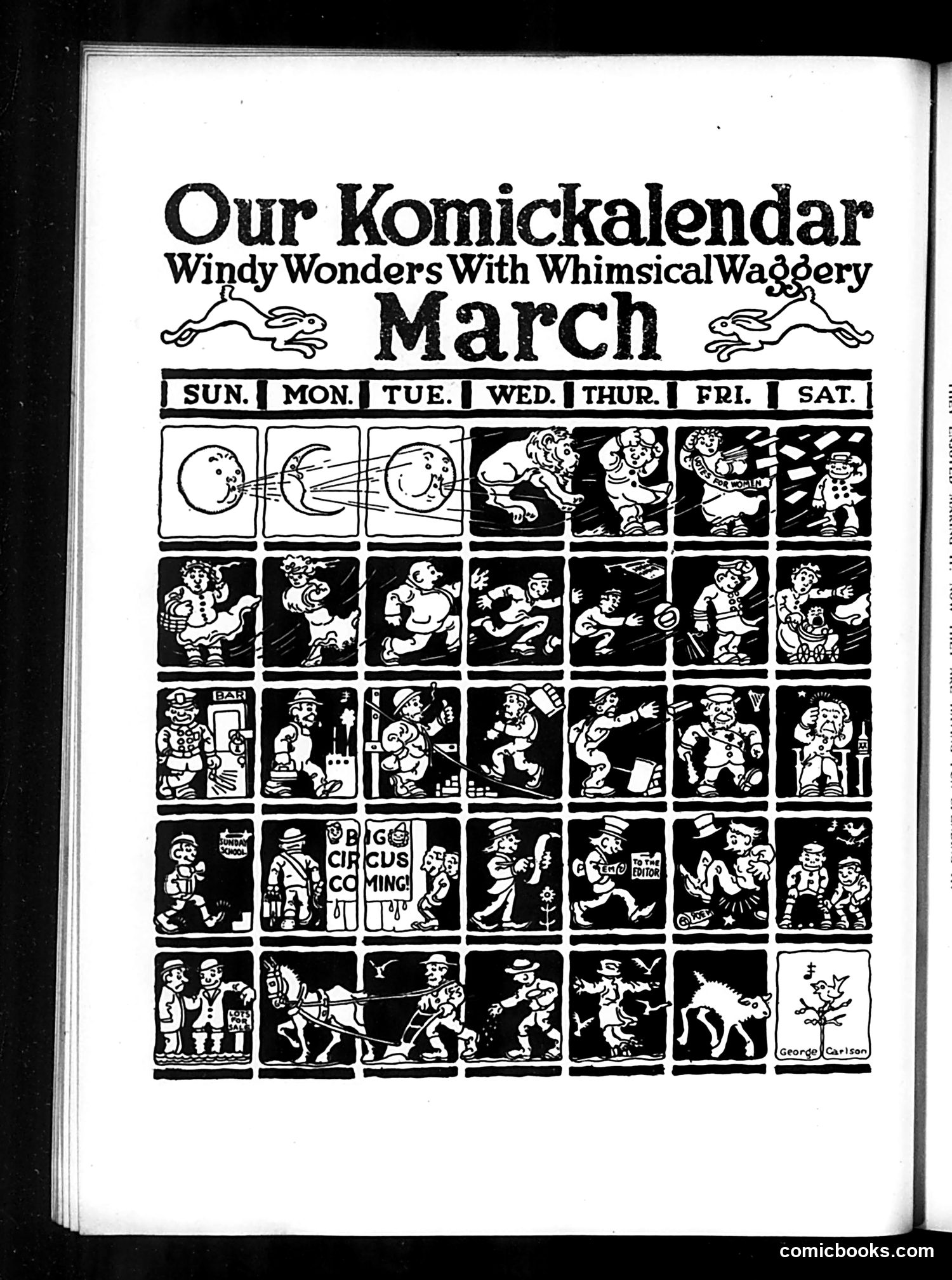
This is a March calendar page from Judge magazine featuring "Our Komickalendar: Windy Wonders With Whimsical Waggery." The page displays a grid of small comic panels—one for each day—rendered in black and white with exaggerated, cartoonish figures engaged in various comedic situations: characters falling, fighting, celebrating, performing tricks, and interacting in slapstick scenarios. The title suggests these are gag comics related to "March winds" (a seasonal reference). The style is typical of early-to-mid 20th century American comic humor—physical comedy and absurdist situations without requiring narrative continuity. One panel is credited to "George Carlson," a known cartoonist. The calendar format was a common Judge feature combining topical humor with practical utility.
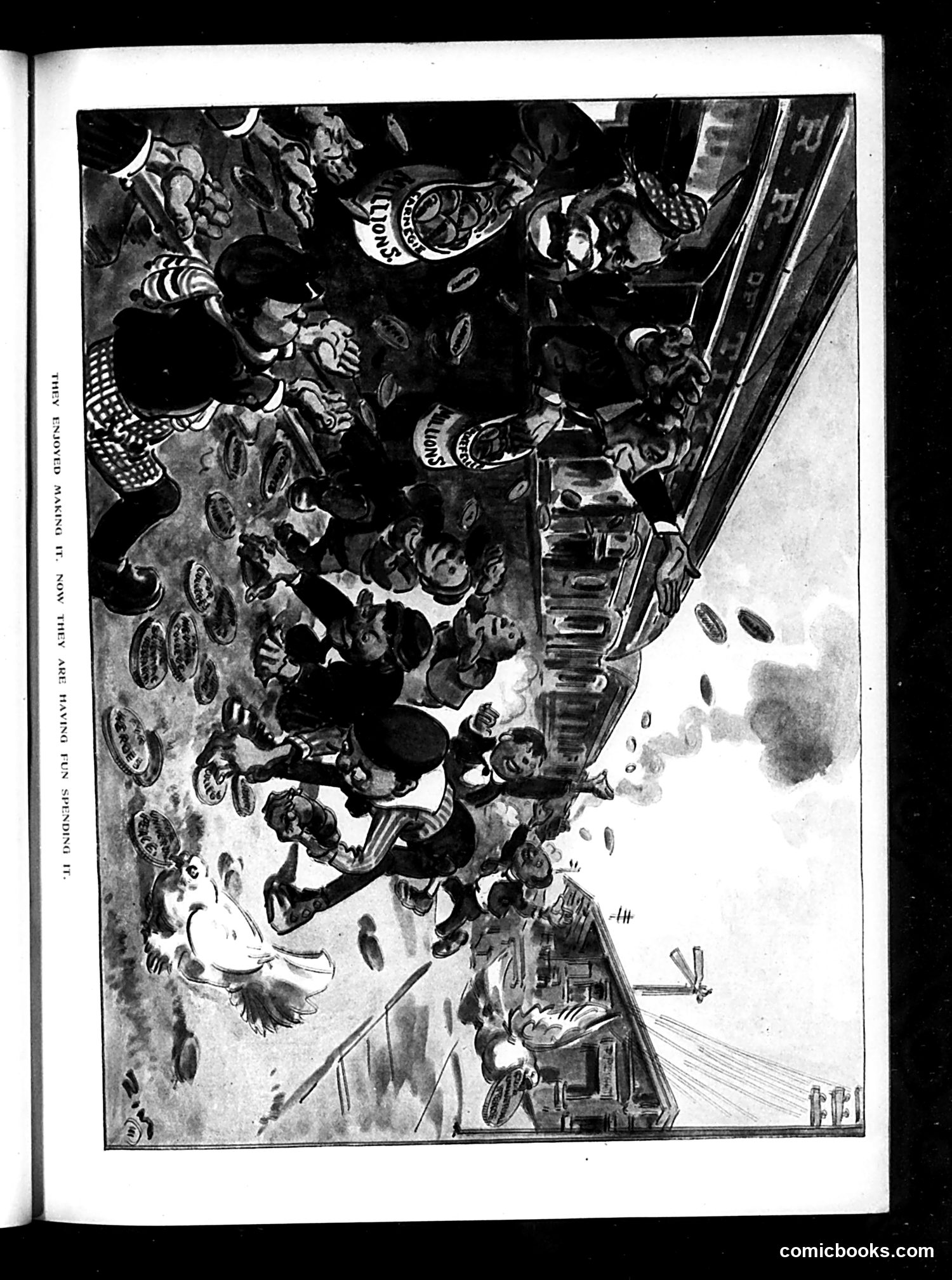
I can see this is a black and white cartoon from *Judge* magazine, but the image is rotated 90 degrees, making it difficult to read details with certainty. The scene appears to show multiple figures gathered indoors, with ornate decorative elements visible on the walls. There are caricatured faces suggesting this is political or social satire typical of *Judge*'s style. However, without being able to clearly read the accompanying text or identify specific figures due to the rotation and image quality, I cannot confidently identify who the subjects are or what specific political/social commentary is intended. To accurately explain the satire's meaning to a modern reader, I would need either a correctly-oriented image or clearer visibility of identifying labels or captions.
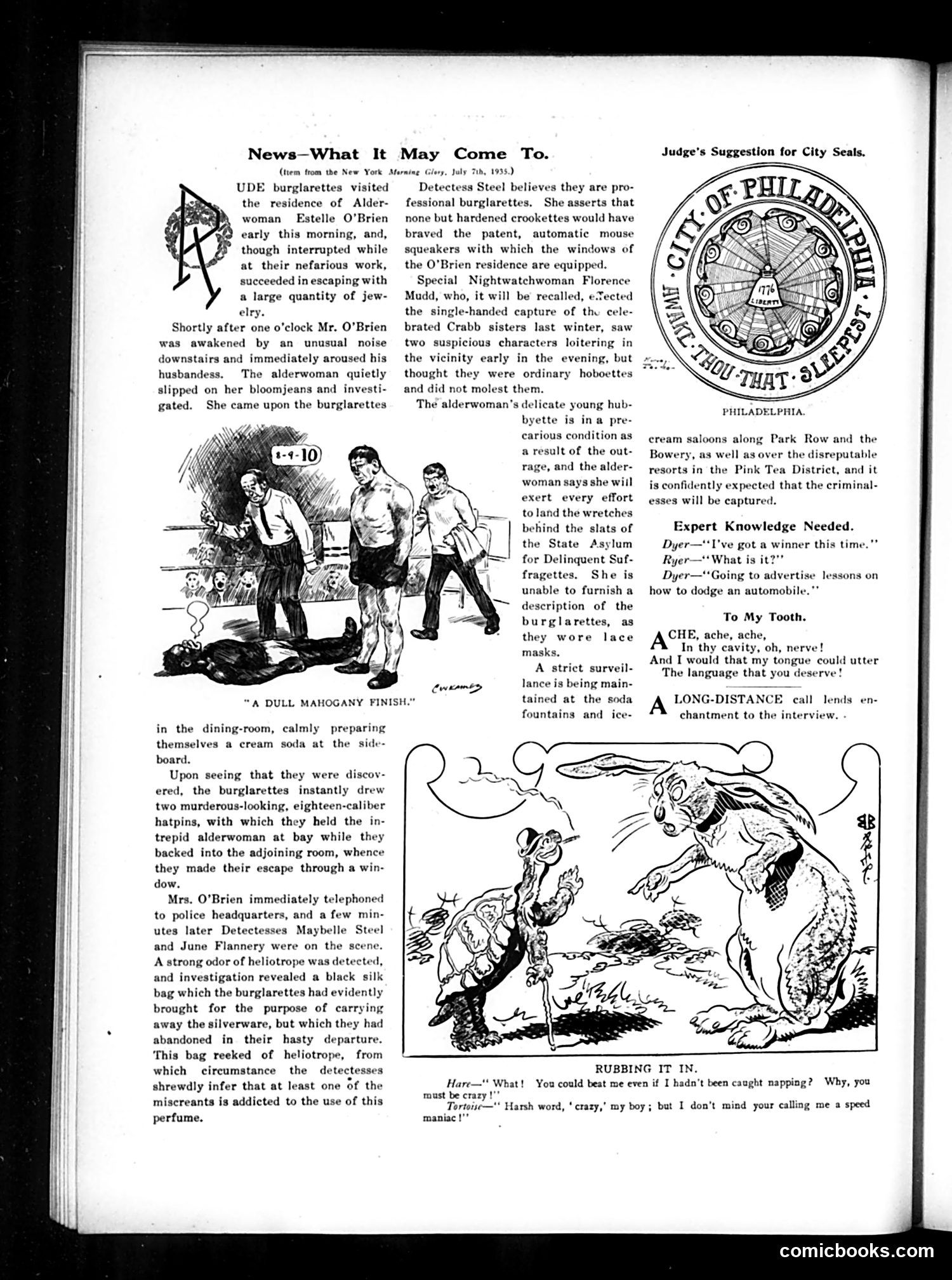
This 1913 piece satirizes women's suffrage through absurdist humor. The article imagines a future where women hold official positions ("Alderwoman," "Detectess," "Nightwatchwoman") and commit crimes as "burglarettes" and "suffragettes"—using feminized "-ette" suffixes to mock the concept. The satire works by treating this scenario seriously: female burglars threaten an alderwoman with hatpins, female detectives investigate using perfume clues, and a "State Asylum for Delinquent Suffragettes" exists. The joke assumes readers will find women in law enforcement or positions of authority inherently ridiculous. The cartoon "A Dull Mahogany Finish" depicts the burglary scene, while other pages show unrelated humor about dodging automobiles and a tortoise-vs.-hare race. This reflects pre-suffrage anxieties (the 19th Amendment passed in 1920) about women's expanding social roles—Judge magazine used exaggeration to mock progressive women's rights advocates.
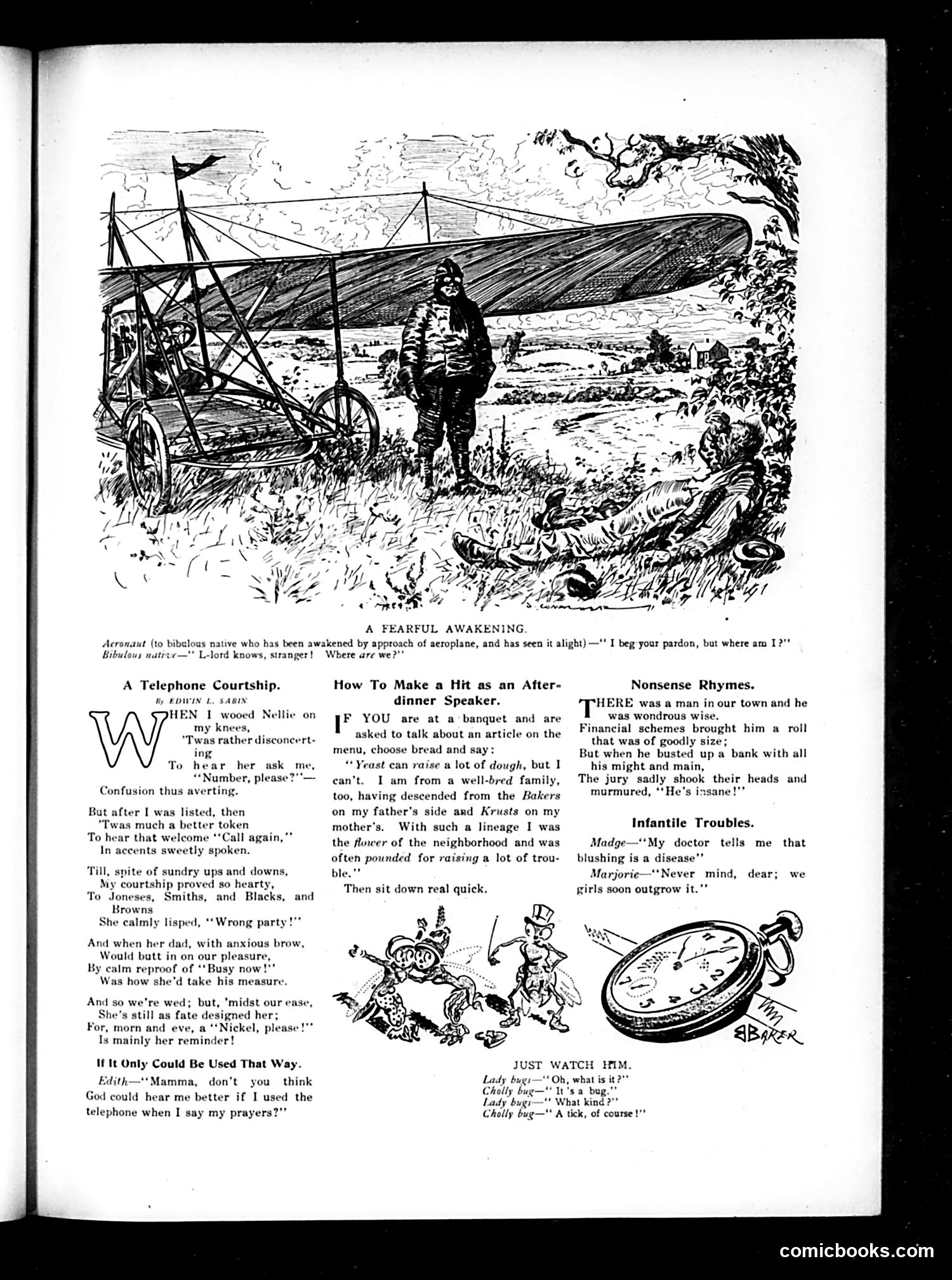
The large cartoon at top depicts an early aviator who has crash-landed his primitive aircraft. A bewildered local man, described as "bibulous" (drunk), awakens to find this strange contraption nearby and asks the pilot where he is—a comedic role reversal where the aeronaut (pilot) is equally disoriented by the native's confusion. This satirizes the novelty and shock of early aviation (circa 1910s). To rural or unsophisticated observers, airplanes were incomprehensible technological marvels that literally fell from the sky. The joke plays on mutual bewilderment: neither man understands what's happened or where they are. The remainder of the page contains humorous poems and quips about telephones, courtship, after-dinner speaking, and children's observations—standard light comedic fare. The "Nonsense Rhymes" section satirizes a wealthy banker's insanity plea following financial collapse, questioning whether genuine mental illness or mere self-interest drove his legal defense.
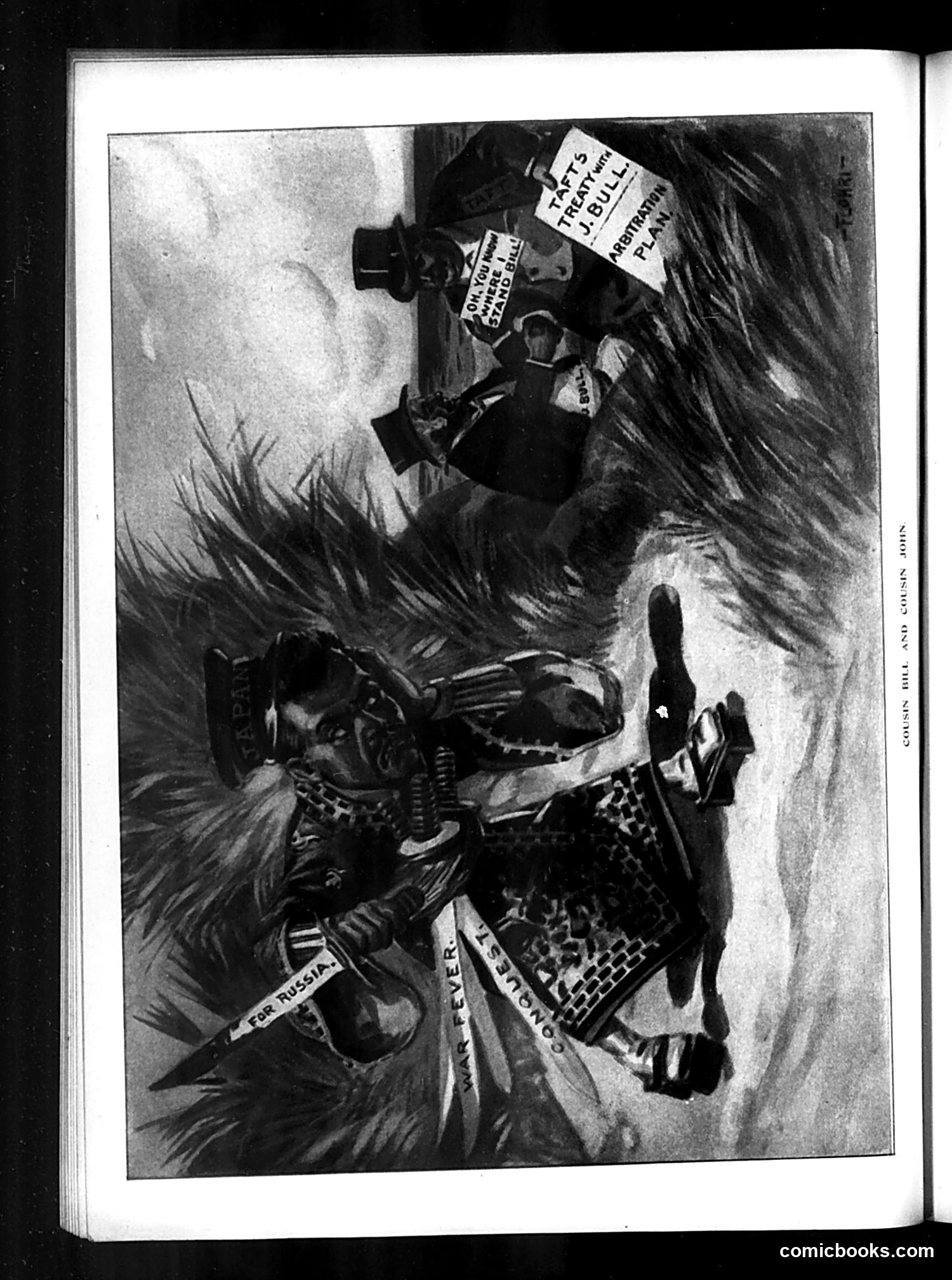
This appears to be a satirical cartoon from *Judge* magazine, though the OCR text is largely illegible, making precise interpretation difficult. The image shows figures in what appears to be a dramatic, chaotic scene with exaggerated expressions and gestures. Visible text labels on signs/banners include references to "Russia" and what appear to be political slogans, suggesting Cold War-era or early 20th-century political commentary. The artistic style—featuring caricatured figures, dynamic action, and propaganda-style labeling—is consistent with *Judge's* tradition of political satire. However, without clearer OCR text or additional context, I cannot definitively identify the specific figures, historical event, or satirical point being made. The page's orientation and image quality further complicate detailed analysis.
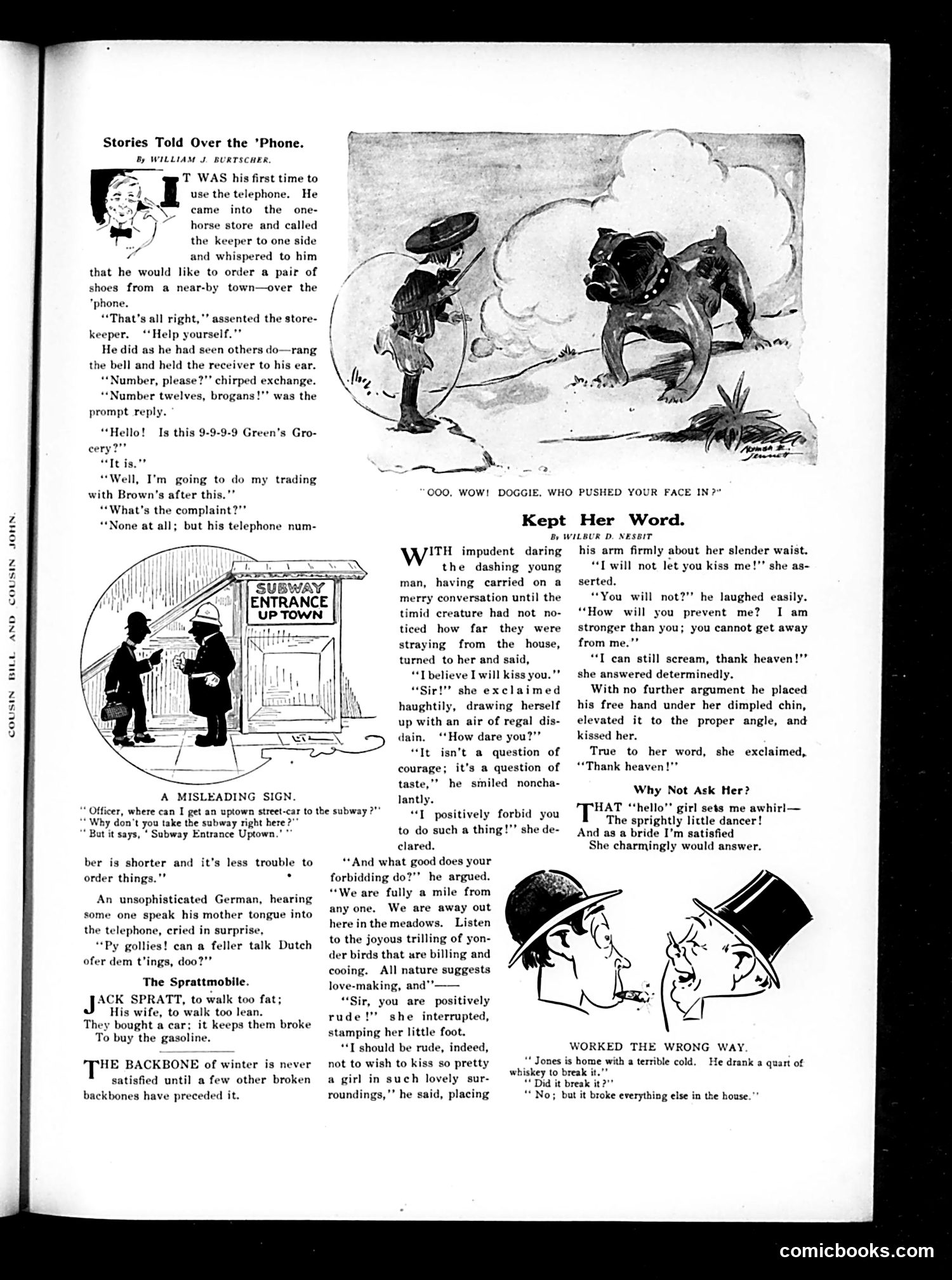
This page from Judge magazine contains several short humorous pieces satirizing early telephone use and dating customs: **"Stories Told Over the Phone"** mocks rural unsophistication—a man orders shoes by calling a grocery store's number instead of a shoe store, then switches vendors simply because the wrong number has fewer digits. A German immigrant expresses amazement that Dutch can be spoken over a telephone. **"A Misleading Sign"** plays on confusion about the new subway system—a pedestrian misreads "Subway Entrance Uptown" and asks a cop where to find the uptown entrance, not understanding the sign indicates direction. **"Kept Her Word"** is a flirtation story where a young man tries to kiss a woman in a meadow. She declares "I will not let you kiss me!" but then screams—fulfilling her word literally by screaming rather than by physically resisting. These pieces reflect early-20th-century anxieties about new technology and changing social conventions, using dialect humor and wordplay typical of the era's comedy.
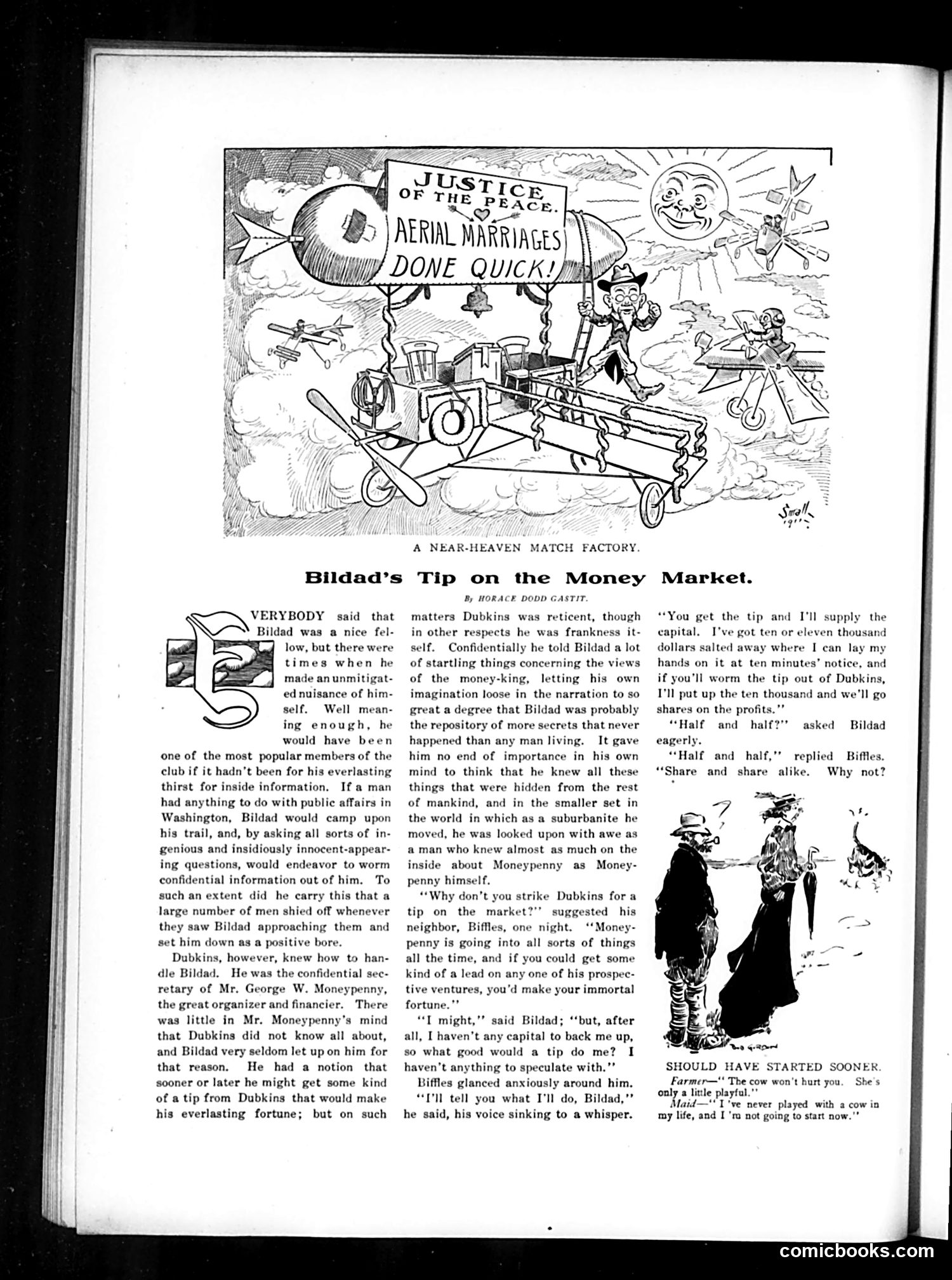
This satirical story mocks the obsessive pursuit of insider trading tips and financial speculation among American businessmen. Bildad is a social climber who relentlessly pesters government and business figures for confidential market information, hoping to parlay secrets into sudden wealth. His target is Dubkins, secretary to financier "George W. Moneypenny" (likely a generic wealthy magnate, though the name suggests possible reference to real financial figures of the era). The satire exposes the era's financial culture: Bildad gains social status merely by *appearing* to know secrets; Dubkins exploits this by fabricating information; and when Bildad finally finds a partner willing to provide capital, both men eagerly scheme together. The cartoon above depicts a chaotic "aerial marriages" factory—suggesting the frivolous, absurd nature of such get-rich-quick fantasies. The humor lies in depicting financial speculation as gossip-driven and fundamentally dishonest.
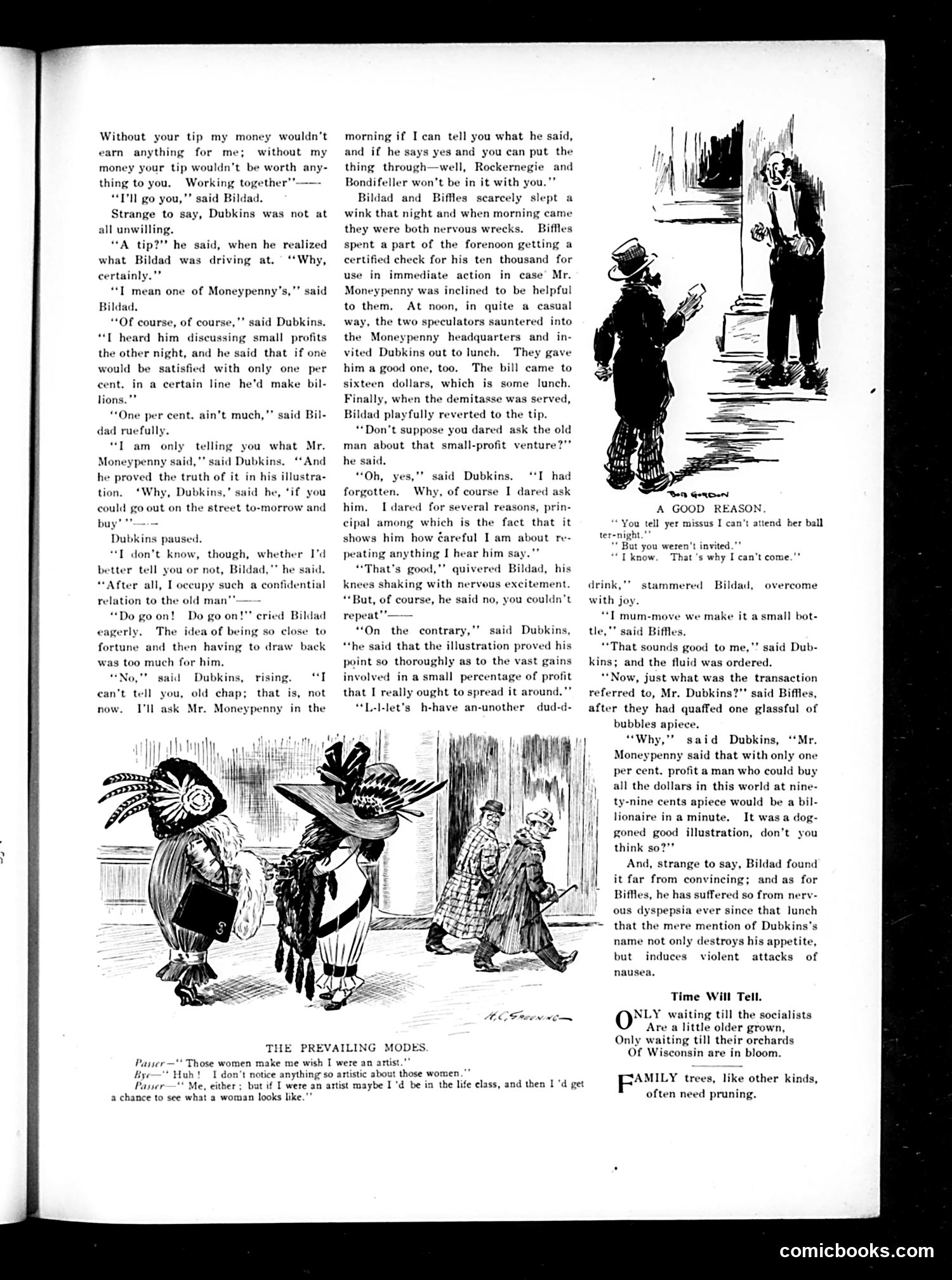
This page satirizes the get-rich-quick schemes and financial naiveté of the era. The main narrative concerns two speculators, Bildad and Biffles, who become obsessed with a "tip" from a wealthy financier named Moneypenny about making fortunes through tiny profit margins (one percent). The satire targets the gullible belief that millionaires possess secret formulas for wealth-building. Moneypenny's "illustration"—that buying all dollars in the world at 99 cents each would make one a billionaire—is mathematically absurd, yet the characters treat it as profound wisdom. The cartoon mocks both the speculators' desperation to access insider knowledge and their inability to recognize obvious nonsense. The secondary cartoon, "The Prevailing Modes," jokes about artistic pretension regarding women's fashion.
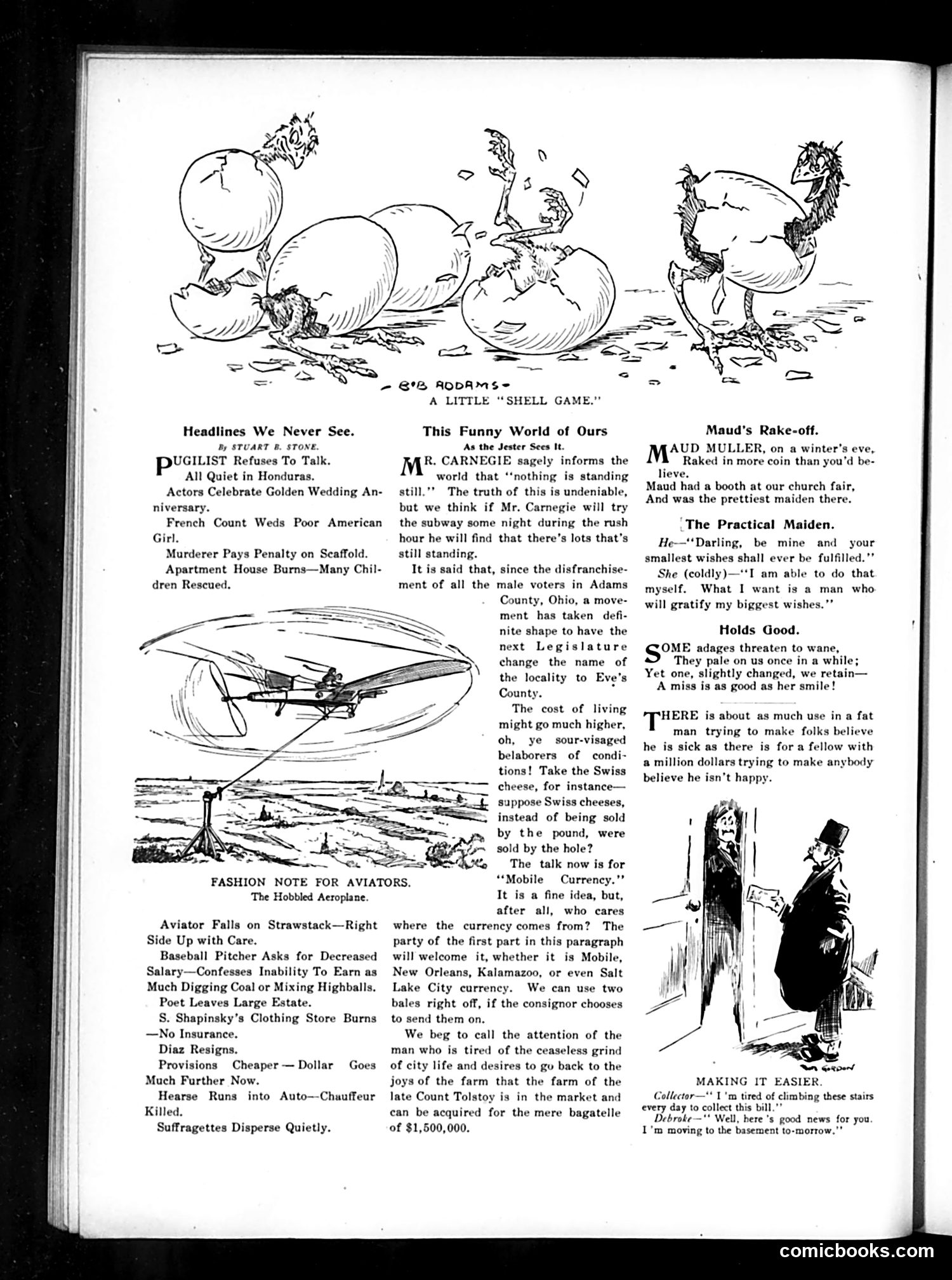
This page contains satirical humor typical of Judge magazine's style. The top section, "Headlines We Never See," lists absurd or unlikely newspaper headlines—a pugilist staying quiet, peasant uprisings being peaceful, a poet dying wealthy—mocking the sensational or predictable nature of actual news. The central cartoon, "A Little Shell Game," shows roosters with eggs, illustrating a column by "The Jester" discussing Andrew Carnegie's claim that nothing stands still. The satire uses everyday observations (crowded subways, Swiss cheese pricing) to mock social commentary. The page includes brief humor columns on various topics: a women's suffrage joke, a practical maiden who wants financial security rather than romance, and commentary on wealth and happiness. The bottom cartoon "Making It Easier" shows a debt collector and debtor joking about moving to the basement to make bill collection easier—dark humor about poverty. The advertisements mixed throughout reflect early 1900s concerns: aviators, real estate, and currency reform.
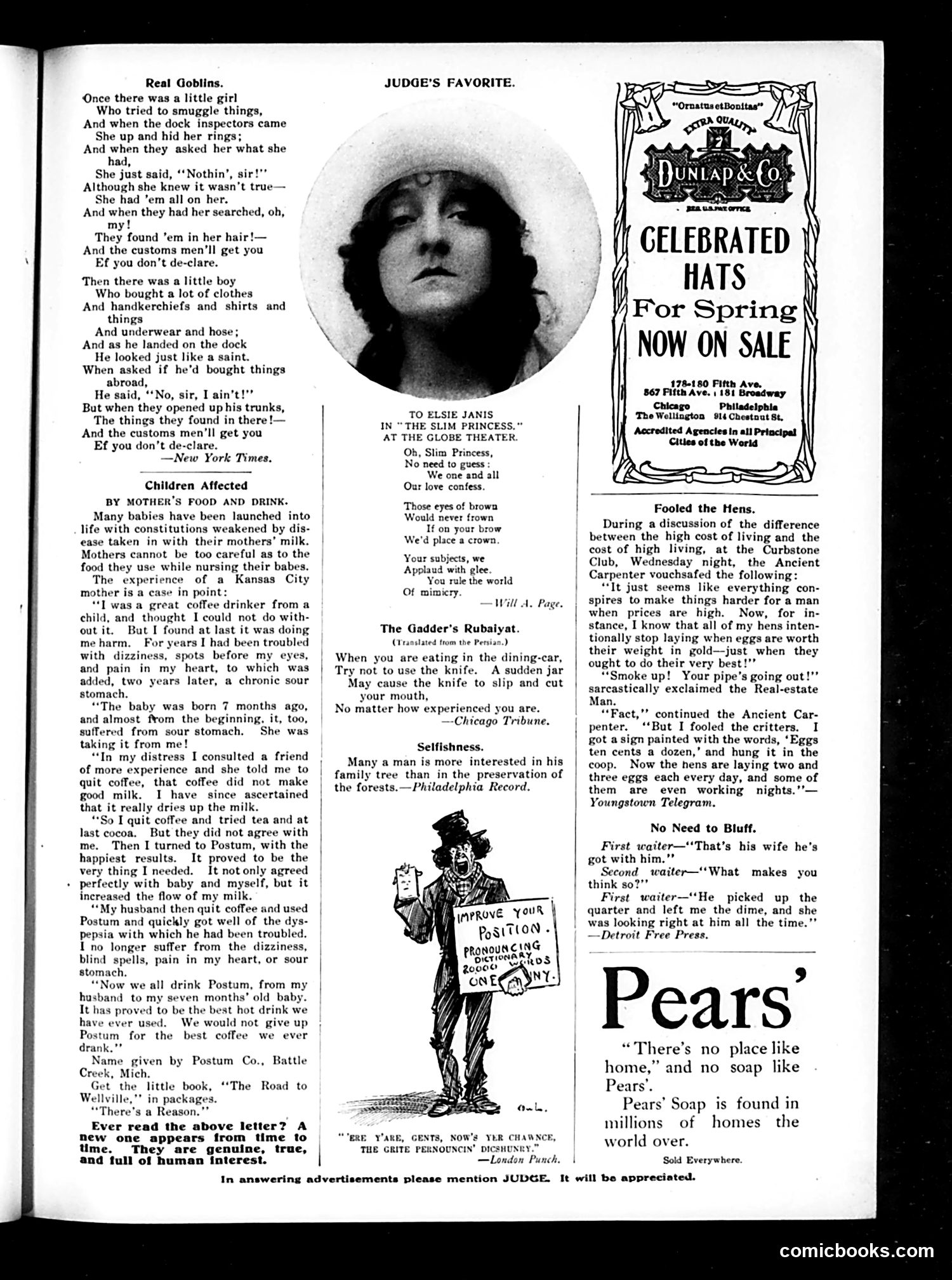
This page combines editorial content with advertising from an early 20th-century American satirical magazine. **"Real Goblins"** is a cautionary poem about customs enforcement, personifying customs inspectors as threatening figures ("goblins") who catch smugglers. Two children attempt to hide contraband goods—rings and clothing—through deception, but inspectors discover everything. The satire mocks people who think they can outsmart government authorities. **"Children Affected"** is a Postum advertisement disguised as health advice. It claims coffee damages nursing mothers' milk quality and causes infant stomach problems. The testimonial describes how switching to Postum (a caffeine-free grain beverage) cured the entire family's ailments. This reflects early 1900s advertising tactics: using pseudo-scientific health claims to sell products. **"Judge's Favorite"** is a tribute poem to actress Elsie Janis performing in "The Slim Princess" at the Globe Theater, praising her comedic talents. Other brief items include jokes and a **Dunlap & Co. hat advertisement**. The page primarily serves commercial purposes while maintaining Judge's satirical voice through the customs poem and health-product advertising.
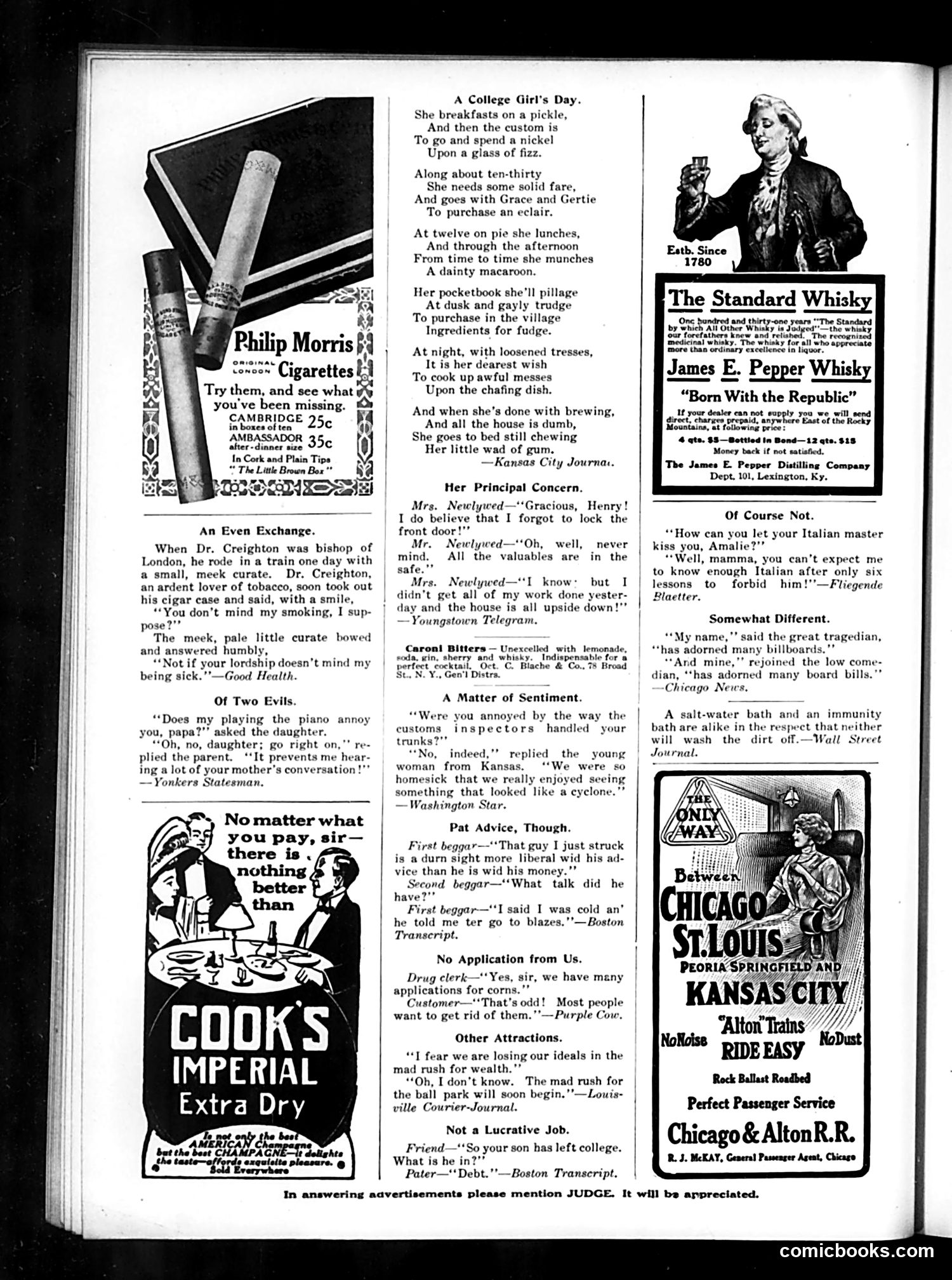
This page from Judge magazine (a satirical weekly) contains mostly **humorous anecdotes and advertisements** rather than political cartoons. The jokes target early 1900s social conventions and domestic life. "A College Girl's Day" satirizes young women's frivolous eating habits and obsession with sweets—snacking constantly on pickles, fudge, macaroons, and pie. "Of Two Evils" jokes about preferring a wife's piano-playing to her conversation. The "Newlywed" anecdote mocks a wife's concern about losing jewelry over unlocked doors. The advertisements reflect period consumer goods: cigarettes, whisky (heavily marketed), champagne, and railroad services. One ad features what appears to be a **gentleman in 18th-century dress** (labeled "Born 1789"), advertising James E. Pepper Whisky as authentically historic. The humor is genteel and domestic—reflecting Judge's audience of middle-to-upper-class readers—rather than overtly political. The satire targets gender roles, courtship conventions, and consumption habits typical of Edwardian America.
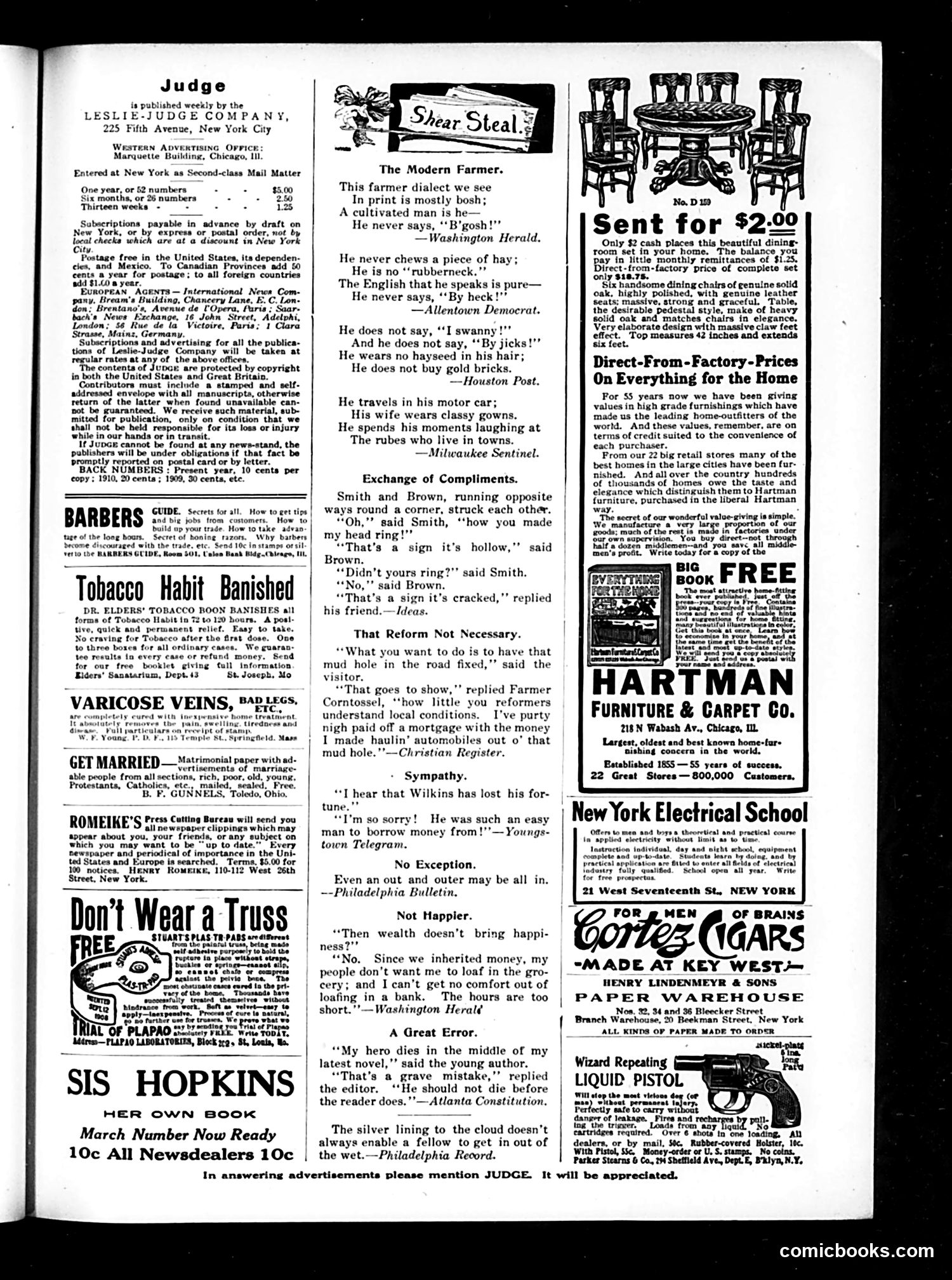
This page is primarily a **masthead and advertising section** of Judge magazine, a prominent American satirical weekly published in New York. The left column contains subscription and publication information. The small **"Shear Steal" section** at top center presents brief, humorous dialect poems mocking rural farmer speech. The satire argues that modern "cultivated" farmers actually speak proper English and *don't* use folksy expressions like "B'gosh," "By heck," or "I swanny." This reflects early 20th-century urban attitudes toward rural Americans—suggesting farmers were stereotyped as crude and illiterate, though the piece claims (ironically or sincerely) this stereotype was outdated. The remainder consists of **period advertisements** for tobacco cessation, marriage services, medical treatments (varicose veins), press clipping services, and other products typical of 1910s popular magazines. **The Sis Hopkins advertisement** promotes her comic strip/book available at newsstands for 10 cents.
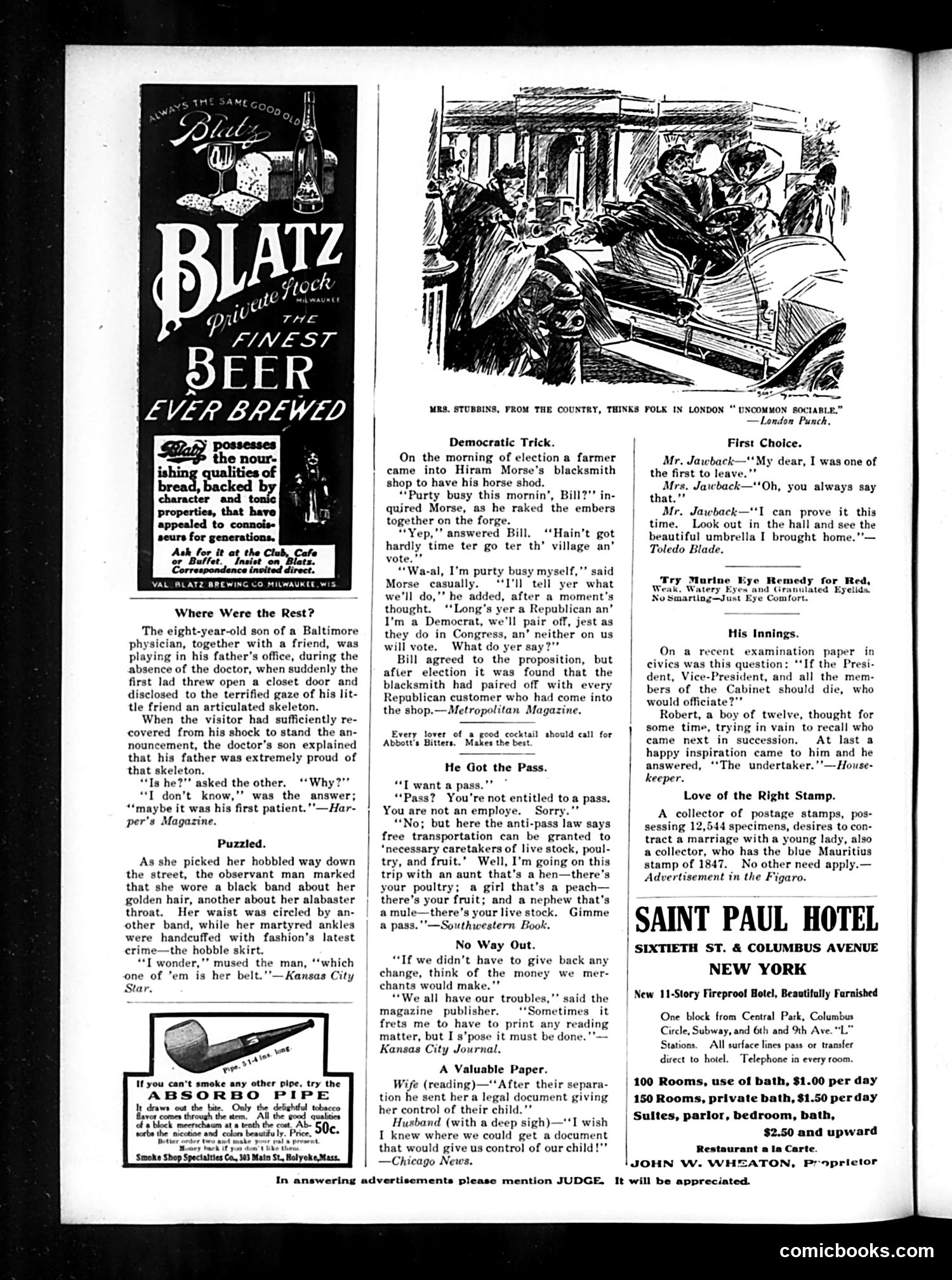
This page from Judge magazine (a major American satirical publication) contains several humorous vignettes rather than a single political cartoon. The notable piece is "Democratic Trick," which satirizes rural political cynicism. A blacksmith convinces a Republican farmer to mutually abstain from voting by claiming they'll "pair off" like congressmen. The trick: the blacksmith then pairs off with every Republican customer, ensuring only Democratic votes get cast. This mocks both Democratic manipulation tactics and voter gullibility in early 20th-century elections. Other jokes address fashion ("Puzzled," mocking women's fashionable hobble skirts), medical humor, and general social absurdities. The page is primarily filled with advertisements (Blatz Beer, pipes, the Saint Paul Hotel) and short joke submissions from various magazines. The humor reflects Progressive-era anxieties about election integrity and folk-level political dishonesty.
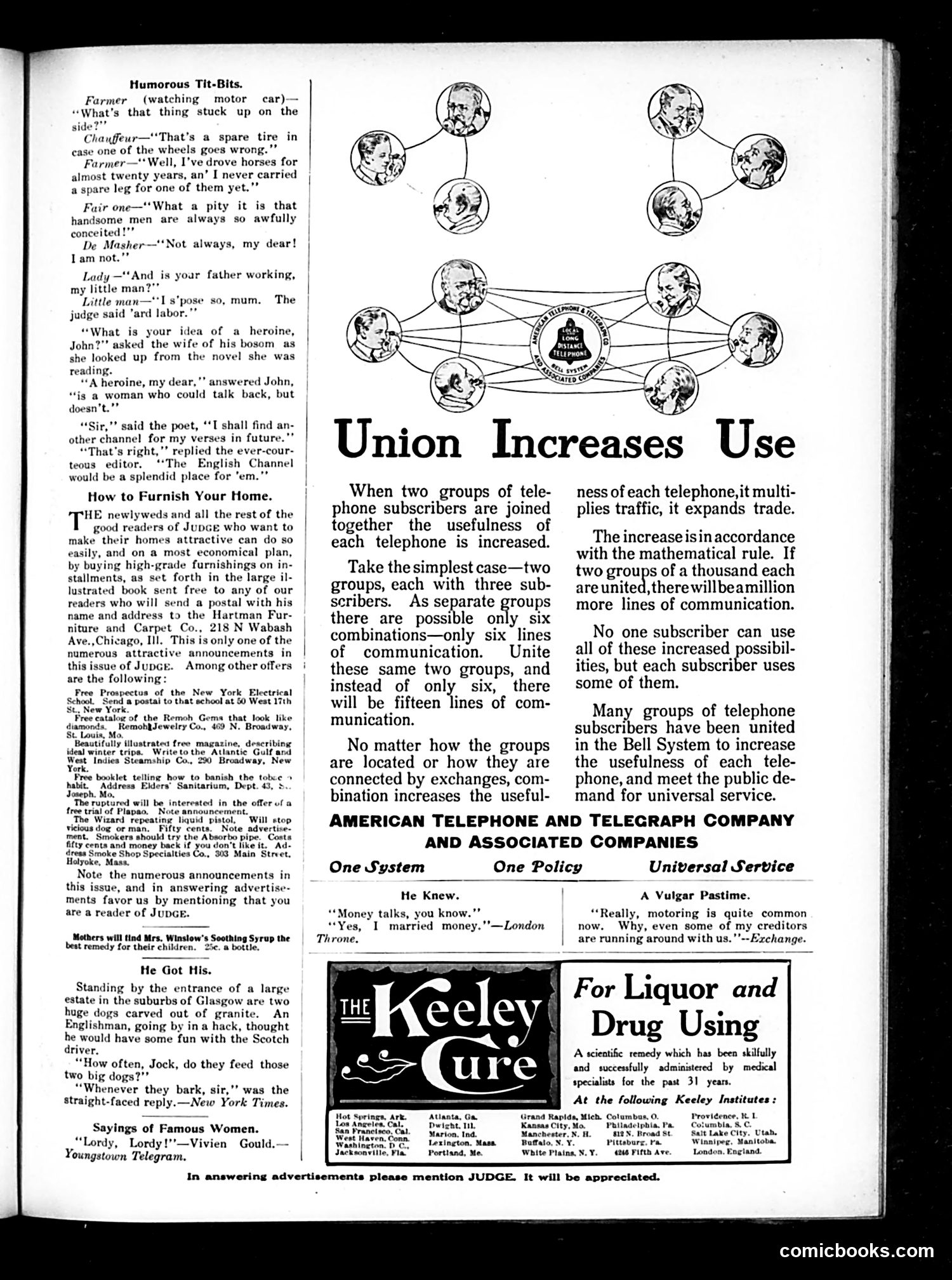
This page contains primarily **short humorous anecdotes** and **advertising** rather than political cartoons. The "Humorous Tit-Bits" section presents jokes about emerging automobile technology (farmers unfamiliar with spare tires), conceited men, children's misunderstandings of legal terms ("'ard labor" for "hard labor"), and domestic gender relations. These reflect early 20th-century social attitudes: bewilderment at new technology, vanity, working-class humor, and a joke about wives remaining silent. The **main visual content** is a **Bell Telephone System advertisement** featuring a diagram showing how connecting telephone networks exponentially increases communication possibilities—using mathematical principles to promote telephone service expansion as economically beneficial. The page also includes numerous **classified advertisements** for mail-order products (furniture catalogs, electrical schools, jewelry, sanitariums, etc.), reflecting Judge's business model of monetizing reader interest. The content reflects pre-WWI American culture: technological change, consumer capitalism, and traditional gender roles, with no apparent political satire on this particular page.
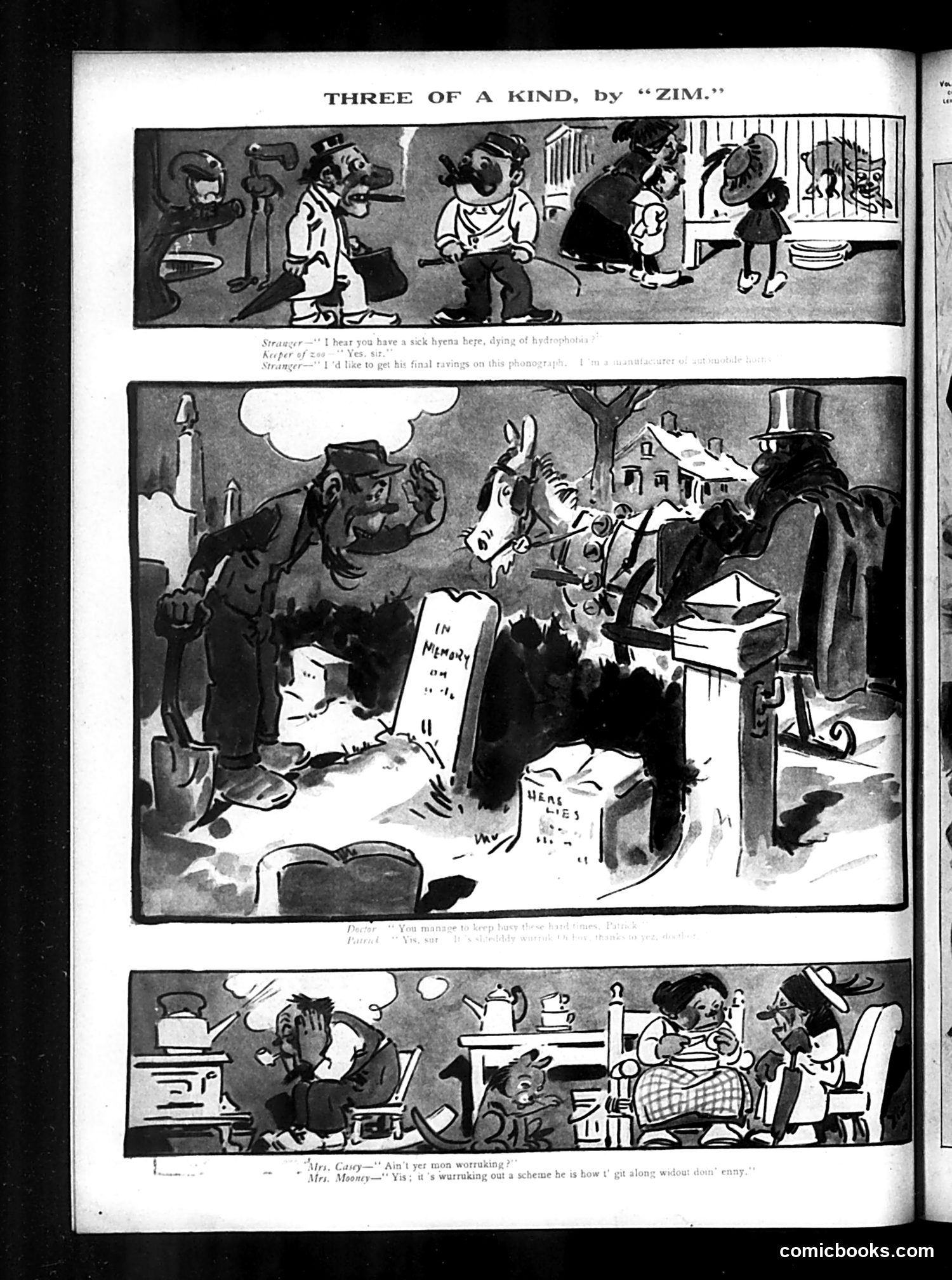
This three-panel comic satirizes three distinct social types through exaggerated caricature: **Panel 1** depicts a "Stranger" consulting with what appears to be a charlatan or quack doctor about a "sick hyena" suffering from "hydrophobia" — likely mocking both fraudulent medical practitioners and gullible clients. **Panel 2** shows a funeral scene where mourners gather at graves marked "In Memory" while a gentleman in a top hat conducts proceedings — seemingly satirizing excessive funeral pageantry or insincere mourning rituals. **Panel 3** returns to domestic life, with two women discussing a "worrying" scheme, apparently mocking housewives' gossip and their tendency to catastrophize minor domestic concerns. The overall title "Three of a Kind" suggests these represent three archetypal con artists, charlatans, or foolish types inhabiting American society.