
A complete issue · 24 pages · 1910
Judge — December 17, 1910
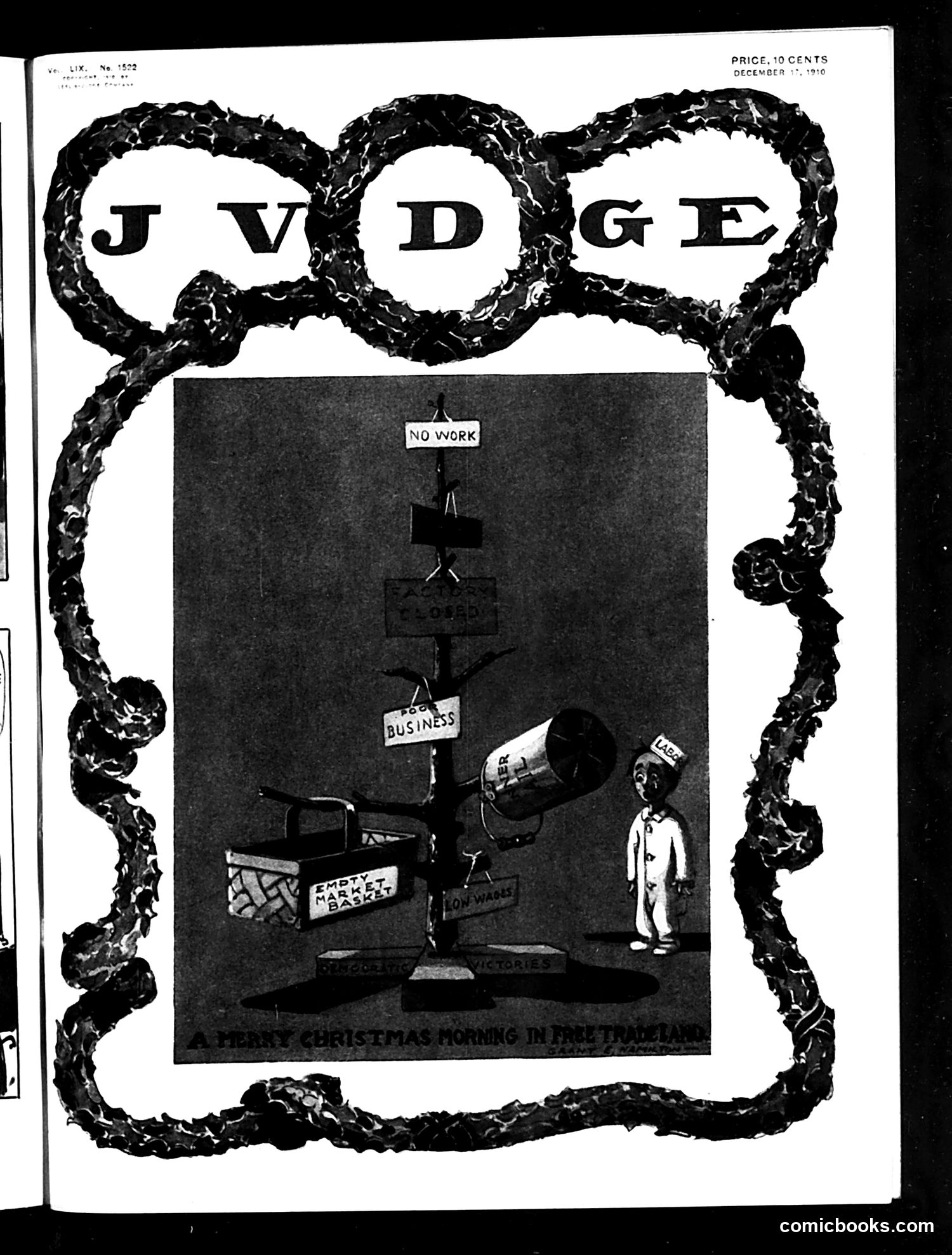
This Judge magazine cover (December 13, 1910) presents a satirical Christmas morning scene critiquing economic hardship. The central image shows a sparse, disappointing holiday: a small child receives minimal gifts while signs reading "NO WORK," "BUSINESS" (crossed out), and "HARD TIMES" dominate the scene. A megaphone labeled "LOW WAGES" amplifies the grim message. The "EMPTY MARKET BASKET" sits empty. The cartoon satirizes the contrast between Christmas's promise of joy and the economic reality of working-class families facing unemployment and poverty in early 1910s America. The decorative holly border frames this bleak domestic scene ironically, emphasizing how holiday cheer rang hollow for those struggling financially. The piece critiques economic inequality and labor conditions of the era.
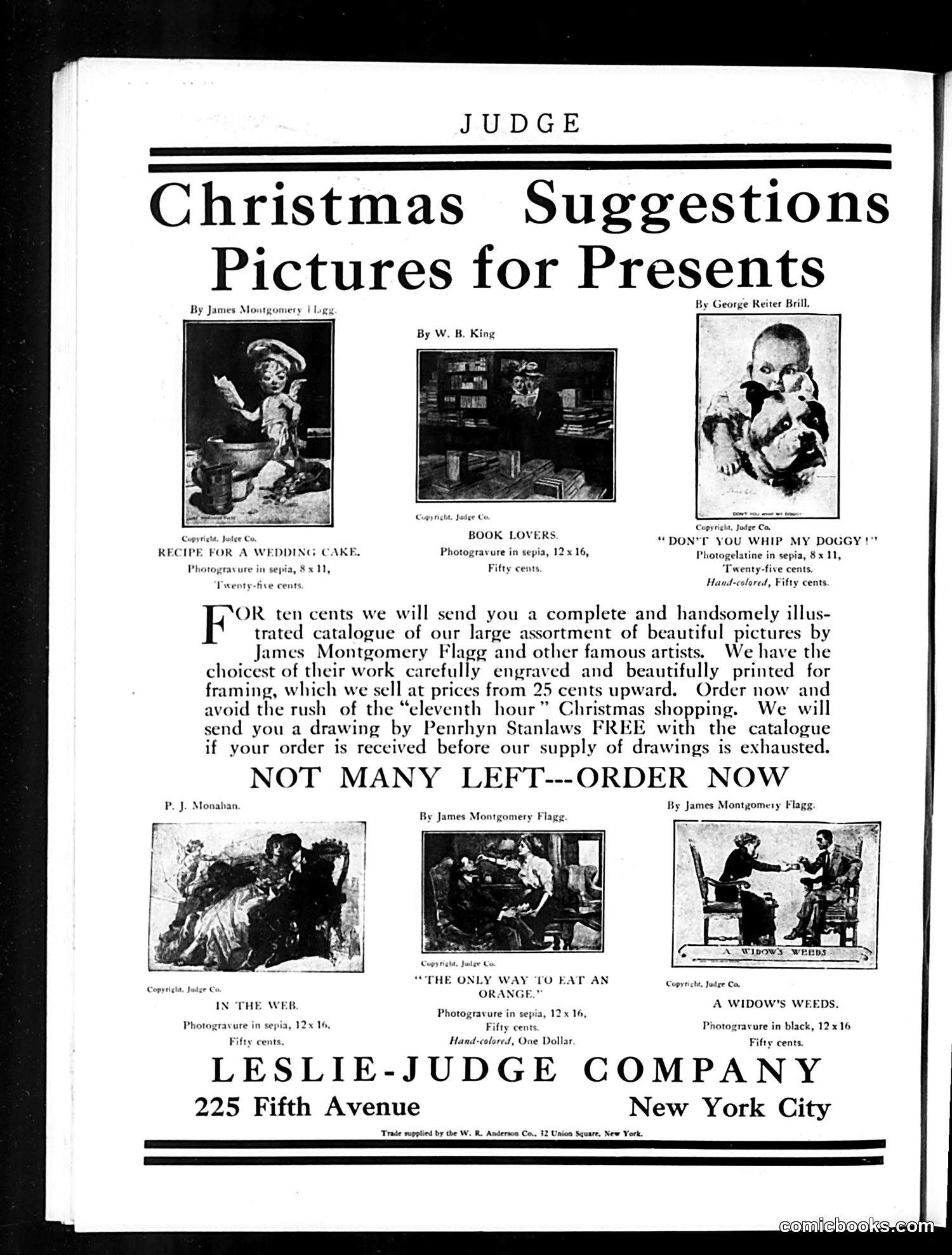
This is primarily a **Christmas gift advertisement** for the Leslie-Judge Company, not a political cartoon page. Judge magazine is selling framed pictures and photogravures by famous artists including James Montgomery Flagg and George Reiter Brill. The six featured images appear to be domestic genre scenes and humorous illustrations typical of early 20th-century popular art—including titles like "Recipe for a Wedding Cake," "Book Lovers," "Don't You Whip My Doggy!", "In the Web," "The Only Way to Eat an Orange," and "Widow's Weeds." The advertisement emphasizes affordable pricing (25 cents to one dollar) and promises a free drawing by Penrhyn Stanlaws with orders. The urgency ("Not Many Left—Order Now") is a standard retail sales tactic for holiday shopping.
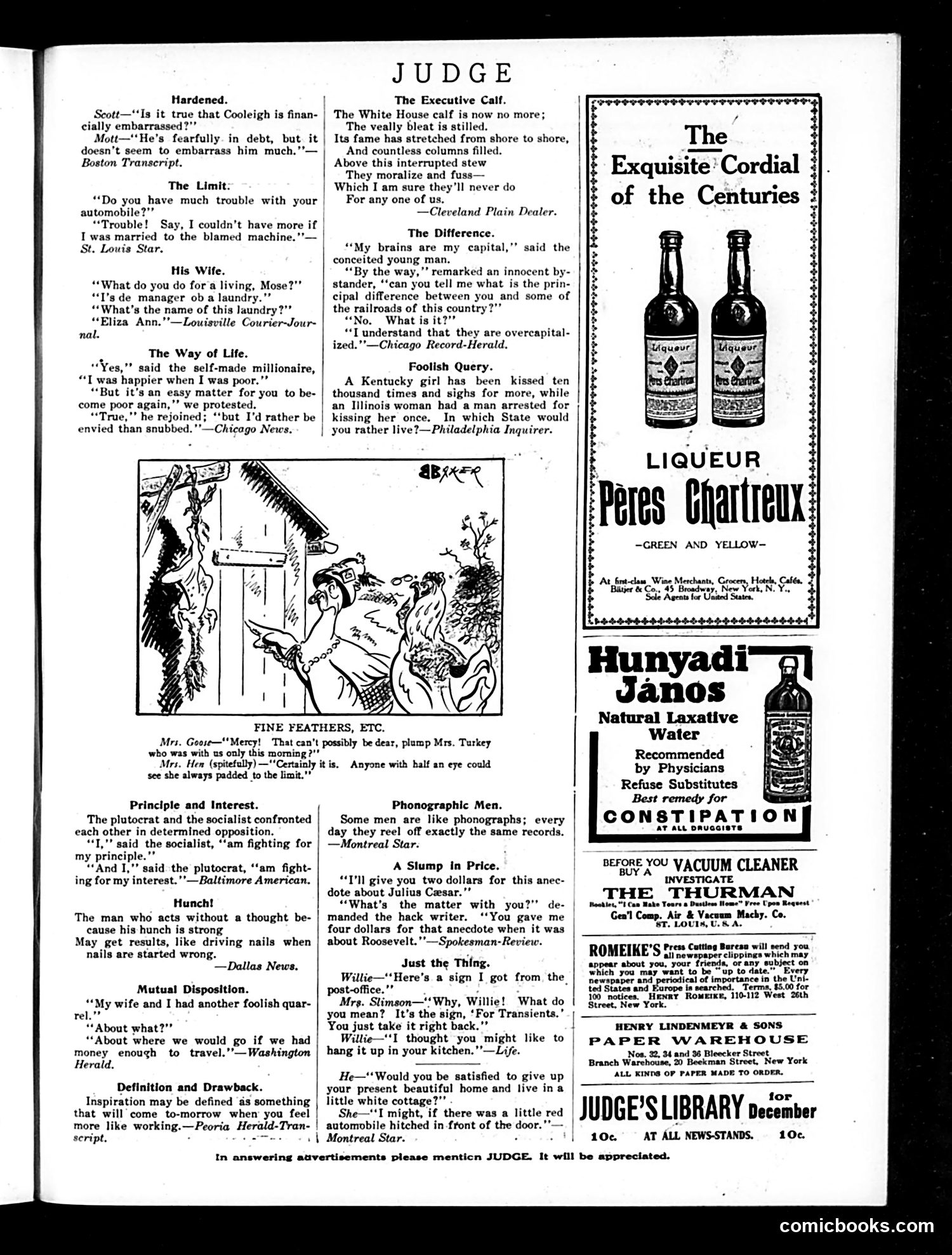
This page is primarily **advertisements and humor columns** rather than political cartoons. The main illustrated content is titled "FINE FEATHERS, ETC." — a domestic comedy scene showing what appears to be a woman discovering her husband with another woman, creating a farcical situation. The humor columns contain **social satire** about everyday American life: wealth and capitalism ("My brains are my capital"), romance and courtship (a Kentucky girl's kissing record), marriage dynamics, and work. The advertisements for liqueur, laxative water, vacuum cleaners, and paper warehouse represent typical early 20th-century consumer products, suggesting this is likely from the 1900s-1920s era. Overall, this page reflects **middle-class domestic humor** rather than political commentary.
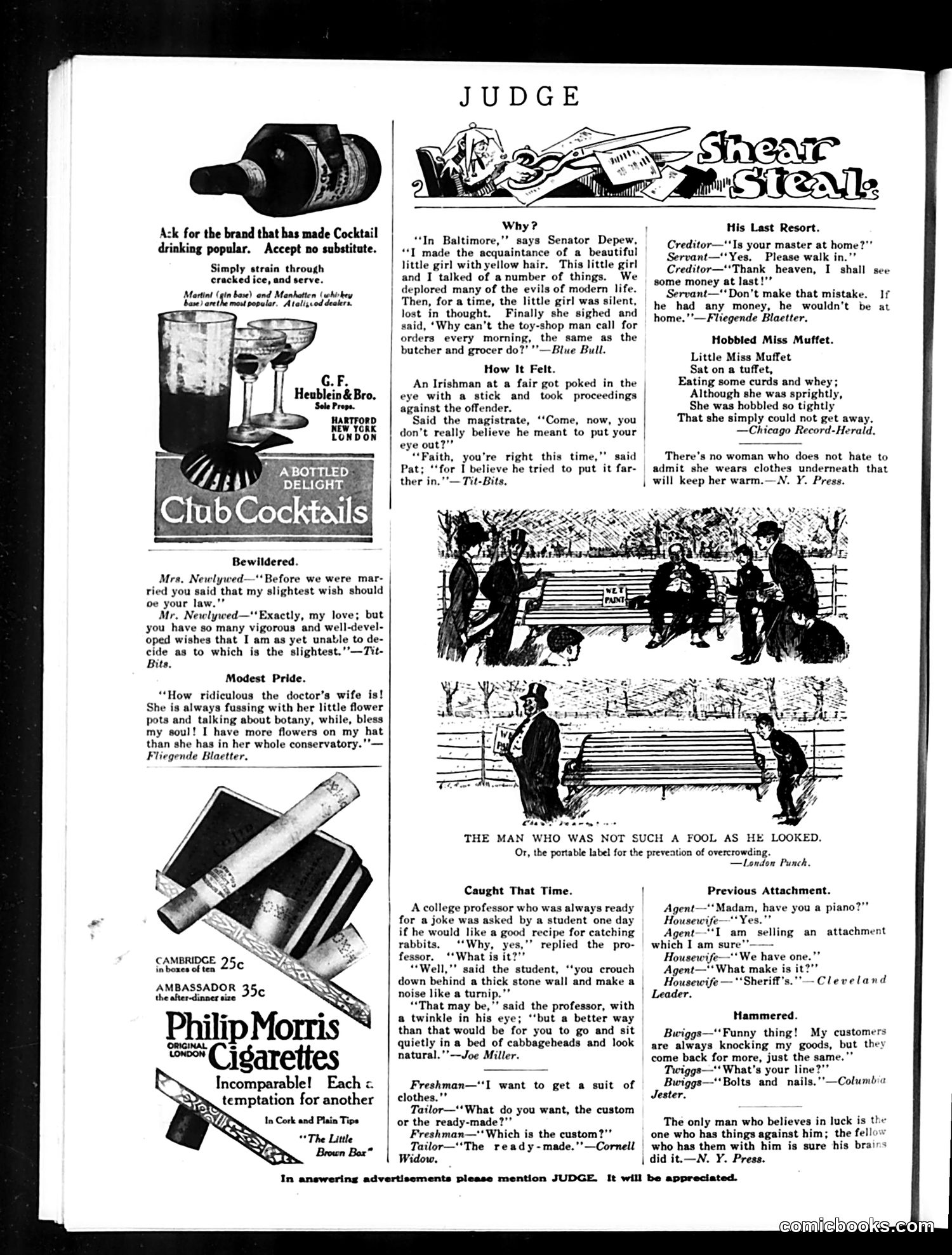
This page is primarily **advertising and humor content** rather than political cartoons. The main elements include: **Advertisements:** - Club Cocktails (alcohol) - Philip Morris Cigarettes - Heublein & Bro. (spirits) **Humorous Anecdotes:** The "Shear Steal" section and other titled jokes mock social situations—marital disputes, doctor's wives with excessive hobbies, student-professor interactions, and commercial transactions. These are generic domestic humor pieces typical of the era. **The cartoon illustration** shows figures on park benches, likely illustrating one of the anecdotes, though the specific connection is unclear from the OCR text alone. The content reflects early-20th-century middle-class American concerns: marriage dynamics, education, and consumer behavior. There's no identifiable political satire or caricature of specific public figures visible.
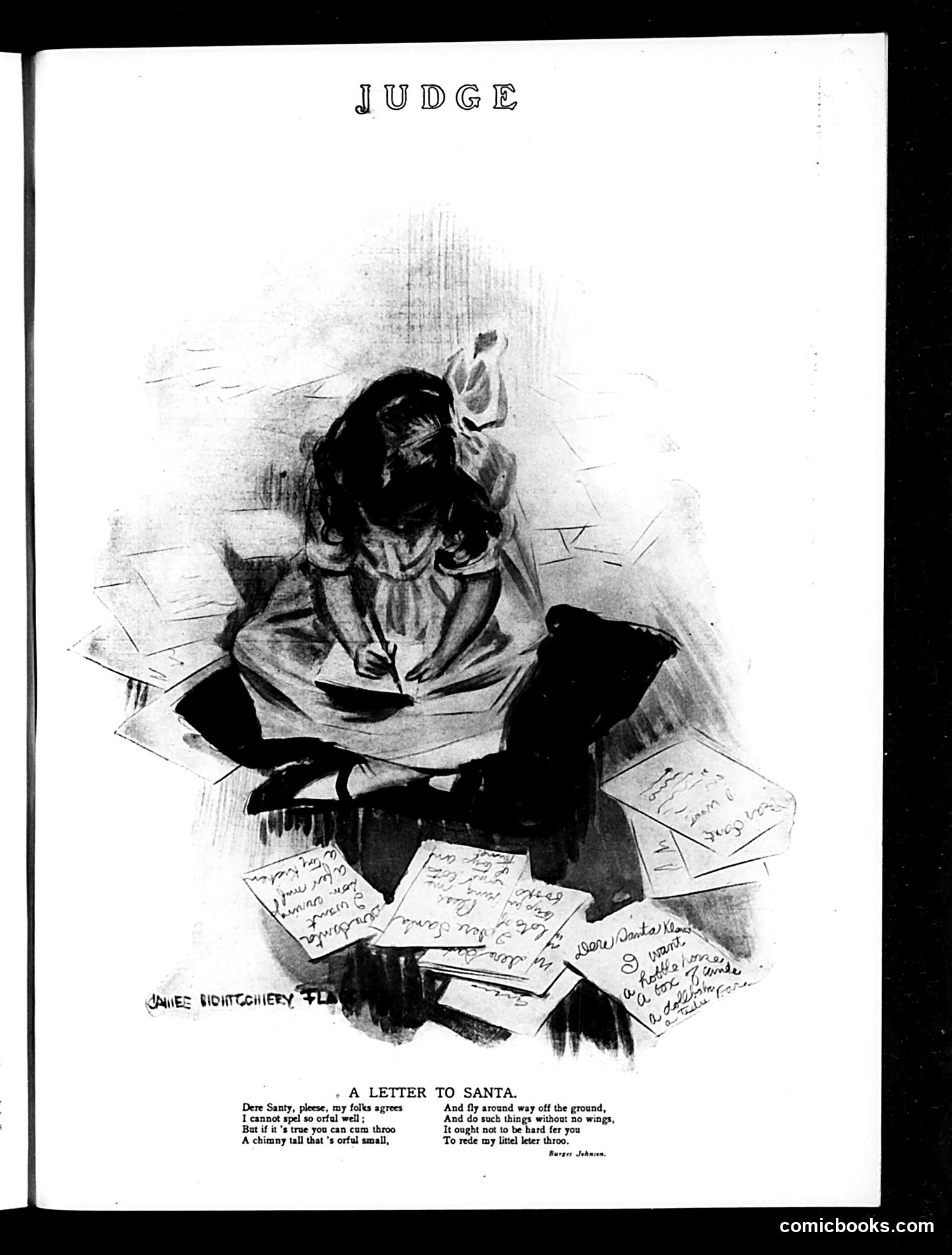
This Judge magazine illustration satirizes a child writing to Santa Claus. The artwork, credited to James Montgomery Flagg, shows a young person surrounded by scattered letters and documents, head bowed over writing materials. The accompanying poem ("A Letter to Santa") humorously depicts a child negotiating with Santa—acknowledging the practical difficulties of chimney delivery and asking Santa to use alternative methods. The satire likely mocks either childhood naiveté or, possibly, contemporary social concerns (the scattered papers suggest bureaucratic or financial troubles). Without a visible date, the specific historical context remains unclear, but the cartoon exemplifies Judge's blend of domestic humor and gentle social commentary typical of early-to-mid 20th century American satire.
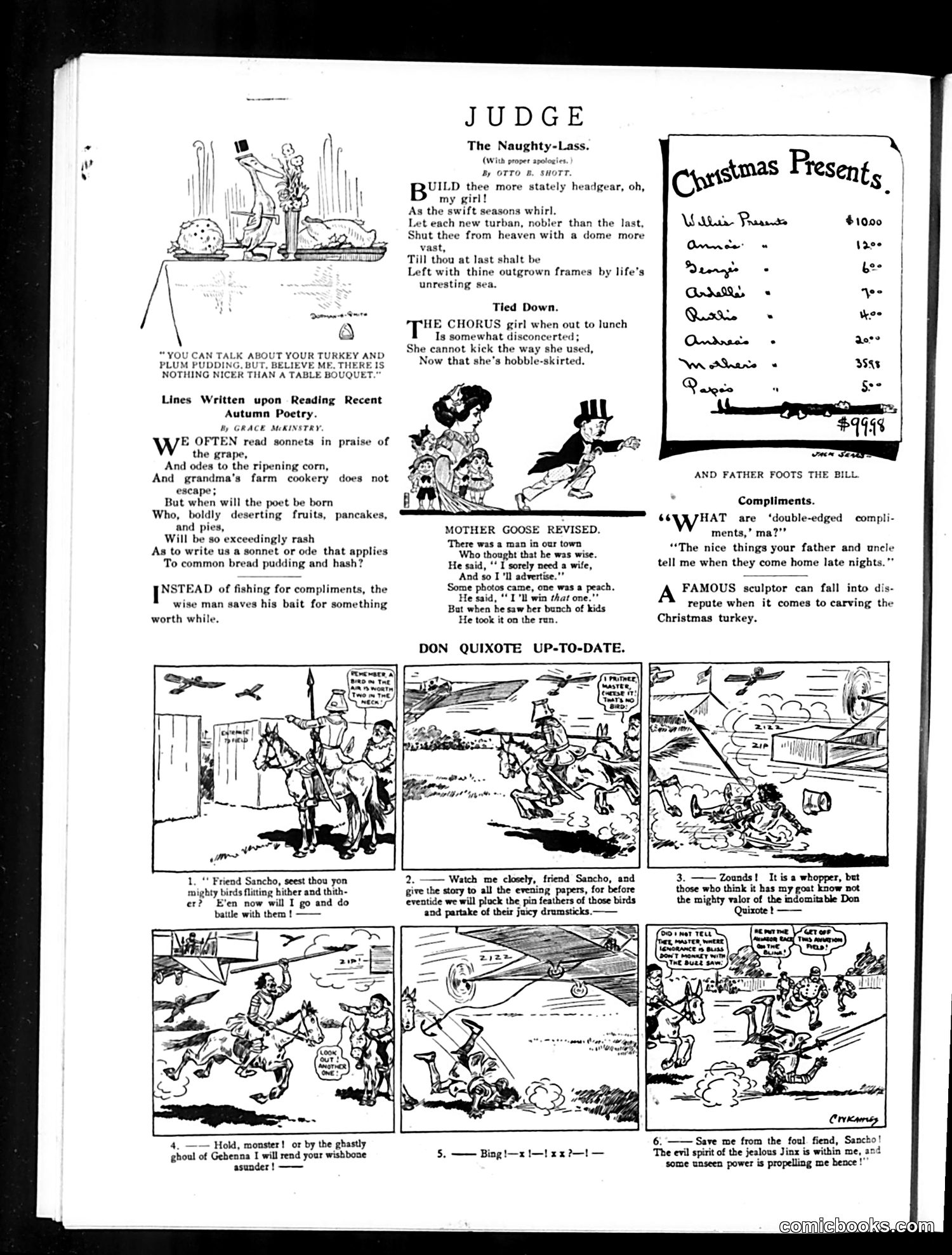
This page from **Judge** (an American satirical weekly) contains several humor pieces typical of early 20th-century publication: **Main Comic Strip: "Don Quixote Up-to-Date"** updates Cervantes' classic novel to modern times. Don Quixote mistakes airplanes for "birds" and attempts to attack them with Sancho Panza. The satire mocks both outdated chivalric ideals and the bewildering technological change of the era—the absurdity of ancient heroic values confronting modern aviation. **Other Content:** - Poetry mocking overwrought Romantic literature celebrating nature while ignoring humble foods - Social commentary on the hobble skirt fashion restricting women's movement - "Mother Goose Revised": dark humor about a man advertising for a wife, then fleeing when he discovers she has children - "Christmas Presents" advertisement and joke about fathers paying bills **Context:** This reflects Judge's typical blend of satire on fashion trends, gender relations, outdated literary conventions, and technological disruption—all delivered with period-appropriate cynicism about modern life.
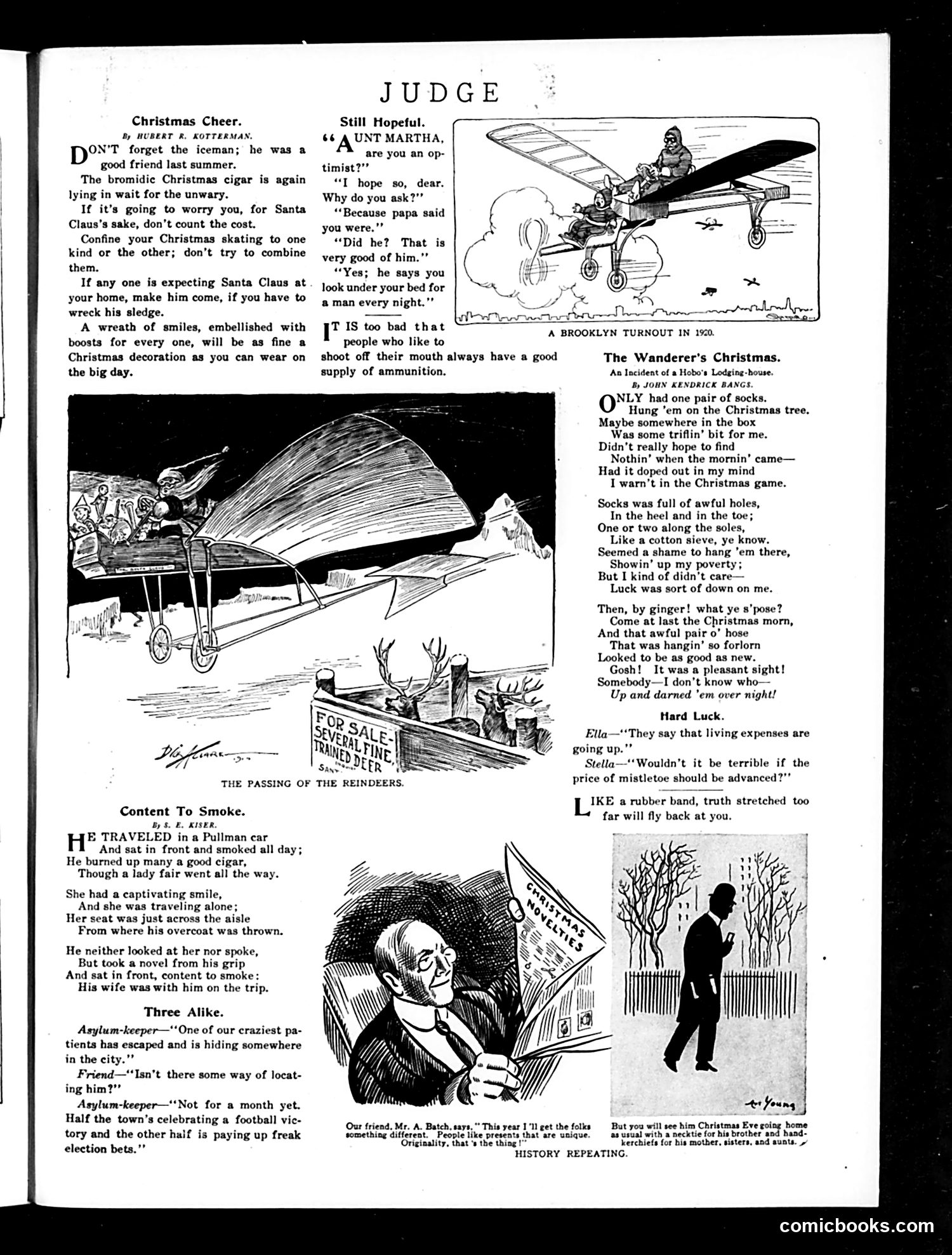
This page from *Judge* contains several Christmas-themed satirical pieces reflecting early 20th-century American life. **"The Passing of the Reindeers"** cartoon satirizes the modernization replacing traditional Christmas imagery—motorized vehicles and aircraft are depicted alongside Santa's obsolete sleigh, commenting on rapid technological change. **"Content to Smoke"** jokes about male indifference and marital complacency: a man ignores an attractive female traveler, prioritizing his cigar and novel because his wife is present, suggesting men only behave decently when monitored. **"Three Alike"** compares asylum inmates escaping to townspeople celebrating football victories and settling election bets—satirizing public behavior as equally irrational. **"The Wanderer's Christmas"** by John Kendrick Bangs presents sentimental verse about a poor hobo whose torn socks mysteriously get darned overnight, celebrating anonymous charity. The scattered jokes mock conspicuous consumption, living expenses, and mistletoe price inflation—typical seasonal concerns. "History Repeating" suggests predictable, unchanged gift-giving practices among ordinary people despite modern pretensions.
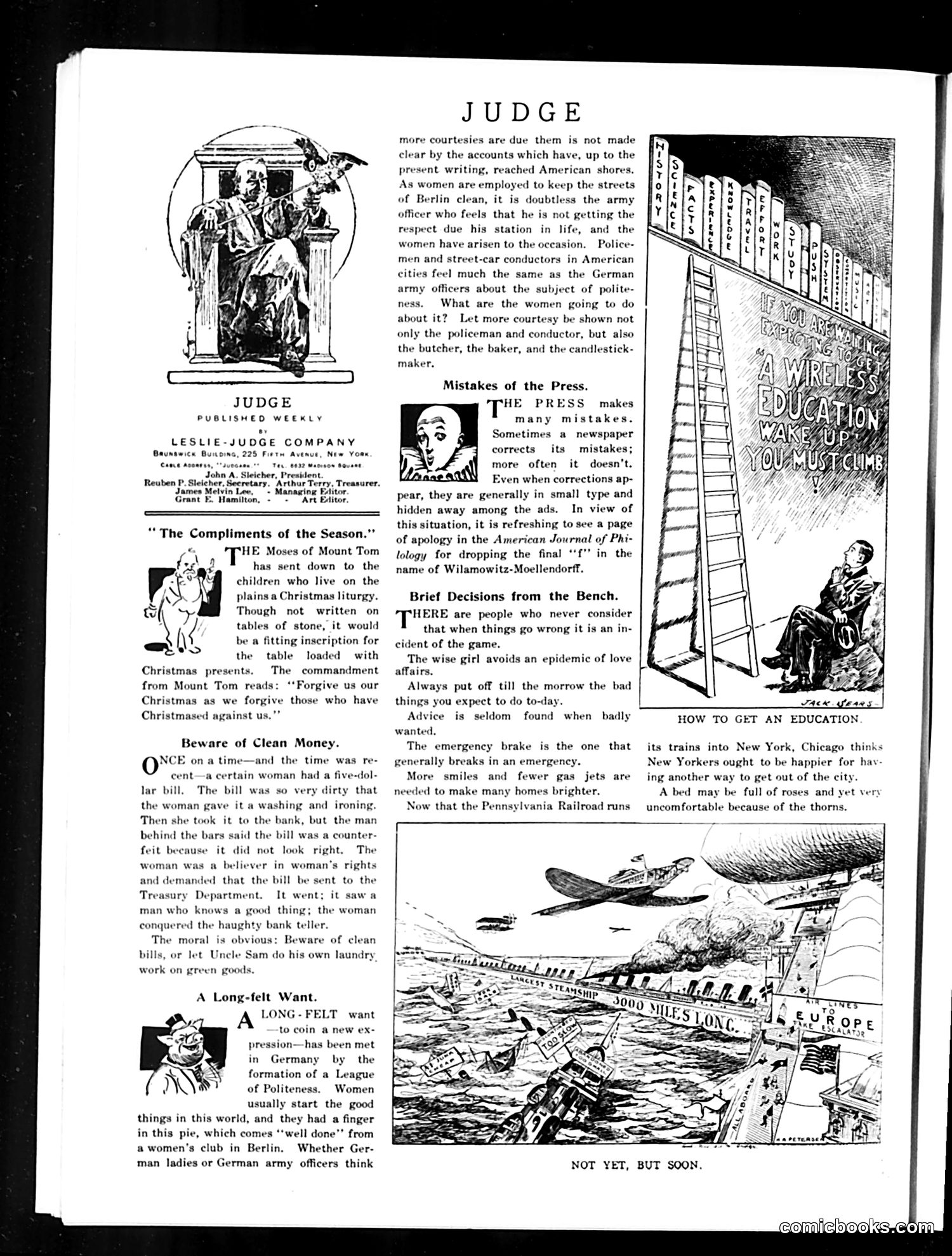
This page from *Judge* magazine contains several satirical pieces targeting early 20th-century American social issues: **"Beware of Clean Money"** mocks Treasury Department bureaucracy: a woman washes a dirty five-dollar bill, then the bank rejects it as counterfeit because it looks "too clean." The satire critiques rigid, senseless government rules that ignore common sense. **"A Long-Felt Want"** jokes about a newly-formed German "League of Politeness" for women. The implication is darkly ironic—suggesting that German society (particularly military officers) is so rude that such a league is necessary. This reflects American skepticism toward German militarism pre-WWI. **"Mistakes of the Press"** notes newspapers rarely apologize for errors, then applauds the *American Journal of Philology* for a full-page apology for misspelling "Wilamowitz-Moellendorff." The bottom cartoon, "How to Get an Education," appears to depict a sinking ship labeled with European destinations, suggesting immigration and the challenges newcomers faced reaching American cities.
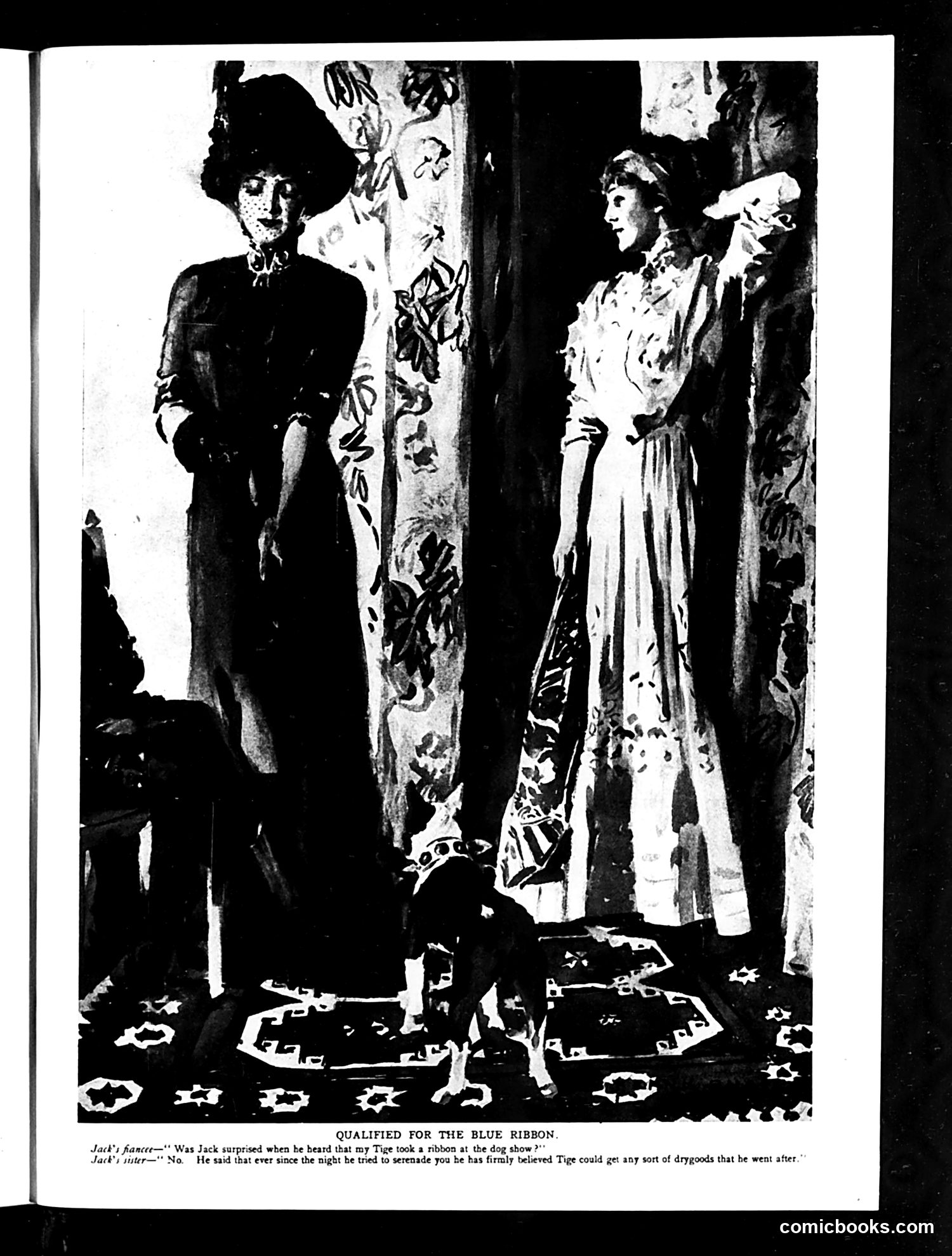
This is a humorous domestic scene involving a young woman (Jack's fiancée) and Jack's sister discussing a dog named Tige that won a ribbon at a dog show. The joke plays on a failed serenade: Jack once attempted to serenade his fiancée but apparently made such terrible noise that his sister sarcastically suggests the dog could successfully "get" (attract or win) even merchandise ("drygoods")—implying Jack's singing was so bad it sounded like a dog howling. The cartoon mocks Jack's romantic incompetence through his sister's cutting remark, suggesting that if his awful serenading couldn't repel success, even a dog could achieve anything. It's gentle domestic satire typical of Judge magazine's humor about courtship and family dynamics in the early 20th century.
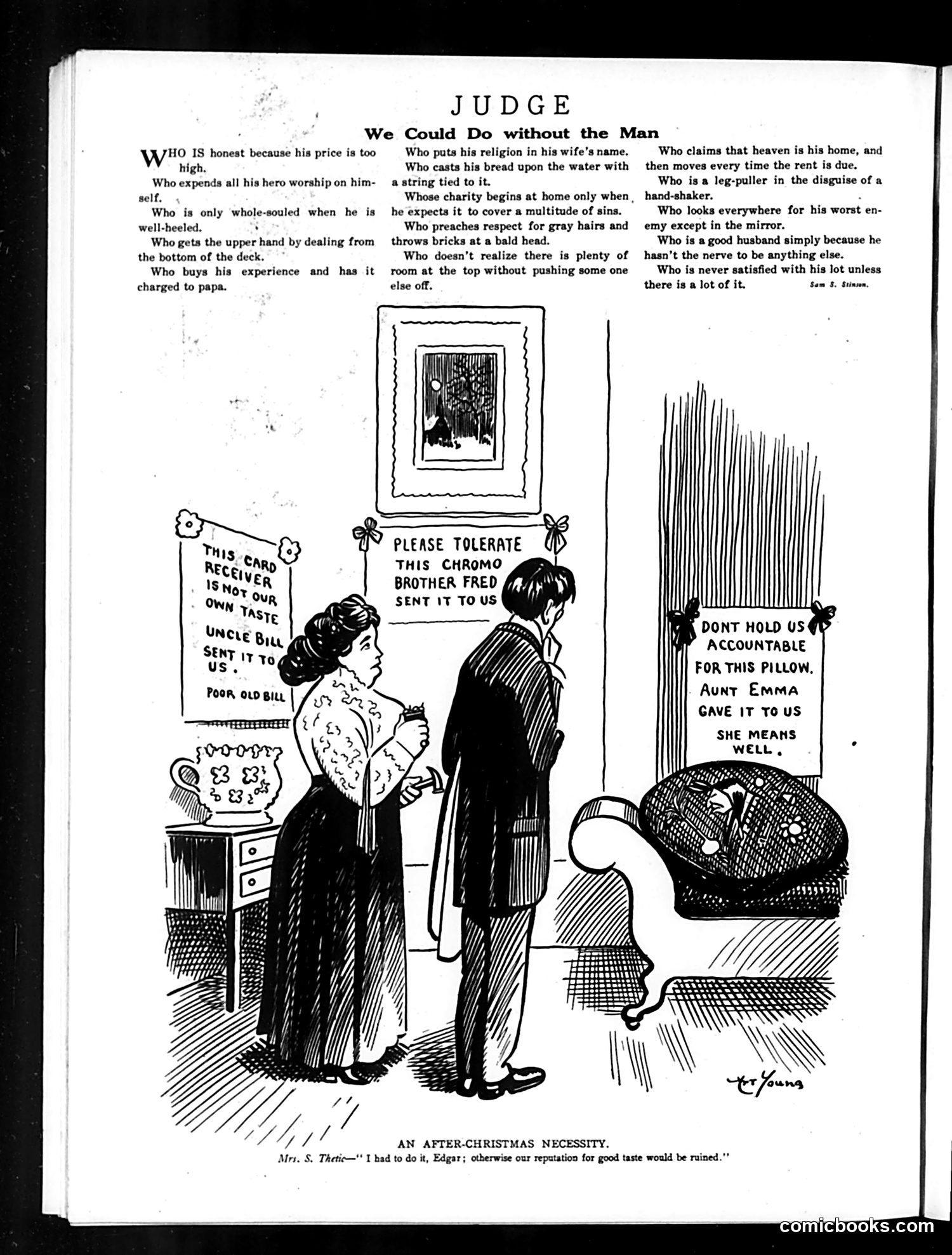
This page contains two distinct pieces of social satire: **"We Could Do Without the Man"** (text columns): A cynical list of hypocritical male types—men who are dishonest, self-absorbed, fraudulent, or morally inconsistent. Examples include those who hide behind religion, practice false charity, or lack genuine conviction. This represents Judge's typical social criticism of masculine vice and pretense. **"An After-Christmas Necessity"** (cartoon): A domestic scene where a couple must apologize to guests for receiving unwanted Christmas gifts. Notes on items ("Uncle Bill sent it," "Brother Fred sent it," "Aunt Emma gave it") explain away tacky gifts—a cheap decorative plate, chromolithograph, and pillow. Mrs. S. Thetic tells Edgar they must display these items to avoid offending gift-givers, even though they ruin the home's "good taste." The satire targets the social obligation to keep and display unwanted gifts, and the hypocrisy required to maintain family relationships and social reputation—a relatable post-holiday problem that remains relevant today.
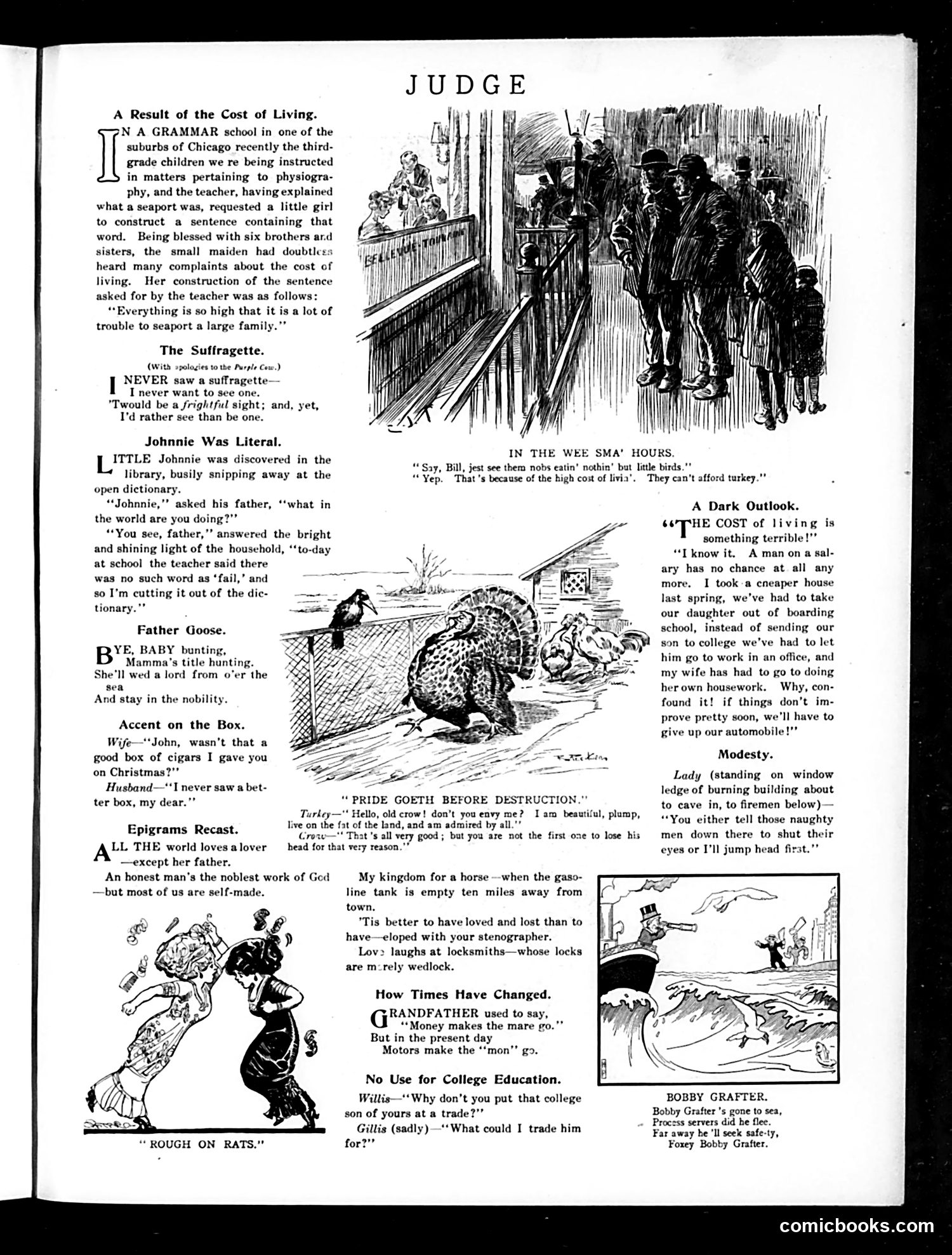
This page satirizes the **cost of living crisis** affecting early 20th-century America. Multiple pieces target economic hardship: The opening anecdote mocks how pervasive financial anxiety had become—a Chicago schoolgirl confuses "seaport" with "support," saying families struggle to "seaport a large family" because "everything is so high." "A Dark Outlook" depicts a middle-class man cataloging devastating lifestyle losses: cheaper housing, daughters removed from boarding school, sons working instead of attending college, wives doing housework instead of hiring help. His final despair—potentially losing the automobile—captures how economic pressure threatened middle-class status symbols. Other items reinforce the theme: "In the Wee Sma' Hours" jokes that wealthy people eat only "little birds" due to high costs; "How Times Have Changed" contrasts old wisdom ("Money makes the mare go") with modern reality (motors consume the money). The page uses humor to process genuine economic anxiety among Judge's likely middle and upper-class readership, making light of serious financial pressures while validating audience concerns about changing living standards.
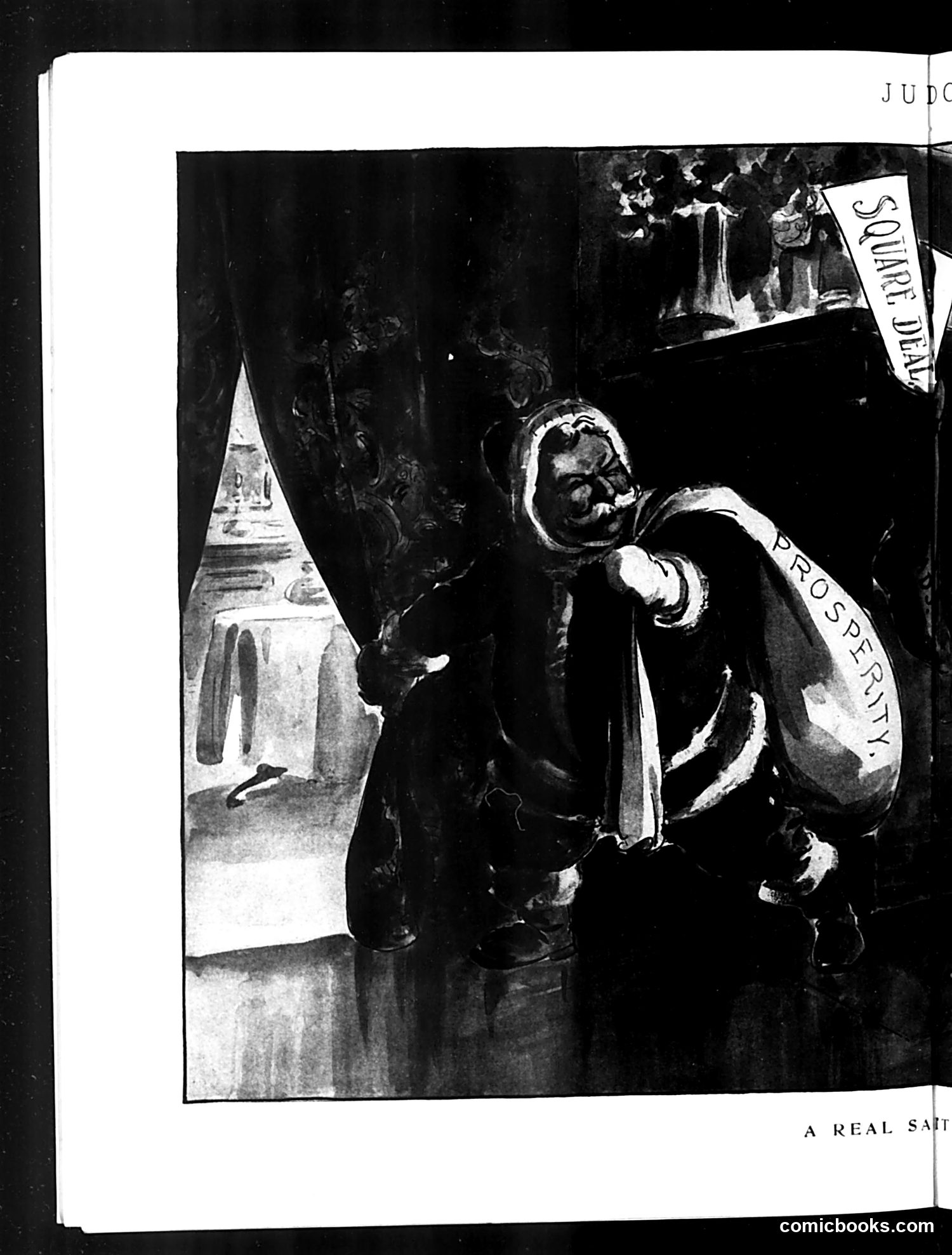
This appears to be a satirical cartoon depicting a figure in religious or ecclesiastical robes (suggested by the white headpiece and formal dress) peering through ornate curtains or drapery. The visible text fragments read "SOLEMNITY" and "PROSPERITY," suggesting the cartoon critiques a contrast between outward religious solemnity and material prosperity—possibly mocking hypocrisy or the alignment of religious institutions with wealth. The figure's posture—peeking through curtains—implies secretive or hidden behavior, common in Judge's satirical style. The caption at bottom reads "A REAL SAI[NT]" (likely "SAINT"), suggesting ironic commentary on claims of religious virtue. Without the complete caption and date, the specific target remains unclear, but this likely satirizes Gilded Age or Progressive Era tensions between religious authority and commercial interests.
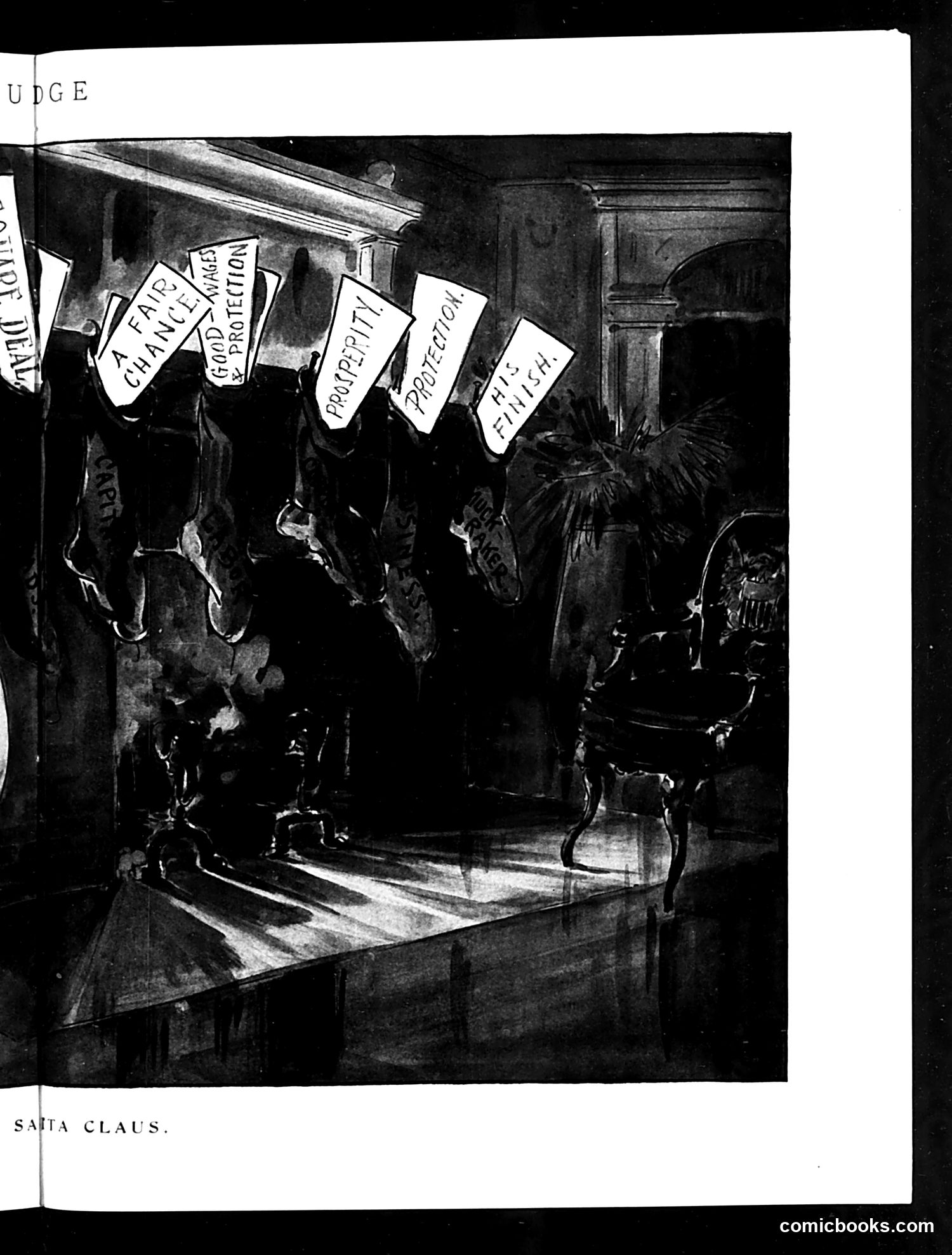
This political cartoon depicts Santa Claus as a figure carrying sacks labeled with various social problems: "A FARE GUARANTEE," "GOOD PROTECTION," "PROSPERITY," "PROTECTION," and "FISH." The artwork satirizes political promises made during election campaigns—specifically, candidates offering solutions to major issues as if they were gifts from Santa. The cartoon critiques politicians who make unrealistic or empty campaign pledges, treating serious economic and social concerns (tariffs, labor protections, prosperity) as magical deliverables rather than genuine policy solutions. By equating politicians with Santa Claus, Judge mocks the naive hope voters place in candidates' promises that are unlikely to materialize as presented. The exact historical period remains unclear without additional context.
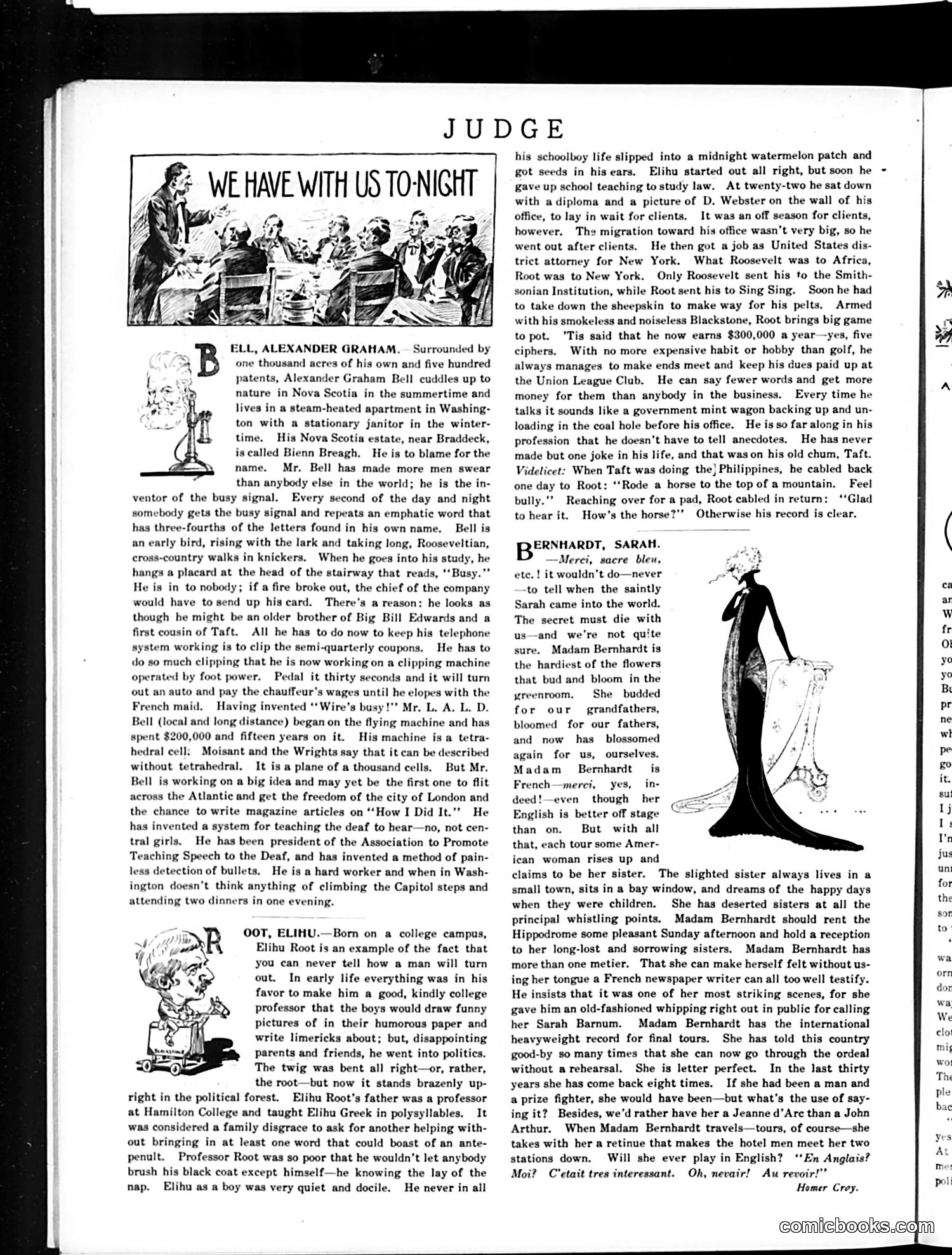
This page profiles three prominent American figures through satirical biographical sketches: **Alexander Graham Bell** is mocked for inventing the "busy signal" (blamed for making countless people swear in frustration) and for his obsessive work habits—hanging "Busy" signs to avoid interruptions. The satire suggests he's so consumed by invention that he neglects normal life, though he's also credited with genuine scientific achievements (deaf education, aviation research). **Elihu Root** is portrayed as an unexpected political figure—his Greek-professor father expected him to become an academic, but Root became a prominent lawyer and politician instead. The humor plays on his transformation from a well-mannered, timid boy into someone "brazenly" active in politics. The cartoon's top panel shows these figures as dinner guests, likely at a Washington social event. Judge's satirical approach celebrates their accomplishments while gently ribbing their quirks and unexpected life trajectories—typical of the magazine's light roasting of public figures.
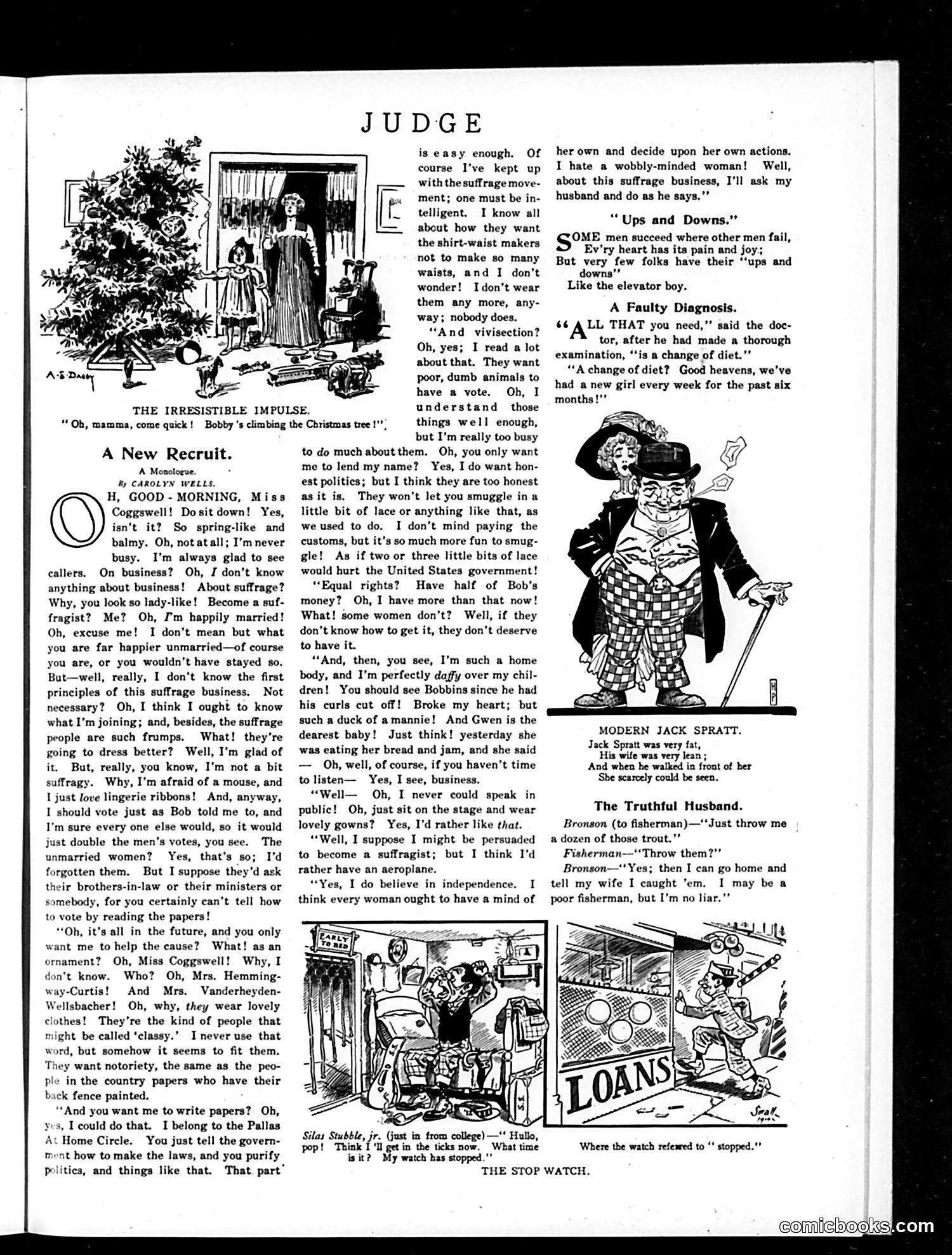
This Judge magazine page satirizes early 20th-century women ambivalent about the suffrage movement. **"A New Recruit"** is a monologue by Carolyn Wells featuring Miss Coggswell, a wealthy, frivolous woman recruited to support women's voting rights. The satire targets her shallow reasoning: she opposes suffrage initially because suffragists are "frumps," worries about "smuggling lace" past customs, and claims she'd just vote as her husband Bob tells her anyway. Yet she contradicts herself repeatedly—claiming she knows about suffrage issues (shirt-waist makers, vivisection, "equal rights") while admitting ignorance. The joke mocks both anti-suffrage women who hide behind domesticity and marriage, and perhaps the movement itself for recruiting such vapid allies. References to "Mrs. Hemingway-Curtis" and "Mrs. Vanderheyden-Wellsbacher" satirize society women seeking "notoriety" rather than genuine reform. Her final comment—preferring an aeroplane to independence—underscores her complete triviality as a potential political voice.
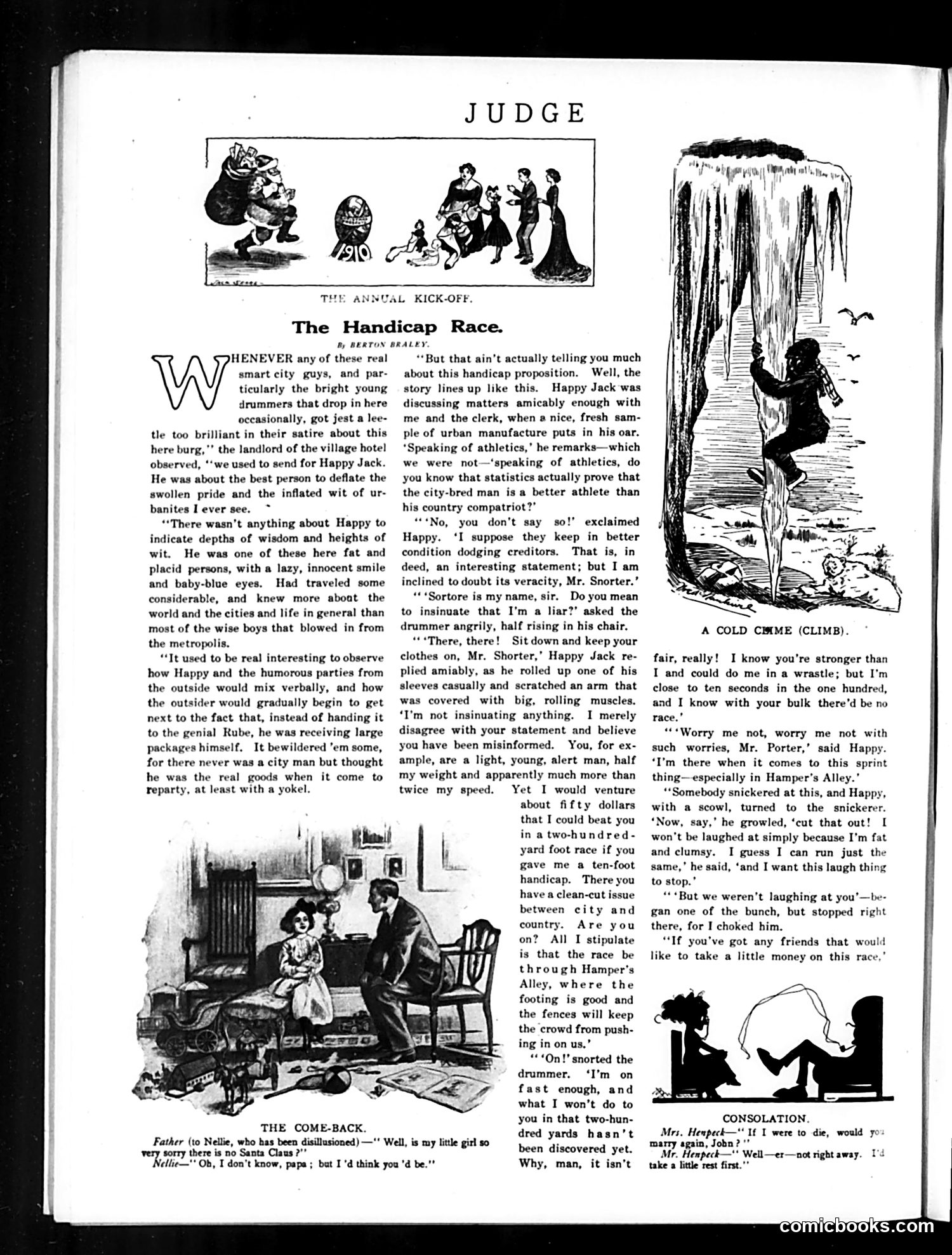
This page satirizes the stereotype of the city "drummer" (traveling salesman) as an arrogant know-it-all who condescends to rural people. The story describes a cocky urban salesman claiming city-dwellers are superior athletes based on "statistics." Happy Jack, a seemingly simple country man with a lazy demeanor and "baby-blue eyes," challenges him to a foot race through Hamper's Alley. The satire works by subverting expectations: the city man assumes rural people are inferior, but Happy Jack—despite appearing dumb and overweight—confidently offers to beat him while giving a handicap. The joke exposes how urbanites mistake book-learning and statistics for actual wisdom or ability, while underestimating practical country folk. The smaller cartoons mock sentimental city attitudes ("no Santa Claus") and urban pretension generally.
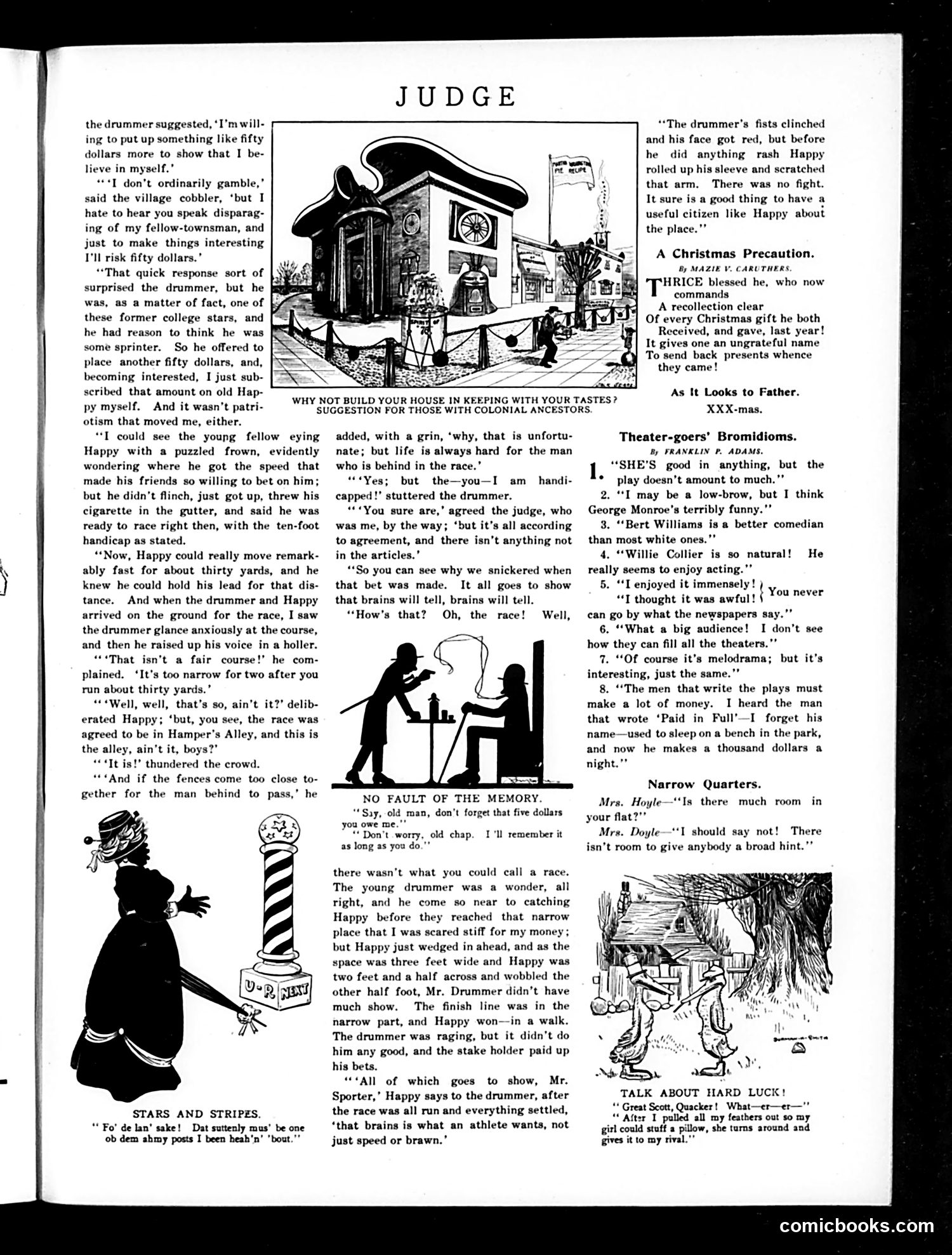
This page contains multiple humorous short pieces typical of the satirical magazine's content. **Main Story ("Judge")**: A con-man narrative where locals bet on a footrace between a traveling drummer (salesman) and "Happy," a local character. The joke relies on a rigged contest—Happy deliberately chooses a narrow alley where his wider body gives him an unfair advantage. The drummer, who appears confident initially, discovers too late that "brains" (local cunning) beat athletic ability. The moral seems to satirize overconfident outsiders getting outsmarted by small-town folk wisdom. **Other pieces include**: - "A Christmas Precaution" (etiquette humor about regifting) - "Theater-goers' Broadsides" (brief theatrical critiques) - "Narrow Quarters" (housing/space humor) - Small cartoons including "Stars and Stripes" (dialect humor, possibly racial stereotyping typical of the era) The page reflects early 20th-century American humor emphasizing rural cunning over urban sophistication, with some content reflecting period attitudes we'd now recognize as problematic.
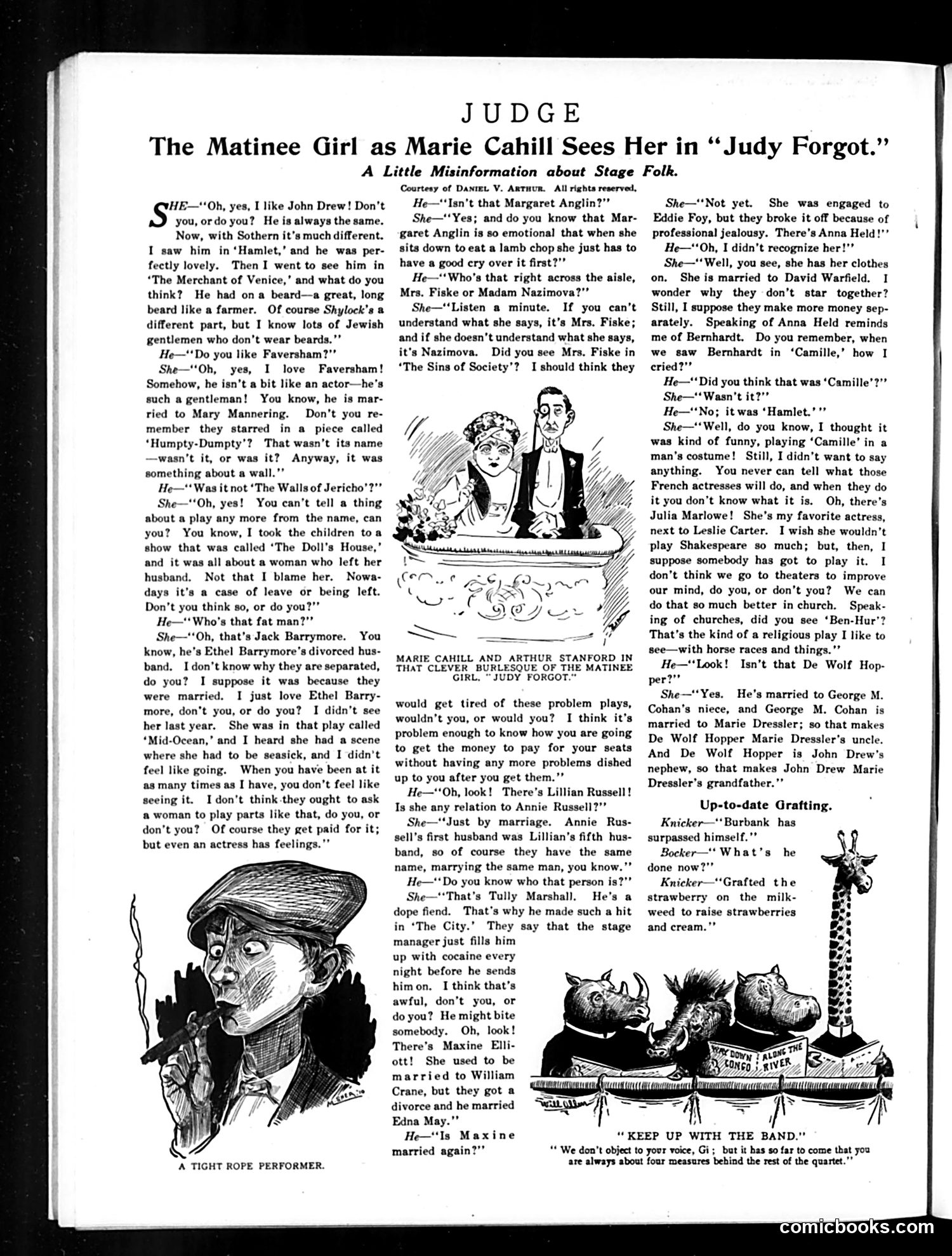
This page satirizes the stereotypical "matinee girl"—a wealthy, gossipy female theater-goer of the early 1900s. The conversation between "She" and "He" mocks her superficial knowledge of Broadway stars and theater, presenting her as intellectually vapid and prone to spreading rumors. The satire targets her confidently spouting false information: confusing play titles ("Humpty-Dumpty" vs. "The Walls of Jericho"), misremembering actors' personal lives, and spreading unsubstantiated gossip (claiming an actor is a "dope fiend" filled with cocaine nightly). The reference to Marie Cahill's play "Judy Forgot" frames this as theatrical satire—the matinee girl represents a recognizable social type Judge's audience would find ridiculous. Her constant verbal tics ("don't you, or do you?") reinforce the mockery. The bottom illustrations ("A Tight Rope Performer," "Keep Up with the Band") appear unrelated comic sketches.
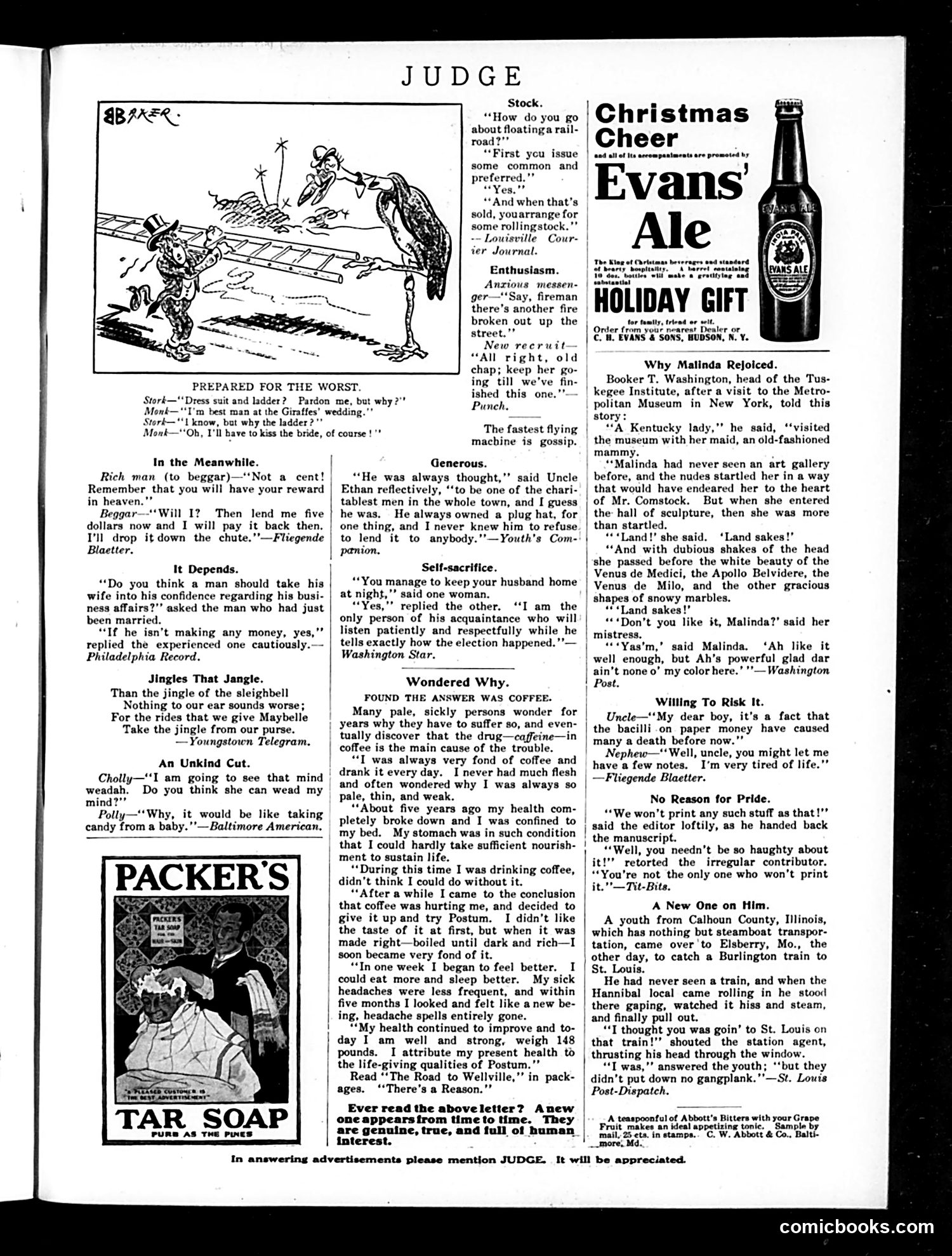
This page contains multiple short humorous items typical of Judge's satirical format, rather than a single political cartoon. **Key Items:** - **"Prepared for the Worst"**: A joke about a monk attending a giraffe's wedding—he needs a ladder to kiss the bride, playing on the giraffe's height. - **"Why Malinda Rejoiced"**: A racist anecdote attributed to Booker T. Washington about an elderly Black woman ("mammy") visiting an art museum. The "humor" relies on a stereotype: she's relieved the classical nude sculptures are white, not Black. This reflects early 20th-century racial attitudes typical of the era. - **Minor jokes** on marriage, begging, business, and other topics use wordplay and social commentary. - **Advertisements** for Evans' Ale and Packer's Tar Soap occupy substantial space. The content reflects Judge's satirical approach to contemporary life, though some material—particularly the racist "Malinda" piece—exposes deeply offensive attitudes normalized at the time.
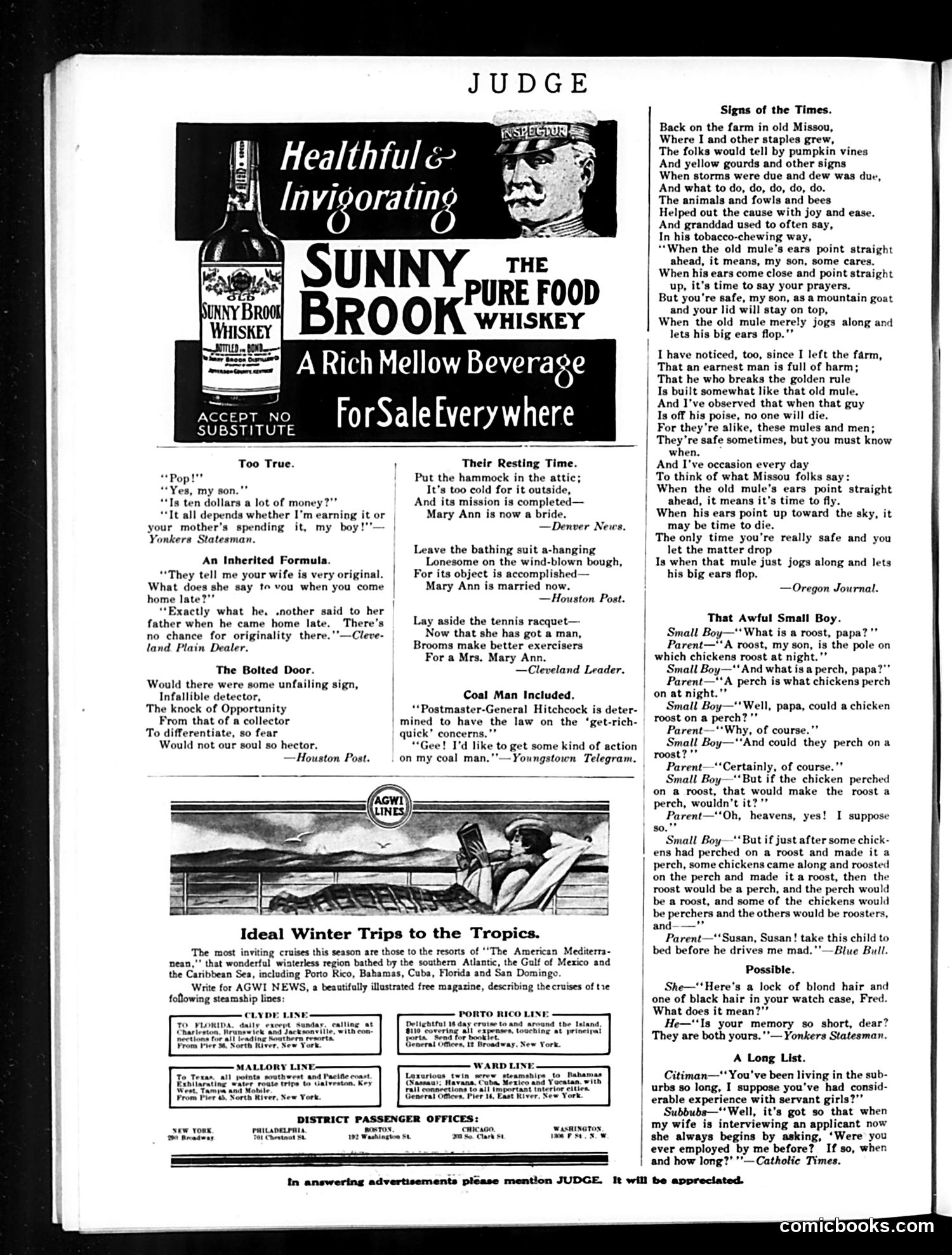
This page is primarily **advertising and filler content** rather than political satire. The dominant feature is a large **Sunny Brook Whiskey advertisement** promoting "pure food whiskey" as a "rich mellow beverage." The surrounding short humor pieces are mild domestic jokes typical of early 1900s magazines: a father-son dialogue about earning versus spending money, married women putting away recreational items (bathing suits, tennis rackets), and wordplay about opportunity versus bill collectors. One piece references **Postmaster-General Hitchcock** enforcing laws against "get-rich-quick" schemes, reflecting Progressive Era concerns about consumer fraud. The lengthy poem "Signs of the Times" romanticizes rural Missouri farm wisdom, using a mule's ear positions to predict weather and fate—nostalgia for agrarian life common in this period. The page concludes with **steamship line advertisements** for Caribbean cruises, targeting affluent readers. Overall, this appears to be a typical Judge issue mixing light humor with commercial advertising rather than sharp political commentary.
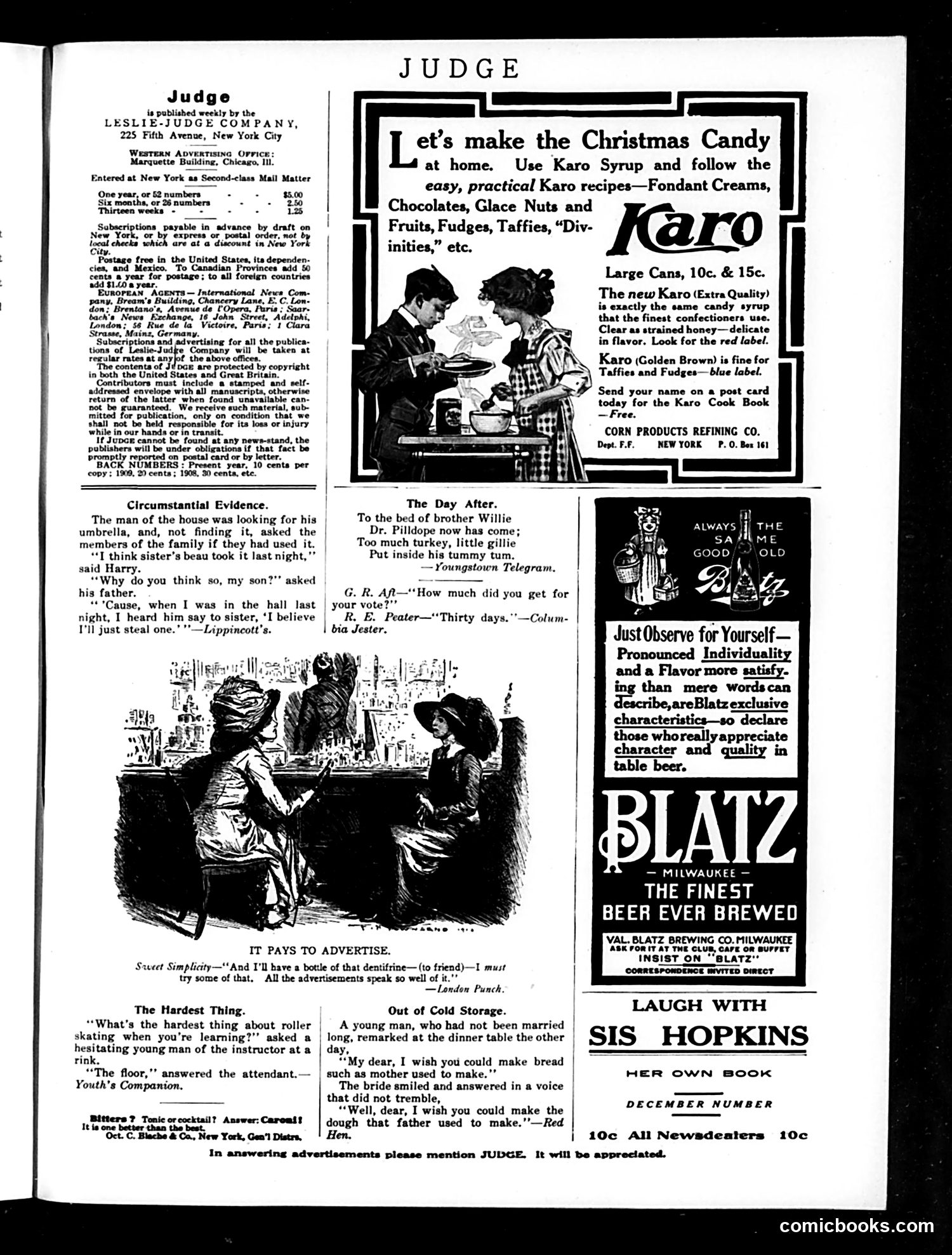
This page is primarily **advertising and filler content** rather than editorial cartoons. The main elements are: **Advertisements:** - **Karo Syrup** (top): Promotes making homemade Christmas candy using their product, targeting domestic consumers - **Blatz Beer** (right): Emphasizes the beer's "individuality" and quality, appealing to discerning drinkers - **Sis Hopkins** (bottom right): Promotes a humor book available at newsstands **Humor Fillers:** Several short jokes appear, including "Circumstantial Evidence" (a misheard marriage proposal), "The Day After" (a child's overindulgence), and "The Hardest Thing" (a roller-skating joke). These are typical turn-of-the-century light humor—domestic situations and wordplay with no political content. The page reflects Judge's dual function as satire magazine and advertising vehicle, mixing commercial promotions with genteel family humor aimed at middle-class readers.
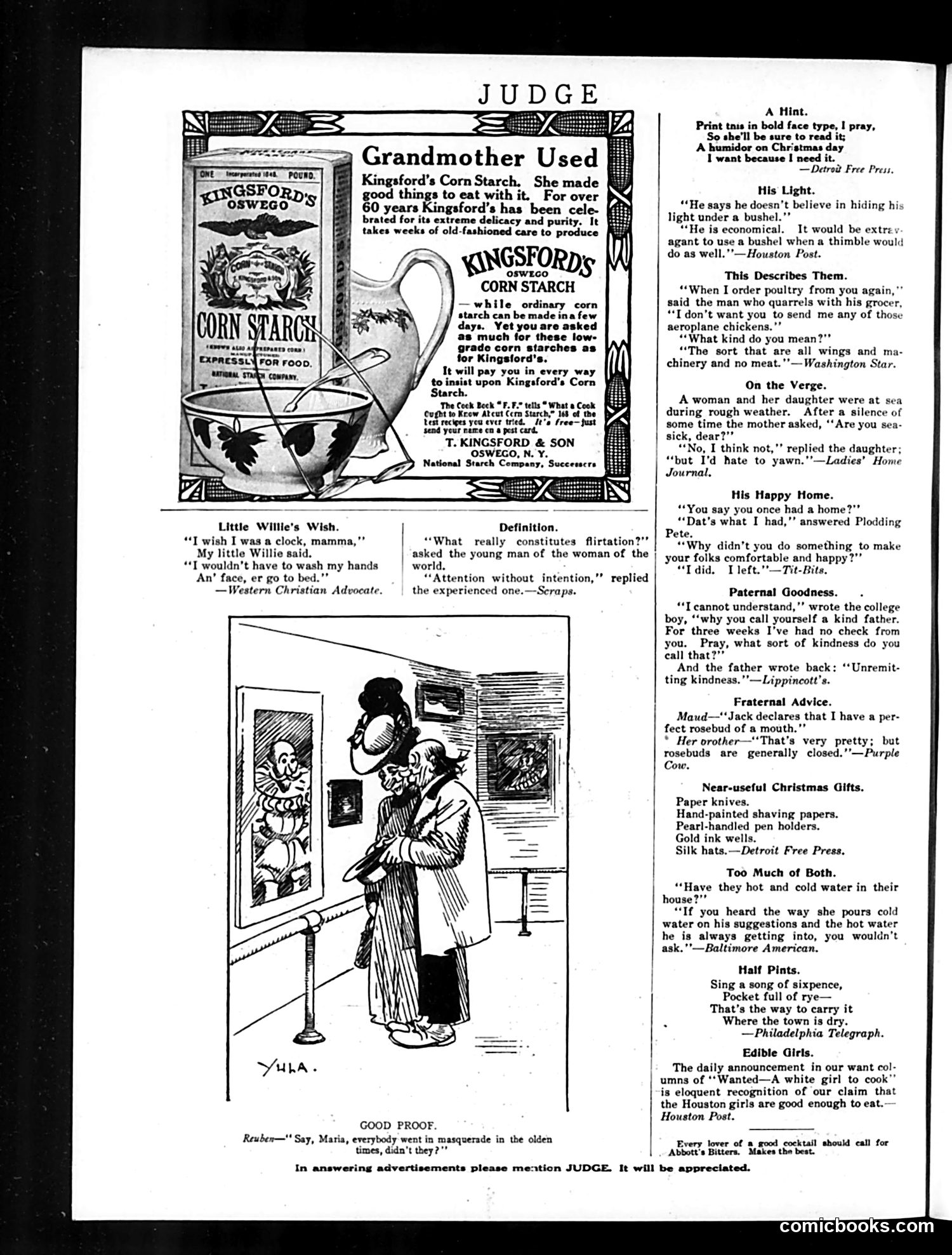
This page is primarily **advertising and humor content**, not political satire. The dominant element is a **Kingsford's Corn Starch advertisement** featuring a grandmother, emphasizing the product's 60-year heritage and "old-fashioned care." Below are several **short humor pieces** typical of Judge's era: - **"Little Willie's Wish"**: A child's joke about not wanting to wash if he were a clock - **"Good Proof"**: A brief exchange about historical masquerade customs - **Various one-liners** on topics like flirtation, poultry quality, seasickness, and family dynamics The cartoon shows a **woman admiring a decorated mirror or window display**, likely illustrating one of these jokes. The page concludes with miscellaneous **quips and gift suggestions** (paper knives, silk hats, etc.). This represents Judge's typical format: **commercial advertising interspersed with genteel, domestic humor** aimed at middle-class readers. There is **no evident political commentary** or caricature of public figures on this particular page.
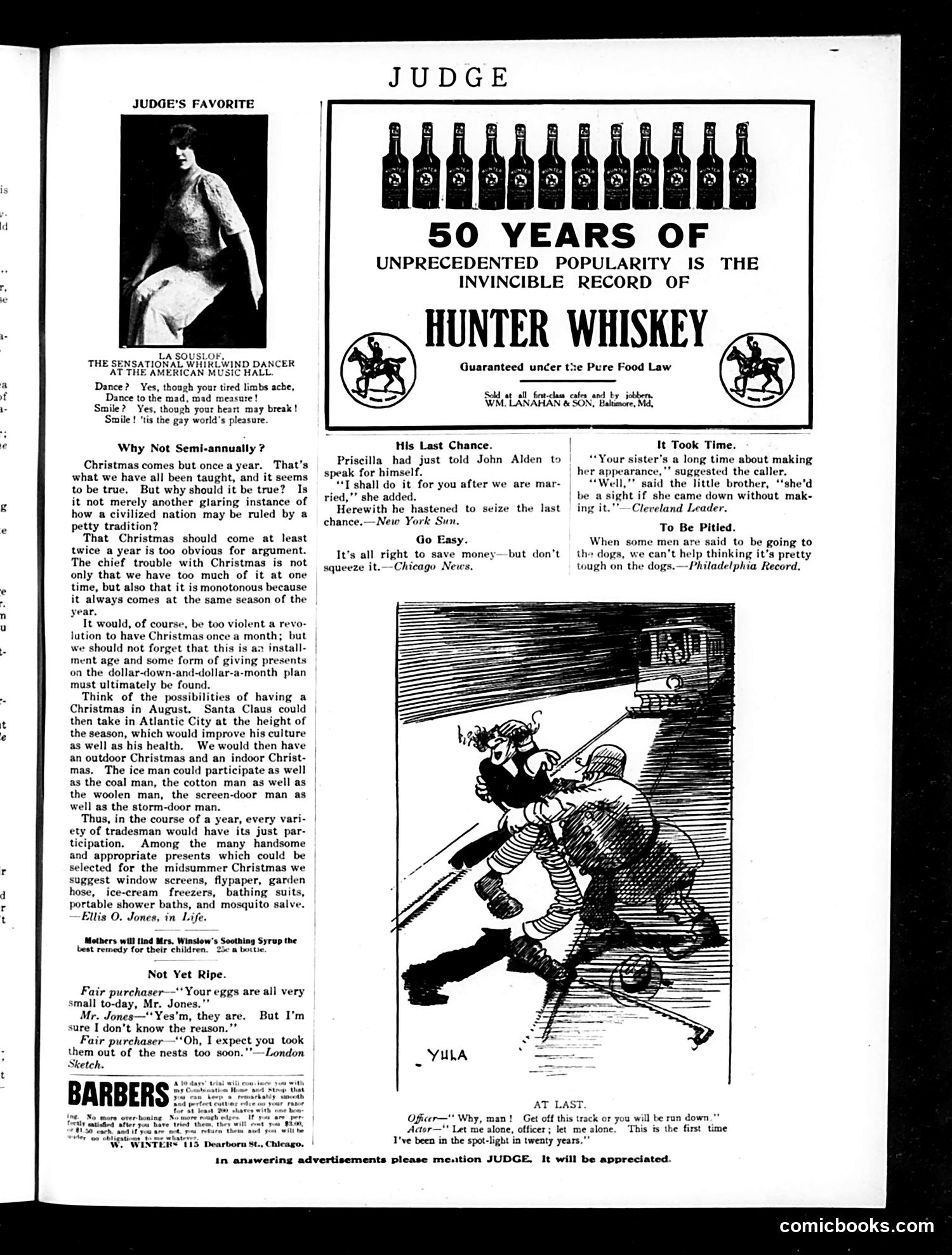
This page contains **short humorous anecdotes and advertisements** rather than political cartoons. **Key Content:** The main satirical piece is "Why Not Semi-annually?"—a tongue-in-cheek proposal to celebrate Christmas twice yearly. The author argues that since Christmas is monotonous (always same season) and modern life operates on installment plans, society should add a "midsummer Christmas" in August. This allows different tradesmen (ice men, coal men, screen-door salesmen) equal business opportunities. The humor mocks both rigid traditions and the era's obsession with consumer installment purchasing. **Other Elements:** - Several brief joke exchanges (eggs too small, actor in spotlight) - A Yulla illustration of a skier - Period advertisements including Hunter Whiskey (emphasizing 50 years of popularity and Pure Food Law compliance—reflecting early 1900s consumer concerns about product safety) - An ad for Mrs. Winslow's Soothing Syrup for children **Context for Modern Readers:** The page reflects Progressive Era anxieties about modernization, consumer culture, and the tension between tradition and efficiency that characterized early 20th-century America.
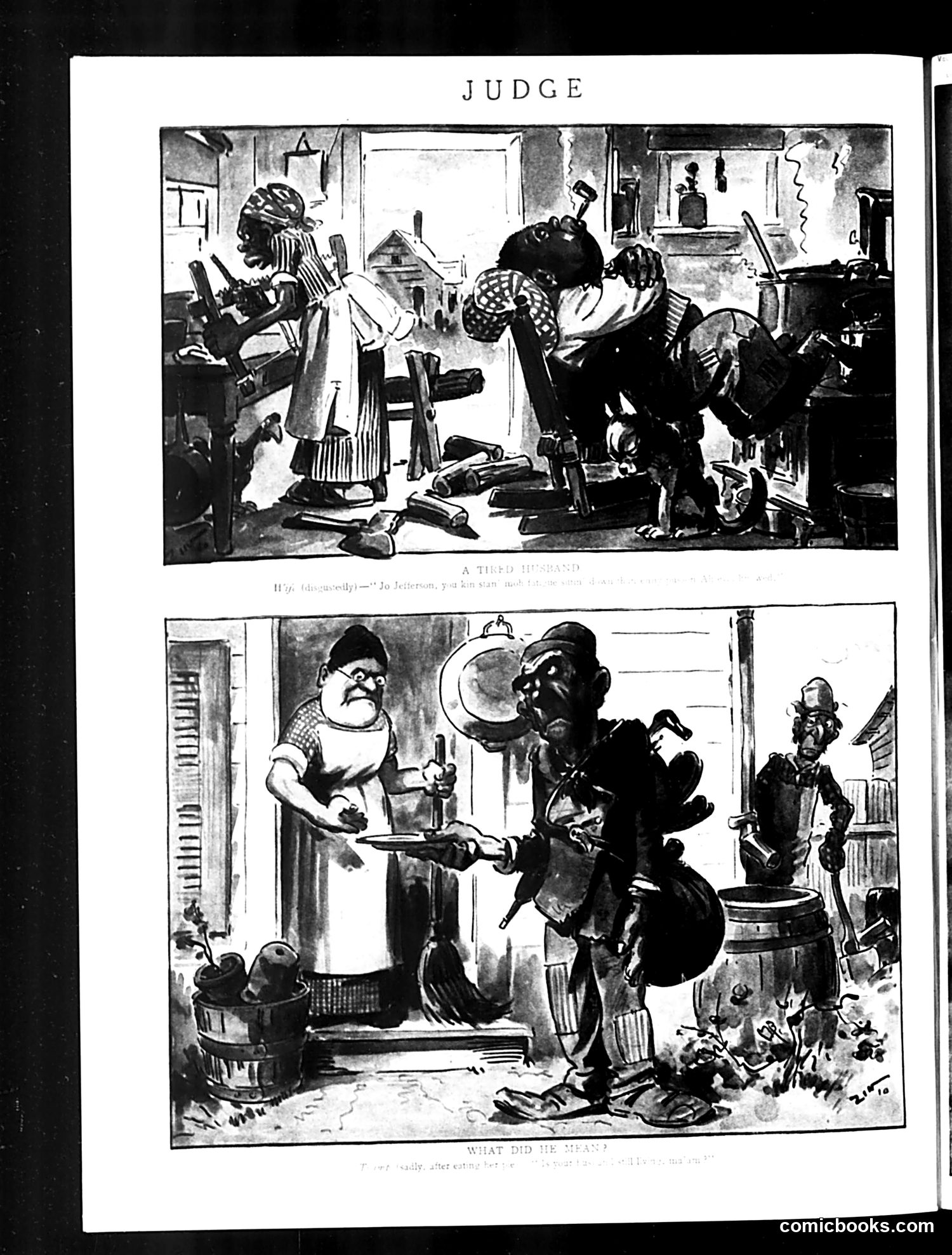
These two cartoons satirize domestic discord and marital conflict through physical comedy. The top panel, "A Tired Husband," depicts a chaotic kitchen scene where a man appears exhausted while his wife and another woman engage in animated activity amid scattered cookware and household items—suggesting domestic tumult. The bottom panel, "What Did He Say?," shows a confrontation between a man and woman in a kitchen setting, with what appears to be a third party observing. The title suggests miscommunication or marital misunderstanding. Both cartoons use exaggerated caricature typical of late 19th/early 20th-century Judge magazine humor, mocking the frustrations of married life and the stereotypical "battle of the sexes" popular in period satire. The settings emphasize women's domestic domain versus the husband's outsider status.