
Judge, 1910-12-17 · page 14 of 24
Judge — December 17, 1910 — page 14: what you’re looking at
What you’re looking at
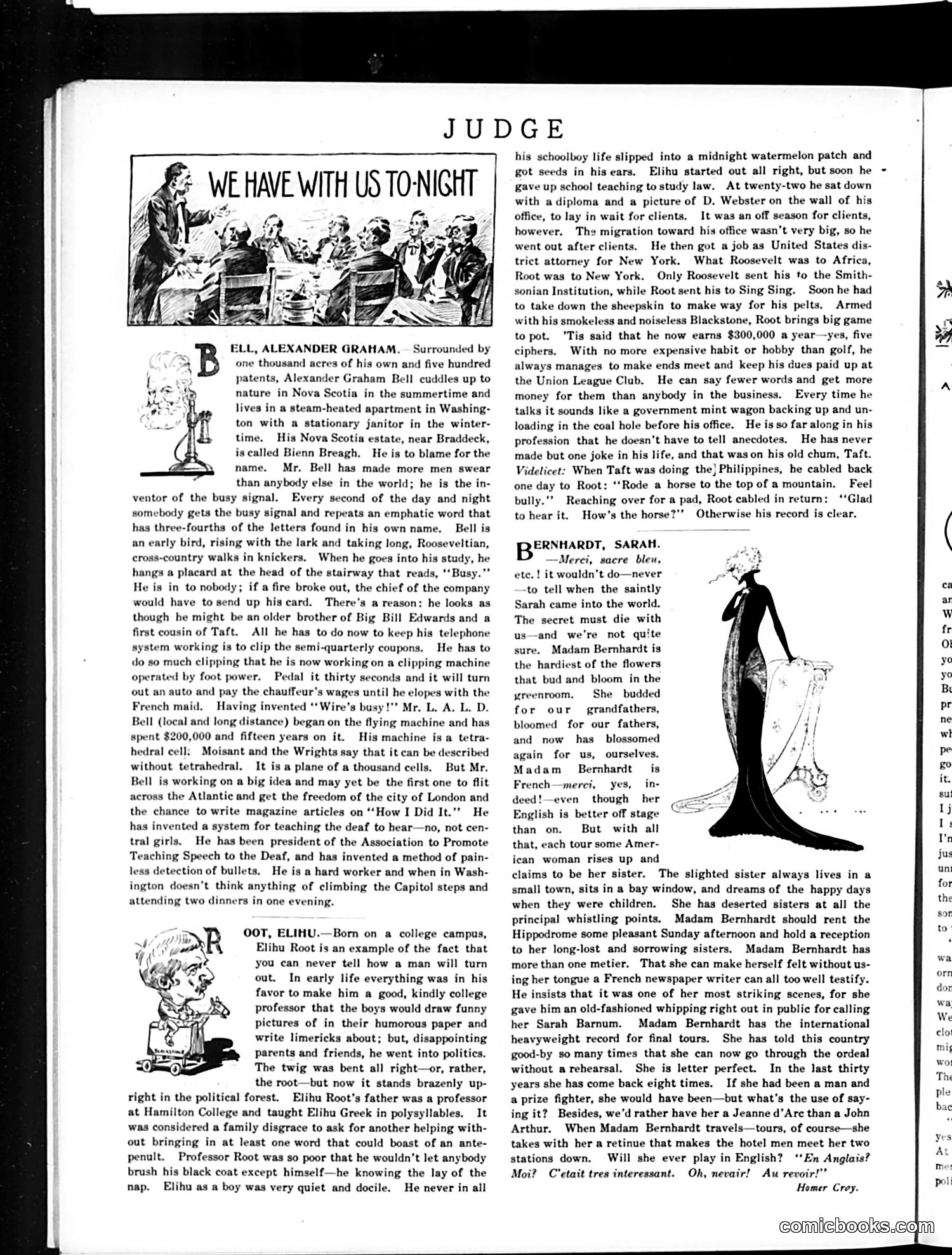
This page profiles three prominent American figures through satirical biographical sketches: **Alexander Graham Bell** is mocked for inventing the "busy signal" (blamed for making countless people swear in frustration) and for his obsessive work habits—hanging "Busy" signs to avoid interruptions. The satire suggests he's so consumed by invention that he neglects normal life, though he's also credited with genuine scientific achievements (deaf education, aviation research). **Elihu Root** is portrayed as an unexpected political figure—his Greek-professor father expected him to become an academic, but Root became a prominent lawyer and politician instead. The humor plays on his transformation from a well-mannered, timid boy into someone "brazenly" active in politics. The cartoon's top panel shows these figures as dinner guests, likely at a Washington social event. Judge's satirical approach celebrates their accomplishments while gently ribbing their quirks and unexpected life trajectories—typical of the magazine's light roasting of public figures.
📄 Transcribed text from this page (OCR, searchable)
Machine-transcribed from the original scan — historical spelling and the odd misread are preserved.
JUDGE re, P= WEHAVE WITH US TONIGHT one thousand acres of his own and five hundred patents, Alexander Graham Bell cuddles up to nature in Nova Scotia in the summertime and lives in a steam-heated apartment in Washing- ton with a stationary janitor in the winter- time. His Nova Scotia estate, near Braddeck, is called Bienn Breagh. He is to blame for the name. Mr. Bell has made more men swear than anybody else in the world; he is the in- ventor of the busy signal. Every second of the day and night somebody gets the busy signal and repeats an emphatic word that has three-fourths of the letters found in his own name. Bell is an early bird, rising with the lark and taking long, Rooseveltian, cross-country walks in knickers. When he goes into his study, he hangs a placard at the head of the stairway that reads, ‘‘Busy.’’ He is in to nobody; if a fire broke out, the chief of the company would have to send up his card. There's a reason: he looks as though he might be an older brother of Big Bill Edwards and a first cousin of Taft. All he has to do now to keep his telephone system working is to clip the semi-quarterly coupons. He has to do so much clipping that he is now working on a clipping machine operated by foot power. Pedal it thirty seconds and it will turn out an auto and pay the chauffeur’s wages until he elopes with the French maid. Having invented **Wire’s busy!"’ Mr. L. A. L. D. Bell (local and long distance) began on the flying machine and has spent $200,000 and fifteen years on it. His machine is a tetra- hedral cell; Moisant and the Wrights say that it can be described without tetrahedral. It is a plane of a thousand cells. But Mr. Bell is working on a big idea and may yet be the first one to flit across the Atlantic and get the freedom of the city of London and the chance to write magazine articles on ‘How I Did It."" He has invented a system for teaching the deaf to hear—no, not cen- tral girls. He has been president of the Association to Promote Teaching Speech to the Deaf, and has invented a method of pain- less detection of bullets. He is a hard worker and when in Wash- ington doesn’t think anything of climbing the Capitol steps and attending two dinners in one evening. B ELL, ALEXANDER GRAHAM. | Surrounded by OOT, ELINU.—Born on a college campus, Elihu Root is an example of the fact that you can never tell how a man will turn out. In early life everything was in his favor to make him a good, kindly college professor that the boys would draw funny pictures of in their humorous paper and write limericks about; but, disappointing parents and friends, he went into politics. The twig was bent all right—or, rather, the root—but now it stands brazenly up- right in the political forest. Elihu Root’s father was a professor at Hamilton College and taught Elihu Greek in polysyllables. It was considered a family disgrace to ask for another helping with- out bringing in at least one word that could boast of an ante- penult. Professor Root was so poor that he wouldn't let anybody brush his black coat except himself—he knowing the lay of the nap. Elihu as a boy was very quiet and docile. He never in all his schoolboy life slipped into a midnight watermelon patch and got seeds in his ears. Elihu started out all right, but soon he gave up school teaching to study law. At twenty-two he sat down with a diploma and a picture of D. Webster on the wall of his office, to lay in wait for clients. It was an off season for clients, however. The migration toward his office wasn’t very big, so he went out after clients. He then got a job as United States dis- trict attorney for New York. What Roosevelt was to Africa, Root was to New York. Only Roosevelt sent his to the Smith- sonian Institution, while Root sent his to Sing Sing. Soon he had to take down the sheepskin to make way for his pelts. Armed with his smokeless and noiseless Blackstone, Root brings big game to pot. ‘Tis said that he now earns $300,000 a year—yes, five ciphers. With no more expensive habit or hobby than golf, he always manages to make ends meet and keep his dues paid up at the Union League Club. He can say fewer words and get more money for them than anybody in the business. Every time he talks it sounds like a government mint wagon backing up and un- loading in the coal hole before his office. He is so far along in his profession that he doesn’t have to tell anecdotes. He has never made but one joke in his life, and that was on his old chum, Taft. Videlicet: When Taft was doing the} Philippines, he cabled back one day to Root: ‘Rode a horse to the top of a mountain. Feel bully. Reaching over for a pad, Root cabled in return: ‘‘Glad to hear it. How’s the horse?”’ Otherwise his record is clear. ERNHARDT, SARAH. —Merci, sacre bleu, ete. ! it wouldn't do—never -to tell when the saintly Sarah came into the world. The secret must die with us—and we're not quite sure. Madam Bernhardt is the hardiest of the flowers that bud and bloom in the yreenroom. She budded for our grandfathers, bloomed for our fathers, and now has _ blossomed again for us, ourselves, Madam _ Bernhardt is French—merei, yes, in- deed! —e though her English is better off stage than on. But with all that, each tour some Amer- ican woman rises up and claims to be her sister. The slighted sister always lives in a small town, sits ina bay window, and dreams of the happy days when they were children. She has deserted sisters at all the principal whistling points. Madam Bernhardt should rent the Hippodrome some pleasant Sunday afternoon and hold a reception to her long-lost and sorrowing sisters. Madam Bernhardt has more than one metier. That she can make herself felt without us- ing her tongue a French newspaper writer can all too well testify. He insists that it was one of her most striking scenes, for she gave him an old-fashioned whipping right out in public for calling her Sarah Barnum. Madam Bernhardt has the international heavyweight record for final tours. She has told this country good-by so many times that she can now go through the ordeal without a rehearsal. She is letter perfect. In the last thirty years she has come back eight times. If she had been a man and a prize fighter, she would have been—but what's the use of say- ing it? Besides, we'd rather have her a Jeanne d’Arc than a John Arthur. When Madam Bernhardt travels—tours, of course—she takes with her a retinue that makes the hotel men meet her two stations down. Will she ever play in English? ‘‘En Anglais? Moi? C’etait tres interessant. Oh, nevair! Au revoir!"’ Homer Crey. comichooks.