
Judge, 1910-12-17 · page 16 of 24
Judge — December 17, 1910 — page 16: what you’re looking at
What you’re looking at
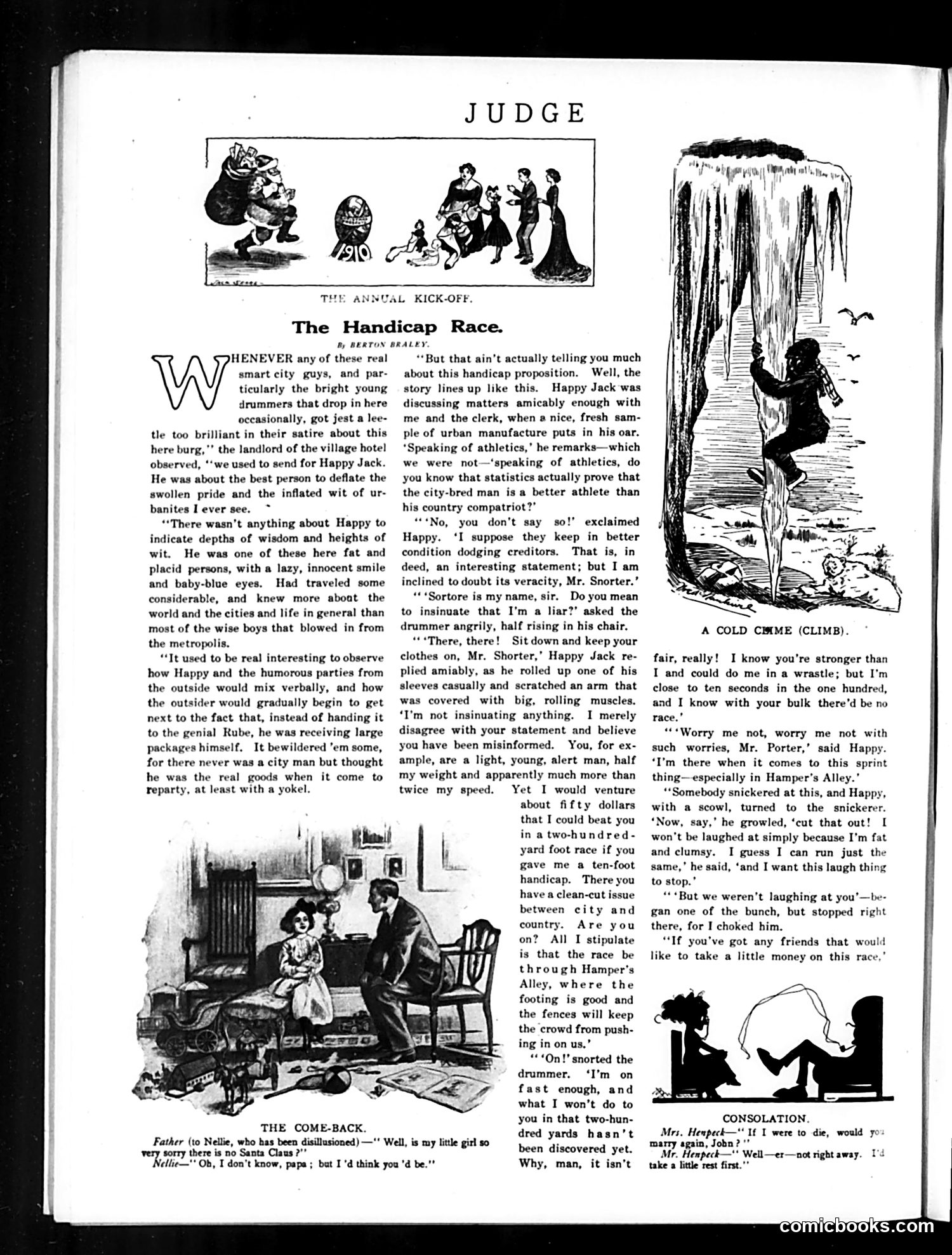
This page satirizes the stereotype of the city "drummer" (traveling salesman) as an arrogant know-it-all who condescends to rural people. The story describes a cocky urban salesman claiming city-dwellers are superior athletes based on "statistics." Happy Jack, a seemingly simple country man with a lazy demeanor and "baby-blue eyes," challenges him to a foot race through Hamper's Alley. The satire works by subverting expectations: the city man assumes rural people are inferior, but Happy Jack—despite appearing dumb and overweight—confidently offers to beat him while giving a handicap. The joke exposes how urbanites mistake book-learning and statistics for actual wisdom or ability, while underestimating practical country folk. The smaller cartoons mock sentimental city attitudes ("no Santa Claus") and urban pretension generally.
📄 Transcribed text from this page (OCR, searchable)
Machine-transcribed from the original scan — historical spelling and the odd misread are preserved.
THE ANNUAL KICK-OFF, The Handicap Race. By BERTON BRALEY. HENEVER any of these real smart city guys, and par- ticularly the bright young drummers that drop in here occasionally, got jest a lee- tle too brilliant in their satire about this here burg,”’ the landlord of the village hotel observed, ‘‘we used to send for Happy Jack. He was about the best person to deflate the swollen pride and the inflated wit of ur- banites lever see. ~ “There wasn't anything about Happy to indicate depths of wisdom and heights of wit. He was one of these here fat and placid persons, with a lazy, innocent smile and baby-blue eyes. Had traveled some considerable, and knew more aboat the world and the cities and life in general than most of the wise boys that blowed in from the metropolis. “It used to be real interesting to observe how Happy and the humorous parties from the outside would mix verbally, and how the outsider would gradually begin to get next to the fact that, instead of handing it to the genial Rube, he was receiving large packages himself. It bewildered ’em some, for there never was a city man but thought he was the real goods when it come to reparty, at least with a yokel. THE COME-BACK. Father (to Nellie, who bas been disillusioned) —‘' Well, is my little girl so sorry there is no Santa Claus ?”” fellie—"* Ob, I don't know, papa ; but I'd think you 'd be.'" “But that ain’t actually telling you much about this handicap proposition. Well, the story lines up like this. Happy Jack was discussing matters amicably enough with me and the clerk, when a nice, fresh sam- ple of urban manufacture puts in his oar. ‘Speaking of athletics,’ he remarks—which we were not—‘speaking of athletics, do you know that st: ics actually prove that the city-bred man is a better athlete than his country compatriot?" "No, you don't say so!’ exclaimed Happy. ‘I suppose they keep in better condition dodging creditors. That is, in deed, an interesting statement; but I am inclined to doubt its veracity, Mr. Snorter.’ “«*Sortore is my name, sir. Do you mean to insinuate that I'm a liar?’ asked the drummer angrily, half rising in his chair, “There, there! Sit down and keep your clothes on, Mr. Shorter,’ Happy Jack re- plied amiably, as he rolled up one of his sleeves casually and scratched an arm that was covered with big, rolling muscles, ‘I'm not insinuating anything. I merely disagree with your statement and believe you have been misinformed. You, for ex- ample, are a light, young, alert man, half my weight and apparently much more than Yet I would venture about fifty dollars that I could beat you in a two-hundred- yard foot race if you gave me a ten-foot handicap. There you have a clean-cut issue between city and country. Are you on? All I stipulate is that the race be through Hamper’s Alley, where the footing is good and the fences will keep the ‘crowd from push- ing in on us,’ “**On!’ snorted the drummer. ‘I’m on fast enough, and what I won't do to you in that two-hun- dred yards hasn’t been discovered yet. Why, man, it isn't twice my speed. A COLD CMIME (CLIMB). fair, really! I know you're stronger than I and could do me in a wrastle; but I'm close to ten seconds in the one hundred, and I know with your bulk there'd be no race.’ ‘Worry me not, worry me not with such worries, Mr. Porter,’ said Happy. ‘I'm there when it comes to this sprint thing—especially in Hamper's Alley.’ “Somebody snickered at this, and Happy, with a scowl, turned to the snickerer. ‘Now, say,’ he growled, ‘cut that out! [ won't be laughed at simply because I’m fat I guess I can run just the id, ‘and I want this laugh thing and clumsy. same,’ he 83 to stop.’ “**But we weren't laughing at you’—be- gan one of the bunch, but stopped right there, for I choked him. “If you've got any friends that would like to take a little money on this race,’ CONSOLATION. Mrs. Henpeck—“‘ If I were to die, would yo: marry again, Jobn?"’ Mr. Henpeck—‘* Well—er—not right away. I'd take a little rest first." icbooks.com