
A complete issue · 24 pages · 1910
Judge — December 10, 1910
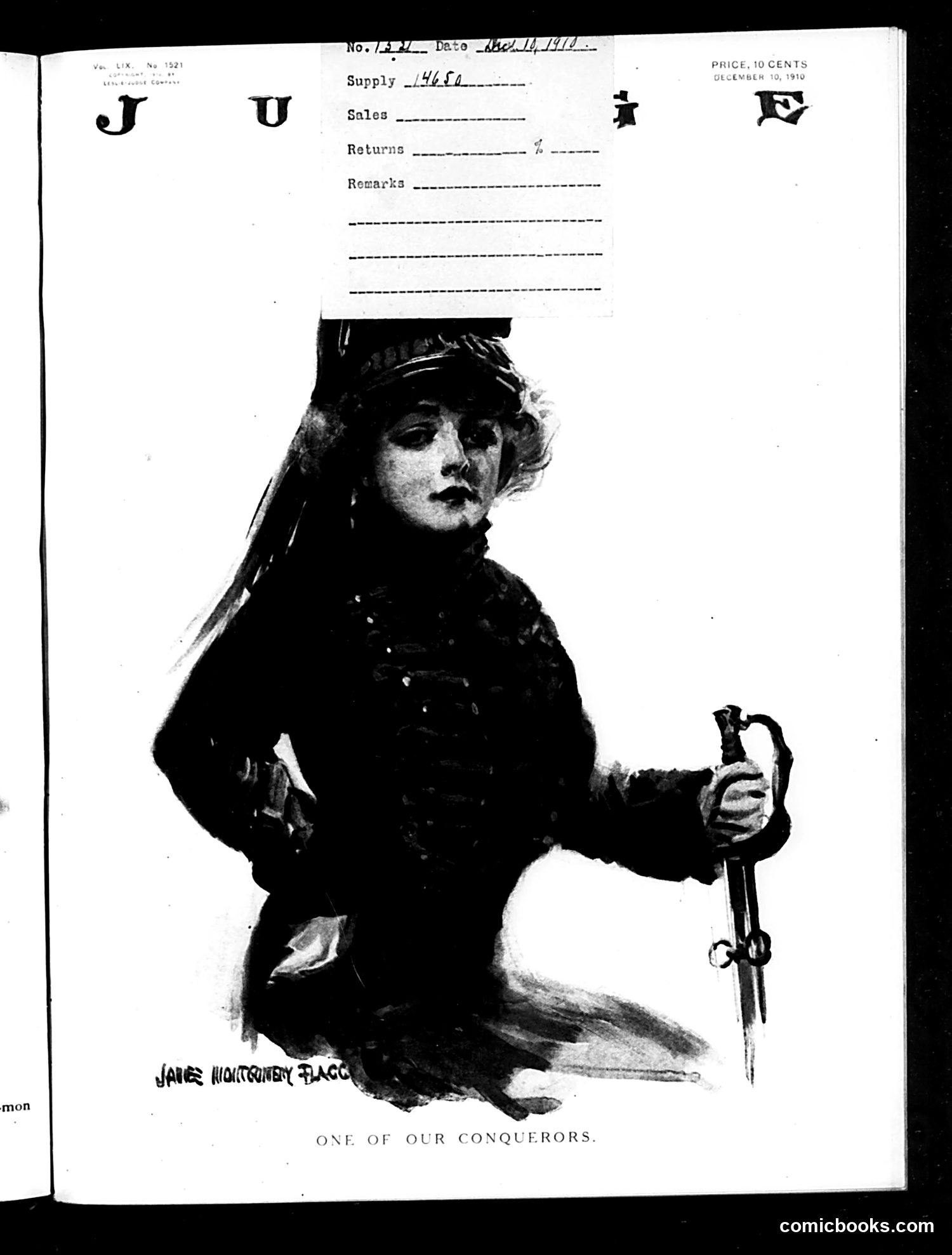
This Judge magazine page features a satirical illustration by James Montgomery Flagg depicting a figure in military attire holding a rifle and sword. The caption "ONE OF OUR CONQUERORS" appears to reference American military conquest or imperialism, likely from the early 20th century period when Judge regularly satirized U.S. foreign policy. The character's somewhat exaggerated, feminine features and theatrical pose suggest mockery of militaristic posturing. Without clearer historical context from the supply/sales information at the page's top, the specific military campaign referenced remains unclear—though this appears critical commentary on American imperial ventures, possibly relating to conflicts in Latin America, the Philippines, or similar contemporary interventions Judge frequently lampooned.
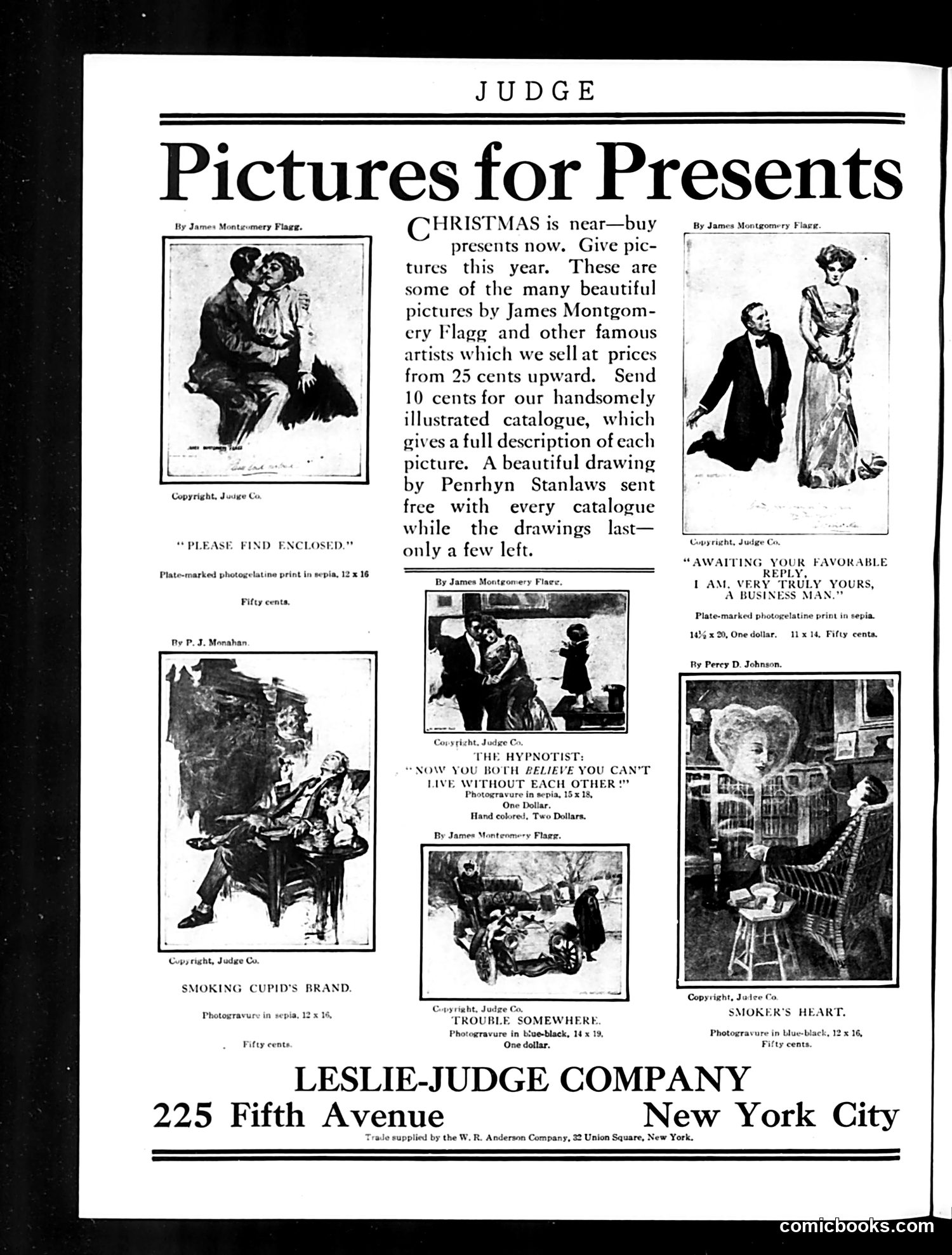
This page is primarily an **advertisement** for the Leslie-Judge Company, selling pictures and drawings as Christmas gifts. The content showcases sample artworks by prominent illustrators like James Montgomery Flagg, P.J. Monahan, and others. The pictures themselves are **sentimental romantic scenes** typical of early 1900s gift art: couples in affectionate poses ("Please Find Enclosed," "Awaiting Your Favorable Reply"), humorous domestic situations ("Smoking Cupid's Brand," "Smoker's Heart"), and dramatic moments ("The Hypnotist," "Trouble Somewhere"). These weren't satirical cartoons but rather **commercially-marketed prints** reflecting period aesthetics. The Judge magazine used its pages to advertise such products, blending editorial content with advertising—common practice for the era. The appeal was nostalgic romanticism and gentle humor for middle-class gift-giving.
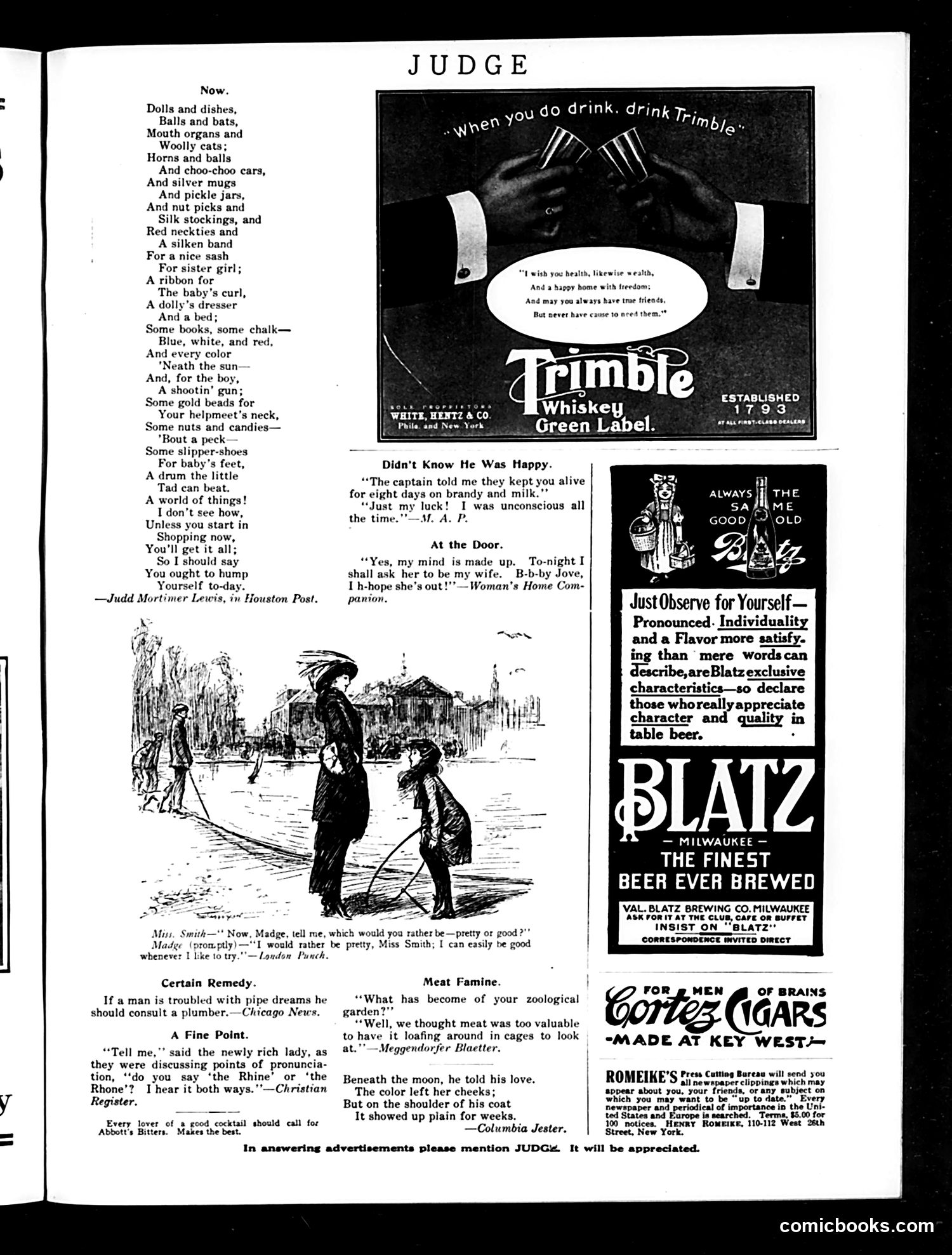
This page is primarily **advertising**, not political satire. The main content includes: 1. **Trimble Whiskey ad** (top): Features a formal toast wishing "health, like wine a wealth" and "a happy home with freedom"—standard aspirational messaging for liquor advertising. 2. **Blatz Beer ad** (right): Claims "individuality and flavor" distinguish this Milwaukee beer as "the finest ever brewed." 3. **Other ads**: Cortez Cigars, Romeike's press clipping service. 4. **Humorous sketches** (left/center): Light social comedies—one showing a woman asking a man if he'd prefer "pretty or good," another about romantic proposals. These are gentle humor, not political commentary. The page reflects early 20th-century Judge content: advertising-heavy with scattered social comedy rather than sharp political satire.
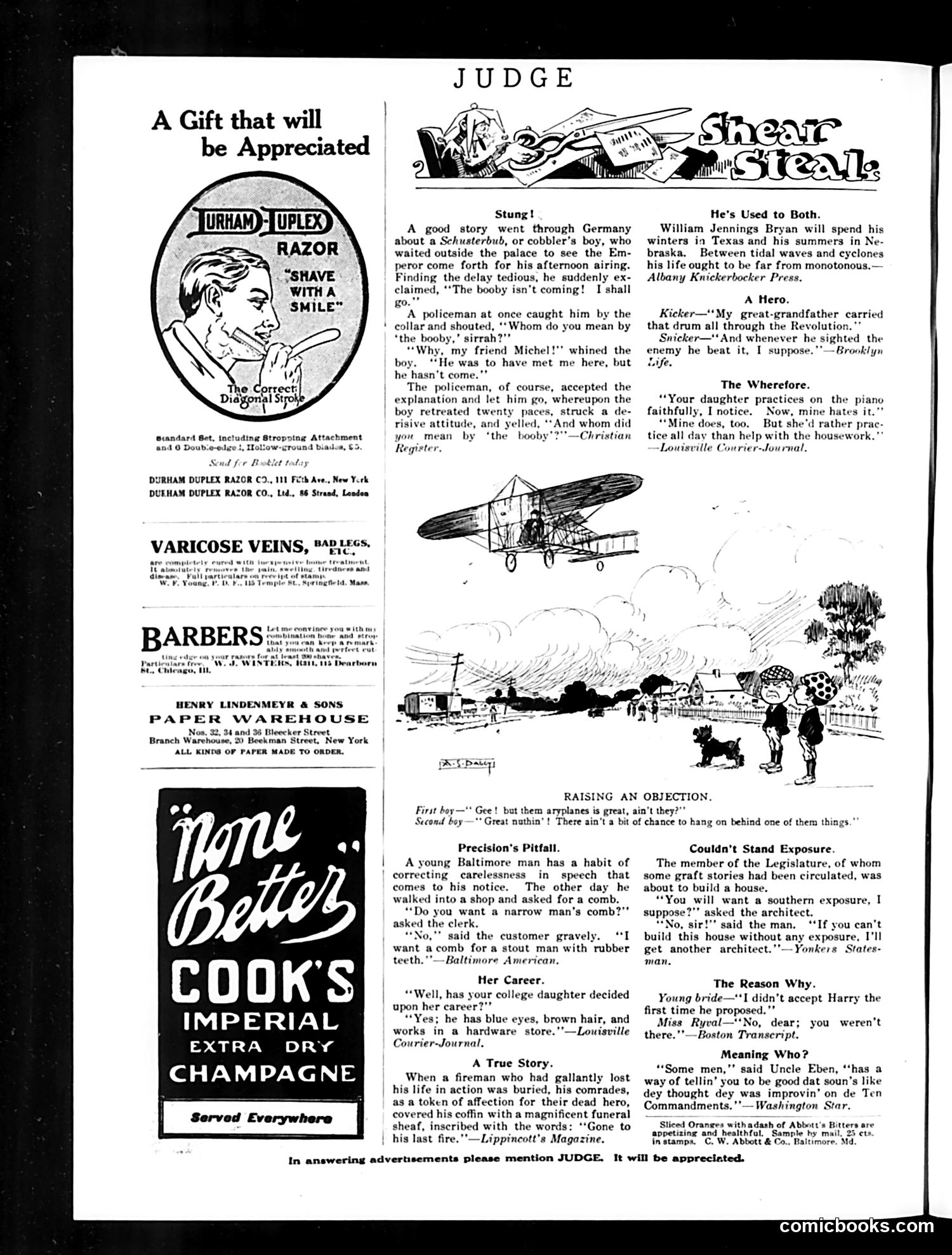
This page is primarily **advertisements and humor fillers** rather than political satire. The main content includes: **"Shear Steal"** (top right): A comic strip featuring William Jennings Bryan, the three-time presidential candidate. The humor plays on his reputation and political presence, though the specific joke is unclear from the fragmented text visible. **Other humor sections** ("Raising an Objection," "Precision's Pitfall," etc.) are generic jokes about speech, courtship, and social mishaps—typical early 20th-century magazine filler with no apparent political content. **Left side**: Advertisements for razors, barber services, champagne, and medical treatments (varicose veins). The page reflects Judge's mix of political commentary and commercial content, though this particular page emphasizes advertising over substantive satire.
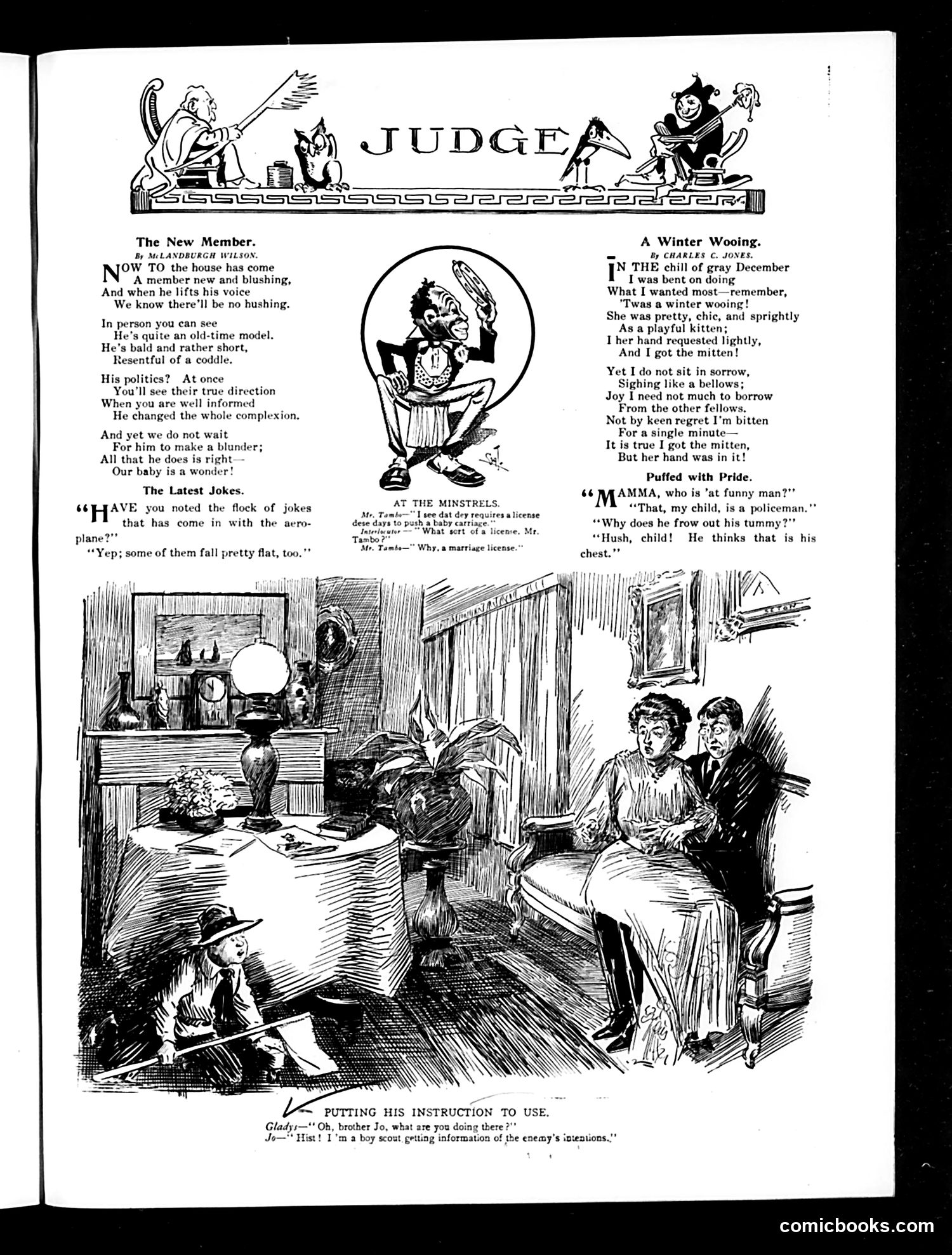
This page contains three satirical pieces from Judge magazine: 1. **"The New Member"** by Landsburgh Wilson mocks a newly elected congressman as blushing, naive, and overly idealistic about politics, suggesting he'll quickly learn that self-interest matters more than principle. 2. **"A Winter Wooing"** by Charles C. Jones is a sentimental poem about romantic rejection, unrelated to politics. 3. **"The Latest Jokes"** presents a joke about obtaining a marriage license, playing on bureaucratic procedures. 4. **The main illustration** titled "Putting His Instruction to Use" depicts a boy receiving military instruction indoors while a couple discusses his activities. The caption suggests the boy is learning about "the enemy's intentions"—likely satirizing how children absorbed militaristic or spy-craft rhetoric during an era of international tensions (appears early 20th century).
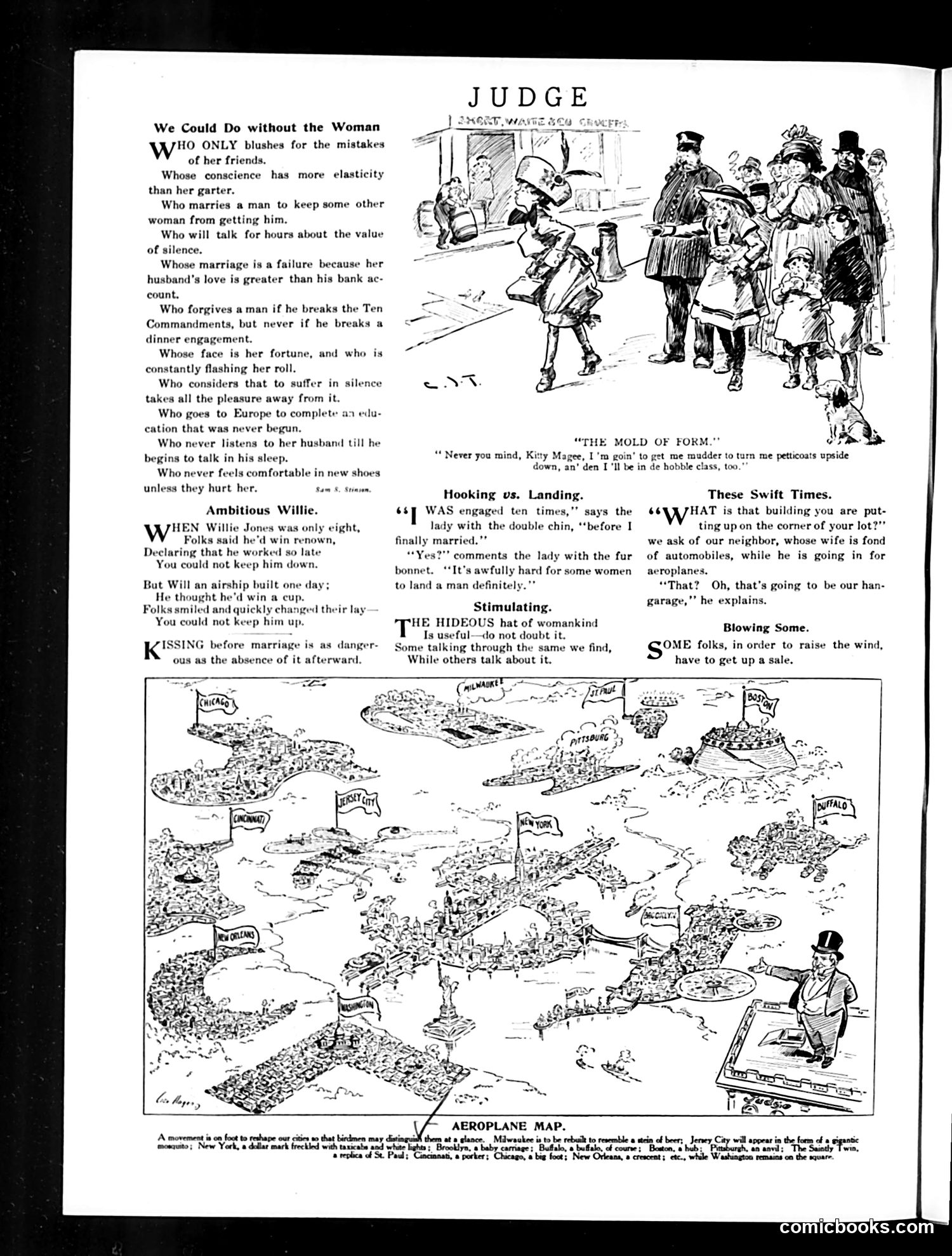
This satirical page from Judge contains multiple short humor pieces mocking social conventions, particularly women's behavior and modern society. **"We Could Do without the Woman"** presents a list of female stereotypes—women who prioritize social appearances over morality, talk excessively about silence, suffer theatrically, and care more about broken dinner engagements than broken commandments. The satire criticizes women's perceived hypocrisy and shallow values. **"Ambitious Willie"** jokes about a boy whose ambitions keep literally failing—an airship that won't stay grounded, reversing the expected meaning of "ambitious." **The remaining vignettes** target modern anxieties: women's fashion (uncomfortable shoes), courtship rituals (pre-marital kissing), aviation (the husband's aeronautical interests), and economic concerns (raising money through sales). **The "Aeroplane Map"** is a novelty cartoon reimagining American cities as aviation-related objects—likely satirizing both the era's fascination with flight and urban identity. The overall tone reflects early 20th-century satirical humor about rapidly changing gender roles, new technology, and consumer culture.
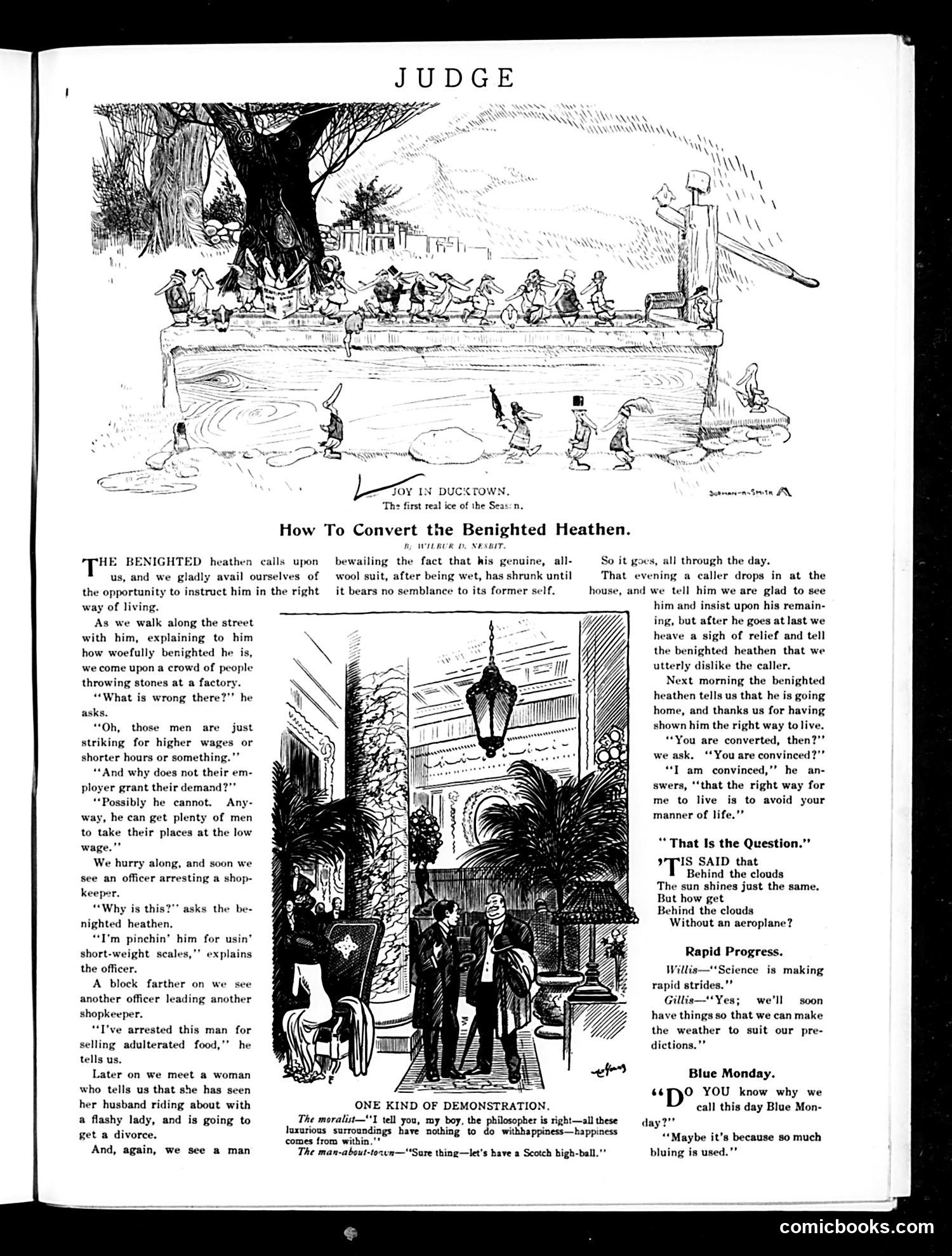
This satirical piece mocks American hypocrisy and moral superiority. A narrator "converts" a foreign visitor (the "benighted heathen") to Western civilization by parading him through the city, pointing out various social evils as if they're instructive lessons: striking workers, corrupt shopkeepers using false scales and adulterated food, infidelity, and defective merchandise. The joke is the unintended lesson: the heathen observes that American society is rife with dishonesty, labor exploitation, and moral corruption—yet presented as the "right way to live." He concludes that "the right way for me to live is to avoid your manner of life." The satire attacks American self-righteousness and the gap between professed Christian values and actual behavior. Judge magazine frequently critiqued social corruption, labor issues, and consumer fraud of the early 20th century through ironic inversion: by showing "civilization" through a foreigner's eyes, the piece exposes its fundamental hypocrisy.
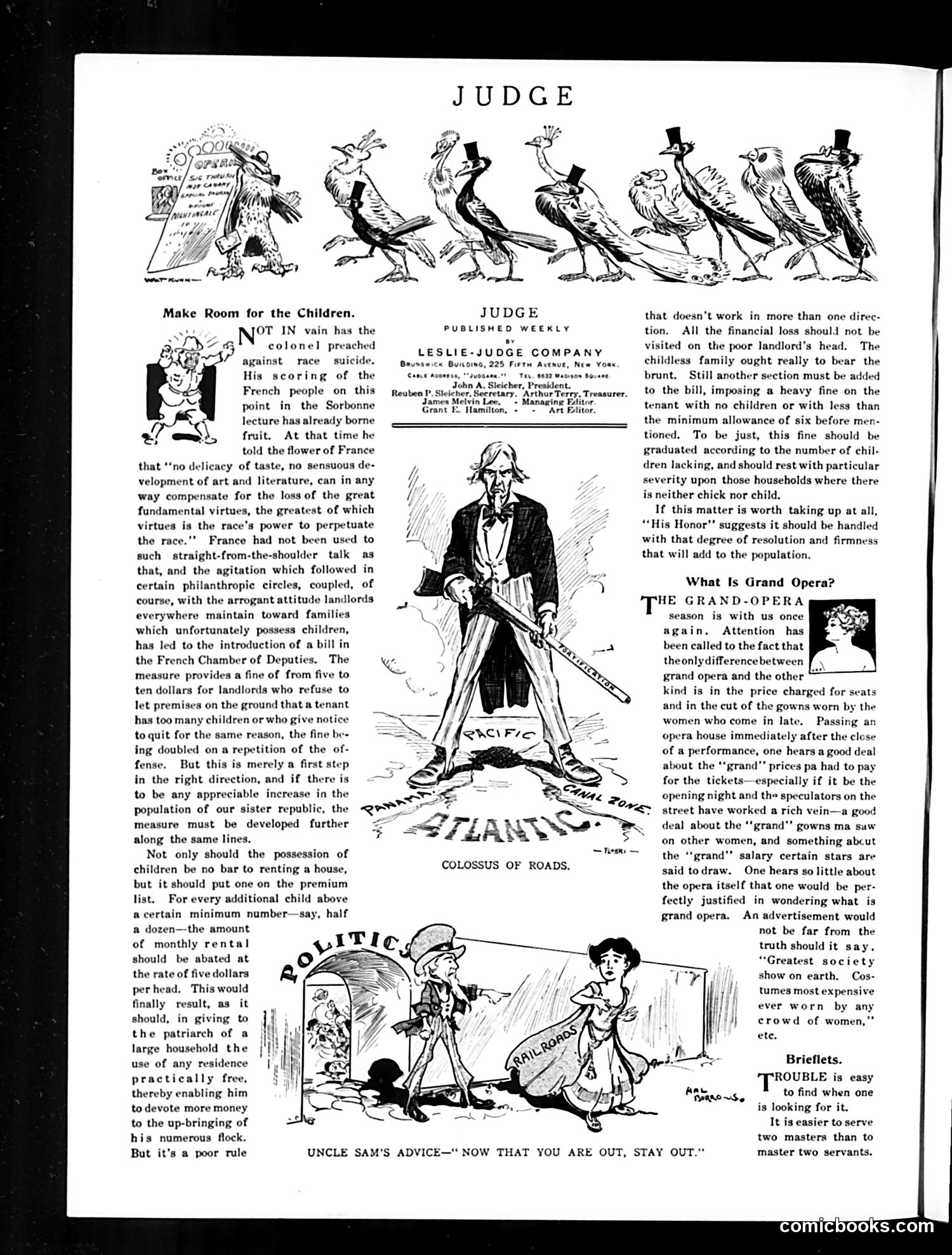
This *Judge* magazine page contains two satirical pieces: **"Make Room for the Children"** mocks a French colonel who publicly criticized France for "race suicide" (low birth rates). The piece sarcastically proposes increasingly absurd legislation: fining landlords who refuse tenants with children, then reversing it to fine *childless* tenants, with fines scaled to their lack of offspring. The satire targets both the colonel's nationalist rhetoric about population and the real French housing discrimination against families—exposing how far such "pro-natalist" thinking could logically extend into tyrannical absurdity. **"What Is Grand Opera?"** humorously suggests that "grand" opera differs from regular opera only in ticket prices and women's fancy gowns—implying the actual musical performance is irrelevant to audiences obsessed with status symbols and social display. It's gentle mockery of opera-goers' materialism. The cartoons appear to illustrate these pieces with relevant figures, though specific identities aren't clearly labeled.
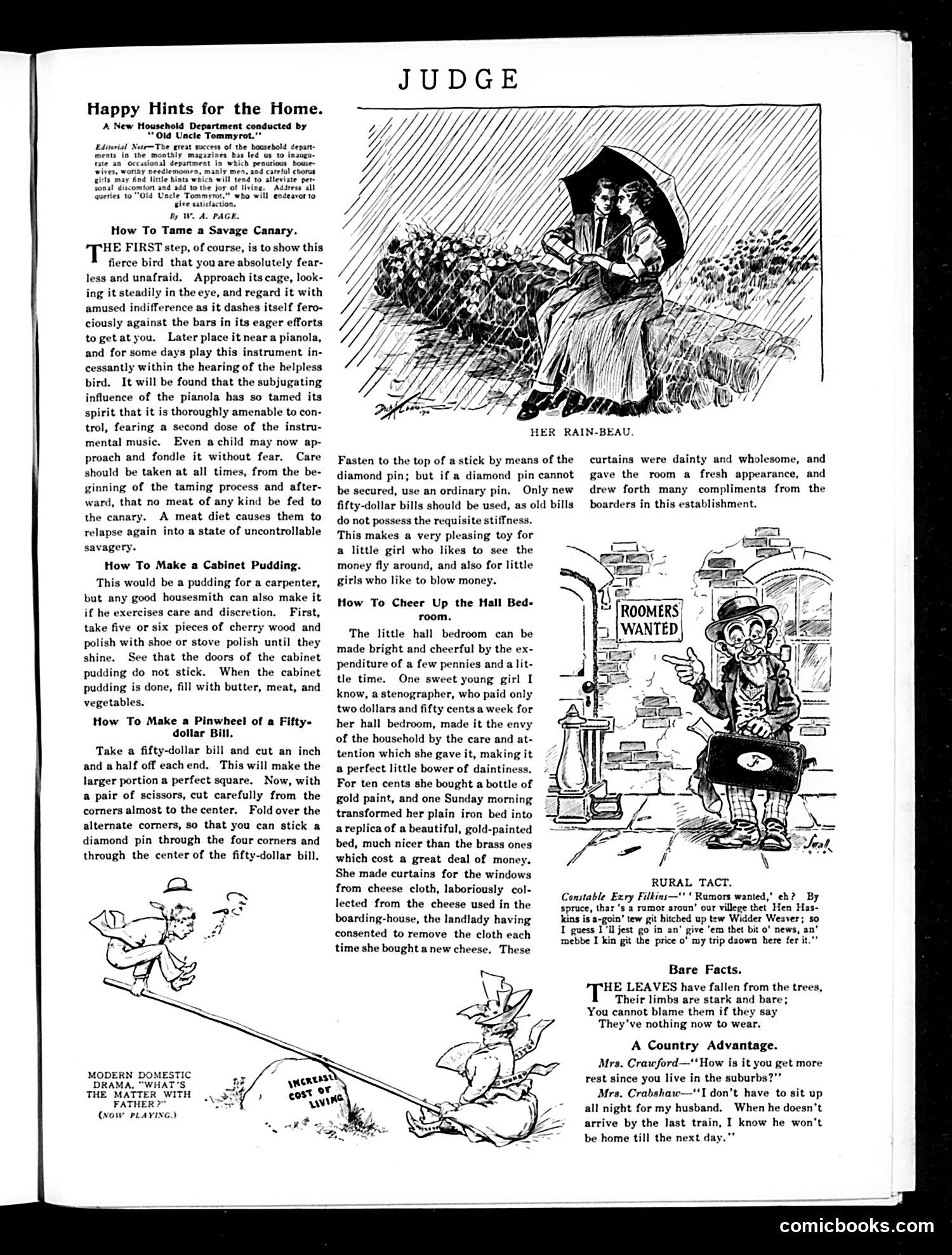
This page from Judge presents satirical "household hints" mocking domestic advice columns. The satire works through absurd, impractical instructions presented deadpan as genuine helpful tips. The humor targets: 1. **"How to Tame a Savage Canary"** – absurdly suggests playing a pianola (player piano) incessantly to subjugate a bird, inverting normal pet care logic. 2. **"Pinwheel of a Fifty-dollar Bill"** – satirizes wasteful wealthy frivolity by instructing readers to destroy currency as a children's toy, mocking both excess spending and poor financial judgment. 3. **"Cheer Up the Hall Bedroom"** – mocks penny-pinching boarding-house life and the exploitative wages of working girls (a stenographer earning $2.50/week), while praising her resourcefulness in making gold paint and cheese cloth "improvements." The cartoons reinforce these themes of class disparity and domestic absurdity. Judge's satirical approach critiques both wealthy excess and working-class economic desperation through exaggerated "advice."
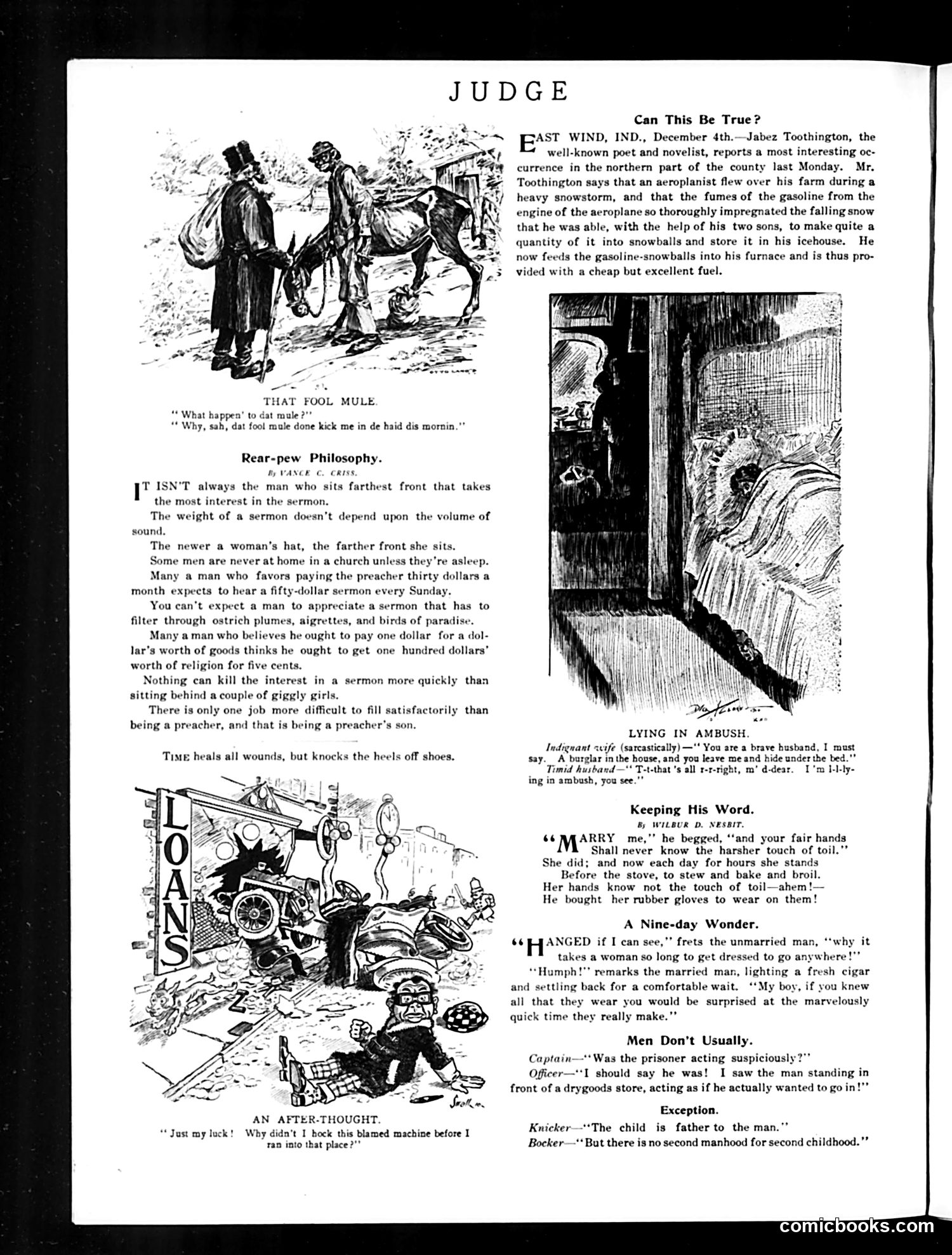
This page from the satirical magazine *Judge* contains several cartoons and humorous pieces mocking everyday social hypocrisy and gender dynamics of the era. **"That Fool Mule"** uses a dialect joke (reflecting period racial stereotypes in humor) about a mule kicking someone. **"Rear-pew Philosophy"** satirizes church behavior—criticizing parishioners who sleep through sermons, women who wear attention-grabbing hats, and those expecting free religious instruction while grudging the preacher's salary. **"Lying in Ambush"** mocks masculine cowardice: a husband hides under the bed during a burglary, claiming he's "in ambush." **"Keeping His Word"** is ironic social commentary: a suitor promises his bride will never know "toil," but she now labors at cooking. His "solution"—rubber gloves—technically keeps her hands from direct contact with labor while she works constantly. The piece satirizes both romantic false promises and the gap between courtship rhetoric and married reality, particularly regarding women's domestic expectations.
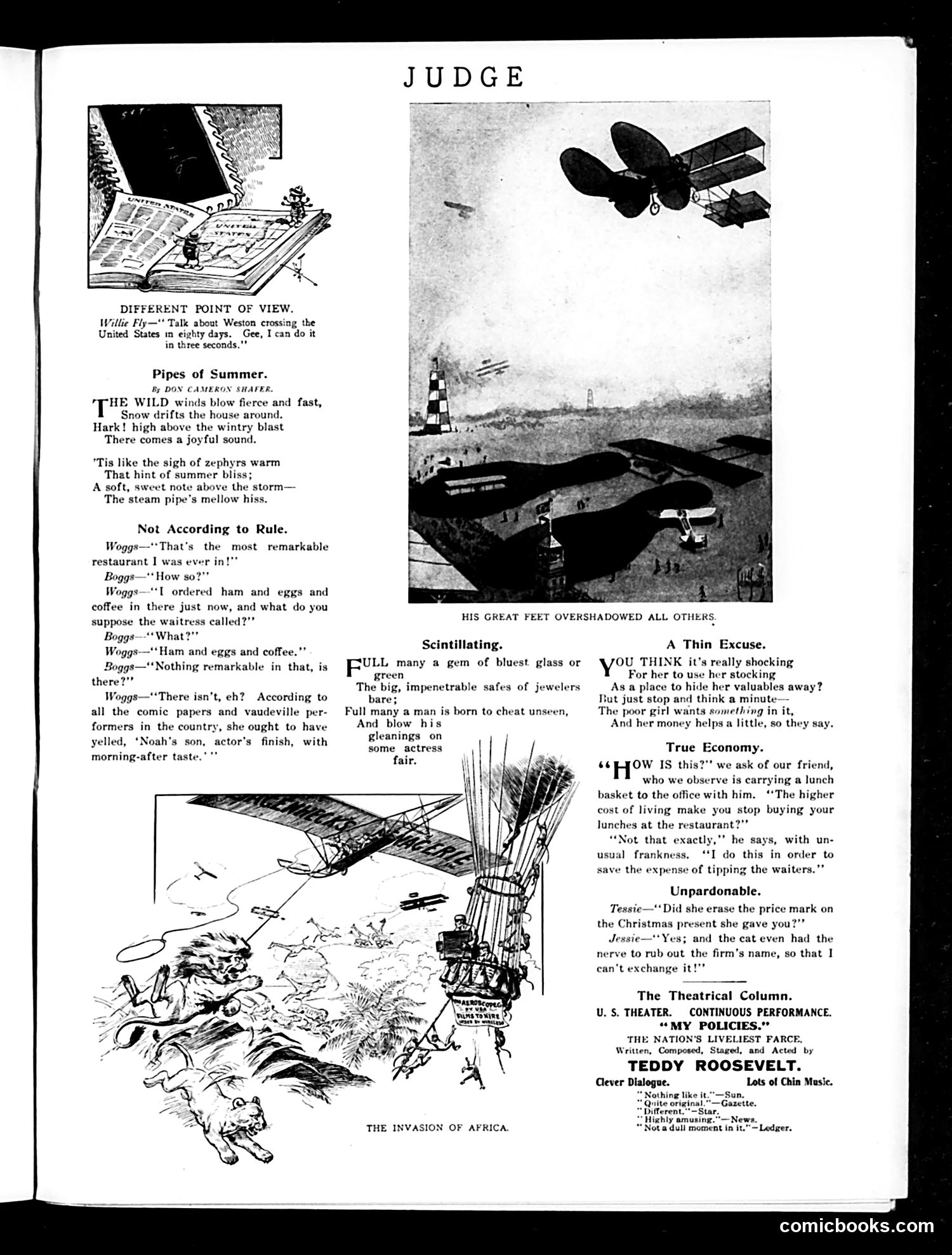
This page contains several short humorous pieces typical of Judge's satirical style: **"Different Point of View"** jokes about a fly's speed relative to Weston (likely the famous pedestrian/athlete), suggesting even insects outpace human achievement. **"Pipes of Summer"** is sentimental poetry about winter steam pipes, parodying romantic verse. **"Not According to Rule"** satirizes vaudeville conventions—a waitress correctly names food items, which the character finds shockingly unrealistic given that comedians and vaudeville performers always exaggerate or mangle such orders for laughs. **"The Invasion of Africa"** (illustrated) appears to be a political cartoon, though the specific reference is unclear from visible text. The remaining pieces—**"Scintillating,"** **"A Thin Excuse,"** **"True Economy,"** and **"Unpardonable"**—are brief joke exchanges mocking various social hypocrisies around wealth, thrift, and dishonesty. **"The Theatrical Column"** advertises a Teddy Roosevelt farce titled "My Policies," suggesting contemporary political satire of Roosevelt's administration.
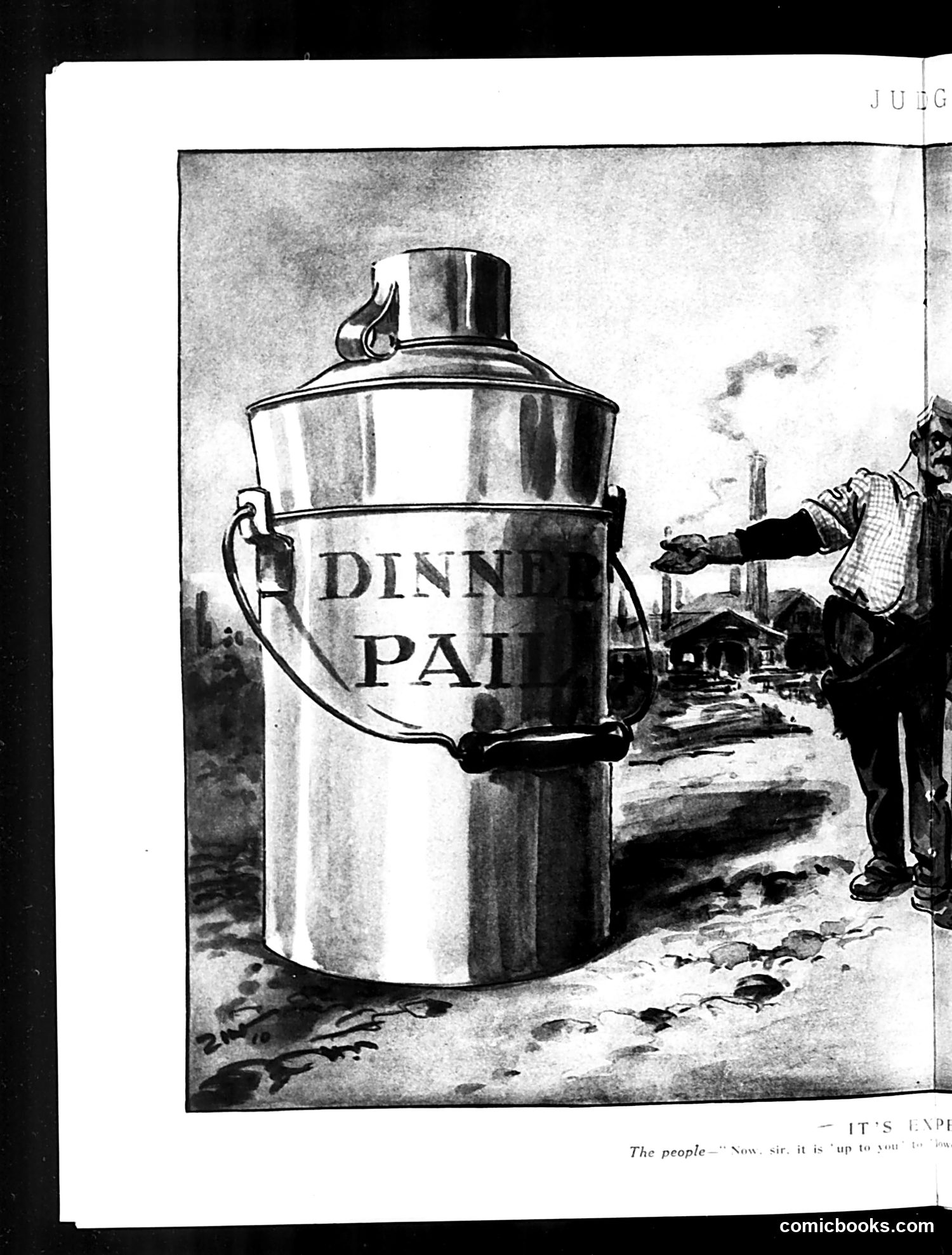
This appears to be a satirical cartoon from *Judge* magazine depicting a large dinner pail labeled "DINNER PAIL" as a central political symbol. A man in period clothing gestures toward it, with industrial imagery (smokestacks, factory buildings) visible in the background. The "dinner pail" was a famous political symbol in early 20th-century American elections, particularly associated with prosperity and working-class welfare. The phrase "a full dinner pail" promised economic security to laborers. The caption states "Now, sir, it is up to" the viewer/people, suggesting the cartoon makes an appeal about political responsibility regarding economic conditions. However, without the complete text or date visible, the specific political message and target remain unclear—it could reference any number of early-1900s debates about labor, prosperity, or political accountability.
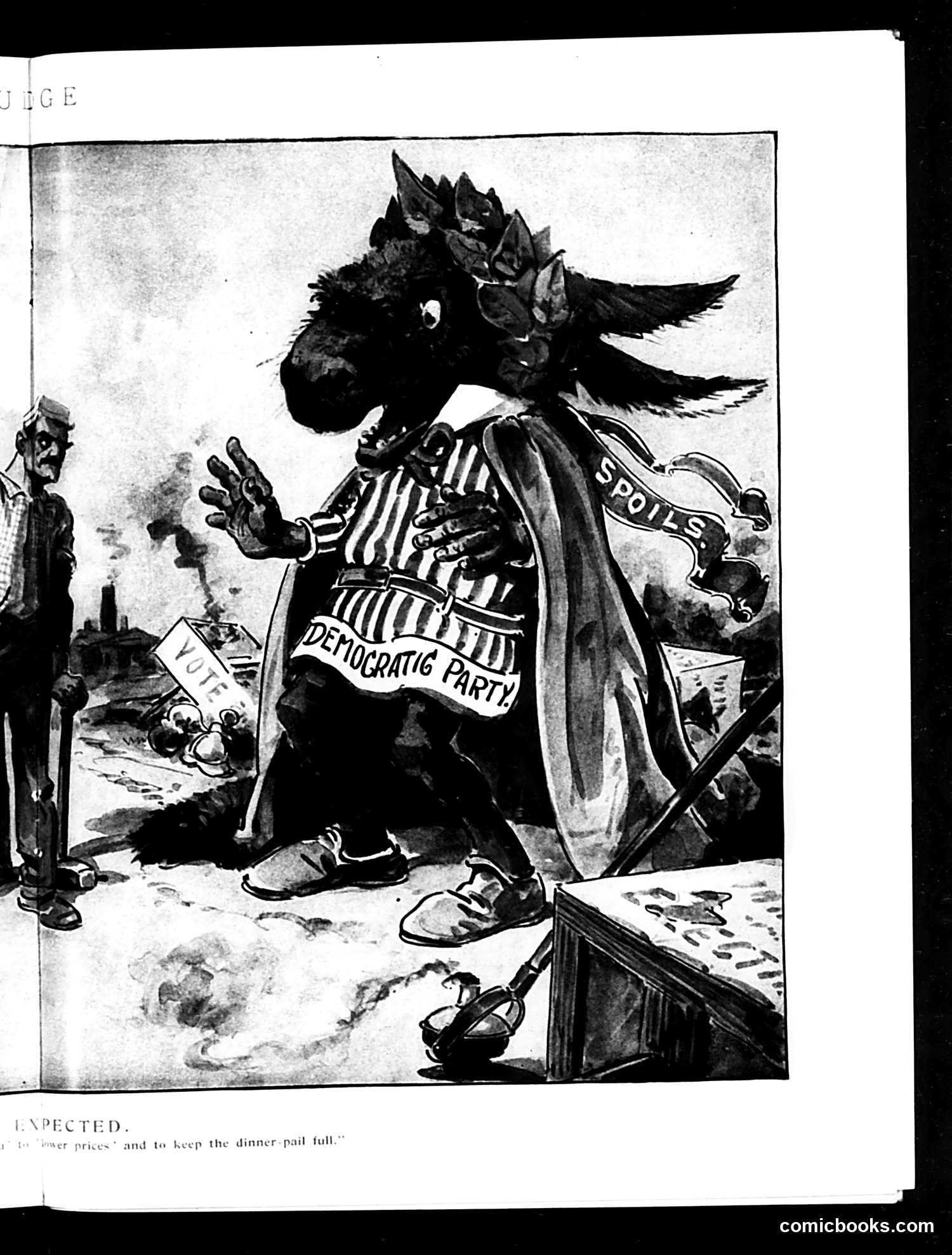
This is a political cartoon depicting a demonic or monstrous figure wearing striped clothing labeled "DEMOCRATIC PARTY" and a cape labeled "SPOILS." The creature has a grotesque head with horns and appears menacing. A "VOTE" ballot is visible on the ground. The satire attacks the Democratic Party, portraying it as corrupt and demonic, driven by desire for political "spoils" (patronage and power). The figure gestures threateningly while observers watch. The cartoon likely criticizes Democratic political practices—possibly related to machine politics, corruption, or patronage systems that were common concerns in late 19th/early 20th-century American politics. The title "EXPECTED" suggests this behavior was predictable or unsurprising to readers.
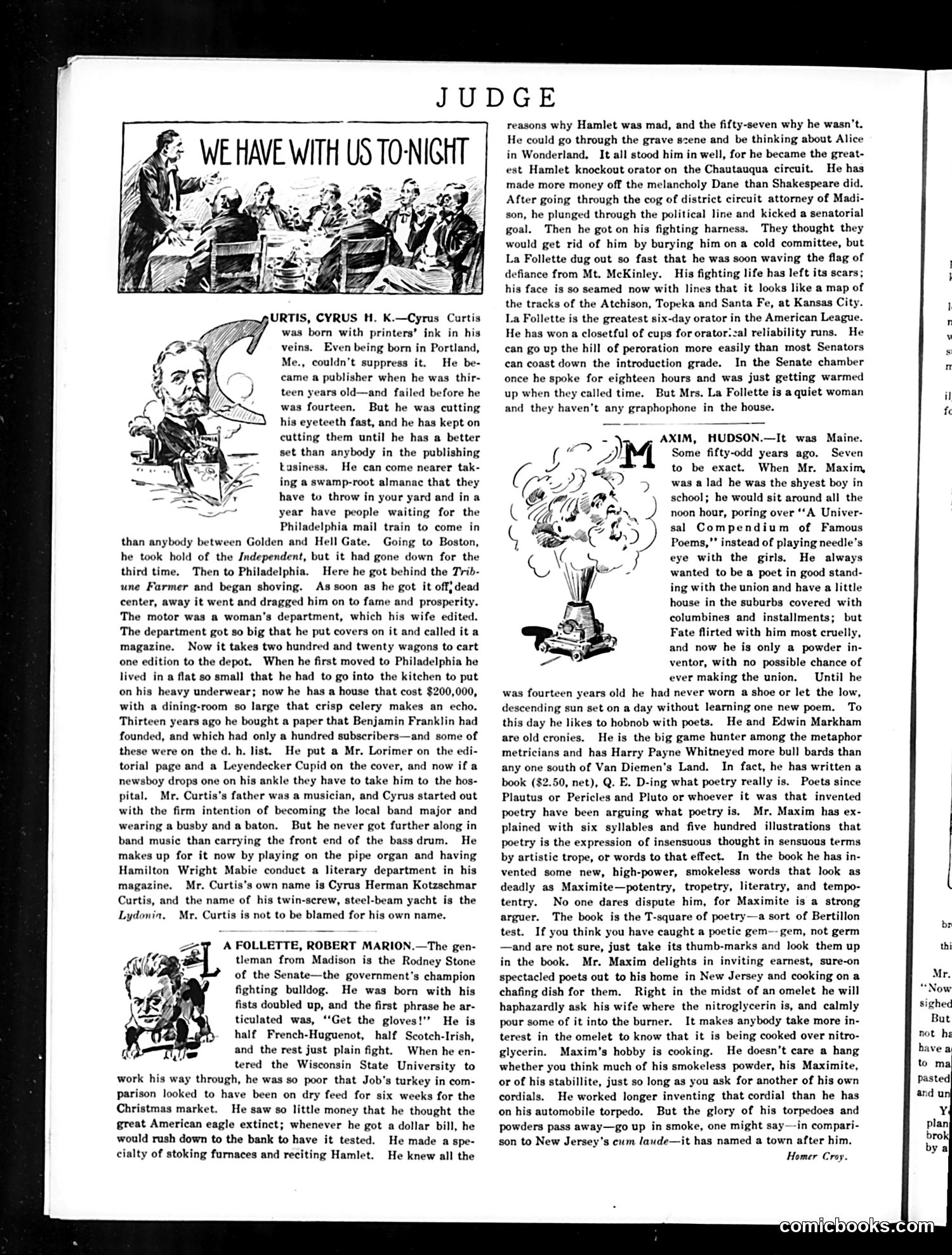
This page from Judge features biographical sketches of three prominent American figures from the early 1900s: **Cyrus Curtis** — Publisher who built the Philadelphia Curtis Publishing Company into a major enterprise. The satire mocks his rise from poverty (living in a tiny flat) to wealth ($200,000 house), and his expansion of *The Saturday Evening Post* into a massively successful magazine. The joke emphasizes his wife's "woman's department" as the original engine of his success. **Robert Marion La Follette** — Wisconsin politician (likely U.S. Senator) portrayed as a scrappy fighter—literally and politically. The satire celebrates his working-class origins, his oratorical skills on the Chautauqua circuit (where he apparently profited reciting Hamlet more than Shakespeare did), and his aggressive political maneuvering ("kicked a senatorial goal"). Both sketches use humorous exaggeration to celebrate American self-made success and political pugnacity—typical Judge fare celebrating ambitious, combative figures.
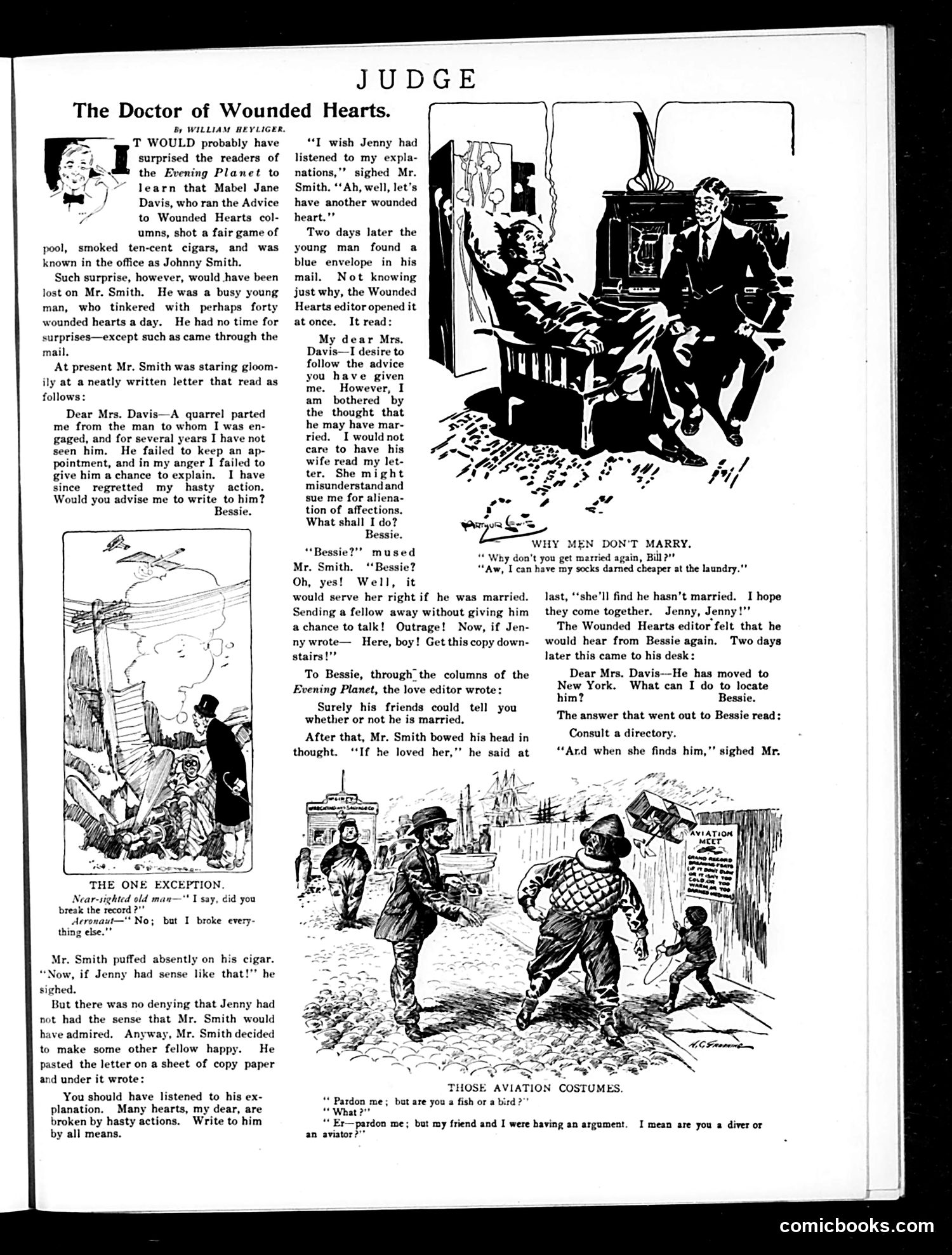
This page satirizes the hypocrisy of advice columnists. "Mrs. Davis," who dispenses romantic counsel in the *Evening Planet* newspaper, is actually Johnny Smith, a cynical male office worker who smokes cigars and makes snap judgments about love. The irony: Smith gives sound advice to a woman named Bessie about reconciling with her estranged fiancé, yet he himself failed to reconcile with his own ex-fiancée Jenny after a quarrel—advice he clearly needed but never took. As Bessie follows his guidance, Smith's emotional investment reveals his unresolved feelings. The final panel shows him hoping Bessie will "find" her man and reunite, suggesting Smith fantasizes about his own reconciliation with Jenny through others' stories. The satire targets the contradiction of lovesick advice-givers dispensing wisdom they cannot apply to themselves.
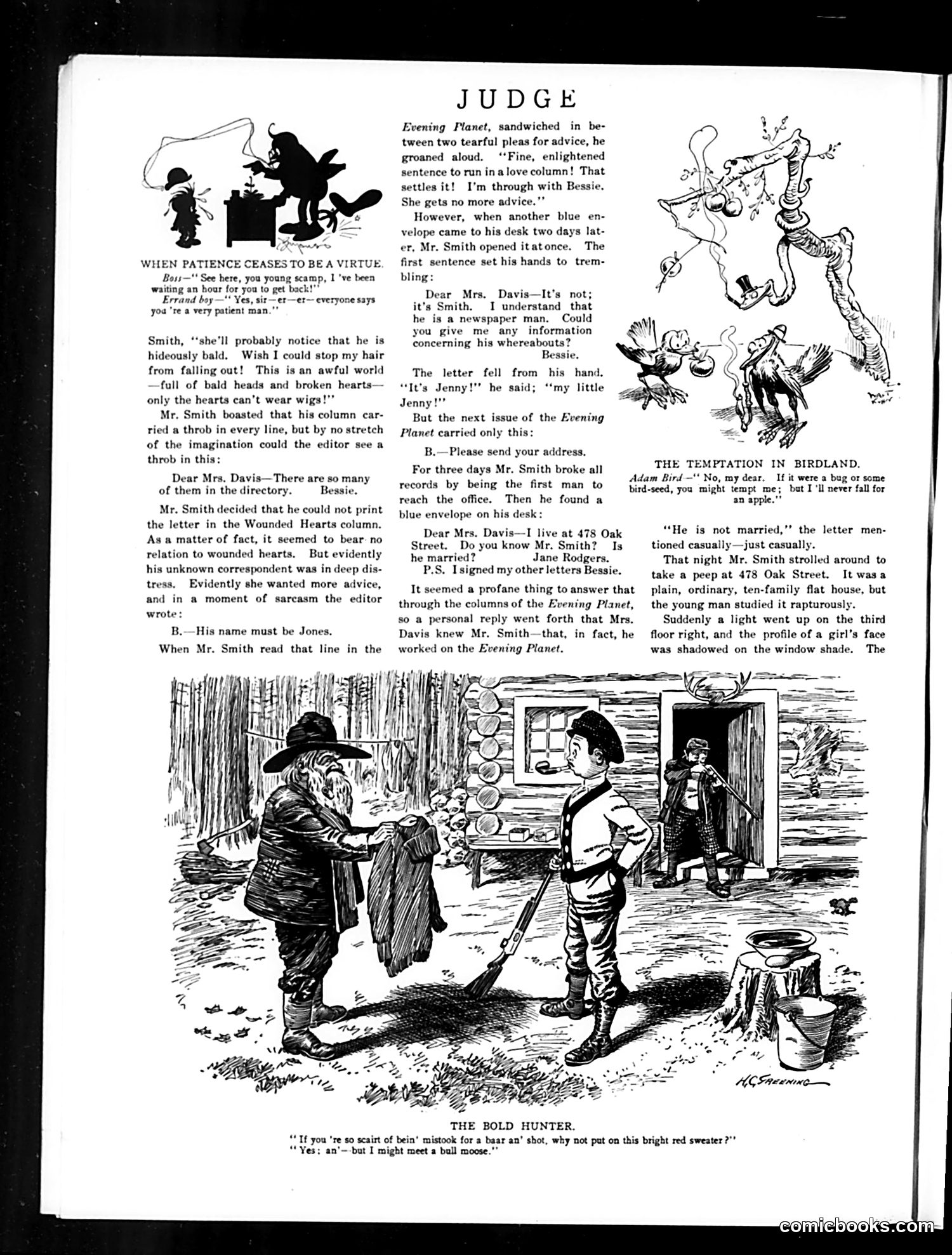
This page contains three separate satirical pieces typical of early 20th-century Judge magazine humor: **"When Patience Ceases to Be a Virtue"**: A multi-part story about Mr. Smith, a newspaper advice columnist for the "Wounded Hearts" column in the *Evening Planet*. Smith receives cryptic letters and replies sarcastically, only to discover the writer is actually his long-lost daughter Jenny, who's been trying to locate him. The satire targets both the earnestness of advice columns and the melodrama of domestic newspaper fiction. **"The Bold Hunter"**: A brief animal cartoon where a bird claims immunity to temptation from bird-seed, showing the absurdist humor Judge employed. **"The Temptation in Birdland"**: Another animal gag about a bird afraid of being mistaken for game during hunting season. The page exemplifies Judge's mix of sentimental storylines with wry commentary on American newspaper culture and domesticity.
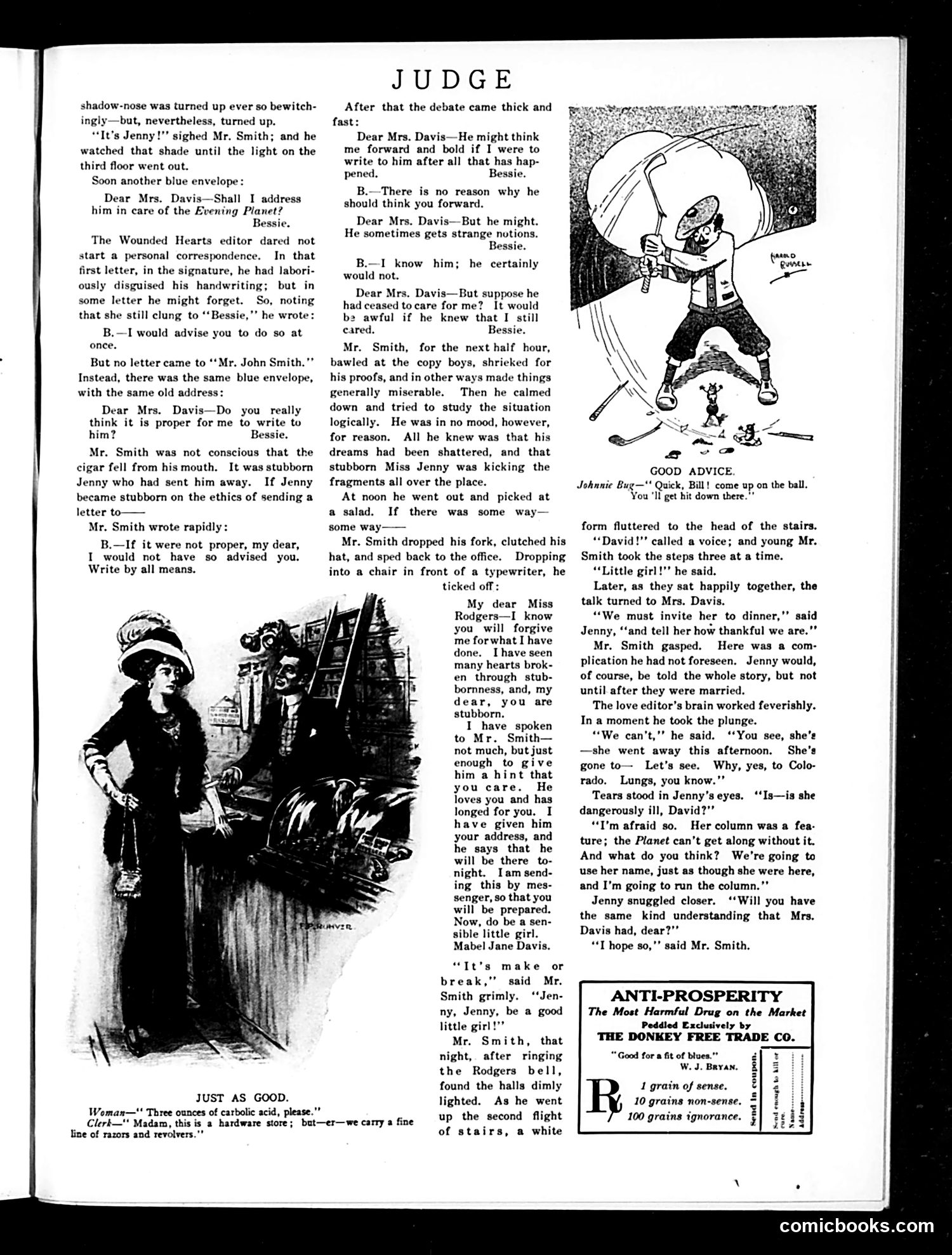
This page presents a serialized romantic comedy about a newspaper's "Wounded Hearts" advice columnist (Mr. Smith) who secretly intervenes in the love life of a reader named Jenny Rodgers. Smith, posing as "Mrs. Davis," encourages the stubborn Jenny to reach out to her estranged boyfriend, then impersonates a matchmaker to reunite them by letter. The humor derives from Smith's professional irony: he advises others on romance while bungling his own interference. The resolution—Jenny and Smith reconcile, unaware of his deception—sets up future comedic complications when she learns the truth. The small cartoon "Just as Good" offers dark satire: a hardware store clerk offers carbolic acid (poison) and razors alongside typical merchandise, suggesting casual availability of suicide methods. This reflects Progressive-era concerns about access to dangerous materials. The "Anti-Prosperity" advertisement is satirical product parody common to Judge magazine.
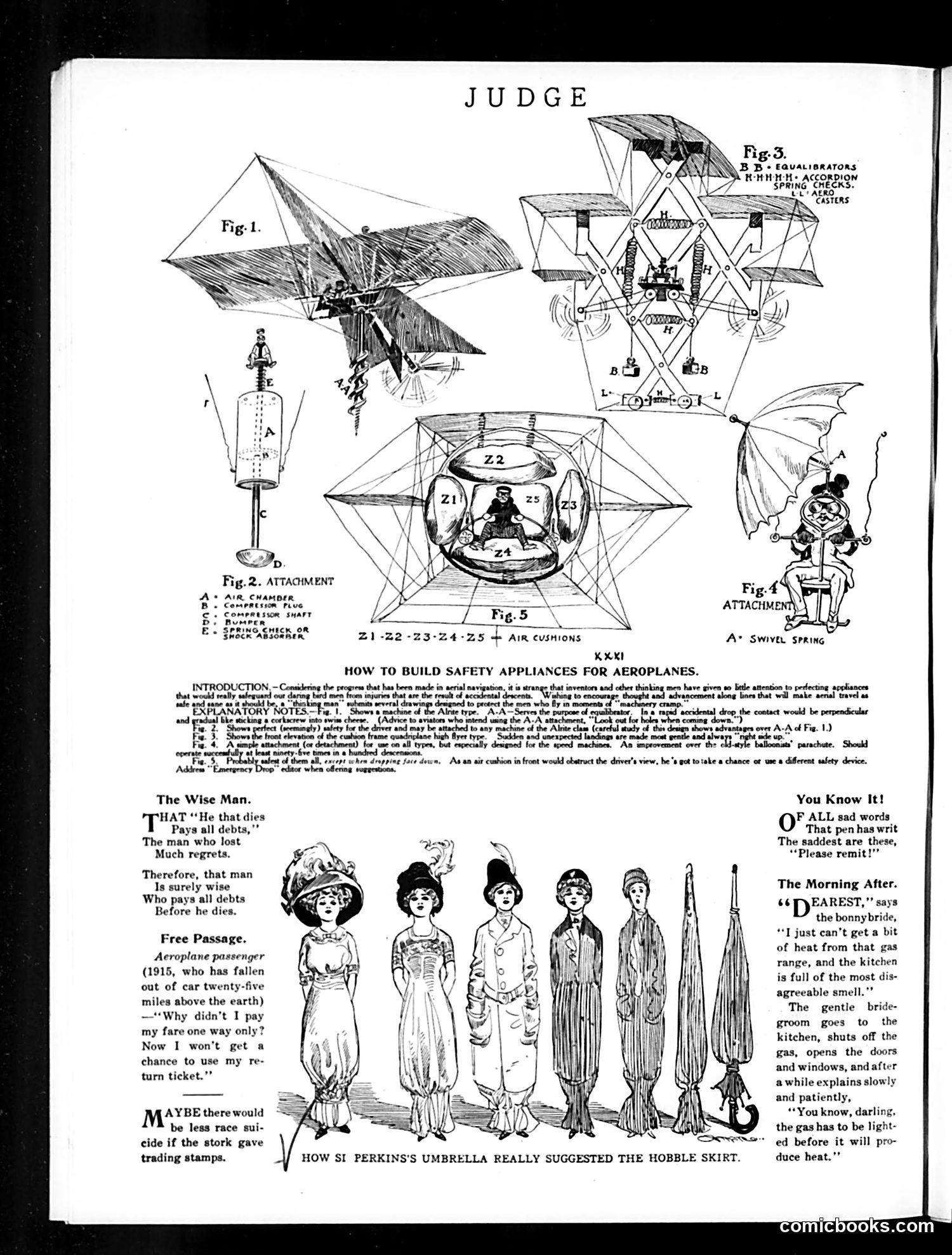
This page from Judge magazine contains three distinct sections: **Top:** Technical diagrams labeled "How to Build Safety Appliances for Aeroplanes" showing early aviation safety devices—parachutes, shock absorbers, and cushioning systems. This appears to be instructional content satirizing contemporary aviation safety concerns during aviation's early experimental era. **Bottom Left:** "The Wise Man" and "Free Passage" are humorous anecdotes. The first is a morality joke about debt; the second tells of an airplane passenger who fell 25 miles and survived, now refusing to pay his return ticket fare—dark humor about improbable survival. **Bottom Right:** "You Know It!" and "The Morning After" are comedic domestic scenarios about newlyweds dealing with kitchen appliances and gas heating—gentle marital humor. **Largest Illustration:** A satirical fashion commentary captioned "How Si Perkins's Umbrella Really Suggested the Hobble Skirt," showing the evolution from umbrella to increasingly restrictive women's skirts. This mocks the hobble skirt trend (restricting women's leg movement) by attributing its origin to an umbrella design. The page blends technical satire, domestic humor, and fashion criticism typical of early-20th-century Judge content.
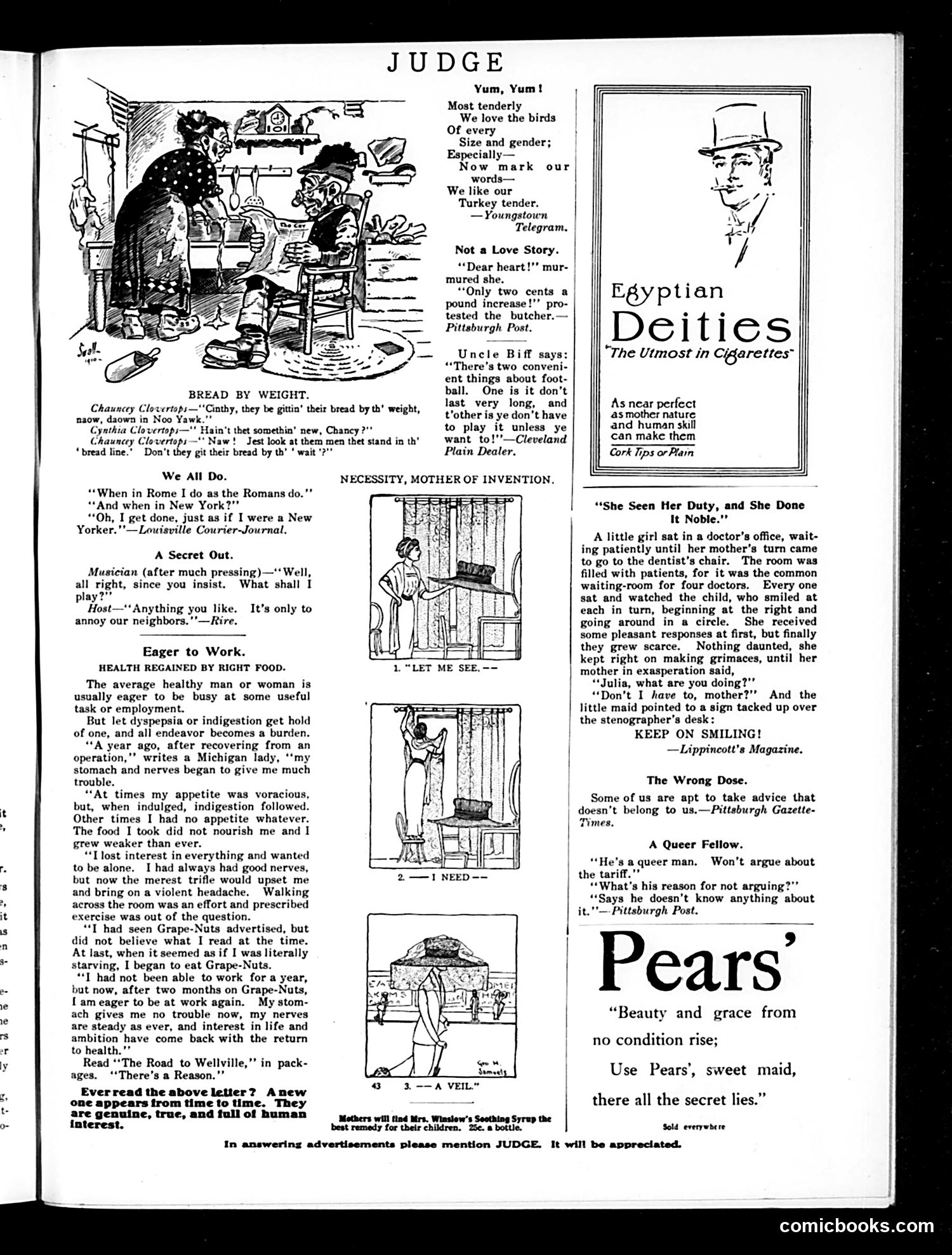
This Judge magazine page contains several short humorous items typical of early 20th-century American satire: **"Bread by Weight"** mocks New York City's "bread lines"—queues of unemployed or poor people receiving free bread. The rural characters joke that these men are literally getting bread "by weight" while standing in line, a pun on weighing bread for sale. **"A Secret Out"** is a brief joke about a musician who agrees to play anything "only to annoy our neighbors"—self-aware humor about amateur musicians. **"Eager to Work"** is primarily a Grape-Nuts cereal advertisement disguised as testimonial, claiming the product cures digestive problems and restores work ethic—common advertising strategy of the era. The page also includes advertisements for Egyptian Deities cigarettes and Pears' soap, plus various short anecdotes about social awkwardness and medical visits. The overall tone reflects Judge's focus on gentle, domestic humor rather than hard-hitting political satire.
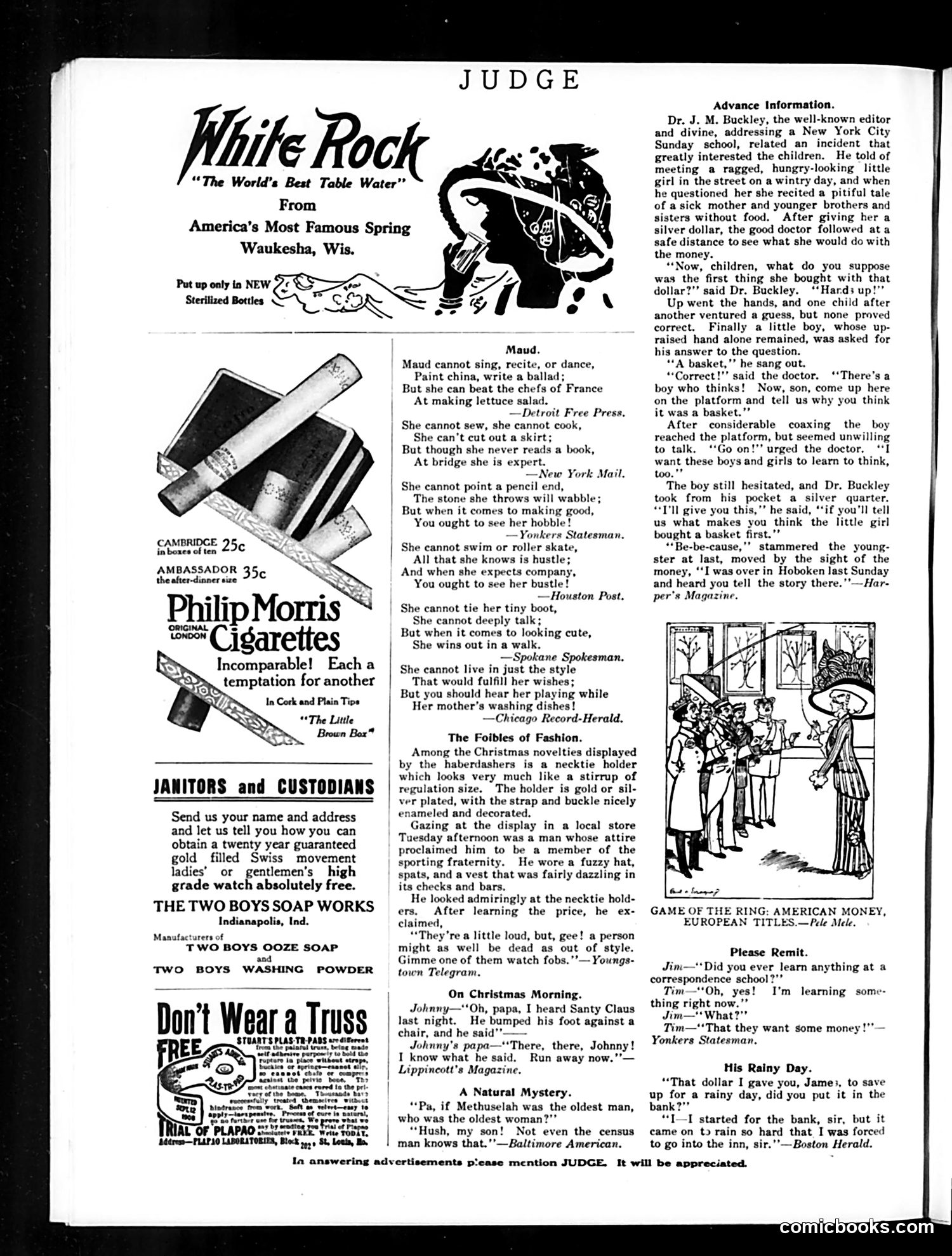
This page is primarily **advertisements and light humor columns**, not political satire. The content reflects early 20th-century American attitudes: **Main Elements:** The advertisements (White Rock water, Philip Morris cigarettes, soap, medical devices) represent typical product marketing of the era. **"Maud" Poetry Series:** A recurring humor feature mocking women's limitations and abilities. Each verse, sourced from newspapers, presents contradictory traits (e.g., "cannot cook" but "beats French chefs at lettuce salad"). This reflects period stereotypes about women's competence and social roles—the humor relies on suggesting women are simultaneously incompetent and surprisingly skilled at domestic tasks. **"The Foibles of Fashion":** Gently satirizes a sporting gentleman's vanity and poor taste (fuzzy hat, garish vest), while he admires expensive accessories. **Moral Anecdotes:** Short stories about children, charity, and virtue—Dr. Buckley's lesson about the poor girl buying a basket demonstrates character and restraint. The overall tone is conservative, moralistic, and mildly sexist by modern standards, typical of early 20th-century middlebrow American humor.
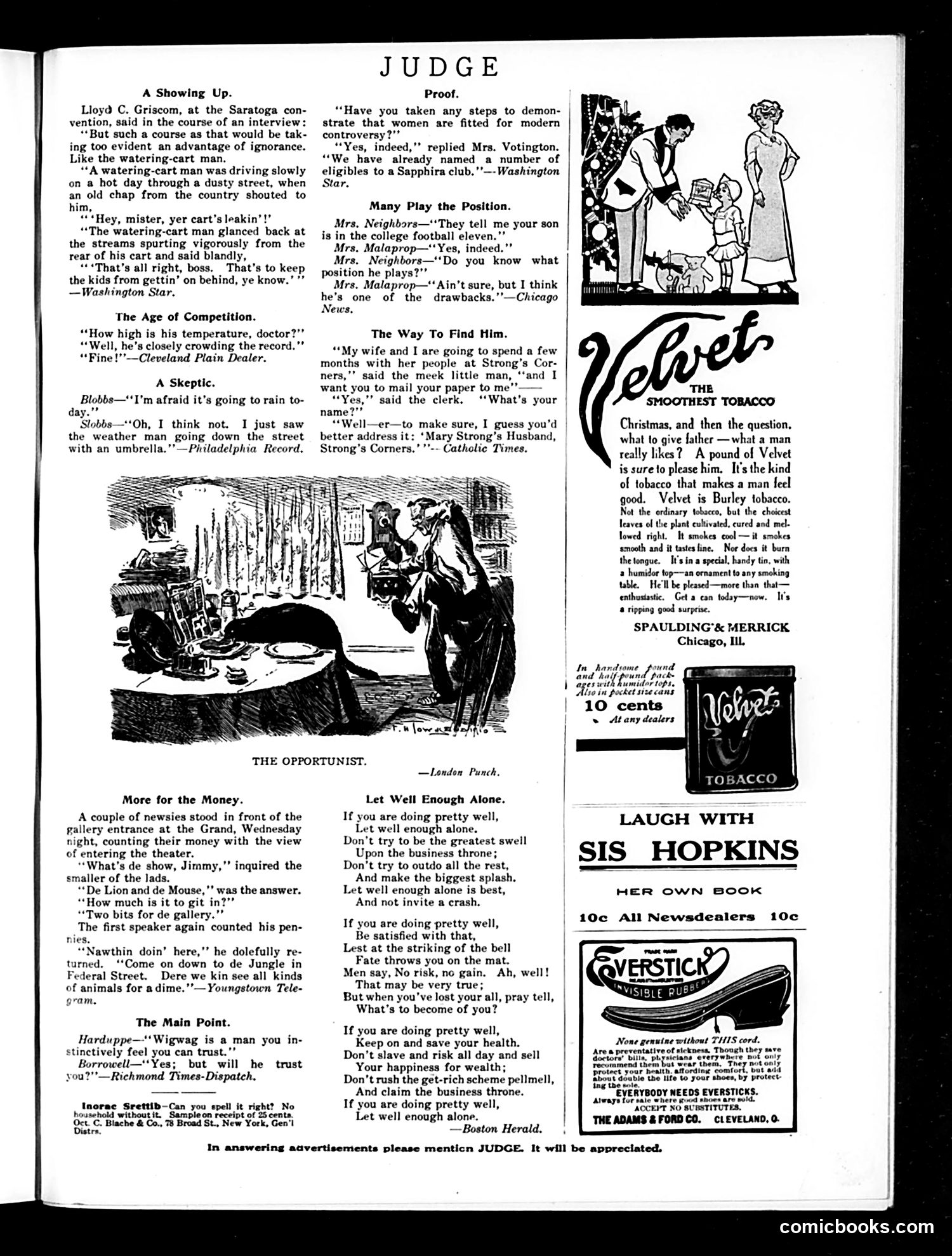
This page contains multiple brief satirical anecdotes and advertisements typical of Judge magazine's humor format. **The main cartoons/jokes mock:** 1. **"A Showing Up"** - Lloyd C. Griscom is referenced making a self-serving justification, compared unfavorably to a watering-cart driver who admits his deceptive practice openly rather than hiding behind false virtue. 2. **"Proof"** - Satirizes women's suffrage advocates by suggesting naming women to a "Sapphira club" (biblical reference to a dishonest woman) as evidence of fitness for "modern controversy." 3. **"Many Play the Position"** - A malapropism joke where a mother mistakes "drawbacks" for a football position, mocking working-class speech patterns. 4. **"The Opportunist"** illustration - Shows two figures in what appears to be a dining scene; specific meaning unclear from image alone. The page primarily features short humorous anecdotes about class differences, gender politics, and contemporary social pretensions—typical of early 20th-century Judge content. Advertisements for Velvet tobacco and other products fill remaining space.
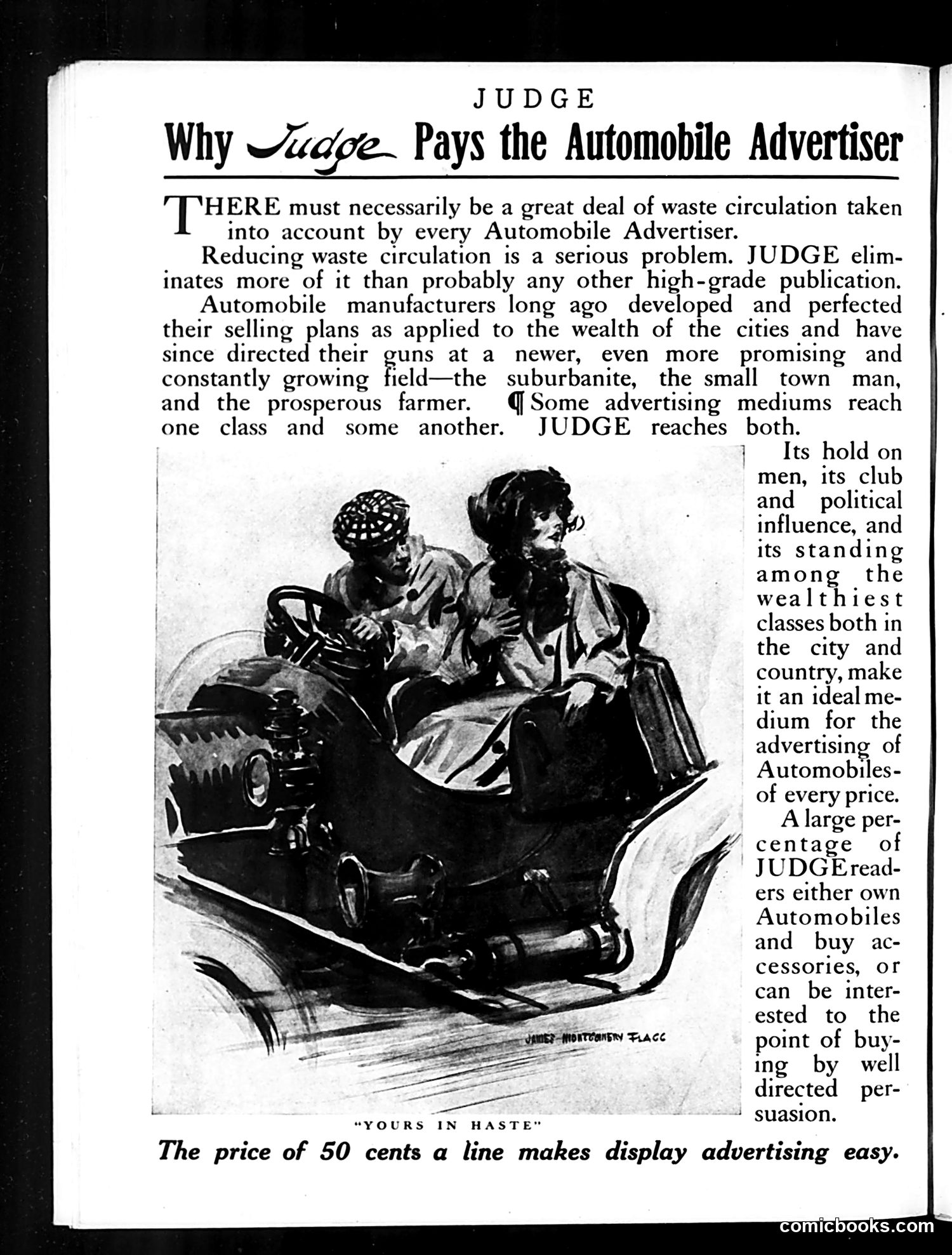
This is a full-page advertisement promoting Judge magazine itself to automobile manufacturers. The cartoon depicts two well-dressed figures in a speeding car labeled "Yours in Haste," illustrating the magazine's appeal to affluent, mobile readers. The pitch argues that Judge eliminates "waste circulation"—advertising dollars spent reaching uninterested audiences. Judge claims unique reach across both wealthy urban and rural audiences: city elites, suburbanites, small-town men, and prosperous farmers. The text emphasizes Judge's influence among "the wealthiest classes" and notes that readers already own automobiles or can be persuaded to buy them. This reflects early 20th-century advertising strategy: targeting purchasing power rather than just broad circulation. Judge positions itself as the smart buy for auto advertisers seeking efficient, high-value audience reach at 50 cents per line.
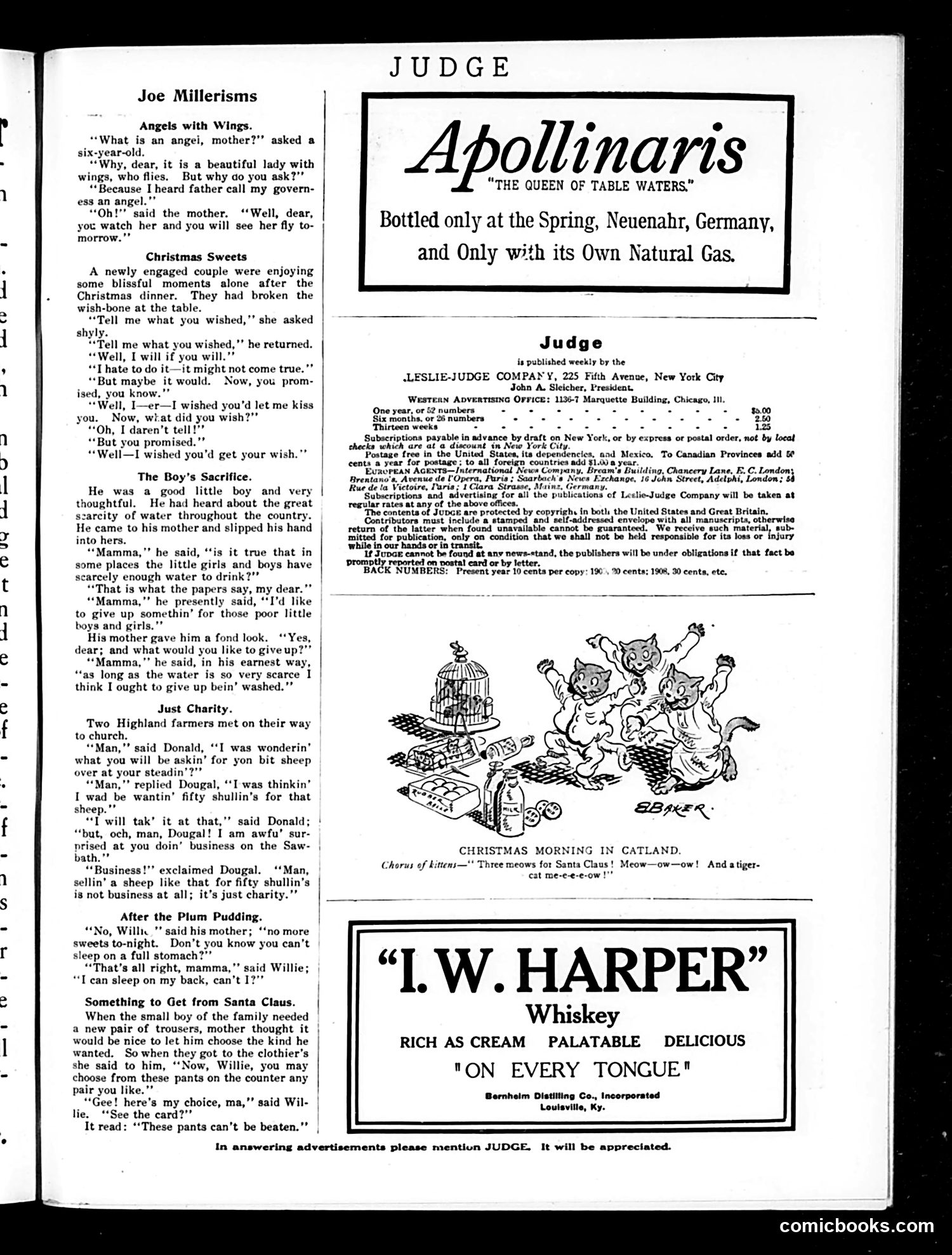
This page from the satirical magazine **Judge** is primarily a collection of humor pieces and advertisements rather than political cartoons. The **left column contains "Joe Millerisms"**—short, gentle jokes in a traditional vaudeville style. These include: - A child's misunderstanding about angels (governesses) - An engaged couple's awkward wish-bone moment - A boy's naive solution to water scarcity: stop bathing - Scottish farmers' dialect humor about sheep sales - A child's stomach-sleeping logic - A boy choosing indestructible trousers These are light domestic humor reflecting early-1900s family life and social propriety. The **right side features advertisements**: Apollinaris mineral water ("Queen of Table Waters") and I.W. Harper whiskey, with a whimsical illustration of children celebrating Christmas morning. The page lacks political satire or caricature. It's entertainment-focused—representative of Judge's mix of mild humor and advertising rather than hard-hitting social commentary.
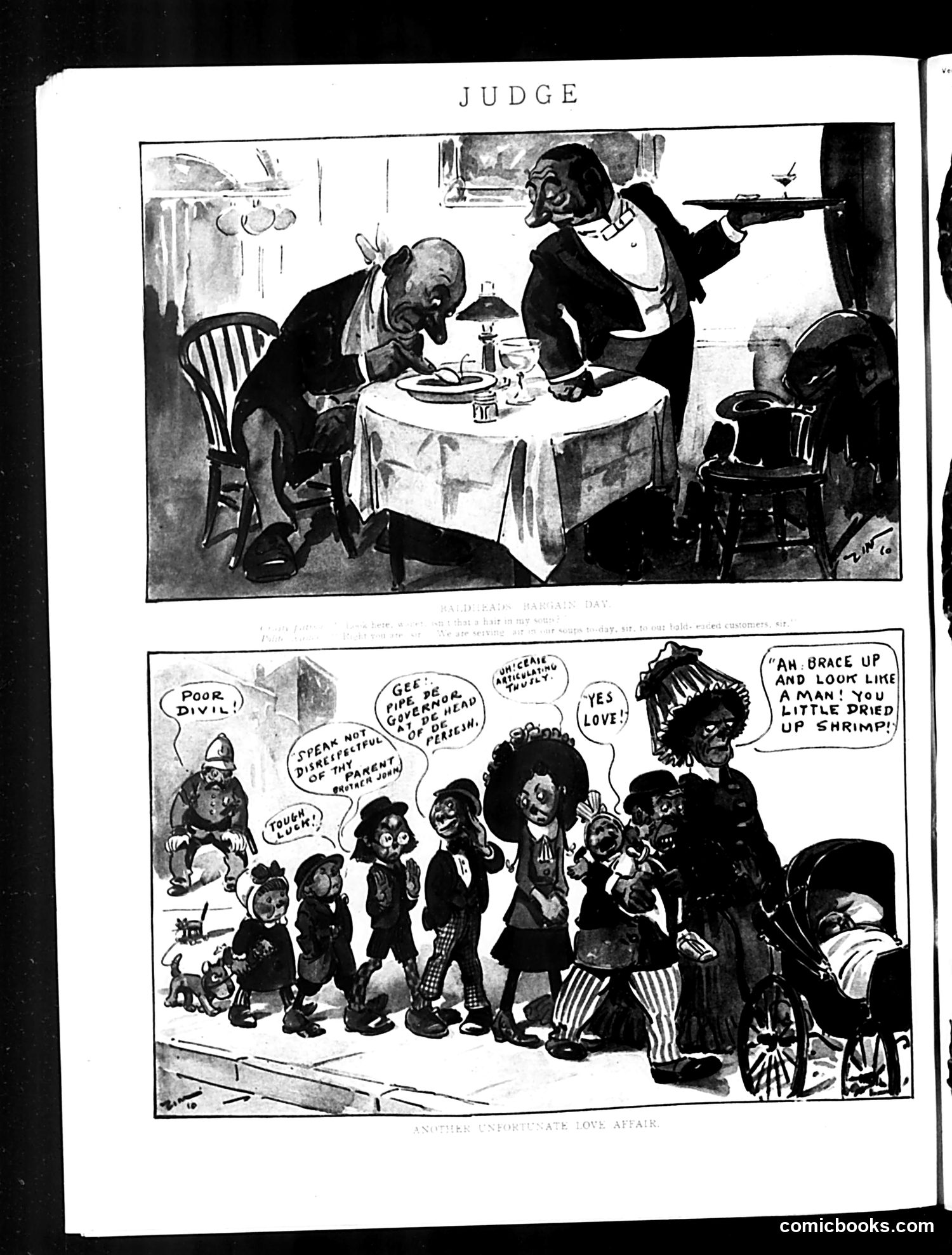
This page contains two cartoons using caricature and exaggerated features typical of early Judge satirical humor. The top panel depicts two figures dining, with one aiming a telescope or gun-like object—likely political satire about observation or intervention, though the specific reference is unclear without a date. The bottom panel, titled "Another Unfortunate Love Affair," shows a group of characters with exaggerated facial features in what appears to be a street scene. One tall figure addresses a smaller character, telling him to "brace up and look like a man" and calling him a "little dried up shrimp." The dialogue suggests romantic or social embarrassment. The caricatured style and character designs reflect period conventions, though the specific satirical target—whether a political figure, social type, or event—remains unclear from the image alone.