
Judge, 1910-12-10 · page 8 of 24
Judge — December 10, 1910 — page 8: what you’re looking at
What you’re looking at
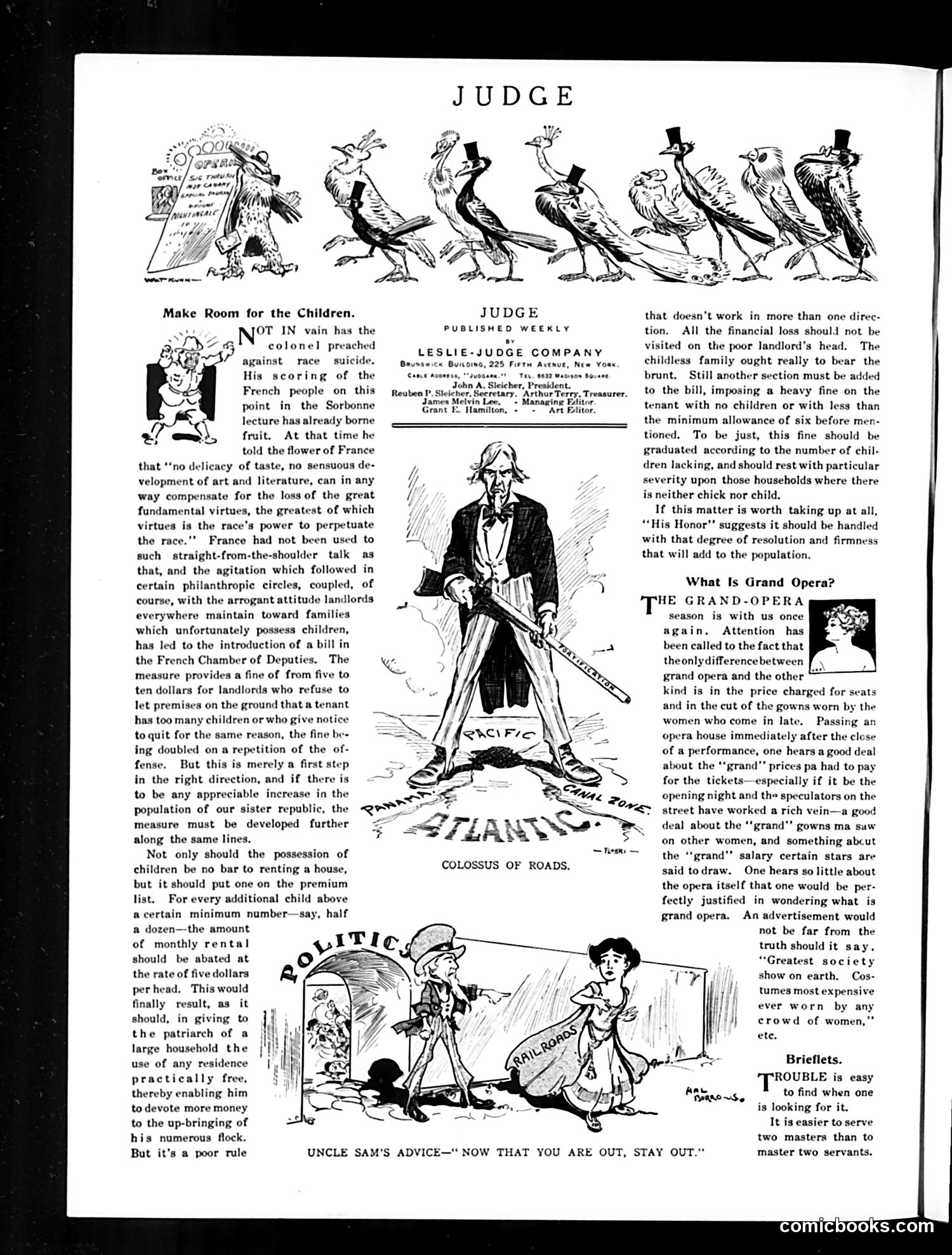
This *Judge* magazine page contains two satirical pieces: **"Make Room for the Children"** mocks a French colonel who publicly criticized France for "race suicide" (low birth rates). The piece sarcastically proposes increasingly absurd legislation: fining landlords who refuse tenants with children, then reversing it to fine *childless* tenants, with fines scaled to their lack of offspring. The satire targets both the colonel's nationalist rhetoric about population and the real French housing discrimination against families—exposing how far such "pro-natalist" thinking could logically extend into tyrannical absurdity. **"What Is Grand Opera?"** humorously suggests that "grand" opera differs from regular opera only in ticket prices and women's fancy gowns—implying the actual musical performance is irrelevant to audiences obsessed with status symbols and social display. It's gentle mockery of opera-goers' materialism. The cartoons appear to illustrate these pieces with relevant figures, though specific identities aren't clearly labeled.
📄 Transcribed text from this page (OCR, searchable)
Machine-transcribed from the original scan — historical spelling and the odd misread are preserved.
Make Room for the Children. x OT IN vain has the SbF 5 colonel preached KE ? against race suicide. RE: Hy His scoring of the French people on this ~ point in the Sorbonne PISS lecture has already borne fruit. At that time he told the flower of France that ‘‘no delicacy of taste, no sensuous de- velopment of art and literature, can in any way compensate for the loss of the great fundamental virtues, the greatest of which virtues is the race’s power to perpetuate the race."’ France had not been used to such straight-from-the-shoulder talk as that, and the agitation which followed in certain philanthropic circles, coupled, of course, with the arrogant attitude landlords everywhere maintain toward families which unfortunately possess children, has led to the introduction of a bill in the French Chamber of Deputies. The measure provides a fine of from five to ten dollars for landlords who refuse to let premises on the ground that a tenant has too many children or who give notice to quit for the same reason, the fine be- ing doubled on a repetition of the of- fense. But this is merely a first step in the right direction, and if there is to be any appreciable increase in the population of our sister republic, the measure must be developed further along the same lines. Not only should the possession of children be no bar to renting a house, but it should put one on the premium list. For every additional child above acertain minimum number—say, half a dozen—the amount of monthly rental should be abated at the rate of five dollars per head. This would finally result, as it should, in giving to the patriarch of a large household the use of any residence practically free, thereby enabling him to devote more money to the up-bringing of his numerous flock. But it’s a poor rule PUBLISHED WEEKLY v LESLIE-JUOGE COMPANY 0, 225 Firtn Avenue, New Yous joonee.t* Tea. $692 Macnson Savane Sleicher, President. a ‘Arthur Terry, Treasurer. Managing Fai > Art Ea COLOSSUS OF ROADS, Tem — UNCLE SAM'S ADVICE—‘‘ NOW THAT YOU ARE OUT, STAY OUT.” that doesn’t work in more than one direc- tior All the financial loss should not be visited on the poor landlord's head. The childless family ought really to bear the brunt. Still another section must be added to the bill, imposing a heavy fine on the tenant with no children or with less than the minimum allowance of six before men- tioned. To be just, this fine should be graduated according to the number of chil- dren lacking, and should rest with particular se ty upon those households where there is neither chick nor child. If this matter is worth taking up at all, “His Honor’’ suggests it should be handled with that degree of resolution and firmness that will add to the population. What Is Grand Opera? 2, Bo HE GRAND-OPERA season is with us once again. Attention has been called to the fact that theonlydifferencebetween grand opera and the other kind is in the price charged for seats and in the cut of the gowns worn by the women who come in late. Passing an opera house immediately after the close of a performance, one hears a good deal about the “grand” prices pa had to pay for the tickets—especially if it be the opening night and the speculators on the street have worked a rich vein—a good deal about the ‘‘grand’’ gowns ma saw ‘on other women, and something abcut the ‘‘grand’’ salary certain stars are said todraw. One hears so little about the opera itself that one would be per- fectly justified in wondering what is grand opera. An advertisement would not be far from the truth should it sa “Greatest society show on earth. Cos- tumes most expensive ever worn by a crowd of women, ete. Brieflets. ROUBLE is easy to find when one is looking for it. It is easier to serve two masters than to master two servants.