
Judge, 1910-12-10 · page 7 of 24
Judge — December 10, 1910 — page 7: what you’re looking at
What you’re looking at
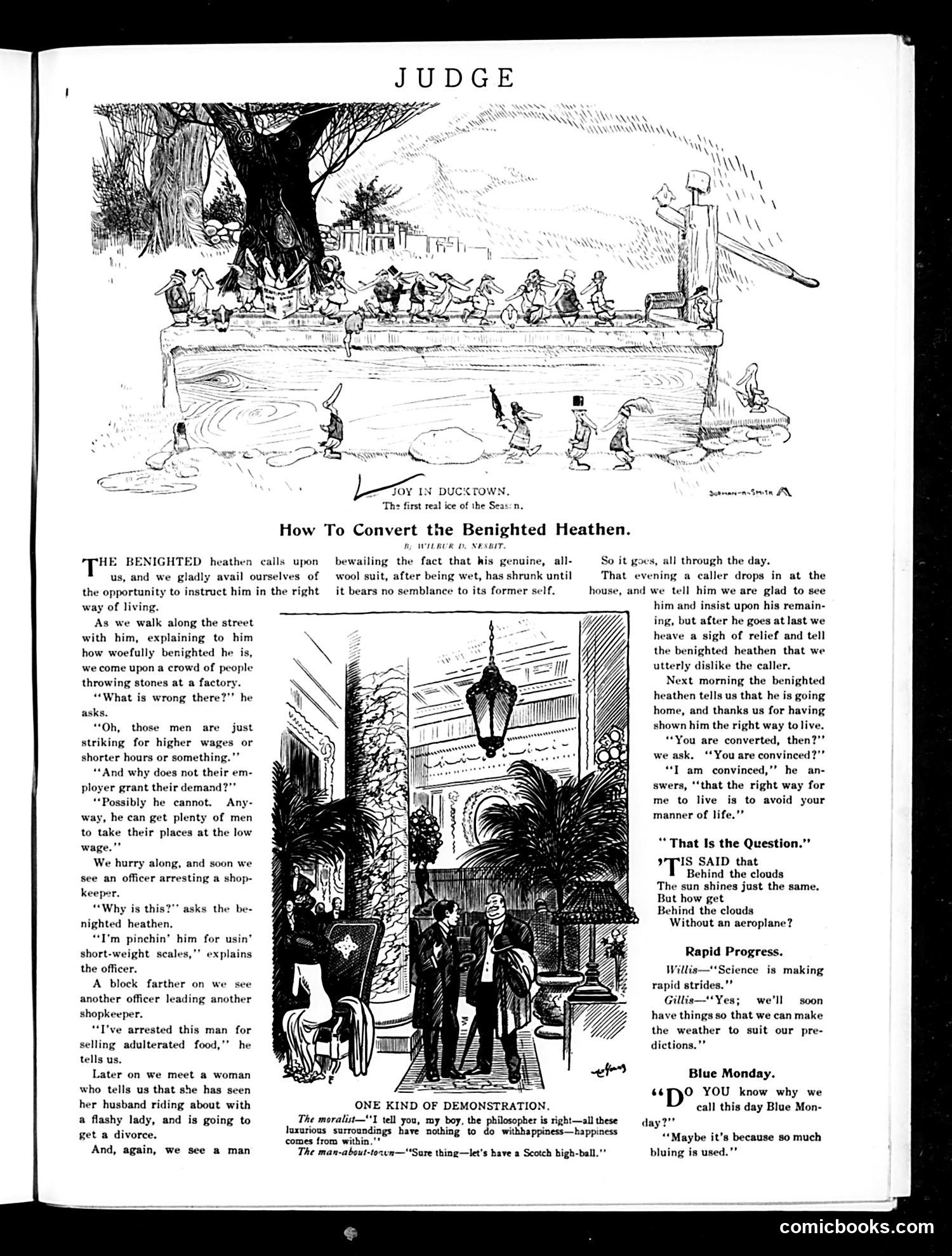
This satirical piece mocks American hypocrisy and moral superiority. A narrator "converts" a foreign visitor (the "benighted heathen") to Western civilization by parading him through the city, pointing out various social evils as if they're instructive lessons: striking workers, corrupt shopkeepers using false scales and adulterated food, infidelity, and defective merchandise. The joke is the unintended lesson: the heathen observes that American society is rife with dishonesty, labor exploitation, and moral corruption—yet presented as the "right way to live." He concludes that "the right way for me to live is to avoid your manner of life." The satire attacks American self-righteousness and the gap between professed Christian values and actual behavior. Judge magazine frequently critiqued social corruption, labor issues, and consumer fraud of the early 20th century through ironic inversion: by showing "civilization" through a foreigner's eyes, the piece exposes its fundamental hypocrisy.
📄 Transcribed text from this page (OCR, searchable)
Machine-transcribed from the original scan — historical spelling and the odd misread are preserved.
T= BENIGHTED heathen calls upon us, and we gladly avail ourselves of the opportunity to instruct him in the right way of living. As we walk along the street with him, explaining to him how woefully benighted he is, we come upon a crowd of people throwing stones at a factory. “What is wrong there?’ he asks. “Oh, those men are just striking for higher wages or shorter hours or something.”” “And why does not their em- ployer grant their demand?”’ “Possibly he cannot. Any- way, he can get plenty of men to take their places at the low wage."" We hurry along, and soon we see an officer arresting a shop- keeper. “Why is this?” asks the be- nighted heathen, “I'm pinchin’ him for usin’ short-weight scales,’ the officer. A block farther on we see another officer leading another shopkeeper. “I've arrested this man for selling adulterated food,’’ he tells us. Later on we meet a woman who tells us that she has seen her husband riding about with a flashy lady, and is going to get a divorce. And, again, we see a man explains How To Convert the Benighted Heathen. hy WILBUR D, NESBIT. bewailing the fact that his genuine, all- wool suit, after being wet, has shrunk until it bears no semblance to its former self. ONE KIND OF DEMONSTRATION. The moralist—"I tell you, my boy, the philosopher is right—all these luxurious surroundings have nothing to do withhappiness—happiness comes from within.’ The man-about-toren—'“Sare thing—Iet’s have a Scotch bigh-ball."" dernaneenssrvtn AL So it goes, all through the day. That evening a caller drops in at the house, and we tell him we are glad to see him and insist upon his remain- ing, but after he goes at last we heave a sigh of relief and tell the benighted heathen that we utterly dislike the caller. Next morning the benighted heathen tells us that he is going home, and thanks us for having shown him the right way to live. ‘You are converted, then?’’ we ask. ‘‘You are convinced?’” “Tam convinced,’’ he an- swers, ‘‘that the right way for me to live is to avoid your manner of life.’” “That Is the Question.” TIS SAID that Behind the clouds The sun shines just the same. But how get Behind the clouds Without an aeroplane? Rapid Progress. Willis—‘‘Science is making rapid strides.” Gillis—‘Yes; we'll soon have things so that we can make the weather to suit our pre- dictions.”” Blue Monday. “T° YOU know why we call this day Blue Mon- day Maybe it’s because so much bluing is used.’” comicbooks.com