
Judge, 1910-12-10 · page 14 of 24
Judge — December 10, 1910 — page 14: what you’re looking at
What you’re looking at
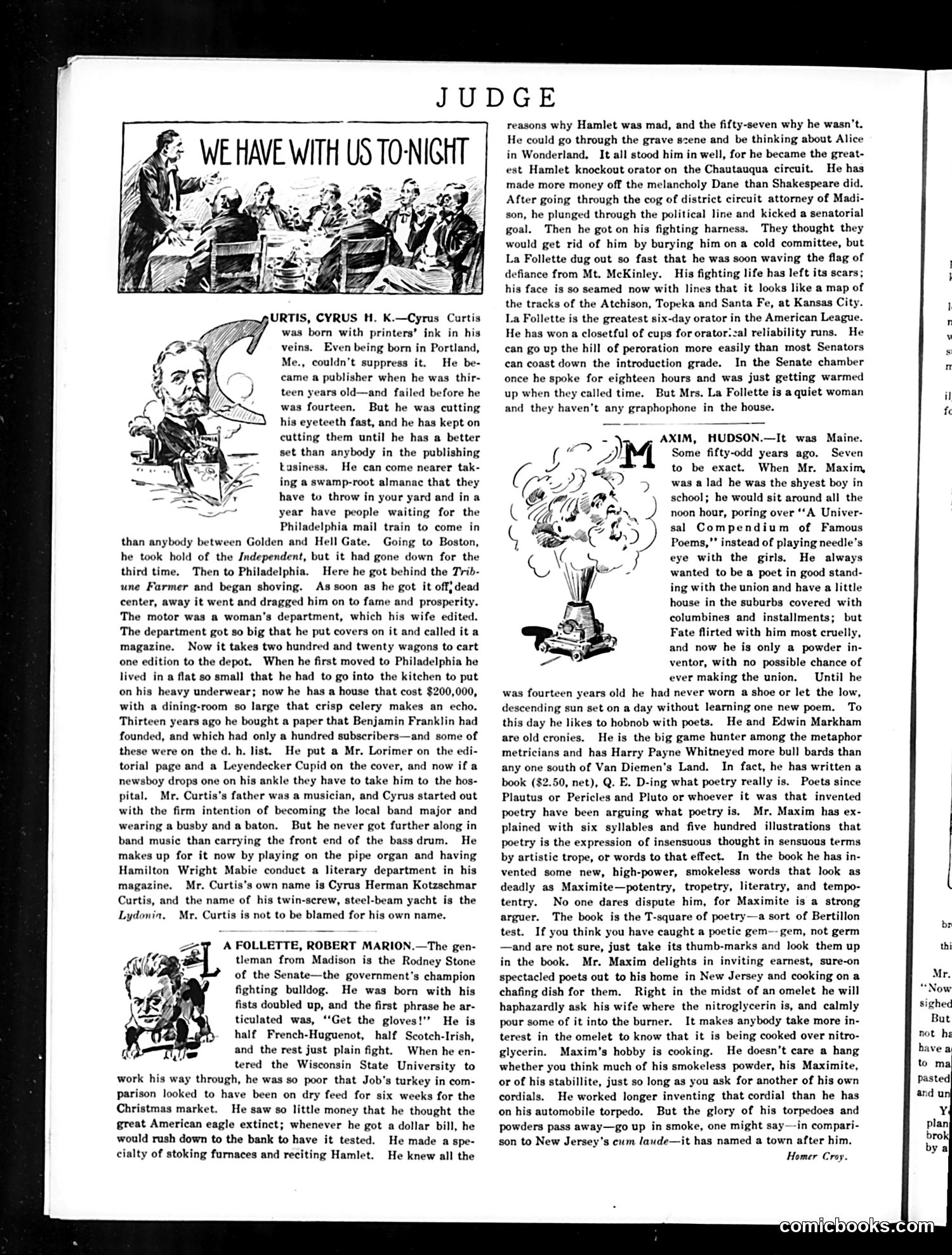
This page from Judge features biographical sketches of three prominent American figures from the early 1900s: **Cyrus Curtis** — Publisher who built the Philadelphia Curtis Publishing Company into a major enterprise. The satire mocks his rise from poverty (living in a tiny flat) to wealth ($200,000 house), and his expansion of *The Saturday Evening Post* into a massively successful magazine. The joke emphasizes his wife's "woman's department" as the original engine of his success. **Robert Marion La Follette** — Wisconsin politician (likely U.S. Senator) portrayed as a scrappy fighter—literally and politically. The satire celebrates his working-class origins, his oratorical skills on the Chautauqua circuit (where he apparently profited reciting Hamlet more than Shakespeare did), and his aggressive political maneuvering ("kicked a senatorial goal"). Both sketches use humorous exaggeration to celebrate American self-made success and political pugnacity—typical Judge fare celebrating ambitious, combative figures.
📄 Transcribed text from this page (OCR, searchable)
Machine-transcribed from the original scan — historical spelling and the odd misread are preserved.
vo WE HAVE WITH US TO-NIGHT URTIS, CYRUS H. K.—Cyrus Curtis was born with printers’ ink in his veins, Even being born in Portland, Me., couldn't suppress it. He be- came a publisher when he was thir- teen years old—and failed before he was fourteen. But he was cutting his eyeteeth fast, and he has kept on cutting them until he has a better set than anybody in the publishing business. He can come nearer tak- ing a swamp-root almanac that they have to throw in your yard and in a year have people waiting for the Philadelphia mail train to come in than anybody between Golden and Hell Gate. Going to Boston, he took hold of the Independent, but it had gone down for the third time. Then to Philadelphia. Here he got behind the Trib- une Farmer and began shoving. As soon as he got it off’ dead center, away it went and dragged him on to fame and prosperit: The motor was a woman's department, which his wife edite: The department got so big that he put covers on it and called it a magazine. Now it takes two hundred and twenty wagons to cart one edition to the depot. When he first moved to Philadelphia he lived in a flat so small that he had to go into the kitchen to put on his heavy underwear; now he has a house that cost $200,000, with a dining-room so large that crisp celery makes an echo. Thirteen years ago he bought a paper that Benjamin Franklin had founded, and which had only a hundred subscribers—and some of these were on the d. h. list. He put a Mr. Lorimer on the edi- torial page and a Leyendecker Cupid on the cover, and now if a newsboy drops one on his ankle they have to take him to the hos- pital. Mr. Curtis's father was a musician, and Cyrus started out with the firm intention of becoming the local band major and wearing a busby and a baton. But he never got further along in band music than carrying the front end of the bass drum. He makes up for it now by playing on the pipe organ and having Hamilton Wright Mabie conduct a literary department in his magazine. Mr. Curtis's own name is Cyrus Herman Kotzschmar Curtis, and the name of his twin-screw, steel-beam yacht is the Lydonin, Mr. Curtis is not to be blamed for his own name. tleman from Madison is the Rodney Stone of the Senate—the government's champion fighting bulldog. He was born with his fists doubled up, and the first phrase he ar- ticulated was, ‘‘Get the gloves!’ He is half French-Huguenot, half Scotch-Irish, and the rest just plain fight. When he en- tered the Wisconsin State University to work his way through, he was so poor that Job’s turkey in com- parison looked to have been on dry feed for six weeks for the Christmas market. He saw so little money that he thought the great American eagle extinct; whenever he got a dollar bill, he would rush down to the bank to have it tested. He made a spe- cialty of stoking furnaces and reciting Hamlet. He knew all the 4] A FOLLETTE, ROBERT MARION.—The gen- JUDGE reasons why Hamlet was mad, and the fifty-seven why he wasn’t. He could go through the grave szene and be thinking about Alice in Wonderland. It all stood him in well, for he became the great- est Hamlet knockout orator on the Chautauqua circuit. He has made more money off the melancholy Dane than Shakespeare did. After going through the cog of district circuit attorney of Mad son, he plunged through the political line and kicked a senatorial goal. Then he got on his fighting harness. They thought they would get rid of him by burying him ona cold committee, but La Follette dug out so fast that he was soon waving the flag of defiance from Mt. McKinley. His fighting life has left its scars; his face is so seamed now with lines that it looks like a map of the tracks of the Atchison, Topeka and Santa Fe, at Kansas City. La Follette is the greatest six-day orator in the American League. He has won a closetful of cups for orator:zal reliability runs. He can go up the hill of peroration more easily than most Senators can coast down the introduction grade. In the Senate chamber once he spoke for eighteen hours and was just getting warmed up when they called time. But Mrs. La Follette is a quiet woman and they haven't any graphophone in the house. AXIM, HUDSON.—It was Maine. Some fifty-odd years ago. Seven to be exact. When Mr. Maxim, was a lad he was the shyest boy in school; he would sit around all the noon hour, poring over “A Univer- sal Compendium of Famous Poems,”’ instead of playing needle’s eye with the girls. He always wanted to be a poet in good stand- ing with the union and have a little house in the suburbs covered with columbines and installments; but Fate flirted with him most cruelly, and now he is only a powder in- ventor, with no possible chance of ever making the union. Until he was fourteen years old he had never worn a shoe or let the low, descending sun set on a day without learning one new poem. To this day he likes to hobnob with poets. He and Edwin Markham are old cronies. He is the big game hunter among the metaphor metricians and has Harry Payne Whitneyed more bull bards than any one south of Van Diemen’s Land. In fact, he has written a book ($2.50, net), Q. E. D-ing what poetry really is. Poets since Plautus or Pericles and Pluto or whoever it was that invented poetry have been arguing what poetry is. Mr. Maxim has ex- plained with six syllables and five hundred illustrations that poetry is the expression of insensuous thought in sensuous terms by artistic trope, or words to that effect. In the book he has in- vented some new, high-power, smokeless words that look as deadly as Maximite—potentry, tropetry, literatry, and tempo- tentry. No one dares dispute him, for Maximite is a strong arguer. The book is the T-square of poetry—a sort of Bertillon test. If you think you have caught a poetic gem—gem, not germ —and are not sure, just take its thumb-marks and look them up in the book. Mr. Maxim delights in inviting earnest, sure-on spectacled poets out to his home in New Jersey and cooking on a chafing dish for them. Right in the midst of an omelet he will haphazardly ask his wife where the nitroglycerin is, and calmly pour some of it into the burner. It makes anybody take more in- terest in the omelet to know that it is being cooked over nitro- glycerin. Maxim's hobby is cooking. He doesn’t care a hang whether you think much of his smokeless powder, his Maximite, or of his stabillite, just so long as you ask for another of his own cordials. He worked longer inventing that cordial than he has on his automobile torpedo. But the glory of his torpedoes and powders pass away—go up in smoke, one might say—in compari- son to New Jersey’s cum lande—it has named a town after him. Homer Croy. 2M Mr. “Now sighed But not hi have a to ma pasted