
Judge, 1910-12-10 · page 17 of 24
Judge — December 10, 1910 — page 17: what you’re looking at
What you’re looking at
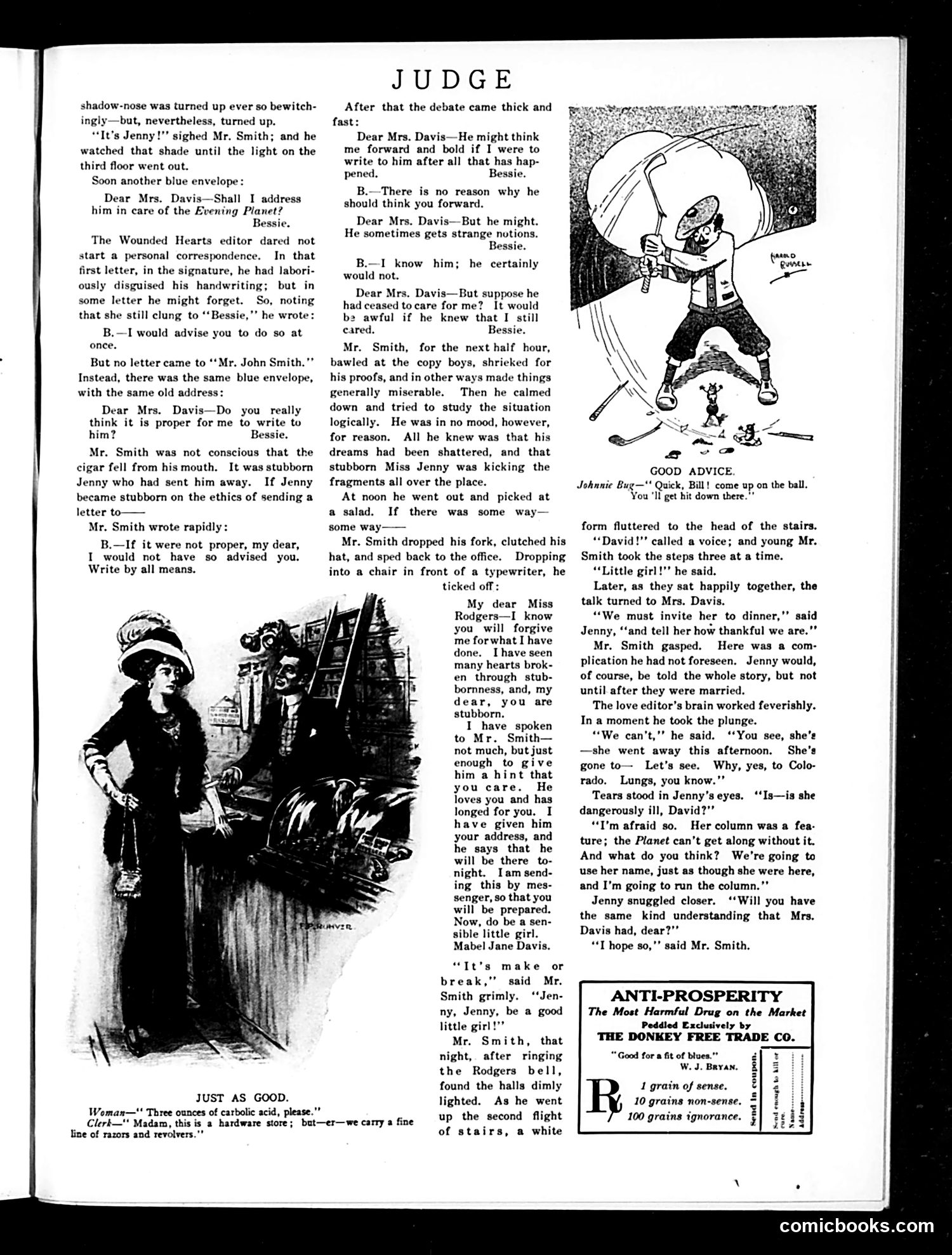
This page presents a serialized romantic comedy about a newspaper's "Wounded Hearts" advice columnist (Mr. Smith) who secretly intervenes in the love life of a reader named Jenny Rodgers. Smith, posing as "Mrs. Davis," encourages the stubborn Jenny to reach out to her estranged boyfriend, then impersonates a matchmaker to reunite them by letter. The humor derives from Smith's professional irony: he advises others on romance while bungling his own interference. The resolution—Jenny and Smith reconcile, unaware of his deception—sets up future comedic complications when she learns the truth. The small cartoon "Just as Good" offers dark satire: a hardware store clerk offers carbolic acid (poison) and razors alongside typical merchandise, suggesting casual availability of suicide methods. This reflects Progressive-era concerns about access to dangerous materials. The "Anti-Prosperity" advertisement is satirical product parody common to Judge magazine.
📄 Transcribed text from this page (OCR, searchable)
Machine-transcribed from the original scan — historical spelling and the odd misread are preserved.
shadow-nose was turned up ever so bewitch- ingly—but, nevertheless, turned up. “It’s Jenny!"’ sighed Mr. Smith; and he watched that shade until the light on the third floor went out. Soon another blue envelope: Dear Mrs. Davis—Shall I address him in care of the Evening Plane Bessie. The Wounded Hearts editor dared not start a personal correspondence. In that first letter, in the signature, he had labori- ously disguised his handwriting; but in some letter he might forget. So, noting that she still clung to ‘‘Bessie,’’ he wrote: B.—I would advise you to do so at once. But no letter came to ‘‘Mr. John Smith."” Instead, there was the same blue envelope, with the same old address: Dear Mrs. Davis—Do you really think it is proper for me to write to him? Bessie, Mr. Smith was not conscious that the cigar fell from his mouth. It was stubborn Jenny who had sent him away. If Jenny became stubborn on the ethics of sending a letter to— Mr. Smith wrote rapidly : B.—If it were not proper, my dear, I would not have so advised you, Write by all means. JUST AS GOOD. Woman—'' Three ounces of carbolic acid, please." Clerk— line of razors and revolvers."’ Madam, this is a hardware store; but—er—we carry a fine JUDGE After that the debate came thick and fast: Dear Mrs. Davis—He might think me forward and bold if I were to write to him after all that has hap- pened. Bessie. B.—There is no reason why he should think you forward. Dear Mrs. Davis—But he might. He sometimes gets strange notions. Bessie. B.—I know him; would not. he certainly Dear Mrs. Davis—But suppose he had ceased to care for me? It would be awful if he knew that I still cared. Bessie. Mr. Smith, for the next half hour, bawled at the copy boys, shrieked for his proofs, and in other ways made things generally miserable. Then he calmed down and tried to study the situation logically. He was in no mood, however, for reason. All he knew was that his dreams had been shattered, and that stubborn Miss Jenny was kicking the fragments all over the place. At noon he went out and picked at a salad, If there was some way— some way—— Mr. Smith dropped his fork, clutched his hat, and sped back to the office. Dropping into a chair in front of a typewriter, he ticked off : My dear Miss Rodgers—I_ know you will forgive me forwhat I have done. Ihave seen many hearts brok- en through stub- bornness, and, my dear, you are stubborn. I_have spoken to Mr. Smith— not much, but just enough to give him a hint that you care. He loves you and has longed for you. I have given him your address, and he says that he will be there to- night. Iam send- ing this by mes- senger, so that you will be prepared. Now, do be a sen- sible little girl. Mabel Jane Davis. “It's make or break," said Mr. Smith grimly. ‘‘Jen- ny, Jenny, be a good little girl!” Mr. Smith, that night, after ringing the Rodgers bell, found the halls dimly lighted. As he went up the second flight of stairs, a white GOOD ADVICE. * Quick, Bill! come up on the ball. You ‘Il get hit down there."* form fluttered to the head of the stairs. “David!’’ called a voice; and young Mr. Smith took the steps three at a time. “Little girl!’’ he said. Later, as they sat happily together, the talk turned to Mrs. Davis. “We must invite her to dinner,’’ said Jenny, “and tell her how thankful we are."” Mr. Smith gasped. Here was a com- plication he had not foreseen. Jenny would, of course, be told the whole story, but not until after they were married. The love editor’s brain worked feverishly. In a moment he took the plunge. “We can't,’’ he said. ‘‘You see, shee —she went away this afternoon. She's gone to— Let's see. Why, yes, to Colo- rado. Lungs, you know.’’ Tears stood in Jenny's eyes. dangerously ill, David?’’ “I’m afraid so. Her column was a fea- ture; the Planet can’t get along without it. And what do you think? We're going to use her name, just as though she were here, and I’m going to run the column.’ Jenny snuggled closer. ‘‘Will you have the same kind understanding that Mrs, Davis had, dear?’’ “*T hope so,’’ said Mr. Smith. “‘Is—is she ANTI-PROSPERITY The Most Harmful Drug on the Market Peddled Exclusively by THE DONKEY FREE TRADE Co. “ Good for a fit of blues.” W. J. Bryan. 1 grain of sense. 10 grains non-sense. 100 grains ignorance. Send In coupon. comicbooks.com