
A complete issue · 24 pages · 1910
Judge — November 12, 1910
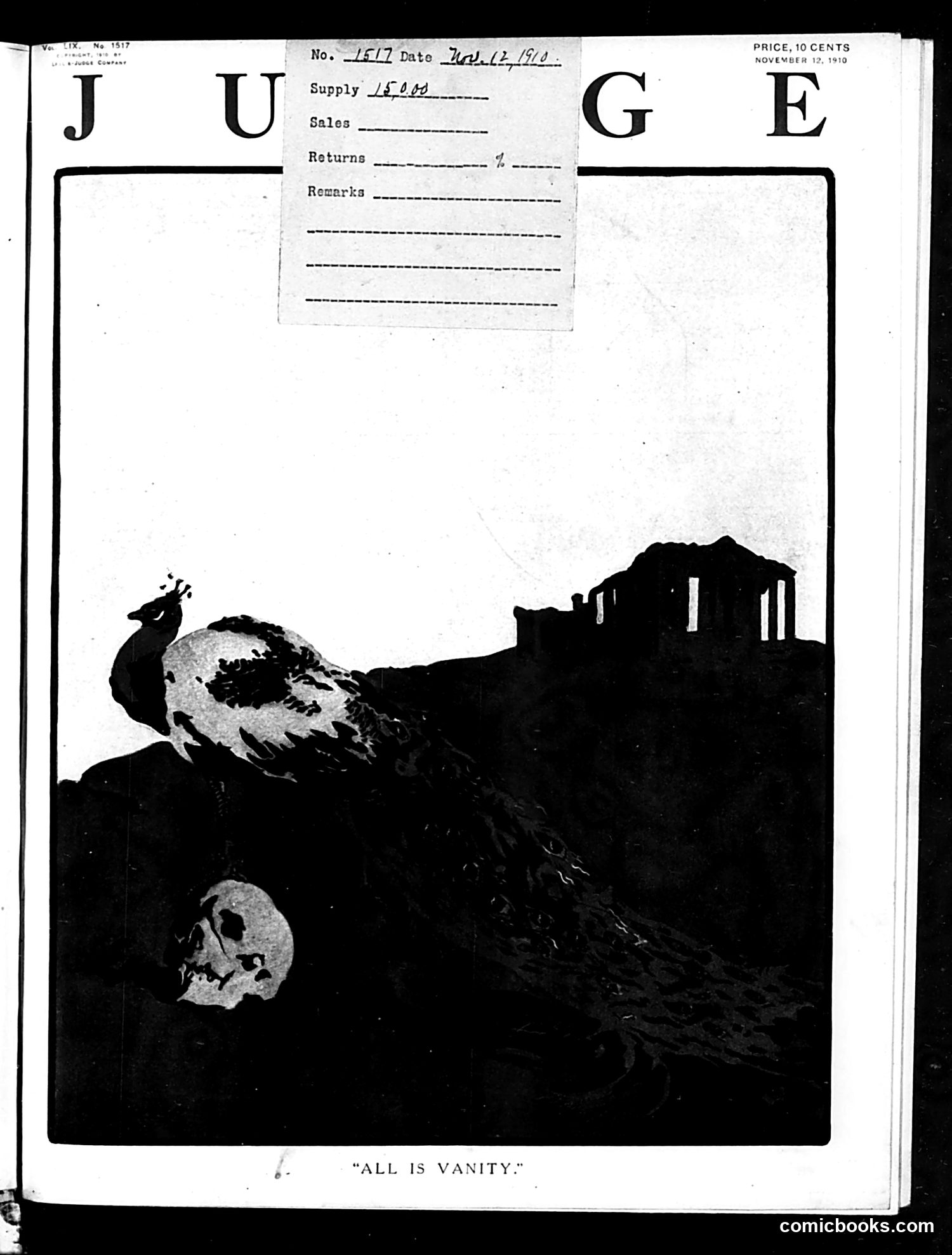
This is a memento mori cartoon playing on the classical "vanity" theme. A peacock—symbol of pride and vanity—admires itself while standing atop a human skull. In the background, a ruined classical structure (possibly representing fallen empires or civilization) crumbles into darkness. The caption "All Is Vanity" references the biblical book of Ecclesiastes, emphasizing that pride and worldly display are ultimately meaningless in the face of mortality. The peacock's elaborate plumage contrasts sharply with the death imagery below, suggesting that no amount of beauty, pride, or material grandeur can escape death's inevitability. This appears to be social commentary on human arrogance and the futility of vanity—a common Progressive Era theme about excess and pride.
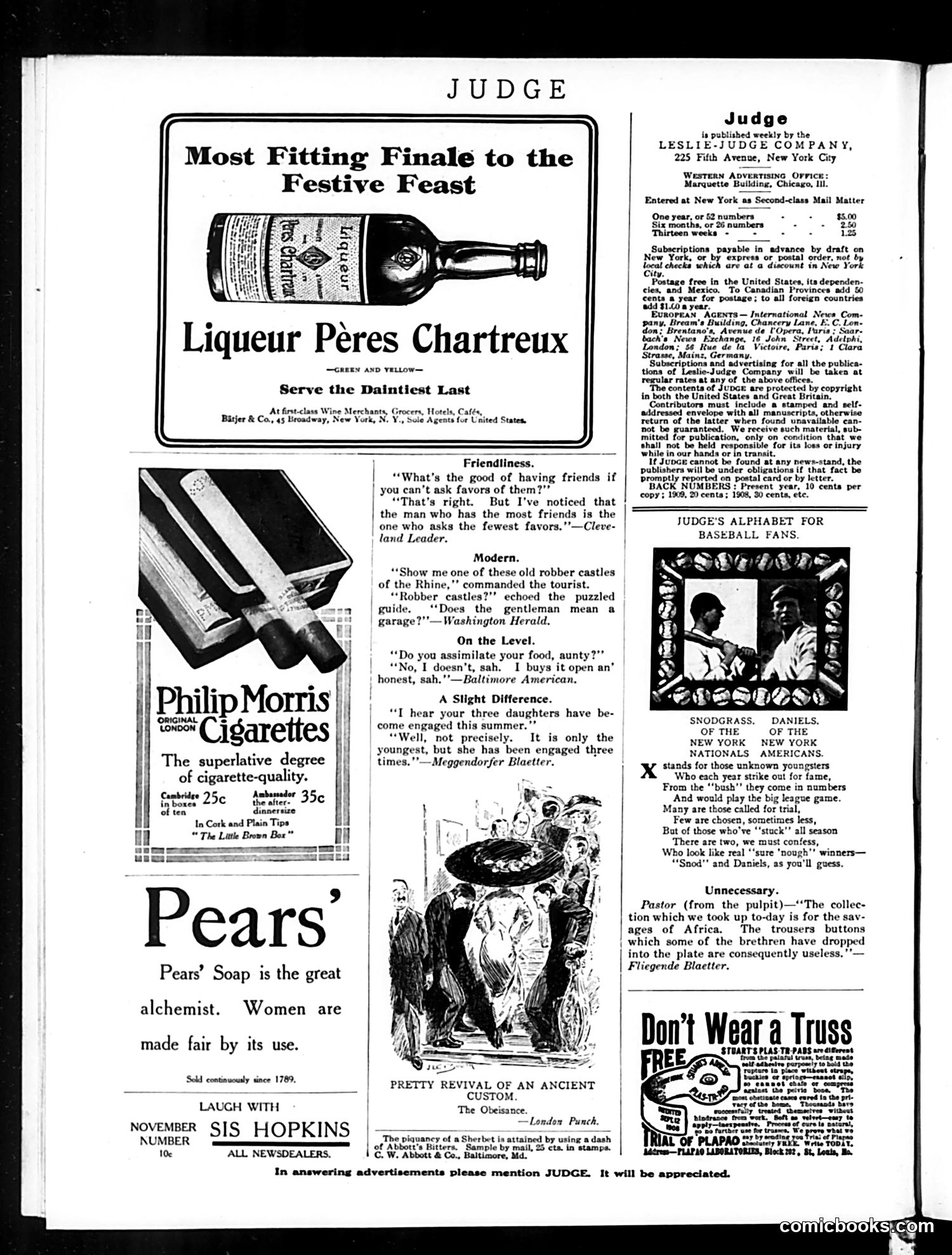
This page is primarily **advertisements with minimal editorial content**. The main cartoon, titled "Pretty Revival of an Ancient Custom," depicts a Sherbet vendor using a dash of opium in the beverage — likely satirizing both the casual drug use of the era and exotic/colonial practices. The reference to London Punch suggests this is commentary on British imperial attitudes. The other content consists mostly of product ads (Liqueur Pères Chartreux, Philip Morris Cigarettes, Pears' Soap) and brief humorous anecdotes on topics like friendship and social manners. "Judge's Alphabet for Baseball Fans" is a sporting reference feature, while "Don't Wear a Truss" advertises medical devices. Without knowing the specific publication date, the cartoon's satirical intent regarding drug use remains the only substantive editorial commentary visible.
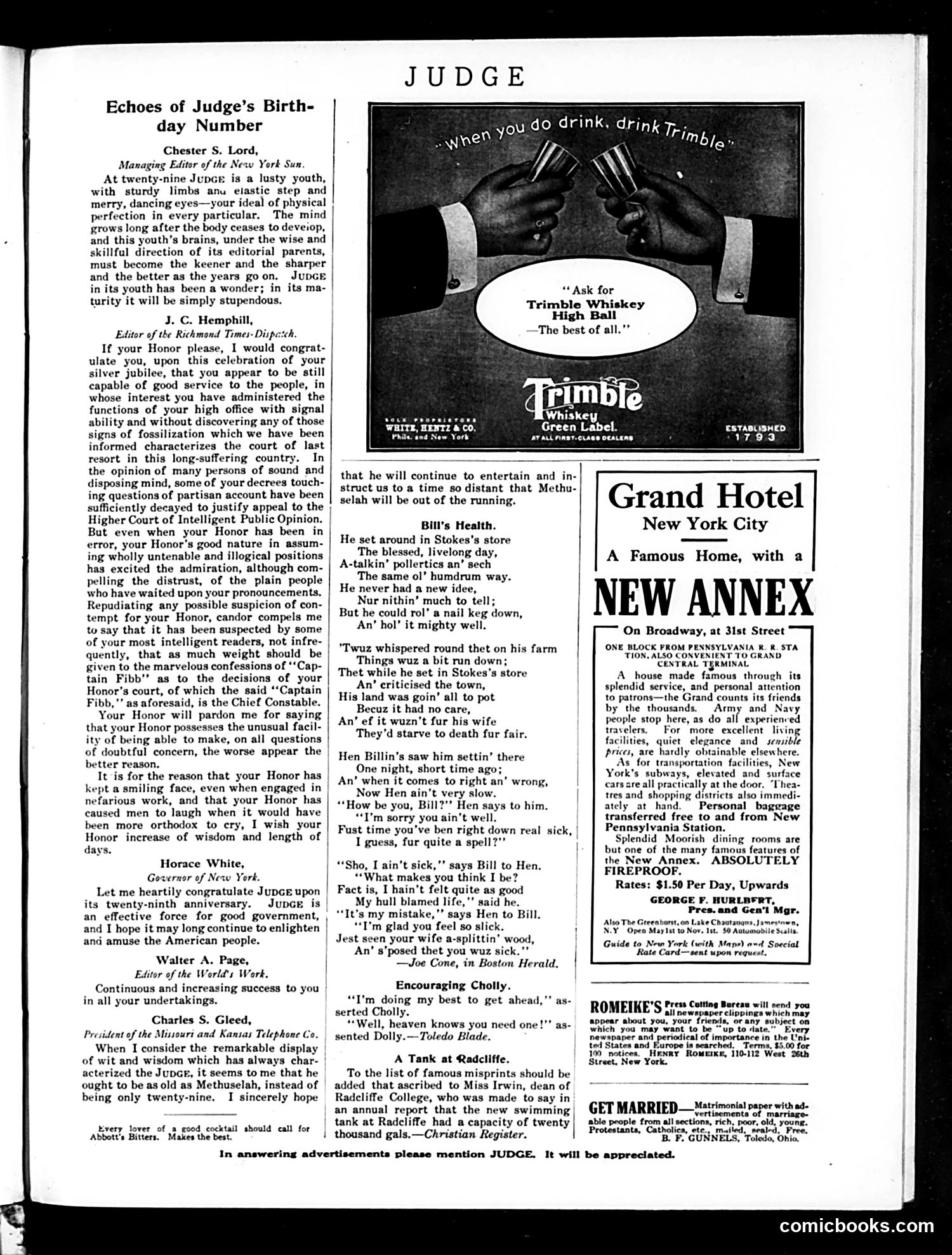
This page is primarily **birthday congratulations and advertisements** rather than political satire. The left column contains celebratory messages to Judge magazine's twenty-ninth anniversary, contributed by prominent figures like Chester S. Lord and J.C. Hemphill. The main illustrated advertisement features **Trimble Whiskey**, showing a hand holding a glass with the slogan "Ask for Trimble Whiskey High Ball—The best of all." Below are advertisements for the **Grand Hotel** in New York City and its "New Annex" on Broadway at 31st Street, emphasizing hospitality for travelers. The page lacks substantive political commentary or satirical cartoons typical of Judge's usual content. Instead, it functions as a commemorative issue celebrating the magazine's longevity while generating revenue through advertisements.
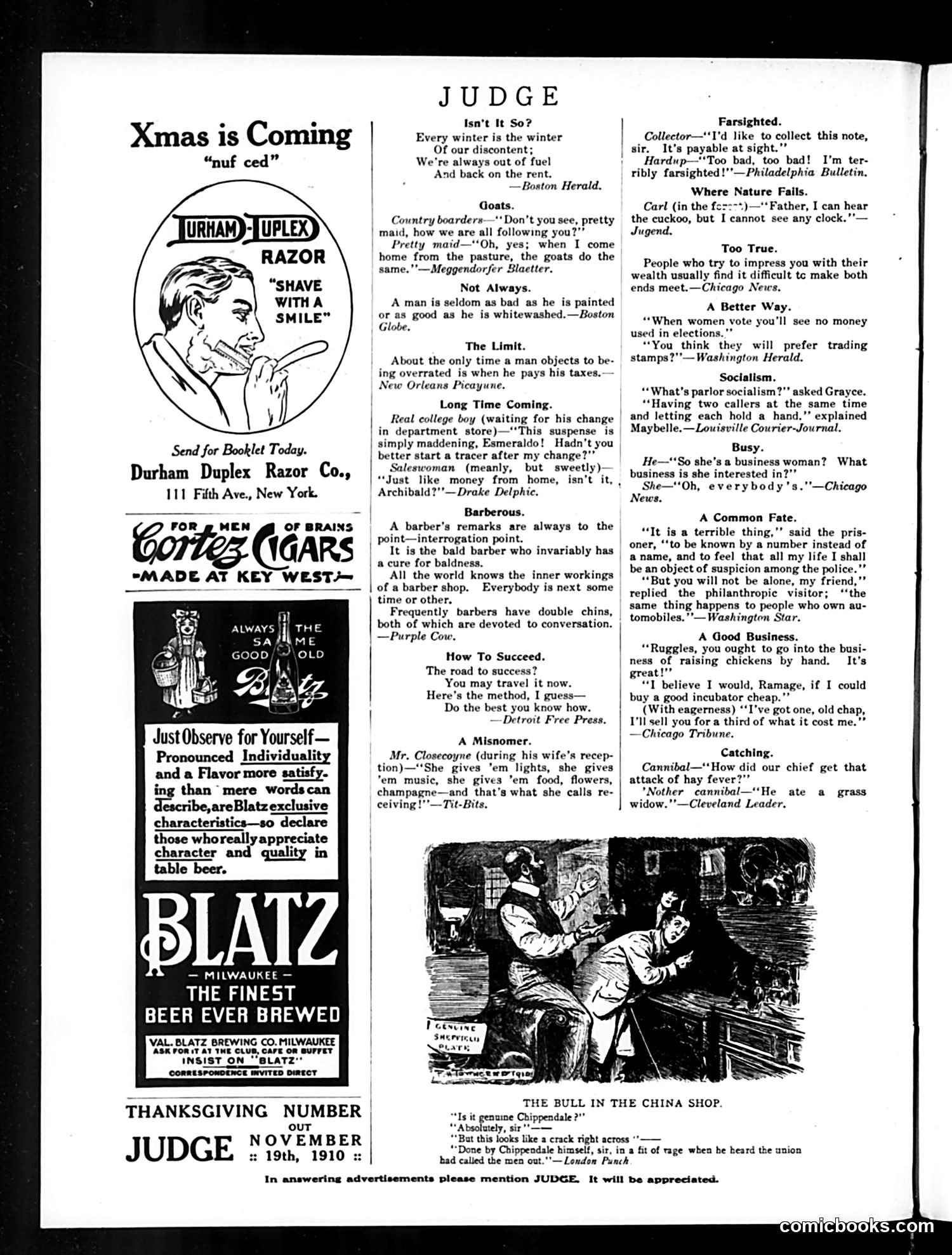
This page is primarily **advertising and humor columns** rather than political cartoons. The main content includes: **Advertisements:** Durham Duplex Razors, Cortez Cigars, and Blatz Beer dominate the layout with brand messaging about quality and individuality. **Humor Section ("Judge"):** Short satirical quips and jokes on various topics—marriage, barbers, socialism, women voting, business—typical of early 1900s magazine humor. These are gentle social observations rather than sharp political commentary. **Illustration:** "The Bull in the China Shop" sketch shows slapstick domestic chaos, a common visual joke format of the era. The page reflects *Judge*'s characteristic mix of commercial content and light social satire aimed at middle-class readers, with no specific major political event or figures referenced.
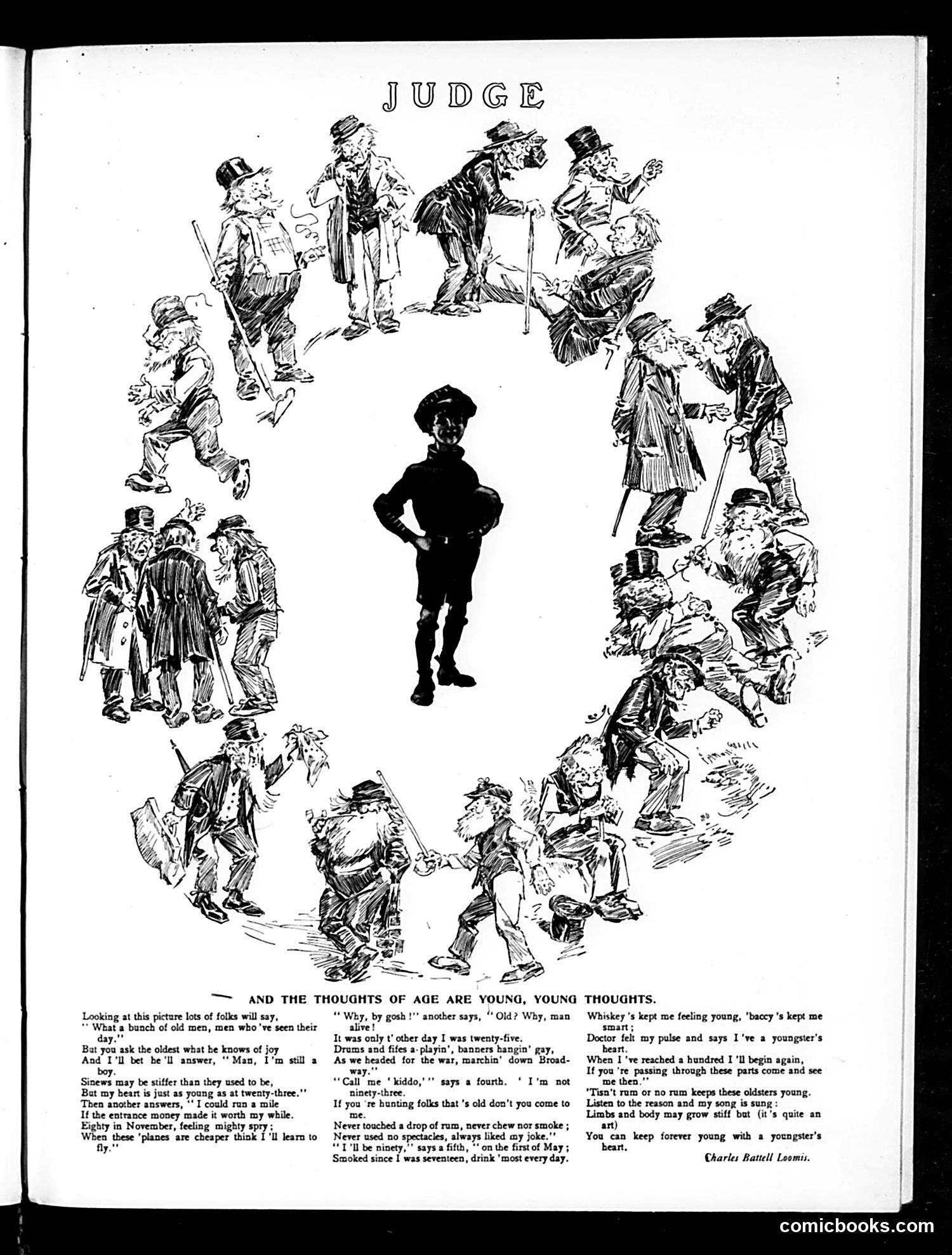
This satirical page features a silhouetted central figure labeled "JUDGE" surrounded by various caricatured men in Victorian dress, arranged in a circle. The accompanying poem and commentary mock older men who cling to youthful behaviors and attitudes. The satire targets aging gentlemen who refuse to acknowledge their age—they claim their hearts remain youthful despite advancing years, avoid spectacles and canes, maintain youthful vices (smoking, drinking), and generally resist the dignified comportment expected of elderly men in Victorian society. The cartoon ridicules this denial of aging as foolish and undignified, suggesting that attempting to preserve youth through behavior rather than accepting one's years with grace is both pathetic and comic. The circular arrangement emphasizes how widespread this behavior apparently was among Judge's intended male readership.
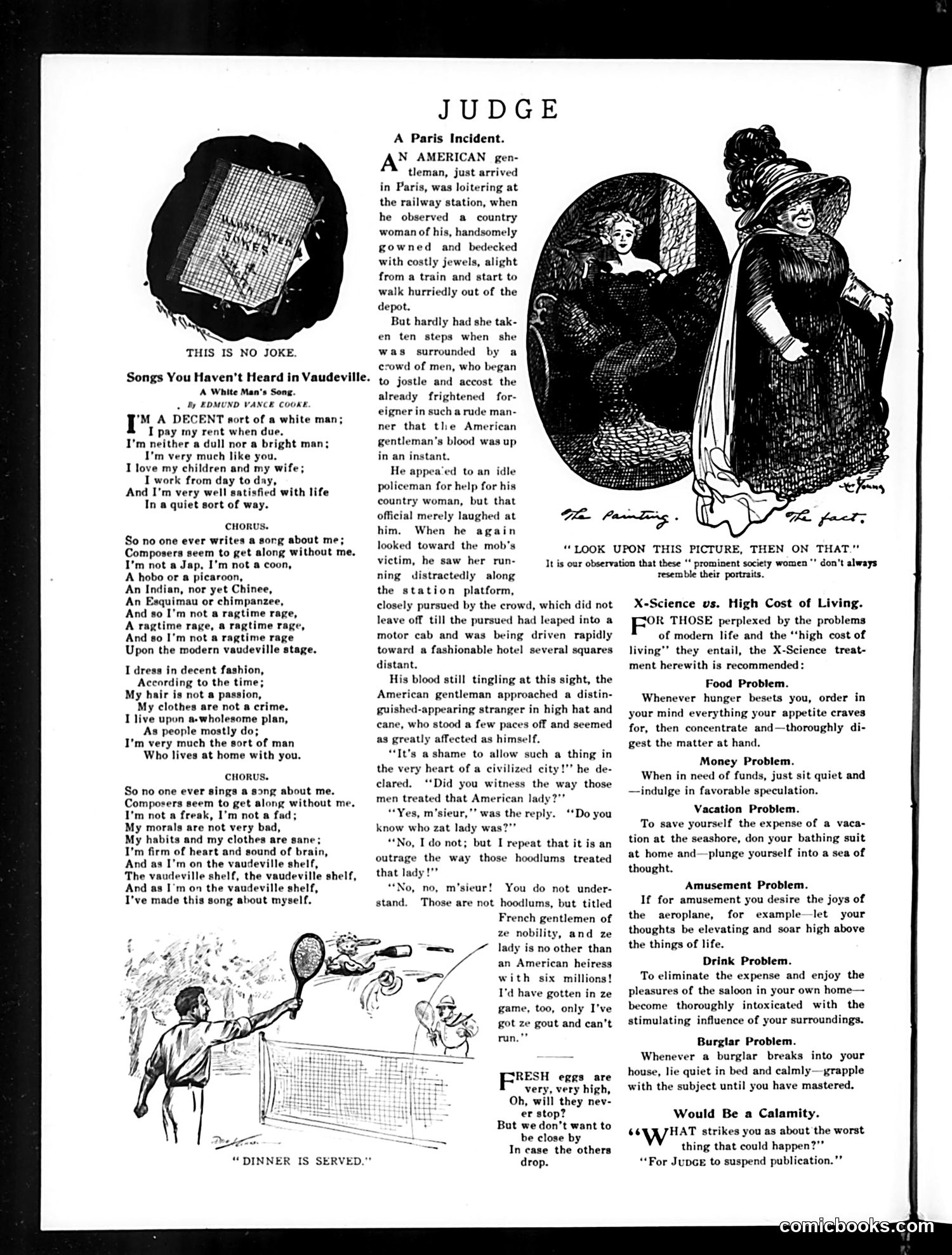
This page contains **two main satirical pieces**: **"A White Man's Song"** mocks American vaudeville's obsession with exotic or marginalized characters. The poem's speaker is an ordinary white man frustrated that songwriters ignore decent, conventional people like him—focusing instead on racial caricatures ("Jap," "coon," "Chinee"), immigrants, and stereotyped "ragtime" subjects. The satire targets both vaudeville's sensationalism and middle-class anxieties about being culturally invisible. **"A Paris Incident"** satirizes wealthy American heiresses and French aristocratic behavior. An American gentleman witnesses titled French noblemen harassing a well-dressed woman at a train station. When he protests, a Parisian reveals the "victim" is actually a rich American heiress—and the nobleman explains the chase was competition among aristocrats to court her millions, not harassment. The joke mocks both the predatory behavior of European nobility toward American wealth and the absurdity of mistaking fortune-hunting for crime. Both pieces reflect turn-of-the-century American anxieties about class, immigration, and international relations.
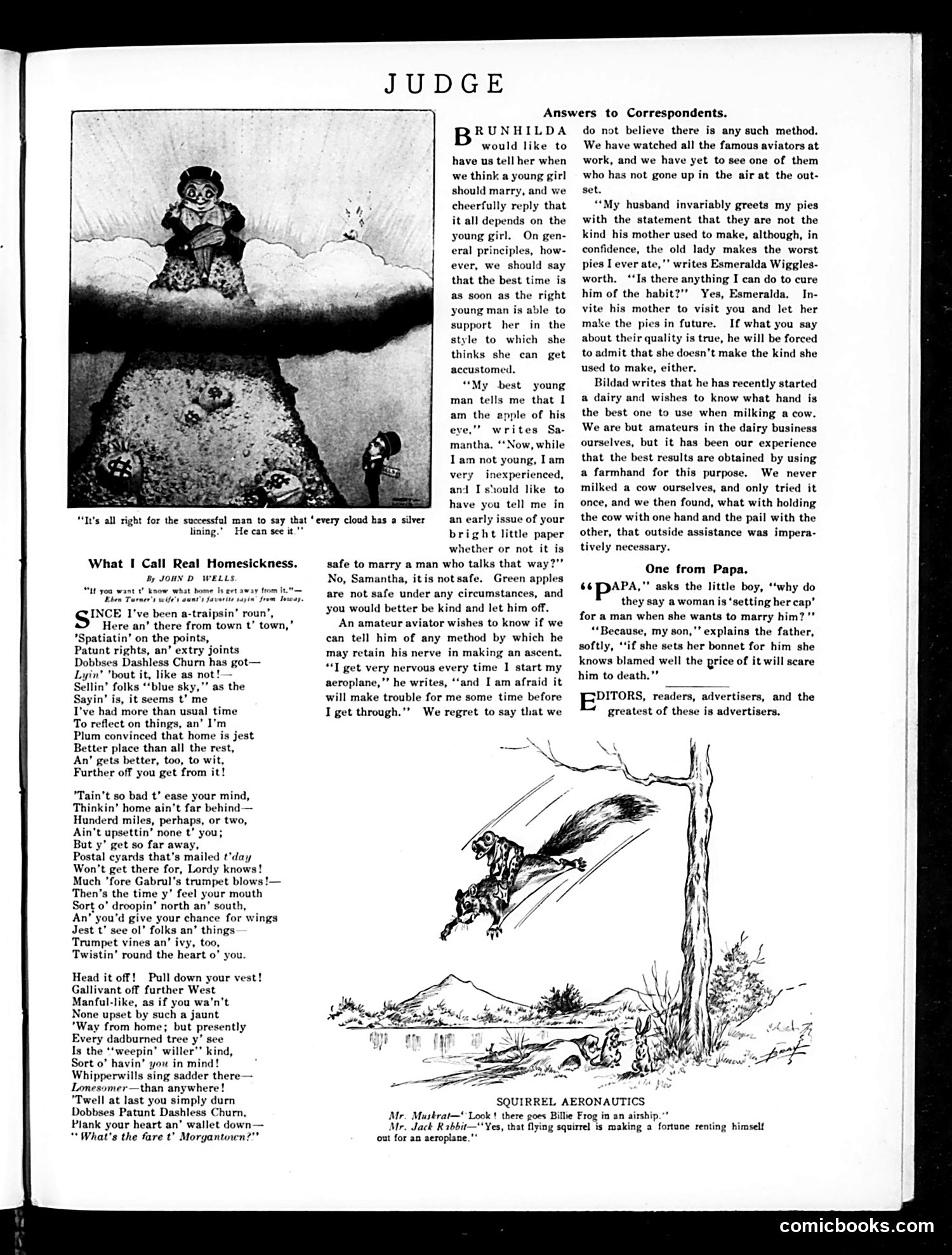
This Judge magazine page contains three distinct pieces of satirical content: **"What I Call Real Homesickness"** is a dialect poem about a traveling salesman (hawking the "Dobbses Dashless Churn") who grows increasingly homesick the farther he travels from home. The satire mocks both the sentimental nostalgia of American rural life and the traveling salesman character type—common in early 20th-century humor. **"Answers to Correspondents"** is an advice column offering tongue-in-cheek responses to readers' questions about marriage, aviation, and domestic matters. The humor relies on deadpan logic: e.g., to fix a husband's pie criticism, invite his mother to cook instead. **"Squirrel Aeronautics"** (bottom cartoon) depicts a flying squirrel, with characters joking that the squirrel is "making a fortune renting himself out for an aeroplane." This references the contemporary fascination with early aviation. The overall page satirizes American domesticity, marriage, technological progress, and commercial hustle typical of the 1910s era.
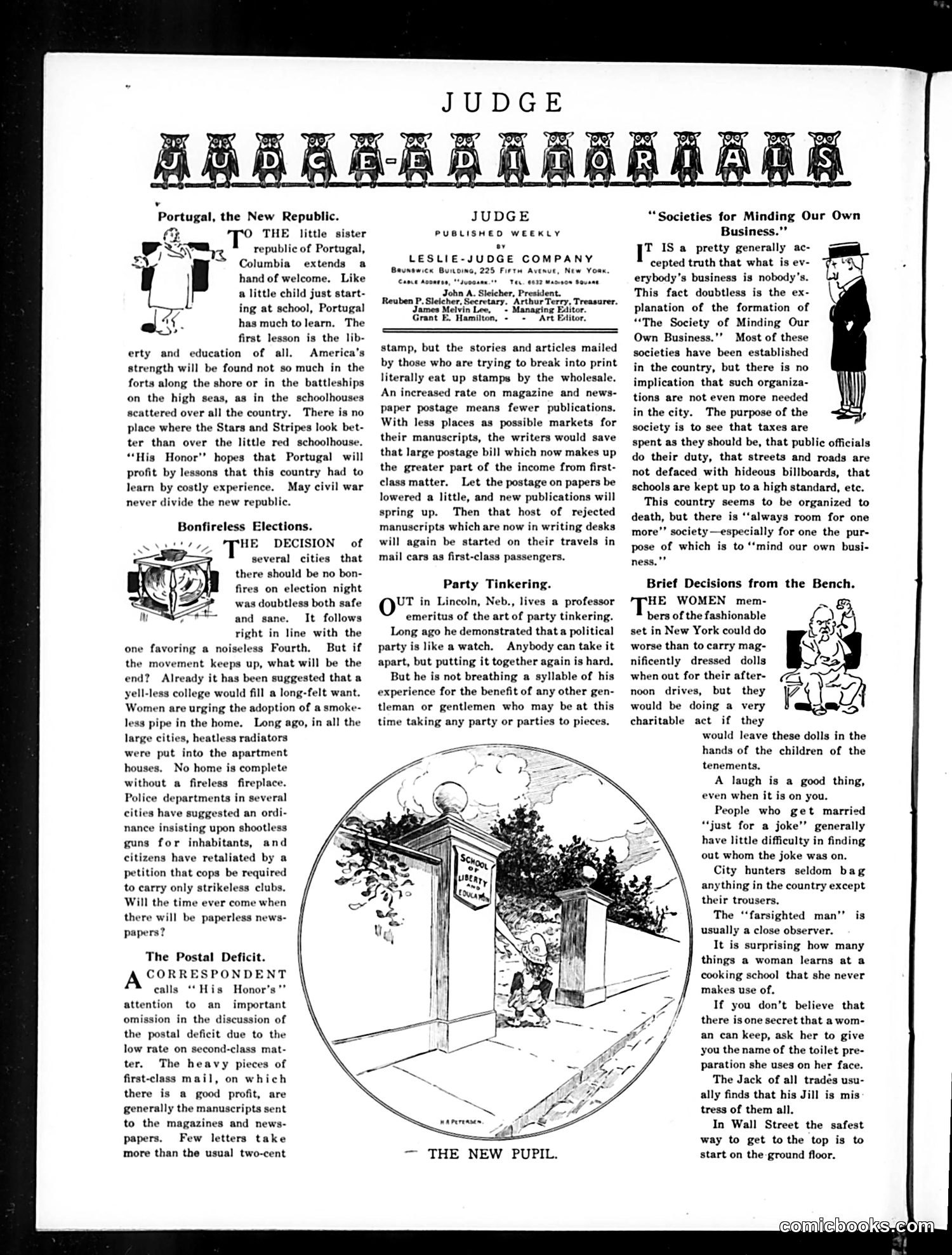
This page from *Judge* contains several satirical pieces targeting early 20th-century American politics and society: **"Portugal, the New Republic"** welcomes Portugal's recent transition to republicanism, suggesting America mentor the new nation—particularly in education and avoiding civil war. **"Bonfireless Elections"** satirizes progressive reform movements through absurdist escalation: if cities ban election bonfires for safety, why not silence Fourth of July celebrations, smokeless pipes, heatless radiators, and ultimately "paperless newspapers"? The joke mocks well-intentioned but increasingly ridiculous regulation. **"Party Tinkering"** references a Nebraska professor who compared political parties to watches—easy to disassemble but difficult to reassemble. This critiques politicians who destructively meddle with party structures without understanding consequences. **"The New Pupil"** illustration (center) depicts a schoolhouse, visually supporting the Portugal editorial's emphasis on education. The other sections address postal deficits and "Societies for Minding Our Own Business"—likely commenting on civic busybodies or reform organizations.
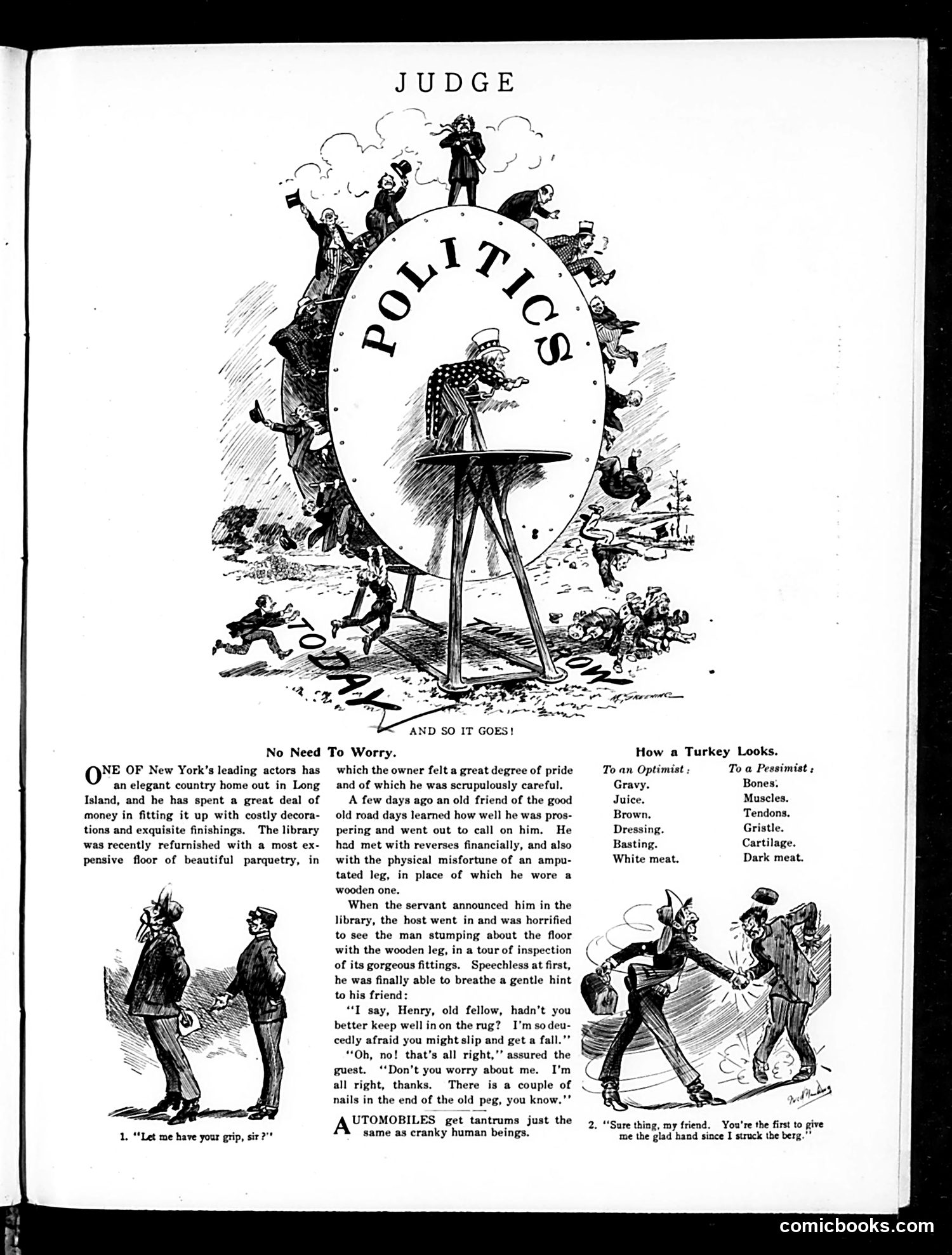
This page contains three separate humor pieces from *Judge* magazine: **Main story ("No Need To Worry"):** A wealthy New York actor, proud of his expensive parquet floor, is visited by an old friend from his struggling days who now wears a wooden prosthetic leg. The host nervously warns him to stay on the rug to avoid damage, but the friend reassures him—his wooden leg has nails in it for traction. The joke plays on the irony of the friend's casual confidence and the absurdity of the host's anxiety over floor damage compared to his friend's actual hardship. **Top cartoon:** Shows "Politics" as an enormous balloon with various figures clambering over it, suggesting the chaos and opportunism of political involvement. **Bottom section:** Brief humorous lists comparing how turkeys appear to optimists versus pessimists—focusing on desirable versus undesirable parts—likely seasonal holiday content. The final cartoon references someone who "struck the berg," suggesting shipwreck or disaster. The overall tone is lighthearted satire typical of *Judge's* era.
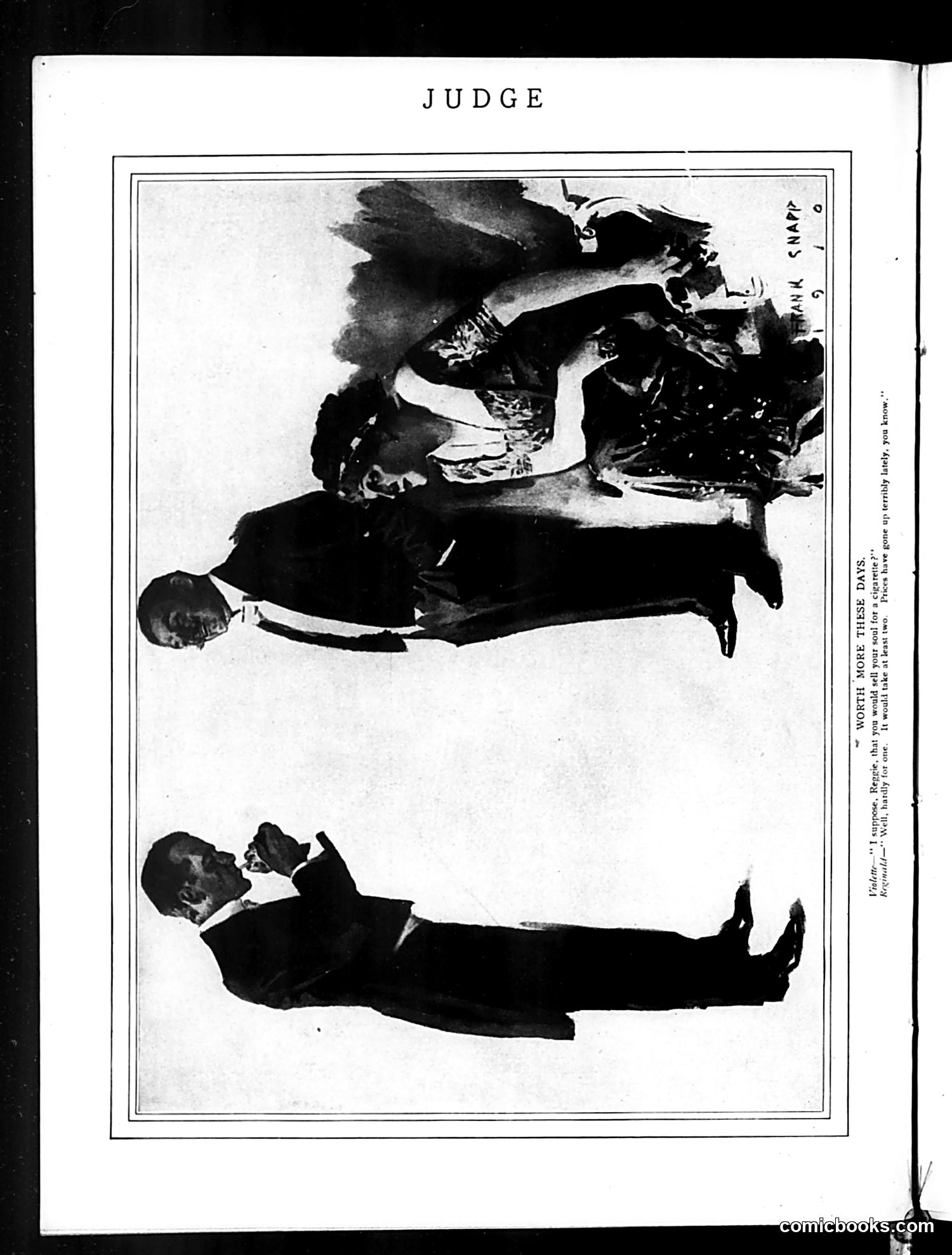
This page from Judge magazine shows two figures photographed against a white background, presented in a rotated orientation (the page appears meant to be turned sideways to view properly). The OCR text is severely corrupted and unreadable, making it impossible to identify the specific individuals or political references with certainty. The photographic style and composition suggest this may be a satirical comparison or commentary on contemporary political or social figures, which was common in Judge during the late 19th century. Without legible caption text or clearer image quality, I cannot reliably identify who these figures represent or what specific event or issue the satire addresses. The magazine's satirical purpose is evident from format, but the particular joke or critique remains unclear.
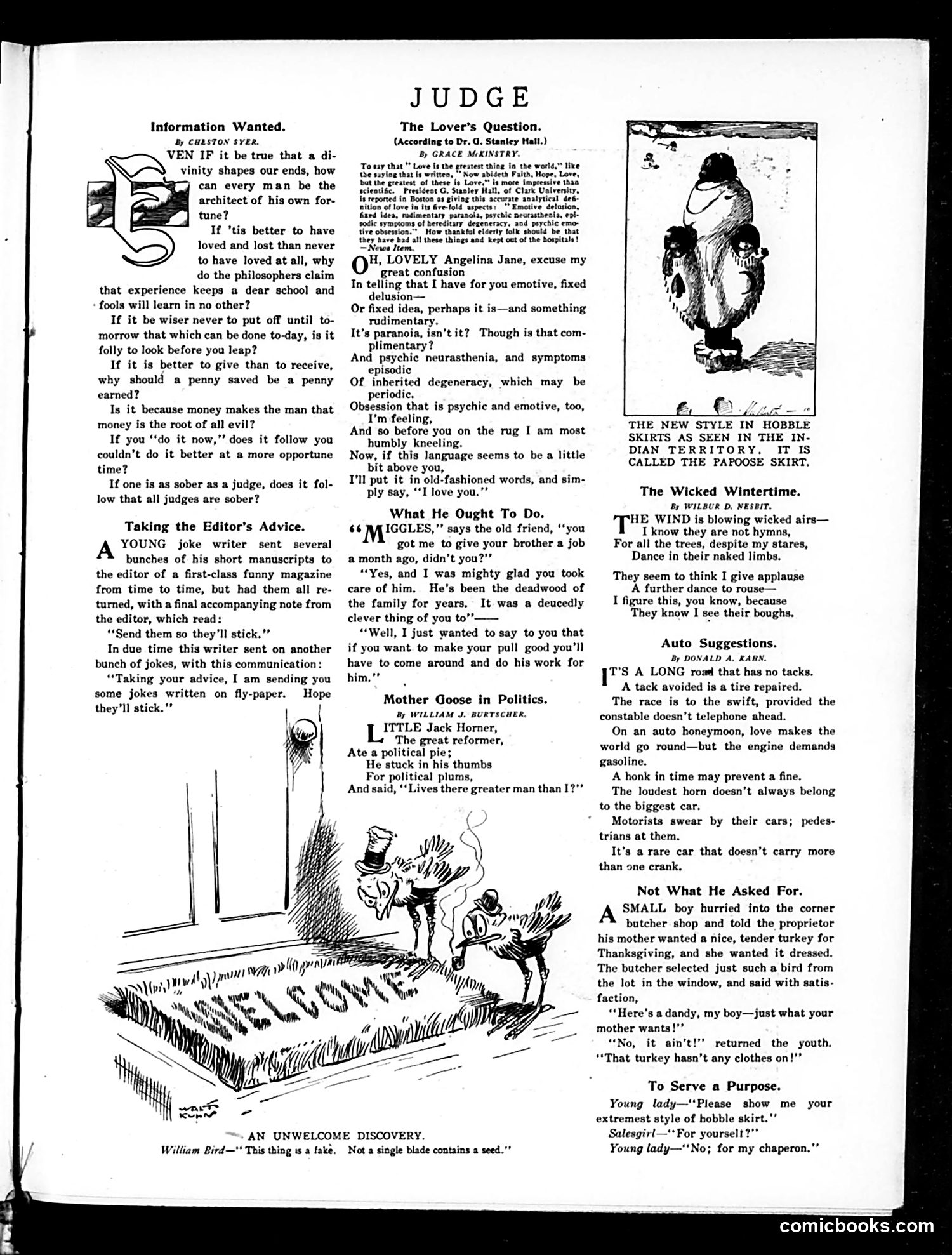
This page from the satirical magazine *Judge* contains several short humorous pieces mocking intellectual pretension and social absurdities: **"Information Wanted"** poses philosophical paradoxes (if giving is better than receiving, why save money?) to expose contradictions in common wisdom. **"Taking the Editor's Advice"** jokes about a joke writer literally writing submissions on fly-paper after being told to make them "stick"—a pun on adhesiveness and permanence. **"The Lover's Question"** parodies pseudo-scientific psychology jargon, mocking Dr. G. Stanley Hall's theories. A suitor confesses love using clinical terms like "psychic neurasthenia" and "inherited degeneracy," then admits the fancy language means simply "I love you." **"Mother Goose in Politics"** satirizes political reformers as self-serving, using the nursery rhyme format to mock "Little Jack Horner" (a reformer) who extracts political favors while pompously claiming moral superiority. The other pieces offer brief comic observations on driving and Thanksgiving turkeys.
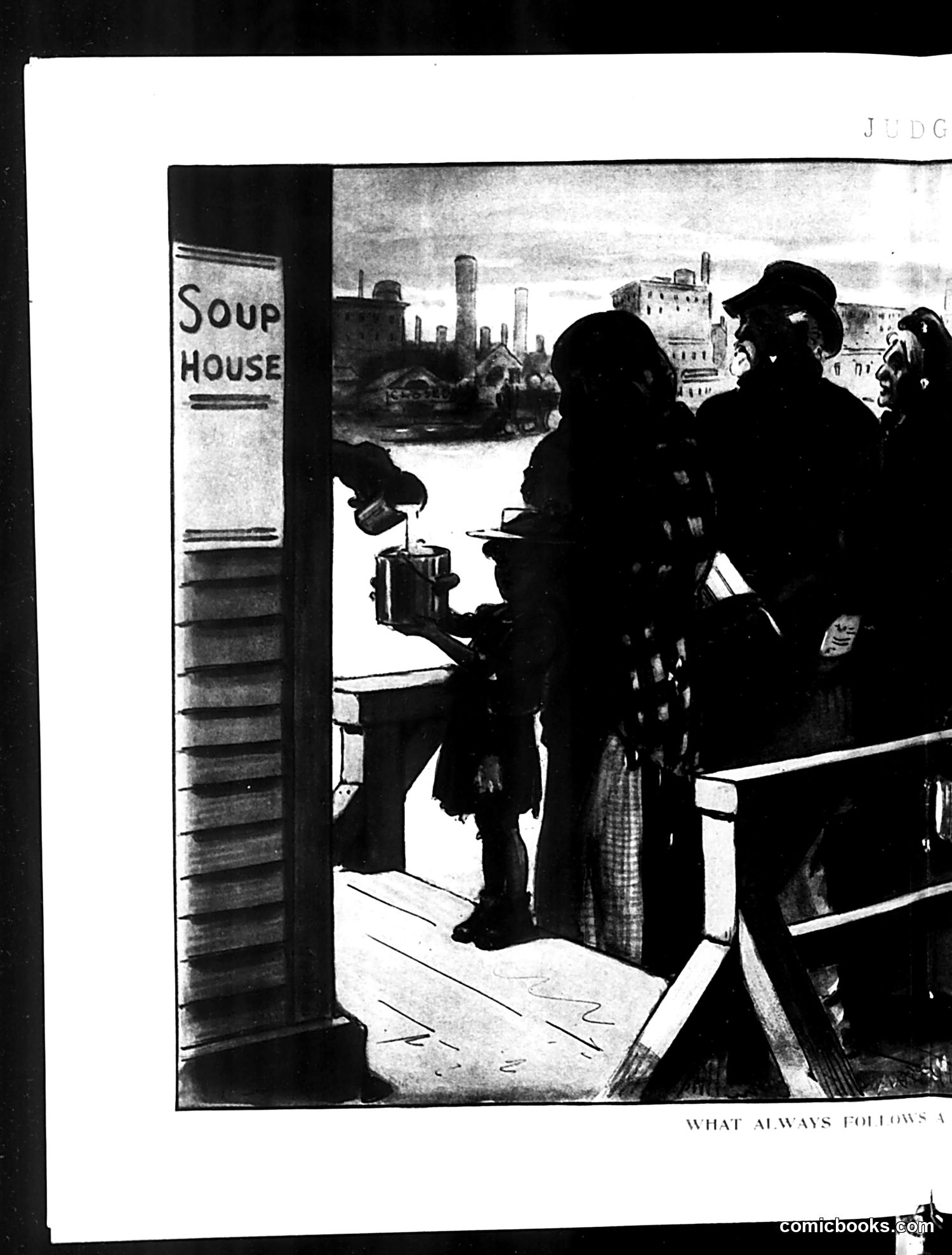
This black-and-white photograph shows people lined up outside a "Soup House" with an urban skyline visible in the background. The caption reads "WHAT ALWAYS FOLLOWS A—" (incomplete). This appears to be satirical commentary on economic hardship and breadlines. The image likely references the Great Depression era, when soup houses and breadlines became visible symbols of widespread poverty. The incomplete caption suggests the cartoon is making a political point about what consequences "follow" certain events or policies—presumably economic collapse or financial crisis. The silhouetted figures waiting at the soup house serve as stark visual evidence of unemployment and destitution. Without seeing the complete caption or date, the exact political target remains unclear, but the image uses the soup house as a symbol of societal suffering caused by larger economic forces.
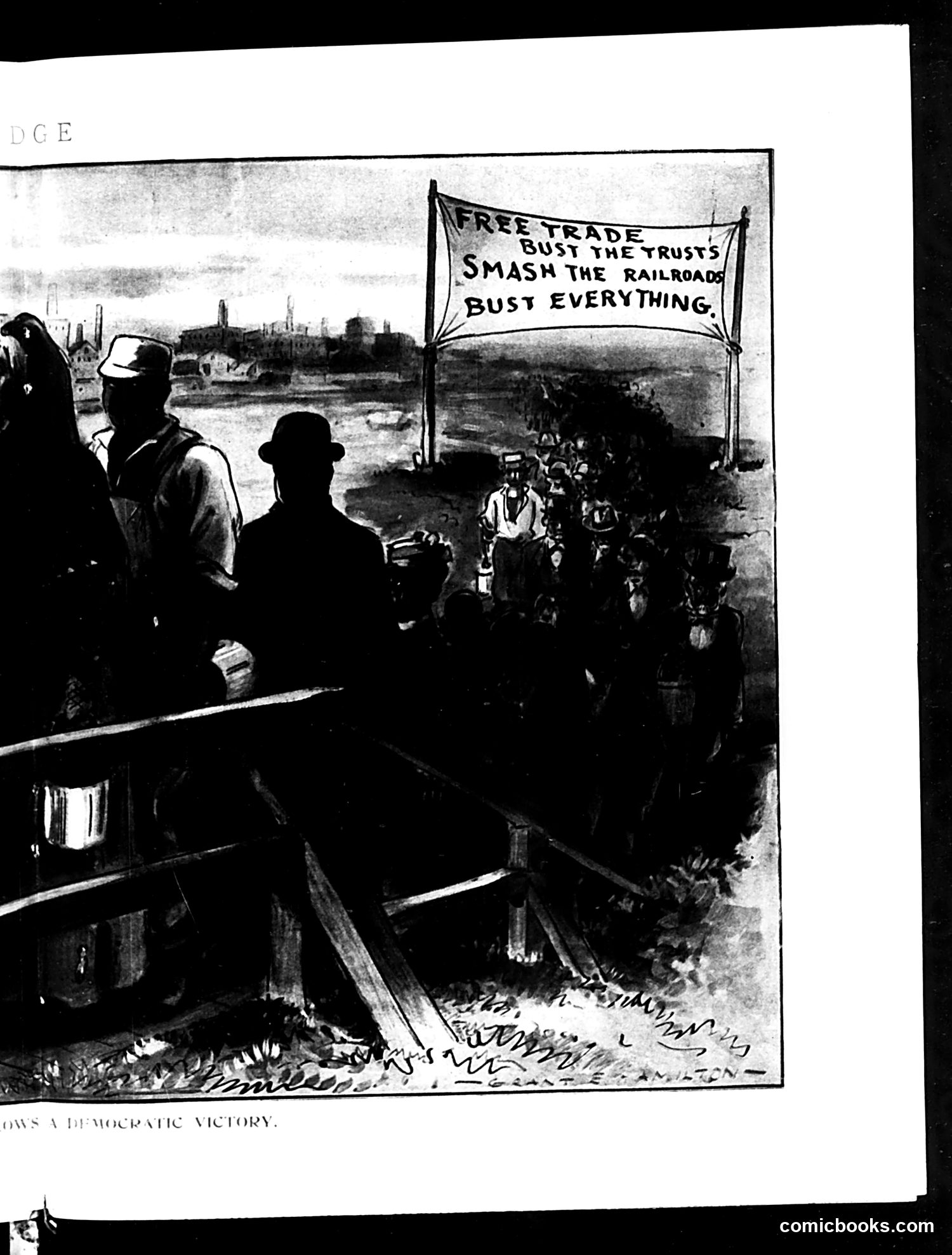
This cartoon depicts a protest or rally with a banner reading "FREE TRADE / BUST THE TRUSTS / SMASH THE RAILROADS / BUST EVERYTHING." The image shows men in period dress (early 20th century, based on hats and clothing) gathered near railroad tracks, with industrial smokestacks visible in the background. The satire appears to target radical or populist political movements advocating for antitrust action and railroad regulation—key issues of the Progressive Era. The exaggerated slogan "BUST EVERYTHING" suggests *Judge* magazine is mocking these reformers as indiscriminate destroyers rather than thoughtful policymakers. The caption indicates this represents a "DEMOCRATIC VICTORY," likely sarcastically implying that such destructive policies would result from Democratic governance. The cartoon critiques aggressive government intervention against major industries as economically reckless.
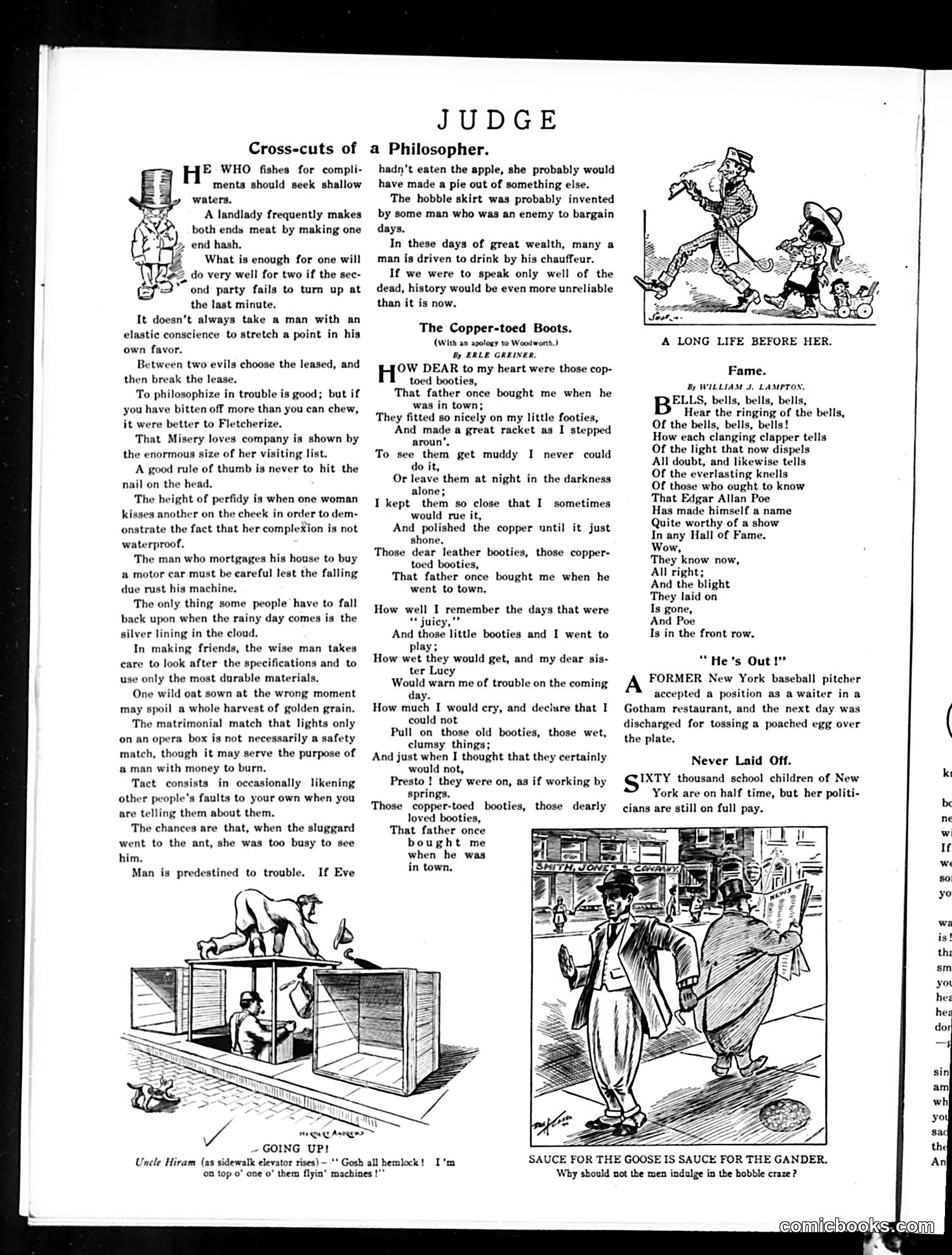
This page contains satirical philosophical observations ("Cross-cuts of a Philosopher") that mock conventional wisdom through deliberately inverted logic. For example: "A good rule of thumb is never to hit the nail on the head" and "Between two evils choose the leased, and then break the lease." The humor relies on recognizing absurdity disguised as wisdom. The cartoons include: "Going Up!" depicting Uncle Hiram on a sidewalk elevator (an early 1900s novelty), mistaking it for a flying machine. The "Sauce for the Goose" cartoon critiques gender double standards regarding the "hobble skirt" craze—showing a man and woman where only the woman's mobility is restricted, questioning why men escape similar social constraints. "The Copper-toed Boots" is a nostalgic poem about childhood footwear. The overall page reflects Judge's typical Edwardian-era focus on contemporary social fads, technological novelties, and domestic absurdities for middle-class readers.
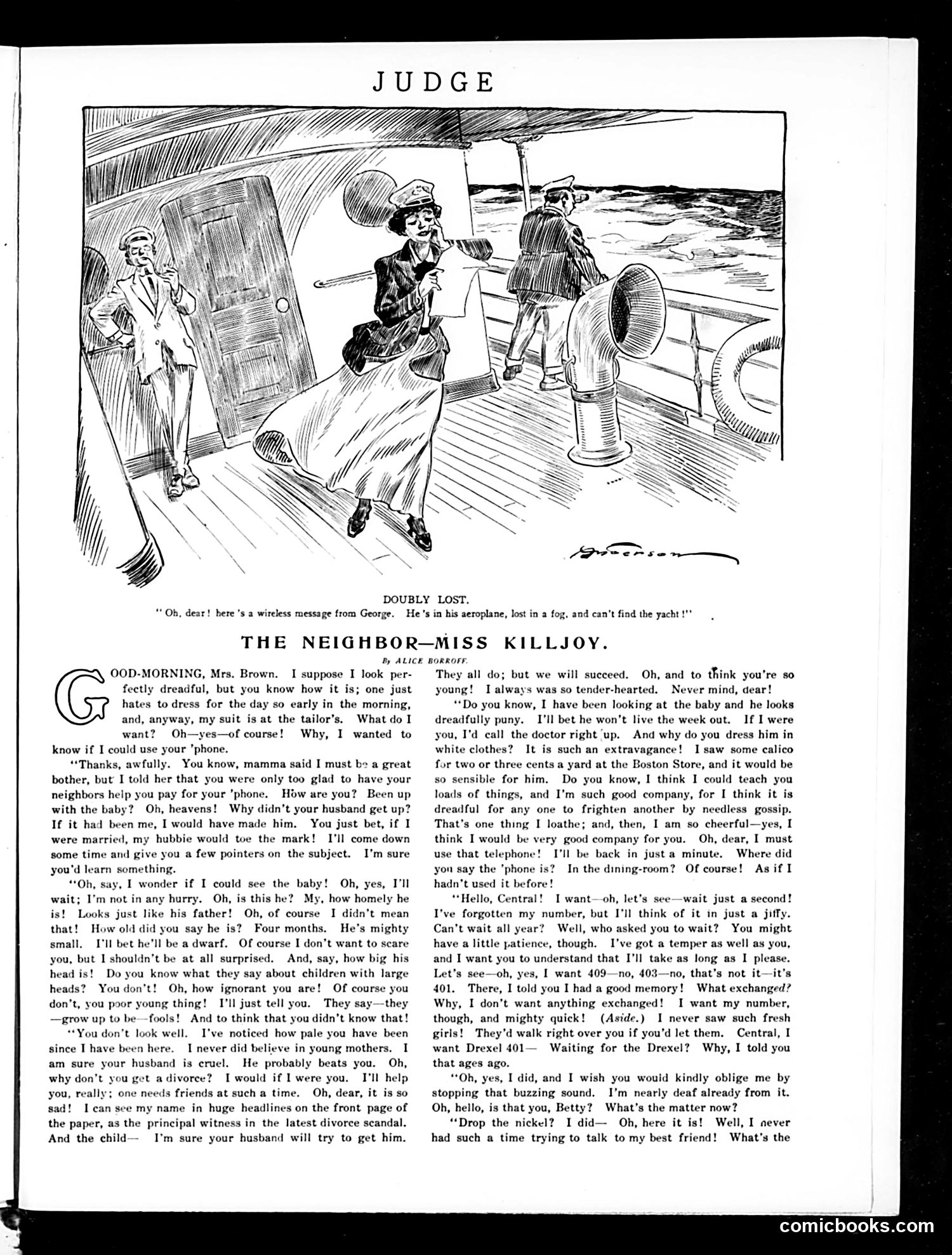
This story-cartoon satirizes the archetypal nosy neighbor who imposes herself on others while offering unsolicited criticism disguised as concern. "Miss Killjoy" embodies early-20th-century social annoyance: she borrows the telephone (a newer technology families had to share costs for), criticizes Mrs. Brown's appearance, insults her baby's appearance and health prospects, questions her mothering and marriage, suggests her husband beats her, and encourages divorce—all while claiming to be "good company." The satire targets women who use false concern to justify gossip and meddling. Her rudeness to the telephone operator and impatience ("Can't wait all year?") reveal her underlying selfishness. The ironic title "Killjoy" captures how such people—despite claiming helpfulness—drain others' happiness through relentless negativity and boundary-crossing.
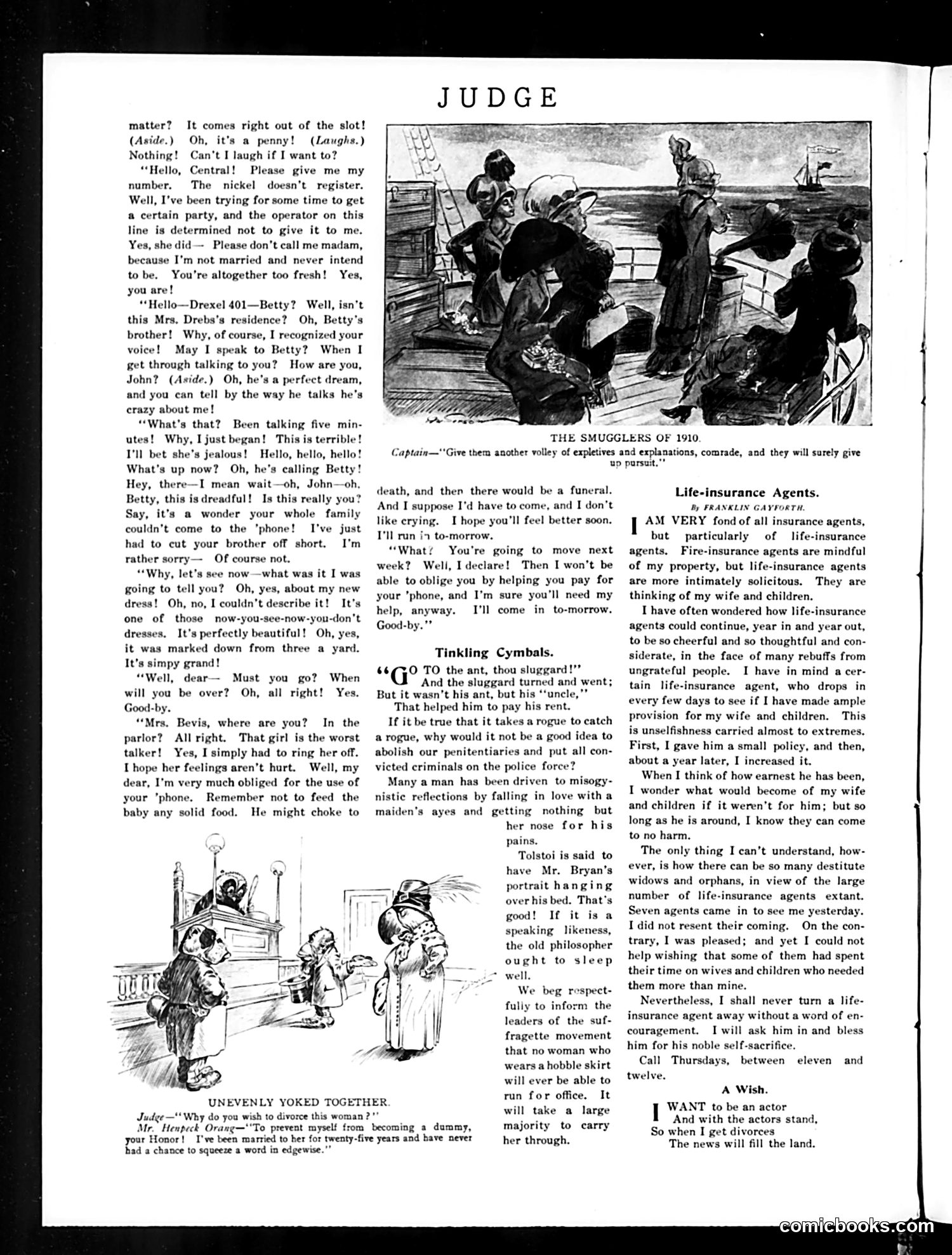
This page contains multiple satirical pieces rather than a single coherent cartoon. **"The Smugglers of 1910"** (top illustration) depicts figures on a ship discussing explosives, likely satirizing contemporary smuggling or contraband concerns of that era. **"Tinkling Cymbals"** (middle) appears to mock someone—possibly a politician or public figure—whose portrait hangs over a bed. The satire suggests hollow rhetoric or empty promises ("tinkling cymbals" being a biblical reference to meaningless noise). **"Unevenly Yoked Together"** (bottom) shows a cartoon about divorce, with the caption suggesting marital discord and incompatibility. The prose sections cover life insurance agents and suffrage movement concerns, typical Judge satire targeting contemporary social issues and professional types of the 1910 era. Without clearer identification of specific individuals caricatured, precise political targets remain unclear.
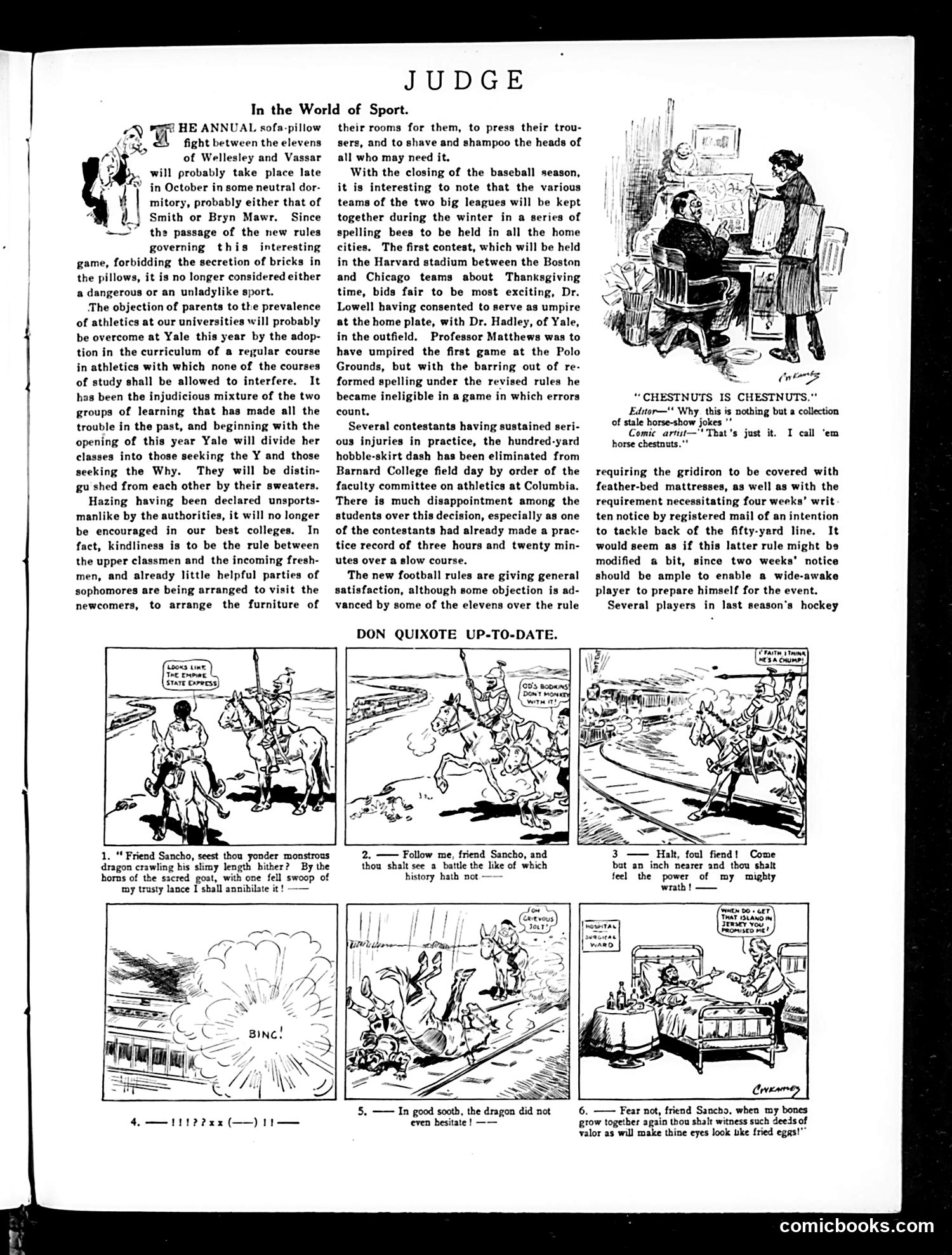
This page satirizes early 1900s college athletics through mock-serious commentary and a Don Quixote parody comic strip. **Main text satire:** Judge mocks the absurdity of new athletic regulations at elite colleges (Yale, Vassar, Wellesley, Barnard). Examples include: Yale dividing students into those seeking "the Y" versus "the Why"; pillow fights between female colleges now deemed "safe" because bricks are forbidden; baseball teams replaced by spelling bees; football fields requiring feather-bed mattresses; and a "hobble-skirt dash" for women (mocking restrictive fashion). The tone feigns earnest approval while exposing the ridiculousness of these rules. **Comic strip:** "Don Quixote Up-to-Date" shows the famous knight attacking what he perceives as dragons—satirizing how misguided enthusiasm (like Don Quixote's delusions) characterizes athletics reform movements. **The joke:** Judge presents these invented "reforms" deadpan, suggesting that athletic governance at prestigious universities had become so bureaucratically absurd that such rules seemed plausible to readers.
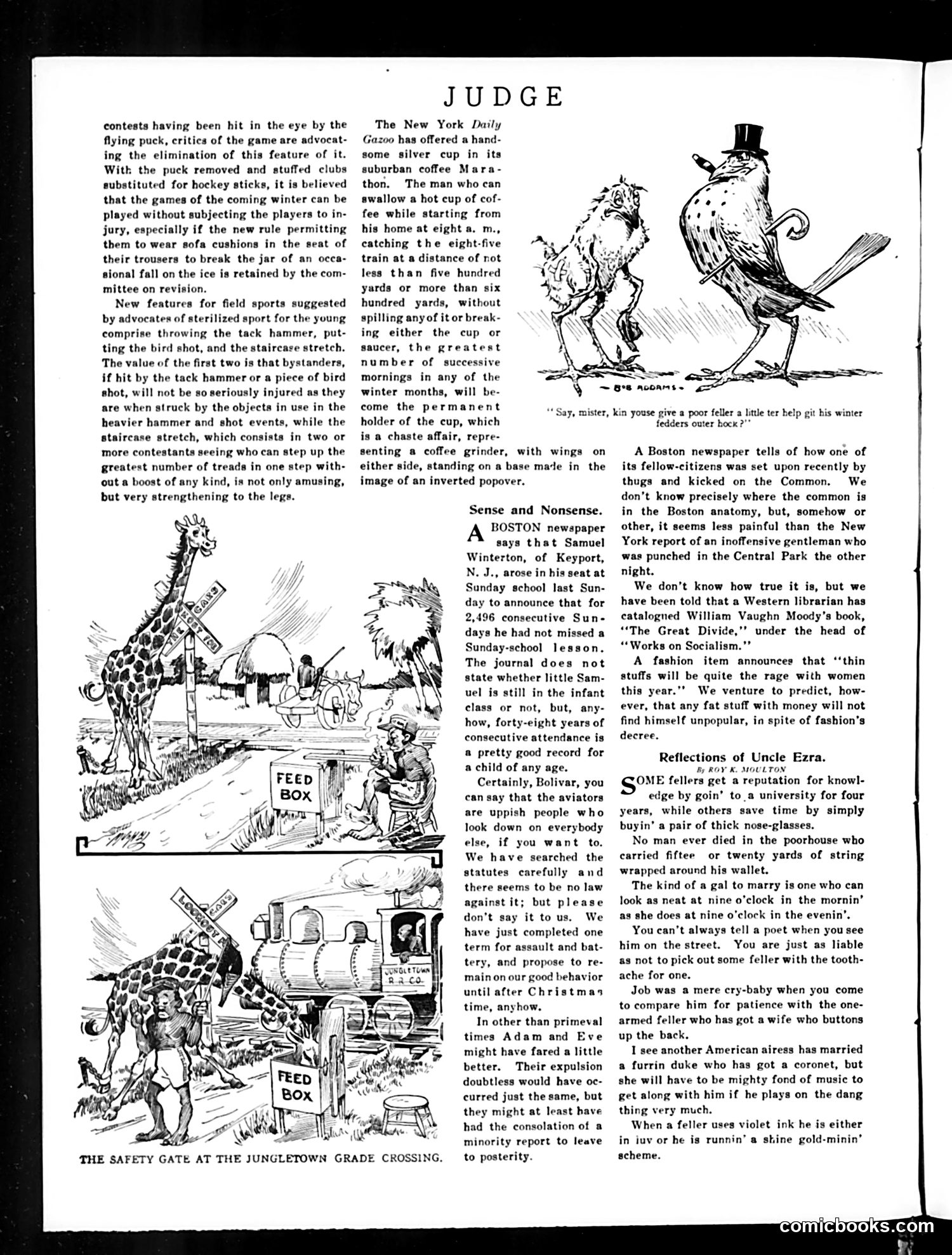
This page contains several satirical pieces typical of *Judge* magazine's humor: **Main cartoon ("The Safety Gate at the Jungletown Grade Crossing")**: This appears to be social satire about railroad safety at grade crossings, depicted through animal characters (a giraffe and other creatures). The "safety gate" ironically fails to protect, suggesting commentary on inadequate industrial safety regulations of the era. **Text sections** mock various contemporary absurdities: - Proposed "safer" sports modifications (replacing hockey pucks with stuffed clubs, adding cushions to clothing) that defeat the purpose of athletics - A Boston man's 48-year perfect Sunday school attendance record—presented as unremarkable despite being statistically improbable - Jokes about aviators being "uppish" (arrogant) - A quip about Adam and Eve's expulsion from Eden The humor relies on exaggeration and deadpan delivery to expose social pretension, absurd rules, and human vanity. The cartoons and text work together to satirize early-20th-century American culture.
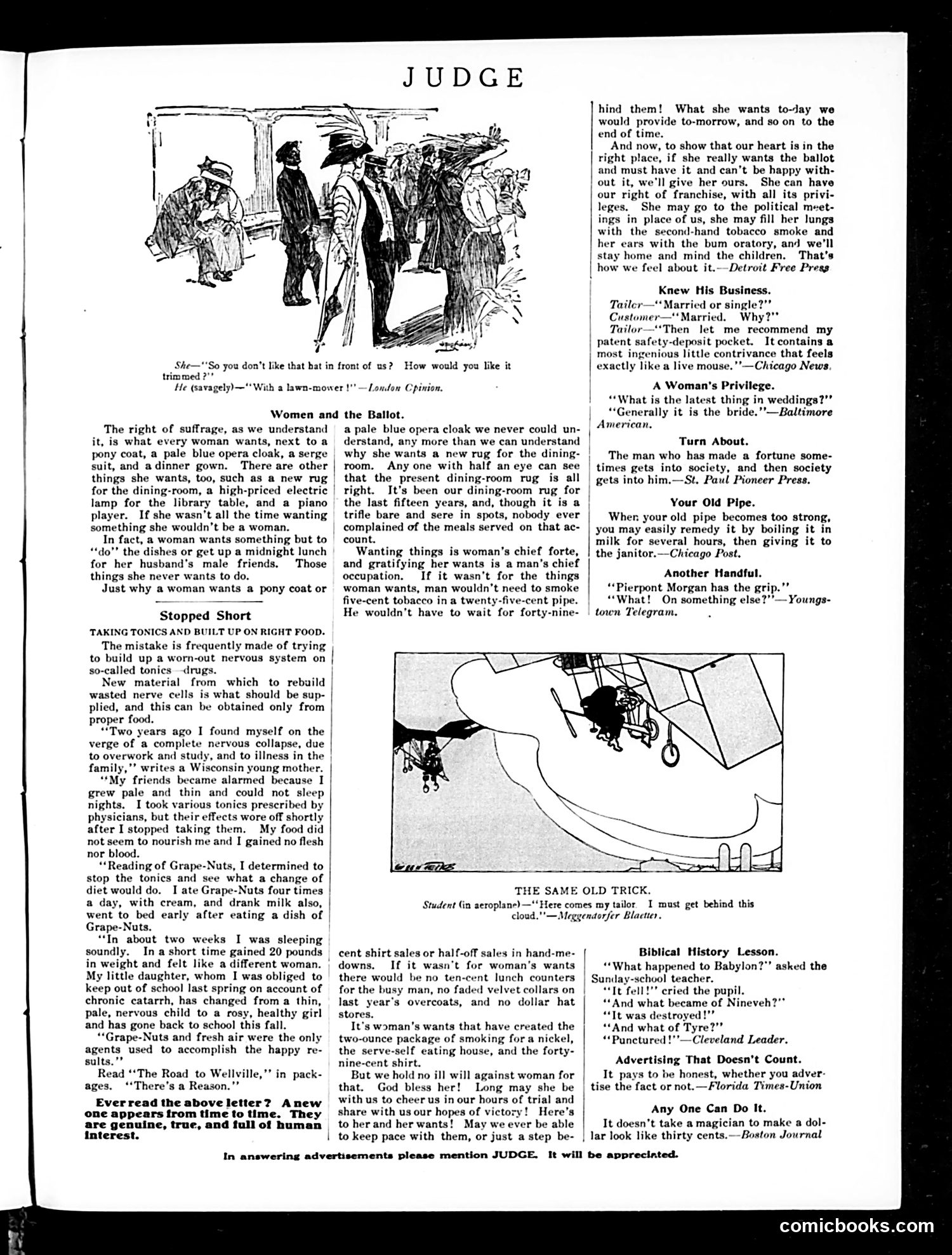
The main cartoon satirizes women's fashion, specifically elaborate hats. A man responds to his companion's complaint about an obstructed view by suggesting the offending hat be trimmed "with a lawn-mower"—exaggerating the absurdity of the enormous, ornate hats women wore in this era. This was a genuine social irritant: large feathered and decorated hats were fashionable and notoriously obstructed theater and public viewing. The longer text piece ("Women and the Ballot") is satirical commentary on women's suffrage. Written from a mock-male perspective, it argues women already have power through wanting material goods (pony coats, rugs, pianos), so why want voting rights? The piece sardonically "concedes" women the vote—claiming men will happily surrender their ballots to stay home and mind children while women attend boring political meetings. The satire works by exposing male anxiety about female empowerment beneath claims of gallantry.
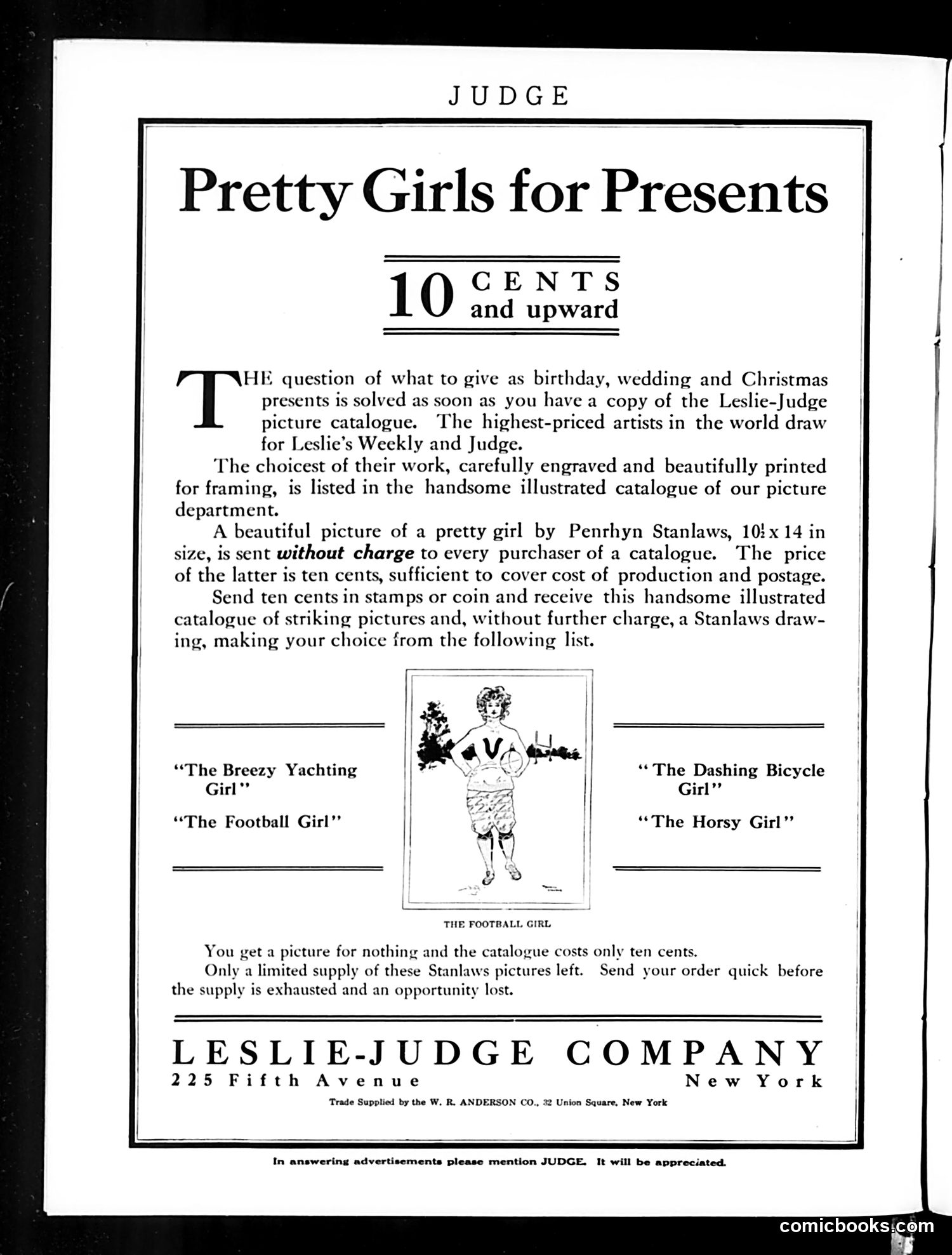
This is primarily an **advertisement**, not a cartoon with satirical content. It promotes the Leslie-Judge Company's picture catalog featuring artwork by Penrhyn Stanlaws, a popular illustrator of the era. The "Pretty Girls for Presents" offers decorative prints of attractive young women engaged in fashionable activities—yachting, bicycling, horseback riding, and football. These were marketed as affordable gift options (10 cents for the catalog, prints starting at 10 cents) suitable for birthdays, weddings, and Christmas. The single illustrated example shown is "The Football Girl," depicting a young woman in athletic attire—likely referencing the 1920s-era cultural phenomenon of women's increasing participation in sports and more active lifestyles. This represents a modest social commentary: the advertisement capitalizes on evolving attitudes toward women's independence and modern activities, positioning these images as contemporary and desirable. The appeal emphasizes scarcity ("limited supply") to drive sales—a standard advertising tactic.
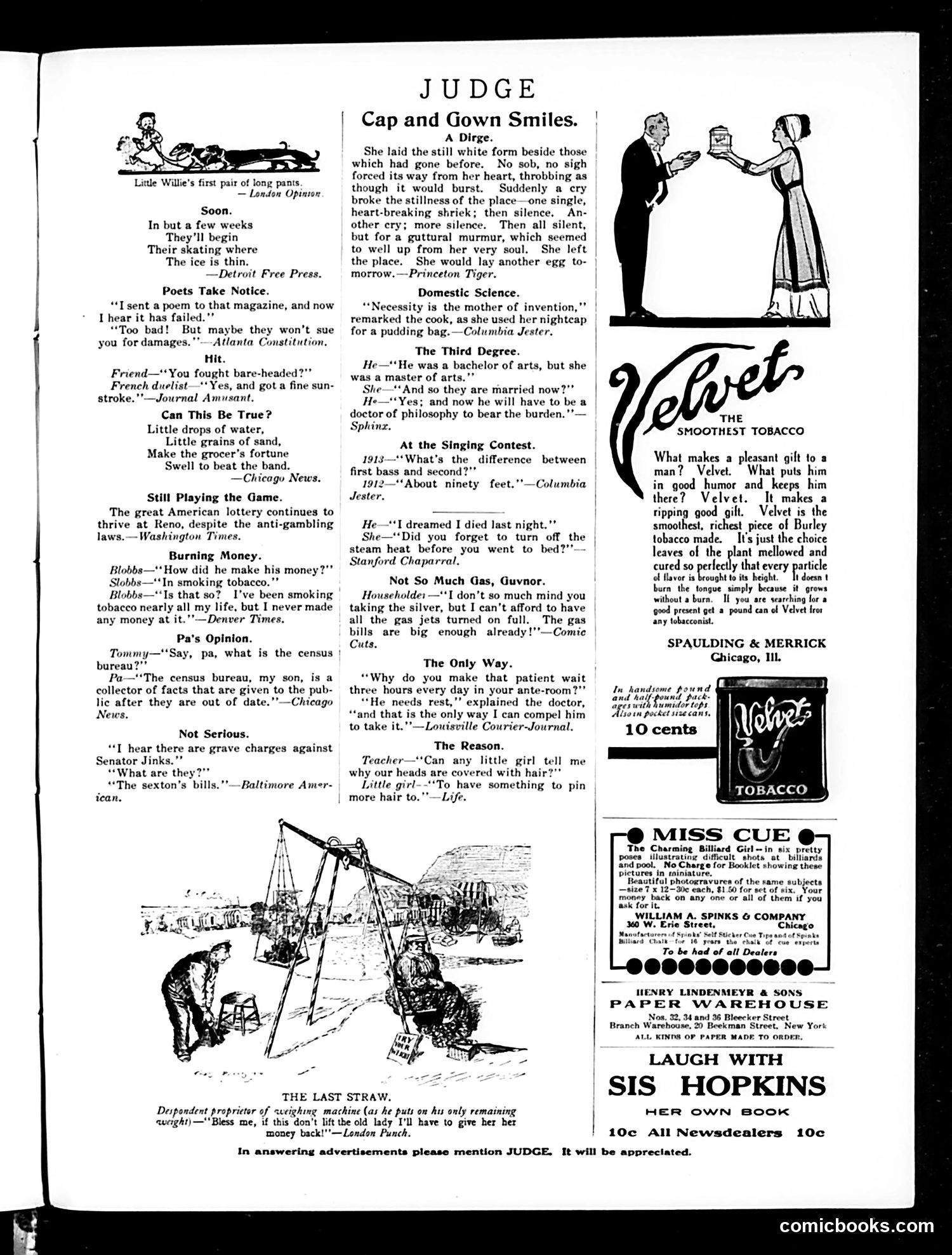
This page from **Judge** (an American satirical weekly) contains mostly **short humor pieces and advertisements** rather than political cartoons. The jokes mock everyday absurdities: a census bureau that reports outdated information; a doctor who forces patients to wait as "rest"; a cook using her nightcap as cooking equipment; a weighing-machine operator unable to budge an overweight customer. **"The Last Straw"** cartoon (bottom) depicts a dejected proprietor of a public weighing scale, straining to add his final weight to the machine to reach the fee threshold for a heavy customer—the joke being that if he can't make her weight register, he'll have to refund her money. The page also includes advertisements for **Velvet tobacco** and **Sis Hopkins** (a book/publication). These pieces represent typical early 1910s humor: domestic comedy, professional ironies, and gentle satire of modern inconveniences—with no apparent political content.
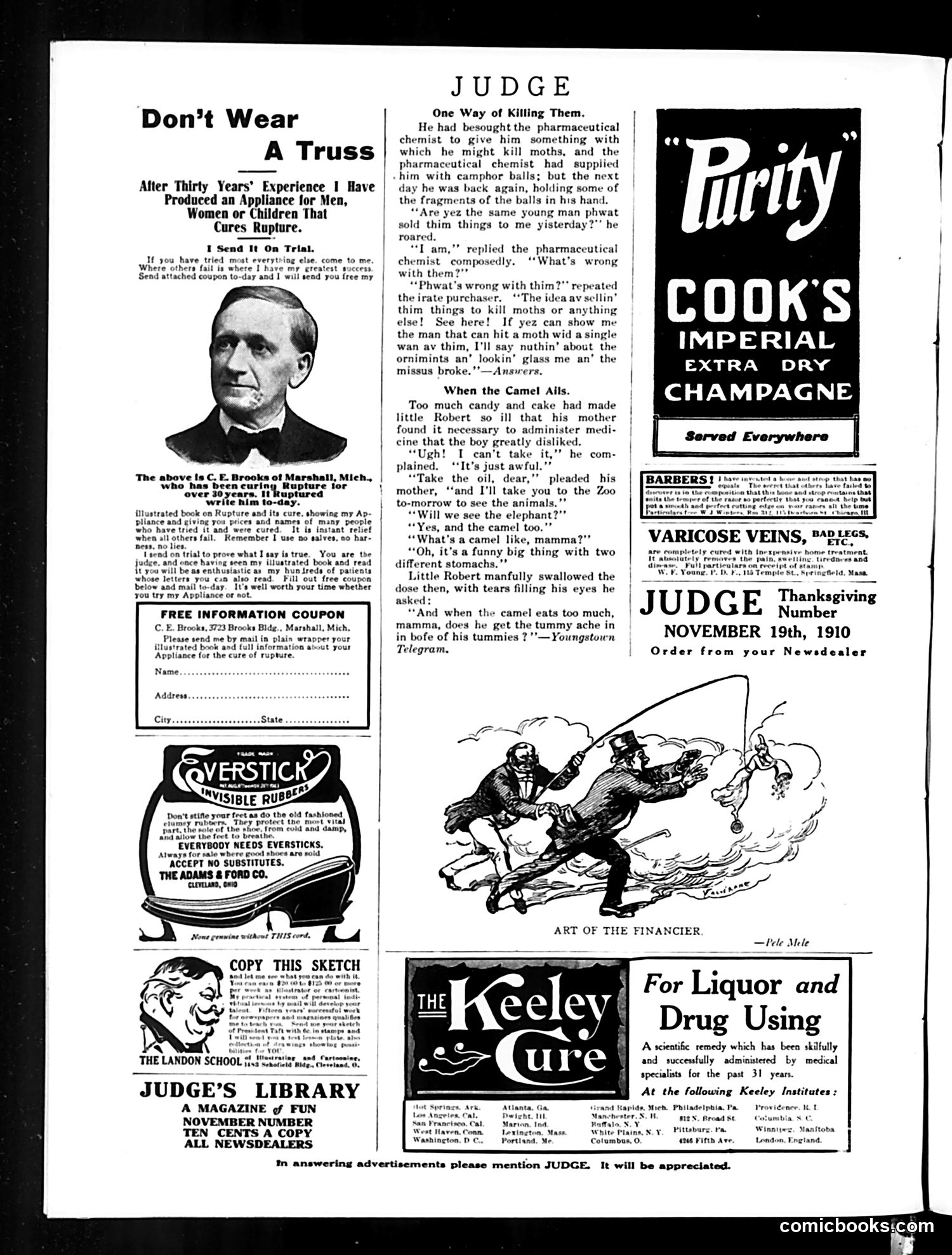
This page is primarily **advertising with light satirical content**. The main editorial content consists of two brief humorous anecdotes: 1. **"One Way of Killing Them"**: A joke about a frustrated customer returning camphor balls to a pharmacist, claiming they're useless for killing moths because you can't hit a moth with them. The humor relies on the customer's literal interpretation—the balls are meant to repel moths through scent, not be thrown at them. 2. **"When the Camel Ails"**: A child's innocent misunderstanding about camels having "two different stomachs," leading him to worry whether a sick camel gets "tummy ache in bofe of his tummies." Both are gentle, family-oriented jokes typical of early 1900s humor magazines. The page is dominated by **period advertisements** for medical devices (trusses for rupture), shoe products, and notably **The Keeley Cure**—a famous (now-infamous) addiction treatment claiming to cure alcoholism and drug dependency through a secret formula administered at institutes nationwide. This was common patent medicine advertising of the era, before FDA regulation.
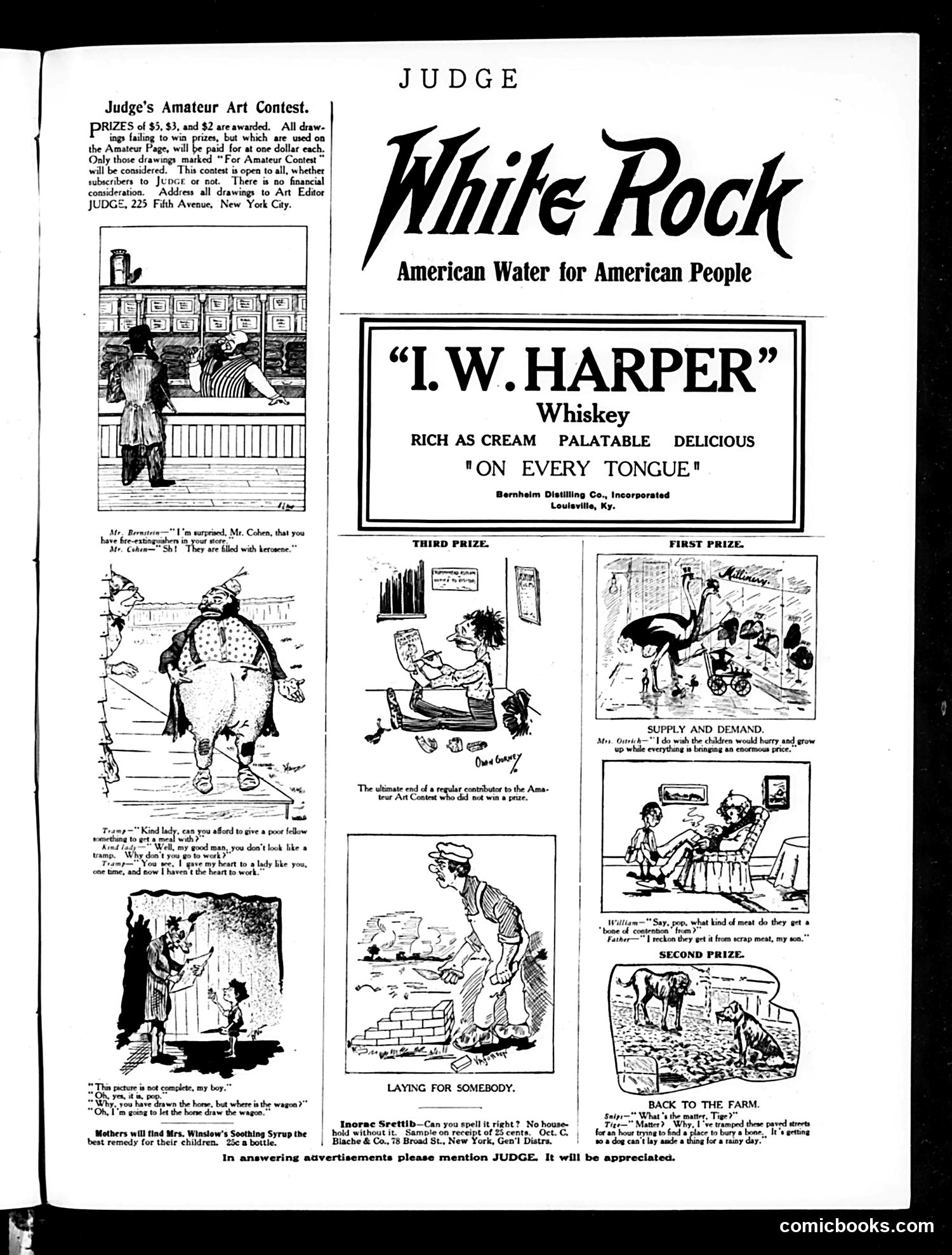
This page showcases Judge's amateur art contest with prize-winning cartoons alongside whiskey advertising. The winning cartoons employ typical early-20th-century humor: **First Prize** depicts "Supply and Demand"—an ostrich hoping her children grow quickly to profit from wartime price inflation, satirizing profiteering during (likely WWI-era) shortages. **Second Prize**, "Back to the Farm," shows a dog preferring rural life to city streets, reflecting nostalgic agrarian sentiment. **Third Prize** features various gag cartoons, including one about "bone of contention" and another about incomplete artwork. The page also includes ethnic humor stereotypes typical of the period (the Cohen/Bernstein dialogue about fire extinguishers filled with kerosene). The I.W. Harper whiskey advertisement emphasizes "American Water for American People"—likely nationalist branding common during the Prohibition era or wartime patriotism.
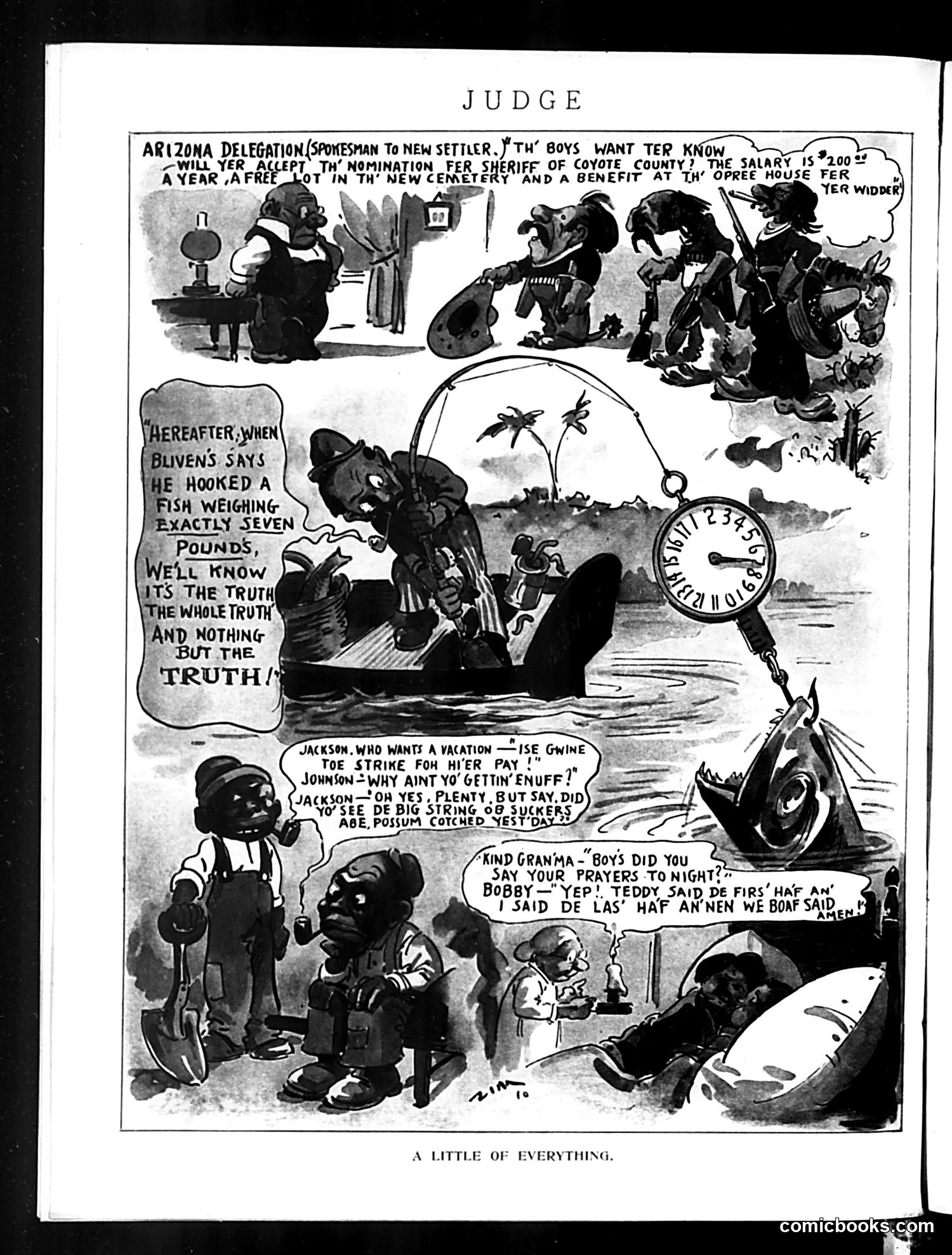
This Judge magazine page satirizes early 1900s American politics through multiple vignettes using racist caricatures and dialect. **Top section**: An Arizona delegation pitches a sheriff position to a newcomer, offering "$200 a year, a free lot in the new cemetery, and a benefit at the Opree House"—mocking frontier life's dangers and poor compensation. **Middle**: Jackson (likely representing a Black worker) discusses vacation pay with his employer, referencing catching "suckers" and a "possum"—crude humor about labor disputes and working-class struggles. **Bottom**: A grandmother asks children if they said prayers; they respond they split the task between "Teddy" and "de las' haf"—likely referencing President Theodore Roosevelt, satirizing how even religious instruction gets casualized or delegated in modern life. The title "A Little of Everything" suggests scattered, disconnected observations on American society. The humor relies heavily on offensive racial stereotypes typical of the era.