
A complete issue · 18 pages · 1910
Judge — October 15, 1910
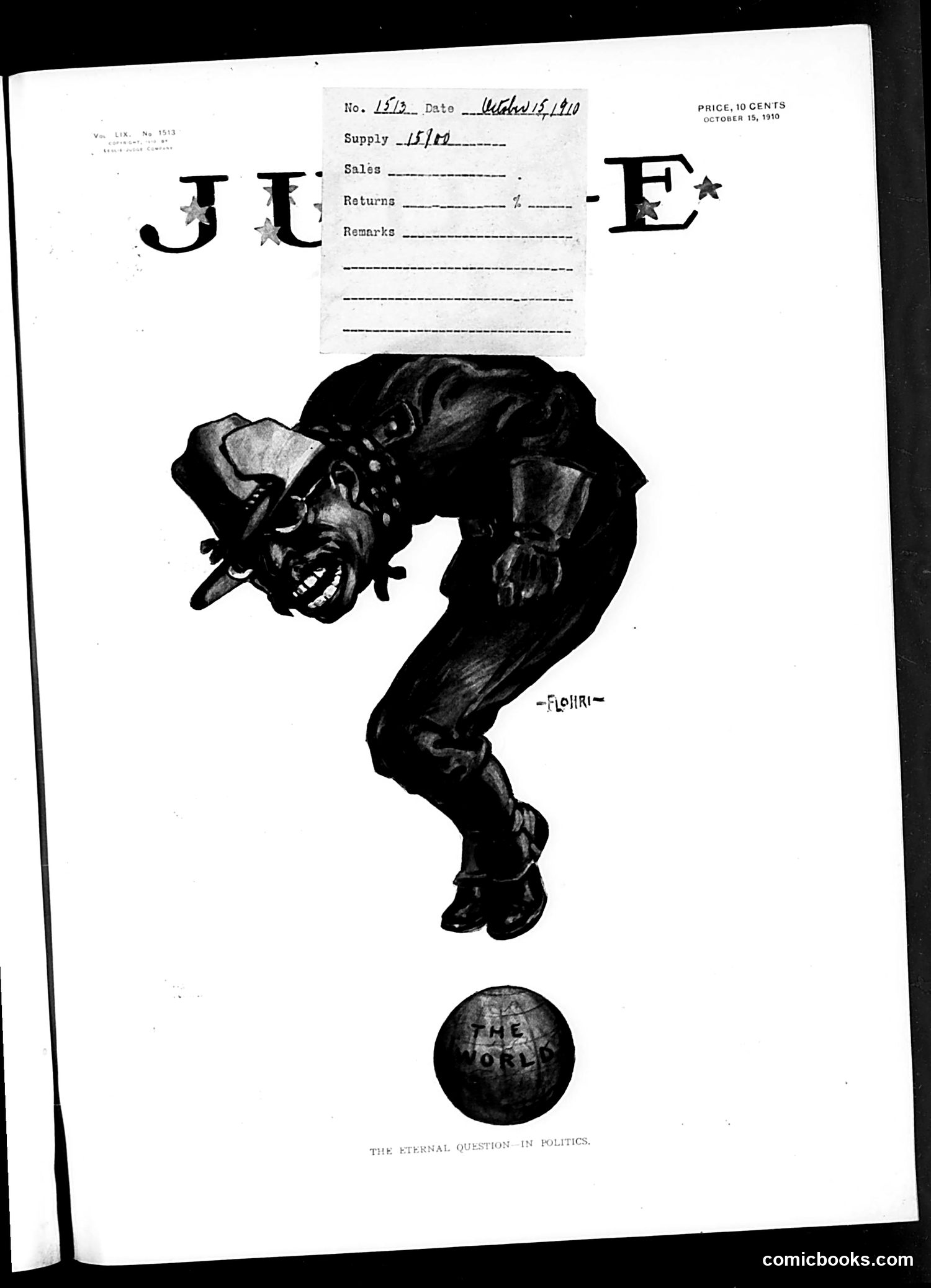
**Publication Details:** October 15, 1910; 10 cents **Content:** This page features a political cartoon titled "The Eternal Question in Politics." The image shows a grotesque figure bent into a question mark shape, wearing a hat and formal clothing with an exaggerated, menacing facial expression. Below sits a spherical object labeled (unclear from image quality). **Meaning:** The cartoon appears to satirize political uncertainty or an unresolved political dilemma of 1910. The twisted figure forming a question mark symbolizes confusion or indecision within American politics during this era. Without clearer identification of the specific figure or sphere, the exact political issue remains unclear, though it likely references a major contemporary controversy or leadership question.
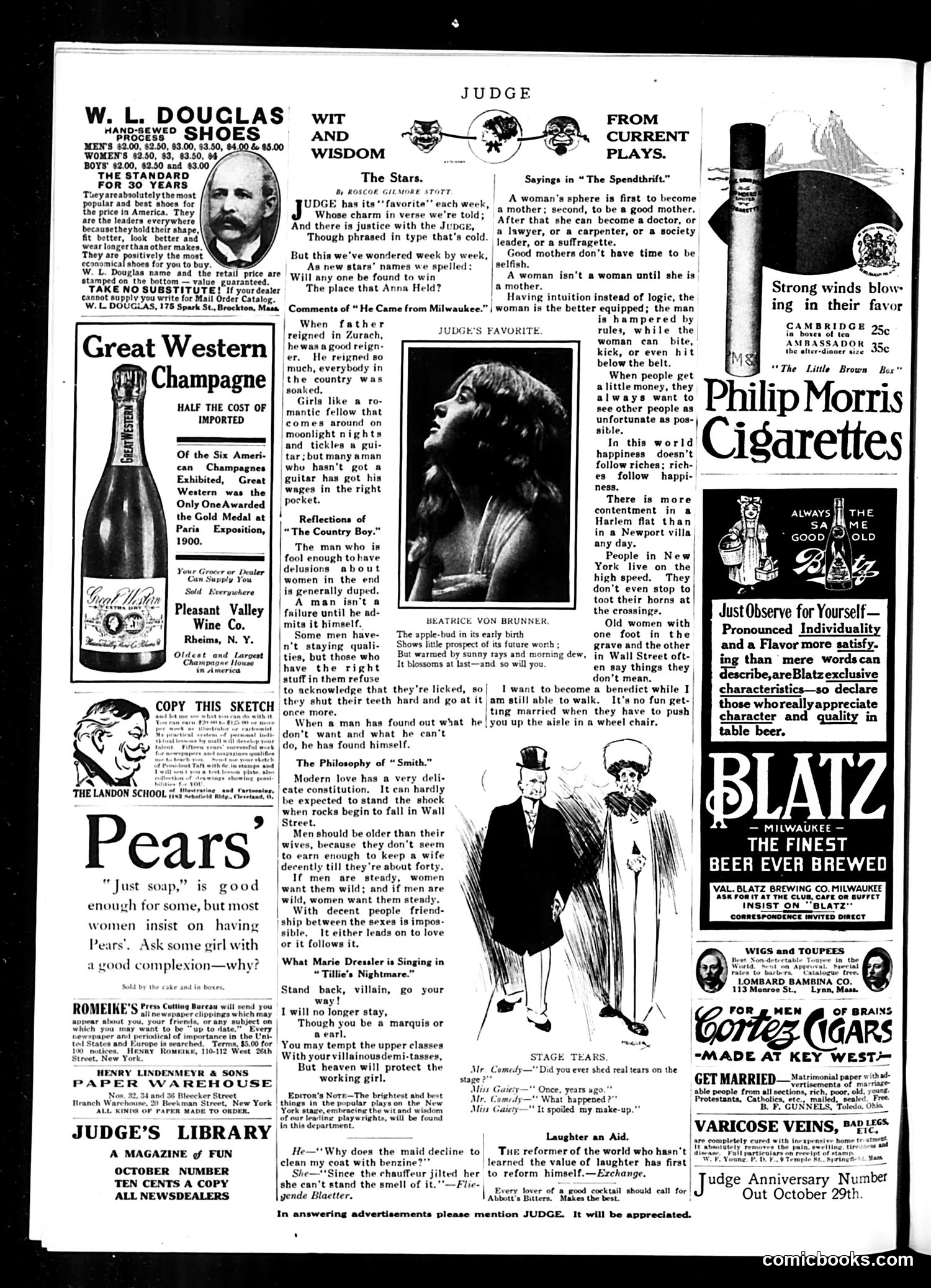
This page is primarily **advertising with light satirical content**. The main cartoons are small: 1. **"Stage Tears"** (bottom center): A sketch mocking theatrical emotion—showing two men, one asking if the other has "ever shed real tears on the stage," suggesting actors' artificial emotional displays. 2. **"Wit and Wisdom"** section (top): Brief satirical observations about women's roles and social behavior—commenting that women possess intuition over logic, and critiquing men's expectations in relationships. The bulk of the page features **period advertisements** for champagne, beer (Blatz), cigars, soap (Pears), and medical treatments, typical of early-20th-century Judge magazine. The satire is **mild and domestic** in focus, targeting theatrical pretension and gender relations rather than political issues. The content reflects contemporary attitudes about gender roles and entertainment.
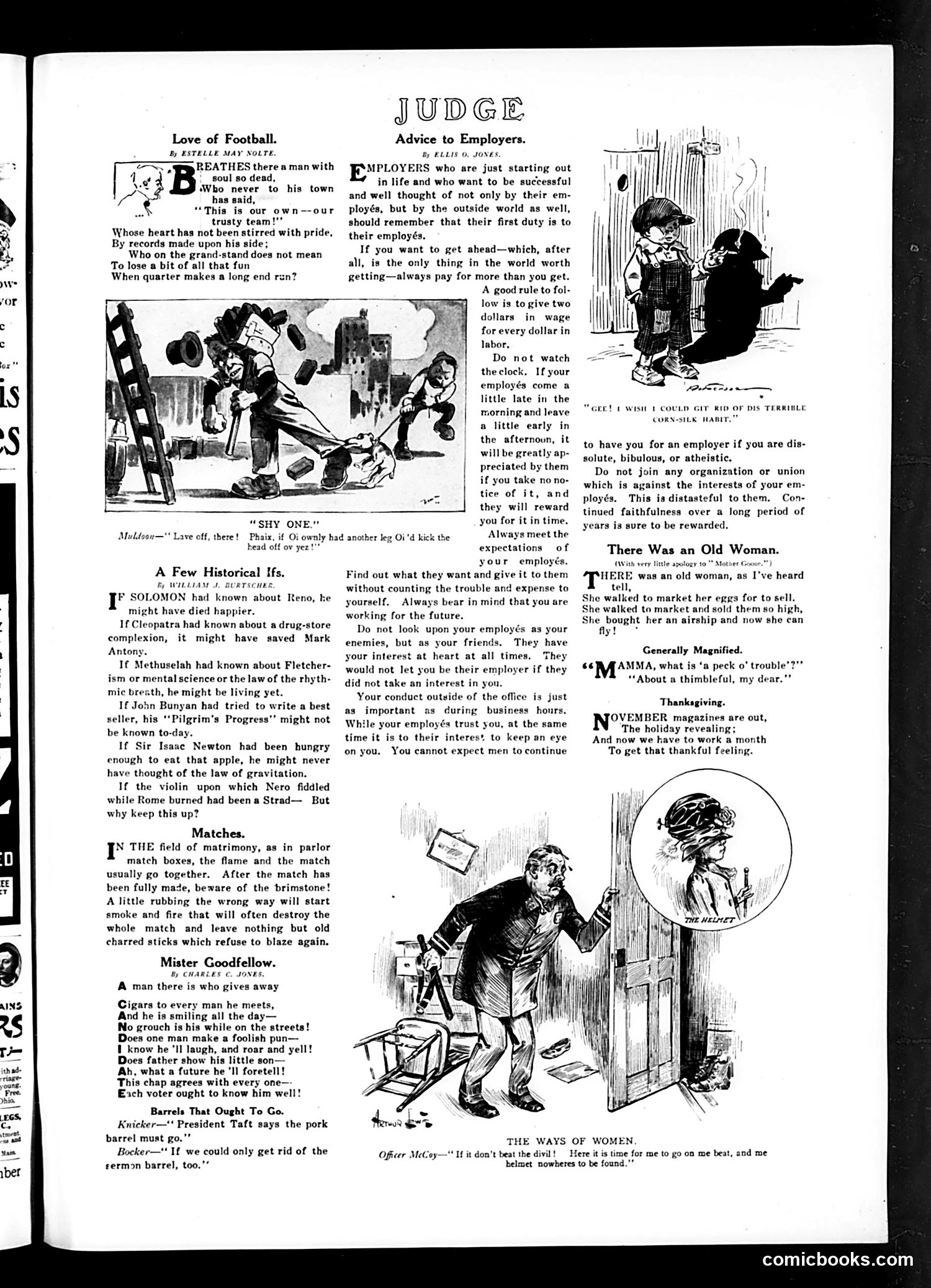
This page contains several satirical pieces typical of early-20th-century Judge magazine. The main cartoon "Shy One" depicts workplace dynamics—likely commentary on labor relations or employee conduct. The "Advice to Employers" section offers practical guidance on fair wage practices and employee relations, suggesting this was a period of labor activism and worker concerns. "There Was an Old Woman" appears to be social satire about economic struggle, while "Generally Magnified" and "Thanksgiving" offer lighter humor about domestic life and holidays. The bottom cartoon "The Ways of Women" depicts a man showing a woman's portrait to someone, with dialogue suggesting marital or romantic complications—typical of Judge's frequent commentary on gender relations and marriage. The overall tone reflects early-1900s middle-class concerns: labor fairness, gender roles, and social propriety.
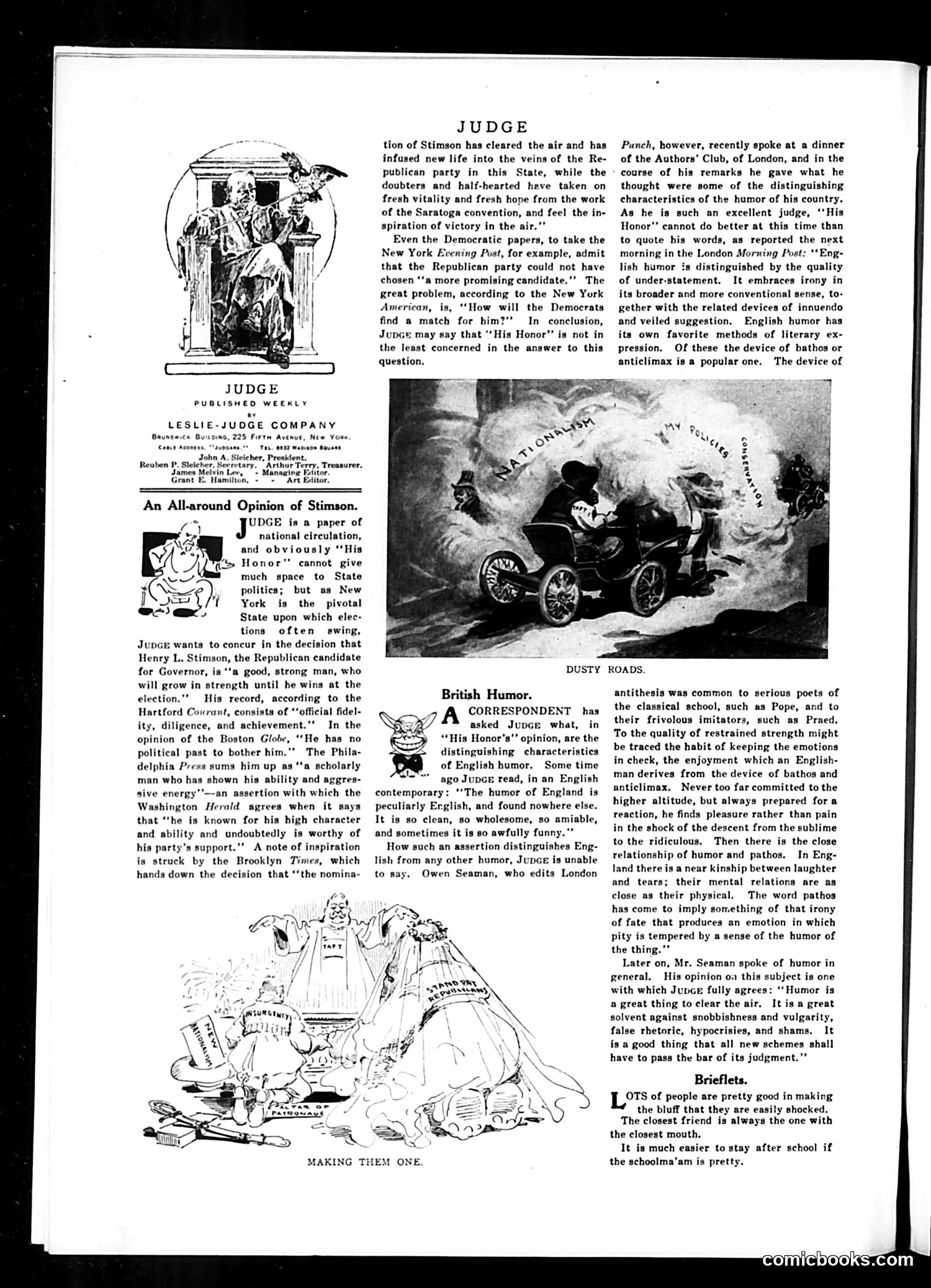
This page discusses Henry L. Stimson, the Republican gubernatorial candidate in New York (apparently during an election cycle). The editorial "An All-around Opinion of Stimson" praises him as "a good, strong man" while noting Judge's national focus limits state political coverage. The page includes a photograph labeled "DUSTY ROADS" showing someone in an early automobile, though its connection to Stimson is unclear. The "British Humor" section quotes Owen Seaman (editor of London's Punch magazine) on the distinctive qualities of English humor—its restraint, wholesomeness, and emotional depth. Judge uses this discussion to explore how humor "clears the air" and serves as social commentary. The page concludes with brief aphorisms ("Brieflets") on everyday observations.
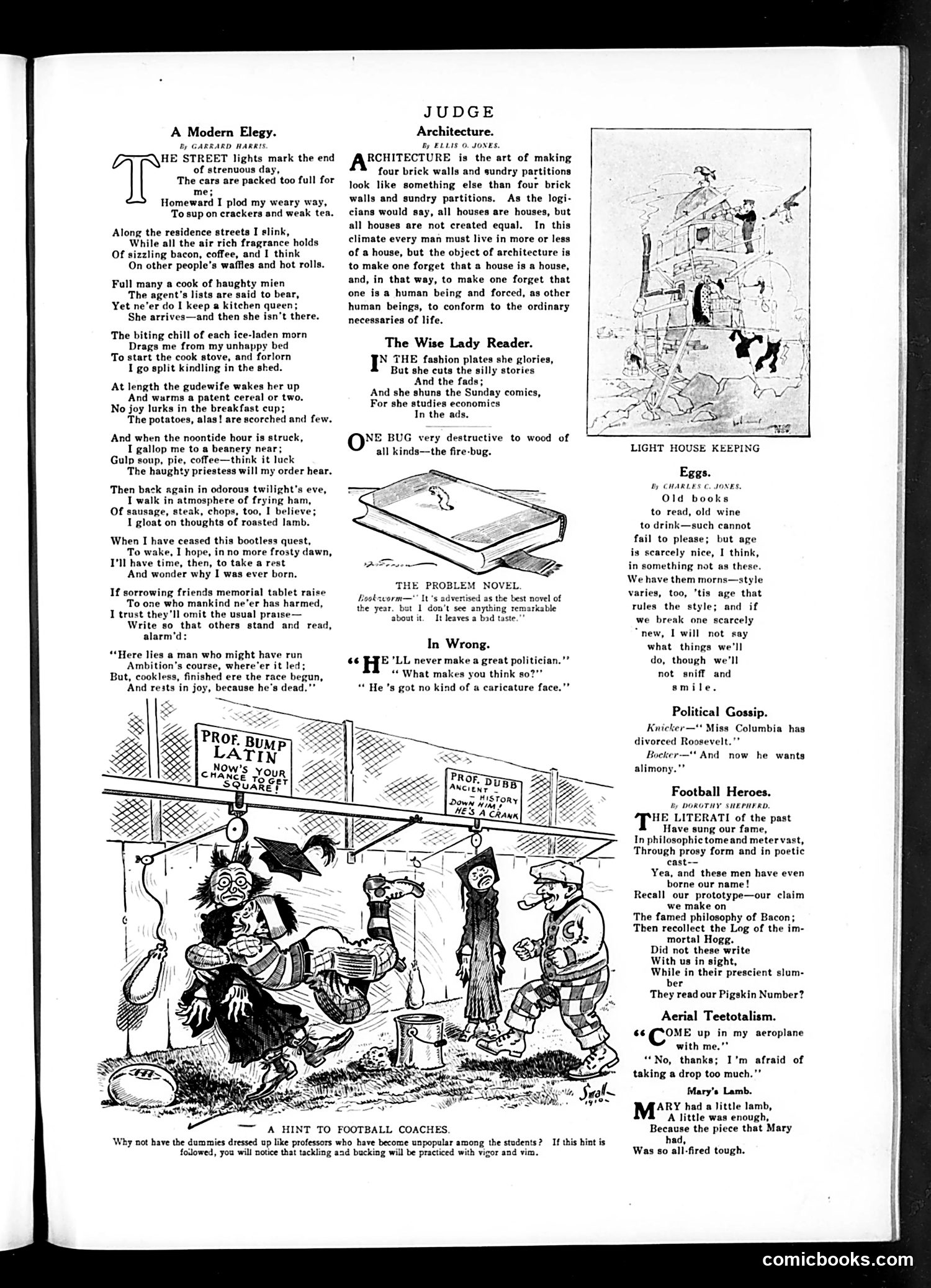
The main cartoon, "A Hint to Football Coaches," depicts professors dressed as dummies in a shop window labeled "Prof. Bumpkin" and "Prof. Bump, Ancient History." The satire criticizes how football coaches have become unpopular among students. The cartoon's caption suggests that if coaches dressed as dummies (made to look ridiculous), tackling and backing practice would improve with "vigor and vim"—implying coaches are currently ineffective and deserve mockery. This reflects early 20th-century anxieties about collegiate athletics: coaches' authority, student discipline, and whether football was educational or merely entertainment. The remaining page content includes various brief humorous poems and social commentary typical of Judge's satirical format, touching on reading habits, household management, and political gossip.
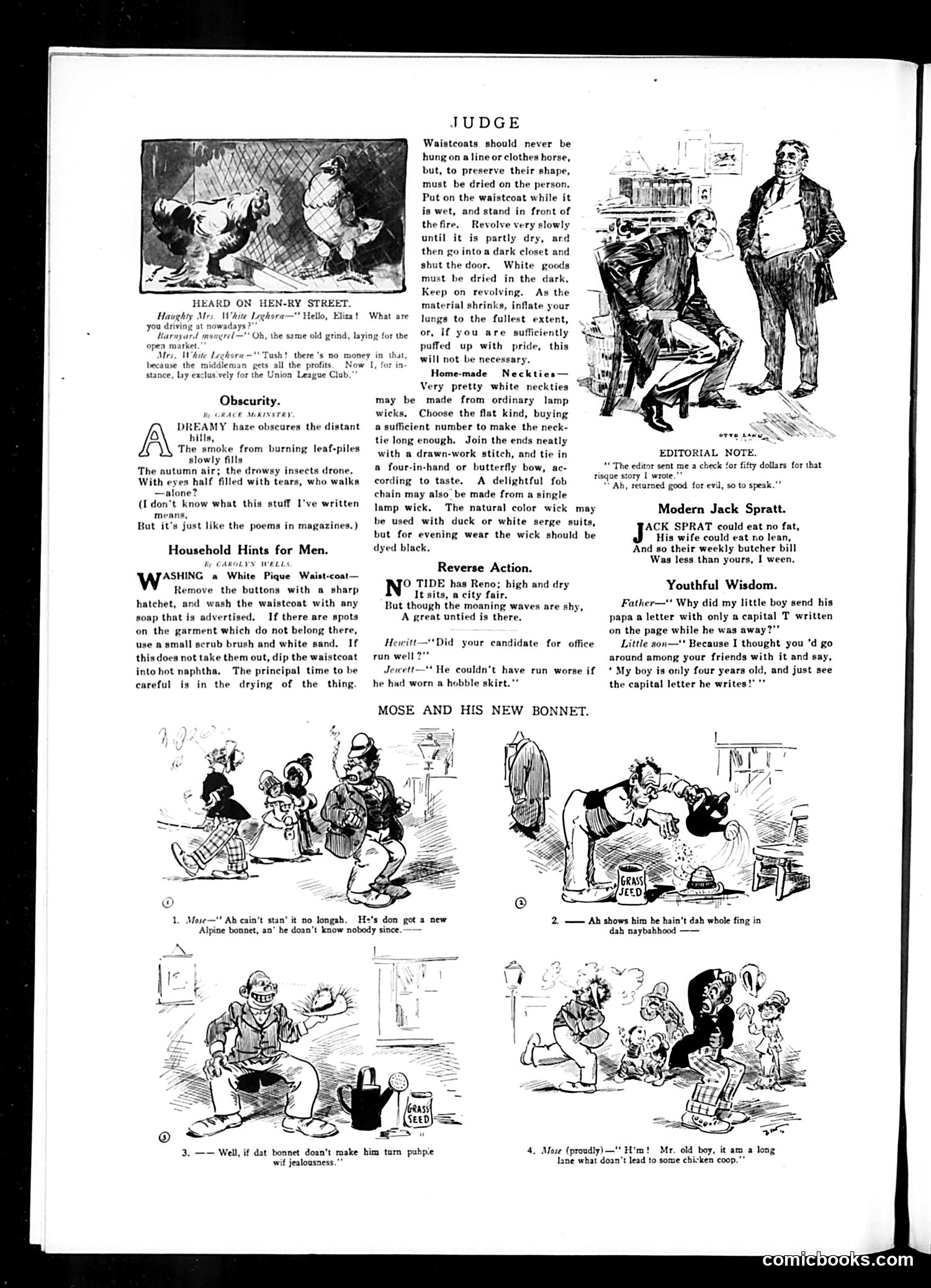
This page from *Judge* contains several satirical pieces typical of early 20th-century American humor: **"Heard on Hen-ry Street"** mocks wealthy society women (Mrs. White Leghorn—the name itself a chicken breed—is a pun) discussing where eggs come from, criticizing middlemen's profits while insisting on exclusive Union League Club sources. **"Household Hints for Men"** by Carolyn Wells is absurdist humor satirizing domesticity advice columns, with deliberately ridiculous instructions (washing waistcoats with hatchets, drying them on one's body). **"Mose and His New Bonnet"** is a racial stereotype comic strip featuring Black dialect humor, common in this era's publications. Mose's vanity over a new hat generates jealousy among his peers. Other pieces include light verse about obscurity and romance, and a brief joke about political candidates. The content reflects period attitudes toward class, gender, and race that modern readers should understand as products of their time, not endorsed views.
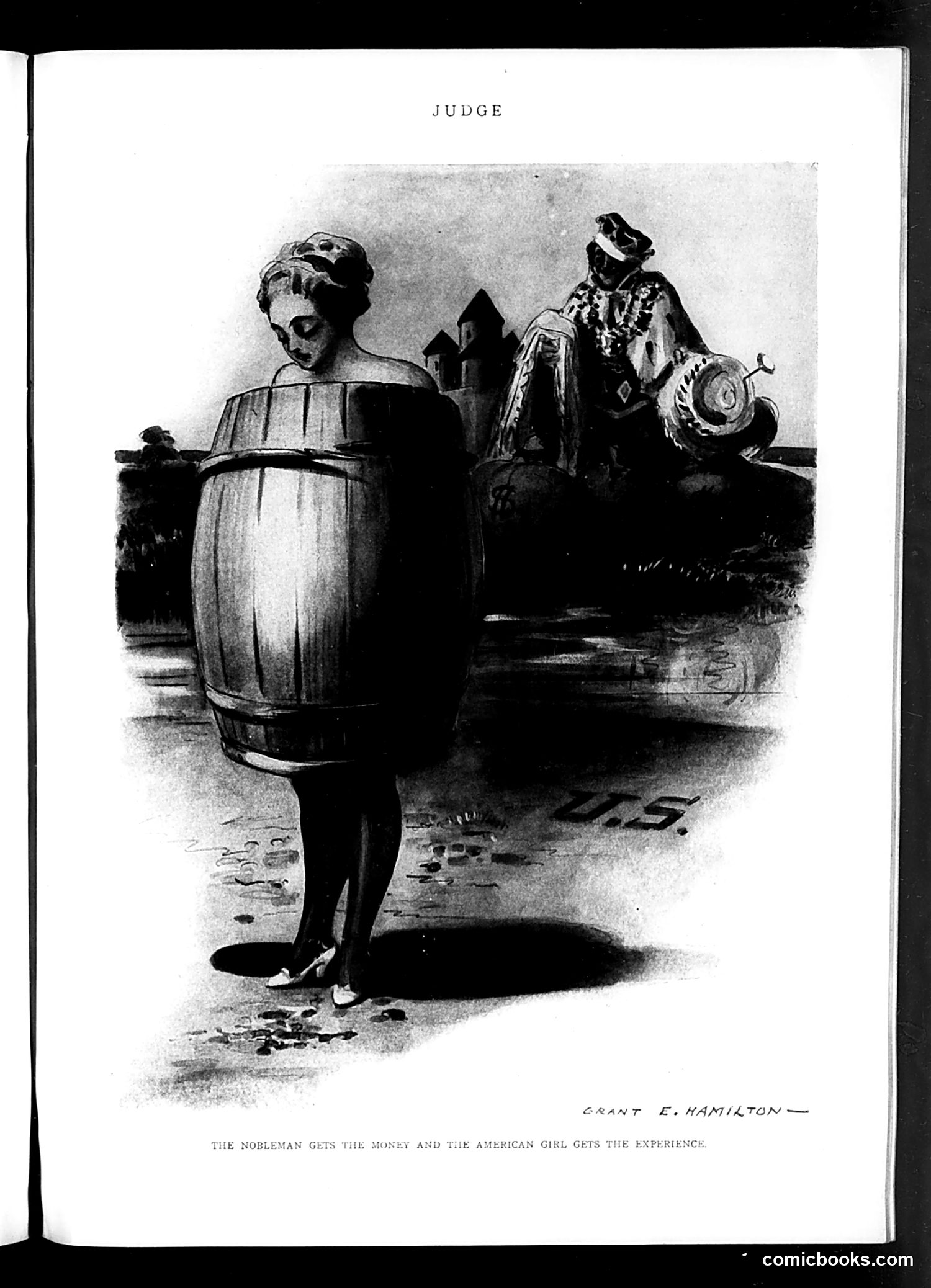
This cartoon by Grant E. Hamilton satirizes unequal economic exchange between a European nobleman and an American woman. The figure on the left—depicted as a woman in a barrel (suggesting poverty or being "taken for a ride")—represents the American girl. The elaborately dressed nobleman on the right, holding what appears to be money or valuables, represents European aristocracy. The caption's irony is clear: "The Nobleman Gets the Money and the American Girl Gets the Experience." This reflects late-19th-century concerns about wealthy European men courting American heiresses for financial gain while offering only social prestige in return. The barrel imagery suggests the American woman is being emptied of wealth while receiving nothing of substance—a pointed critique of transatlantic marriages driven by money rather than genuine affection.
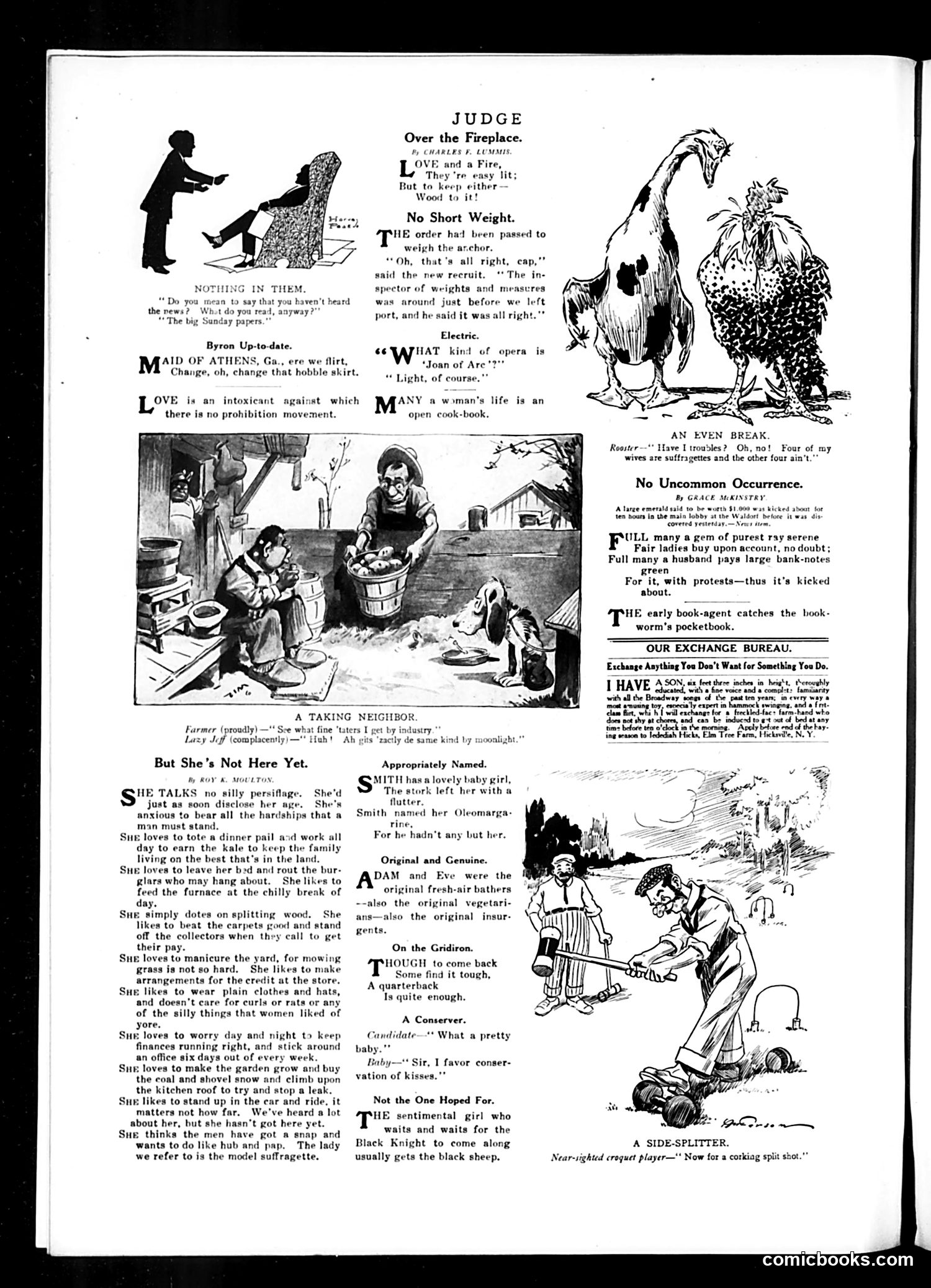
This is a humor page from *Judge* magazine featuring multiple short jokes and satirical cartoons, likely from the early 1900s based on references to "hobble skirts" and suffragettes. Key content includes: **Social satire**: "But She's Not Here Yet" mocks the "model suffragette"—a woman claiming to want equality and perform men's labor, yet the joke suggests she's all talk. This reflects anti-suffrage sentiment common in the era. **Gender humor**: Multiple jokes target women's roles: "Any a woman's life is an open cook-book" and "Love is an intoxicant" suggest women's limited spheres and irrationality. **Other jokes** include mild puns (the "electric" opera "Joan of Arc" is "Light, of course") and domestic humor about weight inspectors and manicuring yards. **The cartoons** illustrate these concepts with simple line drawings—a woman doing household chores, a rooster with suffragette wives. Overall, the page represents early-20th-century satirical humor targeting feminism and women's changing roles, though by modern standards the "jokes" appear simply as expressions of gender prejudice rather than actual humor.
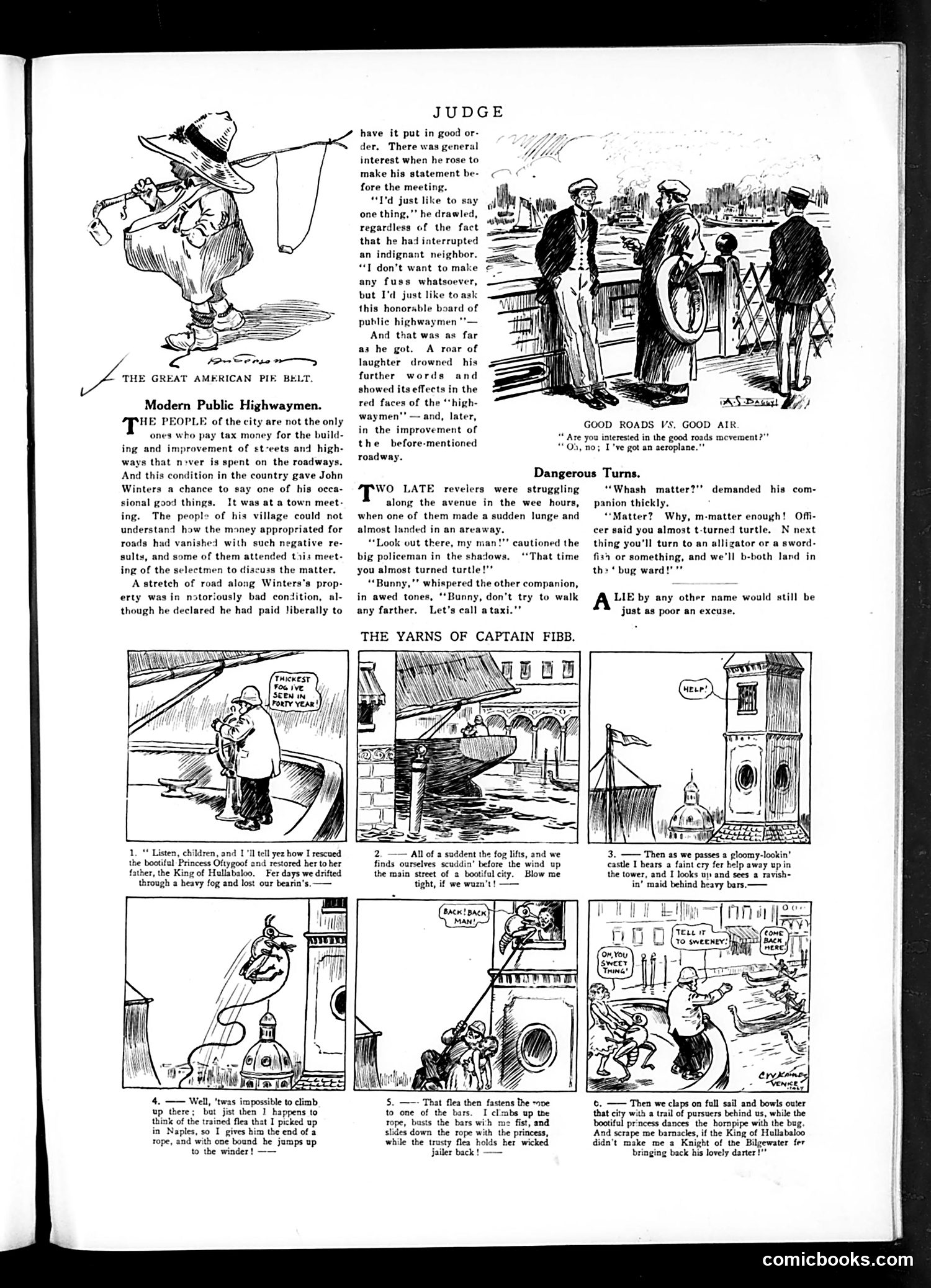
This page contains three distinct satirical pieces: **"Modern Public Highwaymen"** mocks municipal corruption. A town resident, John Winters, sarcastically calls local selectmen (road officials) "highwaymen"—suggesting they steal public funds appropriated for road repairs without actually improving roads. The satire lies in naming the theft plainly; laughter forces officials to finally fix the deteriorated roadway. **"Good Roads vs. Good Air"** is a brief joke contrasting public investment priorities. One character dismisses interest in road improvement because he owns an airplane—satirizing the emerging technology's appeal to wealthy Americans who could ignore poor infrastructure ordinary citizens depended on. **"The Yarns of Captain Fibb"** is a tall-tale comic strip mocking exaggerated adventure stories. The captain recounts an absurdly implausible rescue involving a trained flea, deliberately ridiculous nautical nonsense that parodies seafaring legends and pulp fiction. All three pieces target either government corruption or popular gullibility through humor.
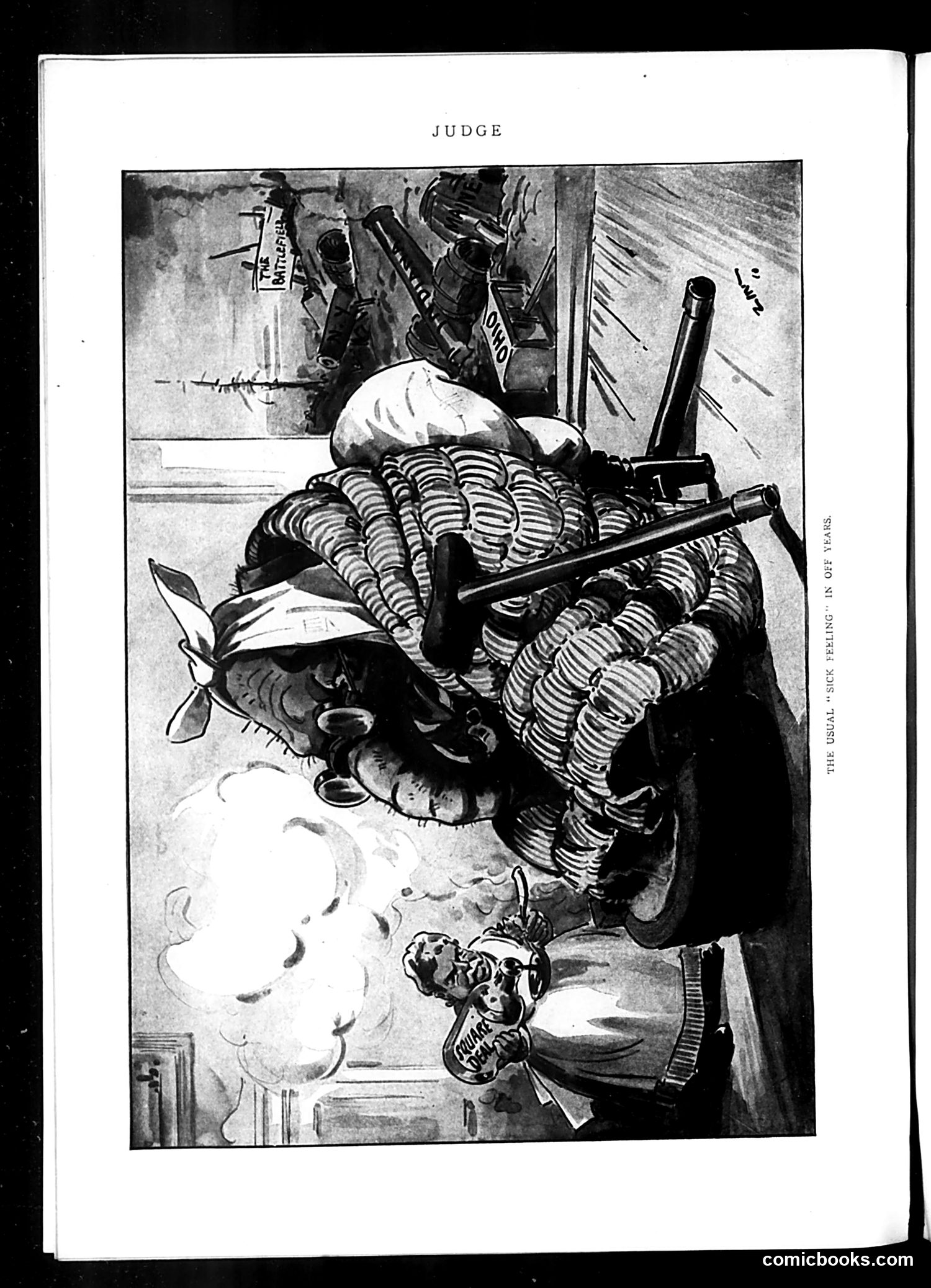
This page contains a single political cartoon titled "Judge" at the top. The OCR text is corrupted and unreadable, so I must rely on the image alone. The cartoon depicts a large figure in military/formal dress with an exaggerated bulbous body made of stacked rings or coils, holding a rifle. The figure wears a headband and has an animal-like face with prominent features. A small cherub or cupid figure appears at the bottom left. The caption on the spine reads "THE USUAL RESULT THEREOF IS OUR YEARS," though the full meaning is unclear without additional context. **I cannot reliably identify the specific figure, political reference, or satirical intent** from the image alone, as the visual style is allegorical and the corrupted OCR provides no guidance. The military dress and weapon suggest commentary on militarism or a specific military figure, but determining which would require speculation.
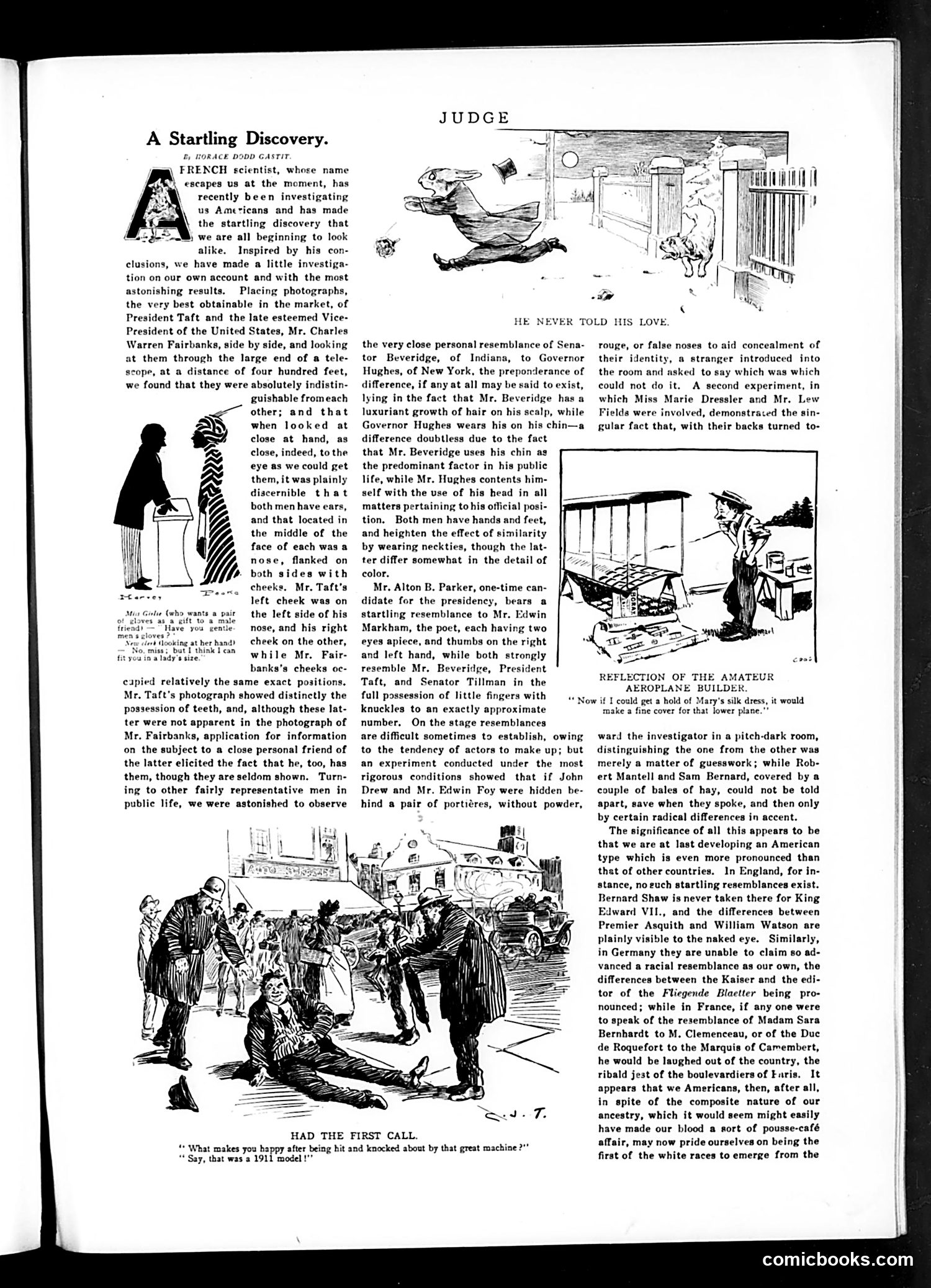
This Judge magazine article satirizes a French scientist's claim that Americans are becoming physically indistinguishable from one another. The satirist responds by deliberately finding absurd, trivial similarities between prominent public figures—President Taft, Vice President Fairbanks, Senator Beveridge, Governor Hughes, former presidential candidate Alton B. Parker, and stage actors John Drew and Edwin Foy. The joke relies on identifying obvious, universal human features (ears, noses, teeth, fingers) that all people share, then treating these commonalities as evidence of homogeneity. The satire mocks both the original French scientist's dubious claim and American anxiety about conformity or lack of distinctive character. The accompanying cartoons appear unrelated: one depicts a humorous domestic misunderstanding about hand size; another shows an amateur airplane builder's reflection. These seem editorial filler rather than connected commentary.
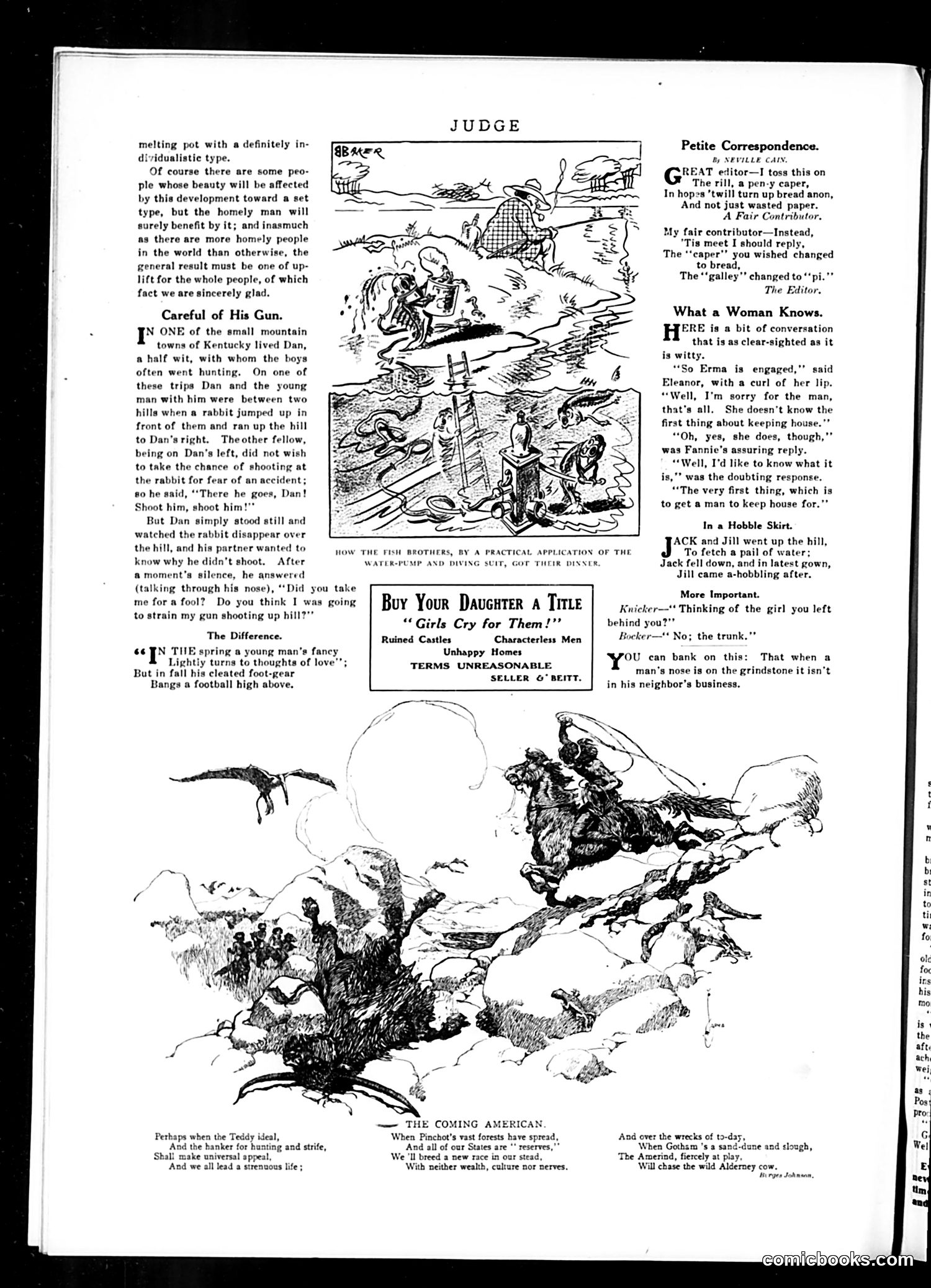
This page contains primarily **humor pieces and light satire** rather than hard political cartooning: **"Careful of His Gun"** mocks rural Kentucky folk through a dialect story about "Dan," a "half wit" who refuses to shoot uphill, fearing damage to his gun—a joke playing on stereotypes of backwoods simplemindedness. **"The Difference"** contrasts spring romance with fall football season—gentle satire on American social customs. **"The Coming American"** satirizes conservation policy (likely referencing Gifkrigid Pinchot's forestry initiatives) by predicting future Americans will be bred without "wealth, culture nor nerves"—mocking progressive reform zeal. **"Buy Your Daughter a Title"** advertises satirically selling European nobility titles to American heiresses, mocking the Gilded Age practice of wealthy Americans marrying impoverished European aristocrats. The remaining pieces are comedic observations about engagements, hobble skirts (contemporary fashion), and human nature—standard Judge magazine humor targeting middle-class sensibilities rather than serious political critique.
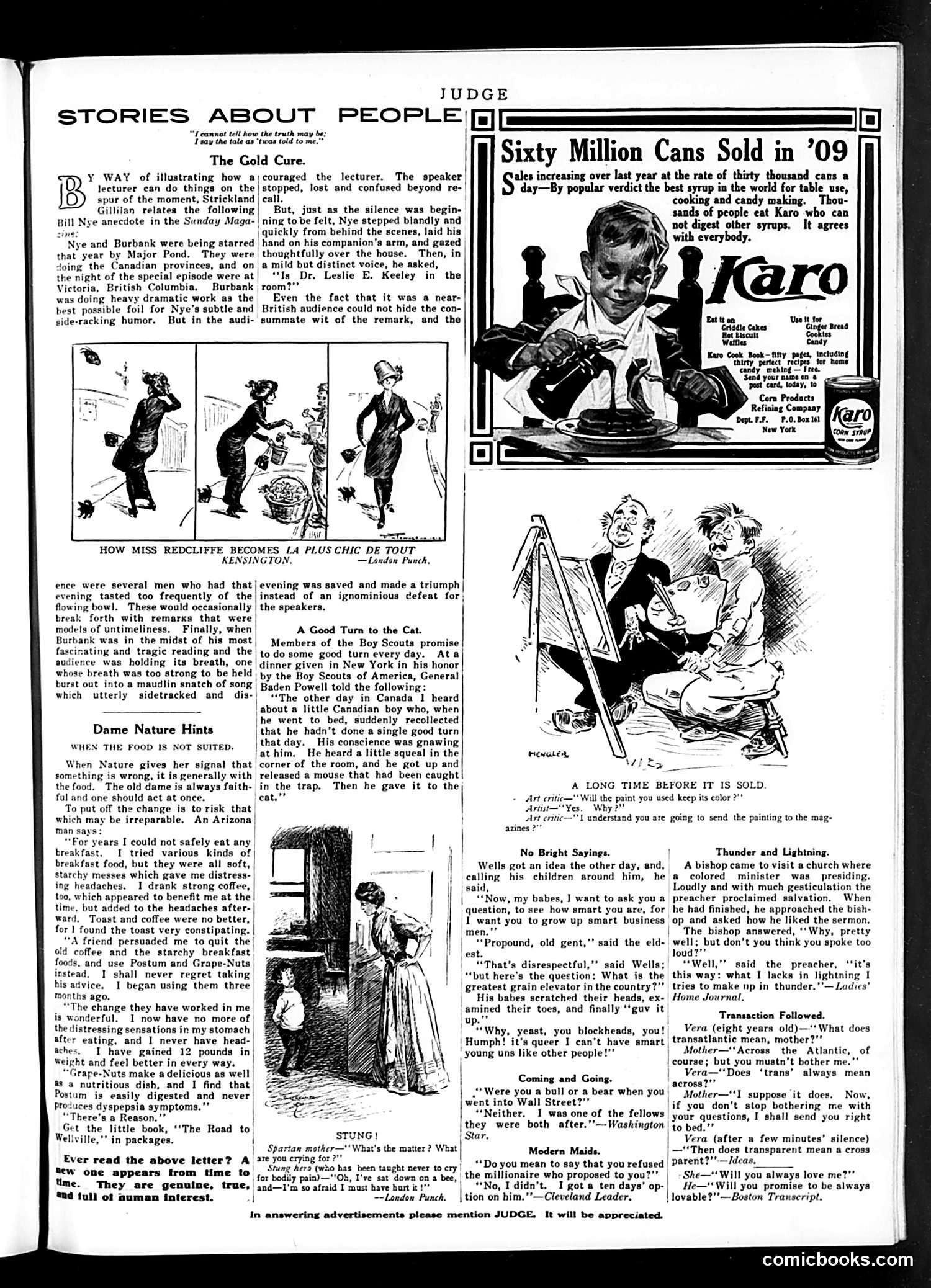
This page from *Judge* magazine contains several humorous anecdotes and includes a Karo syrup advertisement. **"The Gold Cure"** recounts an anecdote about Bill Nye (a famous 19th-century humorist) performing with Shakespearean actor David Burbank in Victoria, British Columbia. During a dramatic reading, a drunk audience member disrupts the performance. Nye saves the evening by calmly asking if "Dr. Leslie E. Keeley" is present—a reference to the Keeley Institute, a then-famous (now-infamous) cure for alcoholism. The joke's wit lies in Nye's subtle, public shaming of the heckler through this well-known reference, rescuing the show through humor rather than confrontation. The other brief anecdotes ("Dame Nature Hints," "A Good Turn to the Cat," etc.) are lighthearted moral tales typical of early-20th-century magazines. The Karo syrup ad claims sixty million cans sold, positioning the product as digestible for those with sensitive stomachs—a significant marketing angle for the era.
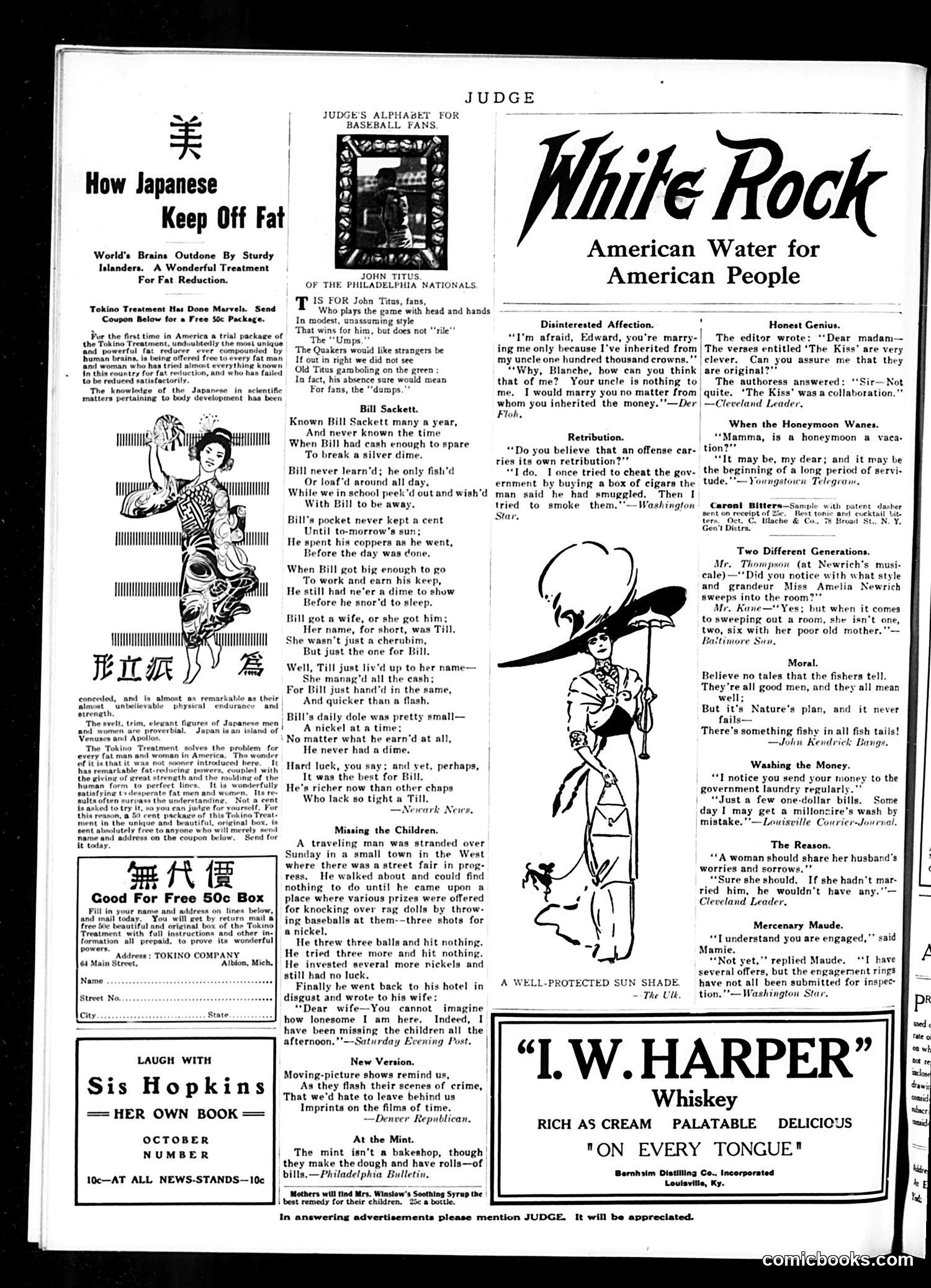
This page from *Judge* (a major American satirical magazine) contains several distinct elements: **Main Content:** The page features a racist advertisement for "Tokino Treatment," a weight-loss product marketed with stereotypical imagery of Japanese people, claiming Oriental methods ensure fitness. This reflects early 20th-century "scientific racism" and Orientalism—using non-Western cultures as exotic marketing hooks. **Other Articles:** - "Judge's Alphabet for Baseball Fans" provides lighthearted baseball commentary - Various brief humorous pieces on everyday topics (travel, mint operations, moving pictures) - A story about "Bill Sackett" regarding financial management **Advertisements:** Including I.W. Harper Whiskey and Sis Hopkins' book promotion. **Historical Context:** The page demonstrates how racist stereotyping and pseudoscientific claims about non-Western peoples were normalized in mainstream American publications of this era. The Japanese imagery, while presented as humorous and authoritative, perpetuates harmful caricatures. This reflects pre-WWII American attitudes toward Asian peoples.
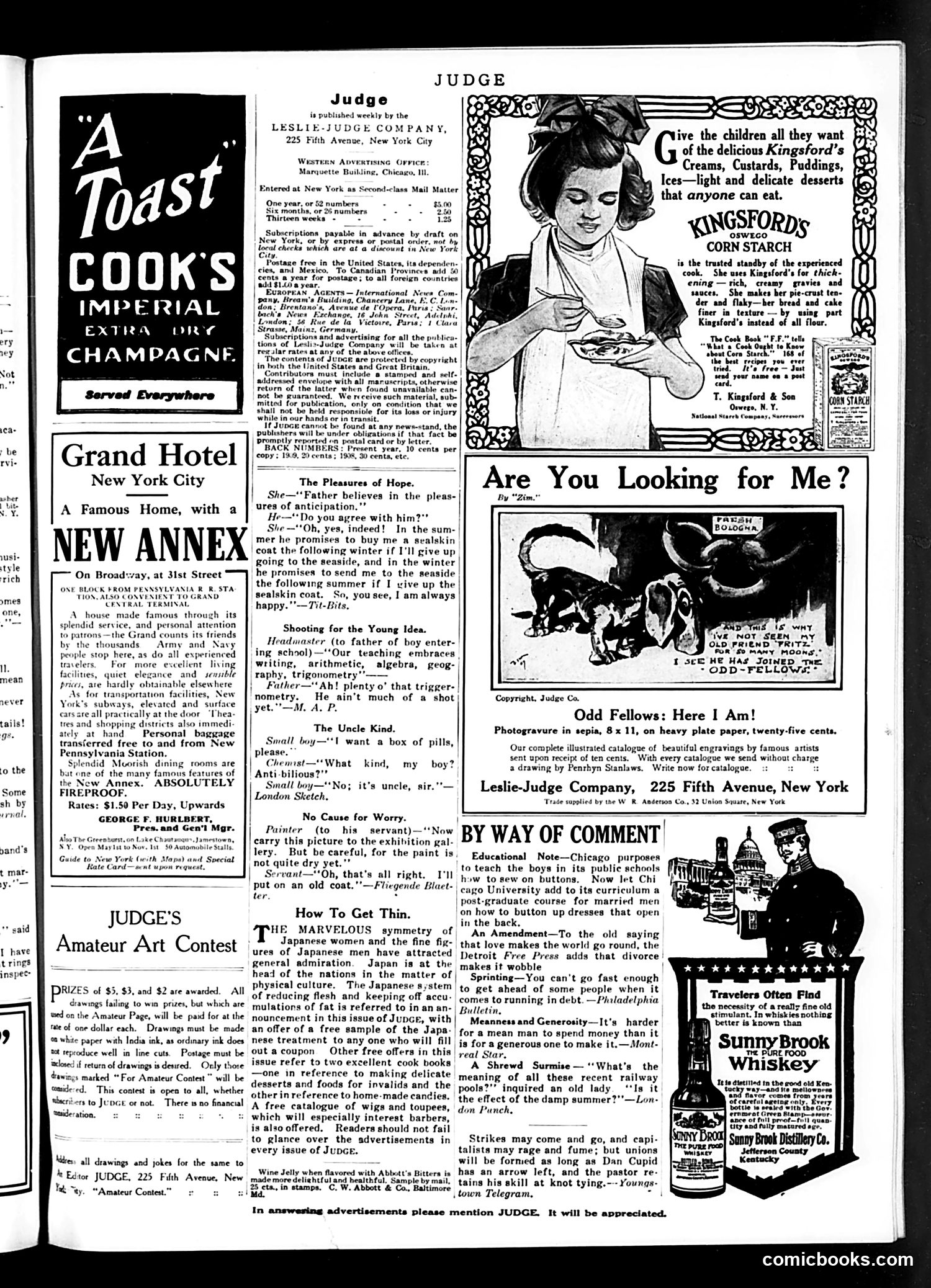
This page is primarily **advertising and editorial content** rather than political satire. The main elements include: **Advertisements**: For A Toast Cook's Imperial Extra Dry Champagne, the Grand Hotel in New York, and Sunny Brook Whiskey dominate the layout. **"Judge's Amateur Art Contest"**: An announcement inviting readers to submit drawings for prizes ($5, $3, $2), with submissions paid at one dollar each. **Humor Shorts**: The page includes several brief comic anecdotes ("The Pleasures of Hope," "Shooting for the Young Idea," "The Uncle Kind," "No Cause for Worry," "How To Get Thin") typical of Judge's satirical humor, poking gentle fun at social conventions—a woman's father bribing her with coats, schoolmasters, servants, and Japanese beauty standards. **"By Way of Comment"**: Educational notes on current topics like sewing buttons and divorce. The cartoons and jokes lack sharp political bite; they're mainstream social humor for the magazine's affluent readership.
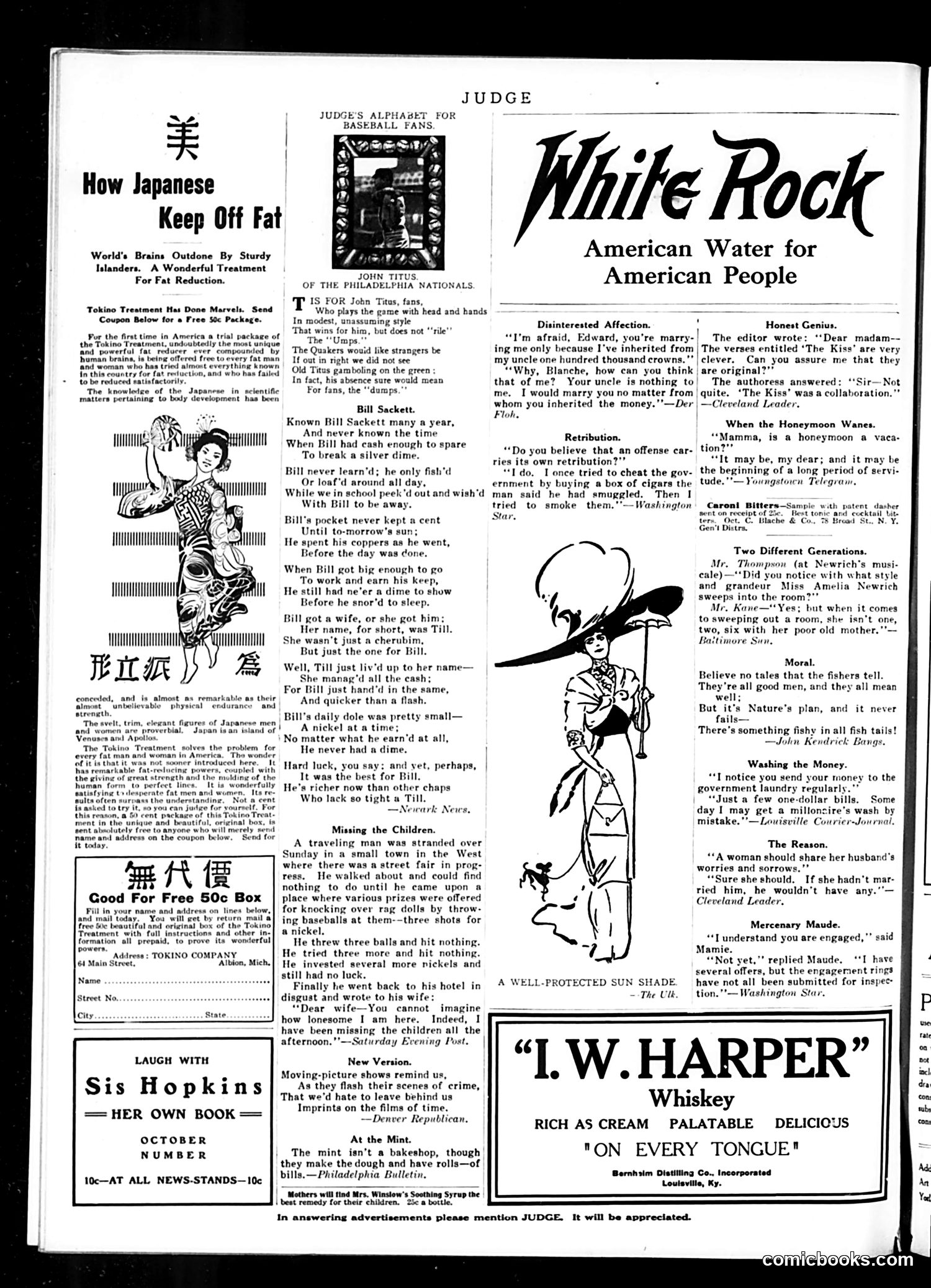
This October issue of Judge contains three distinct elements: **Main Feature - "How Japanese Keep Off Fat"**: A full-page advertisement for "Tokino Treatment," a weight-loss product marketed as based on Japanese scientific methods. The ad exploits early-20th-century fascination with Asian cultures as sources of exotic health remedies, a common advertising trope of the era. **"Judge's Alphabet for Baseball Fans"**: A series of illustrated biographical sketches of Philadelphia Nationals players (John Titus and Bill Sackett), presented in the style of an alphabet book. These are gentle, humorous character studies rather than satire. **Miscellaneous Short Humor Items**: Brief jokes and anecdotes, including "Missing the Children" (a traveling salesman's joke), "New Version" (commentary on cinema), and "At the Mint" (incomplete). The page demonstrates Judge's mix of advertising, sports commentary, and light humor typical of early American magazines. There is no significant political satire present.
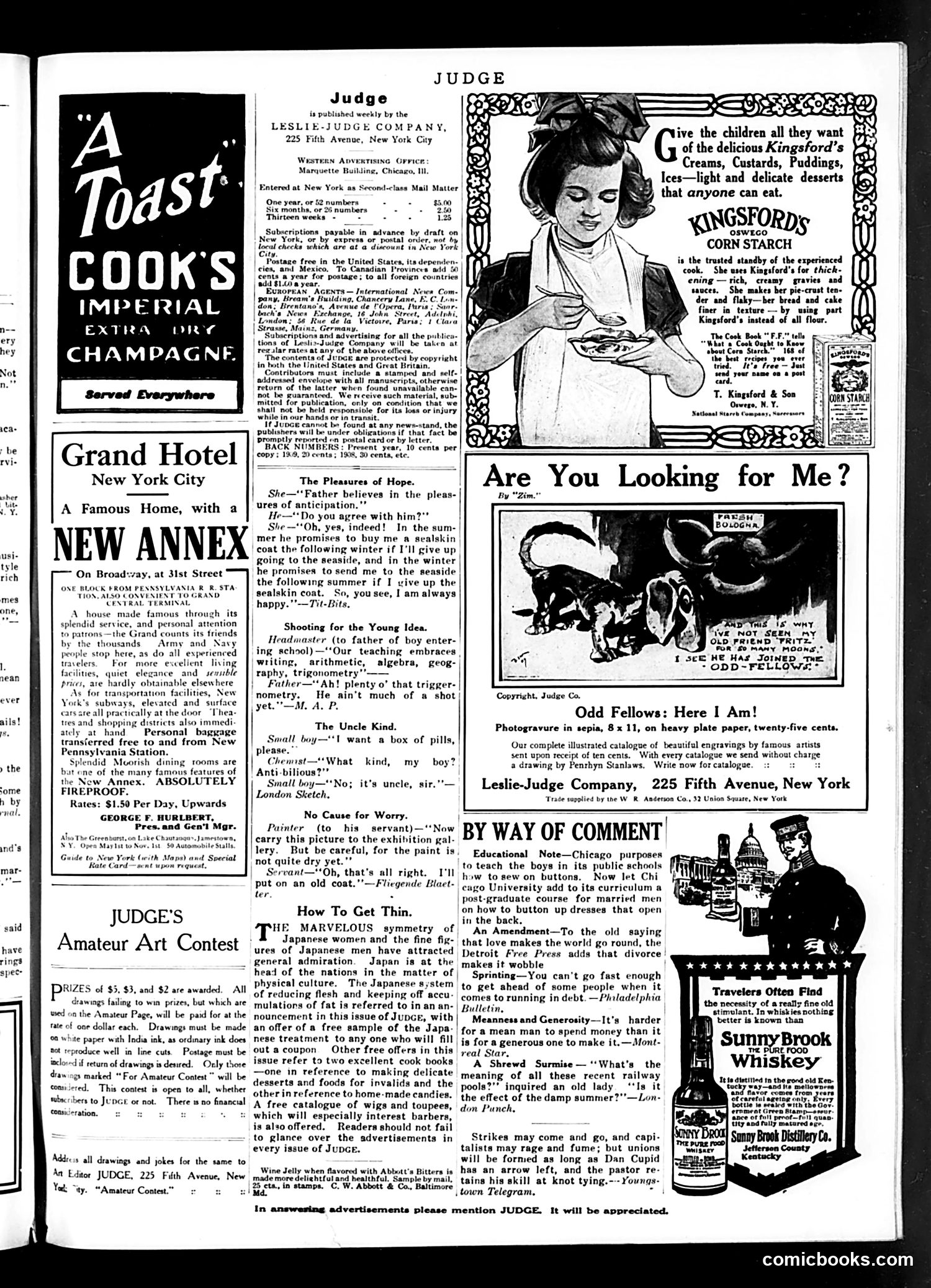
This page is primarily **advertisements and humorous filler content** rather than political satire. The cartoons present light domestic comedy: **"Are You Looking for Me?"** depicts a husband claiming he joined the Odd Fellows fraternal organization, apparently after a long absence. The joke references fraternity culture and presumably his wife's reaction. **"Shooting for the Young Idea"** mocks educational pretension—a headmaster boasts of teaching "trigonometry" to a father who mishears it as "trigger-nometry," implying the boy can't shoot. It satirizes both pompous educators and uneducated parents. The remaining sections are humor columns ("The Pleasures of Hope," "The Uncle Kind") featuring mild marital and family jokes typical of early-1900s Judge content. The advertisements dominate—Cook's champagne, Grand Hotel, Kingsford's corn starch, and Sunny Brook Whiskey—reflecting the magazine's commercial nature. This appears to be a routine issue without major political commentary.
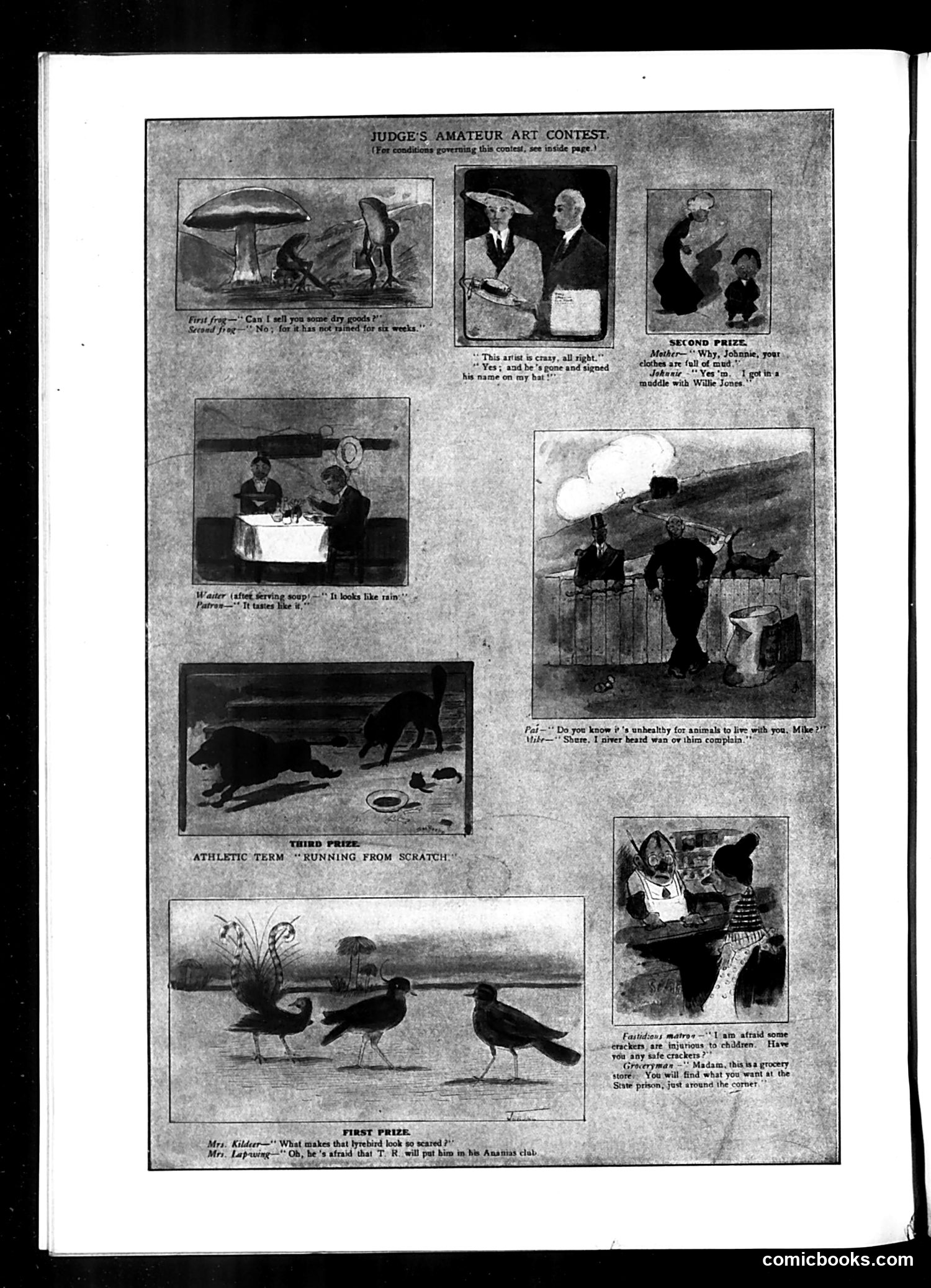
This page presents a humorous amateur art competition with satirical captions mocking various social types and contemporary figures. The **first prize** depicts a lyrebird frightened that "T.R." (Theodore Roosevelt) will add it to his "Ananias club"—Roosevelt's famous public list of politicians and public figures he deemed liars. The joke: even animals fear Roosevelt's sharp judgment. The **second prize** shows a boy covered in mud explaining he got into a "muddle" with a friend—a pun on the word "muddle." Other entries mock: - An eccentric artist signing his work - A waiter serving "rain" (sardonic comment on bad soup) - A man claiming animals never complain about mistreatment - A grocer's joke about "safe crackers" (cookies vs. safecrackers/burglars) The satire targets human folly—vanity, dishonesty, animal cruelty, and wordplay—using visual humor typical of early-20th-century American comedy magazines.