
Judge, 1910-10-15 · page 4 of 18
Judge — October 15, 1910 — page 4: what you’re looking at
What you’re looking at
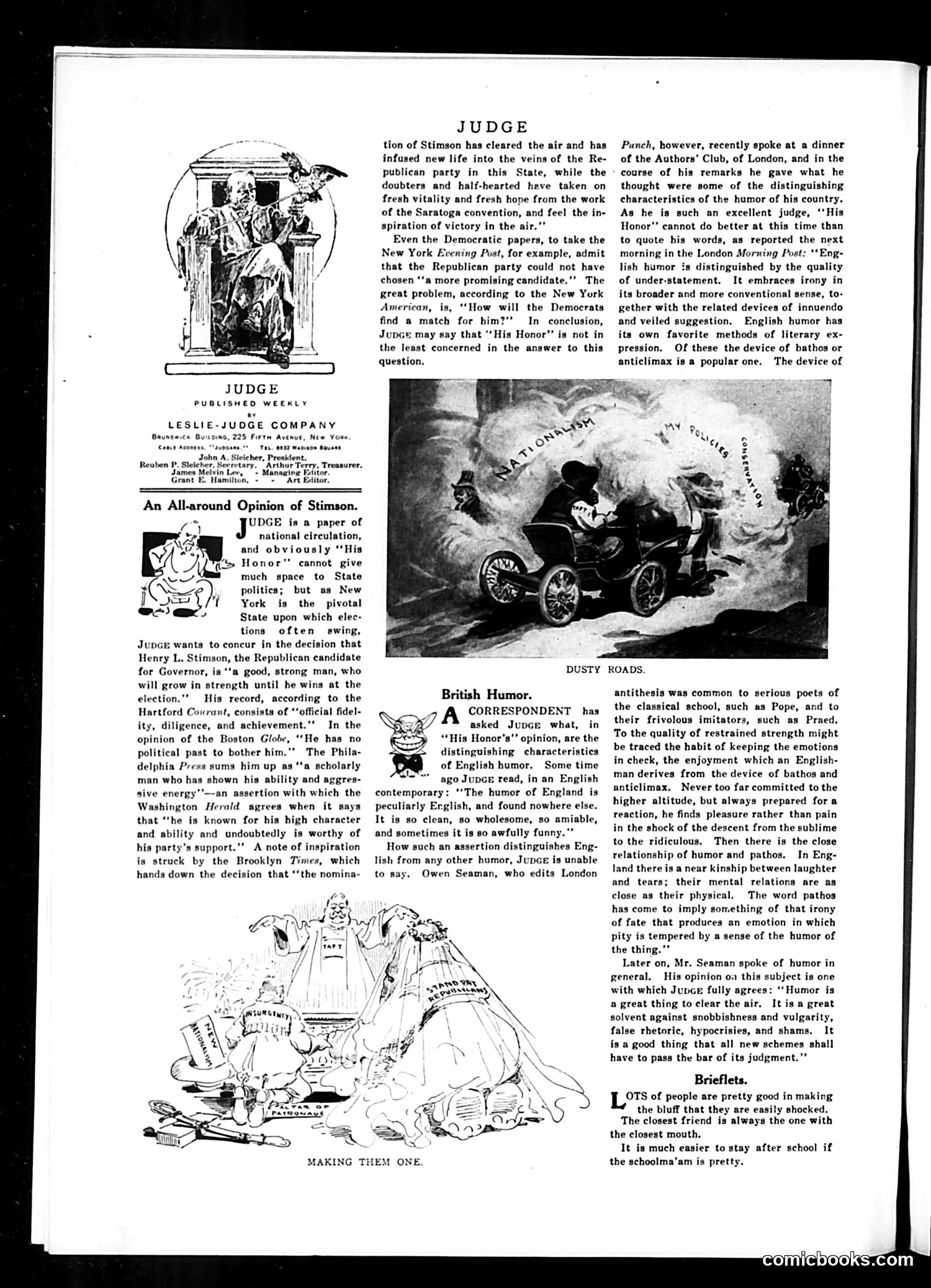
This page discusses Henry L. Stimson, the Republican gubernatorial candidate in New York (apparently during an election cycle). The editorial "An All-around Opinion of Stimson" praises him as "a good, strong man" while noting Judge's national focus limits state political coverage. The page includes a photograph labeled "DUSTY ROADS" showing someone in an early automobile, though its connection to Stimson is unclear. The "British Humor" section quotes Owen Seaman (editor of London's Punch magazine) on the distinctive qualities of English humor—its restraint, wholesomeness, and emotional depth. Judge uses this discussion to explore how humor "clears the air" and serves as social commentary. The page concludes with brief aphorisms ("Brieflets") on everyday observations.
📄 Transcribed text from this page (OCR, searchable)
Machine-transcribed from the original scan — historical spelling and the odd misread are preserved.
PUBLISHED WEEKLY ov LESLIE-JUODGE COMPANY + Managing FAitor ‘Art Exlitor, An All-around Opinion of Stimson. UDGE is a paper of national circulation, ch | and obviously “His J R> Honor” cannot give oo, much space to State politics; but as New "(York is the pivotal #. State upon which elec- tions often swing, !DGE wants to concur in the decision that Henry L, Stimson, the Republican candidate for Governor, is ‘a good, strong man, who will grow in strength until he wins at the election.” His record, according to the Hartford Covrant, consists of ‘‘official fidel- ity, diligence, and achievement.’’ In the opinion of the Boston Globe, “He has no political past to bother him."’ The Phila- delphia Press sums him up as “ta scholarly man who has shown his ability and aggres- sive energy’’—an assertion with which the Washington Herald agrees when it says that ‘the is known for his high character and ability and undoubtedly is worthy of his party's support.’’ A note of inspiration is struck by the Brooklyn Times, which hands down the decision that ‘the nomina- JUDGE tion of Stimson has cleared the air and has infused new life into the veins of the Re- publican party in this State, while the doubters and bali-hearted heve taken on fresh vitality and fresh hope from the work of the Saratoga convention, and feel the in- spiration of victory in the air." Even the Democratic papers, to take the New York Evening Post, for example, admit that the Republican party could not have chosen ‘‘a more promising candidate."” The great problem, according to the New York American, is, ‘‘How will the Democrats find a match for him?’ In_ conclusion, Jupce may say that "His Honor” is not in the least concerned in the answer to this question. DUSTY British Humor. CORRESPONDENT has asked JupGe what, in “His Honor’s"’ opinion, are the distinguishing characteristics of English humor. Some time ago Juvce read, in an English contemporary: ‘The humor of England is peculiarly English, and found nowhere else. It is so clean, so wholesome, so amiable, and sometimes it is 80 awfully funny. How such an assertion distinguishes Eng- lish from any other humor, Jupce is unable to say. Owen Seaman, who edits London MAKING THEM ONE. Punch, however, recently spoke at a dinner of the Authors’ Club, of London, and in the course of his remarks he gave what he thought were some of the distinguishing characteristics of the humor of his country. As he is such an excellent judge, ‘His Honor”’ cannot do better at this time than to quote his words, as reported the next morning in the London Morning Post: **Eng- lish humor is distinguished by the quality of under-statement. It embraces irony in its broader and more conventional sense, to- gether with the related devices of innuendo and veiled suggestion. English humor has its own favorite methods of literary ex- pression. Of these the device of bathos or anticlimax is a popular one. The device of ROADS. antithesis was common to serious poets of the classical school, such as Pope, and to their frivolous imitators, such as Praed. To the quality of restrained strength might be traced the habit of keeping the emotions in check, the enjoyment which an English- man derives from the device of bathos and anticlimax. Never too far committed to the higher altitude, but always prepared for a reaction, he finds pleasure rather than pain in the shock of the descent from the sublime to the ridiculous. Then there is the close relationship of humor and pathos. In Eng- land there is a near kinship between laughter and tears; their mental relations are as close as their physical. The word pathos has come to imply something of that irony of fate that produces an emotion in which pity is tempered by a sense of the humor of the thing.”” Later on, Mr. Seaman spoke of humor in general. His opinion oa this subject is one with which Jupce fully agrees: “Humor is a great thing to clear the air. It is a great solvent against snobbishness and vulgarity, false rhetoric, hypocrisies, and shams. It is a good thing that all new schemes shall have to pass the bar of its judgment.’” Brieflets. L°7S of People are pretty good in making the bluff that they are easily shocked. The closest friend is always the one with the closest mouth. It is much easier to stay after school if the schoolma’am is pretty.