
Judge, 1910-10-15 · page 11 of 18
Judge — October 15, 1910 — page 11: what you’re looking at
What you’re looking at
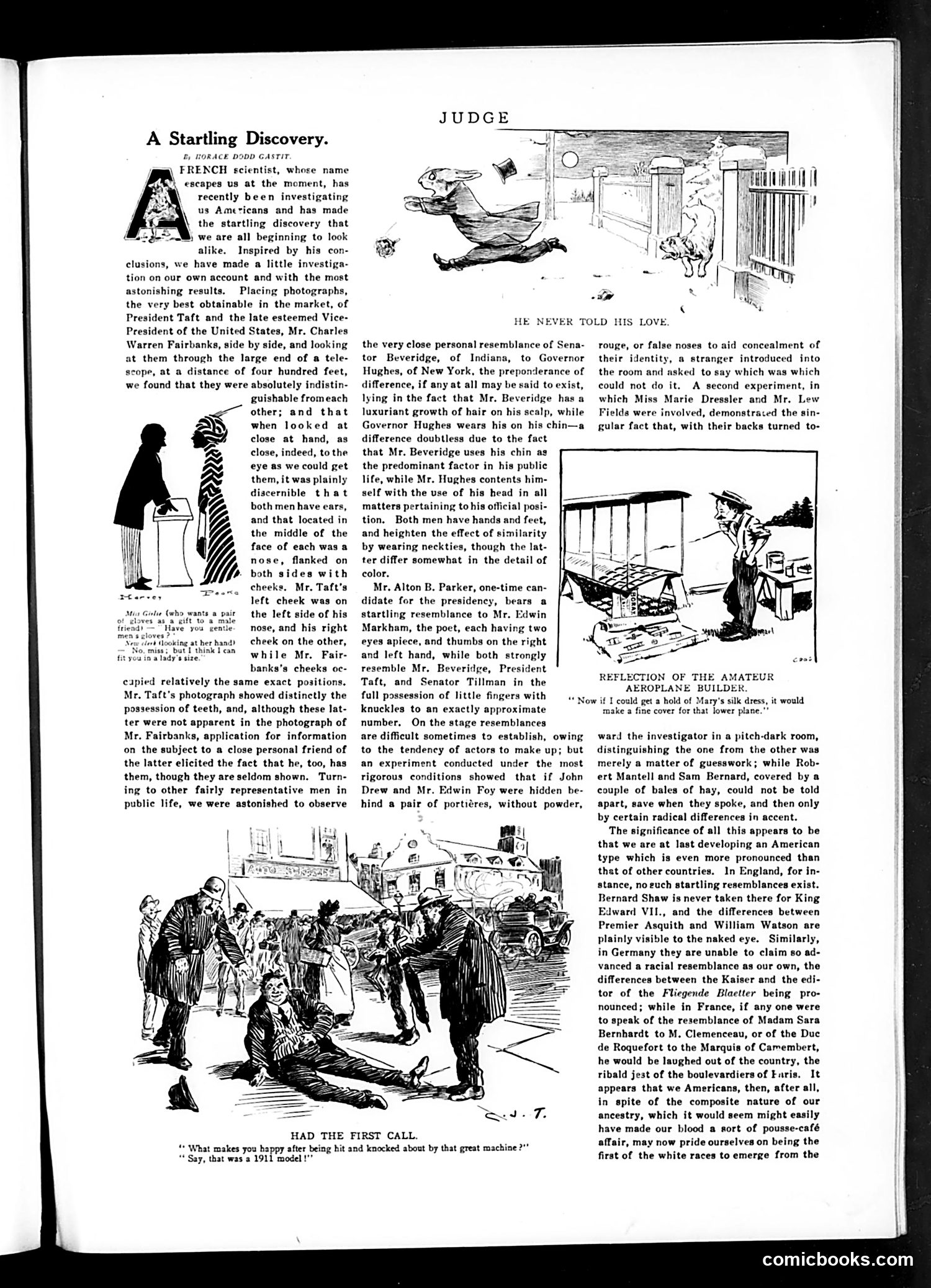
This Judge magazine article satirizes a French scientist's claim that Americans are becoming physically indistinguishable from one another. The satirist responds by deliberately finding absurd, trivial similarities between prominent public figures—President Taft, Vice President Fairbanks, Senator Beveridge, Governor Hughes, former presidential candidate Alton B. Parker, and stage actors John Drew and Edwin Foy. The joke relies on identifying obvious, universal human features (ears, noses, teeth, fingers) that all people share, then treating these commonalities as evidence of homogeneity. The satire mocks both the original French scientist's dubious claim and American anxiety about conformity or lack of distinctive character. The accompanying cartoons appear unrelated: one depicts a humorous domestic misunderstanding about hand size; another shows an amateur airplane builder's reflection. These seem editorial filler rather than connected commentary.
📄 Transcribed text from this page (OCR, searchable)
Machine-transcribed from the original scan — historical spelling and the odd misread are preserved.
A Startling Discovery. fy HORACE DODD GasTiT. | FRENCH scientist, whose name escapes us at the moment, has recently been investigating us Americans and has made \\ the startling discovery that MB we are all beginning to look alike. Inspired by his con- clusions, we have made a little investiga- tion on our own account and with the most astonishing results. Placing photographs, the very best obtainable in the market, of President Taft and the late esteemed Vice- President of the United States, Mr. Charles Warren Fairbanks, side by side, and looking at them through the large end of a tele- scope, at a distance of four hundred feet, we found that they were absolutely indistin- guishable fromeach other; and that when looked at close at hand, as close, indeed, to the eye as we could get them, it was plainly discernible that both men have ears, and that located in the middle of the face of each was a nose, flanked on both sides with cheeks. Mr. Taft's left cheek was on the left side of his nose, and his right cheek on the other, while Mr. Fair- banks’s cheeks oc- capied relatively the same exact positions. Mr. Taft's photograph showed distinctly the possession of teeth, and, although these lat- ter were not apparent in the photograph of Mr. Fairbanks, application for information on the subject to a close personal friend of the latter elicited the fact that he, too, has them, though they are seldom shown. Turn- ing to other fairly representative men in public life, we were astonished to observe Have you kentle 4 “ooking at her hand? No, but | think Lean fit you in a lady's size. HE NEVER TOLD HIS LOVE the very close personal resemblance of Sena- tor Beveridge, of Indiana, to Governor Hughes, of New York, the preponderance of difference, if any at all may be said to exist, lying in the fact that Mr. Beveridge has a luxuriant growth of hair on his scalp, while Governor Hughes wears his on his chin—a difference doubtless due to the fact that Mr. Beveridge uses his chin as the predominant factor in his public life, while Mr. Hughes contents him- self with the use of his head in all matters pertaining to his official posi- tion. Both men have hands and feet, and heighten the effect of similarity by wearing neckties, though the lat- ter differ somewhat in the detail of color. Mr. Alton B. Parker, one-time can- didate for the presidency, bears a startling resemblance to Mr. Edwin Markham, the poet, each having two eyes apiece, and thumbs on the right and left hand, while both strongly resemble Mr. Beveridge, President Taft, and Senator Tillman in the full possession of little fingers with knuckles to an exactly approximate number, On the stage resemblances are difficult sometimes to establish, owing to the tendency of actors to make up; but an experiment conducted under the most rigorous conditions showed that if John Drew and Mr. Edwin Foy were hidden be- hind a pair of portiéres, without powder, HAD THE FIRST CALL. “; What makes you happy after being bit and knocked about by that great machine 7” “* Say, that was a 1911 model!" rouge, or false noses to concealment of their identity, a stranger introduced into the room and asked to say which was which could not do it, A second experiment, in which Miss Marie Dressler and Mr. Lew Fields were involved, demonstraced the sin- gular fact that, with their backs turned to- REFLECTION OF THE AMATEUR AEROPLANE BUILDER. “* Now if I could get a hold of Mary's silk dress, it would make a fine cover for that lower plane.” ward the investigator in a pitch-dark room, distinguishing the one from the other was merely a matter of guesswork; while Rob- ert Mantell and Sam Bernard, covered by a couple of bales of hay, could not be told ve when they spoke, and then only by certain radical differences in accent. The significance of all this appears to be that we are at last developing an American type which is even more pronounced than thet of other countries. In England, for in- stance, no euch startling resemblances exist. Bernard Shaw is never taken there for King Edward VII., and the differences between Premier Asquith and William Watson are plainly visible to the naked eye. Similarly, in Germany they are unable to claim so a vanced a racial resemblance as our own, the differences between the Kaiser and the edi- tor of the Fliegende Blaetter being pro- nounced; while in France, if any one were to speak of the resemblance of Madam Sara Bernhardt to M. Clemenceau, or of the Duc de Roquefort to the Marquis of Camembert, he would be laughed out of the country, the ribald jest of the boulevardiers of Furis, It appears that we Americans, then, after all, in spite of the composite nature of our ancestry, which it would seem might easily have made our blood a sort of pousse-café affair, may now pride ourselves on being the first of the white races to emerge from the comicbooks.com