
Judge, 1910-10-15 · page 3 of 18
Judge — October 15, 1910 — page 3: what you’re looking at
What you’re looking at
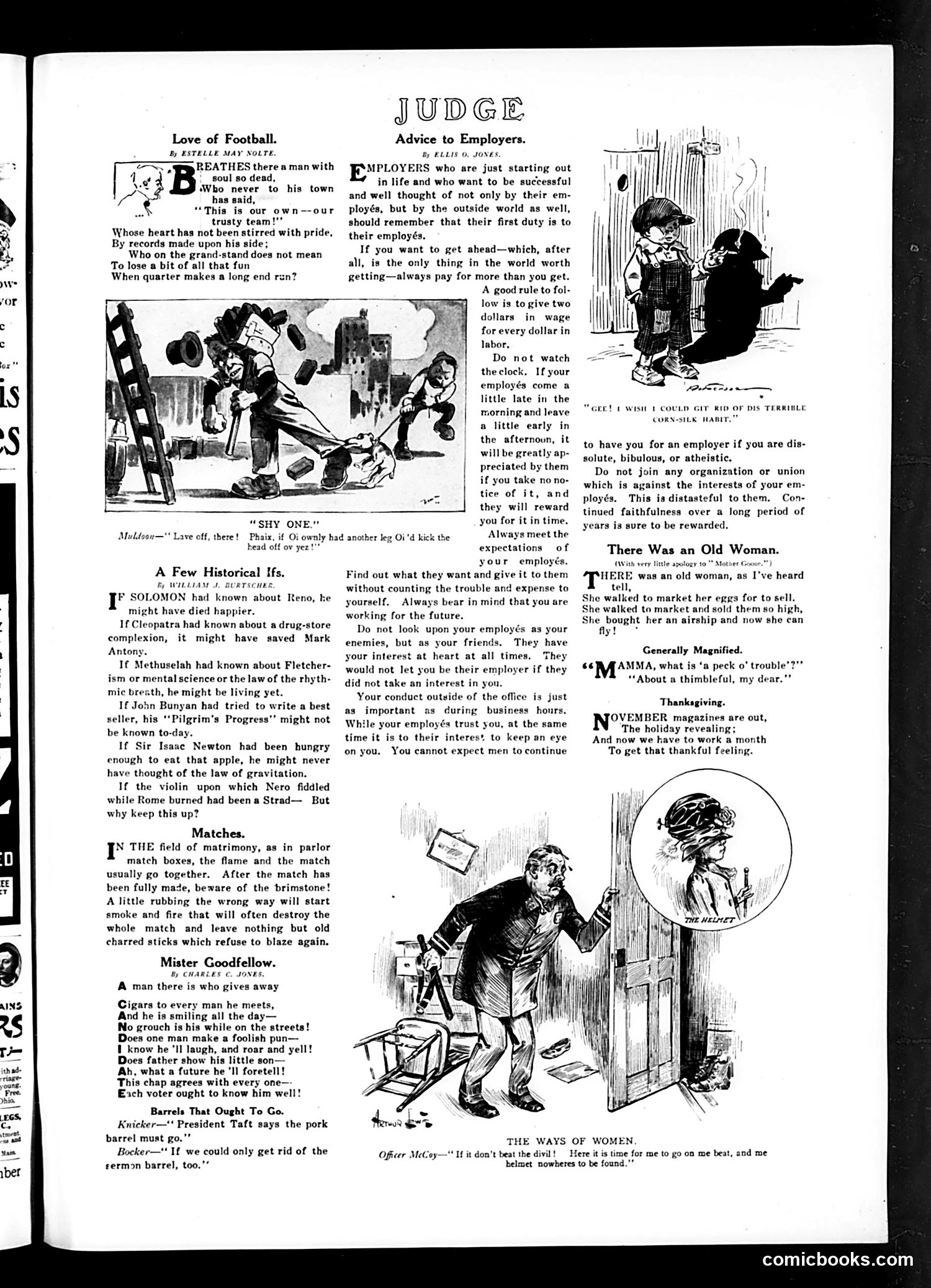
This page contains several satirical pieces typical of early-20th-century Judge magazine. The main cartoon "Shy One" depicts workplace dynamics—likely commentary on labor relations or employee conduct. The "Advice to Employers" section offers practical guidance on fair wage practices and employee relations, suggesting this was a period of labor activism and worker concerns. "There Was an Old Woman" appears to be social satire about economic struggle, while "Generally Magnified" and "Thanksgiving" offer lighter humor about domestic life and holidays. The bottom cartoon "The Ways of Women" depicts a man showing a woman's portrait to someone, with dialogue suggesting marital or romantic complications—typical of Judge's frequent commentary on gender relations and marriage. The overall tone reflects early-1900s middle-class concerns: labor fairness, gender roles, and social propriety.
📄 Transcribed text from this page (OCR, searchable)
Machine-transcribed from the original scan — historical spelling and the odd misread are preserved.
Love of Football. By ESTELLE MAY NoLTE. EATHES there a man with soul so dead, ‘Who never to his town hi id, “This is our own—our trusty team!"" Whose heart has not been stirred with pride, By records made upon his side; Who on the grand-stand does not mean To lose a bit of all that fun When quarter makes a long end ran? JUDGE Advice to Employers. By ELLIS 0. Jones MPLOYERS who are just starting out in life and who want to be successful and well thought of not only by their em- ployés, but by the outside world as well, should remember that their first duty is to their employés. If you want to get ahead—which, after all, is the only thing in the world worth getting—always pay for more than you get. A good rule to fol- low is to give two dollars in wage for every dollar in labor. Do not watch theclock. If your employés come a little late in the morning and leave a little early in the afternoon, it will be greatly ap- preciated by them if you take no no- tice of it, and they will reward “SHY ONE.” Muldoon—"' Lave off, there! head off ov yez!"" A Few Historical Ifs. By WILLIAM J. BURTSCHER. ILOMON had known about Reno, ke might have died happier. If Cleopatra had known about a drug-store complexion, it might have saved Mark Antony If Methuselah had known about Fletcher- ism or mental science or the law of the rhyth- mic breath, he might be living yet. If John Bunyan had tried to write a best seller, his ‘Pilgrim's Progress’’ might not be known to-day. If Sir Isaac Newton had been hungry enough to eat that apple, he might never have thought of the law of gravitation. If the violin upon which Nero fiddled while Rome burned had been a Strad— But why keep this up? Matches. JX THE fietd of matrimony, as in parlor match boxes, the flame and the match usually go together. After the match has been fully made, beware of the brimstone! A little rubbing the wrong way will start smoke and fire that will often destroy the whole match and leave nothing but old charred sticks which refuse to blaze again. Mister Goodfellow. By CHARLES C. JONES. A man there is who gives away Cigars to every man he meets, And he is smiling all the day— No grouch is le on the streets! Does one man make a foolish pun— 1 know he 'Il laugh, und roar and yell! Does father show his little son— Ah, what a future he 'Il foretell! This chap agrees with every one— Each voter ought to know him well! Barrels That Ought To Go. Knicker—‘‘ President Taft says the pork barrel must go.”” Bocker- If we could only get rid of the sermon barrel, too.” Phaix, if Oi ownly had another leg Oi'd kick the you for it in time. Always meet the expectations of your employés. Find out what they want and give it to them without counting the trouble and expense to yourself, Always bear in mind that you are working for the future. Do not look upon your employ enemies, but as your friends. They have your interest at heart at all times, They would not let you be their employer if they did not take an interest in you. Your conduct outside of the office is just as important 2s during business hours. While your employés trust you, at the same time it is to their interest to keep an eye on you, You cannot expect men to continue as your THE WAYS Officer McCoy—"* If it don't beat the divil ! AOk ers "GEE! E WISH 1 COULD GIT RID OF DIS TERRIBLE CORN-SILK. HABIT.” to have you for an employer if you are dis- solute, bibulous, or atheistic. Do not join any organization or union which is against the interests of your em- ployés, This is distasteful to them. Con- tinued faithfulness over a long period of years is sure to be rewarded. There Was an Old Woman. (With very little apology to" Motaet Gos HERE was an old woman, as I've heard tell, She walked to market her eggs for to sell. She walked to market and sold them so high, She bought her an airship and now she can fly! * Generally Magnified. oe AMMA, what is ‘a peck 0’ trouble’?”’ “About a thimbleful, my dear.’" Thanksgiving. OVEMBER magazines are out, ‘The holiday revealing; And now we have to work a month To get that thankful feeling. OF WOMEN Here it is time for me to go on me beat, and me helmet nowheres to be found. comicbooks.com