
A complete issue · 16 pages · 1910
Judge — September 3, 1910
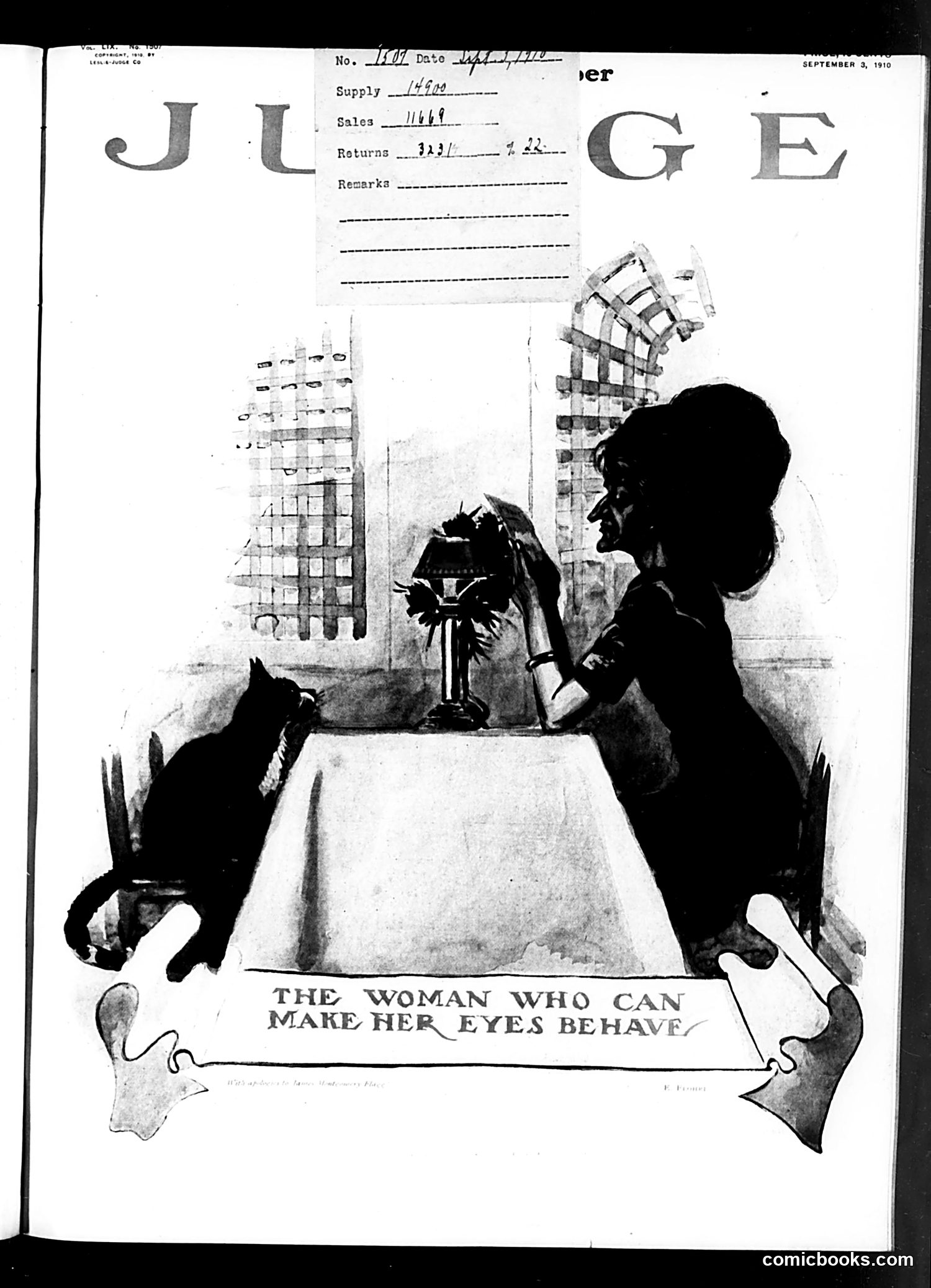
This page from Judge magazine (dated September 3, 1910) features an illustration titled "The Woman Who Can Make Her Eyes Behave." The image shows a silhouetted woman at a table with a black cat, gazing at two tall buildings in the background. The caption suggests the satire concerns women's ability to control their eye contact or gaze—likely referencing early 20th-century social etiquette concerns about women's public behavior and propriety. The accompanying business information (Supply, Sales, Returns, Remarks fields) indicates this is a magazine production or inventory page. The humor appears to target contemporary anxieties about women's independence and social conduct during this progressive era.
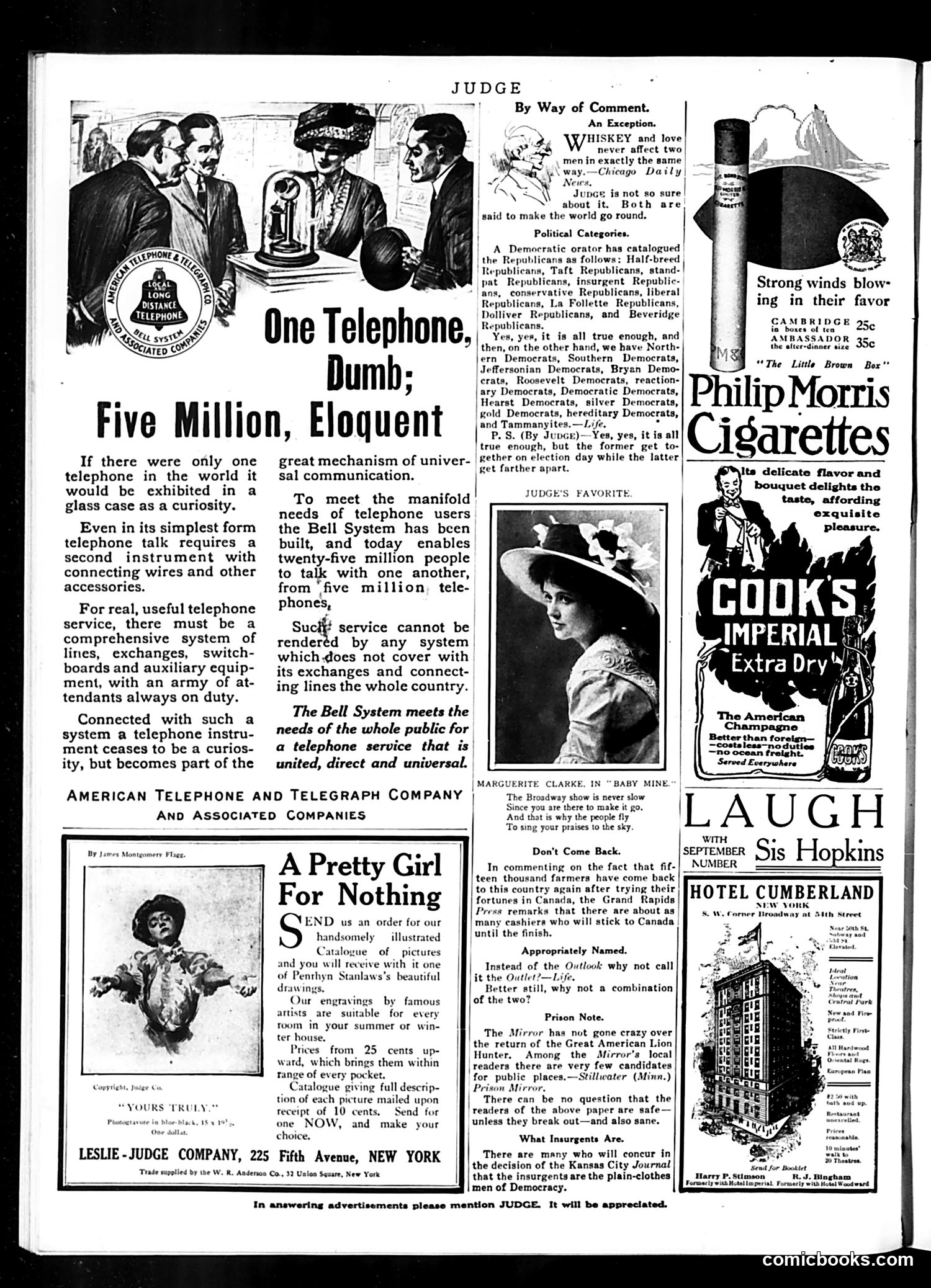
This page combines satirical commentary with period advertising. The main editorial cartoon "One Telephone, Dumb; Five Million, Eloquent" argues that while a single telephone is useless, the Bell System's network of five million connected phones creates genuine value—a metaphor for unified systems over isolated individual power. The "Political Categories" section satirizes Republican divisions, categorizing various Republican factions (Half-breed, Stalwart, Taft Republicans, etc.) with mock seriousness, suggesting the party's fragmentation into competing camps. Below, a section titled "Judge's Favorite" features actress Marguerite Clarke in "Baby Mine," while other content includes commentary on Canadian farmers and insurgent politics. The page is primarily **advertising-driven**, featuring cigar, cigarette, and hotel advertisements typical of early 20th-century Judge magazine content.
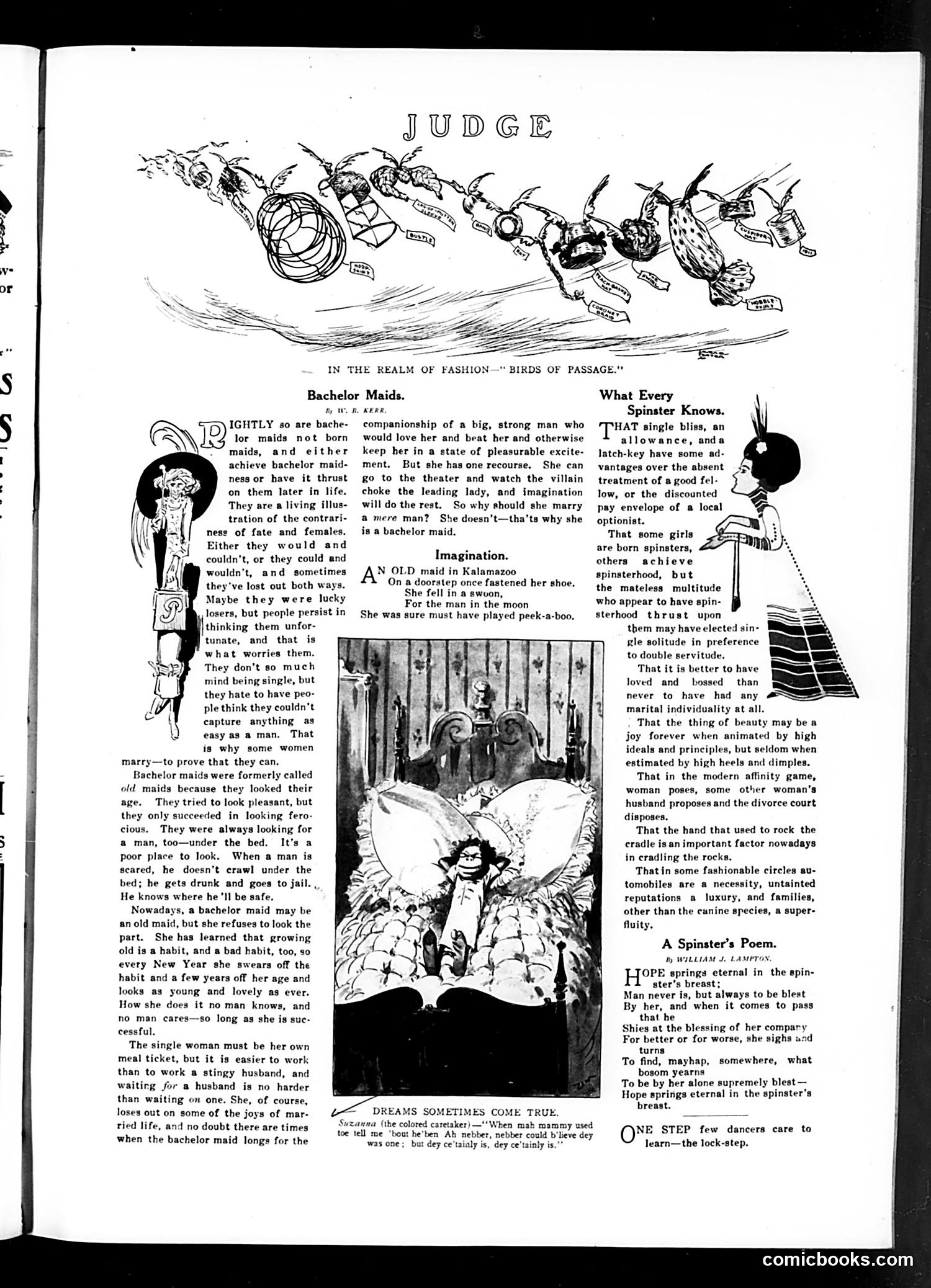
This page from *Judge* magazine contains social commentary on unmarried women ("Bachelor Maids"), presented through satirical articles and illustrations. The main cartoon depicts "Dreams Sometimes Come True," showing a woman fantasizing about romantic scenarios. The accompanying text argues that bachelor maids—unmarried women—represent a social problem. The author suggests they exist because women won't marry "mere men" and instead hold unrealistic expectations. The satire critiques both unmarried women's supposed vanity and pretension, and the bachelor maid concept itself. The "Spinster's Poem" on the right presents hope as eternally springing from unmarried women's hearts. The overall page reflects early 20th-century anxieties about changing gender roles and the increasing numbers of unmarried women, treating spinsterhood as simultaneously pitiable and self-inflicted through excessive standards.
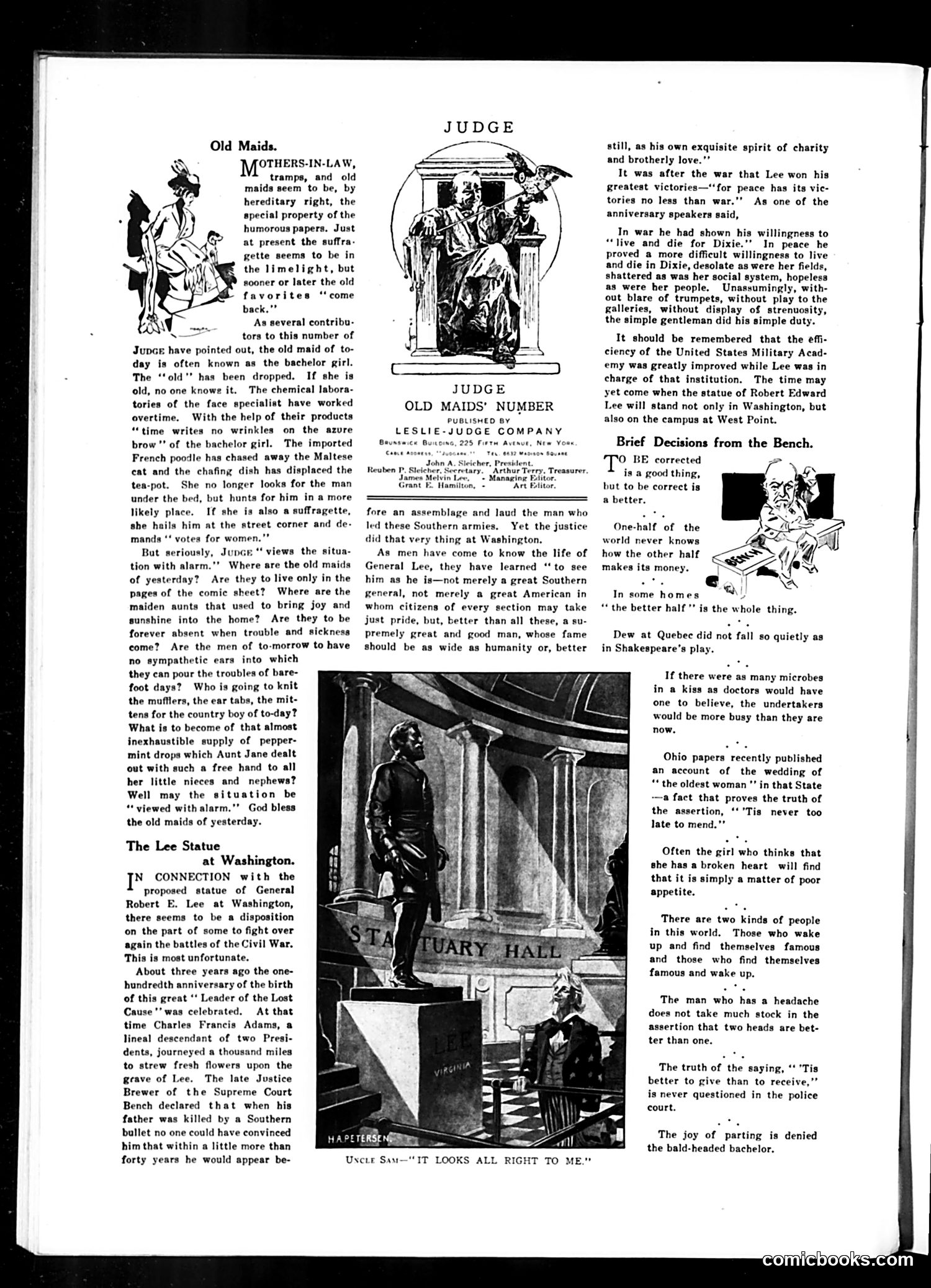
This page contains commentary on **General Robert E. Lee**, the Confederate general, alongside various humorous editorial pieces. The main article discusses the proposed placement of a Lee statue at Washington, D.C., noting some controversy about honoring a Confederate figure in the nation's capital roughly 40-50 years after the Civil War. The illustrations labeled "Old Maids" and "Judge" appear to be stock humorous drawings about unmarried women and domestic situations—typical filler content for Judge magazine's satirical format. The photographs show what appears to be **Statuary Hall** at the Capitol, depicting the practical consideration of where Confederate monuments would physically fit in federal buildings. The text emphasizes Lee's post-war character and dignity rather than his wartime role, reflecting late 19th/early 20th-century reconciliation narratives.
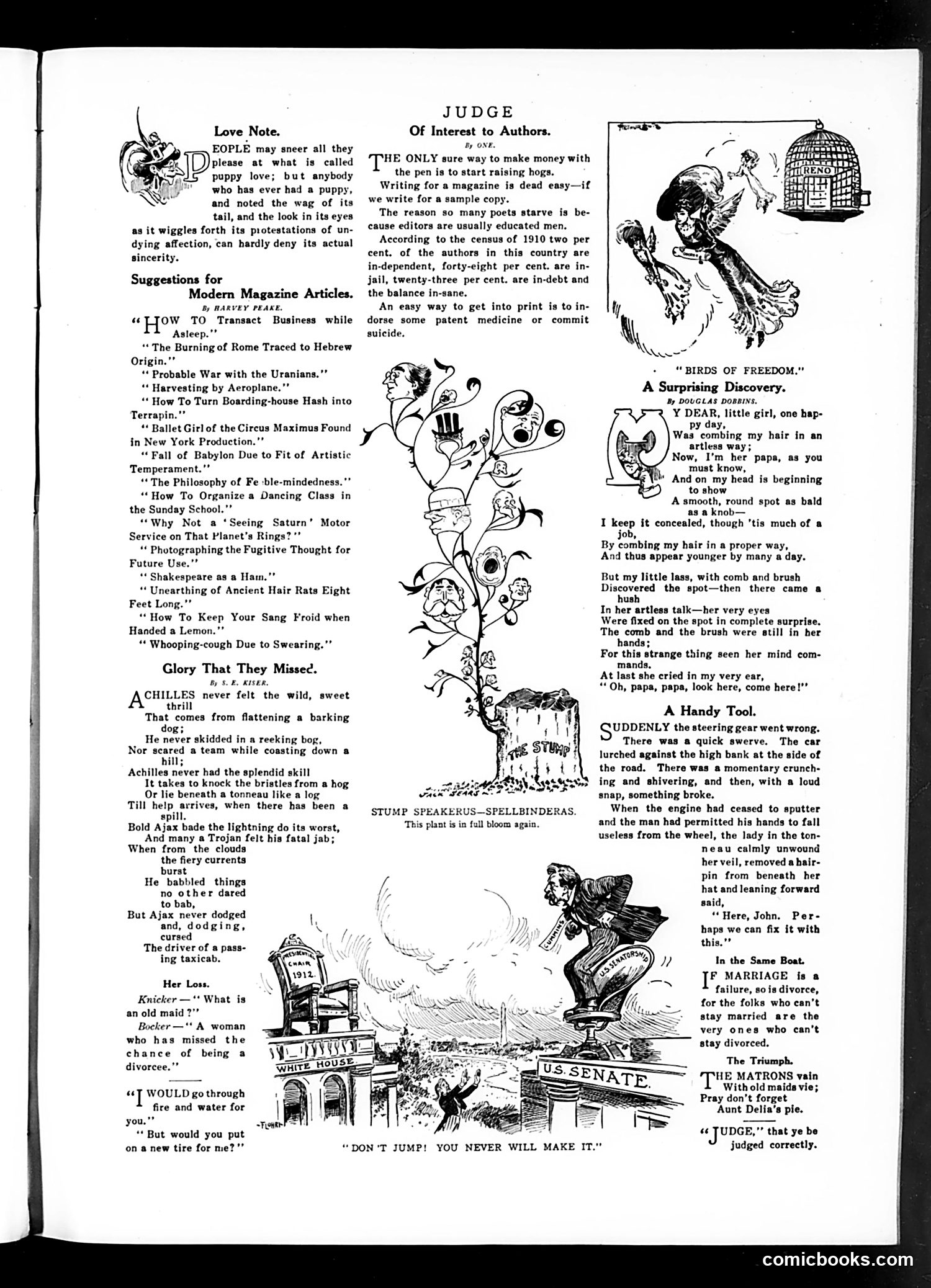
This page contains several unrelated satirical pieces and poems typical of Judge magazine's format. **"Don't Jump! You Never Will Make It"** (bottom cartoon): Depicts a figure attempting to jump from the White House to the U.S. Senate building, with a policeman warning against the attempt. This satirizes the difficulty of political advancement—the gap between executive and legislative branches symbolizes the challenge of transitioning between these positions. **Other content** includes poems like "Glory Never to Be Missed" (about a dog named Ajax) and "A Handy Tool" (about a steering gear malfunction), plus advice columns and jokes about marriage and divorce. The page demonstrates Judge's mix of political satire with lighter domestic humor, reflecting early 20th-century magazine conventions blending serious commentary with entertainment.
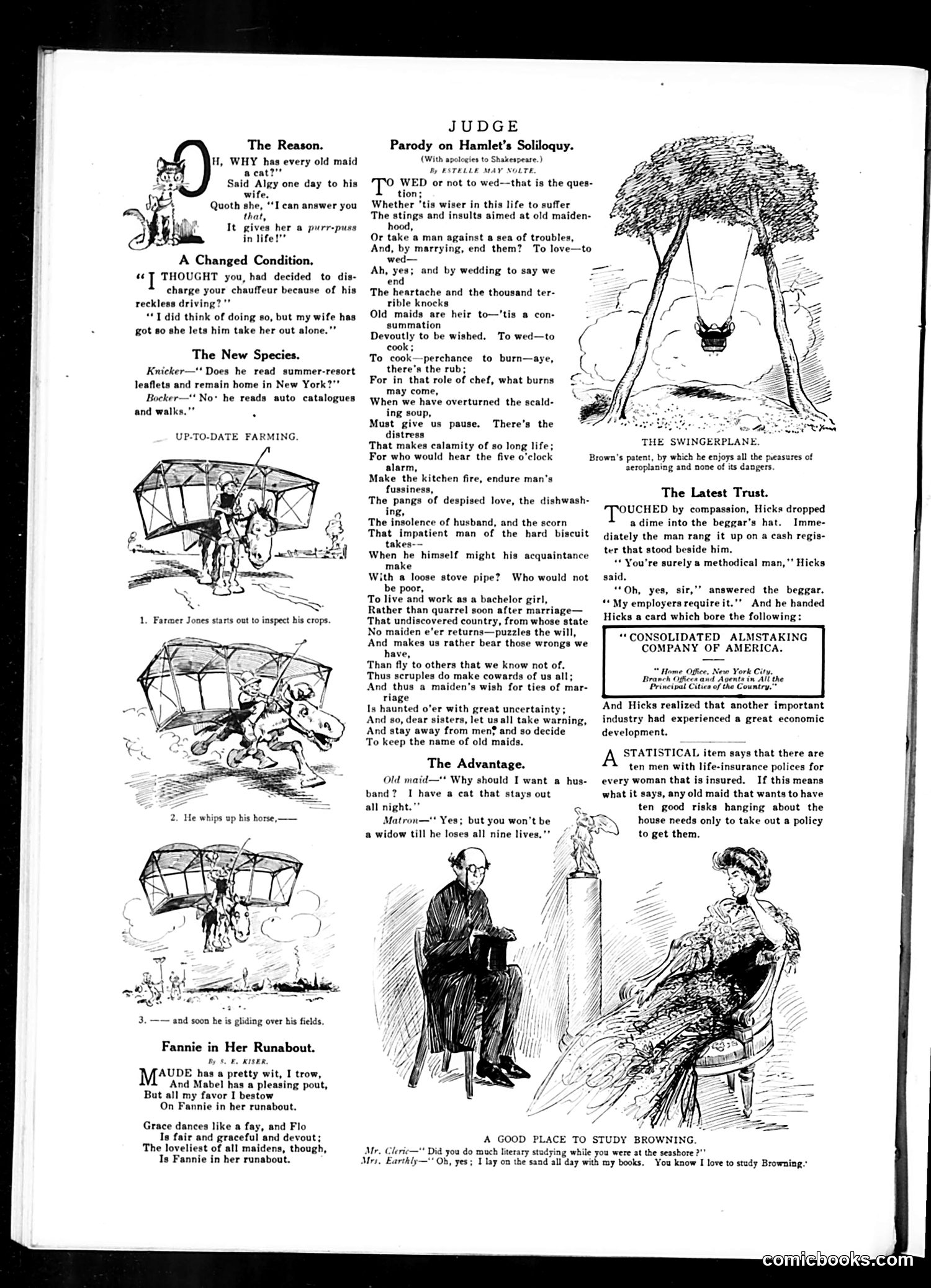
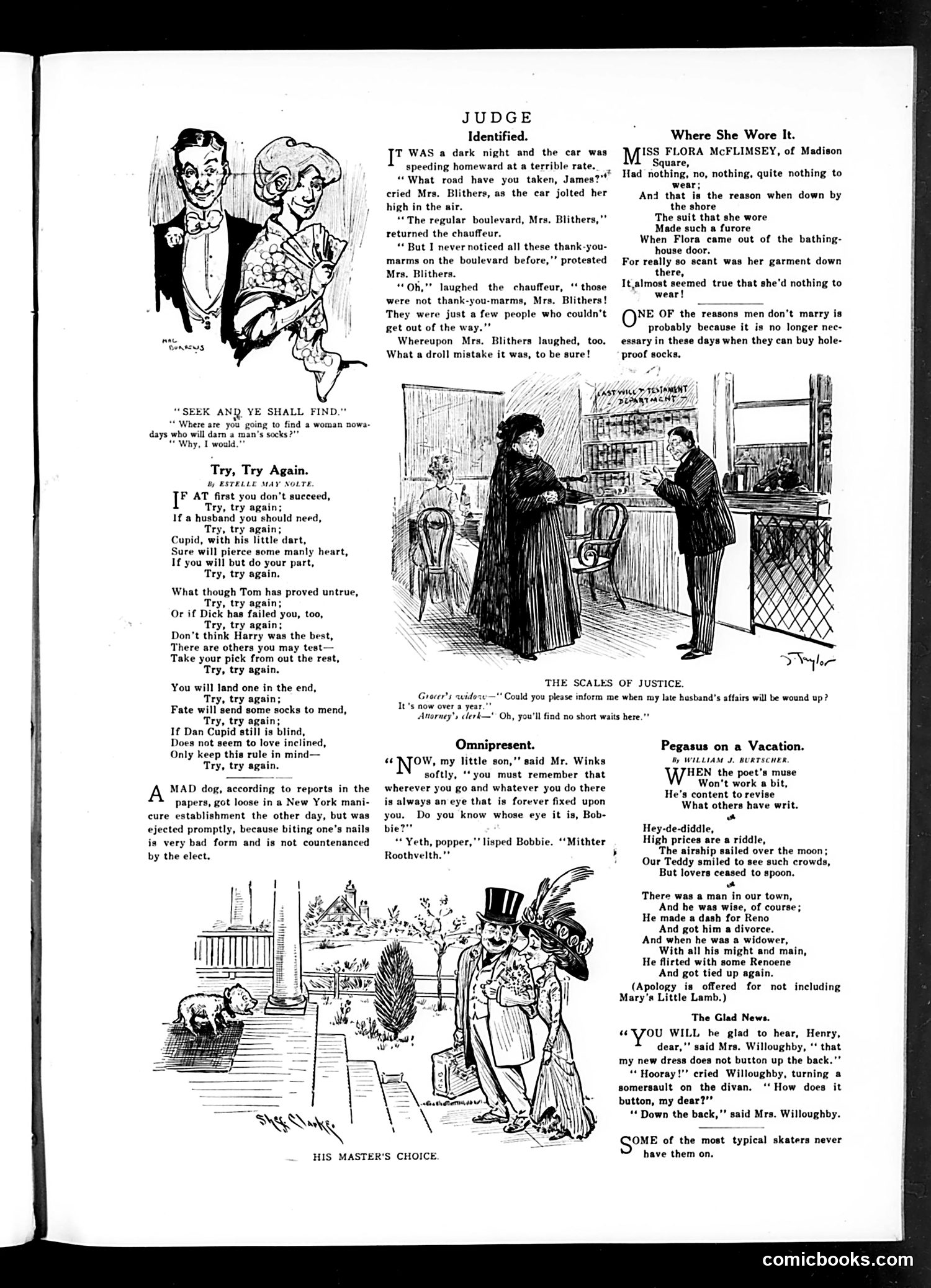
This page contains several satirical pieces targeting early 20th-century social conventions: **"Where She Wore It"** mocks the fashion trend of increasingly minimal bathing costumes, referencing the famous 19th-century poem "Nothing to Wear" about a woman with an empty wardrobe. The joke critiques women's scandalous beach attire. **"Try, Try Again"** is a humorous poem reframing the motivational phrase to mock women's desperation for marriage, particularly their need for husbands to darn socks—a common domestic necessity. **"Seek and Ye Shall Find"** sarcastically questions where modern women capable of darning socks can be found, reflecting anxiety about changing gender roles. **"The Scales of Justice"** satirizes lawyers' delays in settling estates. **"His Master's Choice"** appears to mock a dog choosing to eat/attack something in a manicure salon, commenting on social propriety. The humor throughout targets evolving social norms: women's fashion, marriage expectations, domestic duties, and modern inconveniences—reflecting period anxieties about social change.
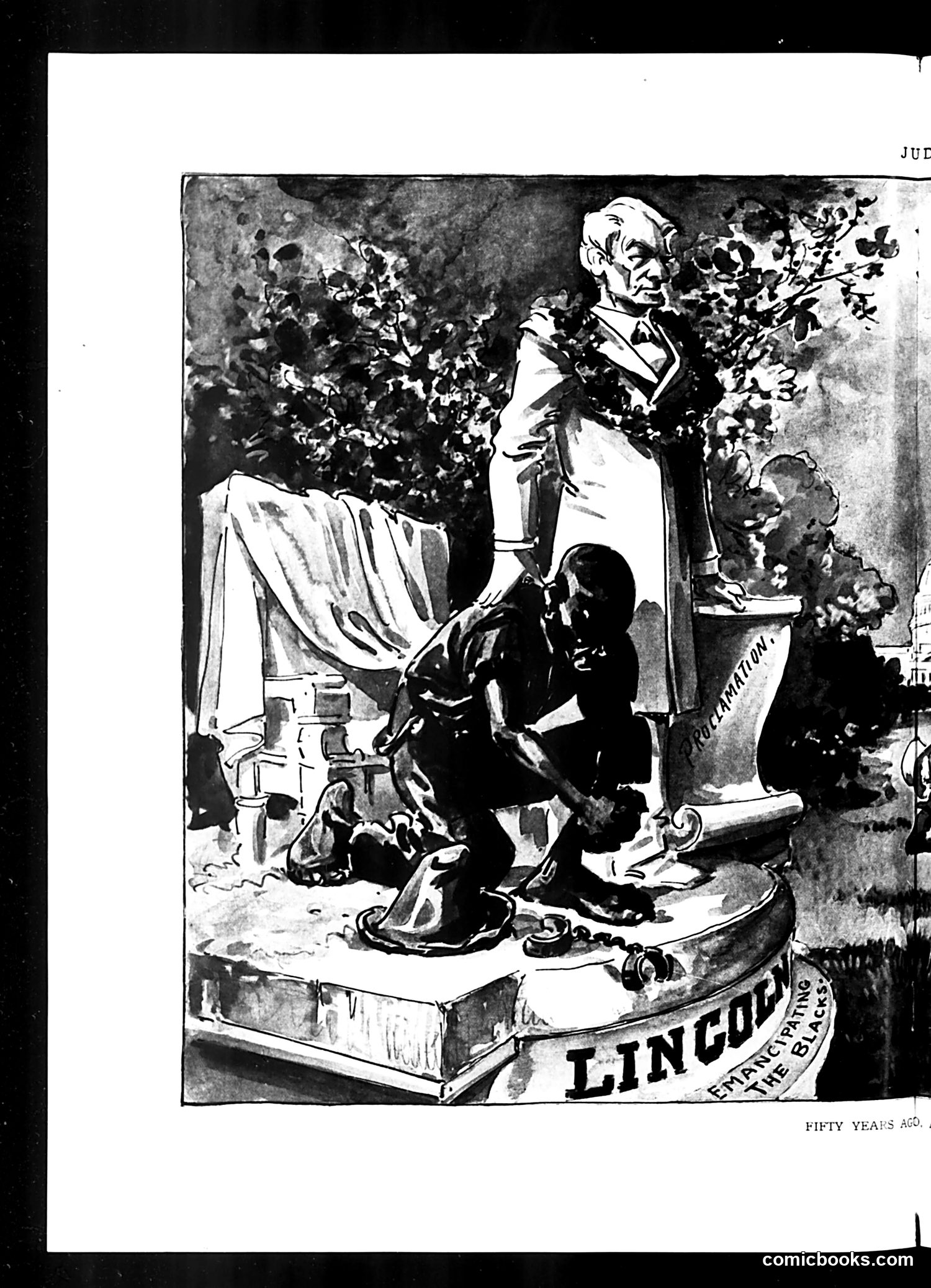
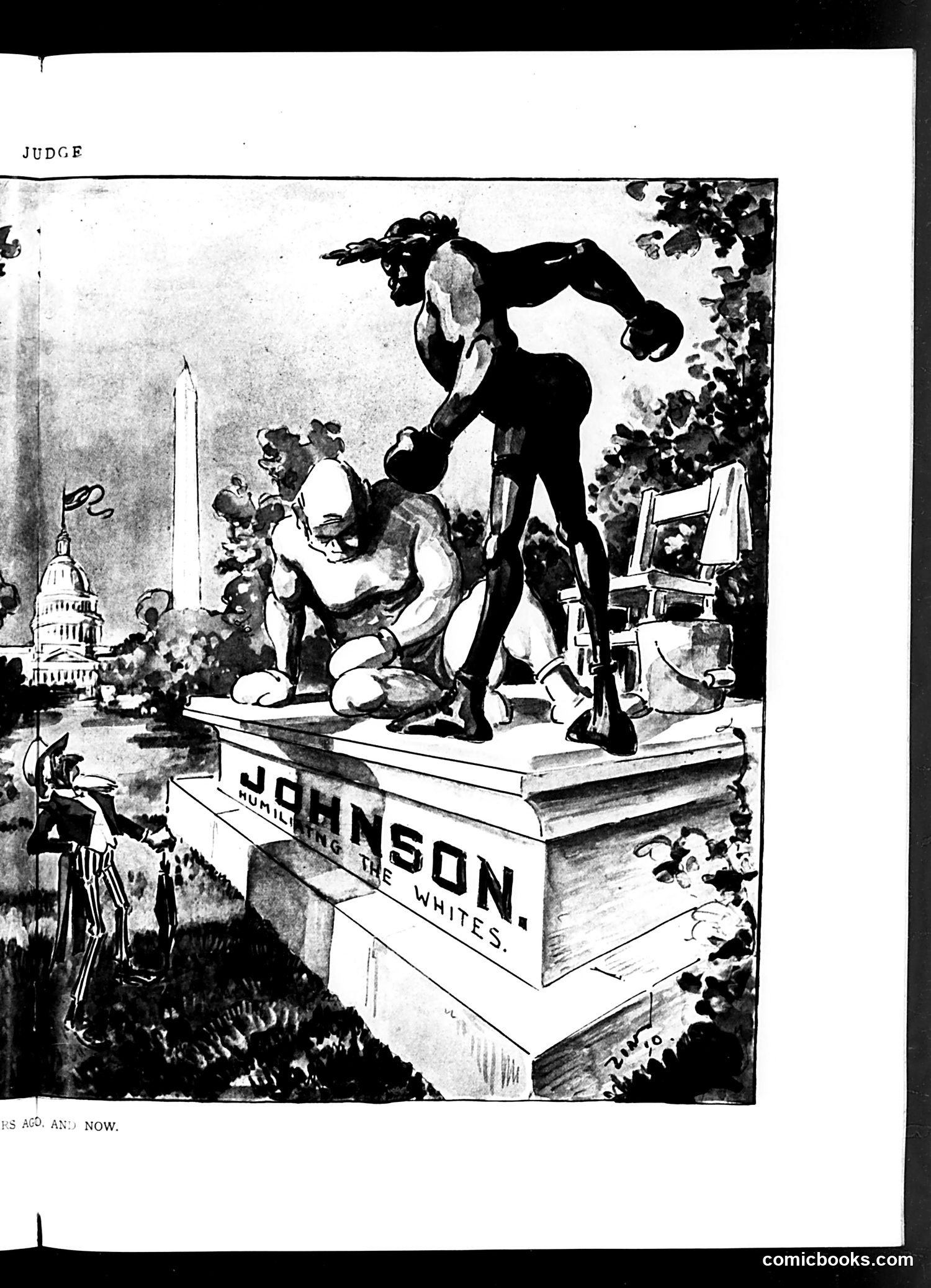
This political cartoon titled "Judge" depicts a caricatured Black figure being elevated on a pedestal labeled "Johnson—Ruling the Whites." The figure holds what appears to be a gavel or mallet, suggesting judicial authority. The Capitol building is visible in the background, establishing a Washington, D.C. political setting. This appears to be racist satire commentary on a Johnson (likely President Andrew Johnson) administering authority over white Americans. The exaggerated caricature and scenario reflect the inflammatory racial politics of Reconstruction era America, when conservative publications used dehumanizing imagery to oppose policies granting political power to formerly enslaved people. The satire mocks what the magazine's audience apparently viewed as an unnatural inversion of racial hierarchy.
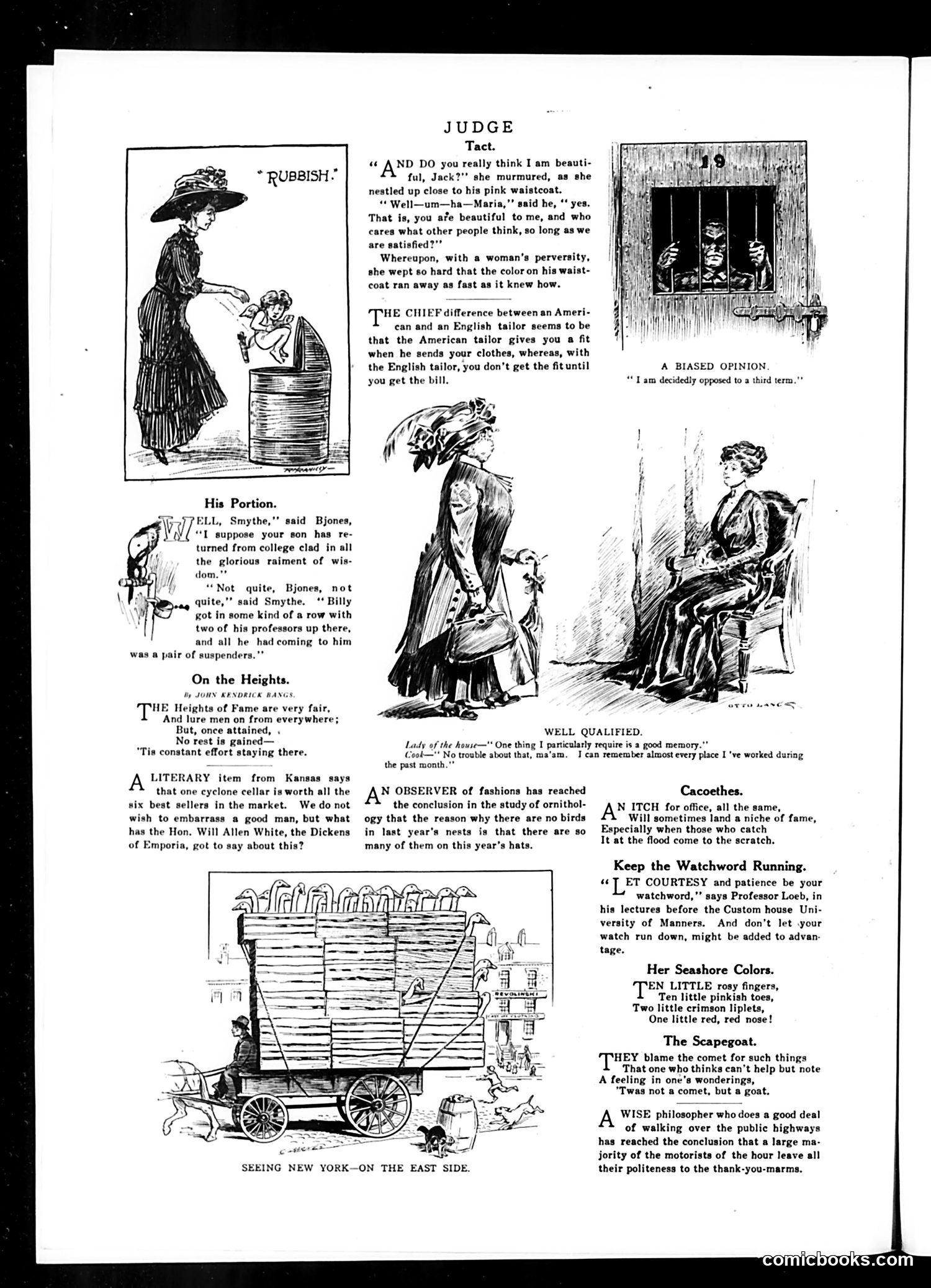
This page from the satirical magazine **Judge** contains multiple short humorous pieces and cartoons typical of early 20th-century American humor. **Key Content:** The main cartoons mock social pretensions and practical absurdities. "Rubbish" depicts a woman discarding a child in a barrel—commentary on wasteful fashion or parenting. "A Biased Opinion" shows prisoners behind bars opposing "third terms" (prison sentences). **Social Satire Topics:** - **Education**: A father's son returns from college with only "a pair of suspenders" after fighting with professors—mocking both academic conflicts and meager learning outcomes - **Fashion**: Critiques American vs. English tailors, and absurdly blames the disappearance of last year's bird nests on feathered hats - **Fame**: "Heights of Fame" notes that achieving success brings constant struggle to maintain it - **Motorists**: Complaints that early automobile drivers are discourteous, leaving "politeness to the thank-you-marms" (likely referring to politeness only to women) The pieces reflect period concerns: education quality, fashion excess, and emerging automobile culture's social impact.
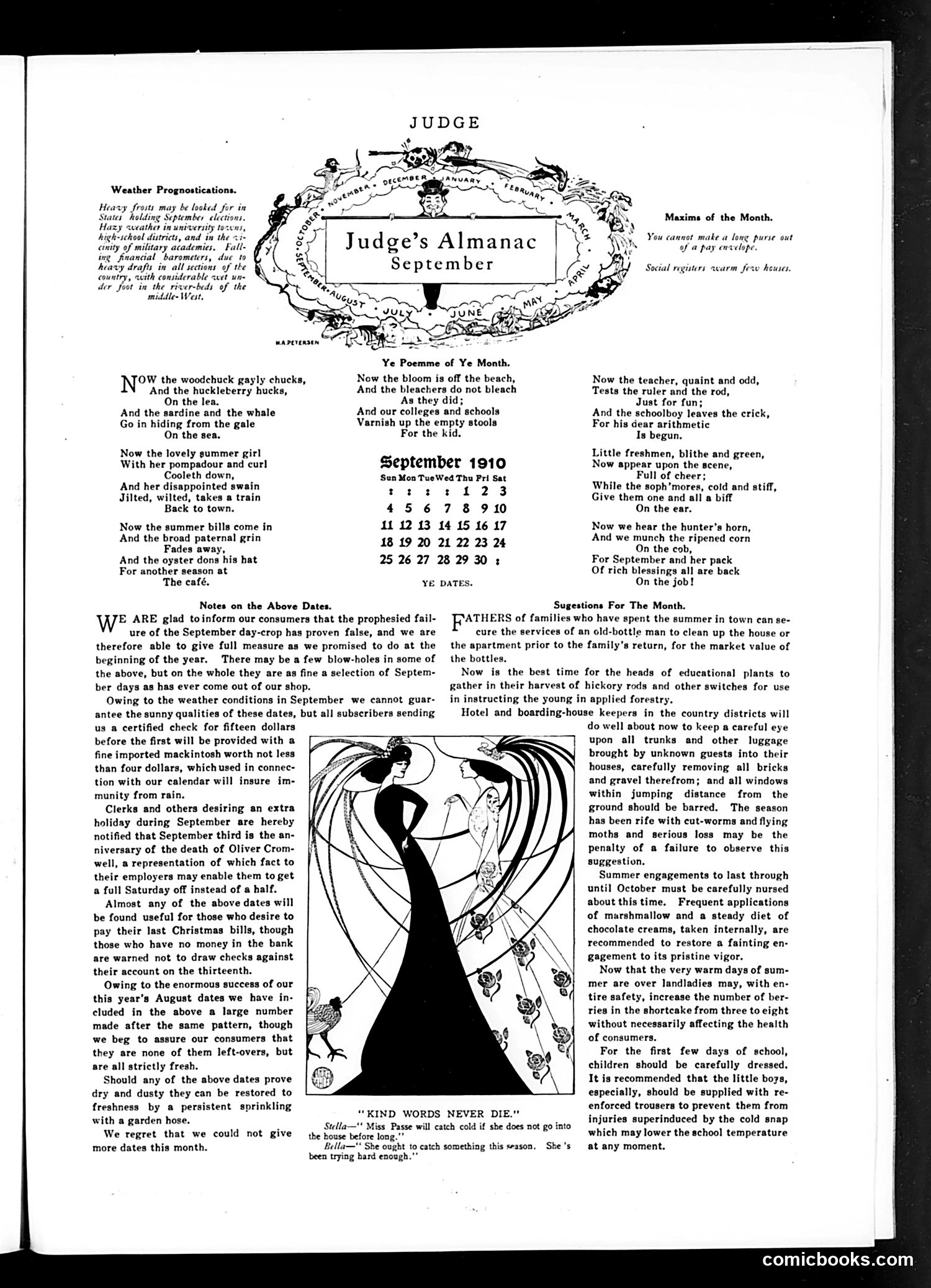
This page is primarily a humorous **almanac** spoofing weather forecasts and practical advice for September. The satire includes: **Weather Predictions**: Mock "prognostications" reference "heavy frosts in states holding September elections"—a political jab suggesting electoral competition creates a chilling effect. **Seasonal Humor**: Poems and maxims ridicule typical September occurrences: summer romance ending ("the lovely summer girl...takes a stain back to town"), financial strain from accumulated bills, school resuming, and hunting season. **The Cartoon**: Features a woman in a heart-shaped frame with the caption "KIND WORDS NEVER DIE," illustrating romantic disappointment—thematically connected to the issue's emphasis on summer romance fading. **Tone**: Lighthearted social commentary on middle-class American life—financial anxiety, romantic transience, and the predictable cycle of seasons. No specific political figures are caricatured; rather, Judge mocks universal social experiences and class anxieties of the era.
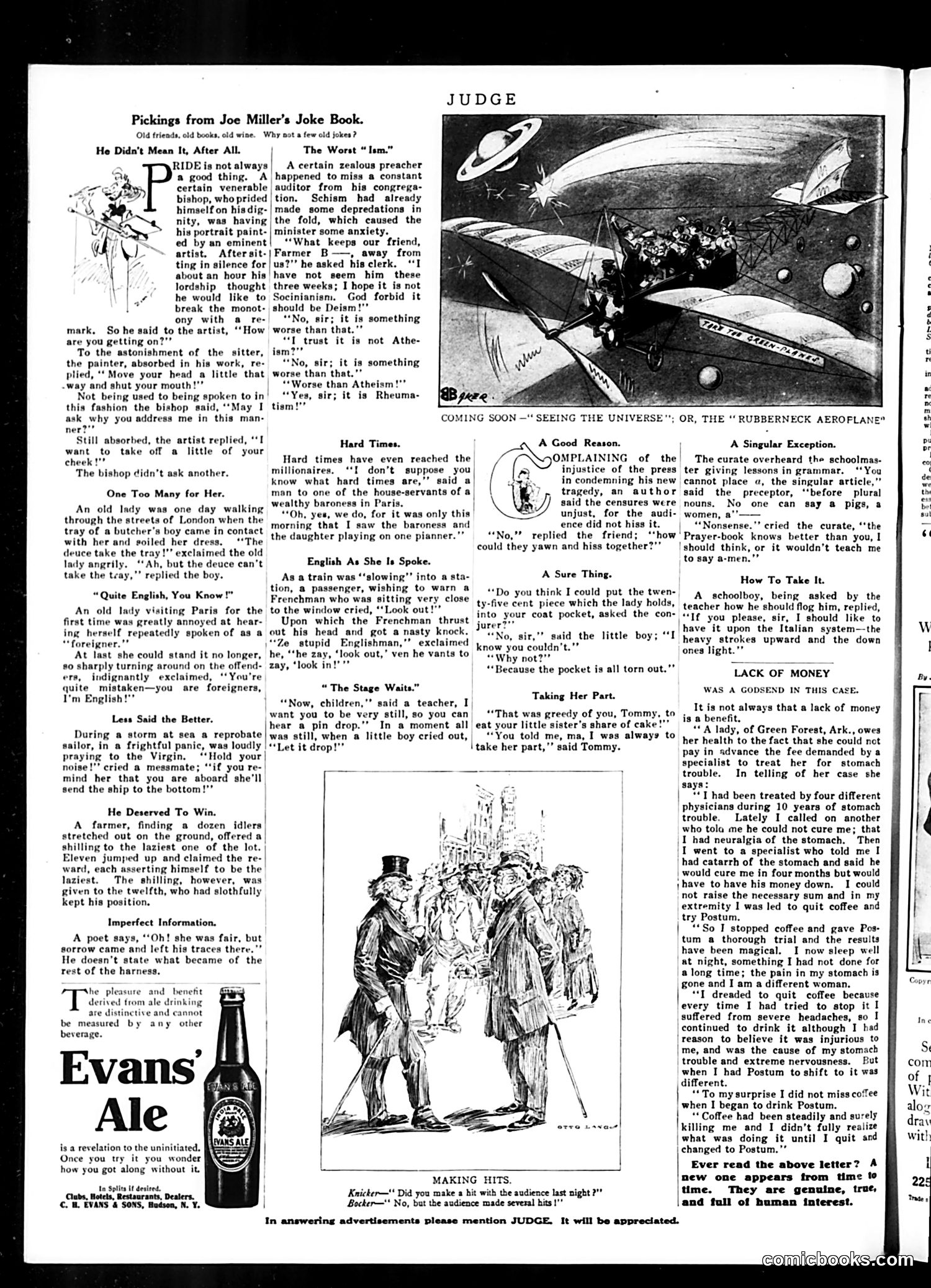
This page from **Judge** magazine contains reprinted jokes from "Joe Miller's Joke Book"—a classic 18th-century jestbook. The humor relies on wordplay and social class comedy typical of that era. Key jokes include: - **"He Didn't Mean It"**: A bishop is humiliated when a portrait painter, absorbed in work, tells him to "shut your mouth" and "take off a little of your cheek"—the artist means literally, but the bishop takes it as insult. - **"Hard Times"**: Wealthy people complaining about hardship; a baroness's servant notes even the rich suffer—they must share a piano. - **"English As She Is Spoke"**: Language barrier humor: a Frenchman misunderstands "Look out!" (warning) as an instruction to stick his head out the window. The page also advertises **Evans Ale** and previews an upcoming aeronautical article. The satire is gentle, class-based humor rather than political commentary—poking fun at pretension, linguistic confusion, and the wealthy.
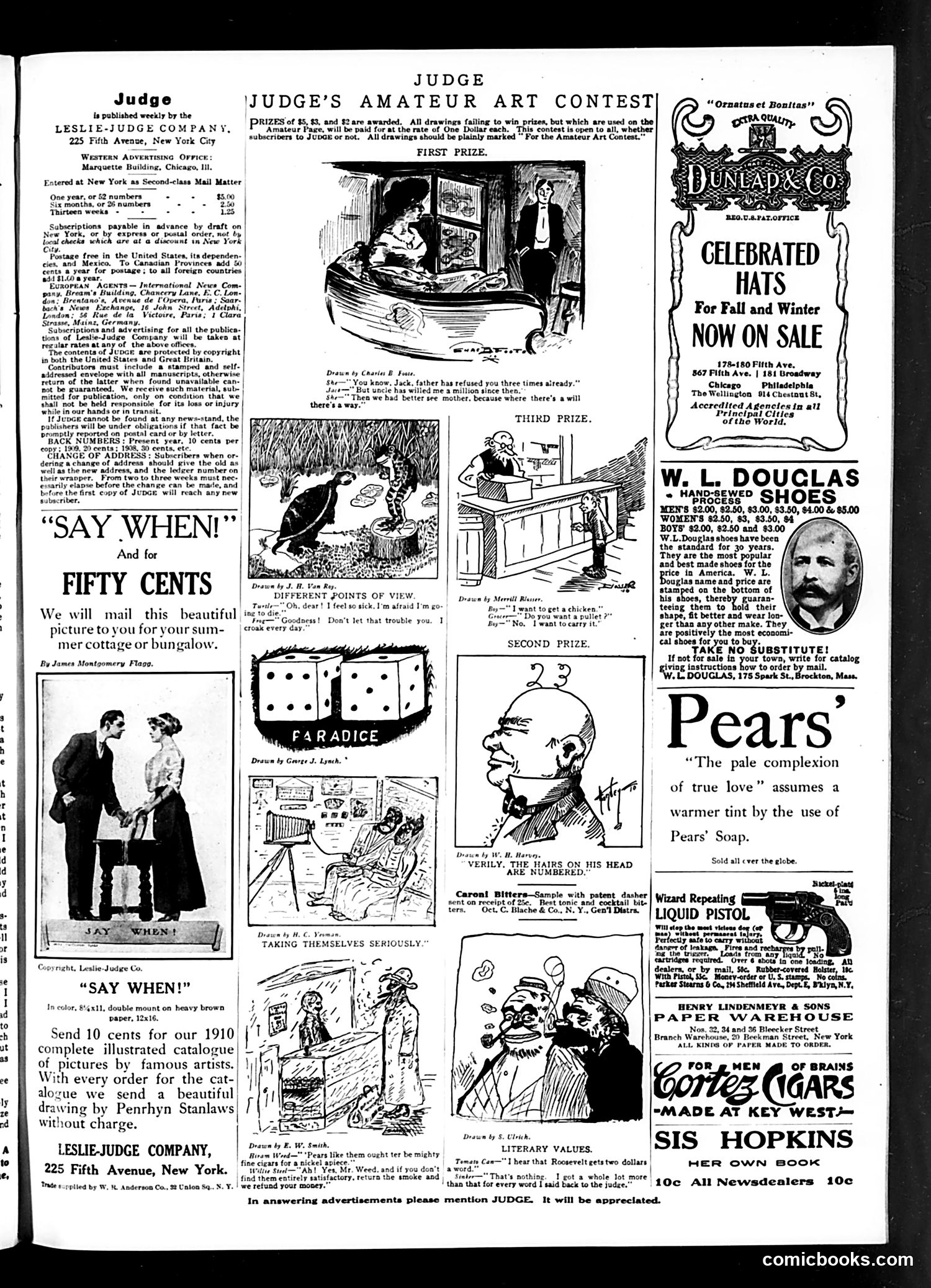
This page from *Judge* magazine presents a satirical amateur art contest with cartoons demonstrating various visual humor approaches. **The cartoons shown include:** 1. **"Different Points of View"** — A sick man tells his doctor not to worry about his condition since he dies daily anyway. The joke satirizes resigned pessimism. 2. **"Paradice"** — Illustrated through dice, likely a visual pun on "paradise" through gambling. 3. **"Taking Themselves Seriously"** — Multiple scenes apparently mocking self-important behavior in everyday situations. 4. **"Literary Values"** — References Theodore Roosevelt receiving $2 per word for writing, while someone else claims earning more per word for their courtroom testimony ("every word I said back to the judge"). This satirizes both Roosevelt's celebrity status and judicial proceedings. The page serves primarily as a contest showcase with accompanying advertisements. The humor relies on visual gags, wordplay, and social observation typical of early-20th-century American satirical magazines.
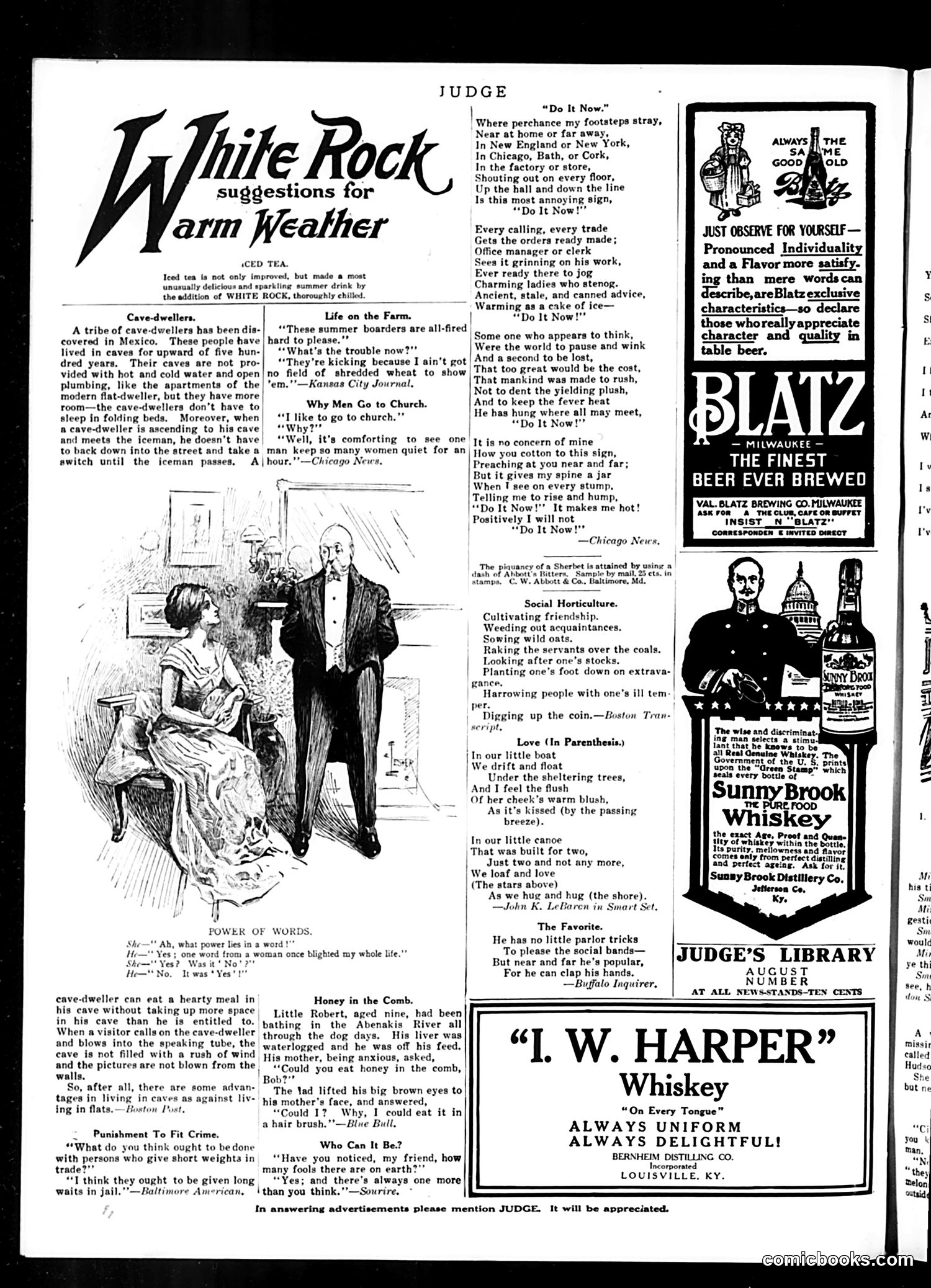
This page from Judge magazine consists primarily of **advertising and humor content**, not political satire. The central piece is a poem titled **"Do It Now!"** criticizing the ubiquitous workplace slogan that demands constant urgency and productivity. The author mocks this phrase as it appears "on every floor" in factories, offices, and stores, calling it "most annoying" and "ancient, stale, and canned advice." The satire targets the relentless pressure of early 20th-century industrial culture to work faster and harder. Supporting humorous pieces include: - **Cave-dwellers anecdote**: A joke about Mexican cave-dwellers who have more living space than apartment-dwellers with folding beds - **Social Horticulture**: A clever wordplay list equating farming terms with social behaviors (e.g., "Raking the servants over the coals") - **Power of Words**: A brief joke about how "Yes" ruined someone's life The remainder is **period advertising** for alcoholic beverages (Blatz beer, I.W. Harper whiskey, Sunny Brook whiskey) and Judge's library service—standard for this era.
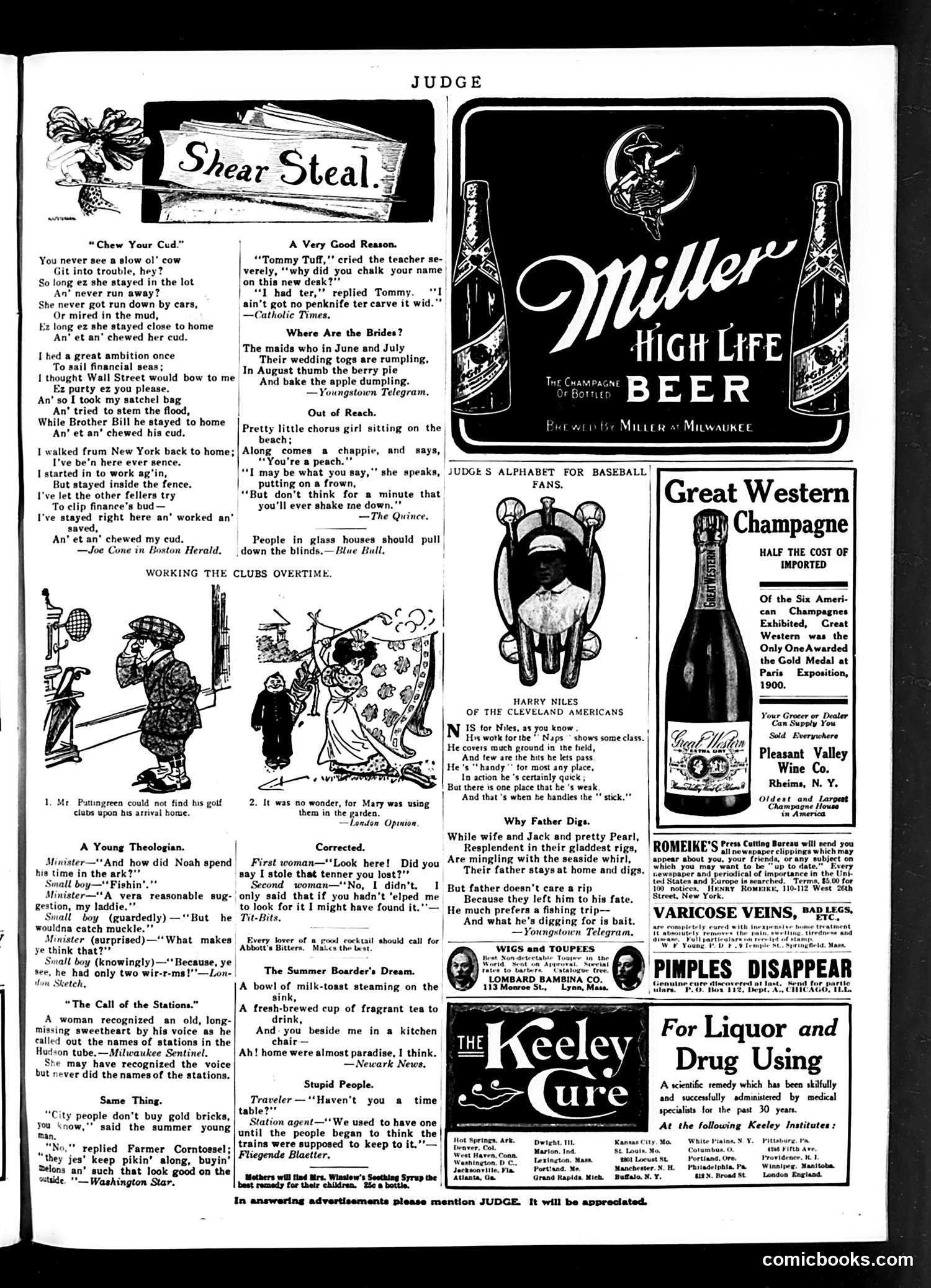
This is primarily an **advertising page** with scattered humor pieces, typical of Judge's format. Most content is promotional rather than satirical commentary. **The humor pieces** are light, domestic jokes: a farmer morally superior for staying home and chewing his cud while others chase Wall Street; golf club theft; a woman recognizing her lost sweetheart by his voice calling subway stops; various puns about chorus girls and clergy. **The advertisements dominate**, promoting: - **Miller High Life Beer** (major ad featuring bottles and brewery branding) - **Great Western Champagne** (emphasizing it won gold at Paris Exposition 1900) - **Keeley Cure** (treatment for addiction/alcoholism) - **Varicose veins and pimples remedies** The page includes "**Judge's Alphabet for Baseball**"—a small feature with cartoon character Harry Niles of Cleveland—appealing to sports fans. **Overall context**: This reflects early 1900s American middle-class concerns (success anxiety, alcohol consumption) and emerging mass-market advertising in satirical publications.
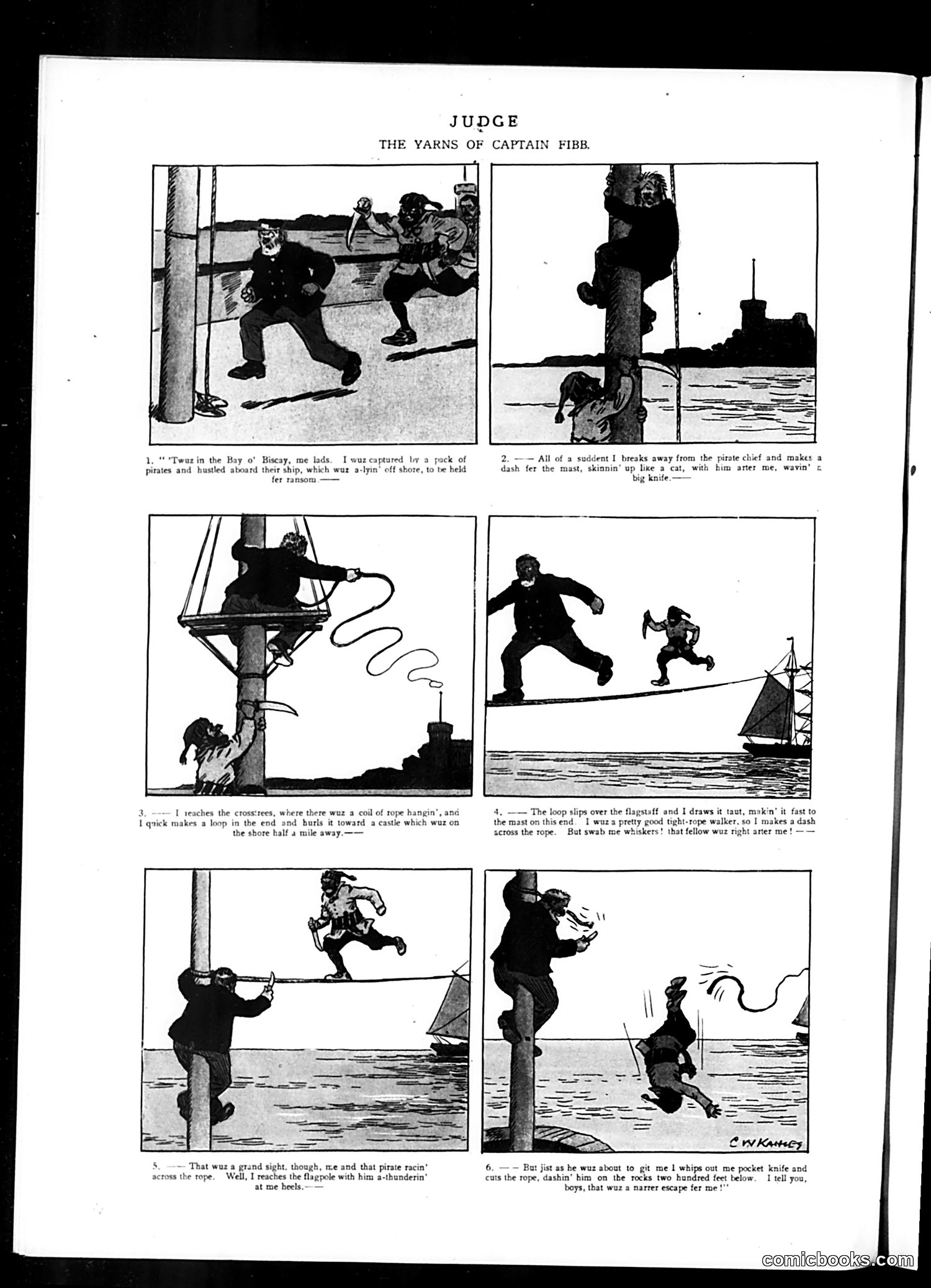
This is a tall-tale comic strip featuring an unnamed sea captain recounting an improbable adventure. The humor relies on increasingly absurd nautical escapades: captured by pirates, he escapes by improvising a tightrope using ship's rigging and a castle flagpole half a mile away. He outruns a pursuing pirate across the rope, then cuts it, sending the pirate to his death below. The satire targets the genre of exaggerated sailor stories—the "sea yarn"—where rough seamen boast of impossible feats. The captain's dialect ("'Twuz," "me lads," "swab me whiskers") and cavalier attitude toward murder exemplify the stereotype. For modern readers, this represents period humor mining comedic value from working-class braggadocio and implausible adventure narratives popular in late 19th/early 20th-century entertainment.