
Judge, 1910-09-03 · page 3 of 16
Judge — September 3, 1910 — page 3: what you’re looking at
What you’re looking at
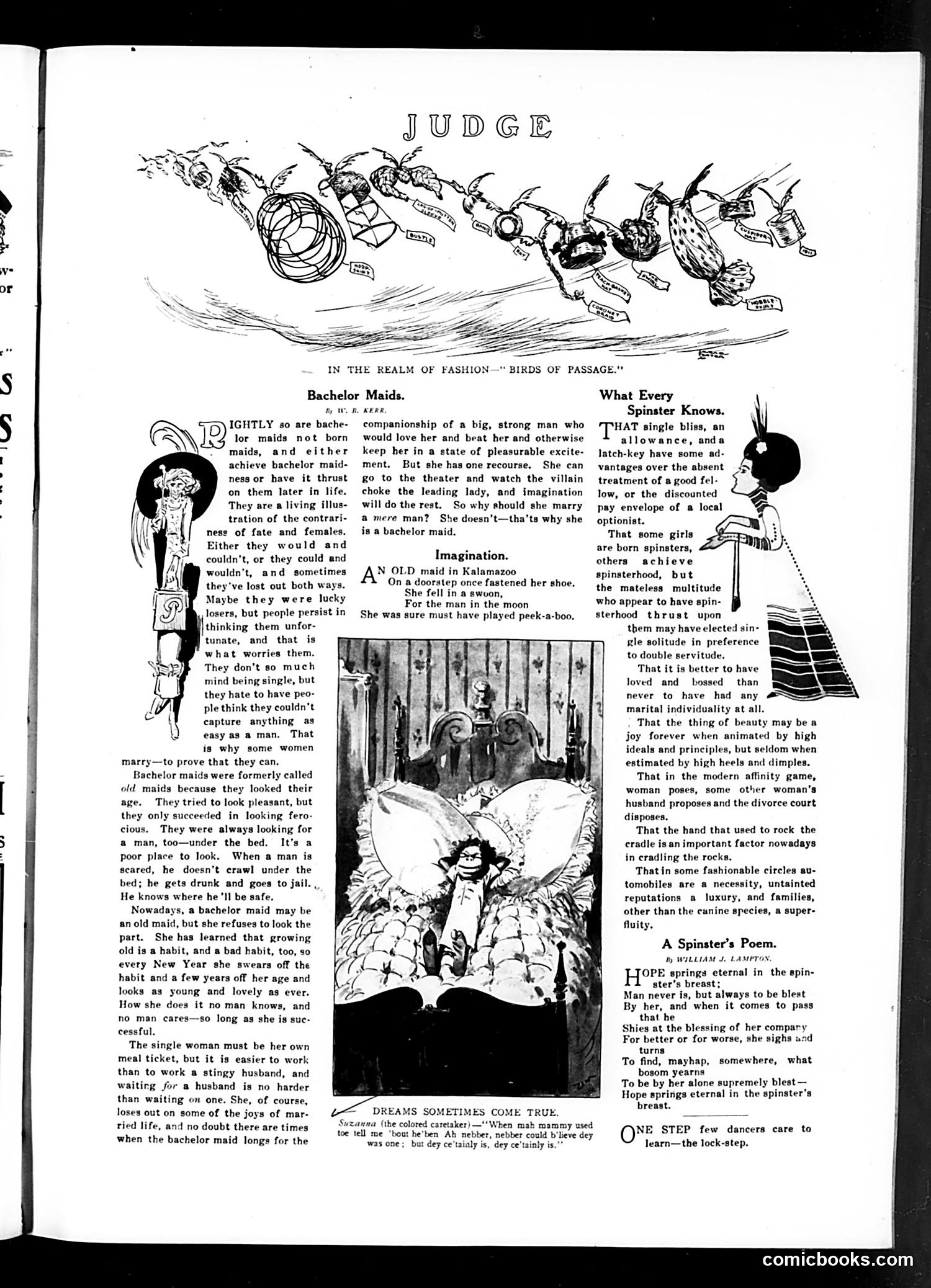
This page from *Judge* magazine contains social commentary on unmarried women ("Bachelor Maids"), presented through satirical articles and illustrations. The main cartoon depicts "Dreams Sometimes Come True," showing a woman fantasizing about romantic scenarios. The accompanying text argues that bachelor maids—unmarried women—represent a social problem. The author suggests they exist because women won't marry "mere men" and instead hold unrealistic expectations. The satire critiques both unmarried women's supposed vanity and pretension, and the bachelor maid concept itself. The "Spinster's Poem" on the right presents hope as eternally springing from unmarried women's hearts. The overall page reflects early 20th-century anxieties about changing gender roles and the increasing numbers of unmarried women, treating spinsterhood as simultaneously pitiable and self-inflicted through excessive standards.
📄 Transcribed text from this page (OCR, searchable)
Machine-transcribed from the original scan — historical spelling and the odd misread are preserved.
IN THE REALM OF FASHION—" BIRDS OF PASSAGE." Bachelor Maids. What Every By WB, KERR, Spinster Knows. ip) IGHTLY 30 are bache- companionship of a big, strong man who THat single bliss, an C\ ») lor maids not born would love her and beat her and otherwise allowance; anda maids, and either keep her in a state of pleasurable excite- latch-key have some ad- achieve bachelor maid- ment. But she has one recourse. She can vantages over the absent ness or have it thrust go to the theater and watch the villain treatment of a good fel- on them later in life. choke the leading lady, and imagination low, or the discounted They are a living illus- will do the rest. So why should she marry pay envelope of a local tration of the contrari- a mere man? She doesn’t—tha’ts why she _ optionist. ness of fate and females. is a bachelor maid. That some girls Either they would and —e are born spinsters, couldn't, or they could and Imagination. others achieve wouldn't, and sometimes N OLD maid in Kalamazoo spinsterhood, but they've lost out both ways. On a doorstep once fastened her shoe. the mateless multitude Maybe they were lucky She fell in a swoon, For the man in the moon who appear to have spin- = thinking them unfor- tunate, and that is what worries them. They don’t so much mind being single, but they hate to have peo- ple think they couldn't capture anything as easy ag a man. That is why some women losers, but people persist in She was sure must have played peek-a-boo, sterhood thrust upon = them may have elected sin- Wma} gle solitude in preference — ==, — =, to double servitude. = That it is better to have loved and bossed than 5 never to have had any J marital individuality at all. That the thing of beauty may be a joy forever when animated by high ideals and principles, but seldom when marry—to prove that they can. Bachelor maids were formerly called old maids because they looked their age. They tried to look pleasant, but they only succeeded in looking fero- cious. They were always looking for a man, too—under the bed. It’s a poor place to look. When a man is scared, he doesn’t crawl under the bed; he gets drunk and goes to jail. He knows where hell be safe. Nowadays, a bachelor maid may be an old maid, but she refuses to look the part. She has learned that growing old is a habit, and a bad habit, too, so every New Year she swears off the habit and a few years off her age and looks as young and lovely as ever. How she does it no man knows, and no man cares—so long as she is suc- cessful. The single woman must be her own meal ticket, but it is easier to work than to work a stingy husband, and waiting for a husband is no harder than waiting on one. She, of course, loses out on some of the joys of mar- DREAMS SOMETIMES COME TRUE. estimated by high heels and dimples. That in the modern affinity game, woman poses, some other woman's husband proposes and the divorce court disposes, That the hand that used to rock the cradle is an important factor nowadays in cradling the rock: That in some fashionable circles au- tomobiles are a necessity, untainted reputations a luxury, and families, other than the cunine species, a super- fluity. A Spinster’s Poem. By WILLIAM J. LAMPTON. OPE springs eternal in the spin- ster’s breast; Man never is, but always to be blest and when it comes to pass t Shies at the blessing of her compary For better or for worse, she sighs and turns To find, mayhap, somewhere, what bosom yearns To be by her alone supremely blest — Hope springs eternal in the spinster's breast. NE STEP few dancers care to learn—the lock-step. ‘anna (the colored caretaker) —"‘When mah mammy used toe tell me ‘bout he'ben Ah nebber, nebber could b’lieve dey was one; but dey ce’taialy is,” dey ce’tainly is."” ried life, and no doubt there are times when the bachelor maid longs for the comicbooks.com