
Judge, 1910-09-03 · page 4 of 16
Judge — September 3, 1910 — page 4: what you’re looking at
What you’re looking at
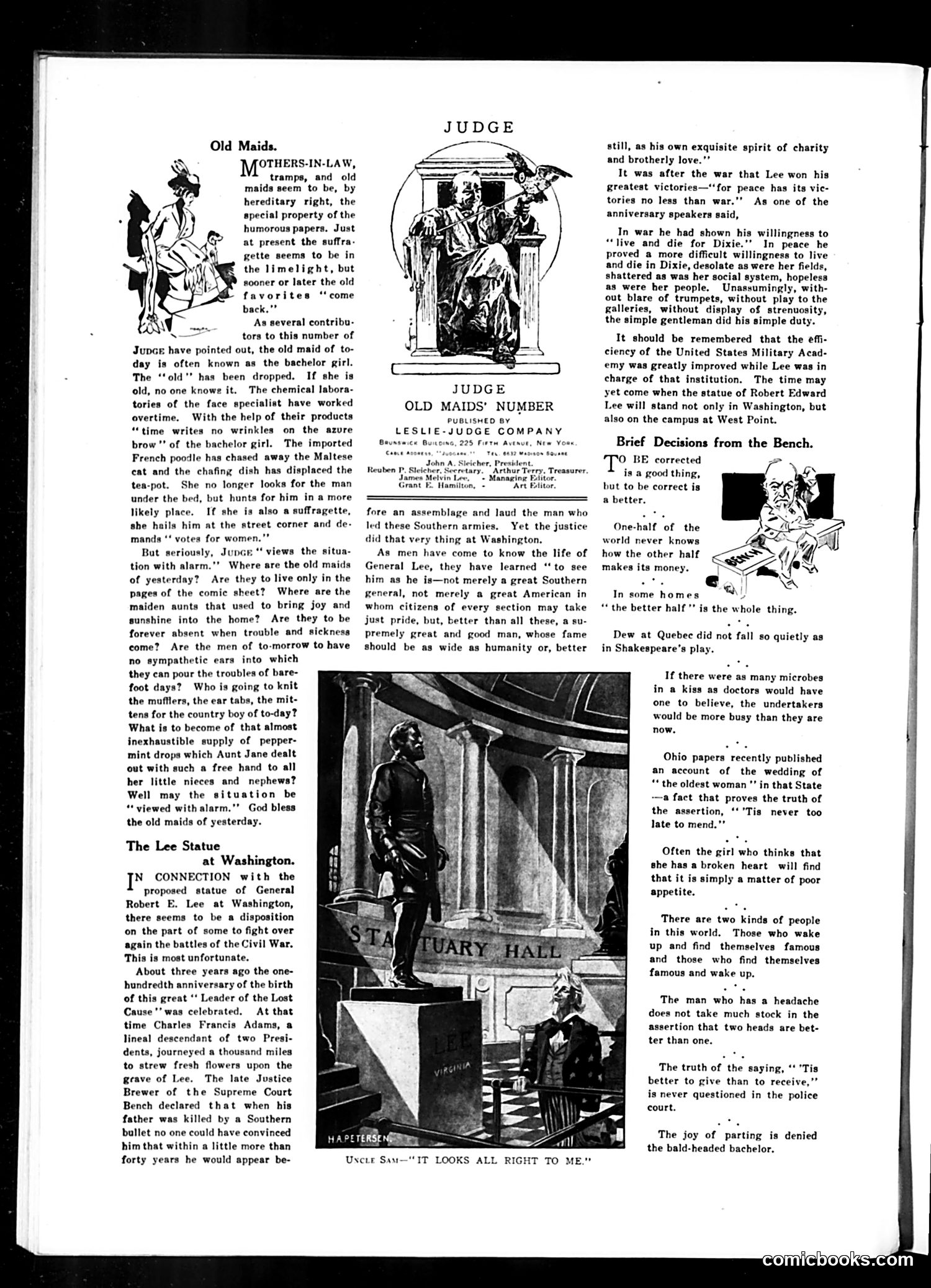
This page contains commentary on **General Robert E. Lee**, the Confederate general, alongside various humorous editorial pieces. The main article discusses the proposed placement of a Lee statue at Washington, D.C., noting some controversy about honoring a Confederate figure in the nation's capital roughly 40-50 years after the Civil War. The illustrations labeled "Old Maids" and "Judge" appear to be stock humorous drawings about unmarried women and domestic situations—typical filler content for Judge magazine's satirical format. The photographs show what appears to be **Statuary Hall** at the Capitol, depicting the practical consideration of where Confederate monuments would physically fit in federal buildings. The text emphasizes Lee's post-war character and dignity rather than his wartime role, reflecting late 19th/early 20th-century reconciliation narratives.
📄 Transcribed text from this page (OCR, searchable)
Machine-transcribed from the original scan — historical spelling and the odd misread are preserved.
Old Maids. OTHERS-IN-LAW, tramps, and old maids seem to be, by hereditary right, the special property of the humorous papers. Just at present the suffra- gette seems to be in the limelight, but sooner or later the old favorites ‘‘come back.”” As several contribu- tors to this number of JupcE have pointed out, the old maid of to- day is often known as the bachelor girl. The ‘‘old'’ has been dropped. If she is old, no one knowe it. The chemical labora- it have worked overtime. the help of their products “time writes no wrinkles on the azure brow’? of the bachelor girl. The imported French poodle has chased away the Maltese cat and the chafing dish has displaced the tea-pot. She no longer looks for the man under the bed, but hunts for him in a more likely place. If she is also a suffragette, she hails him at the street corner and de- mands ‘‘ votes for women. 2 views the situa- Where are the old maids of yesterday? Are they to live only in the pages of the comic sheet? Where are the maiden aunts that used to bring joy and sunshine into the home? Are they to be forever absent when trouble and sickness come? Are the men of to-morrow to have no sympathetic ears into which they can pour the troubles of bare- foot days? Who is going to knit the mufflers, the ear tabs, the mit- tens for the country boy of to-day? What is to become of that almost inexhaustible supply of pepper- mint drops which Aunt Jane dealt out with such a free hand to all her little nieces and nephews? Well may the situation be ** viewed with alarm.’’ God bless the old maids of yesterda: The Lee Statue at Washington. N CONNECTION with the proposed statue of General Robert Lee at Washington, there seems to be a disposition on the part of some to fight over again the battles of the Civil War. This is most unfortunate. About three years ago the one- hundredth anniversary of the birth of this great ‘ Leader of the Lost Cause "was celebrated, At that time Charles Francis Adams, a lineal descendant of two Presi- dents, journeyed a thousand miles to strew fresh flowers upon the grave of Lee. The late Justice Brewer of the Supreme Court Bench declared that when his father was killed by a Southern bullet no one could have convinced him that within a little more than forty years he would appear be- tion with alarm. JUDGE OLD MAIDS' NUMBER PUBLISHED BY LESLIE-JUDGE COMPANY 225 Furtm Avenue, New Your Beunsmice Bucs John A. Sleicher, President : ‘Arthur Terry, Treasurer. Managing Foi ‘Art Bal fore an assemblage and laud the man who led these Southern armies. Yet the justice did that very thing at Washington. As men have come to know the life of General Lee, they have learned “to see him as he is—not merely a great Southern general, not merely a great American in whom citizens of every section may take just pride, but, better than all these, a su- premely great and good man, whose fame should be as wide as humanity or, better Uxcie Sam—"IT LOOKS ALL RIGHT TO ME." still, as his own exqui and brotherly love."” It was after the war that Lee won his greatest victories—‘‘for peace has its vie- tories no less than war." As one of the anniversary speakers said, te spirit of charity In war he had shown his willingness to “‘live and die for Dixie.’’ In peace he proved a more difficult willingness to live and die in Dixie, desolate as were her fields, shattered as was her social system, hopeless as were her people. Unassumingly, with- out blare of trumpets, without play to the galleries, without display of strenuosity, the simple gentleman did his simple duty. It should be remembered that the effi- ciency of the United States Military Acad- emy was greatly improved while Lee was in charge of that institution. The time may yet come when the statue of Robert Edward Lee will stand not only in Washington, but also on the campus at West Point. Brief Decisions from the Bench. ‘O BE corrected is a good thing, but to be correct is a better. One-half of the world never knows how the other half makes its money. S a e In some homes y “the better half” is the whole thing. Dew at Quebec did not fall so quietly as in Shakespeare's play. If there were as many microbes in a kiss as doctors would have one to believe, the undertakers would be more busy than they are now. Ohio papers recently published an account of the wedding of ** the oldest woman "’ in that State —a fact that proves the truth of the assertion, “'Tis never too late to mend. Often the girl who thinks that she has a broken heart will find that it is simply a matter of poor appetite. There are two kinds of people in this world. Those who wake up and find themselves famous and those who find themselves famous and wake up. The man who has a headache does not take much stock in the assertion that two heads are bet- ter than one. The truth of the saying, “ better to give than to receive,’’ is never questioned in the police court. The joy of parting is denied the bald-headed bachelor,