
A complete issue · 18 pages · 1910
Judge — August 6, 1910
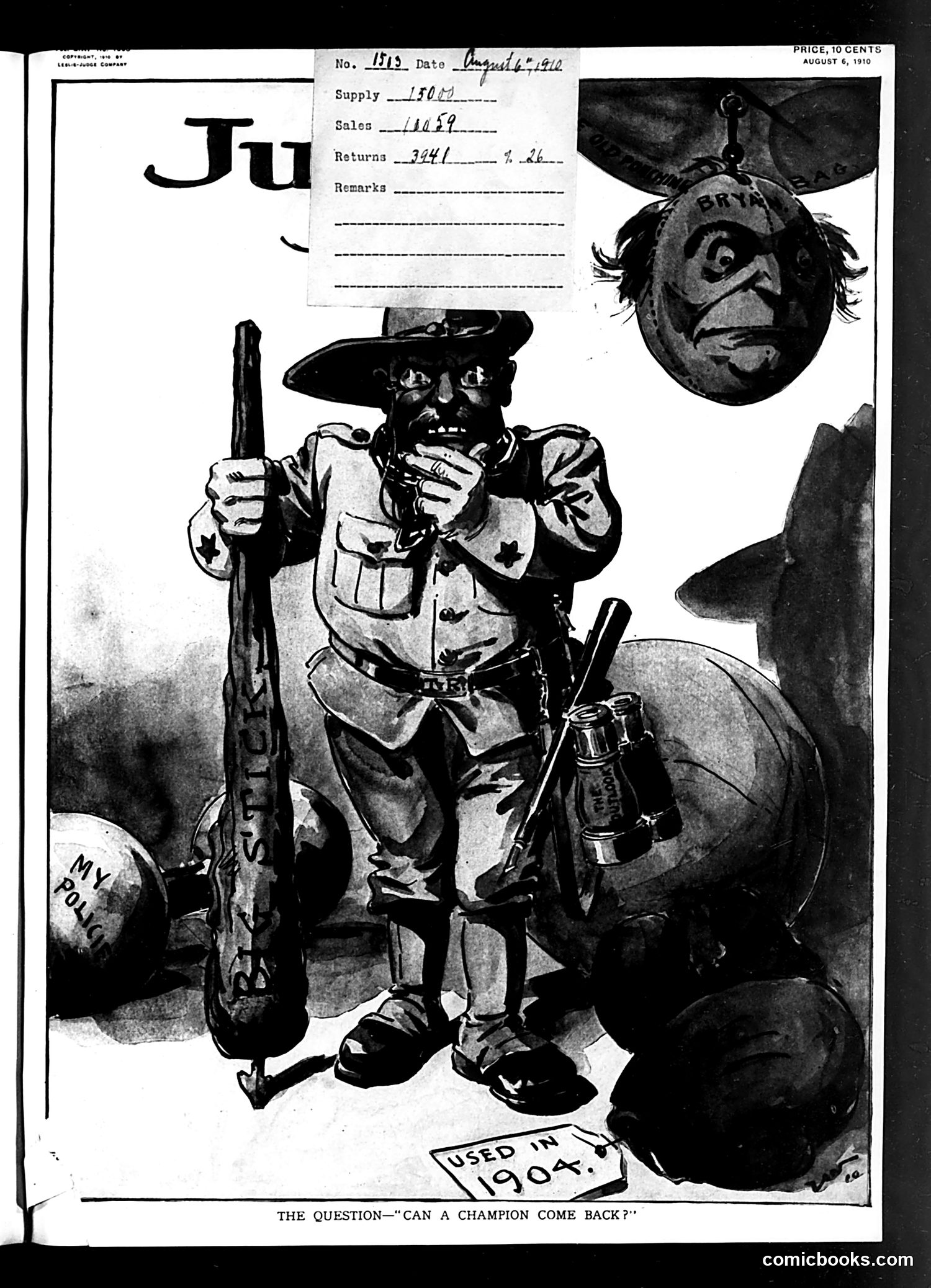
This *Judge* magazine page from August 6, 1910, features a caricatured military or colonial figure labeled "USED IN 1904" holding weapons and military equipment. The cartoon's caption asks "CAN A CHAMPION COME BACK?" The figure appears to represent a defeated or discredited political/military leader being questioned about potential return to power. The grotesque caricature and aggressive imagery suggest satire of either a foreign military power or a domestic political figure associated with military intervention—likely referencing the 1904 Russo-Japanese War era or American imperial activities. Without clearer identification of the specific figure, the precise political target remains unclear, but the satire comments on whether disgraced military leadership could regain influence or relevance.
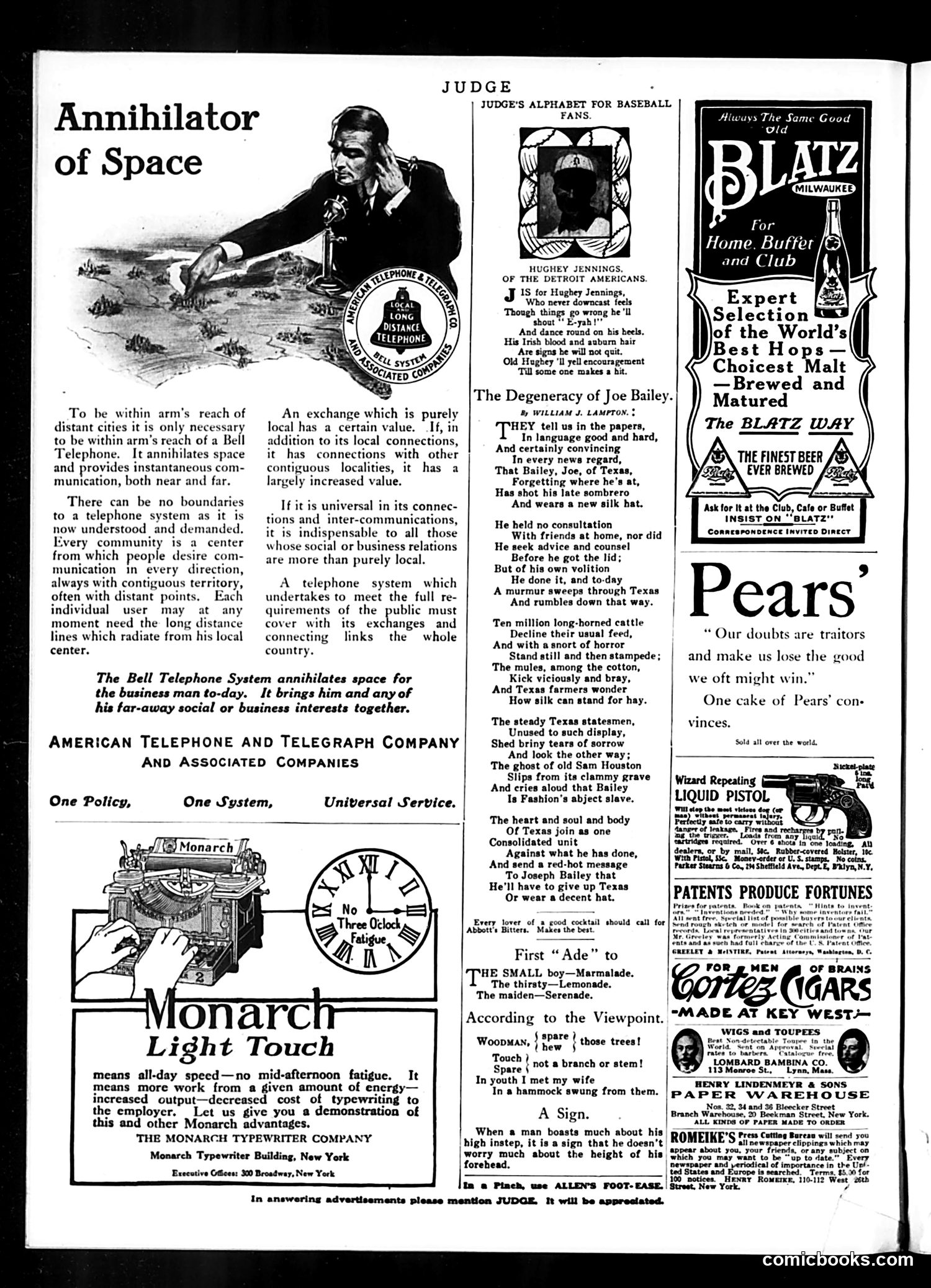
This page is primarily **advertisements** with minimal satirical content. The main cartoon ("Annihilator of Space") advertises Bell Telephone's long-distance service, showing a man operating a device to connect distant cities—framing telecommunications as quasi-magical technology that "annihilates space." The center section includes **"Judge's Alphabet for Baseball Fans,"** a humorous verse about Hughey Jennings (a baseball manager), and several poems mocking specific individuals like Joe Bailey and Sam Houston—likely political figures of the era, though context is unclear without dates. Lower sections advertise typewriters, pistols, cigars, and other products typical of early 20th-century publications. The content reflects Judge's mix of satire and commercial promotion rather than coherent political commentary.
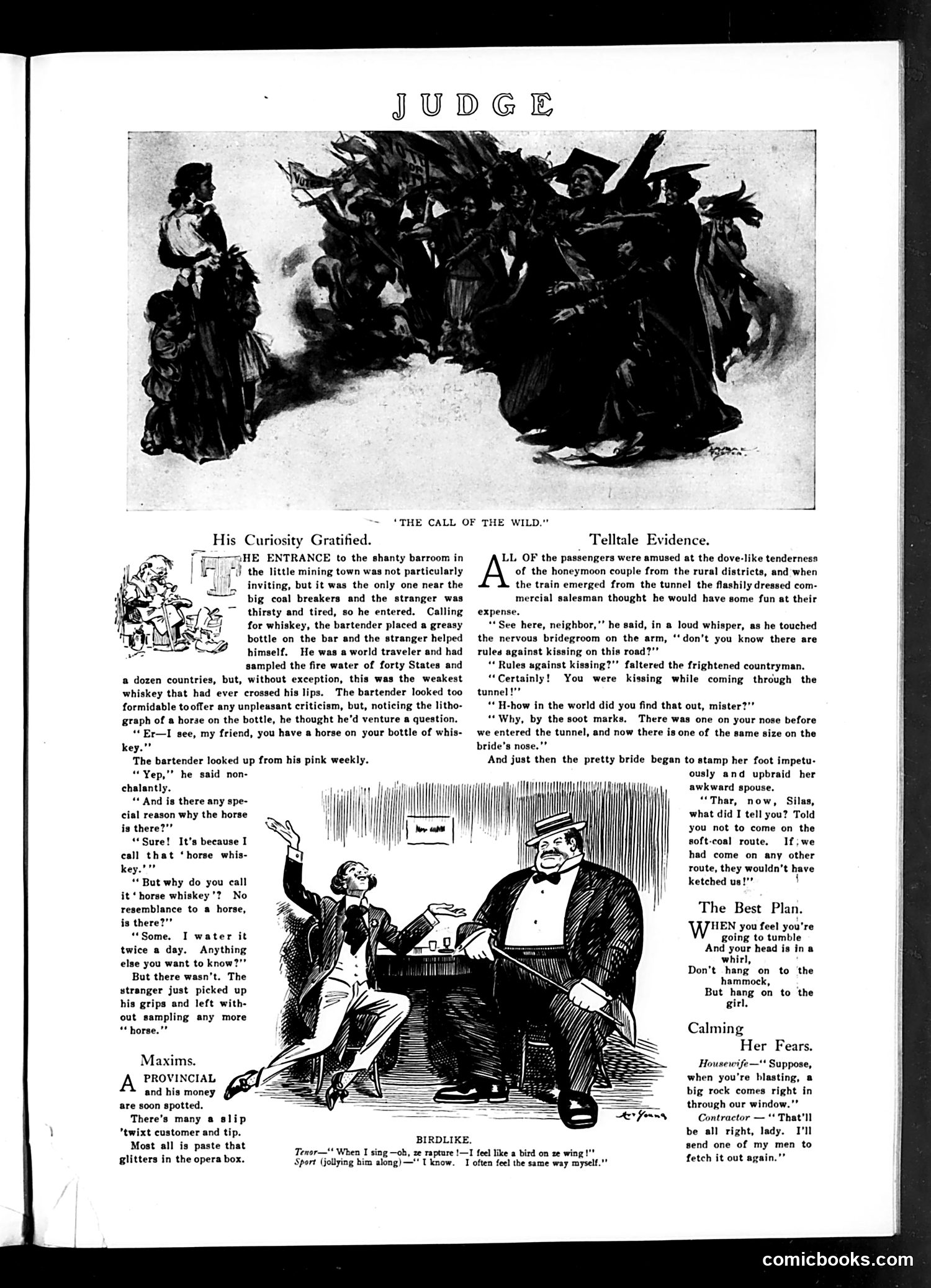
This page contains three separate humorous pieces: 1. **"The Call of the Wild"** (top): A satirical illustration showing a woman addressing a rowdy crowd, likely depicting a suffragette or reform-minded speaker facing public opposition. 2. **"His Curiosity Gratified"** and **"Telltale Evidence"**: A anecdotal humor piece about a bartender and a stranger. The stranger orders "horse whiskey," confusing the bartender, who assumes it's a drink rather than literal horse. The joke plays on wordplay and the stranger's eccentric explanation. 3. **"Birdlike"**: A cartoon showing two men—one appearing to be singing or performing operatically while the other observes. The caption references birds and opera, suggesting satire of pretentious operatic performance or affected behavior. The page represents typical early 20th-century Judge magazine humor: wordplay-based jokes, social observation, and lighthearted domestic/commercial scenarios aimed at general readers.
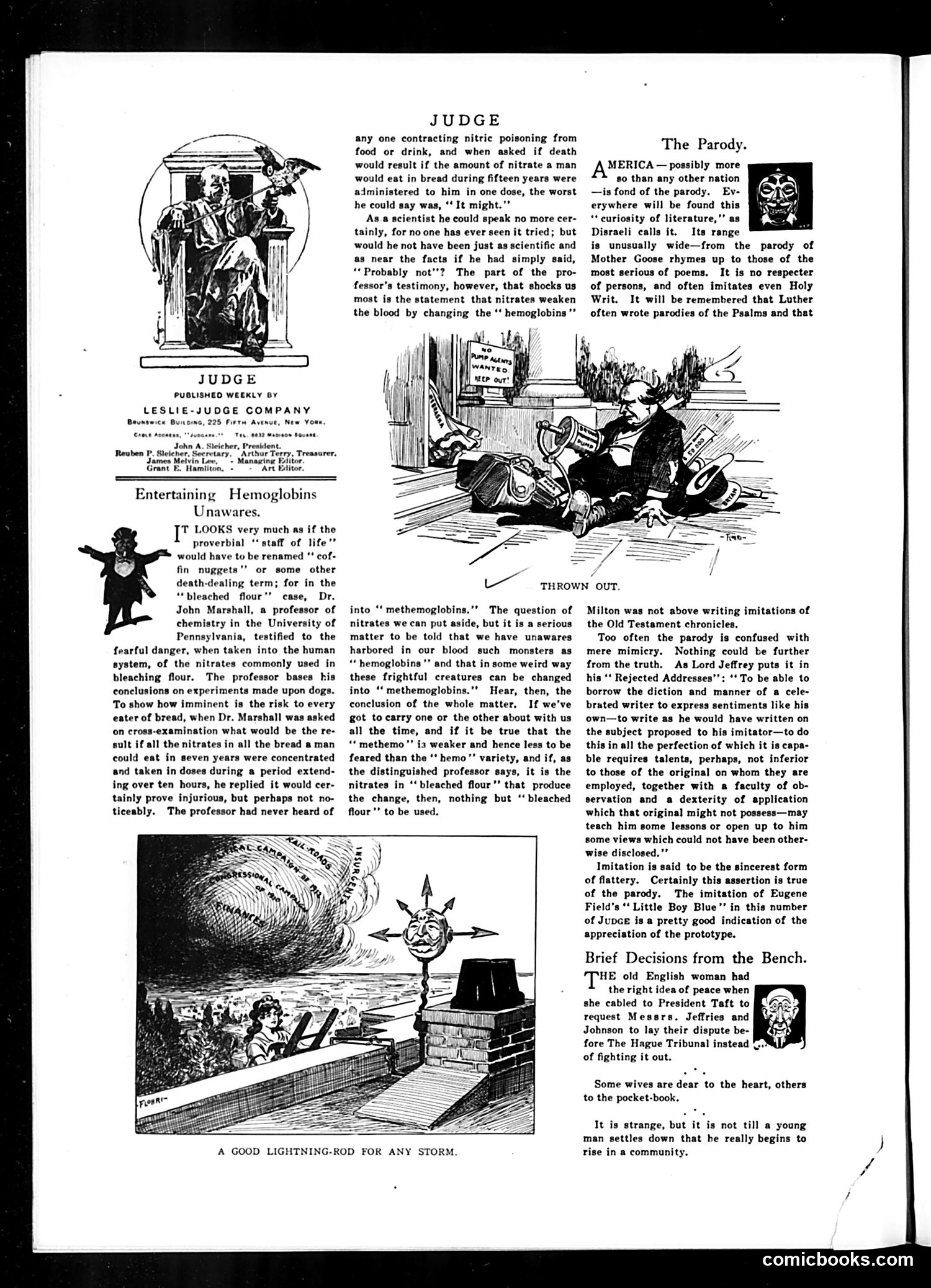
This page contains satirical commentary on scientific debate, specifically about nitrates and hemoglobins in blood chemistry. The text mocks Dr. John Hauhardt, a University of Pennsylvania chemistry professor, for claims about nitrates weakening blood by altering hemoglobins. The top cartoon "THROWN OUT" depicts someone being ejected, likely representing dismissal of Hauhardt's theories. The lower illustration "A GOOD LIGHTNING-ROD FOR ANY STORM" uses a lightning-rod metaphor—suggesting Hauhardt's claims are an easy target for scientific ridicule. The satire ridicules unproven scientific assertions presented as fact, a common Judge theme. The magazine attacks both the professor's credibility and the credulity of people who might believe dramatic health claims without proper evidence. The piece exemplifies late-19th/early-20th-century skepticism toward pseudoscience.
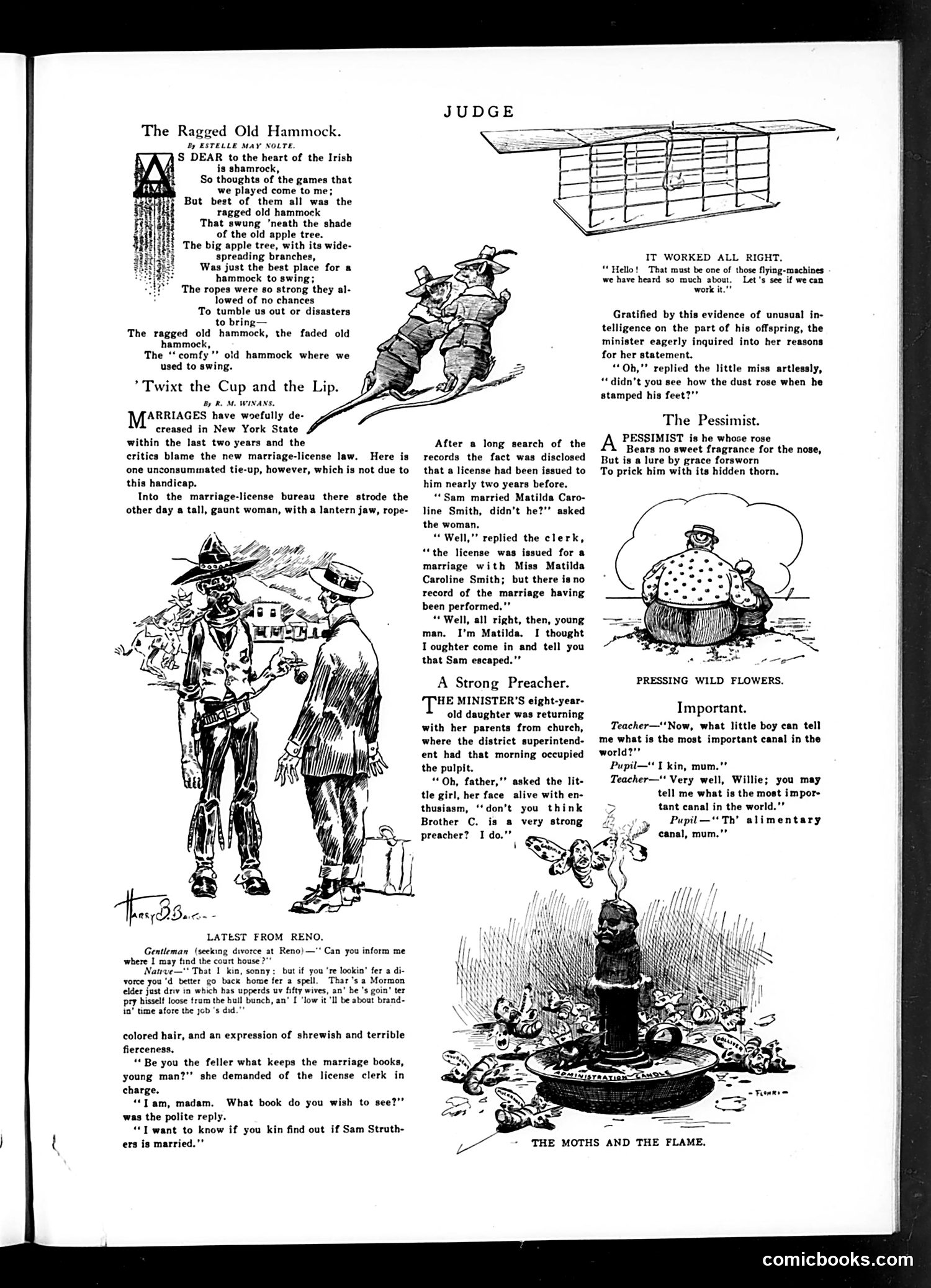
This page contains several unrelated humorous pieces rather than political cartoons: 1. **"The Ragged Old Hammock"** - A sentimental poem about childhood memories, accompanied by illustrations of people relaxing. 2. **"Twist the Cup and the Lip"** - A satirical piece about New York State's marriage-license law, criticizing bureaucratic confusion when a couple discovers their license was issued nearly two years prior but the marriage was never actually performed. 3. **"A Strong Preacher"** - A joke about a minister's daughter praising her father's preaching abilities. 4. **"The Pessimist," "Important," and "The Moths and the Flame"** - Brief humorous illustrated vignettes with wordplay and visual gags. The page functions primarily as entertainment and social humor rather than political commentary.
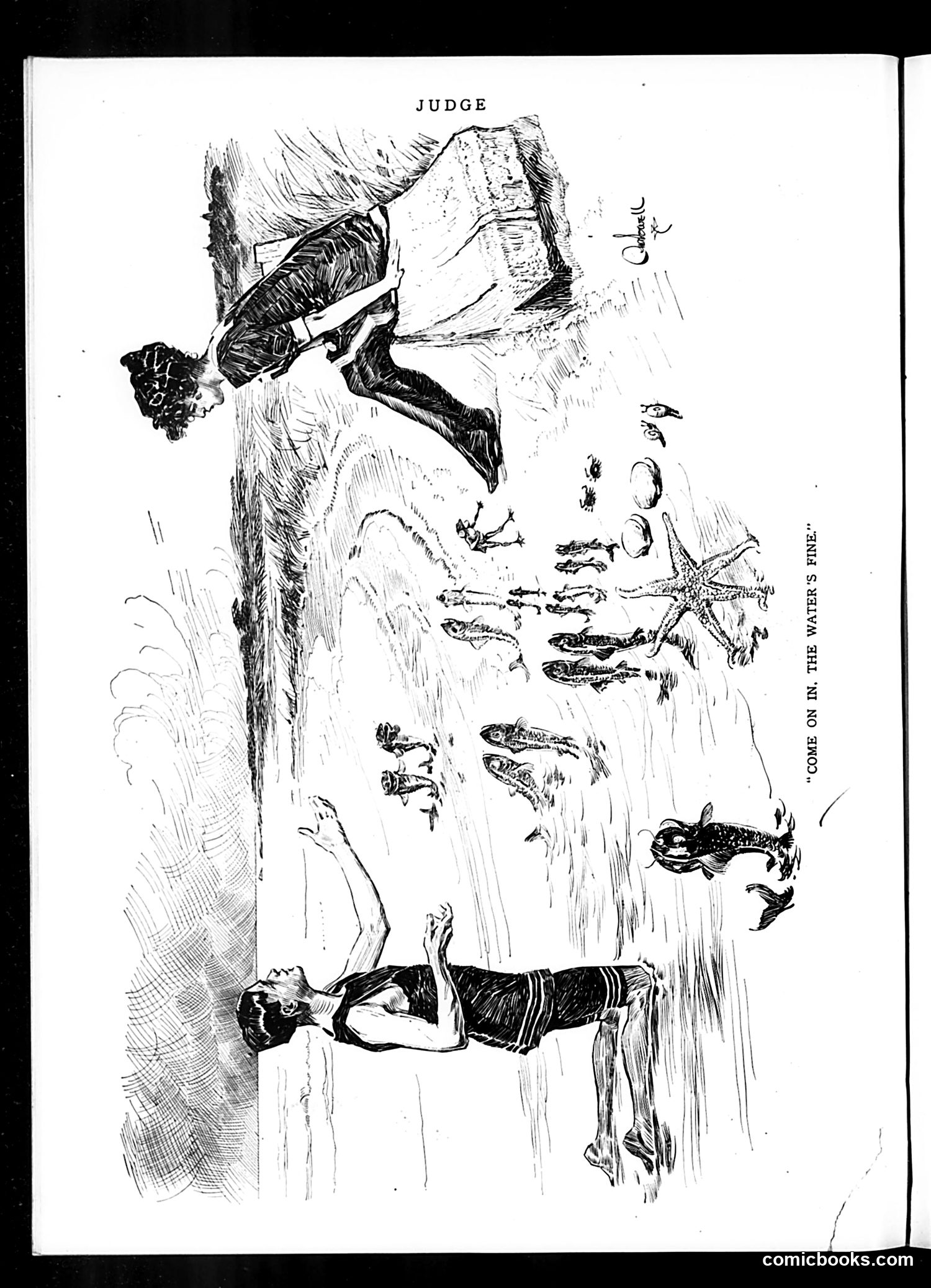
I can see this is a Judge magazine page titled "Judge" at the top, with the caption "'Come on the Water's Fine!'" on the right side. The illustration shows a figure in judicial robes perched on a cliff or high position, gesturing downward toward water below where various fish and aquatic creatures are depicted, along with what appears to be a child figure in the water. However, the OCR text is largely illegible and doesn't provide clear context. Without readable accompanying text or clearer identification of the specific historical moment referenced, I cannot reliably identify which judge is caricatured, what legal or political controversy this satirizes, or the precise meaning of the "water" metaphor. The cartoon appears to involve judicial authority and some form of persuasion or coercion, but I cannot assert specific details without stronger evidence.
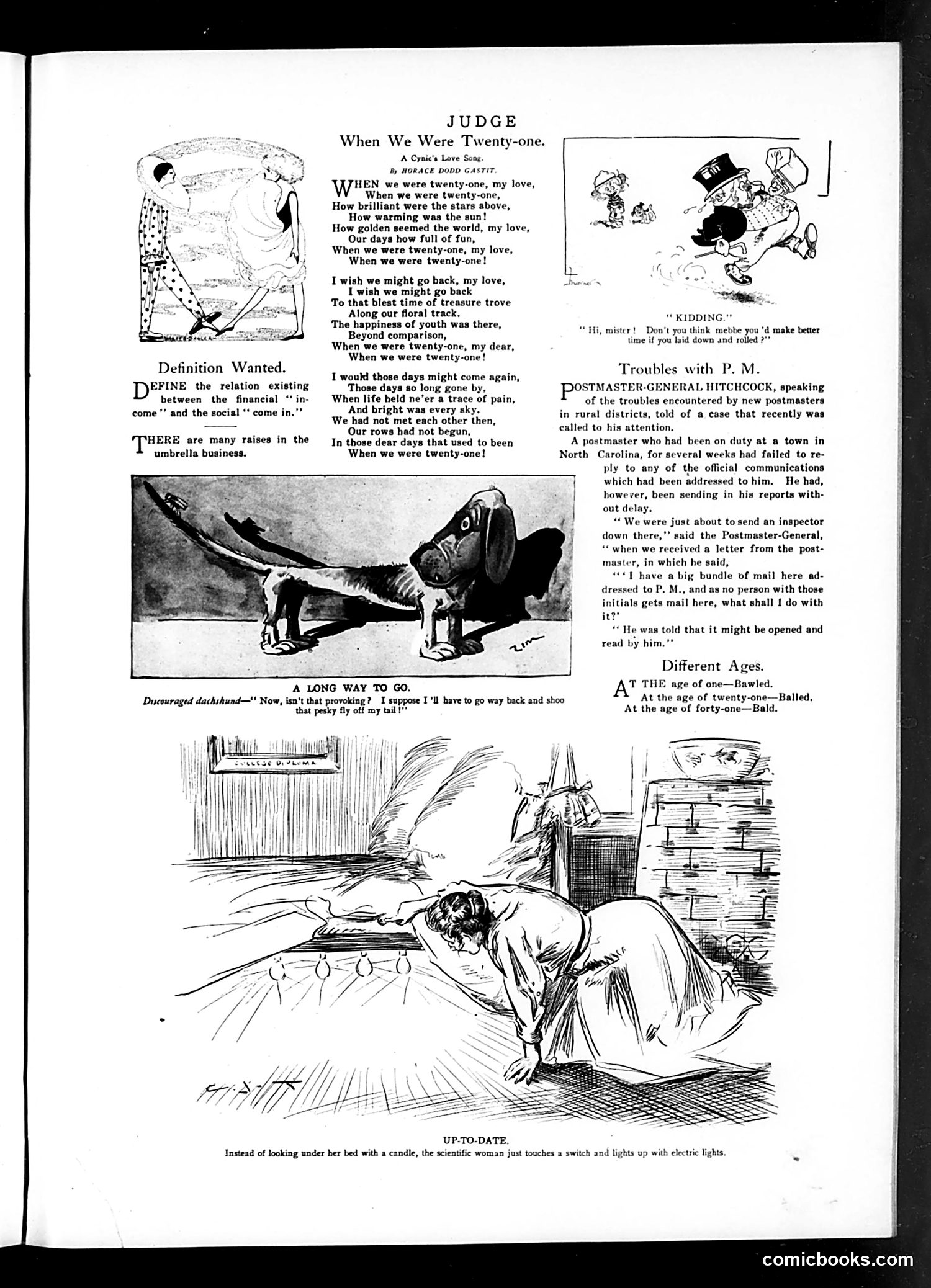
This page contains several unrelated satirical pieces typical of Judge's format: **"When We Were Twenty-one"** is a nostalgic poem mocking romantic sentimentality—a cynical take on how couples romanticize their youth while their actual relationship has deteriorated into conflict ("Our rows had not begun"). **"Definition Wanted"** is a brief joke suggesting confusion between financial and social definitions of "income"—likely poking fun at economic terminology or class distinctions. **"Troubles with P.M."** recounts Postmaster-General Hitchcock's anecdote about a rural postmaster who received mail addressed to "P.M." (Post Master) and didn't realize it referred to himself. The joke satirizes rural postal workers' lack of sophistication or education. **"Different Ages"** presents three single-line jokes about baldness across life stages—simple visual humor. **"Up-to-Date"** contrasts old superstition (checking under beds by candlelight) with modern technology (electric lights), celebrating progress. The page emphasizes social satire, generational commentary, and gentle mockery of rural/working-class figures—typical Judge content from the early 20th century.
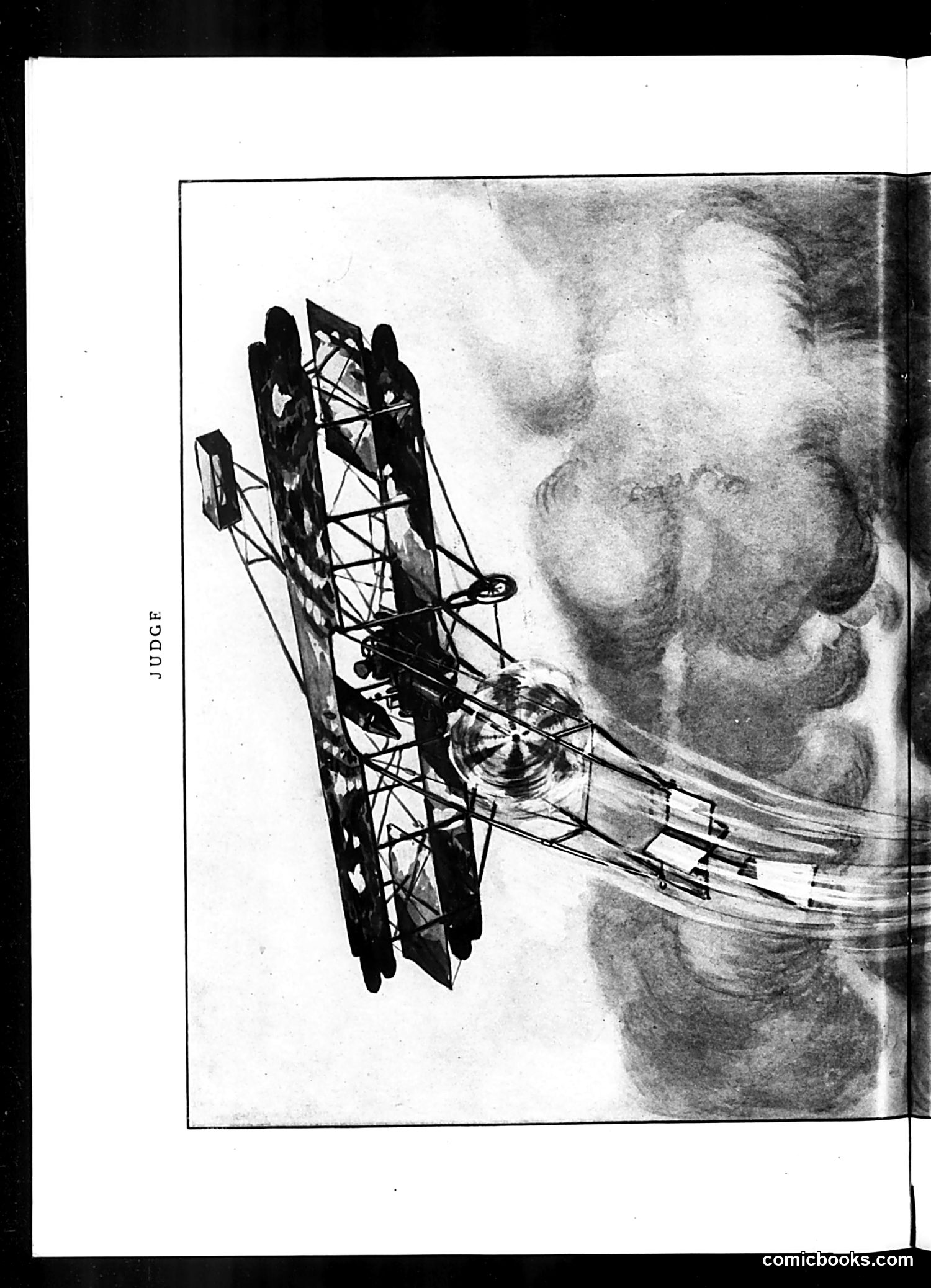
The OCR text appears corrupted and unreadable, providing no usable information. The image shows a mechanical or skeletal structure (possibly an early aircraft or flying machine) rendered in silhouette against a cloudy sky. On the left margin appears the word "JUDGE OF" (likely a page header or caption). Without legible accompanying text, I cannot confidently identify: - The specific political or social figure being caricatured - The historical event or controversy being satirized - The intended meaning of the mechanical structure The artistic style suggests early 20th-century satirical illustration, but without supporting text, any interpretation would be speculation. To properly explain this cartoon's meaning to a modern reader, I would need either clearer OCR text or additional context about the magazine's publication date and relevant contemporary events.
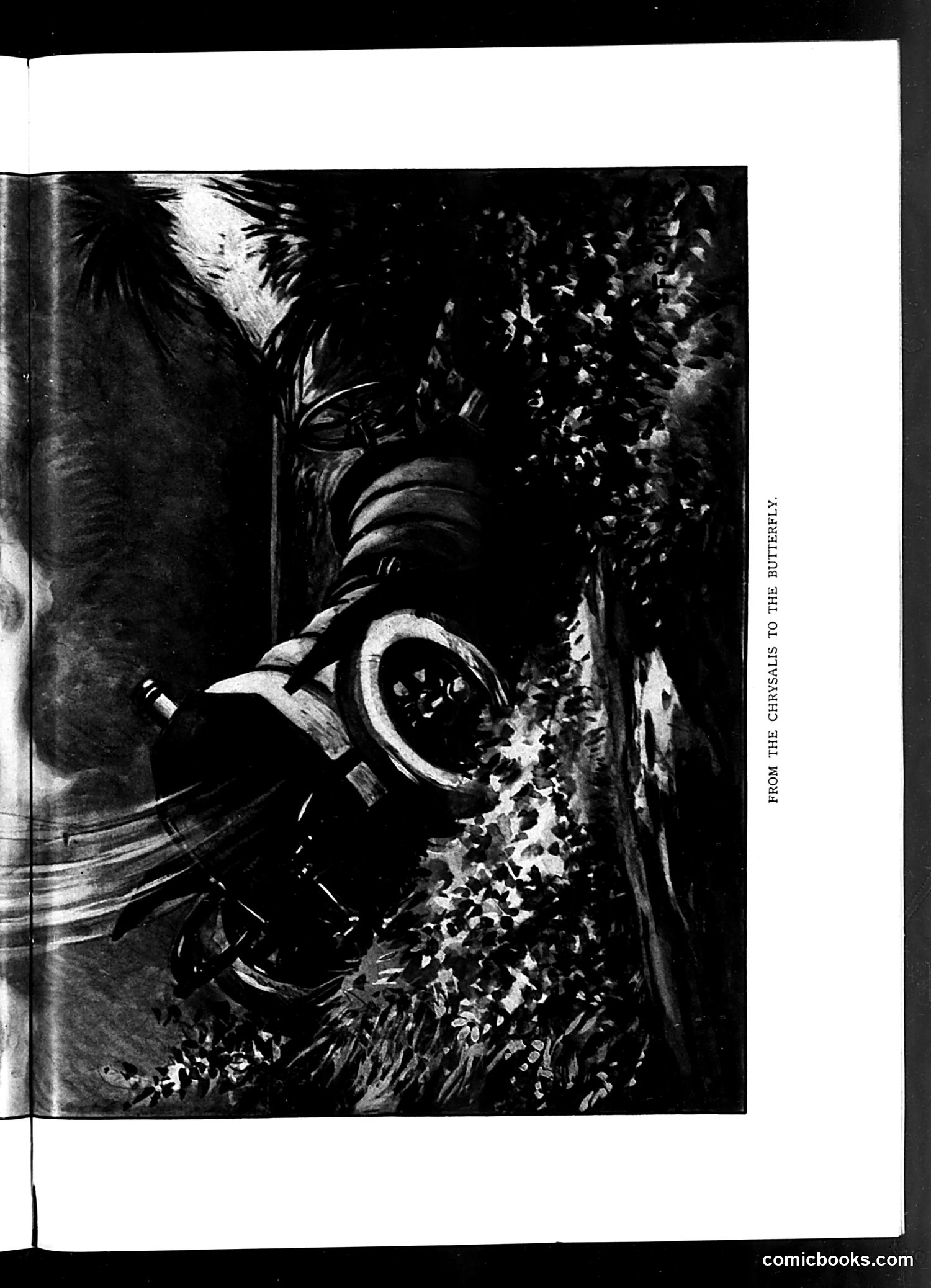
The caption reads "FROM THE CHRYSALIS TO THE BUTTERFLY," indicating this is a metamorphosis illustration rather than a political cartoon. The image shows a detailed black and white drawing of a chrysalis or cocoon with a butterfly emerging from it. The artwork emphasizes the transformation process, with delicate wings unfurling and natural textures rendered in fine detail. Without additional context from surrounding articles or advertisements on this Judge magazine page, the specific satirical point is unclear. It may be a metaphorical commentary on personal transformation, social change, or rebirth—common themes in turn-of-the-century American satire. However, the precise political or social reference cannot be determined from the image and caption alone.
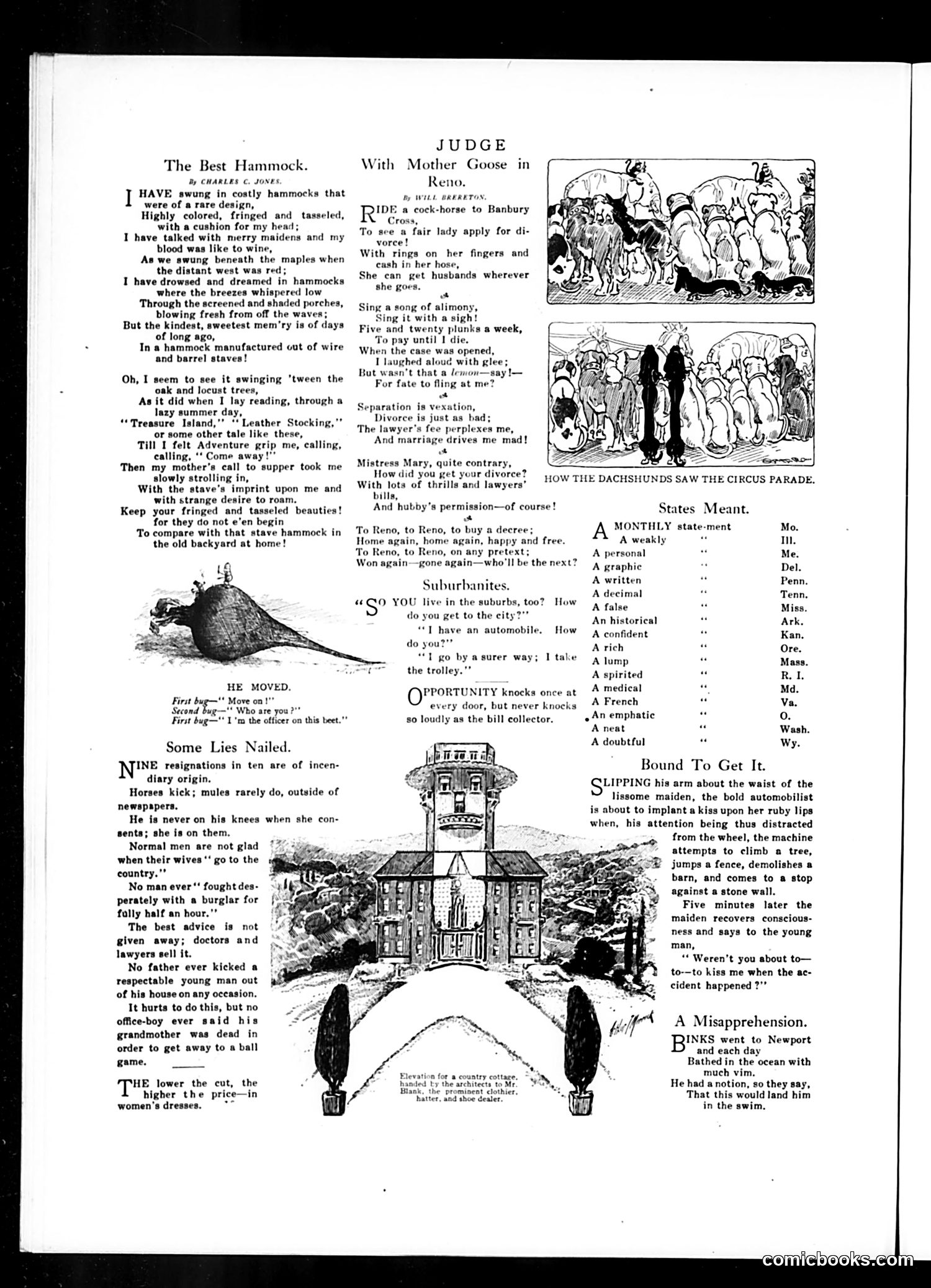
This page from *Judge* contains several satirical pieces reflecting early 20th-century American social concerns: **"Mother Goose in Reno"** parodies nursery rhymes to mock the divorce epidemic centered in Reno, Nevada—then a divorce haven with lenient laws. The satire targets both the ease of obtaining divorces and the financial burden of lawyers' fees and alimony payments ("twenty plunks a week"). **"Some Lies Nailed"** debunks common exaggerations in journalism and everyday life—horses kicking, desperate burglary defenses, office boys faking deaths—establishing *Judge's* fact-checking stance. **"Suburbanites"** jokes about commuting differences between automobile owners and trolley users, reflecting the era's class divisions around new automotive technology. Minor pieces include nostalgic poetry about hammocks and a cartoon about an automobile accident caused by distraction—early commentary on driving dangers. The tone throughout is lighthearted social criticism targeting contemporary middle-class anxieties: divorce, legal costs, urban-suburban divides, and new technologies.
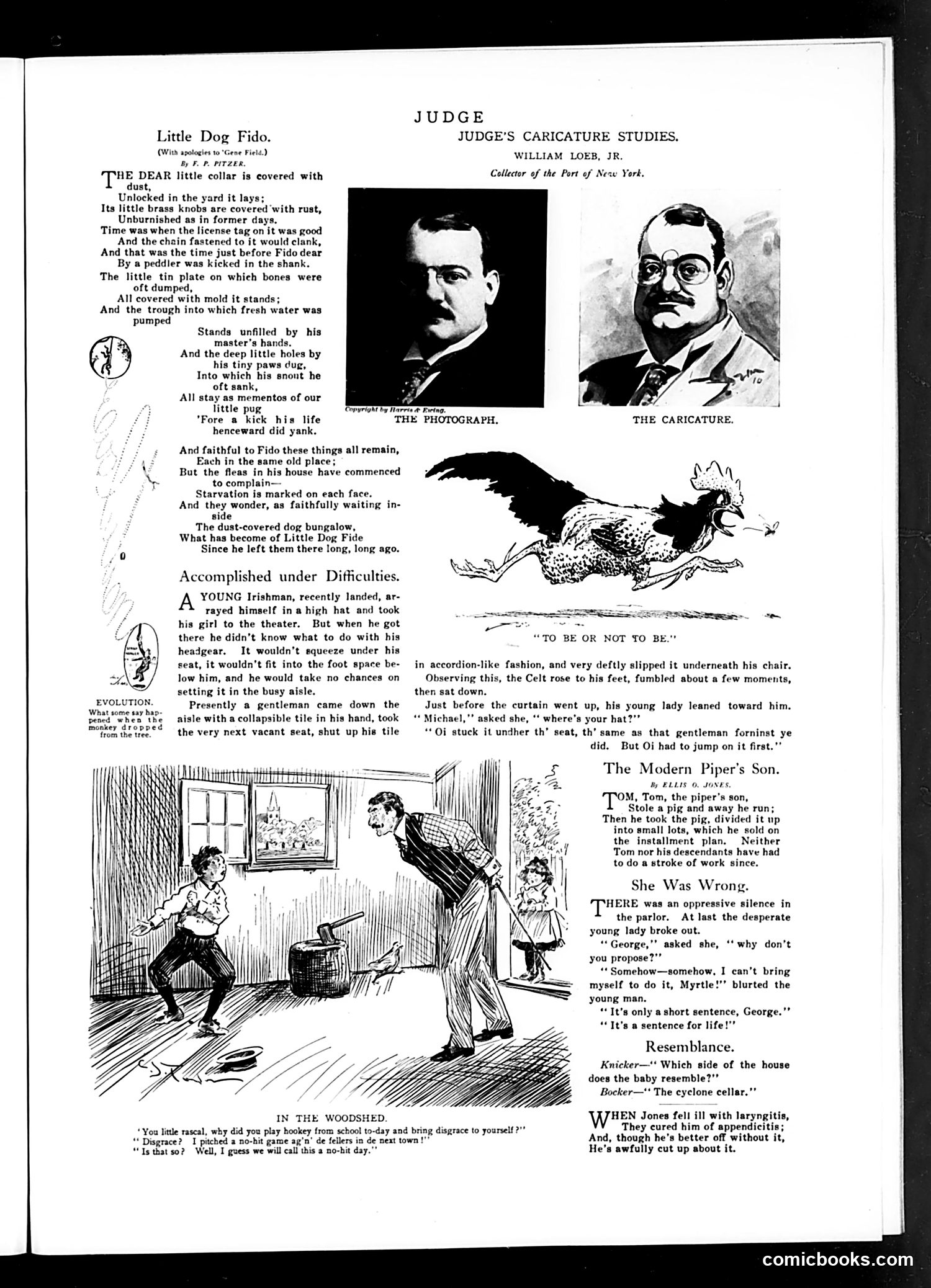
This page from *Judge* contains several satirical pieces typical of early 20th-century American humor: **Main Feature: "Judge's Caricature Studies"** showcases William Loeb Jr., Collector of the Port of New York, with a photograph and caricature. The accompanying poem "Little Dog Fido" (parody of Eugene Field) uses a neglected dog as metaphor for Loeb—suggesting he's been abandoned or forgotten from his position, now covered in "dust" and "rust." **Other Pieces** include: - "Accomplished under Difficulties": An Irish immigrant's theater mishap satirizes immigrant unfamiliarity with American customs - "The Modern Piper's Son": Dark satire on installment-plan consumer culture enabling idleness - Brief jokes about romance ("She Was Wrong") and childhood misbehavior ("In the Woodshed") The page's primary purpose appears attacking Loeb through the dog metaphor, though the specific political context isn't evident without additional historical knowledge.
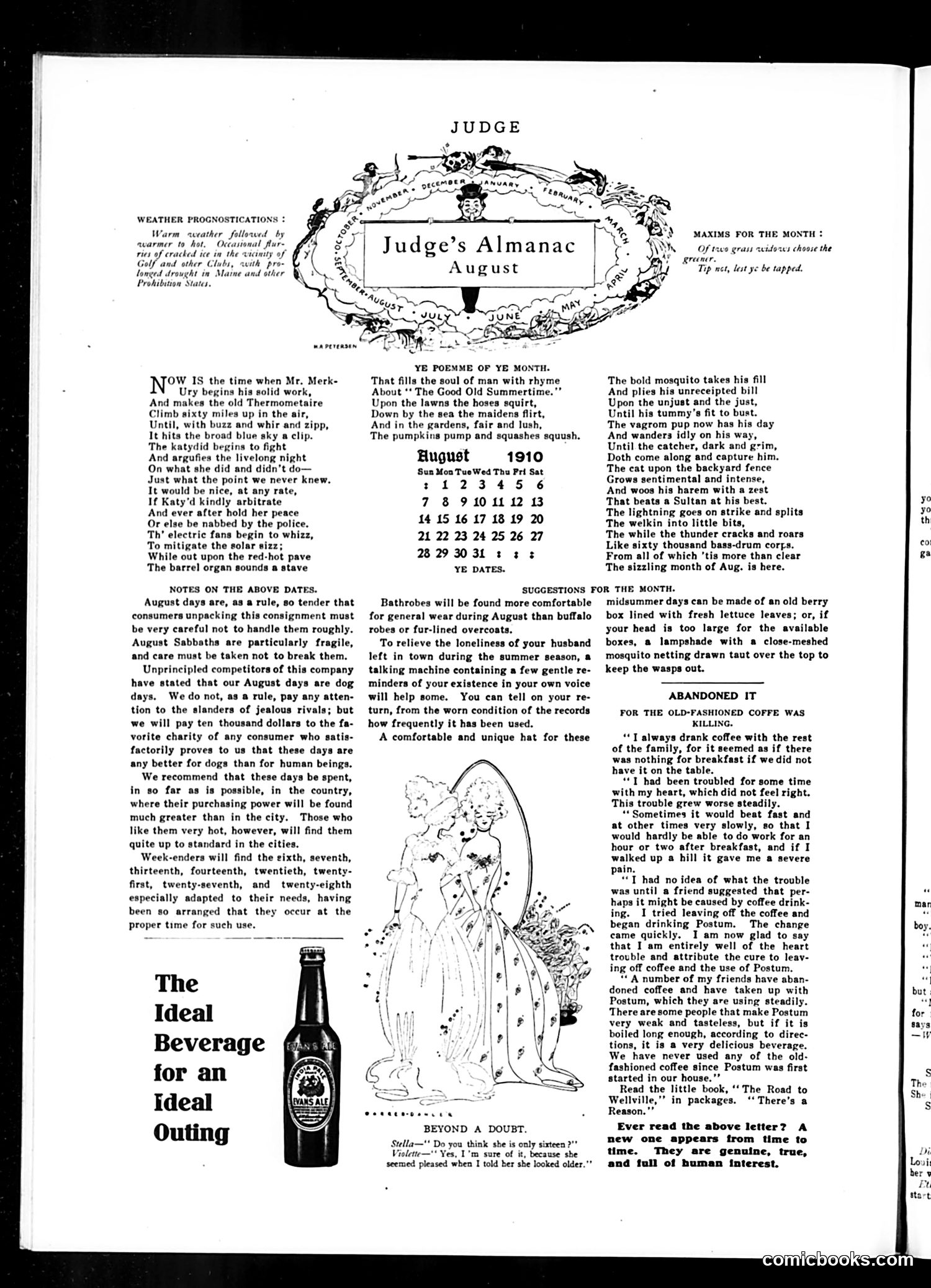
This is primarily a **calendar and almanac page** for August 1910, with satirical commentary rather than editorial cartoons. The page's humor targets: 1. **Prohibition** – The weather forecast jokes about "prolonged drought in Maine and other Prohibition States," mocking alcohol bans. 2. **Summer complaints** – Humorous verse about August heat, insects (mosquitoes), stray dogs, and amorous cats; the "maxims" offer tongue-in-cheek advice about managing the season's discomforts. 3. **Consumer protection parody** – The "Notes on the Above Dates" section satirizes business language by treating August days like fragile merchandise that must be "handled carefully," while defending them against competitors' "slanders" about being "dog days." 4. **Social commentary** – References to "grass widows" (women whose husbands are away), talking machines as wives' entertainment, and implied commentary on marital life. The beer advertisement ("Ideal Beverage for an Ideal Outing") represents period marketing. The page reflects early 20th-century summer leisure culture and domestic anxieties.
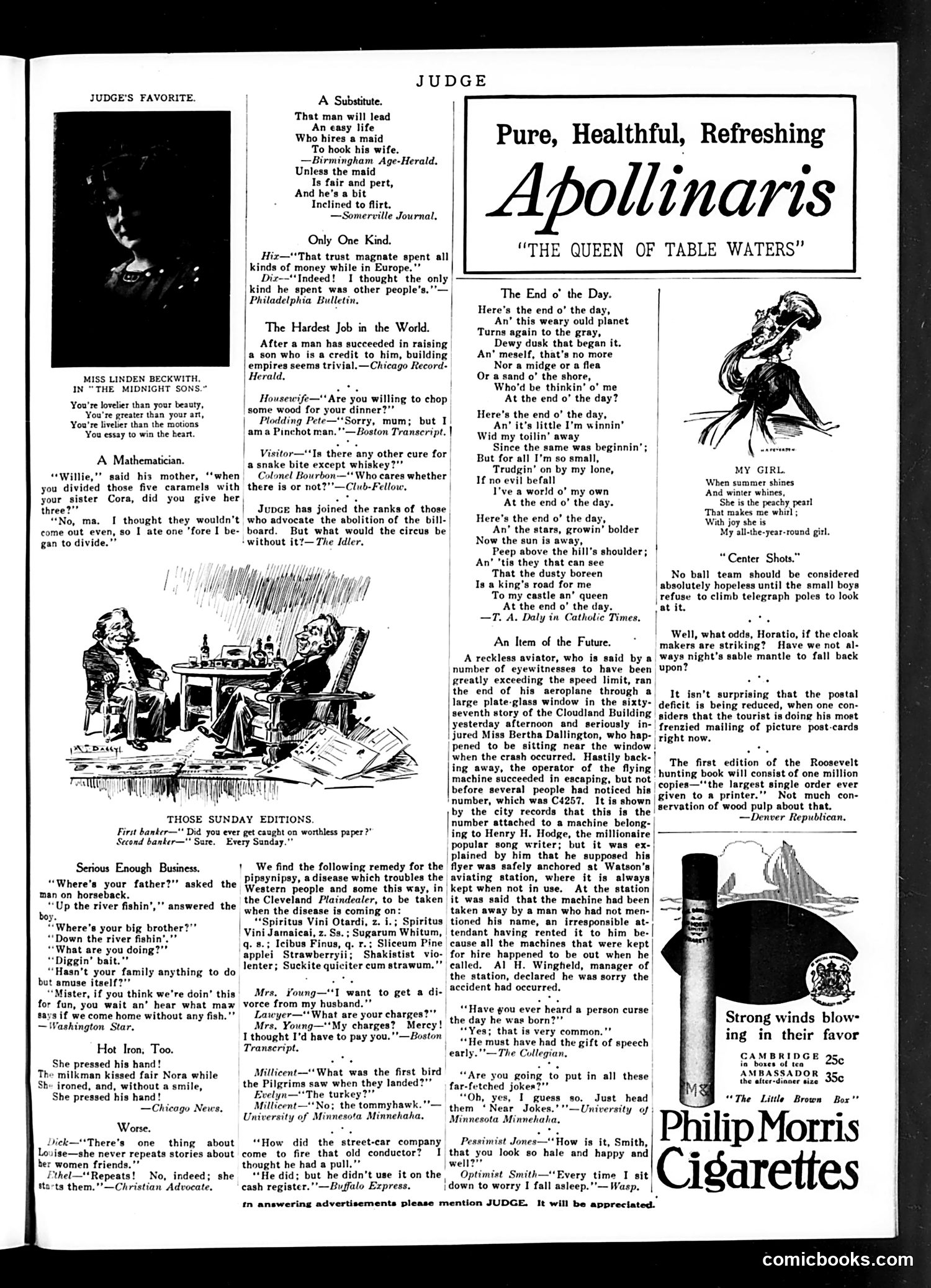
This page from *Judge* magazine contains satirical humor and advertisements typical of early 20th-century American journalism. The cartoons mock everyday situations: a joke about hiring a maid to dress one's wife (with the obvious moral risk); a quip about a wealthy "trust magnate" spending other people's money in Europe; and a mathematician's child who can't divide fairly, eating one candy before splitting the rest. One substantial piece satirizes a future aviation accident—a reckless pilot crashes through a skyscraper window, injuring a woman. This reflects contemporary anxiety about new aviation technology and careless operators. Other items include humorous definitions ("The Hardest Job in the World" = raising an honorable son) and poetry about working-class life's small dignity. The page is largely **advertisements**—notably for Apollinaris mineral water and Philip Morris cigarettes—interspersed with short jokes and light verse. The overall tone is genteel, moralistic humor aimed at middle-class readers concerned with propriety, wealth, and modern industrial change.
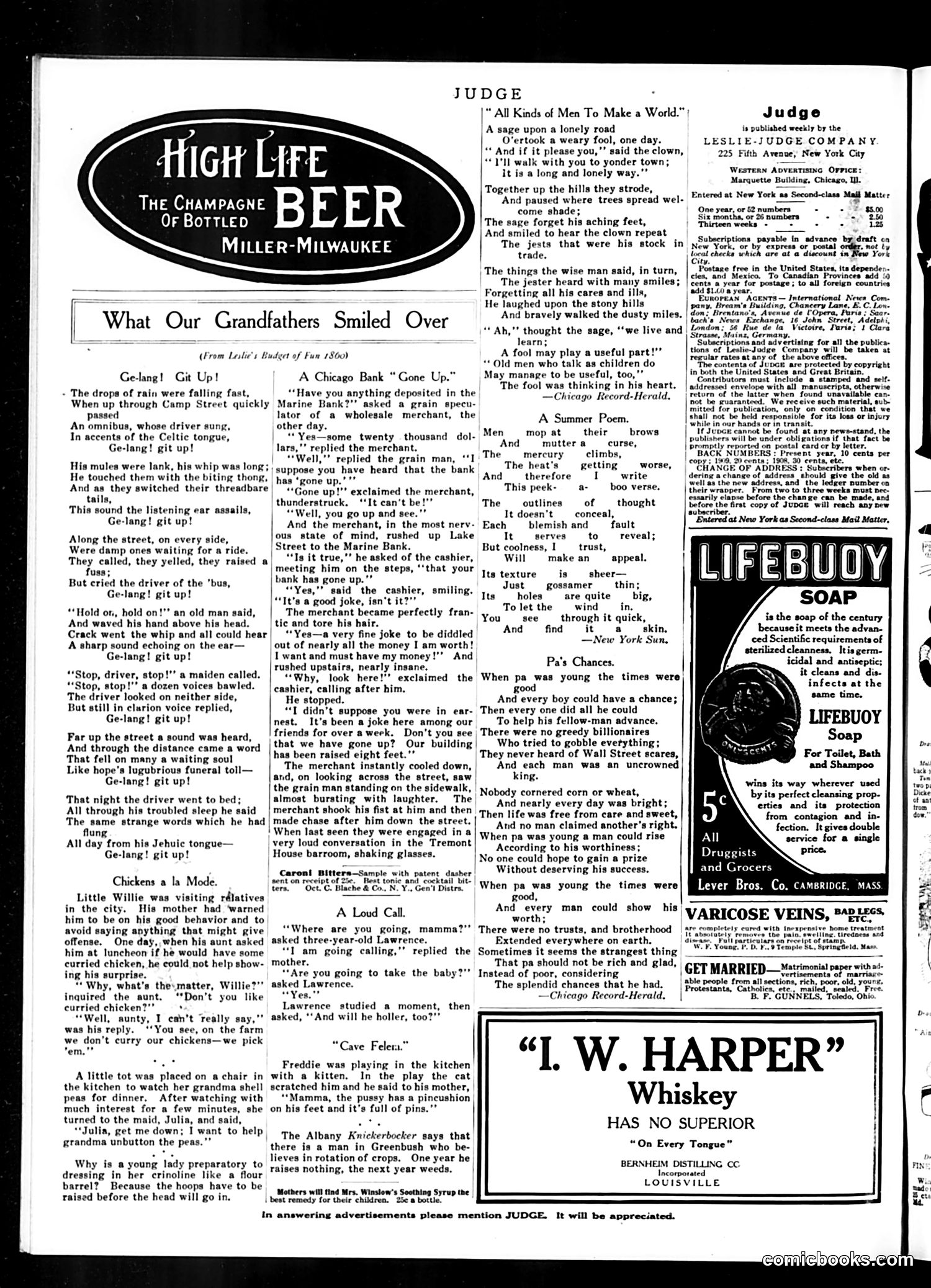
This page from *Judge* magazine (circa 1860, based on the "Budget of Fun" notation) contains primarily **advertising and humorous verse** rather than political cartoons. **Main Content:** The central feature is "What Our Grandfathers Smiled Over"—a collection of lighthearted anecdotes and poems meant to amuse readers with gentle, nostalgic humor. Notable pieces include: - **"Ge-lang! Git Up!"**: A repetitive poem about an Irish omnibus driver's catchphrase, playing on ethnic stereotype humor common to the era - **"A Chicago Bank 'Gone Up'"**: A pun-based joke about a bank building literally being raised (moved) eight feet, which a merchant misinterprets as financial collapse - **"Chickens à la Mode"** and similar brief comedic sketches exploiting children's misunderstandings of language **Context for Modern Readers:** These are not satirical political commentaries but rather **period entertainment**—Victorian-era "Dad jokes" relying on puns, malapropisms, and ethnic humor. The page is primarily **filler content surrounding advertisements** for High Life beer, Lifebuoy soap, and I.W. Harper whiskey. The humor reflects mid-19th-century sensibilities, heavy on wordplay and innocent misunderstandings rather than social critique.
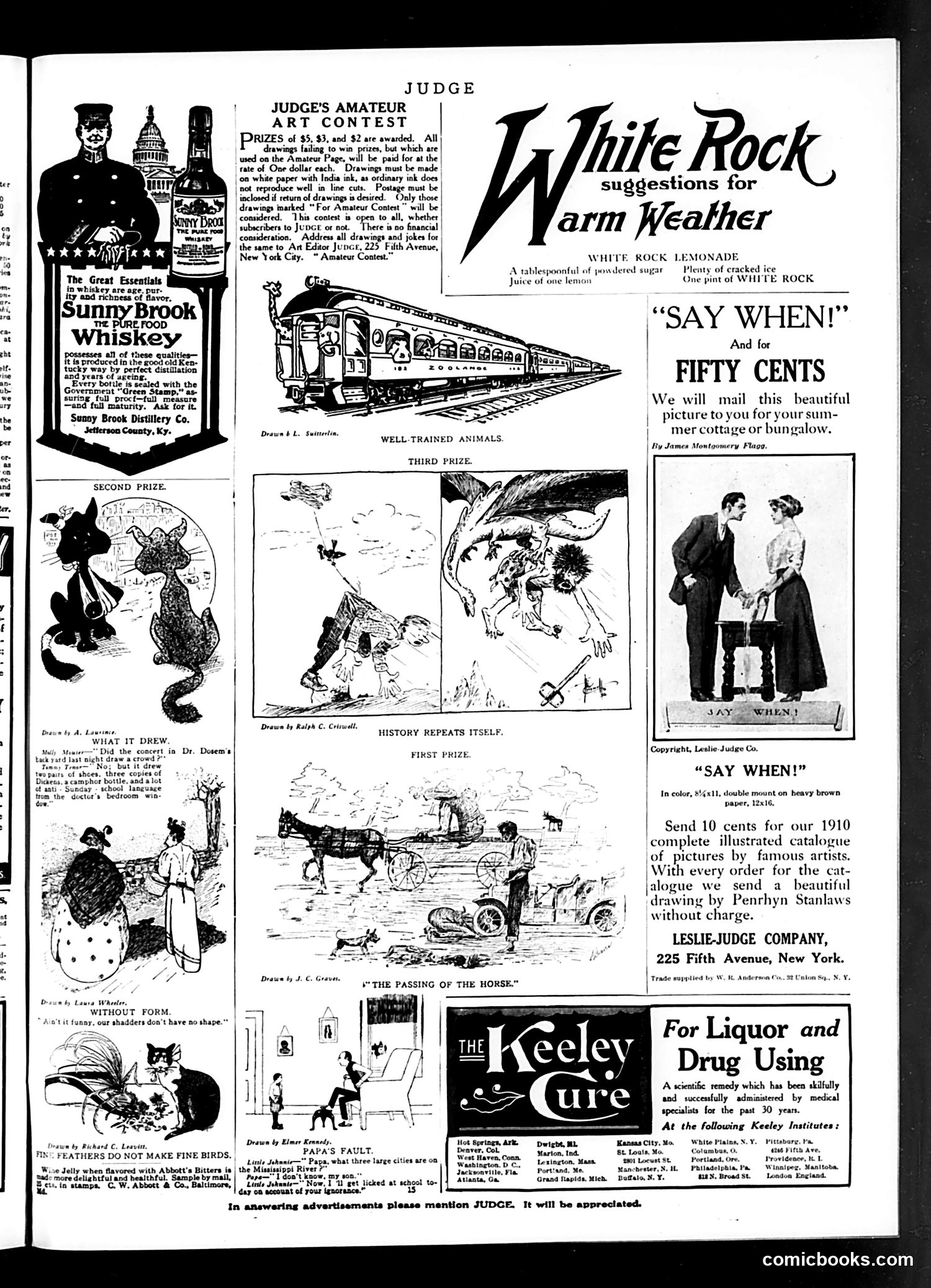
This page primarily features **Judge's Amateur Art Contest** and related advertisements rather than political satire. The contest invited readers to submit drawings in India ink for prizes ($5, $3, $2), with entries judged for publication. The page displays **winning contest entries** with titles like "Well-Trained Animals," "History Repeats Itself," and "The Passing of the Horse"—largely humorous domestic and animal scenes typical of early-1900s comic illustration. **Advertising dominates the right side**, including: - White Rock Lemonade recipes - A "Say When!" picture offer (50 cents) by James Montgomery Flagg - Sunny Brook Whiskey - The Keeley Cure (an addiction treatment institute operating across multiple U.S. cities) The Keeley Cure ad is historically significant—it represents a real medical enterprise treating alcoholism and drug addiction, reflecting contemporary attitudes toward substance abuse as a treatable medical condition rather than pure moral failing. The page shows **minimal political content**, functioning instead as a reader-participation showcase and advertising platform typical of Judge's format.
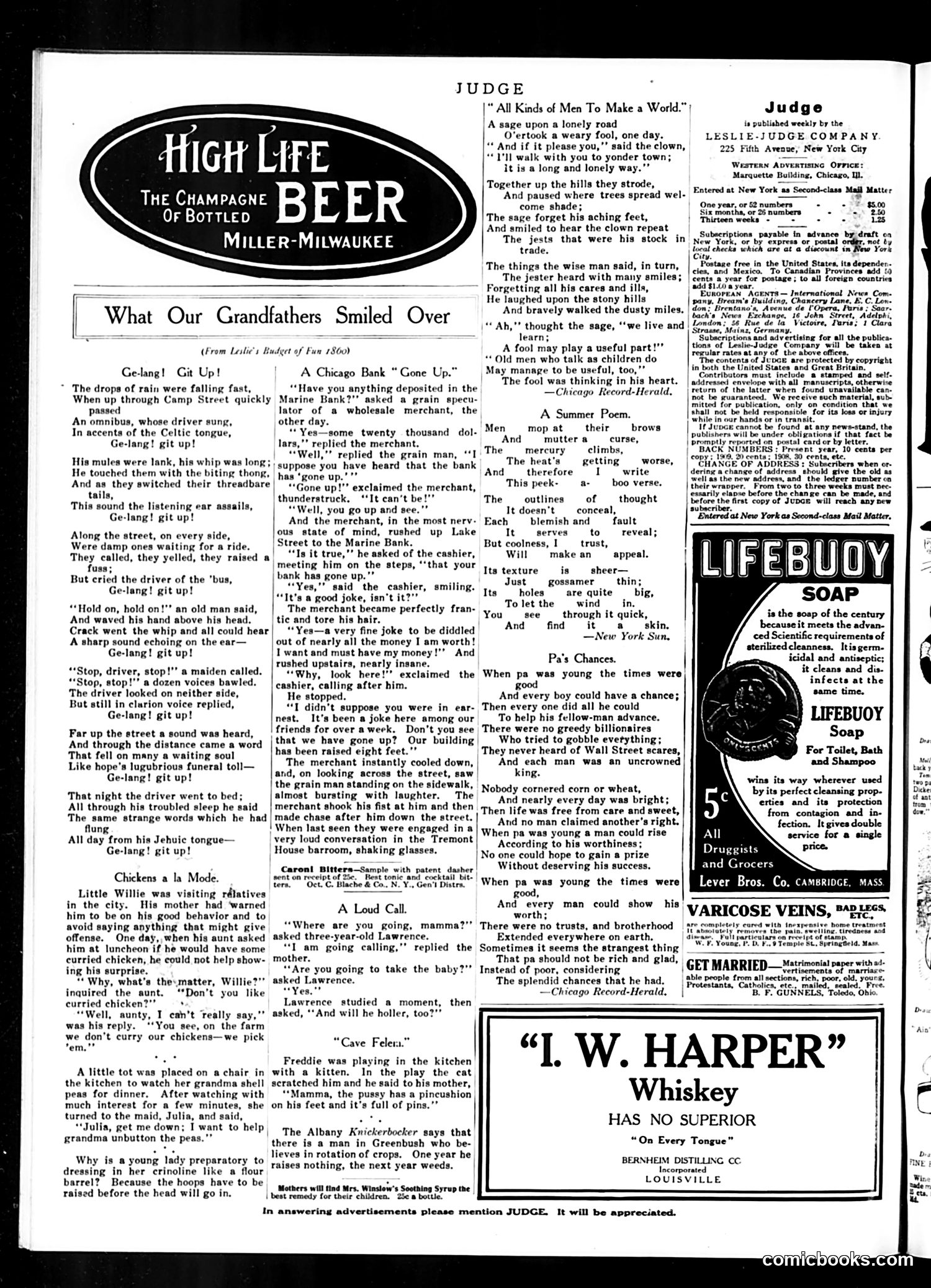
This page is primarily **advertising and light humor** rather than political satire. The main content includes: **"Ge-lang! Git Up!"** — A humorous Irish dialect poem (noted as from 1860) about an omnibus driver repeatedly shouting "Ge-lang! Git up!" at his mules, with the phrase becoming an earworm that haunts him and others throughout the day. It's ethnic humor playing on Irish-American speech patterns. **"A Chicago Bank 'Gone Up'"** — A joke about a merchant who panics when told his bank has "gone up," misunderstanding it as bankruptcy. The punchline: the bank building was literally raised eight feet (a real 1860s Chicago practice), not financially ruined. The remaining pieces are brief jokes about children's malapropisms and a riddle about crinolines. The page is dominated by **period advertisements** for High Life Beer (Miller-Milwaukee) and other products, with the Judge masthead indicating this is a weekly satirical magazine. No specific political figures or events are referenced.
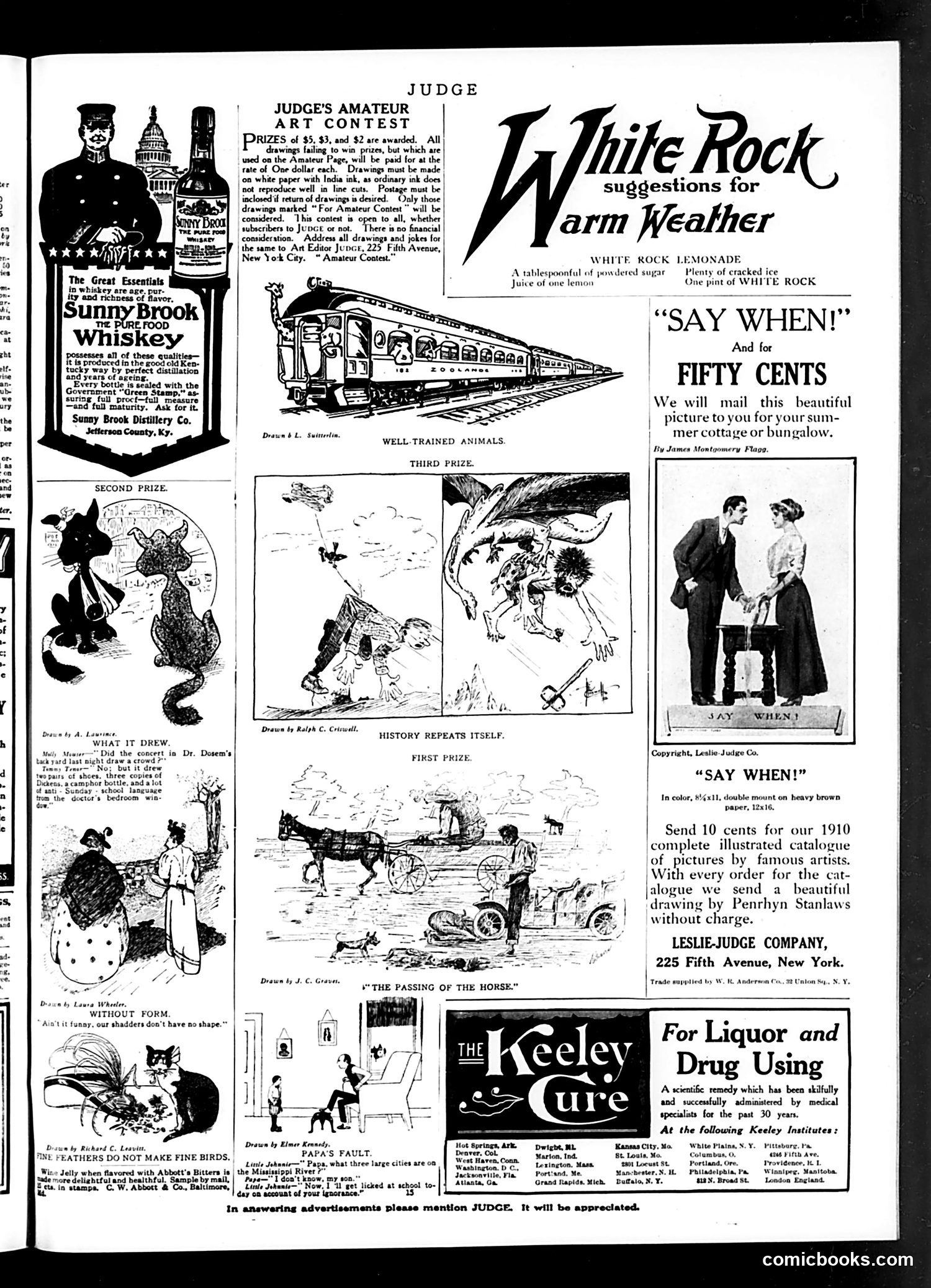
This page showcases Judge's amateur art competition alongside period advertisements. The cartoon contest invited readers to submit drawings for prize money ($5, $3, $2) or $1 per accepted piece—a notable incentive during the early 1900s when such payment supported struggling artists. The winning cartoons display typical Judge humor: anthropomorphized animals ("Well-Trained Animals"), visual puns ("What It Drew"—a doctor's sketch literally depicts items from his bedroom), and domestic comedy ("History Repeats Itself," "Papa's Fault"). The satire is gentle, targeting absent-minded fathers and ironic life lessons rather than political figures. The surrounding advertisements reflect contemporary concerns: whiskey's "purity," White Rock lemonade as a refreshing alternative, Leslie-Judge's mail-order art pictures (25 cents), and notably "The Keeley Cure"—a commercialized alcoholism treatment claiming medical legitimacy. This juxtaposition ironically pairs liquor ads with addiction-treatment marketing, reflecting early-1900s attitudes toward substance abuse as a "medical" rather than moral problem.
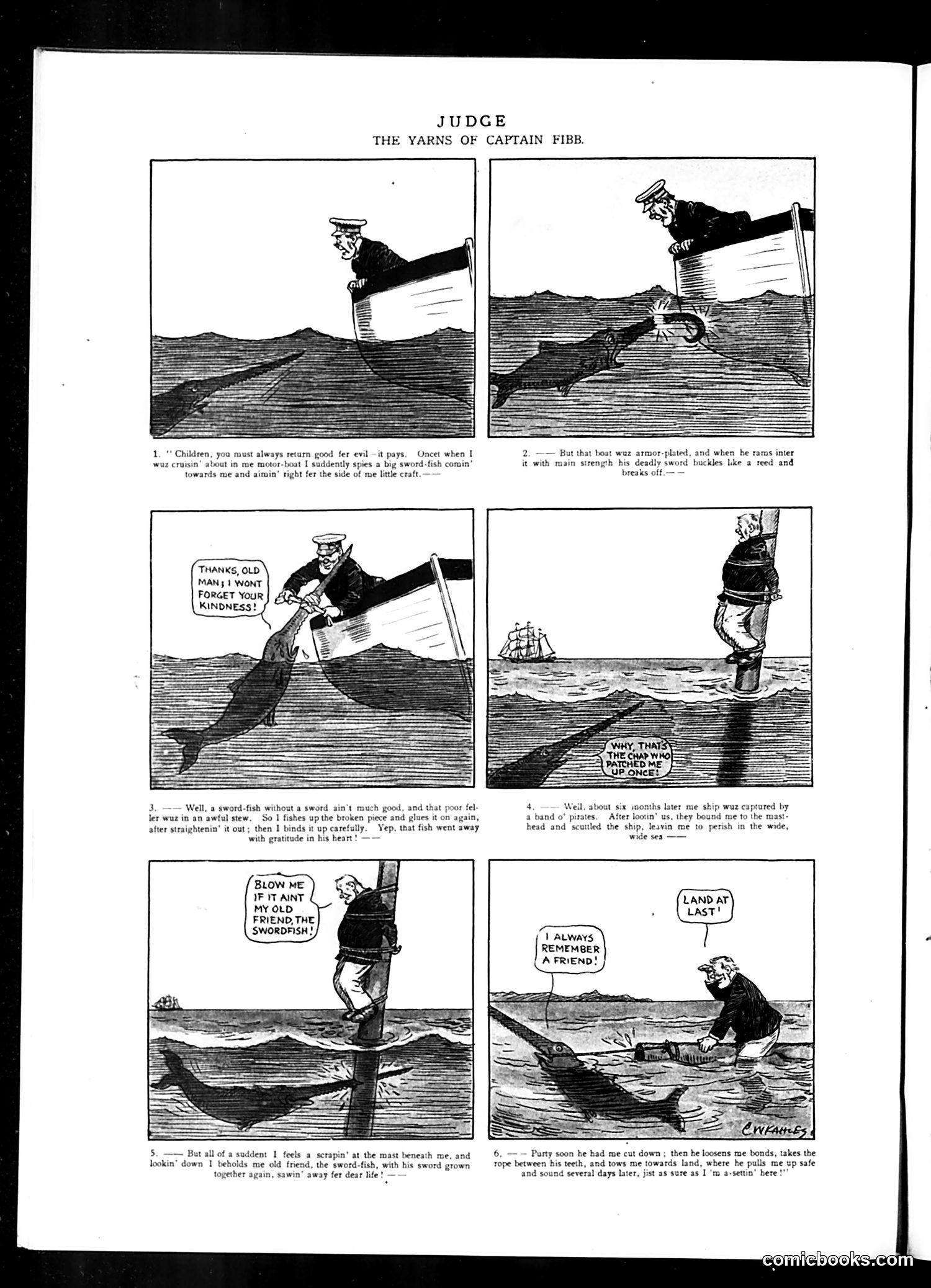
This is a tall-tale comic strip featuring an unnamed sea captain recounting an implausibly heroic adventure. The humor relies on increasingly absurd coincidences and exaggerations typical of seafaring folklore. The narrative arc: Captain Fibb encounters a sword-fish, disarms it (the sword breaks), repairs the fish's weapon out of kindness, later gets captured by pirates and left to die, and is rescued by that same grateful sword-fish, who cuts him down and tows him to safety. The satire targets the genre of exaggerated adventure yarns—the type of unbelievable stories sailors traditionally told. The joke is that every improbable element compounds the next, reaching an absurd climax where an animal performs impossible rescue tasks. The "moral" opening about returning good for evil gets hilariously validated by literal animal gratitude, mocking sentimental adventure tropes popular in early 20th-century entertainment.