
Judge, 1910-08-06 · page 4 of 18
Judge — August 6, 1910 — page 4: what you’re looking at
What you’re looking at
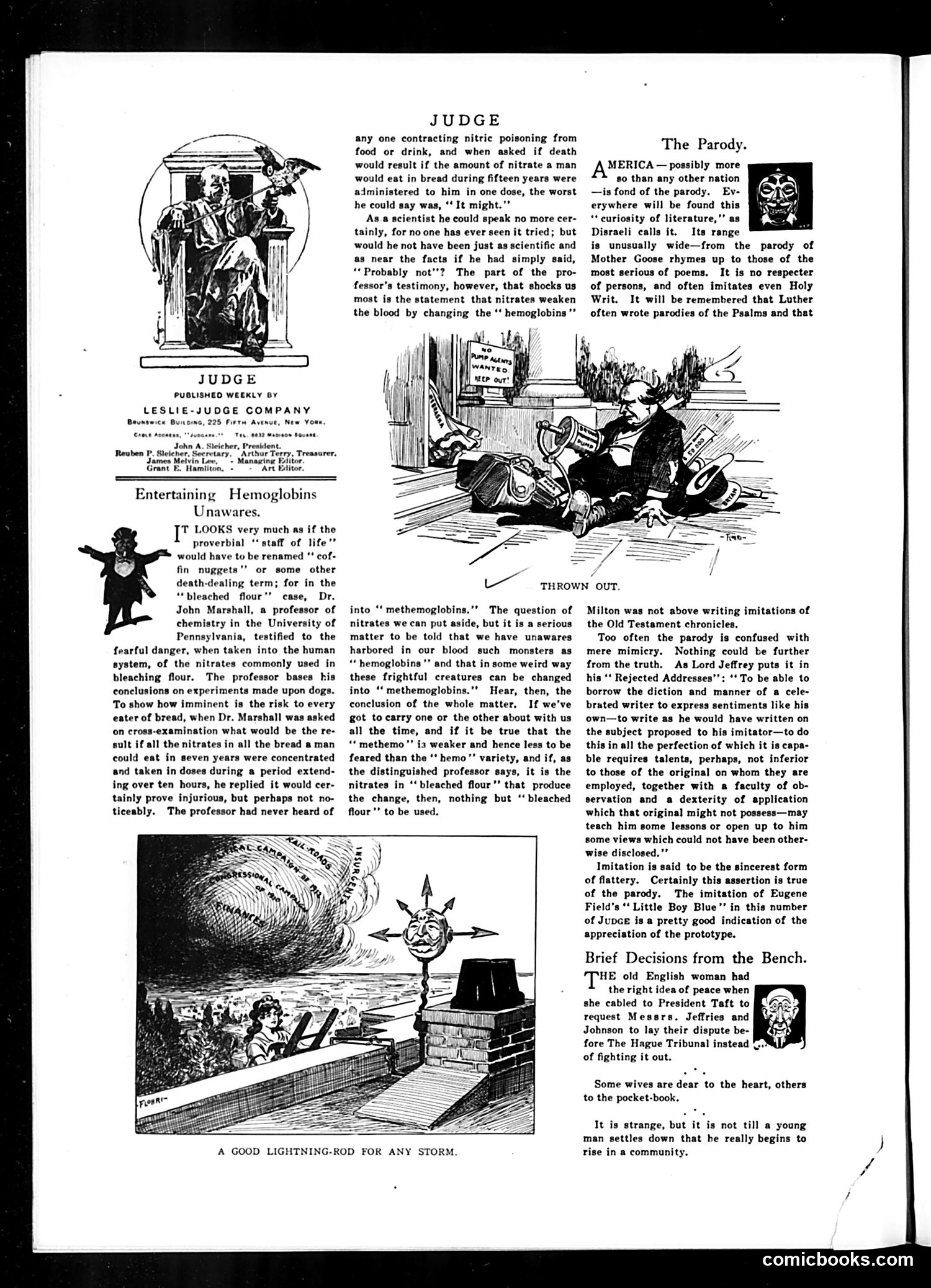
This page contains satirical commentary on scientific debate, specifically about nitrates and hemoglobins in blood chemistry. The text mocks Dr. John Hauhardt, a University of Pennsylvania chemistry professor, for claims about nitrates weakening blood by altering hemoglobins. The top cartoon "THROWN OUT" depicts someone being ejected, likely representing dismissal of Hauhardt's theories. The lower illustration "A GOOD LIGHTNING-ROD FOR ANY STORM" uses a lightning-rod metaphor—suggesting Hauhardt's claims are an easy target for scientific ridicule. The satire ridicules unproven scientific assertions presented as fact, a common Judge theme. The magazine attacks both the professor's credibility and the credulity of people who might believe dramatic health claims without proper evidence. The piece exemplifies late-19th/early-20th-century skepticism toward pseudoscience.
📄 Transcribed text from this page (OCR, searchable)
Machine-transcribed from the original scan — historical spelling and the odd misread are preserved.
PUBLISHED WEEKLY BY LESLIE-JUDGE COMPANY New Your. Tee. ena cher, President. tary, Arthur Terry, Treasurer. + Managing Estitor. ‘Art Exlitor. John A. Reuben P. Sleicher, Secre James Melvin Lee, Grant E. Hamliton, = Entertaining Hemoglobins Unawares. [7 LOOKS very much as if the proverbial ‘‘ staff of life’’ would have to be renamed “ cof- fin nuggets" or some other death-dealing term; for in the “bleached flour’? case, Dr. John Marshall, a professor of chemistry in the University of Pennsylvania, testified to the fearful danger, when taken into the human system, of the nitrates commonly used in bleaching flour. The professor bases his conclusions on experiments made upon dogs. To show how imminent is the risk to every eater of bread, when Dr. Marshall was asked ‘on cross-examination what would be the re- sult if all the nitrates in all the bread aman could eat in seven years were concentrated and taken in doses during a period extend- ing over ten hours, he replied it would cer- tainly prove injurious, but perhaps not no- ticeably. The professor had never heard of JUDGE any one contracting nitric poisoning from food or drink, and when asked if death would result if the amount of nitrate a man would eat in bread during fifteen years were administered to him in one dose, the worst he could say was, ‘It might."’ As.a scientist he could speak no more cer- tainly, for no one has ever seen it tried; but would he not have been just as scientific and as near the facts if he had simply 8: “Probably not’? The part of the pro- fessor’s testimony, however, that shocks us most is the statement that nitrates weaken the blood by changing the ‘‘ hemoglobins” The Parody. AMERICA — possibly more so than any other nation —is fond of the parody. Ev- erywhere will be found this “ curiosity of literature, Disraeli calls it. Its range is unusually wide—from the parody of Mother Goose rhymes up to those of the most serious of poems. It is no respecter of persons, and often imitates even Holy Writ. It will be remembered that Luther often wrote parodies of the Psalms and that THROWN OUT. into ‘‘ methemoglobins.’’ The question of nitrates we can put aside, but it is a serious matter to be told that we have unawares harbored in our blood such monsters as “ hemoglobins "’ and that in some weird way these frightful creatures can be changed into ‘* methemoglobins.’’ Hear, then, the conclusion of the whole matter. If we've got to carry one or the other about with us all the time, and if it be true that the “*methemo"’ is weaker and hence less to be feared than the ‘* hemo’ variety, and if, as the distinguished professor says, it is the nitrates in ‘‘ bleached flour’’ that produce the change, then, nothing but ‘‘ bleached flour "’ to be used. A GOOD LIGHTNING-ROD FOR ANY STORM. Milton was not above writing imitations of the Old Testament chronicles. Too often the parody is confused with mere mimicry. Nothing could be further from the truth. As Lord Jeffrey puts it in his ‘* Rejected Addresse: “To be able to borrow the diction and manner of a cele- brated writer to express sentiments like his own—to write as he would have written on the subject proposed to his imitator—to do this in all the perfection of which it is capa- ble requires talents, perhaps, not inferior to those of the original on whom they are employed, together with a faculty of ob- servation and a dexterity of application which that original might not possess—may teach him some lessons or open up to him some views which could not have been other- wise disclosed.” Imitation is said to be the sincerest form of flattery. Certainly thi rtion is true of the parody. The imitation of Eugene Field's *‘ Little Boy Blue’’ in this number of Jupce is a pretty good indication of the appreciation of the prototype. Brief Decisions from the Bench. Ts old English woman had the right idea of peace when she cabled to President Taft to request Messrs. Jeffries and Johnson to lay their dispute be- fore The Hague Tribuna of fighting it out. Some wives are dear to the heart, others to the pocket-book. It is strange, but it is not till a young man settles down that be really begins to rise in a community. comicbooks.com