
Judge, 1910-08-06 · page 7 of 18
Judge — August 6, 1910 — page 7: what you’re looking at
What you’re looking at
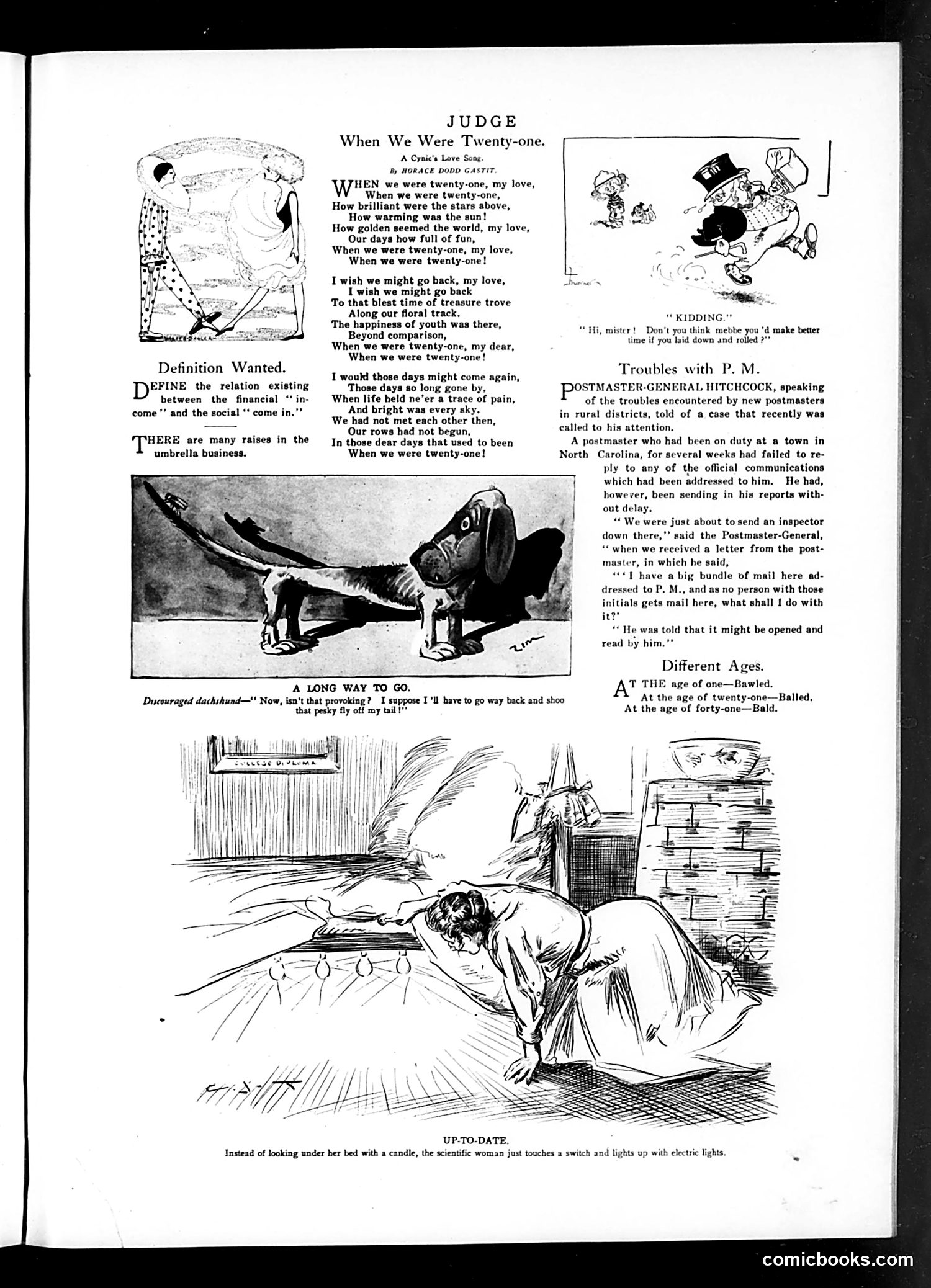
This page contains several unrelated satirical pieces typical of Judge's format: **"When We Were Twenty-one"** is a nostalgic poem mocking romantic sentimentality—a cynical take on how couples romanticize their youth while their actual relationship has deteriorated into conflict ("Our rows had not begun"). **"Definition Wanted"** is a brief joke suggesting confusion between financial and social definitions of "income"—likely poking fun at economic terminology or class distinctions. **"Troubles with P.M."** recounts Postmaster-General Hitchcock's anecdote about a rural postmaster who received mail addressed to "P.M." (Post Master) and didn't realize it referred to himself. The joke satirizes rural postal workers' lack of sophistication or education. **"Different Ages"** presents three single-line jokes about baldness across life stages—simple visual humor. **"Up-to-Date"** contrasts old superstition (checking under beds by candlelight) with modern technology (electric lights), celebrating progress. The page emphasizes social satire, generational commentary, and gentle mockery of rural/working-class figures—typical Judge content from the early 20th century.
📄 Transcribed text from this page (OCR, searchable)
Machine-transcribed from the original scan — historical spelling and the odd misread are preserved.
JUDGE When We Were Twenty-one. A Cynic’s Love Song. By HORACE DODD GASTIT. WHEN we were twenty-one, my love, When we were twenty-one, How brilliant were the stars above, How warming was the sun! How golden seemed the world, my love, Our days how full of fun, When we were twenty-one, my love, When we were twenty-one! I wish we might go back, my love, I wish we might go back To that blest time of treasure trove Along our floral track. <eispere The happiness of youth was there, " , : 5, Hi, mister! Don’t you think mebbe you 'd make better Beyond comparison, ; Ps you'd When we were twenty-one, my dear, tine Hyon. tald down apd roles f When we were twenty-one! Definition Wante [wound uses anya satgue comeragates Troubles with P. M. FINE the relation existing Those days so long gone by, POSTMASTER-GENERAL HITCHCOCK, speaking between the financial “ When life held ne’er a trace of pain, of the troubles encountered by new postmasters come" and the social ‘‘ come in. And bright was every sky. in rural districts, told of a case that recently was We had not met each other then, = ; Our rows had not begun, called to his attention. (THERE are many raises in the In those dear days that used to been ‘A postmaster who had been on duty at a town in umbrella business. When we were twenty-one! North Carolina, for several weeks had failed to re- ply to any of the official communications which had been addressed to him. He had, however, been sending in his reports with- out delay. “ We were just about to send an inspector down there,” said the Postmaster-General, “when we received a letter from the post- master, in which he said, “*T have a big bundle of mail here ad- dressed to P. M., and as no person with those initials gets mail here, what shall { do with it?” “ He was told that it might be opened and read by him."* Different Ages. A LONG WAY TO GO. T THE age of one—Bawled. Ducouraged dackshund—"' Now, isn't that provoking? I suppose I'll have to go way back and shoo At the age of twenty-one—Balled. that pesky fly off my tail !’* At the age of forty-one—Bald. UP-TO-DATE. Instead of looking under her bed with a candle, the scientific woman just touches a switch and lights up with electric lights, comicbooks.com