
A complete issue · 25 pages · 1910
Judge — June 25, 1910
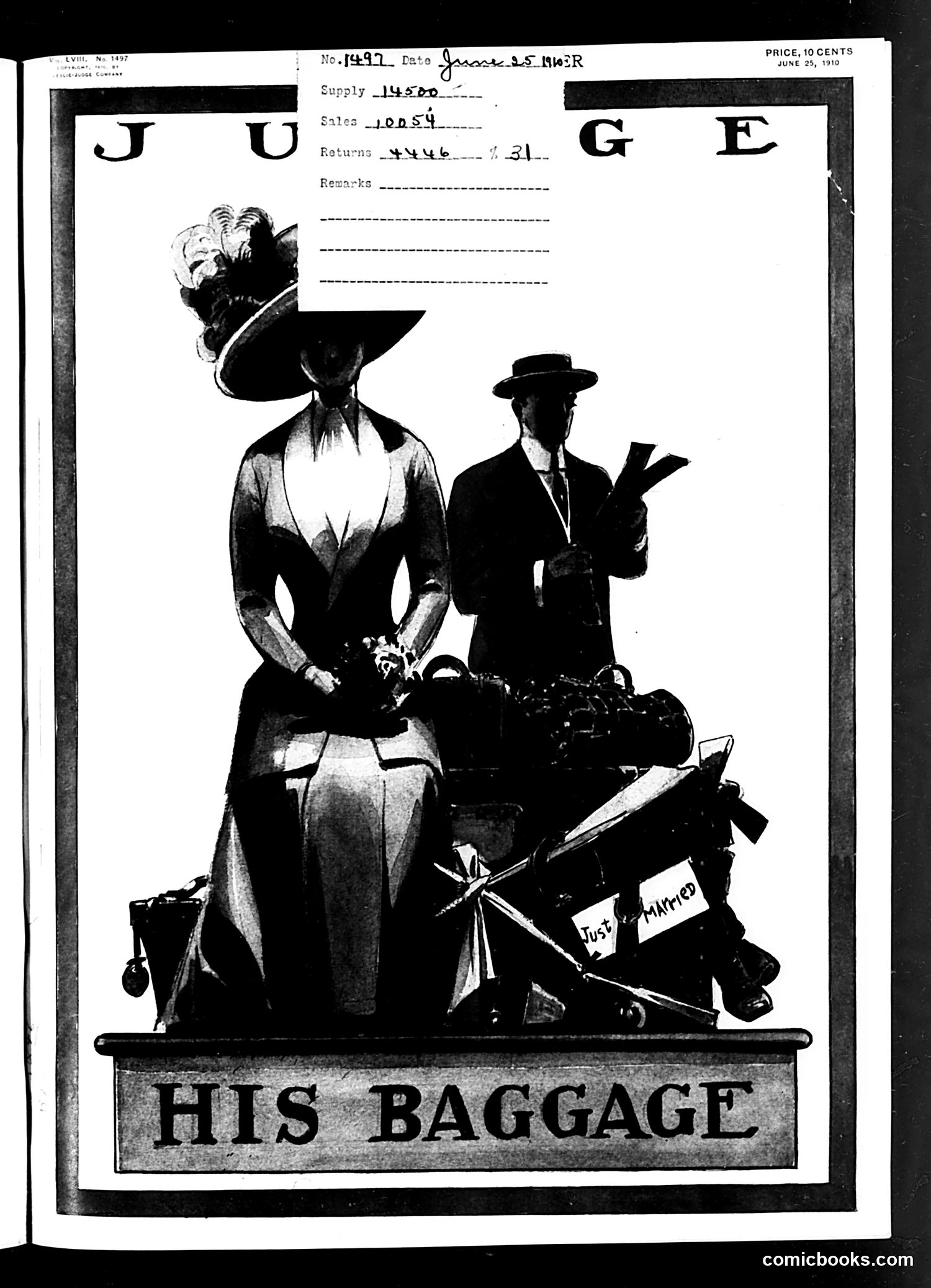
This satirical cartoon depicts a newlywed couple with excessive luggage labeled "Just Married." The woman wears an elaborate hat and fashionable dress; the man carries paperwork. The humor critiques the burden of marriage—specifically the expectation that husbands must support their wives' material demands and lifestyle expenses. The "baggage" is double-meaning: literal suitcases representing the wife's possessions and accessories, but also figurative "baggage" meaning obligations and financial responsibility. The exaggerated hat size emphasizes how women's fashion extravagance was perceived as financially burdensome to newlywed husbands. This reflects early 20th-century gender anxieties about marriage and consumerism, where wives were stereotyped as expensive dependents with expensive tastes.
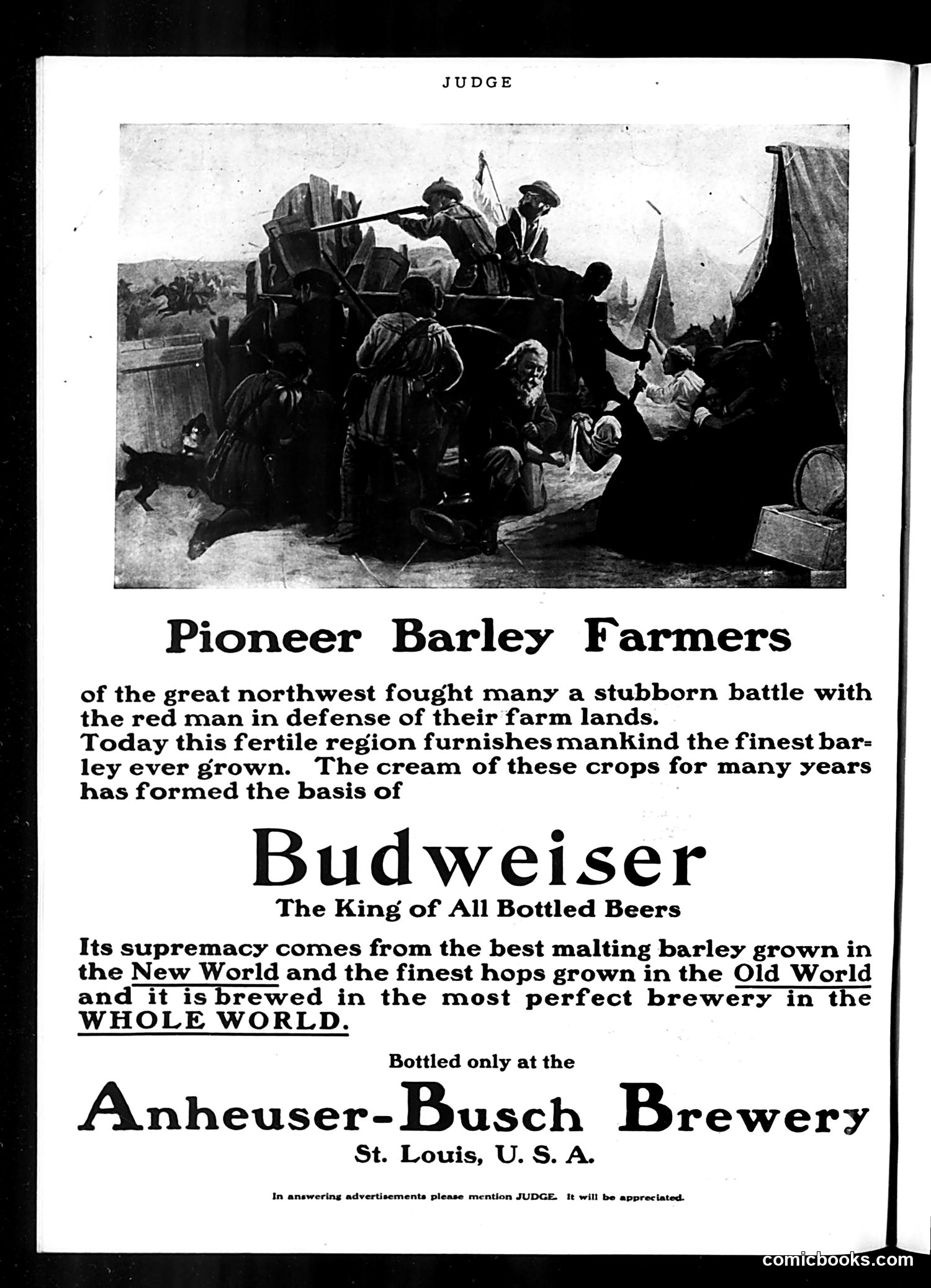
This page is **primarily an advertisement**, not satire or political commentary. The image depicts pioneer settlers—likely representing the American frontier narrative—in a dramatic scene with covered wagons and conflict with Native Americans ("the red man in defense of their farm lands," per the text). Anheuser-Busch uses this historical imagery to market Budweiser beer by claiming the barley for their product comes from the "great northwest"—the same region where these pioneers supposedly fought. The advertisement connects American expansion mythology with product quality, suggesting Budweiser's superiority derives from the finest barley grown in this "fertile region." This reflects early 20th-century advertising strategy: leveraging nationalist narratives and westward expansion mythology to sell consumer goods. The page contains no actual satire or joke—it's straightforward (if ethically problematic) brand marketing.
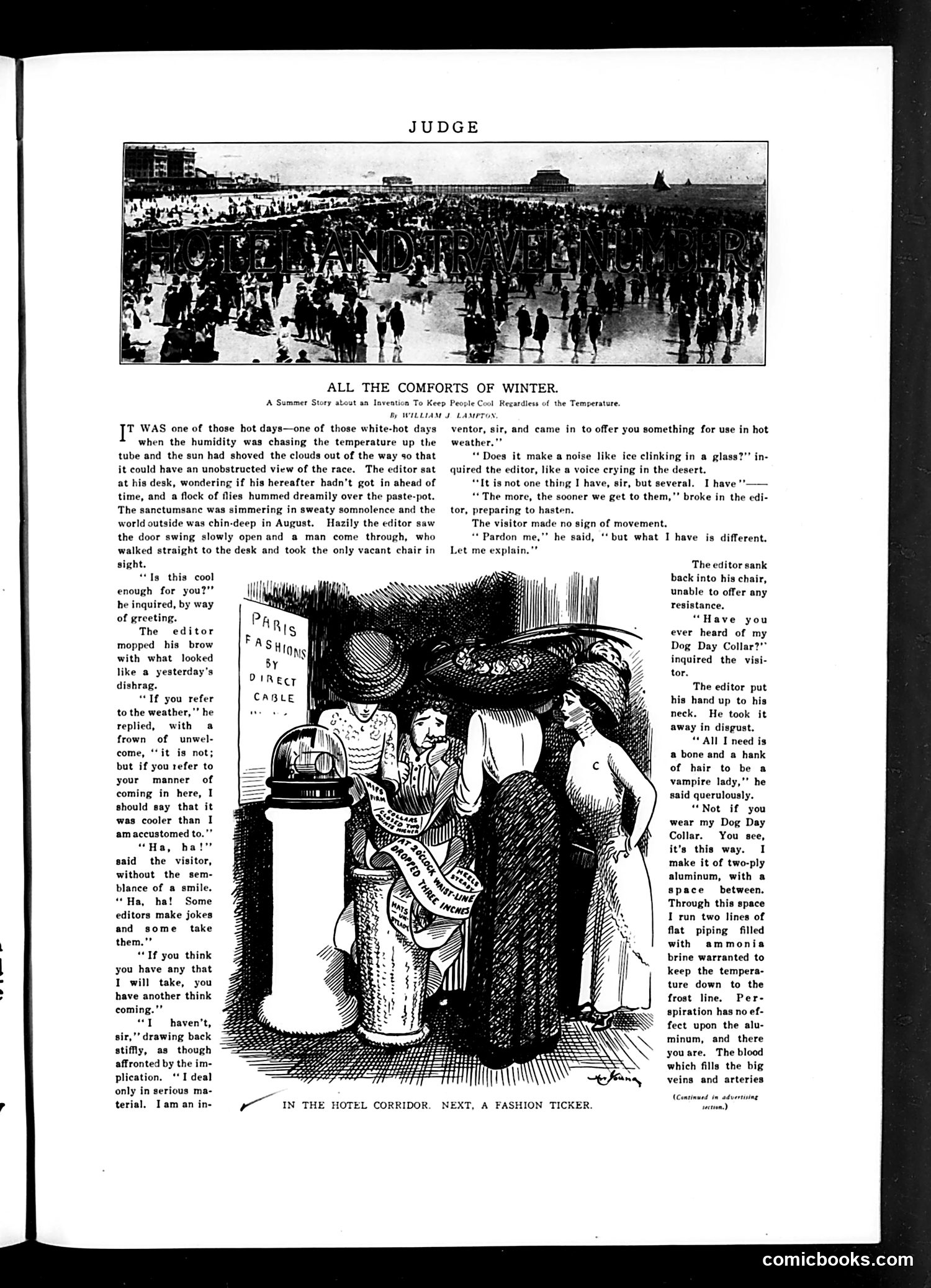
This satirical story mocks an inventor pitching a cooling device to a newspaper editor during an oppressively hot summer day. The inventor claims his contraption—a "Dog Day Collar"—can keep people cool by circulating ammonia-filled brine through flat aluminum piping worn around the neck. The joke targets both the absurdity of the invention itself and the editor's skeptical, dismissive response. The satire reflects late 19th/early 20th-century anxieties about heat, technology, and dubious patent schemes. The phrase "Dog Days" refers to summer's hottest period, making the device name darkly comic. Judge uses this scenario to ridicule over-engineered "solutions" to everyday problems and gullible inventors seeking funding.
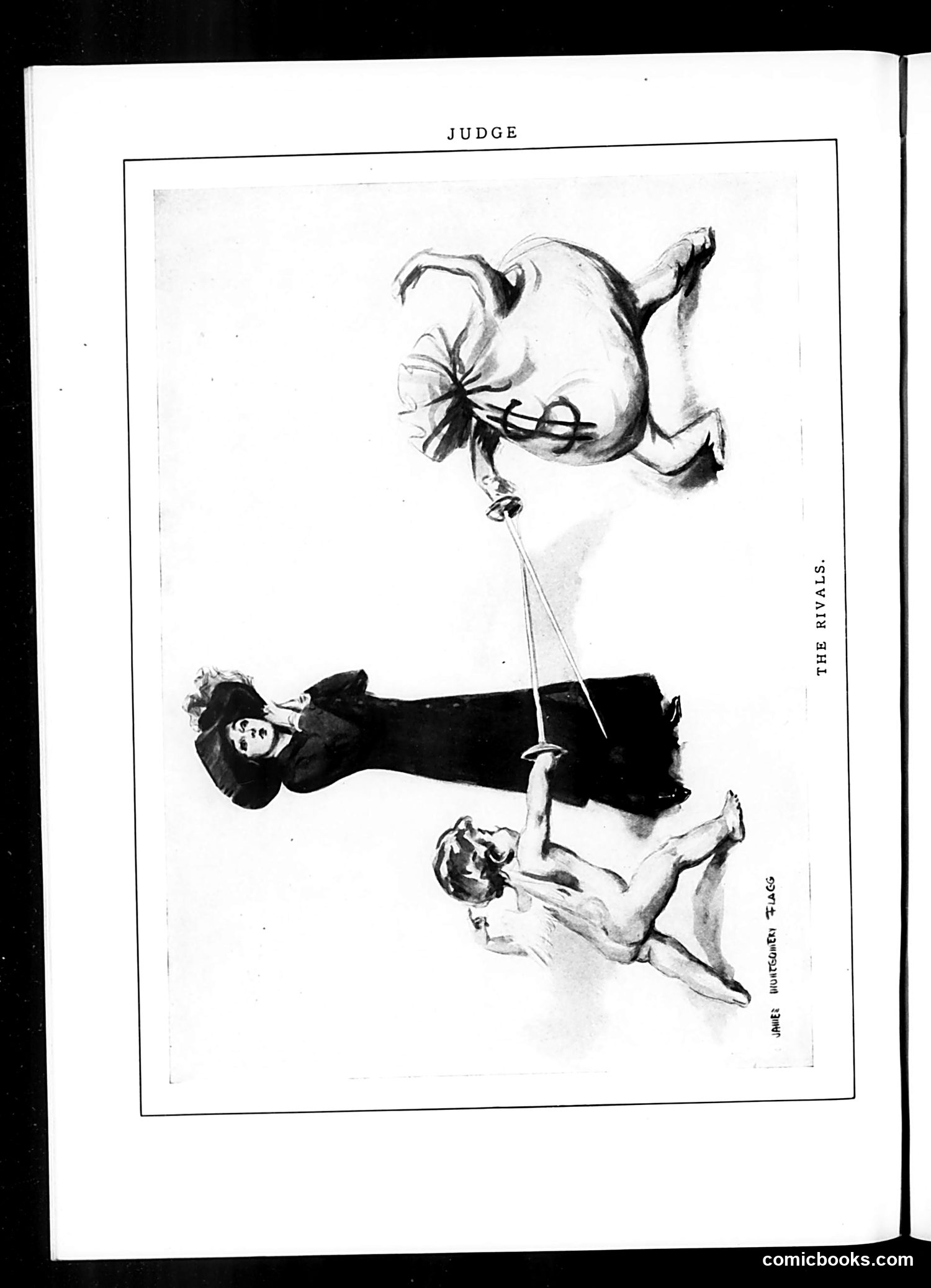
This political cartoon depicts two figures in conflict over a woman—a classic "rivals" scenario. The man in formal dress (center-left) appears to be a judge or authority figure, while the shirtless man (bottom-right) represents a common laborer or working-class competitor. The woman above, depicted as an object of desire, suggests the satire concerns competition for feminine attention or loyalty across class lines. The title "The Rivals" and the stark contrast between formal and casual dress indicates social commentary on class conflict, possibly mocking how different social classes compete for the same resources or women. Without clearer historical context or visible names, the specific political figures or events referenced remain unclear, though the class-based satire is evident.
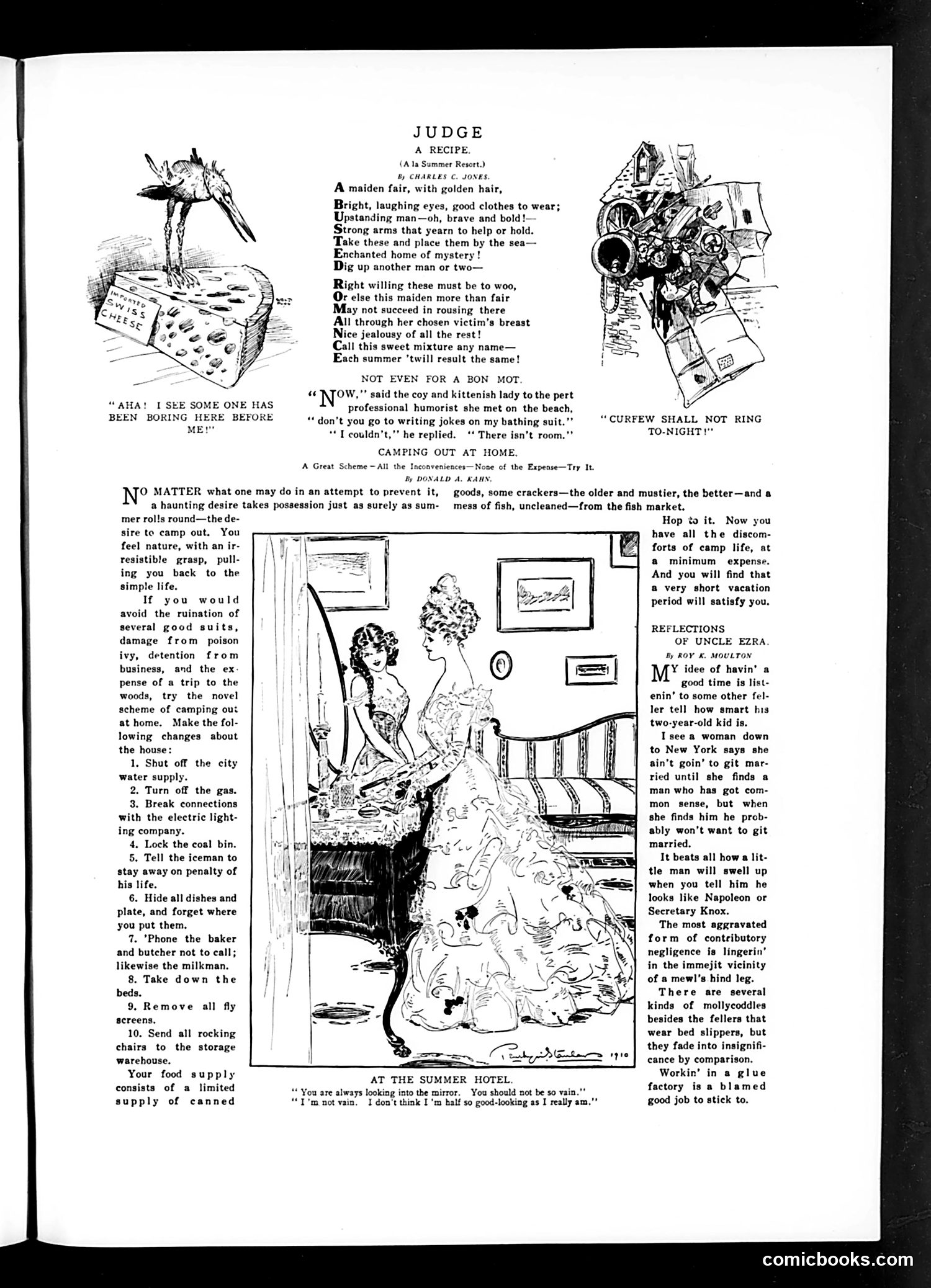
This page contains three separate pieces of humor content typical of early 20th-century Judge magazine: 1. **"Judge: A Recipe"** (top) — A poem by Charles E. Jewel offering satirical "instructions" for creating an ideal judge, describing desirable qualities (maiden fair, bright eyes, strong arms). It's unclear what specific judicial or political figure this references. 2. **"Camping Out at Home"** (center-left) — Practical advice for budget vacationing, listing nine steps to simulate camping indoors by shutting utilities and removing furniture. This reflects early 1900s middle-class leisure concerns. 3. **"Reflections of Uncle Ezra"** (right) — A comedic advice column offering observations about romance and relationships, including commentary on women delaying marriage and men's vanity. The page is primarily **entertainment and lifestyle humor** rather than political satire.
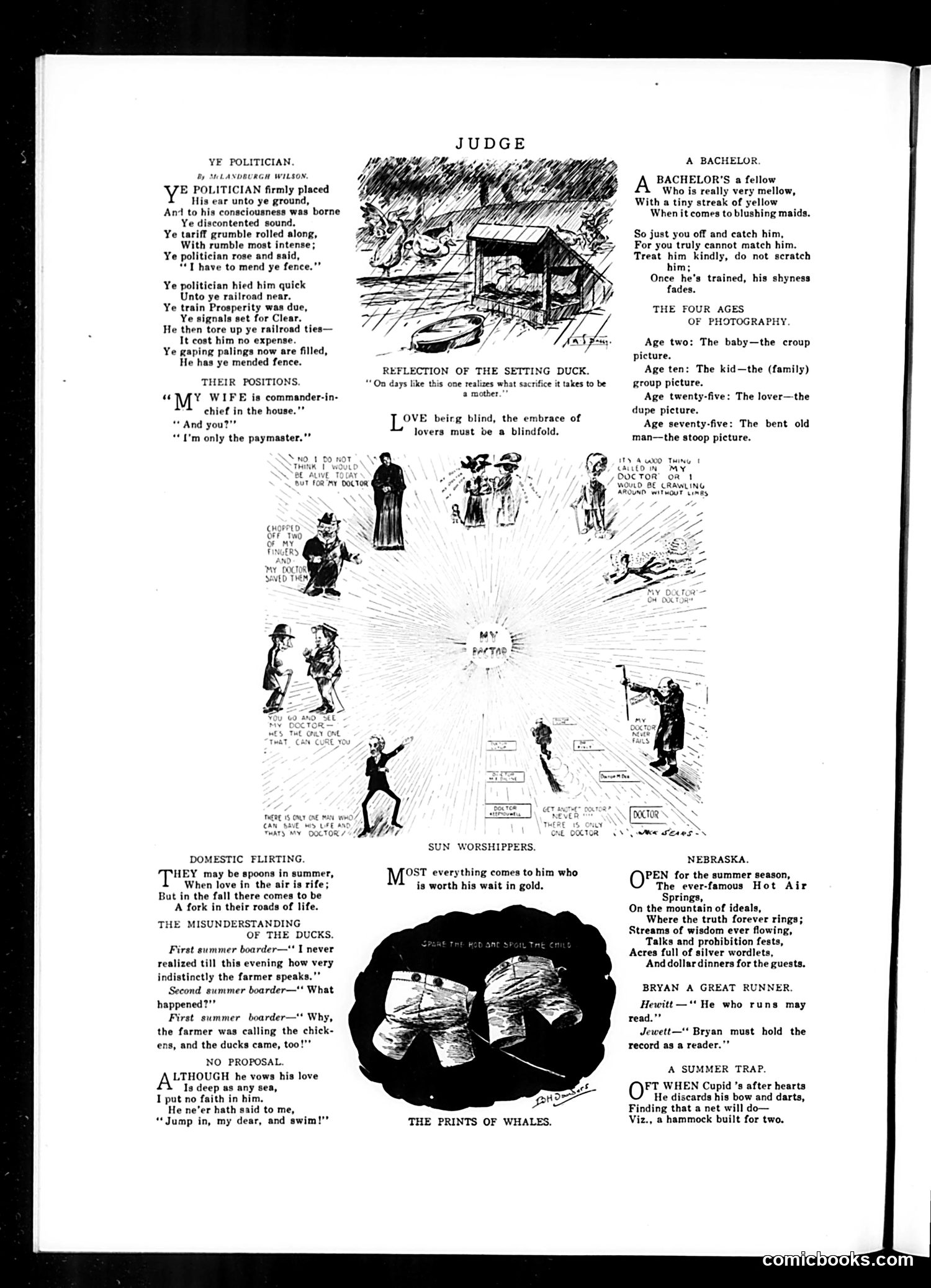
This page from *Judge* magazine (a late 19th/early 20th-century satirical publication) contains multiple short humorous pieces and cartoons on various social topics: **"Ye Politician"** uses mock-archaic language to mock politicians who claim to address public complaints (tariff grumbles, economic discontent) but actually destroy infrastructure ("tore up ye railroad tie") to solve problems superficially—"mending the fence" with materials ripped from more important places. **Other pieces** are light domestic humor: jokes about marital power dynamics, summer boarders misunderstanding farmers, and four stages of photography (baby photos, family portraits, romance pictures labeled "dupe pictures," and elderly photos). **"Nebraska" and "Bryan a Great Runner"** likely reference William Jennings Bryan, the Populist/Democratic politician from Nebraska, though the specific reference is unclear without more context. Most content here is apolitical wordplay about bachelorhood, romance, and summer activities rather than serious satire—typical lighter fare filling a humor magazine's pages.
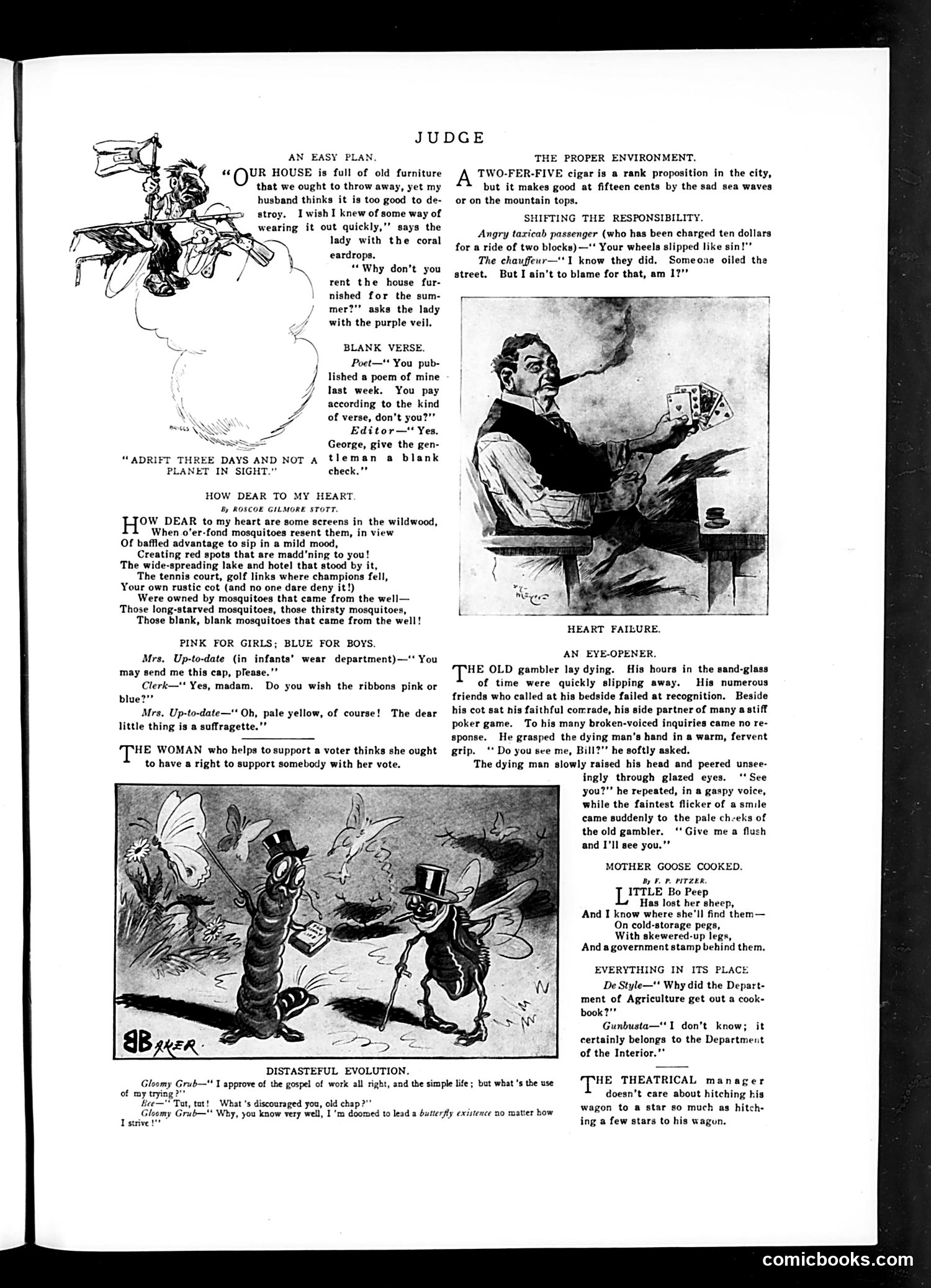
This page from Judge magazine contains multiple satirical pieces targeting early 20th-century social issues: **"Pink for Girls; Blue for Boys"** mocks the emerging women's suffrage movement by having a mother request pale yellow ribbon for her infant daughter's cap because "the dear little thing is a suffragette"—satirizing feminists as overly ideological. **"The Woman who helps support a voter"** directly addresses women's voting rights, sarcastically suggesting women who financially support voters deserve voting power themselves. **"Mother Goose Cooked"** parodies nursery rhymes to criticize food storage practices, likely referencing contemporary concerns about preserved or artificially stored foods. The page also includes lighter humor about mosquitoes, taxi overcharges, and theatrical managers—typical Judge fare mixing political commentary with general satire. The suffrage mockery reflects Judge's conservative editorial stance during the pre-1920 women's voting rights debates.
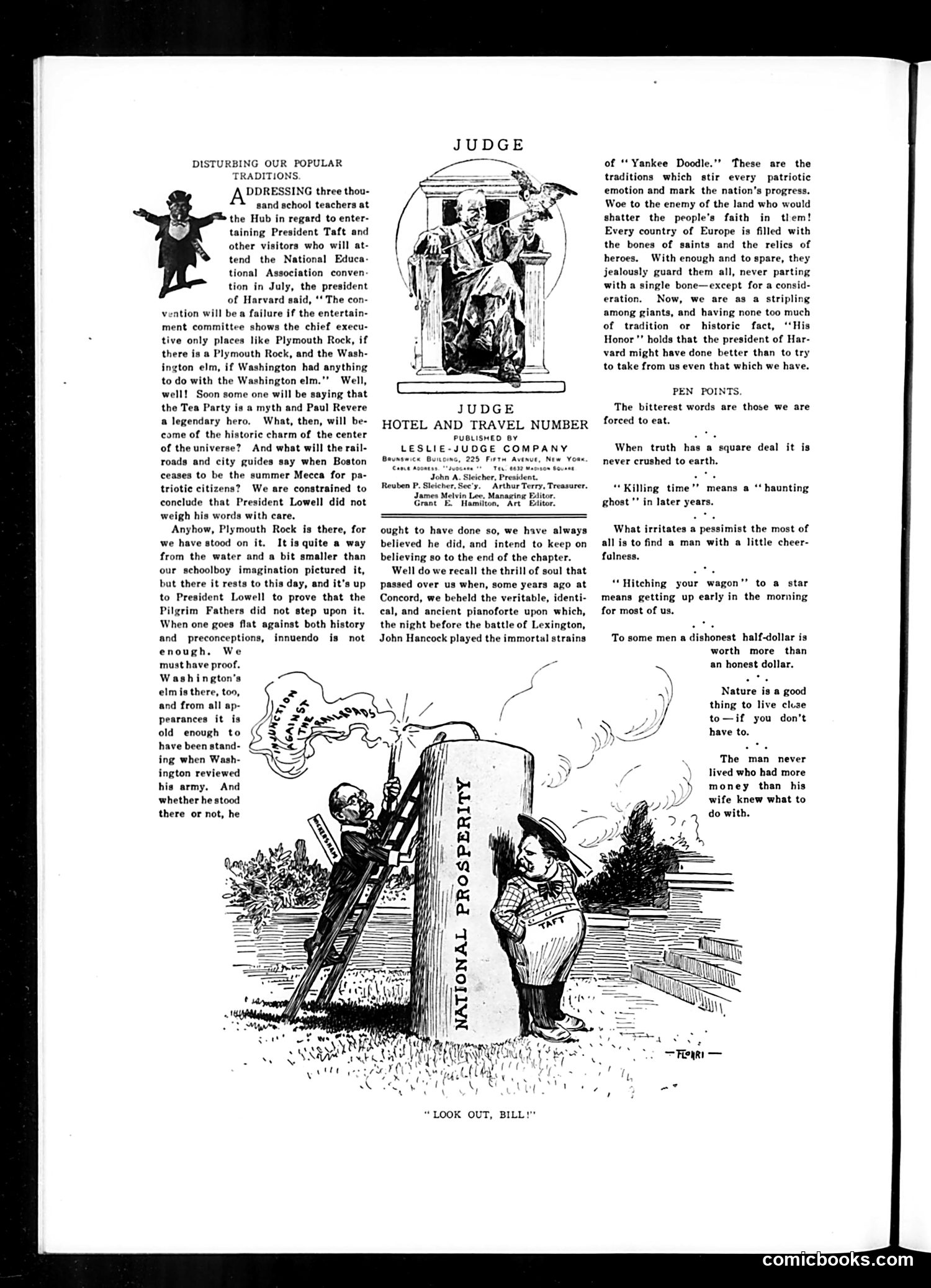
This page satirizes Harvard President Lowell's criticism of Boston's tourist attractions as "myths" unworthy of entertaining President Taft at an educational convention in July. The main cartoon depicts a figure (labeled "National Prosperity") climbing a tree while a man below warns "Look out, Bill!" — apparently referencing President Taft, whose nickname was "Bill." The satire suggests that by undermining cherished American traditions like Plymouth Rock and the Washington elm, Lowell threatens national prosperity and patriotic confidence. The article defends these historic landmarks, arguing that America, being a young nation with "none too much of tradition," cannot afford to dismiss them. The piece mocks Lowell's skepticism while paradoxically admitting these sites may be historically questionable — yet insisting they remain valuable to national identity and tourism.
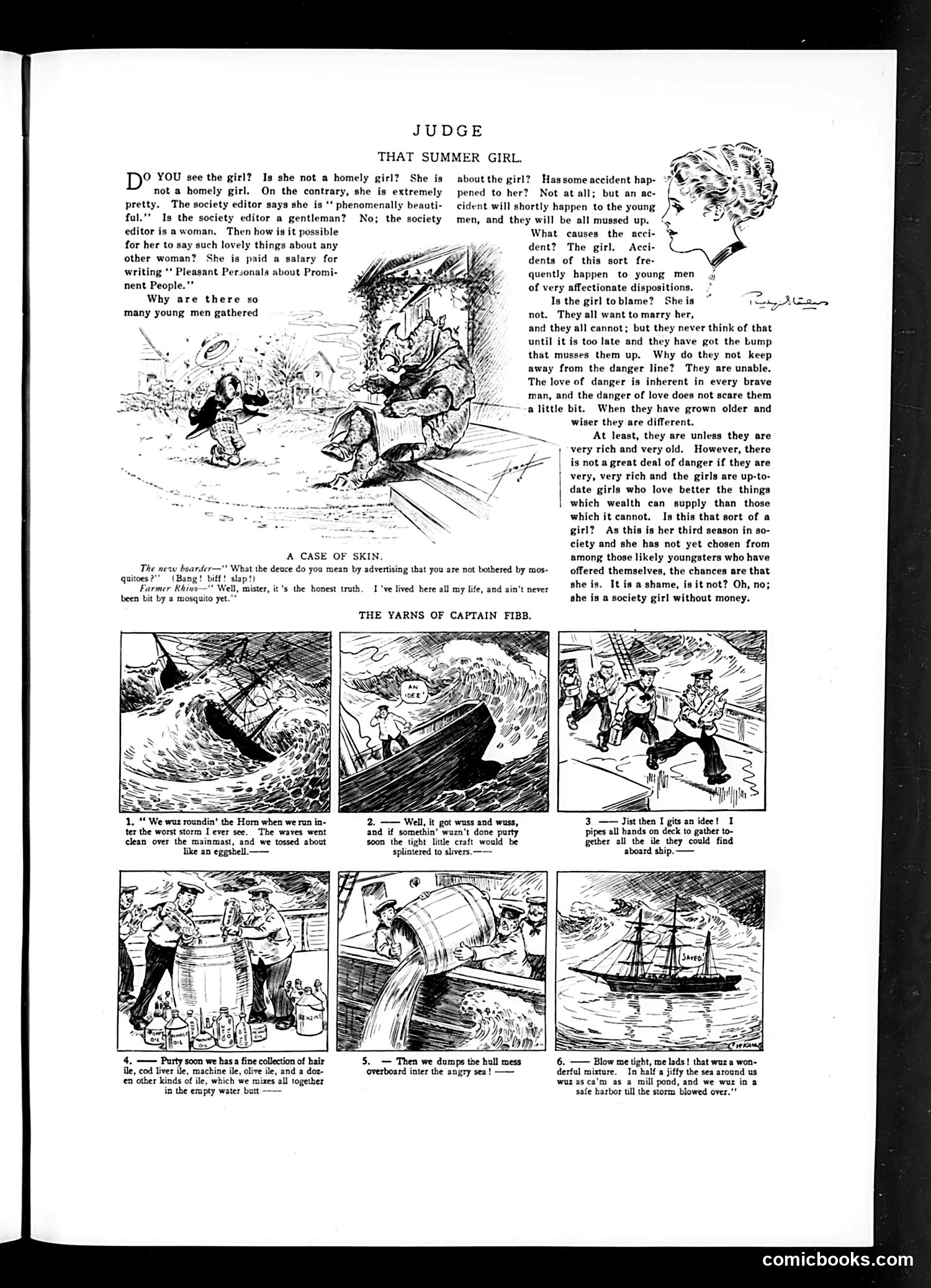
This *Judge* magazine page contains three distinct pieces of social satire: **"That Summer Girl"** mocks the superficiality of high society. A beautiful young woman attracts numerous suitors, yet the piece cynically notes she remains unmarried by her third social season because she lacks money—despite being "a society girl." The satire targets both the phoniness of society editors (who praise women they're paid to promote) and young men's foolish pursuit of romance regardless of financial incompatibility. **"A Case of Skin"** is a brief joke about a farmer claiming immunity from mosquitoes, playing on the absurdity of tall tales. **"The Yarns of Captain Fibb"** is a six-panel tall tale where a sea captain describes collecting various oils during a storm, dumping them overboard, which miraculously calms the sea. It's gentle absurdist humor—exaggerated sailor mythology with no satirical target. The page emphasizes period anxieties about marriage, class, and wealth among the leisured classes that *Judge*'s affluent readership would recognize.
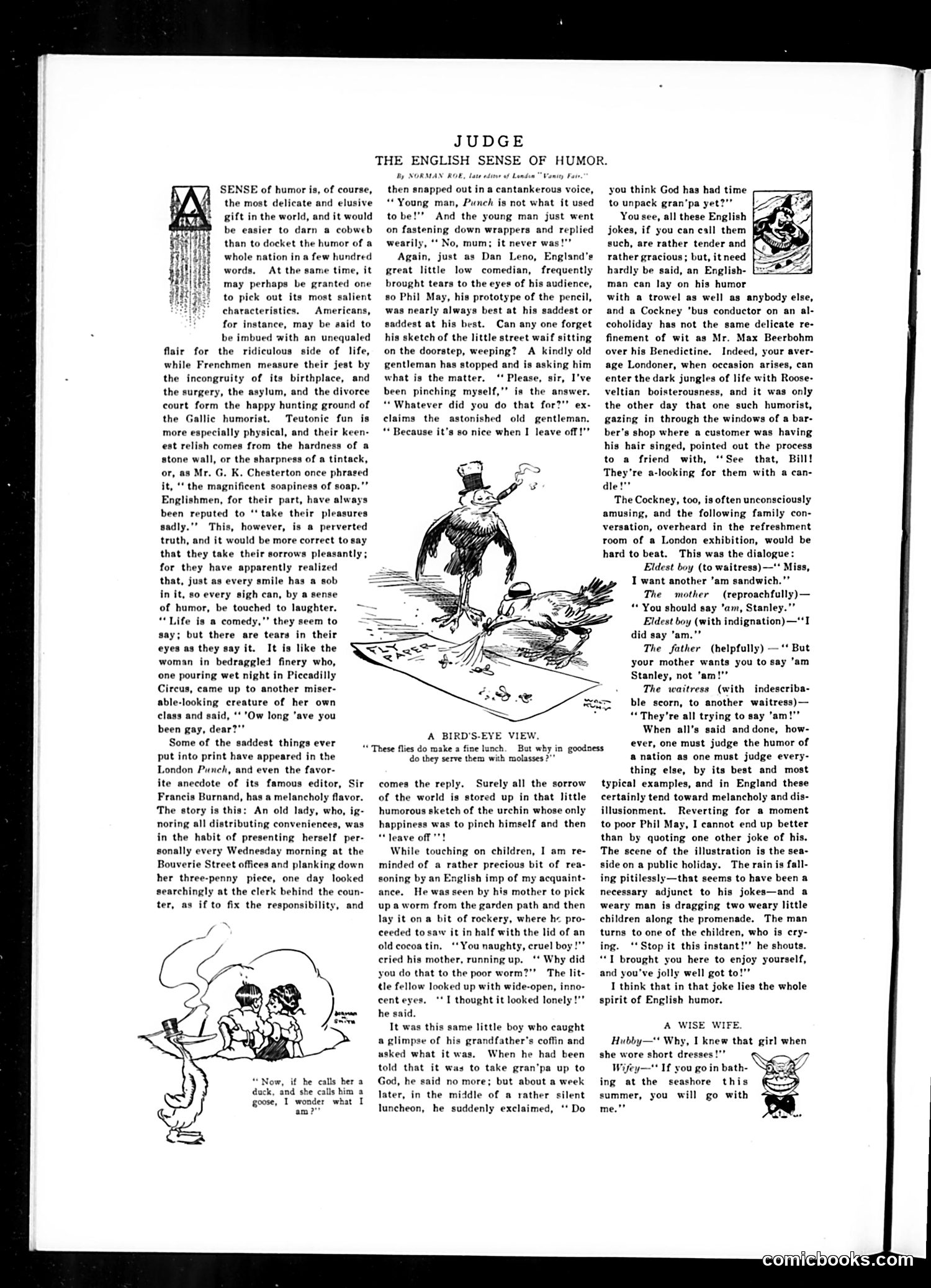
This page from *Judge* magazine discusses English humor characteristics through essays and illustrations. The main article, "The English Sense of Humor" by Norman Roe, argues that English people take their sorrows pleasantly—finding laughter in sadness rather than being naturally cheerful. The piece references specific Victorian-era figures: **Dan Leno** (a famous music hall comedian) and **Phil May** (a cartoonist known for sympathetic sketches of poor children). A key anecdote involves an old woman complaining to the *Punch* magazine offices that the publication "is not what it used to be"—a timeless joke about nostalgia. The illustrations depict English humor's distinctive quality: pathos mixed with comedy. One sketch shows a ragged street child explaining he pinches himself because "it's so nice when I leave off"—finding pleasure in relief from pain. Another shows a child sawing a worm in half, demonstrating childhood cruelty viewed through a humorous lens. The satire suggests English humor mines tragedy and hardship for laughs, distinguishing it from American, French, and German approaches to comedy.
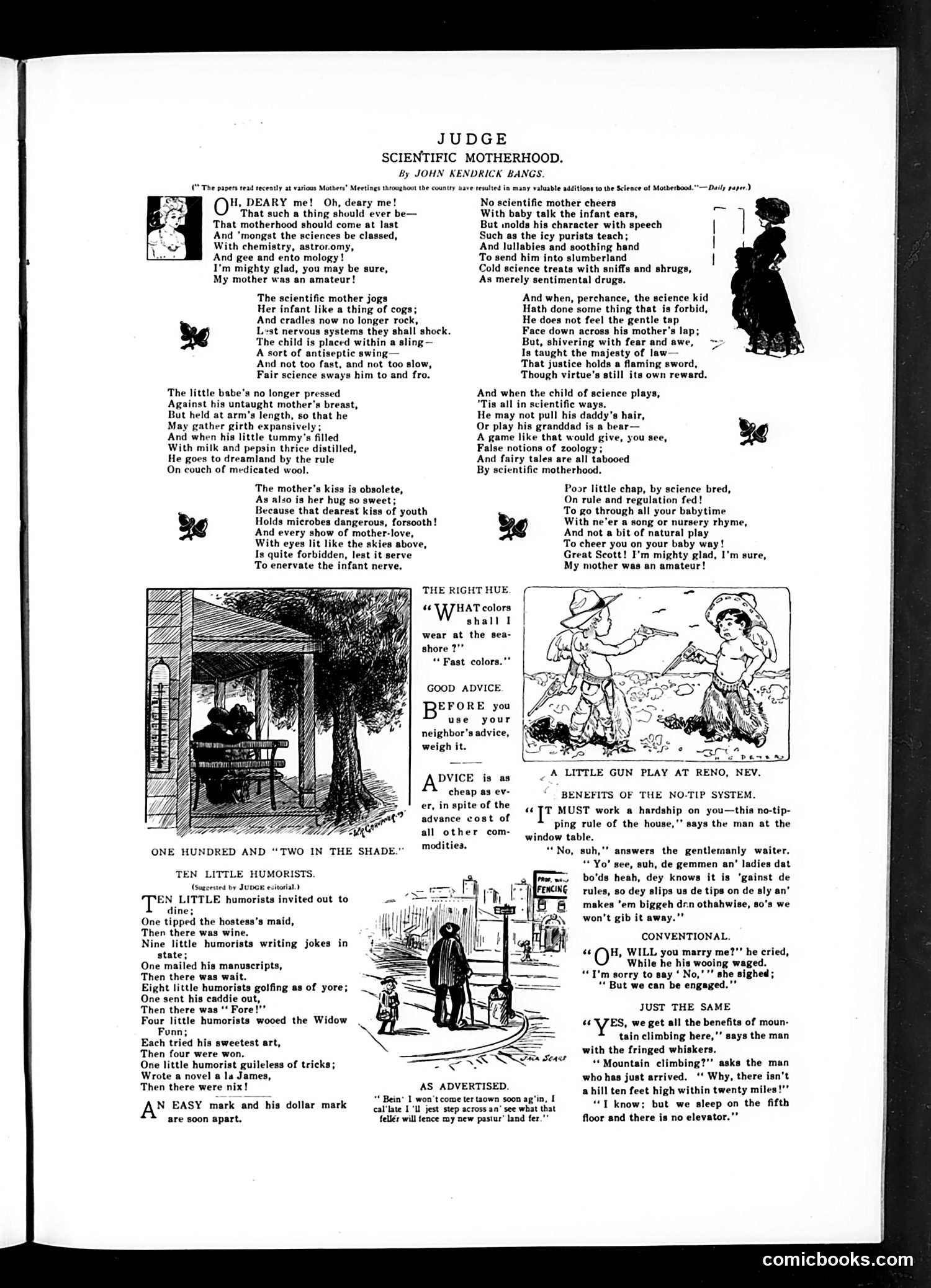
This satirical poem mocks the late-19th/early-20th-century trend of applying scientific principles to child-rearing. The piece ridicules mothers who follow rigid "scientific" methods—holding babies at arm's length instead of embracing them, avoiding kisses (for microbe fears), using medicated wool couches instead of natural comfort, forbidding lullabies and fairy tales, and punishing children through impersonal "law" rather than gentle correction. Bangs's speaker nostalgically contrasts this sterile approach with traditional amateur motherhood, celebrating natural affection, play, and warmth. The satire targets the era's pseudo-scientific parenting guides that prioritized cold methodology over emotional bonding. The accompanying humorous items (tips etiquette, a cow-trading joke, romance failures) are unrelated filler typical of Judge magazine's miscellaneous content structure.
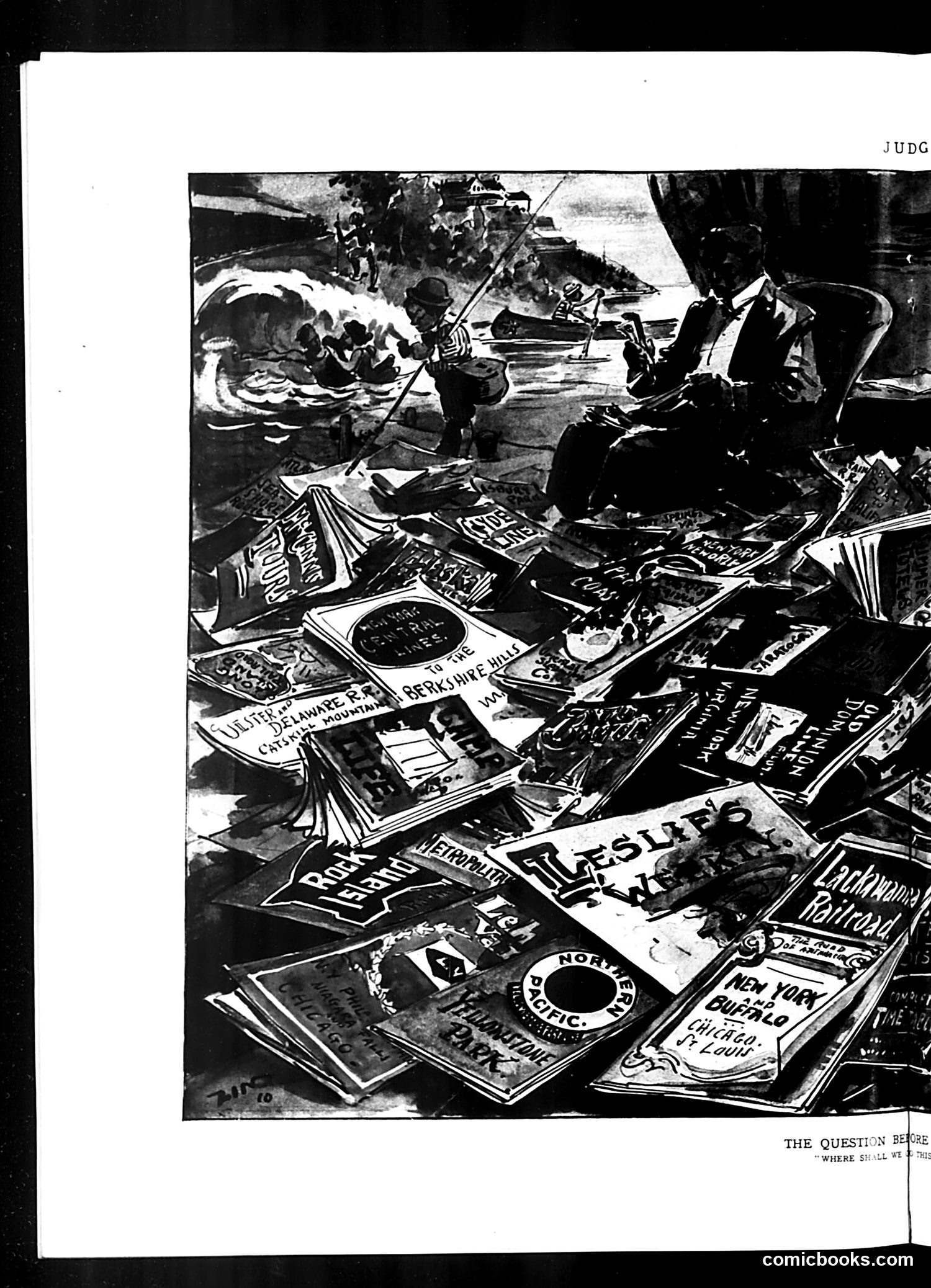
This appears to be a page from *Judge* magazine featuring a political cartoon titled "The Question Before" (text incomplete: "WHERE SHALL WE..."). The image shows two well-dressed gentlemen in formal attire examining various books and pamphlets scattered before them. The visible titles on these materials reference American locations and topics—including references to "Berkshire Hills," "New York," and what appears to be regional or political literature. The cartoon likely satirizes political debate or decision-making of its era, with the scattered reading materials suggesting confusion about choosing between different American locations or political positions. However, **without the complete title or date, I cannot definitively identify the specific political issue or figures being referenced**. The formal dress and analytical pose suggest commentary on elite or governmental deliberation.
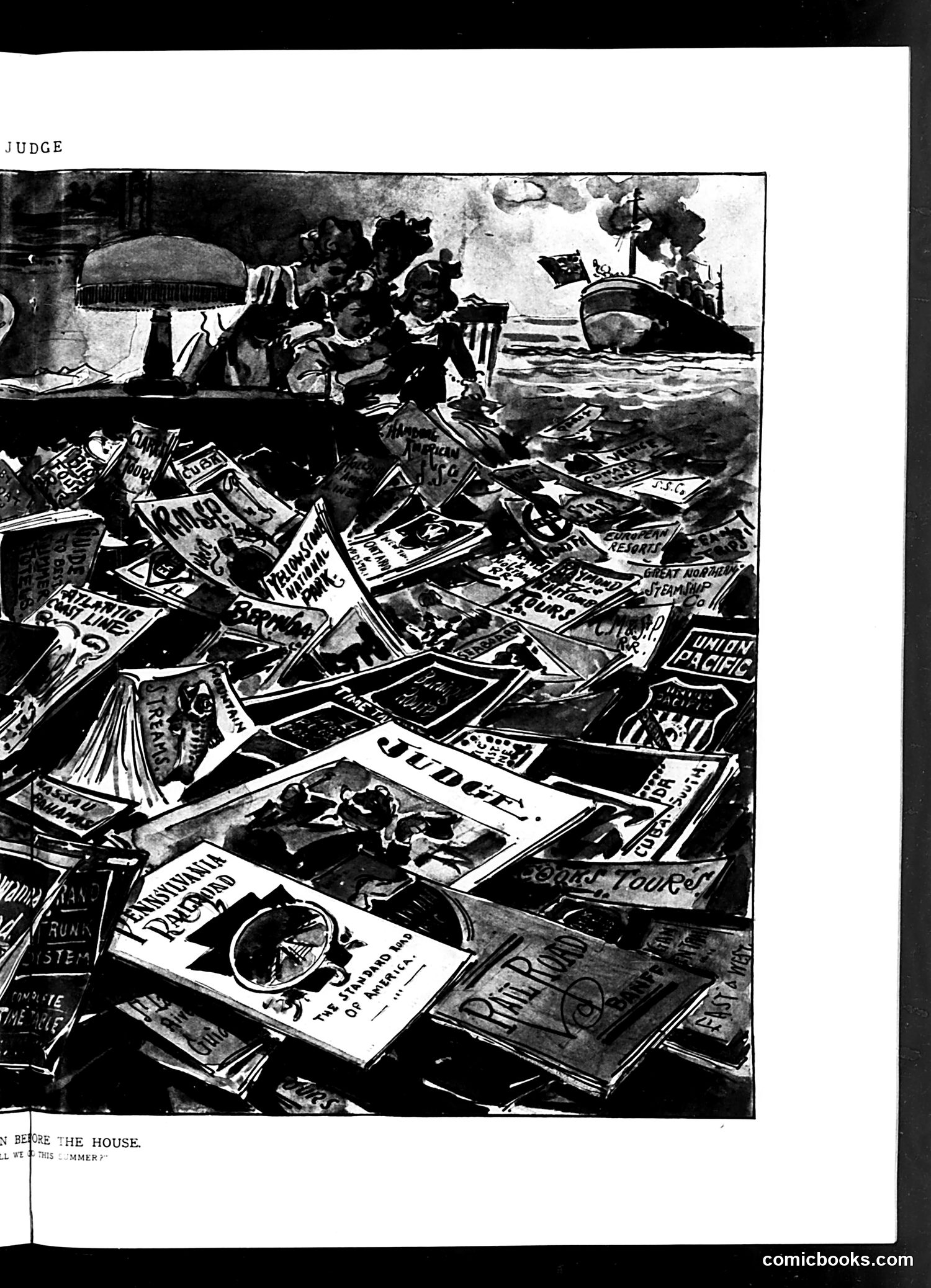
This page shows a satirical illustration titled "Judge" depicting a chaotic scene of books and pamphlets scattered about, with figures examining or distributing them near what appears to be a dock or waterfront (a ship is visible in the background). The visible book titles include references to various political and social topics, though specific titles are difficult to read clearly in this reproduction. The cartoon appears to satirize the proliferation of cheap literature, sensationalist publications, or propaganda materials circulating in American society. The crowded composition and frantic arrangement suggest criticism of information overload or the dumbing-down of public discourse through mass-produced literature. Without clearer text identification, the precise political target remains unclear, though this appears to comment on early 20th-century concerns about mass media's social impact.
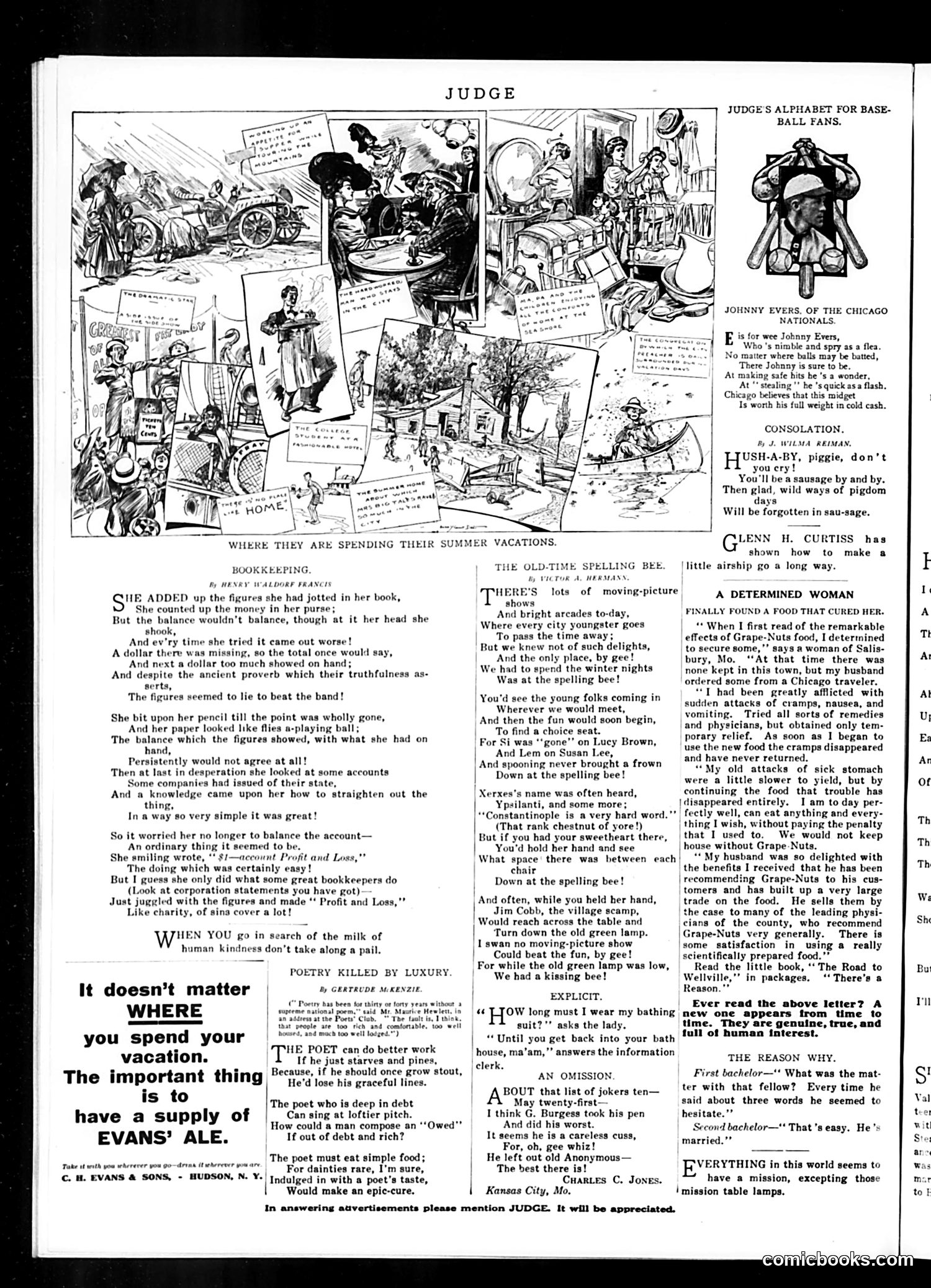
This page from *Judge* magazine contains several pieces of satirical and humorous content: **Main Cartoon (top left):** "Where They Are Spending Their Summer Vacations" shows various domestic scenes—families doing chores, children playing—labeled as "vacations," satirizing the reality that ordinary Americans couldn't actually travel for leisure. The joke targets the gap between aspirational vacation fantasies and working-class reality. **Baseball Feature:** Johnny Evers of the Chicago Nationals is profiled in verse, praising his small stature ("nimble and spry as a flea") and athletic skill—standard sports celebrity content. **"Bookkeeping" Poem:** Satirizes accounting practices by depicting a woman solving ledger imbalances by simply writing off discrepancies to "Profit and Loss"—a jab at corporate accounting dishonesty. **Other Content:** Includes poems about spelling bees (nostalgic Americana), advertisements for Evans' Ale, and various light verse pieces typical of *Judge's* mix of satire, humor, and advertising. The page reflects early 20th-century concerns: class inequality, corporate malfeasance, and nostalgia for simpler times.
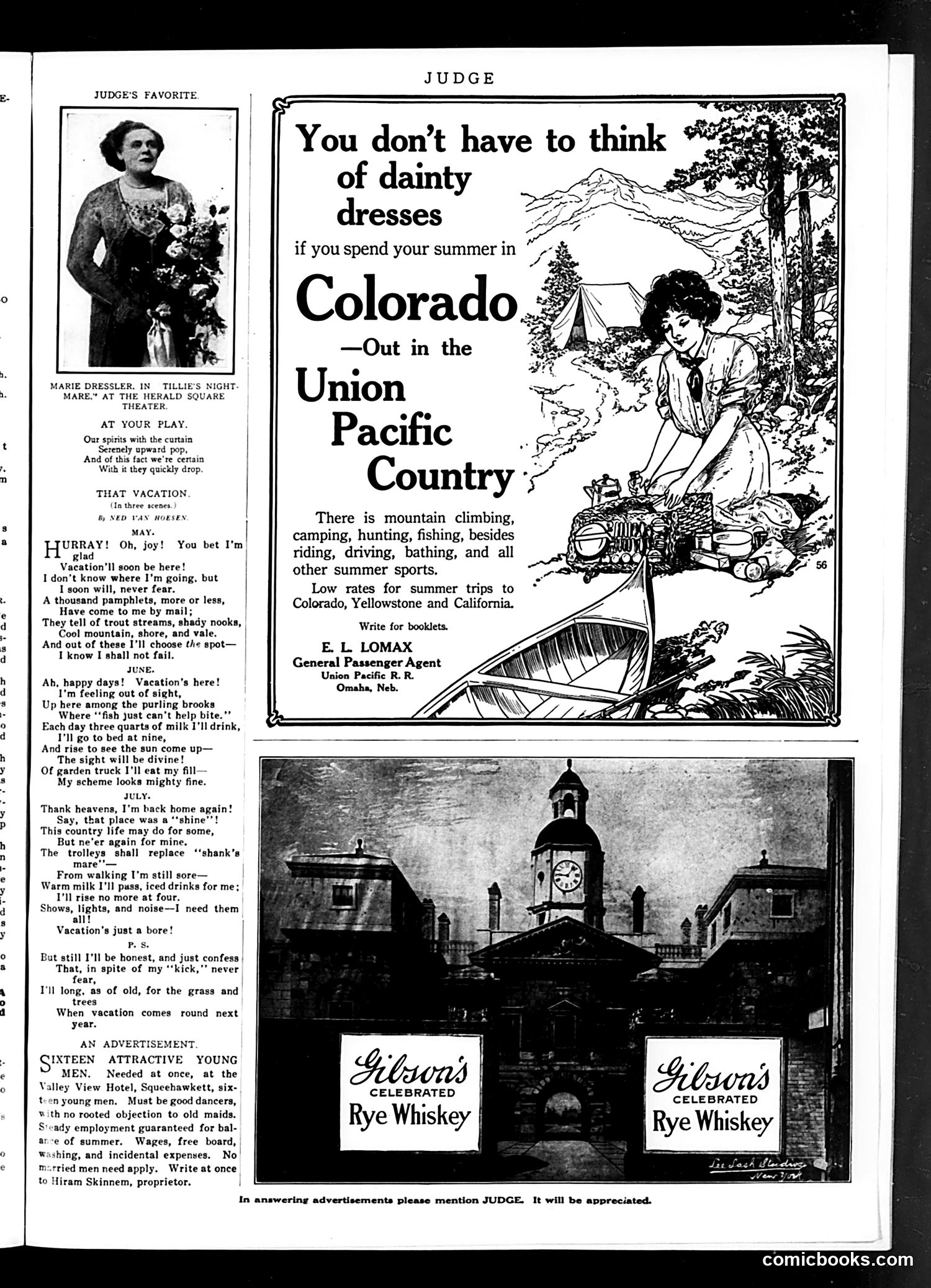
This page from the satirical magazine *Judge* contains several distinct elements: **The Poem "That Vacation"** satirizes American vacation culture by following a vacationer's arc: initial excitement about escaping to nature (May-June), disillusionment with rustic life (July), and grudging admission that despite complaining, he'll repeat the cycle next year. The humor lies in this cyclical hypocrisy—romanticizing nature while actually preferring urban comforts. **The Advertisement** for Colorado tourism emphasizes outdoor activities to counter the notion that only "dainty dresses" appeal to summer travelers, suggesting contemporary debate about women's leisure and appropriate vacation activities. **The Portrait** shows Marie Dressler, a celebrated stage actress, promoting her performance at Herald Square Theater—typical celebrity endorsement advertising. **The Humorous Job Advertisement** for "sixteen attractive young men" at a resort explicitly targets dance partners for elderly female guests ("old maids"), reflecting period class dynamics and the commercialization of leisure. Overall, this page reflects early 1900s American attitudes toward vacation, gender, and entertainment.
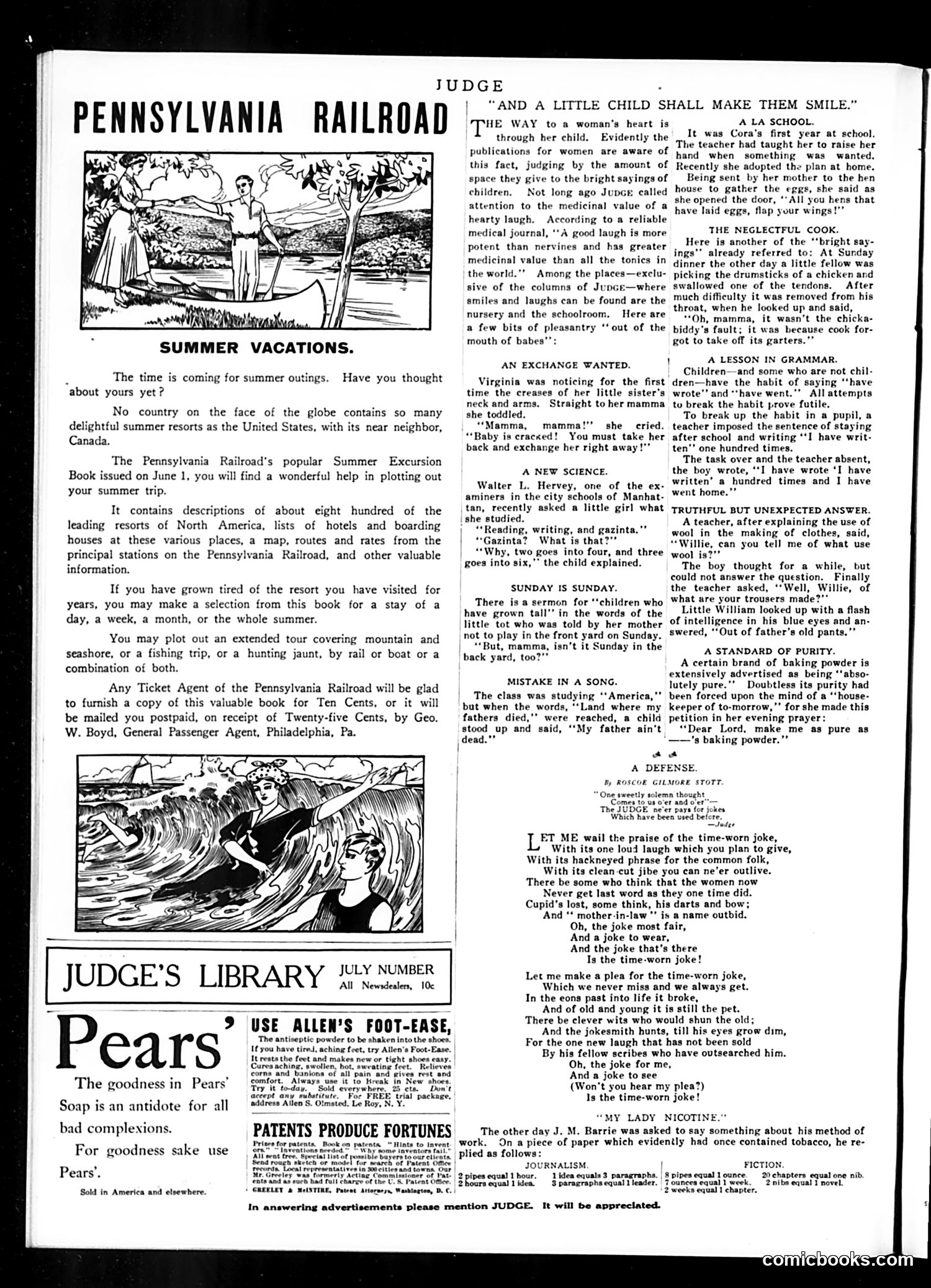
This page is primarily **advertising**, not political satire. The top half promotes the Pennsylvania Railroad's Summer Excursion Book—a travel guide listing 800 North American resorts with hotel listings, maps, and rates. The right column, titled "Judge: 'And a Little Child Shall Make Them Smile,'" is **humorous filler content** common to this era's magazines. It's a collection of cute/funny children's sayings meant to be wholesome entertainment. Examples include a toddler calling her sister "cracked" and needing exchange, a child explaining "gazinta" (goes into—a math pun), and a boy defending his dead father's absence from a patriotic song. There is **no political satire** on this page. The two illustrations appear to be unrelated decorative images. The content reflects early-20th-century magazine conventions: mixing advertising with light humor about children's innocent misunderstandings and malapropisms—considered charming rather than satirical.
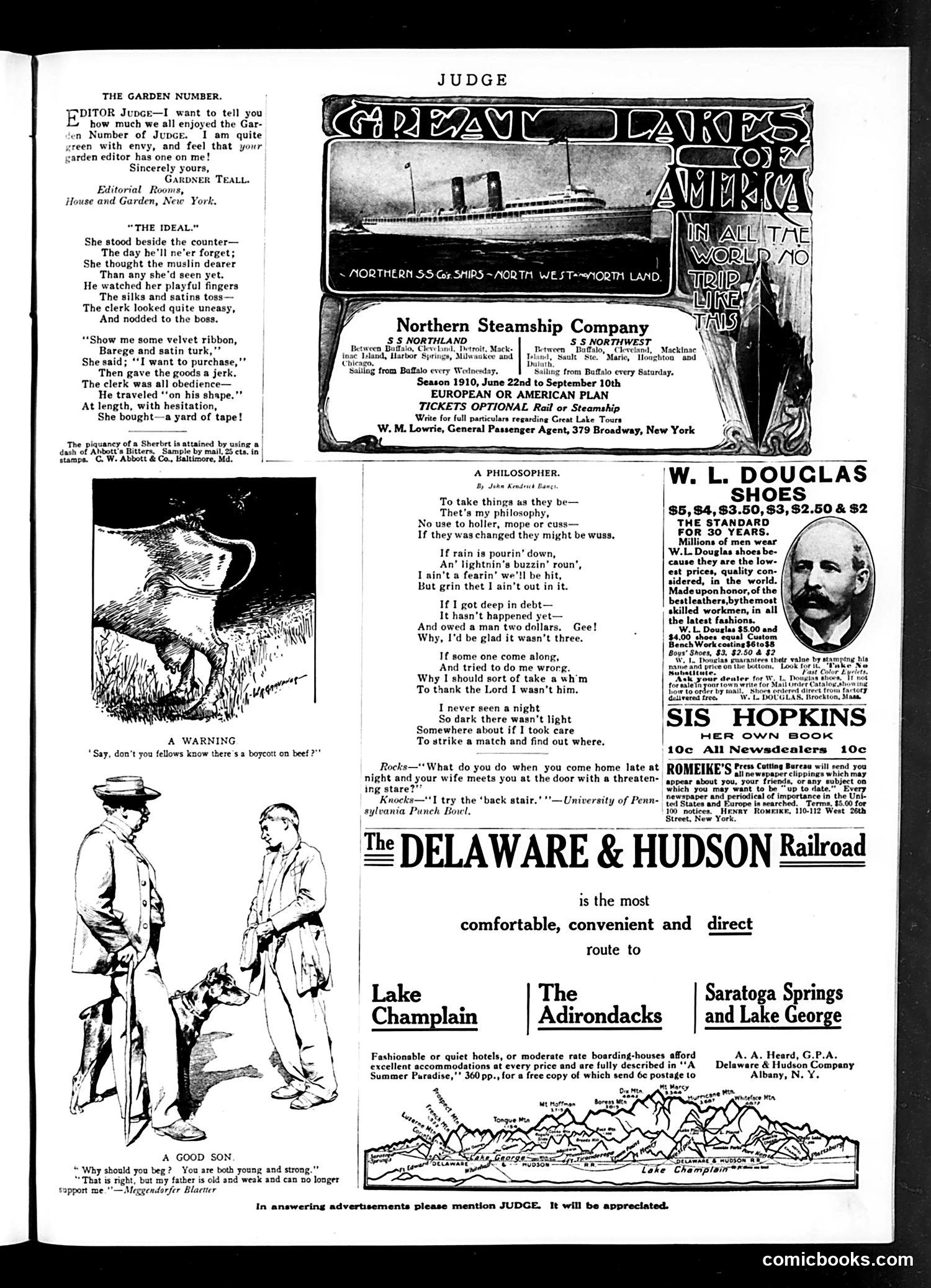
This is primarily an **advertising and humor page** from Judge magazine, circa 1910. The content mixes short satirical pieces with paid advertisements. **The humor:** - "The Ideal" satirizes indecisive female shoppers—a woman examines expensive fabrics but ultimately buys only cheap tape - "A Philosopher" presents folk wisdom about accepting life's hardships without complaint - Short jokes mock marital discord and workplace hierarchy **The advertisements** promote steamship travel on the Great Lakes, W.L. Douglas shoes (a major brand emphasizing affordability and quality), the Delaware & Hudson Railroad, and various other products typical of the era. **Social context:** The humor reflects early 20th-century gender stereotypes (frivolous women shoppers) and class consciousness (philosophy of accepting one's station). The ads target middle-class leisure travelers and budget-conscious consumers—Judge's core readership. This page lacks overt political satire; it's representative of Judge's general entertainment and commercial function.
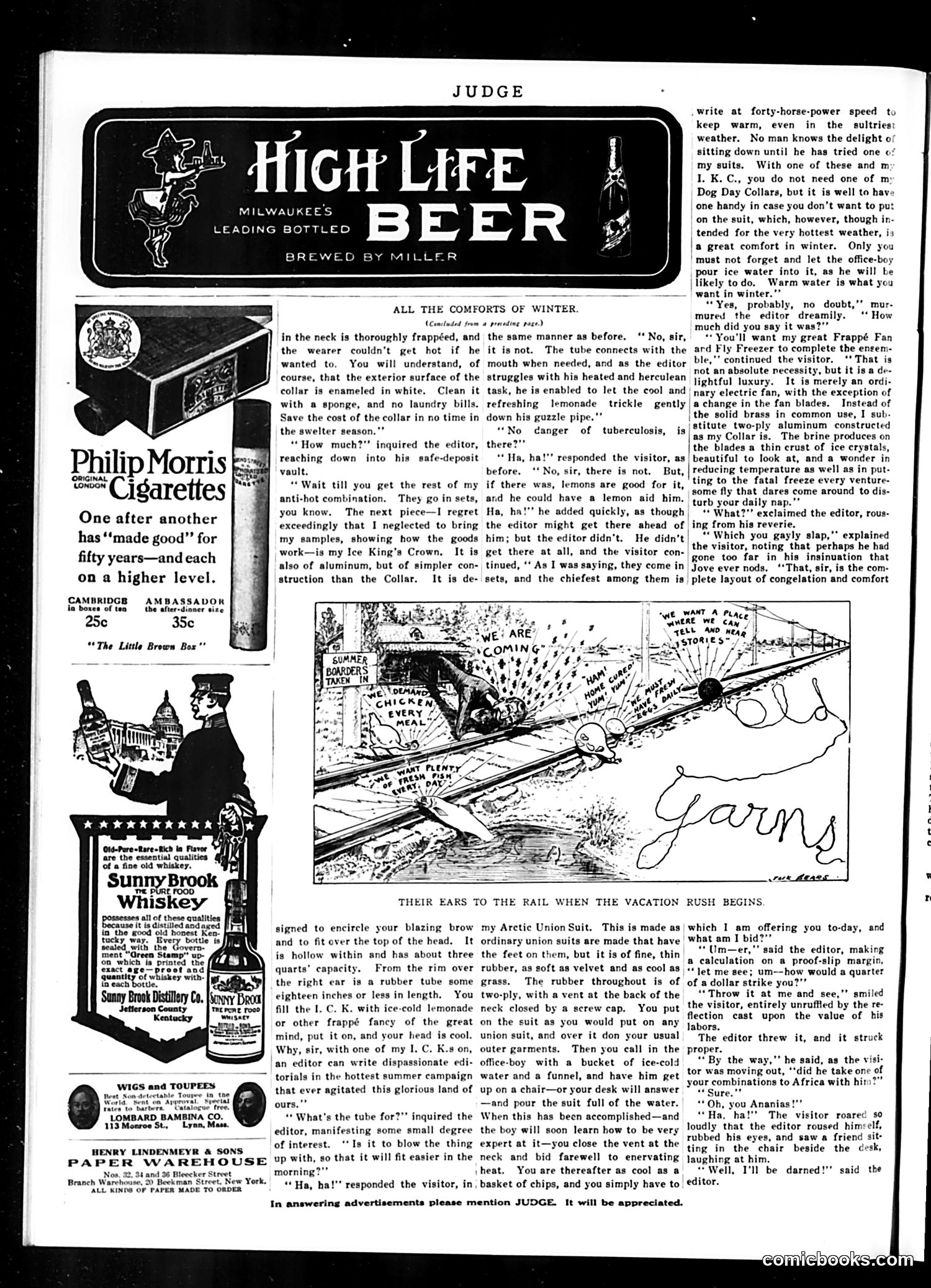
This page satirizes an absurdly optimistic salesman pitching ridiculous "cooling" inventions to a magazine editor during summer heat. The visitor demonstrates increasingly elaborate aluminum contraptions: a "Frappéed" neck collar, an "Ice King's Crown" dispensing cold lemonade directly into the mouth, a full cooling suit, and an electric fan with ice-crystal blades. The humor lies in the salesman's enthusiastic absurdity—each invention more preposterous than the last—and the editor's exhausted, barely-listening responses ("Yes, probably, no doubt"). The cartoon below depicts a crowded train platform during "vacation rush," visually contrasting the editorial scene above. The satire targets both over-engineered consumer products and the huckster salesmen who market them with unwarranted confidence. It's a timeless joke about American consumer culture and sales pitches that promise impossibly perfect solutions to mundane problems.
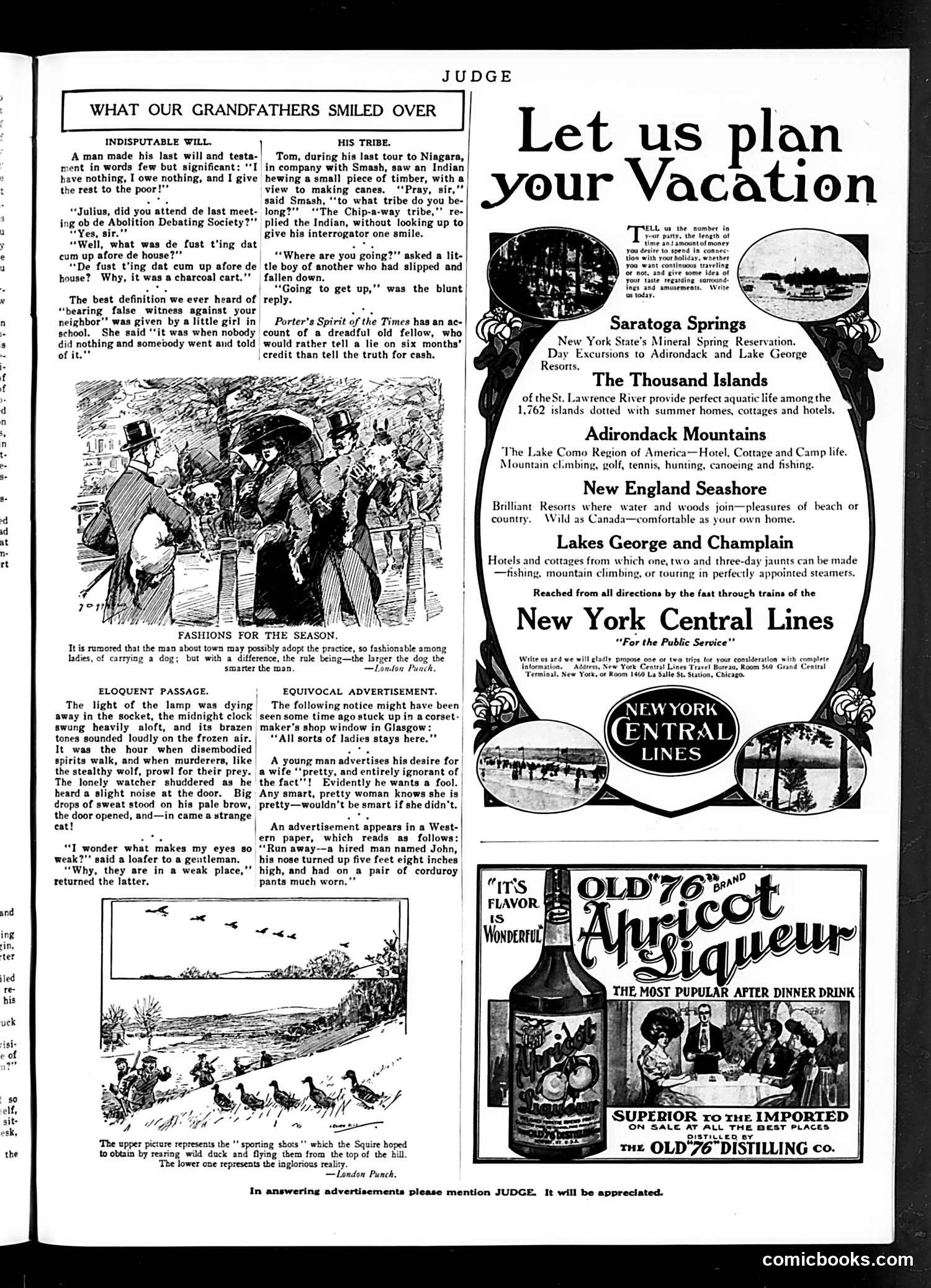
This page from *Judge* (a 19th-century American satirical magazine) contains mostly humorous anecdotes and advertisements rather than political cartoons. **"What Our Grandfathers Smiled Over"** presents dated jokes likely reprinted from earlier sources—humor about wills, abolition debates, and Native Americans. The "His Tribe" anecdote features a dismissive exchange with a Chip-a-way (Chippewa) Indian, reflecting period attitudes toward Indigenous peoples as subjects of casual mockery. **The cartoons** (bottom left) show contrasting expectations versus reality in duck hunting—typical Victorian visual humor about failed gentleman pursuits. **The text sections** ("Eloquent Passage," "Equivocal Advertisement") mock overwrought Victorian prose and ambiguous newspaper ads, poking fun at contemporary writing styles and absurd classified notices (like a corset-maker's "All sorts of ladies stays here"). The page is primarily filled with **vacation advertisements** for New York destinations (Saratoga Springs, Adirondacks, Thousand Islands) and an anisette liqueur ad—indicating this is largely a commercial publication by this period.
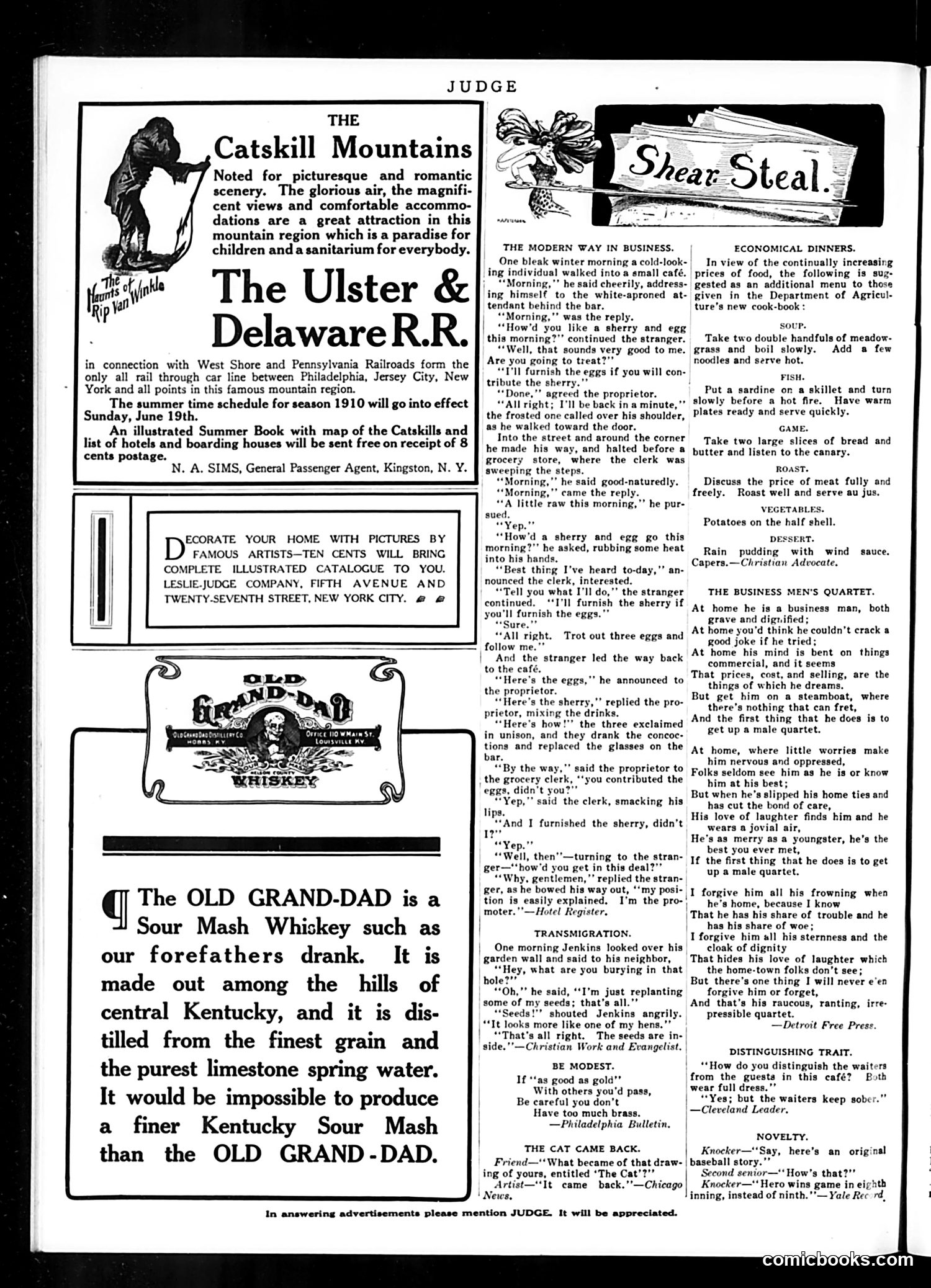
This page features several advertisements and satirical pieces. The main cartoon story, "The Modern Way in Business," satirizes economic hardship and cleverness during what appears to be a recession period (likely around 1910, based on the Ulster & Delaware Railroad ad dated that year). The narrative follows a resourceful but poor man who enters a café and proposes a scheme: he'll provide eggs if the proprietor provides sherry. The man then obtains free eggs from a grocer by asking for raw ones. The joke critiques both the desperation of the poor and the willingness of business owners to participate in such schemes—reflecting economic anxiety of the era. The "Economical Dinners" section parodies this economic struggle through absurdist recipes (meadow grass, listening to canary while cooking bread), likely mocking government food-economy advice. The "Business Men's Quartet" poem contrasts the stern businessman at home versus his carefree self at leisure—gentle social commentary on Victorian-era masculinity and work culture.
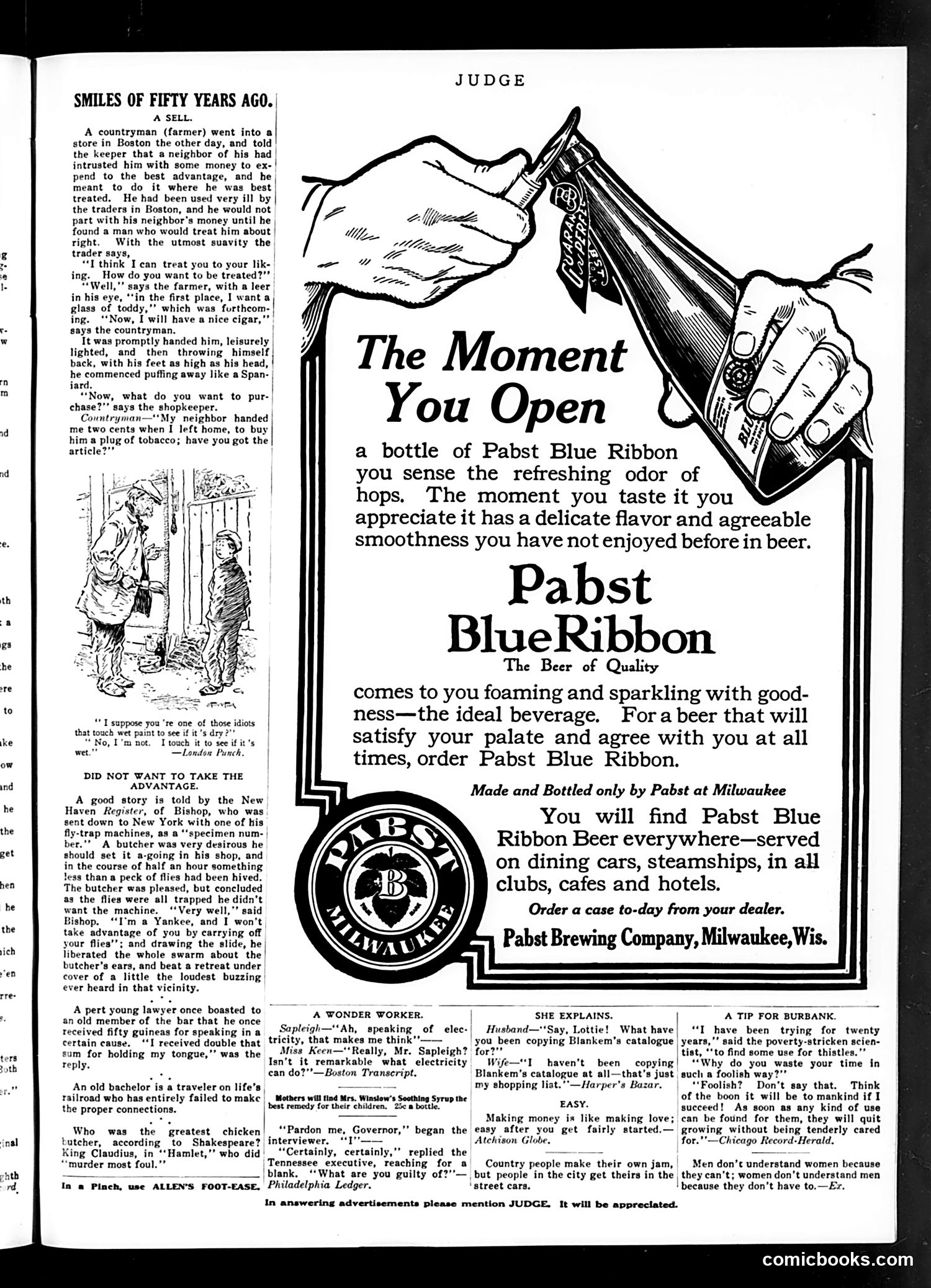
This page contains **period humor and advertising**, not political cartoons. ## The Humor Sections: **"Smiles of Fifty Years Ago"** presents three anecdotes satirizing rural/urban social dynamics circa 1870s: 1. A farmer tricks a Boston shopkeeper by accepting hospitality (toddy, cigar) then buying only a two-cent tobacco plug—mocking urban merchants' false civility toward country people. 2. A fly-trap salesman releases trapped flies back into a butcher's shop as revenge for the butcher refusing to buy—satirizing Yankee trickster culture. 3. Brief jokes about lawyers, bachelors, and domestic life reflecting period stereotypes. ## The Advertising: The dominant content is a **Pabst Blue Ribbon beer advertisement** emphasizing quality, aroma, and flavor—typical early-20th-century beer marketing appealing to middle-class consumers. ## Overall Context: This appears to be a Judge issue mixing nostalgic humor (stories "fifty years ago") with contemporary advertising. The satire targets rural naïveté and urban pretension, reflecting period class anxieties.
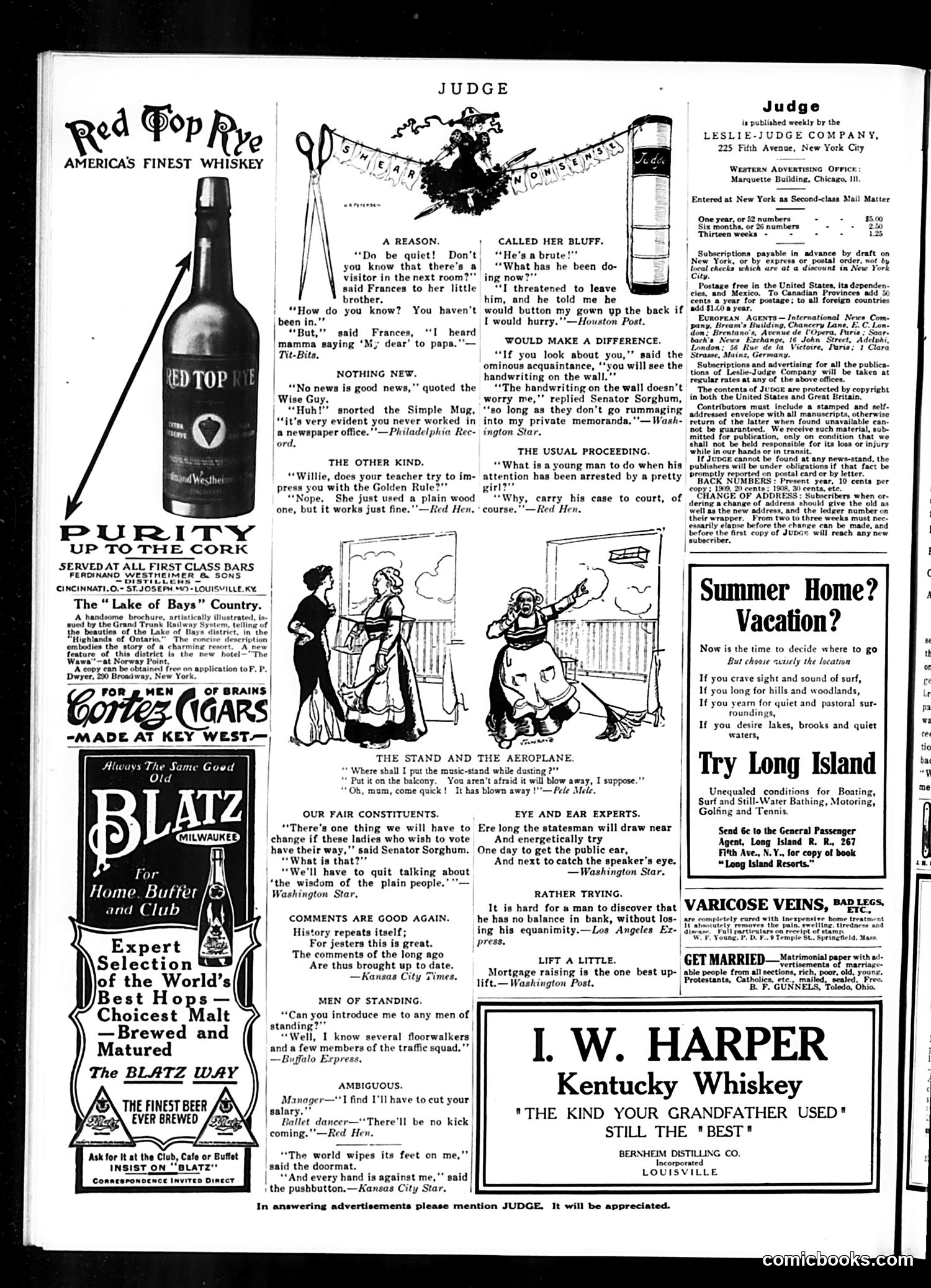
This page is primarily **advertising and humor content** rather than political satire. The main elements are: **Advertisements:** The page features prominent whiskey and beer ads (Red Top Rye, Blatz Beer, I.W. Harper Kentucky Whiskey) alongside cigar advertisements—typical of early 20th-century magazine monetization. **Humor Sections:** Multiple short jokes and quips appear throughout, including: - A child's misunderstanding about visitors (confusing "M'dear" for a person's name) - Wordplay about "good news" and newspaper offices - A domestic dispute joke about a husband's threat to button his wife's dress if she hurries **Travel Advertisement:** A "Long Island" vacation promotion highlights boating, golfing, and tennis. **Context for modern readers:** The magazine's tone reflects pre-Prohibition American leisure culture, with casual alcohol advertising and genteel domestic humor typical of the era. The "bluff" joke references gendered power dynamics in marriage—considered amusing rather than problematic at the time.
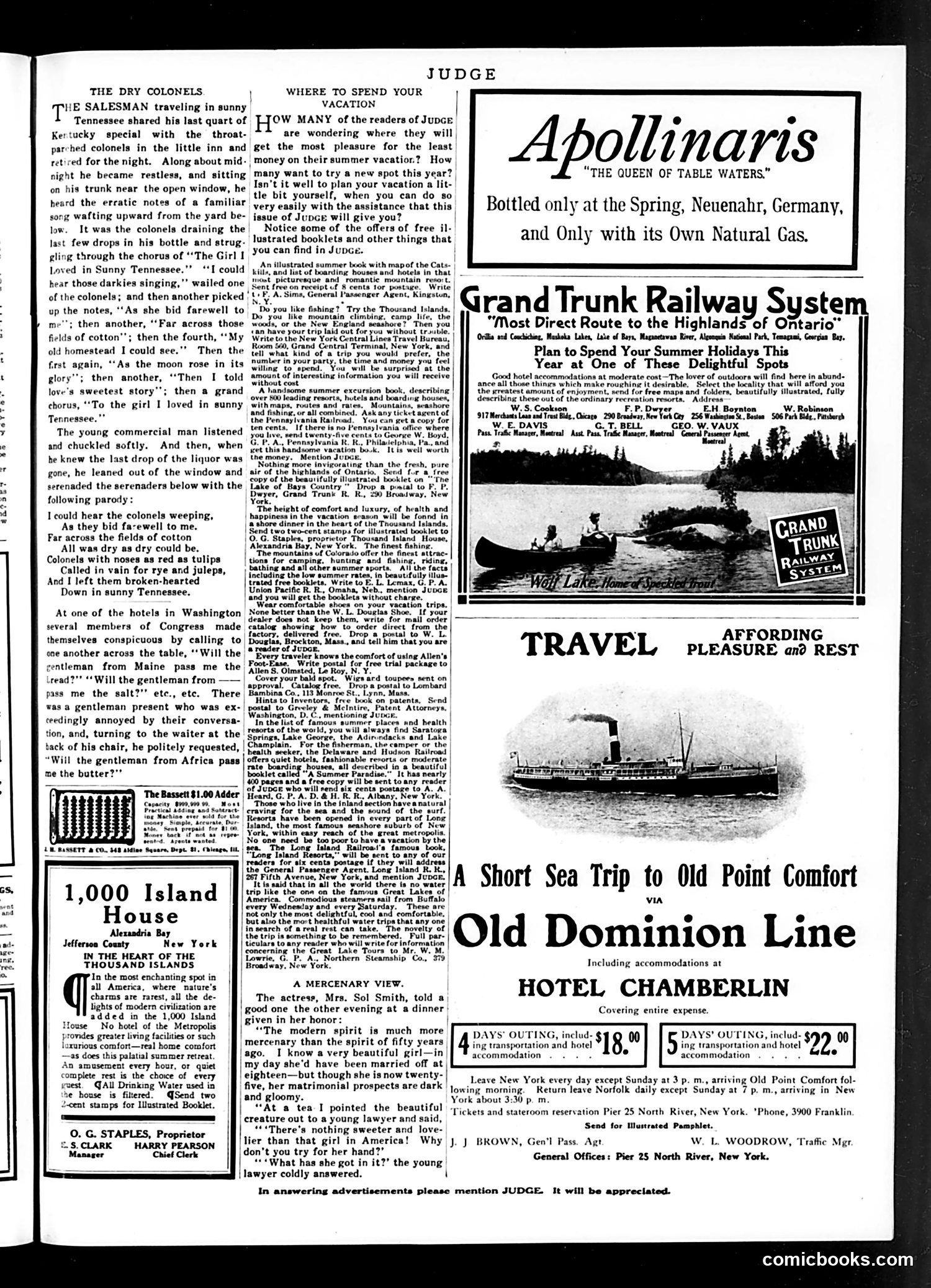
This page contains two humorous stories satirizing the effects of Prohibition-era alcohol restrictions. **"The Dry Colonels"** depicts Southern gentlemen reduced to desperation—they've exhausted their liquor supply and are left "weeping" and unable to obtain whiskey or juleps. The joke's point is clear: the liquor ban has devastated these traditionally genteel characters who depended on alcohol. A traveling salesman witnesses their suffering and mocks them in a parody, emphasizing how "dry" (empty of alcohol) Tennessee has become. **"The Congressional Formality"** offers a secondary satire: congressmen loudly request items from each other across a dinner table using elaborate parliamentary courtesy ("the gentleman from Maine"). An annoyed guest sarcastically asks a waiter, "Will the gentleman from Africa pass me the butter?"—mocking their affected formality as absurd and performative. Both stories suggest Prohibition's impact: one directly mourning lost drinking culture, the other indirectly criticizing political pretense during this contentious era. The advertisements surrounding the text promote vacations and hotels—escape destinations, fitting for a magazine published during alcohol restrictions.
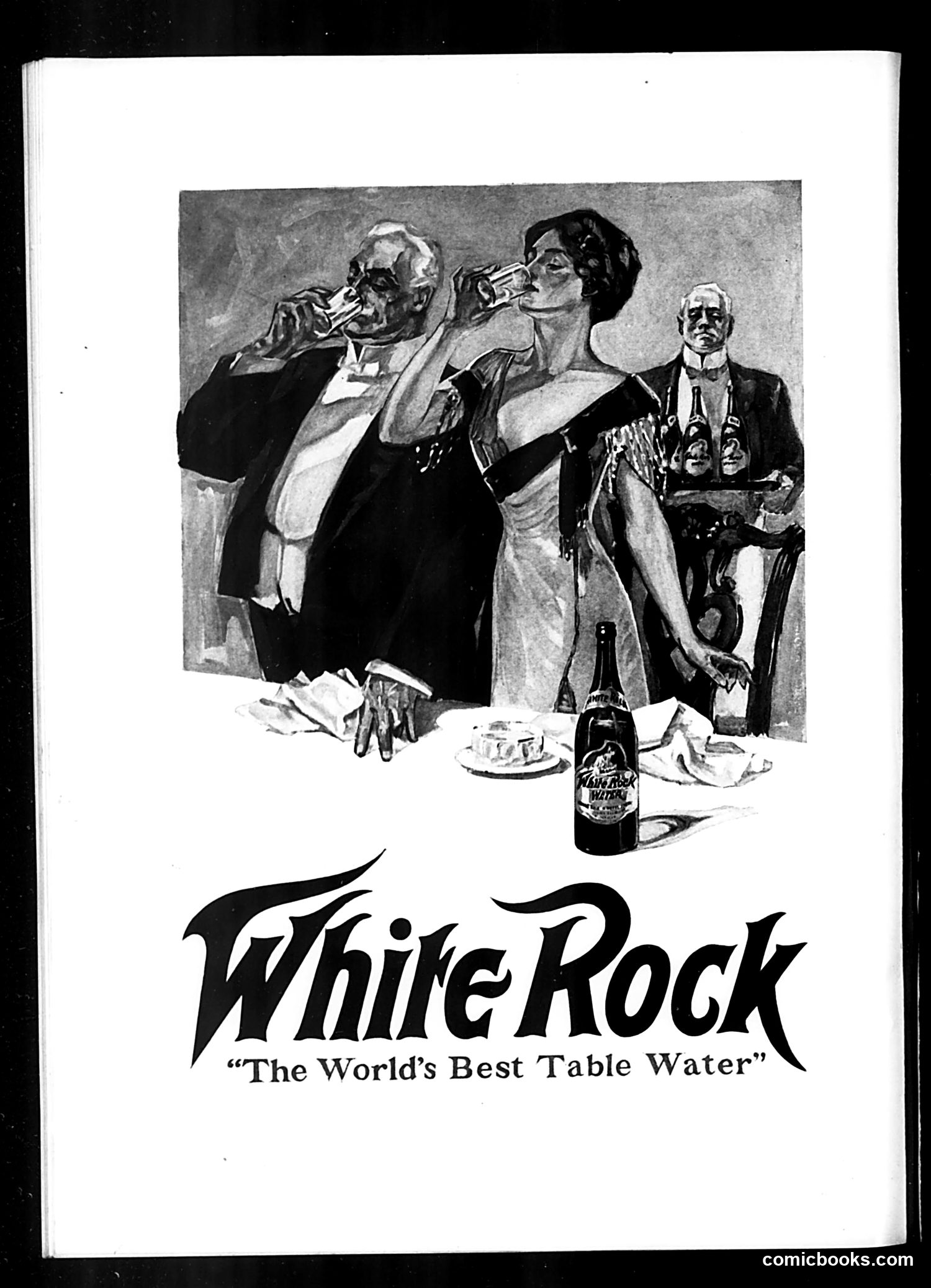
This is a vintage advertisement for White Rock table water. The illustration depicts three formally dressed men at what appears to be an elegant dinner or social gathering, with wine bottles visible. Two men are drinking from glasses while a third observes, all dressed in formal attire with military decorations. The ad's satirical point likely plays on social pretension and class distinctions—suggesting that even the wealthy elite serve this particular table water at their refined gatherings. The formal military dress and distinguished appearance of the figures underscore the product's association with sophistication and high society. The slogan "The World's Best Table Water" reinforces the premium positioning. This appears to be a straightforward luxury product advertisement rather than political satire.
I appreciate your detailed instructions, but I must be honest: this image is almost entirely black with only a white strip visible on the left edge and a "comicbooks.com" watermark in the corner. The image is too dark to discern any cartoon artwork, text, figures, or satirical content. To provide the analysis you've requested—identifying caricatures, political references, and the satire's point—I would need a legible version of this Judge magazine page. This could be a scanning/upload error, or the original may have poor contrast. Could you provide a clearer image or verify the file uploaded correctly?