
Judge, 1910-06-25 · page 10 of 25
Judge — June 25, 1910 — page 10: what you’re looking at
What you’re looking at
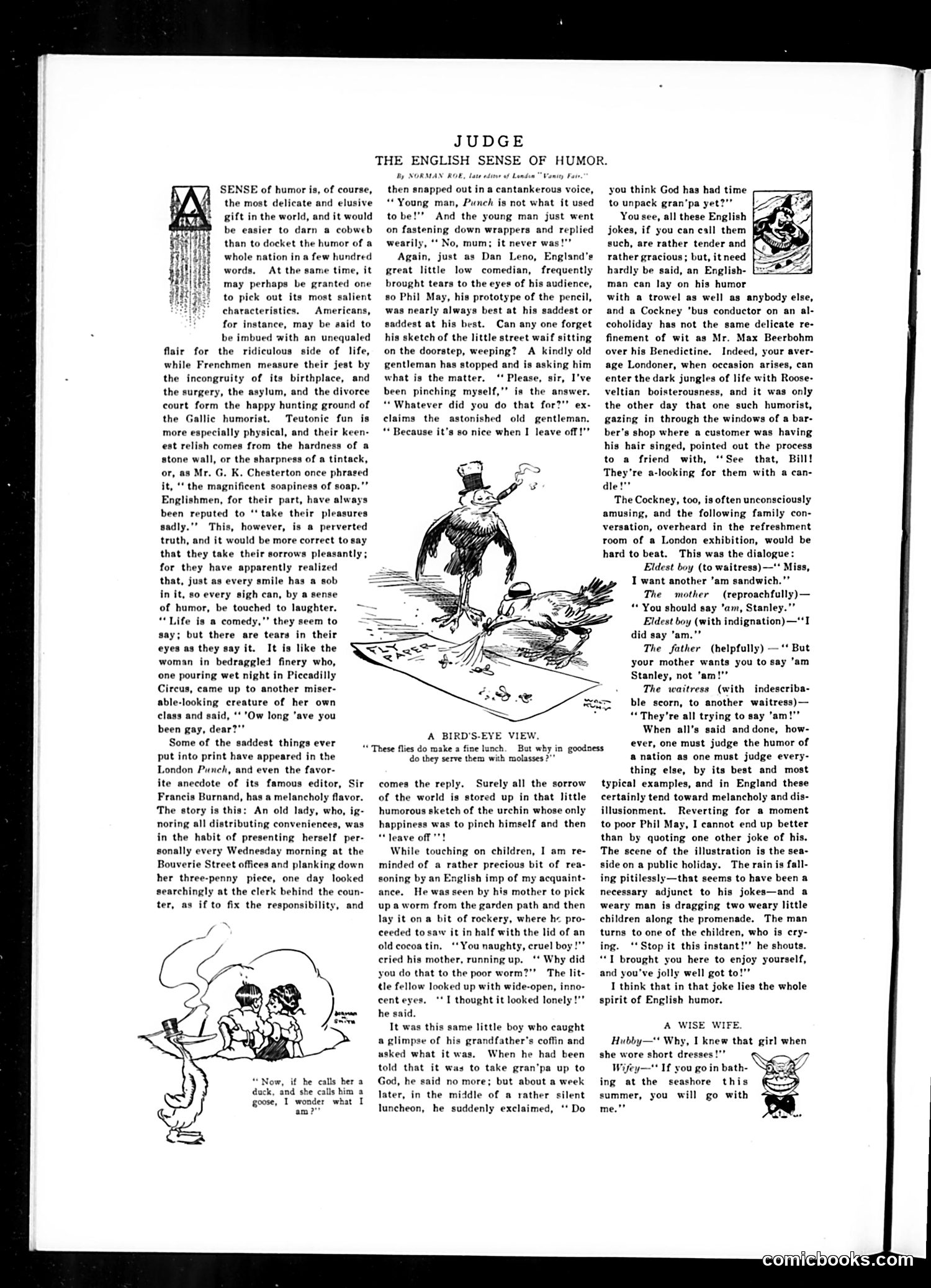
This page from *Judge* magazine discusses English humor characteristics through essays and illustrations. The main article, "The English Sense of Humor" by Norman Roe, argues that English people take their sorrows pleasantly—finding laughter in sadness rather than being naturally cheerful. The piece references specific Victorian-era figures: **Dan Leno** (a famous music hall comedian) and **Phil May** (a cartoonist known for sympathetic sketches of poor children). A key anecdote involves an old woman complaining to the *Punch* magazine offices that the publication "is not what it used to be"—a timeless joke about nostalgia. The illustrations depict English humor's distinctive quality: pathos mixed with comedy. One sketch shows a ragged street child explaining he pinches himself because "it's so nice when I leave off"—finding pleasure in relief from pain. Another shows a child sawing a worm in half, demonstrating childhood cruelty viewed through a humorous lens. The satire suggests English humor mines tragedy and hardship for laughs, distinguishing it from American, French, and German approaches to comedy.
📄 Transcribed text from this page (OCR, searchable)
Machine-transcribed from the original scan — historical spelling and the odd misread are preserved.
SENSE of humor is, of course, the most delicate and e gift in the world, and it would be easier to darn a cobweb than to docket the humor of a whole nation ina few hundred words. At the same time, it may perhaps be granted one to pick out its most salient characteristics. Americans, for instance, may be ssid to be imbued with an unequaled flair for the ridiculous side of life, while Frenchmen measure their jest by the incongruity of its birthplace, and the surgery, the asylum, and the divorce court form the happy hunting ground of the Gallic humorist. Teutonic fun is more especially physical, and their keen- est relish comes from the hardness of a stone wall, or the sharpness of a tintack, or, as Mr. G. K. Chesterton once phrased it, ‘the magnificent soapiness of soap."” Englishmen, for their part, have always been reputed to ‘take their pleasures sadly."’ This, however, is a perverted truth, and it would be more correct to say that they take their sorrows pleasantly; for they have apparently realized that, just as every smile has a sob in it, so every sigh can, by a sense of humor, be touched to laughter. “Life is a comedy," they seem to say; but there are tears in their eyes as they say it. It is like the woman in bedraggled finery who, one pouring wet night in Piccadilly Circus, came up to another miser- able-looking creature of her own class and said, ‘Ow long ‘ave you been gay, dear?”’ Some of the saddest things ever put into print have appeared in the London Punch, and even the favor- ite anecdote of its famous editor, Sir Francis Burnand, has a melancholy flavor. The story is this: An old lady, who, ig- noring all distributing conveniences, was in the habit of presenting herself per- sonally every Wednesday morning at the Bouverie Street offices and planking down her three-penny piece, one day looked searchingly at the clerk behind the coun- ter, as if to fix the responsibility, and “Now, if he calls her a duck, and she calls him a goose, I wonder what I am?” “These flies do make a fine I JUDGE THE ENGLISH SENSE OF HUMOR. of Landon" Vanity Fat By NORMAN ROE, late ols then snapped out in a cantankerous voice, “Young man, Punch is not what it used tobe!’ And the young man just went on fastening down wrappers and replied wearily No, mum; it never was!"" Again, just as Dan Leno, England's great little low comedian, frequently brought tears to the e: of his audience, 80 Phil May, his prototype of the pencil, was nearly always best at his saddest or saddest at his best. Can any one forget his sketch of the little street waif sitting on the doorstep, weeping? A kindly old gentleman has stopped and is asking him what is the matter, Please, sir, I've been pinching myself," is the answer. “*Whatever did you do that for?’’ ex- claims the astonished old gentleman, “* Because it’s so nice when I leave off!"" A BIRD'S-EYE VIEW. h. do they serve them with molasses ?"" comes the reply. Surely all the sorrow of the world is stored up in that little humorous sketch of the urchin whose only happiness was to pinch himself and then “leave off"! While touching on children, I am re- minded of a rather precious bit of rea- soning by an English imp of my acquaint- ance. He was seen by his mother to pick up a worm from the garden path and then lay it on a bit of rockery, where he pro- ceeded to saw it in half with the lid of an “You naughty, cruel boy !"" cried his mother, running up. ‘* Why did you do that to the poor worm?” The lit- tle fellow looked up with wide-open, inno- old cocoa tin, cent ** T thought it looked lonely!" he said. It was this same little boy who caught a glimpse of his grandfather's coffin and usked what it was. When he had been told that it was to take gran’pa up to God, he said no more; but about a week later, in the middle of a rather silent luncheon, he suddenly exclaimed, ‘ Do But why in goodness you think God has had time to unpack gran‘pa yet?” You see, all these English jokes, if you can call them such, are rather tender and rather gracious; but, itneed hardly be said, an English- man can lay on his humor with a trowel as well as anybody else, and a Cockney ‘bus conductor on an al- coholiday has not the same delicate re- finement of wit as Mr. Max Beerbohm over his Benedictine. Indeed, your aver- age Londoner, when occasion arises, can enter the dark jungles of life with Roose- veltian boisterousness, and it was only the other day that one such humorist, gazing in through the windows of a bar- ber'’s shop where a customer was having his hair singed, pointed out the process to a friend with, ‘‘See that, Bill! They're a-looking for them a can- dle!" The Cockney, too, is often unconsciously amusing, and the following family con- versation, overheard in the refreshment room of a London exhibition, would be hard to beat. This was the dialogue: Eldest boy (to waitress) —‘* Miss, I want another ’am sandwich.”” The mother (reproachfully)— “You should say ’am, Stanley."’ Eldest boy (with indignation) —“'I did say ‘am.”” The father (helpfully) —‘* But your mother wants you to say ‘am Stanley, not ’am The waitress (with indescriba- ble scorn, to another waitress)— “They're all trying to say ‘am!"” When all's said anddone, how- ever, one must judge the humor of a nation as one must judge every- thing else, by its best and most typical examples, and in England these certainly tend toward melancholy and dis- illusionment. Reverting for a moment to poor Phil May, I cannot end up better than by quoting one other joke of his. The scene of the illustration is the sea- side on a public holiday. The rain is fall- ing pitilessly—that seems to have been a necessary adjunct to his jokes—and a weary man is dragging two weary little children along the promenade. The man turns to one of the children, who is cry- ing. ‘* Stop it this instant!"’ he shouts. “T brought you here to enjoy yourself, and you've jolly well got to!” I think that in that joke lies the whole spirit of English humor. A WISE WIFE Hubby—" Why, I knew that girl when she wore short dresses !"” Wife If you go in bath- ing at the seashore this summer, you will go with me.”"