
Judge, 1910-06-25 · page 8 of 25
Judge — June 25, 1910 — page 8: what you’re looking at
What you’re looking at
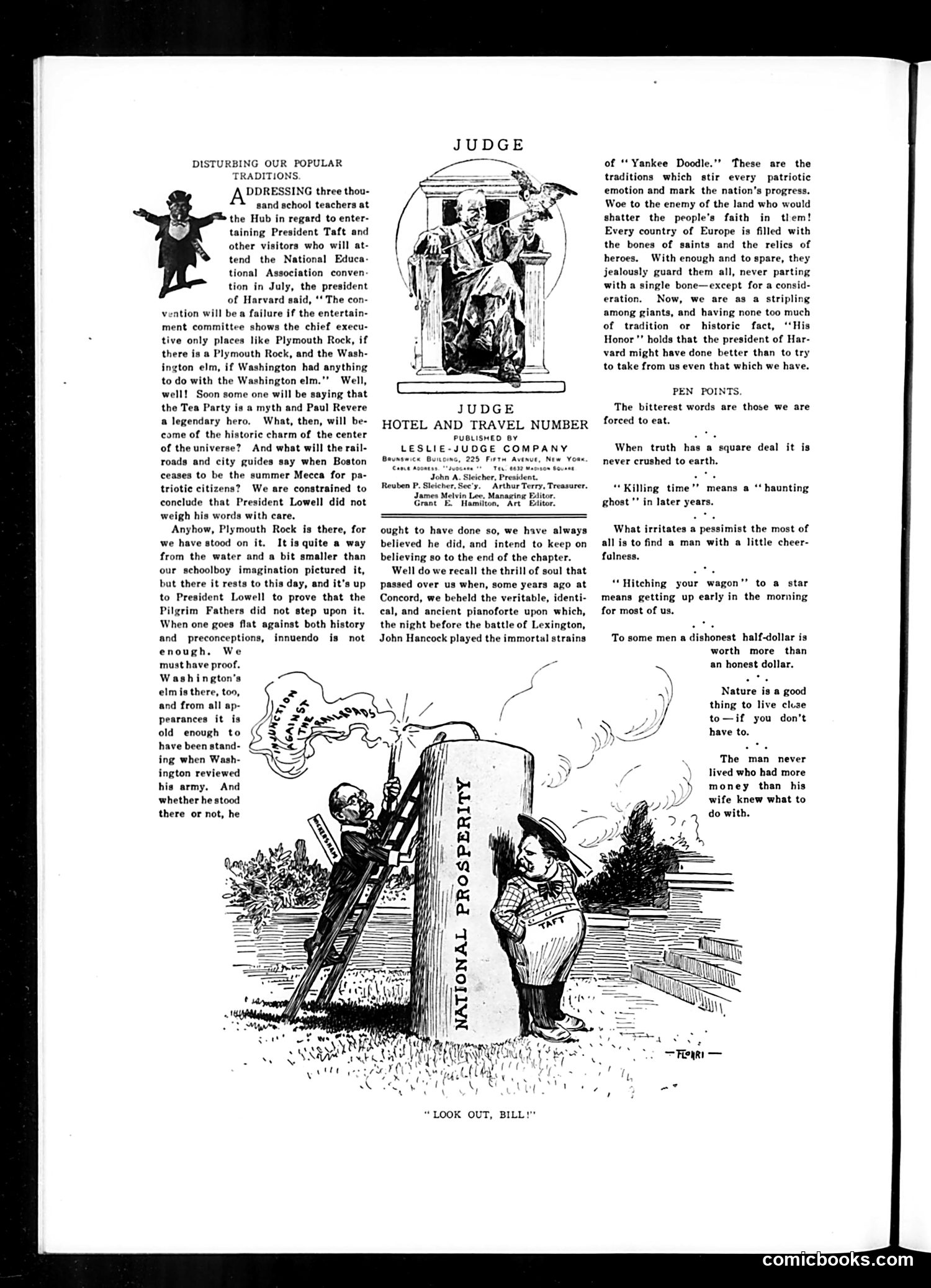
This page satirizes Harvard President Lowell's criticism of Boston's tourist attractions as "myths" unworthy of entertaining President Taft at an educational convention in July. The main cartoon depicts a figure (labeled "National Prosperity") climbing a tree while a man below warns "Look out, Bill!" — apparently referencing President Taft, whose nickname was "Bill." The satire suggests that by undermining cherished American traditions like Plymouth Rock and the Washington elm, Lowell threatens national prosperity and patriotic confidence. The article defends these historic landmarks, arguing that America, being a young nation with "none too much of tradition," cannot afford to dismiss them. The piece mocks Lowell's skepticism while paradoxically admitting these sites may be historically questionable — yet insisting they remain valuable to national identity and tourism.
📄 Transcribed text from this page (OCR, searchable)
Machine-transcribed from the original scan — historical spelling and the odd misread are preserved.
DISTURBING OUR POPULAR TRADITIONS. DDRESSING three thou- sand school teachers at the Hub in regard to enter- taining President Taft and other visitors who will a! tend the National Educa- tional Association conven- tion in July, the president of Harvard said, ‘‘ The con- vention will be a failure if the entertain- ment committee shows the chief execu- tive only places like Plymouth Rock, if there is a Plymouth Rock, and the Wash- ington elm, if Washington had anything to do with the Washington elm. Well, well! Soon some one will be saying that the Tea Party is a myth and Paul Revere a legendary hero. What, then, will be- come of the historic charm of the center of the universe? And what will the rail- roads and city guides say when Boston ceases to be the summer Mecea for pa- triotic citizens? We are constrained to conclude that President Lowell did not weigh his words with care. Anyhow, Plymouth Rock is there, for we have stood on it. It is quite a way from the water and a bit smaller than our schoolboy imagination pictured it, but there it rests to this day, and it’s up to President Lowell to prove that the Pilgrim Fathers did not step upon it. When one goes flat against both history and preconceptions, innuendo is not enough. We must have proof. Washington's elm is there, too, and from all ap- pearances it is old enough to ( have been stand- ing when Wash- ington reviewed his army. And whether he stood there or not, he HOTEL AND TRAVEL NUMBER PUBLISHED BY LESLIE-JUDGE COMPANY 225 Firtn Avenue, New You Tee. 22 Maoraoe Sousa Sleicher, President. sec'y. Arthur Terry, Treasurer. ought to have done so, we have always believed he did, and intend to keep on believing so to the end of the chapter. Well do we recall the thrill of soul that passed over us when, some years ago at Concord, we beheld the veritable, identi- cal, and ancient pianoforte upon which, the night before the battle of Lexington, John Hancock played the immortal strains “LOOK OUT, BILL!" of ‘Yankee Doodle.” These are the traditions which stir every patriotic emotion and mark the nation’s progress. Woe to the enemy of the land who would shatter the people's faith in tlem! Every country of Europe is filled with the bones of saints and the relics of heroes. With enough and to spare, they jealously guard them all, never parting with a single bone—except for a consid- eration. Now, we are as a stripling among giants, and having none too much of tradition or historic fact, “His Honor "* holds that the president of Har- vard might have done better than to try to take from us even that which we have. PEN POINTS The bitterest words are those we are forced to eat. When truth has a square deal it is never crushed to earth. “Killing time’? means a ‘haunting ghost "’ in later years What irritates a pessimist the most of all is to find a man with a little cheer- falness. “‘Hitehing your wagon” to a star means getting up early in the morning for most of us. To some men a dishonest half-dollar is worth more than an honest dollar. Nature is a good thing to live chse to—if you don’t have to. The man never lived who had more money than his wife knew what to do with. comicbooks.com