
A complete issue · 16 pages · 1907
Judge — January 12, 1907
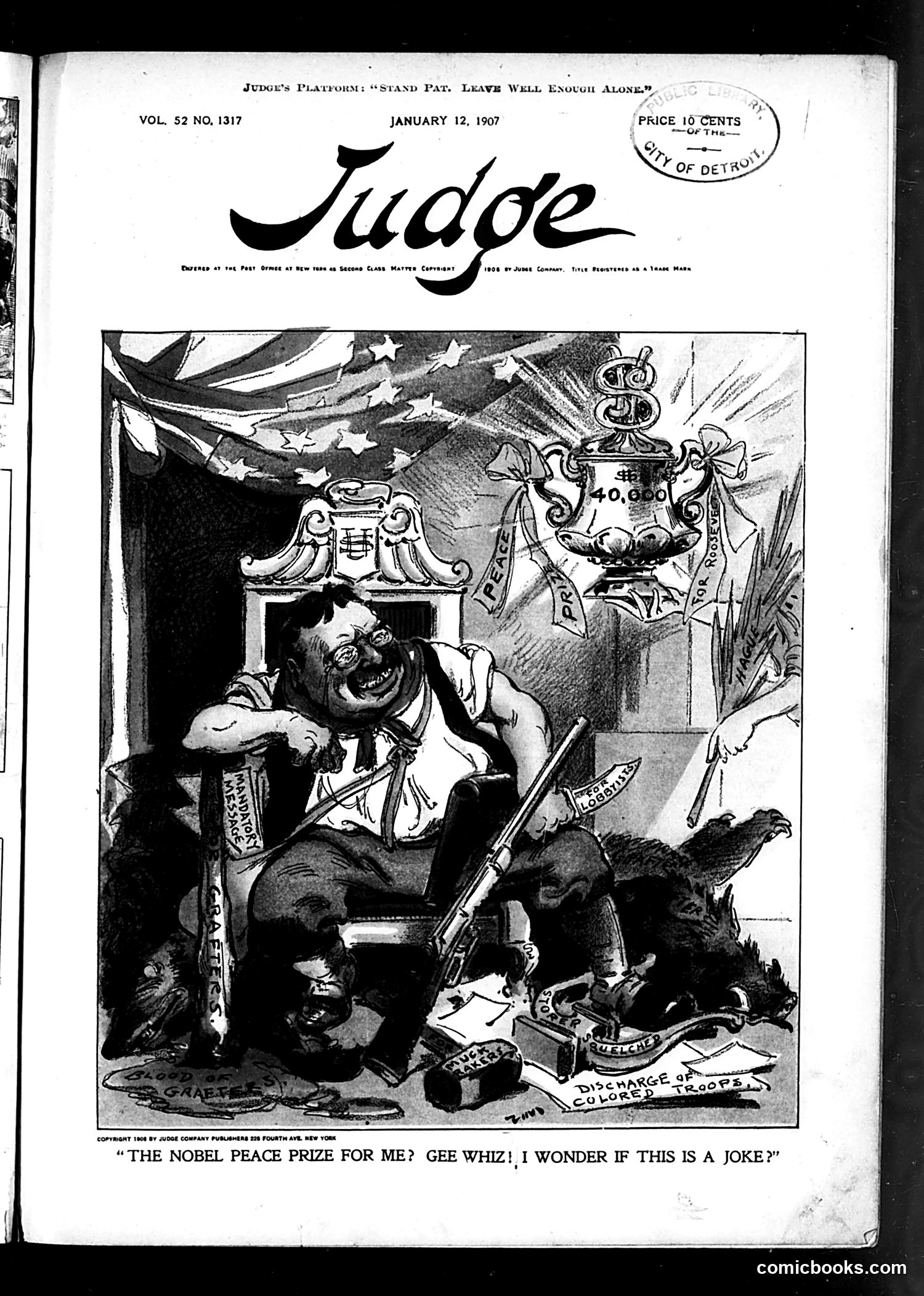
This satirical cartoon mocks what appears to be an unexpected or undeserved honor. The central figure—a heavyset man in military uniform—sits astounded, examining ornate prize cups and certificates marked "40,000" and bearing ribbons. Below him are caricatured figures labeled "Discharge of Colored Troops," suggesting this relates to military affairs and race. The caption reads: "THE NOBEL PEACE PRIZE FOR ME? GEE WHIZ! I WONDER IF THIS IS A JOKE?" The satire likely ridicules a military or political figure receiving a prestigious peace award despite involvement in military operations or racial controversies. The exaggerated expression and surrounding military imagery suggest skepticism about the recipient's worthiness for such an honor, implying hypocrisy or absurdity in the award selection.
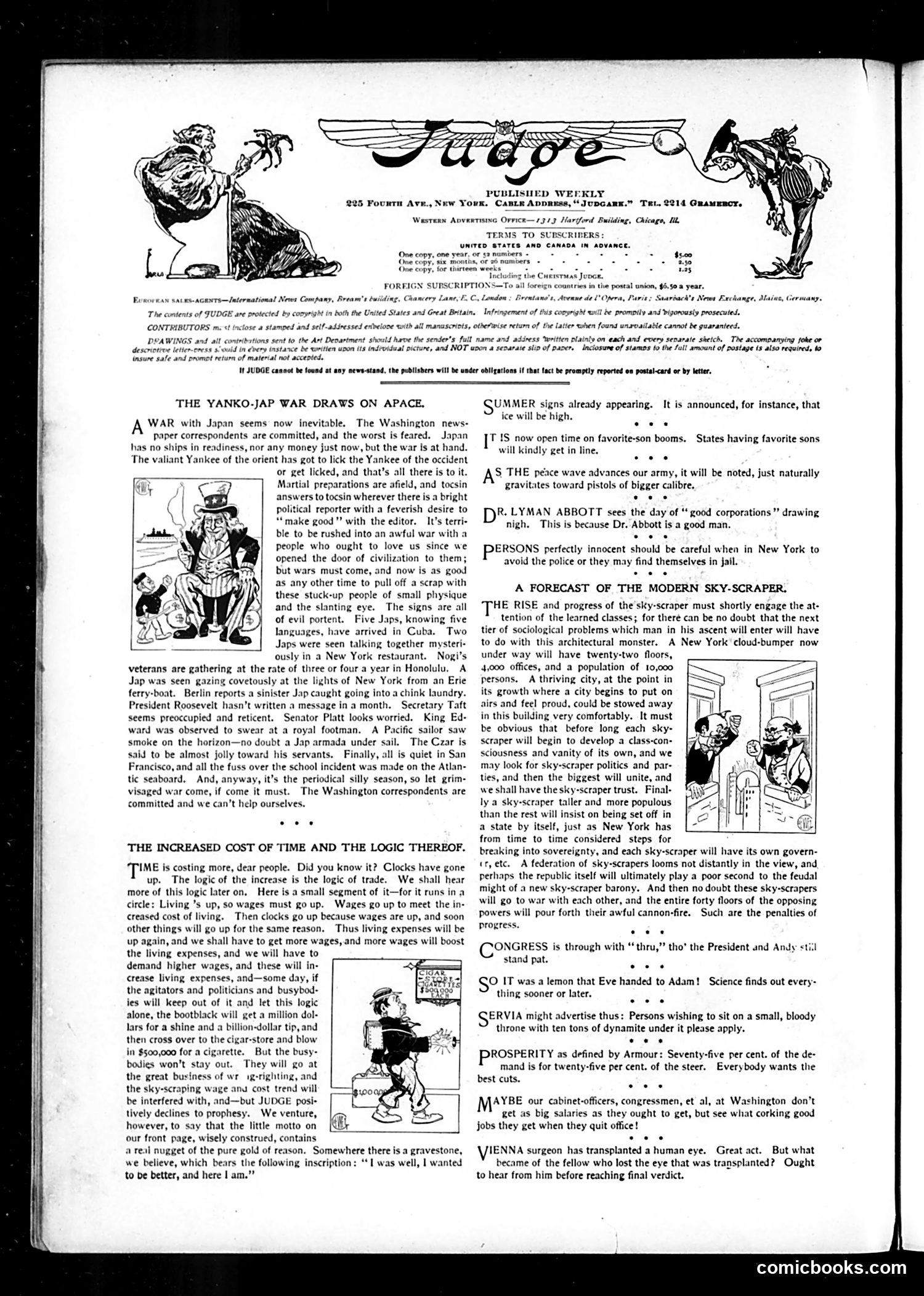
This page contains satirical commentary and editorials rather than political cartoons. The main illustrated pieces mock contemporary issues: **"The Yanko-Jap War Draws on Apace"** features a caricatured Asian figure and discusses inevitable war with Japan, referencing tensions between America and Japan (the text mentions Roosevelt, Taft, and naval concerns). The satire suggests political figures are inadequately addressing this looming conflict. **"A Forecast of the Modern Sky-Scraper"** satirizes New York's vertical growth, imagining future skyscrapers with twenty floors and 4,000 offices, suggesting anxiety about urban overcrowding and architectural ambition. The remaining pieces are brief satirical quips on topics like government corruption, cost of living, and social absurdities—typical Judge magazine fare mocking politics and society.
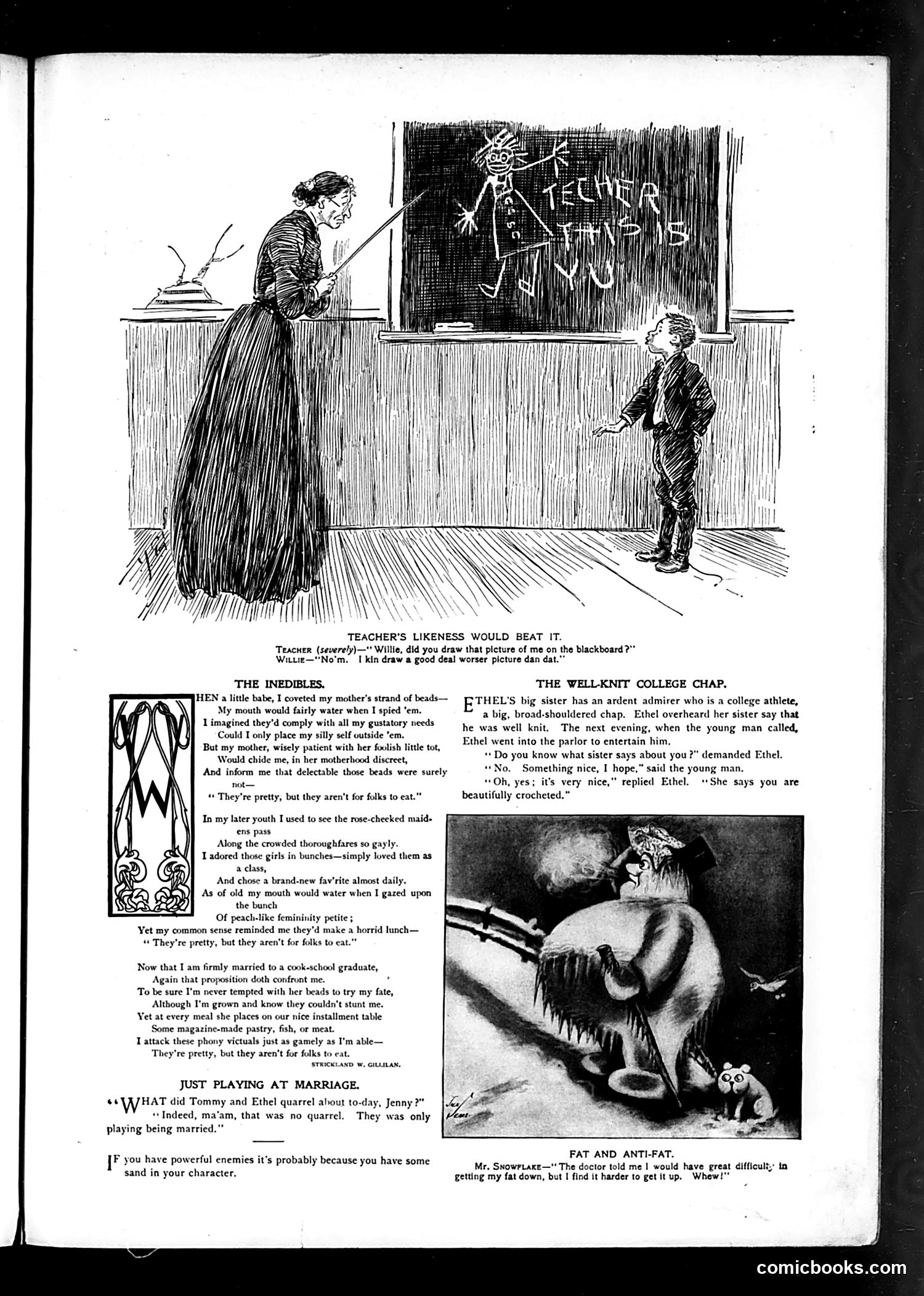
**Top Cartoon - "Teacher's Likeness Would Beat It":** A classroom scene satirizing artistic ability. A teacher points to a crude stick-figure drawing on the blackboard labeled "PICTURE OF ME." The student (Willie) admits he "kin draw a good deal worser picture dan dat." The humor targets the teacher's vanity—her poor drawing skills make even a deliberately worse attempt seem comparatively good. **Other Content:** The page includes three additional pieces: a poem titled "The Inedibles" (satirizing unappetizing food), "The Well-Knit College Chap" (about an athlete), and "Just Playing at Marriage" (a brief domestic humor piece). A photograph labeled "Fat and Anti-Fat" appears to be a doctor's testimonial. These represent typical Judge satirical humor circa early 20th century.
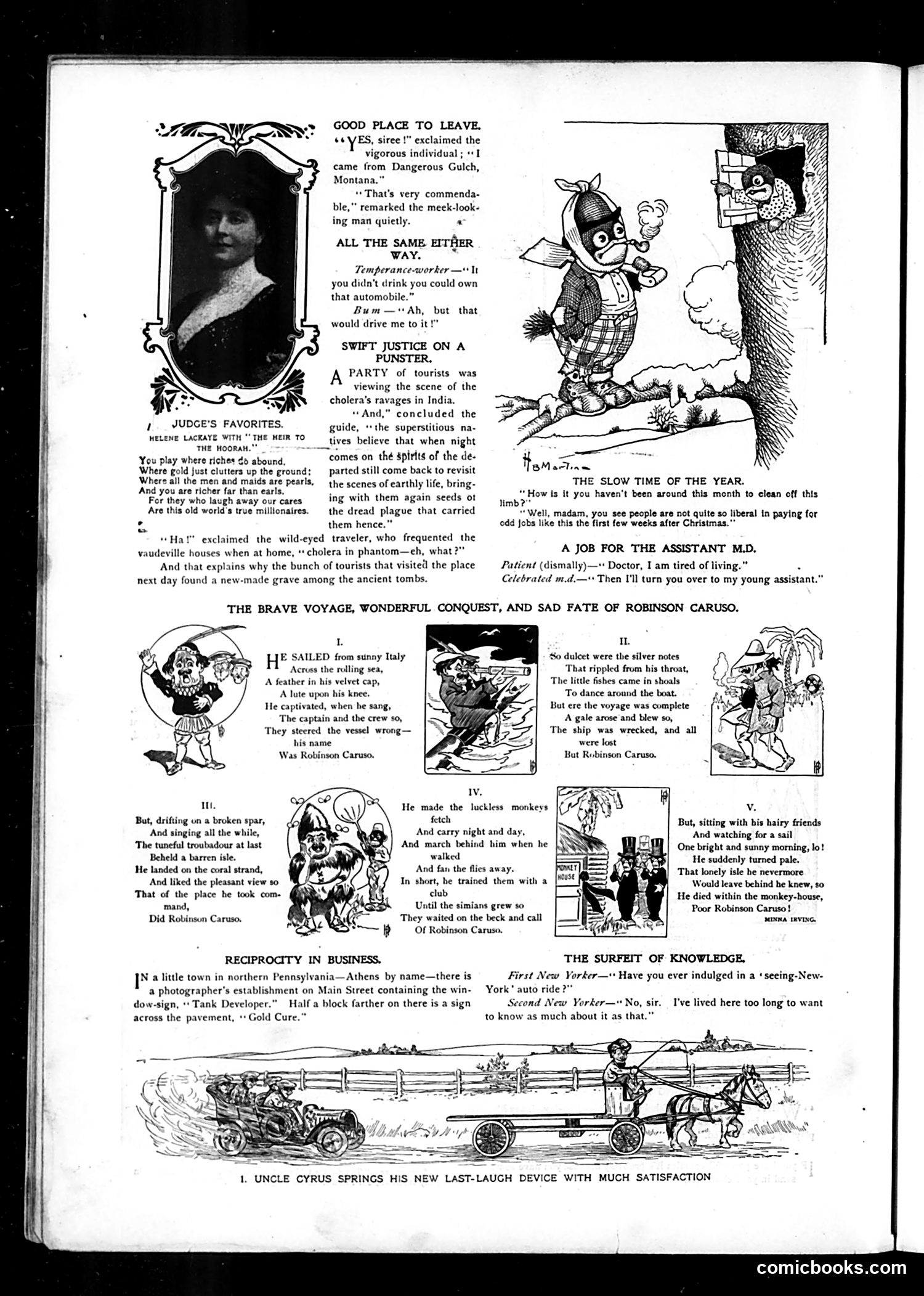
This page contains several distinct satirical items: **"Good Place to Leave"** mocks temperance advocates through dialogue—a traveler from "Dangerous Gulch, Montana" notes the town lacks saloons, prompting a temperance worker to boast about this. The joke satirizes the temperance movement's self-righteousness. **"Swift Justice on a Funster"** depicts a character being ejected from a building, likely mocking someone's inappropriate behavior or social pretension. **"Robinson Caruso"** is a serialized illustrated narrative poem retelling Robinson Crusoe, presented as light entertainment. **"Reciprocity in Business"** shows a photographer's reciprocal sign arrangement—subtle business satire about commercial practices. **"The Surfeit of Knowledge"** features a New Yorker and visitor discussing auto rides, satirizing the difference between practical knowledge and mere information. The page combines political/social satire with humorous fiction and illustrations typical of Judge magazine's format.
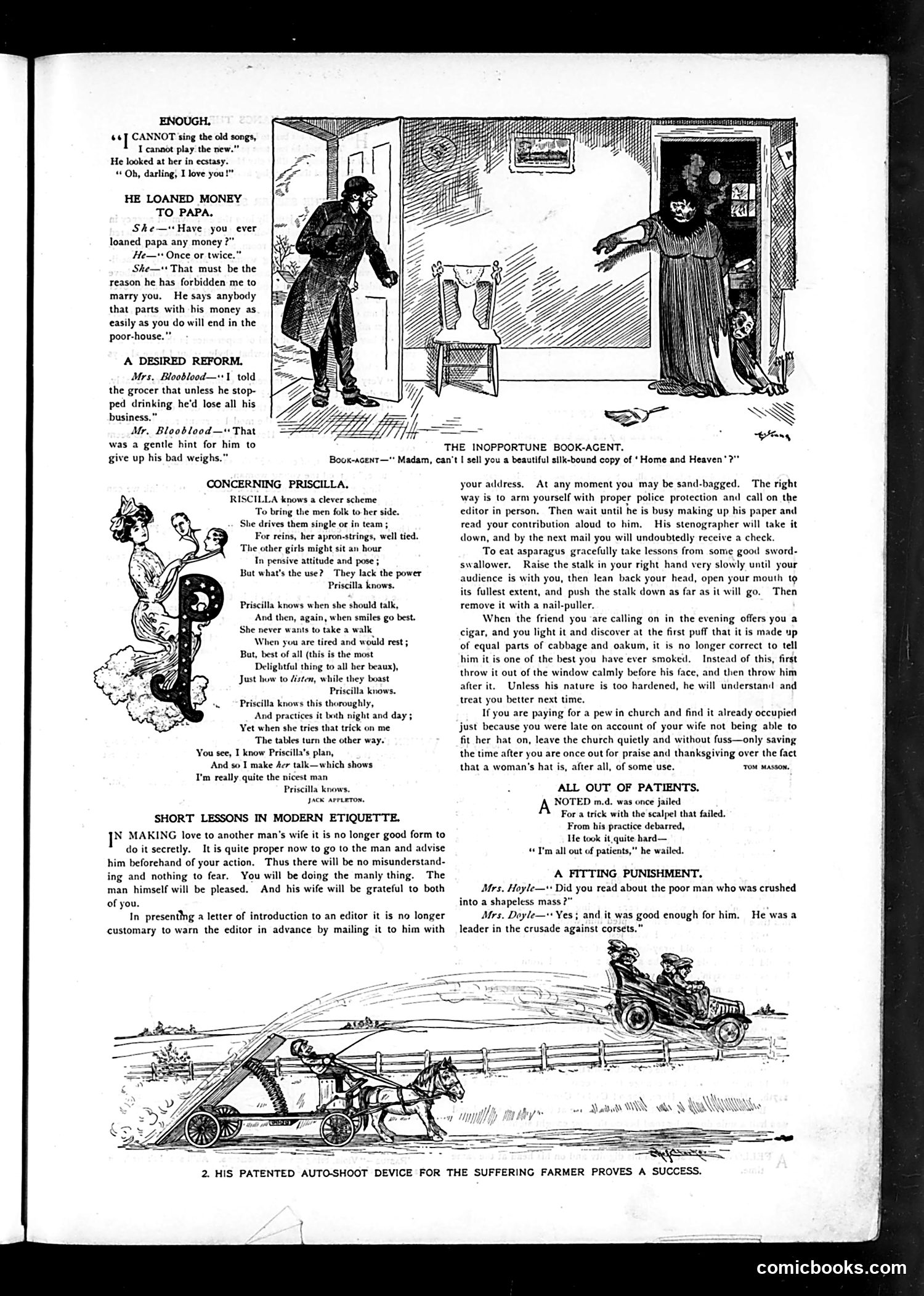
This page contains several humorous sketches and satirical pieces typical of Judge magazine's format. **Top cartoon** ("The Importunate Book-Agent"): Shows a persistent book salesman attempting to sell "Home and Heaven" to a woman, illustrating the era's frustration with aggressive door-to-door salesmen. **"Concerning Priscilla"**: A poem about a woman who uses various methods to attract men, poking fun at female social maneuvering of the period. **"Short Lessons in Modern Etiquette"**: Advises that approaching editors in person about submissions is now acceptable, reflecting changing professional norms. **Bottom cartoon**: Depicts a "patented auto-shoot device" for farmers to protect crops—satirizing both agricultural frustrations and the era's faith in mechanical solutions to rural problems. The page exemplifies Judge's mix of social satire and practical humor commentary on contemporary American life.
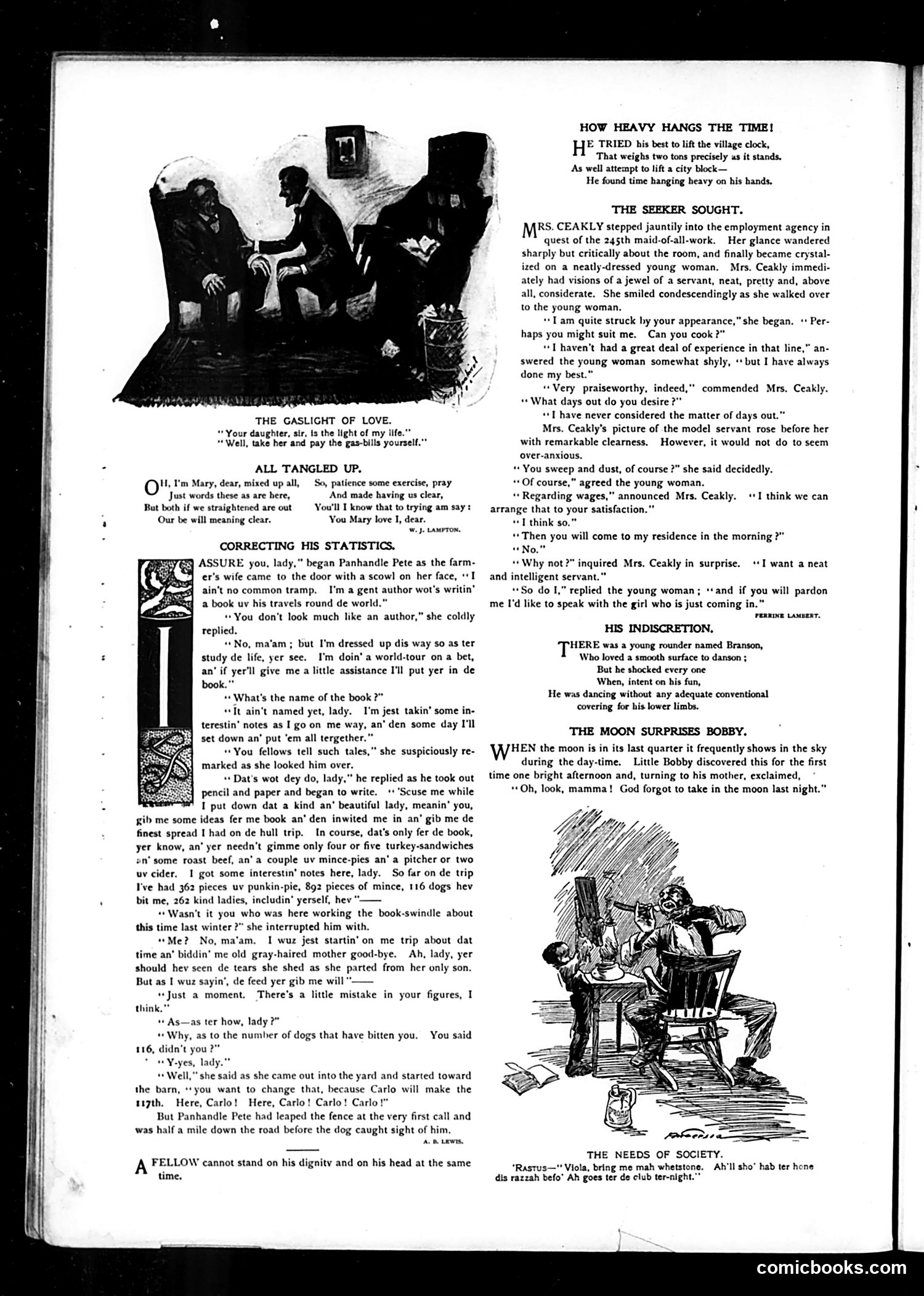
This page contains several brief humorous pieces typical of early 20th-century American satire: **"The Gaslight of Love"**: A pun-based joke about a suitor's marriage proposal—the father agrees to give away his daughter only if the suitor pays future gas bills, deflating romantic sentiment with practical expense. **"All Tangled Up"**: A wordplay piece where a couple's love declarations are rendered nonsensical through scrambled grammar, likely satirizing overwrought romantic language. **"Correcting His Statistics"**: The main cartoon depicts "Panhandle Pete," a con artist posing as a traveling author writing a book. He manipulates a farmwife into feeding him by flattering her and recording exaggerated statistics of his travels (362 pumpkin pies, 116 dog bites). When she threatens to add her dog Carlo as the 117th, he flees. This satirizes both traveling con men and gullible victims of their schemes. The other pieces mock employment-seeking, time management, and social pretension—common Judge magazine targets reflecting period middle-class anxieties.
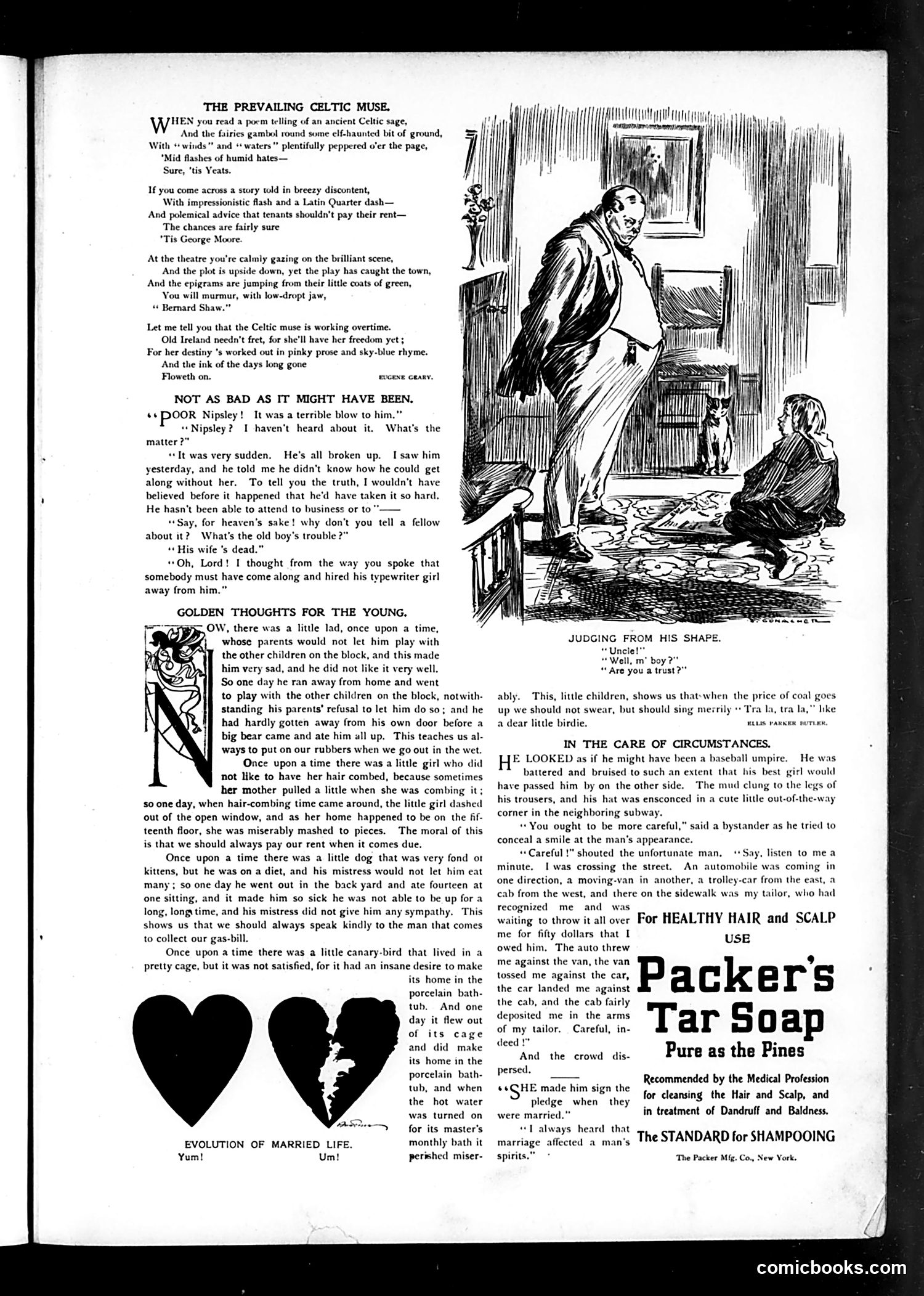
**"The Prevailing Celtic Muse"** mocks contemporary Irish literary figures—likely **W.B. Yeats**, **George Moore**, and **Bernard Shaw**—who were dominating literary circles with their Celtic-themed, often politically charged work. The satire suggests Ireland's freedom will be won through flowery prose rather than action. Eugene Geary implies these writers are self-important and derivative. **"Not as Bad as It Might Have Been"** is a workplace humor piece: a man assumes his colleague's tragedy involves losing his secretary (implying office romance/scandal), but it's merely his wife's death—presented as the *less scandalous* option. **"Golden Thoughts for the Young"** is dark absurdist humor inverting moral fables. Children who disobey or act selfishly face gruesome consequences (eaten by bears, crushed, poisoned), but the "morals" randomly redirect to unrelated lessons (pay rent, be kind to bill collectors). It's intentionally nonsensical satire mocking sentimental children's literature. The **Packer's Tar Soap** advertisement is period commercial content, unrelated to the satire.
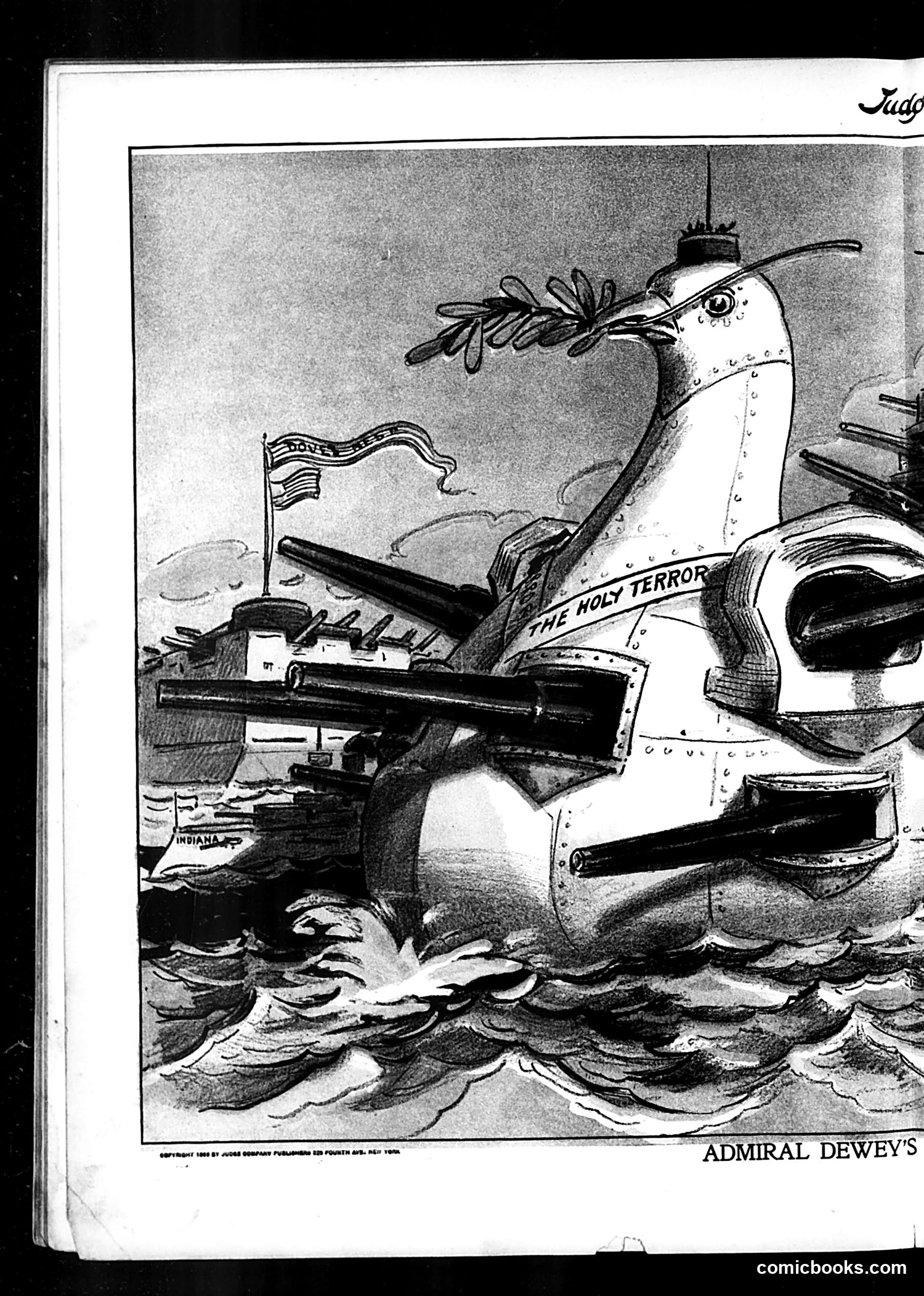
This political cartoon depicts a military vessel named "The Holy Terror" with an anthropomorphized ship's head featuring a long neck holding an olive branch. The ship displays an American flag and appears to be in water with what looks like the Indiana visible in the background. The cartoon likely references Admiral George Dewey and American naval power during the Spanish-American War era (late 1890s). The "Holy Terror" nickname suggests the ship's fearsome reputation, while the olive branch symbolizes peace or diplomatic messaging. The personified ship head appears somewhat grotesque or exaggerated—typical of Judge magazine's satirical style—possibly commenting on American naval might, imperial ambitions, or the tension between military aggression and peaceful intentions during this period of American expansion.
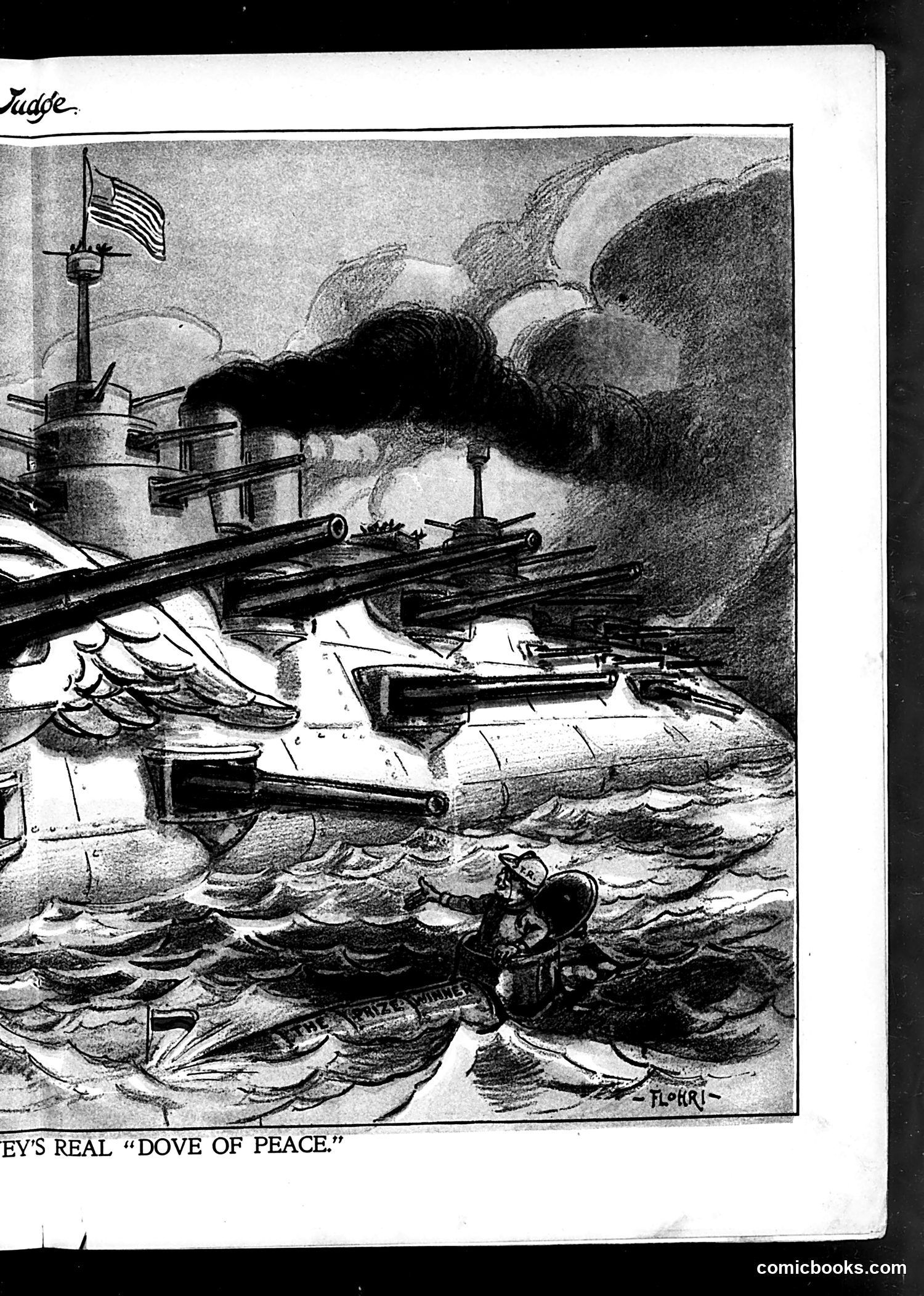
This political cartoon satirizes someone identified as "Fey" (likely referring to a contemporary political figure, though unclear from context alone). The title sarcastically calls their "Dove of Peace" a real dove—but the image shows a warship with an American flag, surrounded by military equipment and weapons, sinking amid turbulent waters. The satire's point: someone claiming to advocate for peace is actually promoting militarism or warfare. The ironic contrast between the peaceful symbolism of a dove and the aggressive naval/military imagery critiques what the cartoonist views as false or hypocritical peace rhetoric masking warmongering intentions. The artist is Florri (visible signature).
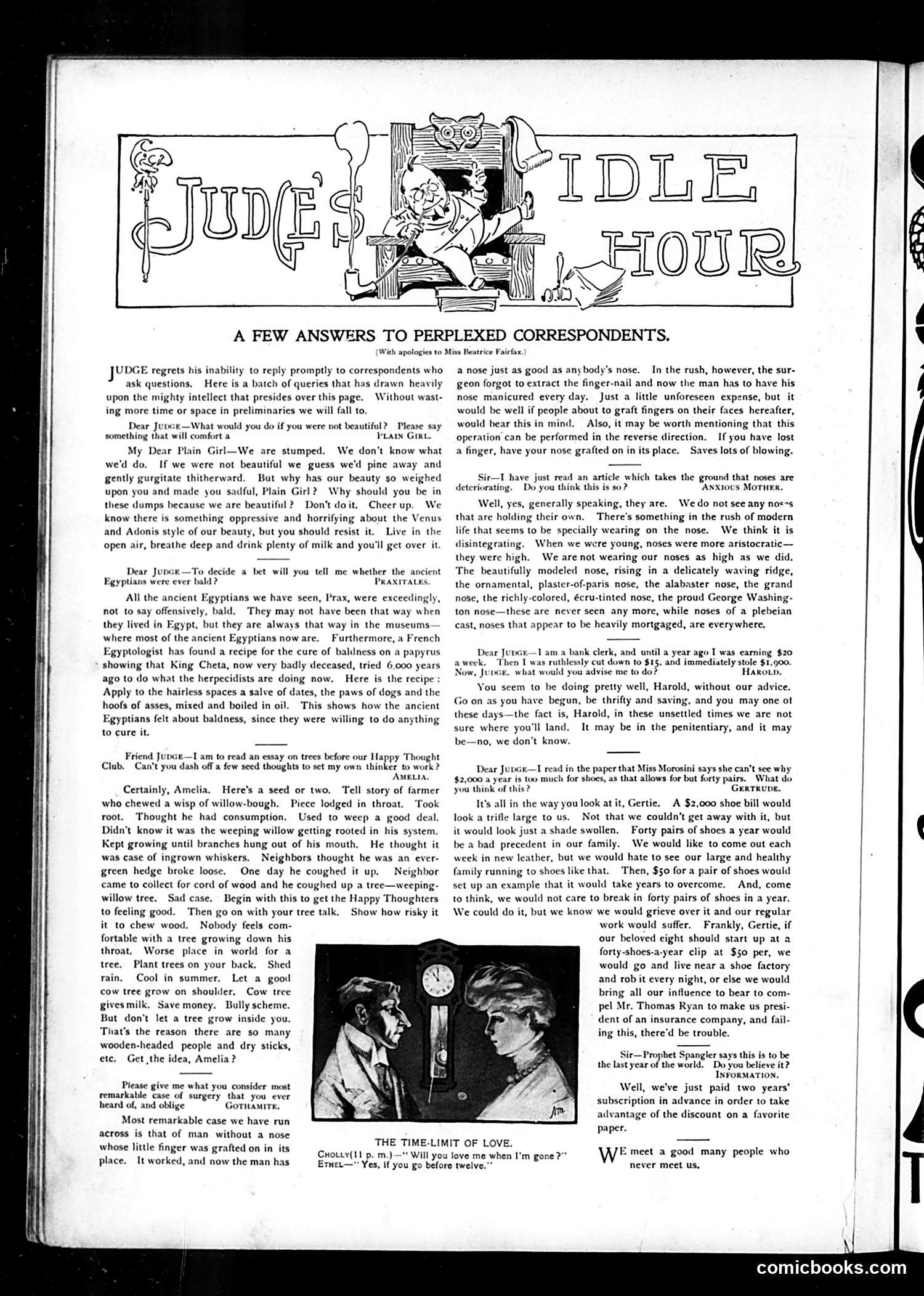
This is an advice column parody mimicking the popular "Dear Beatrice Fairfax" advice format of the early 1900s. The column satirizes both advice-seekers and contemporary obsessions through absurdist humor. Key content includes: **"The Time-Limit of Love"** (illustrated): A couple's dialogue about love ending when one partner leaves—a commentary on romantic impermanence. **Recurring jokes target**: - Vanity (letters about beauty and baldness) - Pseudoscience (Egyptian "cures" for baldness using animal parts—mocking both ancient remedies and modern "Herpecide" hair treatments) - Absurdist scenarios (a farmer growing a weeping willow tree in his throat; a surgical case where a fingernail was accidentally grafted instead of removed) The humor relies on exaggeration and nonsensical logic typical of Judge magazine's style. The illustration shows two figures in profile, appearing to represent a romantic or social exchange. Overall, this mocks middle-class concerns about appearance, health fads, and romantic anxieties through ridiculous "answers."
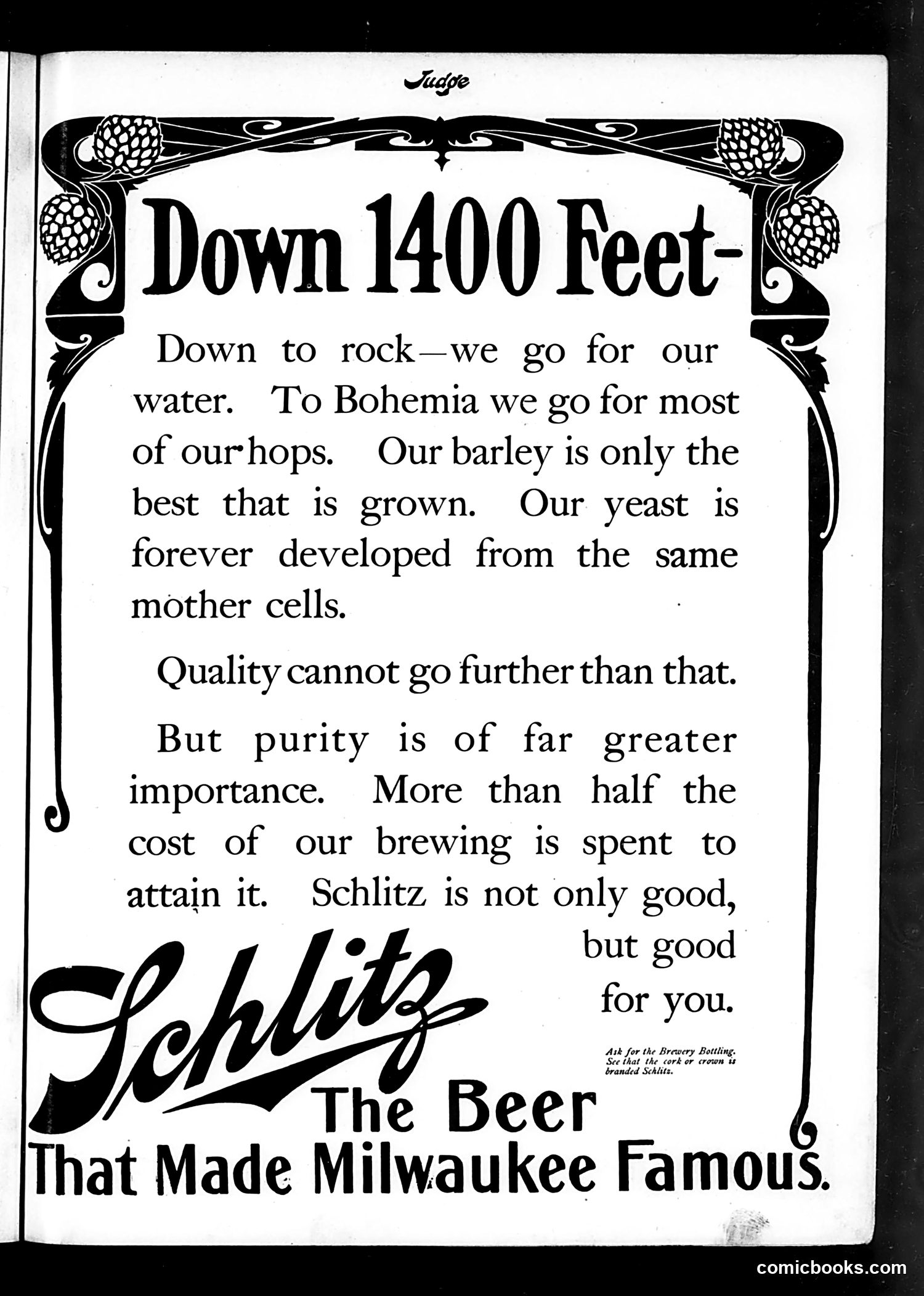
This is a **Schlitz beer advertisement**, not satire or political commentary. The page promotes Schlitz brewery's brewing practices to a Judge magazine audience. The ad emphasizes the brewery's sourcing (water from local rock deposits, hops from Bohemia, quality barley) and production standards, particularly their yeast strain's consistency. The key sales pitch claims that purity—not just quality—justifies Schlitz's premium cost, with "more than half" brewing expenses devoted to achieving it. The slogan "The Beer That Made Milwaukee Famous" appeals to civic pride and German-American heritage (Milwaukee's large German immigrant population). The ornamental border with hop imagery reinforces the premium positioning. This represents early 20th-century advertising strategy: emphasizing scientific manufacturing standards and health benefits to justify price to middle-class consumers.
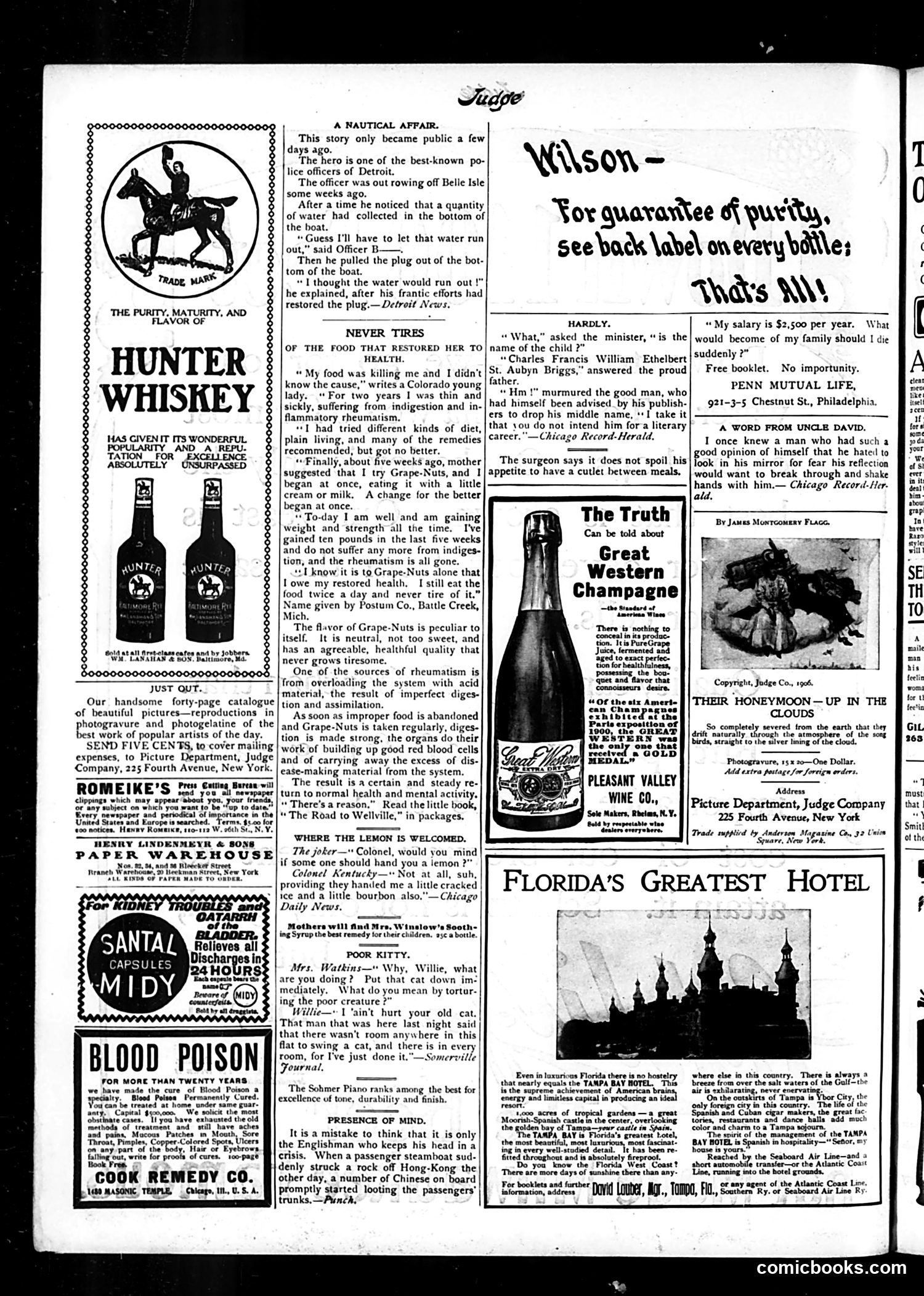
This page is primarily **advertisements and humorous anecdotes** rather than political cartoons. The main content includes: **Advertisement Features:** - Hunter Whiskey (prominent left-side ad emphasizing purity) - Grape-Nuts cereal (testimonial from a woman claiming it cured her indigestion and rheumatism) - Western Champagne, blood poison treatments, and other patent medicines typical of early 1900s advertising **Humorous Anecdotes:** - "A Nautical Affair": A Detroit police officer's embarrassing mishap—he removes a boat's drain plug thinking water will exit, then panics trying to replace it - "Hardly": A clergyman's subtle critique of overly elaborate children's names, suggesting literary parents burden their sons - "Where the Lemon is Welcomed": A joke about a colonel's casual Southern hospitality toward insults The page reflects early 20th-century magazine culture: mixing commercial promotions (many for dubious health products) with light social satire and brief comedic anecdotes mocking human folly and regional stereotypes.
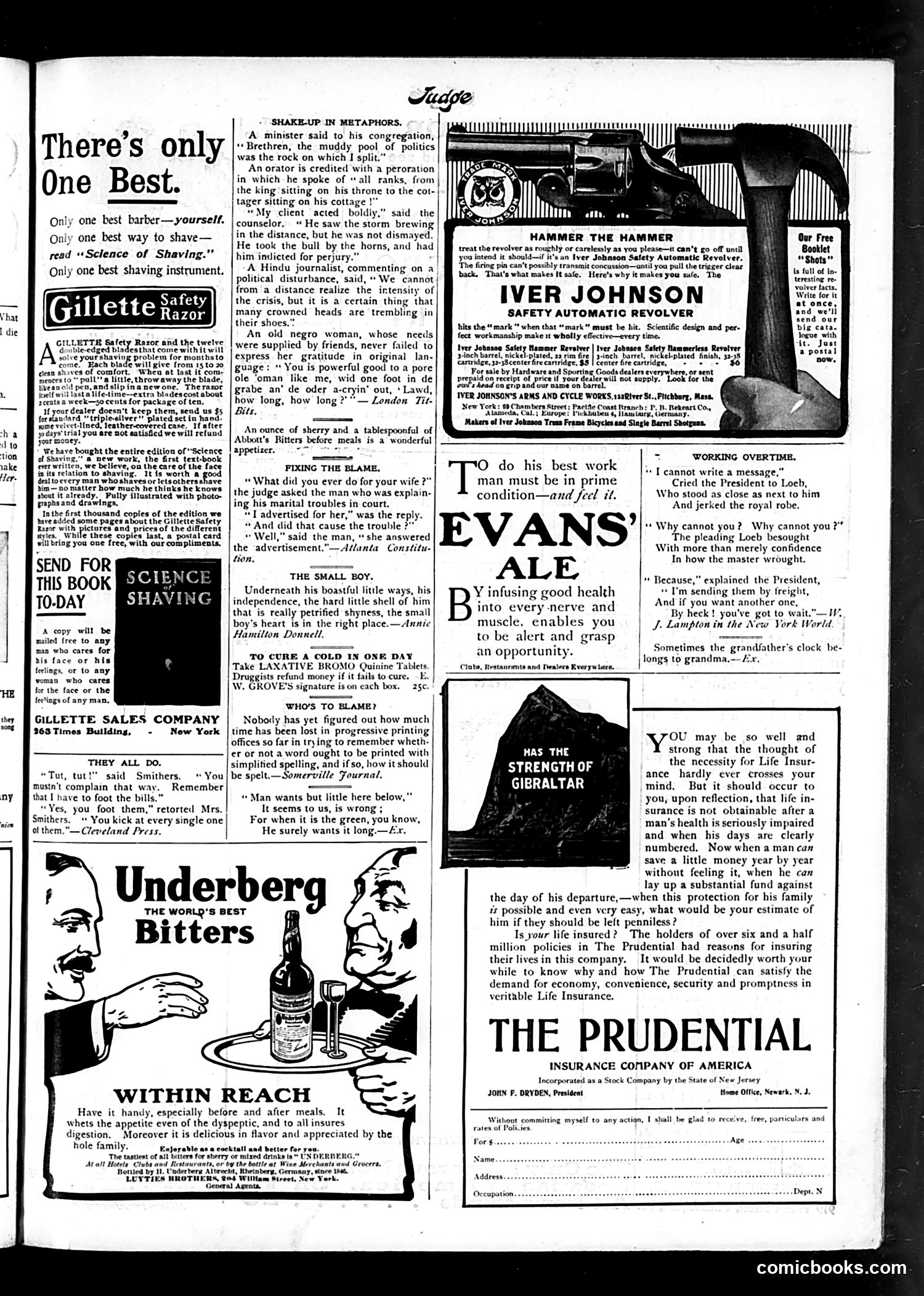
This page is primarily **advertising**, with minimal satirical content. The main pieces are: **"Shake-Up in Metaphors"** - A humorous column collecting examples of mixed or mangled metaphors from public speakers (a minister, orator, counselor, and Hindu journalist). The joke is that these authority figures create absurd, contradictory imagery—like a minister "splitting on a rock," or a counselor telling a client to "take the bull by the horns" and have him indicted. It's gentle satire of pretentious public speakers. **"Fixing the Blame"** - A brief joke about a man whose wife answered his newspaper advertisement for a wife, blaming her (rather than the ad) for their marital troubles. The remainder consists of **product advertisements** for Gillette Safety Razors, Underberg Bitters, Evans Ale, and Prudential Insurance—typical Judge content mixing editorial humor with paid advertising to fund the publication.
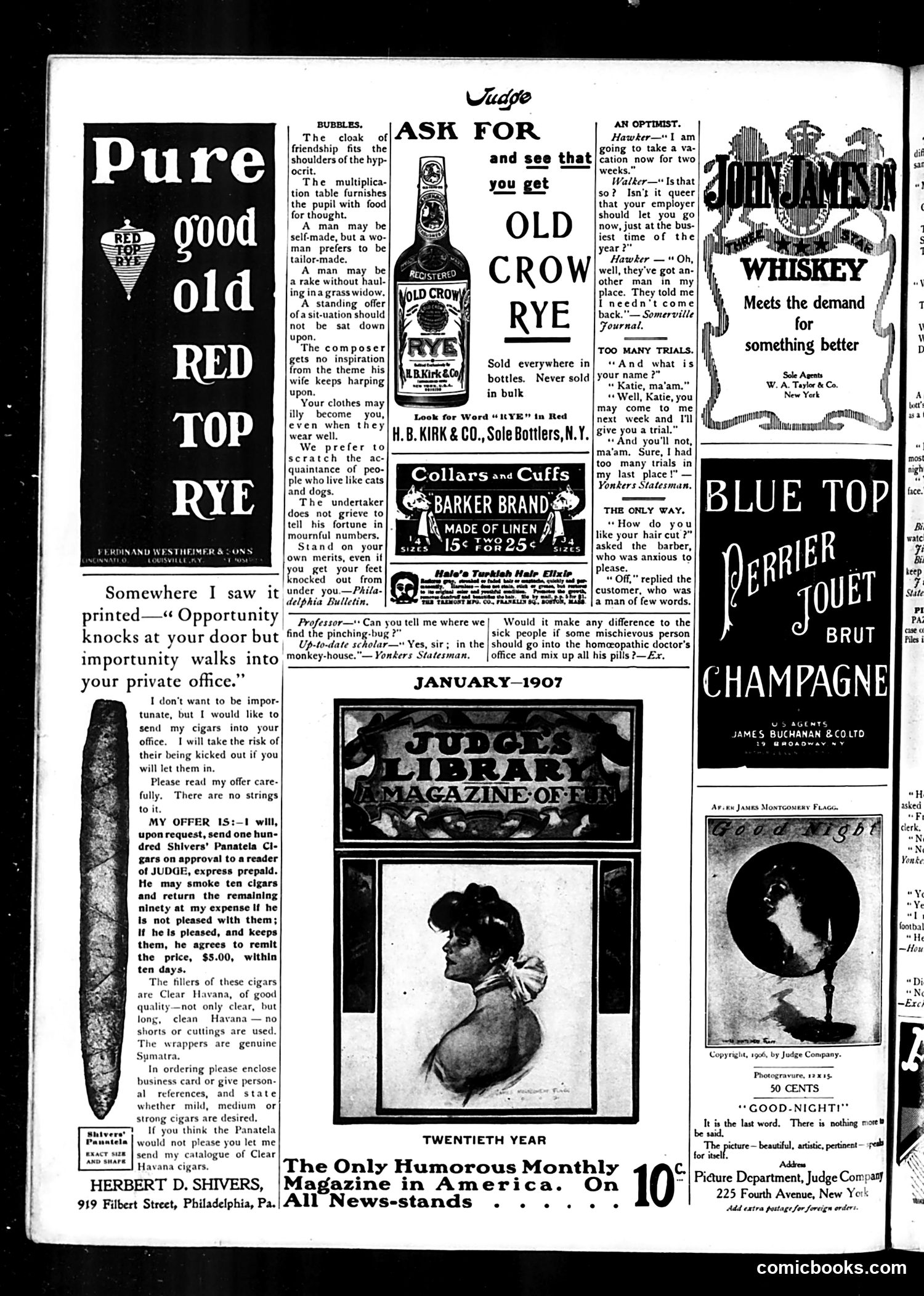
This page is primarily **advertising and filler content** rather than political satire. The dominant feature is a cigar advertisement from Herbert D. Shivers offering "Panatela" cigars on approval to Judge readers. The **small comic vignettes** scattered throughout are lighthearted observations rather than political cartoons—brief, disconnected jokes about marriage, workplace dynamics, and social absurdities typical of Judge's humor. Examples include quips about hypocrisy ("friendship fits the shoulders of the hypocrite") and gender relations ("a woman prefers to be tailor-made"). The page also contains **liquor and champagne advertisements** (Old Crow Rye, Blue Top Berrier Touët champagne) and a photograph labeled "Good-Night!" with no clear context. This represents Judge's **twentieth year** (noted at bottom), positioning itself as "The Only Humorous Monthly in America." The content reflects early-1900s consumer culture and genteel magazine advertising rather than pointed political commentary.
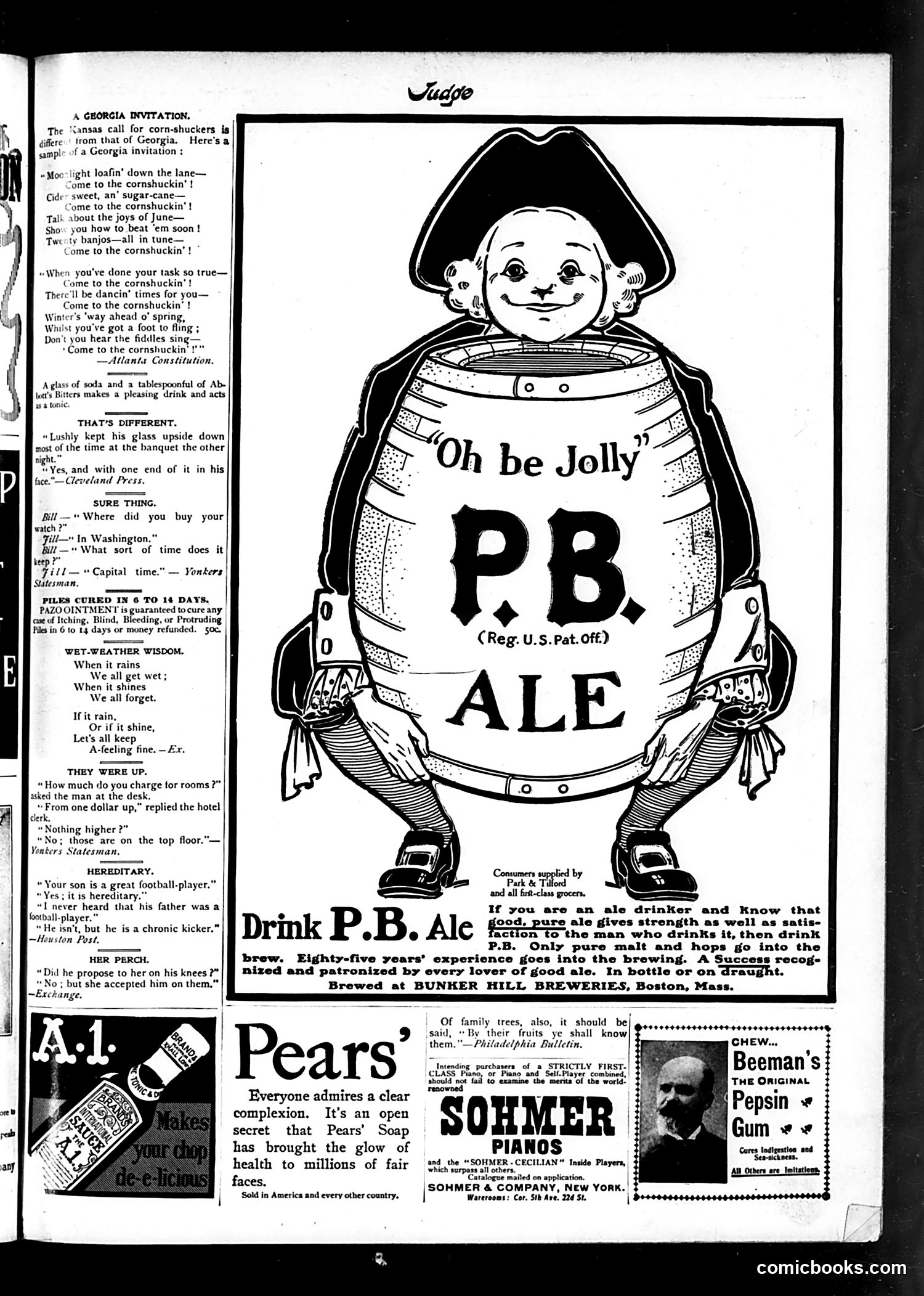
This page is primarily **advertising**, with small humorous filler items around the margins. The dominant feature is a large **P.B. Ale advertisement** showing a rotund, jolly character (elf-like figure) emerging from a barrel, captioned "Oh be Jolly." The ad emphasizes the product's 85 years of brewing experience and appeals to ale drinkers as a source of "strength" and "satisfaction." This reflects early-20th-century beer marketing that claimed health and vigor benefits. The surrounding text includes **brief joke items**: "A Georgia Invitation" mocks the distinctive culture of Southern corn-shucking social gatherings; other jokes play on puns about time-keeping and hotel room pricing. Additional advertisements include **Pears' Soap** (emphasizing complexion improvement), **Sohmer Pianos**, and **Beeman's Pepsin Gum**—all typical Judge magazine advertisements from this era. The page contains no political satire or significant commentary—it's a standard magazine layout mixing light humor with period advertising.
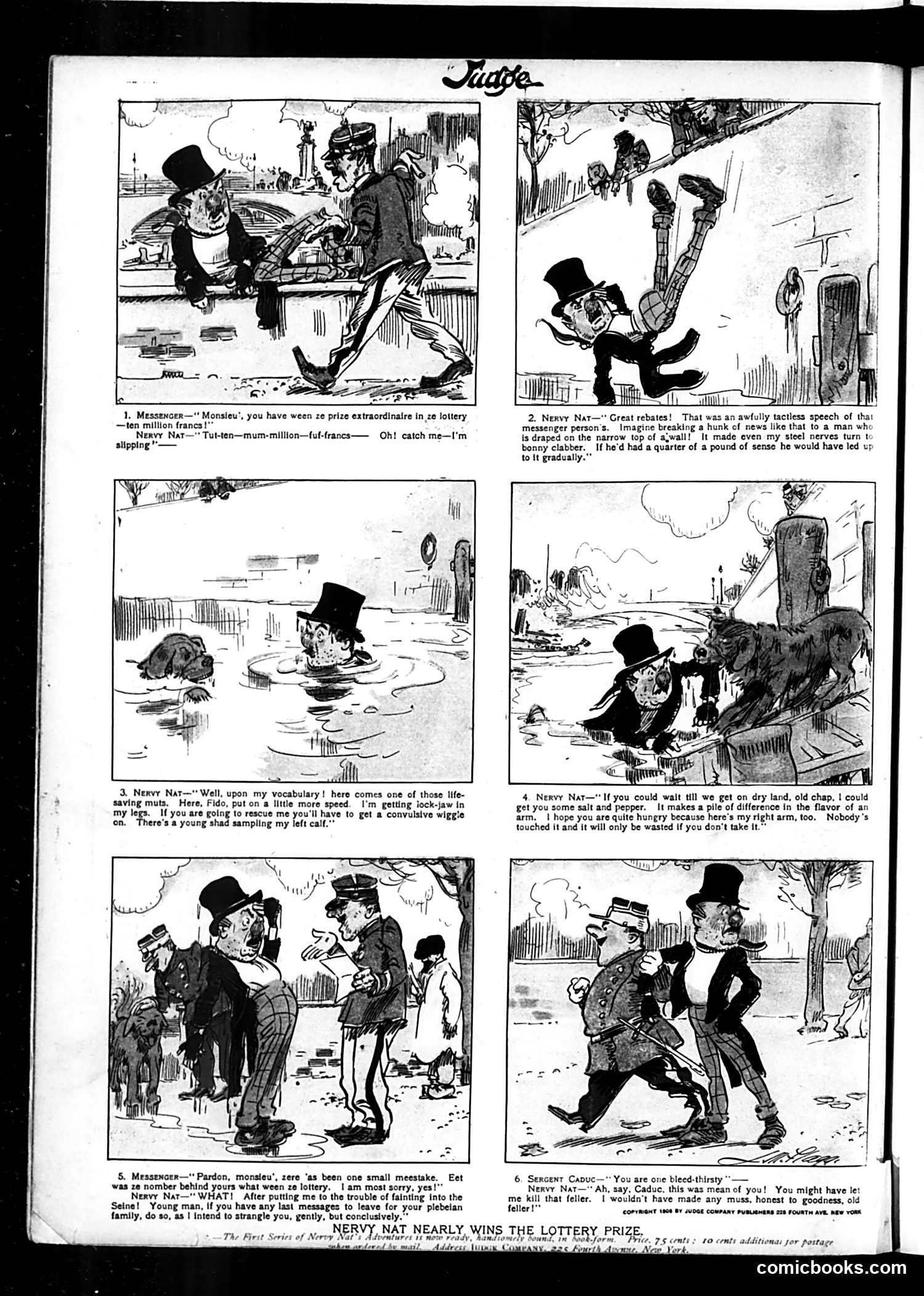
This six-panel comic follows "Nervy Nat," a character known for his exaggerated reactions to misfortune. The plot: a French messenger informs Nat he's won ten million francs in a lottery. Overjoyed, Nat faints and falls into the Seine River. A dog rescues him, but then the messenger returns with bad news—Nat actually *didn't* win; the ticket behind his did. Enraged, Nat threatens to strangle the messenger. Later, while being eaten by a crocodile, Nat maintains dark humor, offering himself as a meal "with salt and pepper." The satire targets two things: lottery fever (the period's gambling mania) and a stock comedic character type—the hapless "everyman" whose terrible luck and sardonic wit made him popular in early 20th-century humor magazines. The joke is that Nat's misery escalates absurdly, yet he remains sarcastically composed throughout.