
A complete issue · 16 pages · 1906
Judge — December 8, 1906
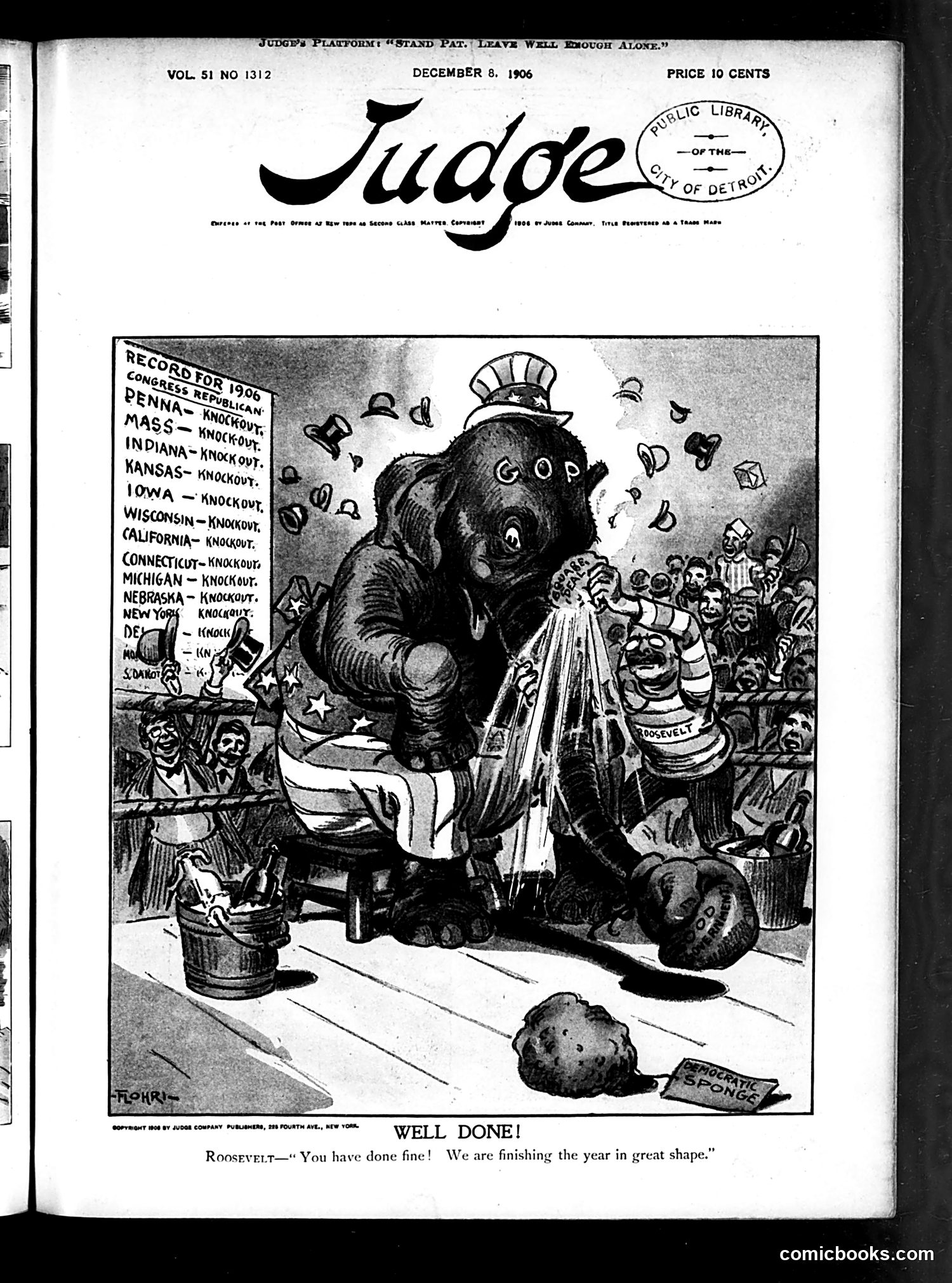
This cartoon celebrates Republican electoral victories in the 1906 midterm elections. An elephant wearing a top hat labeled "GOP" (Republican Party) triumphantly sprays confetti and debris toward a crowd of cheering supporters. The left side lists states with "KNOCKOUT" notations—Pennsylvania, Massachusetts, Indiana, Iowa, Wisconsin, California, Connecticut, Michigan, Nebraska, New York, and D.C.—indicating Republican wins in those races. The caption quotes Roosevelt approving the year's political performance: "You have done fine! We are finishing the year in great shape." The cartoon satirizes Republican dominance by depicting their electoral success as a knockout boxing victory, with the elephant as the victorious fighter vanquishing Democratic opposition. The scattered debris represents defeated Democratic candidates.
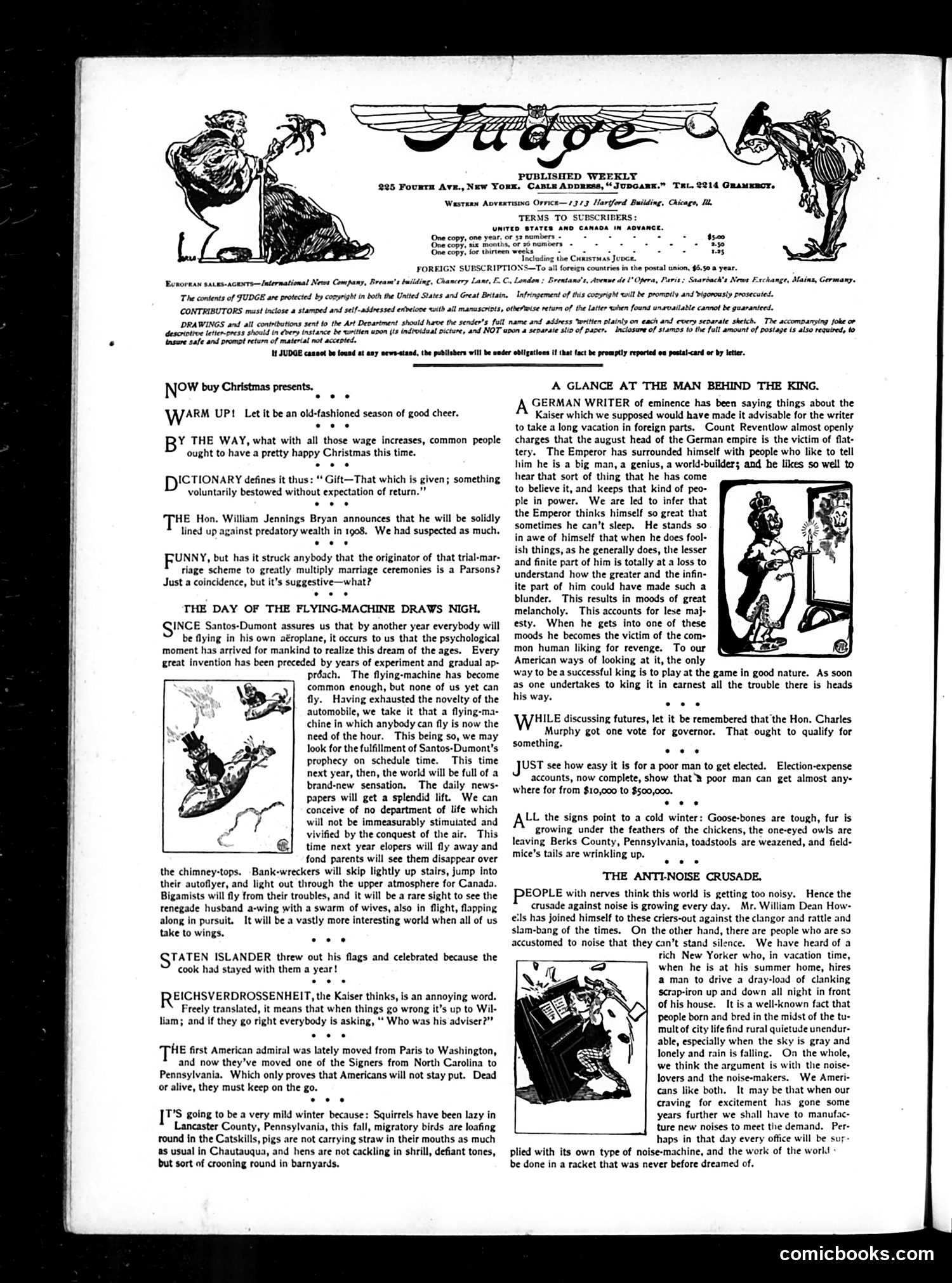
This page contains several short satirical pieces rather than a single cartoon. The main items include: **"Now Boy Christmas Presents"** — brief humorous observations about Christmas and wage increases for workers. **"A Glance at the Man Behind the King"** — a piece criticizing German Kaiser Wilhelm II, describing him as vain and paranoid, surrounding himself with flatterers. It suggests his insecurity causes mood swings and vindictiveness. The satire portrays him as psychologically unfit for leadership. **Various Brief Items** — including jokes about election expenses, winter weather predictions, and an "Anti-Noise Crusade" discussing urban noise problems in New York. The page appears designed as miscellaneous commentary on contemporary politics and society rather than featuring developed political cartoons. The Kaiser piece seems the most substantial satirical content, reflecting American skepticism toward German leadership during this period.
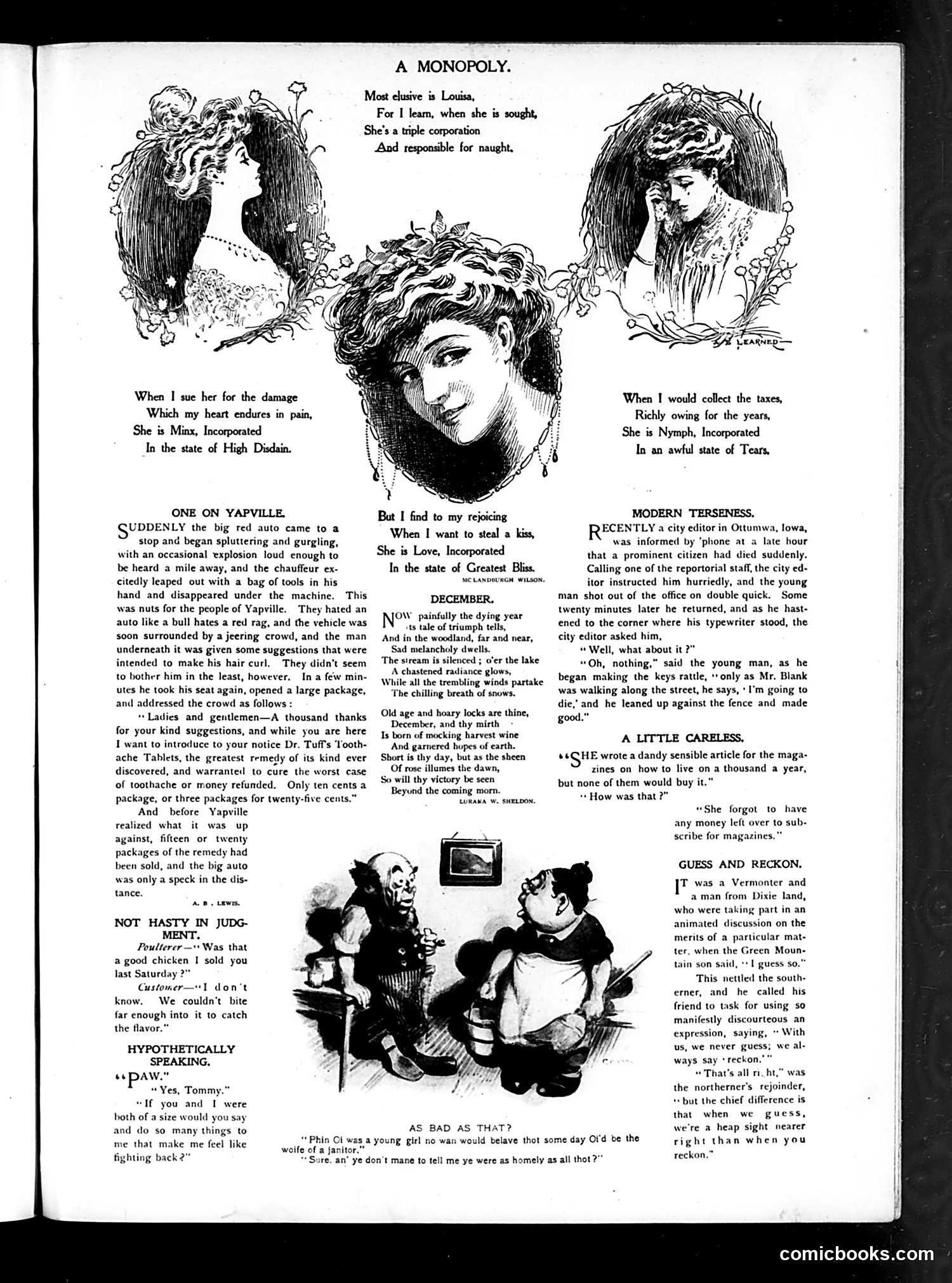
This page contains several satirical pieces rather than a single unified cartoon. "A Monopoly" at the top satirizes corporate control, depicting three women (identified as business entities—Minx, Nymph, and Love—all incorporated) as monopolies exploiting emotional vulnerabilities for profit. The verses suggest these entities extract money and create suffering. "One on Yapville" mocks a small-town incident involving a car and toothache remedy advertising. The central cartoon "As Bad as That?" shows two figures discussing a young woman, with dialogue suggesting gossip about her character and reputation. Various other short humorous pieces fill the page, including "Not Having Judgment" and "Hypothetically Speaking"—typical Judge magazine fare mixing social commentary with wordplay and situational humor from the early 20th century.
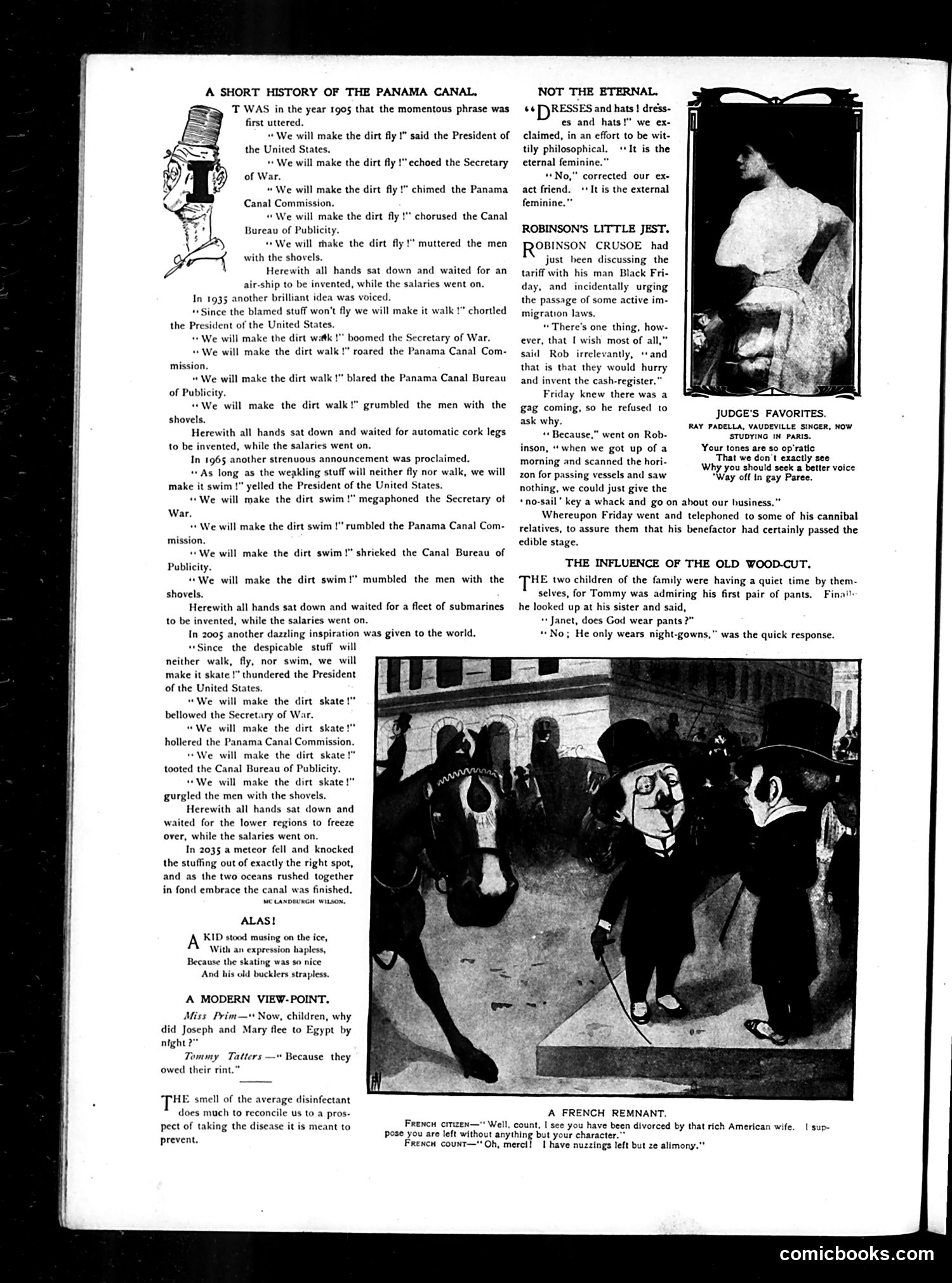
This page satirizes the **Panama Canal construction** through repeated jokes about making dirt "walk," "fly," "swim," and "skate" rather than actually building it. The satire mocks **failed promises and bureaucratic incompetence**: politicians (the President, Secretary of War, Panama Canal Commission) and workers made increasingly absurd proclamations about alternative methods instead of completing the actual excavation work—suggesting the project was stuck in endless, ridiculous debate while salaries continued. The humor targets **government inefficiency and the gap between grand rhetoric and real accomplishment**. Additional lighter pieces (Robinson's jest about cash registers, a child's logic puzzle) fill the page. The cartoon appears designed for readers frustrated with the Canal's slow progress and governmental dysfunction during the early 1900s construction period.
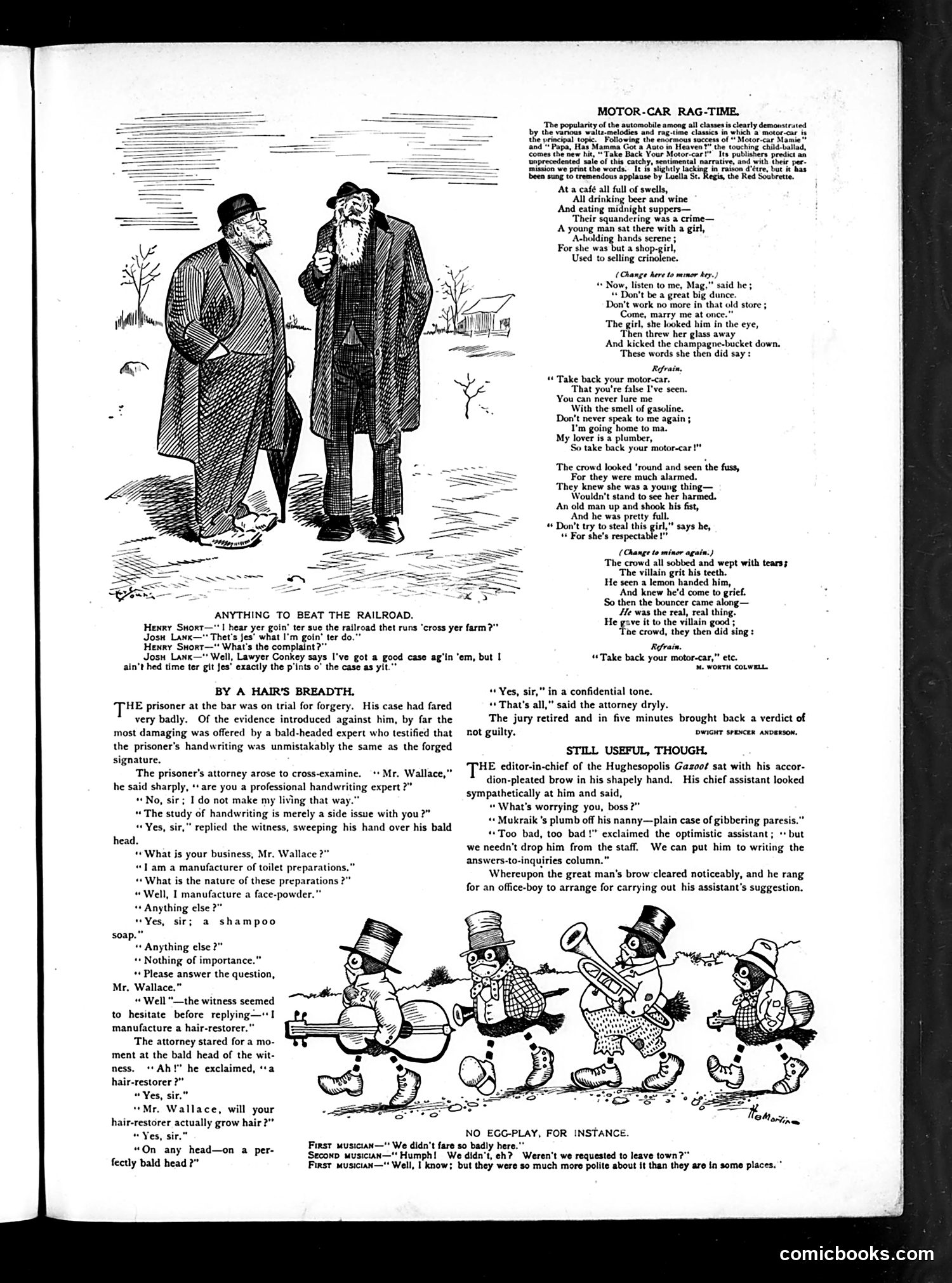
This page contains three distinct pieces of satire: 1. **"Motor-Car Rag-Time"** (top): A poem mocking the popularity of automobile humor in popular culture, referencing specific contemporary songs. It satirizes how thoroughly automobiles have infiltrated entertainment and social commentary. 2. **"By a Hair's Breadth"** (middle): A courtroom sketch where a forger's defense attorney cross-examines a handwriting expert who manufactures toiletries and hair products. The humor relies on the absurdity of questioning a "hair-restorer" about handwriting expertise—a pun on the witness's questionable credentials. 3. **"No Egg-Play, for Instance"** (bottom): A cartoon of anthropomorphic snowmen musicians, with a caption about police requesting they avoid playing in town. The satire likely targets either municipal regulations or social behavior debates of the era.
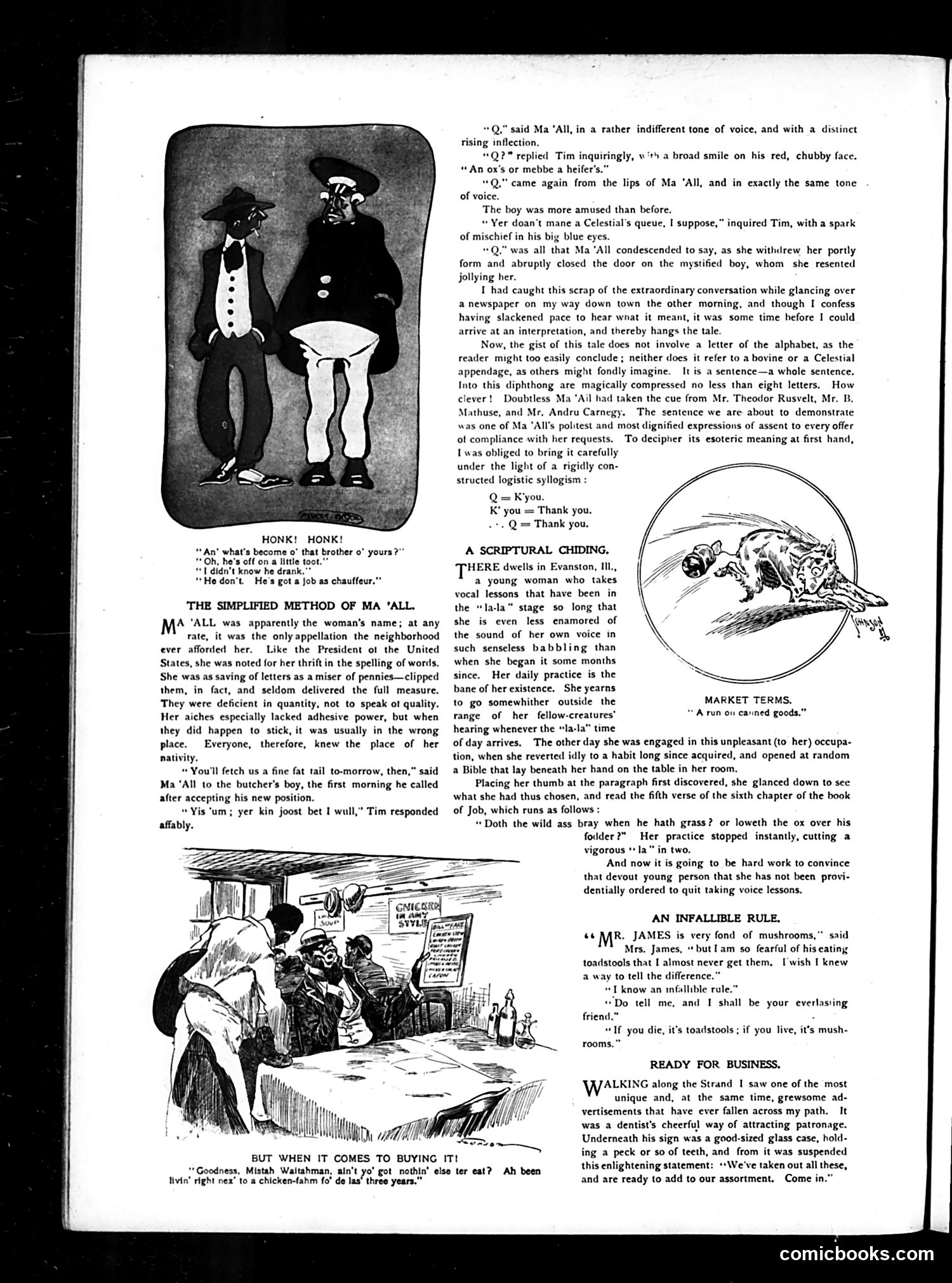
This page contains two main satirical pieces about American speech and manners circa early 1900s. **"The Simplified Method of Ma 'All"** mocks working-class speech patterns. Ma 'All, a penny-pinching woman, omits letters from words—saying "Q" (the letter sound) instead of "Thank you," dropping H's, and abbreviating phrases. The satire targets both her linguistic laziness and the pretentiousness of wealthy figures (Theodore Roosevelt, Andrew Carnegie) who supposedly inspired such "simplified" speech. The cartoon illustrates her interaction with a delivery boy named Tim, playing on class-based dialect humor common in the era. **"A Scriptural Chiding"** describes a young woman taking voice lessons in Evanston, Illinois, whose vocal practice is unbearable. She randomly opens the Bible and finds Job 6:5—"Doth the wild ass bray when he hath grass?"—which she interprets as divine criticism of her own braying vocal exercises. The satire mocks both her vanity and the era's emerging culture of vocal instruction for women. Both pieces use exaggerated dialect and circumstance for comedic effect targeting contemporary urban American life.
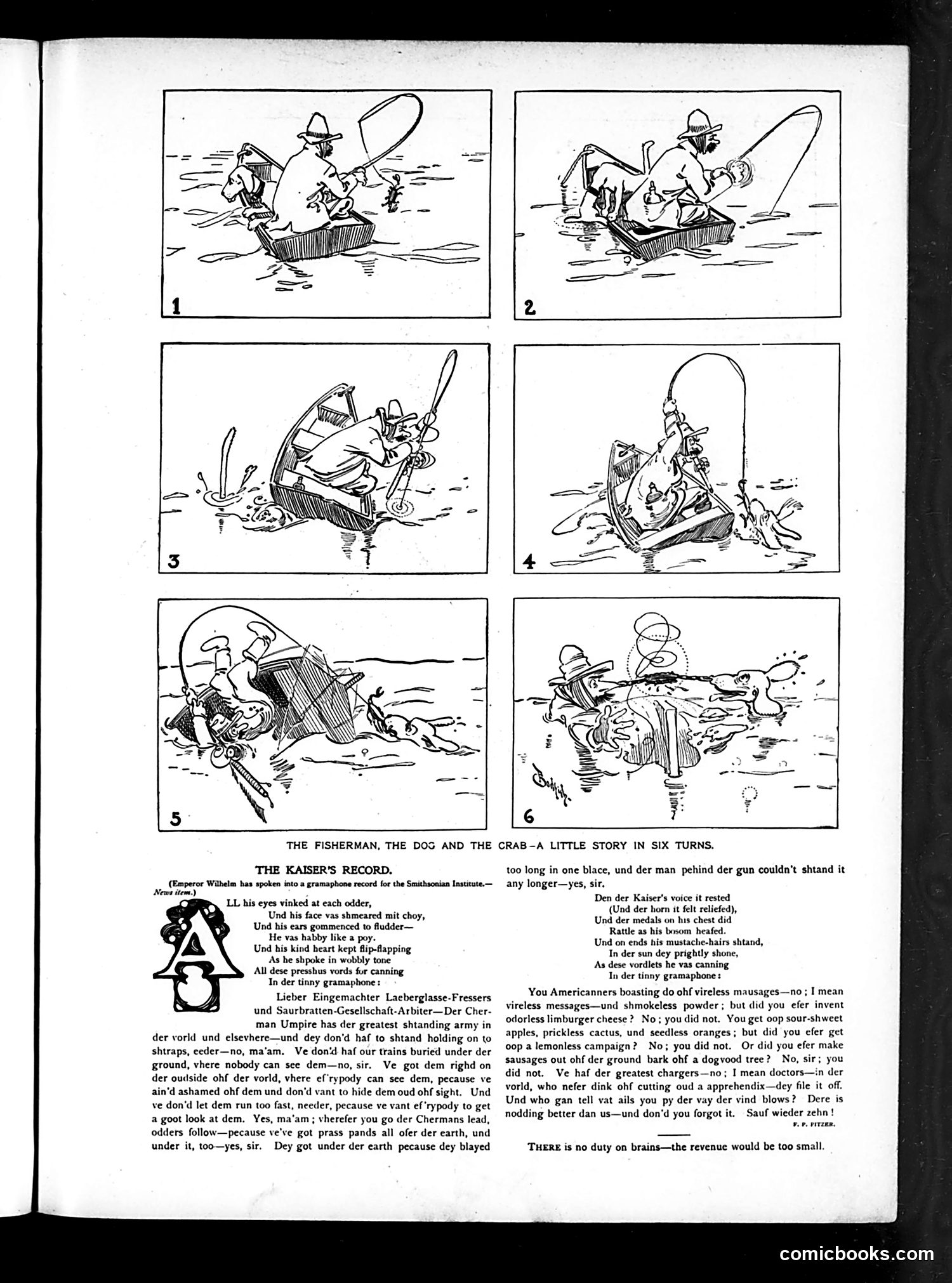
This page satirizes Emperor Wilhelm II's recorded message to the Smithsonian Institution (a real 1914 news item). The cartoon mocks German militarism and the Kaiser's boastfulness through exaggerated German-accented English. The satire ridicules Wilhelm's claims about German military superiority, infrastructure, and innovation. The accent parody emphasizes the "otherness" of Germans to American readers. The Kaiser ironically boasts that German trains run visibly aboveground (implying they're used for military campaigns across conquered lands) rather than hidden underground like American trains—a backhanded admission of aggressive expansionism. The second section's absurd comparisons (odorless limburger cheese, lemonless campaigns, sausages from dogwood bark) deflate German superiority claims through nonsense. The final line—"there is no duty on brains"—suggests Germany lacks intellectual merit. Published during WWI, this represents American anti-German propaganda using ridicule and caricature to delegitimize the enemy.
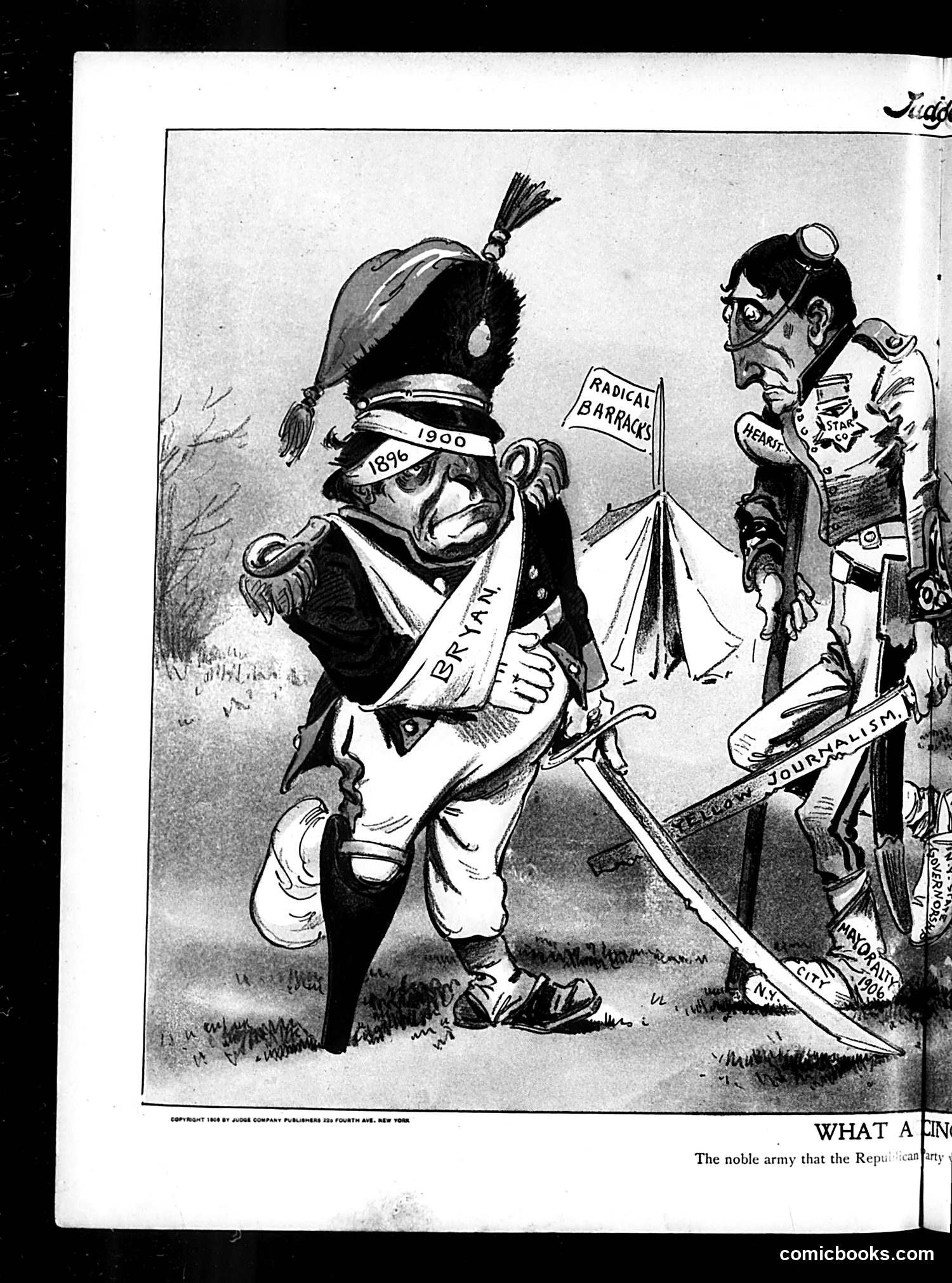
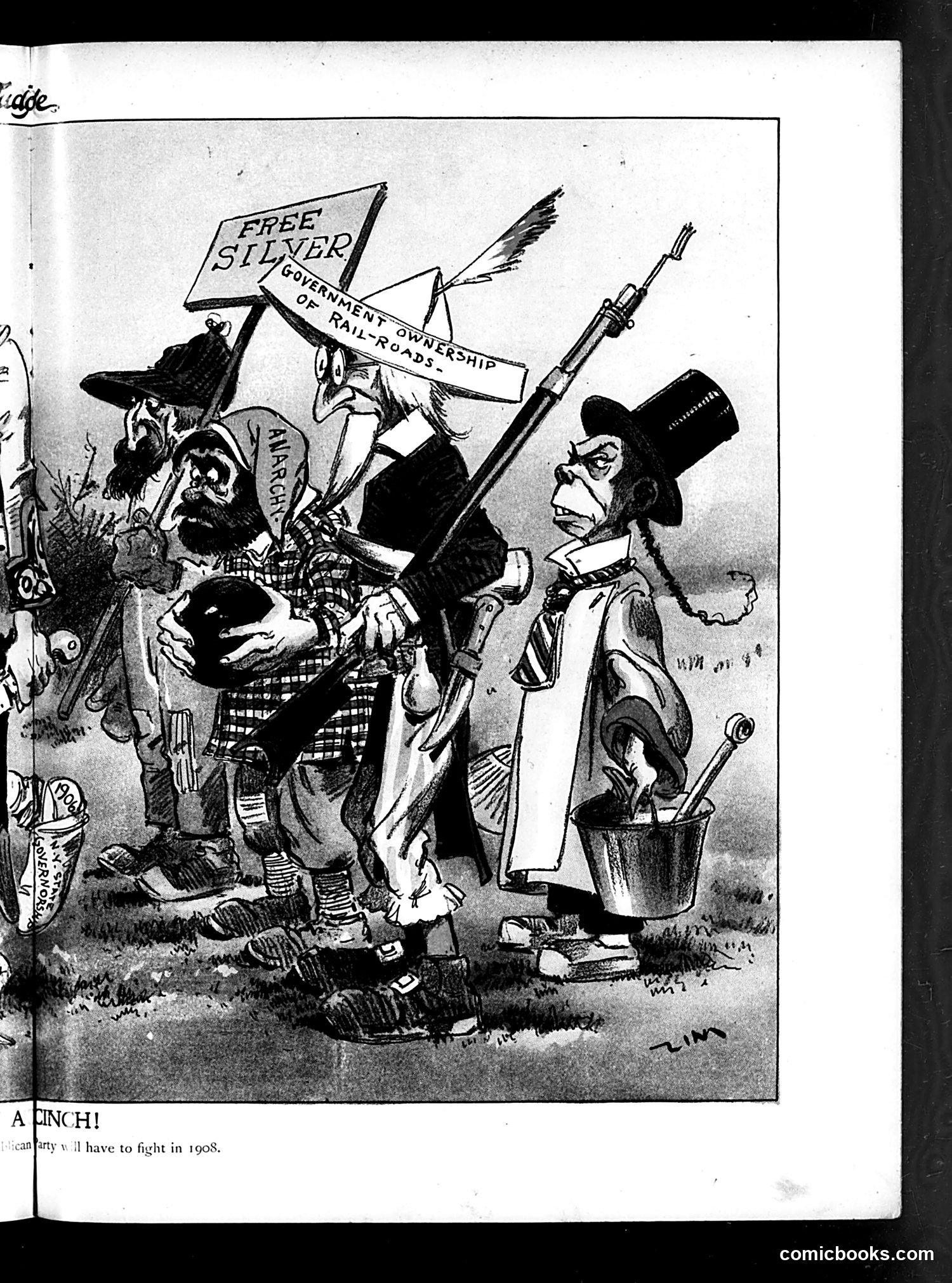
This 1908 Judge cartoon satirizes Republican Party divisions. The central figure, labeled "RADICAL BARRACKS" with dates 1896-1900, appears to be a caricatured military officer representing radical Republican factions. He's depicted as disheveled and incompetent, holding a tent labeled "BRITAIN" (likely referencing foreign policy disputes). On the right stands another figure labeled with "HEARTS," "STAR," and references to journalism and mayoralty, apparently representing Republican establishment leadership observing the radical faction with disdain. The cartoon mocks internal Republican Party conflict, contrasting chaotic radical elements against more conventional party leadership. The military metaphor suggests these weren't unified "noble" forces but rather competing, disorganized factions—the caption's ironic title underscoring this disunity during the 1900s political era.
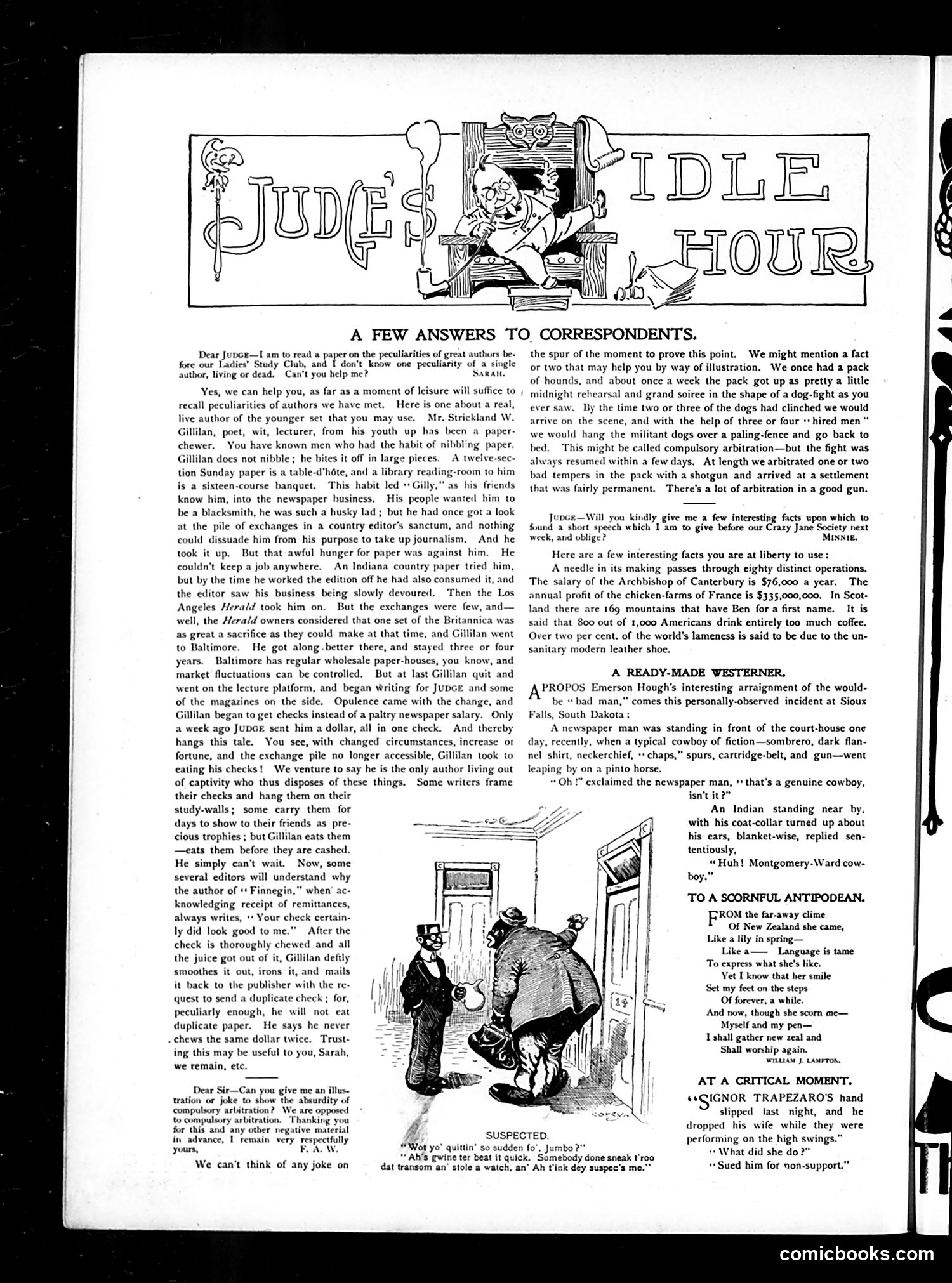
This page presents two main pieces: **Main Article: "A Few Answers to Correspondents"** discusses **Strickland W. Gillilan**, a real poet and author known for an eccentric habit of eating paper. Judge humorously elaborates that Gillilan's appetite for newsprint drove him into journalism, then caused him to lose multiple editorial jobs as he consumed the very papers he was supposed to manage. The joke concludes that upon becoming successful as a lecturer and magazine contributor, Gillilan now literally eats his payment checks before cashing them—a darkly comic exaggeration of his supposed compulsion. **The Cartoon** depicts two figures near a doorway discussing a theft. The dialogue uses heavy dialect stereotyping typical of the era, with one character suspecting another of stealing a watch and fleeing before being blamed. Both pieces reflect late 19th/early 20th-century satirical humor: the first mocking an author's genuine quirk through absurdist exaggeration, the second employing period-typical racial caricature in its comedy.
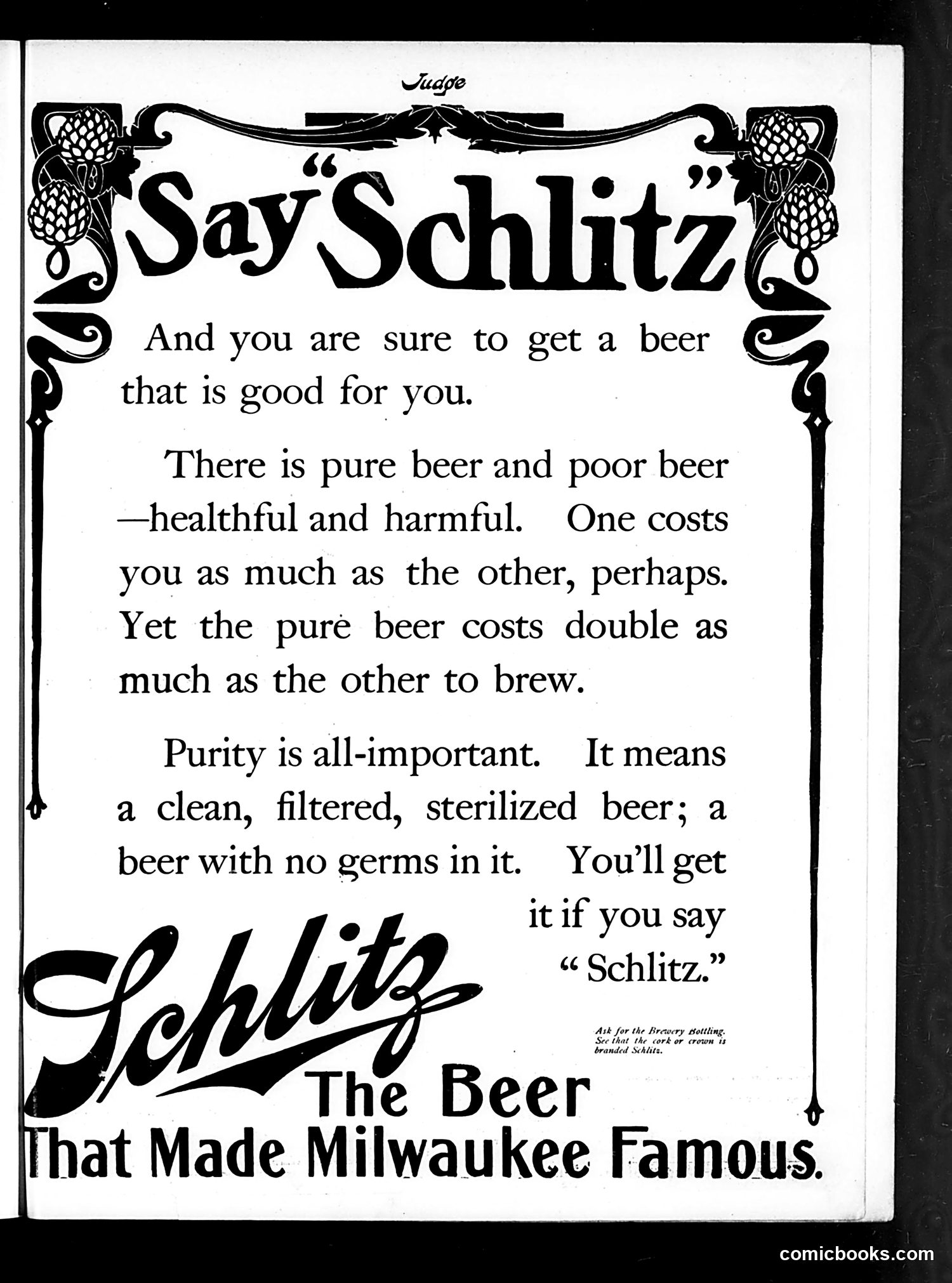
This is **advertising content**, not satire or political commentary. The page promotes Schlitz beer through a paid advertisement in *Judge* magazine. The ad targets consumers by emphasizing **purity as a health benefit**—claiming Schlitz is "clean, filtered, sterilized" with "no germs." This reflects early 20th-century concerns about contaminated food and water, when germ theory was becoming public knowledge. The copywriting addresses a practical consumer dilemma: pure beer costs twice as much to produce but sells at similar prices to inferior beer. The ad urges customers to specifically request "Schlitz" to ensure they receive the purer product. The decorative hop illustrations and "Beer That Made Milwaukee Famous" slogan were standard branding for Schlitz, positioning the company as a quality Milwaukee brewer during the city's prominence in American brewing.
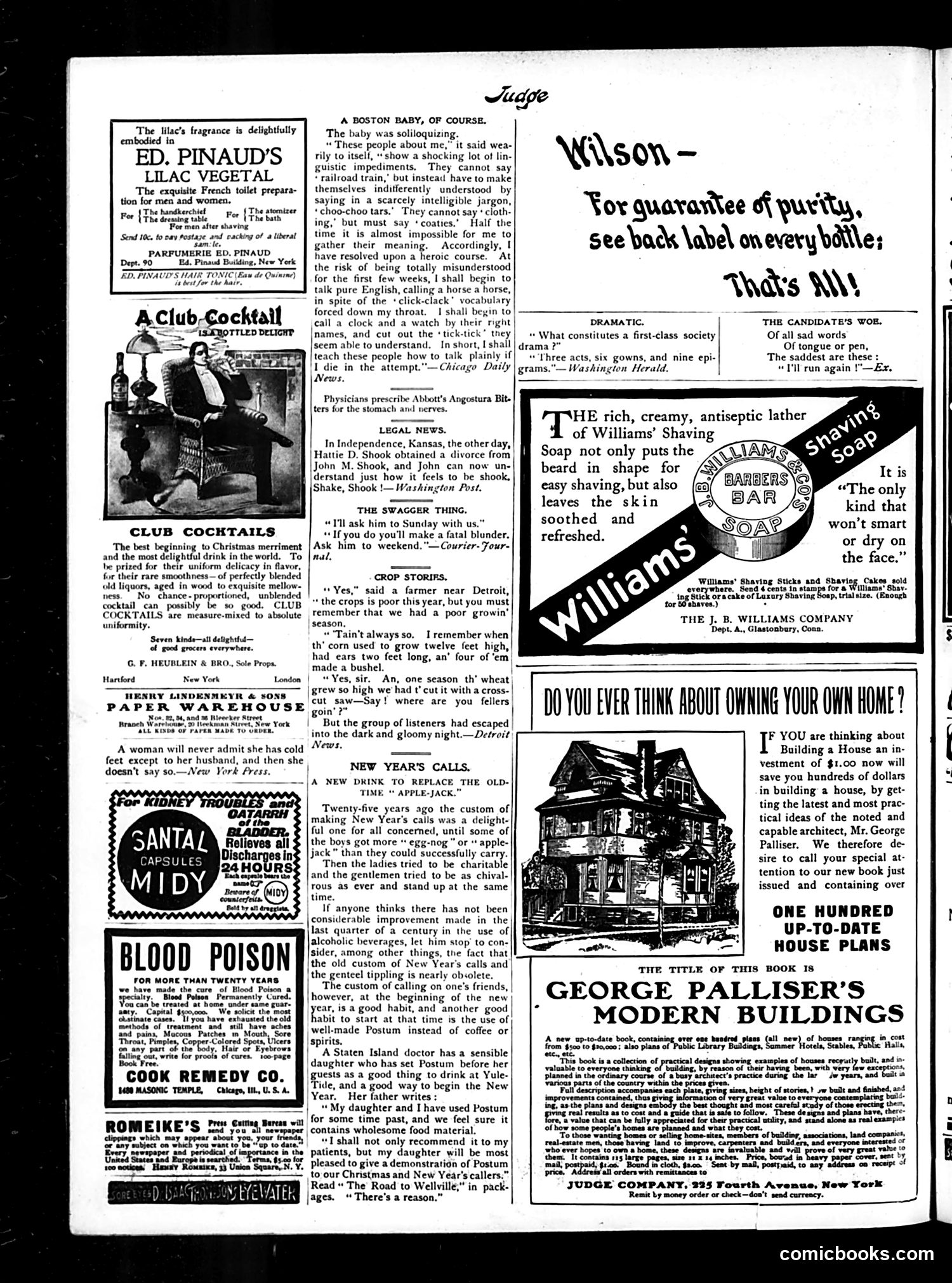
This page is primarily **advertising and humor columns**, not political satire. The main content includes: **The "Boston Baby" piece** satirizes how adults speak to infants in baby talk ("choo-choo cars," "coaties," "tick-tick"). The joke: an exasperated baby narrator resolves to teach adults proper English, frustrated by their linguistic condescension. **"Swagger Thing" and "Crop Stories"** are light humor columns—one mocking fashionable social behavior, the other presenting tall tales about impossibly large crops that farmers tell until listeners flee. **Legal/Social Humor** includes a pun on divorce (Hattie D. "Shook" divorcing John "Shook"). The page is dominated by **product advertisements** (Ed. Pinaud's toiletries, Club Cocktails, Williams' Shaving Soap, home-building books), typical of Judge's commercial content. There are no identifiable political figures or cartoons requiring historical context—this appears to be a regular issue page mixing light domestic humor with period advertising.
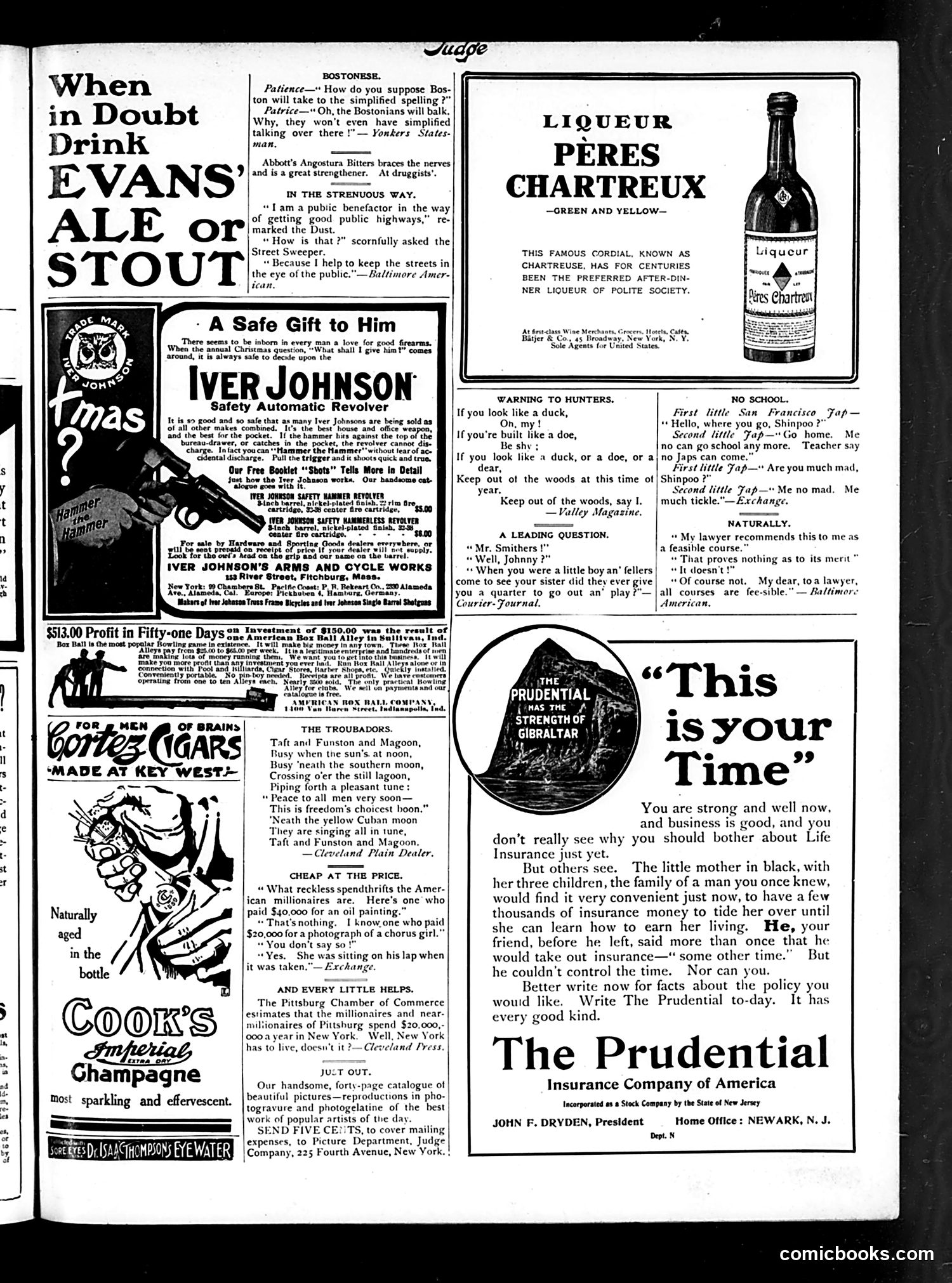
This page is primarily **advertisements and filler content** rather than political cartoons. The main elements: **"Bostonese" section**: Light humor about Boston's resistance to simplified spelling—satirizing Bostonians as stubbornly traditional ("they won't even have simplified talking over there"). **"Warning to Hunters"**: A brief joke about staying out of woods during hunting season, disguised as practical advice. **"San Francisco Fap" dialogue**: Appears to be ethnic humor (unclear context without more historical knowledge, but "Fap" suggests Japanese or Asian characters). **Advertisements dominate**: Iver Johnson revolvers, Cook's champagne, Prudential Insurance, and Liqueur Peres Chartreux liquor. **"Taft and Funston and Magoon" verse**: References three U.S. figures involved in imperial administration (Theodore Roosevelt's era), presented as humorously busy with colonial "peace" efforts. The page reflects early 1900s attitudes: casual ethnic stereotyping, imperialist undertones, and commercial advertising mixed with satirical commentary on American society.
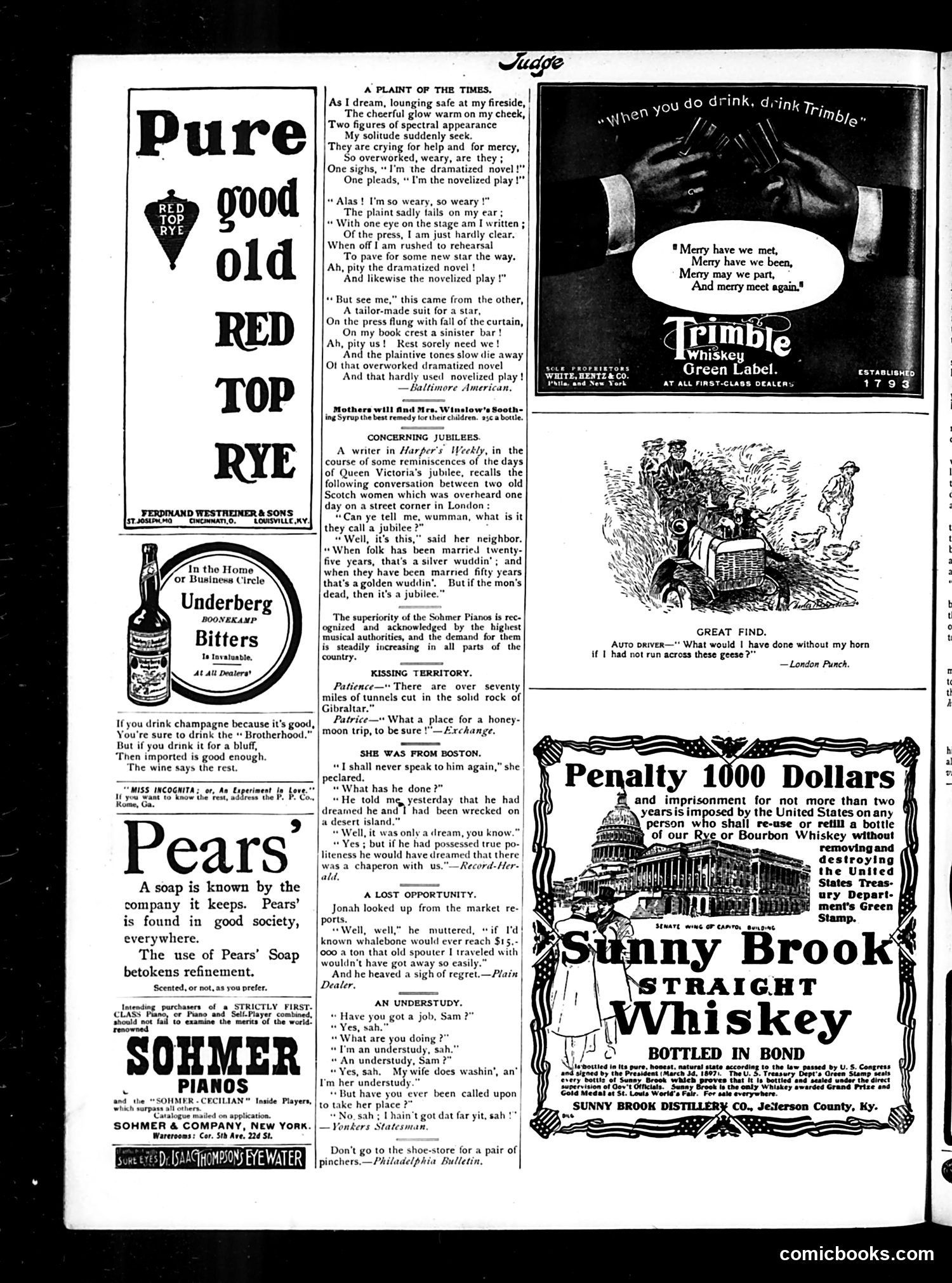
This page is primarily **advertising with light satirical content**, typical of Judge magazine's format. The main satirical piece, "A Plaint of the Times," mocks the over-exploitation of literary works in the early 1900s. It personifies a "dramatized novel" and "novelized play"—spectral figures complaining they're exhausted from constant adaptation between stage and page, rushed into production for new stars. This satirizes the era's trend of rapid cross-media adaptation and commercialization of literature. Other brief humor items include wordplay about jubilees (a Scottish woman defines it as what happens when "the mon's dead"), honeymoon tunnels in Gibraltar, and an anecdote about a Boston woman's etiquette obsession. The **bulk of the page consists of advertisements** for whiskey (Sunny Brook), bitters, soap (Pears'), pianos, and patent medicines—standard Judge revenue sources. These ads reflect Gilded Age consumer culture and class consciousness ("Pears' is found in good society").
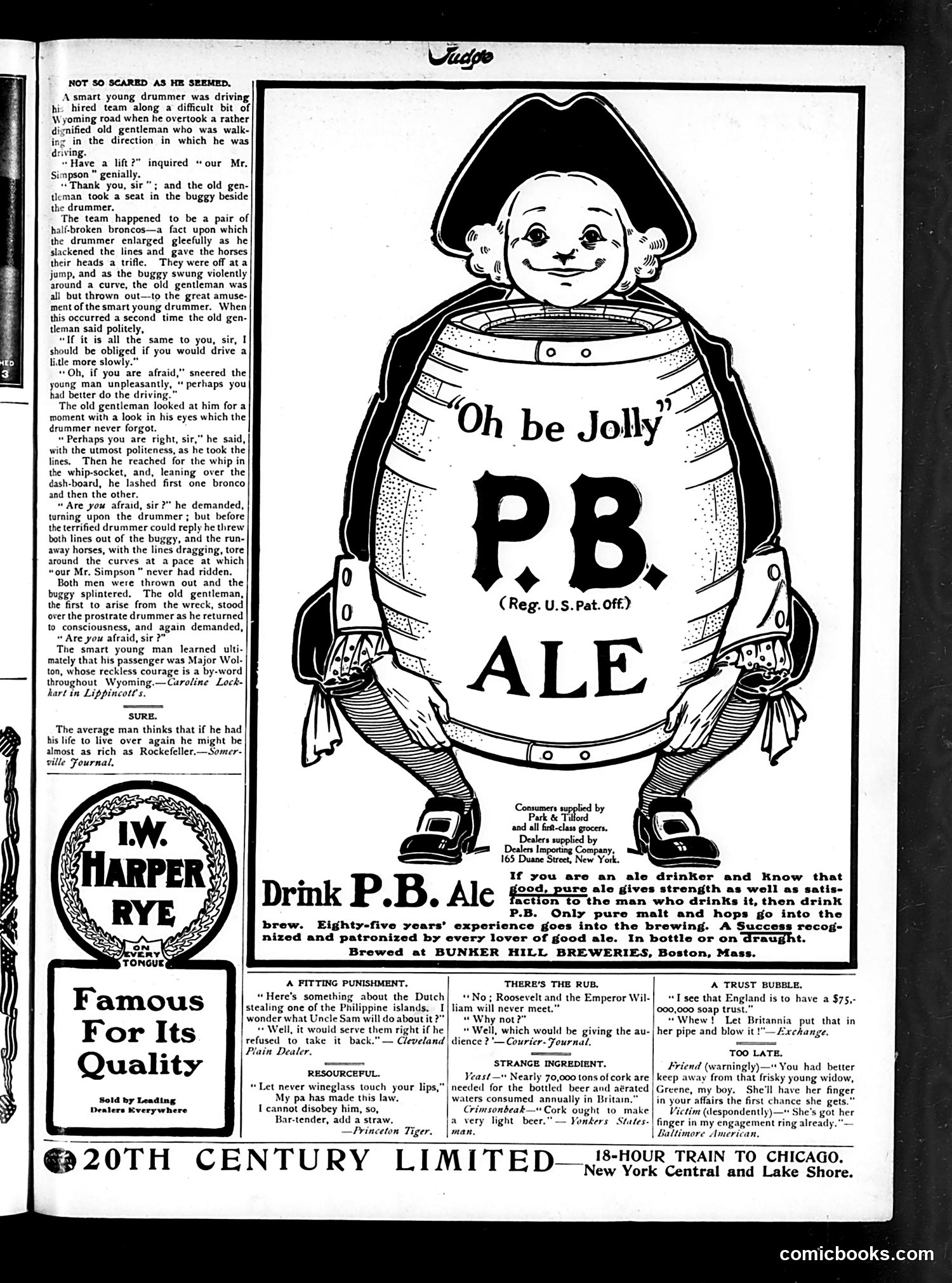
This page combines a short story with advertisements typical of early 20th-century American magazines. The main narrative, "Not So Scared As He Seemed," recounts a Wyoming incident where a cocky young stagecoach driver challenges an elderly passenger's nerve. The driver recklessly speeds around curves with half-broken horses. When insulted, the dignified old man takes the reins and—removing them entirely—drives even more dangerously, terrifying the young man. The twist: the passenger is Major Wolton, a legendary figure known for fearless courage throughout Wyoming, teaching the arrogant youth a humbling lesson. The satire targets youthful overconfidence and rudeness, using frontier mythology to frame the moral: genuine toughness doesn't need to boast. The story validates older authority and wisdom over youth's presumption. The page also features advertisements for P.B. Ale, I.W. Harper Rye, and other products typical of Judge's commercial content, alongside brief humorous quips about contemporary topics (Philippine annexation, Roosevelt, English soap trusts).
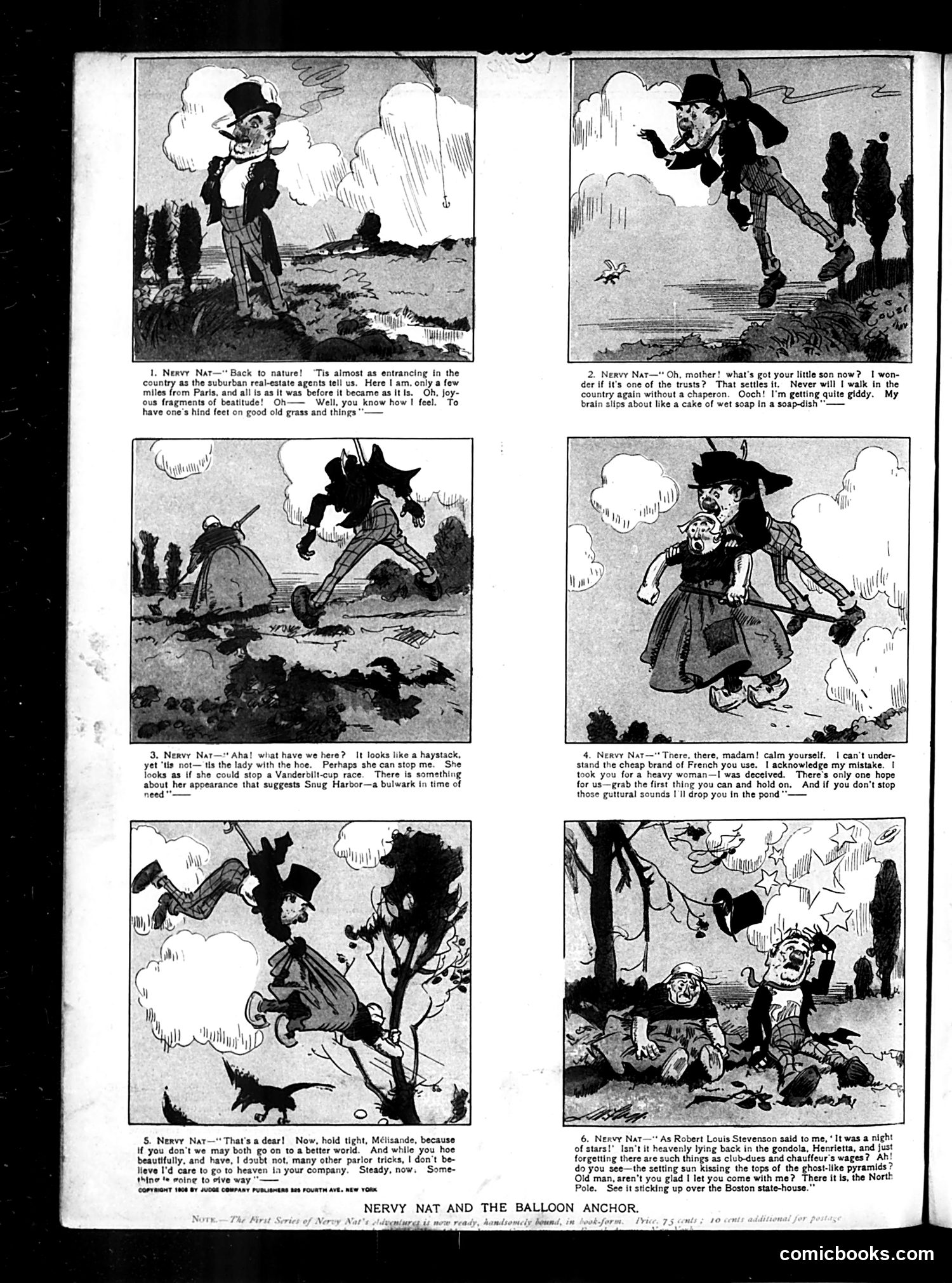
This is a satirical comic strip about "Nervy Nat," an aristocratic character attempting rustic escapades while remaining absurdly pretentious and disconnected from reality. **The satire targets:** - Wealthy urbanites romanticizing "back to nature" while remaining oblivious and incompetent - Class anxiety: Nat mistakes a working-class woman with a hoe for a haystack, then panics she's connected to Vanderbilt wealth - American wealth and leisure: references to "trusts," chauffeurs' wages, and club dues mock nouveau riche concerns - Pretentious name-dropping (Stevenson, French affectations, gondolas) - Gender anxieties: a female companion becomes hysterical; Nat worries about her "cheap French" accent The "balloon anchor" device—they're apparently in a hot air balloon with a woman holding a hoe as anchor—embodies the strip's central joke: these people are fundamentally ridiculous and unprepared, yet utterly convinced of their own sophistication.