
Judge, 1906-12-08 · page 10 of 16
Judge — December 8, 1906 — page 10: what you’re looking at
What you’re looking at
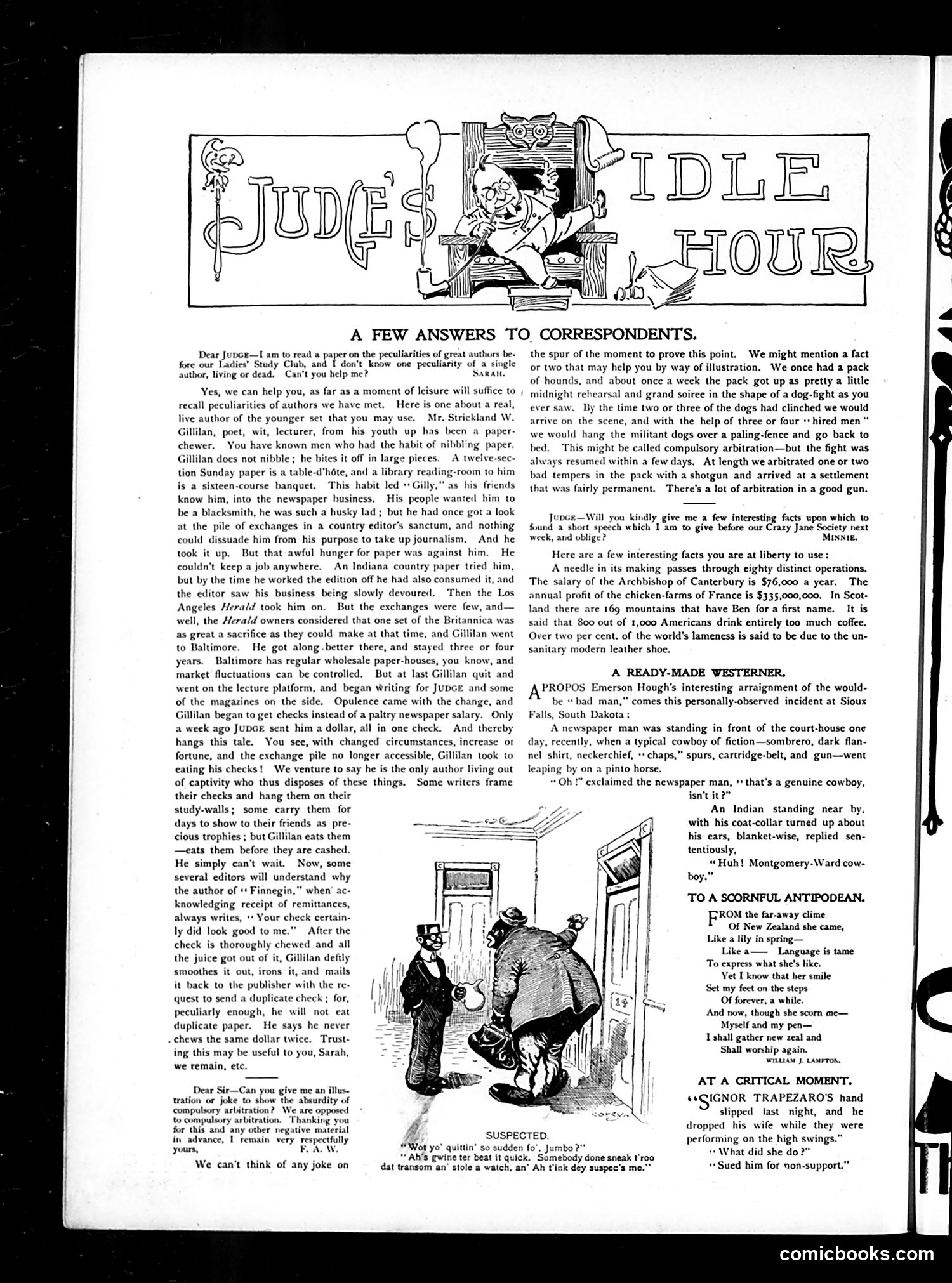
This page presents two main pieces: **Main Article: "A Few Answers to Correspondents"** discusses **Strickland W. Gillilan**, a real poet and author known for an eccentric habit of eating paper. Judge humorously elaborates that Gillilan's appetite for newsprint drove him into journalism, then caused him to lose multiple editorial jobs as he consumed the very papers he was supposed to manage. The joke concludes that upon becoming successful as a lecturer and magazine contributor, Gillilan now literally eats his payment checks before cashing them—a darkly comic exaggeration of his supposed compulsion. **The Cartoon** depicts two figures near a doorway discussing a theft. The dialogue uses heavy dialect stereotyping typical of the era, with one character suspecting another of stealing a watch and fleeing before being blamed. Both pieces reflect late 19th/early 20th-century satirical humor: the first mocking an author's genuine quirk through absurdist exaggeration, the second employing period-typical racial caricature in its comedy.
📄 Transcribed text from this page (OCR, searchable)
Machine-transcribed from the original scan — historical spelling and the odd misread are preserved.
A FEW ANSWERS TO. CORRESPONDENTS. Dear Jupce—I am to read a paperon the peculiarities of great authors b fore our Ladies’ Study Club, and I don't know one peculiarity of a si author, living or dead. Can't you help me? SARAH. Yes, we can help you, as far as a moment of leisure will suffice to , recall peculiarities of authors we have met. Here is one about a real, live author of the younger set that you may use, Mr. Strickland W. Gillilan, poet, wit, lecturer, from his youth up has been a paper- chewer. You have known men who had the habit of nibbling paper. Gillian does not nibble; he bites it off in larg A twelve-sece tion Sunday paper is a table-d’hote, and a lib is a sixteen-course banquet. This habit led know him, into the newspaper business. His people wanted him to be a blacksmith, he was such a husky lad ; but he had once got a look at the pile of exchanges in a country editor's sanctum, and nothing could dissuade him from his purpose to take up journalism, And he took it up. But that awful hunger for paper was against him, He couldn't keep a job anywhere. An Indiana country paper tried him, but by the time he worked the edition off he had also consumed it, and the editor saw his business being slowly devoured. Then the Los Angeles Herald took him on, But the exchanges were few, and— well, the Herald owners considered that one set of the Britannica was as great a sacrifice as they could make at that time, and Gillilan went to Baltimore. He got along. better there, and stayed three or four years. Baltimore has regular wholesale paper-houses, you know, and market fluctuations can be controlled. But at last Gillilan quit and went on the lecture platform, and began Writing for JUDGE and some of the magazines on the side. Opulence came with the change, and Gillilan began to get checks instead of a paltry newspaper salary. Only a week ago JUDGE sent him a dollar, all in one check. And thereby hangs this tale, You see, with changed circumstances, increase ot fortune, and the exchange pile no longer accessible, Gillilan took to eating his checks! We venture to say he is the only author living out of captivity who thus disposes of these things. Some writers frame their checks and hang them on their study-walls; some carry them for days to show to their friends as pre- cious trophies ; but Gillilan eats them —eats them before they are cashed. He simply can't wait. Now, some several editors will understand why the author of «+ Finnegin,” when’ ac- knowledging receipt of remittances, always writes, ** Your check certain- ly did look good to me.” After the check is thoroughly chewed and all the juice got out of it, Gillilan deftly smoothes it out, irons it, and mails it back to the publisher with the re. quest to send a duplicate check ; for, peculiarly enough, he will not eat duplicate paper. He says he never «chews the same dollar twice. Trust- ing this may be useful to you, Sarah, we remain, etc. pieces. y reading-room to him “Gilly,” as his friends Dear Sir—Can you give me an illus. tration or joke to show the absurdity of compulsory arbitration? We are opposed to compulsory arbitration. Thanking you for this and any other negative material very respectfully FAW, We can't think of any joke on Ye SUSPECTED. ‘Wot yo" quittin’ so sudden fo", Jumbo?” “*Ah’s gwine ter beat it quick. Somebody done sneak t'roo dat transom an’ stole a watch, an’ Ah t'ink dey suspec’s me.” the spur of the moment to prove this point. We might mention a fact or two that may help you by way of illustration, We once had a pack of hounds, and about once a week the pack got up as pretty a little midnight rehearsal and grand soiree in the shape of a dog-fight as you ever saw. By the time two or three of the dogs had clinched we would arrive on the scene, and with the help of three or four + hired men" we would hang the militant dogs over a paling-fence and go back to bed. ‘This might be called compulsory arbitration—but the fight was always resumed within a few days. At length we arbitrated one or two bad tempers in the pack with a shotgun and arrived at a settlement that was fairly permanent. There's a lot of arbitration in a good gun. Jupcer—Will you kindly give me a few interesting facts upon which to found a short speech which Iam to give before our Crazy Jane Society next week, and oblige? MINNIE. Here are a few interesting facts you are at liberty to use: A needle in its making passes through eighty distinct operations. The salary of the Archbishop of Canterbury is $76,000 a year. The annual profit of the chicken-farms of France is $335,000,000. In Scot- land there are 169 mountains that have Ben fora first name. It is said that 800 out of 1,000 Americans drink entirely too much coffee. Over two per cent, of the world's lameness is said to be due to the un- sanitary modern leather shoe. A READY-MADE WESTERNER. APROPOS Emerson Hough's interesting arraignment of the would- be “bad man," comes this personally-observed incident at Sioux Falls, South Dakota : A newspaper man was standing in front of the court-house one day, recently, when a typical cowboy of fiction—sombrero, dark flan- nel shirt, neckerchief, “chaps,” spurs, cartridge-belt, and gun—went leaping by on a pinto horse. “Oh !" exclaimed the newspaper man, ‘that's a genuine cowboy, isn’t it?” An Indian standing near by, with his coat-collar turned up about his ears, blanket-wise, replied sen- tentiously, “Huh! Montgomery-Ward cow- boy.” ‘TO A SCORNFUL ANTIPODEAN, FFROM the far-away clime Of New Zealand she came, Like a lily in spring— Like a—— Language is tame To express what she’s like. Yet I know that her smile Set my feet on the steps Of forever, a while. And now, though she scorn me— Myself and my pen— I shall gather new zeal and Shall worship again. WILLLAS J. LAMITON, AT A CRITICAL MOMENT. ‘6GIGNOR TRAPEZARO'S hand slipped last night, and he dropped his wife while they were performing on the high swings.” + What did she do?” + Sued him for non-support.” comicbooks.com