
A complete issue · 16 pages · 1906
Judge — May 19, 1906
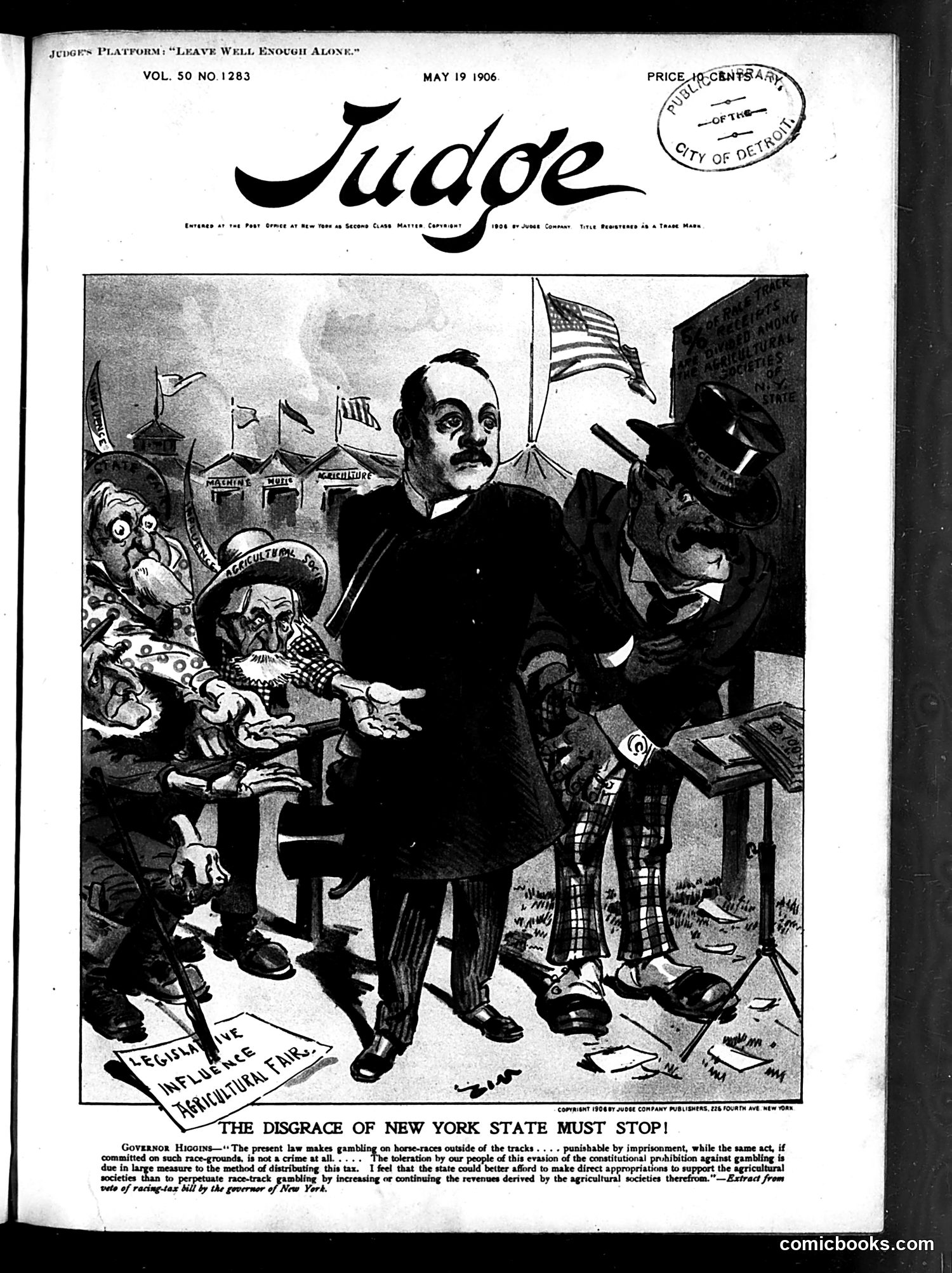
This editorial cartoon criticizes New York State's tolerance of race-track gambling under the guise of agricultural fairs. The central figure (likely Governor Joseph B. Odell or another state official) is depicted surrounded by grotesque caricatures representing corrupt influence—including what appears to be gamblers and manipulative interests. Documents labeled "LEGALIZE," "INFLUENCE," and "AGRICULTURAL FAIRS" litter the scene. The caption "THE DISGRACE OF NEW YORK STATE MUST STOP!" explicitly condemns the state's hypocrisy: while constitutionally prohibiting gambling, authorities permit race-track betting by disguising it as agricultural activity. The editorial argues this contradiction undermines law and morality, and that the state should either enforce its prohibition or stop the charade of moral authority.
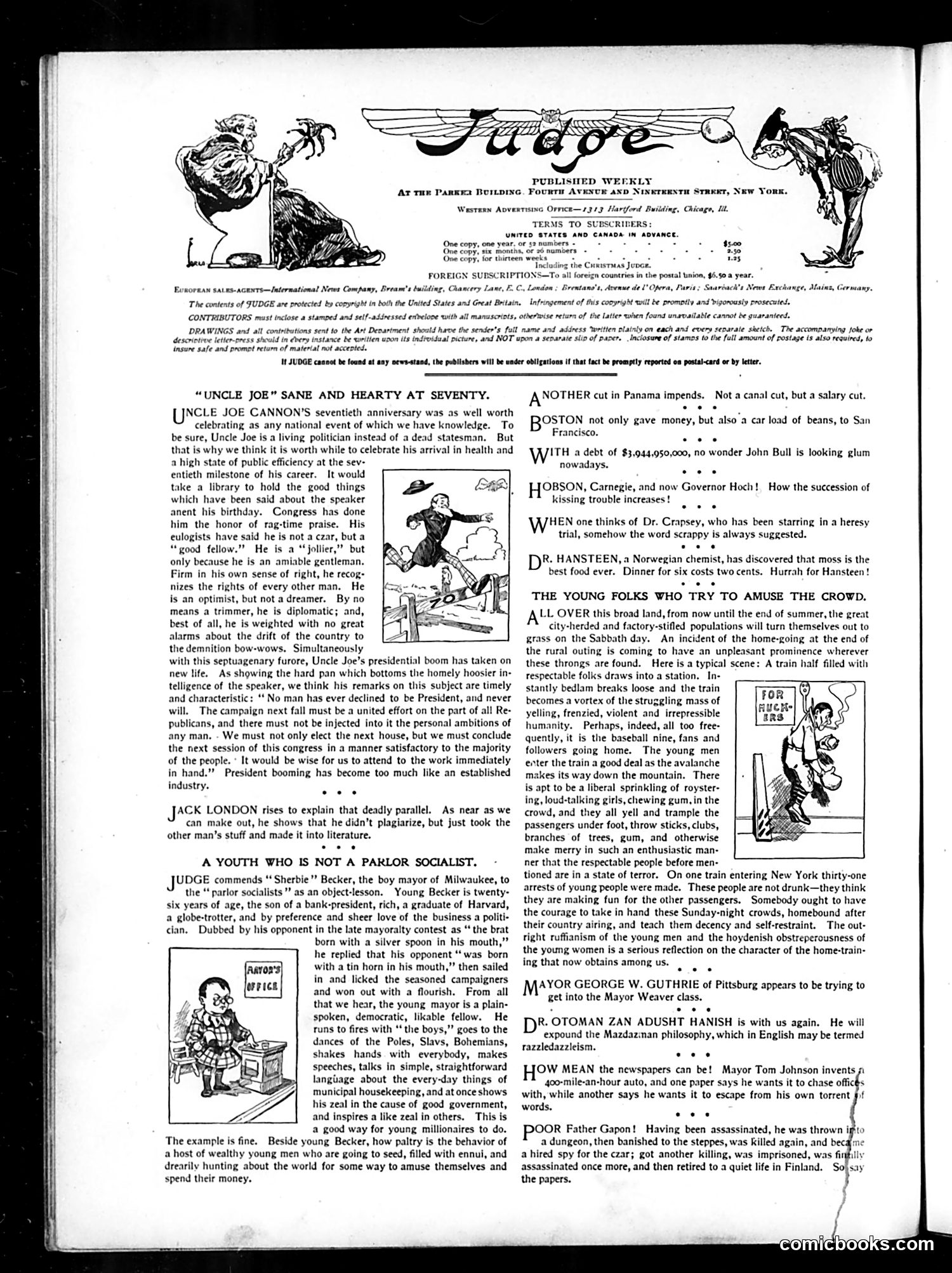
This page from Judge magazine contains satirical commentary on contemporary American politics and social issues, rather than discrete political cartoons. The main piece, "Uncle Joe Sane and Hearty at Seventy," celebrates Uncle Joe Cannon (likely Speaker of the House) on his birthday, praising him as a "good old boy" and "optimist" despite criticizing his limitations. The right column contains brief satirical notes on various public figures and issues: Judge Becker as Milwaukee's boy mayor, Dr. Crooksey's heresy trial, and observations about rowdy young people on trains and city streets. A final item mocks newspapers for sensationalizing a goo-mile-an-hour automobile and a river-powered escape device. The overall tone is lighthearted political commentary typical of early-1900s American satirical journalism.
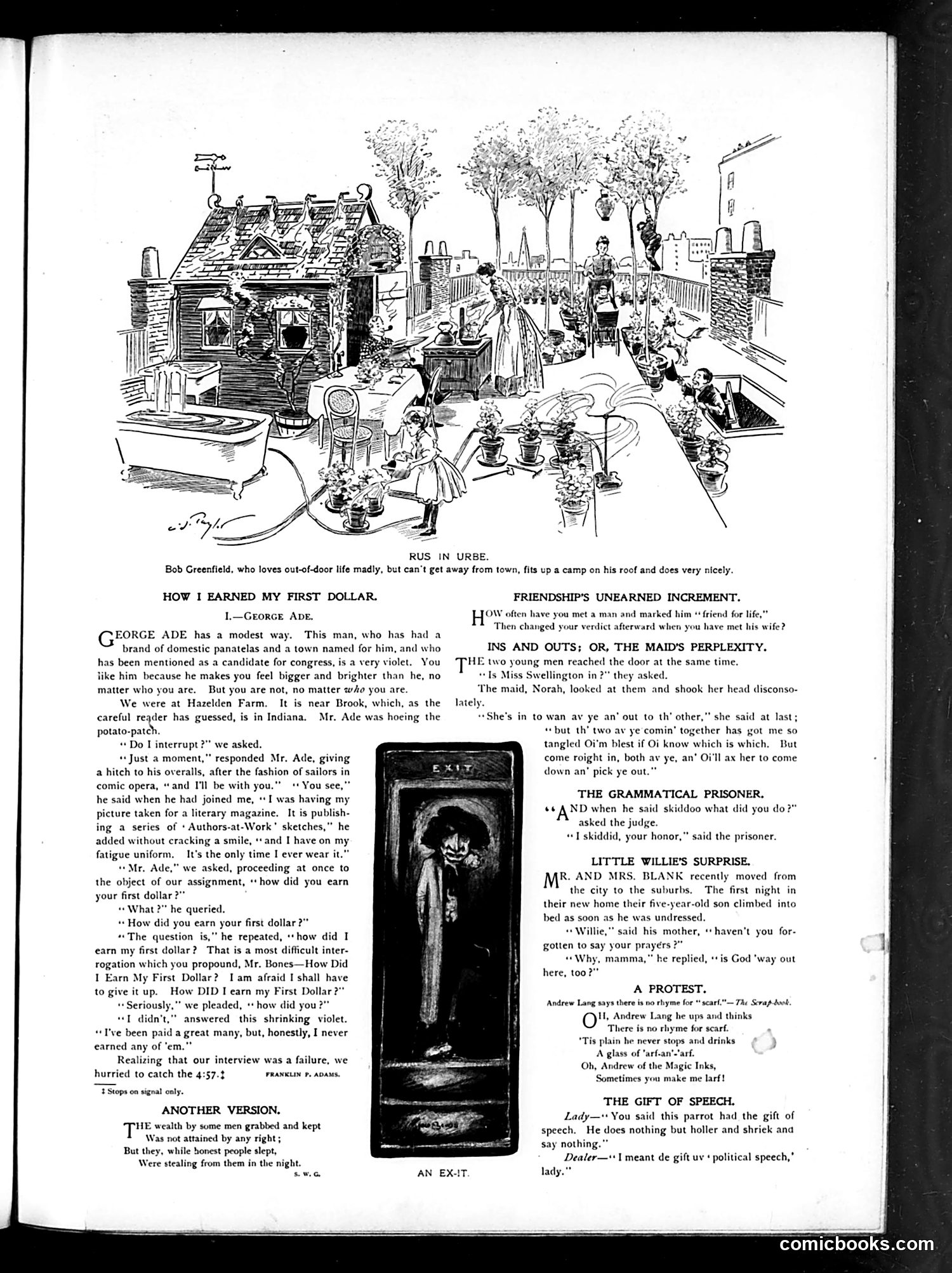
This page contains multiple short humor pieces rather than a single political cartoon. The main illustration labeled "AN EXIT" shows a figure in what appears to be a prison or confined space, likely accompanying "The Grammatical Prisoner" story about a judge's wordplay. The content focuses on social satire rather than politics: "How I Earned My First Dollar" mocks a wealthy man claiming self-made success; "Ins and Outs; Or, The Maid's Perplexity" jokes about courting customs; "Little Willie's Surprise" presents a child's naive religious interpretation; and "A Protest" parodies Andrew Lang's poetry about nonsensical rhyming. The overall theme targets middle-class pretension, gender roles, and literary affectation—typical Judge magazine fare from this era.
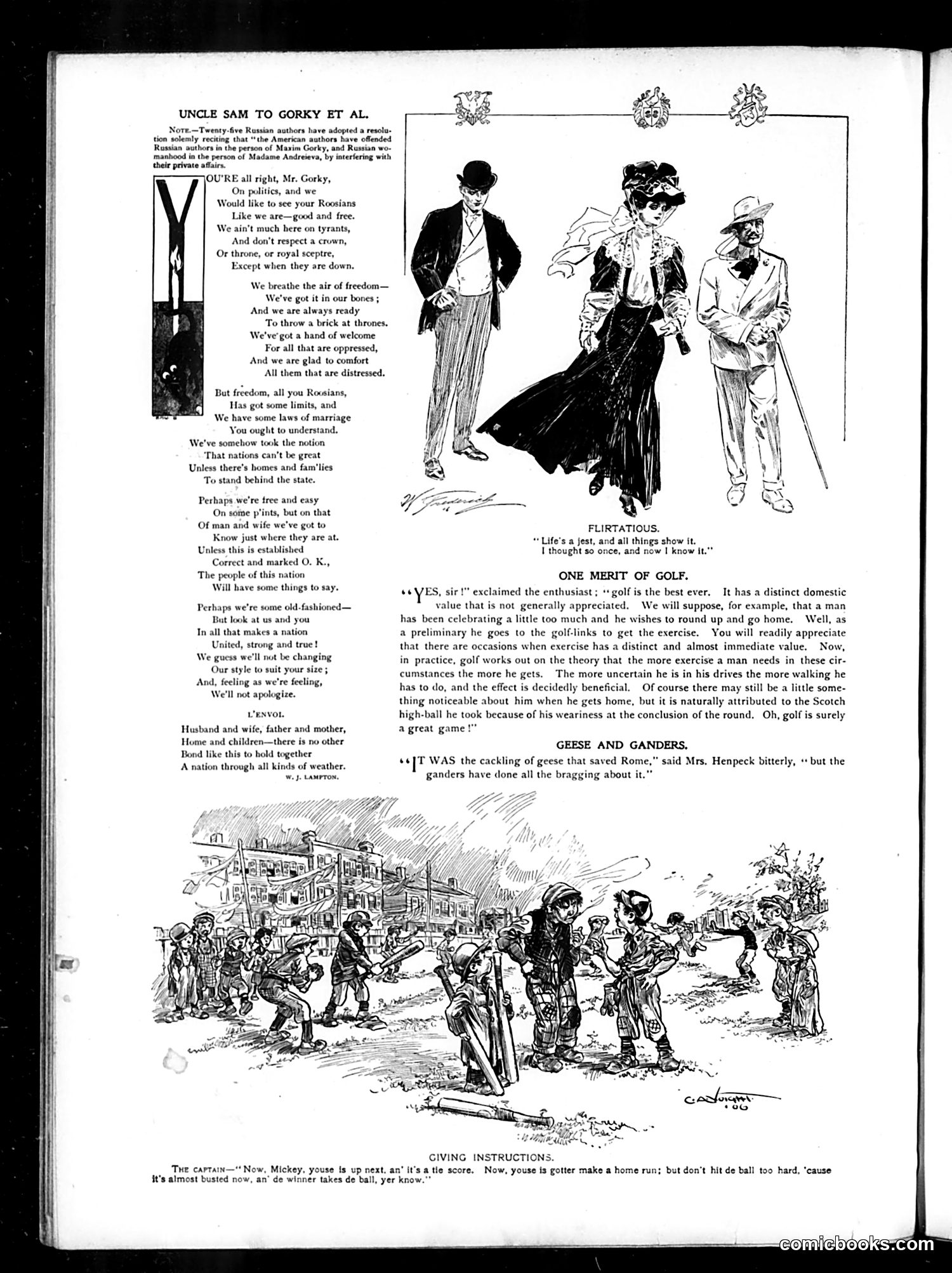
The page contains three distinct sections: 1. **"Uncle Sam to Gorky et al."** - A poem where Uncle Sam addresses Russian authors (likely Maxim Gorky and others), asserting American freedom and rejecting tyranny. This appears to reference early 20th-century Russian political/literary figures, contrasting American democratic values with Russian authoritarianism. 2. **"One Merit of Golf"** and **"Geese and Ganders"** - Brief satirical pieces mocking golf as exercise and making a gender-based joke about historical credit (geese saving Rome versus ganders receiving credit). 3. **"Giving Instructions"** - A cartoon showing a baseball captain instructing a young player, with humor about hitting technique. The page reflects Judge magazine's typical mix of political commentary on US-Russia relations and lighthearted domestic satire about recreation and gender dynamics.
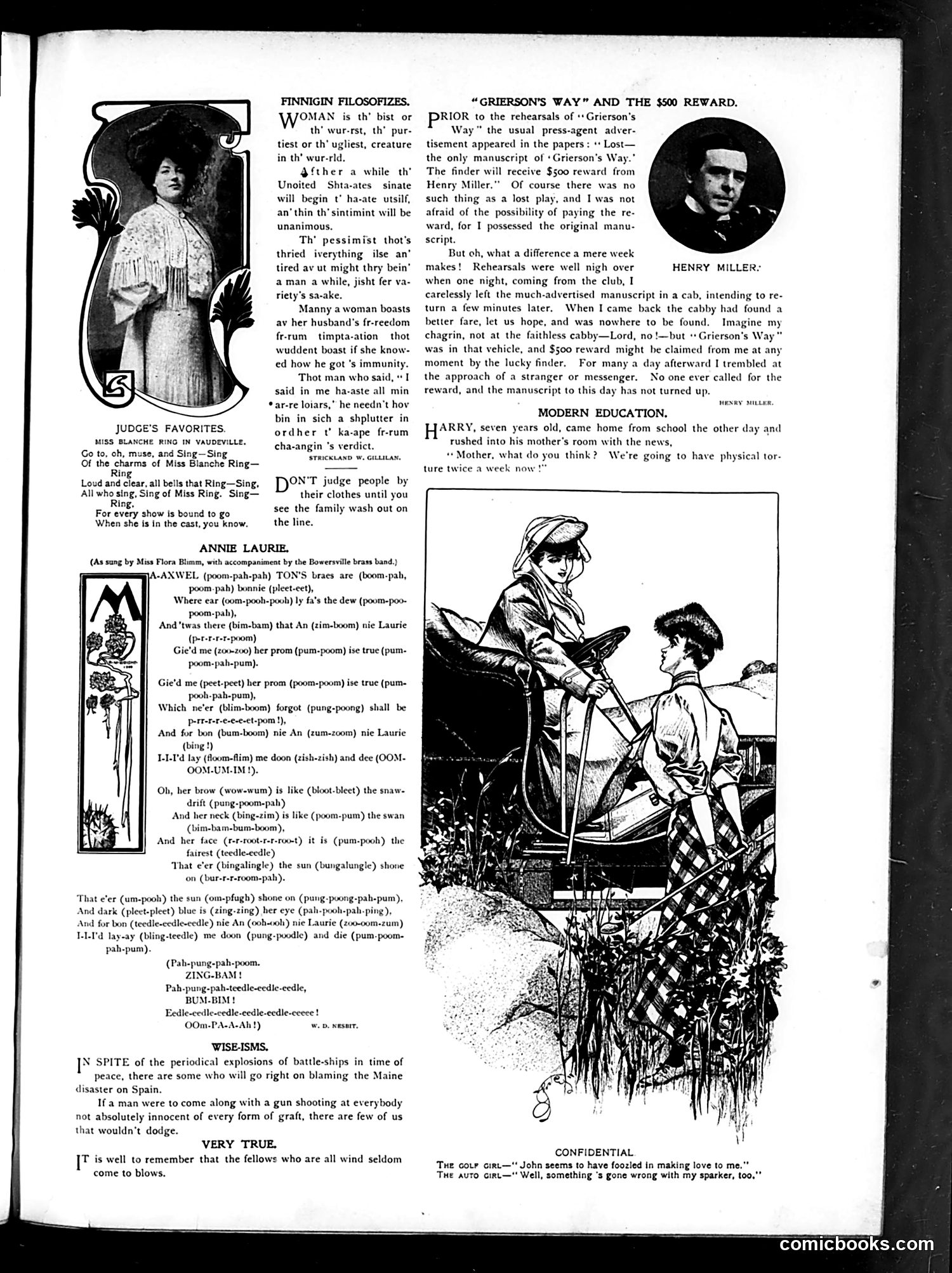
This page contains several unrelated pieces rather than a unified political cartoon: **"Finnigin Philosofizes"** presents a woman musing on gender relations—asserting women shouldn't be judged by clothes until "the family wash out on the line," suggesting hypocrisy in respectability standards. **"Grierson's Way"** describes a lost theatrical manuscript and a $500 reward, appearing to be a humorous anecdote about theatrical life rather than political satire. **"Modern Education"** shows a father with a young boy discussing physical exercise, reflecting early 20th-century anxieties about children's health and parenting. **"Annie Laurie"** is a song with phonetic pronunciation guide—a popular feature in period magazines for readers unfamiliar with Scottish dialect. The page mixes humor, advice, and entertainment content typical of Judge's miscellaneous editorial approach rather than focused satirical commentary.
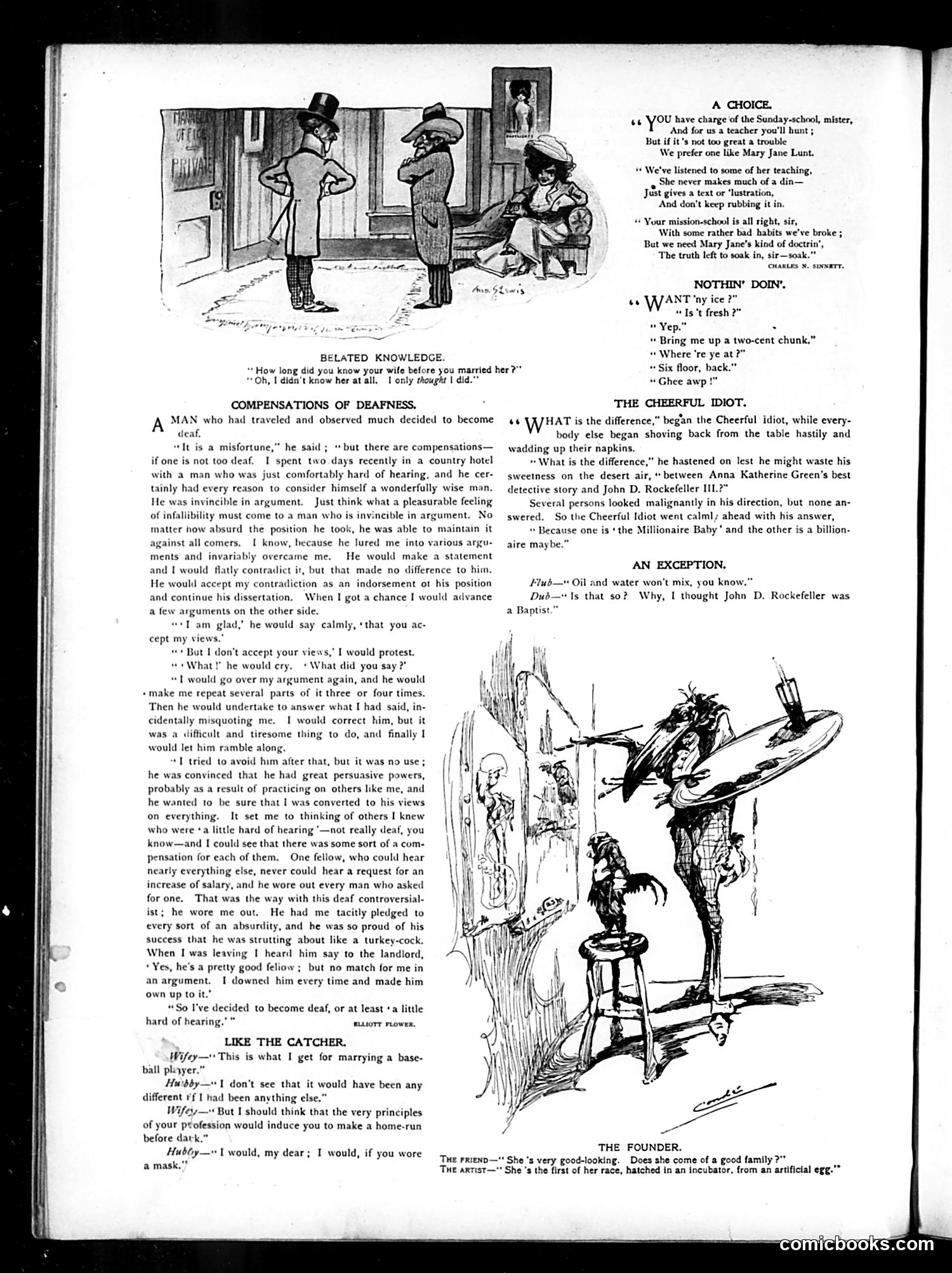
This page contains several standalone humorous sketches satirizing early 20th-century American social types: **"Belated Knowledge"**: A joke about marriage—the husband admits he never actually knew his wife before marrying her, only *thought* he did. It mocks the often-unrealistic expectations men held about courtship. **"Compensations of Deafness"**: The main text satirizes argumentative bores who exploit partial deafness as a conversational advantage. By selectively "mishearing" corrections, the deaf man wins every argument through sheer persistence, never truly engaging with counterpoints. It's social commentary on stubbornness masquerading as confidence. **"Like the Catcher"**: A baseball player joke—the wife complains he doesn't come home before dark. He quips he would, "if you wore a mask," referencing the catcher's protective equipment. It's wordplay mixing domestic expectations with baseball terminology. The cartoons use everyday scenarios to mock human foibles: male self-deception, argumentative dishonesty, and marital miscommunication. The humor relies on recognizable social types rather than topical references.
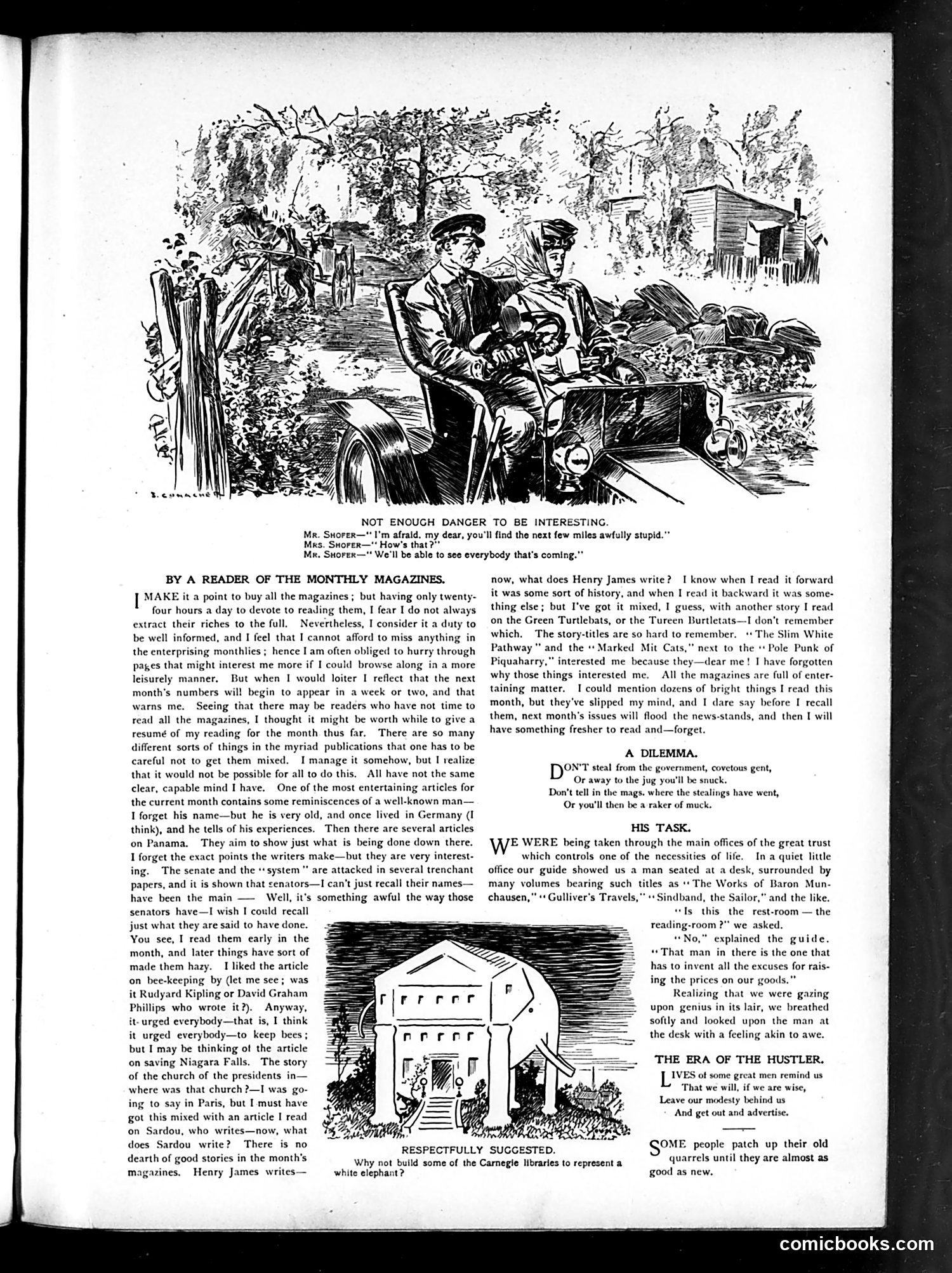
**The Main Cartoon:** The top illustration depicts a couple in an early automobile. Mr. Sorer reassures his wife that the next stretch of road lacks sufficient danger to be interesting—they'll see everyone coming. This satirizes the novelty-seeking thrill-seekers of the automobile era, mocking both the danger of early motoring and the upper class's appetite for excitement. **The Essay Below:** "By a Reader of the Monthly Magazines" mocks the pretentious magazine consumer who claims to read everything but retains nothing. The narrator admits to forgetting authors' names, plot details, and article subjects within weeks—confusing Henry James with bee-keeping articles, mixing up story titles ("Green Turtlebats," "Marked Mit Cats"). The satire targets the conspicuous consumption of culture: people buying multiple magazines monthly to appear well-informed while actually absorbing little. It ridicules both the magazines' proliferation of mediocre content and readers' performative intellectualism—reading too quickly to actually understand anything.
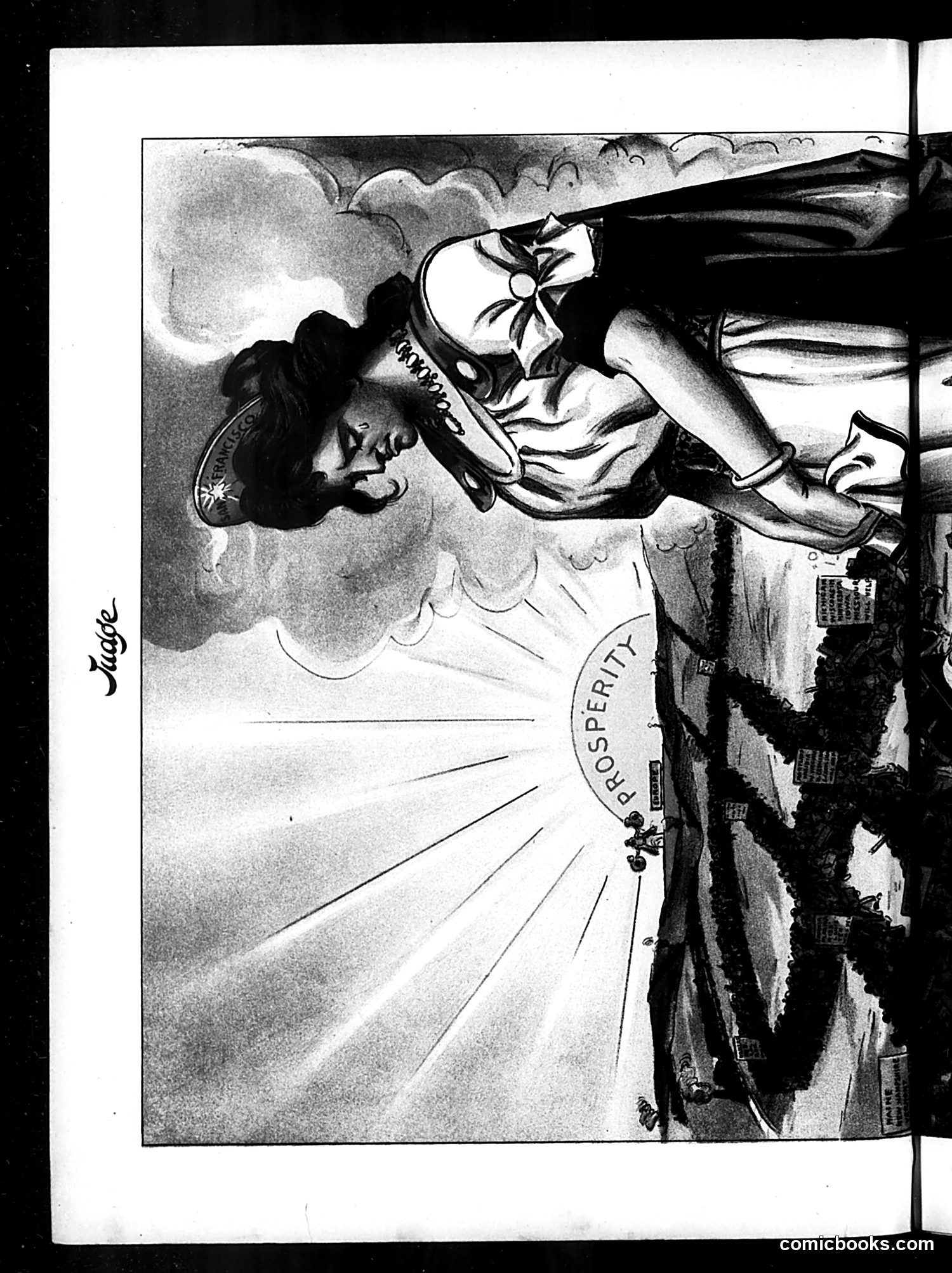
This appears to be a single political cartoon from *Judge* magazine, though the OCR text provides minimal content beyond the website attribution. The image shows a figure in classical or allegorical dress (possibly representing Liberty or a similar concept, given the decorative headpiece) reclining among clouds. The figure appears to be wielding or associated with a sword or lightning bolt. On the right side, what seems to be a cityscape or industrial landscape is visible. Without clearer text or visible date information, I cannot definitively identify the specific political event, public figure, or social issue being satirized. The classical allegory style and dramatic composition suggest commentary on a significant American political or social moment, but determining the precise target and message requires additional context not clearly legible in this reproduction.
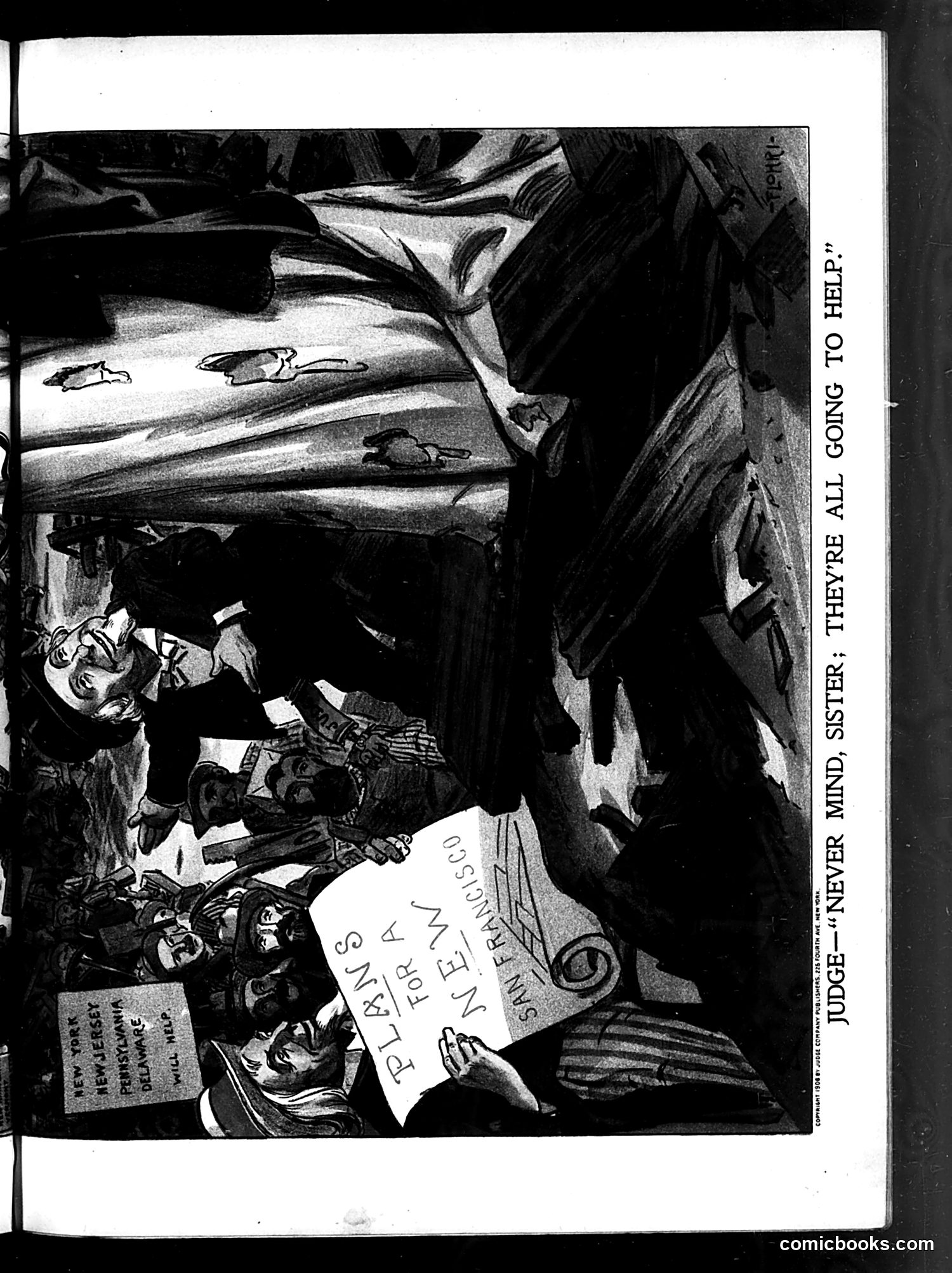
This appears to be a political cartoon from *Judge* magazine showing a figure holding a sign reading "PLANS FOR A SINKING FORECASTLE" (though the exact wording is difficult to read with certainty). The cartoon's caption reads: "JUDGE—NEVER MIND, SISTER; THERE'S ALL GOING TO HELP!" The satire appears to critique someone's proposed plans or policy as fundamentally flawed or destined to fail (the "sinking" metaphor). The figure's distressed posture and the patronizing caption suggesting things will somehow improve despite obvious problems suggests the cartoon mocks either political incompetence, false optimism, or empty reassurances about a failing venture or policy. Without additional context about the specific date or political figures, the exact target remains unclear.
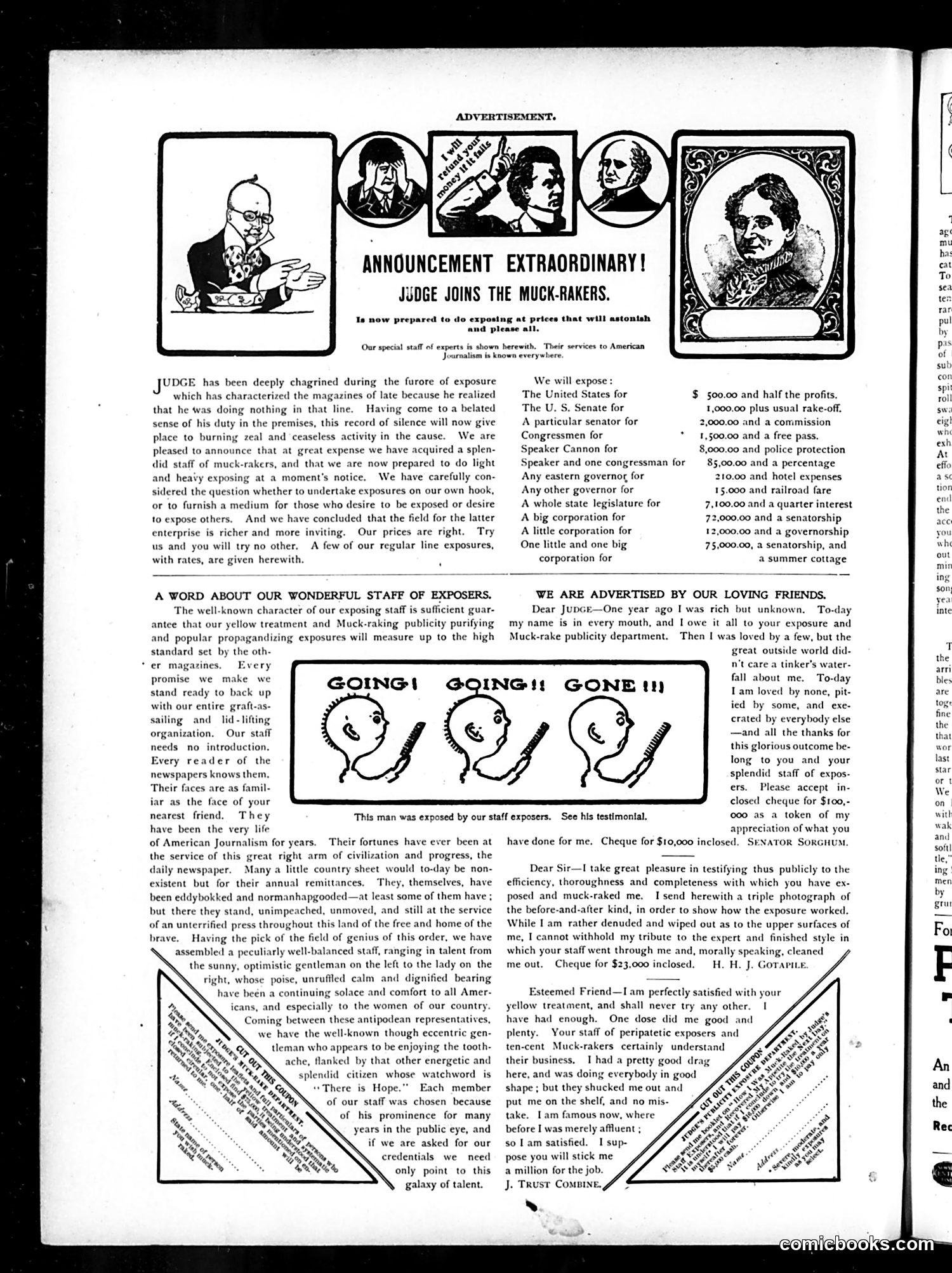
This is a satirical advertisement where *Judge* magazine mockingly announces it will join the "muck-raking" movement—the Progressive Era trend of investigative journalism exposing corruption in government and business. The satire works by treating exposure as a purchasable commodity with explicit price lists. You can buy an exposé of "the United States" for $500 plus half profits, or a senator for $2,000 plus commission. The joke: *Judge* is commercializing reform itself, suggesting muck-rakers are really just selling scandal for profit rather than pursuing principled journalism. The cartoon includes caricatured "exposers" (unnamed in visible text, but described as familiar newspaper figures). The repeated "GOING! GOING! GONE!" sequence mocks the auctioning-off of corruption investigations. This targets both Progressive reformers' sometimes self-promotional methods and yellow journalism's sensationalism—suggesting that exposing wrongdoing had become just another money-making scheme. The satire implies reform journalism was hypocritical or commercially motivated rather than genuinely principled.
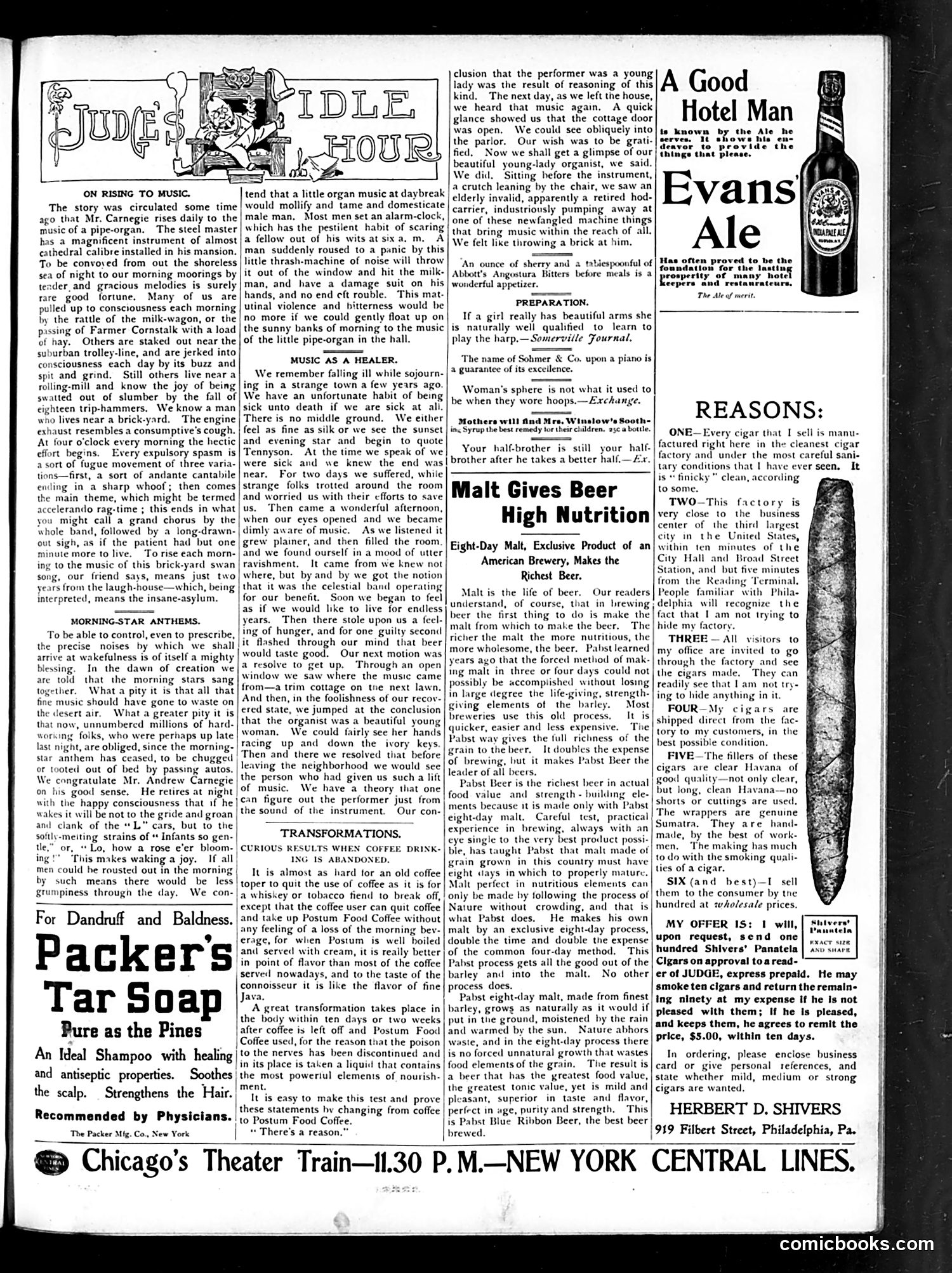
This is a humorous essay satirizing wealth inequality and comfort through the lens of morning routines. The piece contrasts Andrew Carnegie, the steel magnate, who allegedly wakes to organ music in his mansion, with ordinary working people jarred awake by industrial noise: milk wagons, brick-yard machinery, factory hammers, and trolley lines. The satire's point: Carnegie enjoys civilized, aesthetic awakening while laborers suffer brutal sonic assault from the very industries (steel mills, brick-yards) that made men like him wealthy. The essay suggests that providing workers with pleasant morning music might reduce their grumpiness and violence—a gently ironic critique of class disparities and the dehumanizing conditions of industrial labor. The piece reflects early 20th-century anxieties about urban noise pollution and working-class suffering during America's industrial boom.
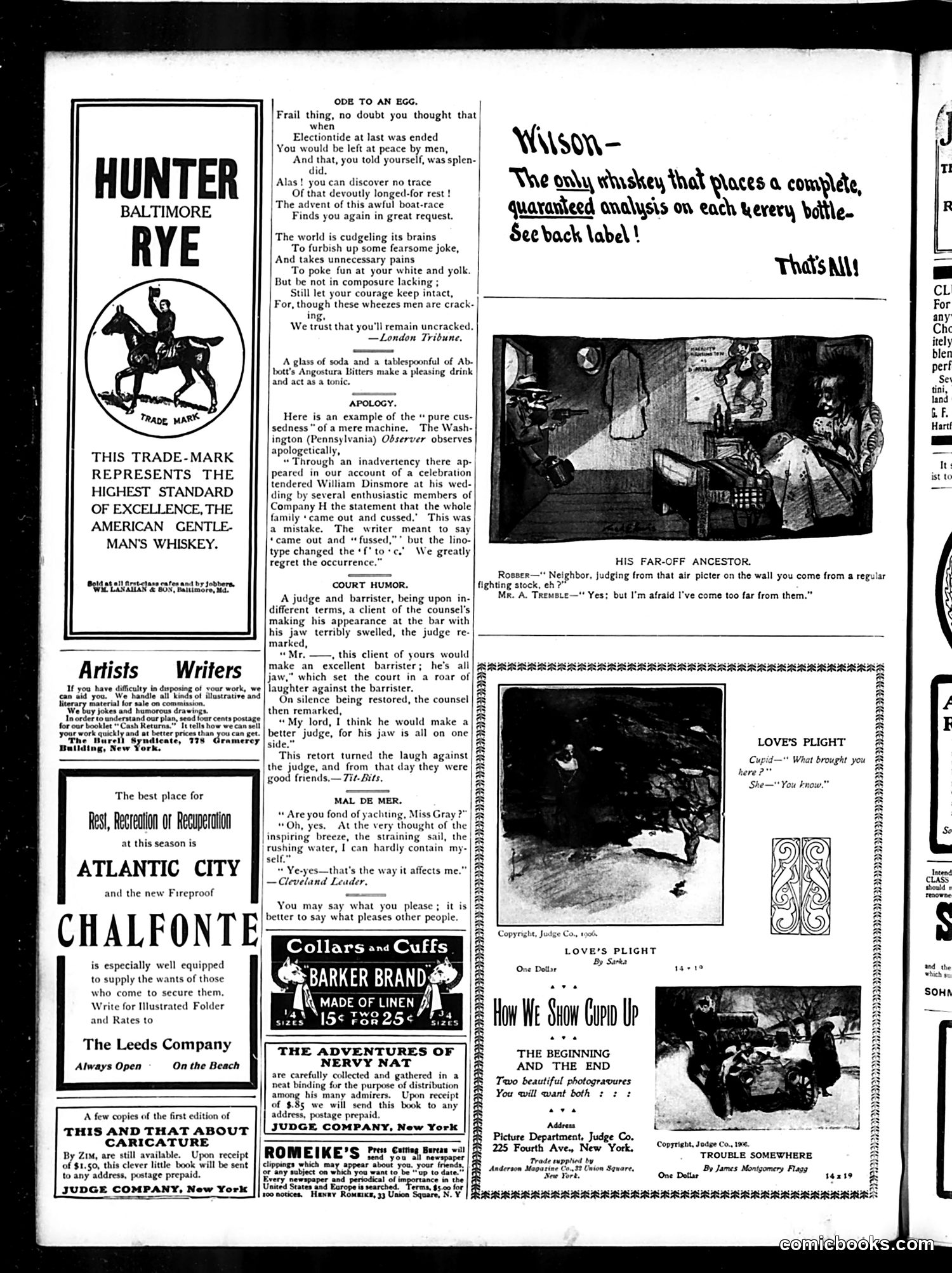
This page from *Judge* magazine contains primarily **advertisements and miscellaneous humor pieces** rather than unified political satire. The main content includes: 1. **Hunter Baltimore Rye whiskey ad** — promoting American whiskey with a trade-mark rider on horseback 2. **"Ode to an Egg"** — light verse poking fun at eggs as subjects of jokes (appears to reference wartime egg rationing or scarcity concerns) 3. **Court humor anecdotes** — brief jokes about judges and barristers, standard fodder for the era 4. **"His Far-Off Ancestor"** — a cartoon suggesting someone has lost their fighting spirit through generations of distance from conflict 5. **"Love's Plight"** — romantic/comedic illustrations The page also advertises services for artists and writers, Atlantic City tourism, and other products. The overall tone is light, domesticated humor typical of early 20th-century American magazines — no sharp political commentary is evident. Most jokes rely on wordplay, social observation, and mild domestic situations rather than contemporary political events.
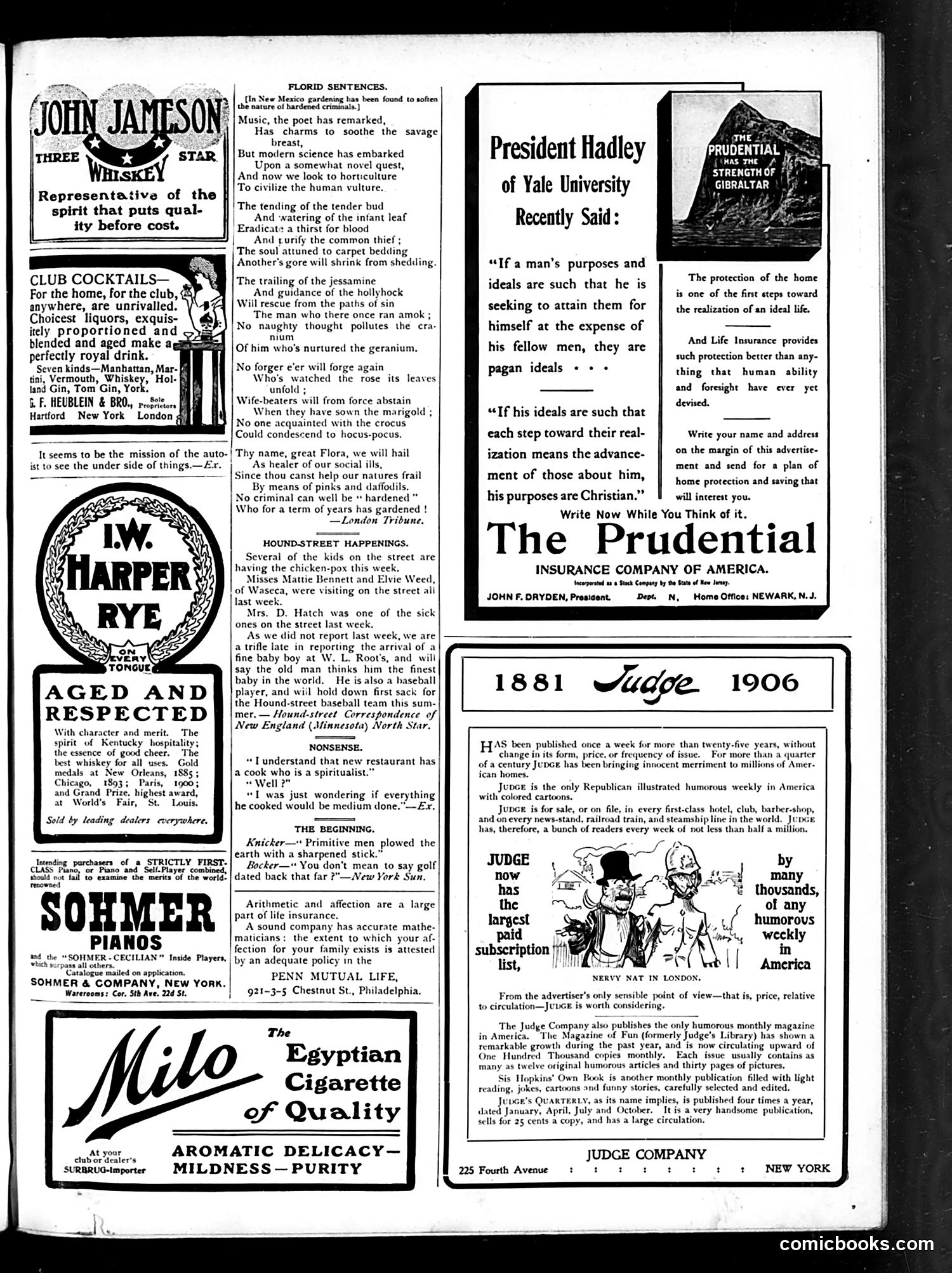
This page is primarily a collection of advertisements and light humor pieces typical of Judge magazine, with no significant political cartoons requiring interpretation. The main content includes: **Advertisements** for whiskey (John Jameson, I.W. Harper), pianos (Sohmer), cigarettes (Milo), and insurance companies, using period marketing appeals about quality and tradition. **Humorous verses and anecdotes**, including "Florid Sentences"—a satirical poem mocking the notion (apparently from New Mexico) that gardening rehabilitates hardened criminals. The joke is the absurdity of believing that tending flowers could reform thieves, forgers, and wife-beaters. **Small items** like "Hound-Street Happenings" (local gossip) and "Nonsense" (brief puns). **A quote from Yale President Hadley** paired with a Prudential Insurance advertisement, linking moral ideals to life insurance—a period advertising strategy connecting virtue with financial responsibility. The page reflects Judge's typical mix of sophisticated satire for educated readers alongside commercial content.
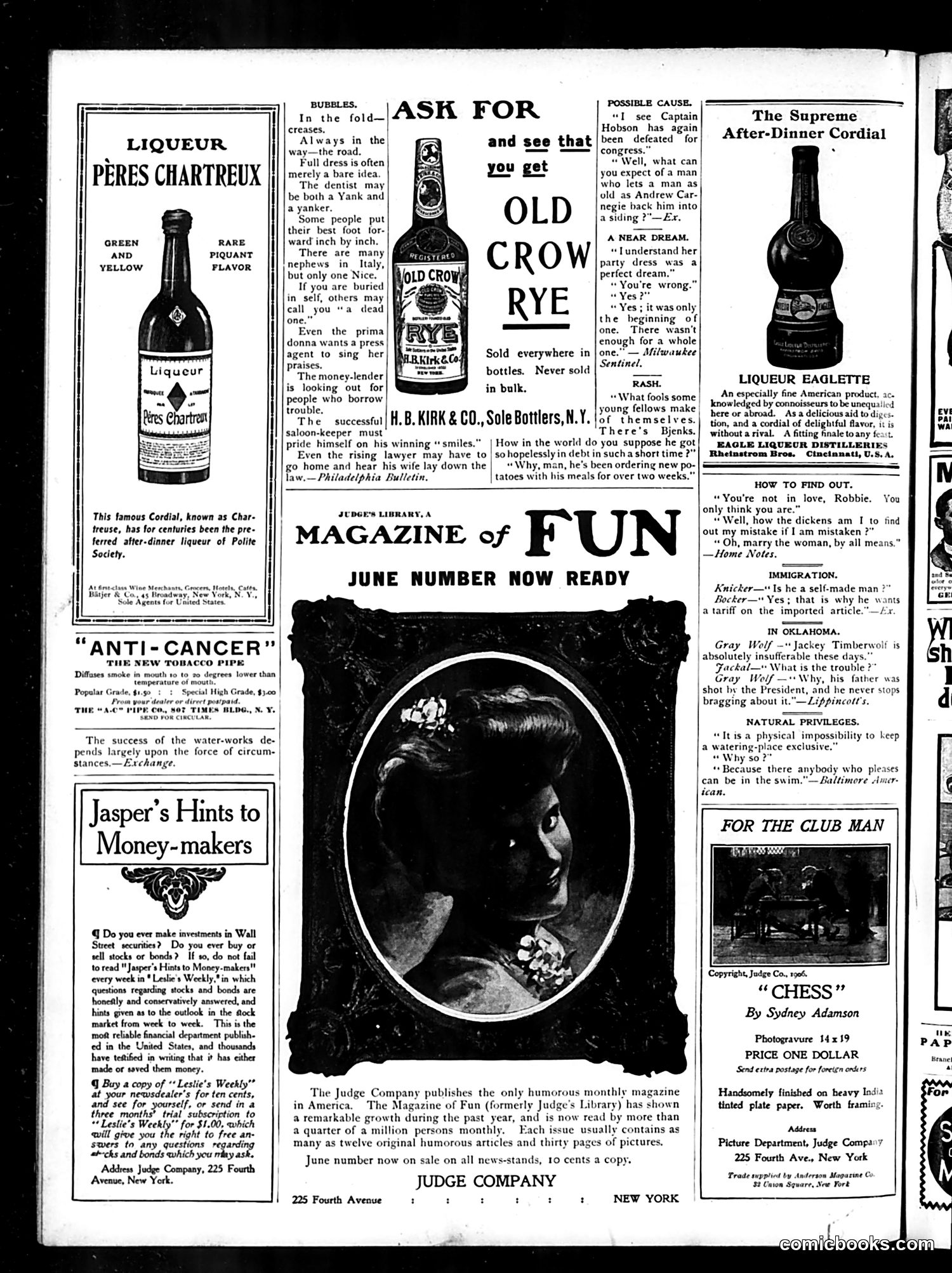
This is primarily an **advertising and content page** from Judge magazine, not a political cartoon. The page features multiple advertisements interspersed with short humor items and magazine promotions. **Key Content:** The central image is a **portrait of a woman's face in profile**, serving as promotion for Judge's "Magazine of Fun" (June issue, 10 cents). Text below indicates Judge published "the only humorous monthly magazine in America" with a circulation of a quarter million. **Advertisements include:** - Liqueur products (Pères Chartreux, Old Crow Rye, Liqueur Eaglette) - An "Anti-Cancer" tobacco pipe - Chess photogravure prints - Jasper's investment advice column **Humor items** scattered throughout mock various social types: dentists, lawyers, society women, and money-lenders—typical turn-of-century satirical targets. References to Captain Hobson's failed congressional run and President Roosevelt shooting suggest **early 1900s dating**. The page exemplifies Judge's mix of satirical commentary with commercial content targeting affluent male readers.
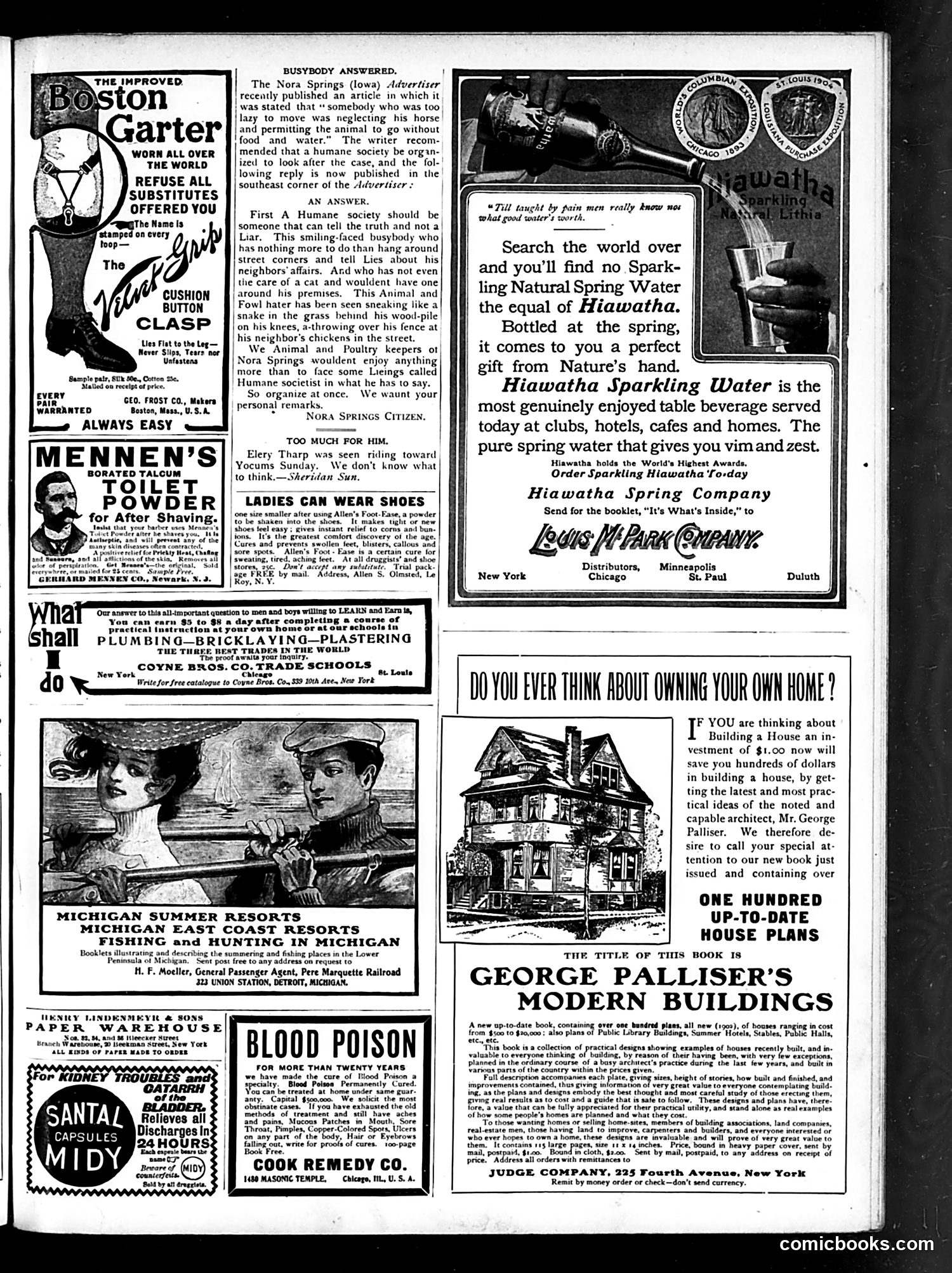
This page features a small-town controversy published in Iowa newspapers. A Nora Springs *Advertiser* article criticized an unnamed neighbor for neglecting his horse. The accused responded with a counter-letter, calling the critic a "busybody" and "Liar" who hangs around street corners spreading gossip—and hypocritically throws stones at neighbors' chickens while claiming moral authority. The humor lies in the escalating personal attacks masquerading as civic virtue. The original complaint invoked Humane Society principles, but the response exposes how small-town "moral busybodies" often lack credibility and harbor their own cruelties. Judge published this as gentle satire of rural pretension and neighborly feuds disguised as ethical concern. The remainder of the page contains unrelated advertisements for garters, talcum powder, trade schools, and medical remedies—typical period advertising filler.
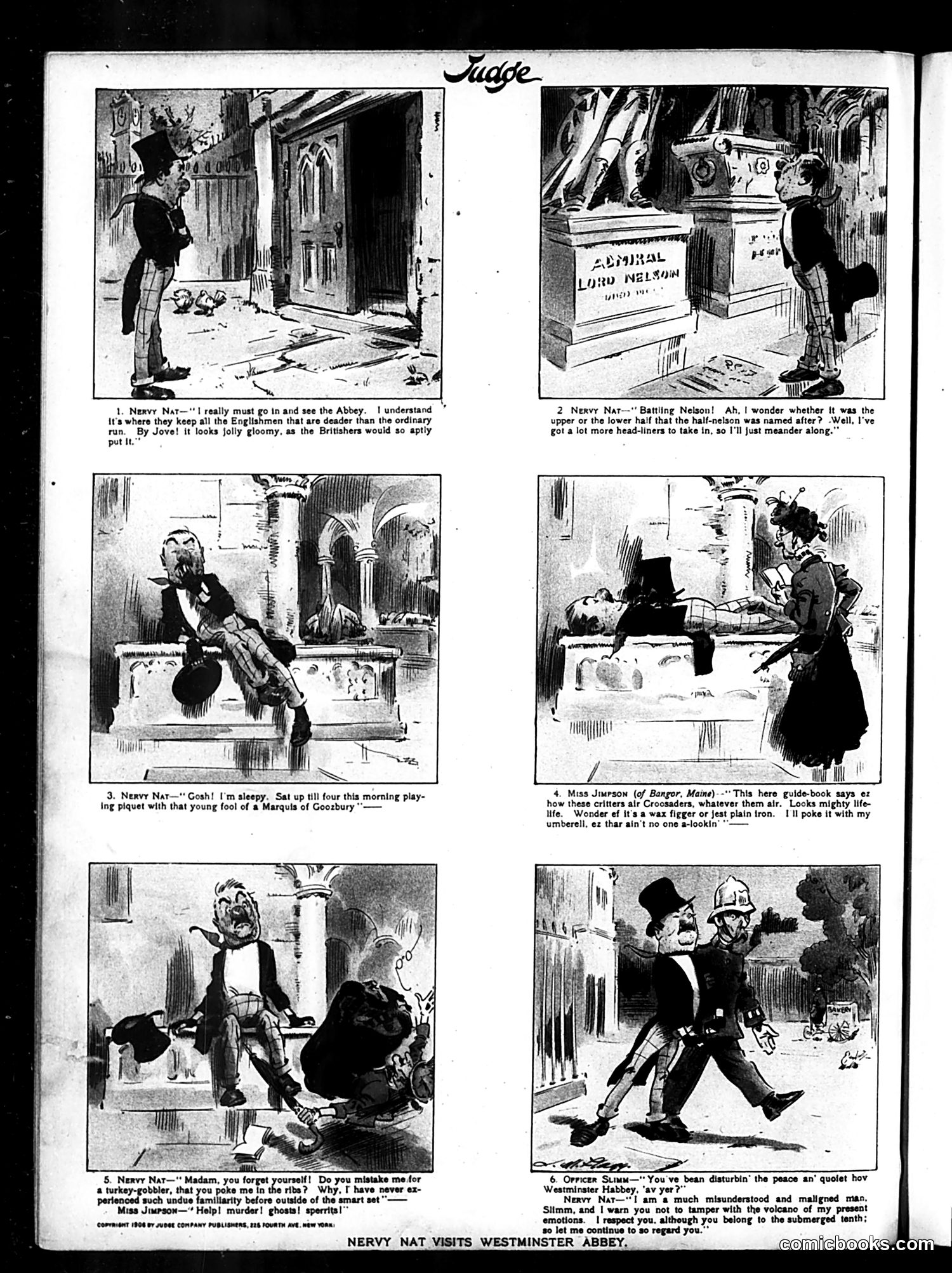
This six-panel comic follows "Nervy Nat," an American tourist character, through Westminster Abbey in London. The humor centers on Nat's brash American ignorance and irreverence toward British institutions and propriety. Nat makes crude jokes (confusing Admiral Lord Nelson's monument with "Battling Nelson," a boxer), sleeps during tours, and accidentally insults a proper English lady (Miss Jumson from Maine) by poking what he assumes is a wax figure but is actually a stone Crusader effigy. The final panel shows Nat condescendingly lecturing Miss Jumson about respecting social hierarchies while contradicting himself. The satire mocks American tourists as culturally insensitive and pretentious, while also gently ridiculing British pomposity. "Nervy Nat" appears to be Judge magazine's recurring character used to satirize American behavior abroad.