
Judge, 1906-05-19 · page 6 of 16
Judge — May 19, 1906 — page 6: what you’re looking at
What you’re looking at
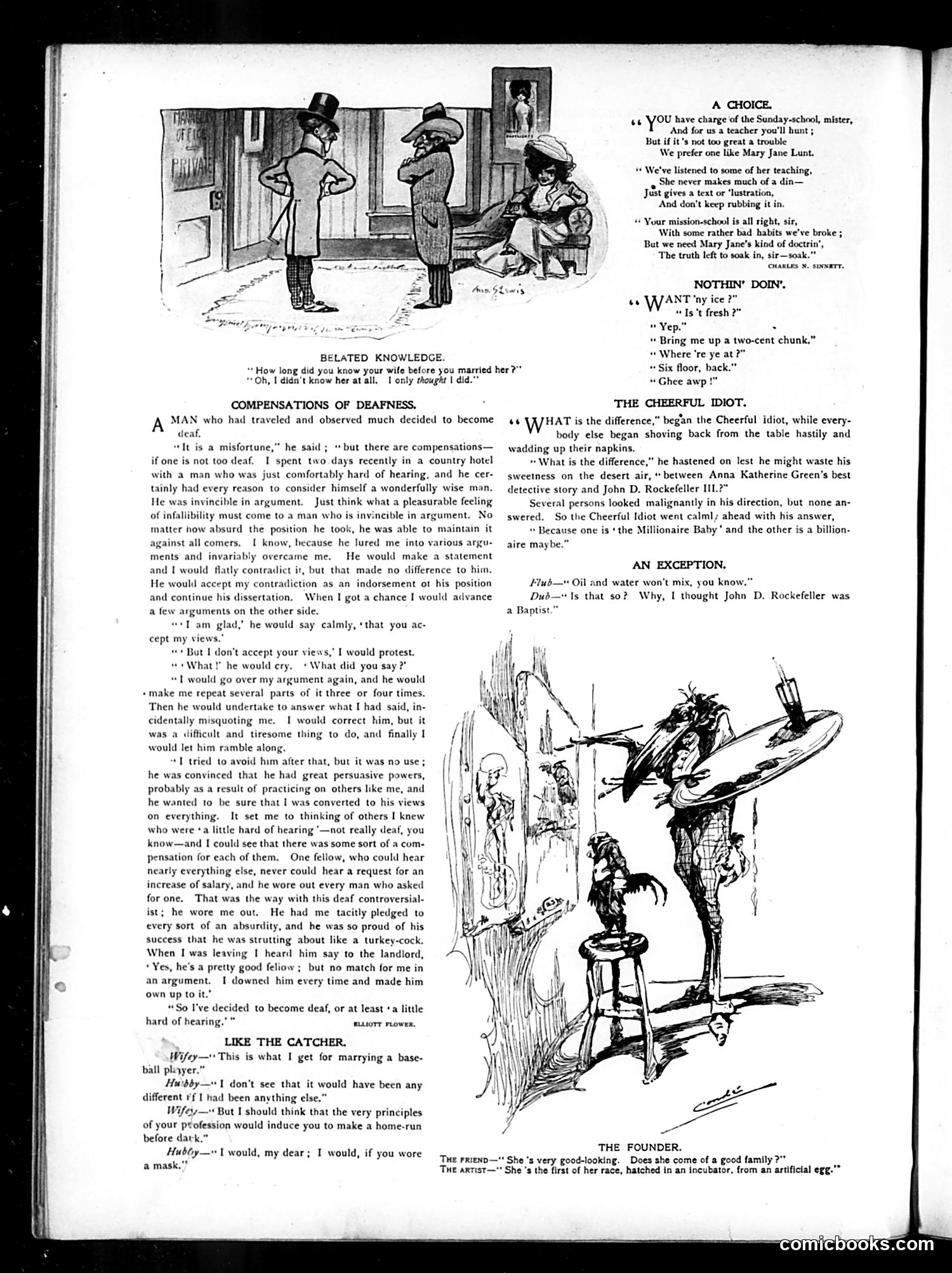
This page contains several standalone humorous sketches satirizing early 20th-century American social types: **"Belated Knowledge"**: A joke about marriage—the husband admits he never actually knew his wife before marrying her, only *thought* he did. It mocks the often-unrealistic expectations men held about courtship. **"Compensations of Deafness"**: The main text satirizes argumentative bores who exploit partial deafness as a conversational advantage. By selectively "mishearing" corrections, the deaf man wins every argument through sheer persistence, never truly engaging with counterpoints. It's social commentary on stubbornness masquerading as confidence. **"Like the Catcher"**: A baseball player joke—the wife complains he doesn't come home before dark. He quips he would, "if you wore a mask," referencing the catcher's protective equipment. It's wordplay mixing domestic expectations with baseball terminology. The cartoons use everyday scenarios to mock human foibles: male self-deception, argumentative dishonesty, and marital miscommunication. The humor relies on recognizable social types rather than topical references.
📄 Transcribed text from this page (OCR, searchable)
Machine-transcribed from the original scan — historical spelling and the odd misread are preserved.
BELATED KNOWLEDGE. How long did you know your wife before you married her?” “Oh, I didn’t know her at all. 1 only thought | did."* COMPENSATIONS OF DEAFNESS. MAN who had traveled and observed much decided to become af, “It is a misfortune,” he said ; “but there are compensations— if one is not too deaf. I spent two days recently in a country hotel with a man who was just comfortably hard of hearing, and he cer- tainly had every reason to consider himself a wonderfully wise man. He was invincible in argument. Just think what a pleasurable feeling of infallibility must come to a man who is invincible in argument. No matter how absurd the position he took, he was able to maintain it I know, because he lured me into various argu- ly overcame me. He would make a statement against all comers. ments and in and I would flatly contradict it, but that made no difference to him. He would accept my contradiction as an indorsement ot his position and continue his dissertation, When I got a chance I would advance a few arguments on the other side. “*T am glad,’ he would say calmly, ‘that you ac- cept my views,” “+ But I don't accept your views,’ I would protest. ++ What!" he would cry, * What did you say ?* “L would go over my argument again, and he would make me repeat several parts of it three or four times. Then he would undertake to answer what I had said, in- cidentally misquoting me. I would correct him, but it was a difficult and tiresome thing to do, and finally 1 would let him ramble along. “1 tried to avoid him after that, but it was no use; he was convinced that he had great persuasive powers, probably as a result of practicing on others like me, and he wanted to be sure that | was converted to his views on everything. It set me to thinking of others I knew who were ‘a little hard of hearing ‘—not really deaf, y know—and I could see that there was some sort of a com- pensation for each of them. One fellow, who could hear nearly everything else, never could hear a request for an and he wore out every man who asked the way with this deaf controversial- ist; he wore me out. He had me tacitly pledged to every sort of an absurdity, and he was so proud of his success that he was strutting about like a turkey-cock. When I was leaving I heard him say to the landlord, + Yes, he’s a pretty good feliow ; but no match for me in an argument. 1 downed him every time and made him own up to it.’ "So I've decided to become deaf, or at least ‘a little hard of hearing.’ ” increase of salary for one. That w: ELLIOTT FLowER. LIKE THE CATCHER. Wifey—" This is what I get for marrying a base- ball player. Hu'dsy—“ 1 don't see that it would have been any different ¥f I had been anything else.” Wifety—" But I should think that the very principles of your profession would induce you to make a home-run before dark.” Hubby—« 1 would, my dear; I would, if you wore a mask."” A CHOICE. 66 YOU have charge of the Sunday-school, mister, And for us a teacher you'll hunt ; Bat if it’s not too great a trouble We prefer one like Mary Jane Lunt. “+ We've listened to some of her teaching, «g She never makes much of a din— Just gives a text or ‘lustration, And don’t keep rubbing it in. “ Your mission-school is all right, sir, With some rather bad habits we've broke ; But we need Mary Jane's kind of doctrin’, ‘The truth left to soak in, sir—soak."” CHARLES. SUNNETT. NOTHIN’ DOIN’. 6s WANT ny ice 2” we. Is't fresh ?” “Yep.” : “ Bring me up a two-cent chunk.” Where ‘re ye at ?” «Six floor, back.” “Ghee awp ‘THE CHEERFUL IDIOT. 66 (HAT is the difference,” began the Cheerful idiot, while every- body else began shoving back from the table hastily and wadding up their napkins. “What is the difference sweetness on the desert air, he hastened on lest he might waste his between Anna Katherine Green's best detective story and John D. Rockefeller 111.2" Several persons looked malignantly in his direction, but none an- So the Cheerful Idiot went calmly ahead with his answer, e one is ‘the Millionaire Baby’ and the other is a billion- swered. « Beca aire maybe. AN EXCEPTION. Flub— Oil and water won't mix, you know, Dub—Is that so? Why, I thought John D. Rockefeller was a Baptist THE FOUNDER. Tue rrienp—"' She ‘s very good-looking. Does she come of a good family ?”” ‘Tue axrist—" She's the first of her race, hatched in an incubator, from an artificial egg.”*