
Judge, 1906-05-19 · page 7 of 16
Judge — May 19, 1906 — page 7: what you’re looking at
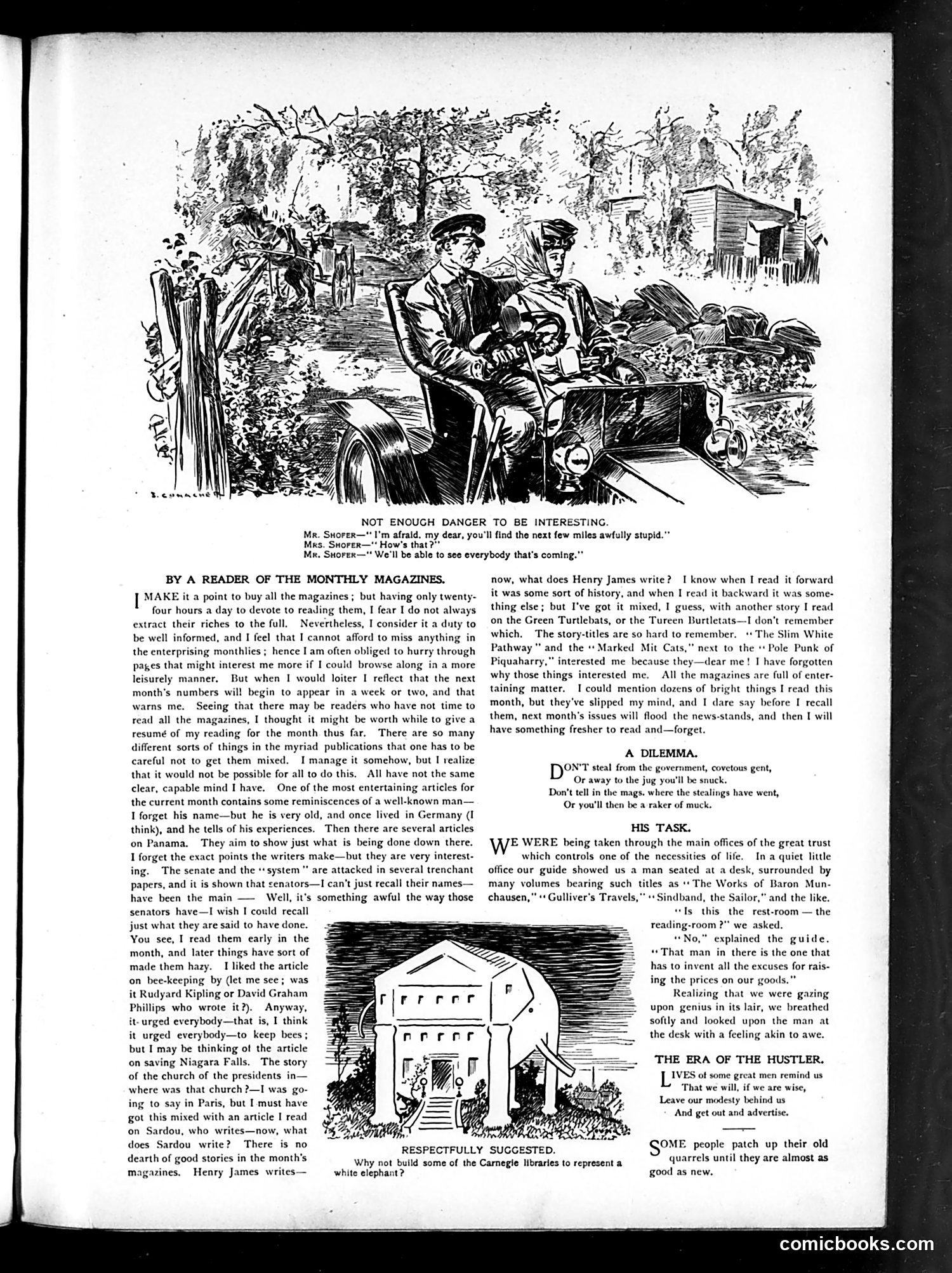
What you’re looking at
**The Main Cartoon:** The top illustration depicts a couple in an early automobile. Mr. Sorer reassures his wife that the next stretch of road lacks sufficient danger to be interesting—they'll see everyone coming. This satirizes the novelty-seeking thrill-seekers of the automobile era, mocking both the danger of early motoring and the upper class's appetite for excitement. **The Essay Below:** "By a Reader of the Monthly Magazines" mocks the pretentious magazine consumer who claims to read everything but retains nothing. The narrator admits to forgetting authors' names, plot details, and article subjects within weeks—confusing Henry James with bee-keeping articles, mixing up story titles ("Green Turtlebats," "Marked Mit Cats"). The satire targets the conspicuous consumption of culture: people buying multiple magazines monthly to appear well-informed while actually absorbing little. It ridicules both the magazines' proliferation of mediocre content and readers' performative intellectualism—reading too quickly to actually understand anything.
📄 Transcribed text from this page (OCR, searchable)
Machine-transcribed from the original scan — historical spelling and the odd misread are preserved.
NOT ENOUGH DANGER TO BE INTERESTING. Mr. Sorer— Mrs. Storer—"* How's that ?”* I'm afraid, my dear, you'll find the next few miles awfully stupid.” Mx. SHorex—" We'll be able to see everybody that’s coming.” BY A READER OF THE MONTHLY MAGAZINES. | MAKE it a point to buy all the magazines; but having only twenty- four hours a day to devote to reading them, I fear I do not always extract their riches to the full. Nevertheless, I consider it a duty to be well informed, and I feel that I cannot afford to miss anything in the enterprising monthlies ; hence I am often obliged to hurry through pages that might interest me more if I could browse along in a more leisurely manner. But when I would loiter I reflect that the next month's numbers will begin to appear in a week or two, and that warns me. Seeing that there may be readers who have not time to read all the magazines, I thought it might be worth while to give a resumé of my reading for the month thus far. There are so many different sorts of things in the myriad publications that one has to be careful not to get them mixed. I manage it somehow, but I realize that it would not be possible for all to do this, All have not the same clear, capable mind I have. One of the most entertaining articles for the current month contains some reminiscences of a well-known man— I forget his name—but he is very old, and once lived in Germany (I think), and he tells of his experiences. Then there are several articles ‘on Panama. They aim to show just what is being done down there. forget the exact points the writers make—but they are very interest- ing. The senate and the ‘system " are attacked in several trenchant papers, and it is shown that senators—I can’t just recall their names— have been the main — Well, it’s something awful the way those senators have—I wish I could recall just what they are said to have done. You see, I read them early in the month, and later things have sort of made them hazy. I liked the article on bee-keeping by (let me see; was it Rudyard Kipling or David Graham Phillips who wrote it?). Anyway, it- urged everybody—that is, I think it urged everybody—to keep bees; but I may be thinking of the article on saving Niagara Falls. The story of the church of the presidents in— where was that church ?—I was go- ing to say in Paris, but I-must have got this mixed with an article I read on Sardou, who writes—now, what does Sardou write? There is no dearth of good stories in the month's magazines, Henry James writes— white elephant? Why not build some of the Carnegie libraries to represent a now, what does Henry James write? I know when I read it forward it was some sort of history, and when I read it backward it was some- thing else; but I've got it mixed, I guess, with another story I read on the Green Turtlebats, or the Tureen Burtletats—I don't remember which, The story-titles are so hard to remember. +The Slim White Pathway" and the “Marked Mit Cats,” next to the ‘Pole Punk of Piquaharry,” interested me because they—dear me! I have forgotten why those things interested me. All the magazines are full of enter- taining matter. I could mention dozens of bright things I read this month, but they've slipped my mind, and I dare say before I recall them, next month’s issues will flood the news-stands, and then I will have something fresher to read and—forget. A DILEMMA. ON'T steal from the government, covetous gent, Or away to the jug you'll be snuck. Don’t tell in the mags. where the stealings have went, Or you'll then be a raker of muck. HIS TASK. WE WERE being taken through the main offices of the great trust which controls one of the necessities of life. In a quiet little office our guide showed us a man seated at a desk, surrounded by many volumes bearing such titles as “The Works of Baron Mun- chausen," «Gulliver's Travels," Sindband, the Sailor,” and the like. Is this the rest-room — the reading-room 2" we asked. “No,” explained the guide. “That man in there is the one that has to invent all the excuses for rais- ing the prices on our goods.” Realizing that we were gazing upon genius in its lair, we breathed softly and looked upon the man at the desk with a feeling akin to awe. THE ERA OF THE HUSTLER. IVES ot some great men remind us That we will, if we are wise, Leave our modesty behind us And get out and advertise. OME people patch up their old quarrels until they are almost as good as new. comicbooks.com