
A complete issue · 16 pages · 1906
Judge — May 5, 1906
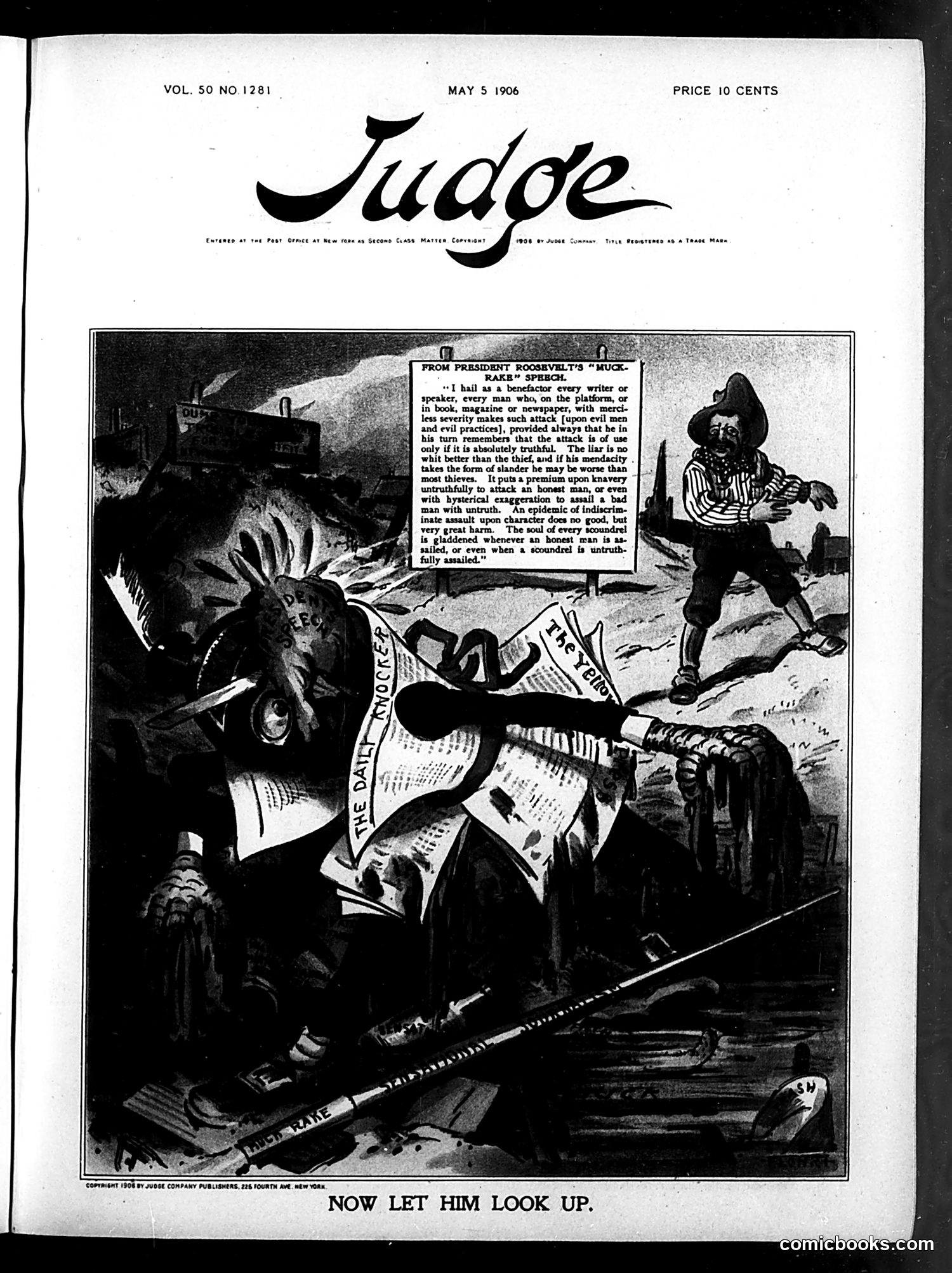
This cartoon satirizes President Theodore Roosevelt's "Muckrake" speech—a famous address criticizing overzealous investigative journalists and reformers who expose scandals indiscriminately. The image depicts a figure (likely representing sensationalist press or radical reformers) violently attacking what appears to be a buffalo or ox labeled "The Daily Mule." The creature lies fallen with newspapers scattered around it. A cowboy-dressed figure watches from the right. Roosevelt's quoted text warns against indiscriminate character assassination, noting that even honest men attacked become defensive. The cartoon's title, "Now Let Him Look Up," suggests the fallen animal should consider the consequences of reckless muckraking. The satire defends Roosevelt's position that aggressive journalism, while sometimes justified, can be destructively excessive.
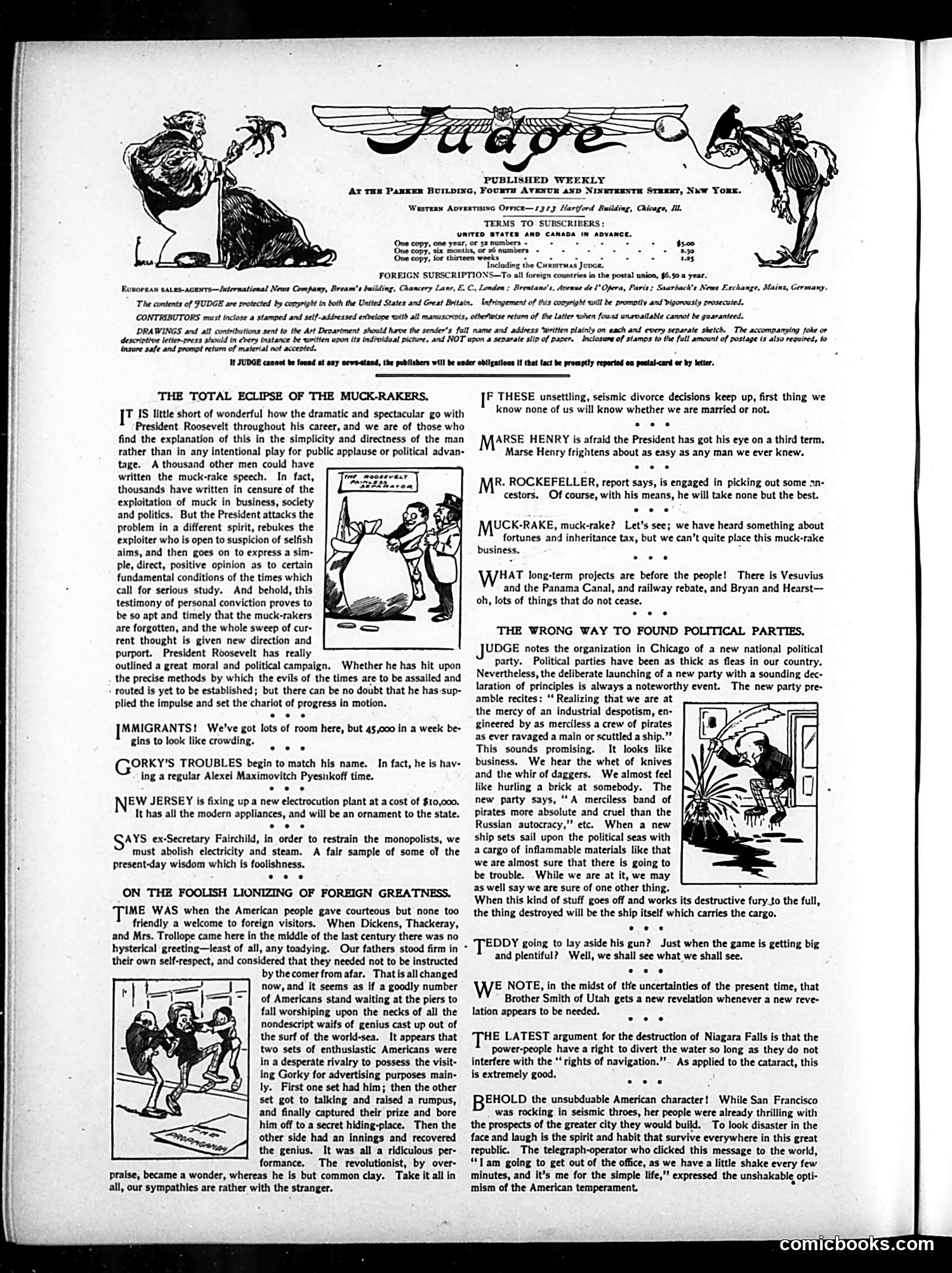
This page contains multiple political commentaries typical of Judge's style. The main article "THE TOTAL ECLIPSE OF THE MUCK-RAKERS" defends President Roosevelt against criticism that he's abandoned his reform agenda, arguing his methods—attacking specific evils rather than making blanket accusations—are actually more effective. The accompanying cartoons mock various targets: one depicts muck-rakers as destructive forces; another satirizes a new Chicago political party as disorganized and dangerous ("a merciless band of pirates more absolute and cruel than the Russian autocracy"). Other brief items mock specific issues: New Jersey's execution plant, monopolies, and the destruction of Niagara Falls. The tone is conservative, defending establishment figures while ridiculing reformers and radicals as chaotic troublemakers rather than legitimate critics.
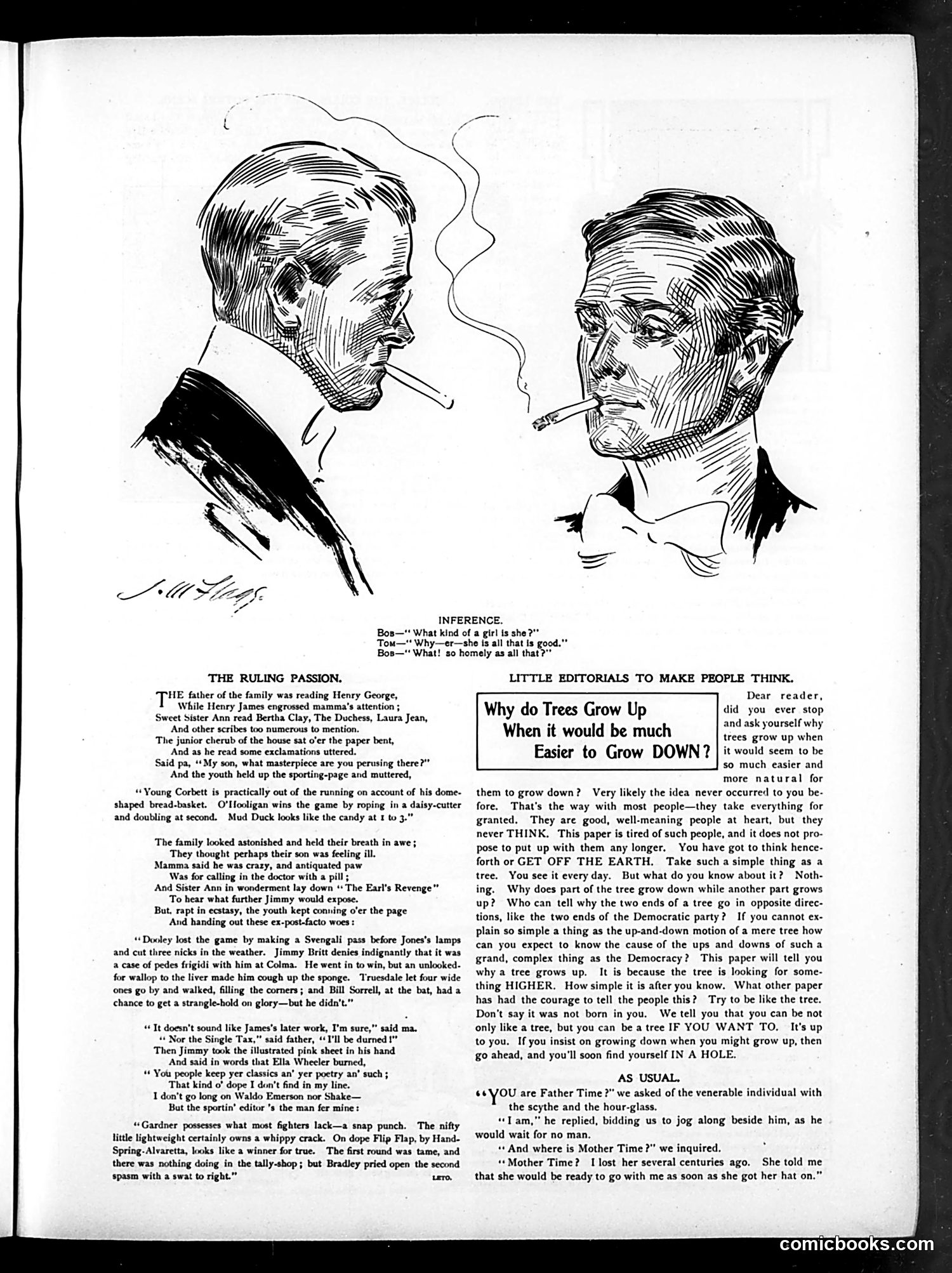
The page features two pen-sketch portraits of men smoking cigarettes at the top, labeled "INFERENCE," with a brief dialogue below about a girl's character. Below are three distinct text sections: "THE RULING PASSION" (a poem about a family's domestic drama involving a young man named Corbett and inheritance), "LITTLE EDITORIALS TO MAKE PEOPLE THINK" (including an essay questioning why trees grow upward rather than downward), and "AS USUAL" (humorous exchanges about Father Time and Mother Time). The content appears primarily **editorial and humor-focused** rather than overtly political satire. The sketches and accompanying joke seem to represent generic social types rather than specific identifiable figures. Without clearer context or captions identifying the portraits, their satirical targets remain unclear.
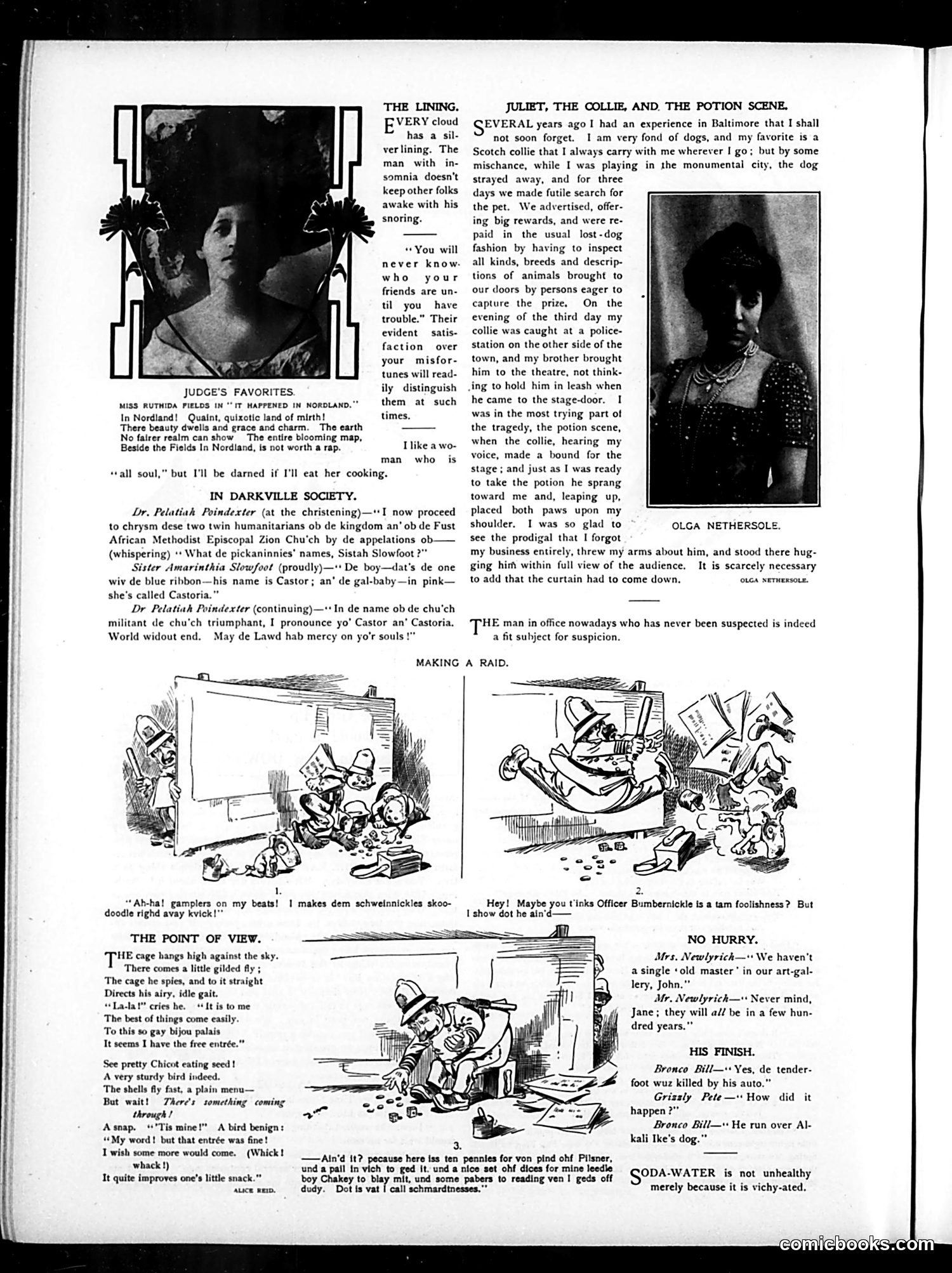
This page combines several satirical elements typical of Judge magazine's format: **"Judge's Favorites"** features a portrait labeled about Norland, praising "grace and charm" alongside commentary on cooking—typical early 20th-century gender humor. **"In Darkville Society"** appears to satirize African American social pretensions through exaggerated dialect and character names ("Castor an' Castoria"), reflecting the racist caricature conventions common to period American humor magazines. **"Making a Raid"** cartoons depict children ransacking what appears to be an office or study, scattering documents—likely commenting on childhood mischief or disorder. The remaining sections include light social commentary and domestic humor typical of Judge's satirical approach during this era, though specific contemporary references remain unclear without additional historical context.
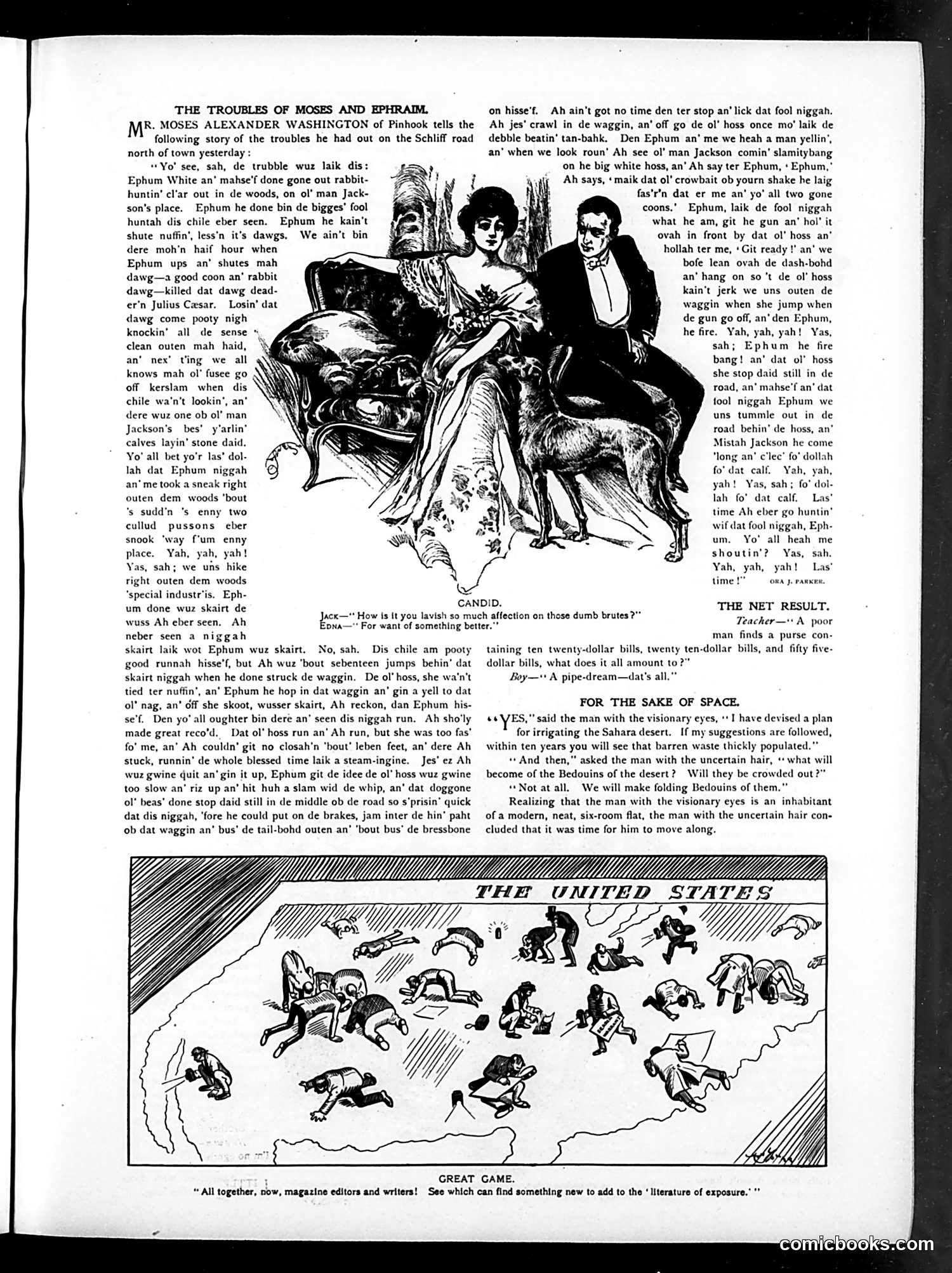
The page contains two distinct pieces: **Upper section**: A story titled "The Troubles of Moses and Ephraim" featuring dialect humor and an illustration of two men with a woman in a carriage. This appears to be humor based on African American vernacular speech—a common (though now offensive) staple of period humor in Judge magazine. **Lower section**: A cartoon labeled "Great Game" depicting numerous figures scattered across a map of the United States. The caption reads: "All together, now, magazine editors and writers! See which can find something new to add to the 'literature of exposure.'" This satirizes the contemporary journalistic trend of investigative reporting and exposés—likely referencing the muckraking movement of the early 1900s. The cartoon mocks editors and writers for overcrowding the market with similar exposé pieces, suggesting the trend had become exhausted and formulaic.
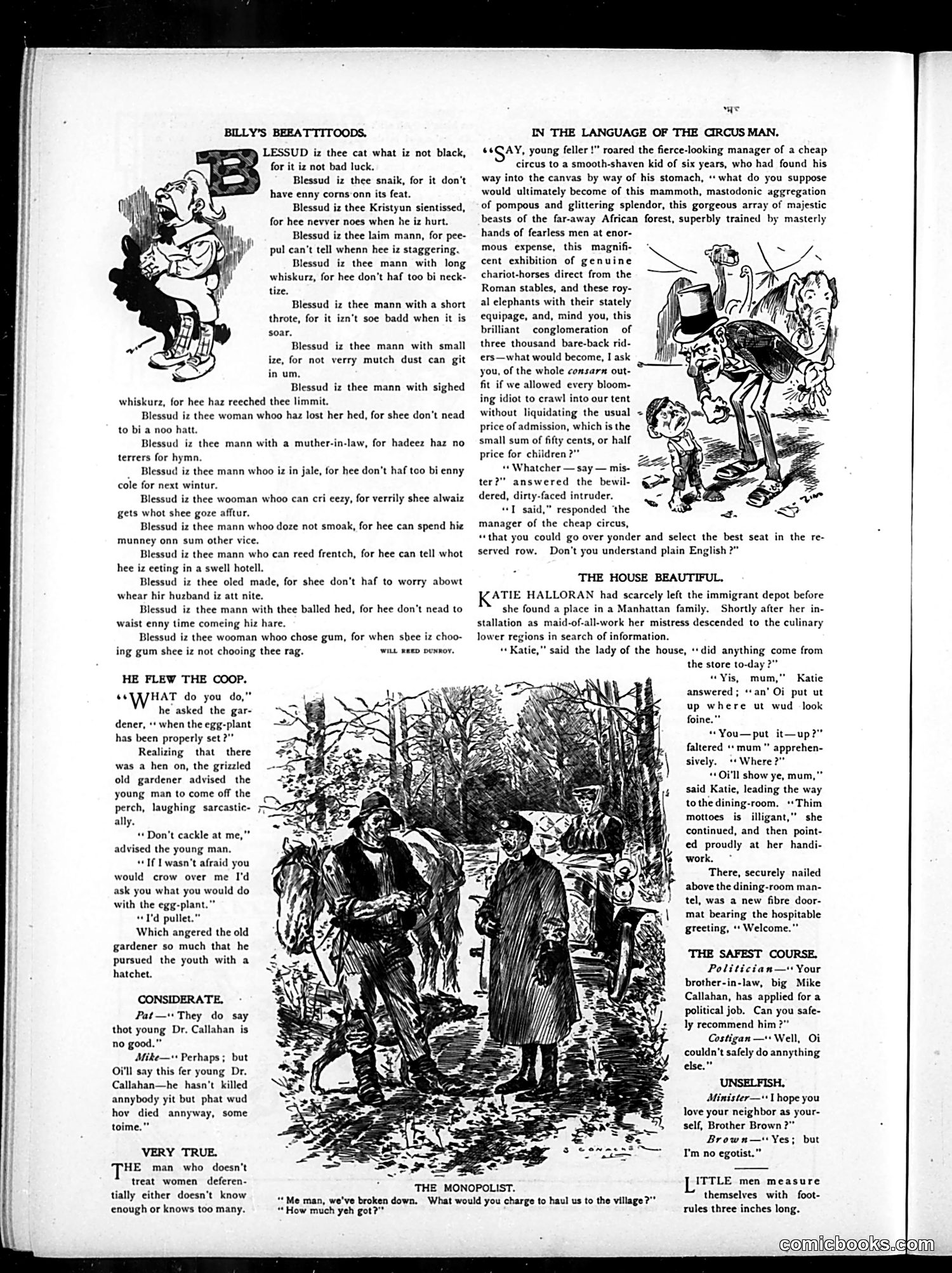
This Judge magazine page contains several satirical pieces mocking contemporary American life: **"Billy's Beatitudes"** parodies religious blessings, humorously listing people society overlooks or undervalues—the lame, the bald, the jailed, the old maid—suggesting they face fewer worldly burdens. It's gentle social satire about life's ironies. **"He Flew the Coop"** is a pun-heavy dialogue between a young man and gardener about an egg-plant, featuring poultry-related wordplay ("perch," "cackle," "crow," "pullet"). The joke relies entirely on forced bird puns that escalate to violence—typical of Judge's sometimes groan-worthy humor style. **"The Monopolist"** depicts economic exploitation: a stranded motorist asks a man for help; the reply—"How much yeh got?"—cynically suggests the helper will charge whatever the desperate customer can afford, satirizing predatory business practices. The illustrations are period cartoons with exaggerated features typical of early 20th-century satirical magazines.
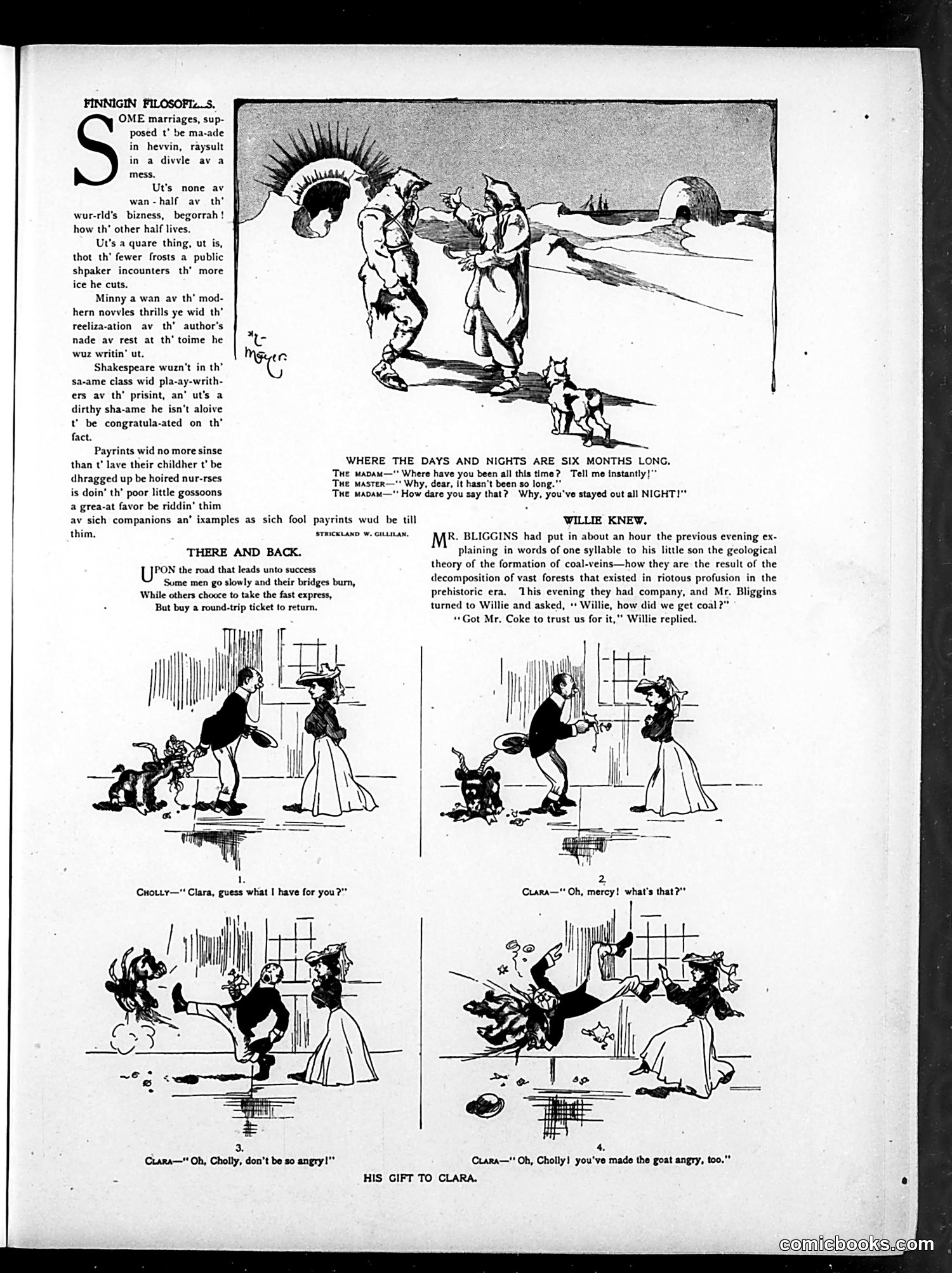
This page contains two distinct satirical pieces: **"Finnigin Filosófiz"** features an Irish-dialect character dispensing folk wisdom about marriage, literature, and parenting. The humor relies on ethnic stereotyping common to early 20th-century American comedy—the "stage Irishman" offering counterintuitive observations in exaggerated brogue. **"His Gift to Clara"** is a four-panel comic strip showing a domestic quarrel. A man (Cholly) returns late; his girlfriend Clara grows increasingly angry, eventually attacking him with an umbrella while a goat joins the chaos. The humor derives from slapstick escalation and the era's assumption that women's jealousy and anger are comedic. **"There and Back"** is a brief poem contrasting two paths to success: the slow, committed approach versus the quick return ticket—suggesting people who quit easily. **"Willie Knew"** presents a child-humor joke: after his father explains coal formation scientifically, Willie pragmatically reveals they obtained coal on credit from "Mr. Coke" (a coal merchant), deflating the lecture's pretension. The page reflects early 1900s Judge sensibilities: ethnic humor, domestic comedy, and anti-intellectual satire.
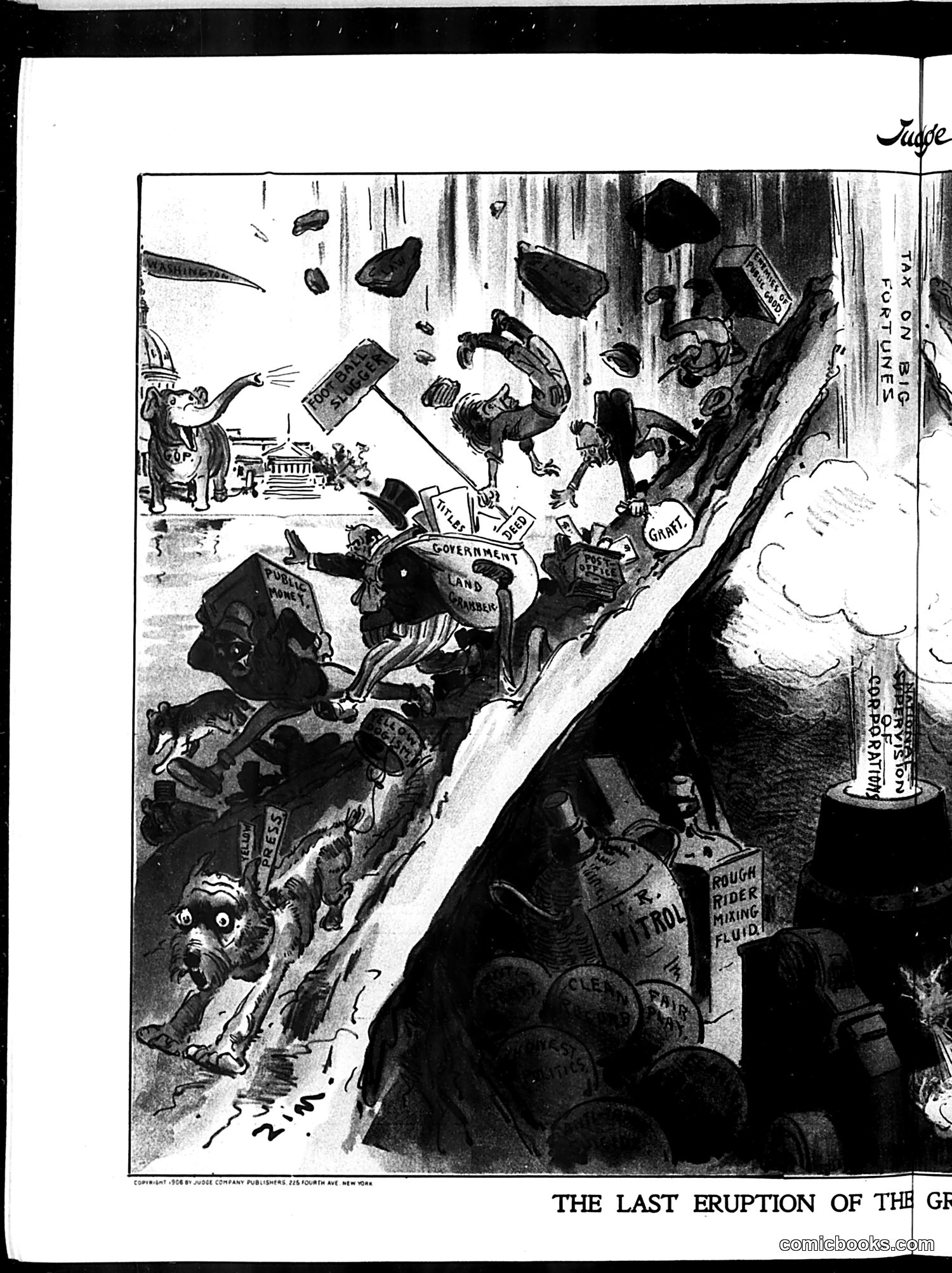
This political cartoon satirizes conflicts over taxation and government spending, likely from the early 20th century. The image depicts a chaotic scene where figures representing "Government," "Graft," and other labeled entities are erupting or exploding downward like a geyser or volcano. Various items labeled "Tax," "Fortunes," and what appears to be corruption-related material scatter violently. The cartoon criticizes both excessive taxation on wealthy individuals and endemic government corruption/graft. The "eruption" metaphor suggests these problems have reached an explosive, unsustainable peak. A dog at the bottom appears alarmed by the chaos descending upon it—possibly representing ordinary citizens caught in the crossfire of political dysfunction. The exact figures and all referenced events are unclear from the visible text alone.
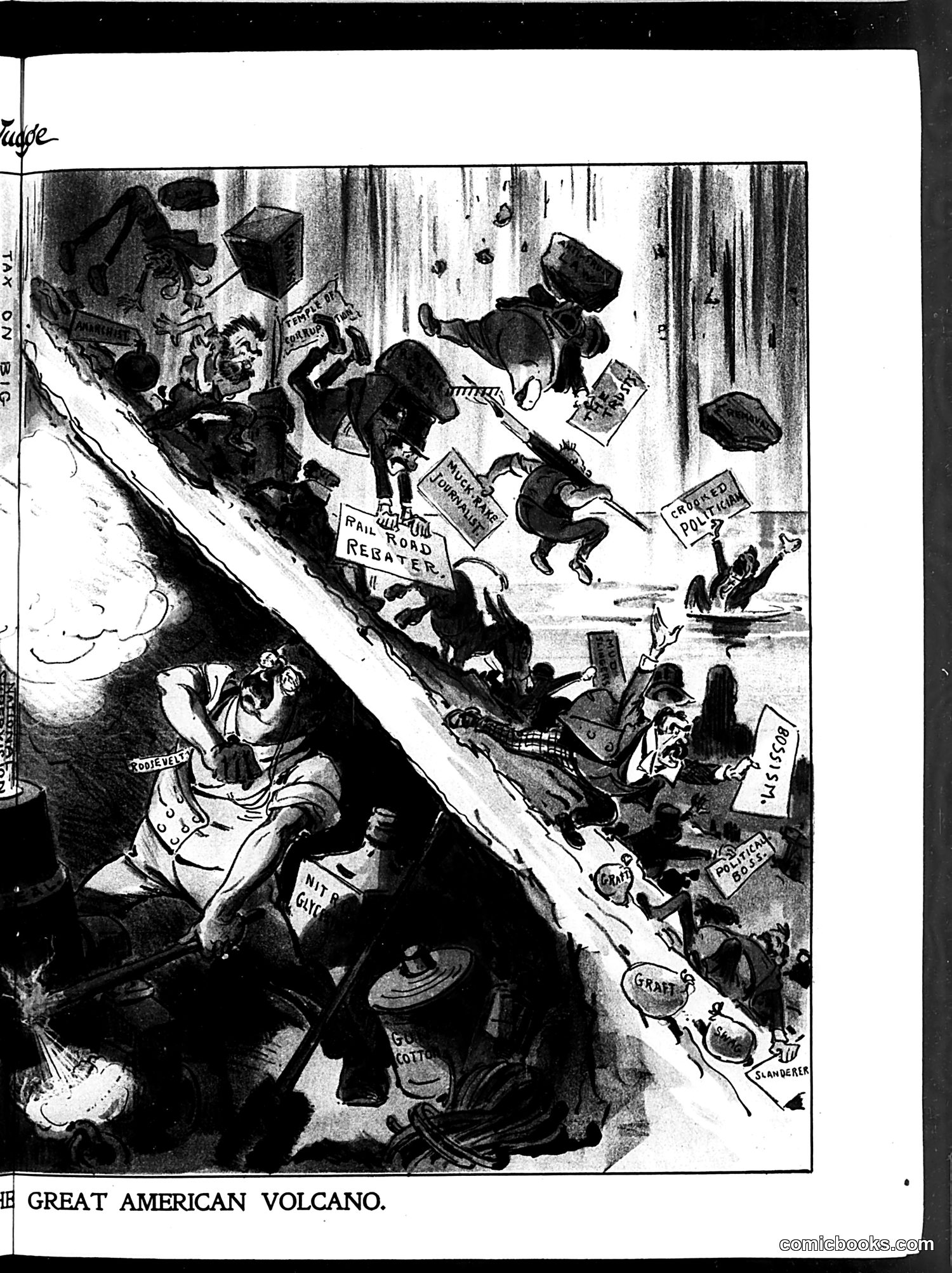
This political cartoon satirizes corruption and scandal erupting in American politics, depicted as a volcano spewing various evils. The imagery shows figures tumbling down the volcano's slope amid labels including "Graft," "Corruption," "Crooked Politics," "Bribery," "Scandal," and similar vices. The cartoon critiques widespread governmental malfeasance of the era (likely early 20th century, based on Judge magazine's style). Political figures and corrupt officials are caricatured as victims of their own system's collapse. The volcanic metaphor suggests these problems have built pressure over time and now erupt catastrophically. Labels visible include references to "Graft," "Nitrate," and what appears to be critiques of specific corrupt practices, though specific individuals remain unclear from the image alone.
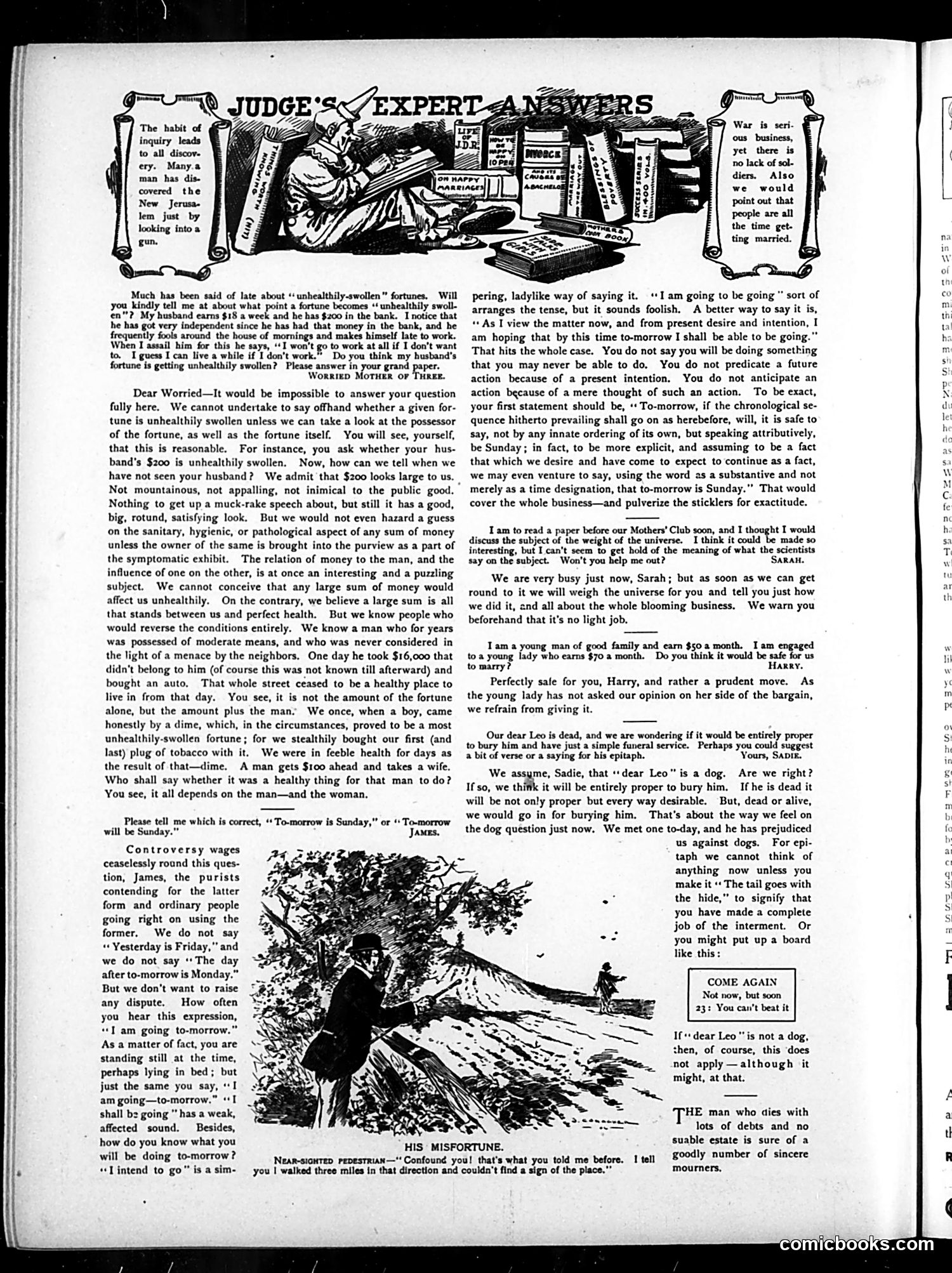
This page from *Judge* magazine addresses the contemporary debate over "unhealthily-swollen fortunes"—likely referencing early 20th-century Progressive Era concerns about wealth inequality and monopolies. **Main Content:** The "Judge's Expert Answers" advice column uses satire to mock the era's vague anxieties about money. A worried mother writes that her husband's modest $200 savings has made him lazy and independent. The Judge's response brilliantly deflates the hysteria: wealth's danger depends entirely on the *person*, not the amount. The editorial uses absurd examples (a dime spent on tobacco, $16,000 spent on a car) to ridicule the moralistic hand-wringing about fortunes without considering individual character. **The Cartoons:** The lower illustration shows a near-sighted pedestrian complaining to someone—appears to be commentary on misdirection or being lost. **Satire Target:** Political and social reformers who spoke loosely about "swollen fortunes" without nuance, treating money as inherently corrupting regardless of circumstance or character.
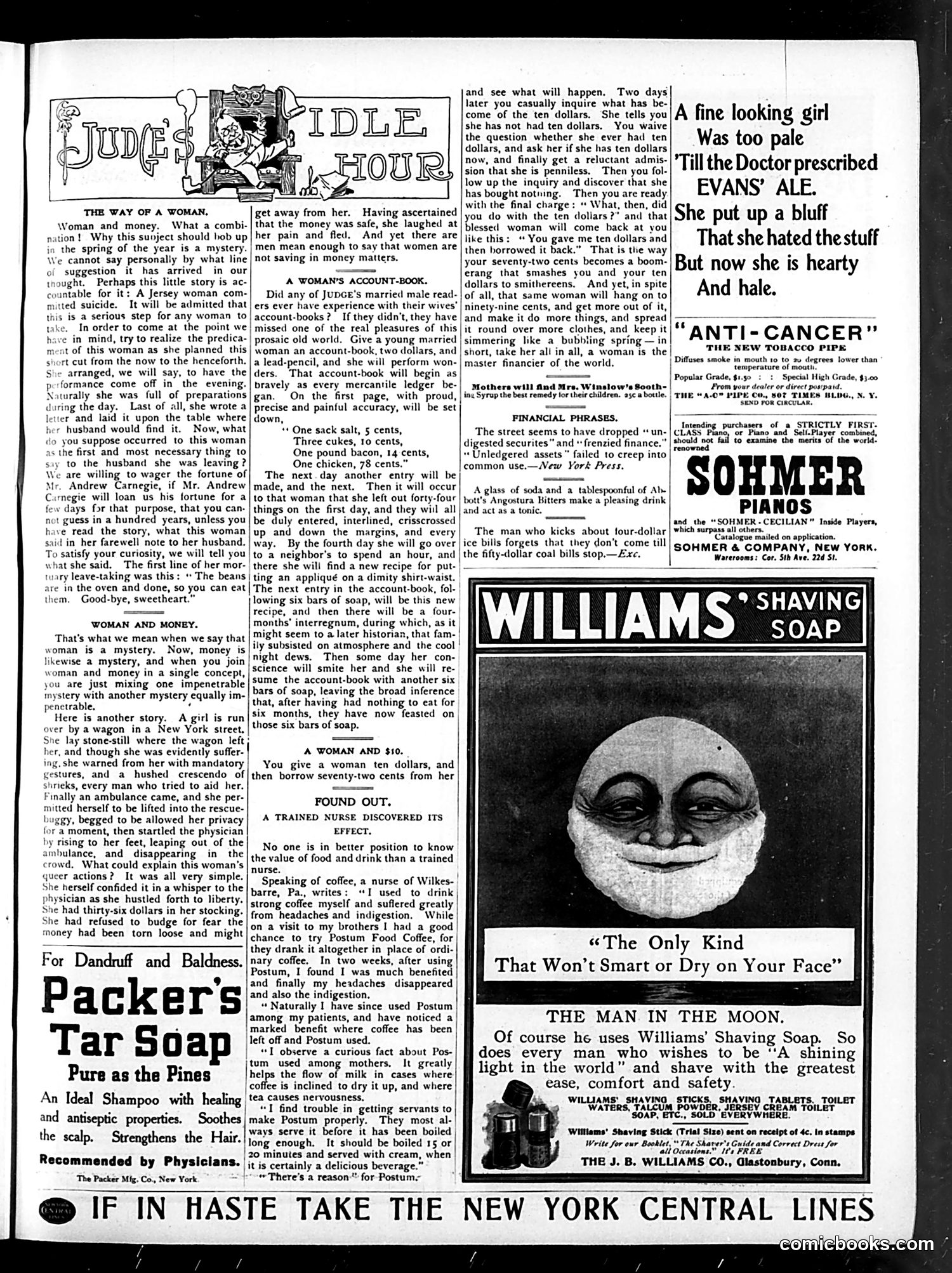
This page from Judge magazine (satirical weekly) primarily consists of **humorous essays about women and money**, not political cartoons. The main pieces mock the supposed paradox of women's relationship with finances: 1. **"The Way of a Woman"** satirizes female irrationality about money through two anecdotes: a suicide note prioritizing bean dinner instructions, and an accident victim refusing help because she feared losing $36 hidden in her stocking. The joke: women claim they can't manage finances, yet obsess over saving money in absurd ways. 2. **"A Woman's Account-Book"** ridicules wives' bookkeeping attempts—meticulous initially, then abandoned—suggesting women cannot maintain financial records. The satire reflects early-20th-century gender stereotypes: women portrayed as simultaneously careless spenders and compulsive hoarders, driven by illogical priorities. The page is predominantly filled with period advertisements (Parker's Tar Soap, Williams' Shaving Soap, Sohmer Pianos), making content placement secondary to revenue.
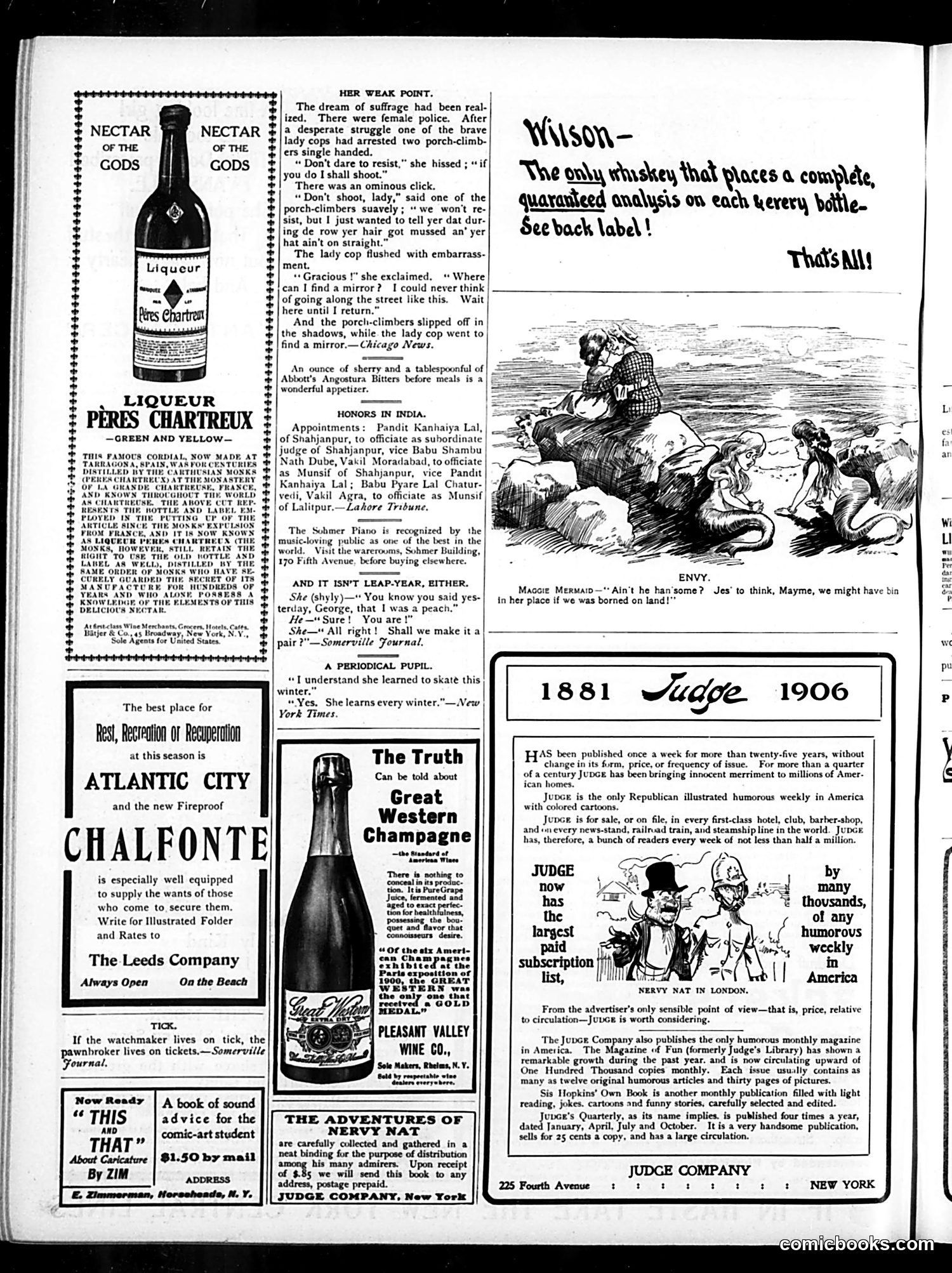
This page primarily contains **advertisements and filler content** rather than significant political satire. The main cartoon, "Her Weak Point," satirizes **early female police officers**. It depicts a female cop who arrests porch climbers (burglars) but is distracted by vanity—when a criminal mentions her disheveled appearance, she abandons her suspects to find a mirror, allowing them to escape. The joke mocks women's supposed inability to resist primping, suggesting female cops are unfit for duty due to feminine weakness. This reflects early-1900s **anti-suffrage sentiment**: as women gained voting rights and entered previously male professions like law enforcement, satirists used humor to argue women lacked the discipline and seriousness needed for such roles. The cartoon dismisses feminist progress through gendered stereotyping. The page also includes a secondary cartoon, "Envy," about mermaids envying humans—minor humor with no clear political content. The remainder comprises **liqueur advertisements** (Pères Chartreux, Great Western Champagne) and promotional material for *Judge* magazine itself.
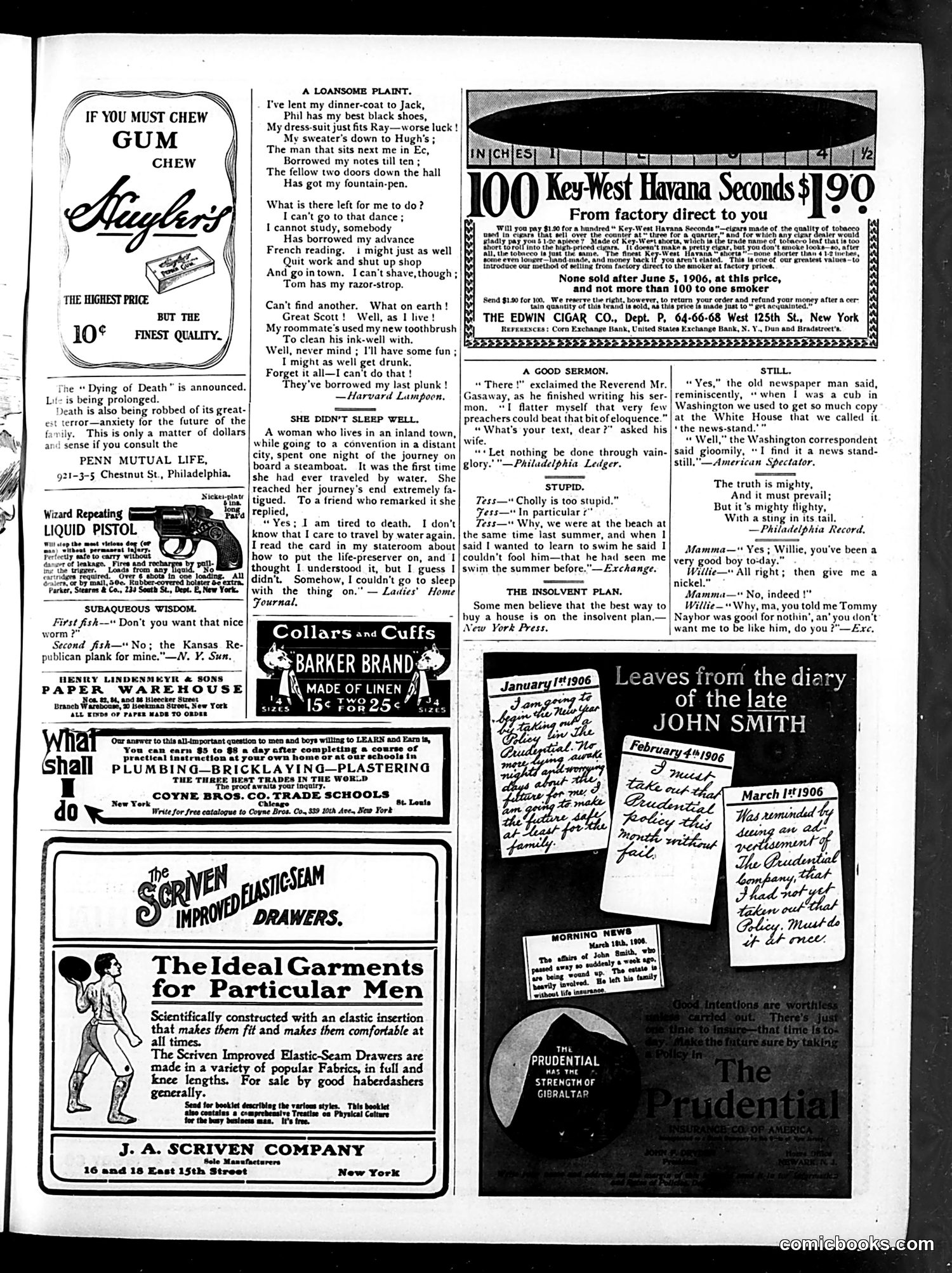
This page from *Judge* magazine contains mostly **advertisements and humorous short pieces** rather than political cartoons. The main satirical content includes: **"A Loansome Plaint"** — A poem mocking college life, depicting a student whose roommates have borrowed all his possessions (clothes, shoes, notes, fountain pen, razor-strop). The joke: he's so broke from lending that he can't afford to get drunk either—they've borrowed his last money. This reflects early 1900s college culture and the casual borrowing habits among students. **"She Didn't Sleep Well"** — A brief anecdote about an inland woman's first steamboat journey. The humor lies in her misunderstanding the life-preserver instructions, keeping it on while trying to sleep. **"Subaqueous Wisdom"** — A fish joke about Republican politics (a fish refuses bait, preferring "the Republican plank"). The remainder is **commercial advertising**: gum, cigars, collars, drawers (underwear), trade schools, and insurance—typical of period magazines that relied on ads for revenue. No significant political satire appears on this page.
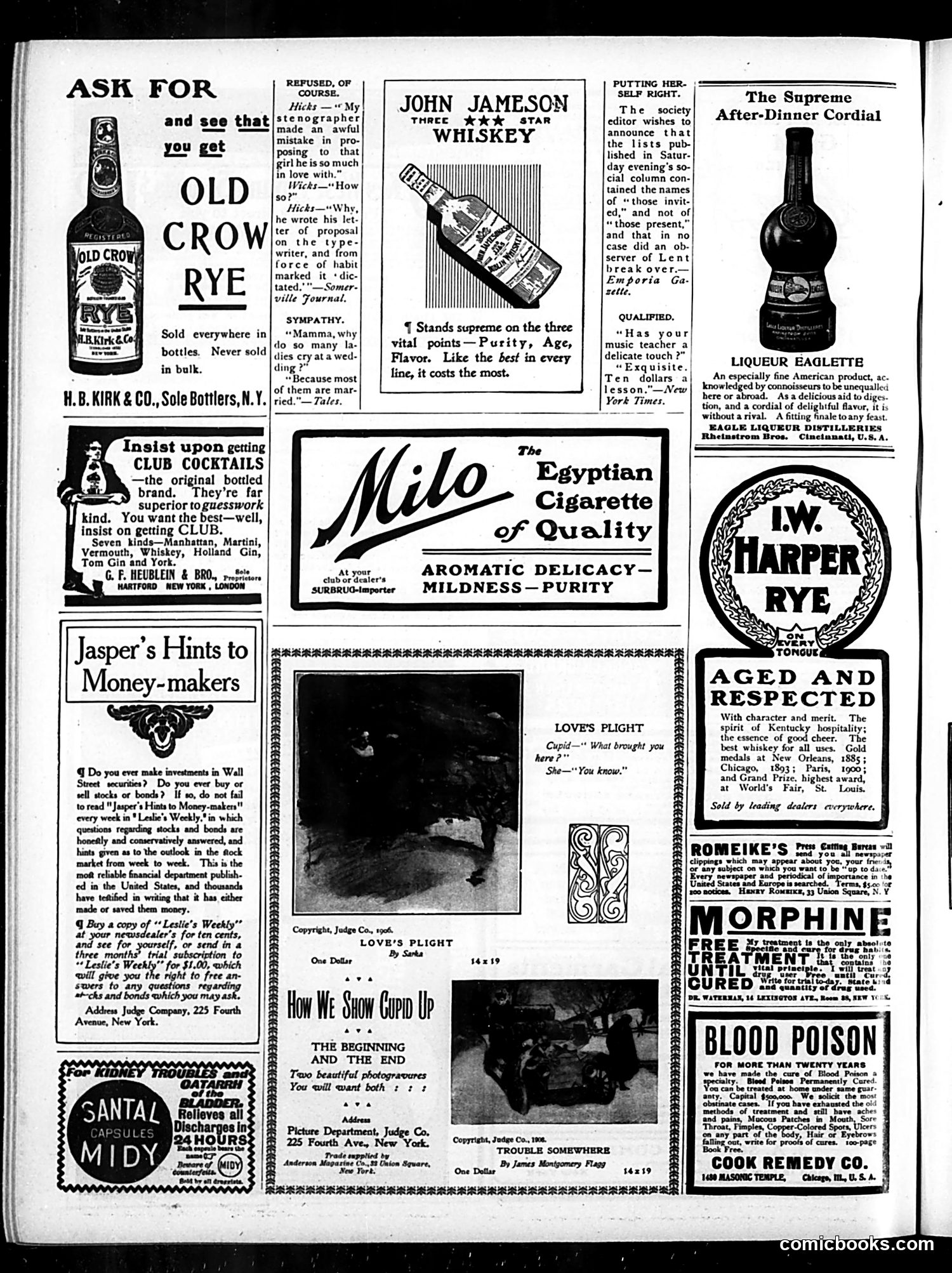
This page is primarily **advertising**, typical of early-20th-century magazines. The advertisements promote alcohol (whiskey, liqueurs, cocktails) and patent medicines—products that would later face heavy regulation or bans. Notable features include: **Alcohol ads** dominate (Old Crow Rye, John Jameson Whiskey, I.W. Harper Rye, Club Cocktails), reflecting the pre-Prohibition era when such advertising was standard in mainstream publications. **Patent medicine ads** advertise dubious "cures" for morphine addiction, blood poison (likely syphilis), and other ailments—these represent the unregulated medical marketplace that Progressive reformers criticized. **Small humor items** (like "Jasper's Hints to Money-makers" and jokes about stenographers) provide filler content typical of Judge's satirical format. The page reveals what modern readers might find shocking: mainstream magazines openly advertised treatments for venereal disease and addictive substances without regulation or medical scrutiny. This historical document illustrates why Progressive-era reforms in medicine and advertising became necessary.
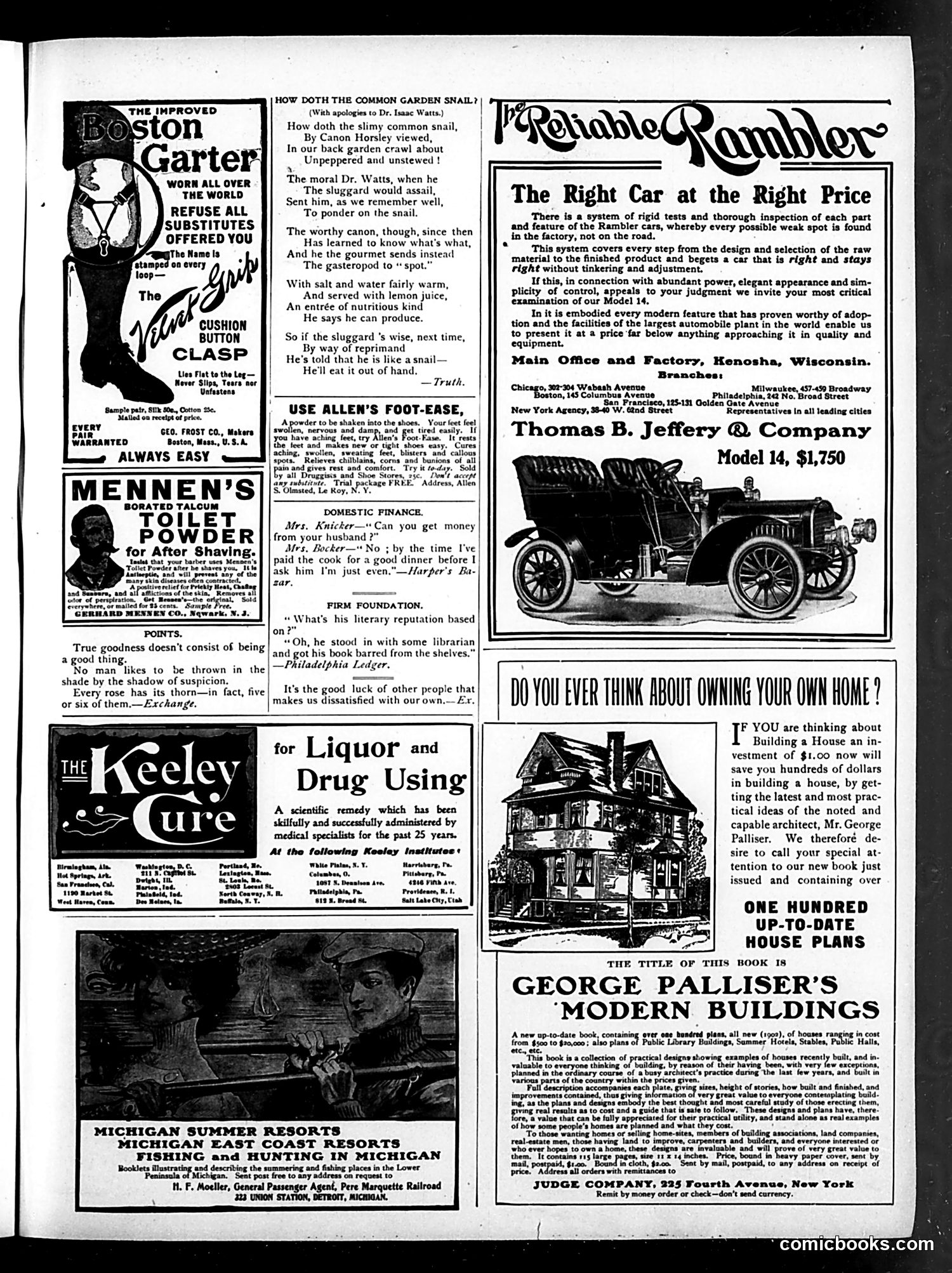
This page is primarily **advertising with light satirical content**, typical of Judge magazine's format. The main satirical piece is a poem "How Doth the Common Garden Snail?" mocking a religious figure (Canon Horsley) who apparently advocated cooking garden snails as food. The satire compares this to Dr. Isaac Watts's moralistic poem about the industrious ant, suggesting the Canon has perverted wholesome moral instruction into justification for consuming snails—turning spiritual guidance into culinary advice. The joke relies on readers knowing Watts's original verse and finding the juxtaposition of piety with gastropod consumption absurd. The page otherwise features period advertisements: Boston Garter suspenders, Mennen's talcum powder, Rambler automobiles, and the Keeley Institute (for treating alcohol and drug addiction—a real institution that existed then). Several brief humorous "Points" offer light social commentary on human nature and marriage. The overall tone reflects early 20th-century American magazine humor: genteel, morally conscious, and mildly irreverent toward authority figures.
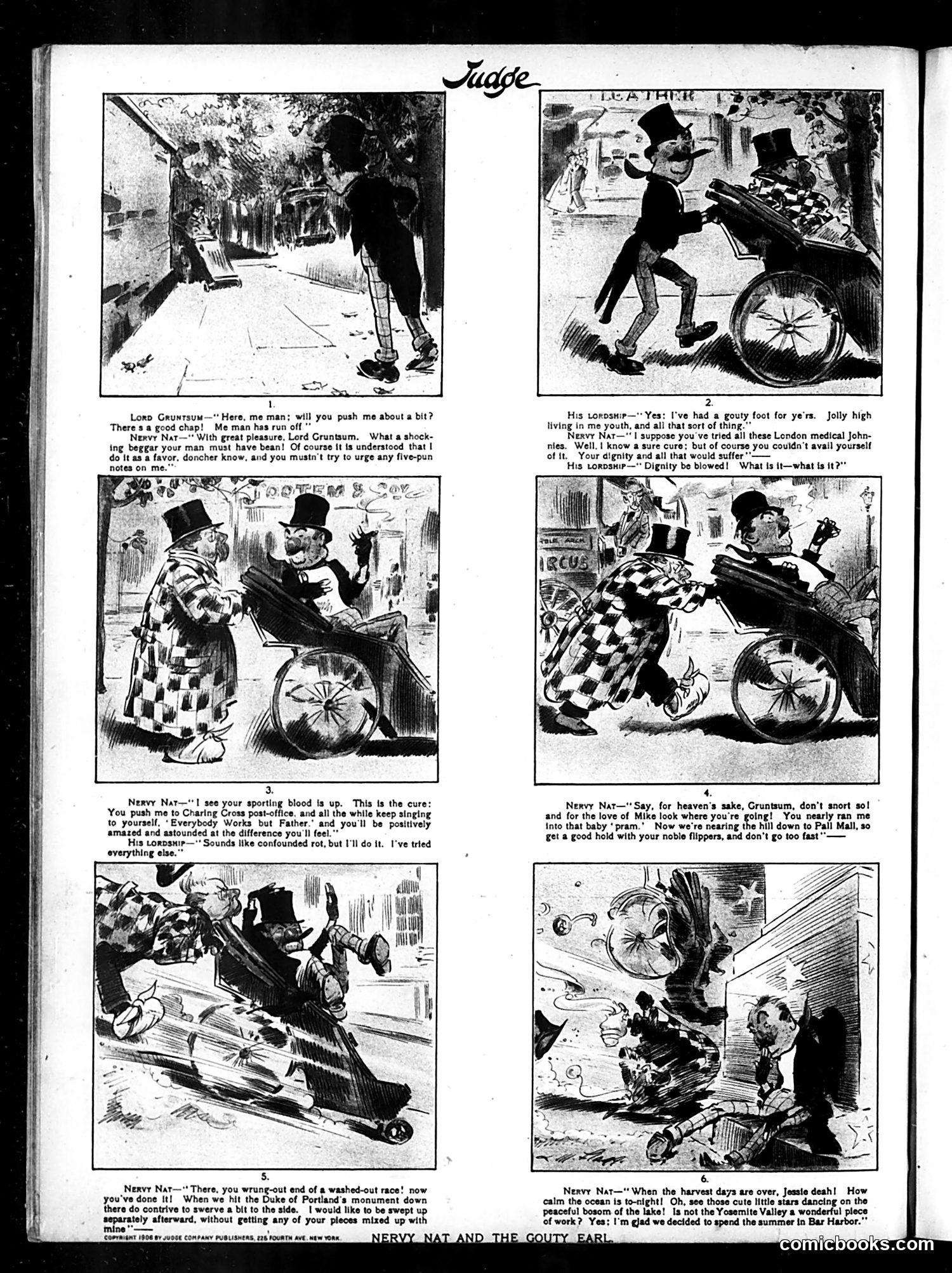
This is a six-panel comic strip satirizing class relations and British social pretense. "Nervy Nat" (a working-class character) repeatedly tricks "Lord Gruntsam" (or similar aristocratic figure) into physical exertion by flattering his vanity and appealing to masculine pride. The joke exploits the contrast between the Earl's supposed dignity and his gouty condition—he's physically deteriorated from "high living" but too proud to admit it. Nat manipulates him into pushing a bicycle as a "cure," then later tricks him into more strenuous activity, all while Nat rides comfortably. The final panel shifts to romance, with Nat sentimentalizing to "Jessie" about Yosemite Valley, suggesting he's a con artist skilled at manipulation across social boundaries. The satire targets both upper-class pretension (the Earl's inflated dignity) and working-class opportunism (Nat's clever deception), reflecting Judge magazine's satirical approach to Gilded Age social hierarchies.