
Judge, 1906-05-05 · page 10 of 16
Judge — May 5, 1906 — page 10: what you’re looking at
What you’re looking at
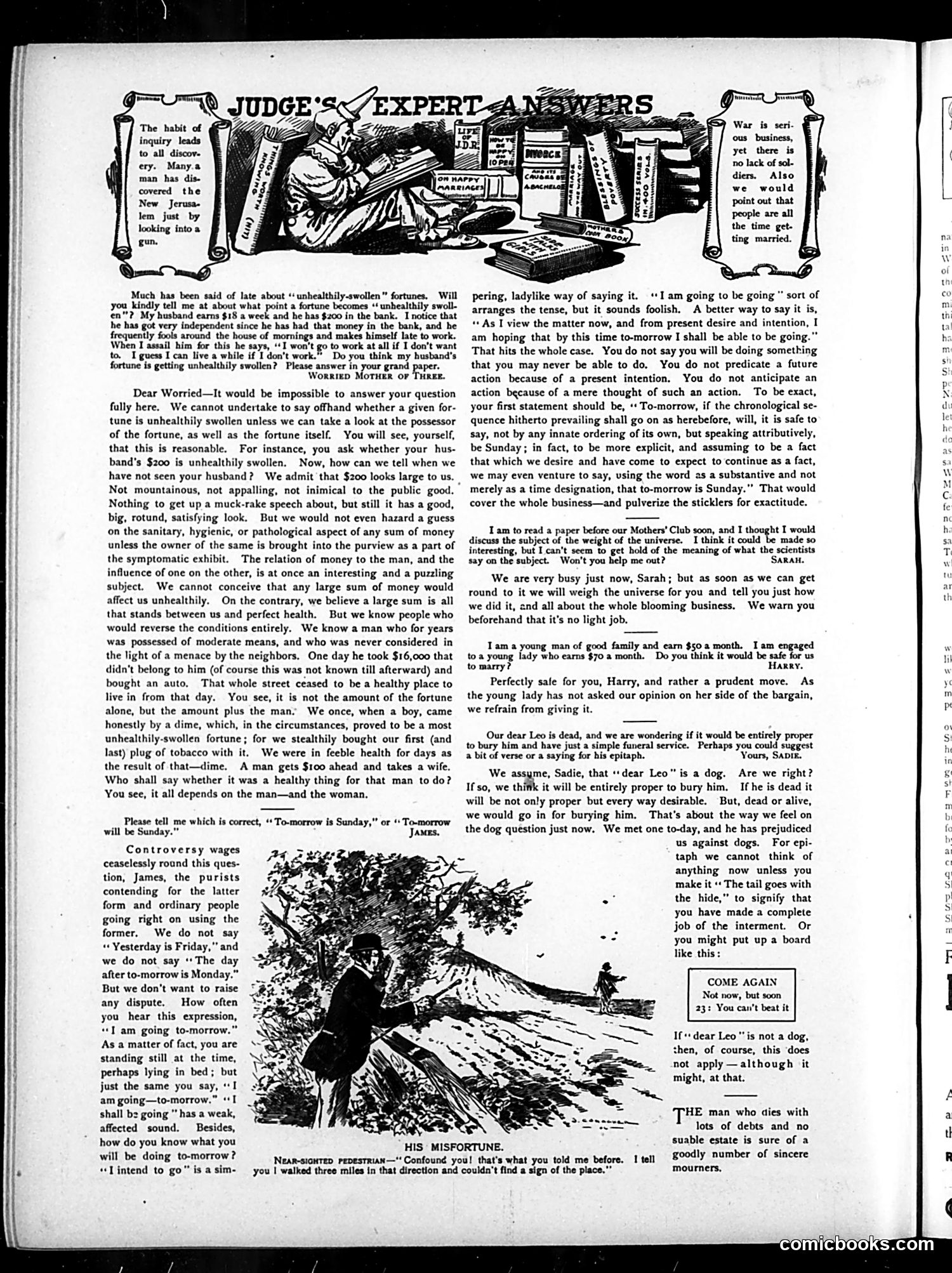
This page from *Judge* magazine addresses the contemporary debate over "unhealthily-swollen fortunes"—likely referencing early 20th-century Progressive Era concerns about wealth inequality and monopolies. **Main Content:** The "Judge's Expert Answers" advice column uses satire to mock the era's vague anxieties about money. A worried mother writes that her husband's modest $200 savings has made him lazy and independent. The Judge's response brilliantly deflates the hysteria: wealth's danger depends entirely on the *person*, not the amount. The editorial uses absurd examples (a dime spent on tobacco, $16,000 spent on a car) to ridicule the moralistic hand-wringing about fortunes without considering individual character. **The Cartoons:** The lower illustration shows a near-sighted pedestrian complaining to someone—appears to be commentary on misdirection or being lost. **Satire Target:** Political and social reformers who spoke loosely about "swollen fortunes" without nuance, treating money as inherently corrupting regardless of circumstance or character.
📄 Transcribed text from this page (OCR, searchable)
Machine-transcribed from the original scan — historical spelling and the odd misread are preserved.
Much has been said of late about ‘‘unhealthily-swollen” fortunes. Will you kindly tell me at about what point a fortune becomes ‘ unhealthily swoll- en"? My husband earns $18 a week and he has $200 in the bank. I notice that he has got very independent since he has had that money in the bank, and he frequently fools around the house of mornings and makes himself late to work. When I assail him for this he says, ‘+I won't go to work at all if I don't want to. I guess I can live a while if I don't work.” Do you think my husband’s fortune is getting unhealthily swollen? Please answer in your grand paper. Worriep MoTHer or THREE. Dear Worried—It would be impossible to answer your question fally here. We cannot undertake to say offhand whether a given for- tune is unhealthily swollen unless we can take a look at the possessor of the fortune, as well as the fortune itself. You will see, yourself, that this is reasonable. For instance, you ask whether your hus- band's $200 is unhealthily swollen. Now, how can we tell when we have not seen your husband? We admit that $200 looks large to us. _ Not mountainous, not appalling, not inimical to the public good. Nothing to get up a muck-rake speech about, but still it has a good, big, rotund, satisfying look, But we would not even hazard a guess on the sanitary, hygienic, or pathological aspect of any sum of money unless the owner of the same is brought into the purview as a part of the symptomatic exhibit. The relation of money to the man, and the influence of one on the other, is at once an interesting and a puzzling subject. We cannot conceive that any large sum of money would affect us unhealthily. On the contrary, we believe a large sum is all that stands between us and perfect health. But we know people who would reverse the conditions entirely. We know a man who for years was possessed of moderate means, and who was never considered in the light of a menace by the neighbors. One day he took $16,000 that didn't belong to him (of course this was not known till afterward) and bought an auto, That whole street ceased to be a healthy place to live in from that day, You see, it is not the amount of the fortune alone, but the amount plus the man. We once, when a boy, came honestly by a dime, which, in the circumstances, proved to be a most unhealthily-swollen fortune; for we stealthily bought our first (and last) plug of tobacco with it. We were in feeble health for days as the result of that—dime. A man gets $100 ahead and takes a wife. Who shall say whether it was a healthy thing for that man to do? You see, it all depends on the man—and the woman. Please tell me which is correct, “* To-morrow is Sunday,” or ‘To-morrow will be Sunday." Controversy wages ceaselessly round this ques- tion, James, the purists contending for the latter form and ordinary people going right on using the former. We do not say «+ Yesterday is Friday," and we do not say “The day after to-morrow is Monday.” But we don’t want to raise any dispute. How often you hear this expression, “Tam going to-morrow.” As a matter of fact, you are standing still at the time, perhaps lying in bed; but just the same you say, “I am going—to-morrow.” “+I shall bz going "has a weak, affected sound. Besides, how do you know what you will be doing to-morrow? «Lintend to go” is a sim- HIS MISFORTUNE. Near-sicntep repestrian—"' Confound you! that's what you told me before. | tell you | walked three miles in that direction and couldn't find a sign of the place."” pering, ladylike way of saying it. I am going to be going" sort of arranges the tense, but it sounds foolish. A better way to say it is, «+ As I view the matter now, and from present desire and intention, I am hoping that by this time to-morrow I shall be able to be going.” That hits the whole case. You do not say you will be doing something that you may never be able to do. You do not predicate a future action because of a present intention. You do not anticipate an action because of a mere thought of such an action. To be exact, your first statement should be, ‘* To-morrow, if the chronological se- quence hitherto prevailing shall go on as herebefore, will, it is safe to say, not by any innate ordering of its own, but speaking attributively, be Sunday; in fact, to be more explicit, and assuming to be a fact that which we desire and have come to expect to continue as a fact, we may even venture to say, using the word as a substantive and not merely as a time designation, that to-morrow is Sunday.” That would cover the whole business—and pulverize the sticklers for exactitude. Iam to read a paper before our Mothers’ Club soon, and I thought I would discuss the subject of the weight of the universe. I think it could made so interesting, but I can’t seem to get hold of the meaning of what the scientists say on the subject. Won't you help me out? ‘SARAH. We are very busy just now, Sarah; but as soon as we can get round to it we will weigh the universe for you and tell you just how we did it, and all about the whole blooming business. We warn you beforehand that it’s no light job. Tam a young man of good family and earn $50 a month. Tam engaged toa young lady who earns $70 a month. Do you think it would be safe for us to marry? Harry. Perfectly safe for you, Harry, and rather a prudent move. As the young lady has not asked our opinion on her side of the bargain, we refrain from giving it. Our dear Leo is dead, and we are wondering if it would be entirely proper to bury him and have just a simple funeral service. Perhaps you could suggest a bit of verse or a saying for his epitaph. Yours, SADIE. We assyme, Sadie, that «dear Leo" is a dog. Are we right? If so, we thik it will be entirely proper to bury him. If he is dead it will be not only proper but every way desirable. But, dead or alive, we would go in for burying him. That's about the way we feel on the dog question just now. We met one to-day, and he has prejudiced us against dogs. For epi- taph we cannot think of anything now unless you make it «« The tail goes with the hide,” to signify that you have made a complete job of the interment. Or you might put up a board like this : COME AGAIN Not now, but soon 23: You can’t beat it If ++ dear Leo "is not a dog, then, of course, this ‘does not apply —although it might, at that. THE man who dies with lots of debts and no suable estate is sure of a goodly number of sincere mourners,