
A complete issue · 16 pages · 1906
Judge — March 17, 1906
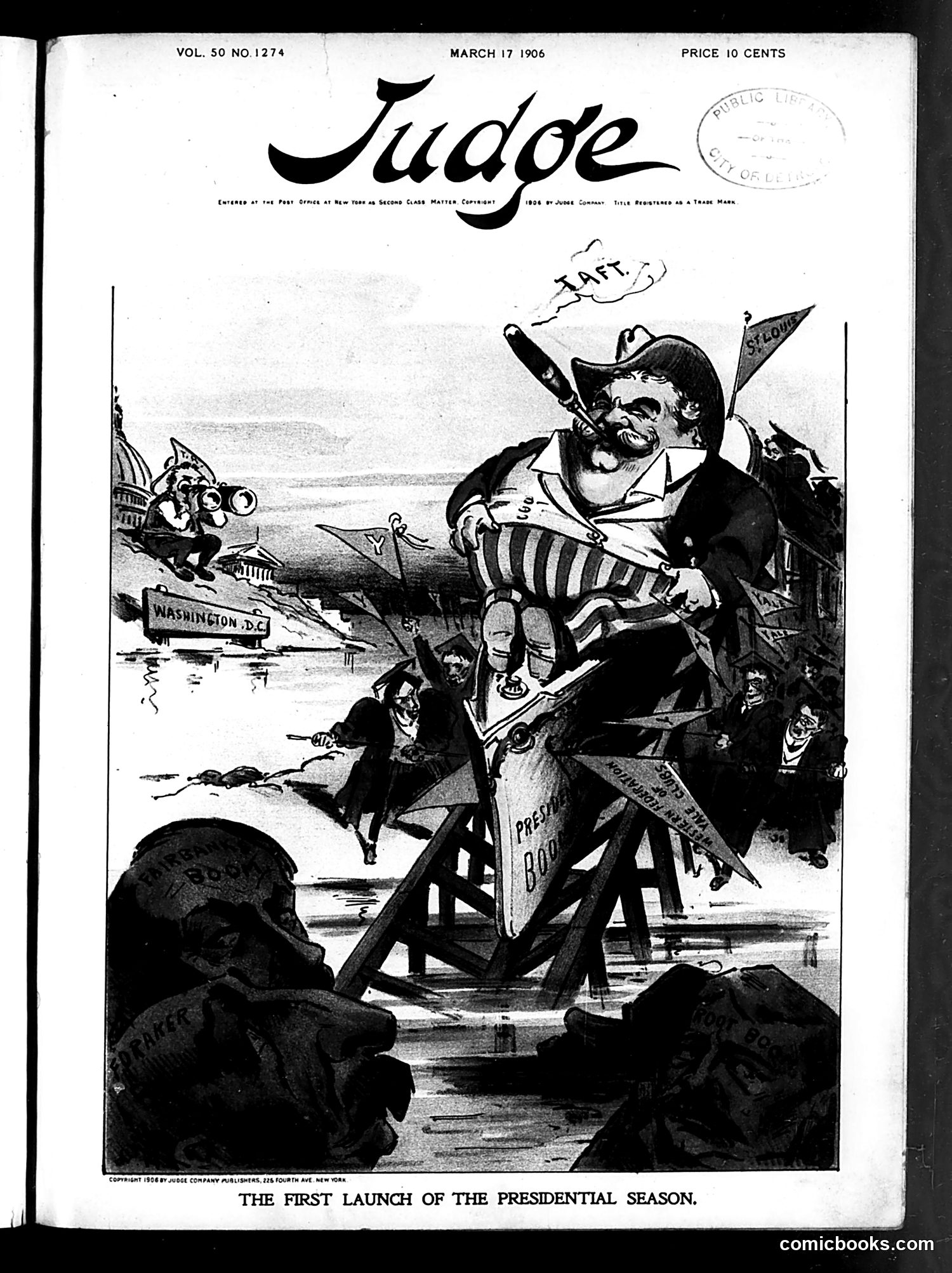
This March 1906 Judge cartoon satirizes the beginning of the 1908 presidential campaign. The central figure appears to be a political operator or party boss launching a candidate (depicted as a large, ornate vessel or ship) from Washington, D.C., into the political waters ahead. The vessel is labeled with terms suggesting presidential ambitions and political machinery ("DRAFT," "STEAM"). The cartoon uses the metaphor of a ship launch to mock how presidential campaigns are orchestrated behind the scenes by political establishments rather than emerging organically. Various figures—likely representing different political interests, media, and party machinery—surround the scene, suggesting the artificial, manufactured nature of political candidacy. The satire critiques the mechanics of presidential politics as mechanical and controlled.
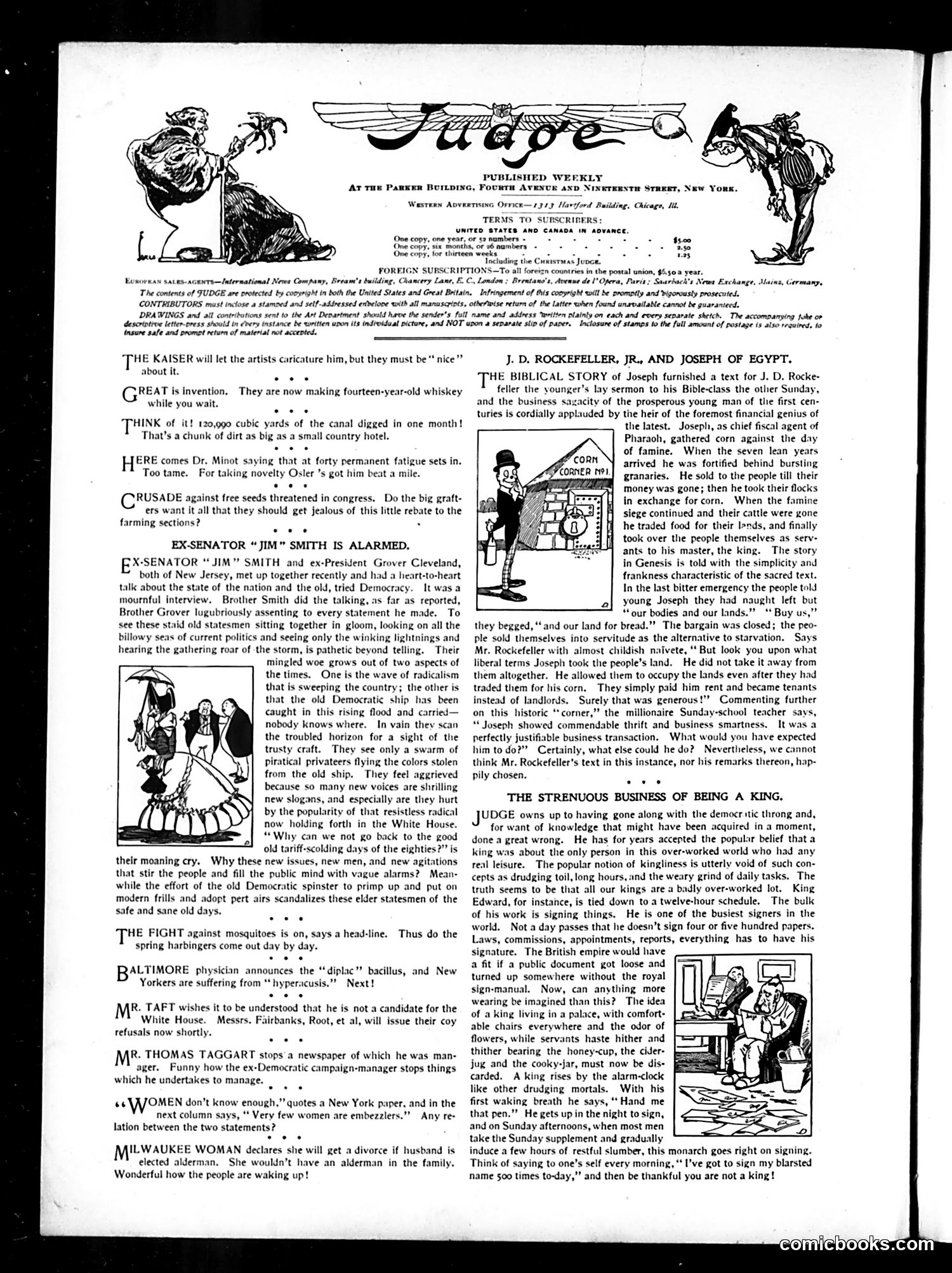
This page contains several short political satirical items typical of Judge's format. The main pieces mock: **"The Kaiser will be artists' caricature him"** — Refers to German Emperor Wilhelm II, suggesting even caricaturists struggle to exaggerate his features. **"Ex-Senator 'Jim' Smith is Alarmed"** — Criticizes Smith and former President Grover Cleveland for their Democratic alliance, portraying them as hypocritical party politicians alarmed by radicalism they themselves enabled. The satire suggests their outrage at party extremism rings hollow. **"The Strenuous Business of Being a King"** — Mocks monarchy, contrasting the romanticized image of kingship with the tedious bureaucratic reality: endless document-signing, commissions, and routine paperwork that consumes a monarch's day. The cartoons use exaggerated illustrations to reinforce these points about political hypocrisy and institutional absurdity.
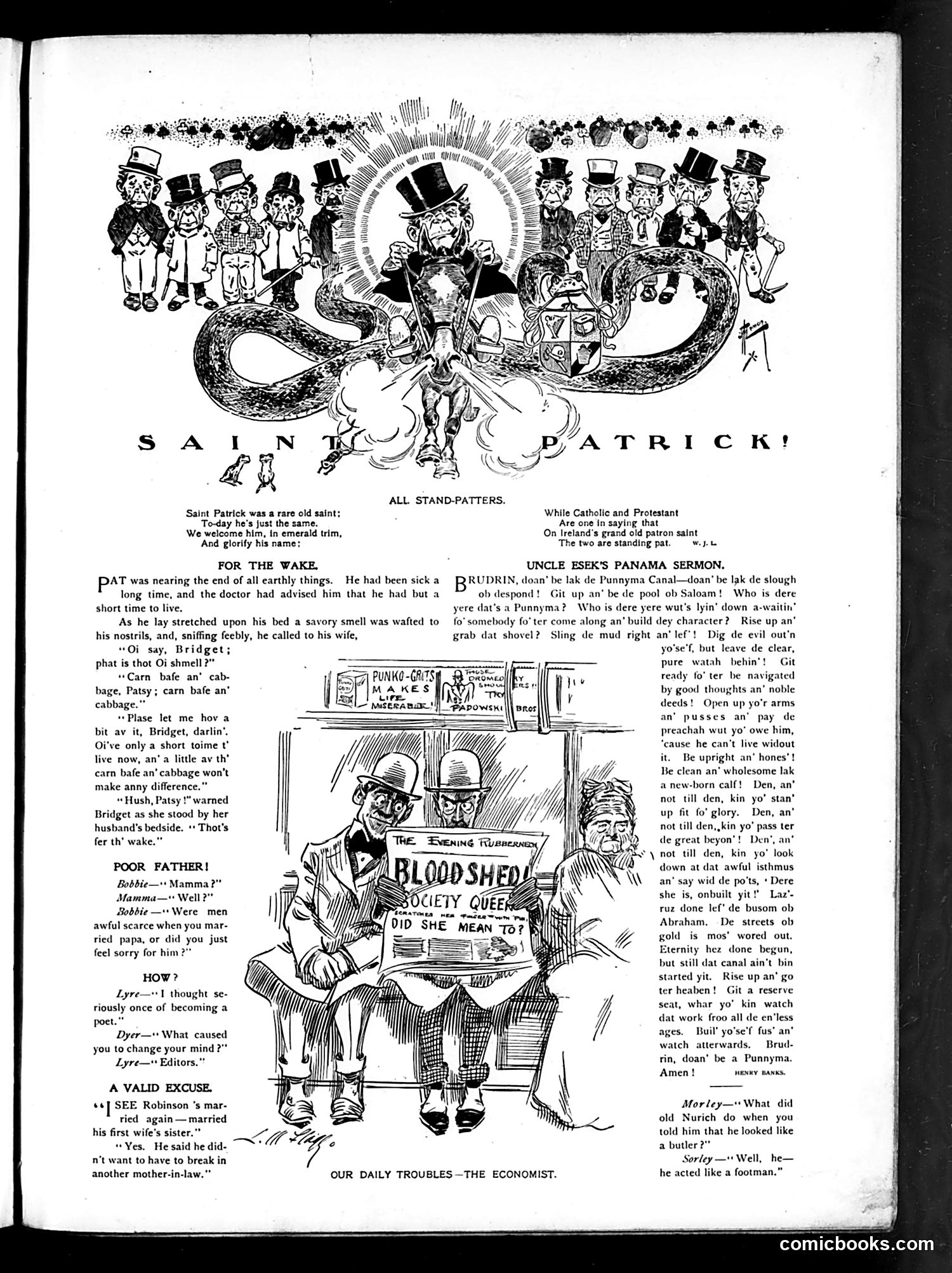
The top illustration celebrates **Saint Patrick's Day** with a humorous composition featuring cartoon figures in top hats arranged around a central serpent (referencing St. Patrick driving snakes from Ireland). The accompanying verse treats Saint Patrick as a unifying figure for Irish Catholics and Protestants alike—a charitable sentiment about Irish-American identity. Below are several short humorous sketches and jokes typical of Judge's format. "Our Daily Troubles—The Economist" depicts two working-class men reading a sensational newspaper headline about a "Bloodshed Society Queen," satirizing tabloid journalism and public fascination with scandal. The remaining items are brief comedic dialogues on domestic topics like marriage and thrift—standard humor content for this era's satirical magazines.
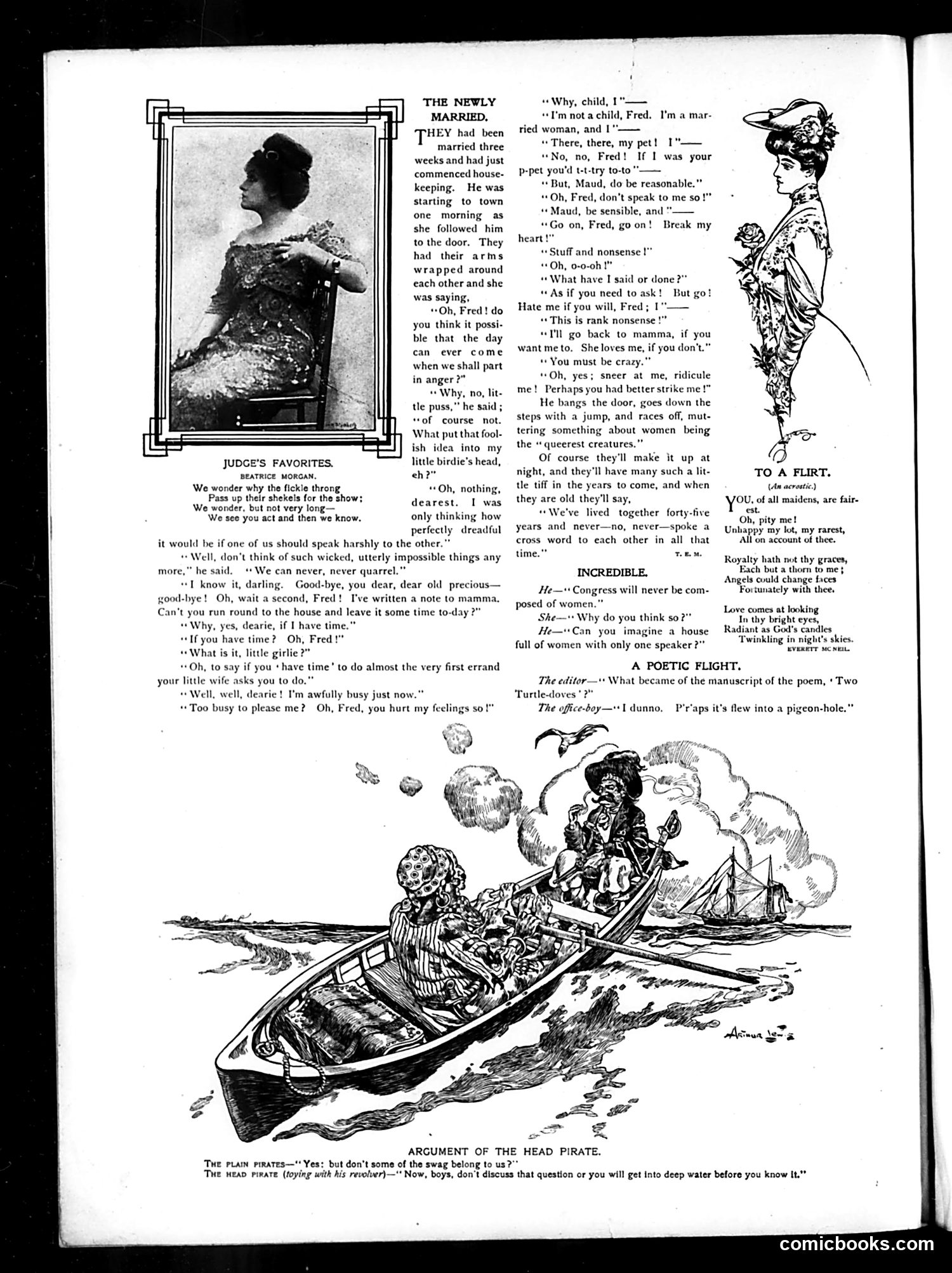
This page contains three humor pieces typical of early 20th-century Judge magazine: **"The Newly Married"** (top left): A domestic comedy about a newly married couple's first disagreement. The husband Fred wants his wife Maud to be "reasonable," but she refuses, leading to an escalating argument about their future together. It satirizes early marriage conflicts and gender dynamics—the wife refusing submission despite the husband's expectations. **"To a Flirt"** (top right): A poem mocking women who flirt indiscriminately, suggesting they're inconstant and emotionally manipulative. **"A Poetic Flight"** and **"Argument of the Head Pirate"** (bottom): Brief comic exchanges; the latter jokes about pirates arguing over stolen booty. The page reflects period attitudes about marriage, women's behavior, and humor conventions of the era.
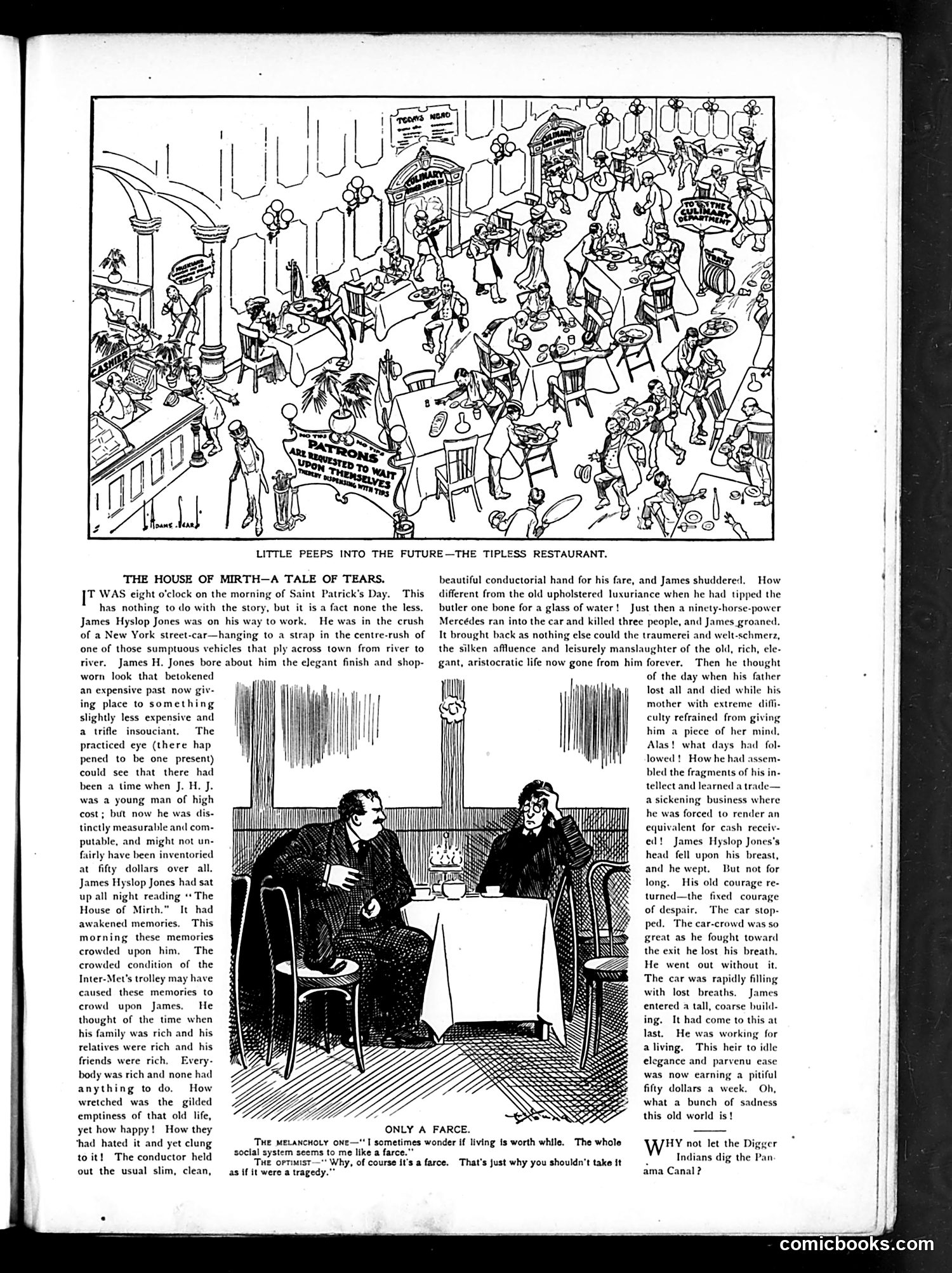
**Main Content:** This page contains a short story titled "The House of Mirth—A Tale of Tears" about James Hyslop Jones, a poor New York street-car worker who dreams of wealth. The narrative follows his downward spiral after inheriting money, describing how newfound riches lead to moral corruption and eventual ruin. **The Cartoon:** The illustration shows two men in a restaurant, with dialogue satirizing social inequality. One figure says living "is just a farce," to which the other responds that poor people shouldn't "take it as if it were a tragedy." **Social Satire:** The page critiques wealth inequality and the American class system, suggesting that the wealthy view poverty cynically while the poor accept suffering. The story warns that money itself corrupts rather than elevates.
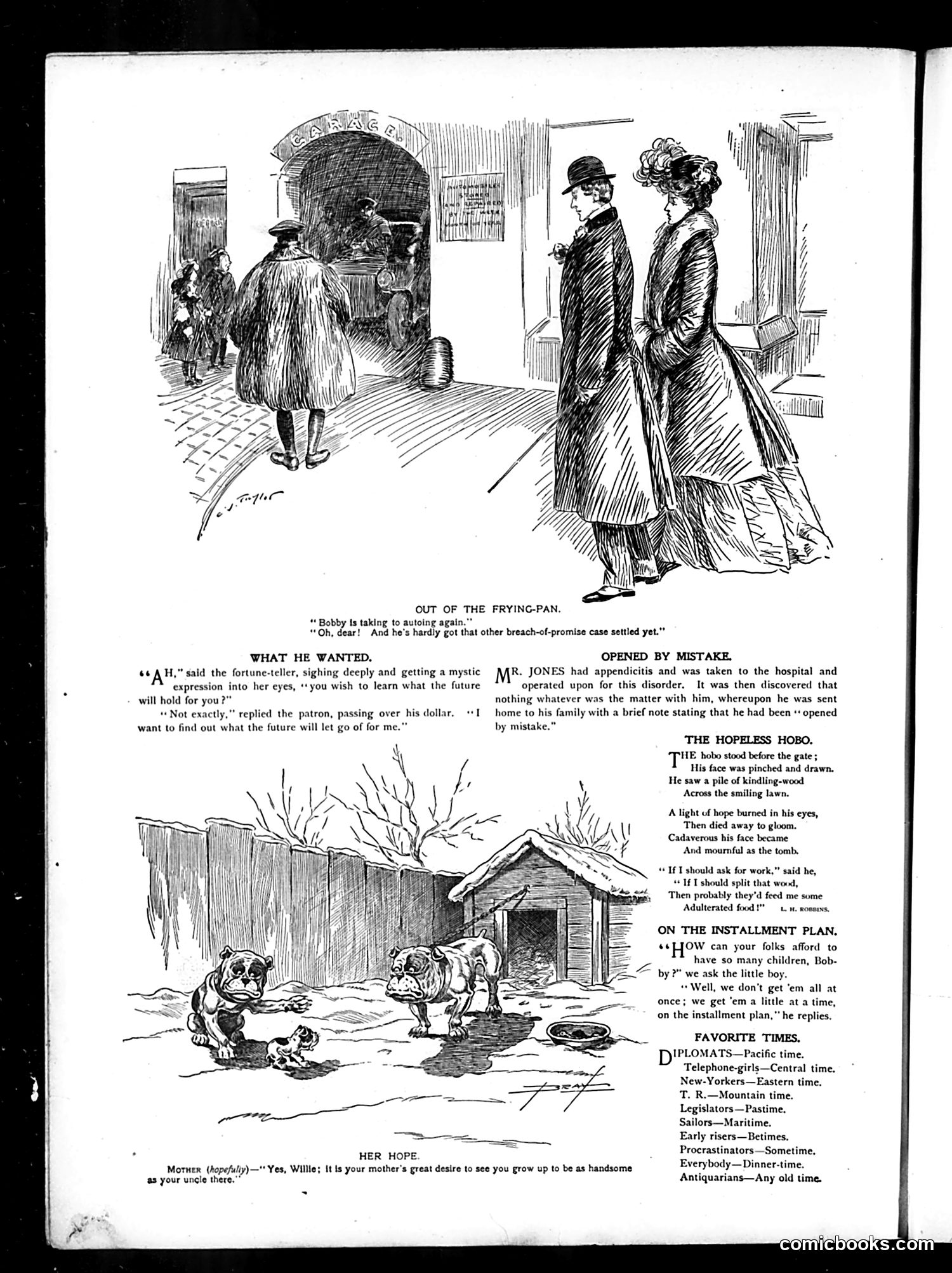
This page contains several satirical vignettes typical of early 20th-century American humor: **"Out of the Frying-Pan"** mocks a wealthy young man ("Bobby") who serially faces romantic scandals—he's barely settled one breach-of-promise lawsuit before taking up automobiling again, suggesting cars attract new romantic trouble. **"What He Wanted"** plays on fortune-telling: a patron seeks not to learn his future but to discover what burdens the future will remove from him—satirizing common anxieties about debt or obligation. **"Opened by Mistake"** darkly jokes about unnecessary surgery: Mr. Jones undergoes appendectomy only for doctors to discover nothing was wrong, then send him home with an apologetic note. **"The Hopeless Hobo"** presents a vagrant too cynical to seek work, anticipating rejection and poor treatment. **"Her Hope"** and **"On the Installment Plan"** offer gentler family humor about appearance and poverty. The final "Favorite Times" section provides pun-based humor about different groups' preferred time periods, including a reference to "T.R." (Theodore Roosevelt).
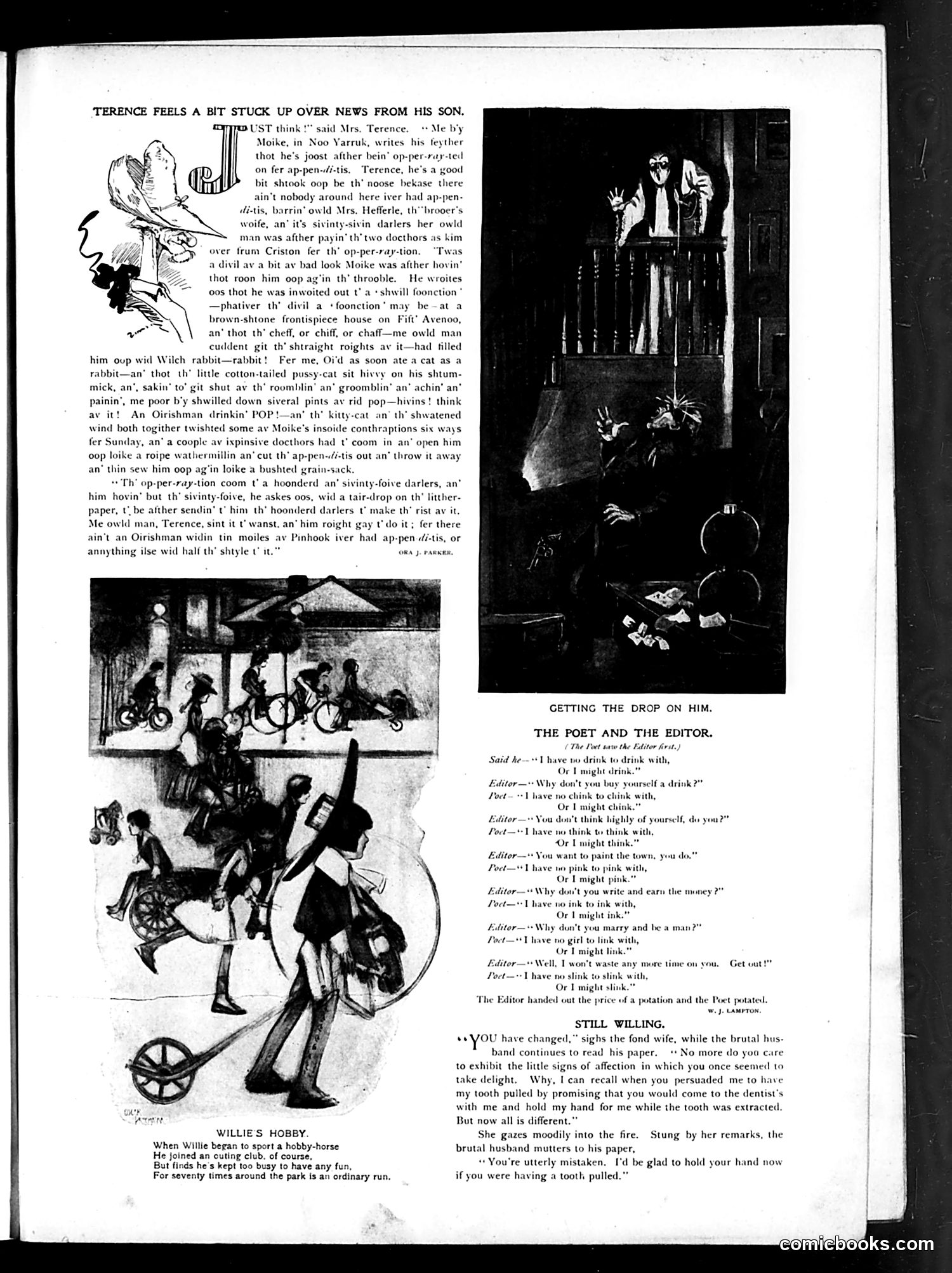
This Judge magazine page contains three satirical pieces: **1. "Terence Feels a Bit Stuck Up"** (top left): An Irish immigrant father brags that his son in New York had an appendectomy—a rare, expensive operation ($175). The satire mocks both Irish-American pride and working-class anxiety about modern medical costs. The misspelled dialect ("op-per-ray-ted," "Fift' Avenoo") is period-typical ethnic humor. **2. "Willie's Hobby"** (bottom left): A brief joke about a man who joins a cycling club but is now exhausted from constant riding—satire of the faddish "hobby-horse" craze and how hobbies can become obsessive burdens. **3. "The Poet and the Editor"** (right): A punning dialogue where a poor poet claims he has no money ("chink"), no self-regard ("think"), no romance ("giel"), etc.—playing on rhyming words. The editor finally gives him drinking money just to leave. **4. "Still Willing"** (bottom right): A husband coldly reads his paper while his wife laments lost affection, then offers to hold her hand—only if she's having a tooth pulled. Dark marital satire.
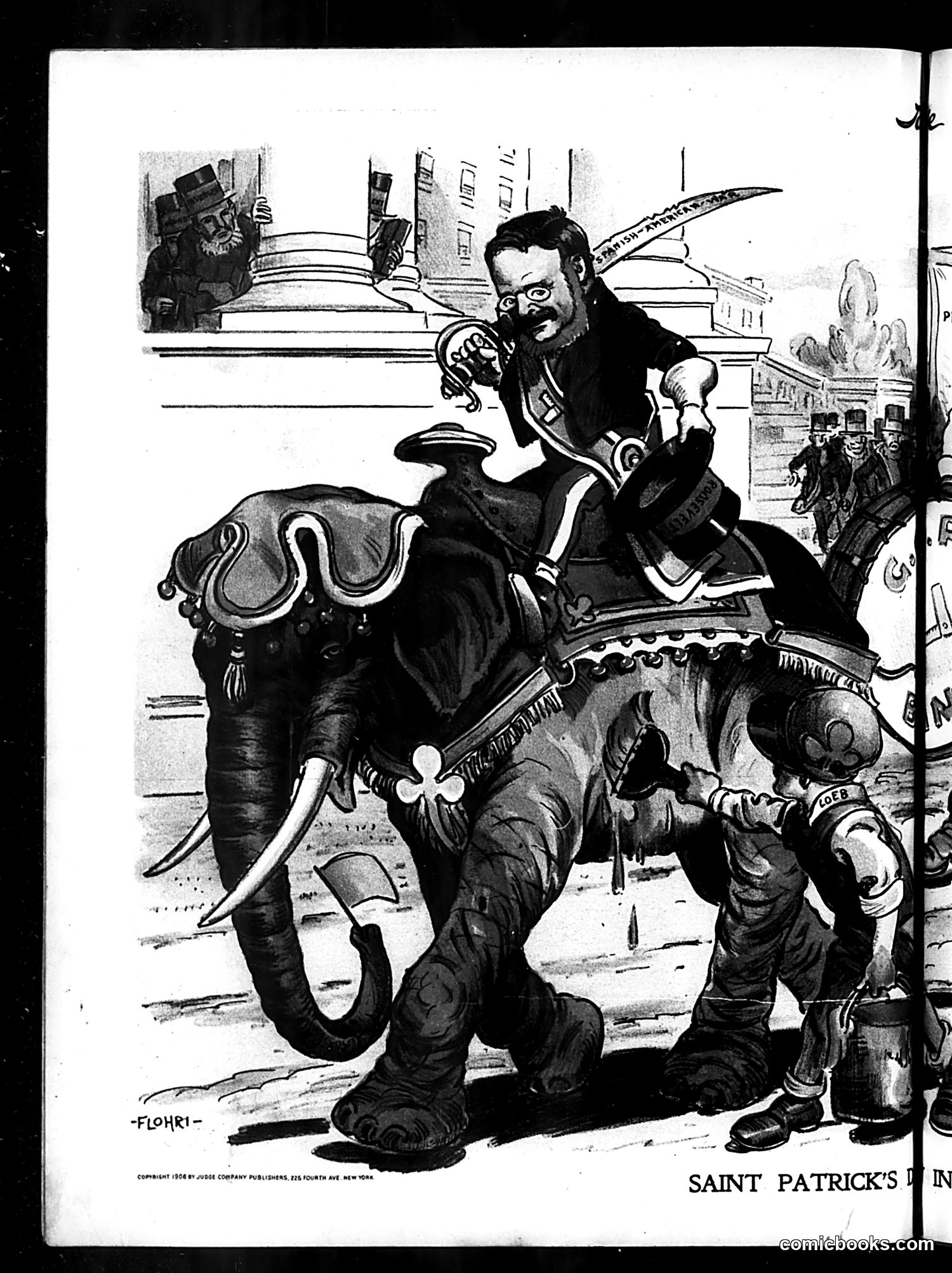
This is a satirical cartoon by Flohr from Judge magazine depicting a figure riding an ornately decorated elephant. The cartoon appears to reference political corruption or misconduct, using the elephant as a symbol (the Republican Party's traditional mascot). The rider's exaggerated facial features and theatrical costume suggest caricature of a specific political figure, though the OCR text is too damaged to confirm identity. The building in the background and onlookers suggest an official or public setting. The "SAINT PATRICK'S D[AY]" text at bottom indicates this was published around that holiday, likely adding another layer of contemporary political commentary. Without clearer identification, the specific scandal or target remains unclear, but the composition suggests criticism of political excess or impropriety.
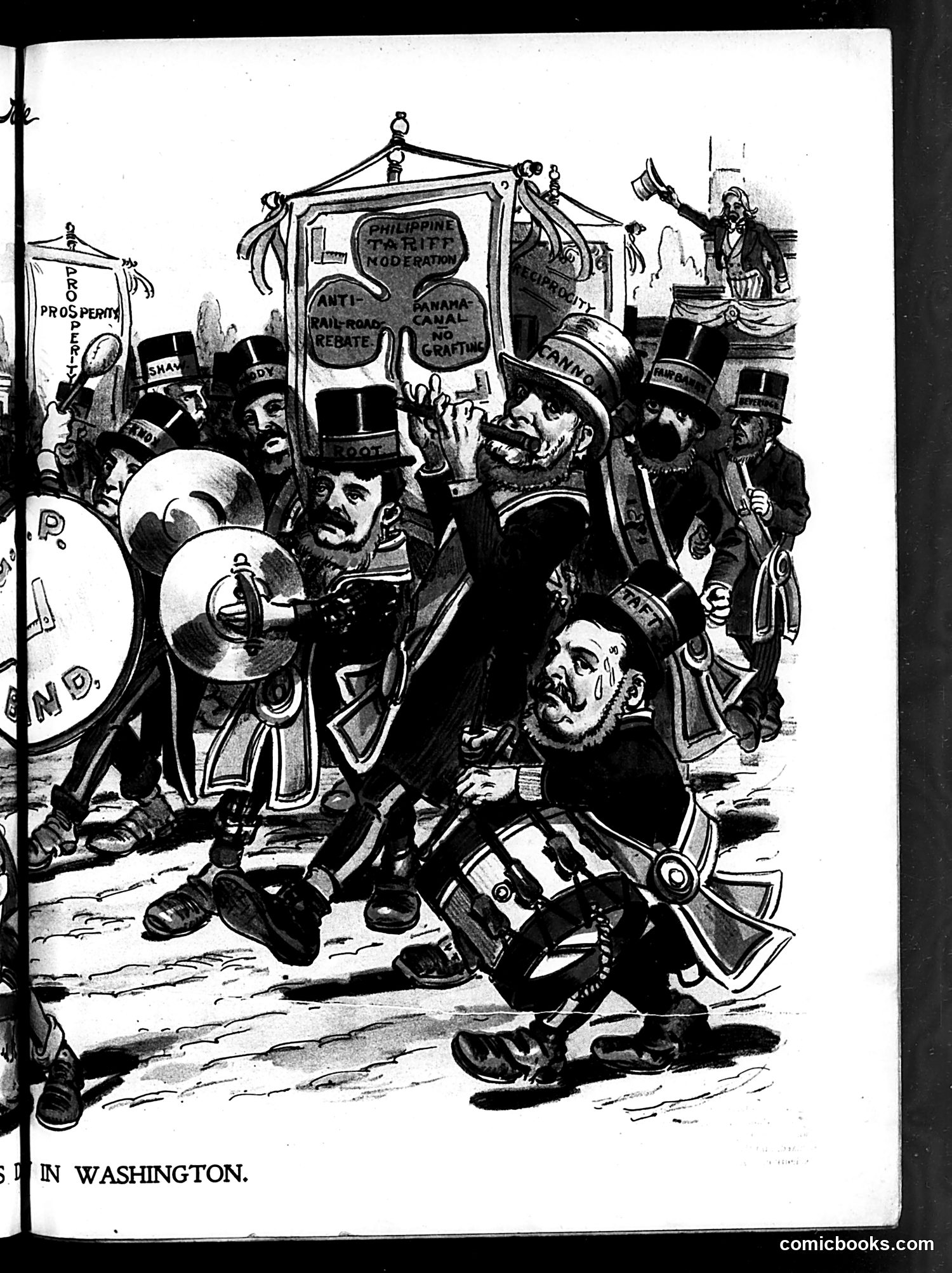
This satirical cartoon depicts what appears to be a political procession or parade "IN WASHINGTON." The central focus is a large sedan chair or platform labeled "PHILIPPINE TARIFF MODERATION," being carried by multiple figures wearing top hats and formal attire—likely representing politicians or special interests. The chair displays controversial items: "ANTI-RAIL-ROAD REBATE" and "CANAL GRAFT" appear to be the issues being debated. Surrounding figures hold signs including "FOR PROSPERITY" (visible on the left), suggesting competing political positions. The caricatured style and exaggerated features are typical of early 20th-century Judge magazine satire, mocking what appears to be political maneuvering around Philippine trade policy and railroad/canal legislation. The figures seem to represent different political factions or lobbyists engaged in this contentious debate during the Progressive Era.
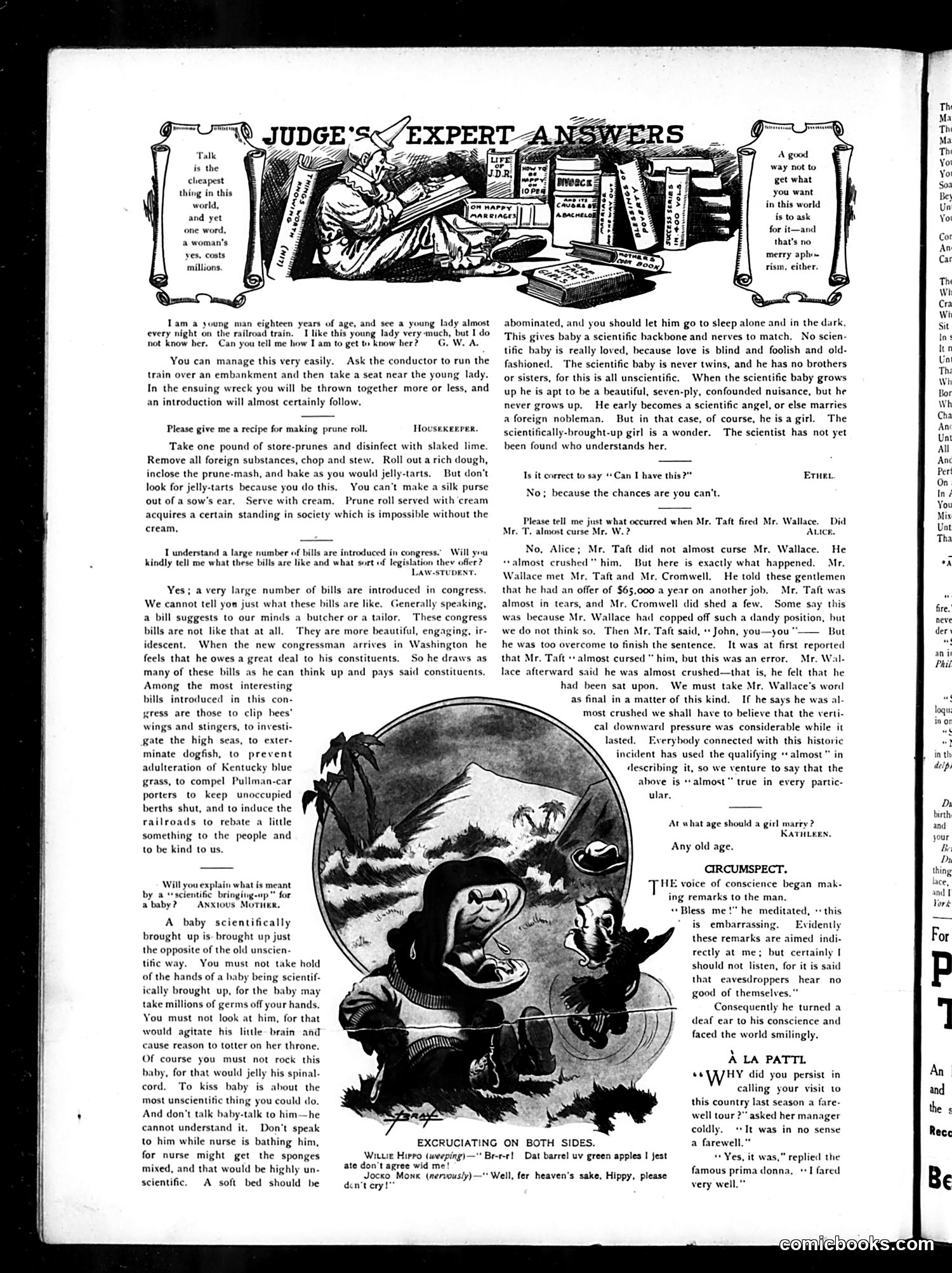
This page from *Judge* magazine features mock advice columns satirizing contemporary American concerns and absurdities. The main cartoon "Excruciating on Both Sides" depicts two working-class men (identifiable by dialect and appearance as Irish immigrants—"Willie Hippo" and "Jocko Monk") arguing over spoiled green apples, representing petty immigrant disputes. The advice columns mock various targets: a naive young man seeking romantic advice; Congressional bill-writing as performative theater where politicians create busywork to appear productive for constituents; and most pointedly, the "scientific child-rearing" trend—likely referring to early 20th-century progressive parenting theories emphasizing hygiene and detachment over affection. The satire suggests these methods produce emotionally stunted, neurotic adults. The overall tone ridicules both immigrant working-class culture and educated middle-class pretensions with equal irreverence.
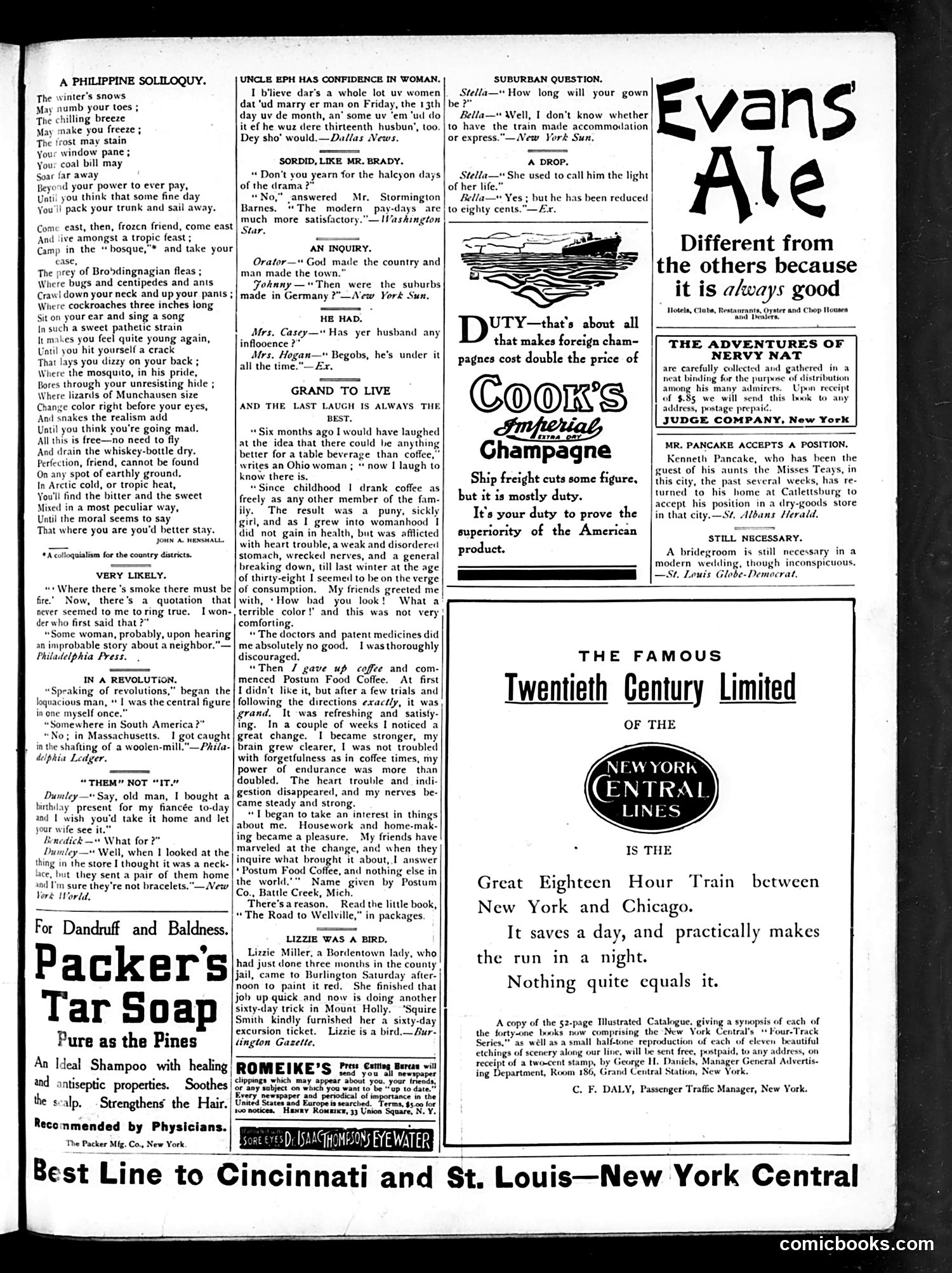
This page consists primarily of **humorous short jokes and satirical quips** rather than political cartoons. The main content includes: **"A Philippine Soliloquy"** — A poem mocking American colonization of the Philippines by contrasting romanticized tropical escape fantasies with the actual miseries (insects, disease, discomfort). It satirizes the era's imperialist attitudes by suggesting paradise abroad is illusory. The remaining sections are brief, scattered jokes on various topics: domestic marriage humor, Irish-American dialect humor ("Uncle Eph"), workplace scenarios, and professional situations. **The advertisements** occupy substantial space, promoting consumer products (Packer's Tar Soap) and the New York Central railroad's train service. For modern readers: This reflects early 1900s American attitudes toward U.S. imperial expansion in the Philippines, presenting the colonies as a romanticized but ultimately disappointing destination. The humor relies heavily on period stereotypes and dialect comedy that would be considered offensive today.
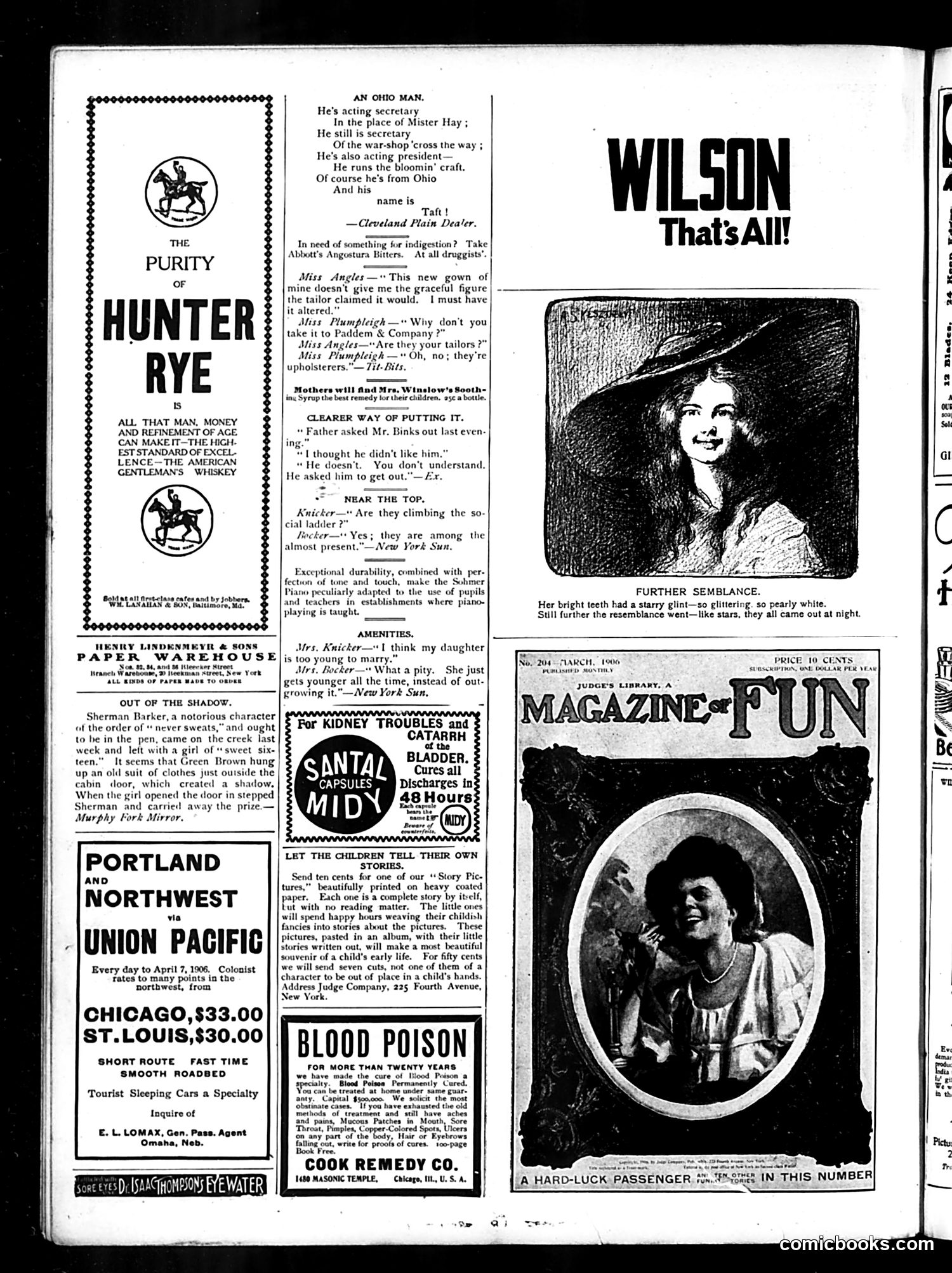
This page's main political content is the poem about "An Ohio Man," clearly referring to **William Howard Taft**. The verse satirizes Taft's multiple overlapping roles: he serves as Secretary of War while simultaneously acting as Secretary of State (filling in for deceased John Hay) and effectively running the Roosevelt administration—yet he's still from Ohio. The joke's point: Taft holds too many positions at once, creating an absurdly concentrated power structure. The phrase "he runs the bloomin' craft" suggests he's essentially doing the president's job while Theodore Roosevelt remains nominally in charge. The satire is **critical of power concentration and administrative inefficiency**—one man cannot competently manage all these roles. The Cleveland Plain Dealer byline indicates this reflects genuine contemporary concern about Taft's unusual position in Roosevelt's cabinet during the early 1900s. The remainder of the page contains unrelated advertisements and genteel humor pieces typical of Judge magazine's mixed content format.
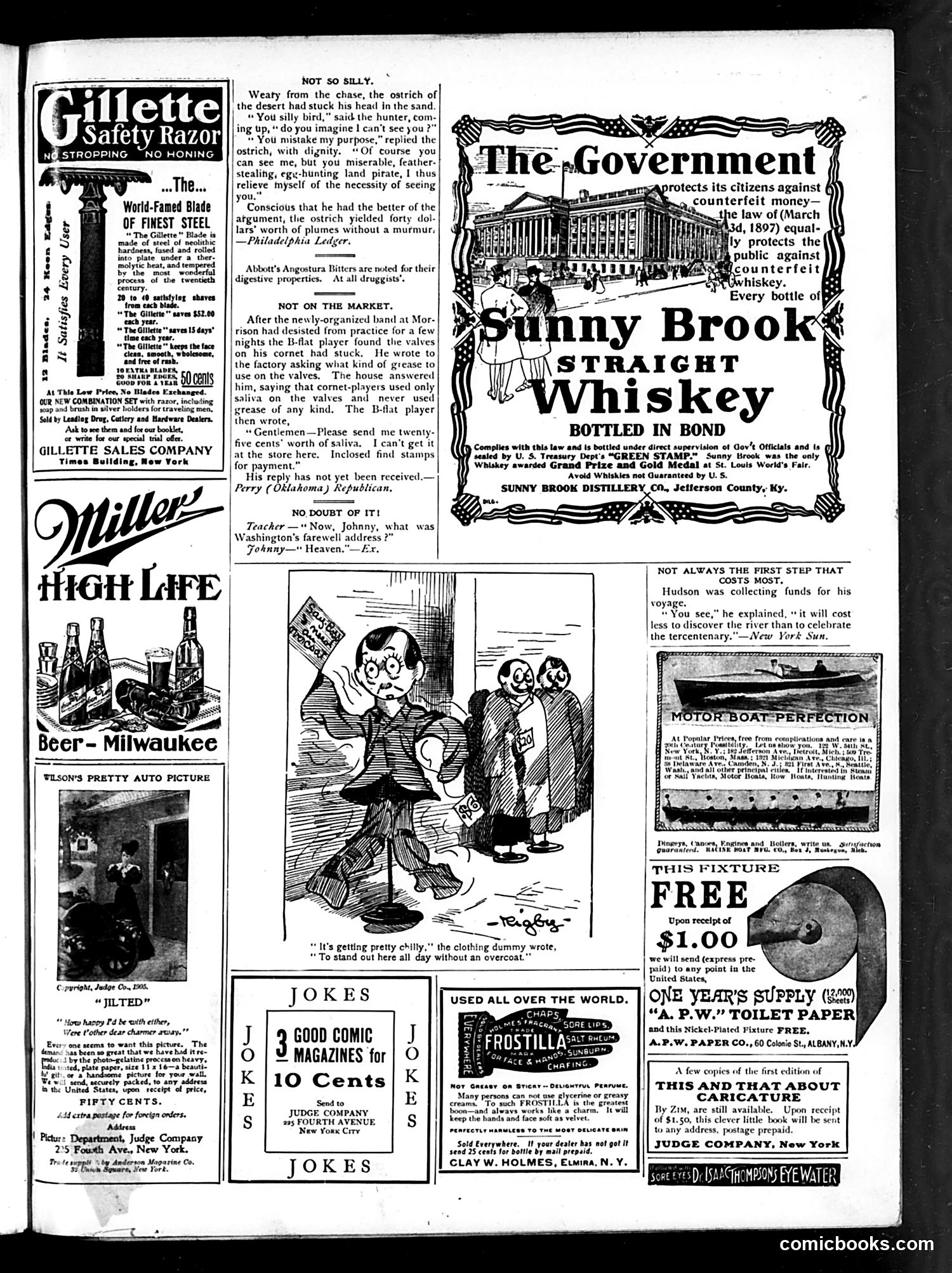
This page from *Judge* (a satirical weekly) contains several brief humorous pieces and advertisements typical of early 20th-century American humor magazines. The main cartoon depicts a **clothing dummy** complaining about standing outside all day without an overcoat—a visual gag playing on the absurdity of inanimate objects having human concerns. Other short pieces include: an anecdote about an **ostrich** sticking its head in sand to avoid seeing its hunter (a reversal of the common saying), and a joke about a **B-flat cornet player** requesting saliva as grease from the manufacturer—mocking musicians' reliance on saliva for instrument maintenance. A brief educational joke has a **teacher** asking Johnny Washington's farewell address, with the child answering "Heaven"—a simple pun. The page is predominantly **advertisements** for Gillette razors, Miller High Life beer, and other period products, with a "pretty auto picture" offer for fifty cents.
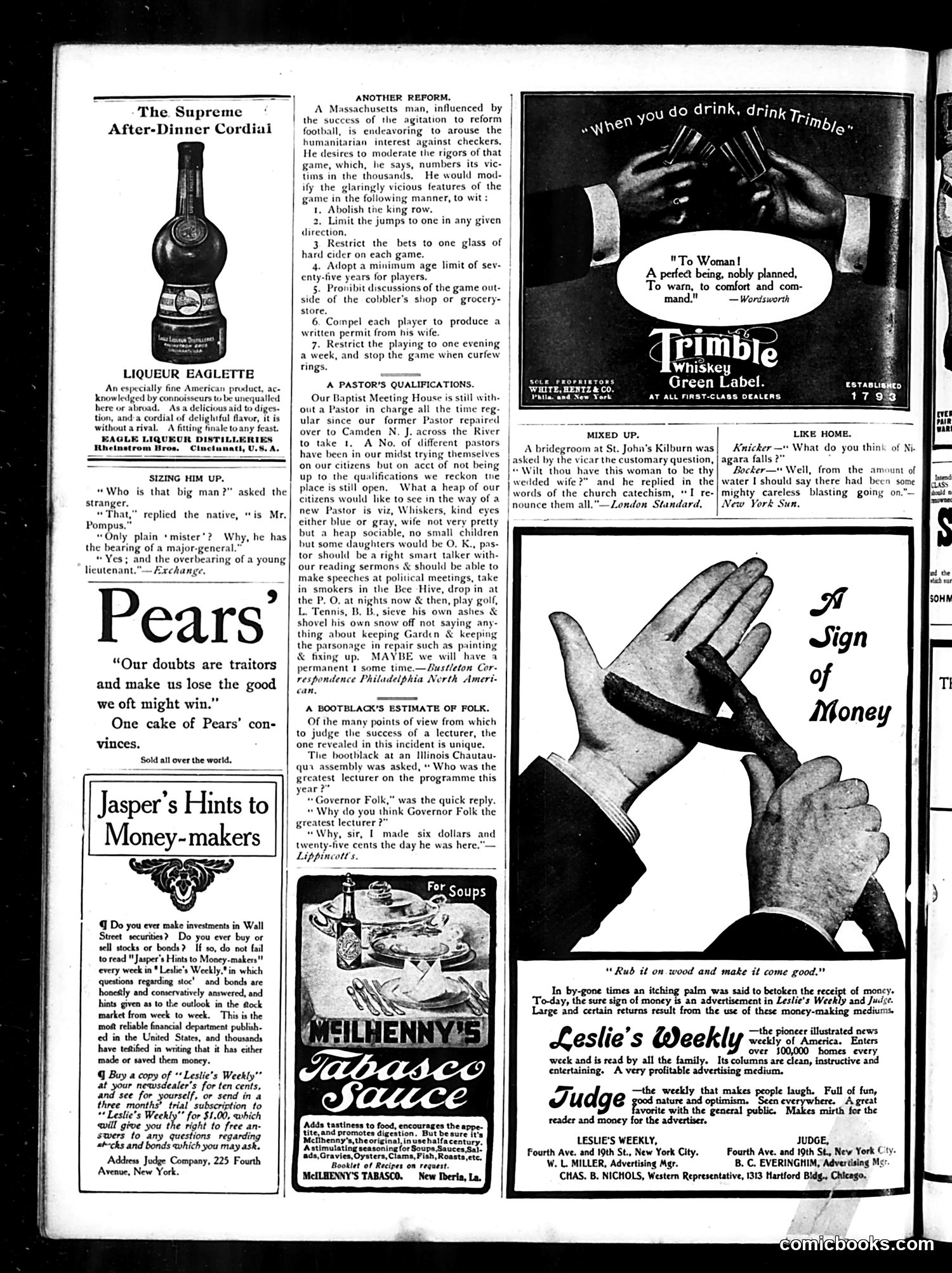
This page from Judge magazine (established 1893) contains primarily **advertisements and humorous filler columns** rather than pointed political satire. The main content includes: 1. **"Another Reform"** — A satirical piece mocking reform movements by absurdly proposing to "reform" checkers (the board game) through ridiculous restrictions, mirroring contemporary Progressive Era campaigns to regulate sports like football for safety reasons. 2. **"A Pastor's Qualifications"** — Rustic humor about rural church congregants listing contradictory, mundane expectations for a new pastor (whiskers, golfing ability, snow-shoveling skills), satirizing small-town pretensions and changing social expectations. 3. **"Sizing Him Up"** — Brief class-consciousness joke contrasting a man's pompous bearing with his ordinary "mister" title. The page is dominated by **product advertisements** (liqueur, Pears' soap, Trimble Whiskey, tabasco sauce) typical of Judge's revenue model. The humor reflects period attitudes toward religion, social reform, and masculinity rather than partisan politics.
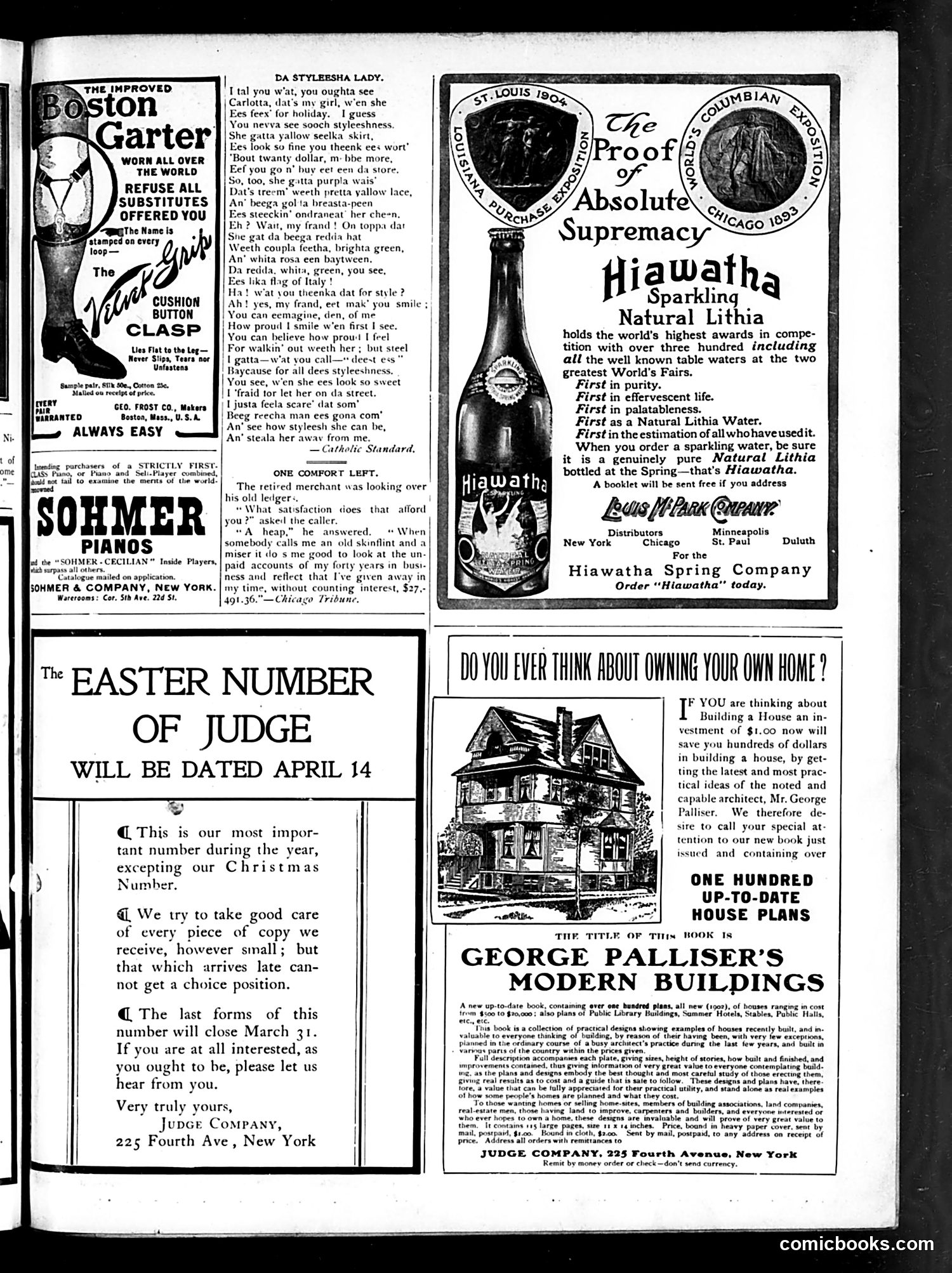
This page is **primarily advertisements** with two short satirical pieces interspersed. The main visual/textual content includes: **Satirical Content:** - "Da Styleesha Lady": A dialect-heavy monologue (appears Italian-American) about a man's girlfriend's fashionable outfit—likely mocking both recent immigrant speech patterns and consumerism/vanity among working-class immigrants. The punchline is his anxiety that wealthier men will steal her away, satirizing social insecurity. - "One Comfort Left": A brief anecdote about a retired merchant finding solace in reviewing his unpaid debts—ironic satire on miserliness and wealth accumulation. **Advertisements include:** - Boston Garter (men's clothing) - Sohmer Pianos - Hiawatha Sparkling Water - George Palliser's Modern Buildings (house plans) - Judge magazine's Easter issue announcement The page reflects early 1900s advertising culture and period stereotypes about immigrants and consumer desires.
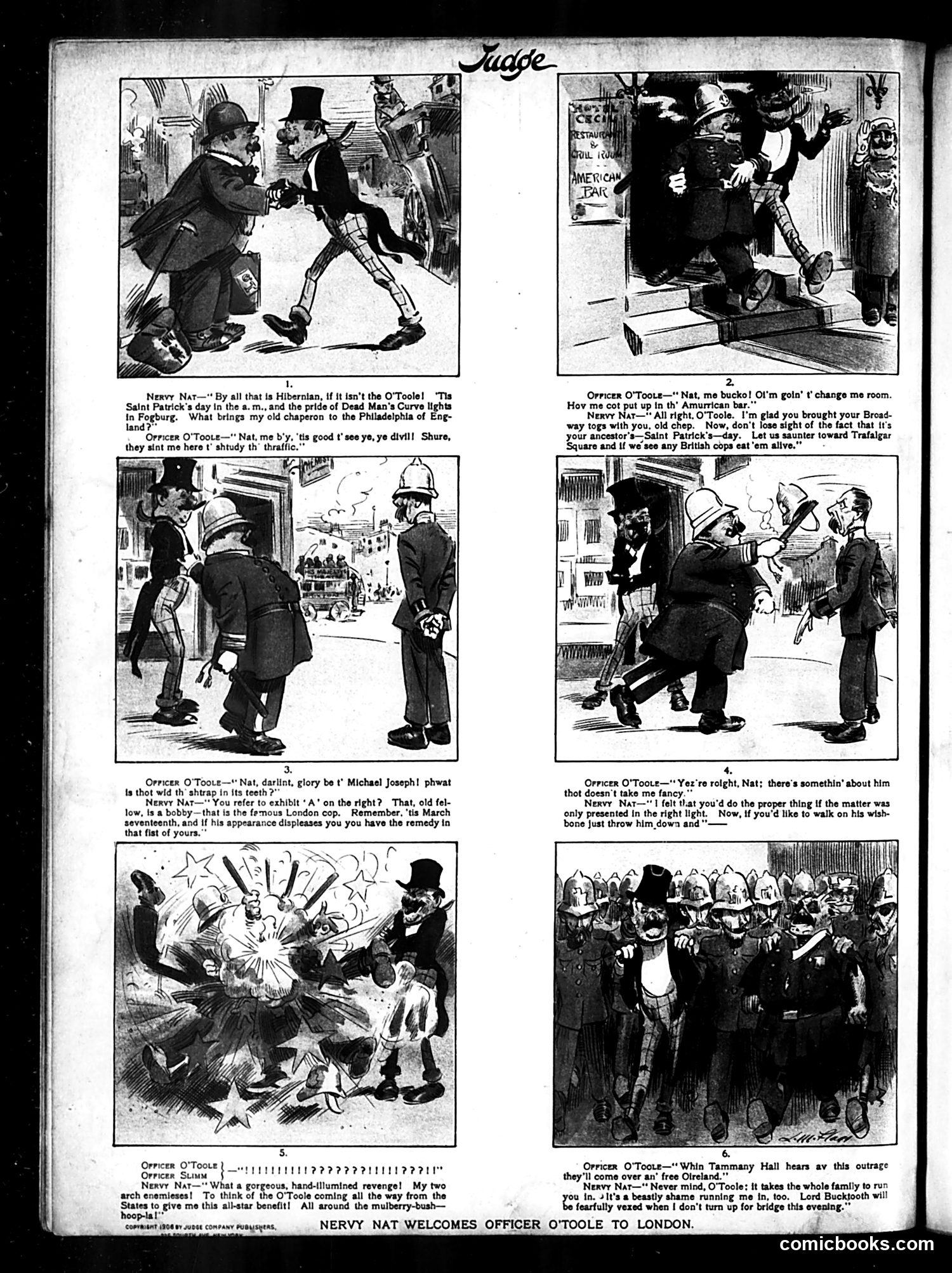
This is a six-panel comic strip satirizing Irish-American stereotypes and Anglo-American relations around St. Patrick's Day (March 17). **Main figures:** "Nervy Nat" (an Irish-American character) and "Officer O'Toole" (an Irish police officer visiting from America), who encounter a British "bobby" (London policeman). **The satire:** The comic mocks Irish-Americans through exaggerated dialect and crude behavior—Nat encourages O'Toole to assault the British cop on St. Patrick's Day as a "revenge" against England. References to "Tammany Hall" (the notorious Irish-American political machine in New York) and the casual threat of violence reinforce negative stereotypes about Irish immigrants. **The joke's appeal:** Judge magazine's audience would have found humor in both the Irish caricatures and the implied criticism of Irish-American rowdiness and their complicated relationship with British authority. The final panel suggests O'Toole will be arrested, with Nat comically worried about missing his bridge game with "Lord Bucktooth."