
Judge, 1906-03-17 · page 2 of 16
Judge — March 17, 1906 — page 2: what you’re looking at
What you’re looking at
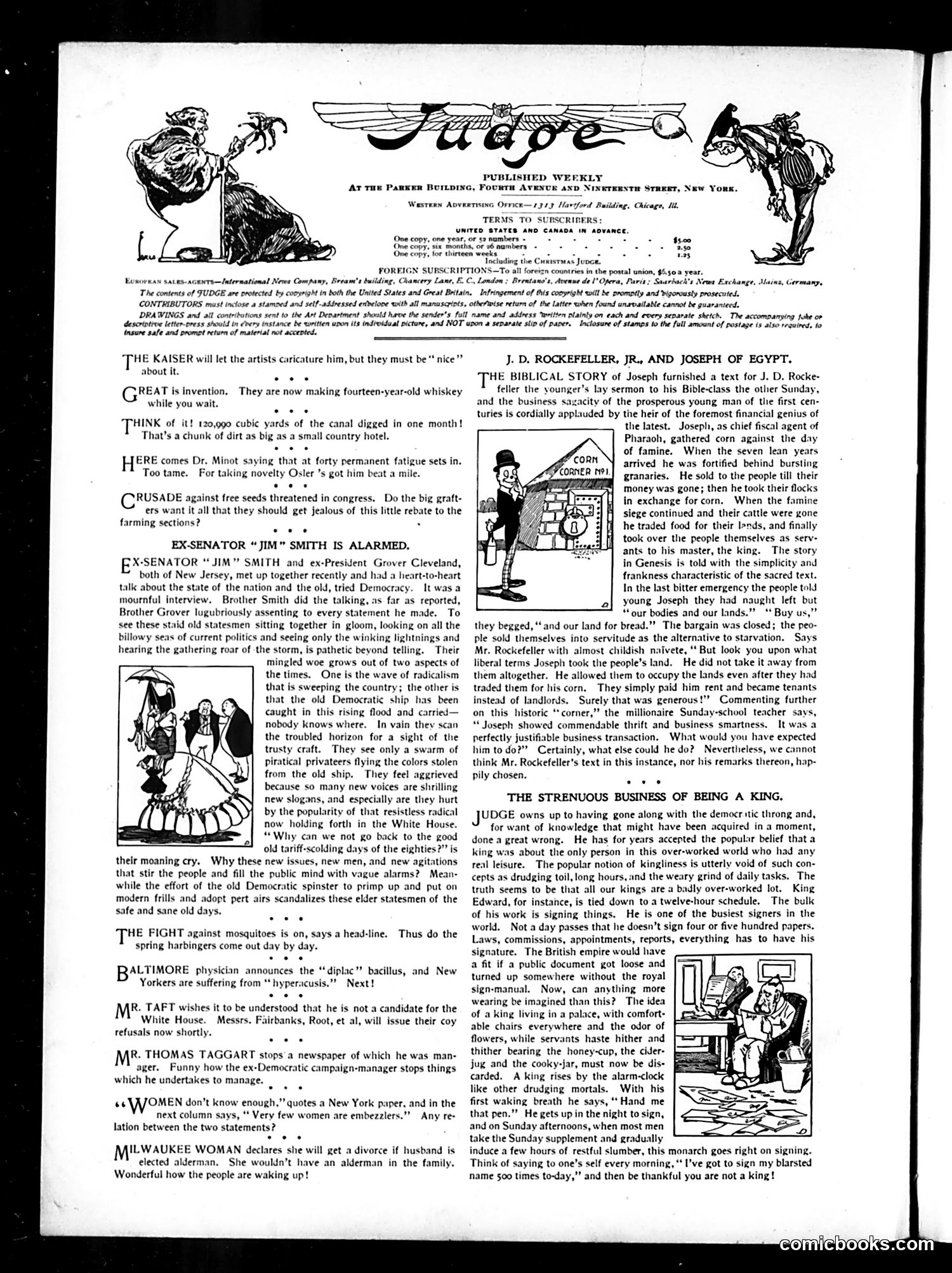
This page contains several short political satirical items typical of Judge's format. The main pieces mock: **"The Kaiser will be artists' caricature him"** — Refers to German Emperor Wilhelm II, suggesting even caricaturists struggle to exaggerate his features. **"Ex-Senator 'Jim' Smith is Alarmed"** — Criticizes Smith and former President Grover Cleveland for their Democratic alliance, portraying them as hypocritical party politicians alarmed by radicalism they themselves enabled. The satire suggests their outrage at party extremism rings hollow. **"The Strenuous Business of Being a King"** — Mocks monarchy, contrasting the romanticized image of kingship with the tedious bureaucratic reality: endless document-signing, commissions, and routine paperwork that consumes a monarch's day. The cartoons use exaggerated illustrations to reinforce these points about political hypocrisy and institutional absurdity.
📄 Transcribed text from this page (OCR, searchable)
Machine-transcribed from the original scan — historical spelling and the odd misread are preserved.
PUBLISHED W Ar Tue Pargxr Bortpinc, Founrm Avexc UNITED STATES AND CANADA IN ADVANCE. One copy, one year, or <2 numbers « 2 os One copy, six months, of 6 numbers = One copy, FOREIC for thirteen weeks SURSCRIPTIONS—To all for Eumovnan sates-acenrrs—Intermational News Company, Bream's building, Chancery Lane, E.C, London : Brentano's, Avenue del" Opera, Paris: Saarbach's he Cuntsraas Junce ‘res in the postal union, $5.50. year. Vows Exchange, Mains, Germany, Tocludi The contents of FUDGE are protected by conyright in both the United States and Great Britain. Infringement of this conyright will be promptly and Pigorously prosecuted. CONTRIBUTORS must inctose a stamsed and self-addressed envelove with all manascriots, othefwise return of the latter when found unavailable cannot be guaranteed. DRAWINGS and ail contributions sent fo the Art Department should harve the sender's full name and address “written plainty on each and every separate shetch. The accompanying joke or descriptive letter-press should in doery instance be written upon its indrotdual picture, and NOT upon a separate slip of paper. Inclosure of stamps t0 the full amount of postage is also required. 19 tnsure safe and promot return of material not accepted. THe KAISER will let the artists caricature him, but they must be" nice’ about it. REAT is invention. They are now making fourteen-year-old whiskey while you wait. HINK of it! 120,990 cubic yards of the canal digged in one month! That’s a chunk of dirt as big as a small country hotel. ERE comes Dr. Minot saying that at forty permanent fatigue sets in. Too tame. For taking novelty Osler ’s got him beat a mile. RUSADE against free seeds threatened in congress. Do the big graft- ers want it all that they should get jealous of this little rebate to the farming sections? : EX-SENATOR “JIM” SMITH IS ALARMED. X-SENATOR * JIM" SMITH and ex-President Grover Cleveland, both of New Jersey, met up together recently and had a heart-to-heart talk about the state of the nation and the old, tried Democracy. It was a mournful interview. Brother Smith did the talking, as far as reported, Brother Grover lugubriously assenting to every statement he made. To see these staid old statesmen sitting together in gloom, looking on all the billowy seas of current politics and seeing only the winking lightnings and hearing the gathering roar of ‘the storm, is pathetic beyond telling. Their mingled woe grows out of two aspects of the times. One is the wave of radicalism that is sweeping the country; the other is that the old Democratic ship has been caught in this rising flood and carried— nobody knows where. In vain they scan the troubled horizon for a sight of the trusty craft. They see only a swarm of piratical privateers flying the colors stolen from the old ship. They feel aggrieved because so many new voices are shrilling new slogans, and especially are they hurt by the popularity of that resistless radical now holding forth in the White House. “Why can we not go back to the good old tariff-scolding days of the eighties?” is their moaning cry. Why these new issues, new men, and new agitations that stir the people and fill the public mind with vague alarms? Mean- while the effort of the old Democratic spinster to primp up and put on modern frills and adopt pert airs scandalizes these elder statesmen of the safe and sane old days. THE FIGHT against mosquitoes is on, says a head-line. Thus do the spring harbingers come out day by day. BALTIMORE physician announces the ‘diplac"” bacillus, and New Yorkers are suffering from “ hyperacusis."” Next! MR. TAFT wishes it to be understood that he is not a candidate for the White House. Messrs. Fairbanks, Root, et al, will issue their coy refusals now shortly. M® THOMAS TAGGART stops a newspaper of which he was man- ager. Funny how the ex-Democratic campaign-manager stops things which he undertakes to manage. COYVOMEN don’t know enough,” quotes a New York paper, and in the next column “ Very few women are embezzlers.” Any re- lation between the two statements? she will get a divorce if husband is elected alderman, She wouldn’t have an alderman in the family. Wonderful how the people are waking up! MILWAUKEE WOMAN declares J. D, ROCKEFELLER, JR., AND JOSEPH OF EGYPT. THE BIBLICAL STORY of Joseph furnished a text for J. D. Rocke- feller the younger’s lay sermon to his Bible-class the other Sunday, and the business sazacity of the prosperous young man of the first cen- turies is cordially applauded by the heir of the foremost financial genius of the latest. Joseph, as chief fiscal agent of Pharaoh, gathered corn against the day of famine. When the seven lean years arrived he was fortified behind bursting granaries. He sold to the people till their money was gone; then he took their flocks in exchange for corn, When the famine siege continued and their cattle were gone he traded food for their lands, and finally took over the people themselves as serv- ants to his master, the king. The story in Genesis is told with the simplicity and frankness characteristic of the sacred text. In the last bitter emergency the people told young Joseph they had naught left but “our bodies and our lands.”” ** Buy us,’” they begged, “and our land for bread.” The bargain was closed; the peo- ple sold themselves into servitude as the alternative to starvation. S: Mr. Rockefeller with almost childish naivete, “ But look you upon what liberal terms Joseph took the people’s land. He did not take it away from them altogether. He allowed them to occupy the lands even after they had traded them for his corn, They simply paid him rent and became tenants instead of landlords. Surely that was generous!’ Commenting further on this historic “corner,” the millionaire Sunday-school teacher says, “ Joseph showed commendable thrift and business smartness. It was a perfectly justifiable business transaction. What would you have expected him to do?” Certainly, what else could he do? Nevertheless, we cannot think Mr. Rockefeller’s text in this instance, nor his remarks thereon, hap- pily chosen. THE STRENUOUS BUSINESS OF BEING A KING. JUDGE owns up to having gone along with the democr itic throng and, for want of knowledge that might have been acquired in a moment, done a great wrong. He has for years accepted the popular belief that a king was about the only person in this over-worked world who had any real leisure. The popular notion of kingliness is utterly void of such con- cepts as drudging toil, long hours, and the weary grind of daily tasks. The truth seems to be that all our kings are a badly over-worked lot. King Edward, for instance, is tied down to a twelve-hour schedule. The bulk of his work is signing things. He is one of the busiest signers in the world, Not a day passes that he doesn’t sign four or five hundred papers. Laws, commissions, appointments, reports, everything has to have his signature. The British empire would have a fit if a public document got loose and turned up somewhere without the royal sign-manual. Now, can anything more wearing be imagined than this? The idea of a king living in a palace, with comfort- able chairs everywhere and the odor of flowers, while servants haste hither and thither bearing the honey-cup, the cider- jug and the cooky-jar, must now be dis- carded. A king rises by the alarm-clock like other drudging mortals. With his first waking breath he says, ‘Hand me that pen.”” He gets up in the night to sign, and on Sunday afternoons, when most men take the Sunday supplement and gradually induce a few hours of restful slumber, this monarch goes right on signing. Think of saying to one’s self every morning,“ I’ve got to sign my blarsted name $00 times to-day,”’ and then be thankful you are not a king!