
Judge, 1906-03-17 · page 5 of 16
Judge — March 17, 1906 — page 5: what you’re looking at
What you’re looking at
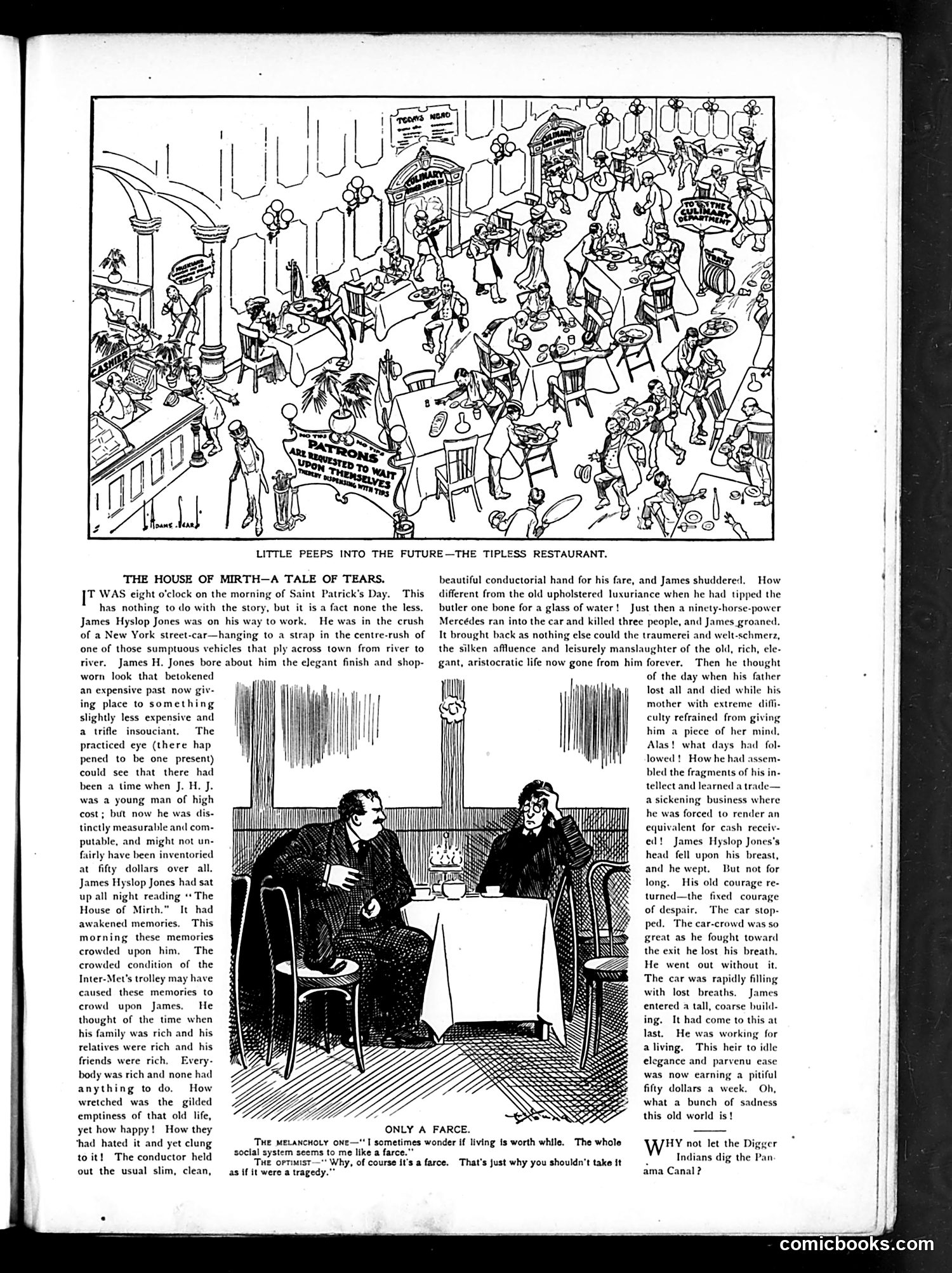
**Main Content:** This page contains a short story titled "The House of Mirth—A Tale of Tears" about James Hyslop Jones, a poor New York street-car worker who dreams of wealth. The narrative follows his downward spiral after inheriting money, describing how newfound riches lead to moral corruption and eventual ruin. **The Cartoon:** The illustration shows two men in a restaurant, with dialogue satirizing social inequality. One figure says living "is just a farce," to which the other responds that poor people shouldn't "take it as if it were a tragedy." **Social Satire:** The page critiques wealth inequality and the American class system, suggesting that the wealthy view poverty cynically while the poor accept suffering. The story warns that money itself corrupts rather than elevates.
📄 Transcribed text from this page (OCR, searchable)
Machine-transcribed from the original scan — historical spelling and the odd misread are preserved.
LITTLE PEEPS INTO THE FUTURE—THE TIPLESS RESTAURANT. THE HOUSE OF MIRTH—A TALE OF TEARS. [T WAS eight o'clock on the morning of Saint Patrick's Day. This has nothing todo with the story, but it isa fact none the less. James Hyslop Jones was on his way to work. He was in the crush of a New York street-car—hanging to a strap in the centre-rush of one of those sumptuous vehicles that ply across town from river to river, James H. Jones bore about him the elegant finish and shop- worn look that betokened La tHAN Giibagtbity ey ing place to something i HY HH Mt i slightly less expensive and {MII i a trifle insouciant. The | practiced eye (there hap 1) } pened to be one present) WH could see that there had was a young man of high } cost; but now he was dis- tinctly measurable and com- putable, and might not un- fairly have been inventoried at fifty dollars over all. up all night reading “The House of Mirth.” It had awakened memories. This morning these memories crowded upon him, The crowded condition of the caused these memories to crowd upon James. He thought of the time when his family was rich and his relatives were rich and his friends were rich, Every- anything to do. How wretched was the gilded emptiness of that old life, yet how happy! How they ‘had hated it and yet clung to it! The conductor held an expensive past now giv- HI i HI! ! q A been a time when J. H. J. | James Hyslop Jones had sat Inter-Met’s trolley may have body was rich and none had out the usual slim, clean, social system seems to me like a farce.” ‘THE opristist as if it were a tragedy.” “Why, of course it’s a farce. That's just why you shouldn't take it beautiful conductorial hand for his fare, and James shuddere!. How different from the old upholstered luxuriance when he had tipped the butler one bone for a glass of water! Just then a ninety-horse-power Mercédes ran into the car and killed three people, and James groaned. It brought back as nothing else could the traumerei and welt-schmerz, the silken affluence and leisurely manslaughter of the old, rich, ele- gant, aristocratic life now gone from him forever. ‘Then he thought of the day when his father It | “ah lth lost all and died while his och mother with extreme diffi culty refrained from giving | him a piece of her mind. Alas! what days had. fol- lowed ! How he had assem. bled the fragments of his in- tellect and learned a trade— | P a sickening business where he was forced to render an equivalent for cash receiv- ed! James Hyslop Jones's head fell upon his breast, and he wept. But not for long. His old courage re- turned—the fixed courage of despair, The car stop- ped. ‘The car-crowd was so great as he fought toward the exit he lost his breath, He went out without it. The car was rapidly filling with lost. breaths. James entered a tall, coarse build- ing. It had come to this at last. He was working for aliving. This heir to idle elegance and parvenu ease was now earning a pitiful fifty dollars a week. Oh, what a bunch of sadness this old world is! ONLY A FARCE. THE MELANCHOLY ONE—''I sometimes wonder if living 1s worth while. ‘The whole wey not let the Digger Indians dig the Pan. ama Canal ? comicbooks.com