
A complete issue · 20 pages · 1905
Judge — October 14, 1905
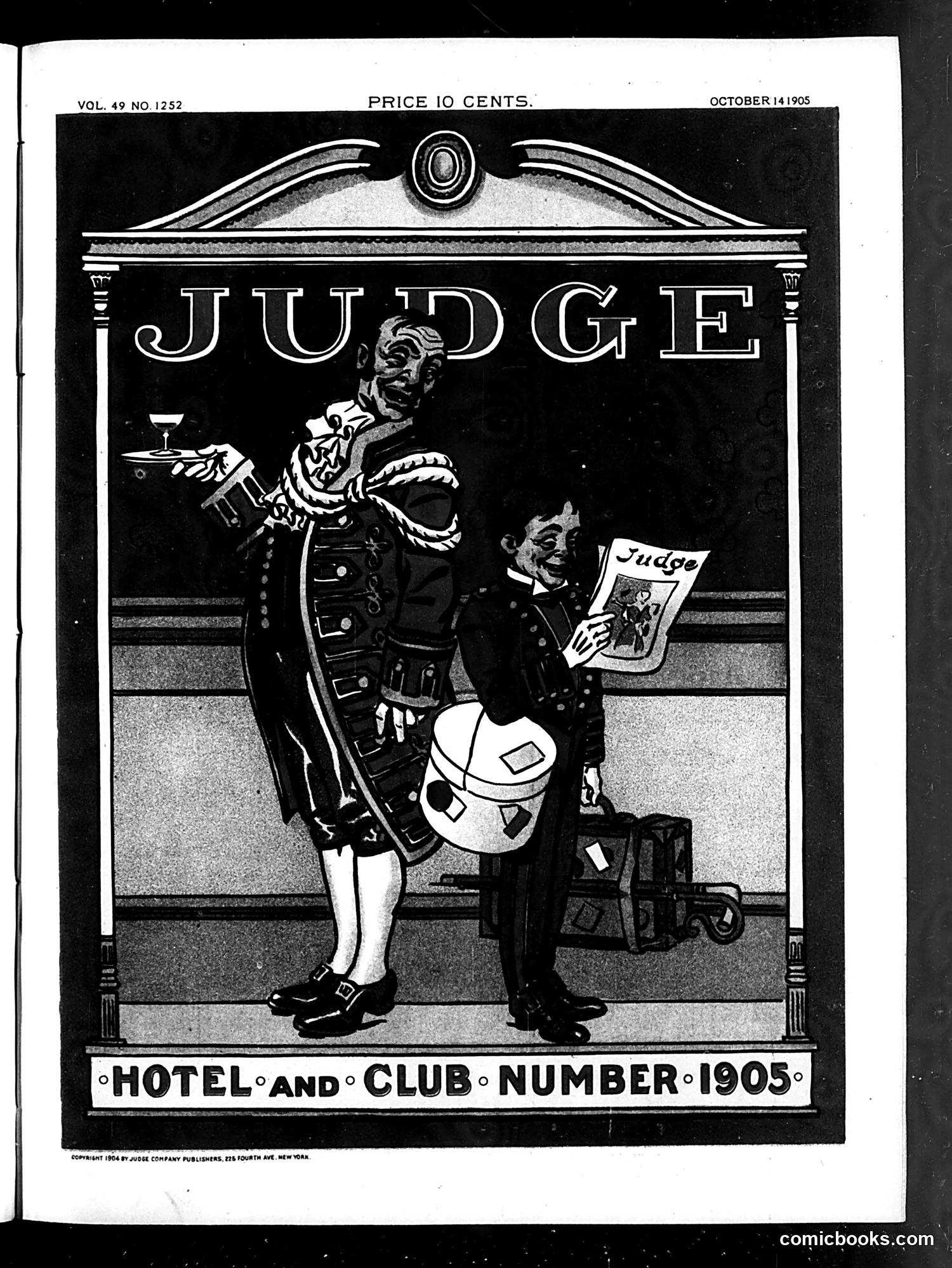
This is the cover of Judge's "Hotel and Club Number" issue from 1905. The cartoon depicts two caricatured figures in formal dress standing before a classical courthouse entrance. The taller figure on the left, dressed in an ornate military or formal uniform with decorative elements, holds a cocktail glass. The shorter figure on the right, wearing a bowler hat, reads a copy of Judge magazine. The satire likely mocks wealthy hotel and club patrons—presumably depicting aristocratic or upper-class types—suggesting they frequent these establishments. The formal military dress and exaggerated caricature suggest mockery of pretentiousness or affected sophistication among the leisure class. The specific identities of these figures remain unclear without additional historical context.
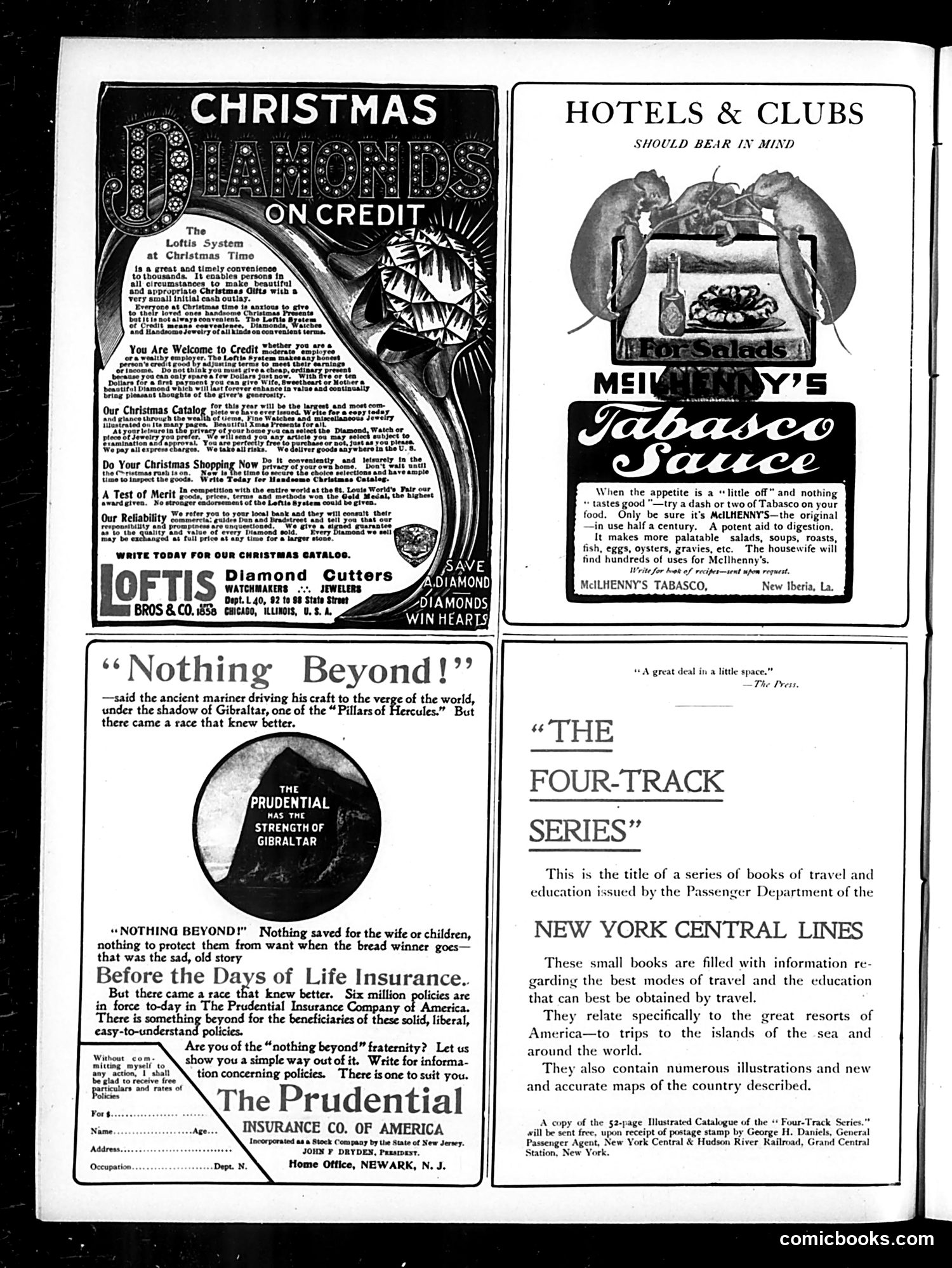
This page is **primarily advertising** rather than editorial content or satire. The advertisements include: 1. **Christmas Diamonds on Credit** (upper left) — promoting installment purchasing during the holiday season, with decorative imagery of a diamond ring and holly. 2. **McIlhenny's Tabasco Sauce** (upper right) — a food advertisement targeting hotels and clubs. 3. **Prudential Insurance** (lower left) — an insurance company ad with the slogan "Nothing Beyond!" referencing Gibraltar's historical fame as the edge of the known world. 4. **New York Central Lines** (lower right) — promoting their "Four-Track Series" travel books. No political cartoons or satire appear on this page. It reflects early 20th-century advertising practices in Judge magazine.
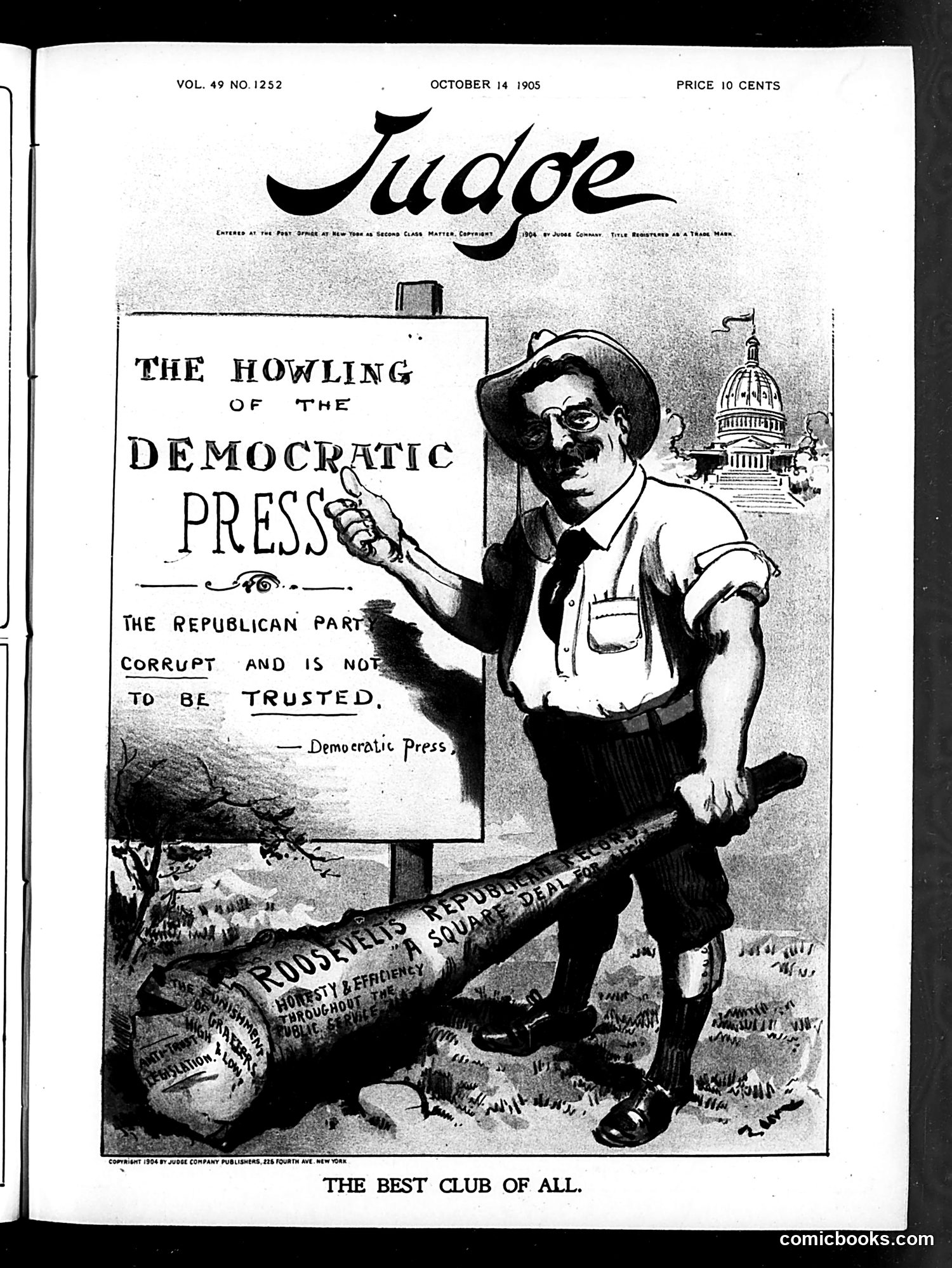
This cartoon satirizes the Democratic Party's criticism of Republicans. A Republican figure (identified by the Capitol building) holds a sign reading "The Howling of the Democratic Press" while wielding a large club labeled "Roosevelt's Republican Squad" (Theodore Roosevelt was president). The club itself is inscribed with words suggesting Republican tactics: "Honesty & Efficiency," "Graft," and "Corruption." The satire works ironically: the Democratic press attacks Republicans as corrupt, yet the cartoon suggests Republicans use forceful methods to combat actual corruption. The title "The Best Club of All" implies Roosevelt's aggressive approach to reform is justified and effective—the "club" of honest governance beats Democratic complaints. This reflects the Progressive Era's partisan debate over reform methods and honesty in government.
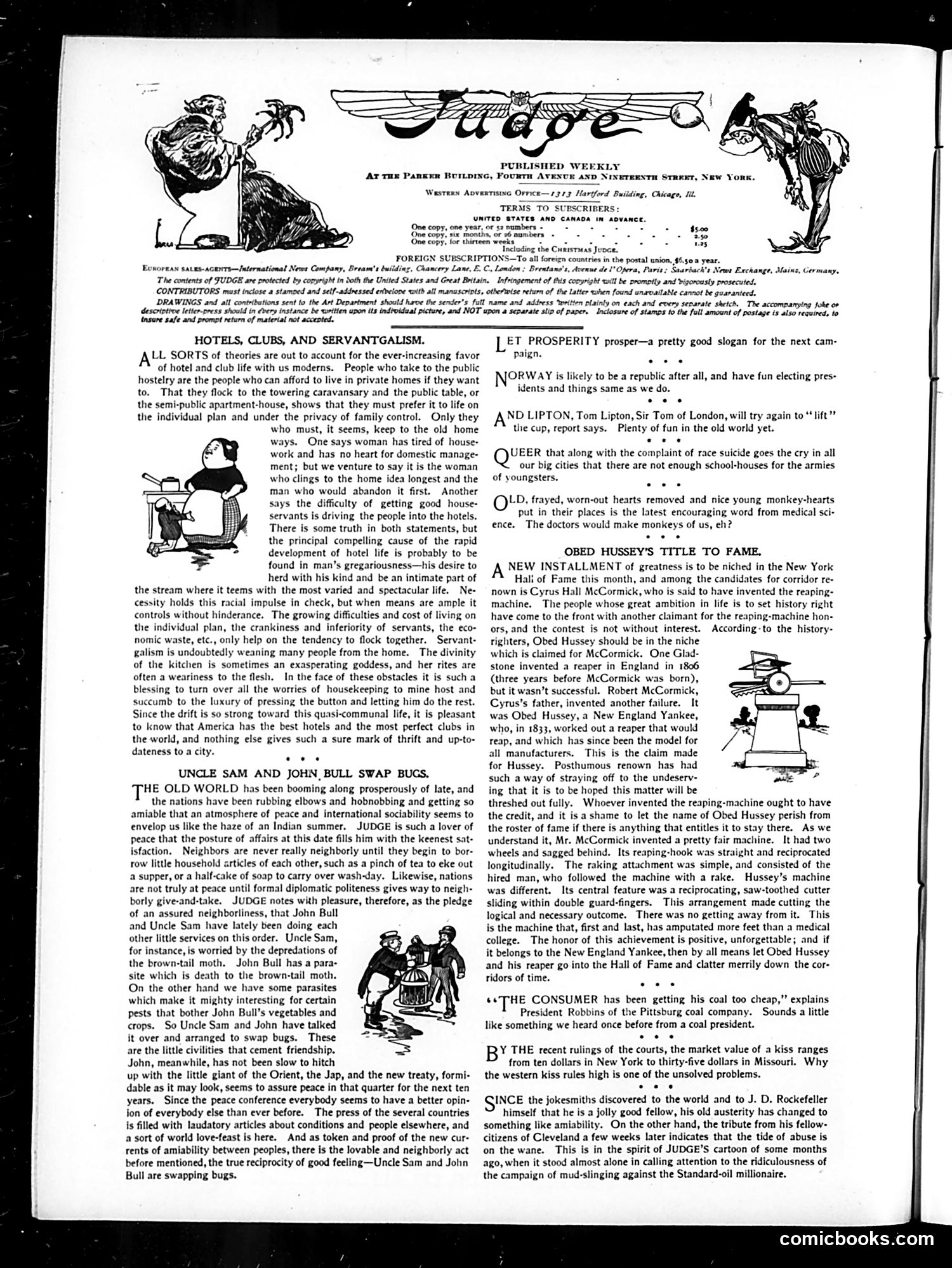
This page primarily contains **satirical editorial commentary** rather than political cartoons. The main articles critique: 1. **Hotel and club life** — mocking the modern trend of wealthy people abandoning home life for hotels, arguing this reflects poorly on domestic values and servant management. 2. **"Uncle Sam and John Bull Swap Bugs"** — a piece using the personified nations (Uncle Sam = USA, John Bull = Britain) to satirize post-WWI peace efforts and international relations, suggesting both nations are trading problems rather than genuinely cooperating. 3. **References to Obed Hussey's reaping machine** — discussing historical disputes over invention credits. The small illustrations show period caricatures accompanying these pieces. Without clearer dates or context clues visible, the exact historical moment remains unclear, though post-WWI references suggest early 1920s publication.
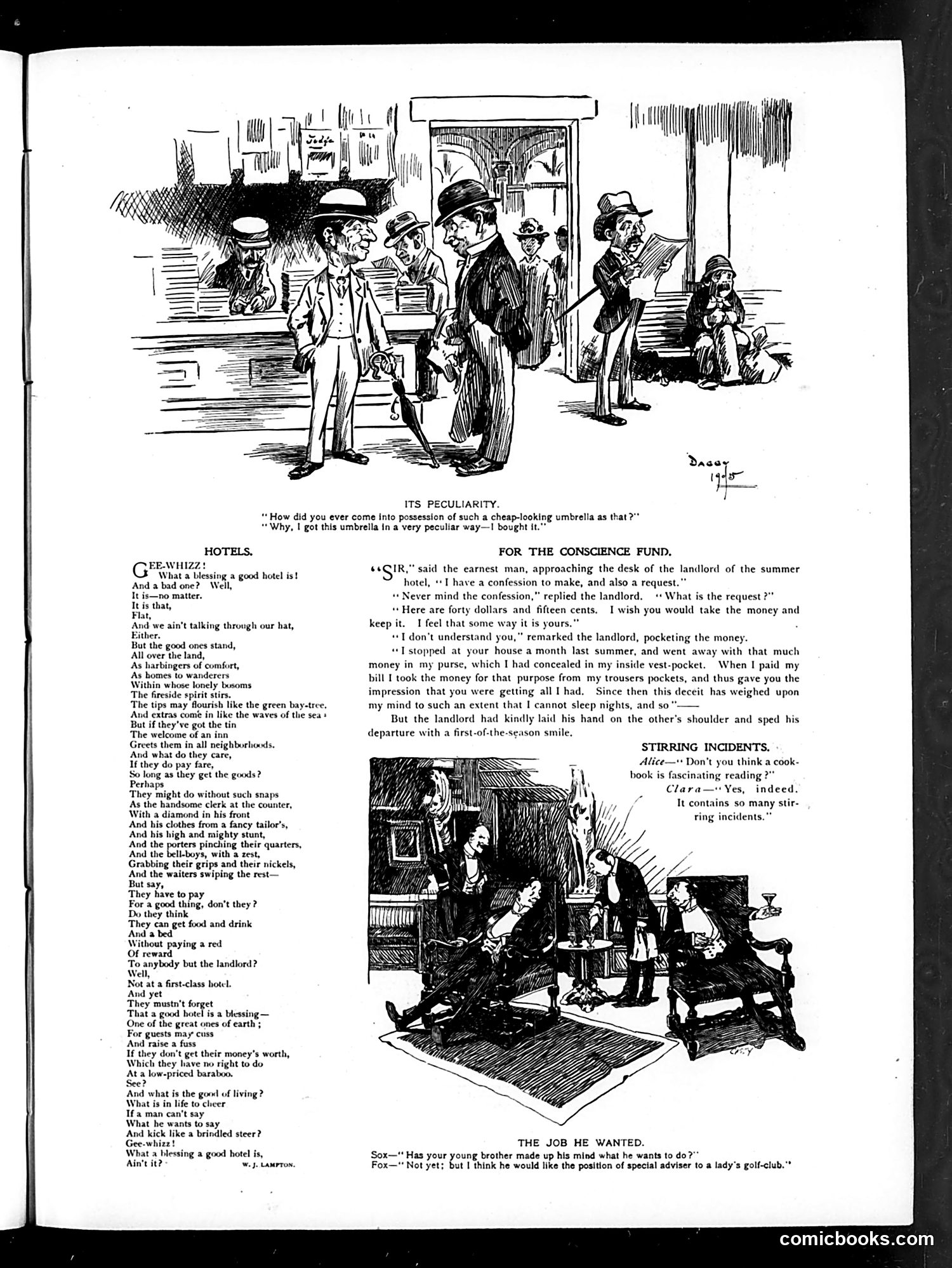
This page contains several unrelated satirical pieces typical of early-20th-century humor magazines: **"Its Peculiarity"** (top cartoon): A simple visual gag mocking cheap umbrellas—the humor lies in the man's matter-of-fact admission that he bought his shabby umbrella through the ordinary means of purchasing it, treating the obvious as mysterious. **"Hotels"** (left column poem): A lengthy, sarcastic tribute to hotels by W.J. Lampton. It sardonically praises hotels as "blessings" while acknowledging guests complain constantly about costs (tips, extras, service charges). The joke mocks both hotels' nickel-and-diming practices and guests' entitled expectations. **"For the Conscience Fund"** (right column): A satirical anecdote about a man confessing he unknowingly defrauded a hotel owner a month earlier, returning the money from guilt. The landlord pockets it without hesitation—the satire mocks both the man's belated conscience and the hotel owner's shameless acceptance of what amounts to found money. **"The Job He Wanted"** (bottom): A brief joke where a young man seeks employment as "special adviser to a lady's golf-club"—apparently implying a social/romantic position rather than serious work.
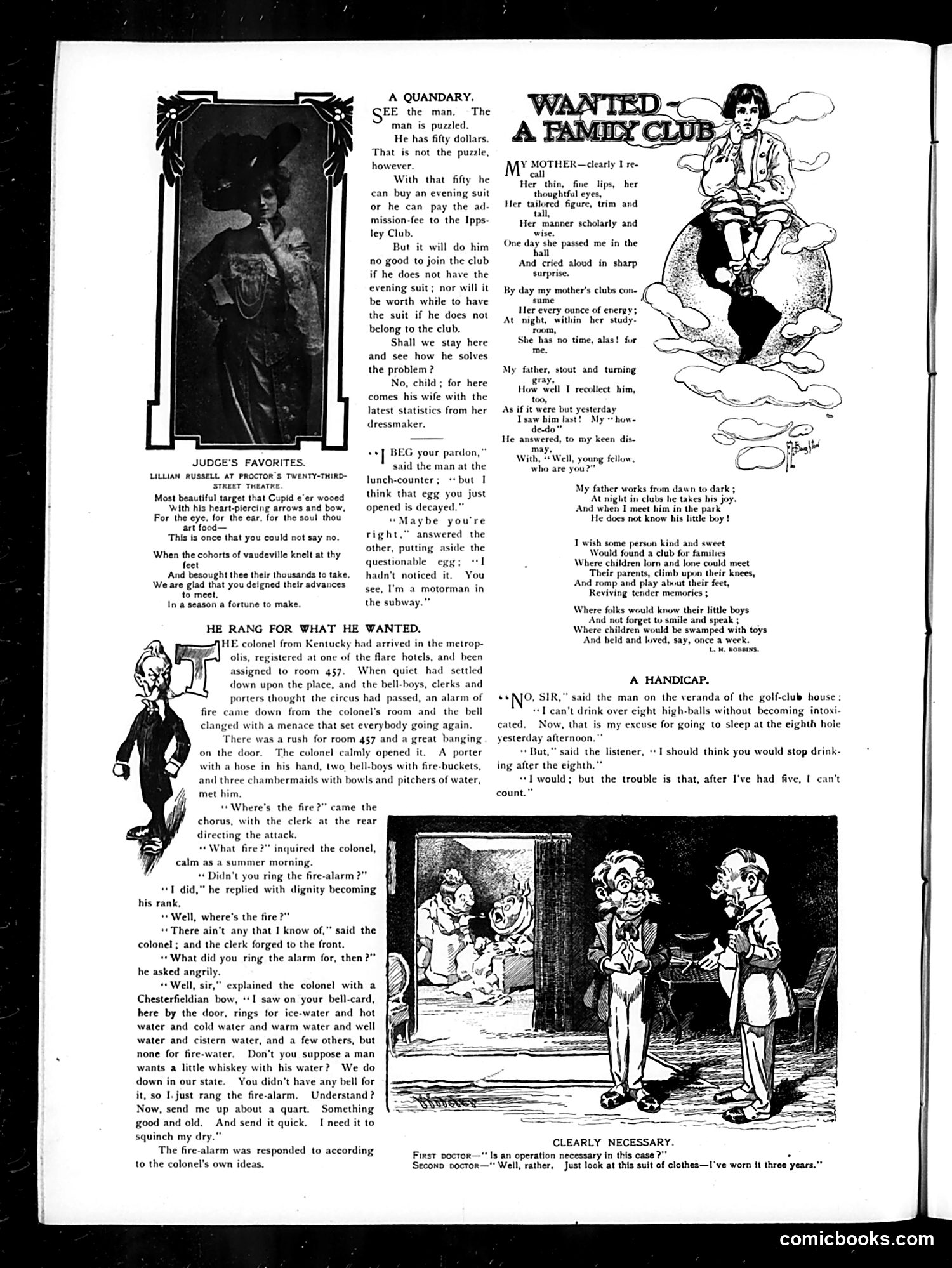
This page from *Judge* magazine contains several satirical pieces targeting early 20th-century upper-class social conventions. **"A Quandary"** mocks the circular social requirements of exclusive clubs: a man needs both formal evening wear AND club membership to participate, creating an impossible catch-22. His wife's arrival with dressmaker bills compounds the financial dilemma—satire on how aspirational status-seeking bankrupts the middle class. **"He Rang for What He Wanted"** ridicules a Kentucky colonel's literal interpretation of a hotel's bell-pull system. Finding no "fire-water" (whiskey) option listed, he absurdly rings the fire alarm to summon assistance—humor based on rural ignorance of urban hotel conventions and the colonel's presumed lack of sophistication. **"Wanted: A Family Club"** is a sentimental poem lamenting how mothers' club activities and fathers' evening club attendance leave children neglected and unknown to their own parents—social criticism of how club culture fractures family bonds among the wealthy. The cartoon "Clearly Necessary" (bottom) appears unrelated wordplay about clothing necessity.
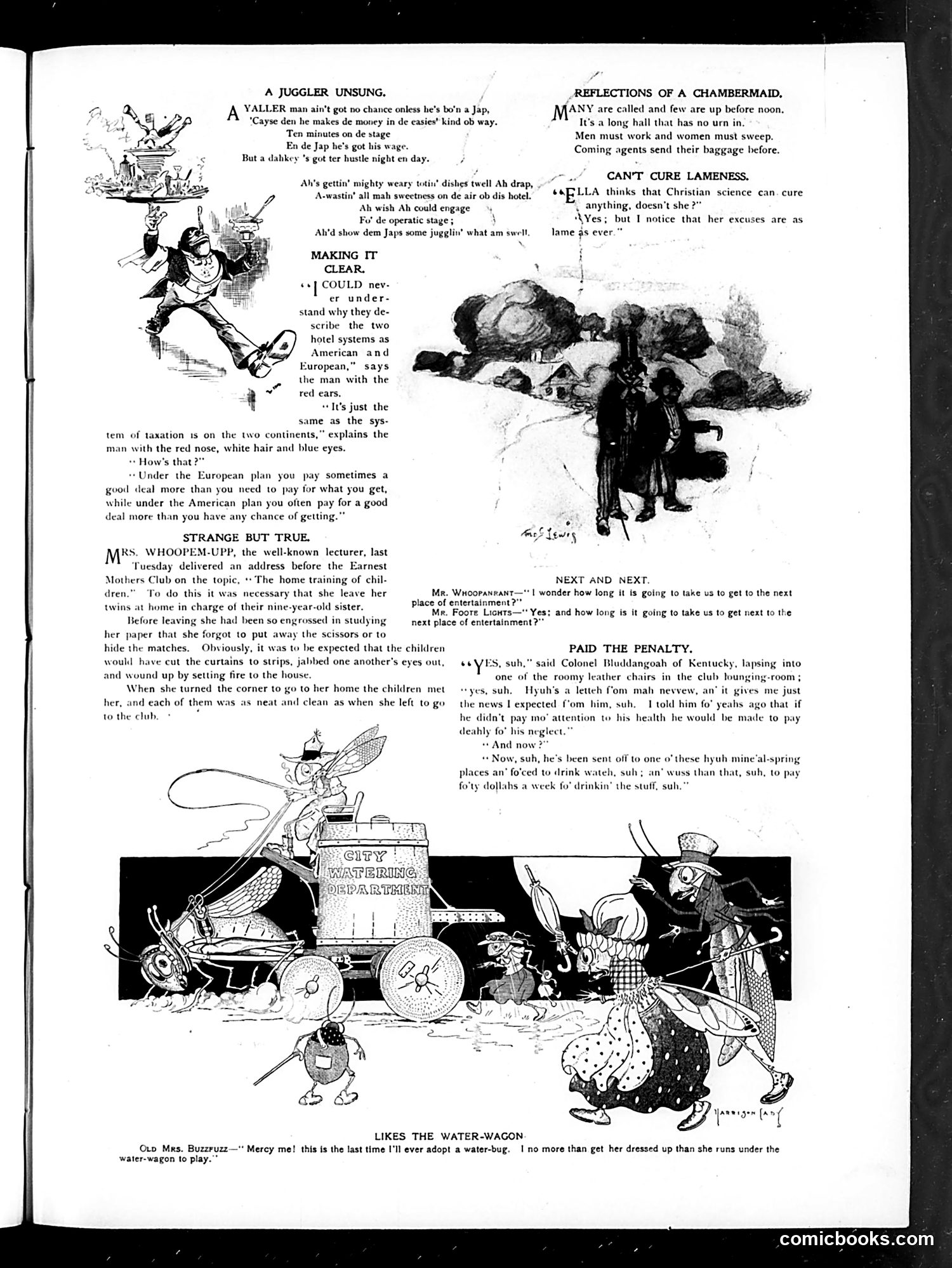
This page contains several satirical pieces typical of early 20th-century American humor: **"A Juggler Unsung"** presents a racist caricature of a Black hotel worker lamenting he can't perform in theater like a Japanese juggler, using heavy dialect. The satire appears to mock racial hierarchies rather than endorse them—contrasting how different immigrants faced different opportunities. **"Making It Clear"** satirizes American vs. European hotel pricing systems, where guests pay differently for identical service. The joke is that both systems overcharge guests. **"Strange But True"** humorously describes a parenting lecture by Mrs. Whoopem-Upp who ironically left scissors and matches at home unsupervised, yet her children returned perfectly clean—mocking either parenting advice or the children's unlikely obedience. **"Paid the Penalty"** uses dialect humor about a Kentucky colonel whose nephew ignored health warnings and was forced into expensive mineral-spring treatments. The bottom cartoon about "water-wagon" adoption appears to be visual absurdist humor. Overall, the page emphasizes class commentary and ethnic/regional dialect humor typical of period satire.
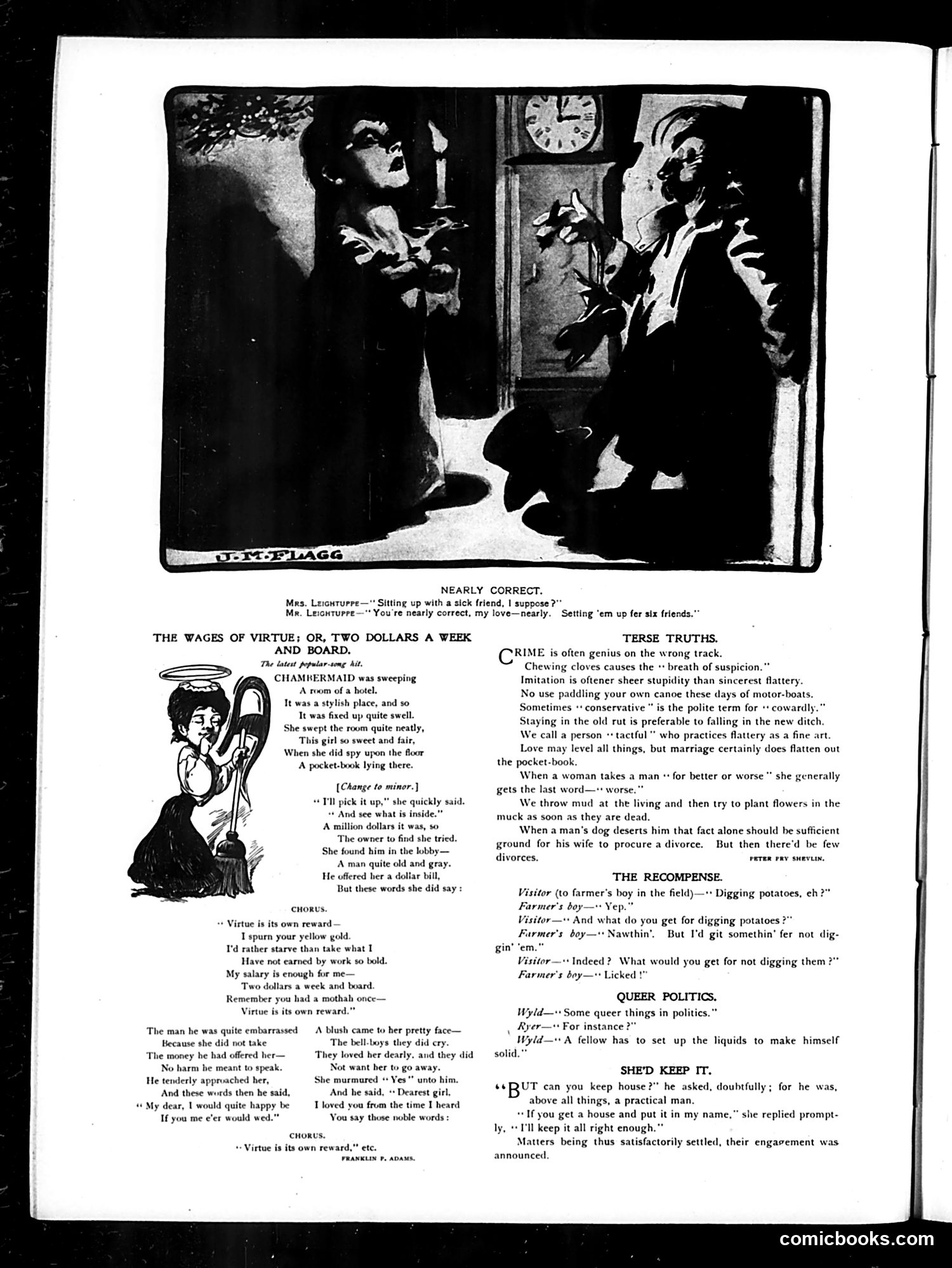
This page contains multiple satirical pieces typical of early 20th-century American humor: **Top Image:** "Nearly Correct" depicts a domestic misunderstanding—a wife tells her husband she's "sitting up with a sick friend," but clarifies she's actually "setting 'em up fer six friends" (buying drinks), a joke about infidelity or deception. **Main Feature:** "The Wages of Virtue" is a sentimental song-poem about a chambermaid who finds a million dollars, refuses the owner's reward, and earns his proposal through her moral integrity. The satire mocks excessive Victorian sentimentality about virtue and working-class piety. **Side Content:** "Terse Truths" offers cynical one-liners on crime, politics, and marriage—typical Judge commentary mocking hypocrisy and social pretense. "She'd Keep It" jokes that a woman marrying for a house only wants property ownership, satirizing women's limited legal and economic independence. The overall tone reflects era-specific concerns: working-class morality, gender relations, and skepticism toward sentimentalism.
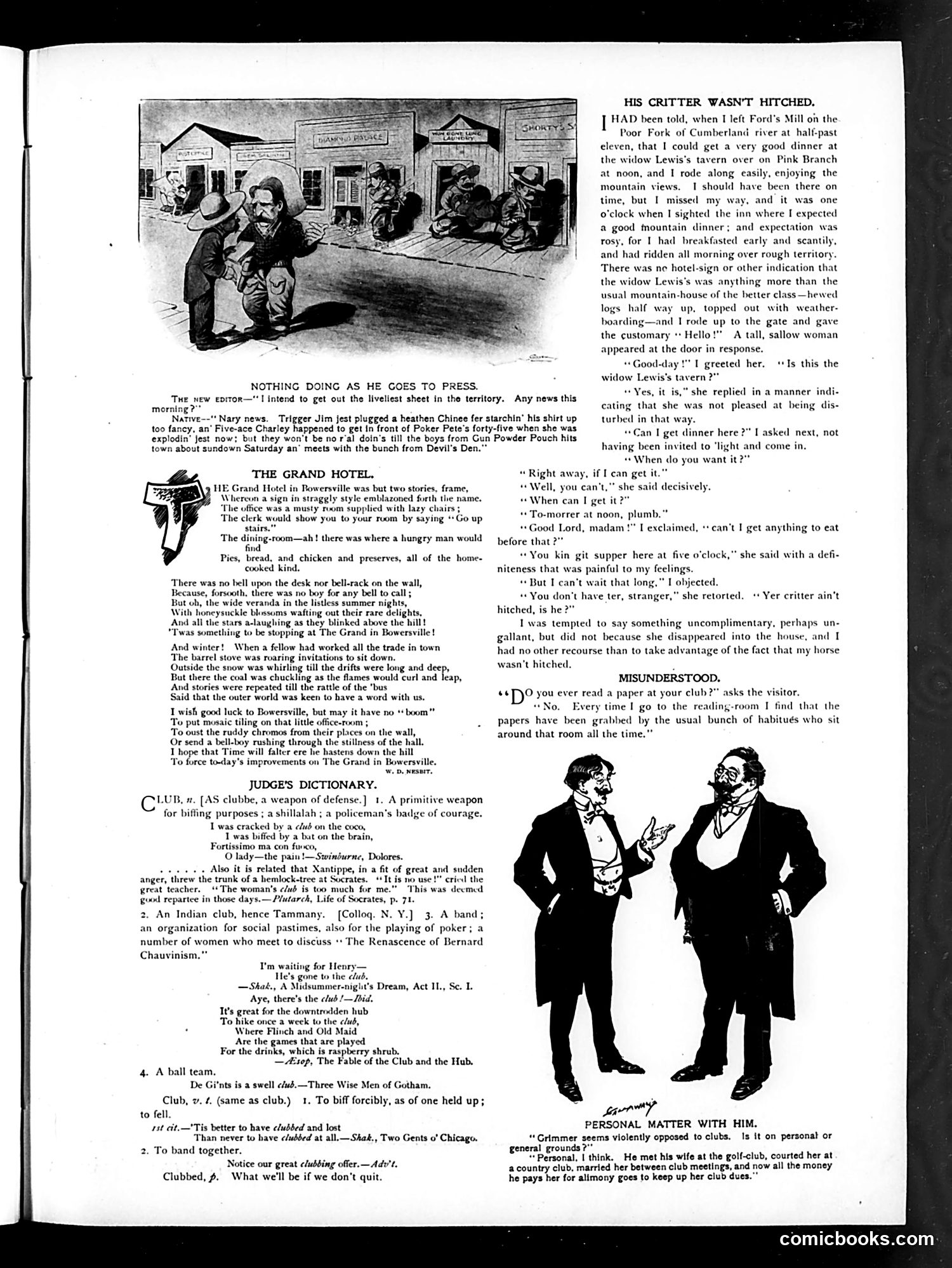
This page contains three separate pieces of satirical content: **"His Critter Wasn't Hitched"** (main narrative): A traveler seeks dinner at a mountain tavern run by the widow Lewis. She refuses to serve him lunch, offering only supper at 5 p.m. When he protests his hunger, she tersely notes his horse "ain't hitched"—implying he's free to leave if dissatisfied. The humor lies in her indifference to customer service and his powerlessness; he must wait because he has no alternative. **"Nothing Doing as He Goes to Press"** (top): Satirizes frontier journalism. A new editor boasts of running the liveliest paper in the territory, but the only "news" is minor frontier violence (shootings, etc.). The joke mocks how slow and uneventful frontier life actually was, contrary to Wild West mythology. **"The Grand Hotel"** (middle): Describes a ramshackle frontier hotel lacking basic amenities (no bell, musty office, sparse dining). The accompanying verse romanticizes it despite these obvious deficiencies—satirizing sentimental nostalgia for rough frontier conditions. All three pieces mock frontier life's harsh realities disguised by romantic mythology.
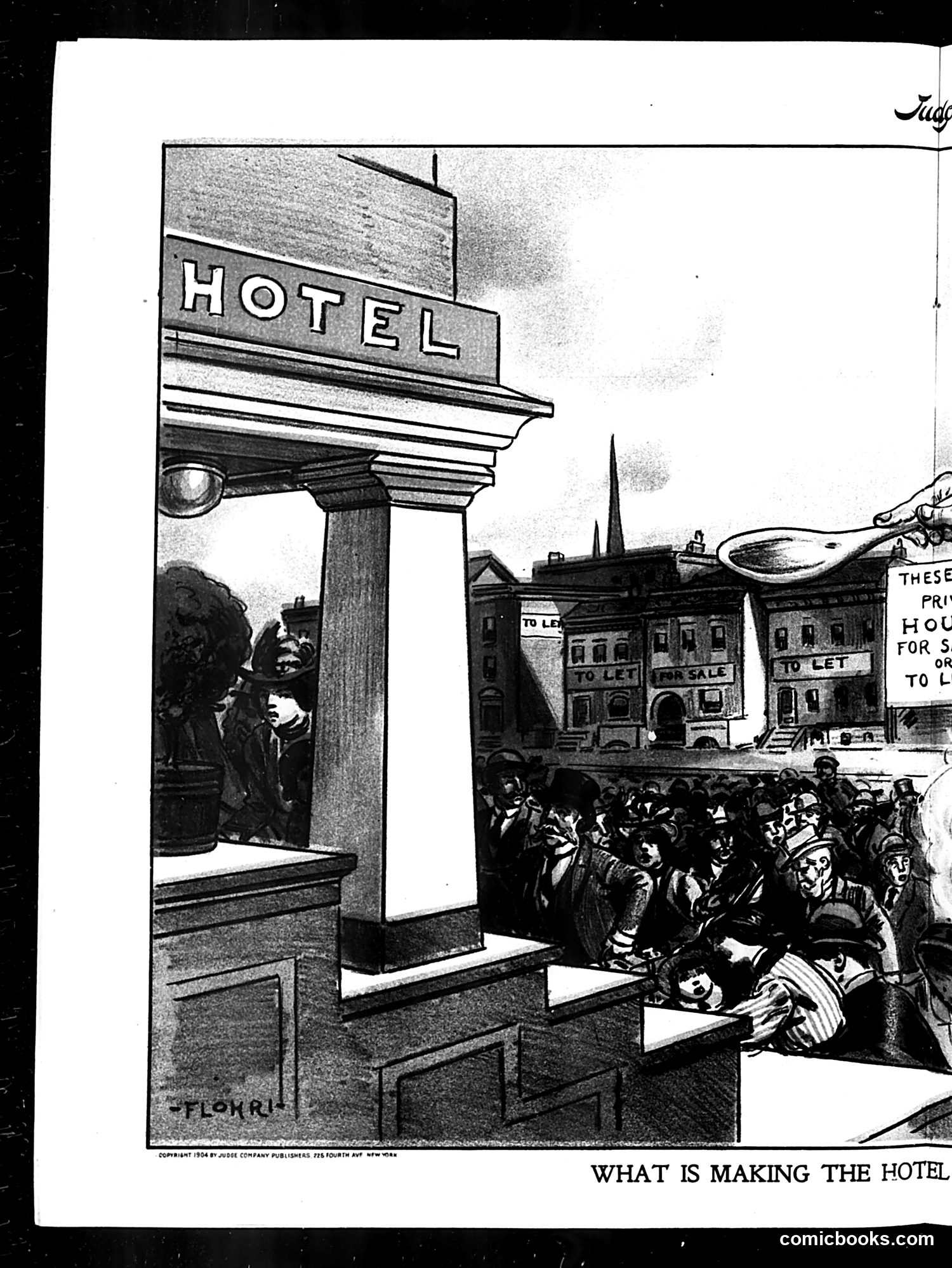
This political cartoon satirizes urban housing scarcity and homelessness, likely from the early 20th century. A hotel clerk stands behind a window while a large crowd of poorly-dressed people gathers outside—depicted as desperate, homeless individuals seeking shelter. The satire's point: the hotel represents inadequate housing availability, with the indifferent clerk suggesting institutional indifference to homelessness. The crowded masses outside illustrate how many people lack adequate shelter. Background signs reading "TO LET" and "FOR SALE" reinforce themes of housing shortage or displacement. The cartoon critiques either housing policy failures or economic conditions creating homelessness. The title "What Is Making the Hotel" (text incomplete) likely concludes with commentary on why hotels are inadequate solutions or why housing remains inaccessible to working-poor populations.
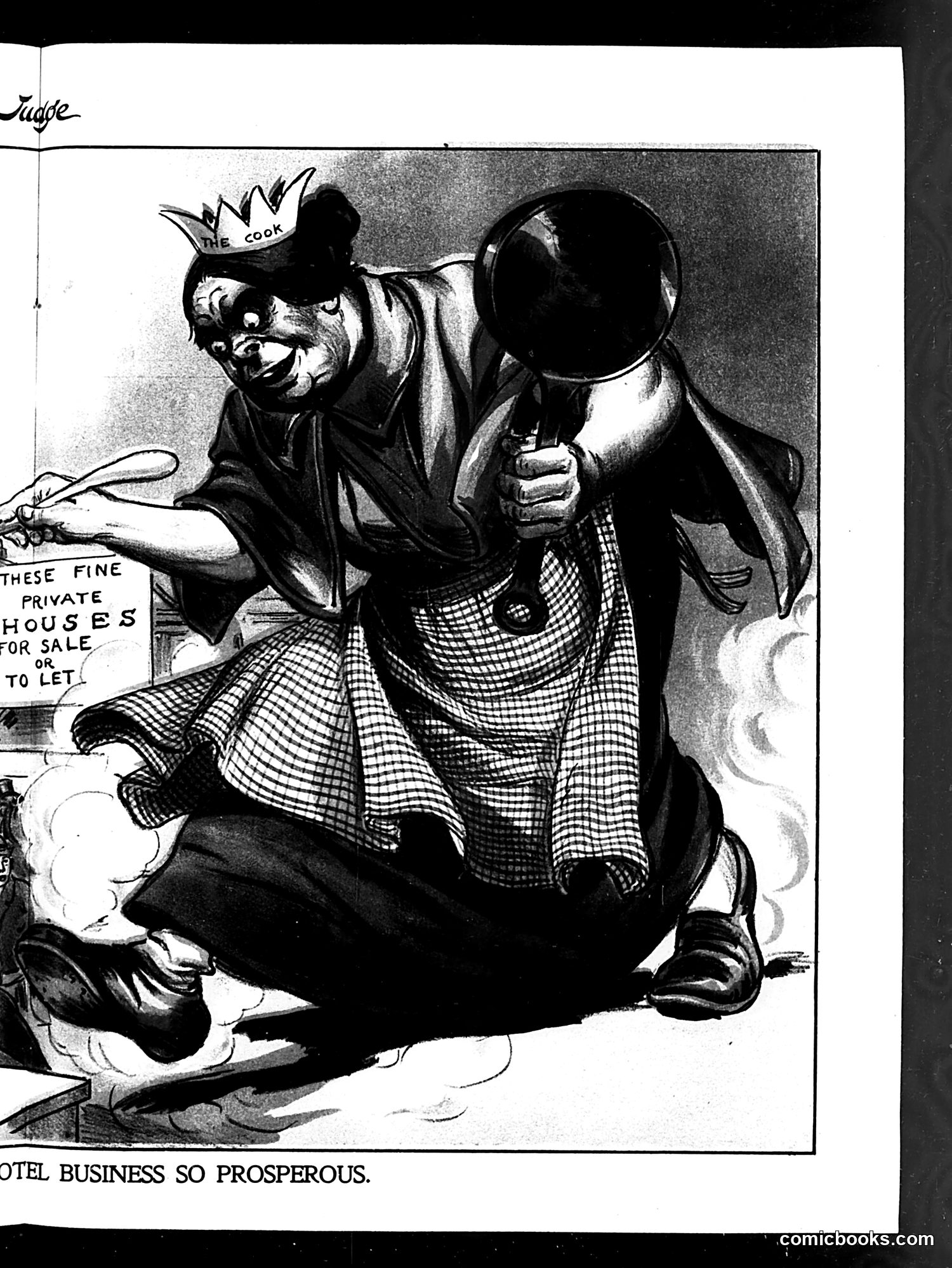
This political cartoon satirizes the hotel and lodging business during a period of apparent prosperity. The caricatured figure—labeled "THE COOK"—is depicted as a portly, exaggerated character wearing a checkered apron, holding a large pot or pan. He's shown alongside a sign advertising "THESE FINE PRIVATE HOUSES FOR SALE OR TO LET." The satire appears to mock how the booming hotel/hospitality business has made proprietors so wealthy and successful that they're converting private residences into commercial lodging ventures. The grotesque rendering of the cook figure suggests commentary on either the greed driving this expansion or the quality of such establishments. The caption "HOTEL BUSINESS SO PROSPEROUS" completes the ironic critique of this economic trend.
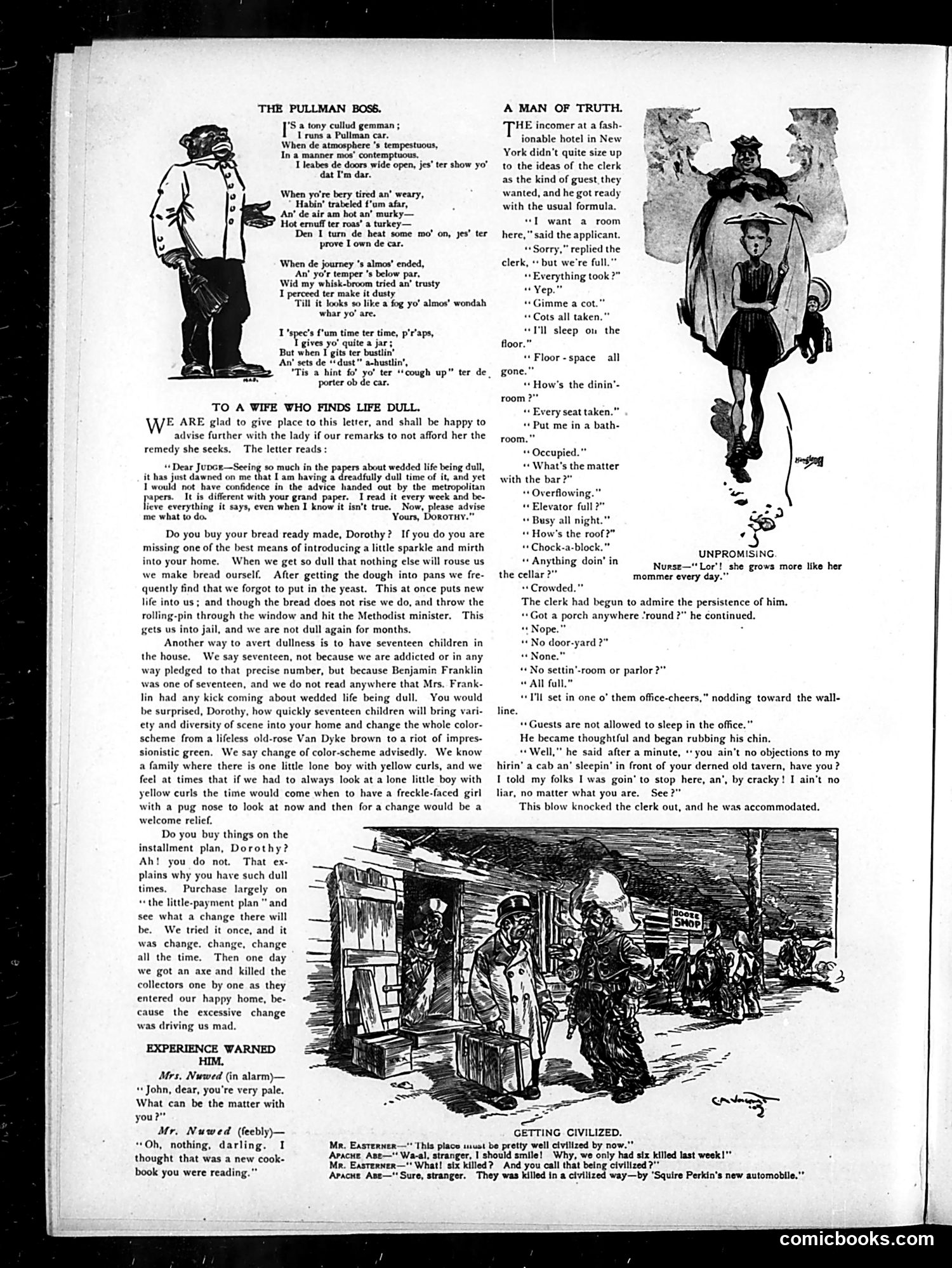
This page contains satirical humor pieces typical of early 20th-century American popular magazines: **"The Pullman Boss"**: A dialect poem mocking a Pullman car porter (likely an African American character, given the stereotypical dialect). It satirizes the porter's deliberate behavior—opening doors during bad weather, cranking up heat, raising dust—to inconvenience passengers and assert petty control over his domain. **"To a Wife Who Finds Life Dull"**: Mock advice column humor. Judge responds absurdly to a woman seeking remedies for dull married life, suggesting forgotten yeast in bread (causing domestic violence against a Methodist minister) or having seventeen children as solutions. The humor lies in the deliberately terrible advice presented deadpan. **"Getting Civilized"**: A brief sketch (bottom) where Apache characters claim "civilization" means using Squire Perkins's automobile to kill people—satirizing contemporary anxieties about "civilization" and technological progress. The page reflects early 1900s comedic conventions: ethnic/dialect humor, domestic satire, and ironic social commentary presented without nuance.
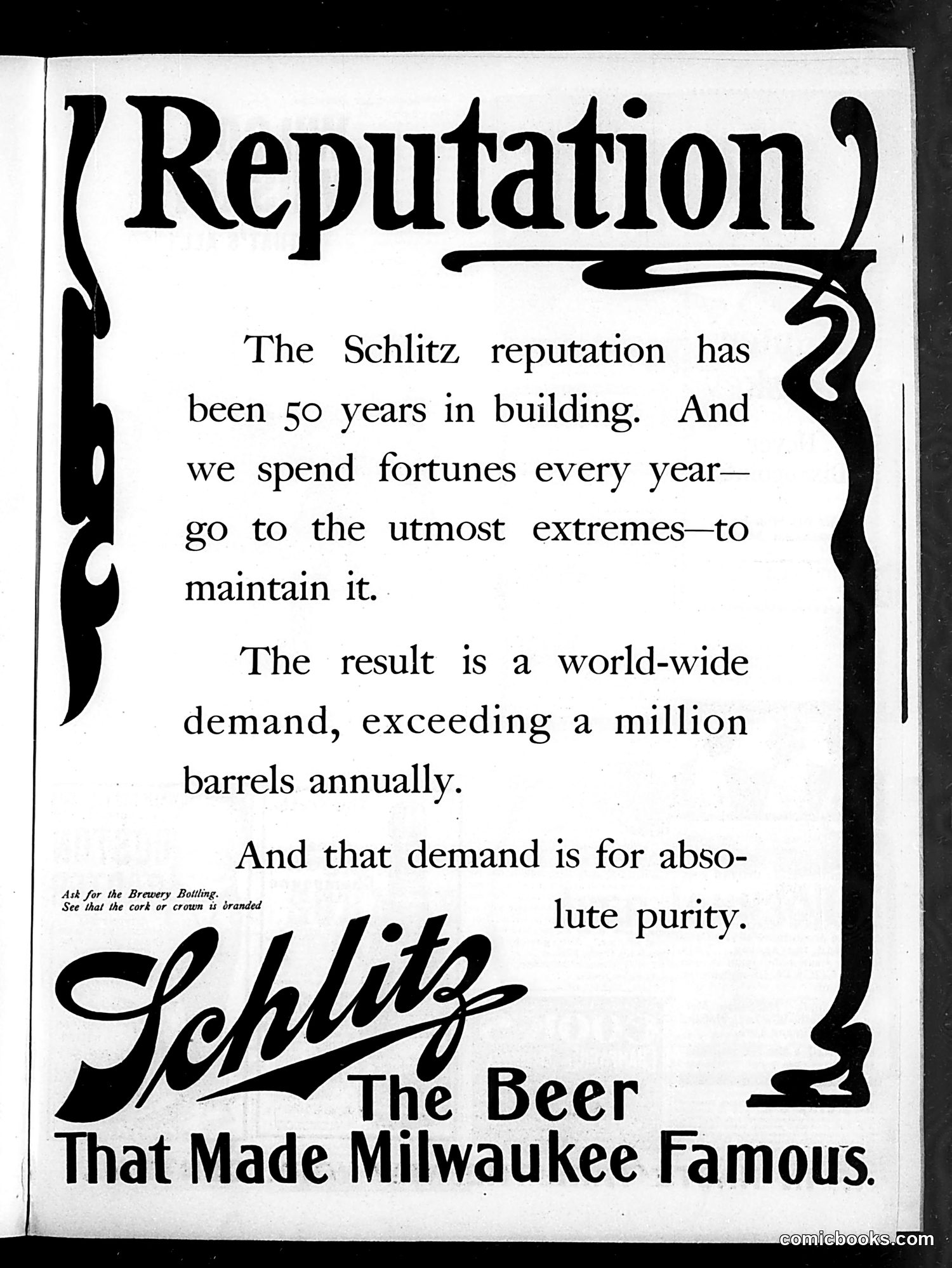
This is a **Schlitz beer advertisement**, not political satire. The page promotes Schlitz's brand reputation and market dominance during the early 20th century (likely Prohibition era or shortly before/after). The ad's main argument is that Schlitz has spent 50 years building trust through expensive quality control measures. This investment supposedly created massive worldwide demand—over one million barrels annually—driven by consumers' desire for "absolute purity." The phrase "The Beer That Made Milwaukee Famous" was Schlitz's actual slogan, positioning the company as the flagship of Milwaukee's brewing industry. The ornamental border design is typical of period advertising aesthetics. For modern readers: this represents how pre-Prohibition breweries marketed themselves by emphasizing reputation and purity standards as competitive advantages in a crowded market.
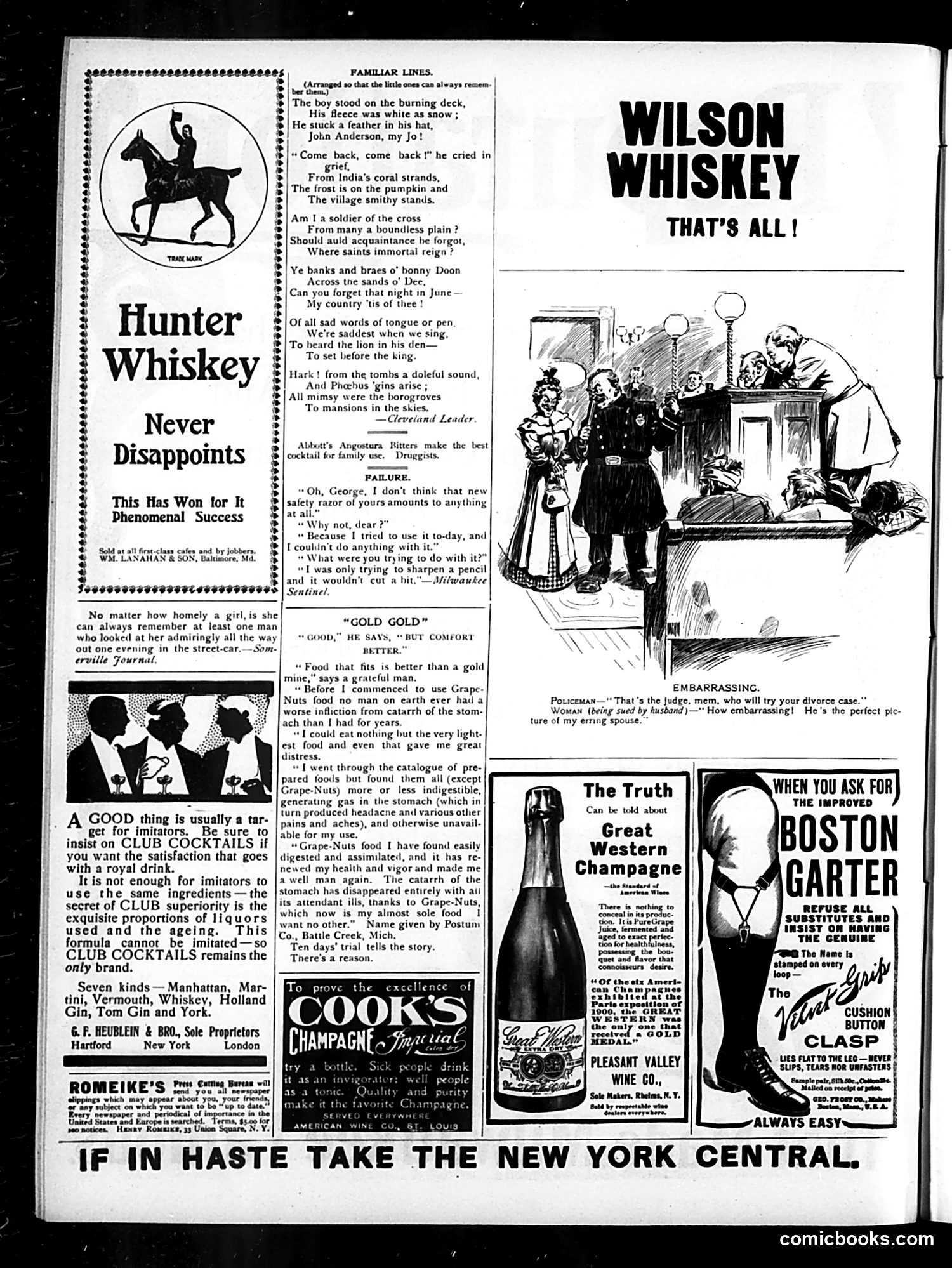
This page is primarily **advertisements and filler content** from *Judge* magazine, with minimal satirical cartooning. The main cartoon depicts an "embarrassing" social situation: a woman addressing a judge about divorce, apparently having confused him with someone else. The humor relies on Victorian-era propriety—the woman's mortification at publicly discussing intimate marital matters with a stranger. The "Familiar Lines" section is a clever literary joke: it deliberately **misquotes and scrambles famous poems** (Byron, Burns, hymns, nursery rhymes), mixing opening lines together nonsensically. This satirizes how poorly educated people or careless speakers garble well-known literature. The remainder comprises liquor and patent medicine advertisements typical of the era—Hunter Whiskey, Club Cocktails, Grape-Nuts (marketed for digestive health), and various other products. These ads reflect early 1900s consumer culture and medicinal claims later regulated as false advertising. There is no apparent political satire on this page.
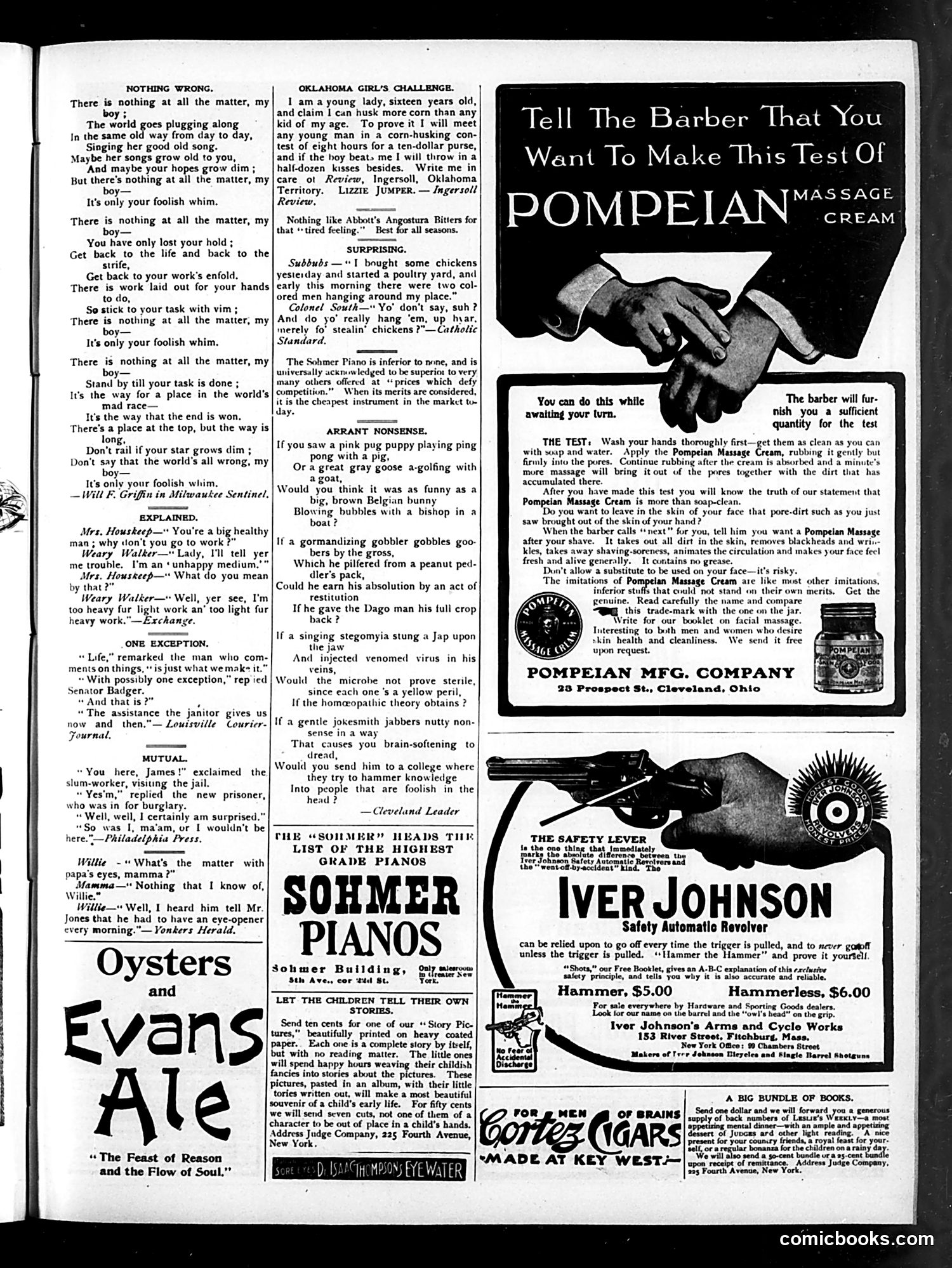
This page is primarily **advertising and light humor** rather than political satire. The main content includes: **Poetry/Verse:** "Nothing Wrong" offers motivational advice to discouraged workers ("my boy"), urging perseverance despite hardship—typical Progressive-era sentiment about self-reliance and work ethic. **Humorous Anecdotes:** Short jokes about: - A vagrant claiming to be an "unhappy medium" between light and heavy labor - A senator's quip about janitor assistance - An Oklahoma girl challenging boys to a corn-husking contest (displaying frontier spirit and gender role boundary-testing) - Dialect humor involving Southern characters and stolen chickens **Advertisements:** Dominating the page are ads for Pompeian Massage Cream, Sohmer Pianos, Iver Johnson Revolvers, and other products. **Notable:** The "Arrant Nonsense" section appears to be absurdist wordplay rather than satire. The Oklahoma girl's challenge represents curiosity about women's capabilities and the frontier, not deep political commentary. This is a typical Judge page blending genteel humor with commercial interests.
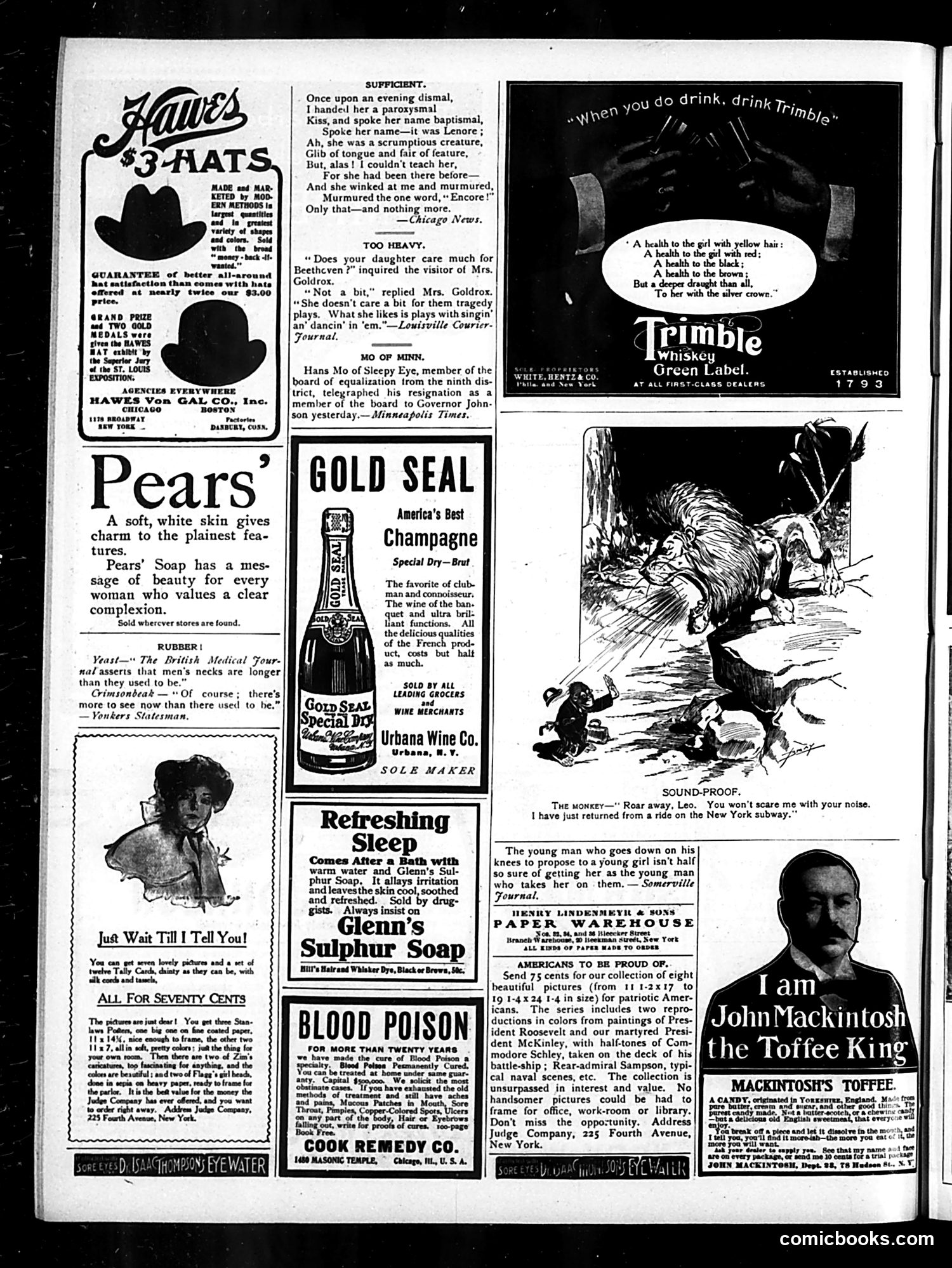
This page is primarily **advertisements with brief satirical items**, typical of Judge magazine's format. The main satirical content includes: **"SUFFICIENT"** — A parody of Poe's "The Raven," mocking romantic naïveté. A man recites poetry to a woman named Lenore, but she's experienced and merely responds "Encore!"—she's heard it all before. The joke: his elaborate seduction attempt fails because she's worldly. **"TOO HEAVY"** — Social satire on Mrs. Goldrox, a wealthy woman who dislikes serious music (Beethoven) and prefers entertainment with "singin' and dancin'." This mocks the cultural pretensions and actual philistinism of the nouveau riche. **"SOUND-PROOF"** — A monkey returning from riding the New York subway claims the monkey's roar won't scare him—implying the subway is noisier than a wild animal. Contemporary urban satire about newly constructed transit systems. The remaining content consists almost entirely of period advertisements for soap, champagne, whiskey, and patent medicines—standard Judge fare from the early 1900s.
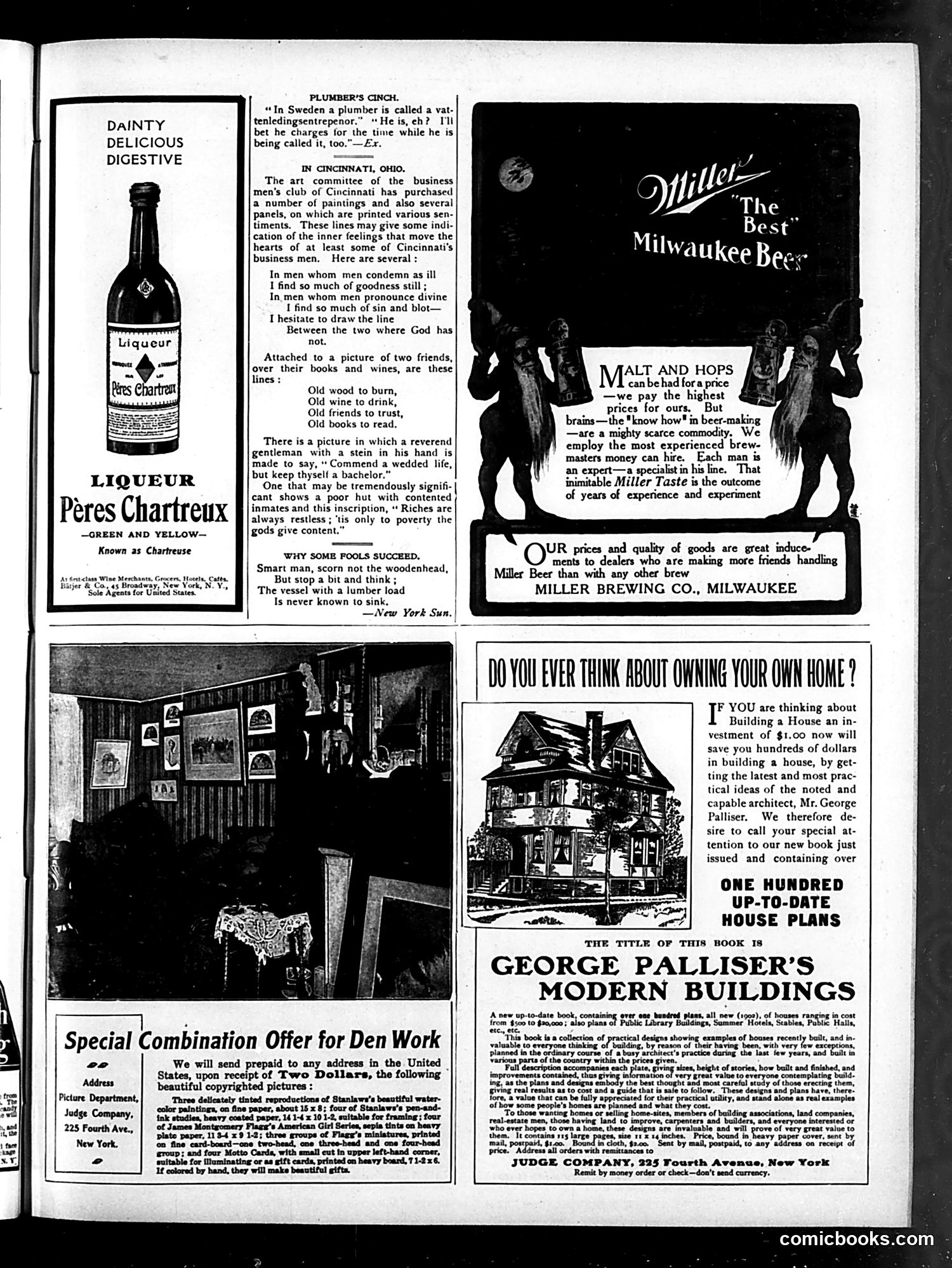
This page is primarily **advertising**, not political satire. It contains: **Main advertisements:** - Peres Chartreux liqueur (top left) - Miller Beer (center-right, with silhouettes of men drinking) - George Palliser's Modern Buildings architectural book (bottom right) **Filler humor sections** (small jokes/anecdotes): - "Plumber's Cinch": A brief joke about Swedish plumbers charging for consultation time - Cincinnati art committee paintings: Philosophical verses about human nature and morality displayed in a business club - "Why Some Fools Succeed": A brief poem suggesting unintelligent people can prosper **Notable context:** The Miller Beer ad emphasizes "brains" and specialized expertise in brewing—a quality distinction pitch. The house plans book targets middle-class home ownership aspirations. The scattered philosophical quotes suggest early 1900s genteel culture among business classes. The page reflects **early 20th-century consumer culture** and middle-class values rather than political commentary.
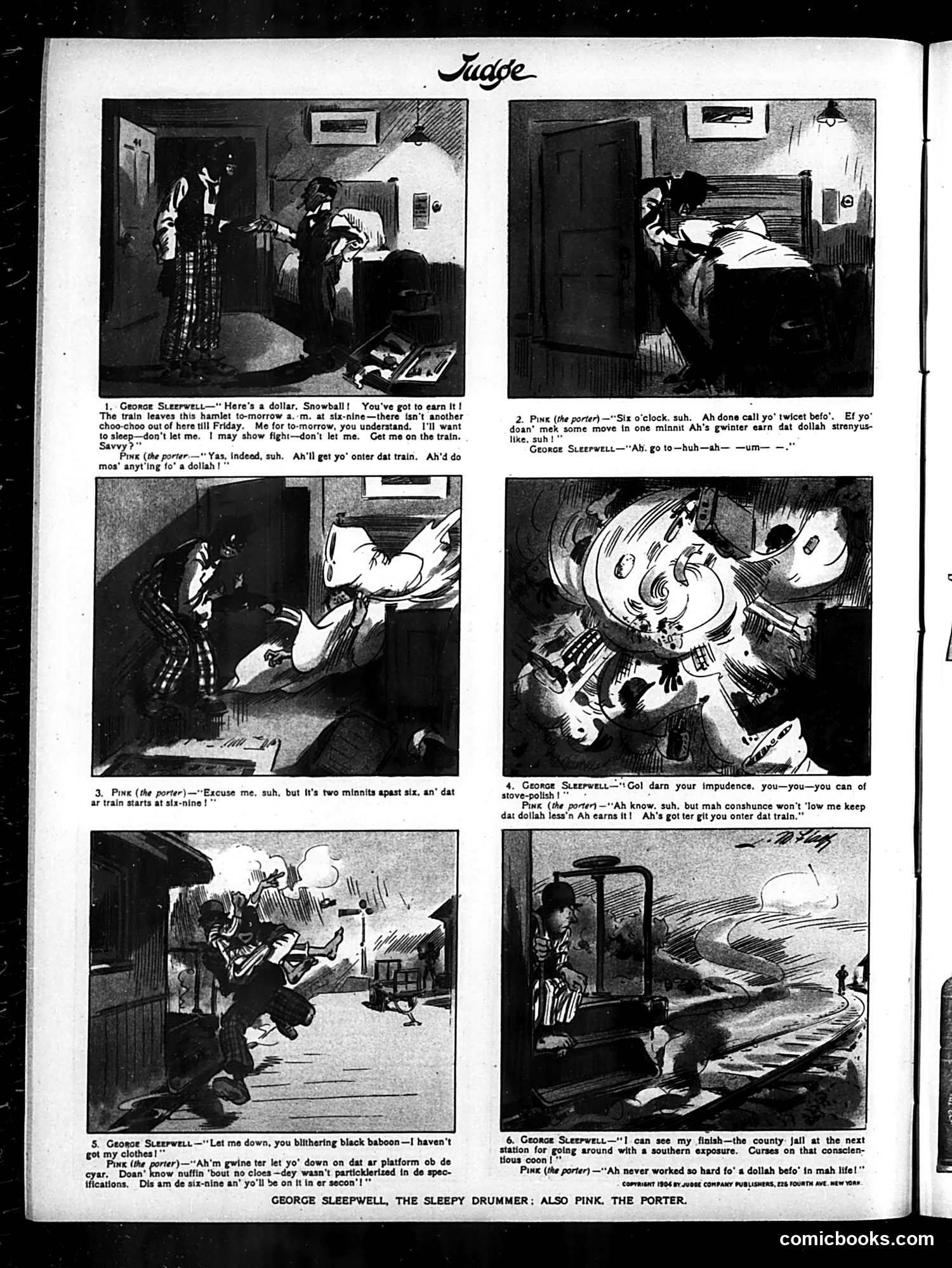
This six-panel comic satirizes a white traveling salesman ("George Sleepwell") who hires a Black porter ("Pink") to forcibly wake him for an early train. The joke centers on the porter's literal interpretation of his job: when Sleepwell refuses to wake or dress properly, Pink physically carries him onto the train—naked and without clothes—to "earn" his dollar tip. The satire targets Sleepwell's unreasonable demands and assumption that the porter will simply obey without question. Pink's determination to complete the task "strenuous-like" and his refusal to lose the dollar creates darkly comic situations where the passenger's own carelessness produces ridiculous consequences. The dialect used for Pink's speech reflects early 1900s racist stereotyping conventions of Judge magazine, though the porter is portrayed as more competent and principled than the hapless white employer. The humor derives from role reversal and the salesman's humiliation.
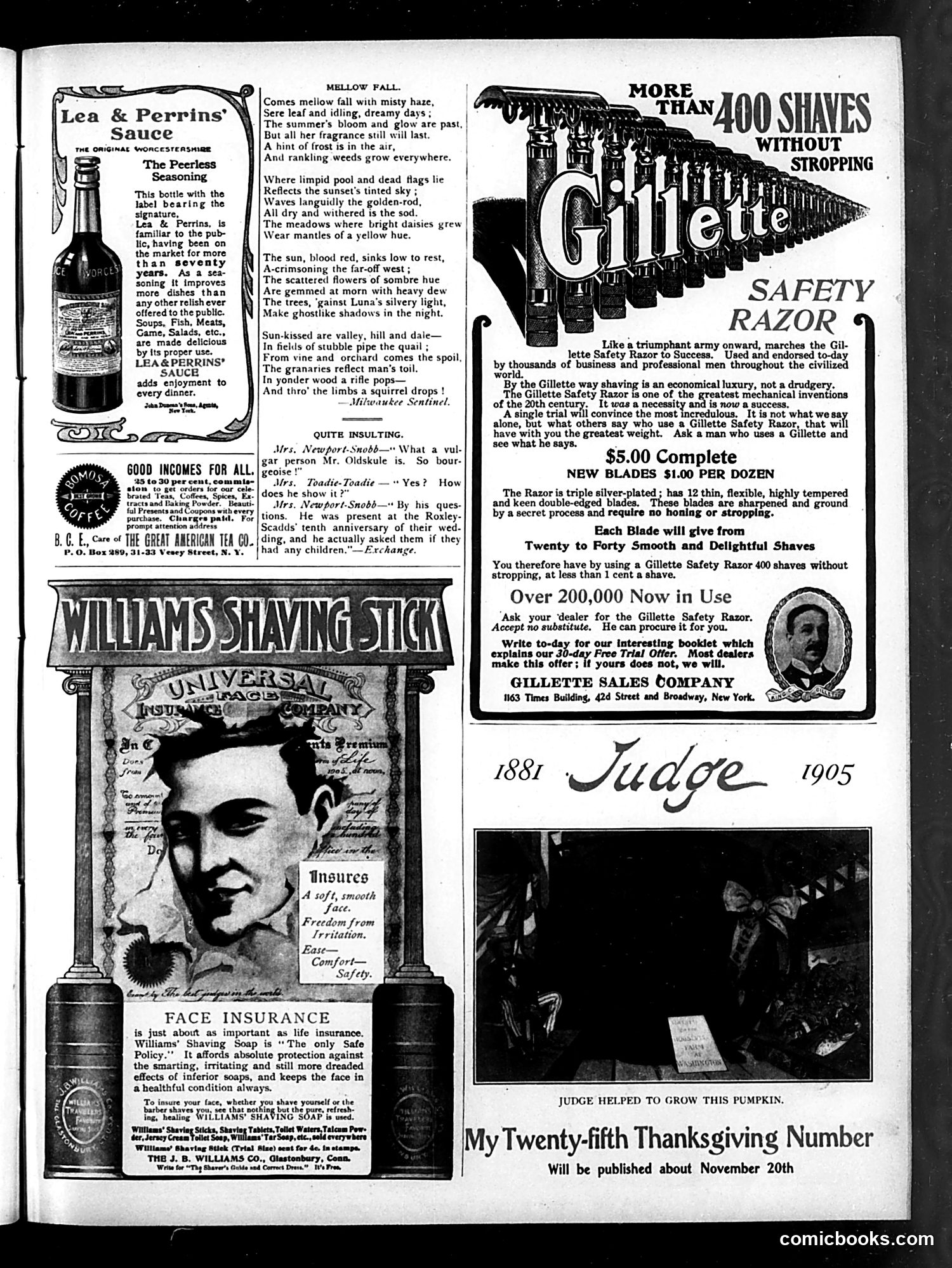
This page is **primarily advertising** with minimal satirical content. The main elements include: **Advertisements:** - Lea & Perrins' Worcestershire Sauce - Gillette Safety Razor (prominent, promising "400 shaves without stropping") - Williams' Shaving Stick (face insurance comparison) - Tea company employment opportunity **Humorous Content:** The only satirical piece is "Quite Insulting"—a brief joke mocking nouveau-riche snobbery. Mrs. Newport-Snobb considers Mr. Oldskule "vulgar" and "bourgeois" merely for asking a couple at their anniversary party if they had children—a reasonable, ordinary question. The satire targets pretentious social climbers who affect superiority through affected manners while exposing their own rudeness by finding normal conversation offensive. **Poetic Content:** "Mellow Fall" is a sentimental autumn poem unrelated to satire. The page reflects *Judge*'s business model: advertising revenue supporting occasional light humor, rather than hard political satire.
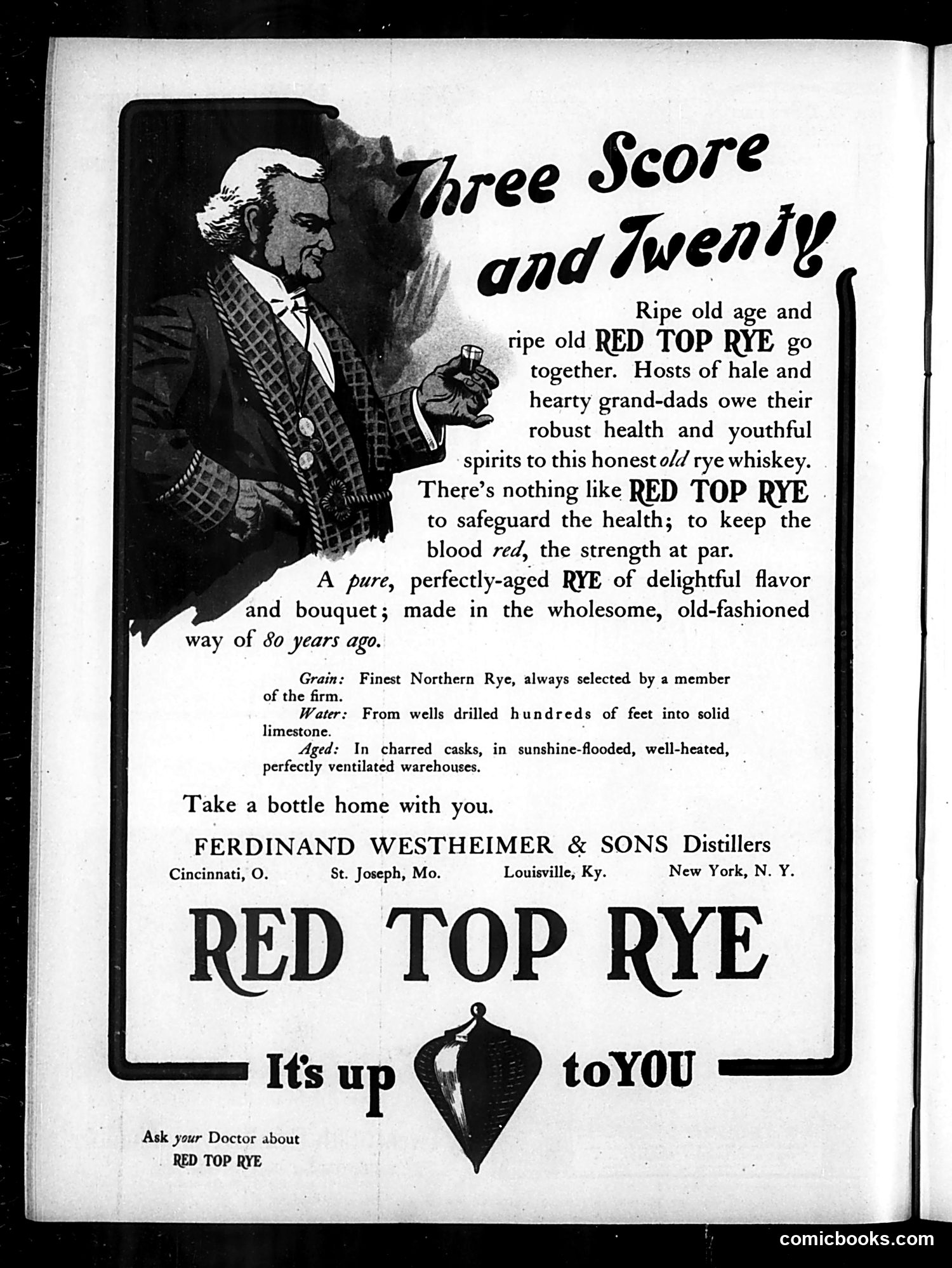
This is primarily a **whiskey advertisement**, not political satire. It features an elderly gentleman in period dress holding a bottle, promoting Red Top Rye whiskey by Ferdinand Westheimer & Sons distillers. The ad employs common early-20th-century marketing tactics: claiming health benefits ("safeguard the health," "keep the blood red"), invoking tradition ("80 years ago"), and using appeals to authority ("Ask your Doctor about RED TOP RYE"). The phrase "Three Score and Twenty" references biblical longevity, suggesting the product promotes long life. The elderly figure appears meant to represent a robust, healthy "grand-dad"—embodying the advertiser's claim that their whiskey contributes to vigor and vitality. Modern readers should recognize this as pre-FDA regulation advertising making dubious medical claims that would be illegal today. The inclusion in *Judge* suggests whiskey advertising was considered appropriate magazine content at this time.