
A complete issue · 16 pages · 1905
Judge — July 15, 1905
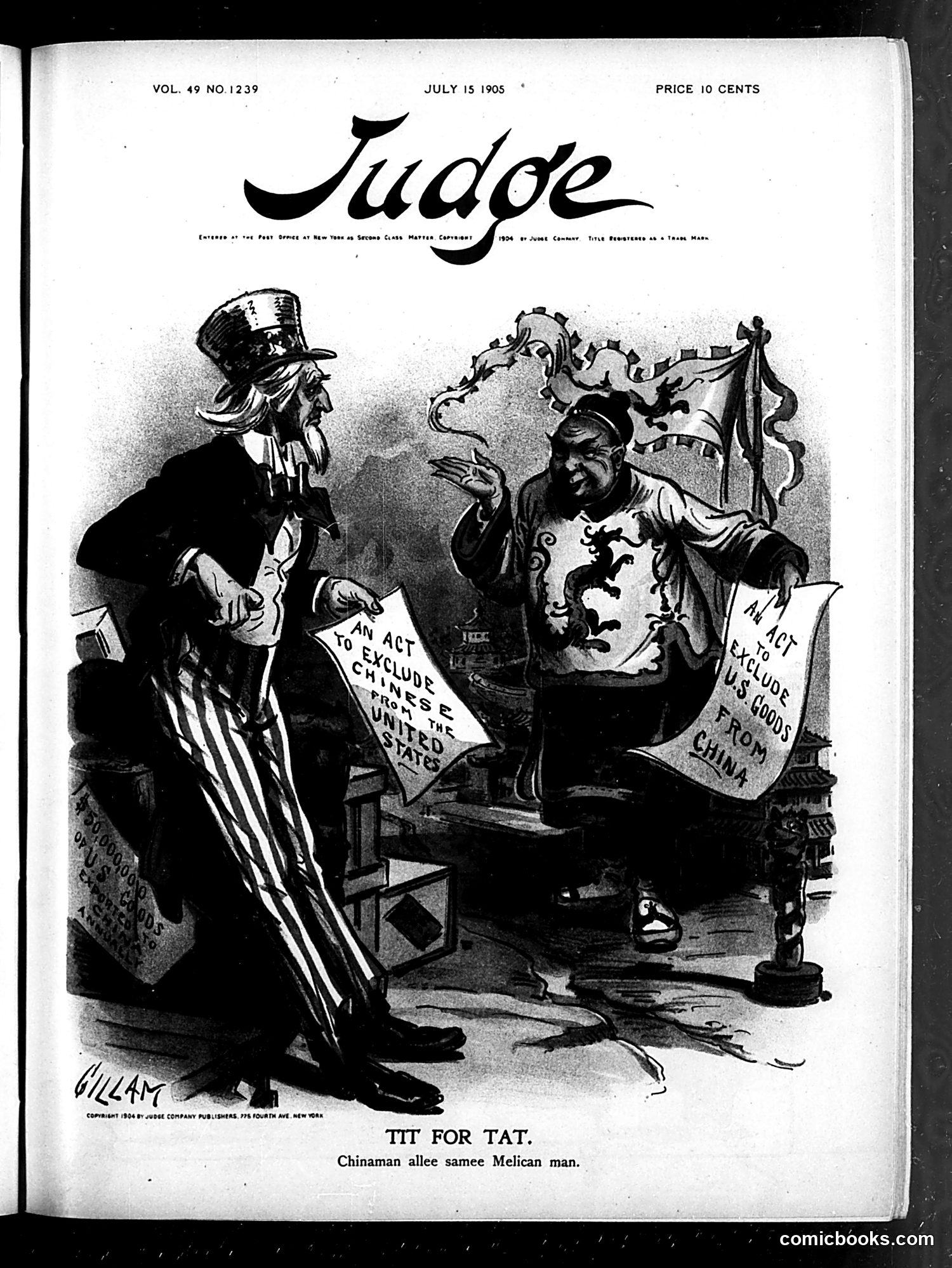
This 1905 *Judge* cartoon depicts a confrontation between Uncle Sam (left, in stars-and-stripes) and a Chinese figure (right, wearing traditional dress). The Chinese figure holds documents labeled "Act to Exclude Chinese from the United States" and "Act Exclude Goods from China," while displaying a mirror-image banner reading "Act Exclude Goods from China." The satire critiques American exclusionary trade and immigration policies toward China. By showing the Chinese figure mirroring Uncle Sam's exclusionary stance, the cartoon suggests that restrictive American tariffs and the Chinese Exclusion Act (1882) provoke reciprocal Chinese trade restrictions. The title "Tit for Tat" emphasizes this retaliatory dynamic—America's discriminatory policies generate equivalent Chinese responses, undermining American commercial interests in China.
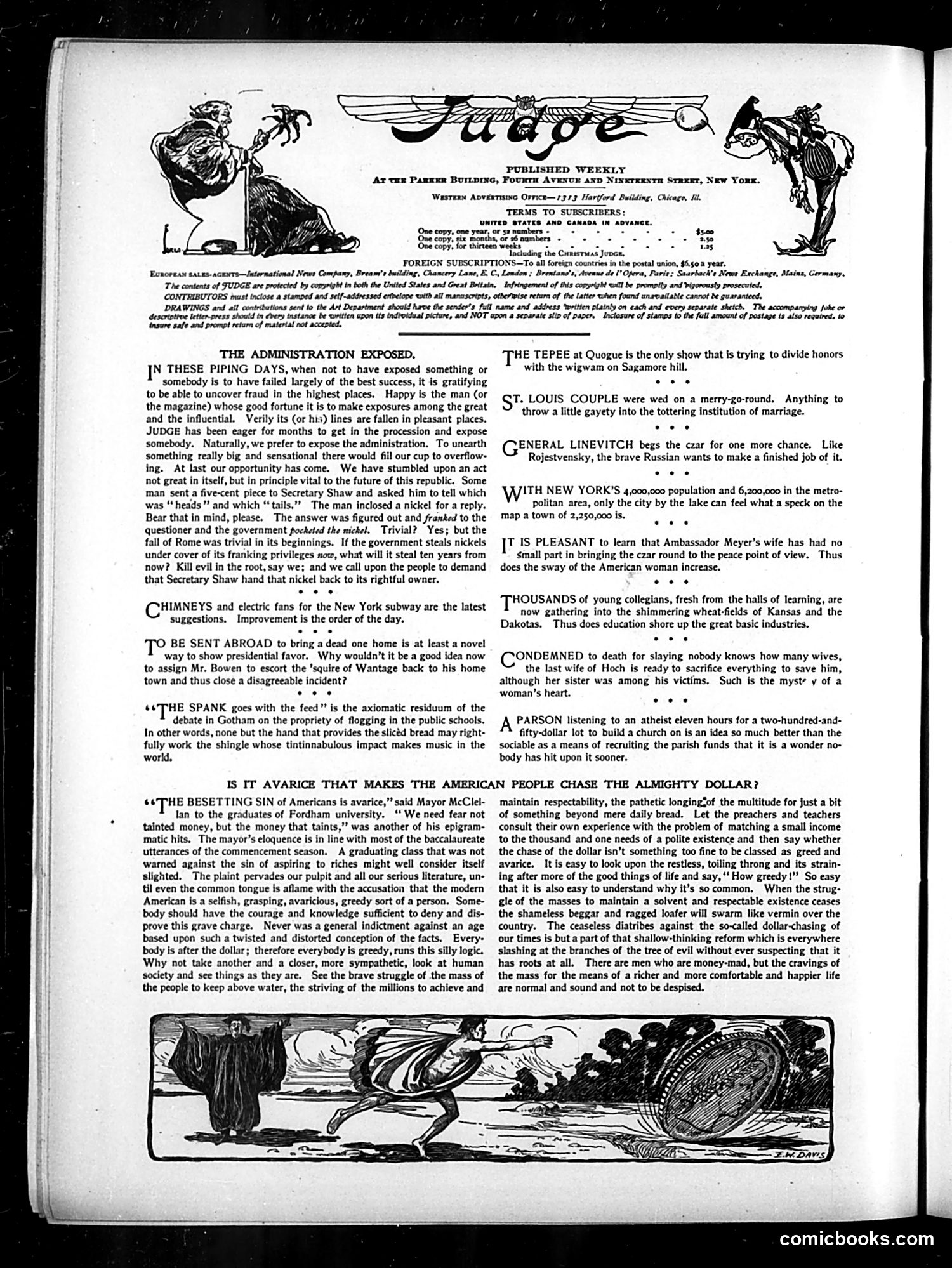
This appears to be a satirical commentary page from Judge magazine. The main editorial piece, "The Administration Exposed," criticizes government officials for exposing fraud and scandals. The author argues that exposing corruption—while principally important—damages the republic by revealing incompetence to the public. The shorter items mock various targets: ineffective solutions (subway improvements), impractical ideas (sending corpses abroad), and hypocrisy (religious figures building churches with questionable motives). The largest piece, "Is It Avarice That Makes the American People Chase the Almighty Dollar?", critiques American materialism. The author defends ordinary people's modest aspirations against elitist attacks, arguing that pursuing basic comfort isn't moral failure—it's human nature. The satire targets sanctimonious critics who judge working people while enjoying privilege themselves. The illustration at bottom (signed F.M. Davis) appears decorative, featuring a figure in motion.
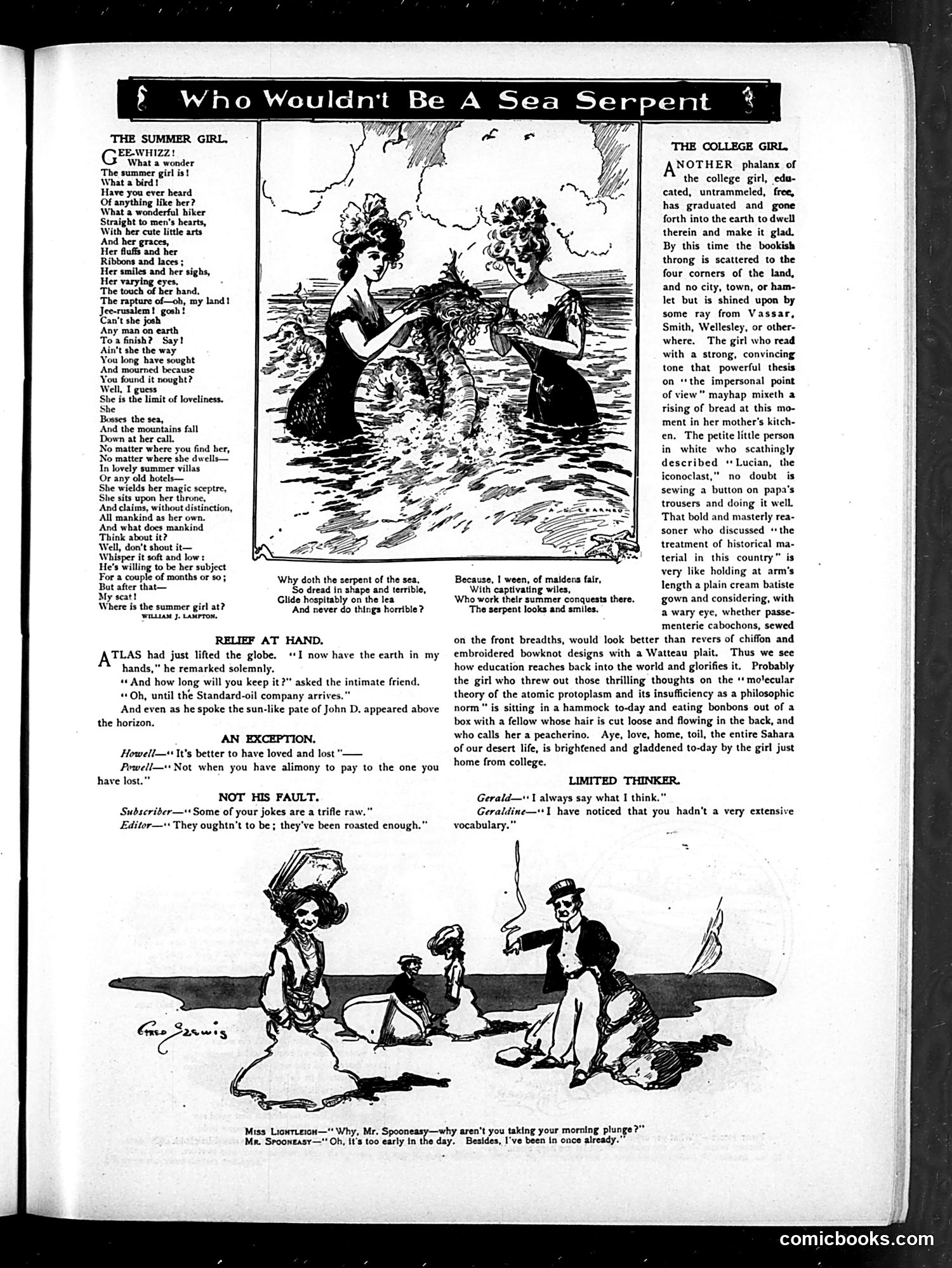
This page satirizes early-20th-century female education and social roles. "The Summer Girl" poem celebrates a carefree, fashionable young woman at leisure—embodying idle beauty and romantic appeal. In stark contrast, "The College Girl" prose describes an educated woman who becomes intellectually serious, pursuing knowledge over appearance and domestic life. The satire mocks this tension: society celebrates women as decorative "summer girls" but also sends them to college, where they develop independent minds and reject traditional roles. The central illustration depicts two women in the sea, likely representing these opposing ideals. The bottom cartoons and brief exchanges humorously depict everyday social awkwardness and misunderstandings between men and women, reinforcing the magazine's comedic commentary on gender dynamics of the era.
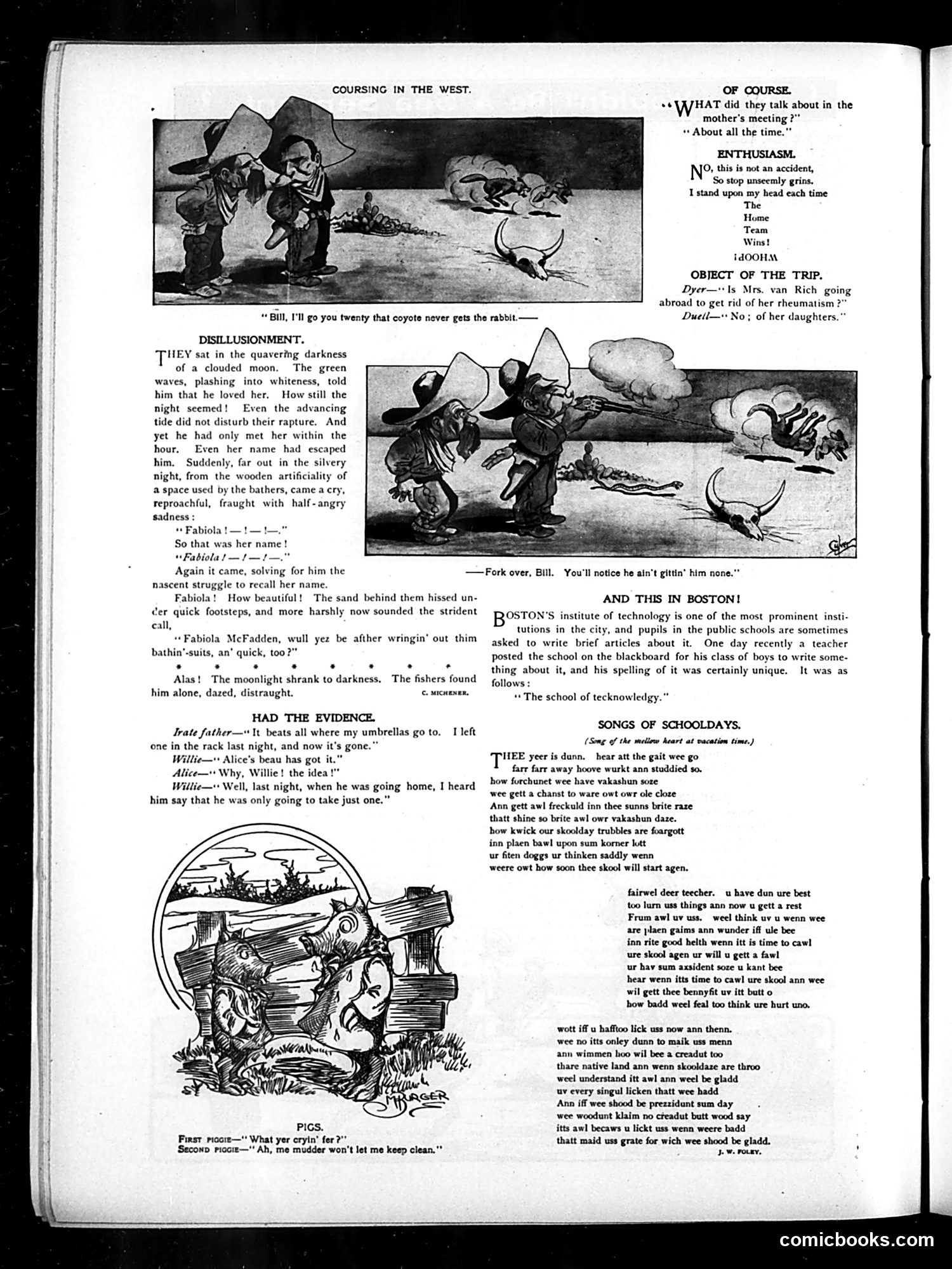
This page contains several unrelated satirical pieces typical of Judge magazine's format: **"Coursing in the West"** depicts two cowboys pursuing a coyote on horseback. The humor relies on a pun: one cowboy bets the other that the coyote will never catch a rabbit—implying the pursuer will fail at their task. **"Disillusionment"** tells a poetic story of unrequited love, where a man seeks a woman named Fabiola in moonlight but finds only emptiness. **"Had the Evidence"** is a brief dialogue joke about umbrellas and borrowed items, playing on marital misunderstandings. **"Songs of Schooldays"** is a sentimental poem about summer vacation written in dialect verse. **"Pigs"** is a short visual gag about cleanliness. The page lacks coherent political satire, instead offering light entertainment typical of early 20th-century humor magazines.
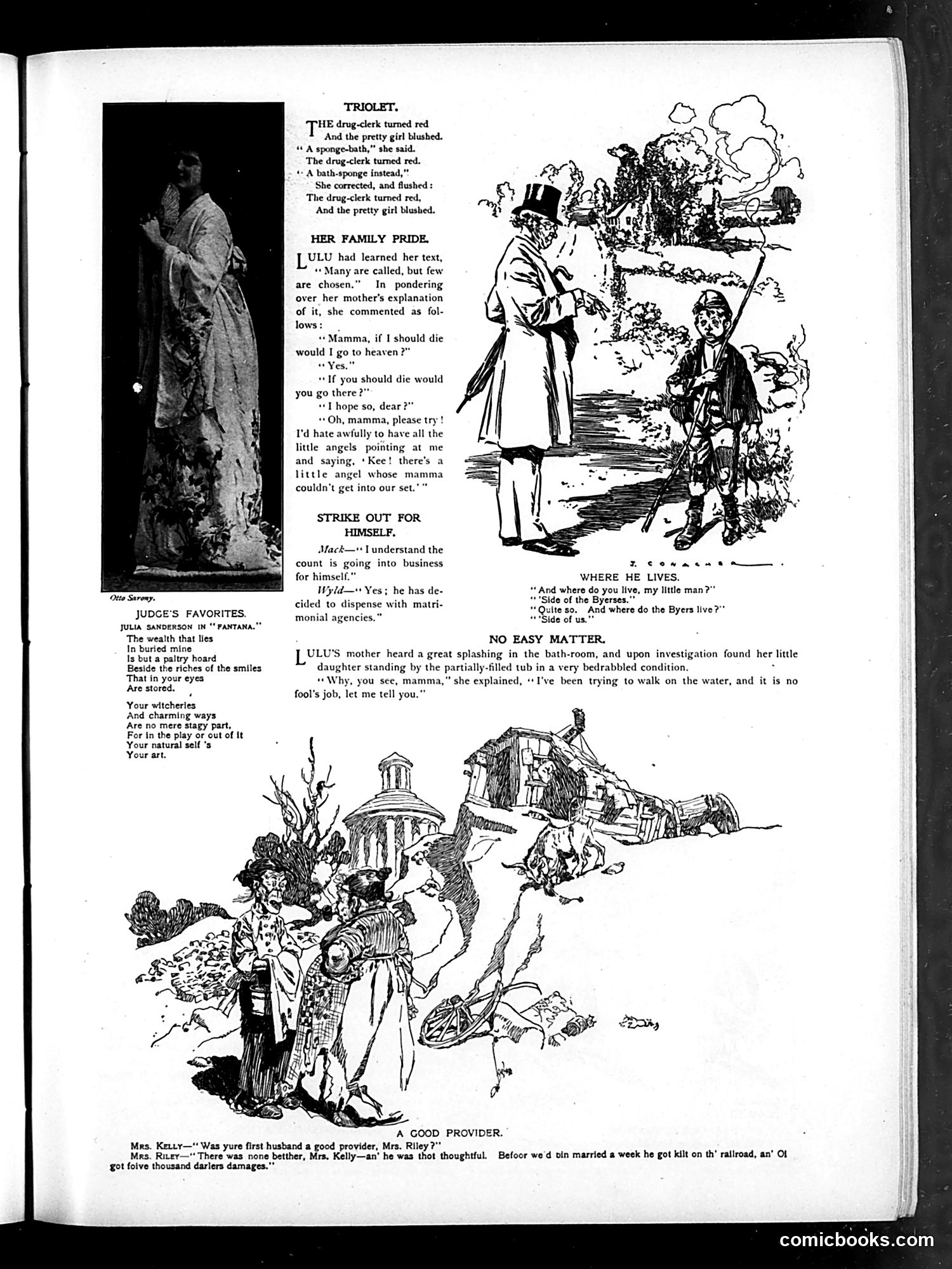
This page contains several brief comedic sketches typical of early-20th-century American humor magazines: **"Triolet"**: A play on miscommunication—a drug clerk and young woman both blush when she requests a "sponge-bath," he apparently misunderstanding as a sexual proposition. She clarifies she meant a bath-sponge, correcting the awkward misunderstanding. **"Her Family Pride"**: Satirizes class anxiety. A girl named Lulu worries that if her mother dies and goes to heaven, other angels will shame her ("pointing" and excluding her) for having a mother who didn't make it into their exclusive social circle. **"Strike Out for Himself"**: A brief quip about a count abandoning matrimonial agencies to conduct his own business—likely mocking aristocratic pretensions. **"No Easy Matter"**: Humor about a child attempting to walk on bathwater, using Biblical reference (Jesus walking on water) to show childish misunderstanding. **"A Good Provider"**: Dark Irish-immigrant humor. A widow brags her first husband was "thoughtful"—he died in a railroad accident within a week, leaving her with $5,000 in damages (a substantial sum then).
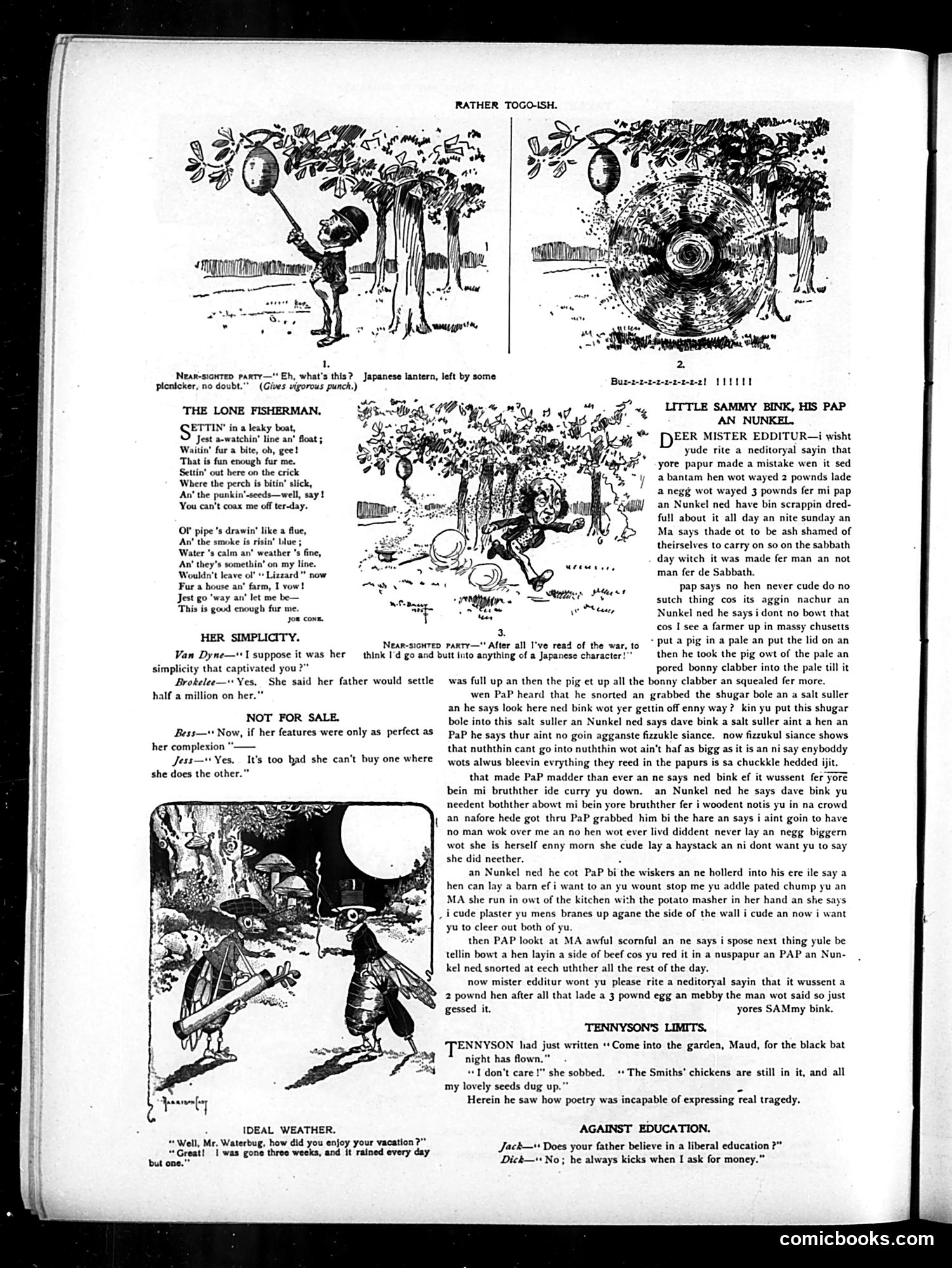
This page contains several satirical pieces typical of Judge's humor: **"Rather Togo-ish"** (top cartoons): The joke references Admiral Togo, the Japanese naval commander celebrated after Japan's 1905 victory in the Russo-Japanese War. The "near-sighted party" mistakes a Japanese lantern for war debris, then sees a circular object as resembling Japanese military imagery—topical humor playing on American fascination with Japan's military prowess and the exotic "Japanese" trend. **Main content**: Comic poems and dialogue exchanges satirize American middle-class life—a fisherman content with simple pleasures, mercenary courtship ("half a million"), and vacation disappointment. **"Little Sammy Bink" section**: A dialect piece (written phonetically in working-class vernacular) featuring a family argument about whether a hen can lay eggs larger than itself—satirizing pseudo-scientific debates among uneducated people who misapply scientific principles. The page reflects Judge's typical focus: mocking American social pretensions, class anxieties, and the gap between educated and working-class reasoning.
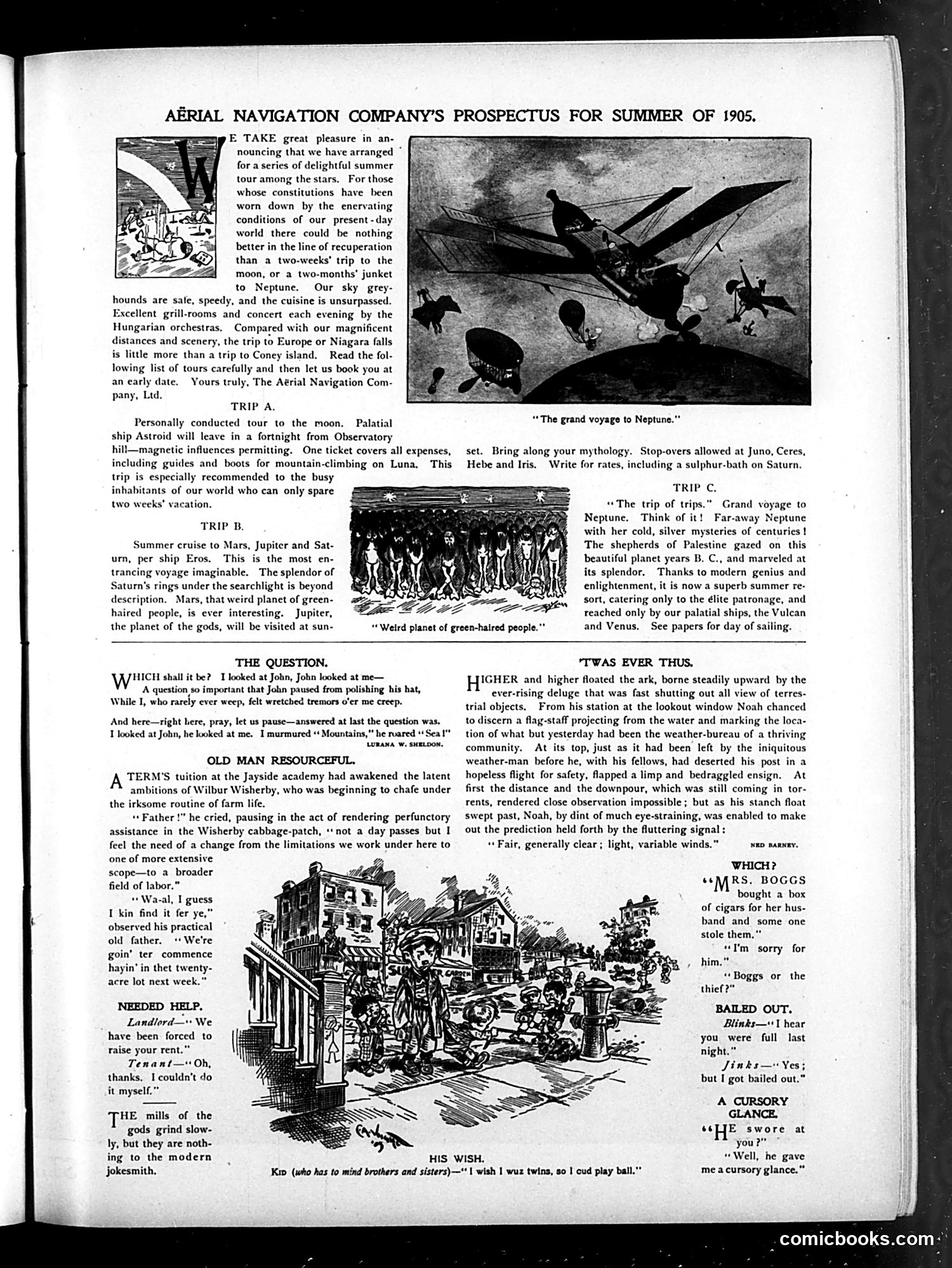
This page satirizes the early 1900s' fascination with emerging aviation technology through mock travel advertisements. The "Aerial Navigation Company" offers fantastical space voyages—to the moon, Mars, Neptune—presented as luxury vacations with modern amenities (concert orchestras, grill-rooms, sulphur baths). The satire works on two levels: it mocks both the era's naive optimism about technological progress and the pretentious travel industry marketing. References to "weird planet of green-haired people" (Mars) and astronomical features like Saturn's rings reflect popular sci-fi imaginings of the time. The accompanying humorous stories—about a farmer's son seeking ambition, a tenant grateful for rent increases, a child wishing to be twins—are unrelated filler typical of Judge's format. They're gentle, domestic humor rather than political commentary. Overall, this represents early 20th-century technological satire, poking fun at both flying fantasies and marketing excess before aviation became practical reality.
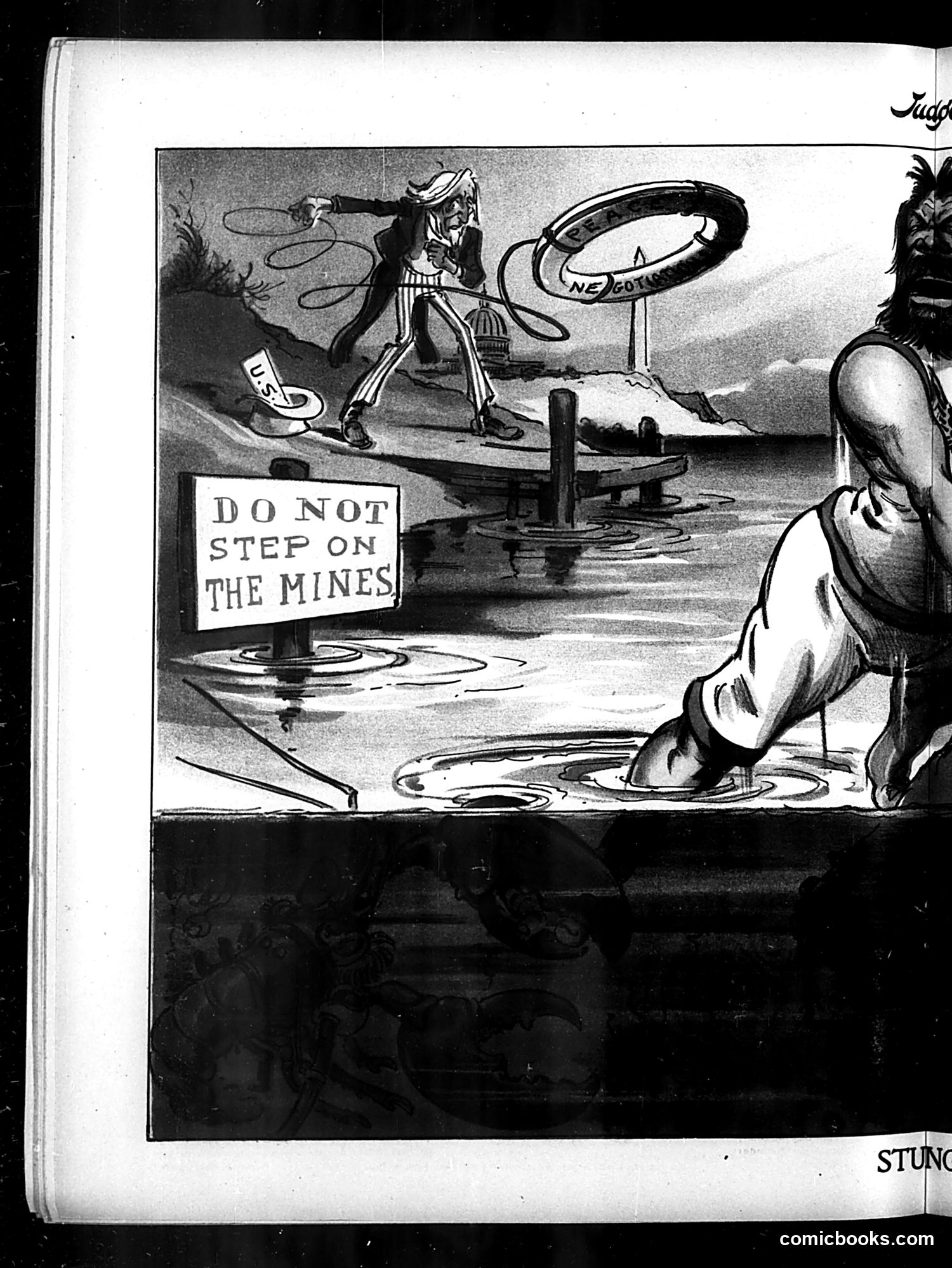
This appears to be a World War I-era cautionary cartoon from *Judge* magazine. The central figure, dressed in military attire, is juggling what appear to be naval mines while standing in water dotted with mine markers. A warning sign reads "DO NOT STEP ON THE MINES." The cartoon likely satirizes either military leadership's reckless tactics or civilian/political figures playing dangerous games with military strategy. The mines represent actual battlefield hazards, while the juggling suggests incompetence or cavalier attitude toward real dangers. A figure on the right observes the scene. The specific political target remains unclear without additional context, but the overall message warns against treating serious military threats lightly.
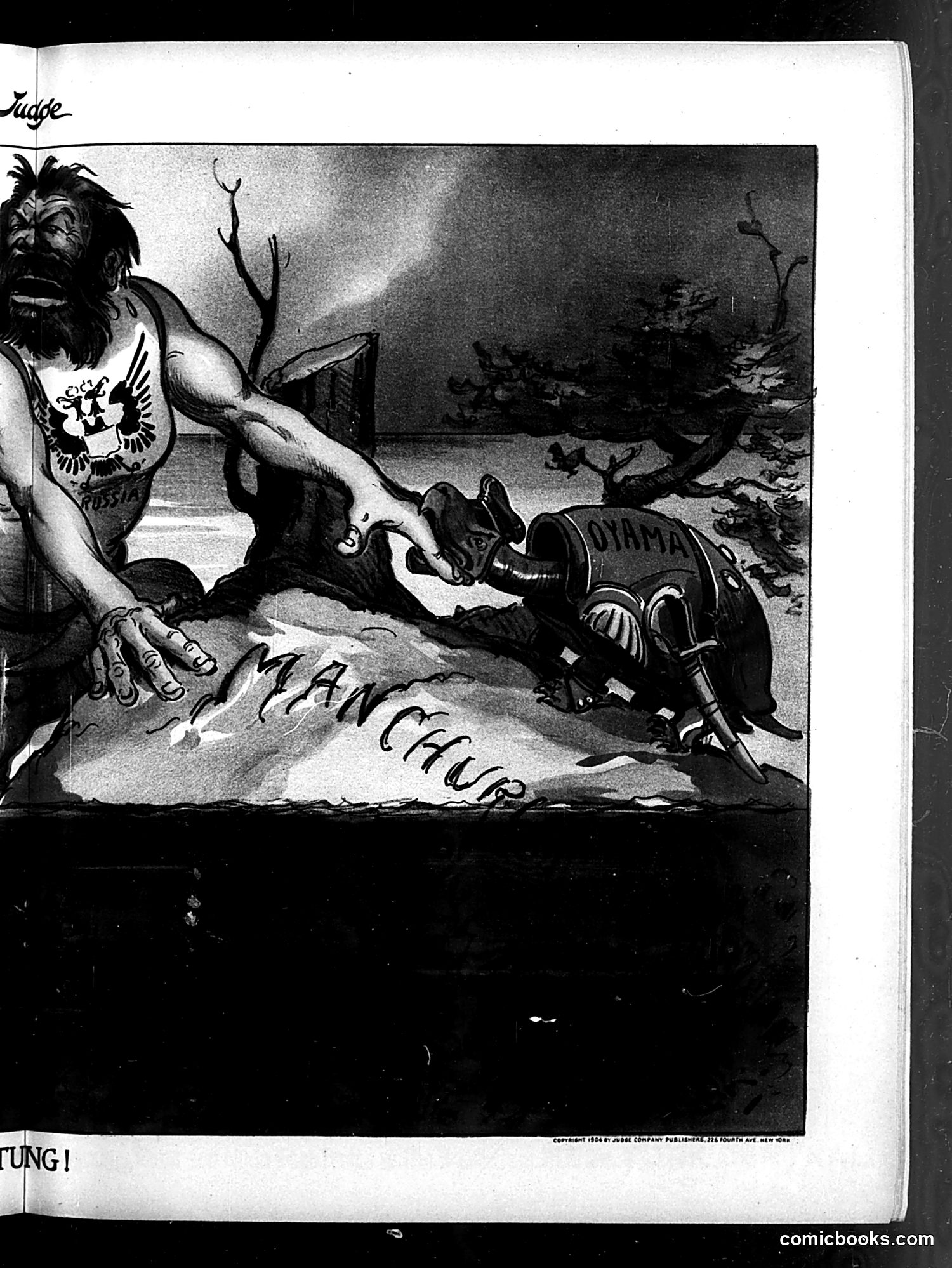
This is a Judge magazine cartoon depicting a wild, unkempt figure (labeled with what appears to be "TUNG" at bottom) confronting a smaller, formally-dressed character labeled "MANCHUKO" on barren ground. The larger figure wears an emblem suggesting Asian identity and holds a branch like a weapon or club. The desolate landscape with bare trees creates an ominous atmosphere. This likely satirizes Japanese aggression toward Manchuria, probably referencing the 1931 Mukden Incident and subsequent invasion. The crude, brutish depiction of the larger figure versus the vulnerable smaller one suggests criticism of imperial Japanese expansionism. The "Judge" magazine context confirms this is American political satire opposing Japanese imperialism in Asia during the 1930s.
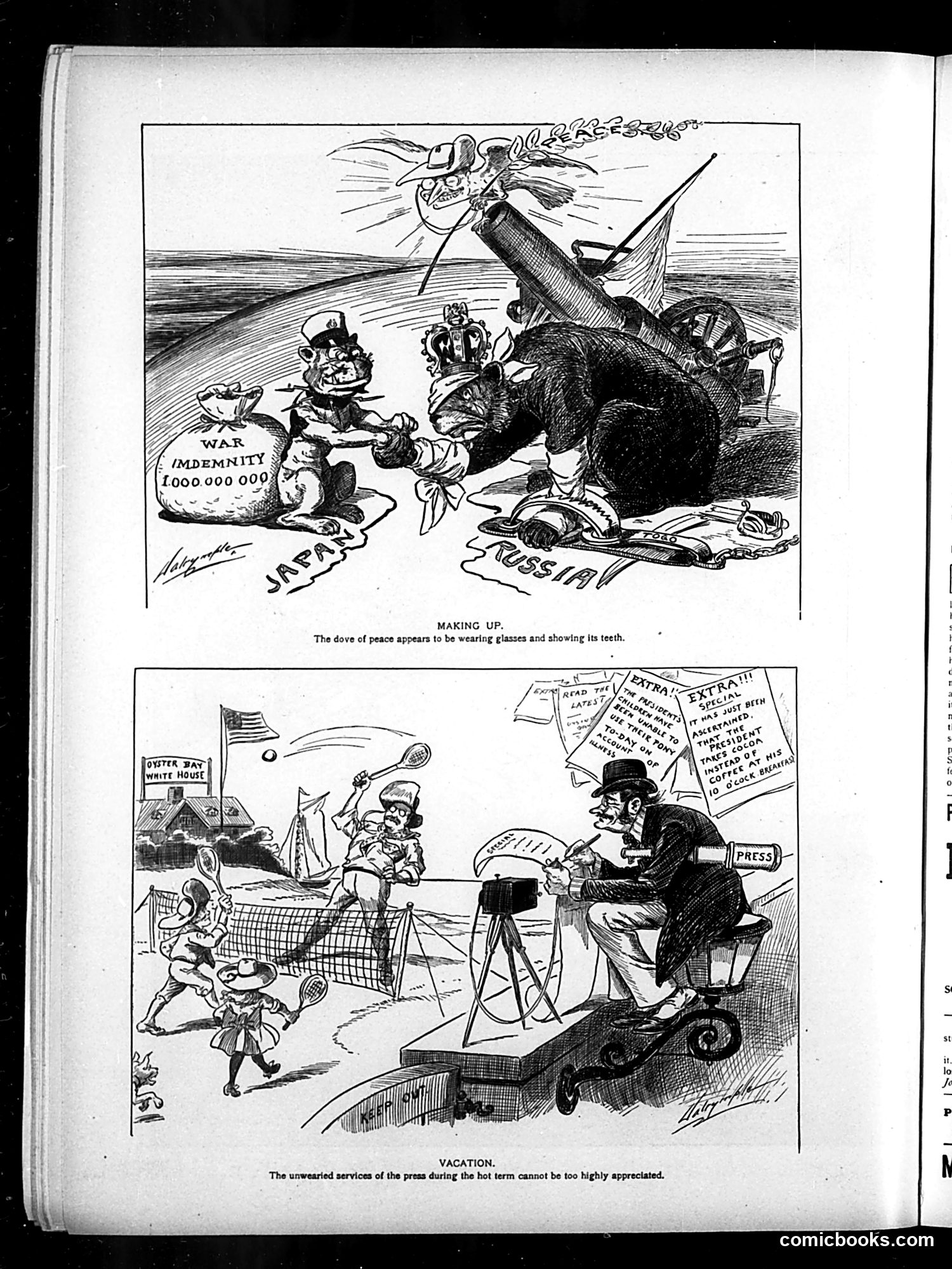
**"Making Up"** (top cartoon): Japan and Russia, depicted as crowned figures, appear to reconcile after conflict, with an enormous indemnity bag labeled "1,000,000,000" between them. The "dove of peace" caption sarcastically notes the dove wears glasses and shows its teeth—suggesting this peace is artificial and aggressive rather than genuine. This likely references post-Russo-Japanese War (1904-1905) negotiations, where Japan secured a massive indemnity from Russia. **"Vacation"** (bottom cartoon): Shows the White House and press representatives at a tennis net. The caption praises the press for working during the "hot term" (summer recess), with newspapers visible behind the press figure. This appears to be gentle satire acknowledging journalists' diligent coverage during a presidential vacation period. Both cartoons use animal/personification metaphors and ironic captions typical of Judge's satirical style.
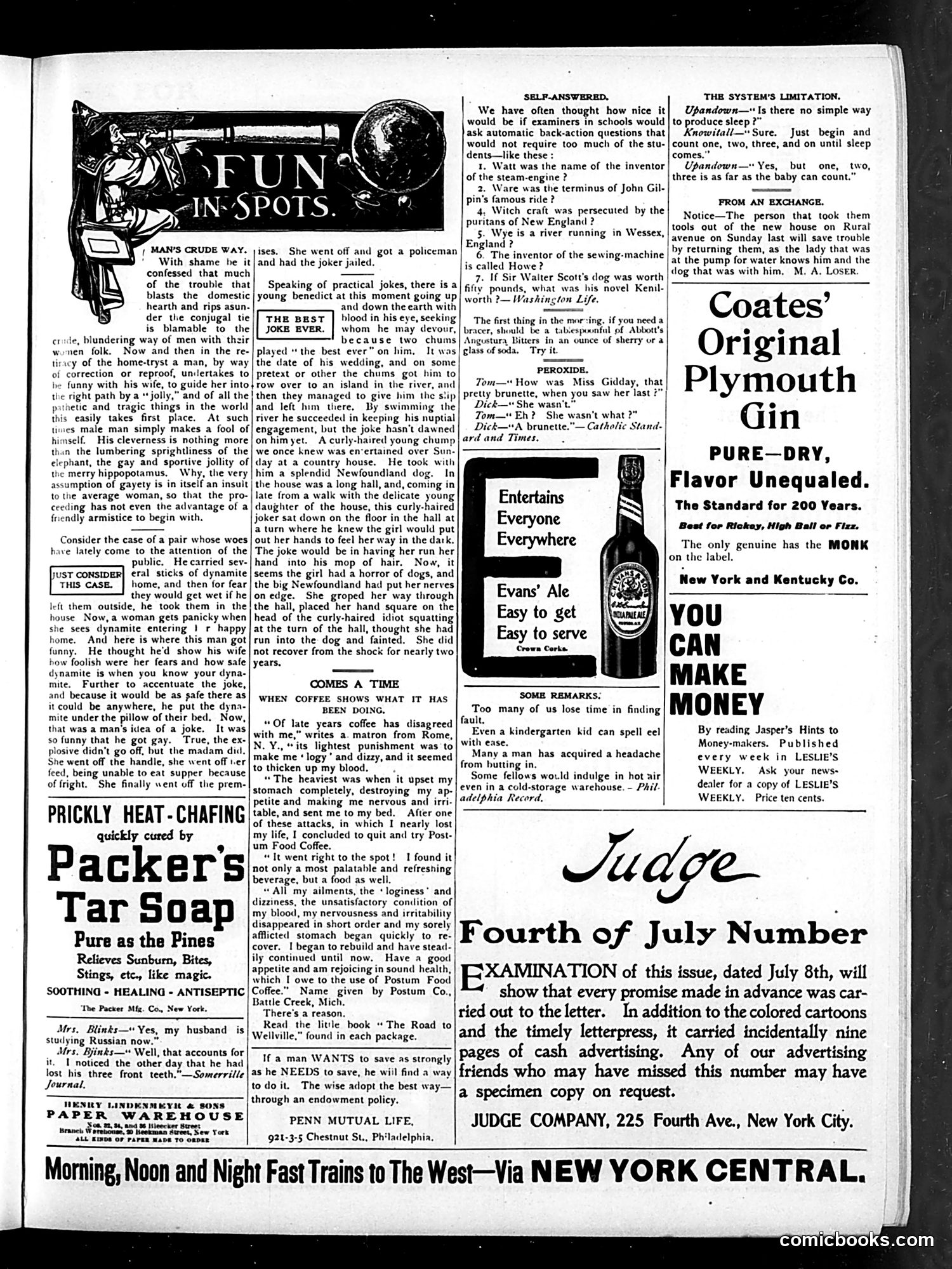
This page satirizes men's dangerously misguided attempts at humor within domestic life. The main cartoon illustrates how husbands' "practical jokes" backfire catastrophically, undermining marital harmony. The featured anecdote describes a husband who places dynamite under their bed as a "joke" to prove it's safe—his wife panics so severely she leaves him and calls police. Additional examples ridicule men hiding under tables to startle women, or placing a curly-haired man where a woman expects a dog, causing her to faint. The satire's point: male attempts at humor reveal stupidity, not wit. Men misread situations, lack emotional intelligence, and cause genuine harm while expecting laughter. The text explicitly condemns this as "lumbering sprightliness"—elephantine and hippopotamic foolishness. For early-20th-century *Judge* readers, this critiqued conventional masculine insensitivity within marriage, framing it as a serious threat to domestic stability.
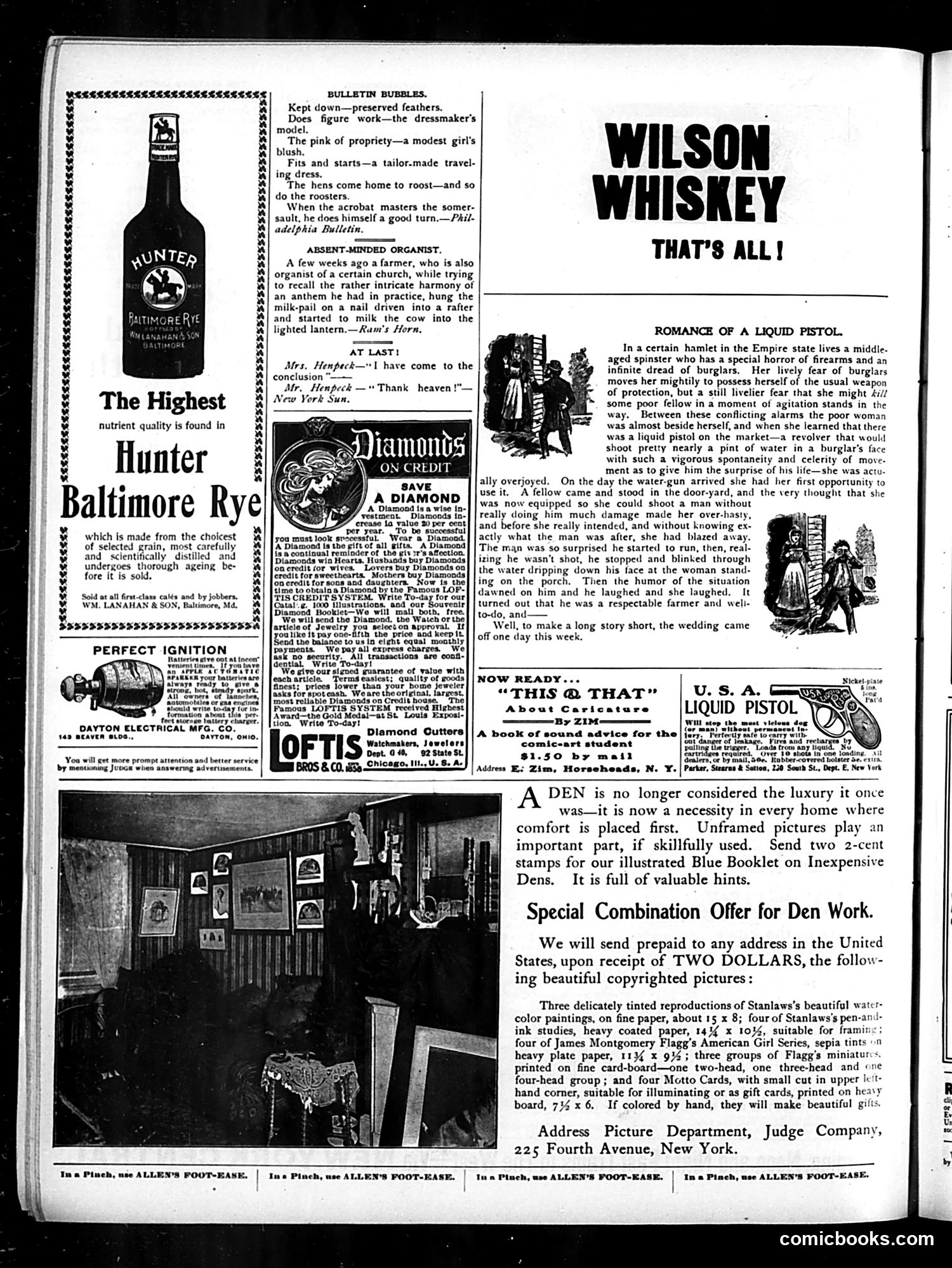
This page is primarily **advertisements and light humor pieces**, not political cartoons. The main illustrated story, "Romance of a Liquid Pistol," is a comedic anecdote about a middle-aged spinster in upstate New York. The joke: She fears burglars but dreads actually shooting someone, so she buys a "liquid pistol" (water gun)—a non-lethal weapon. When a stranger appears at her property, she impulsively shoots him before thinking. Expecting outrage, she's surprised when he laughs. He turns out to be a respectable farmer, and they marry. The satire targets **Victorian anxieties about women and violence**—the contradiction between wanting self-defense and feminine reluctance to cause harm. The "liquid pistol" is a genteel compromise: defensive without being genuinely dangerous. The resolution (marriage to the "victim") plays on period romantic conventions. The other items are puns and brief jokes about everyday situations—no political content. The page is essentially a humor magazine mixed with period advertising for whiskey, jewelry, electrical equipment, and picture books.
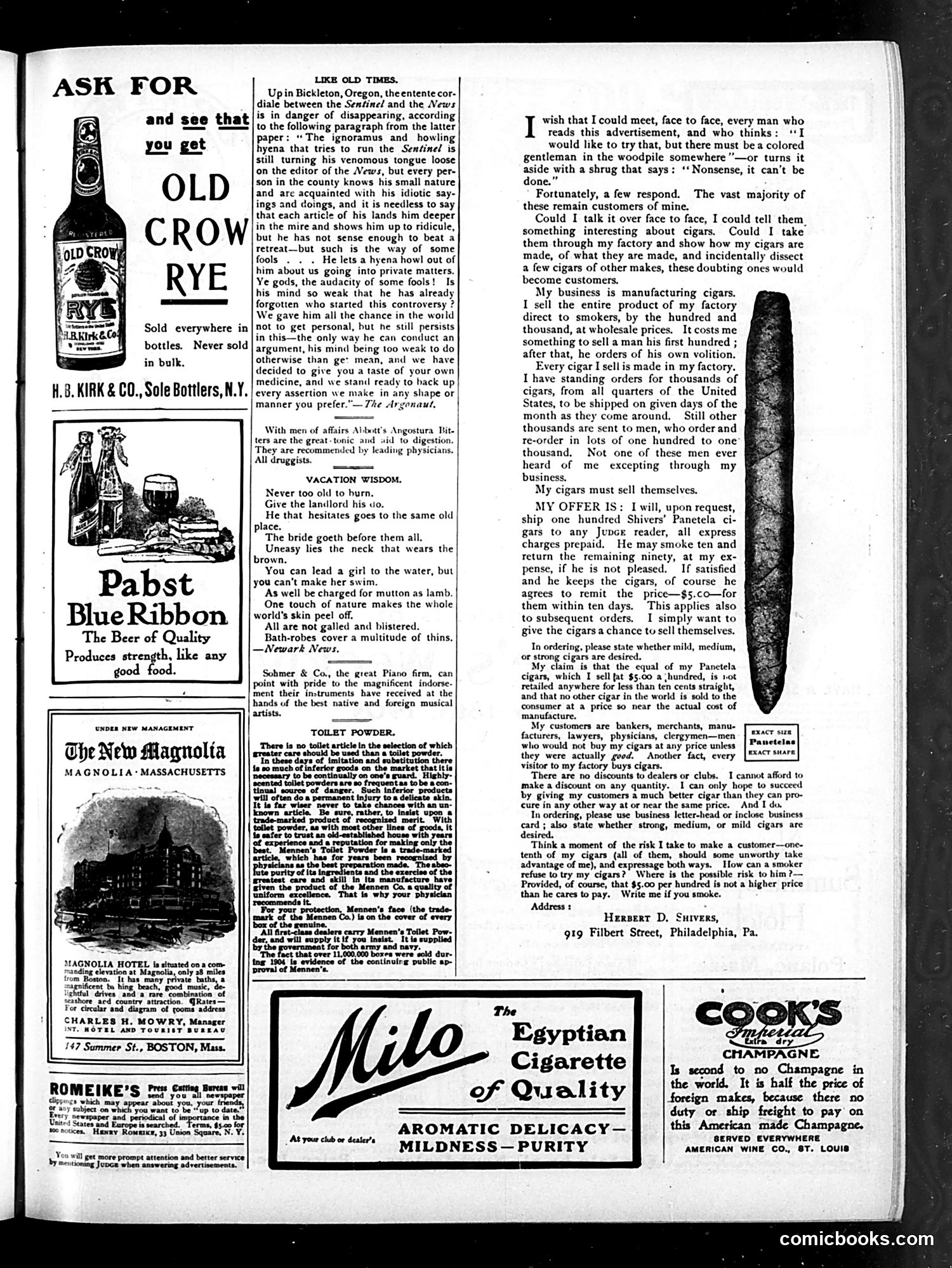
This page is primarily **advertising**, not political satire. It contains multiple product ads (Old Crow Rye whiskey, Pabst Blue Ribbon beer, Magnolia Hotel, Milo cigarettes, Cook's Champagne) interspersed with filler content. The only substantive editorial content is a brief humor section titled "LIKE OLD TIMES," which reprints a comically vicious small-town newspaper feud between two Oregon papers (the *Sentinel* and *News*). The satire mocks how rural editors resort to personal insults rather than substantive argument—calling each other "ignoramus," "hyena," and "fools." The "VACATION WISDOM" section offers light, punny aphorisms ("Never too old to burn"). There's also an extended cigar-manufacturer's pitch attempting to overcome customer skepticism about mail-order quality. The page reflects early 20th-century *Judge* magazine's mix of advertising revenue and light editorial content, with no significant political commentary visible.
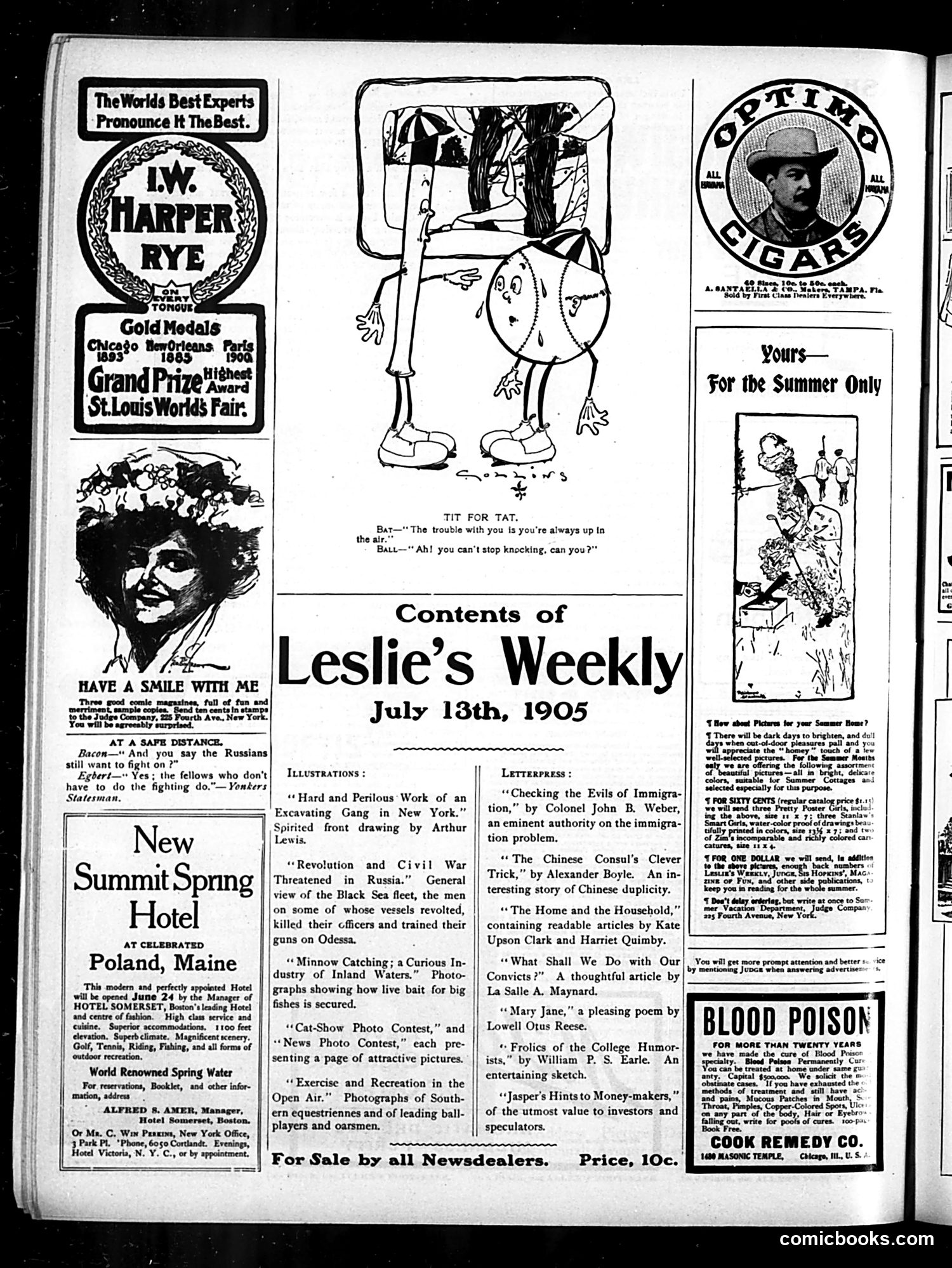
This is primarily a **contents/title page** for Leslie's Weekly magazine, not a political cartoon page. The small cartoon shown—"Tit for Tat"—depicts two bats in wordplay: one criticizes the other for being "always up in the air," and the second responds that the first "can't stop knocking." This is generic satirical humor, not political commentary. The page highlights the magazine's contents, including articles on **contemporary 1905 issues**: the Russian Revolution and naval mutinies at Odessa (referenced in "Revolution and Civil War Threatened in Russia"), immigration policy, and Chinese diplomacy. These reflect real international tensions of the era. The advertisements—for a Maine hotel, I.W. Harper Rye whiskey, and a "Blood Poison" remedy—are period-typical. Overall, this functions as a magazine index rather than a satirical editorial statement.
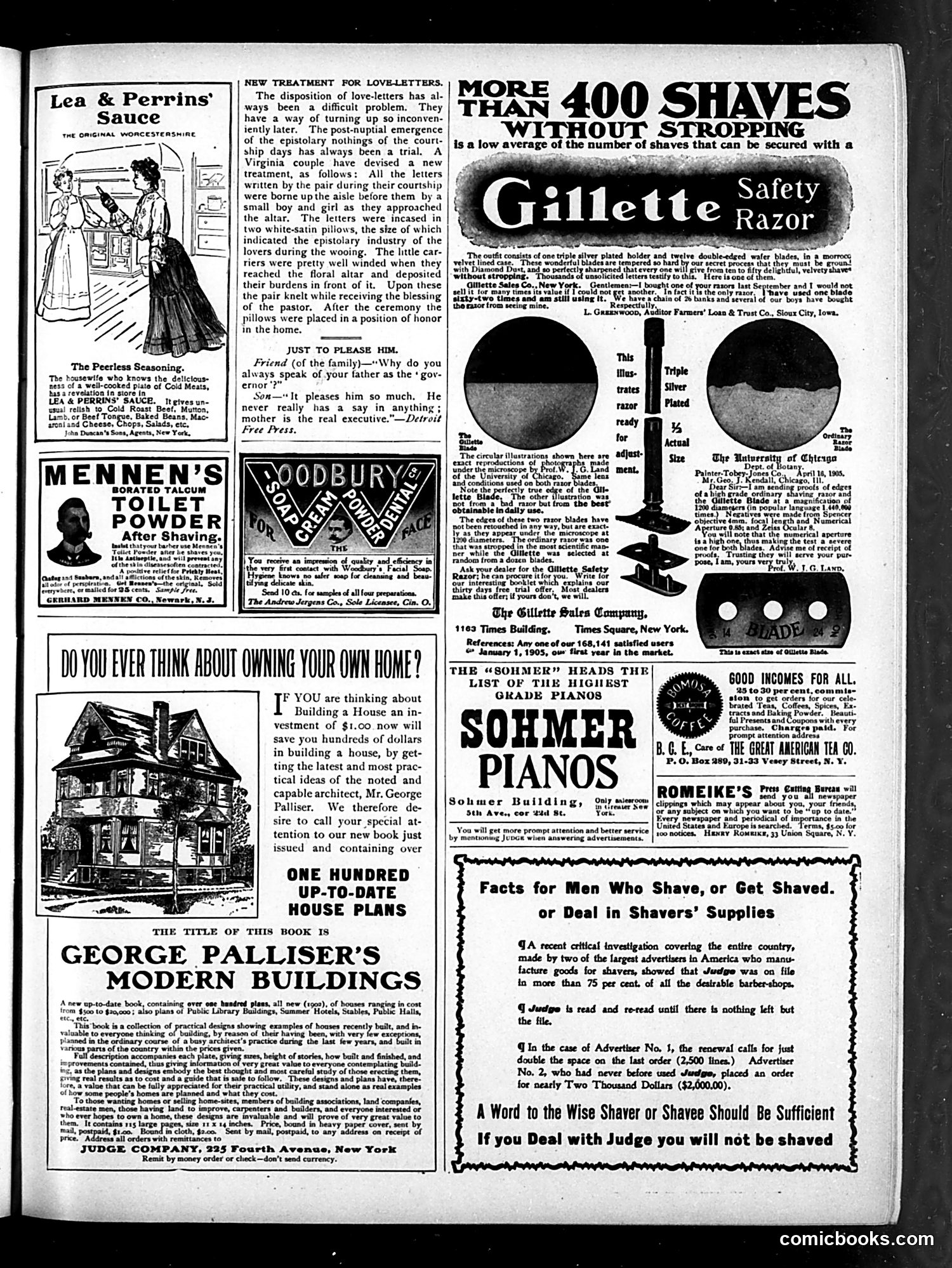
This page is primarily **advertisements and light humor pieces**, not political satire in the traditional sense. The main content includes: **"New Treatment for Love-Letters"** — A humorous anecdote about a Virginia couple who carried their courtship letters in two white-satin pillows down the wedding aisle, solving the problem of embarrassing old love-letters surfacing after marriage. The joke rests on the couple's prolific correspondence creating visibly large pillows. **"Just to Please Him"** — A brief comedic dialogue where a son explains he calls his father "the governor" because it pleases him, even though his mother is actually in charge. This reflects early 20th-century gender dynamics where wives controlled household decisions while husbands maintained nominal authority. The remainder of the page consists of **product advertisements** (Lea & Perrins Sauce, Gillette Safety Razors, Sohmer Pianos, house plan books) typical of *Judge* magazine's revenue model. No significant political figures or events are referenced.
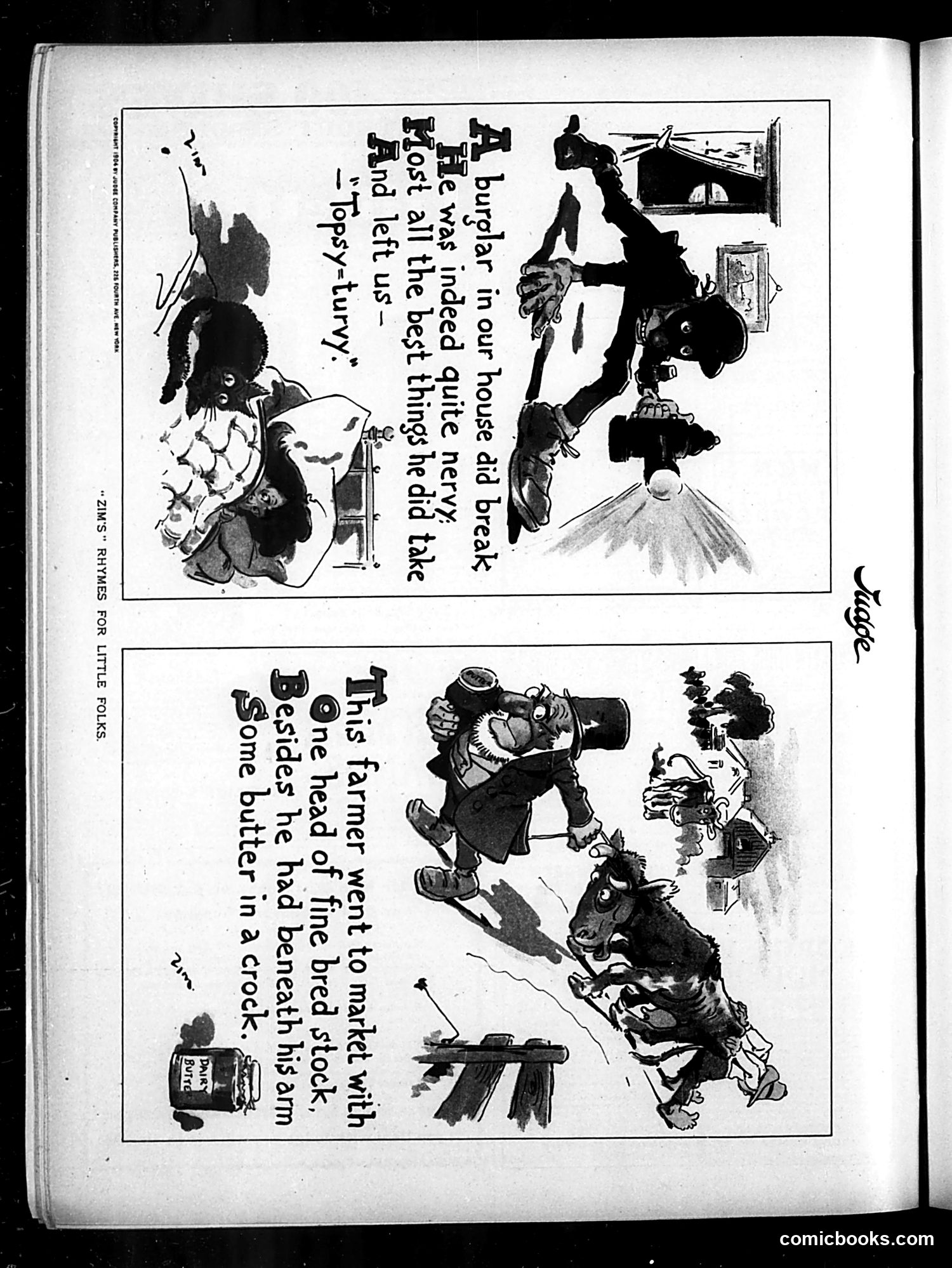
This page contains two separate satirical cartoons from *Judge* magazine. The top cartoon depicts a burglar ("A Burglar in our house") stealing valuables while the homeowners are distressed—likely satirizing home invasions or property crime concerns of the era. The bottom cartoon shows a farmer going to market with livestock and butter, captioned "Topsy-turvy," suggesting the farmer's priorities or the market situation are inverted or absurd in some way. The visual appears to depict the farmer in an undignified or compromised position relative to his goods. Without additional context or publication date, the specific political or social targets remain unclear, though both appear to use exaggerated situations to mock contemporary anxieties about crime, commerce, or rural life.