
A complete issue · 52 pages · 1902
Judge — December 20, 1902
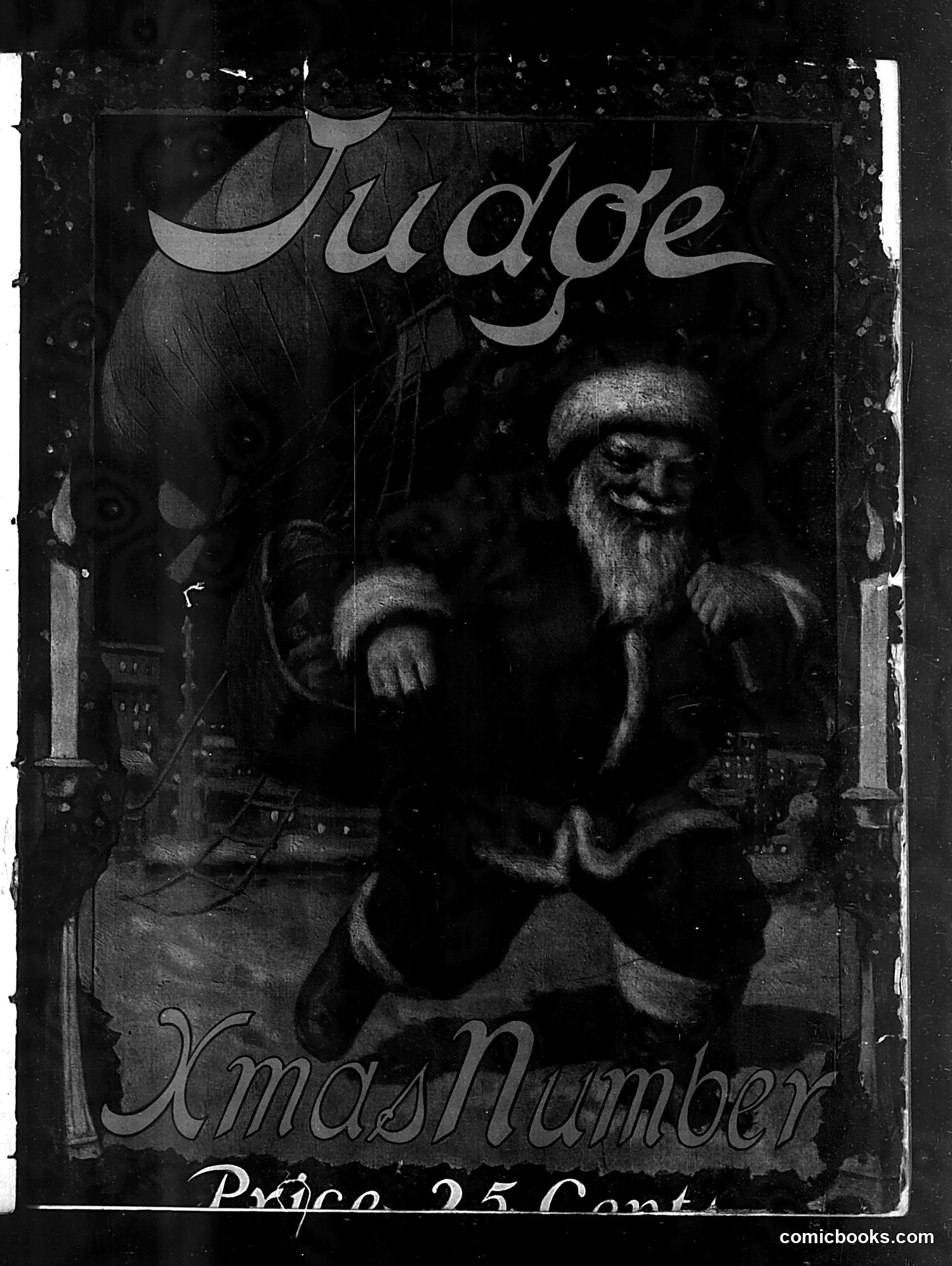
This is a **Judge magazine Christmas issue** (indicated by "Xmas Number" and price of 25 cents). The cover features a bearded Santa Claus figure with what appears to be an elf or gnome-like character, rendered in the satirical black-and-white illustration style typical of early 20th-century Judge. The specific political or social satire is **unclear from the visible text alone**. Without readable OCR content explaining the cartoon's context, I cannot definitively identify which contemporary figures or events are being mocked. The artistic style and composition suggest this tackles holiday-related social commentary typical of Judge's satirical approach, but the precise target remains uncertain from this image alone.
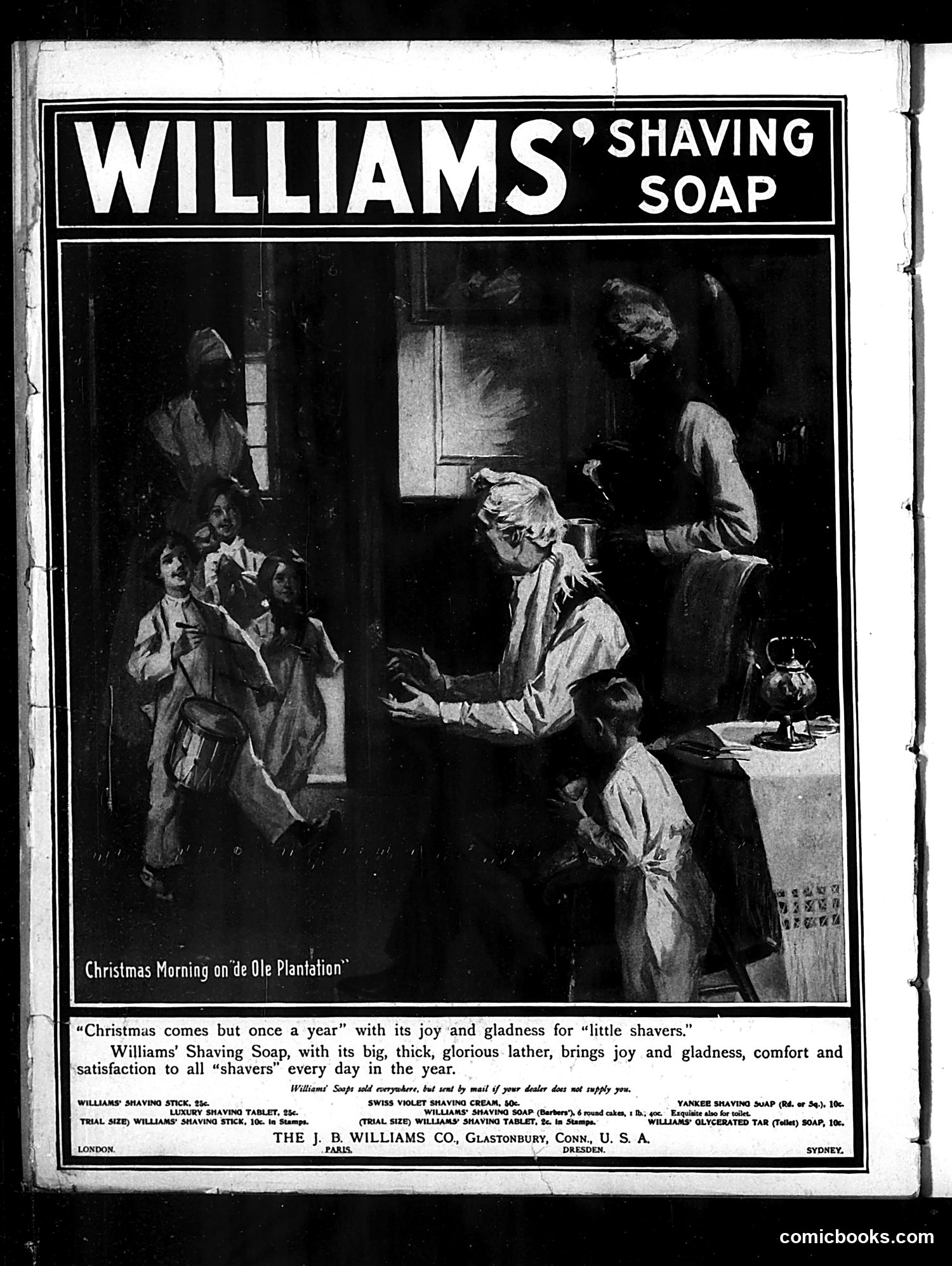
This is primarily **advertising, not editorial content**. It's a full-page advertisement for Williams' Shaving Soap from The J.B. Williams Co., with locations in London, Paris, Glastonbury Connecticut, Dresden, and Sydney. The image depicts a scene titled "Christmas Morning on de Ole Plantation" showing what appears to be enslaved people receiving shaving products as gifts. The advertisement uses this nostalgic plantation imagery to market shaving soap, claiming it brings "joy and gladness" to "shaving" year-round. By modern standards, this represents deeply offensive racial imagery and exploitation of slavery-era nostalgia for commercial purposes—a common advertising practice in early 20th-century America that romanticized plantation life while ignoring its brutal realities.
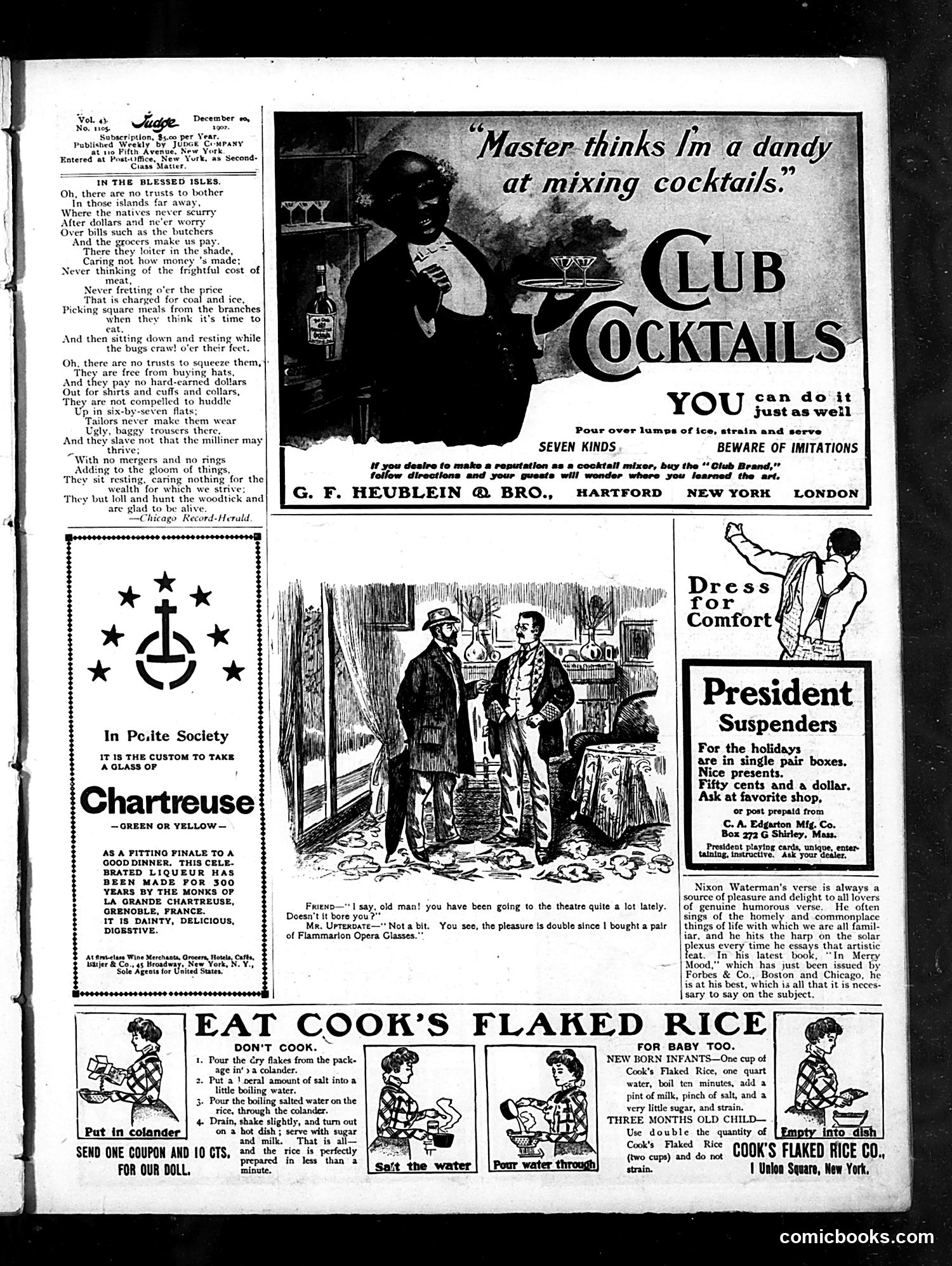
This page is primarily **advertising** rather than political satire. The dominant content includes: **Club Cocktails ad** (top): Promotes a cocktail recipe book by G.F. Heublein & Bro., using a blackface caricature of a servant claiming bartending expertise. This reflects deeply racist 1920s advertising conventions. **Central cartoon**: Shows two well-dressed men discussing theater attendance and opera glasses—lighthearted social commentary on leisure activities among the wealthy. **Product ads**: President Suspenders, Chartreuse liqueur, and Cook's Flaked Rice occupy remaining space with period-appropriate marketing imagery. The page reflects early 20th-century consumer culture and advertising norms, including now-offensive racial imagery that was commonplace in publications of this era.
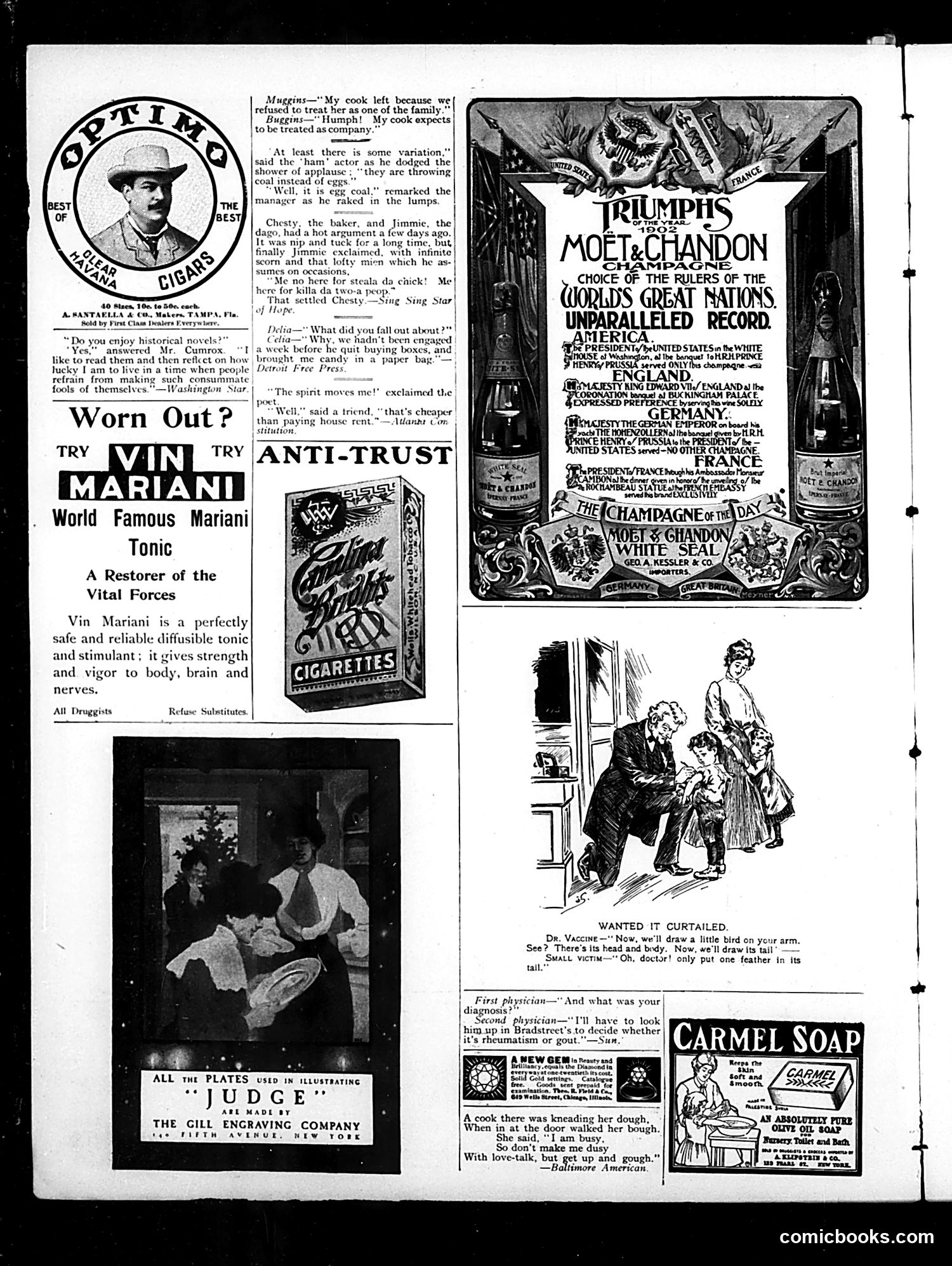
This page is primarily **advertising**, not political satire. It contains four distinct ads: 1. **Optimo Cigars** - features a man in a hat; ad emphasizes quality cigars from Tampa, Florida 2. **Vin Mariani Tonic** - advertises a "World Famous" wine-based tonic claimed to restore "vital forces," promising strength for "body, brain and nerves" 3. **Moet & Chandon Champagne** - elaborate ornate ad celebrating the brand as "champagne of the day" 4. **Carmel Soap** - promotes olive oil soap The page also includes an illustration labeled "Judge" showing what appears to be a domestic scene, credited to the Gill Engraving Company. These ads reflect early 20th-century patent medicine marketing and luxury goods promotion, with health claims that would now be considered fraudulent or misleading.
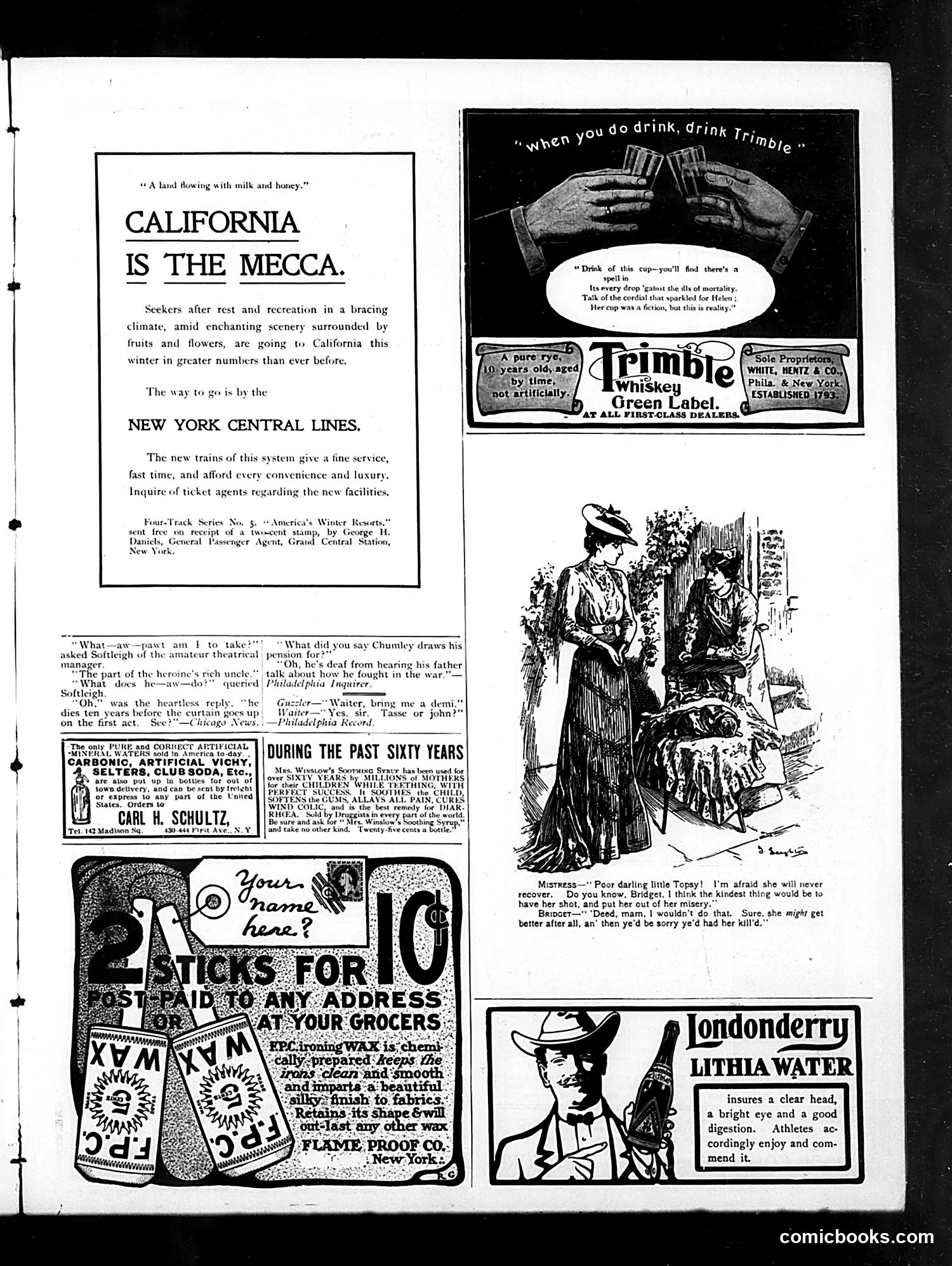
This page is primarily **advertising** interspersed with brief satirical humor snippets typical of Judge magazine's format. **Main Content:** The dominant advertisement promotes California travel via New York Central Lines, using the biblical phrase "land flowing with milk and honey" to market California as a winter resort destination. **Satirical Cartoons/Jokes:** Several small comic exchanges mock theatrical and social pretensions: an amateur actor who dies before the play even begins; deaf performers; and a waiter misunderstanding a drink order. **Social Context:** The advertisements reveal period concerns: ironing wax (for clothing care), patent medicines (Carl H. Schultz's bottled waters), and Trimble Whiskey. The joke about the Irish servant (Bridget) and her mistress reflects era-typical stereotypes about domestic workers. The overall page reflects early 20th-century consumer culture and upper-class leisure, with Judge's characteristic mix of lightweight social satire and commercial promotion targeting affluent readers.
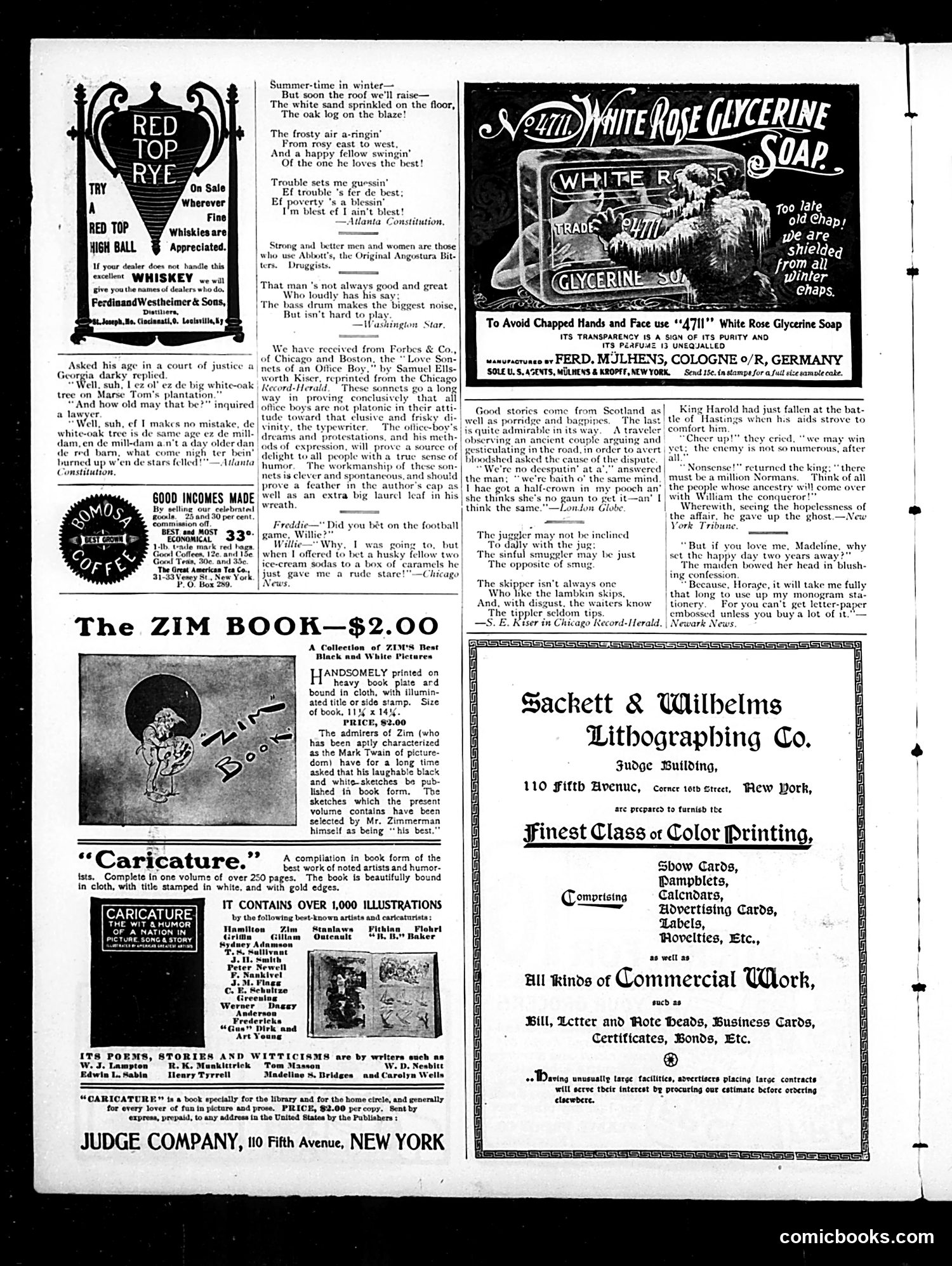
This page is **primarily advertising and promotional content** rather than political cartoons. The dominant elements are: **Main Features:** - **The Zim Book ($2.00)**: A collection of over 250 pages of black-and-white cartoons and humorous sketches by "Zim" (characterized as the "Mark Twain of Kingdom"), featuring 1,000+ illustrations by prominent cartoonists - **Various product advertisements**: Red Top Rye whiskey, White Rose Glycerine Soap, Abbot's Angostura Bitters, and Promod's Coffee **Comic/Humorous Content:** Small jokes scattered throughout, including a dialogue about a young man betting on football and a racial dialect joke about a Georgia man's age (reflecting period racism common in Judge). The page reflects early 20th-century advertising and entertainment marketing rather than serious political satire. The emphasis on the Zim Book suggests Judge was promoting cartoon collections to readers, capitalizing on public appetite for illustrated humor.
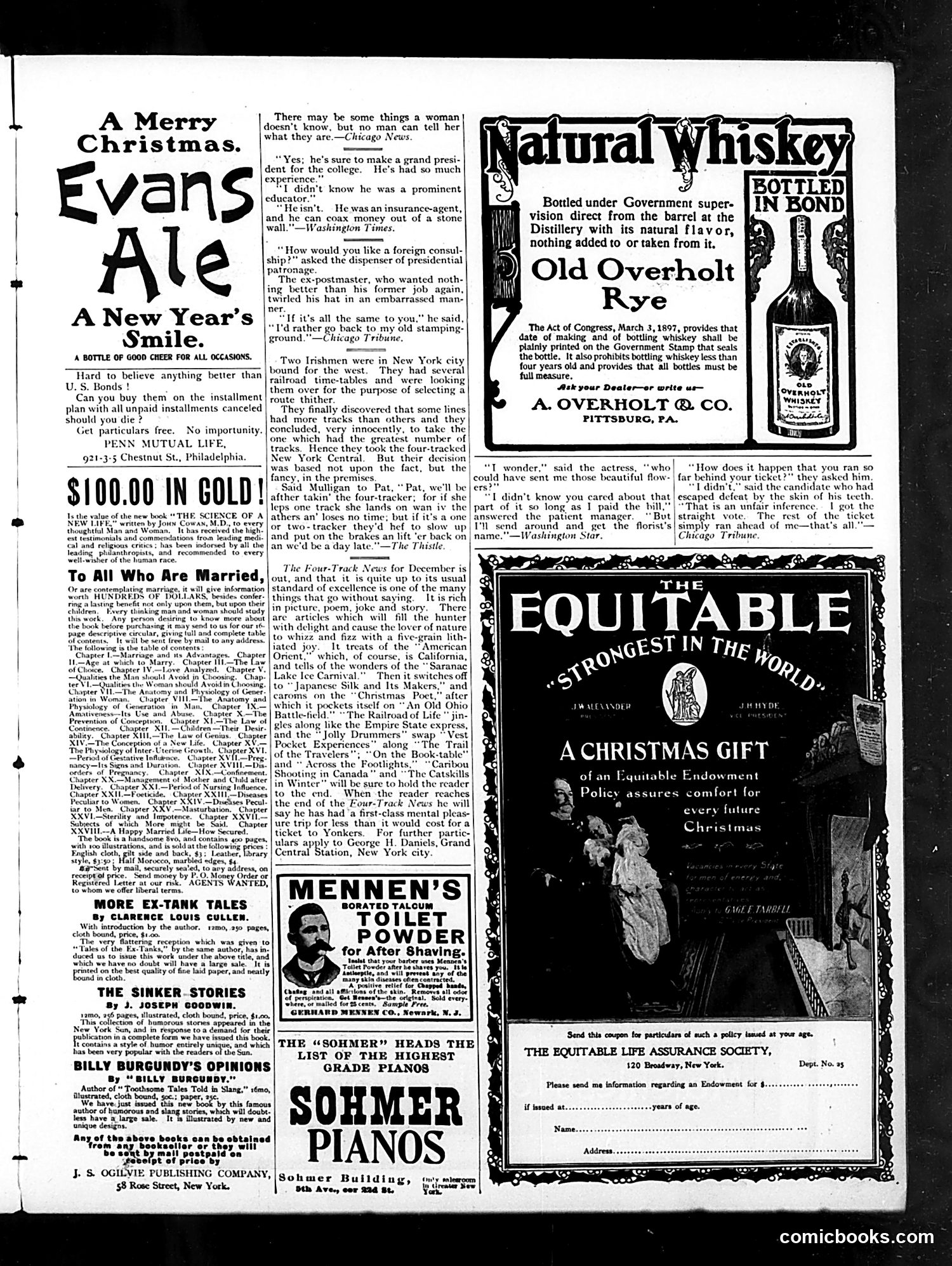
This page is **primarily advertising** with minimal editorial cartoon content. The advertisements dominate, promoting books, insurance, whiskey, pianos, and toilet powder. The few satirical elements are brief anecdotes in the left column: - A joke about a college president who was merely an insurance agent—mocking credential inflation in academia - A quip about a postmaster refusing a foreign consulship to keep his old job—poking fun at bureaucratic careerism - A humorous story about travelers naively choosing a railroad route based on having "four tracks" rather than understanding what that meant—gentle satire of rural/unsophisticated travelers These are lightweight social humor rather than sharp political commentary. The page reflects Judge's focus on genteel, middle-class satire—modest jabs at pretension, incompetence, and naïveté—rather than hard-hitting political cartooning. The advertising volume suggests the magazine relied heavily on commercial revenue by this era.
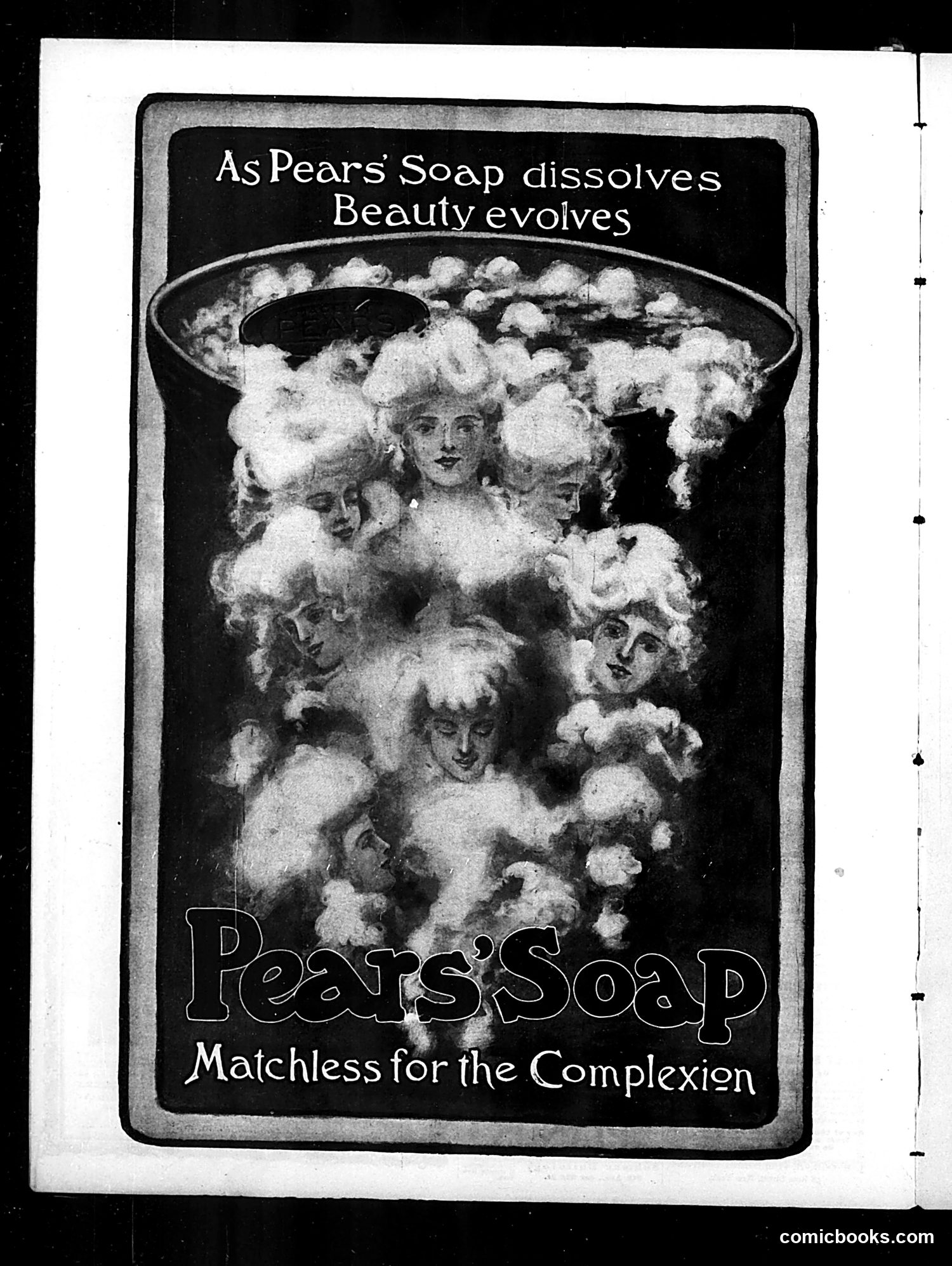
This is a **commercial advertisement**, not political satire. It promotes Pears Soap with the slogan "As Pears' Soap dissolves, Beauty evolves" and claims the product is "Matchless for the Complexion." The image shows multiple female faces emerging from soap suds in a bathtub, apparently meant to illustrate the transformative effect of the soap on women's complexions. The visual metaphor suggests that using Pears Soap will reveal or enhance natural beauty. This reflects late 19th/early 20th-century beauty advertising that made exaggerated claims about soap's skin-improving properties. The romantic, ethereal presentation of the women's faces was typical marketing imagery of the era, appealing to contemporary beauty standards and consumer desires for improved appearance.
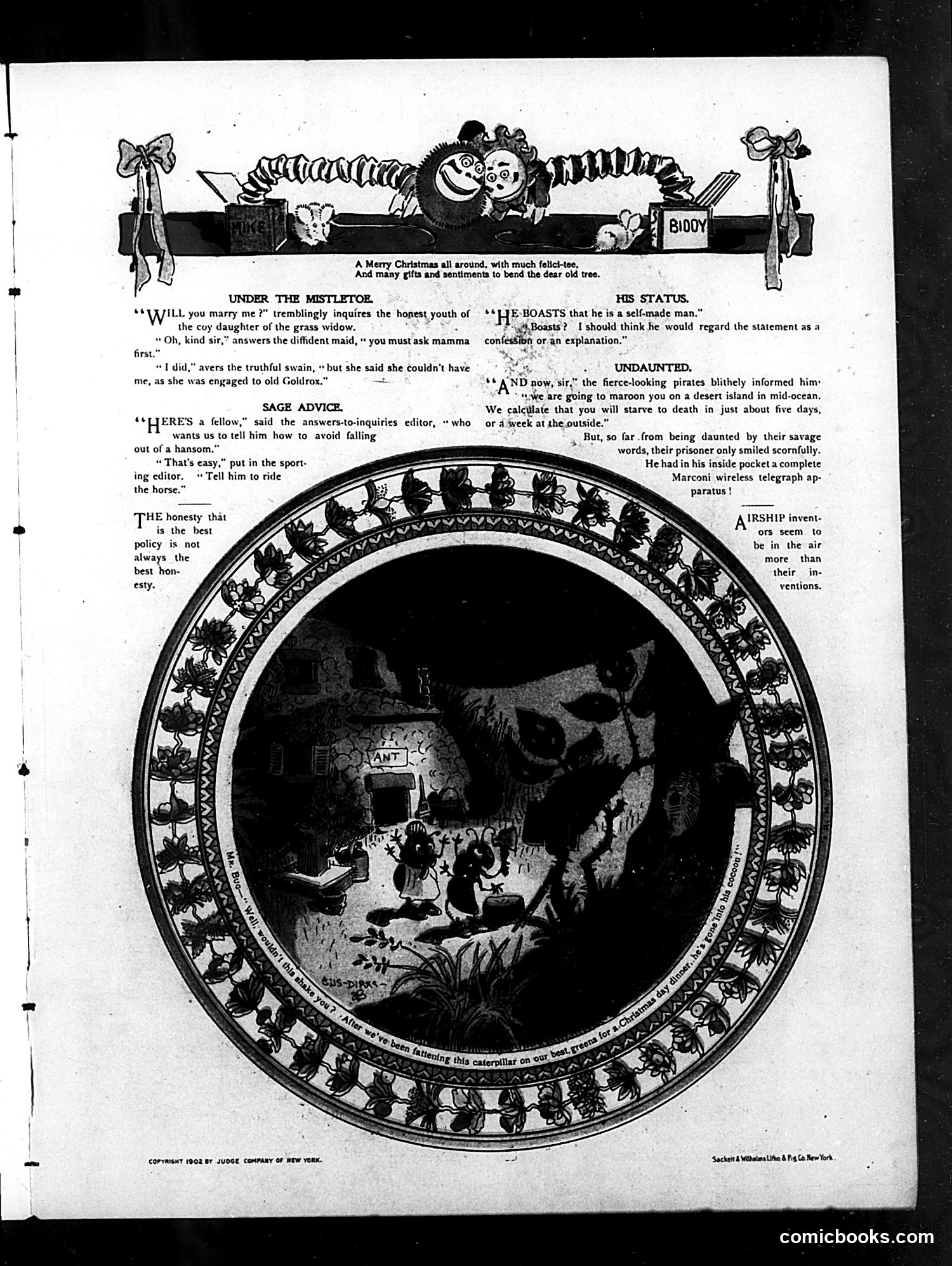
This Christmas-themed page from *Judge* contains several short satirical pieces mocking contemporary social types and technologies: **"Under the Mistletoe"** mocks the awkward marriage proposal, where a suitor must ask not the woman but her mother (a "grass widow"—a separated/divorced woman). The humor lies in outdated courtship formality. **"His Status"** ridicules the self-made man boast as essentially a confession of humble origins—a dig at Gilded Age pretension. **"Undaunted"** satirizes the obsession with new wireless telegraph technology (Marconi apparatus). The joke: a marooned prisoner smugly believes he'll survive because he has a wireless telegraph, though the pirates clearly meant to strand him without rescue options. It mocks blind faith in technology. **"Sage Advice"** and the final note on airship inventors are brief quips about honesty and technological speculation. The ornate circular frame depicts a Christmas party scene. Overall, the page pokes fun at dating customs, social climbing, and contemporary enthusiasm for new inventions—typical *Judge* targets for educated, urban readers.
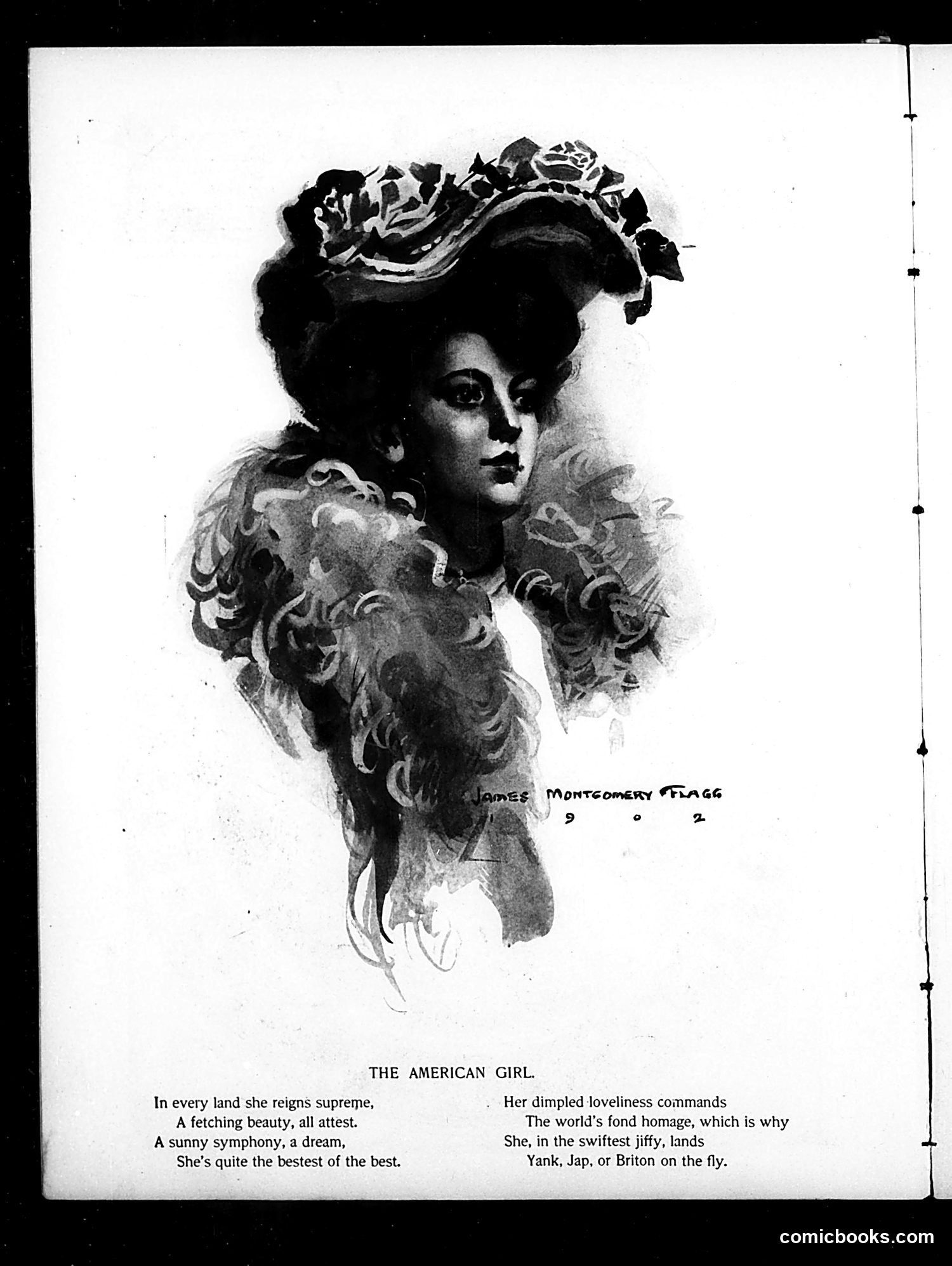
This is a portrait illustration by James Montgomery Flagg from Judge magazine celebrating "The American Girl." The accompanying poem praises American women as universally superior in beauty and appeal—they "reign supreme" globally and command admiration from men of all nationalities ("Yank, Jap, or Briton"). The satire reflects early 20th-century American cultural confidence and nationalism, depicting the American woman as the ultimate prize of international desirability. The references to Japanese and British men suggest a competitive, tongue-in-cheek boast about American cultural superiority. The illustration's fashionable Gibson Girl-style appearance—elaborate hat, feathered collar, refined features—epitomizes the idealized American feminine beauty standard of that era, presented here as irresistibly charming to the world.
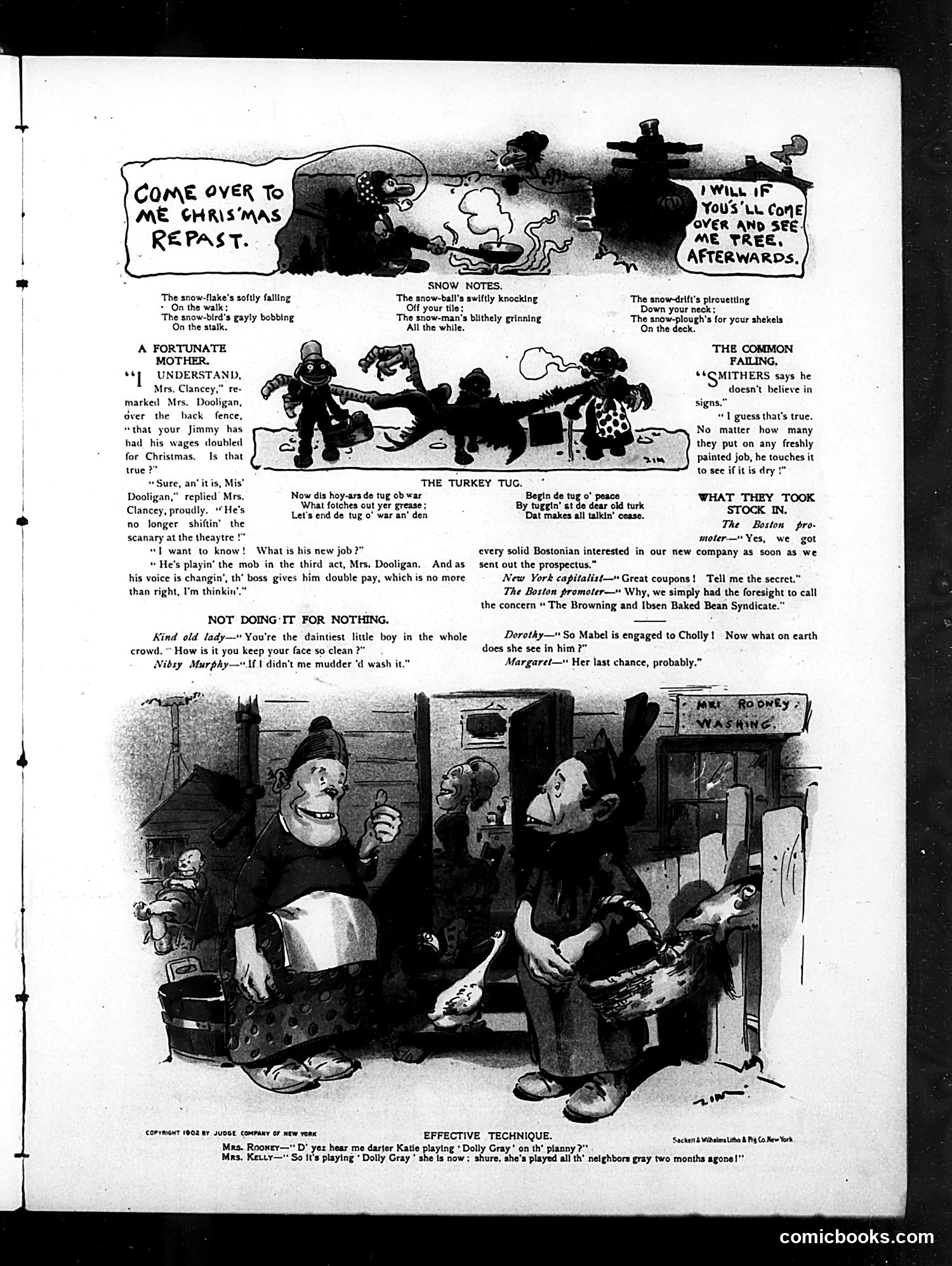
This page contains multiple short satirical pieces typical of Judge magazine's humor: **Snow Notes & Christmas sketches** (top): Lighthearted winter seasonal humor with visual gags about snow and snowmen—no political content. **"A Fortunate Mother"**: Irish-dialect humor about a boy named Jimmy whose wages doubled for Christmas because he's now playing "the mob" in a theater production. The joke: his changing voice during adolescence makes him valuable to the stage. **"The Turkey Tug"**: Appears to reference Boston investors and a baked bean company prospectus, satirizing how changing a company's name to sound literary ("The Browning and Ibsen Baked Bean Syndicate") attracts capital—mocking both Boston's pretensions and investor gullibility. **"Effective Technique"** (bottom): Irish working-class humor where a woman brags her daughter plays piano so much the neighbors are "gray" from hearing it—playing on the popular song "Dolly Gray." The page reflects 1902 attitudes: ethnic dialect humor (Irish), class commentary, and gentle satire of business practices and cultural pretension.
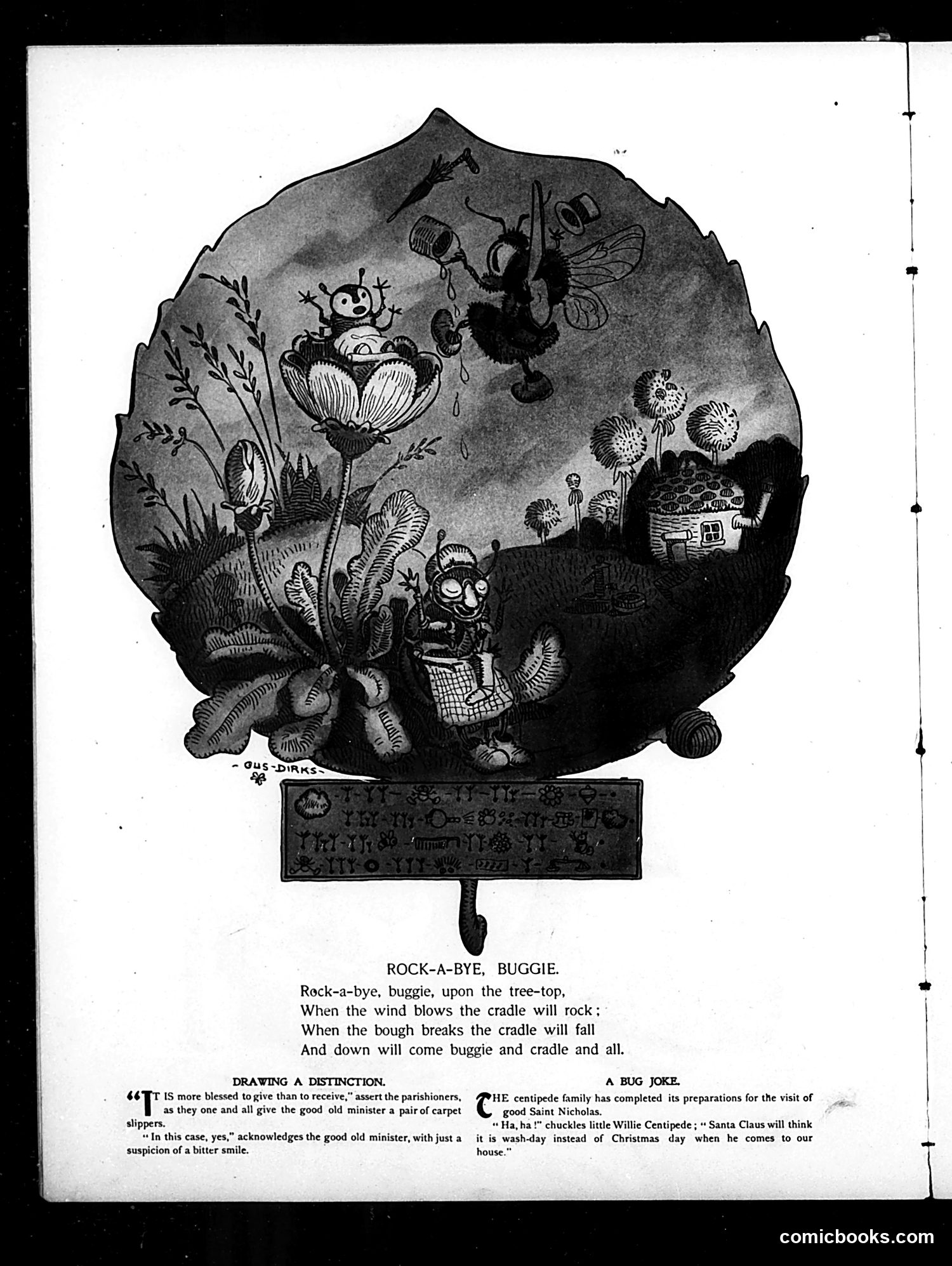
This page contains three distinct pieces of humor: **"Rock-a-bye, Buggie"** (main illustration): A whimsical parody of the nursery rhyme "Rock-a-bye Baby," reimagined with anthropomorphic insects in a fantastical garden scene. The cradle-in-tree setup is replaced with insects in flowers and landscape elements. It's lighthearted children's humor rather than political satire. **"Drawing a Distinction"**: A gentle joke about a minister receiving carpet slippers as a gift from parishioners. The minister's "bitter smile" suggests mild irony—while the Bible states "it is more blessed to give than to receive," the parishioners are clearly giving *to* him, not the reverse. **"A Bug Joke"**: A pun-based joke where little Willie Centipede jokes that Santa Claus will think the centipede household's many legs hanging to dry constitute "wash-day" rather than Christmas preparations. All three are light domestic humor typical of Judge's family-oriented content, with no apparent political commentary or social satire.
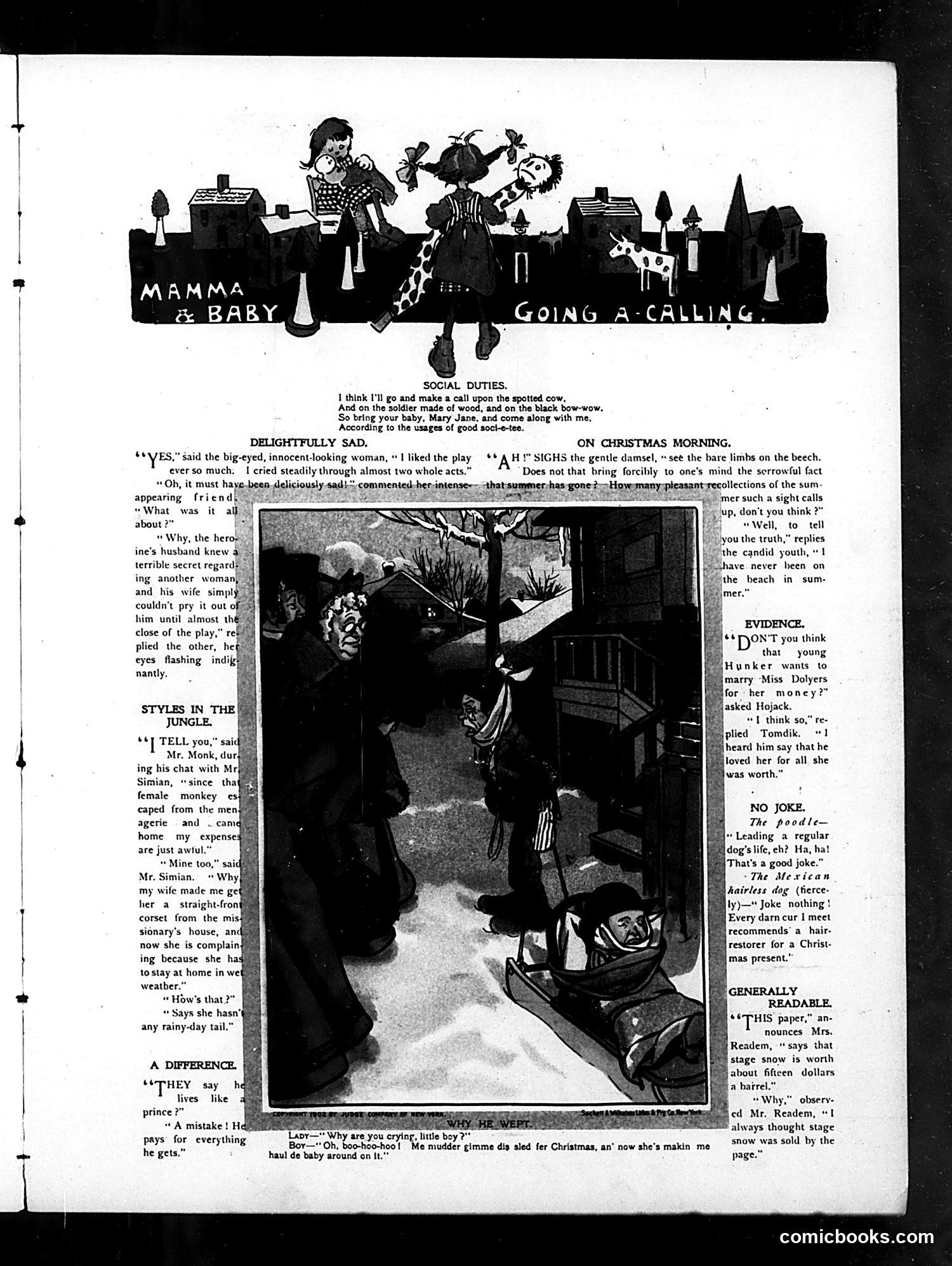
This page contains multiple short satirical pieces mocking Victorian social conventions and contemporary absurdities: **"Mama & Baby Going A-Calling"** (top): Parodies rigid social etiquette by showing a woman making "calls" on inanimate objects (a cow, wooden soldier, dog) as if following formal visiting protocols—satirizing how mechanistic and silly upper-class social rituals had become. **"Social Duties"** and related pieces: Mock sentimental Victorian culture—women crying at plays they claim to enjoy, the contrived sadness of Christmas nostalgia, and pretentious conversation. **"Styles in the Jungle"**: Jokes about women's tight-laced corsets by comparing them to a monkey's wife complaint—physical discomfort presented as marital comedy. **"No Joke"**: Puns on dog breeds and hair-restoration products, typical period humor. The central photograph appears to show a theatrical scene, supporting the page's focus on stage performance and social performance/pretense. Overall, Judge ridicules Victorian propriety, feminine sentimentality, and consumerism through accessible wordplay and domestic scenarios.
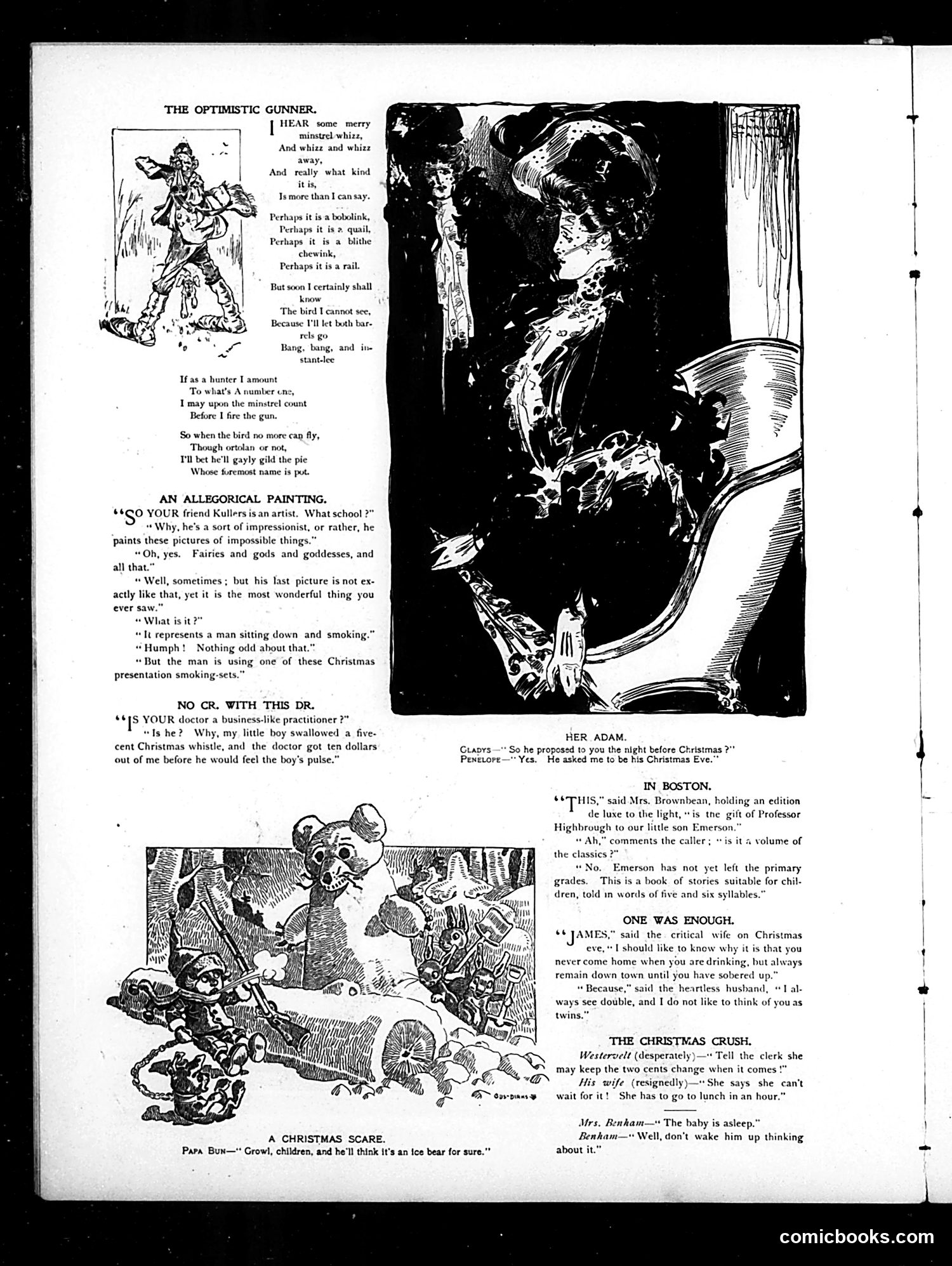
This page collects several short humorous pieces satirizing American middle-class life around Christmas: **"The Optimistic Gunner"** mocks a hunter so incompetent he can't identify birds by sound, yet confidently fires blindly—the joke being his overconfidence despite obvious ignorance. **"An Allegorical Painting"** satirizes pretentious art criticism: a friend claims an artist paints "impossible things," but his masterpiece is merely a man smoking a cheap Christmas novelty pipe—exposing how critics inflate mediocrity into profundity. **"No Cr. with This Dr."** jokes about doctors' greed: a physician charges $10 merely to feel a child's pulse after swallowing a whistle, suggesting medical practitioners exploit parental worry. **Other brief pieces** mock Christmas excess and domestic absurdities: a professor gift-wrapping simplified children's books as "classics," a drunk husband avoiding home because double-vision makes his wife appear duplicated, and a wife obsessed with retrieving two cents change. The satire targets pretension, commercialism, and the anxieties of aspiring middle-class Americans during the Christmas season.
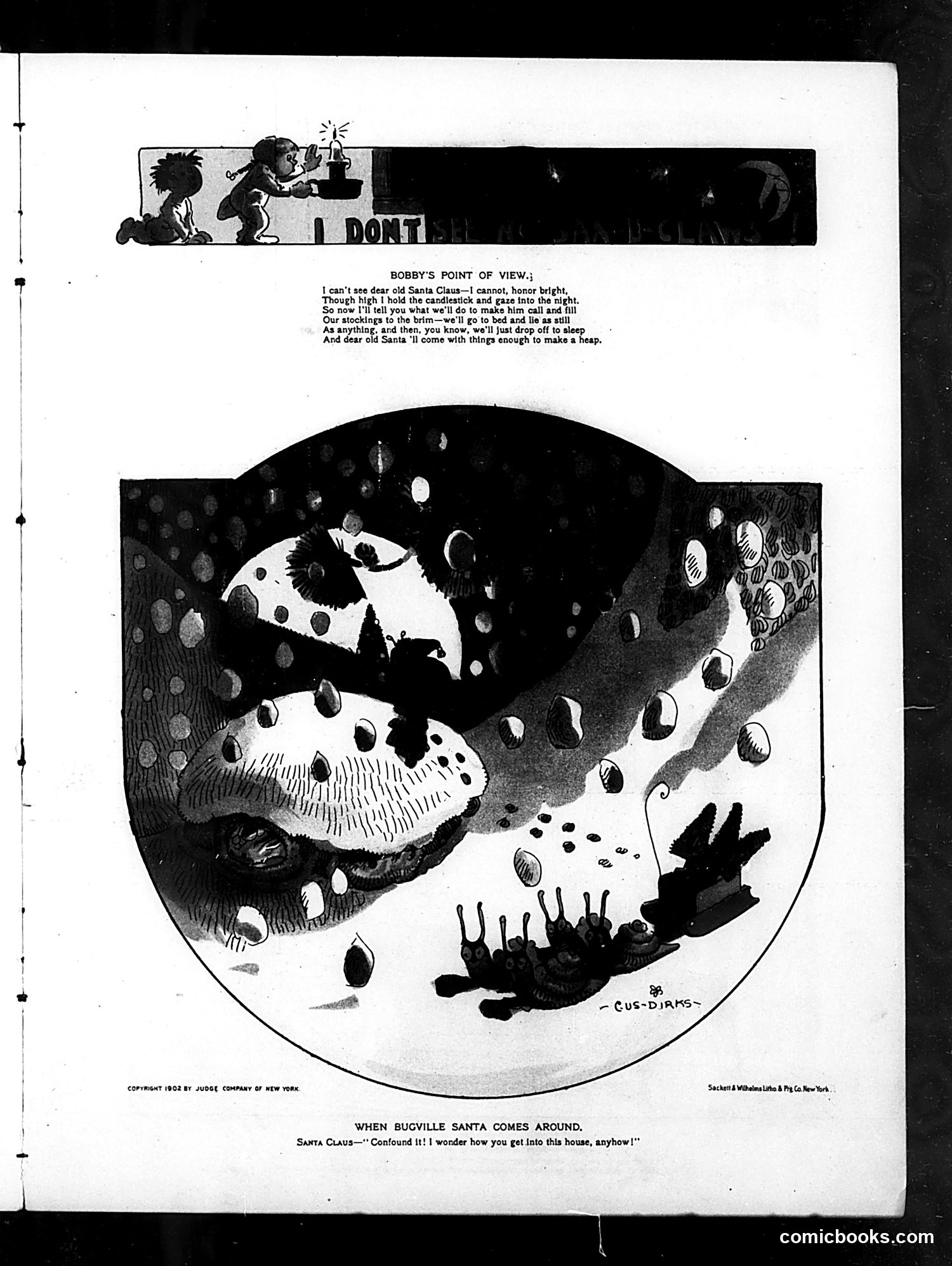
This 1902 *Judge* magazine page contains two Christmas-themed comics: **"Bobby's Point of View"** (top): A child's innocent logic about seeing Santa Claus. Bobby reasons that since he can't see Santa despite holding a candlestick high, the solution is to go to sleep—then Santa will come fill the stockings. The satire gently mocks childish reasoning: the child unknowingly describes the actual mechanics of parental gift-giving. **"When Bugville Santa Comes Around"** (bottom): A surreal illustration showing Santa navigating an insect-filled underground world. Santa appears confused about how he entered this strange "house," suggesting confusion or bewilderment. "Bugville" appears to be a whimsical setting populated by insects and creatures. Both comics trade in gentle, family-appropriate humor typical of *Judge*'s Christmas content—poking fun at childhood innocence and creating imaginative scenarios rather than sharp political satire.
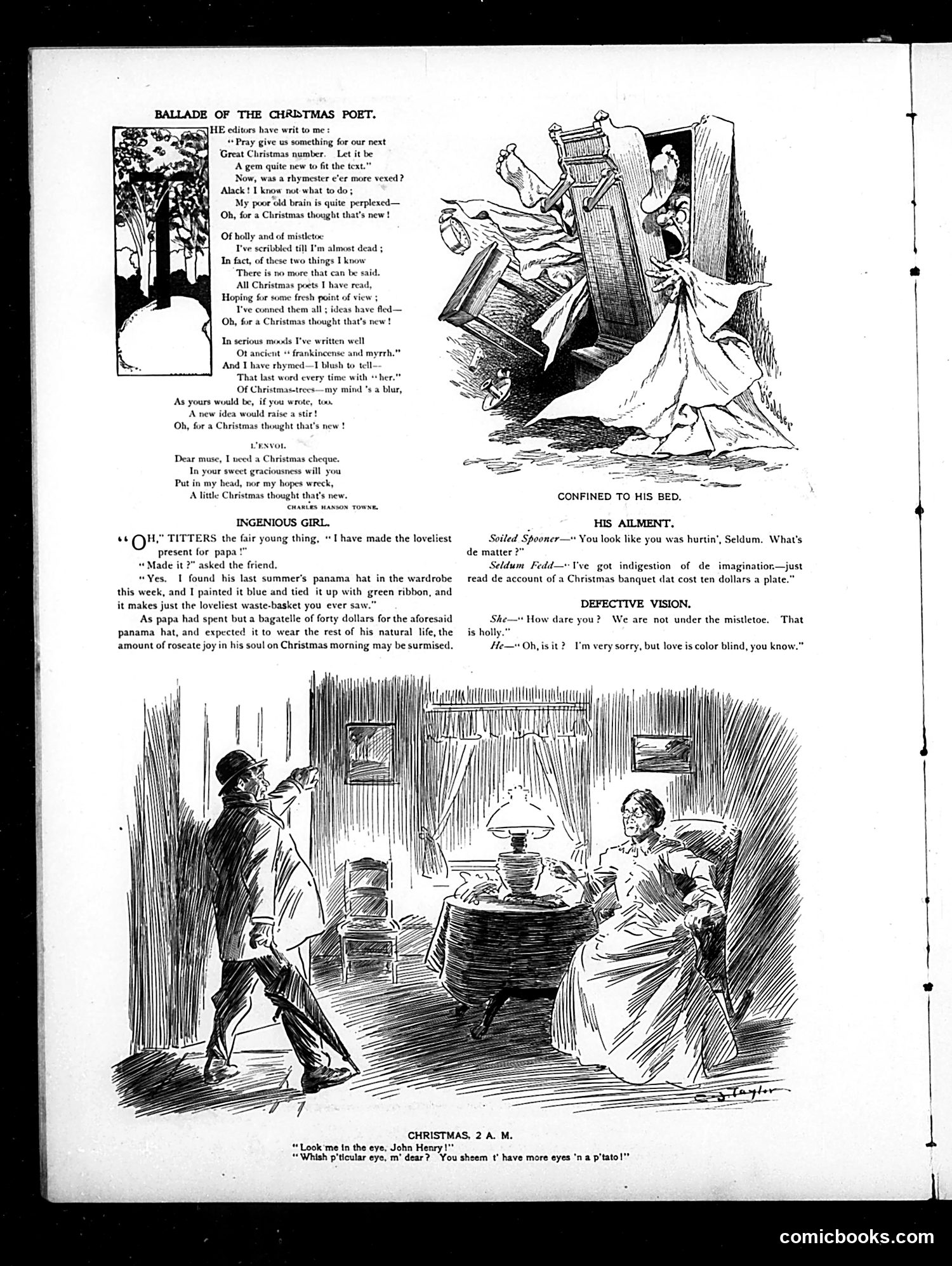
This page from *Judge* magazine contains Christmas-themed humor circa early 1900s: **"Ballade of the Christmas Poet"**: A meta-joke about the magazine's own editorial demands. The poet complains he's exhausted all Christmas topics (holly, mistletoe, frankincense, myrrh, Christmas trees) and desperately needs a fresh idea—yet the editors keep demanding one anyway. It's self-aware satire about creative burnout. **"Ingenious Girl"**: A girl proudly shows her father she's repurposed his expensive Panama hat ($40—significant money then) as a waste-basket by painting it blue with green ribbon. The joke is her "ingenuity" has destroyed something valuable, yet she expects praise. **"His Ailment" and "Defective Vision"**: Brief comedic exchanges. One character claims Christmas banquet reading caused "indigestion of imagination"; another uses mistletoe/holly confusion as a pretext for unwanted kissing. **"Christmas 2 A.M."**: A drunk person sees double, asking which of someone's eyes to look into—implying intoxication from Christmas celebrations. The overall tone mocks Christmas excess, creative exhaustion, and holiday indulgence.
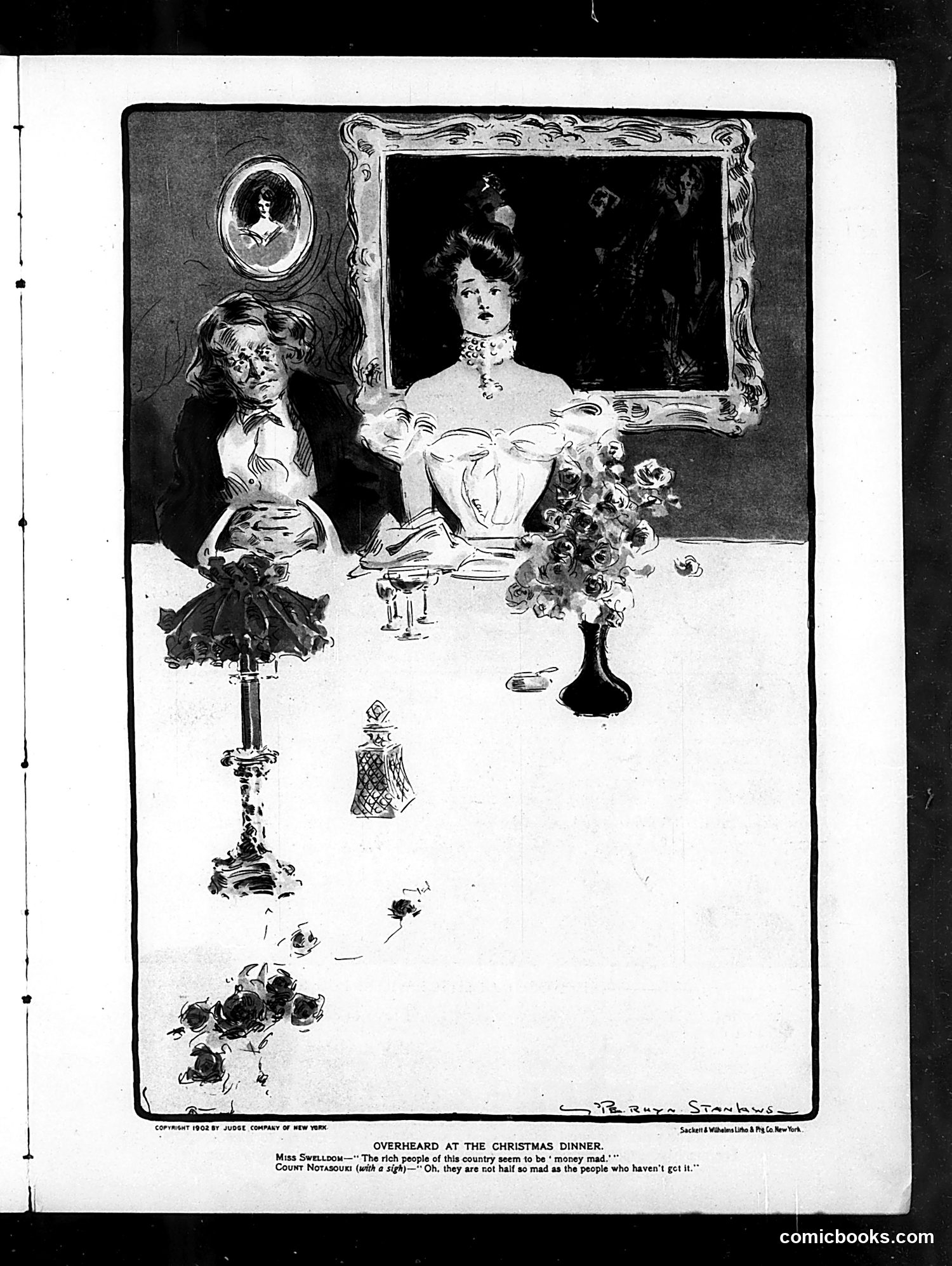
This cartoon satirizes wealth inequality during the Gilded Age. Miss Swetloon, an American woman, complains that rich people are "money mad." Count Norasouski, a European nobleman, responds with worldly cynicism: the poor are even *more* obsessed with money than the wealthy—they're desperate to acquire it. The joke deflates American moral superiority about wealth. Rather than endorsing Miss Swetloon's criticism, the Count suggests that desire for money is universal and perhaps more frantic among those lacking it. The ornate dinner setting, expensive objects (flowers, champagne glasses), and the woman's jewelry underscore the irony: they're discussing greed while surrounded by luxury. This reflects Judge's typical target audience: wealthy, educated readers who could appreciate sardonic commentary on their own class anxieties and pretensions.
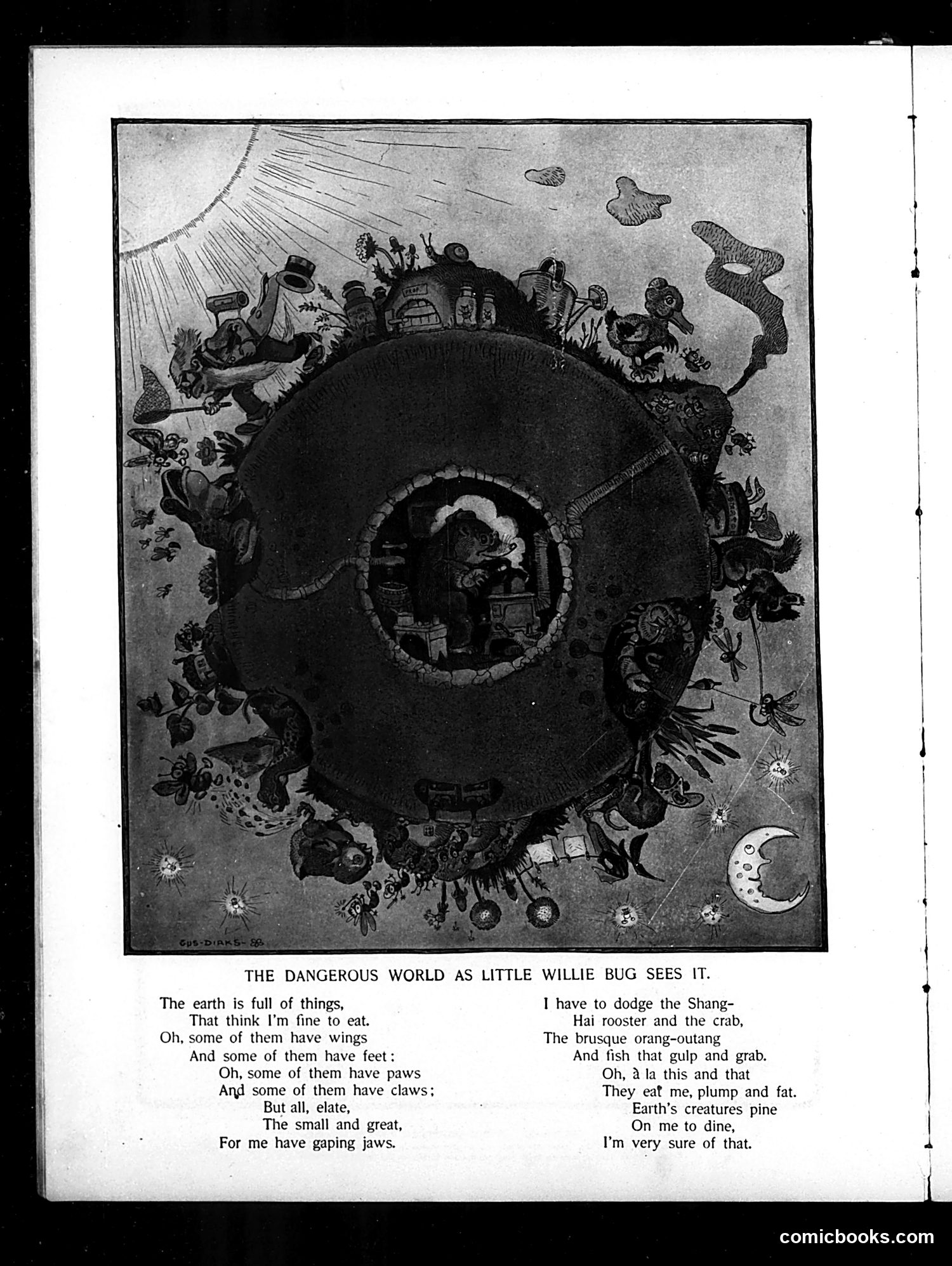
This is a humorous children's verse illustrated from the perspective of "Little Willie Bug"—an anthropomorphized insect viewing the world as a series of predators threatening to eat him. The cartoon depicts a globe or spherical world surrounded by various animals and creatures: birds, crabs, an orangutan, fish, and other beasts. The central circle shows Willie Bug's view from inside, with threatening creatures arranged around the perimeter like a menacing ring. The satire works on two levels: it's lighthearted children's humor about a bug's paranoia regarding natural predators, but also appears to be social commentary using the bug as an everyman figure facing overwhelming external dangers. The poem reinforces this anxiety—every creature, regardless of size or form, is depicted as a potential threat. The work likely appeared in *Judge* magazine as gentle satirical commentary on how vulnerable or ordinary individuals might view a hostile, predatory world.
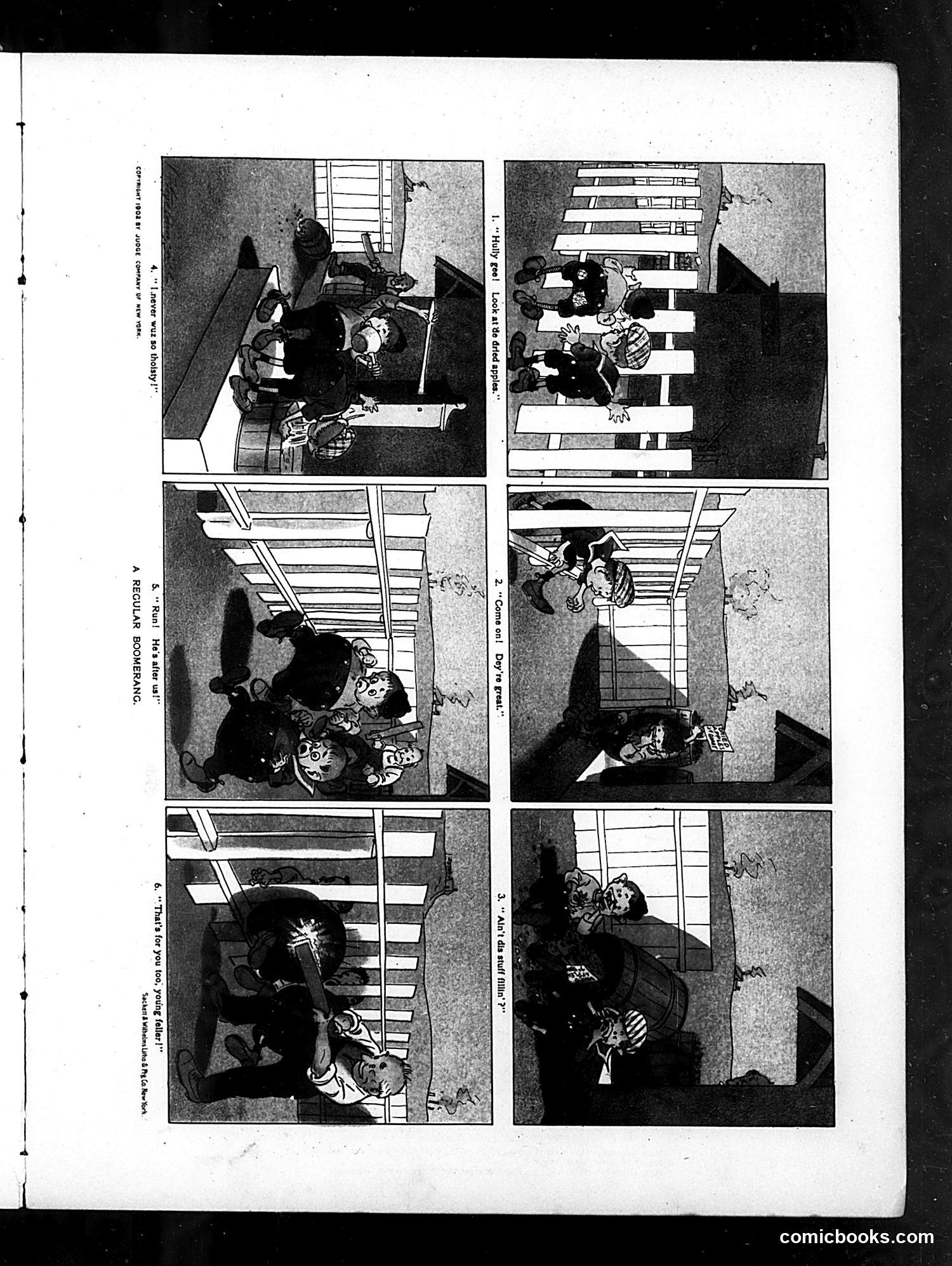
This six-panel satirical sequence depicts someone's plan backfiring comically. The narrative appears to show a figure attempting some scheme that progressively goes wrong, with each panel rotating the image to suggest physical chaos or reversal of fortune—hence the "boomerang" title, meaning an action that rebounds harmfully on its originator. The specific political or social target is unclear without additional context, though the 1902 date suggests possible references to contemporary events or social behaviors Judge magazine frequently mocked. The rotated panels create visual humor by disorienting the reader, emphasizing the subject's loss of control. The lithographic credit indicates professional production quality typical of Judge's satirical comics of this era.
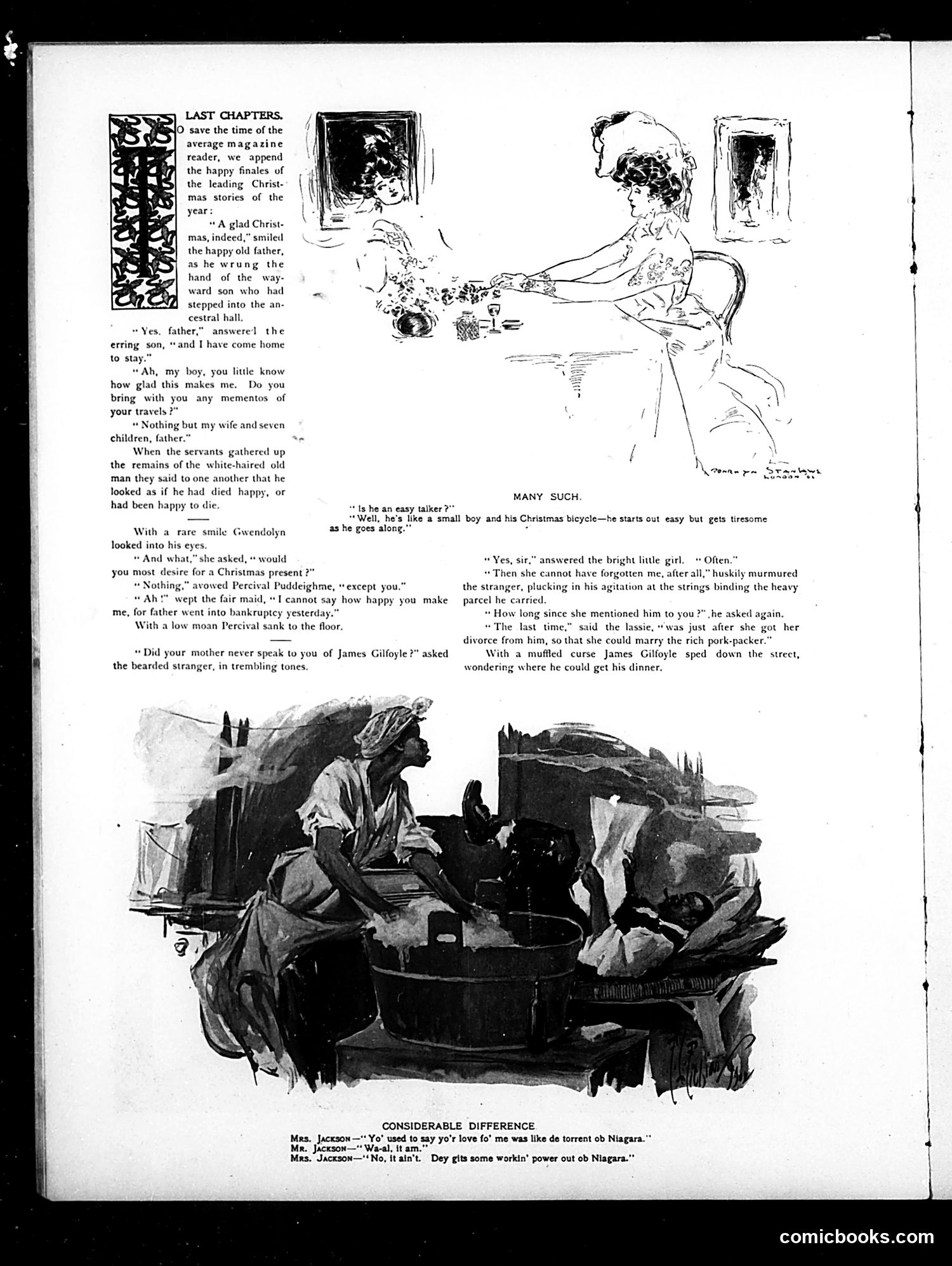
This page satirizes the formulaic, melodramatic endings of sentimental Christmas stories popular in early 20th-century magazines. The "Last Chapters" section mocks their predictable plots through exaggerated scenarios: - An erring son returns with a wife and seven children, causing the father to literally die from shock/joy - A poor suitor offers only love as a Christmas gift, while his beloved's father conveniently goes bankrupt - A mysterious stranger searches for a lost love, only to learn she divorced the man in question to marry a wealthy "pork-packer" The "Considerable Difference" cartoon below jokes about marital disappointment: a wife recalls her husband once compared his love to Niagara Falls' power, but now he's as unreliable as the actual river's hydroelectric output. The satire targets both the absurd coincidences of sentimental magazine fiction and the gap between romantic courtship promises and marriage reality—humor accessible to readers fatigued by overwrought seasonal sentimentality.
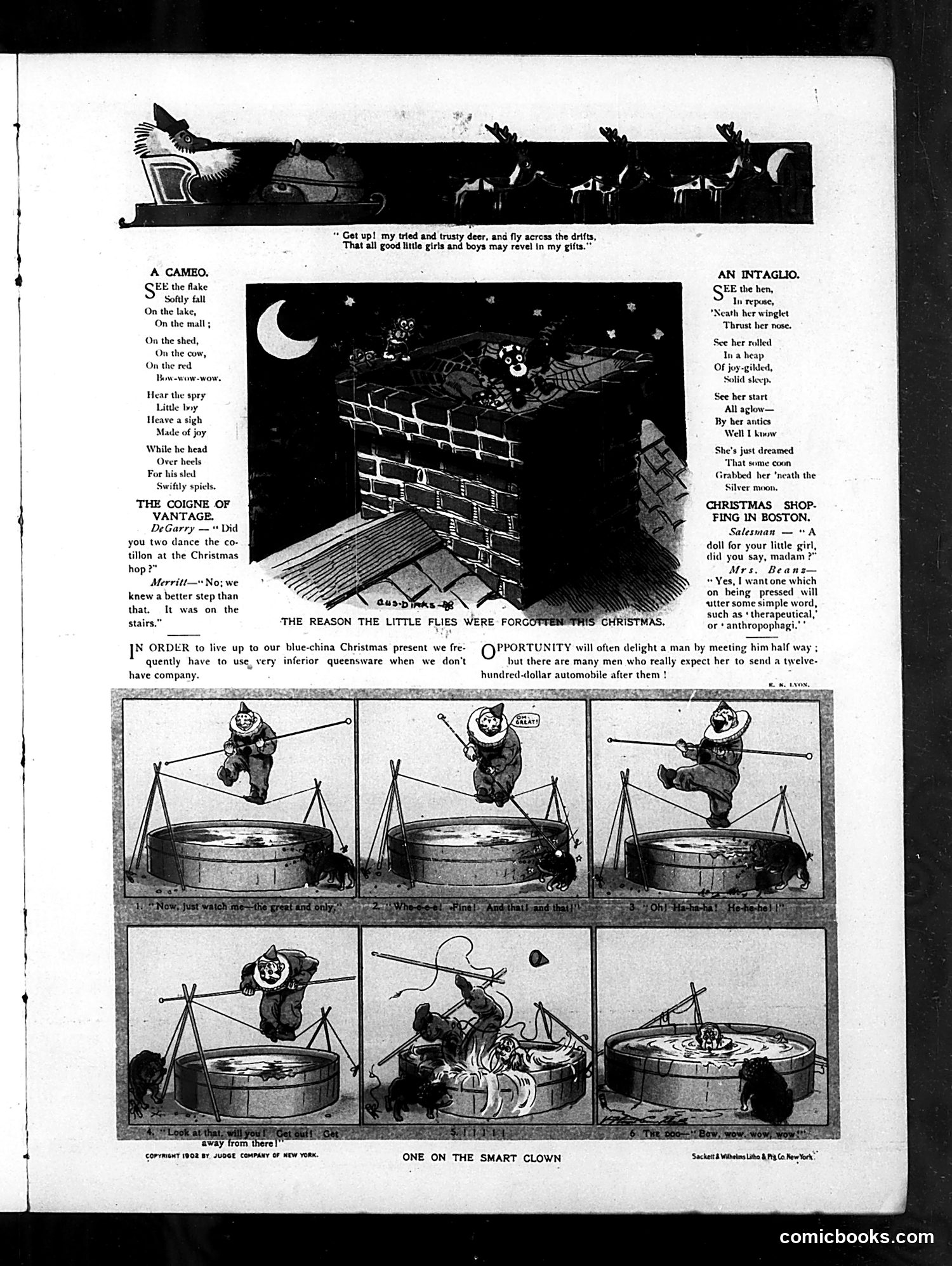
This page contains multiple short satirical pieces typical of Judge's humor circa 1902: **Poetic Vignettes** ("A Cameo," "An Intaglio"): Whimsical verses celebrating winter scenes—falling snow, a boy with his sled, a sleeping hen dreaming of romance. These are light, sentimental pieces with no apparent political content. **"The Coigne of Vantage"**: A brief joke about dancing the cotillion (a formal group dance) at Christmas—one character claims to know a "better step," implying a superior dancing technique or social superiority. **"Christmas Shopping in Boston"**: A salesman pitches a doll to Mrs. Beans that speaks when pressed. She requests one uttering words like "therapeutical" or "anthropophagic"—a satire on pretentious, overeducated speech and the absurd expectations of wealthy customers. **"One on the Smart Clown"**: A comic strip showing a clown performing acrobatic tricks over a basin of water, progressively failing and falling in. **Social commentary**: The shopping joke satirizes class pretension and consumer excess during the wealthy Christmas season. Otherwise, this page emphasizes entertainment over political satire.
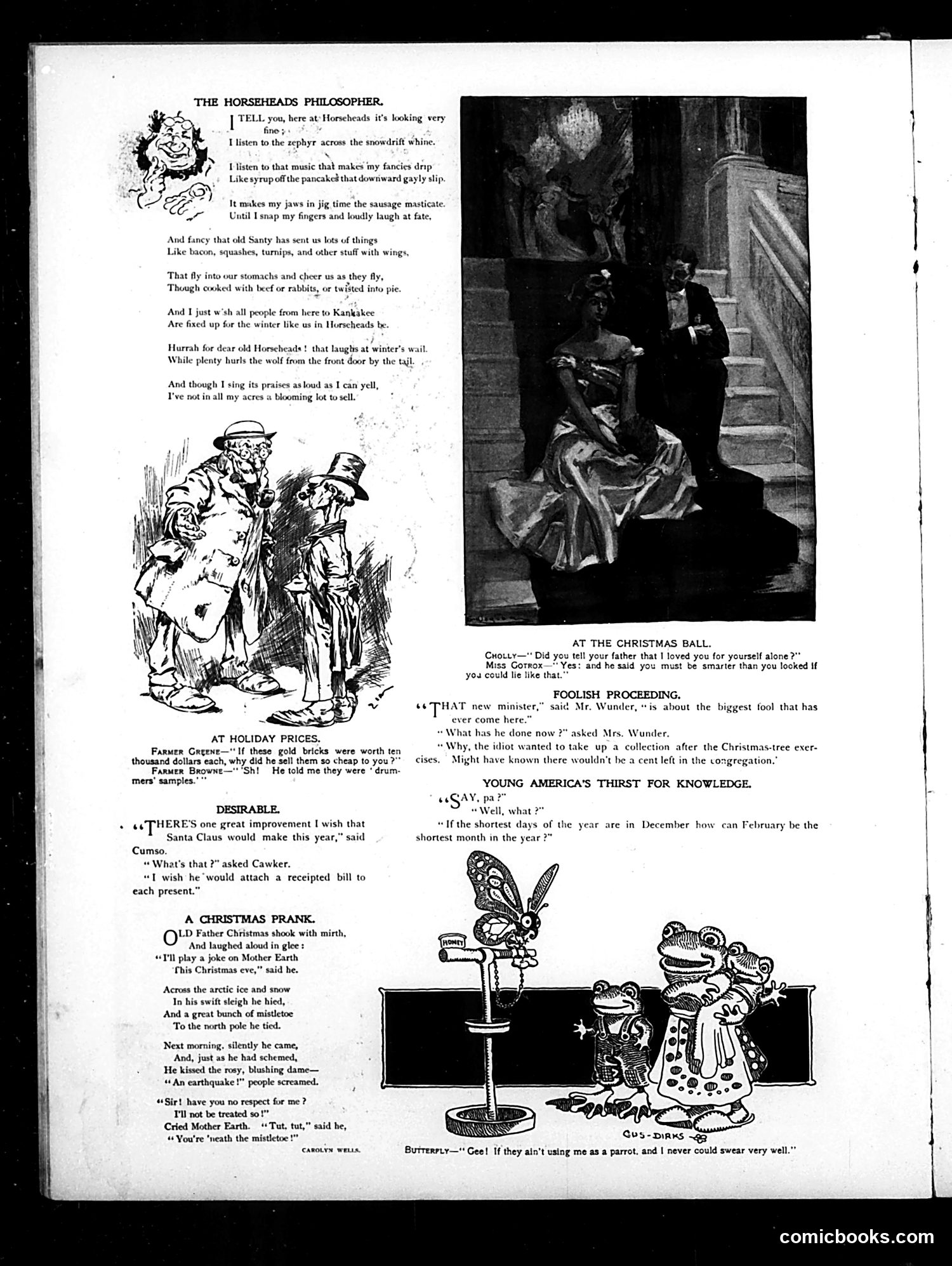
This page contains multiple humorous pieces typical of early 20th-century American satire: **"The Horseheads Philosopher"** presents a rustic character contentedly celebrating winter provisions and community self-sufficiency, with the ironic punchline that despite praising his village, he has nothing worth selling—mocking rural boosterism. **"At the Christmas Ball"** is a flirtation joke: a suitor claims to love a woman "for herself alone," but her father sarcastically doubts he could lie so convincingly, suggesting the suitor is after money. **"Foolish Proceeding"** satirizes a new minister's poor judgment in taking up collections after Christmas festivities when parishioners have already spent their money. **"Young America's Thirst for Knowledge"** features a child's logical question about why February, supposedly the shortest month, can't also be the shortest in the year—innocently exposing faulty reasoning. **"A Christmas Prank"** is a whimsical poem-illustration about Father Christmas kissing Mother Earth under mistletoe, causing an earthquake—wordplay on "Mother Earth" personified. The tone is gentle, domestic humor aimed at middle-class readers.
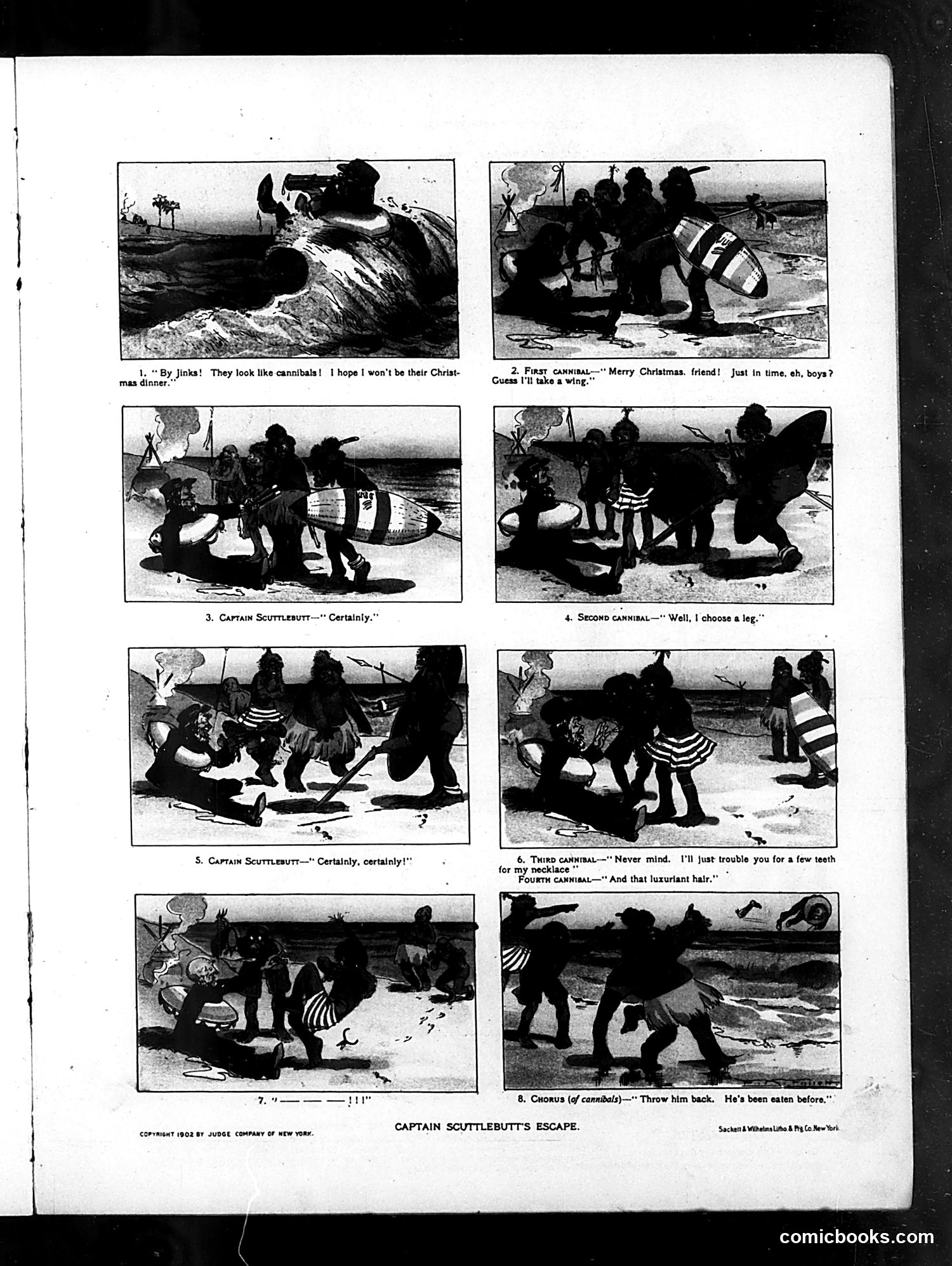
This 1902 Judge comic strip satirizes colonial-era anxieties about "savage" peoples. Captain Scuttlebutt, apparently a seafarer, encounters cannibals on a beach. The humor derives from racist stereotypes: the cannibals are depicted as primitive and dim-witted, speaking broken English and obsessing over eating people. The satire's actual target appears to be Scuttlebutt himself—a comedic buffoon whose repeated captures and escapes mock melodramatic adventure narratives popular at the time. The cannibals' recurring refrain "he's been eaten before" suggests the joke is on the Captain's ridiculous ineptitude rather than genuine danger. The strip reflects turn-of-the-century attitudes treating non-Western peoples as entertaining curiosities for American audiences, while simultaneously mocking overwrought adventure fiction popular in American magazines.
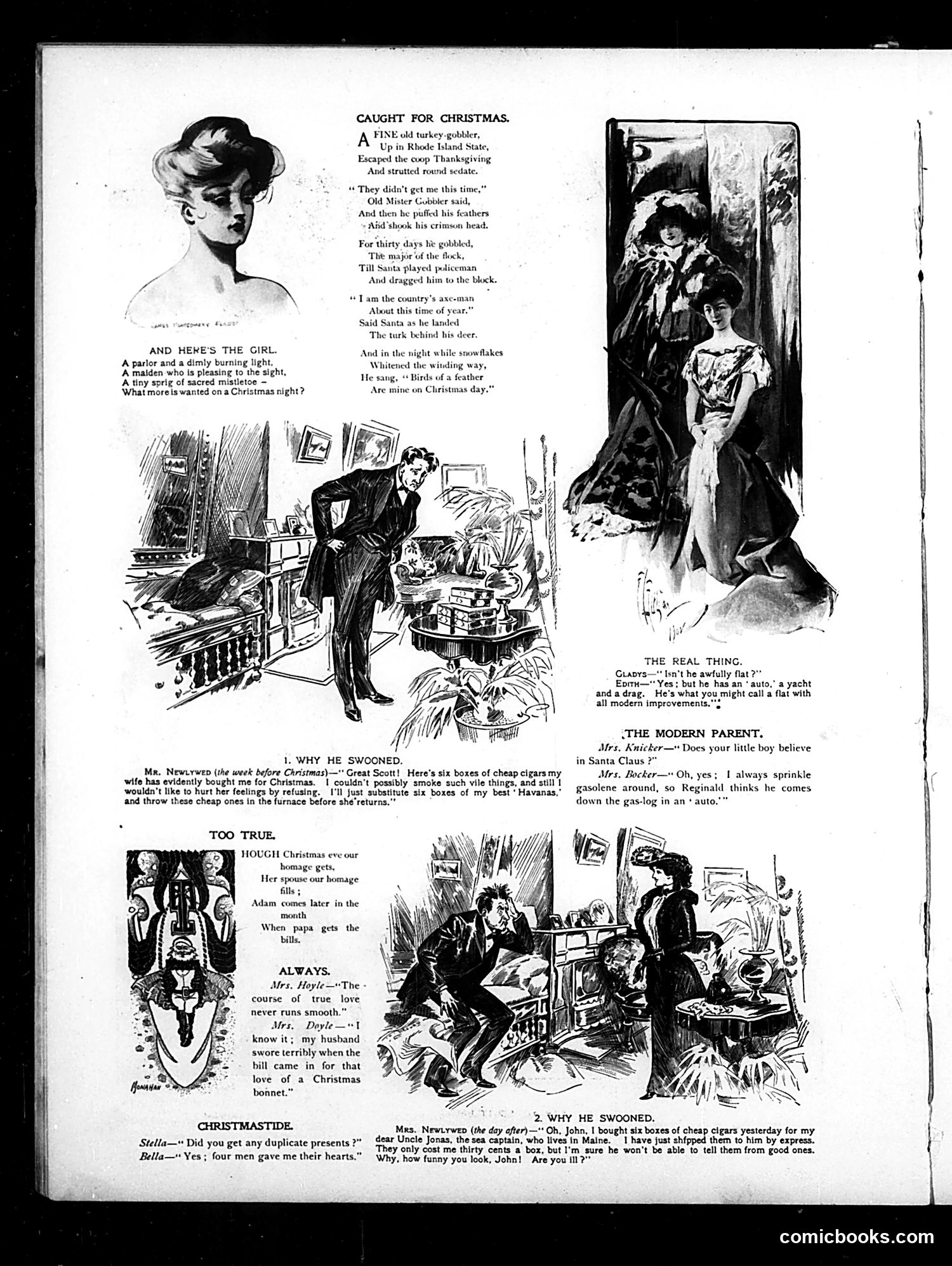
This page presents early 20th-century social humor targeting middle-class anxieties around Christmas gift-giving and courtship. **Main content:** "Caught for Christmas" opens with a talking turkey who escaped Thanksgiving—an anthropomorphic joke about seasonal fate. Multiple vignettes mock **gift-giving hypocrisy**: A husband receives cheap cigars from his wife, plans to secretly replace them with better ones before she discovers his deception. Later, his wife reveals she'd actually bought quality cigars for his uncle—creating ironic mutual deception. "The Real Thing" satirizes wealthy but shallow suitors: a "flat" (dull person) becomes attractive only because he owns an automobile and yacht. "The Modern Parent" jokes about modern parenting: parents encourage children to believe Santa arrives via automobile rather than chimney. The mistletoe vignette plays on Victorian romance conventions. **Overall point**: Judge mocks emerging consumer culture, class pretense, marital dishonesty, and how material goods (automobiles, luxury gifts) are reshaping courtship and family traditions—treating Christmas as increasingly commercialized and fraudulent.
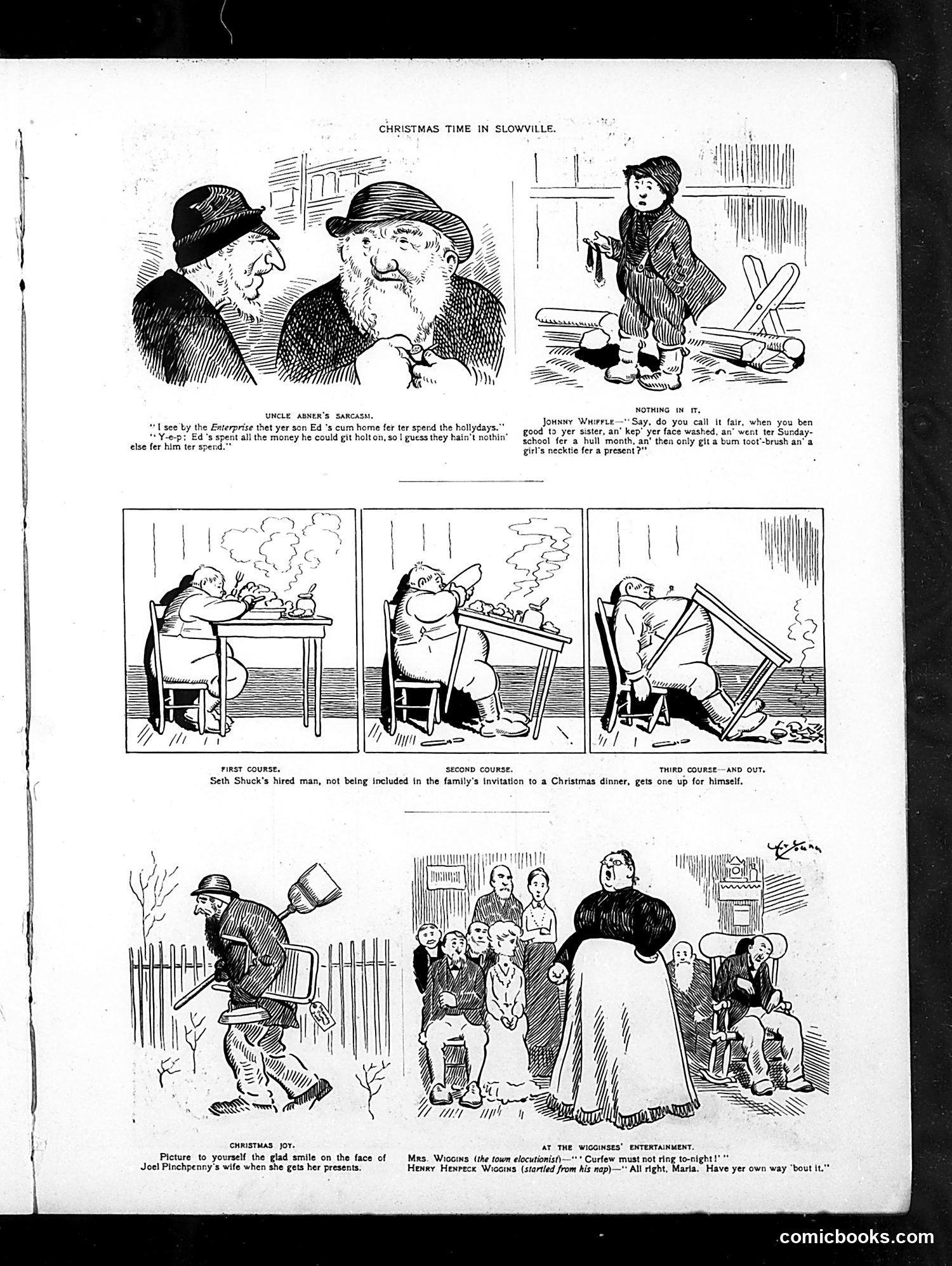
This satirical page mocks small-town American life during the holiday season through several interconnected jokes: **Uncle Abner's Sarcasm**: Two rural men discuss a son spending his Christmas money frivolously—sharp commentary on working-class financial struggles. **Seth Shuck's Hired Man**: A three-panel sequence showing a servant excluded from the family's Christmas dinner. He eats progressively larger meals alone, culminating in him tipping over his chair—visual humor about class inequality and the servant's revenge through gluttony. **Joel Pinchpenny's Wife**: A cruel joke: the "joy" is picturing her forced smile receiving a cheap toothbrush and necktie instead of real presents—satirizing stingy husbands. **The Wigginses**: Mrs. Wiggins performs the dramatic recitation "Curfew Must Not Ring To-Night" (a popular Victorian poem), while her husband, bored, naps through it—mocking pretentious small-town cultural performances and marital indifference. The overall theme: rural Christmas life is characterized by poverty, class division, marital discord, and tedious respectability.
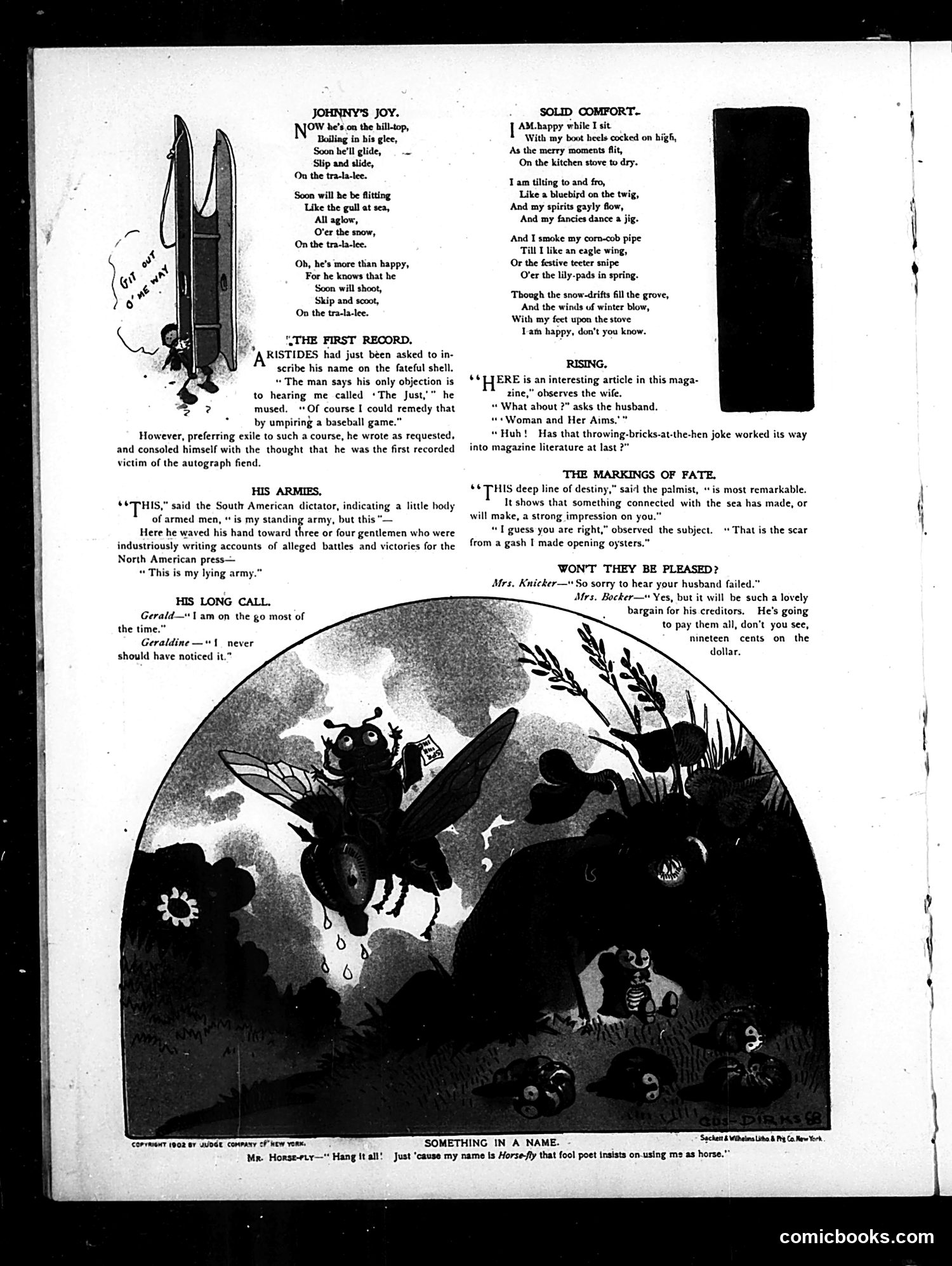
This page from Judge magazine (copyright 1902) contains several brief satirical pieces and cartoons: **"The First Record"** jokes about Aristides (ancient Athenian politician famous for justice) being asked to sign an ostracism shell. He quips he could remedy being called "The Just" by umpiring baseball—a modern American reference mocking the hypocrisy of those seeking fair judgment. **"His Armies"** satirizes a South American dictator distinguishing between his armed forces and his "lying army"—the journalists writing accounts of fabricated battles for North American newspapers. This critiques sensationalist war reporting. **"Something in a Name"** shows a horse-fly complaining a poet uses it as a horse, playing on the literal name. **"Won't They Be Pleased?"** depicts a woman consoling another whose husband failed financially, noting creditors will be "pleased" receiving only nineteen cents per dollar—ironic commentary on bankruptcy. The page exemplifies Judge's satirical style: topical humor, wordplay, and social commentary on politics, journalism, and contemporary life.
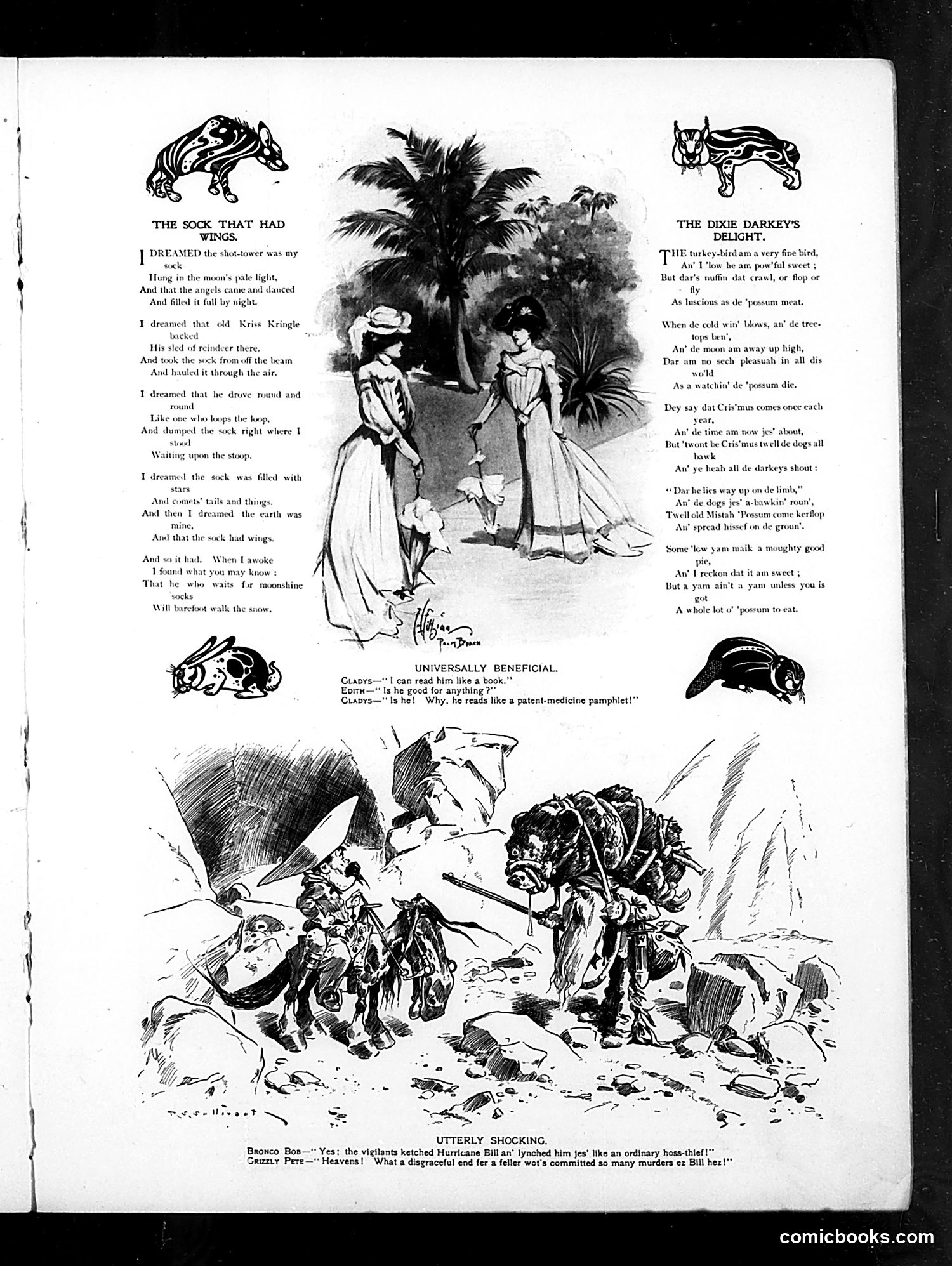
This page contains three distinct pieces: **"The Sock That Had Wings"** (left): A whimsical poem about dreaming of magical Christmas socks—standard light holiday humor with no political content. **"The Dixie Darkey's Delight"** (right): A poem in stereotypical African American dialect celebrating possum hunting. This reflects period racist caricature common in late 19th-century American humor, depicting Black Southerners through exaggerated dialect and crude stereotypes. **"Universally Beneficial"** (center): A brief joke about someone whose reading material resembles patent-medicine pamphlets—mocking dubious medical advertising prevalent in that era. **"Utterly Shocking"** (bottom): Satirizes frontier justice: vigilantes lynch "Hurricane Bill" for being an ordinary thief, yet this seems mild compared to his many murders. The satire criticizes the arbitrary and brutal nature of lynch-mob justice. The page mixes innocent humor with period-typical racism and commentary on American violence and medical fraud.
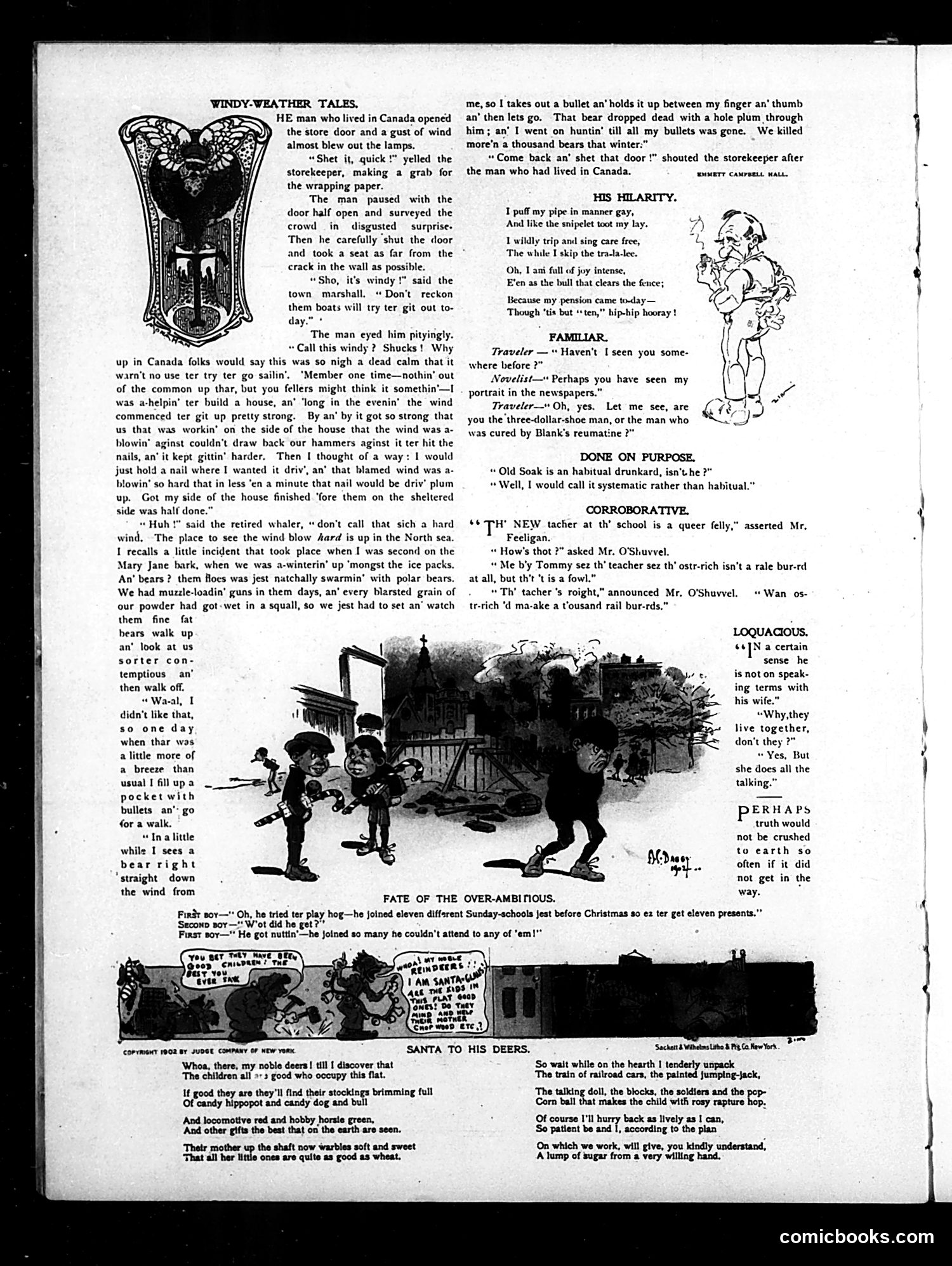
This page from Judge magazine contains multiple short humor pieces typical of the publication's satirical style: **"Windy-Weather Tales"** (main feature): A tall-tale competition where men from different regions boast about extreme weather. A Canadian claims winds so strong they drove nails without hammers; a retired whaler tops it by describing polar bears so numerous he killed over a thousand with wind-blown bullets. The joke satirizes exaggeration and competitive boasting—a common folk humor tradition. The storekeeper's final interruption provides comedic punctuation. **Other brief items** include: - "His Hilarity": A man celebrating a meager ten-dollar pension with exaggerated joy - "Familiar": A novelist mistaken for a patent-medicine advertisement subject - "Done on Purpose": Wordplay distinguishing habitual from "systematic" drunkenness - "Corroborative": Irish dialect humor about an ostrich, with working-class characters The page exemplifies Judge's mix of folk-humor traditions, working-class characters rendered in dialect, and gentle social observation—typical early 20th-century American comic magazine fare.
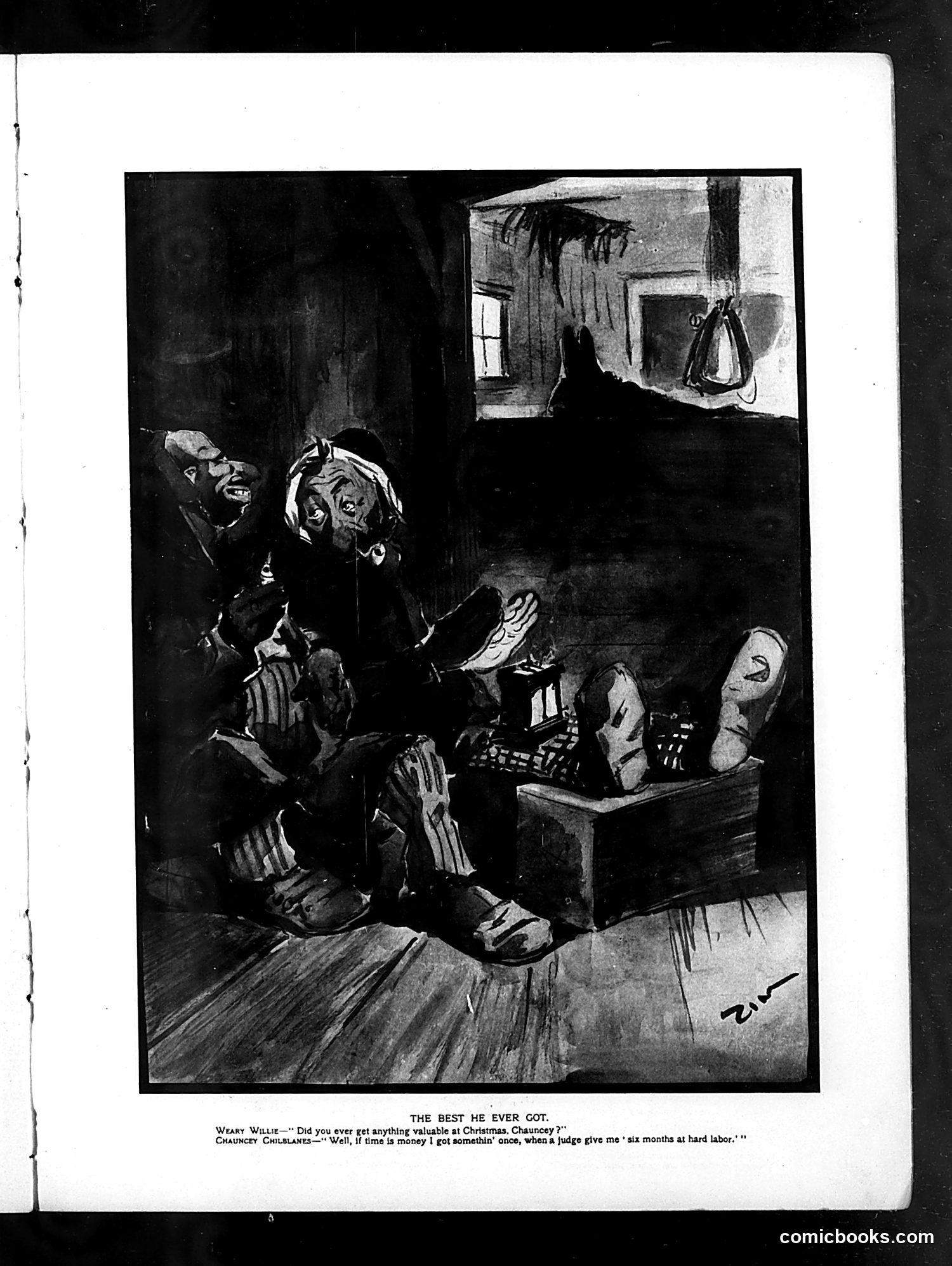
This cartoon satirizes the idea of receiving "valuable" Christmas gifts by showing two characters—"Weary Willie" and "Chauncey Cheerless" (identified by their names and ragged appearance)—in what appears to be a jail or workhouse setting. The joke plays on the phrase "time is money." When Chauncey is asked about valuable Christmas gifts, he responds that the most valuable thing he received was a judge's sentence of six months hard labor—because if "time is money," then time served is literally money gained. This is dark humor mocking poverty and the criminal justice system of the era. The two vagrant characters represent the homeless underclass, and the satire suggests that even incarceration is preferable to their desperate circumstances, since at least it provides food, shelter, and forced labor (treated as "valuable" in economic terms).
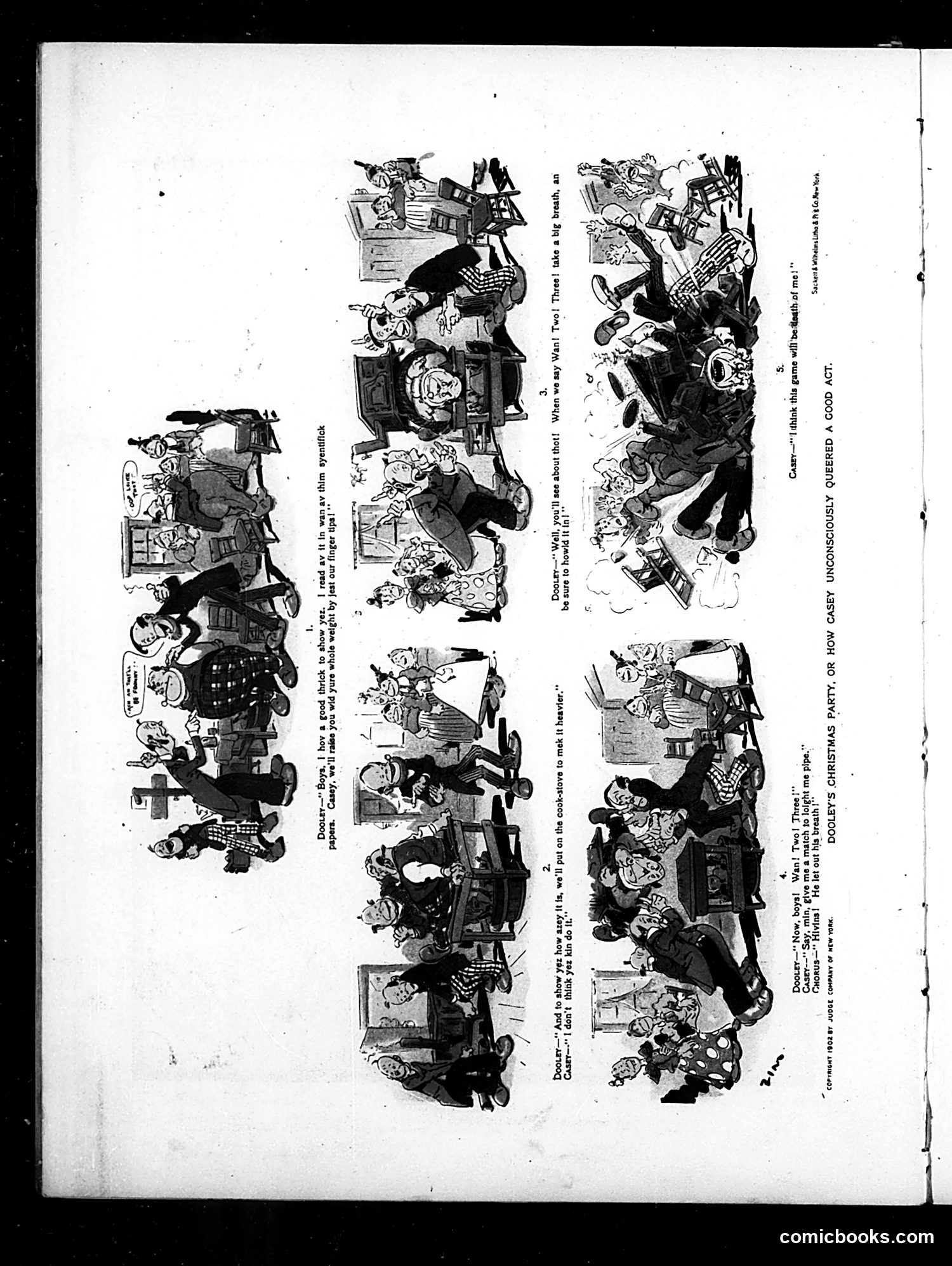
I cannot reliably interpret this page. The OCR text is severely corrupted and essentially unreadable—it appears reversed or otherwise distorted. While I can see this is a page from Judge magazine containing multiple cartoon panels arranged vertically, the poor image quality and illegible text prevent me from identifying the specific figures, political references, or satirical points with confidence. To properly explain what these cartoons mean to a modern reader, I would need either clearer source material or additional context about the publication date and subject matter. I can only assert that this appears to be satirical editorial content typical of Judge's style, but cannot specify the targets or jokes without reliable textual support.
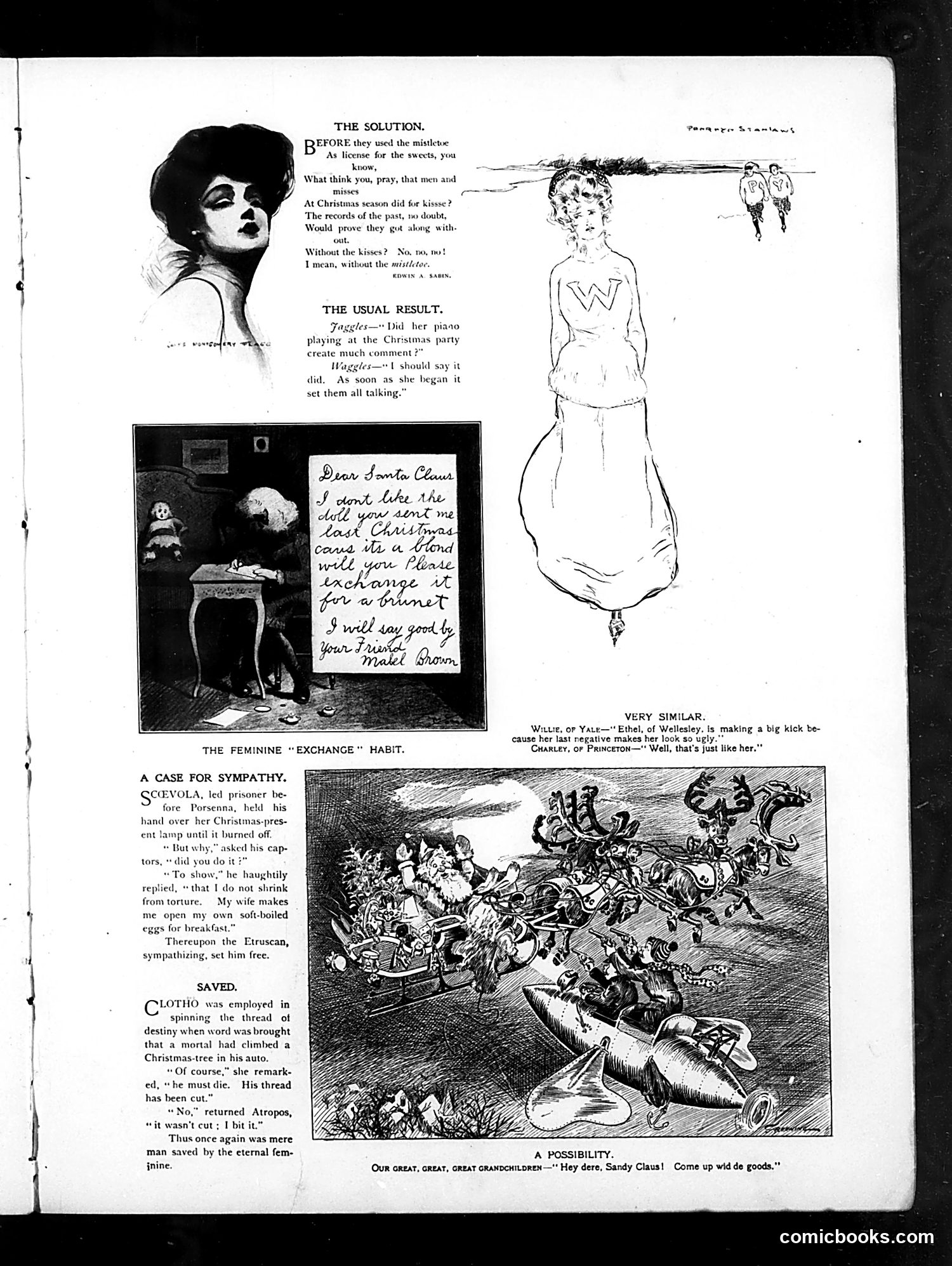
This page contains several interconnected Christmas-themed jokes satirizing early 20th-century gender dynamics and social conventions. **"The Solution"** mocks the mistletoe tradition, suggesting women historically needed no excuse for kissing—the plant is merely modern convenience. **"The Usual Result"** jokes that when a woman plays piano at a Christmas party, she inevitably becomes the center of gossip. **"A Case for Sympathy"** uses classical mythology (Scaevola, Porsenna) as setup for a punchline about nagging wives—a man enduring torture finds the captor sympathetic upon hearing his wife makes him cook his own eggs, inverting expected gender roles comedically. **"Saved"** references the three Fates (Clotho, Atropos) to joke darkly about a mortal climbing a Christmas tree in an automobile (likely referencing early 1900s auto dangers)—he's "saved" by feminine intervention when one Fate bites rather than cuts his thread. The bottom panel appears to address relationship vanity among college-aged women concerned with photographs. The satire consistently targets changing gender relations and modern behaviors through classical/mythological frameworks.
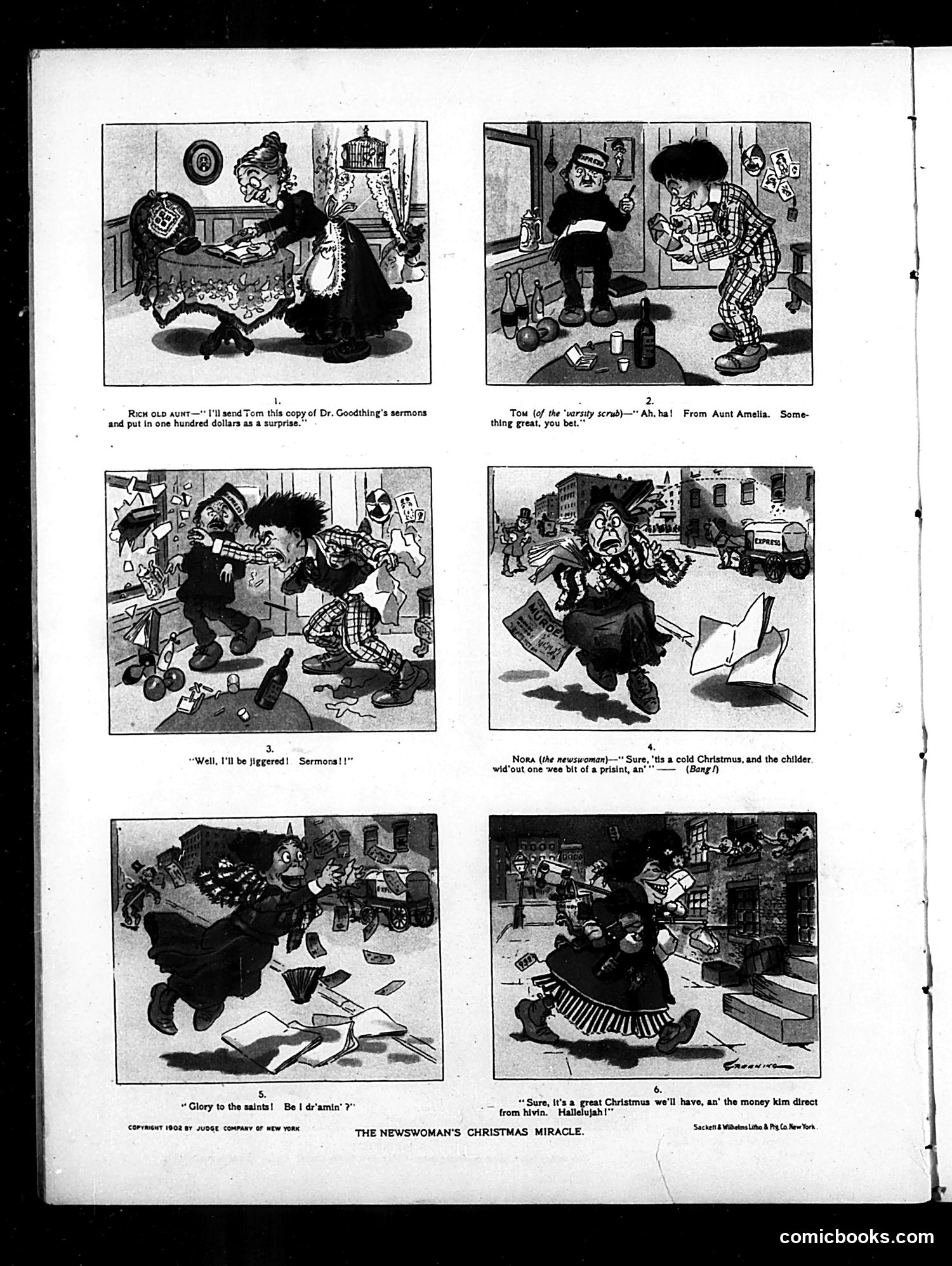
This six-panel comic strip contrasts wealthy and poor Christmas experiences. A rich aunt sends her nephew Tom expensive sermons as a gift—he's disappointed. Meanwhile, "Nona the newswoman" (a working-class woman selling newspapers) has no money for her children's presents and seems desperate. The narrative twist appears to culminate in a "miracle": Nona receives money "direct from" her benefactors, allowing her family a proper Christmas. The strip satirizes class disparities while endorsing charitable giving as a solution. The title suggests divine intervention, but the actual mechanism is wealthy patrons' generosity. The humor relies on period-specific details: "varsity scrub" (college slang), Irish dialect ("wid'out," "prisint"), and the figure of the struggling newswoman—a common symbol of urban poverty in early 20th-century American literature and journalism.
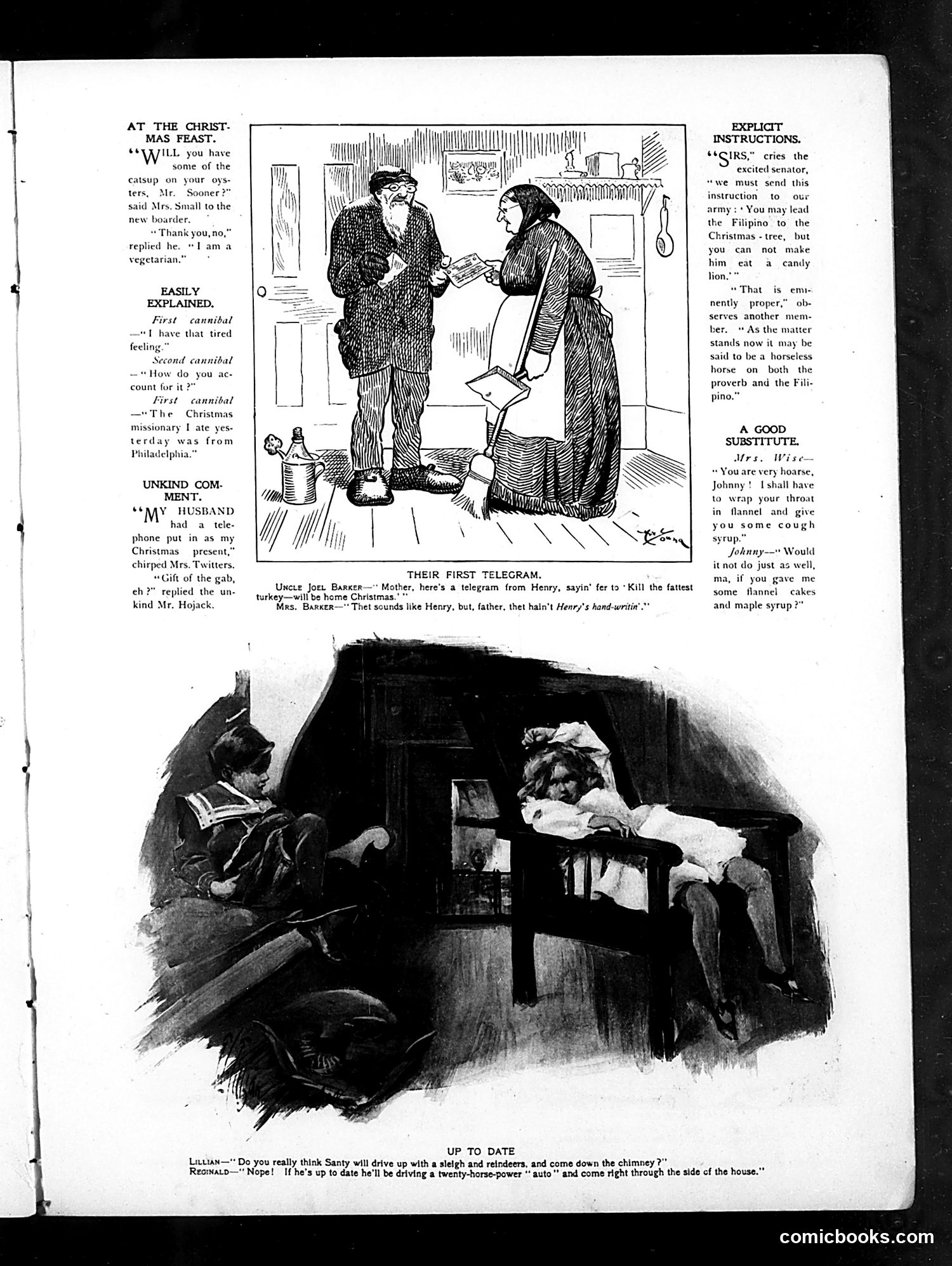
This page contains multiple short comic sketches typical of early 1900s humor magazines: **"At the Christmas Feast"** mocks vegetarians as pretentious. **"Easily Explained"** is a racist cannibal joke implying that a missionary from Philadelphia was particularly exhausting or unpleasant to consume—playing on anti-urban stereotypes. **"Unkind Comment"** makes a pun about women and telephone gossip. **"Up to Date"** satirizes modern technology by imagining Santa using an automobile instead of a sleigh—commentary on rapid industrialization replacing tradition. **"Explicit Instructions"** references the Philippine-American War, mocking military policy regarding Filipino civilians and Christmas gifts. **"A Good Substitute"** is a child's joke about preferring food to medicine. The overall tone reflects period attitudes: casual racism, gender stereotypes, and technological anxiety mixed with humor about modernization. These weren't considered particularly offensive at publication, reflecting early 1900s mainstream attitudes.
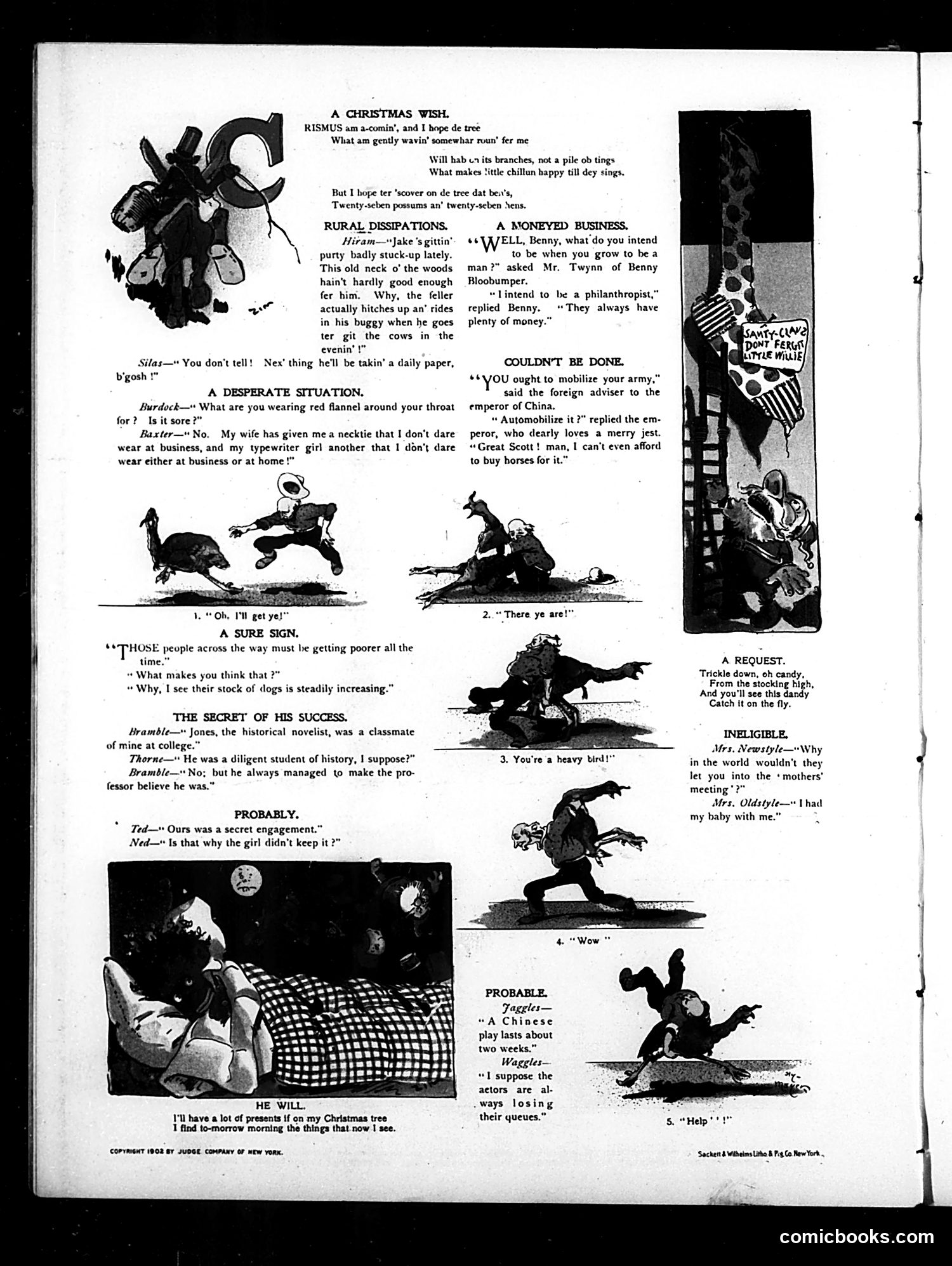
This is a humor page mixing short jokes, comic scenarios, and satirical quips typical of Judge magazine's format. Key elements: **"A Christmas Wish"** uses dialect humor common to the era, depicting an African American character's modest holiday desires—a common (if problematic) comedic trope of the period. **"Rural Dissipations"** and **"A Desperate Situation"** present rural/urban class contrasts—rural figures gaining pretensions, urban men trapped by gift-giving obligations to multiple women (wife, "typewriter girl"). **"Couldn't Be Done"** satirizes China's modernization struggles, with an emperor unable to afford horses while being advised to "mobilize" his army—likely referencing early-1900s Sino-Western tensions. **"The Secret of His Success"** mocks historical novelists as bluffers rather than scholars. The **numbered illustrations** (1-5) show physical comedy—chasing, falling, struggling—common visual gags of the period. Overall, this reflects Judge's satirical focus on social pretension, class anxiety, and international affairs circa 1902.
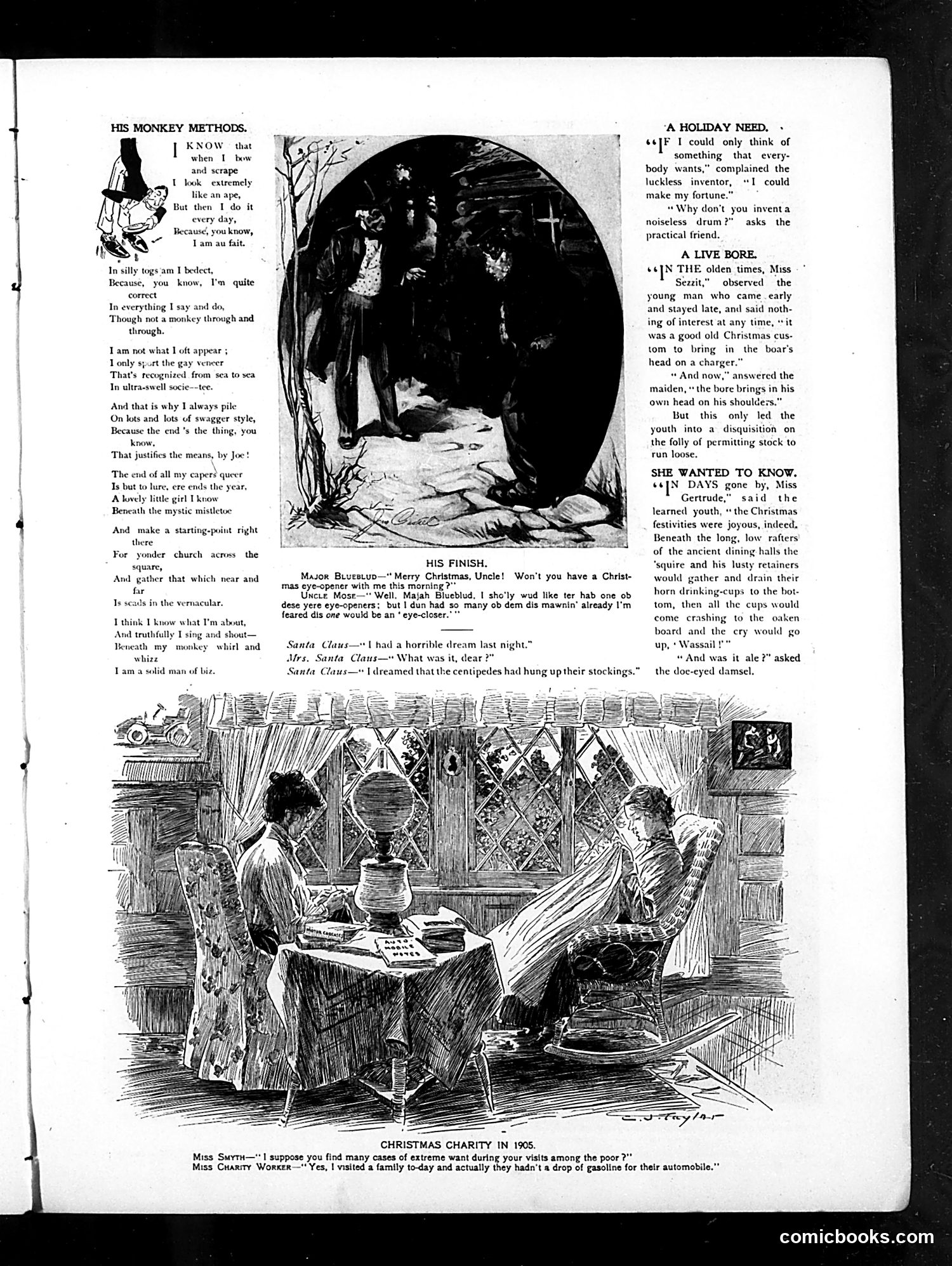
This 1905 *Judge* magazine page satirizes early 20th-century social pretension and holiday hypocrisy. **Top left ("His Monkey Methods"):** A poem mocking men who adopt exaggerated manners and "swagger style" to appear refined in "ultra-swell socie-tee" while remaining fundamentally dishonest—they're performing, not genuinely cultured. **"His Finish":** A dialect-humor exchange where an African American character (Uncle Mose) declines another drink, having already consumed many that morning. This reflects period racial stereotypes about drinking. **"Christmas Charity in 1905":** Satirizes wealthy charity workers' obliviousness to actual poverty. A "charity worker" reports visiting poor families lacking *gasoline for their automobile*—mocking both the wealthy's ignorance of real deprivation and the poor's supposed newfangled spending priorities (automobiles were luxury items then). **Minor pieces** joke about inventors, boring suitors, and nostalgic Christmas traditions. The page's overarching theme: Christmas reveals gaps between pretense and reality across social classes.
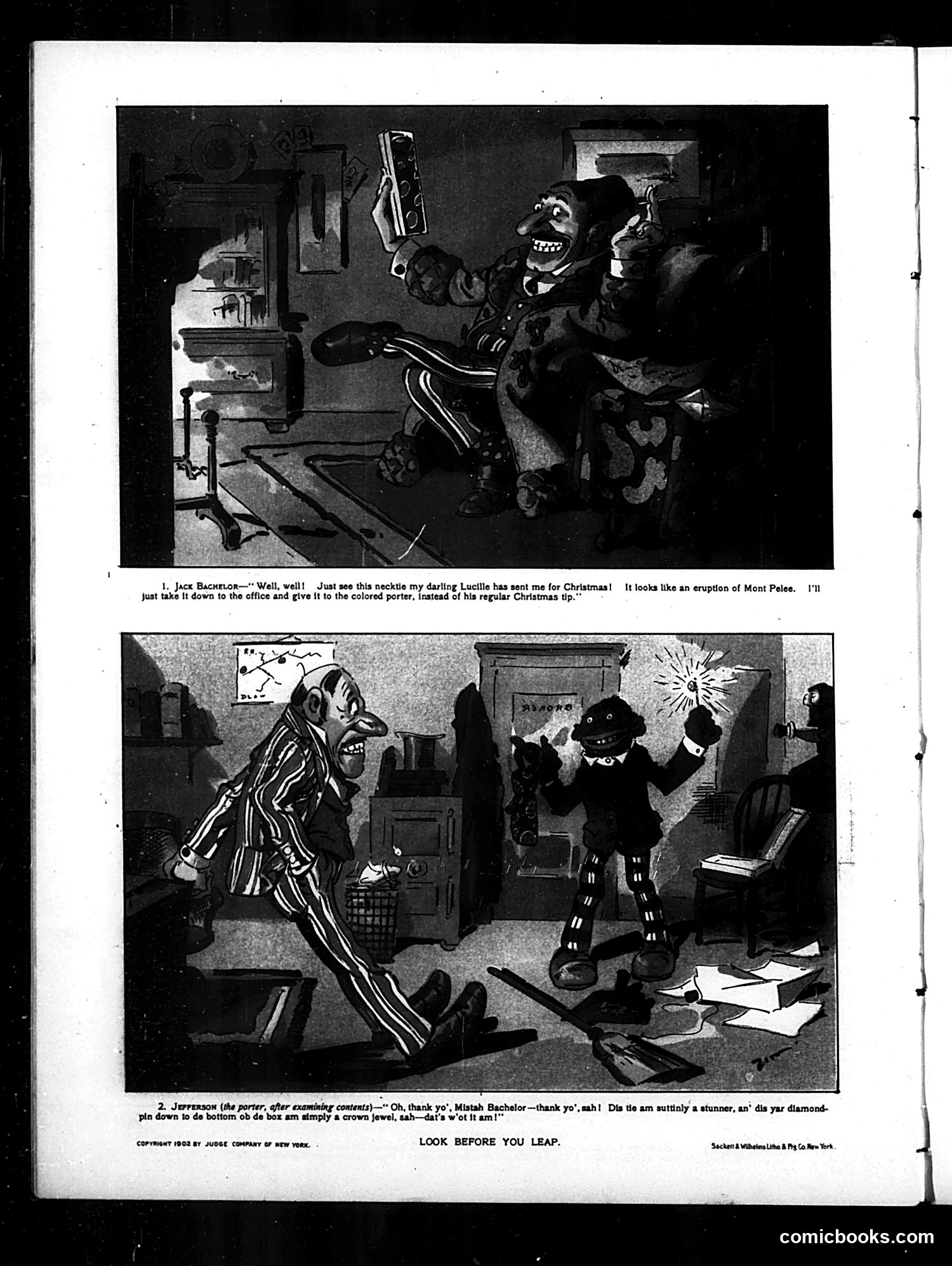
This two-panel cartoon satirizes class assumptions and gift-giving hypocrisy. In panel 1, a wealthy man named Jack Bacneton receives an ugly necktie from his girlfriend and dismissively plans to pass it off as a Christmas "tip" to his Black porter, considering it beneath his own status. Panel 2 reveals the joke's twist: the porter discovers the necktie contains a valuable diamond pin at the bottom of the box—making the "discarded" gift far more valuable than the man realized. The porter's exaggerated dialect speech was typical of 1902 minstrelsy-influenced humor. The satire targets the man's class snobbery and assumptions about what constitutes an appropriate gift for a servant, while the ironic outcome—his attempt to insult inadvertently creates generosity—supplies the comedic moral lesson suggested by the title.
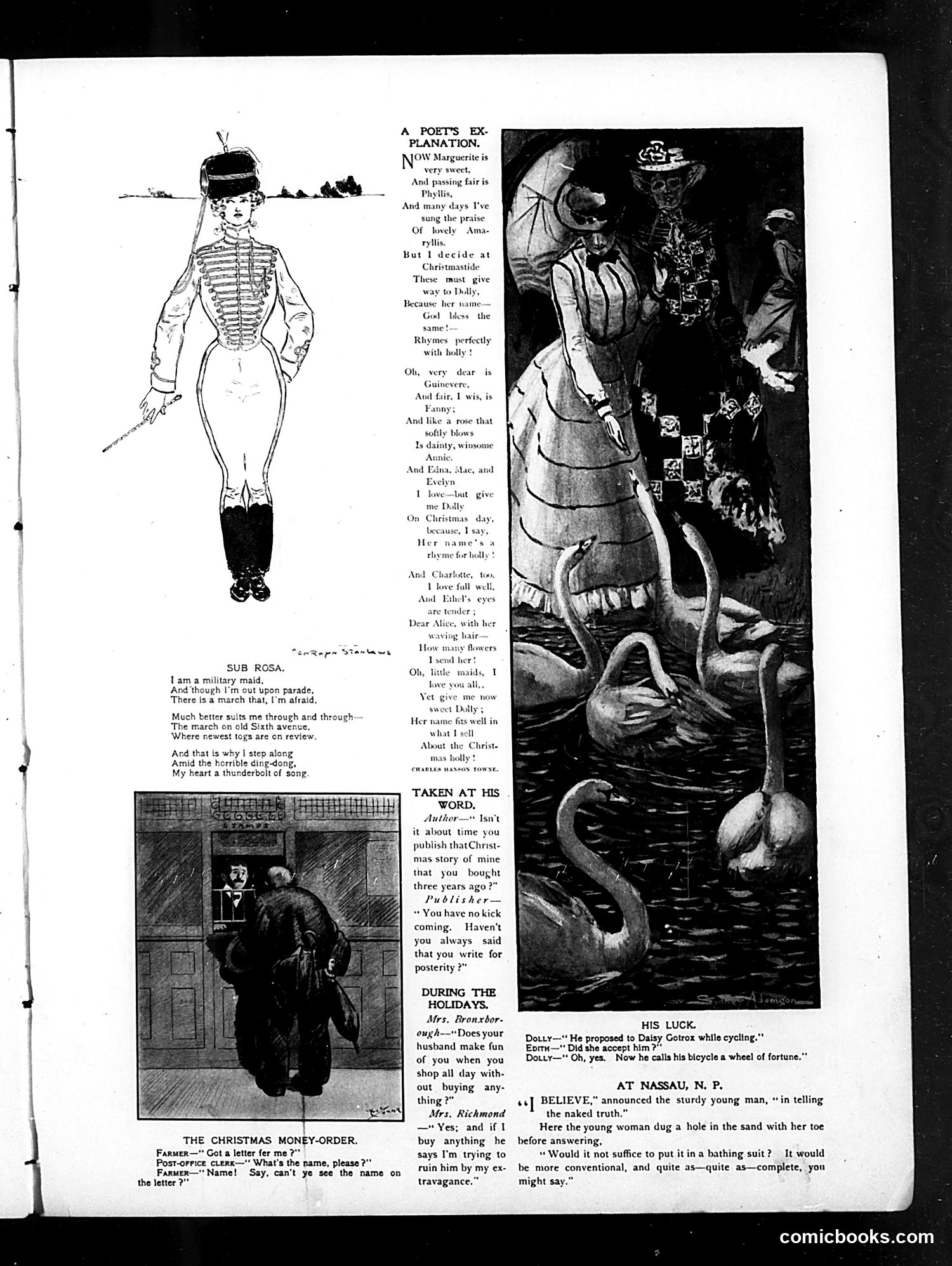
This Judge magazine page contains several satirical sketches mocking social conventions and relationships: **"Sub Rosa"** ridicules a military maid whose romantic interests lie in shopping on Fifth Avenue rather than martial duty—satirizing women's fashion obsession. **"The Christmas Money-Order"** depicts a postal clerk's frustration with an illiterate customer unable to read a name on a letter, mocking working-class incompetence. **"A Poet's Explanation"** parodies sentimental Victorian poetry by showing a poet choosing the name "Dolly" for his Christmas verse solely because it rhymes with "holly"—mocking vapid romantic poetry prioritizing rhyme scheme over genuine feeling. **"Taken at His Word"** jokes that a publisher delays printing an author's Christmas story indefinitely by claiming he "writes for posterity"—satirizing publishers' excuses and artistic pretension. **"During the Holidays"** depicts marital bickering: wives criticized whether they shop or don't shop, reflecting era anxieties about women's spending. **"His Luck"** and **"At Nassau"** contain mild romantic humor about proposals and courtship. The overall tone mocks Victorian sentimentality, gender relations, and middle-class social pretensions.
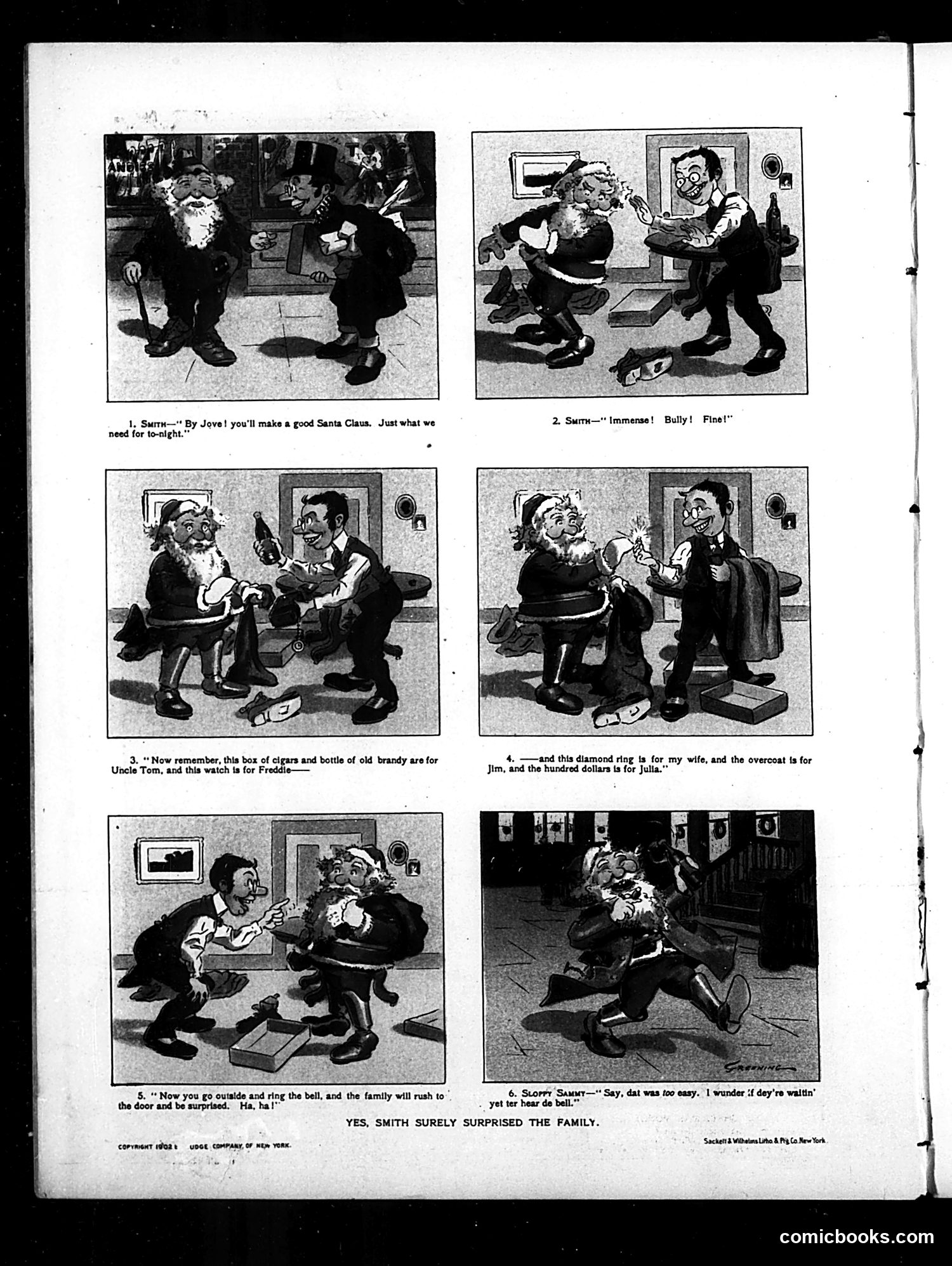
This six-panel comic depicts a working-class man ("Smith") impersonating Santa Claus to deliver gifts to his family on Christmas Eve. The humor centers on his elaborate deception: he dresses as Santa, distributes presents meant for various family members (Uncle Tom, Freddie, Jim, Julia), and rings the doorbell to surprise them. The satire mocks both the pretense of Santa Claus mythology and the financial strain of Christmas gift-giving among ordinary families. Smith's scheme—disguising himself to make modest gifts seem miraculous—reflects period anxieties about maintaining middle-class respectability and family traditions despite economic limitations. The final panel shows the plan backfiring comically when the family is startled rather than delighted. The joke relies on the gap between aspirational Christmas fantasy and working-class reality.
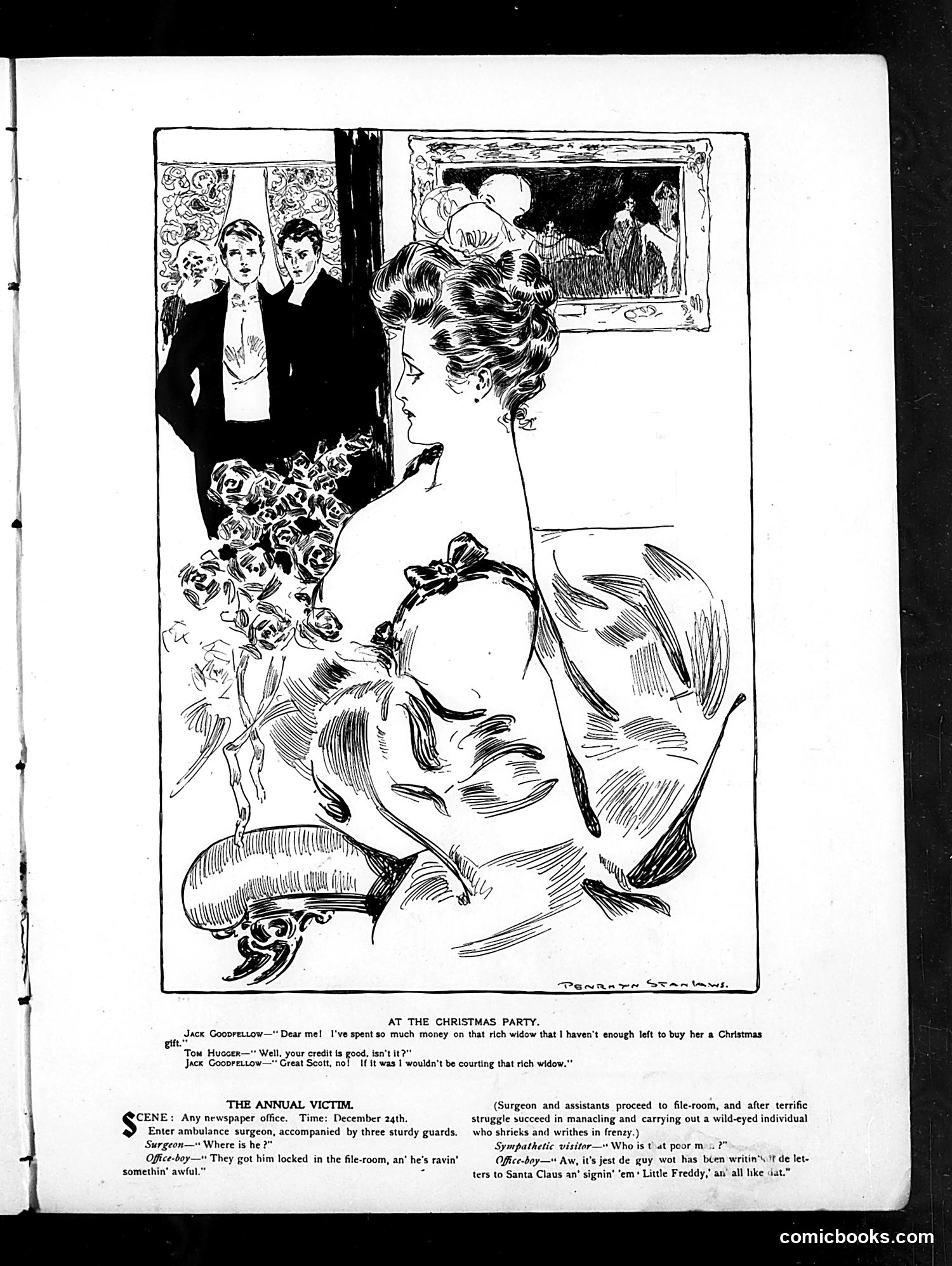
This Judge magazine page contains two satirical pieces mocking holiday social conventions and newspaper absurdities. **"At the Christmas Party"** ridicules a fortune-hunter named Jack Goodfellow who pursues a wealthy widow purely for money. The joke: he can only court her *because* his credit is bad—a rich woman wouldn't interest a man with financial stability. It's satire on social climbing and transactional relationships. **"The Annual Victim"** depicts a newspaper office tradition: removing a deranged writer from the file room on December 24th. The "victim" is a man who habitually writes sentimental letters to Santa Claus under the pseudonym "Little Freddy." The humor targets both maudlin sentimentality and the predictable annual chaos at newspaper offices during the holidays. Both pieces mock human folly—greed and false sentiment—as quintessential holiday behaviors, presented with Judge's characteristic cynical wit.
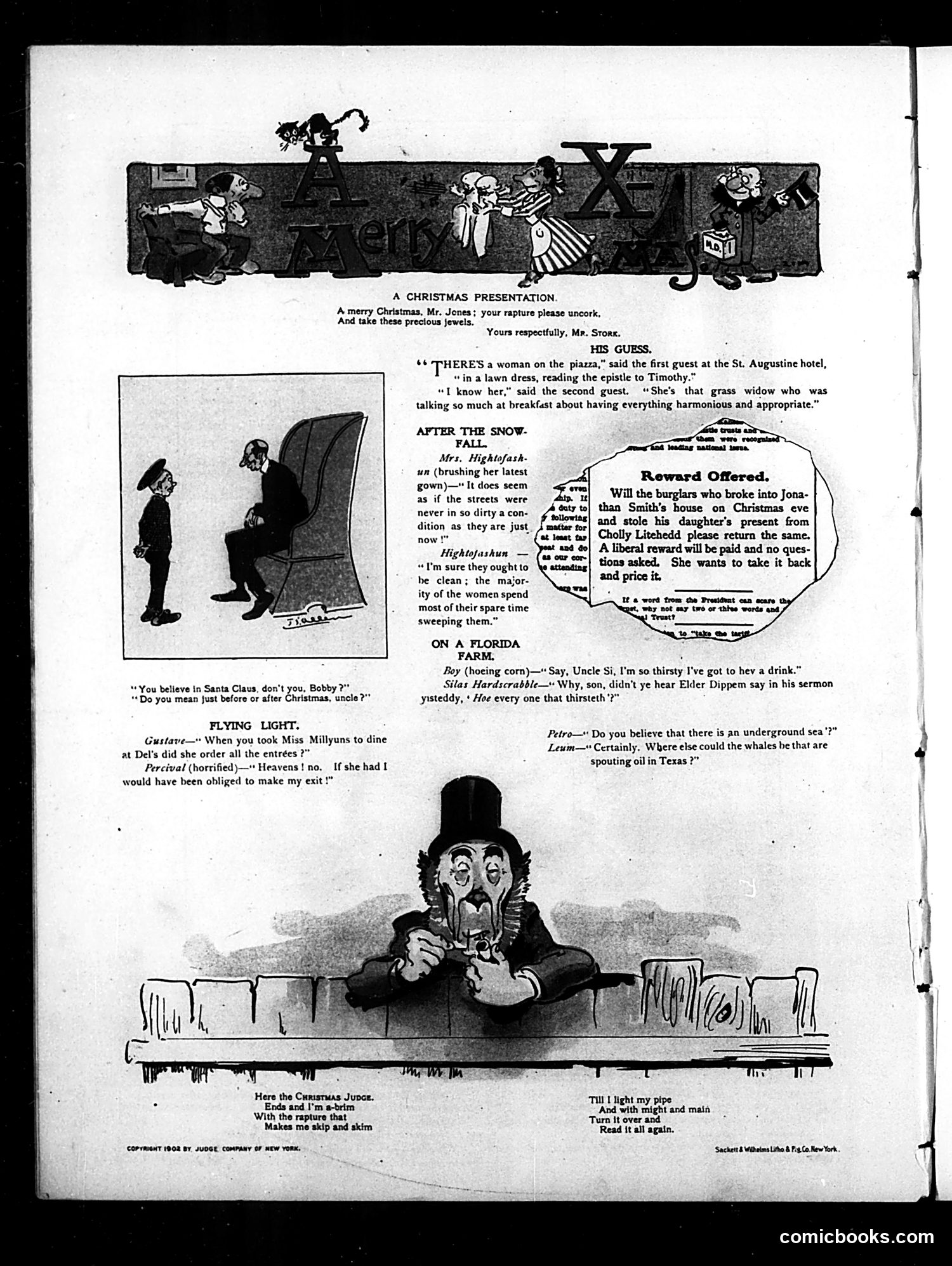
This page collects satirical vignettes typical of Judge's humor. Key pieces: **"A Christmas Presentation"** mocks pretentious gift-giving—Mr. Stork delivers "precious jewels" (a baby), a joke on wealthy absurdity. **The "Grass Widow" anecdote** targets affected society women at resorts who obsess over propriety while gossiping. **"After the Snowfall"** ridicules upper-class women (Mrs. Hightofashun) who complain about street dirt while doing nothing, with her husband sarcastically noting women spend all their time sweeping—implying idle leisure. **"Reward Offered"** jokes about a daughter wanting to return a Christmas gift to check its price, satirizing mercenary materialism. **Rural vignettes** (Florida farm, boy asking about thirst) contrast naive country folk with biblical or folk wisdom. **The Christmas Judge** caricature at bottom appears to be the magazine's mascot character. Overall, the page satirizes class pretension, materialism, and gender stereotypes common to Gilded Age American society. The humor targets wealthy affectation and hypocrisy.
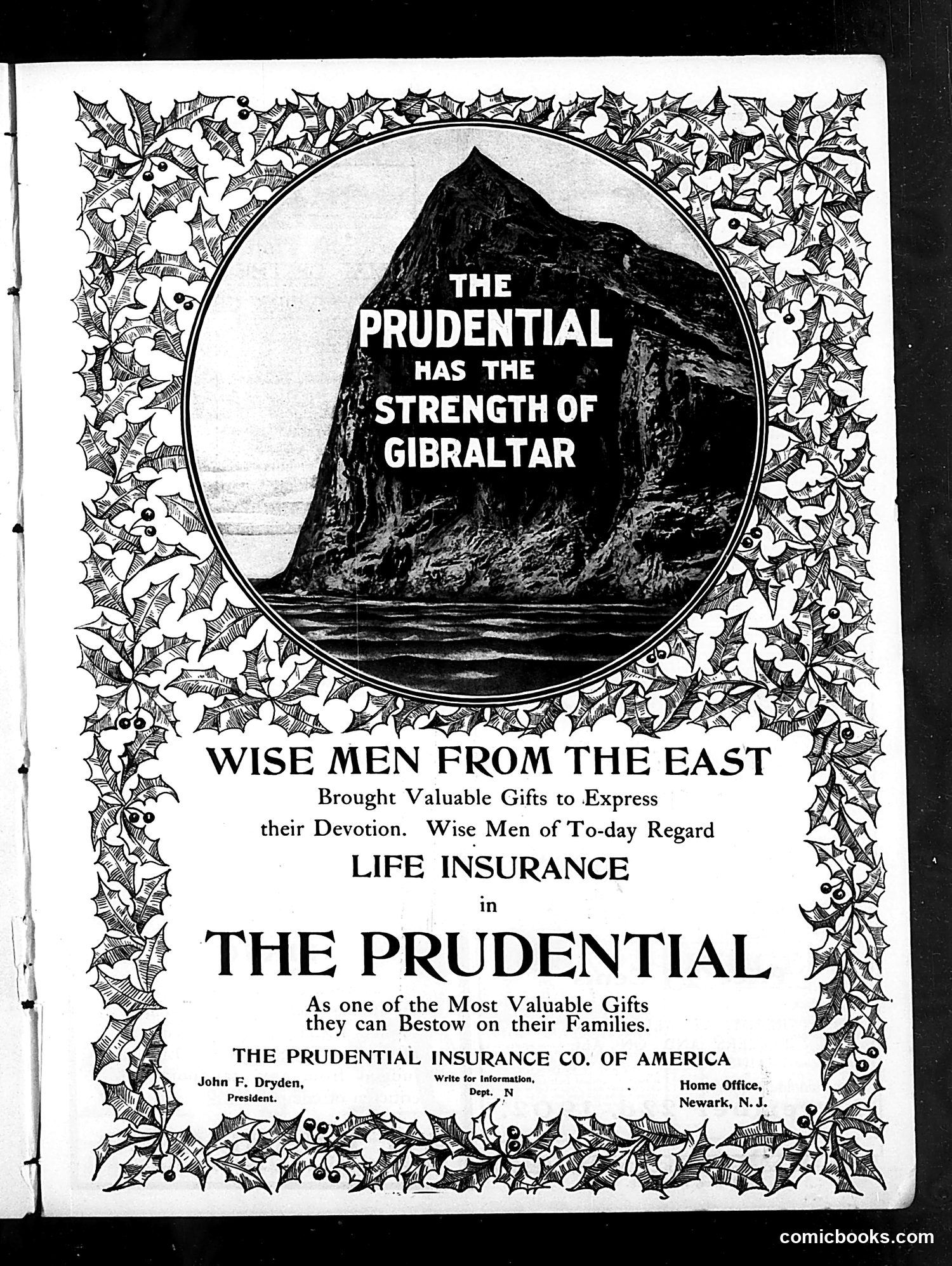
This is primarily a **full-page advertisement**, not political satire. It's a Christmas-themed ad for The Prudential Insurance Company of America (home office: Newark, N.J.). The ad uses a religious reference: "Wise Men from the East" alludes to the biblical Magi who brought gifts to Jesus. The copy cleverly repositions life insurance as a modern equivalent—a valuable gift expressing devotion to one's family, paralleling the Magi's precious offerings. The image shows the Rock of Gibraltar, used as a metaphor for strength and stability. The ornamental holly border reinforces the holiday season. This was typical early-20th-century advertising strategy: connecting commercial products to moral values and family duty. There is **no political cartoon or satire** on this page—it's straightforward insurance marketing dressed in festive, religious language.
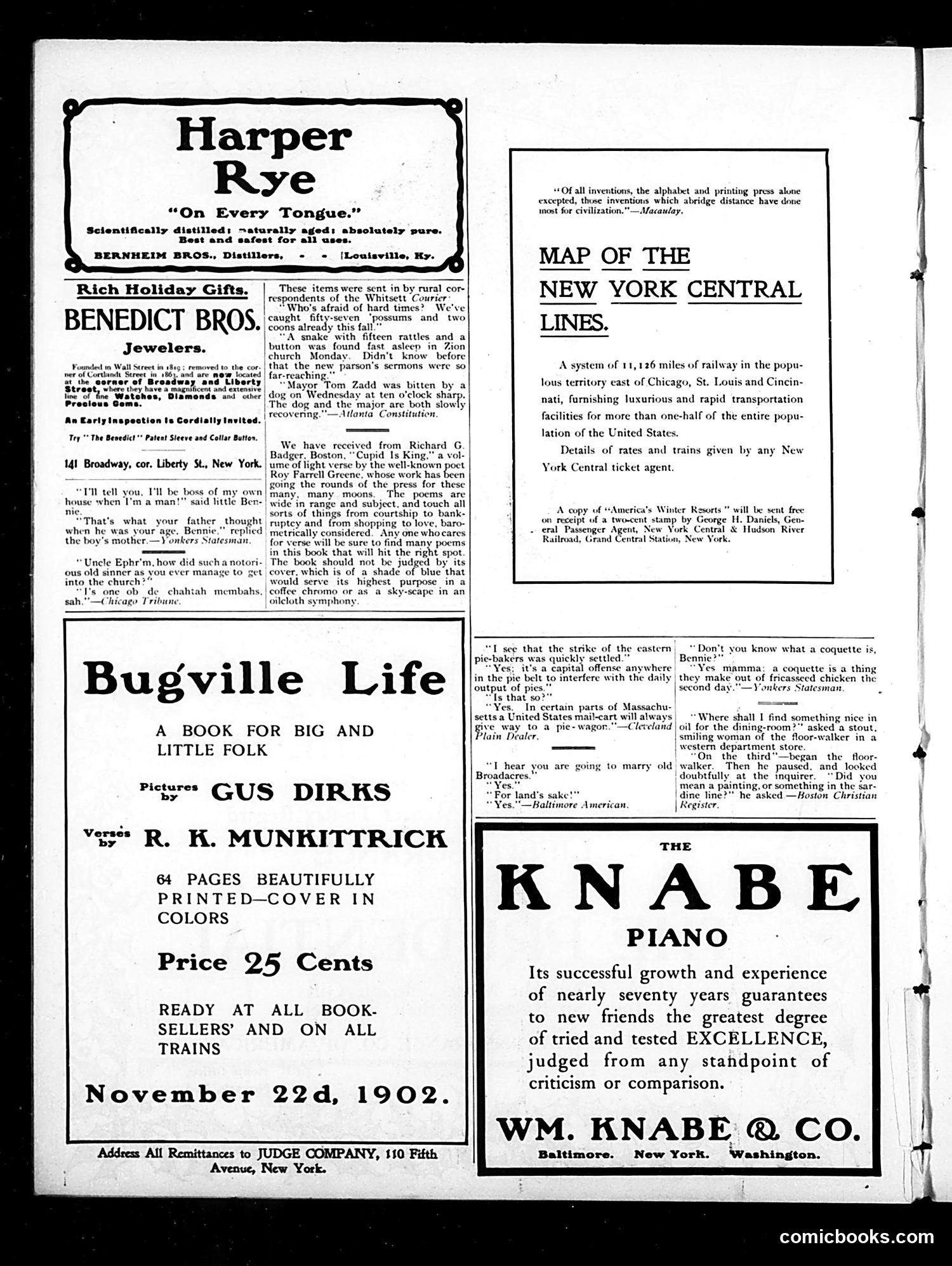
This is primarily an **advertising page** from *Judge* magazine (November 22, 1902), not a political cartoon. The page contains: **Main Content:** - Multiple brief humorous anecdotes and jokes about rural life, relationships, and class differences - Small advertisements for Harper Rye whiskey, Benedict Bros. jewelry, and Knabe pianos - An advertisement for *Bugville Life*, a humorous illustrated book with verses by R.K. Munkittrick **The Humor:** The jokes employ common early-1900s stereotypes—depicting working-class rural correspondents, African American dialect humor ("I's one ob de chahtah membahs"), and domestic comedy (children contradicting parental authority). These reflect period attitudes that modern readers would find outdated or offensive. **No Clear Political Satire:** Unlike typical *Judge* political cartoons, this page's humor is social/domestic rather than politically pointed. It targets universal human foibles (marriage anxiety, class pretension) rather than specific political figures or events.
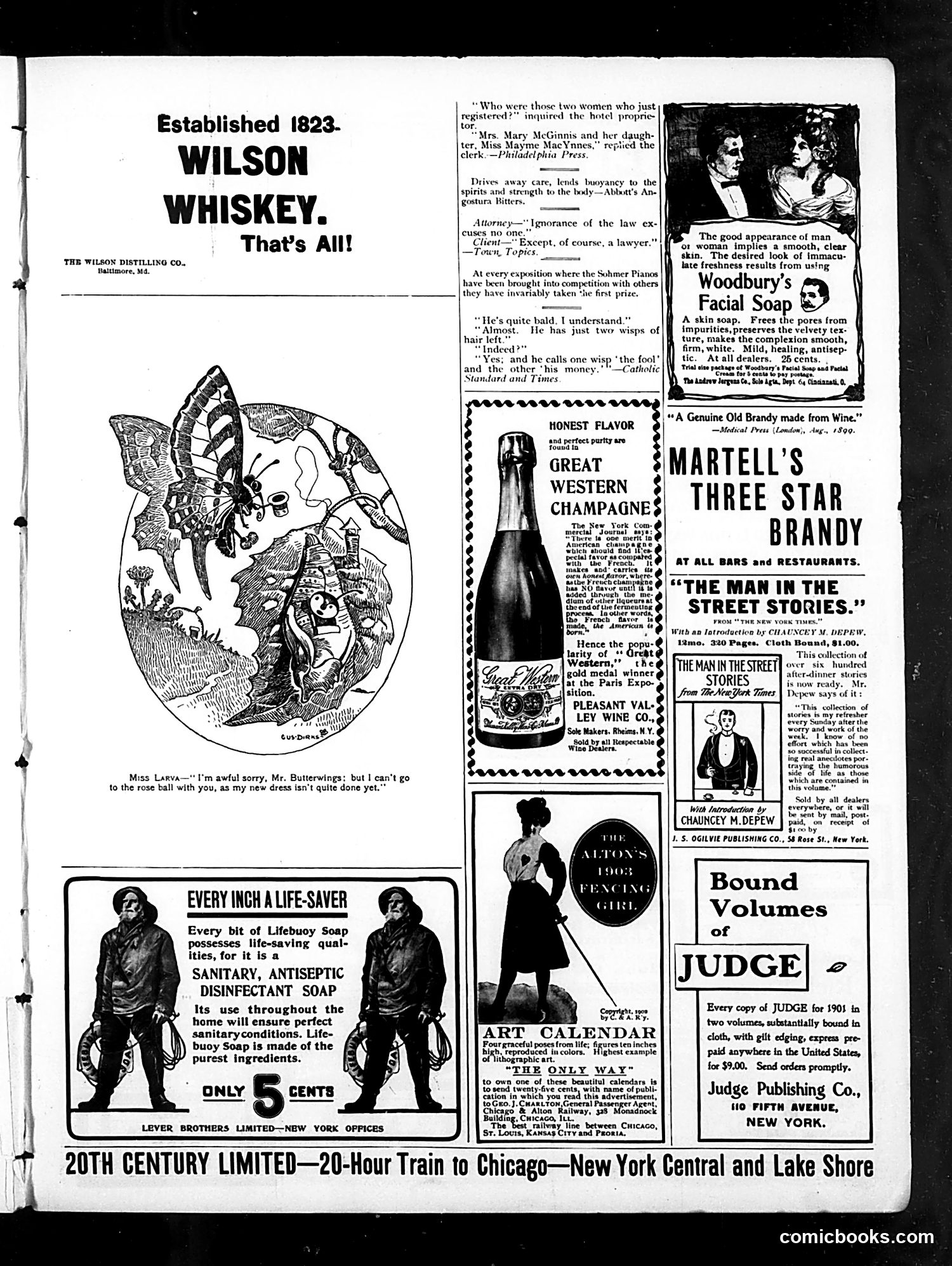
This page is primarily **advertising**, not satirical content. The main cartoon depicts Miss Larva (a figure with insect wings) declining an invitation to a ball because her dress isn't ready—a light domestic humor joke playing on the double meaning of her insect identity. The page is dominated by product advertisements typical of early 1900s Judge magazine: Wilson Whiskey, Great Western Champagne, Woodbury's Facial Soap, Martell's Brandy, and Lifebuoy Soap (marketed as "sanitary" and "antiseptic"—concepts gaining prominence during the germ-theory era). One notable ad features a "1903 Fencing Girl" calendar promoting the Chicago & Alton Railway. There's also an advertisement for "The Man in the Street Stories" by Chauncey M. Depew, a prominent politician/speaker. The page reflects early-20th-century advertising priorities: hygiene products, alcohol, railways, and books—with minimal political satire present.
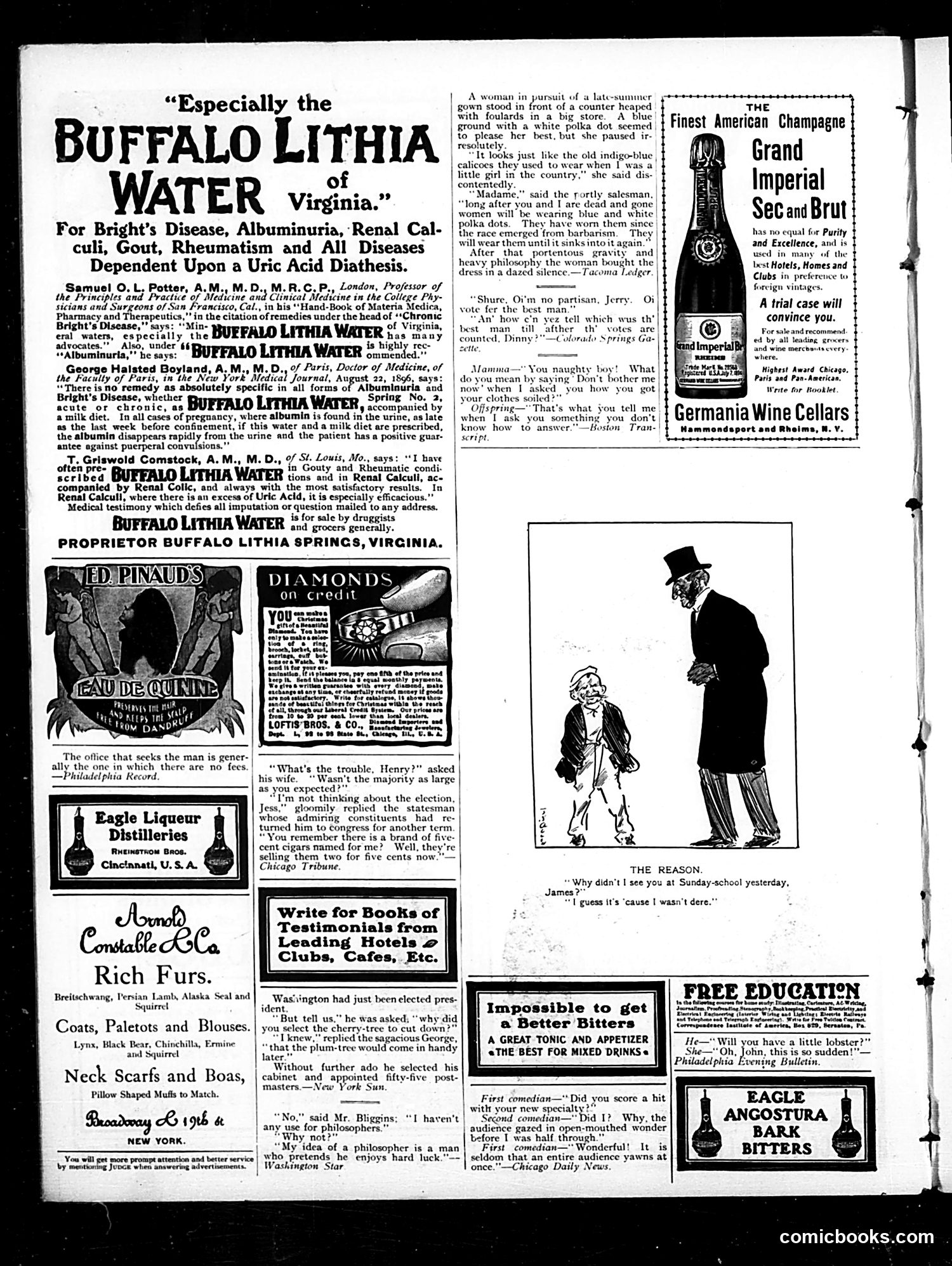
This page is primarily **advertisements and filler content** rather than satirical political cartoons. The dominant feature is a large advertisement for Buffalo Lithia Water, a patent medicine from Virginia claiming to cure kidney disease, gout, and rheumatism—typical of turn-of-the-century medical frauds. The small cartoon near the bottom depicts an adult and child, captioned "THE REASON," with dialogue about missing Sunday school. It's gentle domestic humor, not political satire. The remaining content includes: - Testimonials from doctors (likely fabricated or exaggerated, as was common) - Various product advertisements (diamonds, liqueurs, furs, wine) - Brief humorous anecdotes about a woman buying fabric, Irish voters, and a child's excuse-making **This appears to be a typical Judge magazine filler page**, mixing advertising with light humor. Without knowing the specific publication date, the political content is minimal—the voting anecdote offers mild commentary on electoral decision-making but lacks sharp satire characteristic of Judge's better work.
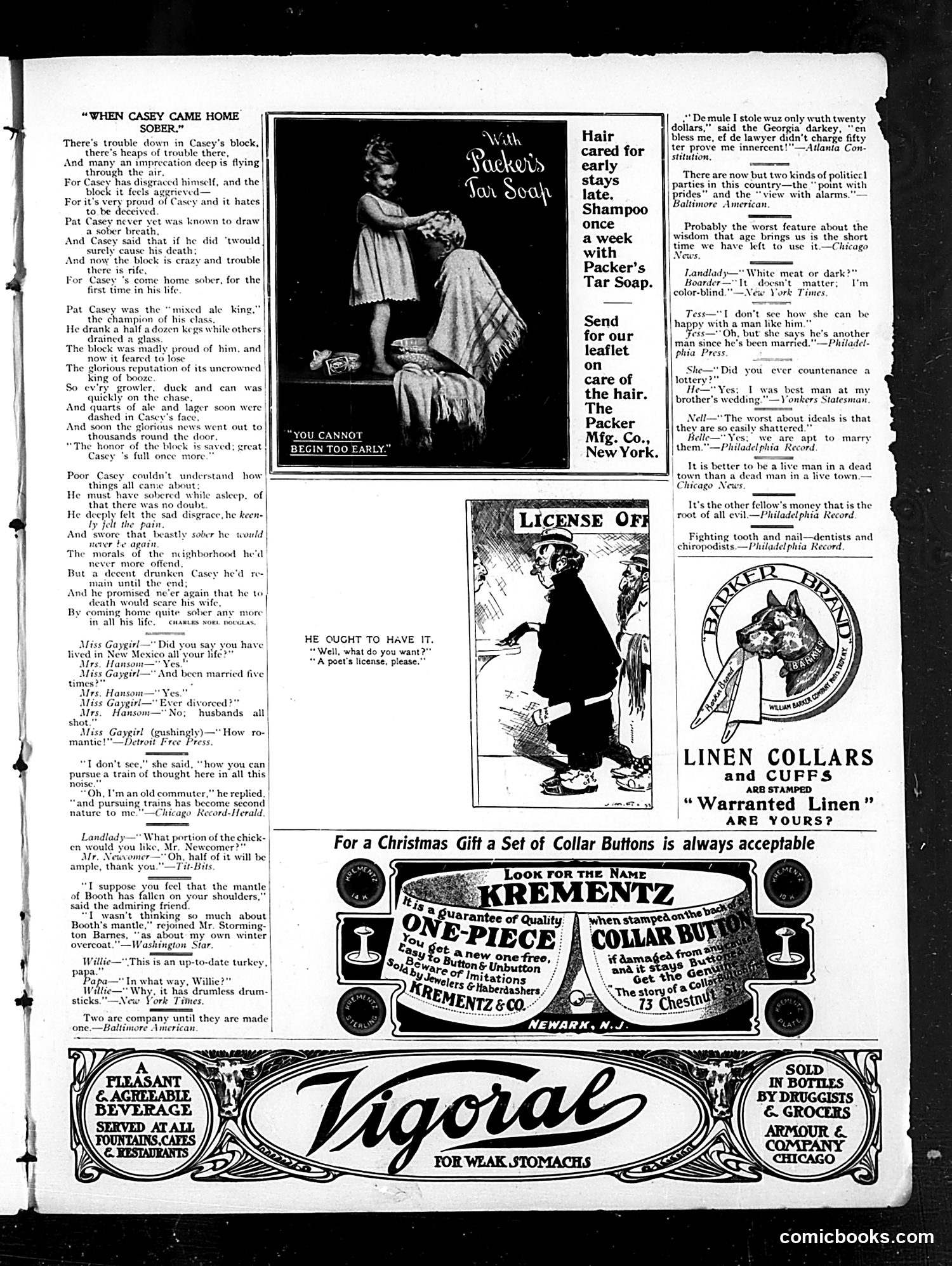
This page from *Judge* magazine contains primarily **humorous short pieces and advertisements** rather than political cartoons. The main story, "When Casey Came Home Sober," is a satirical poem about an Irish immigrant neighborhood's dismay when their celebrated heavy drinker, Pat Casey, arrives home sober. His community—proud of his reputation as a champion drinker—views sobriety as a disgrace and actively tries to get him drunk again. Casey, ashamed of his soberness, promises to return to drinking permanently. The joke satirizes **working-class Irish-American drinking culture** and its social codes, where excessive alcohol consumption was paradoxically a mark of community status. The humor comes from the inverted morality: sobriety is treated as shameful scandal rather than virtue. The page also includes various short jokes about marriage, commuting, and courtship, plus advertisements for soap, collar buttons, and patent medicine—typical *Judge* magazine content from this era.
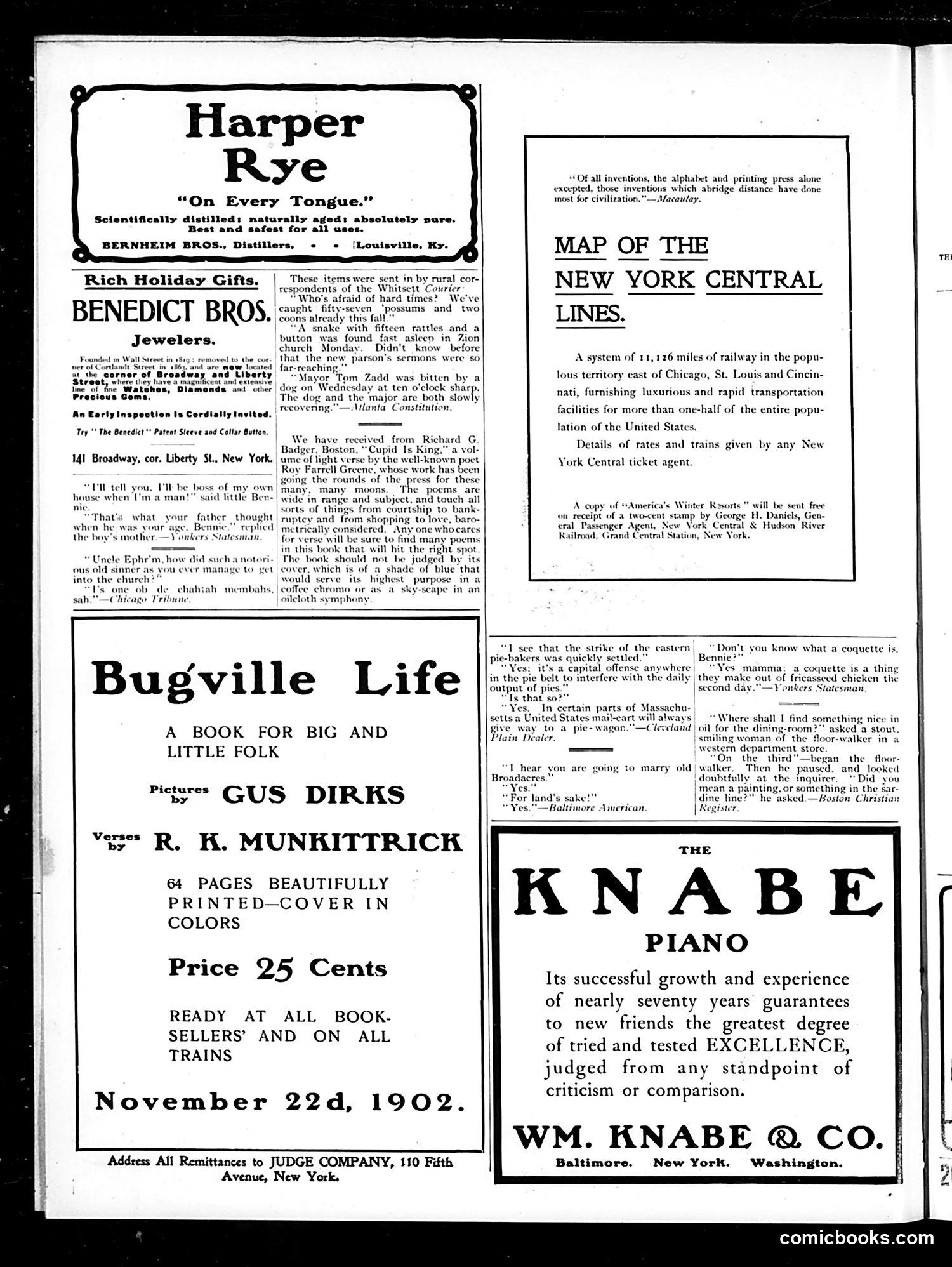
This page is primarily **advertising and filler content** rather than political satire. The dominant elements are: **Advertisements:** Harper Rye whiskey, Benedict Bros. jewelry, Bugville Life (a children's book with illustrations by Gus Dirks), the Knabe Piano, and the New York Central railroad. **Editorial filler:** Brief humorous anecdotes from rural correspondents—jokes about possums, rattlesnakes found in churches, and pie-wagon strikes. These appear designed as light, folksy humor for a general audience. **One satirical element:** A brief exchange mocking a woman shopping for "something nice in oil" (likely lamp oil), where the floor-walker makes an awkward innuendo about her appearance—typical of period humor targeting women shoppers. The page lacks substantive political commentary or caricature. It reflects Judge's mixed approach of combining satirical content with commercial advertising and genteel humor aimed at upper-middle-class readers around 1902.
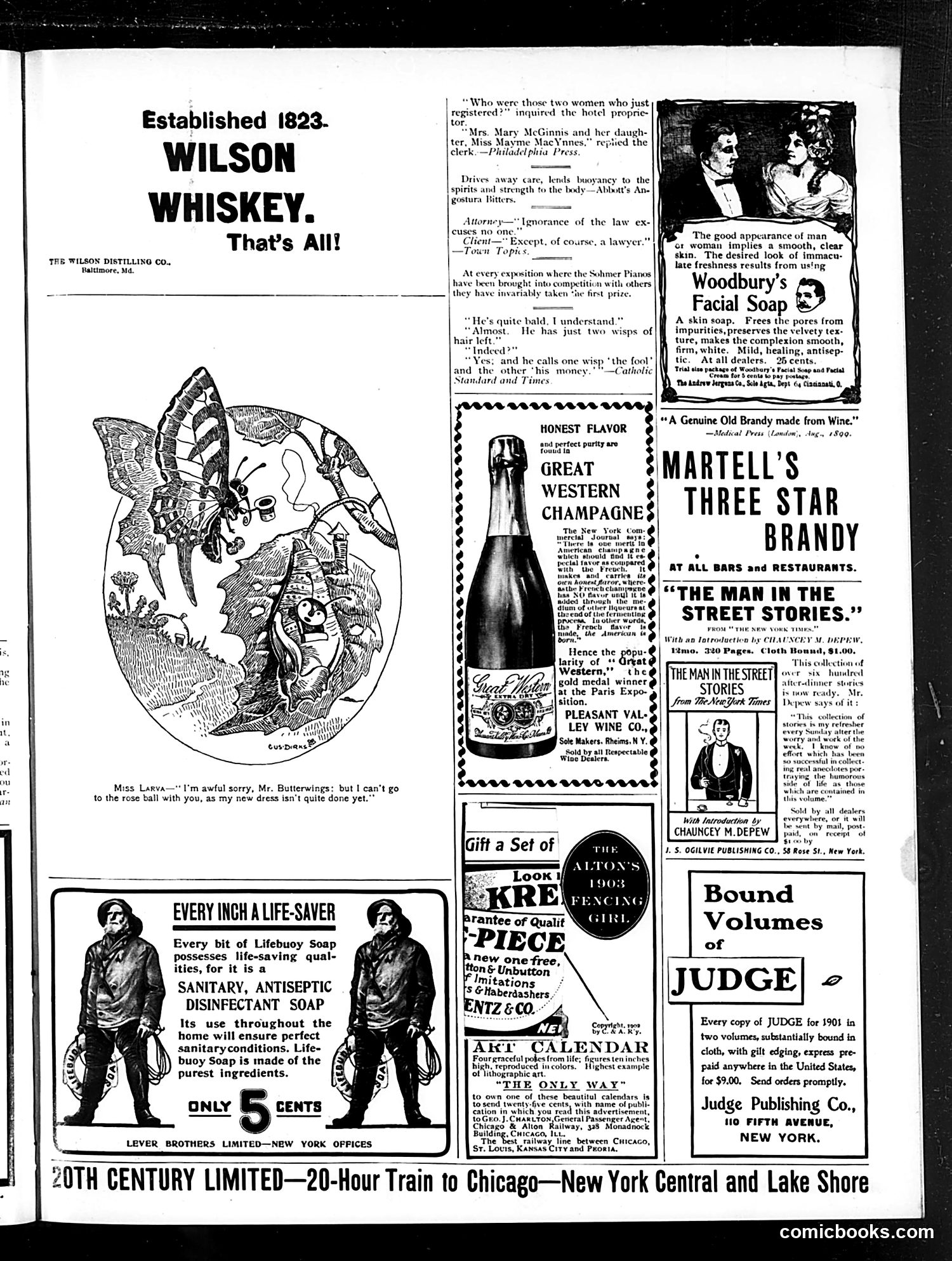
This page is primarily **advertising**, with small comic vignettes interspersed. The main cartoon shows **Miss Larva declining to attend a ball** because her dress isn't ready—a genteel joke about women's social obligations and fashion delays. Other brief jokes include quips about baldness ("two wisps of hair" called "the fool" and "his money") and a hotel clerk mix-up with Irish-sounding names (McGinnis/MacYnnes), typical period humor playing on Irish immigrant stereotypes. The **advertisements dominate**: Wilson Whiskey (established 1823), Woodbury's Facial Soap, Martell's Three Star Brandy, Lifebuoy Soap, Sohmer Pianos, Great Western Champagne, and a bound volumes collection of Judge magazine itself for 1903. These reflect turn-of-the-century consumer goods marketed to middle and upper-class readers. The soap ads emphasize genteel beauty standards; alcohol ads stress quality and awards. The page reflects *Judge*'s audience: affluent, concerned with propriety, fashion, and branded luxury goods.
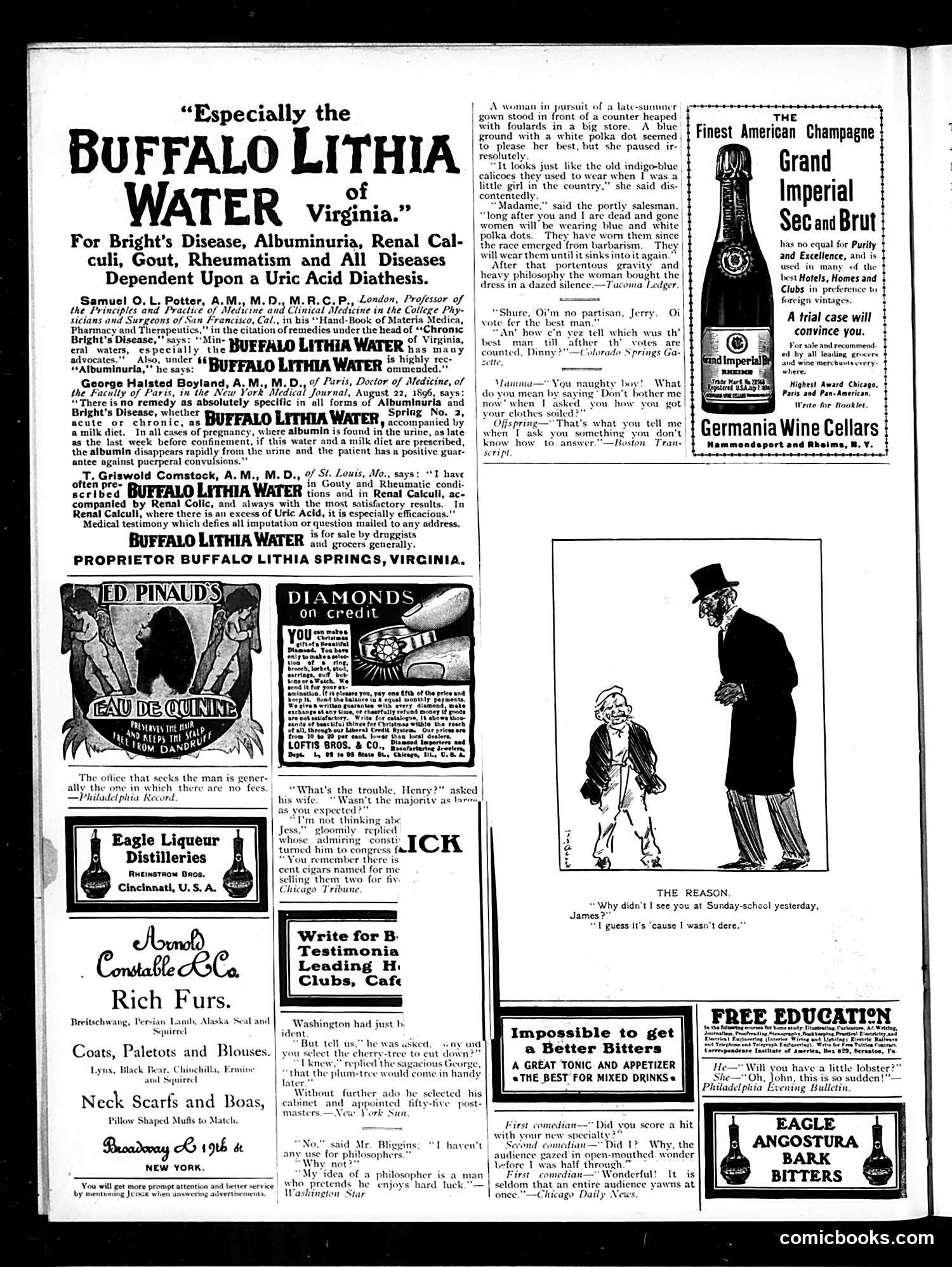
This page is primarily **advertising** for patent medicines and luxury goods, typical of early 20th-century magazines. The dominant content is a large advertisement for Buffalo Lithia Water from Virginia, claiming to cure Bright's Disease, gout, rheumatism, and kidney ailments through "uric acid diathesis" treatment—medical claims that would be considered fraudulent today. The small cartoon in the upper right ("The Reason") shows a well-dressed man questioning a boy about missing Sunday school, with the boy claiming he "wasn't there." This appears to be mild social satire about childhood excuses. Below are brief comic dialogue snippets about partisan voting and marital disagreements—generic humor unrelated to specific political figures. The remaining content comprises period advertisements for champagne, furs, liqueurs, and diamonds—reflecting the magazine's wealthy readership. No specific political satire or identifiable caricatures appear on this page.
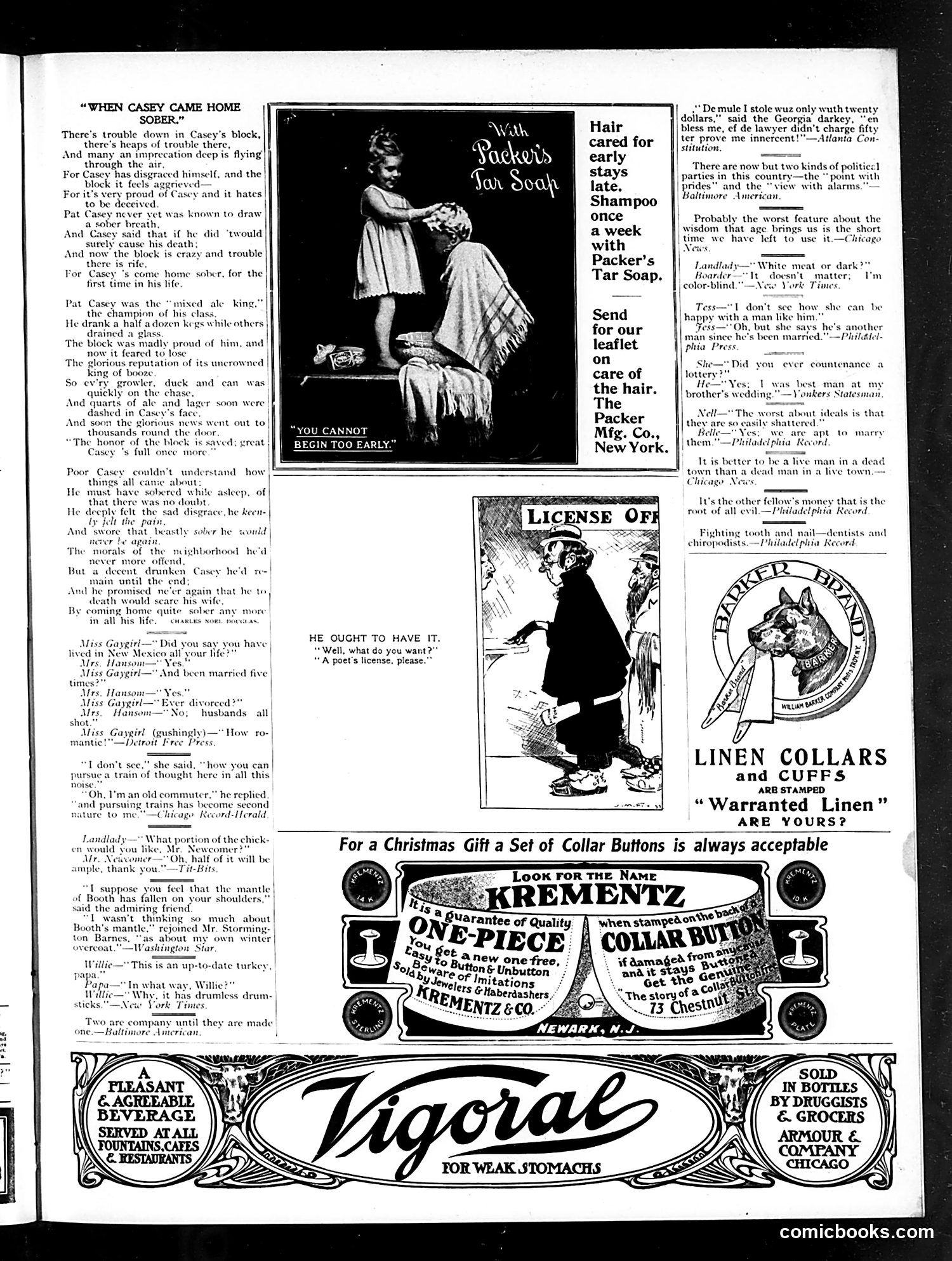
This page's main feature is a satirical poem about Irish-American working-class culture in an urban neighborhood ("the block"). Pat Casey is a local celebrity known as the "mixed ale king"—a heavy drinker respected for his drinking prowess. The joke is that when Casey comes home sober for the first time, the entire neighborhood treats it as a scandal and disgrace rather than an improvement. His community's values are so inverted that sobriety is shameful; the block fears Casey has lost his identity and status. The satire mocks both Casey's drinking culture and the neighborhood's backwards morality system. It's ethnic humor typical of Judge magazine, playing on Irish-American stereotypes about alcohol consumption and community pride in dubious achievements. The poem ends with Casey promising to return to chronic drunkenness to restore his reputation and family peace. The rest of the page consists of period advertisements and unrelated jokes.
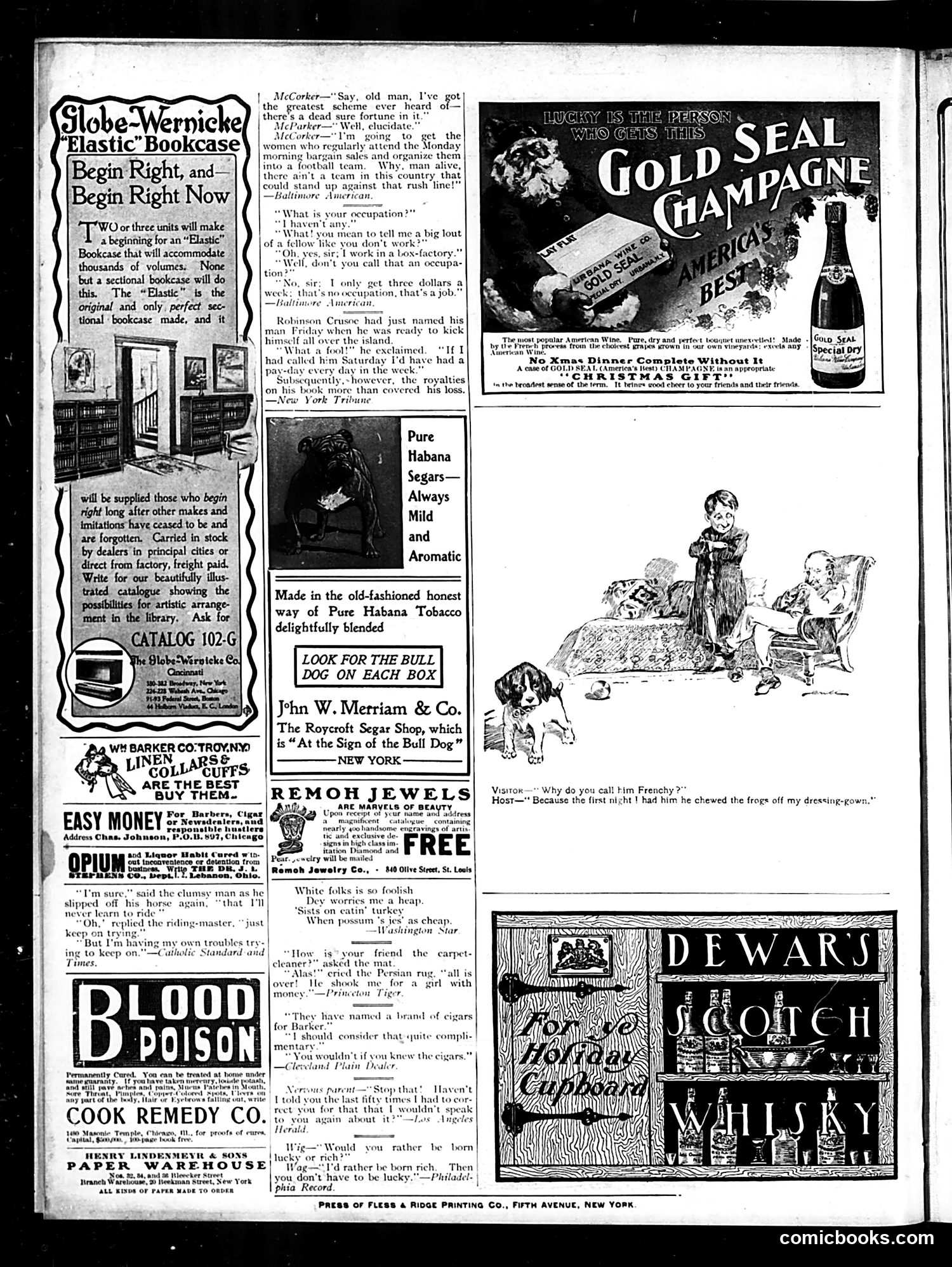
This page from *Judge* magazine contains multiple satirical dialogues and advertisements typical of early 20th-century American humor. **Main Cartoons/Jokes:** The page features several short comic exchanges mocking contemporary social types. One depicts a conversation about occupations, where a man claims to have none—satirizing unemployment or idleness. Another jokes about Robinson Crusoe's financial struggles, suggesting even famous figures face economic hardship. A third cartoon ridicules a clumsy horseman's repeated failures, poking fun at incompetence. **Advertisements:** Prominently featured are period products including the Globe-Wernicke "Elastic" Bookcase, Gold Seal Champagne, Dewar's Scotch Whisky, and cigars—reflecting consumer culture of the era. **Recurring Theme:** The humor targets laziness, incompetence, and social pretension. One exchange mocks someone claiming poverty while refusing honest work. The page is primarily **advertising-driven satirical content** rather than focused political commentary, typical of *Judge*'s entertainment-commercial hybrid format.
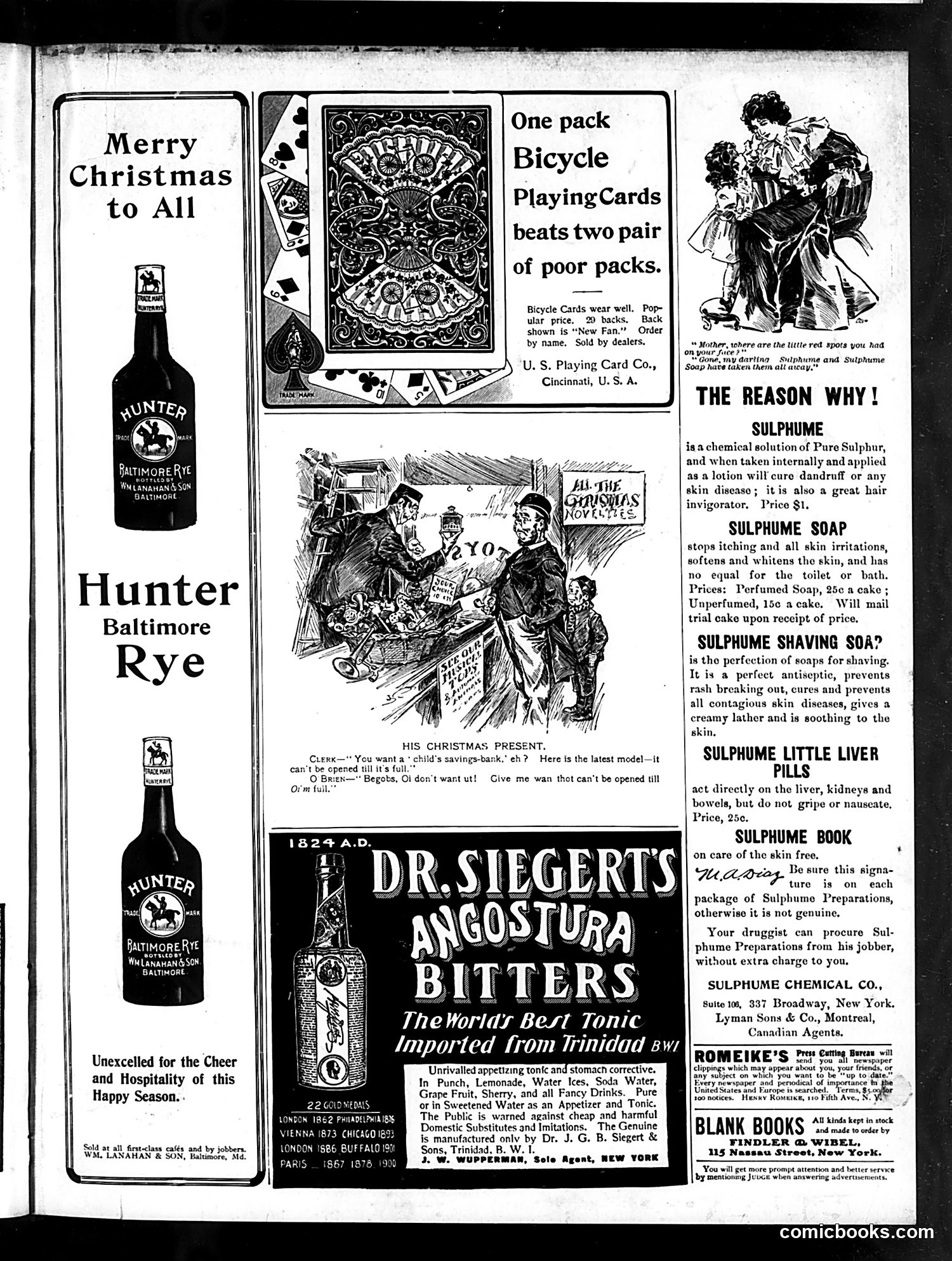
This page is primarily **advertisements** rather than editorial content, typical of late-19th/early-20th century magazines that relied heavily on paid ads. The one **cartoon** present ("His Christmas Present") depicts a shop clerk showing a customer a children's savings bank that "can't be opened till it's full." The joke satirizes the frustration of forced saving—the child receives a gift designed to prevent them from accessing their own money, reflecting contemporary anxieties about thrift and delayed gratification. The remaining content consists of holiday-season product advertisements: Hunter Baltimore Rye whiskey (with "Merry Christmas to All"), Bicycle Playing Cards, and notably multiple ads for "Sulphume," a patent medicine claiming to cure dandruff, skin diseases, and hair loss—typical of the era's largely unregulated snake-oil remedies, some containing actual sulfur compounds. The page reflects Judge's commercial model and period attitudes toward consumer goods and dubious medical products marketed without FDA oversight.
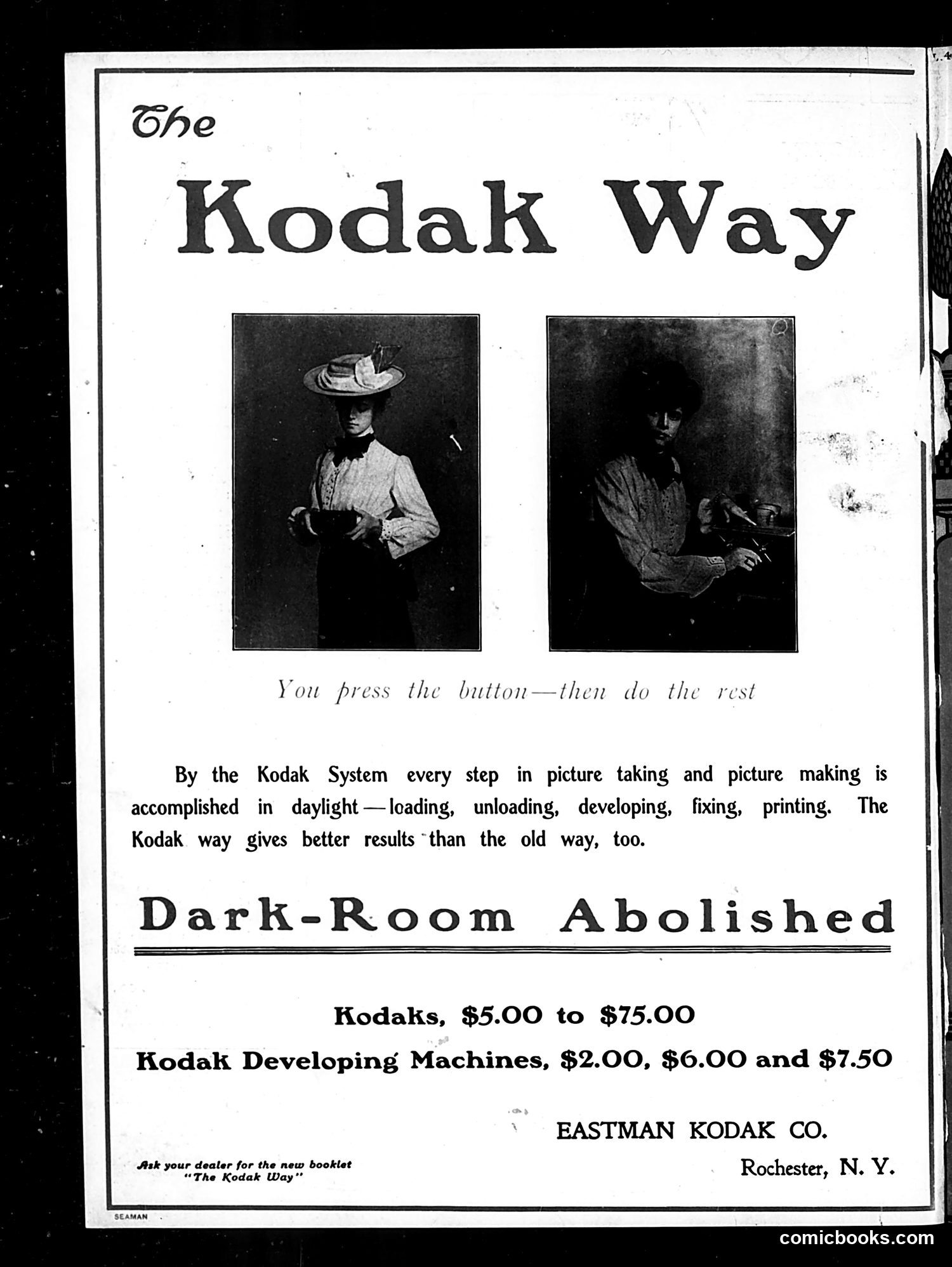
This is a **Kodak advertisement**, not a cartoon or satire. It appears in *Judge*, likely because the magazine accepted paid advertising. The ad promotes Kodak's revolutionary camera system with the famous slogan "You press the button—then do the rest." The two photographs show women demonstrating the ease of use: one in fashionable dress with a hat, one in darker clothing. The key innovation advertised is that photography no longer requires a **dark room**—all developing and printing happen in daylight using Kodak's machines. This was genuinely revolutionary technology that democratized photography, making it accessible to amateurs rather than professionals. The pricing ($5–$75 for cameras) and developing machines ($2–$7.50) reflects early 1900s consumer products. The message is straightforward marketing: Kodak's system is simpler, faster, and produces better results than traditional methods. There is no satirical commentary here—it's a legitimate technological advancement advertisement.