
Judge, 1902-12-20 · page 28 of 52
Judge — December 20, 1902 — page 28: what you’re looking at
What you’re looking at
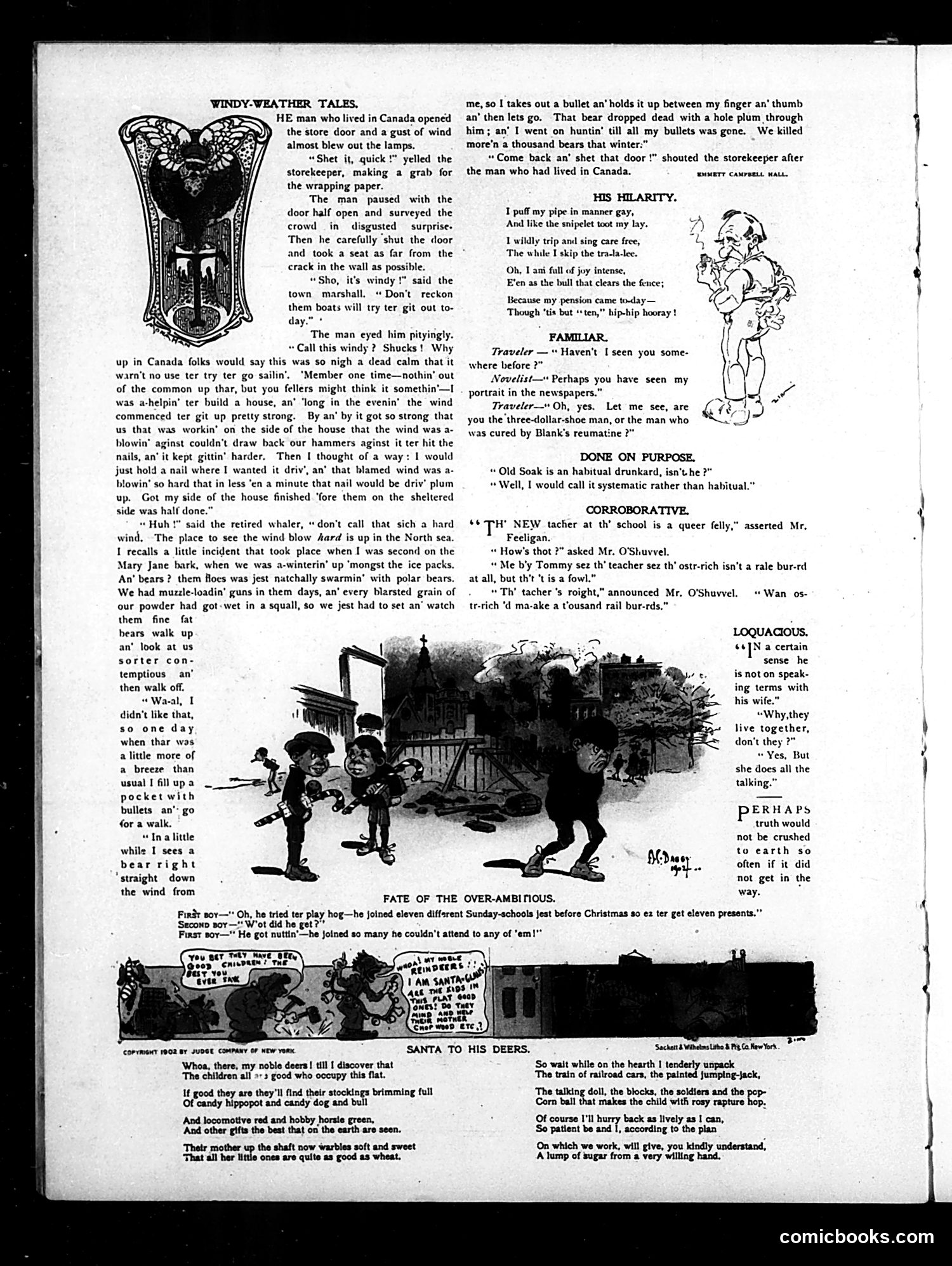
This page from Judge magazine contains multiple short humor pieces typical of the publication's satirical style: **"Windy-Weather Tales"** (main feature): A tall-tale competition where men from different regions boast about extreme weather. A Canadian claims winds so strong they drove nails without hammers; a retired whaler tops it by describing polar bears so numerous he killed over a thousand with wind-blown bullets. The joke satirizes exaggeration and competitive boasting—a common folk humor tradition. The storekeeper's final interruption provides comedic punctuation. **Other brief items** include: - "His Hilarity": A man celebrating a meager ten-dollar pension with exaggerated joy - "Familiar": A novelist mistaken for a patent-medicine advertisement subject - "Done on Purpose": Wordplay distinguishing habitual from "systematic" drunkenness - "Corroborative": Irish dialect humor about an ostrich, with working-class characters The page exemplifies Judge's mix of folk-humor traditions, working-class characters rendered in dialect, and gentle social observation—typical early 20th-century American comic magazine fare.
📄 Transcribed text from this page (OCR, searchable)
Machine-transcribed from the original scan — historical spelling and the odd misread are preserved.
WINDY-WEATHER TALES. HE man who lived in Canada opened the store door and a gust of wind almost blew out the lamps. “Shet it, quick !" yelled the storekeeper, making a grab for the wrapping paper. The man paused with the door half open and surveyed the crowd in disgusted surprise. Then he carefully ‘shut the door and took a seat as far from the crack in the wall as possible. “Sho, it’s windy !* said the town marshall. «Don't reckon them boats will try ter git out to- day.” + The man eyed him pityingly. * Call this windy ? Shucks |. Why up in Canada folks would say this was so nigh a dead calm that it warn't no use ter try ter go sailin’, ‘Member one time—nothin’ out of the common up thar, but you fellers might think it somethin'—I was a-helpin’ ter build a house, an’ ‘long in the evenin’ the wind commenced ter git up pretty strong. By an’ by it got so strong that us that was workin’ on the side of the house that the wind was a- blowin’ aginst couldn't draw back our hammers aginst it ter hit the nails, an’ it kept gittin’ harder. Then { thought of a way: I would just hold a nail where I wanted it driv’, an’ that blamed wind was a- blowin’ so hard that in less ‘en a minute that nail would be driv’ plum up. Got my side of the house finished ‘fore them on the sheltered side was half done.” “Huh !” said the retired whaler, “don’t call that sich a hard wind. The place to see the wind blow Aard is up in the North sea. I recalls a little incident that took place when I was second on the Mary Jane bark, when we was a-winterin’ up ‘mongst the ice packs. An’ bears ? them floes was jest natchally swarmin’ with polar bears. We had muzzle-loadin’ guns in them days, an’ every blarsted grain of our powder had got-wet in a squall, so we jest had to set an’ watch them fine fat bears walk up an’ look at us sorter con- temptious an’ then walk off. “Waal, 1 didn’t like that, so one day when thar was alittle more of a breeze than usual I fill up a pocket with bullets an’: go for a walk. “Ina little while I sees a bear right ‘straight down the wind from Find vor—"* Oh, he tried ter play hog— Secon por—" W'ot did he get?’ me, so I takes out a bullet an‘ holds it up between my finger an’ thumb an’ then lets go. That bear dropped dead with a hole plum through him ; an’ I went on huntin’ till all my bullets was gone. We killed more'n a thousand bears that winter.” “Come back an’ shet that door !” shouted the storekeeper after the man who had lived in Canada. SMMETT CAMYBELL WALL. HIS HILARITY. I puff my pipe in manner gay, And like the snipelet toot my lay. 1 wildly trip and sing care free, ‘The while I skip the tra-la-lee. Oh, 1 ani full of joy intense, E’en as the bull that clears the fence; Because my pension came to-day— Though ‘tis but ten,” hip-hip hooray ! FAMILIAR. Traveler —“ Haven't [seen you some- where before 2” Novelist— Pethaps you have seen my portrait in the newspapers.” Traveler— Oh, yes. Let me see, are af you the three-dollar-shoe man, or the man who was cured by Blank’s reumatine 2” DONE ON PURPOSE. “ Old Soak is an habitual drunkard, isn’t he ?” “Well, I would call it systematic rather than habitual.” CORROBORATIVE. ‘¢-TH' NEW tacher at th’ school is a queer felly,” asserted Mr. Feeligan. “ How's thot ?” asked Mr. O’Shuvvel. “ Me b'y Tommy sez th’ teacher sez th’ ostr-rich isn’t a rale bur-rd at all, but th’t ‘tis a fowl. “ Th’ tacher 's roight,” announced Mr. O'Shuvvel. Wan os- te-rich “d ma-ake a tlousand rail bur-rds." LOQUACIOUS. ee] N a certain sense he is not on speak- ing terms with his wife.” “Why, they live together, don’t they ?” “Yes, But she does all the talking.” P ERHAPS truth would not be crushed to earth so often if it did not get in the FATE OF THE OVER-AMBITIOUS. wer: Jolned eleven different Sunday-schools Jest before Christmas so ez ter get eleven presents.”” Finst soy—" He got nuttin'—he joined so many he couldn't attend to any of "em!"" ° Corrment 1902 BY JUDGE COMPANY OF KEW YORK Whoa, there, my noble deers! till { discover that The children all »*2 good who occupy this flat. If good they are they'll find their stockings brimming full Offanty hippopot and candy dog and bull ‘And locomotive red and hobby horsle green, AASd Goer pif the vant Ua} es tho ean are onan. Tek iota up tee shat nary Warbiee ott and overt ‘That all her li ‘ones are quite as good as wheat. ‘achat Wide ithe B Pit Ca Rew York. So wait while on the hearth | tenderly unpack ‘The train of railroad cars, the painted jumping-jack, The talking doll, the blocks, the solders and the ee Corn ball that makes the child with rosy rapture hop. Of course I'll hurry back as lively as I can, ‘So patient be and I, according to the plan On which we work, will give, you kindly understand, A lump of sugar from a very willing hand. 4 — comicbooks.com