
A complete issue · 46 pages · 1896
Judge — December 19, 1896
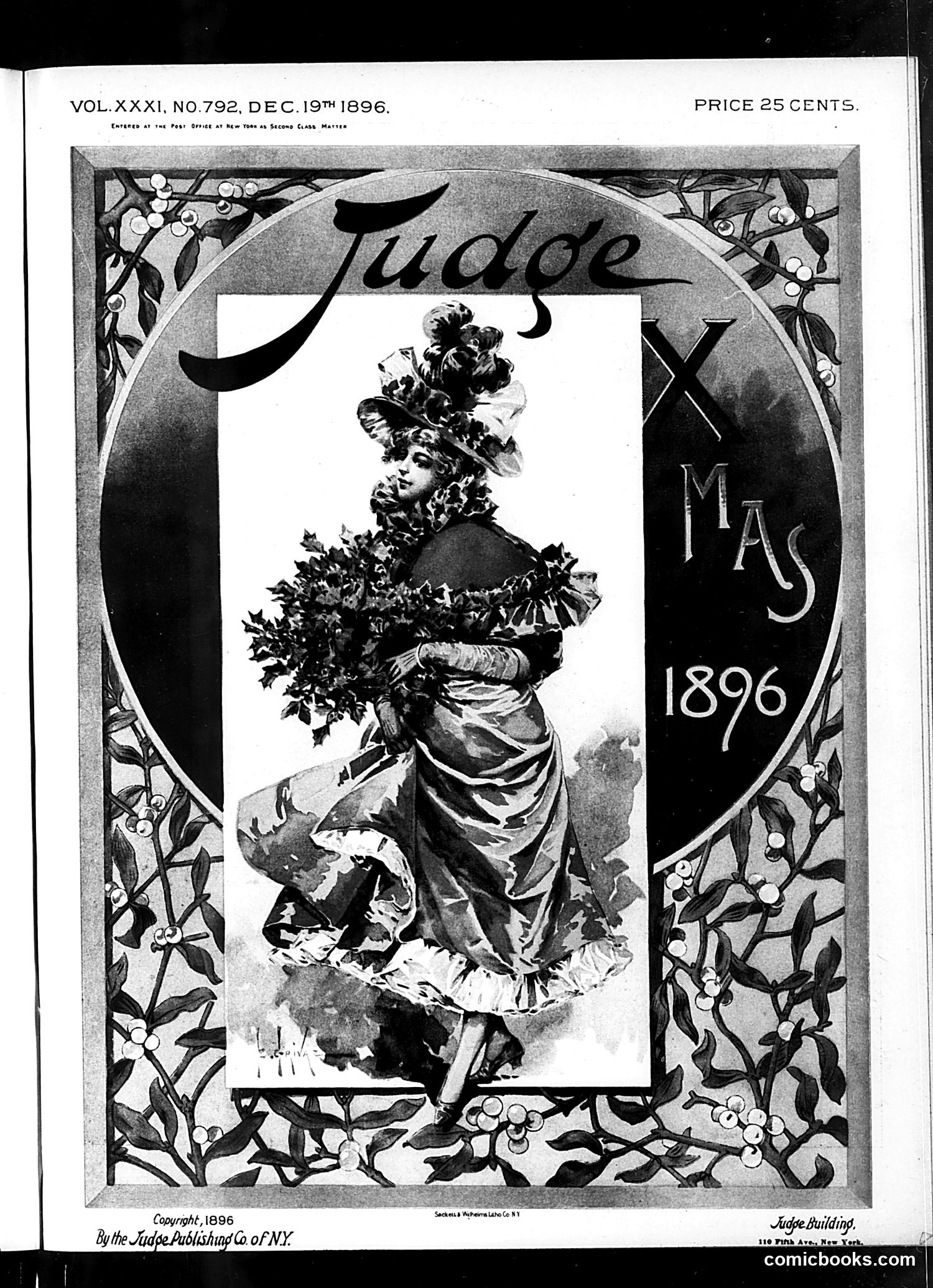
This is a Christmas-themed cover illustration rather than a political cartoon. It depicts an elegantly dressed woman in elaborate 1890s fashion—featuring a large feathered hat, ornate dress with fur trim, and a large holly wreath—posed as a holiday greeting. The decorative border features holly and berries, reinforcing the seasonal theme. The text "Xmas 1896" and "Judge" frame the central figure. This appears to be the magazine's holiday issue cover art, typical of Judge's practice of featuring fashionable, aesthetically pleasing illustrations for seasonal editions. The "Xmas" design would have appealed to readers during the Christmas shopping season, combining seasonal decoration with contemporary fashion illustration rather than social or political satire.
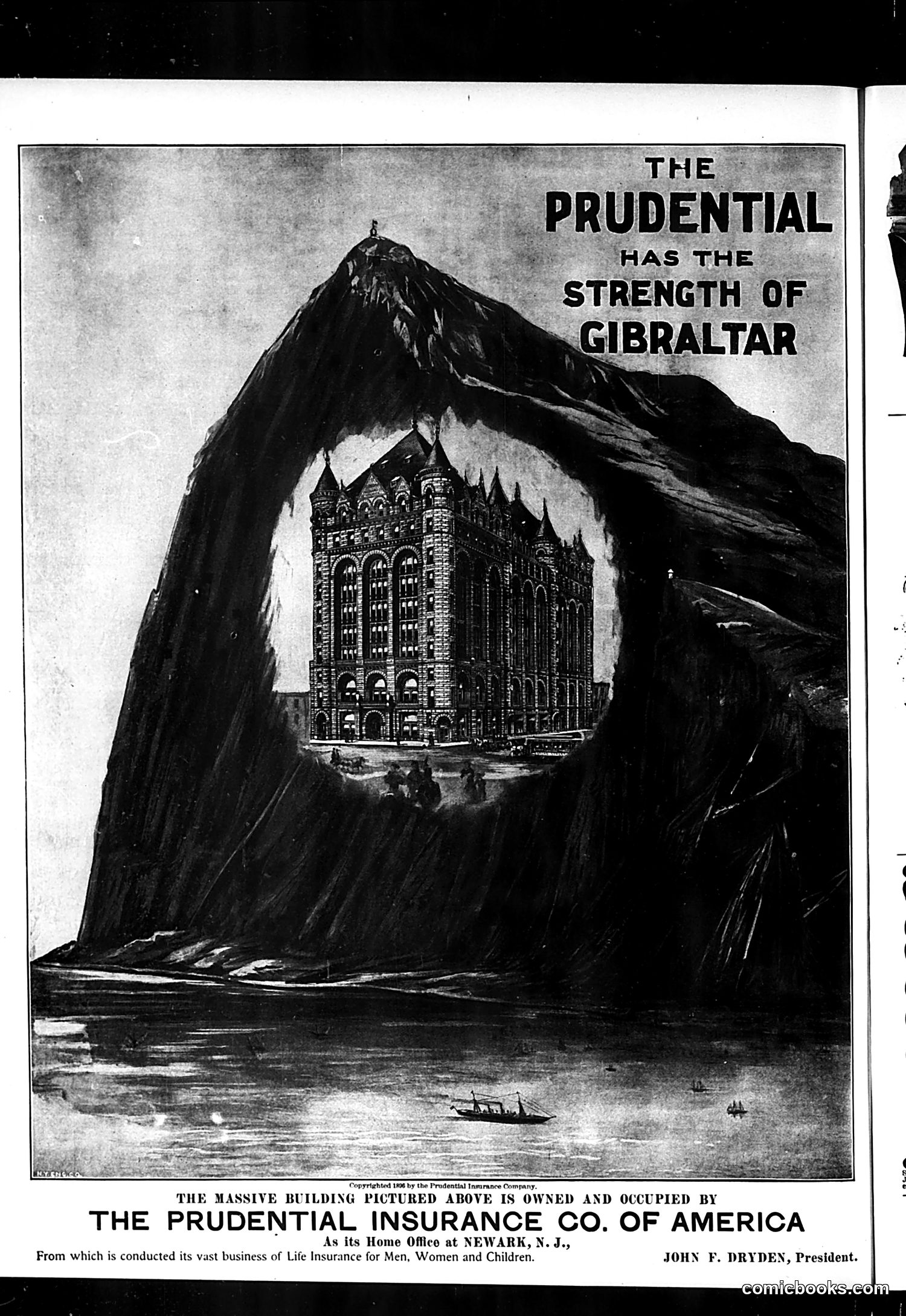
This page is primarily an **advertisement** for The Prudential Insurance Company of America, not a satirical cartoon. The image depicts a massive Gothic building (Prudential's Newark, N.J. headquarters) framed dramatically within the silhouette of the Rock of Gibraltar. The headline states "THE PRUDENTIAL HAS THE STRENGTH OF GIBRALTAR"—a commercial metaphor comparing the insurance company's stability and permanence to the famous rock formation, a symbol of immovable strength and reliability. Rather than satire, this represents early 20th-century corporate advertising using nationalist and geological imagery to suggest financial security and trustworthiness to potential customers. The visual metaphor aims to reassure the public about the company's durability during an era when insurance company failures could devastate policyholders.
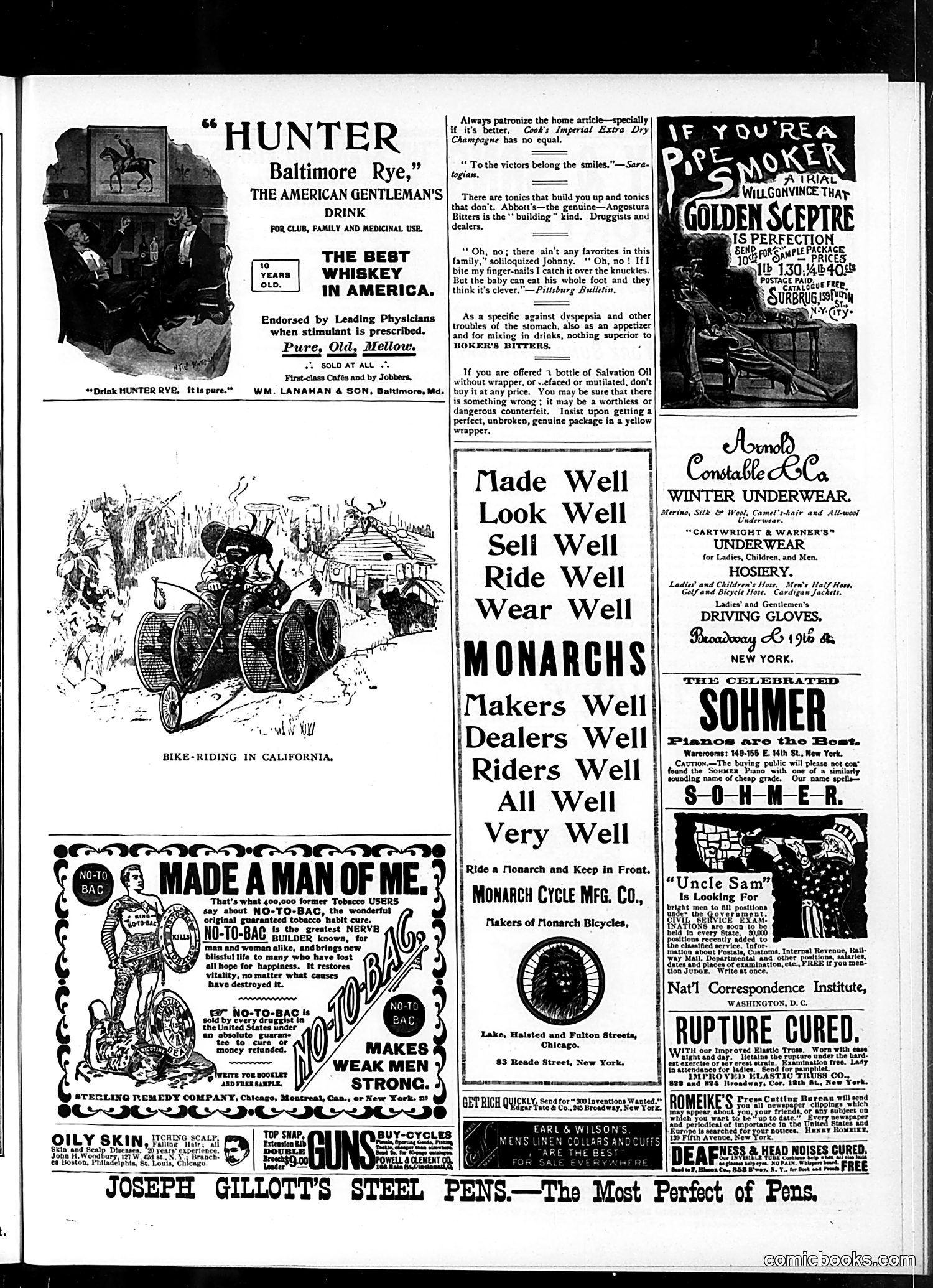
This page is predominantly **advertisements** from circa 1915, with minimal editorial cartooning. The main visual content includes: **"Bike-Riding in California"** - A humorous illustration of early automobile/motorcycle driving, reflecting contemporary fascination with new transportation technology. **Social Commentary Ads:** - "Made a Man of Me" (No-To-Bac tobacco cessation product) uses exaggerated before/after imagery, satirizing masculine identity and addiction - Monarch Bicycles advertisement with repetitive "Well" copy, a common advertising technique of the era - Various health remedies and business opportunity ads typical of early 20th-century publications The page reflects Judge's mixed approach: mixing satirical product advertisements with actual editorial content, while maintaining the magazine's focus on humor directed at middle-class anxieties about health, masculinity, and modern consumer culture.
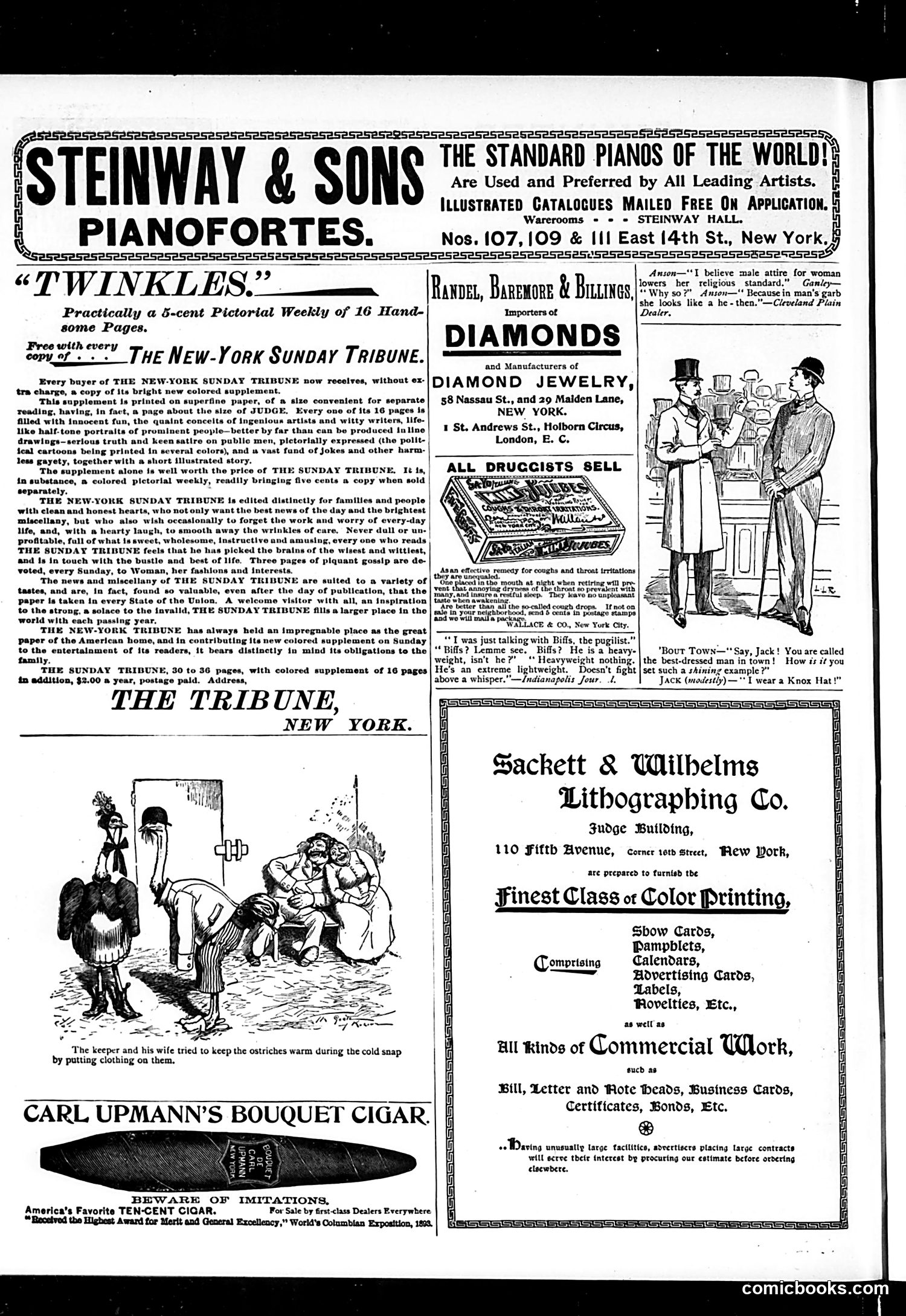
This page is predominantly **advertising**, with one cartoon and minimal editorial content. The main cartoon depicts **ostriches in winter clothing**—a visual pun illustrating the absurdity of the caption below: a zoo keeper and his wife attempting to warm ostriches during a cold snap by dressing them in clothes. The humor lies in the ridiculous image of large birds in human garments, playing on contemporary notions of both animal care and the era's fashion sensibilities. The page's substantial real estate is occupied by advertisements for Steinway pianos, "Twinkles" (a Sunday Tribune supplement), diamonds, cigars, and lithography services. A small text joke about women wearing male attire and "looking like a heathen" reflects period attitudes about gender presentation. The cartoon itself contains no political commentary—it's simply humorous domestic absurdism typical of Judge's lighter content.
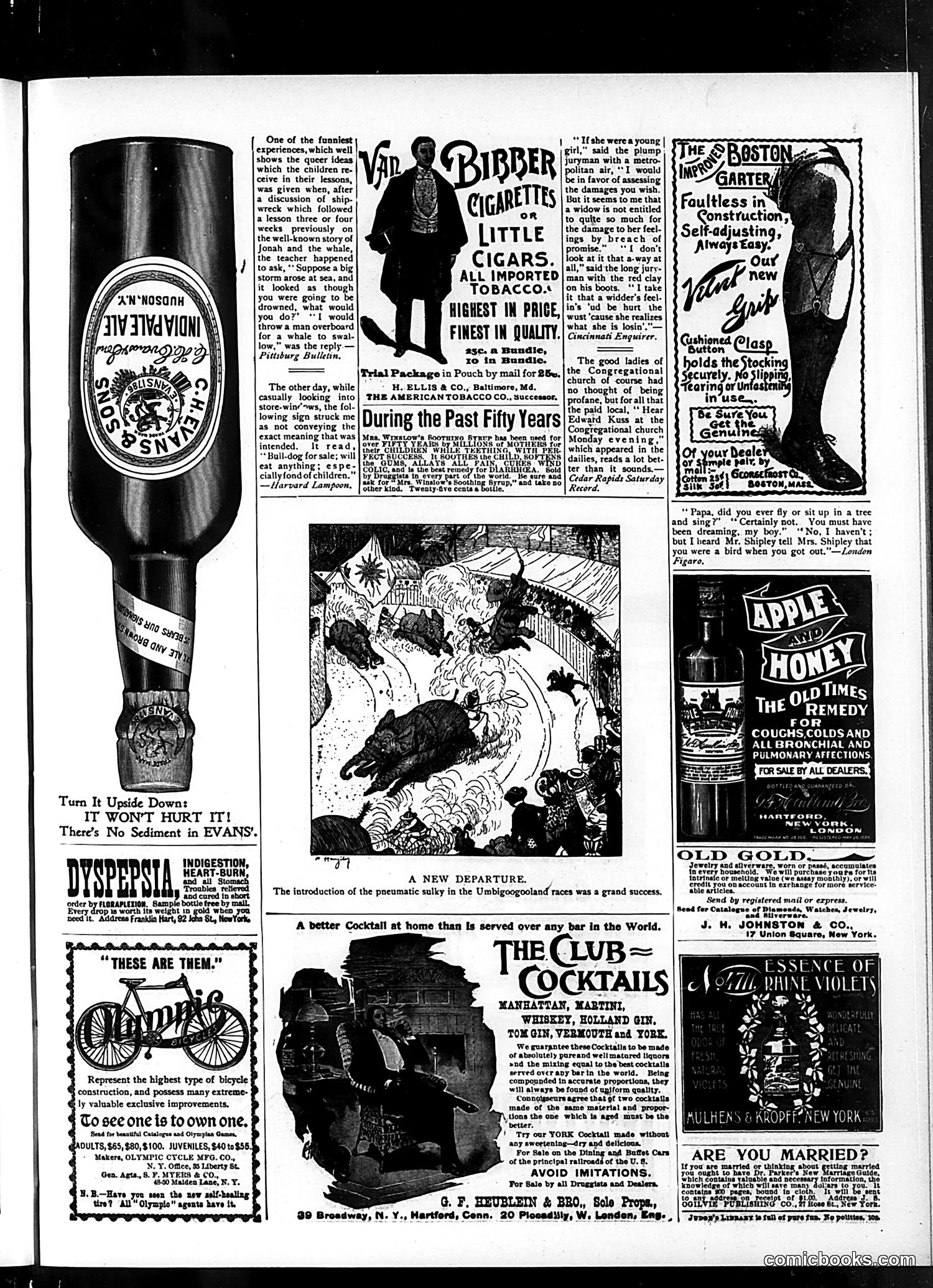
This page is primarily **advertising**, with minimal editorial content. The advertisements promote patent medicines, bicycles, cigars, cocktails, and other consumer goods typical of the late 19th century. The small humorous anecdotes scattered throughout are light, non-political observations: - A child misunderstands a lesson about Jonah, suggesting throwing a man overboard for a whale to swallow - A juryman and farmer debate a widow's damages in a breach-of-promise case, reflecting class differences in perspective - A store sign reading "bull-dog for sale...especially fond of children" creates unintended dark humor These pieces satirize **everyday confusion and miscommunication** rather than targeting specific political figures or events. The humor relies on innocent misinterpretation and social awkwardness. The illustrated cartoon titled "A New Departure" depicts "pneumatic sulky" races in a fictional "Umbigoogooland"—absurdist humor with no identifiable political reference. Overall, this represents Judge's lighter, consumer-focused content rather than hard-hitting political satire.
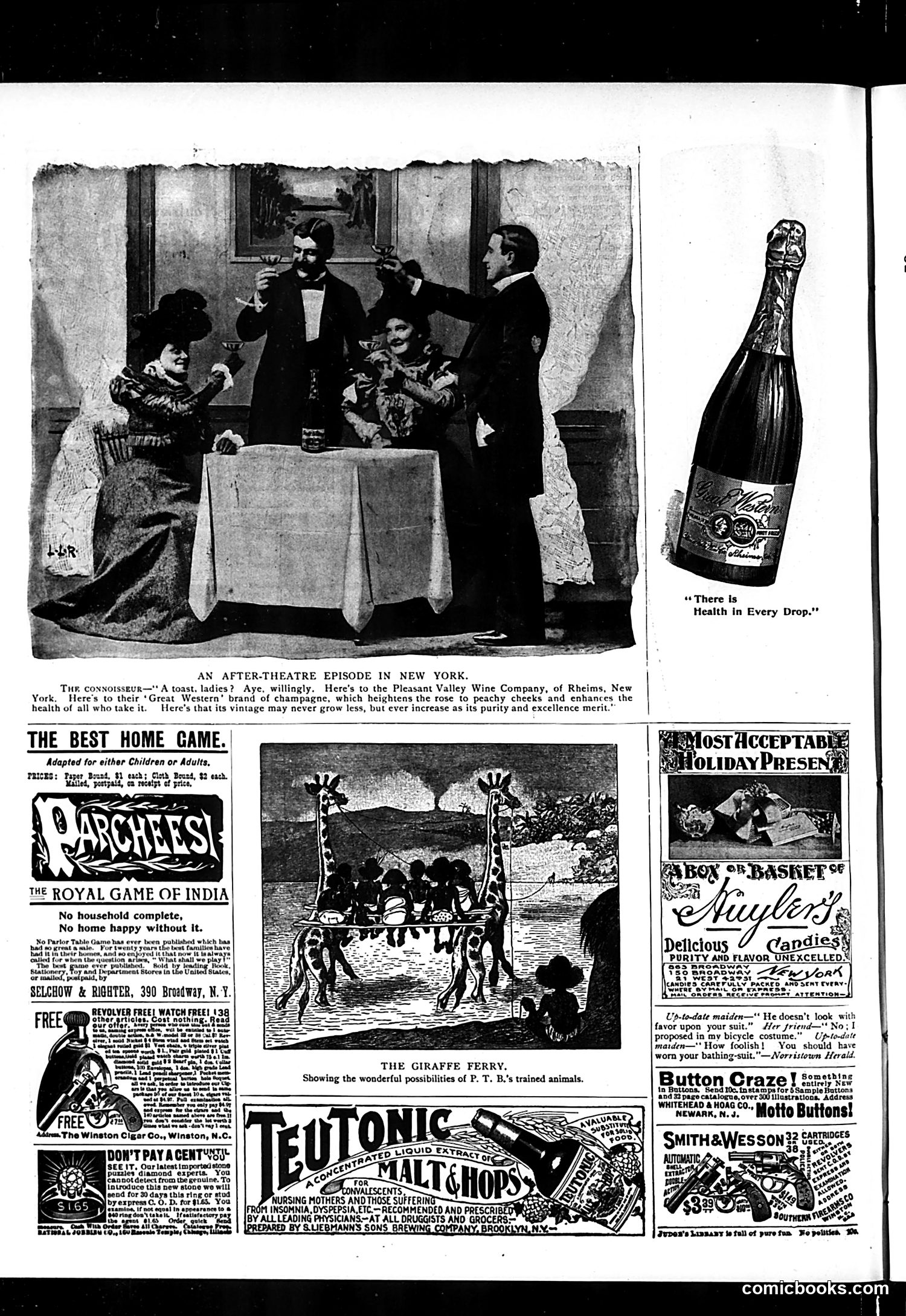
This page is primarily **advertising and light humor**, typical of Judge magazine's format. The main cartoon depicts an "after-theatre episode in New York" where fashionable diners toast with Pleasant Valley Wine Company champagne—a straightforward advertisement disguised as social commentary. The caption's irony is gentle: these sophisticated New Yorkers are celebrating the wine's consistency and quality. Below are various period advertisements (board games, tonics, firearms) and brief humorous anecdotes. "The Giraffe Ferry" references P.T. Barnum's trained animals—a nod to popular entertainment. The "up-to-date maiden" joke mocks the bicycle-craze fashion of the 1890s, where women wore cycling costumes; the humor lies in the absurdity of proposing marriage in athletic wear. The page reflects **Gilded Age consumer culture** and emerging "modern woman" themes, but contains no significant political satire or social critique—it's entertainment and marketing for Judge's affluent readership.
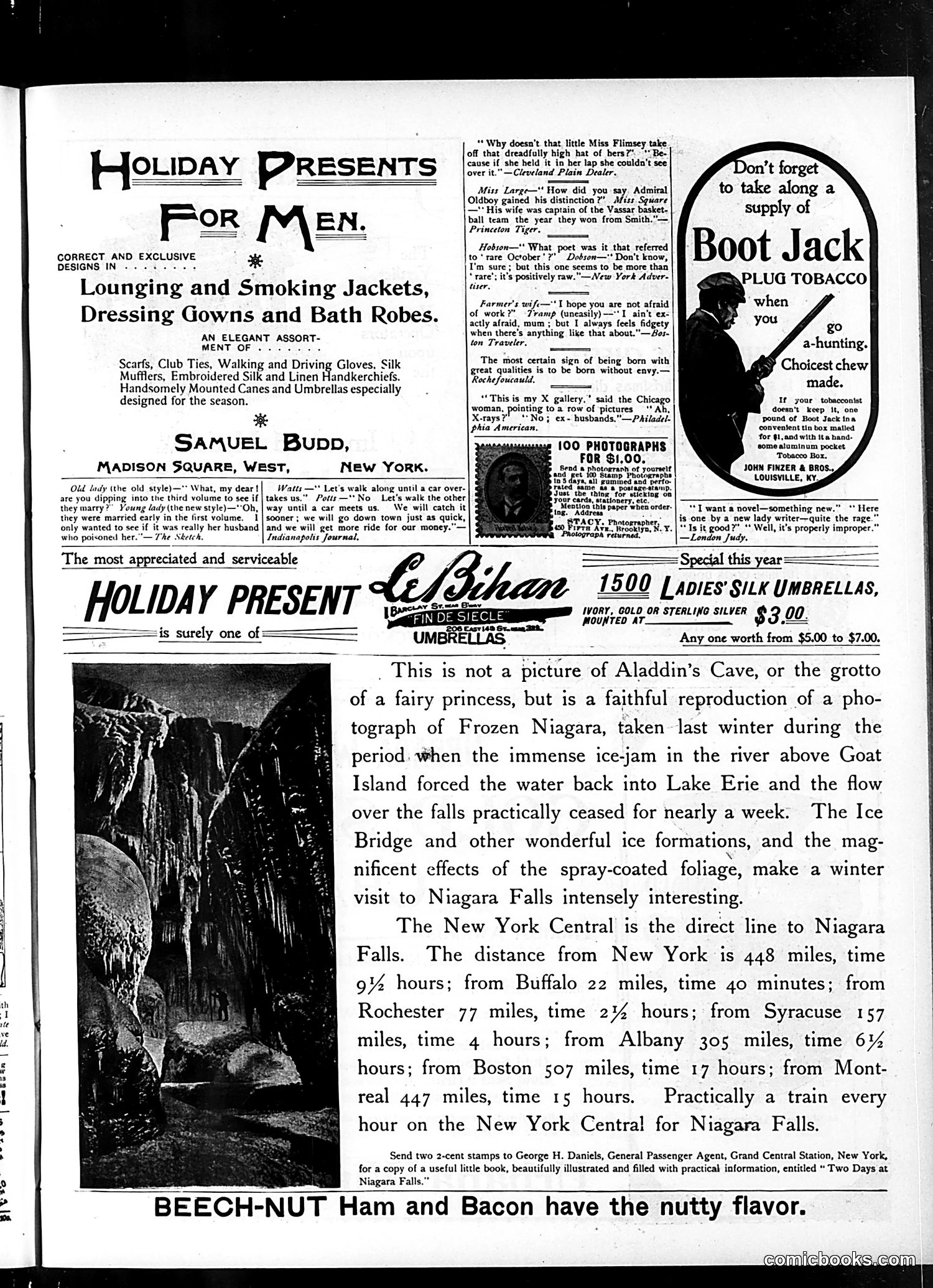
This Judge magazine page is primarily **advertising**, not political satire. It contains: **Comic vignettes** (small humor pieces): Scattered throughout are brief jokes about courtship, social behavior, and domestic life—typical early-20th-century humor. For example, one jokes about a woman reading romance novels to see if characters actually marry; another depicts a tramp nervously avoiding work. These rely on outdated social assumptions (rigid gender roles, class-based humor) that modern readers would find quaint or mildly offensive. **Main advertisements**: Samuel Budd's men's clothing store, Boot Jack Plug Tobacco, Le Bihan silk umbrellas, Beech-Nut ham, and the New York Central Railroad dominate the page. **No political cartoons** are present. The Niagara Falls photograph and railroad information are travel marketing, not satire. The page reflects **Gilded Age consumer culture** and period attitudes toward gender and labor rather than political commentary.
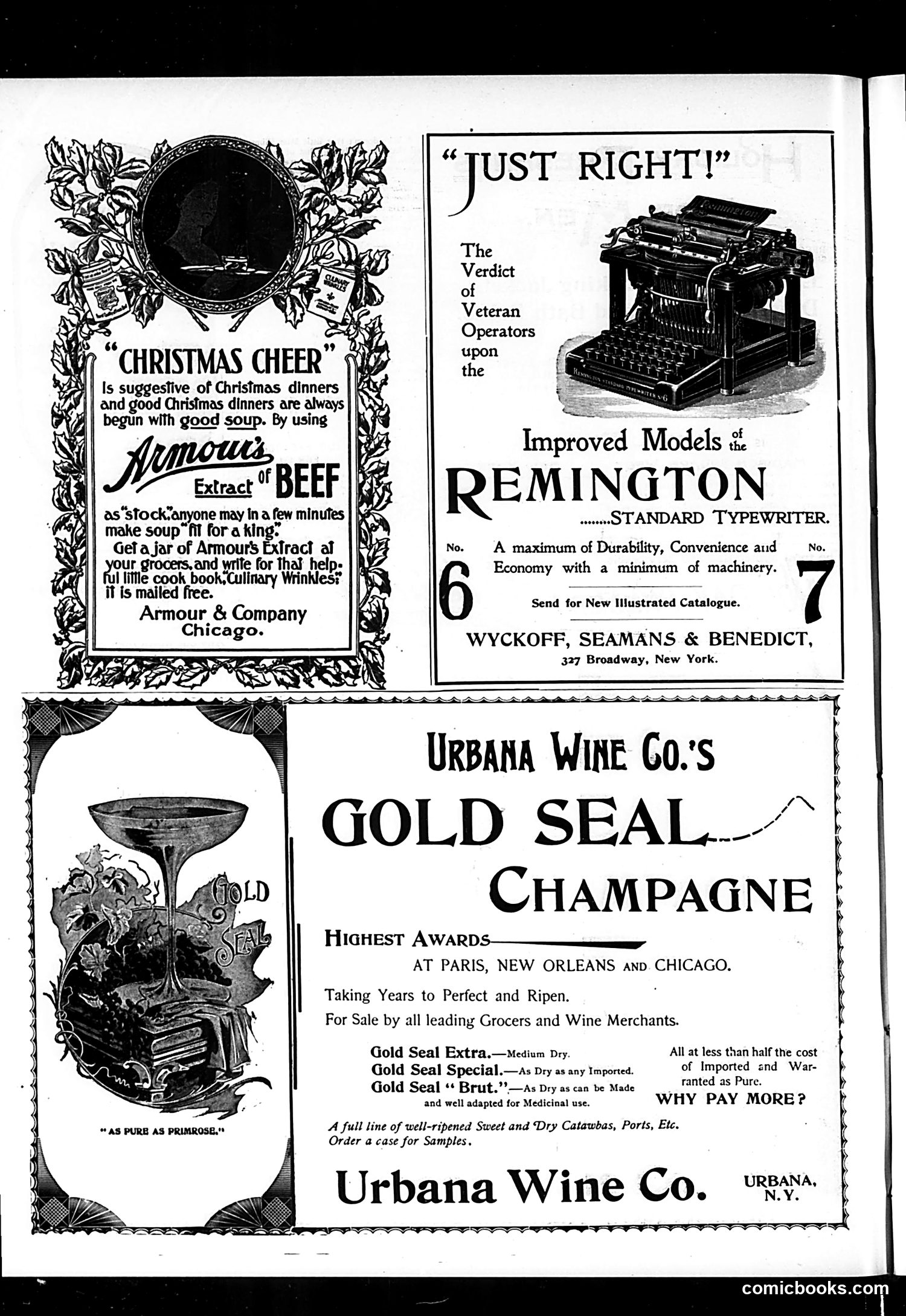
This page contains **no political cartoons or satire**—it is purely **advertising**. The page features four product advertisements typical of an early 20th-century magazine: 1. **Armour's Beef Extract** — promoting instant soup stock for Christmas dinners 2. **Remington Standard Typewriter** (Models 6 & 7) — highlighting durability and simplicity 3. **Urbana Wine Co.'s Gold Seal Champagne** — claiming awards from Paris, New Orleans, and Chicago, marketed as affordable compared to imports 4. A decorative element referencing "Christmas Cheer" The ads employ period marketing tactics: claims of quality, affordability, convenience, and awards. The champagne ad's "WHY PAY MORE?" tagline is particularly notable—suggesting American domestic wine could compete with European imports. No satire, caricature, or political commentary is present. This appears to be a standard advertising page from Judge magazine's commercial content.
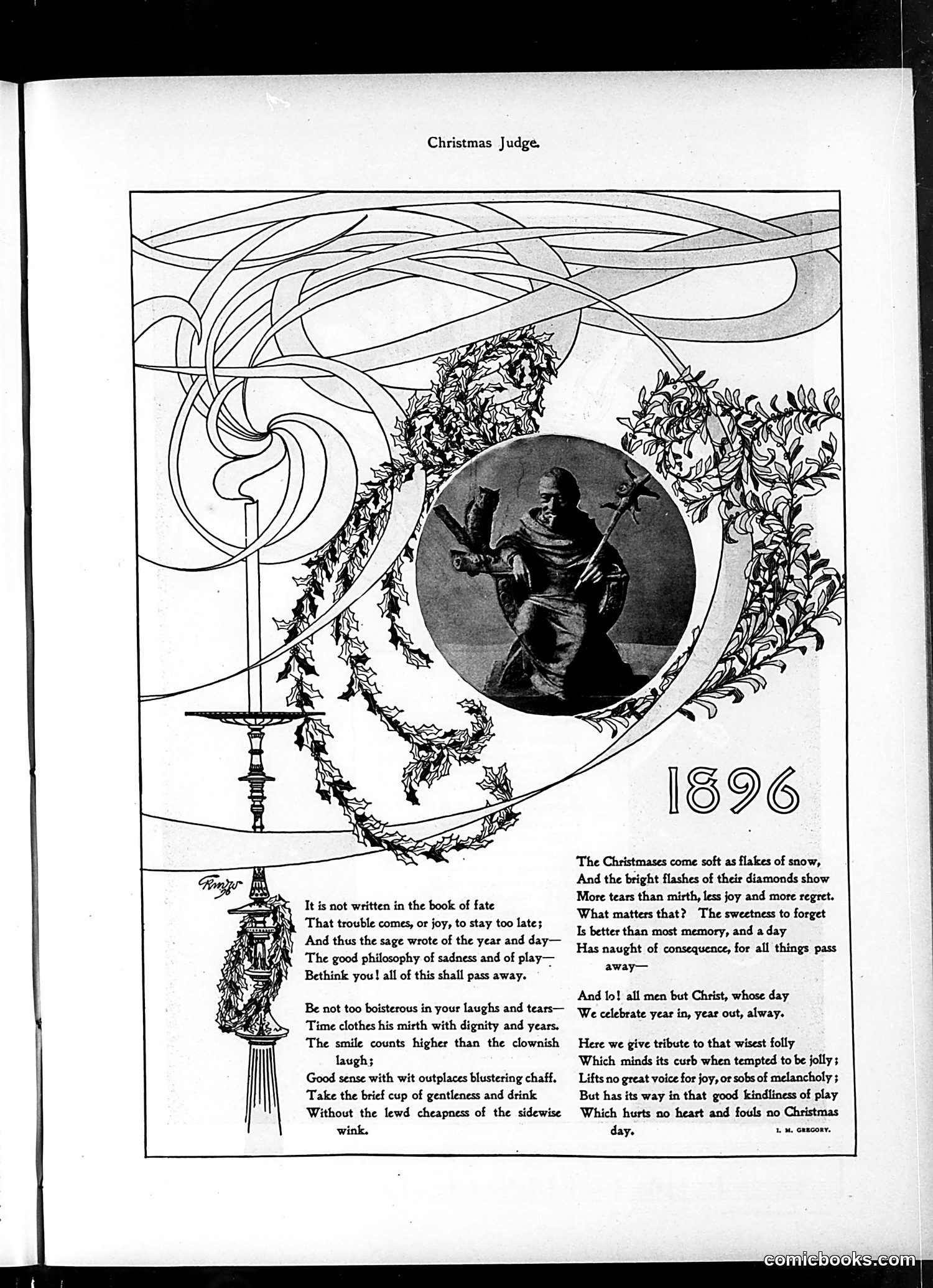
This is the cover/title page of Judge magazine's Christmas issue from 1896. Rather than satirical political cartoons, it presents a philosophical meditation on Christmas through decorative Art Nouveau design. The central circular medallion shows a figure (likely representing Christmas or a holiday personification) surrounded by ornamental garland. The lengthy poem—credited to I.M. Gregory—emphasizes restraint and dignity during holiday celebration: avoid excessive laughter or tears, choose gentle smiles over "clownish" behavior, and practice kindness without rowdiness. The message reflects late-Victorian sensibilities about proper genteel conduct, particularly the concern that working-class holiday celebrations were becoming too boisterous or vulgar (suggested by phrases like "lewd cheapness" and warnings against "blustering chaff"). It's essentially an upper-class exhortation toward refined, measured celebration rather than uninhibited merrymaking.
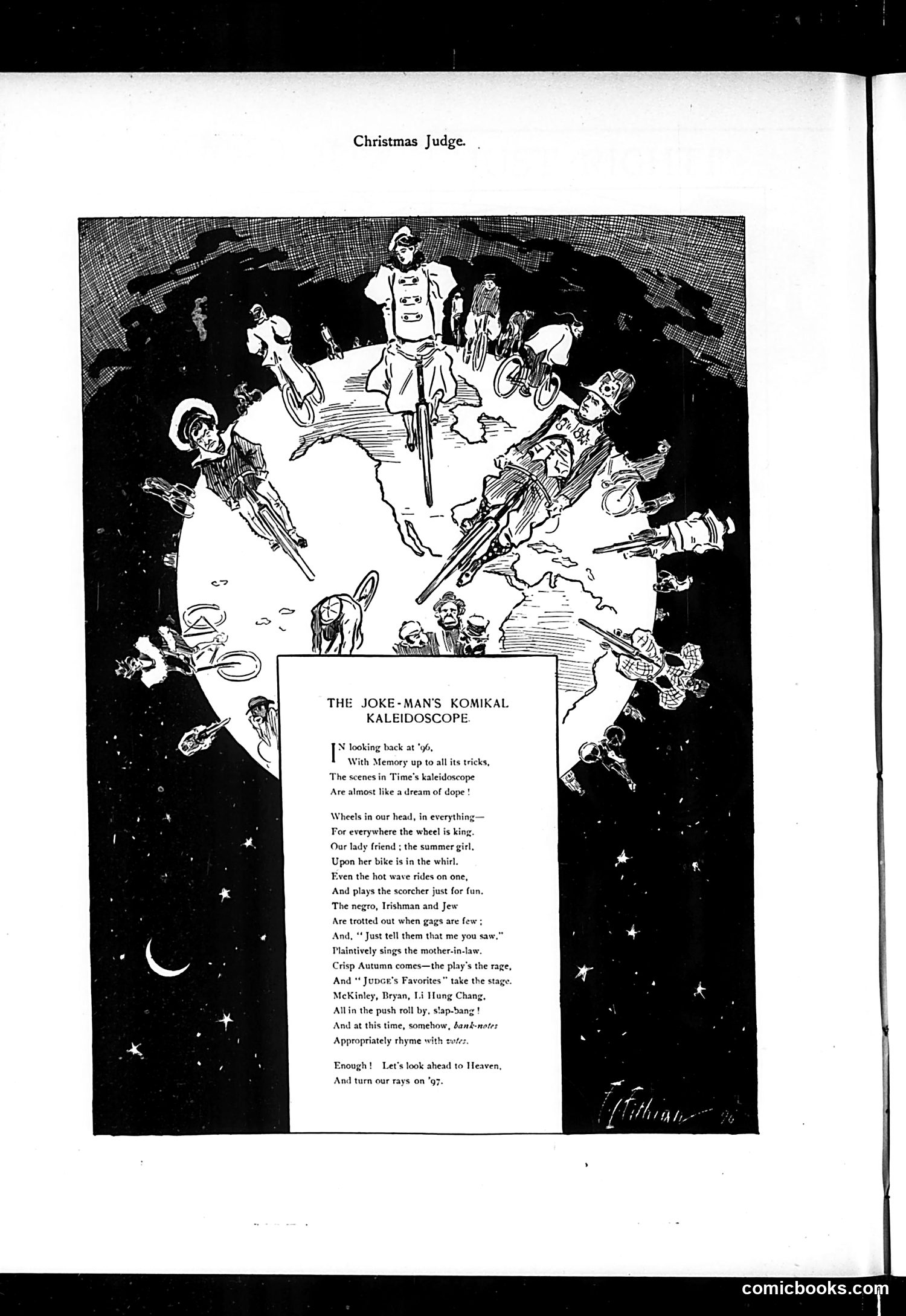
This satirical piece mockingly reviews 1896's popular comedy tropes. The poem catalogs what joke writers recycled that year: the bicycle craze (the "wheel" is everywhere), ethnic stereotypes (Black, Irish, and Jewish characters trotted out for easy laughs), mother-in-law jokes, and theatrical fashions. The references to McKinley, Bryan, and Li Hung Chang indicate the 1896 presidential election and contemporary international politics were also fodder for comedy. The closing couplet about "bank-notes" and "votes" appears to satirize how money influenced politics. The surrounding illustration depicts these recurring comedic tropes in a kaleidoscopic whirl—bicycles, performers, ethnic caricatures—suggesting how predictable and formulaic popular humor had become. The cartoon essentially mocks the humor industry's creative bankruptcy, hoping 1897 might bring something fresher.
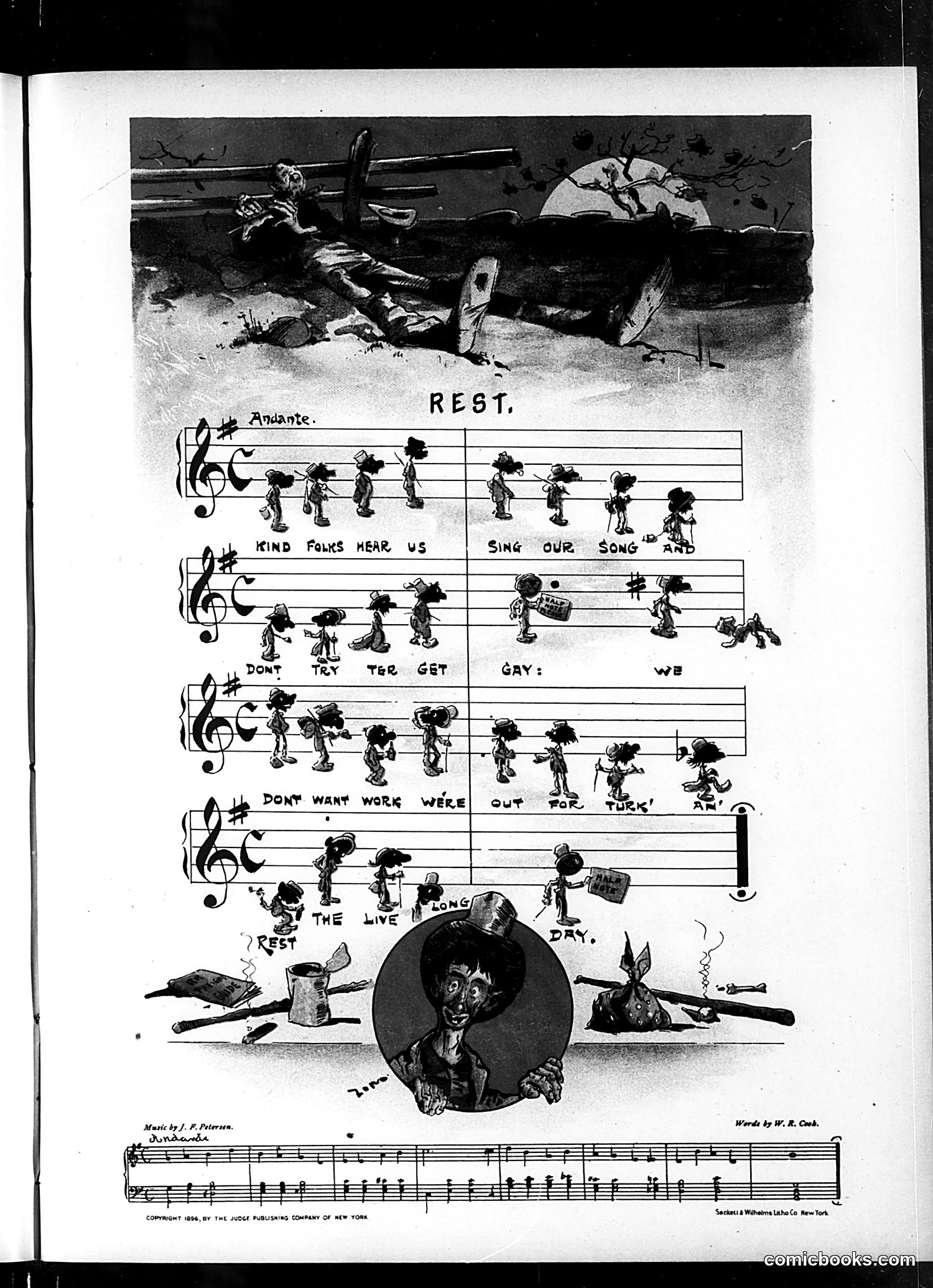
This page presents an antiwar song titled "Rest" (music by J.F. Peterson, words by W.E. Cash), set to sheet music with grotesque illustrated figures representing soldiers or war victims. The lyrics mock recruitment and military service: "Kind folks hear us / Sing our song / Don't try to get gay / We don't want work / Were out for luck / The live long day dry." The imagery—skeletal figures, death, destruction—contrasts darkly with the melody marked "Andante" (slow, peaceful). The surrounding illustrations of dead/dying soldiers and the grotesque face at bottom suggest this is **antimilitarism satire**, likely from WWI era, criticizing the disconnect between patriotic song and war's brutal reality. The cartoon mocks how cheerful music was used to encourage enlistment while concealing combat's horrors.
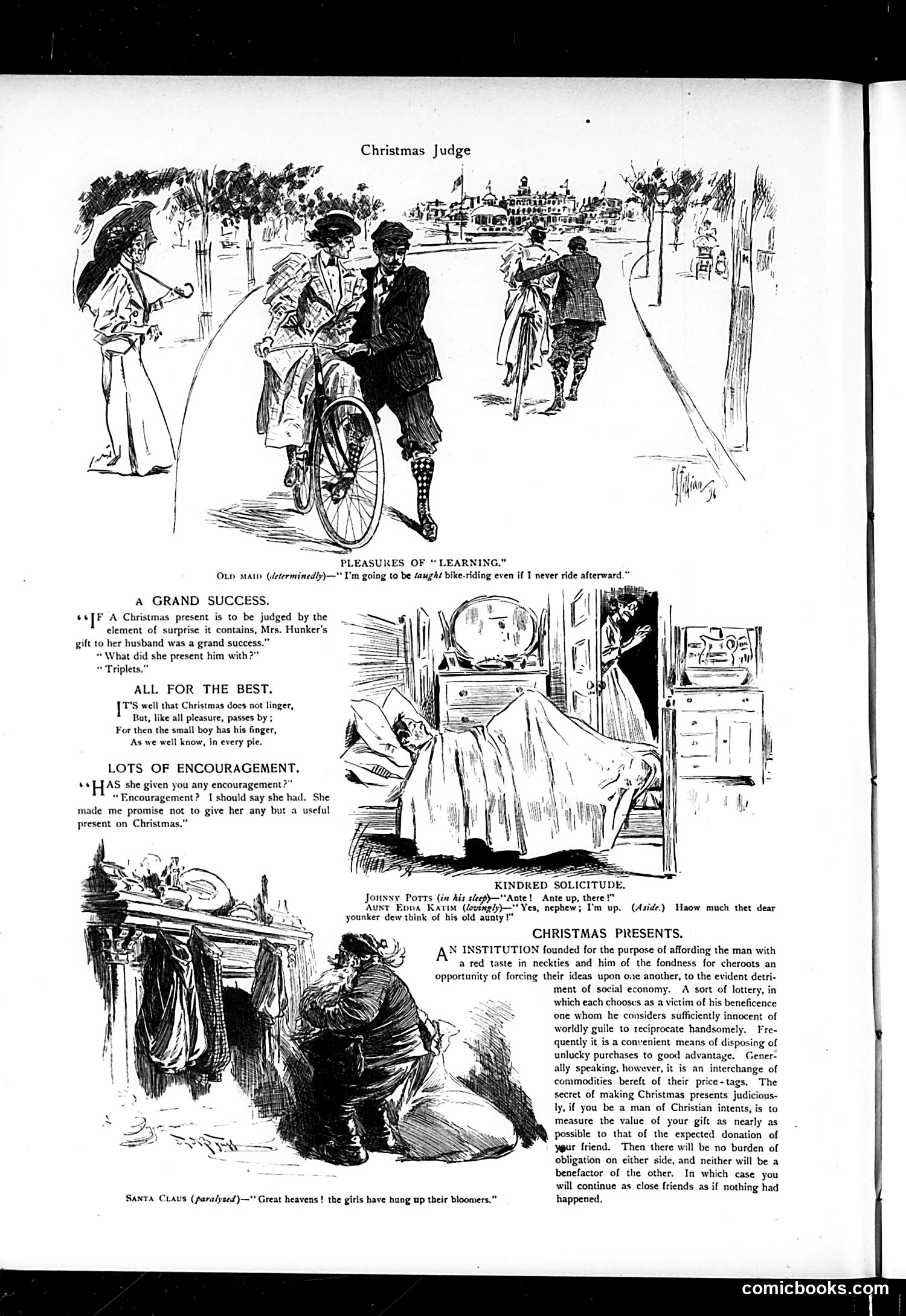
This is a Christmas-themed satirical page from *Judge* magazine featuring multiple brief comedic sketches about holiday gift-giving and family situations. The top illustration shows an old woman determined to learn bicycle-riding, mocking the absurdity of learning something with no practical intent to use it—a commentary on pointless self-improvement. The text sections provide short, punny jokes: one celebrates a woman giving "triplets" as a Christmas present (surprising her husband); another jokes about boys getting into pies during Christmas; and a longer essay satirizes Christmas gift-giving itself as an economically wasteful "institution" where people exchange unwanted items of roughly equal value to avoid obligation—essentially a social formality masquerading as generosity. The "Kindred Solicitude" sketch depicts an uncle sleep-talking about gambling while his aunt congratulates herself on his affection, satirizing self-deception about family relationships. The bottom illustration references "bloomers" (women's athletic wear), suggesting Santa is shocked by changing women's fashion—likely poking fun at Victorian anxieties about evolving gender norms.
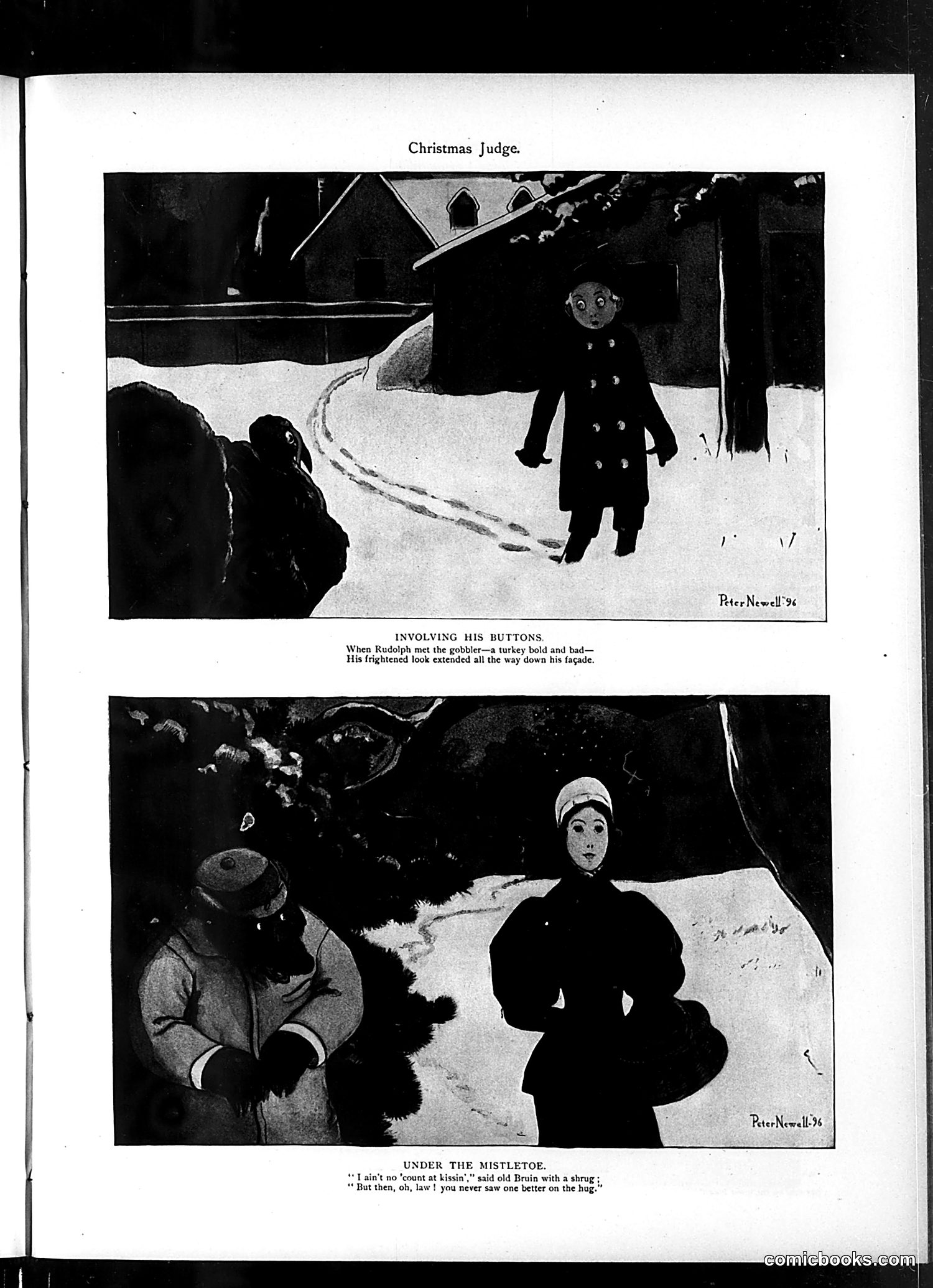
This is a Christmas-themed humorous page from Judge magazine (signed Peter Newell, 1896). It contains two illustrated jokes: The top panel depicts "Rudolph" (likely a character, not the reindeer—this predates that legend) encountering a turkey, with his frightened expression shown literally extending down his body like buttons popping. The bottom panel shows a bear ("old Bruin," a common 19th-century personification) and another figure under mistletoe. The joke plays on the bear's claim to be bad at kissing but excellent at hugging—a pun on "hug" versus the expected romantic context of mistletoe. Both are light seasonal humor with anthropomorphized animals. The satire, if any, is gentle and domestic rather than political. The page exemplifies Judge's style of whimsical comic illustration and wordplay.
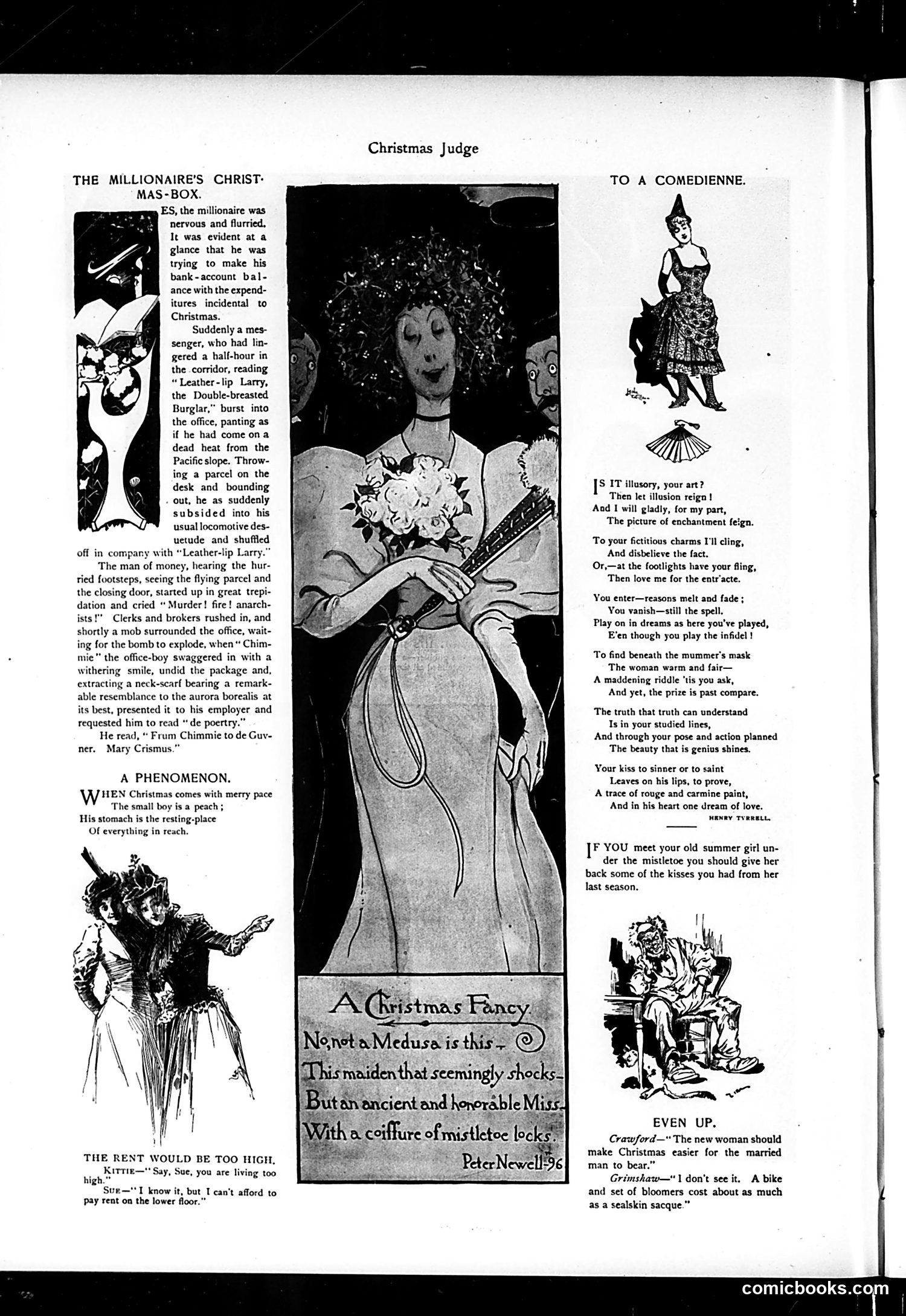
This Christmas-themed page contains several satirical pieces targeting turn-of-the-century American society: **"The Millionaire's Christmas-Box"** mocks wealthy anxiety about holiday spending. A nervous millionaire mistakes his office boy's gift package for a bomb—reflecting contemporary fears of anarchist violence—before discovering it's merely a scarf. The satire targets both the millionaire's paranoia and the boy's presumption in gifting his employer. **"A Phenomenon"** and **"The Rent Would Be Too High"** are light domestic humor: one about children's appetites at Christmas, another about a woman maintaining an expensive lifestyle she cannot afford. **"To a Comedienne"** is romantic verse (attributed to Henry Tyrrell) addressing an actress, playing on the theatrical trope of distinguishing performance from reality. **"Even Up"** satirizes the "New Woman"—a contemporary figure challenging traditional gender roles—by suggesting her bicycle and bloomers cost as much as a sealskin coat, implying the independence movement is economically burdensome for married men. The overall tone reflects Belle Époque attitudes toward wealth, labor, theatrical illusion, and changing gender dynamics.
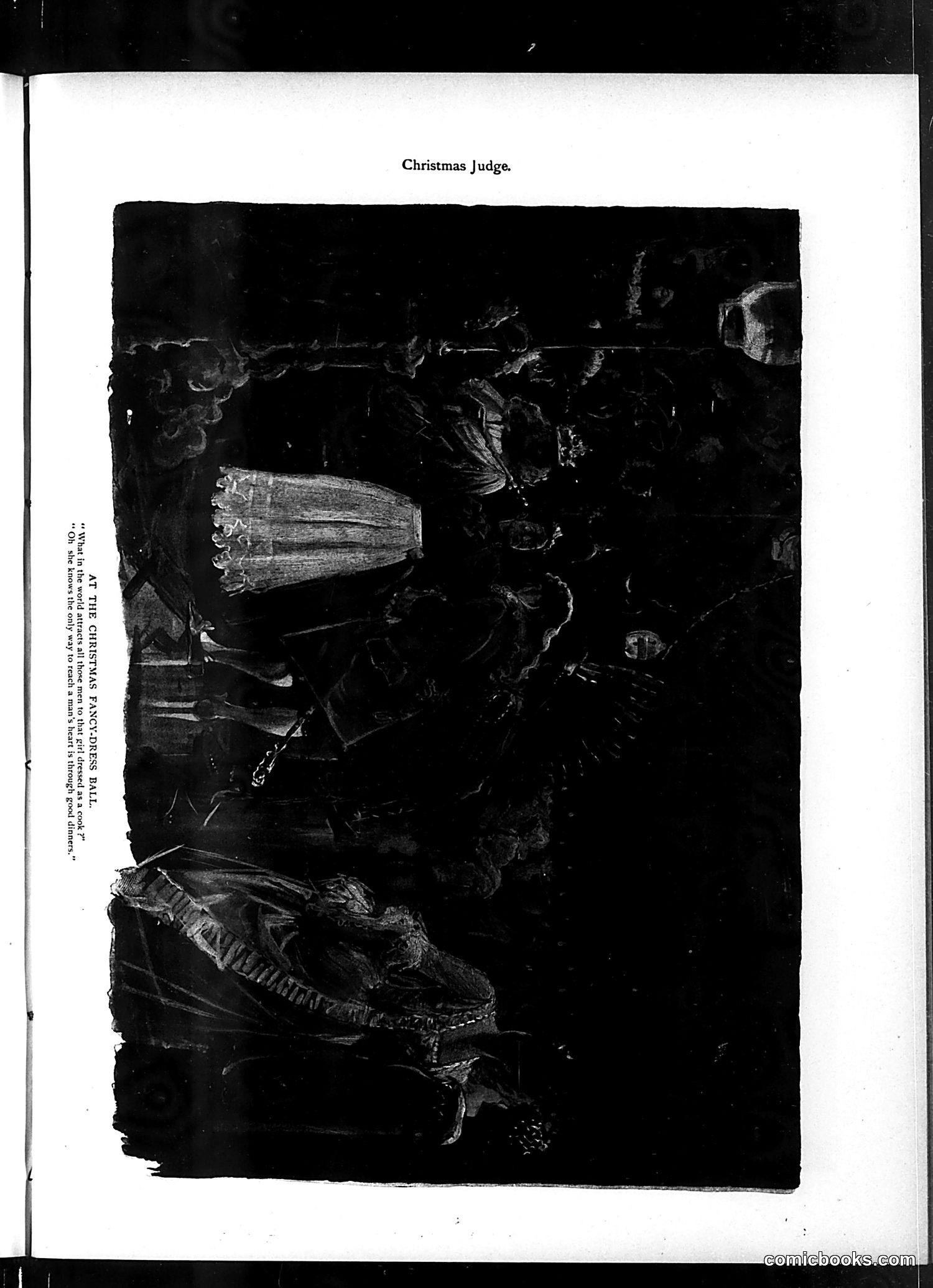
This page shows a single dark illustration titled "Christmas Judge." The image depicts what appears to be a courtroom or judicial scene set during Christmas, with multiple figures in period dress arranged in a dramatic composition. A central figure in light-colored robes (likely representing Justice or a judge) is prominent, surrounded by other characters in darker clothing. The OCR text is largely illegible characters, providing no clear caption or explanation. Without readable text identifying specific figures or the cartoon's subject matter, I cannot definitively explain what political or social satire this represents. The title suggests it comments on justice or judgment during the Christmas season, but the specific references and intended critique remain unclear from this page alone.
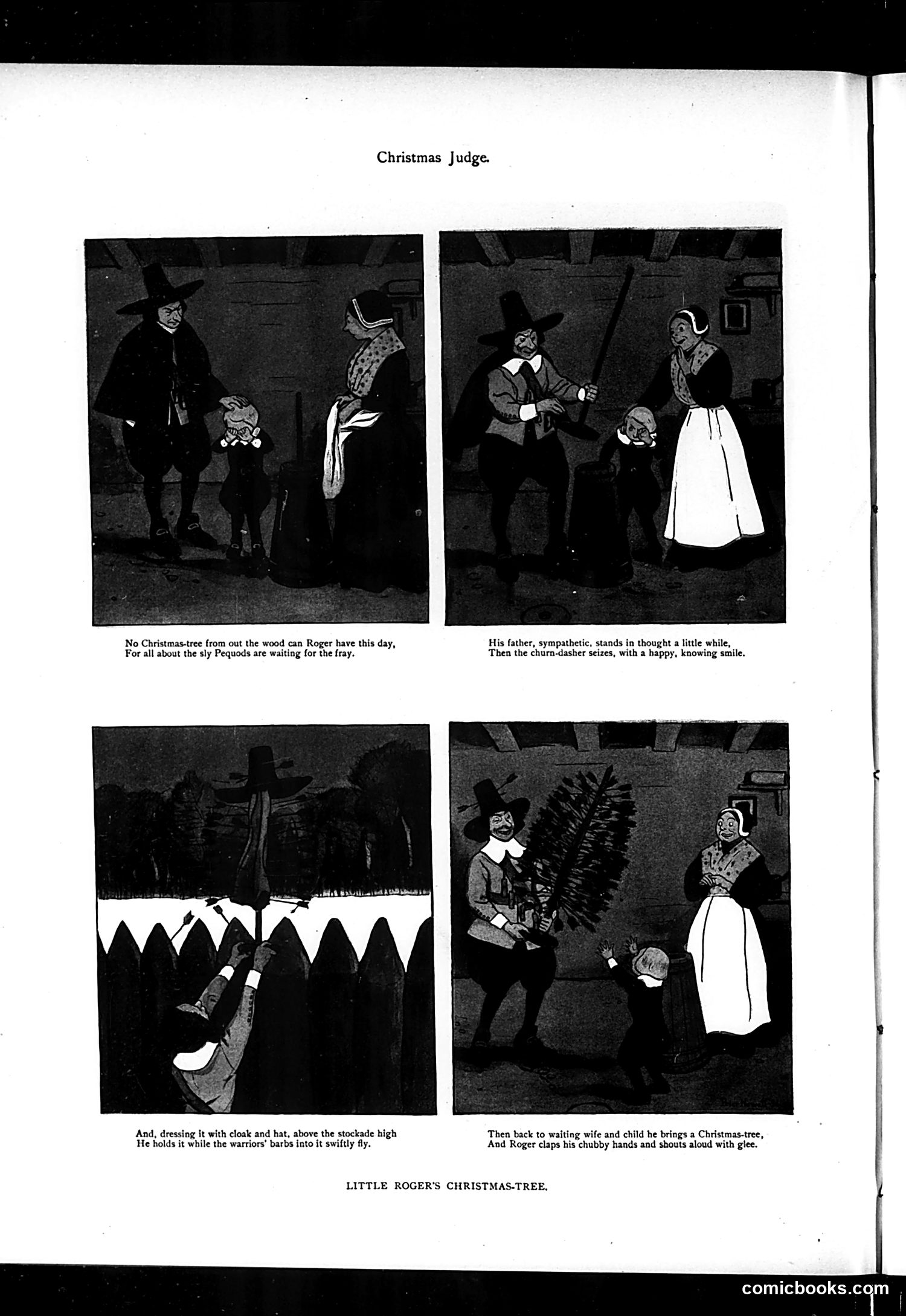
This is a four-panel narrative cartoon depicting a boy named Roger obtaining a Christmas tree during what appears to be a colonial-era conflict with Native Americans (referred to as "Pequods" in the text). The story shows: Roger cannot get a tree from the forest because Native Americans are waiting to attack. His sympathetic father fashions a Christmas tree by dressing a wooden pole or stick with a cloak and hat, then holds it up above the stockade while warriors shoot arrows at it. Roger then celebrates with his family upon receiving this improvised tree. The satire appears to mock domestic life during wartime—finding Christmas cheer and normalcy amid danger. The cartoon plays on the contrast between childhood innocence and frontier violence, presenting the father's creative solution as both absurd and touching. Without a specific date visible, the exact historical moment remains unclear, though the "Pequods" reference suggests colonial New England conflict.
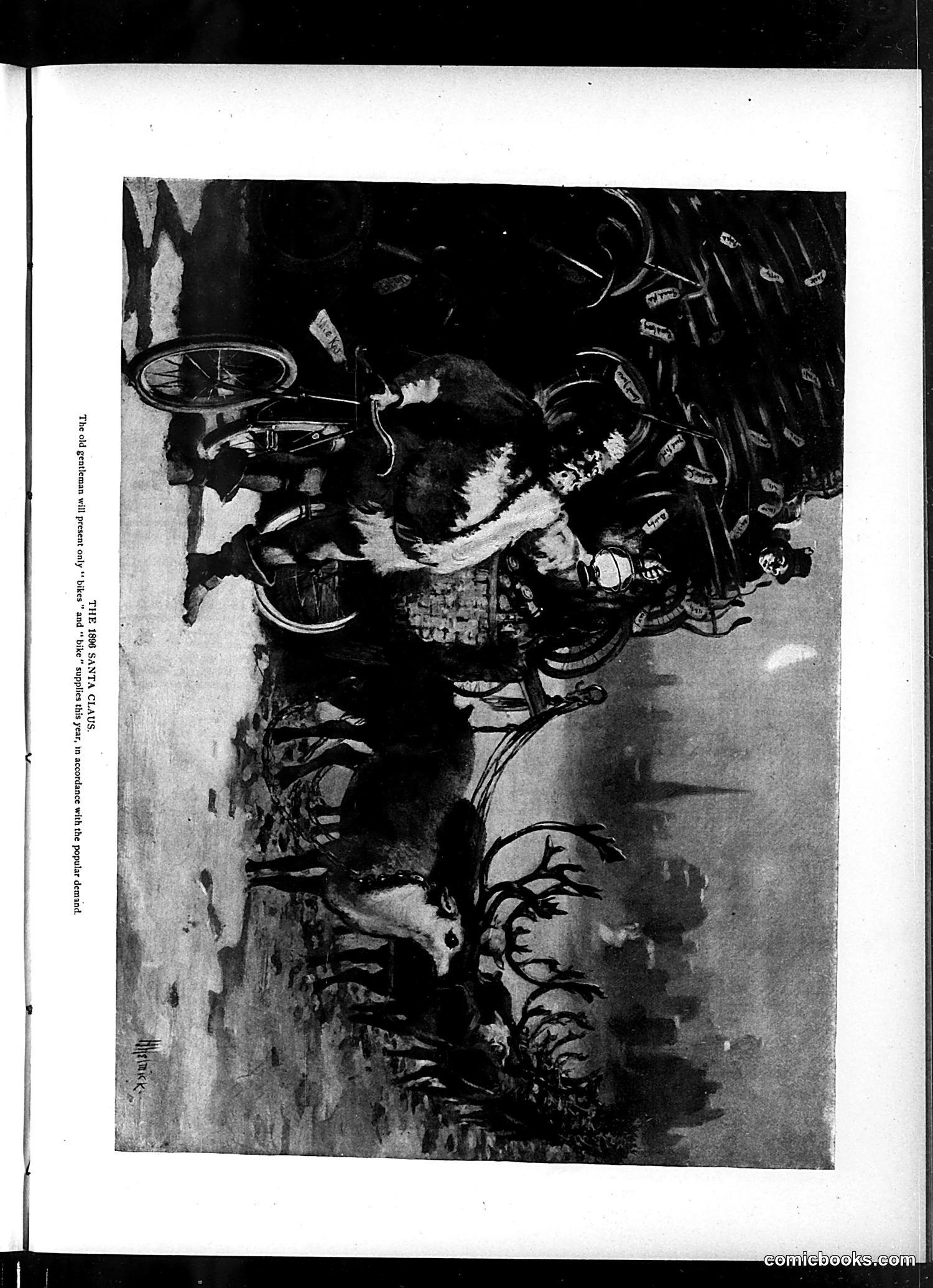
This page appears to be from Judge magazine and shows a single illustration printed sideways. The image depicts multiple overlapping faces or heads with mechanical/gear-like elements integrated into them, suggesting a commentary on mechanization or industrialization of human thought or labor. The caption references "the old gentleman" presenting something "by popular demand," but without clearer text or additional context, I cannot definitively identify which specific political figure or social phenomenon is being satirized. The mechanical imagery suggests criticism of how people have become like machines or cogs in an industrial system—a common Progressive-era satire theme. However, the specific target and satirical point remain unclear from this reproduction.
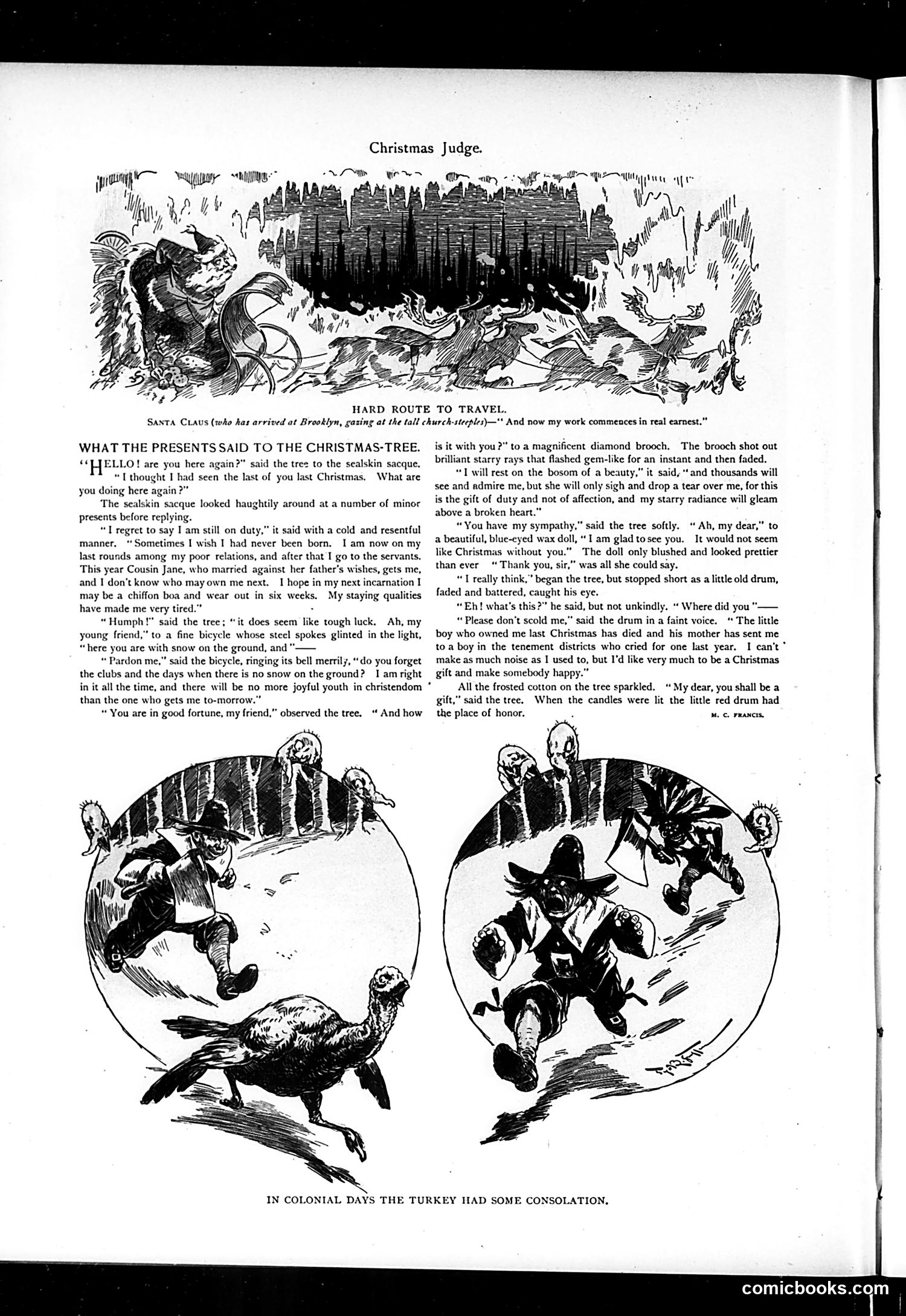
This page from Judge magazine contains two separate satirical pieces: **"Hard Route to Travel"** (top): A simple visual joke showing Santa Claus arriving in Brooklyn, facing tall church steeples. The humor lies in the contrast between Santa's magical work and the urban industrial landscape he must navigate. **"What the Presents Said to the Christmas Tree"** (main story): A sentimentalist allegory where gifts anthropomorphically discuss their fates. The satire critiques class anxiety and consumerism: a sealskin sacque laments being passed down through social ranks; a bicycle boasts of active use; a diamond brooch symbolizes duty without love; and most poignantly, a worn drum destined for a poor tenement child receives honor for bringing joy despite its degradation. The piece gently mocks both wealthy gift-givers' anxieties about status symbols and sentimentalizes charity toward the poor—typical Progressive-era social consciousness. The bottom illustration caption about turkeys appears decorative or unrelated.
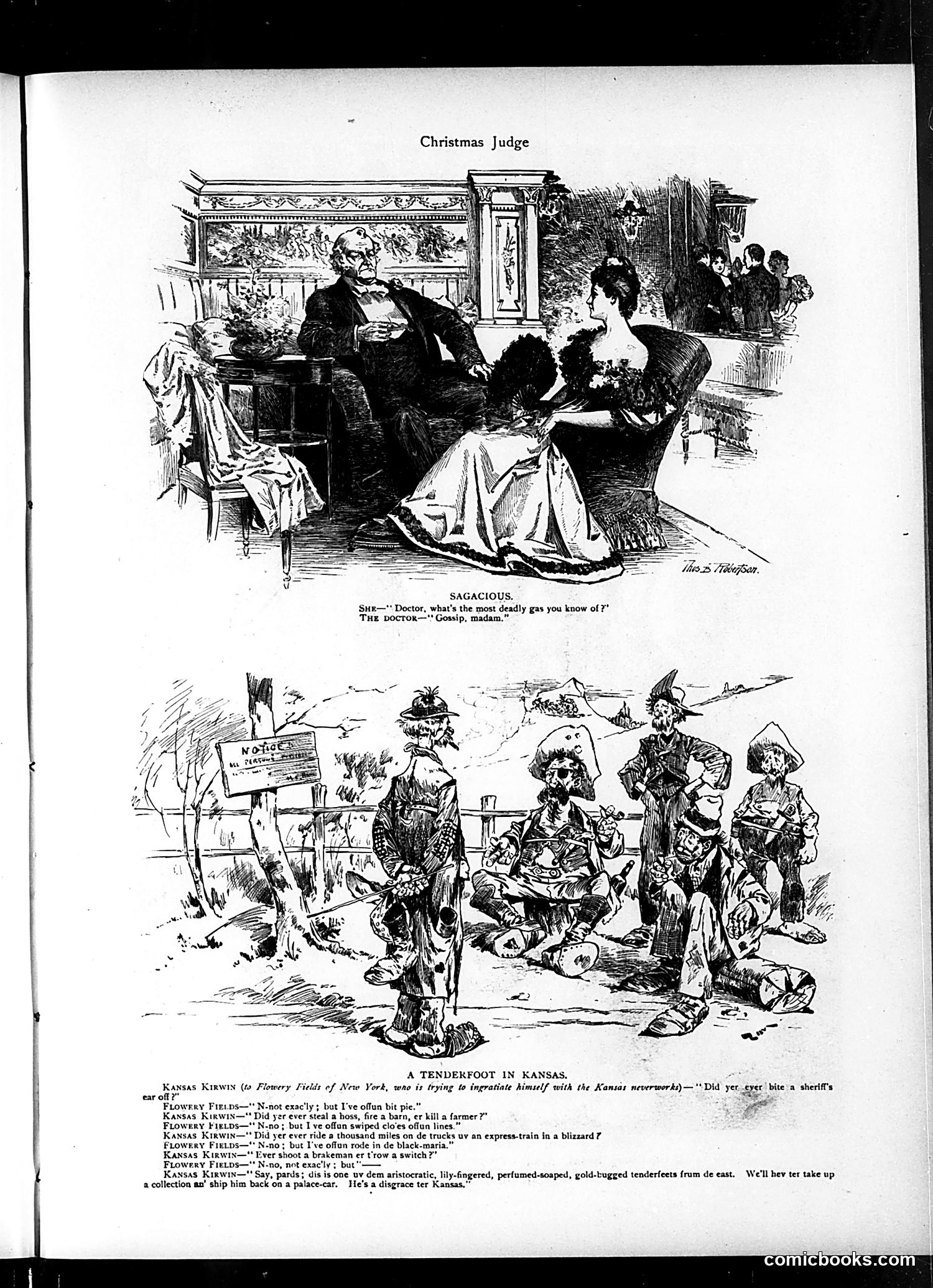
This page contains two satirical cartoons: **"Sagacious" (top):** A doctor and society woman at what appears to be a formal gathering. When asked what the deadliest gas is, the doctor replies "Gossip, madam"—a joke about how destructive idle talk and rumors are in high society, particularly among wealthy women. **"A Tenderfoot in Kansas" (bottom):** A naive easterner nicknamed "Kansas Kirwin" (from New York's "Flowery Fields") attempts to impress rough Kansas cowboys by claiming wild exploits. However, his admissions—biting pie instead of ears, stealing clothes from lines instead of horses, riding in police wagons instead of express trains—reveal him as an effete, law-abiding easterner. The cowboys mock him as an "aristocratic, lily-fingered, perfumed-soaped" disgrace, threatening to ship him back east in a luxury car. The satire mocks both the pretentious easterner and stereotypes about brutal frontier life.
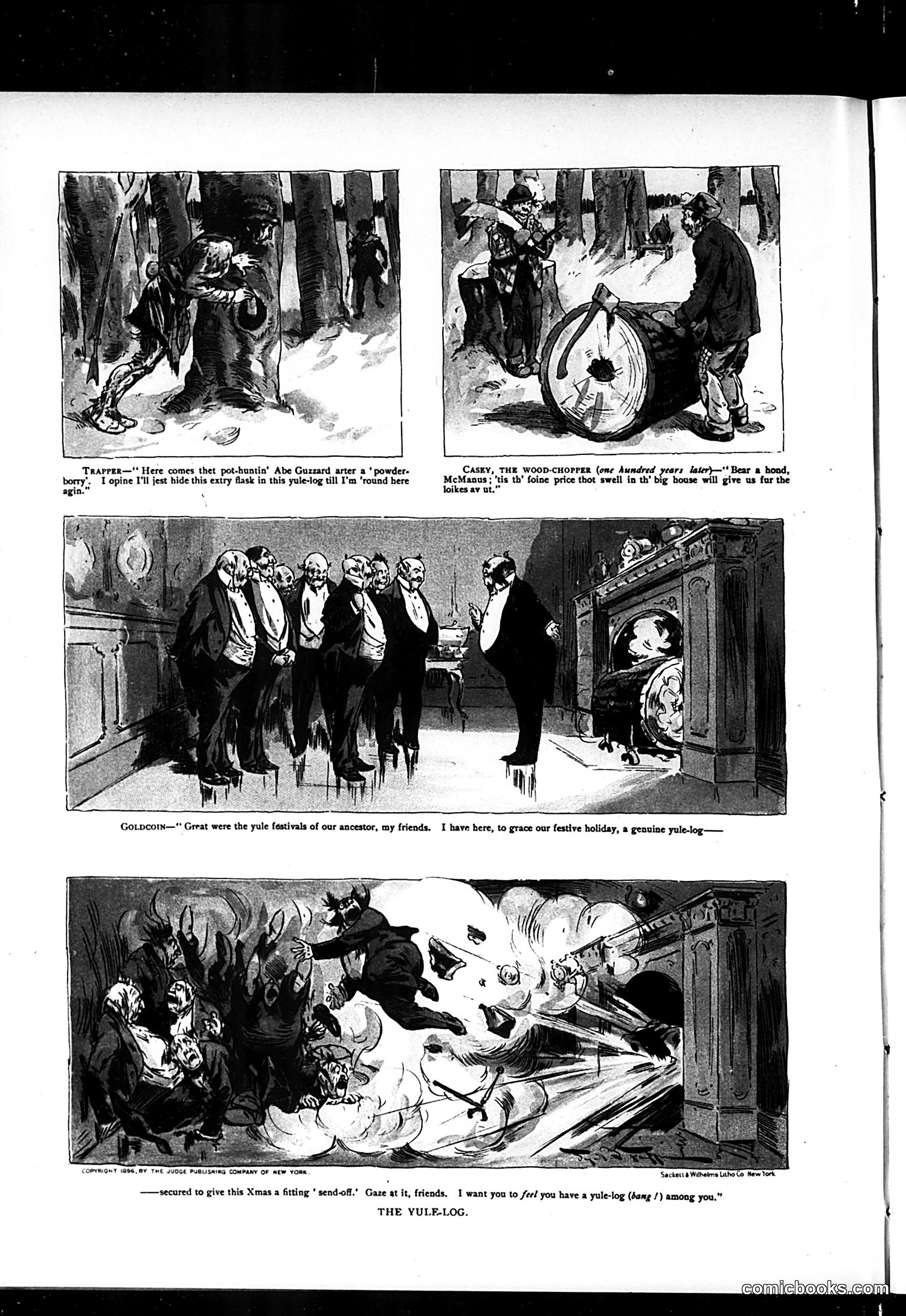
This comic sequence satirizes Christmas traditions and class differences through Gilded Age humor. The top panels show working-class characters (a trapper and wood-chopper) hiding liquor in a yule log—suggesting poor people's resourcefulness in circumventing social restrictions or poverty. The bottom panels depict wealthy men ("Goldcoin" and associates) in a fancy drawing room, where a host presents an elaborate yule log as a status symbol for their holiday celebration. The satire appears to mock the pretentiousness of the wealthy class appropriating rustic traditions while the working poor use the same traditions for survival. The joke hinges on contrasting how different social classes experience Christmas: the poor hide contraband alcohol out of necessity; the rich perform elaborate rituals for display. The title "The Yule-Log" underscores how the same object carries vastly different meanings across class lines.
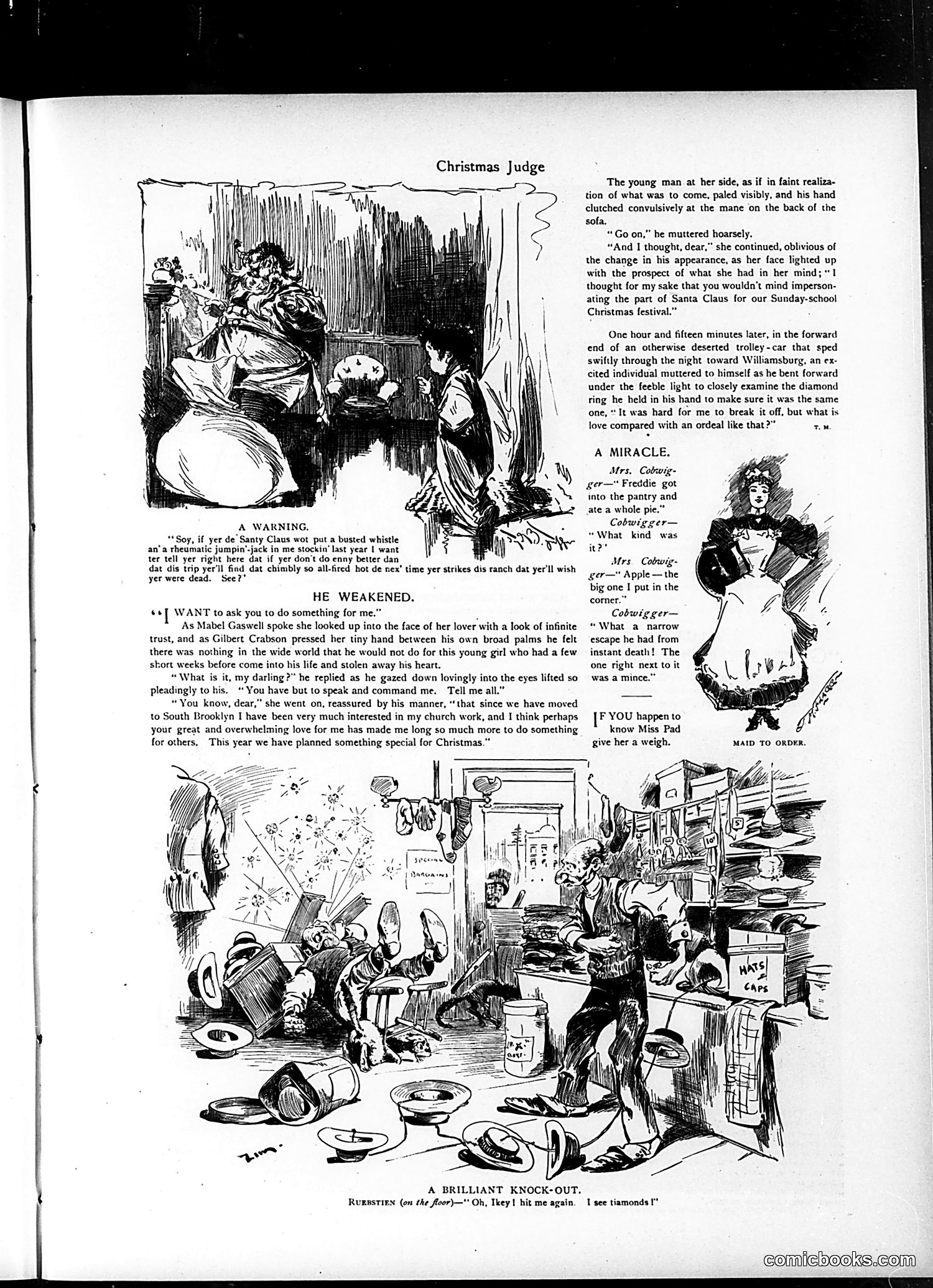
This Christmas-themed Judge page contains multiple satirical pieces mocking romantic sentimentality and domestic life. **"He Weakened"** is the main story: A young man named Gilbert Crabson, deeply in love with Mabel Gaswell, eagerly agrees to do anything for her. When she asks him to play Santa Claus at their church's Sunday-school Christmas festival, he's horrified—so appalled he breaks off their engagement rather than endure the humiliation. The satire targets both the exaggerated romantic language ("infinite trust," "overwhelming love") and male resistance to public embarrassment, suggesting men will abandon love to preserve dignity. The shorter pieces mock domestic life: "A Miracle" jokes about a child's narrow escape from poisoning by eating the wrong pie. "A Brilliant Knock-Out" depicts a street fight where one man, knocked down, hallucinates diamonds. The illustrations use Judge's characteristic crude, expressive line work. The overall message ridicules sentimental romance and the gap between flowery declarations of love and actual male behavior.
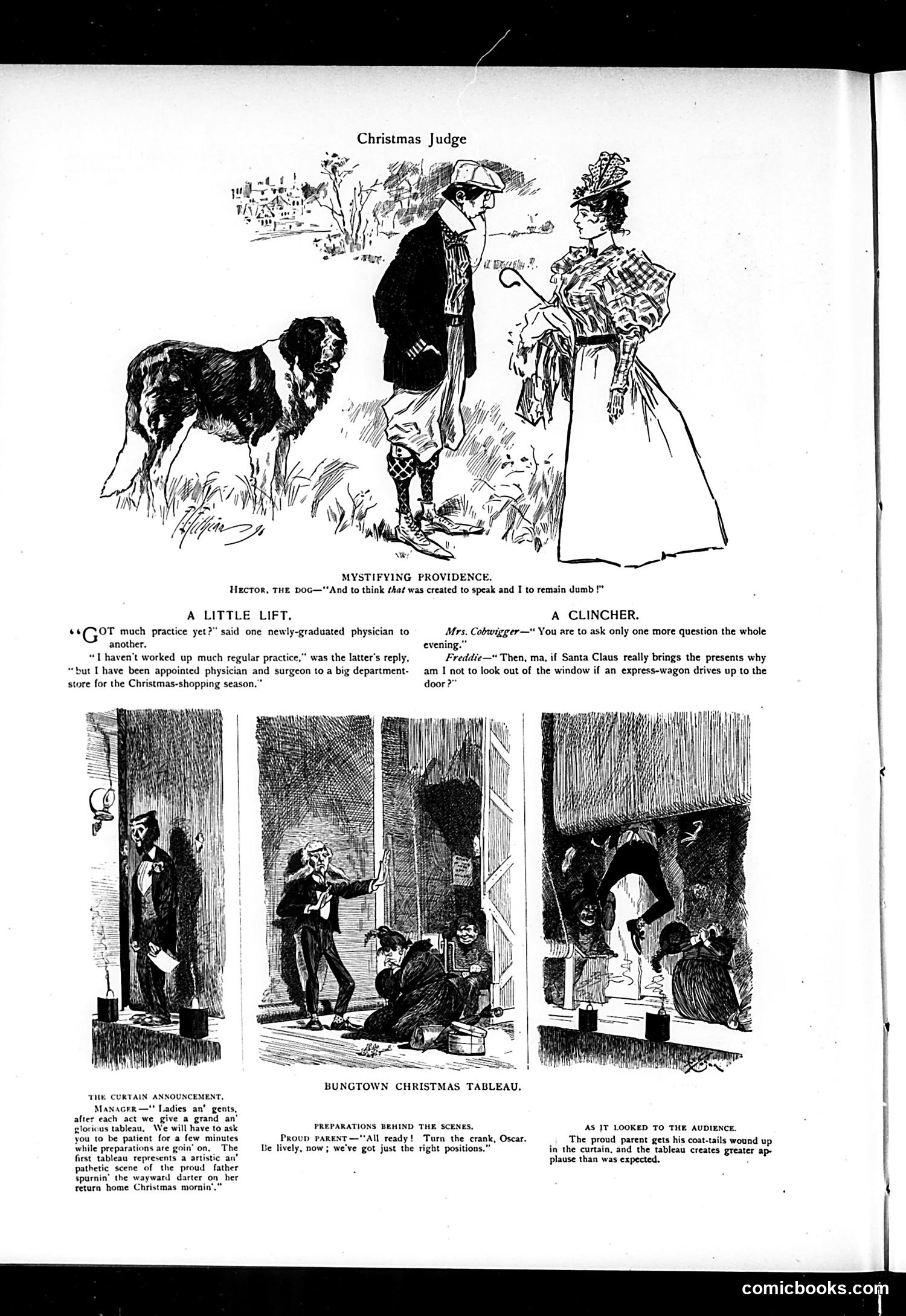
This page contains four separate comic sketches with Christmas themes: **"Christmas Judge"** (top): A man with a dog and well-dressed woman. The dog's caption—wishing it could speak while humans remain "dumb"—is a typical Victorian joke about animal superiority to human folly. **"A Little Lift"**: Two newly-graduated doctors discuss practice. One has secured a position as physician to a department store during the Christmas shopping season—satirizing how commercial establishments hired medical staff for the crowds. **"A Clincher"**: A child (Freddie) exposes the logical contradiction in his mother's Christmas rules: if Santa brings presents, why can't he watch for the delivery wagon? The joke mocks parental explanations that don't hold up to children's logic. **"Bungtown Christmas Tableau"** (three panels): A theater manager announces grand tableaux between acts. The final panels humorously show backstage chaos (a father's coattails caught in the curtain) versus the polished appearance to the audience—satirizing theater production fakery. All are gentle Victorian-era humor about Christmas, medicine, parenting, and theater.
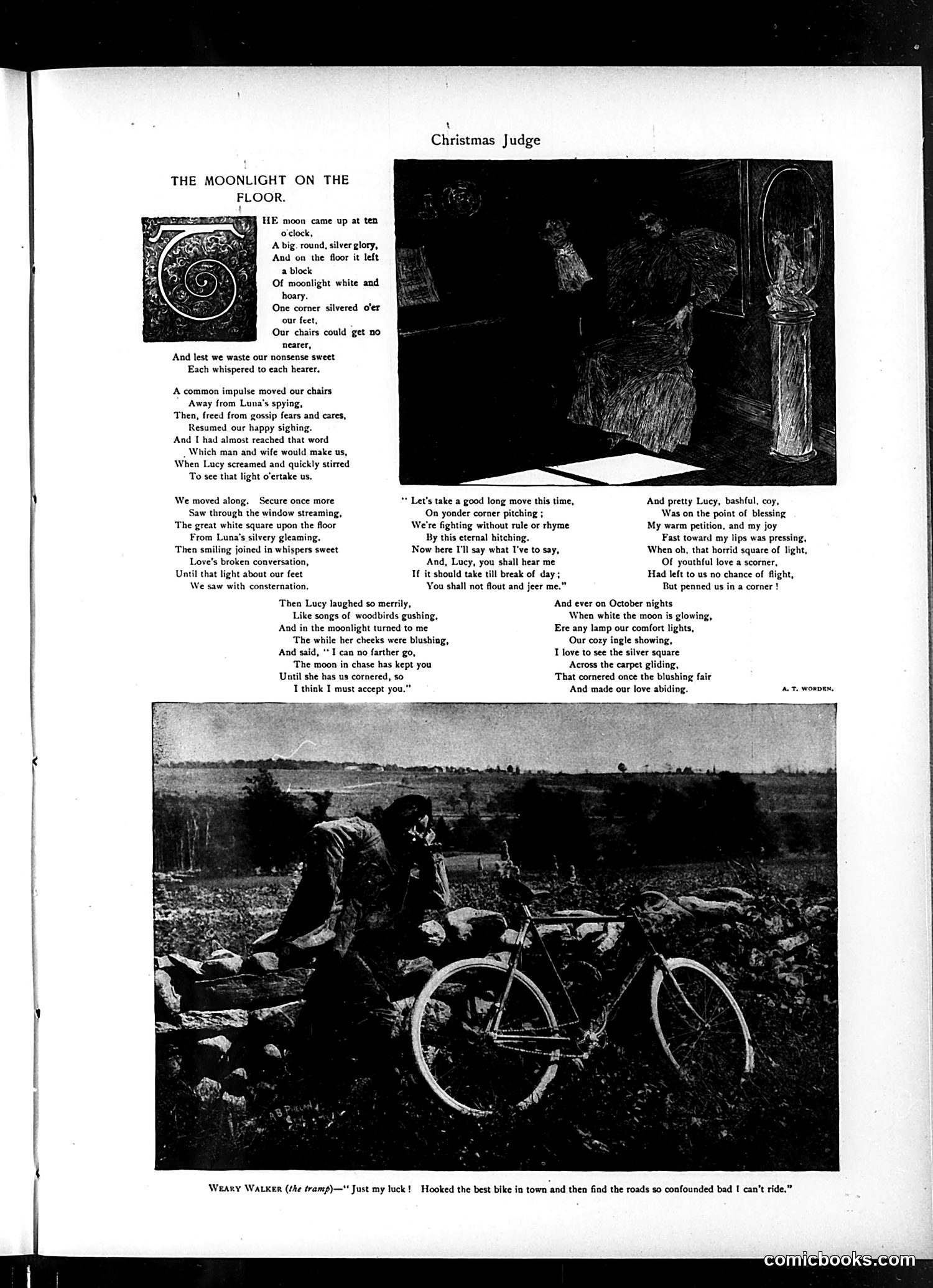
This page presents a sentimental romantic poem by A.T. Worden, not political satire. The narrative describes a couple's courtship interrupted repeatedly by moonlight streaming through a window onto the floor. The moonlight becomes a comedic obstacle—each time the couple moves to avoid its revealing glow, the moon "follows" them, eventually trapping them in a corner. Cornered literally and figuratively, Lucy accepts the narrator's marriage proposal. The poem concludes by romanticizing this memory: the author now cherishes seeing that same silver square of moonlight, remembering how it led to their union. The lower photograph shows "Weary Walker" and a bicycle caption about getting lost on unfamiliar roads—unrelated humor. The page is primarily literary/romantic content rather than political commentary.
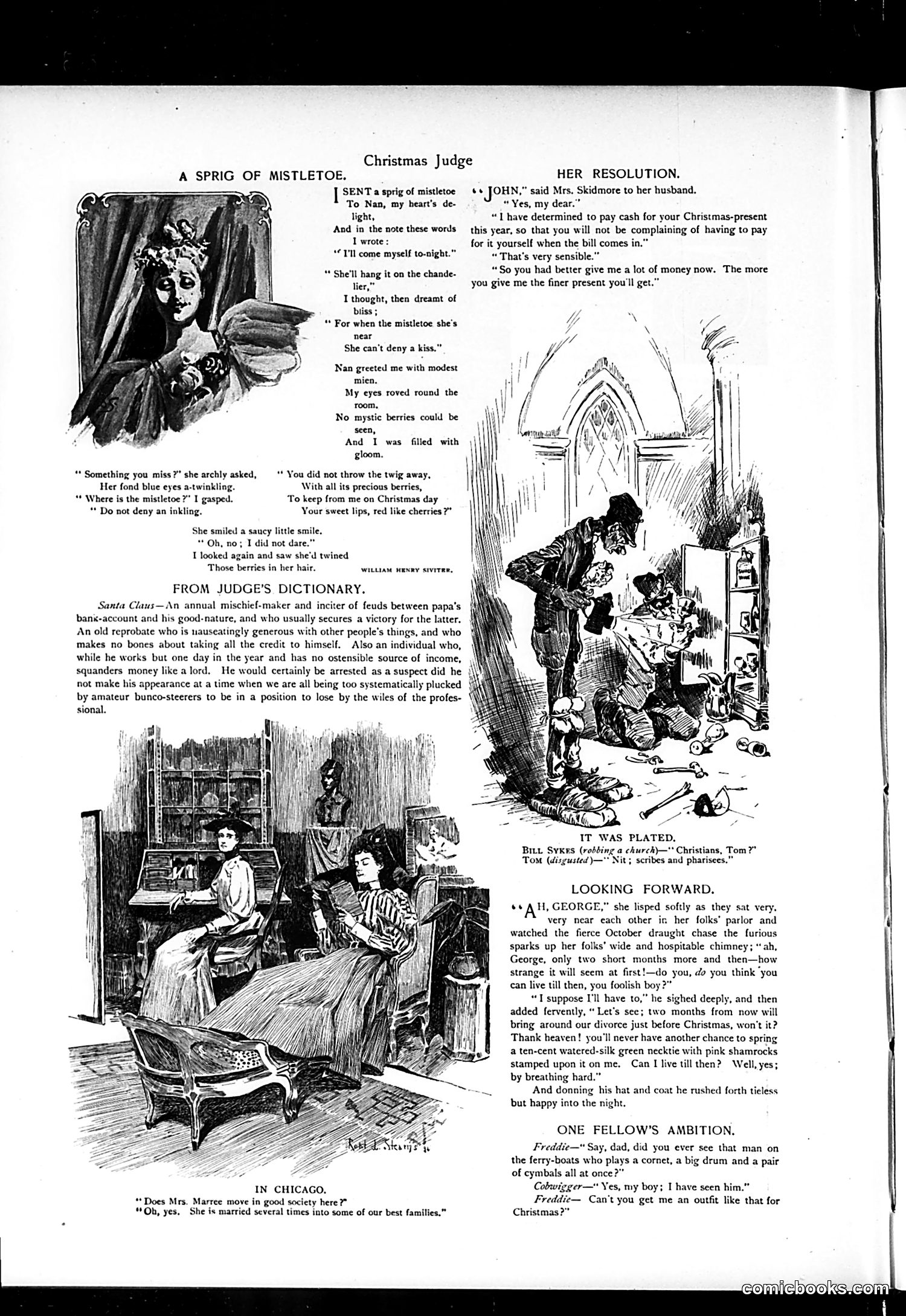
This page from *Judge* magazine contains multiple satirical pieces about Christmas and marriage, reflecting late-19th/early-20th-century American attitudes. **"A Sprig of Mistletoe"** is a romantic poem-story about a man expecting to find mistletoe to kiss a woman named Nan, only to discover she's hidden the berries in her hair—a clever romantic twist. **"Her Resolution"** satirizes wives' financial dependency: Mrs. Skidmore announces she'll "pay cash" for Christmas gifts by demanding her husband give her money upfront—mocking the absurdity of wives' lack of independent finances. **"Looking Forward"** darkly jokes about divorce: a couple discusses their upcoming divorce "just before Christmas" with relief, satirizing unhappy marriages. **"One Fellow's Ambition"** features a child asking his father for a "one-man band" outfit—a humorous non-sequitur. **"In Chicago"** is a brief joke about a woman married "several times into some of our best families"—satirizing how wealthy families overlook scandalous behavior for social status. The tone throughout is cynical about marriage, wealth, and respectability.
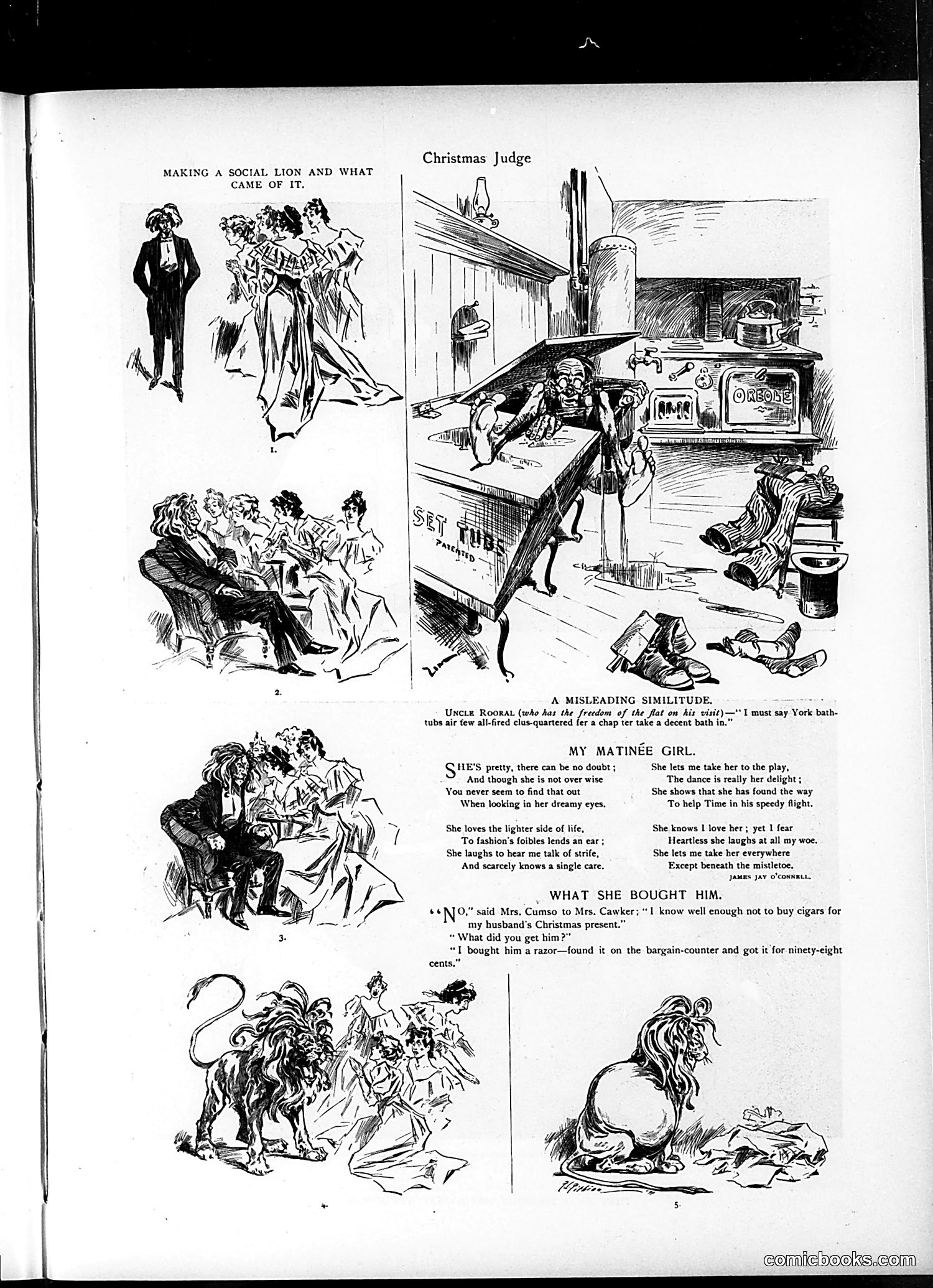
This page contains three separate satirical pieces typical of early-20th-century Judge humor: **"Making a Social Lion"** (left panels): Depicts the creation and social consequences of an artificially promoted society figure—showing how someone is manufactured into social prominence through orchestrated gatherings, then abandoned when novelty fades. **"Christmas Judge"** (center): Shows Uncle Roobat, a visiting relative, complaining about inadequate bathtub facilities—likely satirizing rural visitors' discomfort with urban plumbing or class differences in accommodations. **"My Matinee Girl"** (text poem): A sentimental critique of a shallow, pleasure-seeking woman who accepts entertainment and gifts but remains emotionally detached and refuses romantic commitment (the mistletoe reference). **"What She Bought Him"** (text anecdote): A domestic humor piece where a wife buys her husband a cheap razor as a Christmas gift—the joke being the inadequacy and impracticality of such a present, likely commenting on marital penny-pinching or feminine shopping ignorance. The page blends social satire with gentle domestic comedy typical of Judge's era.
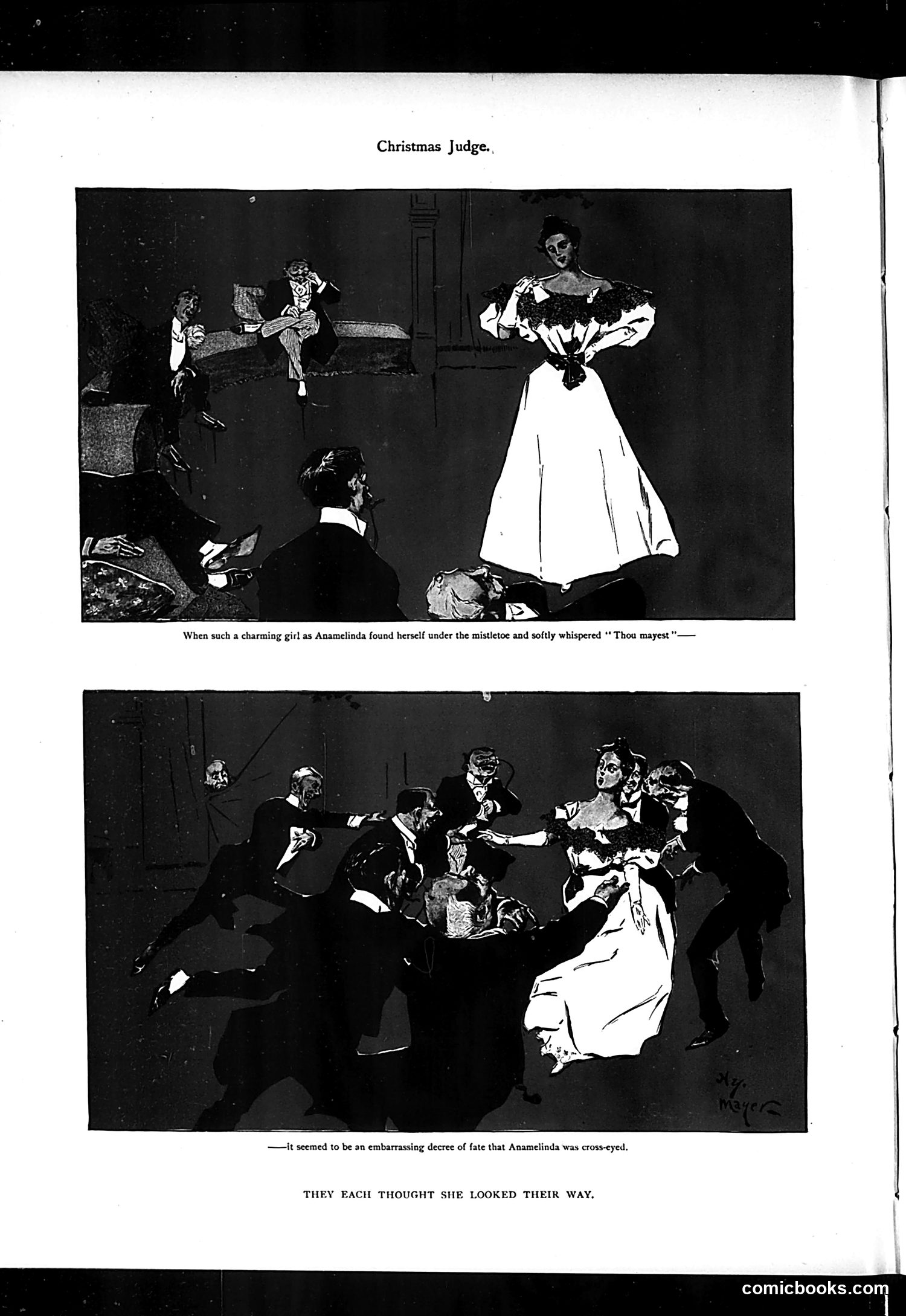
This is a two-panel Christmas joke from *Judge* magazine about a girl named Anamelinda who positions herself under the mistletoe and invites kisses with "Thou mayest." The satire hinges on her being cross-eyed. In the first panel, she stands alone. The second shows multiple men surrounding her, each believing she's looking at *him* individually—when in fact her crossed eyes create an optical illusion making it seem she's gazing toward everyone simultaneously. The joke mocks both male vanity (each man thinks he's the chosen recipient of her affection) and plays on period attitudes toward physical disability as comedic fodder. The caption's final line—"They each thought she looked their way"—drives home the punchline about how her condition creates this awkward, humorous confusion.
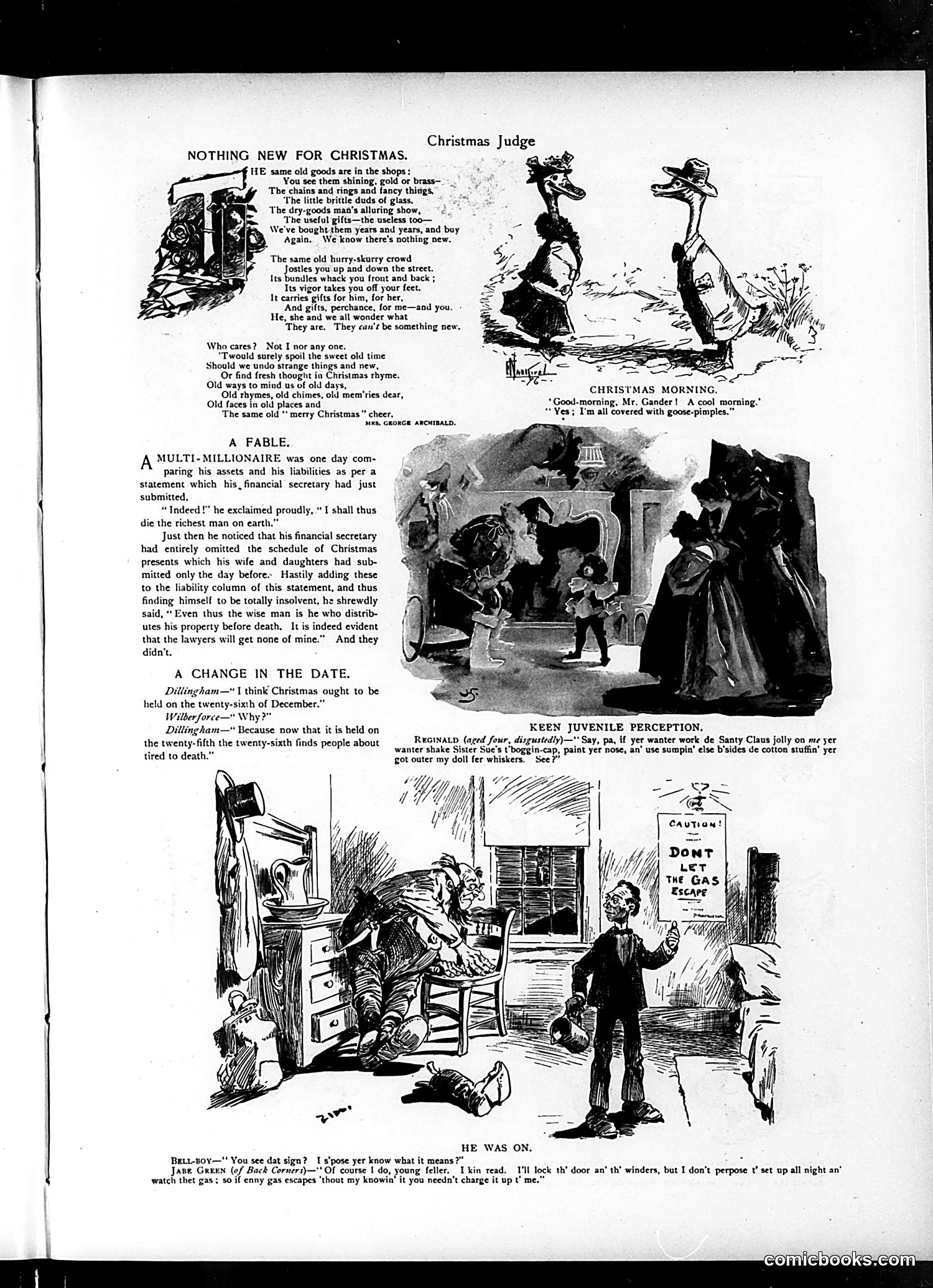
This page from *Judge* contains multiple Christmas-themed satirical pieces: **"Nothing New for Christmas"** (poem): A nostalgic complaint that Christmas shopping offers only tired, repetitive goods and experiences. The satire mocks consumer culture—people buy the same items yearly, endure crowded streets, and exchange predictable gifts. The author advocates valuing tradition over novelty. **"A Fable"**: A wealthy businessman initially boasts he'll die the richest man, but when his secretary adds his wife and daughters' Christmas gift list to his liabilities, he realizes he's insolvent. The joke satirizes how women's spending (particularly Christmas presents) bankrupts even millionaires—a common era anxiety about female consumerism. **"A Change in the Date"**: A brief joke proposing moving Christmas to December 26th because the 25th exhausts people. Simple satire on Christmas fatigue. The remaining sketches use dialect humor featuring working-class characters making innocent observations or misunderstandings about signs and customs—typical *Judge* fare mocking lower-class speech patterns.
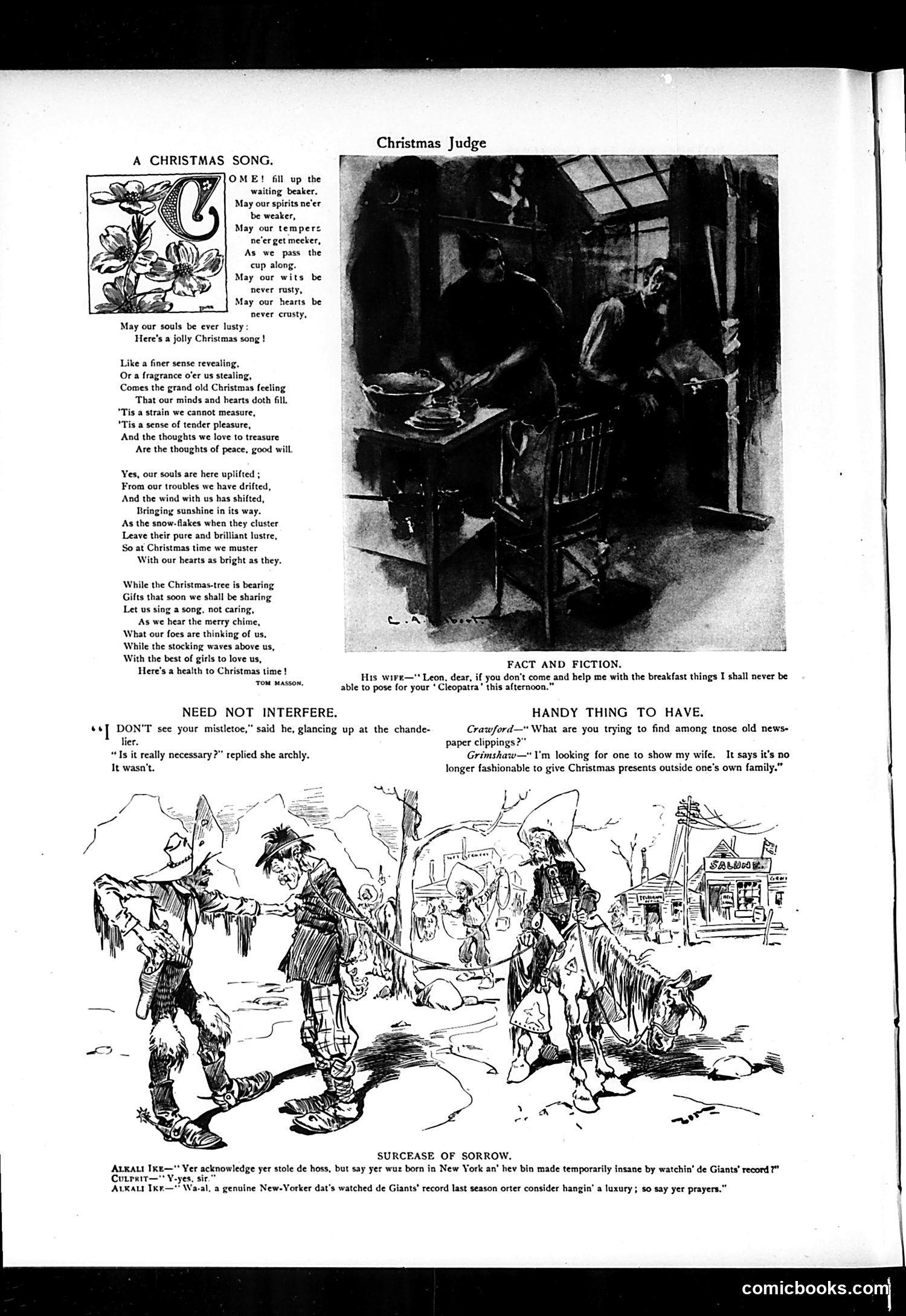
This page contains Christmas-themed humor from Judge magazine, a satirical weekly. The content includes: **"A Christmas Song"**: A sentimental poem celebrating Christmas spirit, temperance, and goodwill—typical holiday fare. **"Christmas Judge" (top photograph)**: Appears to be an illustration or staged scene, possibly depicting a courtroom or formal setting. **"Fact and Fiction"**: A married couple joke where the wife demands her husband help with breakfast dishes so she can pose as Cleopatra for an artistic project—satirizing both domestic dynamics and artistic pretension. **"Need Not Interfere"**: A mistletoe joke playing on romantic expectations. **"Handy Thing to Have"**: Satirizes marriage anxiety by showing a husband searching old newspaper clippings for one claiming Christmas presents within families are unfashionable—a humorous excuse to avoid gift-giving. **"Surcase of Sorrow"**: A cartoon with dialect humor about a New York Giants baseball fan, suggesting watching the team's poor record might justify suicide ("hangin'"). The page reflects early 20th-century American domestic humor and sports culture.
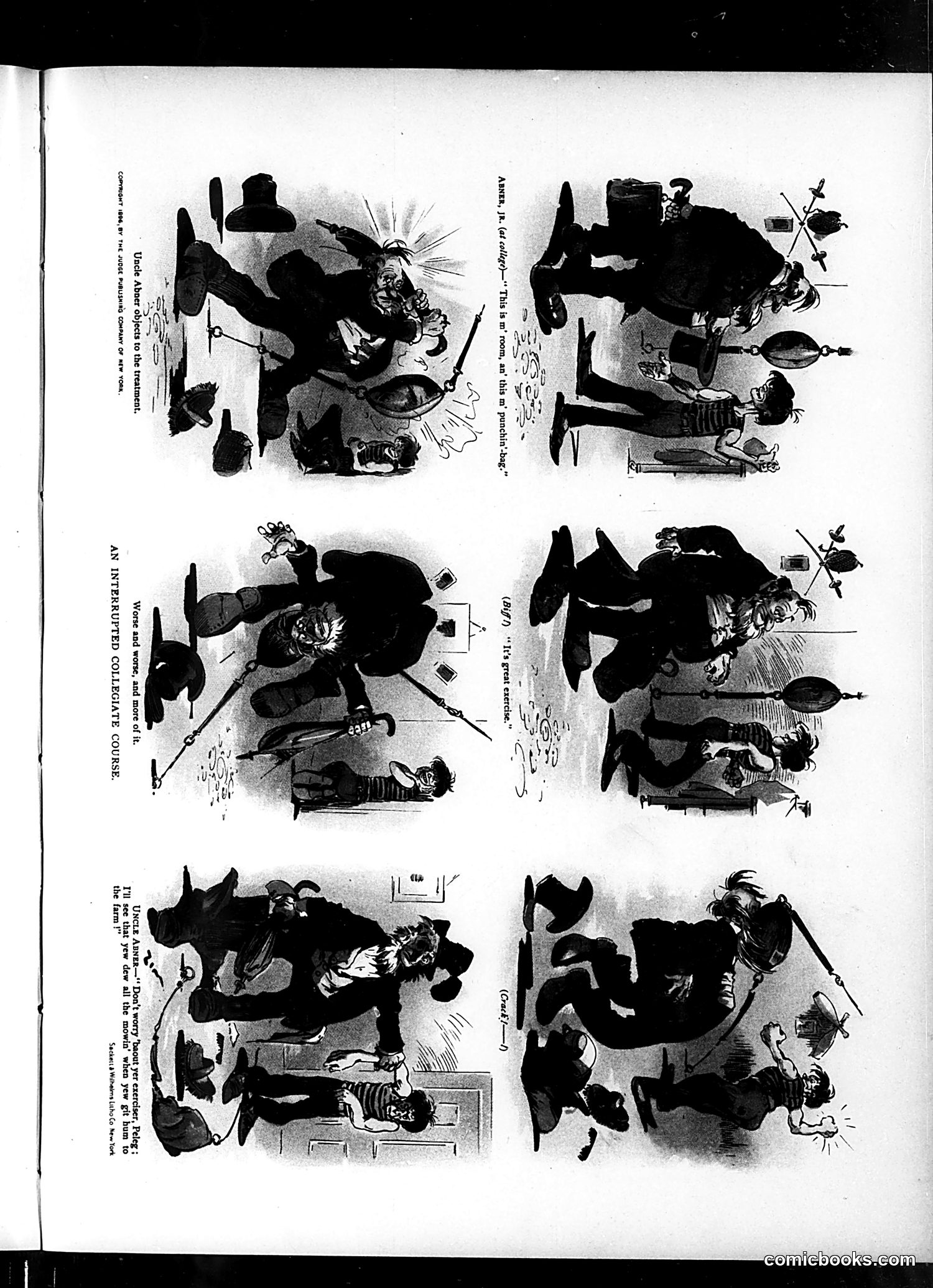
This appears to be a humorous domestic cartoon rather than political satire. It depicts a college student ("Abner, Jr.") showing his uncle his new punching bag, boasting about it as exercise equipment. Uncle Abner responds by promising the young man will get plenty of "exercise" when he returns home to the farm—specifically, mowing. The joke relies on the contrast between collegiate leisure and rural labor. The cartoon satirizes privileged college boys who consider light athletic training "exercise," while mocking their naïveté about actual work. Uncle Abner's dry comeback suggests farmwork will provide far more rigorous physical exertion than any gym equipment. This reflects late 19th/early 20th-century class humor common in *Judge* magazine, poking fun at urban college culture versus rural practicality and work ethic.
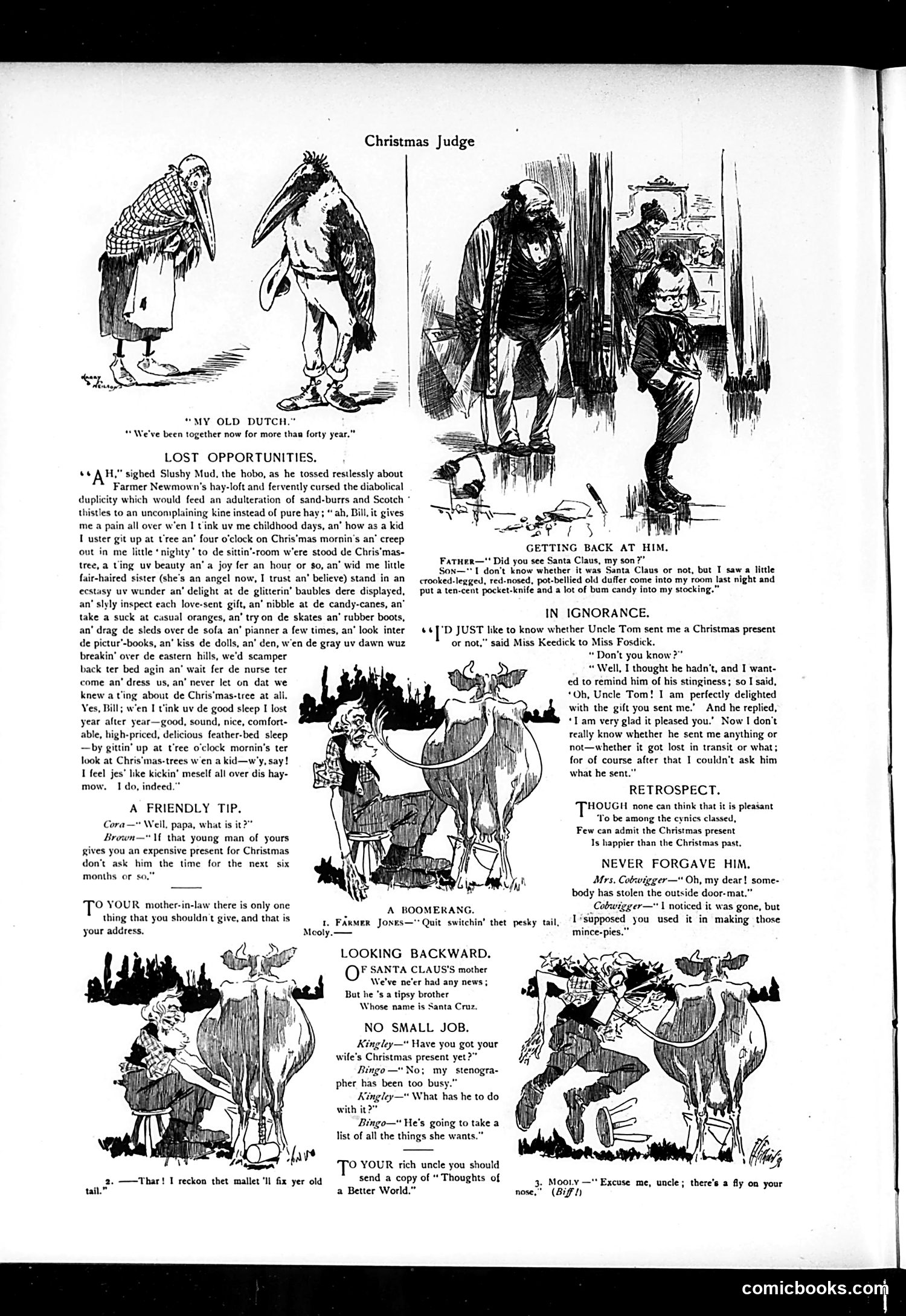
This is a collection of Christmas-themed satirical vignettes typical of *Judge* magazine's humor. The page includes: **Main cartoons:** - "My Old Dutch" and "Lost Opportunities": A hobo nostalgically recalls childhood Christmas mornings, contrasting those joys with his current destitute condition—satirizing poverty and lost prospects. - "Getting Back at Him": A child describes receiving a cheap gift (ten-cent pocket-knife, candy) from someone claiming to be Santa, sarcastically calling him a "pot-bellied old duffer"—mocking false gift-giving. **Brief humor pieces** mock contemporary domestic life: wives' expensive Christmas demands, the difficulty of gift-shopping, and marital tensions. "Never Forgave Him" jokes about a stolen doormat causing lasting resentment. The overall tone satirizes both sentimental nostalgia and modern commercialism around Christmas, with working-class and middle-class perspectives presented for comedic contrast.
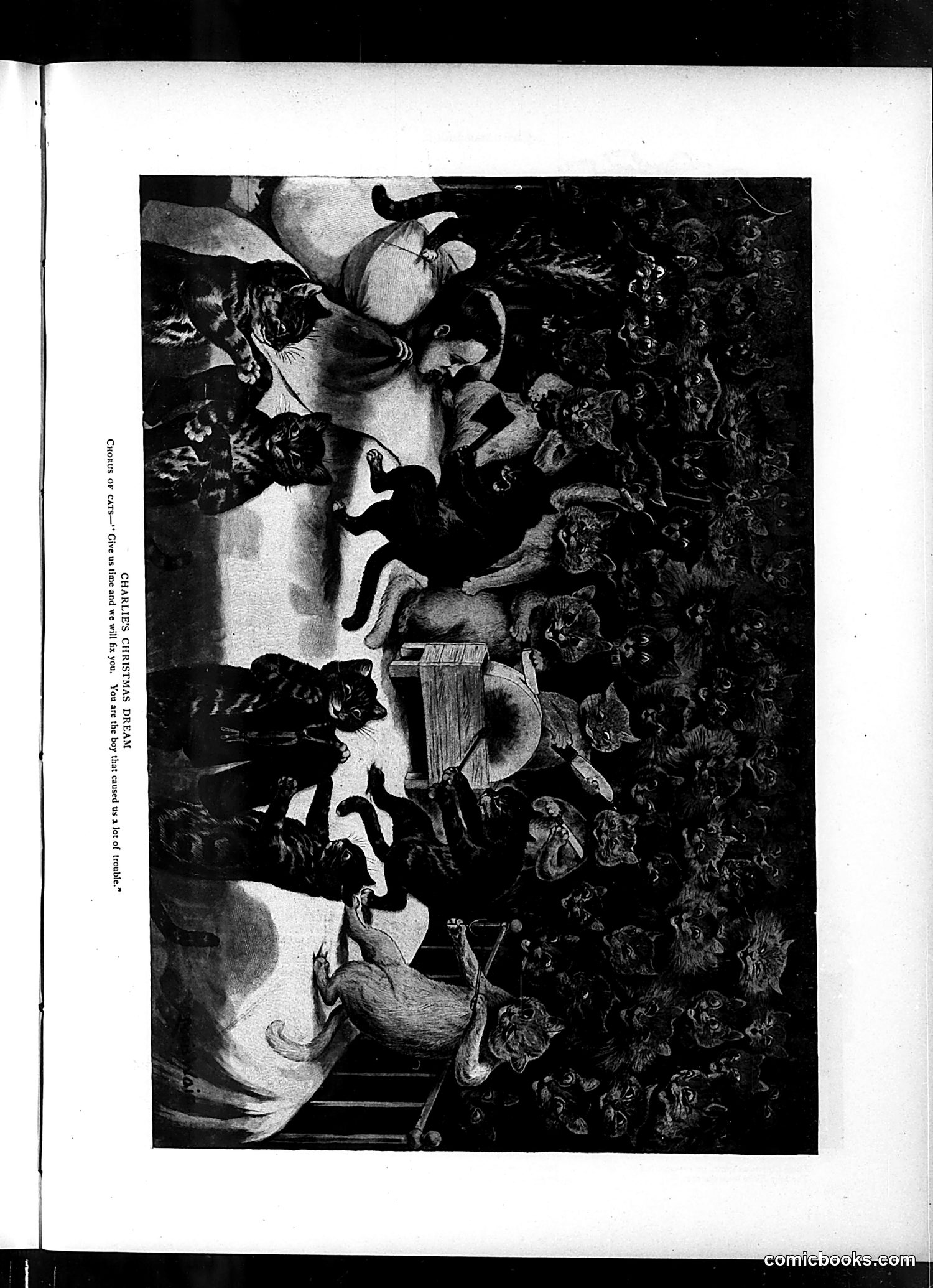
The OCR text is largely illegible, consisting mostly of corrupted characters. The image itself, when rotated to proper orientation, depicts what appears to be a satirical scene with multiple figures and animals in a garden or natural setting with flowering plants. However, without clear text identifying the specific figures, politicians, or social references being satirized, I cannot reliably determine: - Who the caricatured figures represent - What political or social event is being mocked - The intended satirical message To accurately explain this Judge magazine cartoon to a modern reader would require either legible OCR text or clearer identification of the figures shown. The image quality and text corruption prevent confident historical analysis.
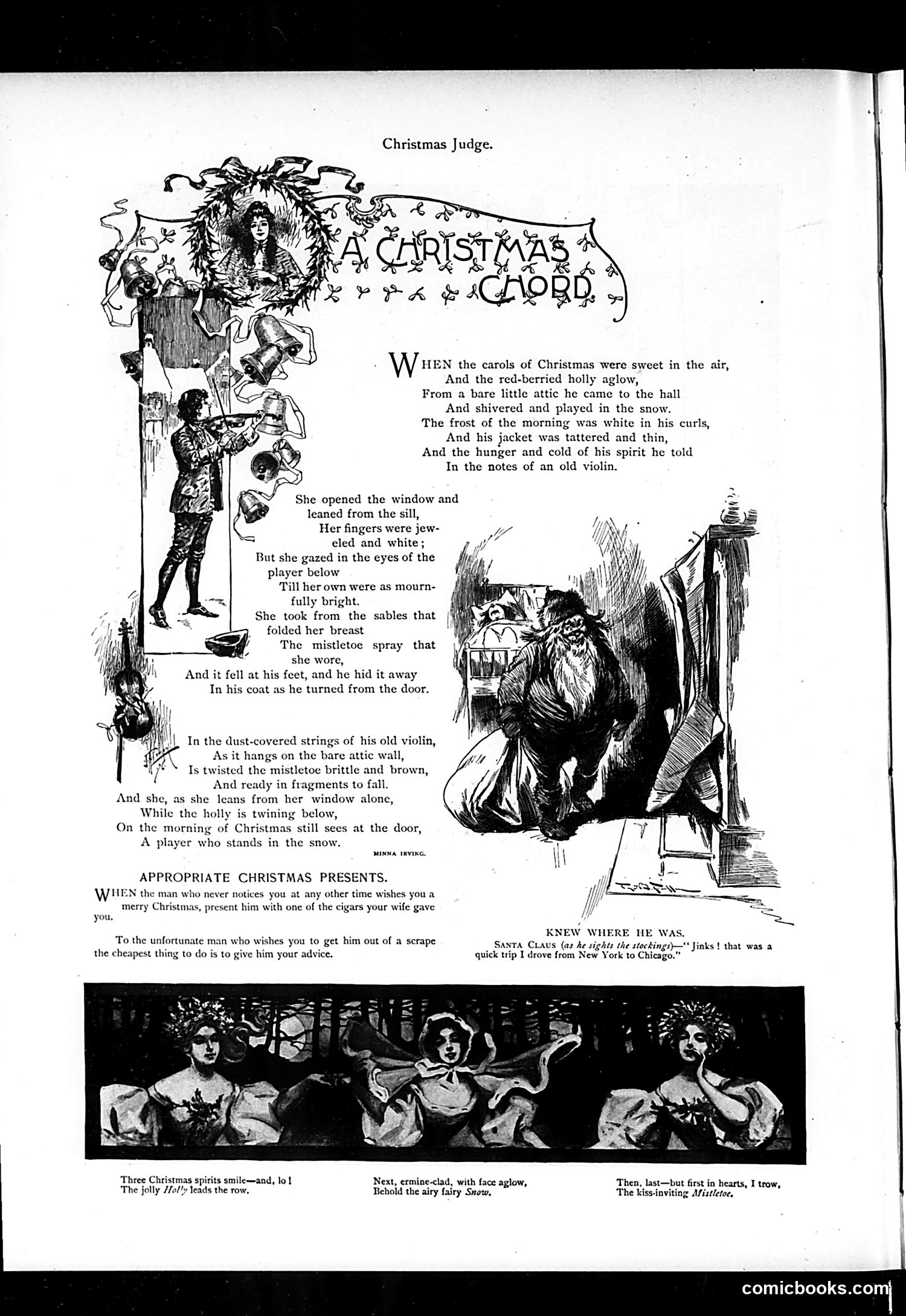
This page combines sentimental poetry with satirical humor typical of *Judge* magazine's Christmas content. **Main Narrative ("A Christmas Carol"):** A sentimental poem about class divide—a poor boy playing violin in the snow captivates a wealthy woman at her window. She gives him her mistletoe spray; he treasures it. The illustration shows this poignant encounter. **Satirical Sections Below:** - **"Appropriate Christmas Presents"**: Biting jokes about stingy gift-giving—regifting cheap cigars to indifferent acquaintances; giving unwanted advice to those in trouble. - **"Knew Where He Was"**: A quip about Santa Claus's rushed efficiency (New York to Chicago). - **Bottom illustrations**: Three allegorical Christmas "spirits"—Holly, Snow, and Mistletoe—personified as elegant women. The page contrasts sentimental Christmas ideals (the touching violin scene) with cynical social commentary about actual holiday behavior—miserliness, insincerity, and transactional relationships among the wealthy.
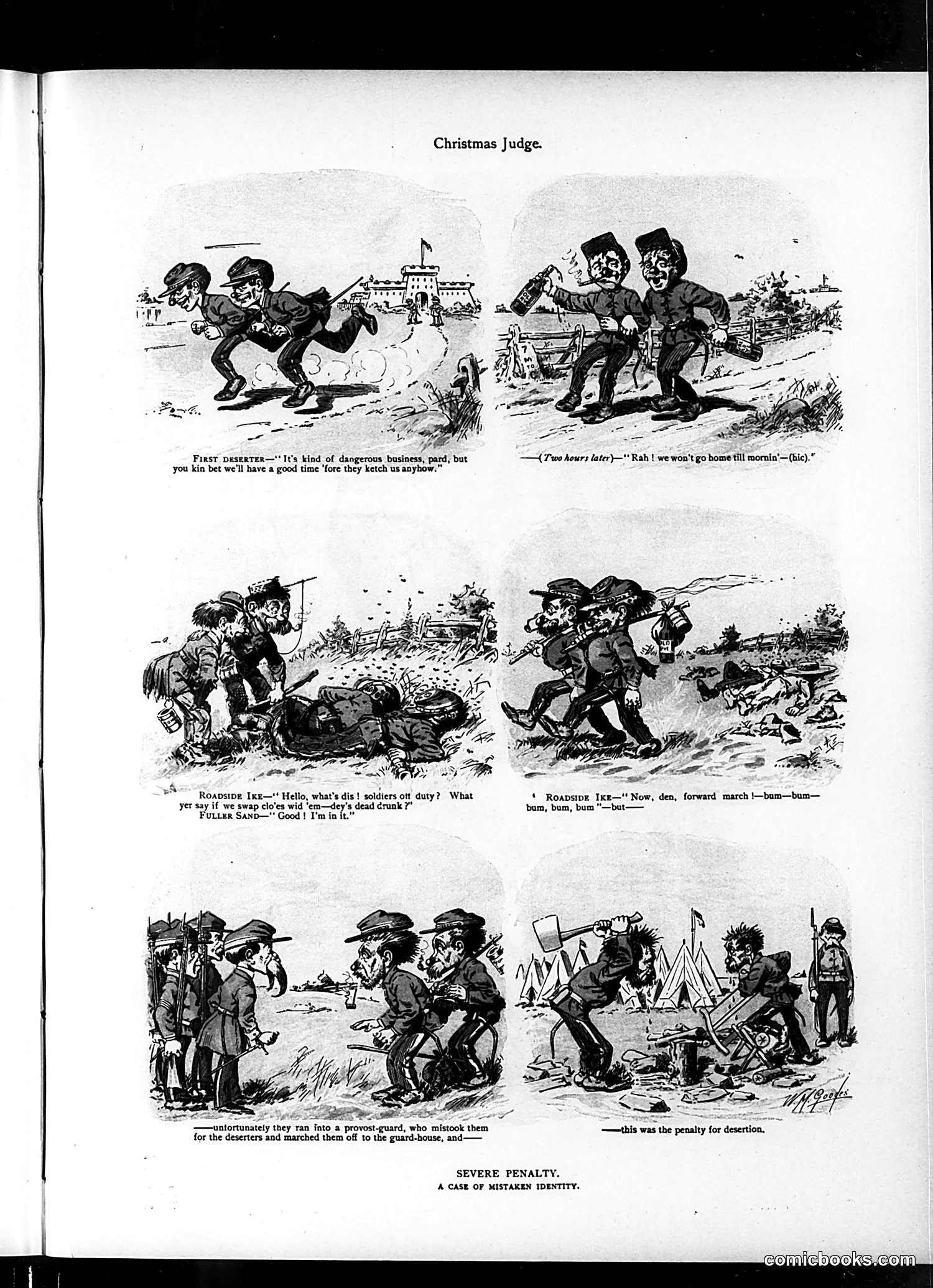
This multi-panel cartoon satirizes military discipline and the consequences of desertion during wartime (likely Civil War era, given the period style). The narrative follows two soldiers who desert, get drunk celebrating their escape, then encounter characters named "Roadside Ike" and "Fuller Sand." These men swap clothes with intoxicated soldiers, apparently planning to disguise themselves. However, a provost guard (military police) mistakes the disguised deserters for actual soldiers and arrests them anyway. The satire's point: the deserters' attempted escape backfires through "mistaken identity"—they're punished despite their scheme, illustrating how military justice operates indiscriminately. The subtitle "A Case of Mistaken Identity" emphasizes the irony: they tried to evade capture but ended up arrested regardless, facing "severe penalty" for desertion. The drunk dialect and comedic tone typical of Judge magazine frame this grim military consequence as darkly humorous.
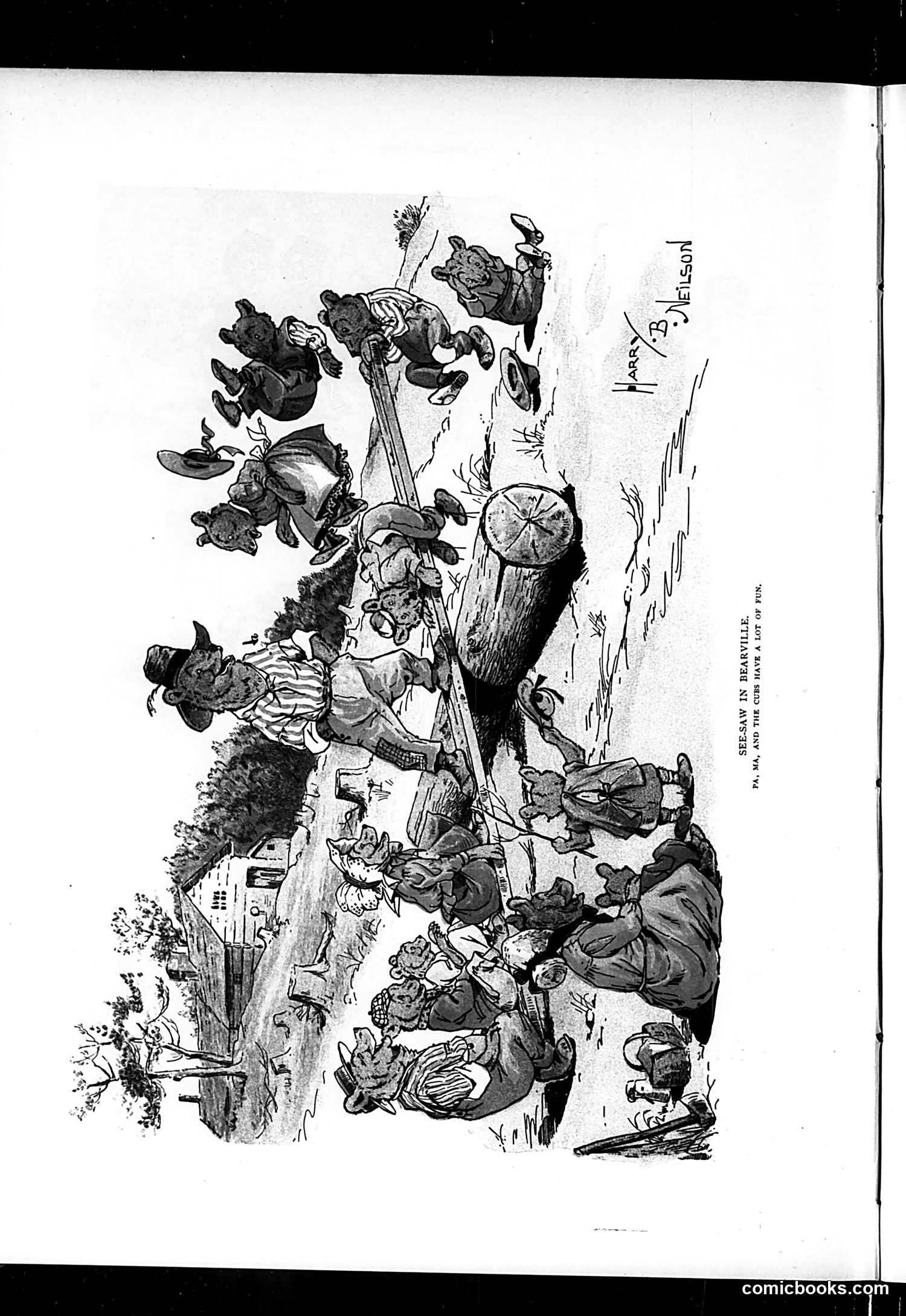
This page appears to be from *Judge* magazine, showing a satirical illustration titled "SEES OWN BRAVELLE" (text partially unclear due to OCR quality). The cartoon depicts multiple figures in 19th-century dress gathered around what seems to be a central scene or incident. The style and composition suggest social or political commentary typical of *Judge's* approach. However, the OCR text is too corrupted to reliably identify specific figures, politicians, or events being satirized. Without clearer text or additional context about the publication date, I cannot accurately explain what specific political/social situation this cartoon addresses or who the caricatured individuals represent. To properly interpret this, the original magazine issue date and any caption text would be essential.
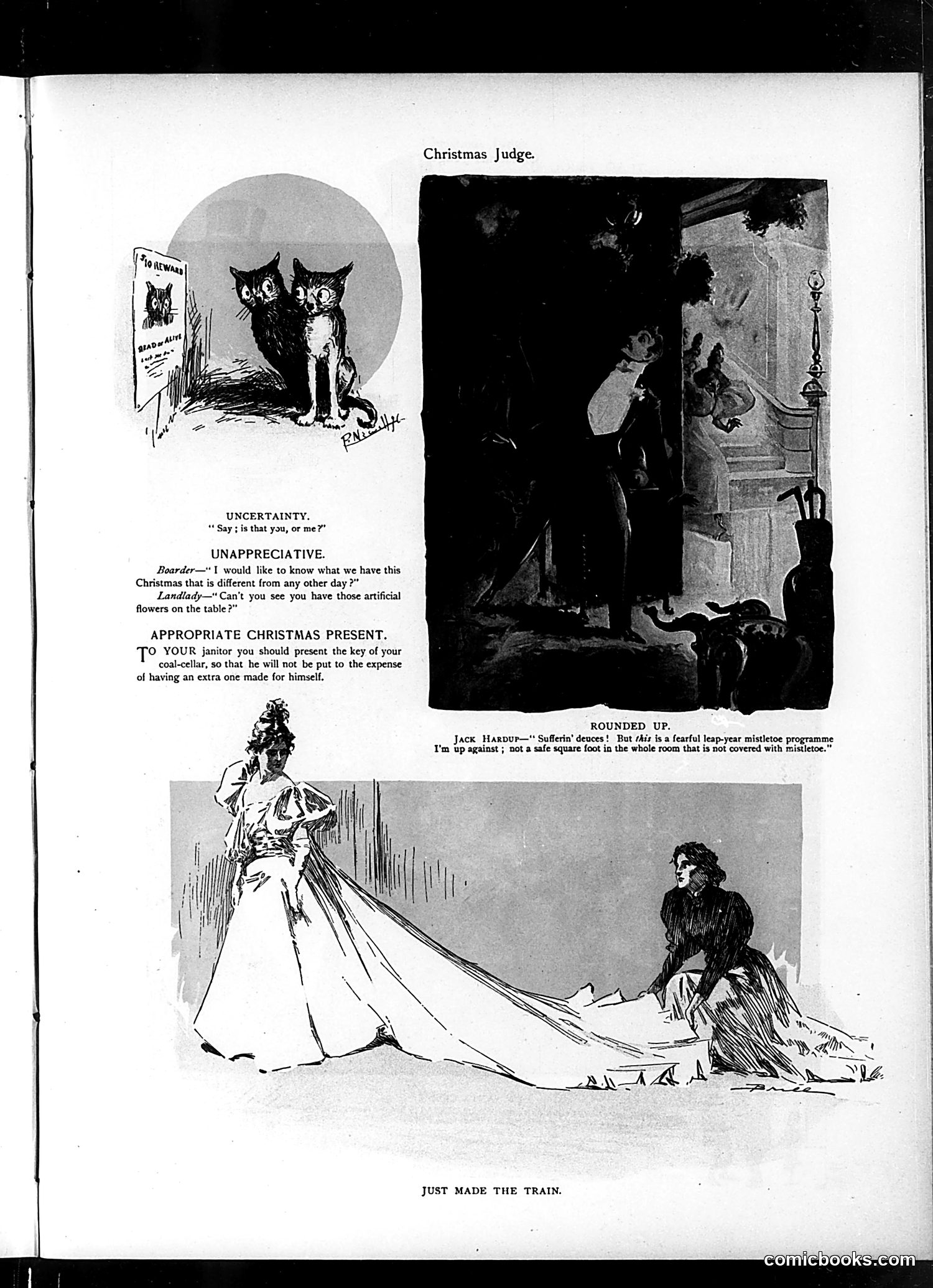
This page contains several brief satirical vignettes typical of Judge's holiday humor: **"Uncertainty"**: Two cats questioning each other's identity—a absurdist joke playing on visual similarity. **"Unappreciative"**: A boarder (tenant) complains that Christmas dinner is indistinguishable from ordinary meals. The landlady's defensive response—pointing to cheap artificial flowers as the special touch—satirizes penny-pinching hospitality and lower-class Christmas efforts. **"Appropriate Christmas Present"**: Sardonic advice suggesting a janitor's Christmas gift should be a coal-cellar key, implying he steals coal anyway. This reflects working-class economic desperation and employer cynicism. **"Rounded Up"**: A leap-year mistletoe joke where a man named Jack Harpur complains that mistletoe covers every safe square foot of a room—suggesting aggressive romantic entanglement or loss of personal space during holiday festivities. **"Just Made the Train"**: An illustration (caption only visible) likely depicting holiday travel chaos. The humor targets landlords, workplace dynamics, and holiday commercialism—distinctly period concerns.
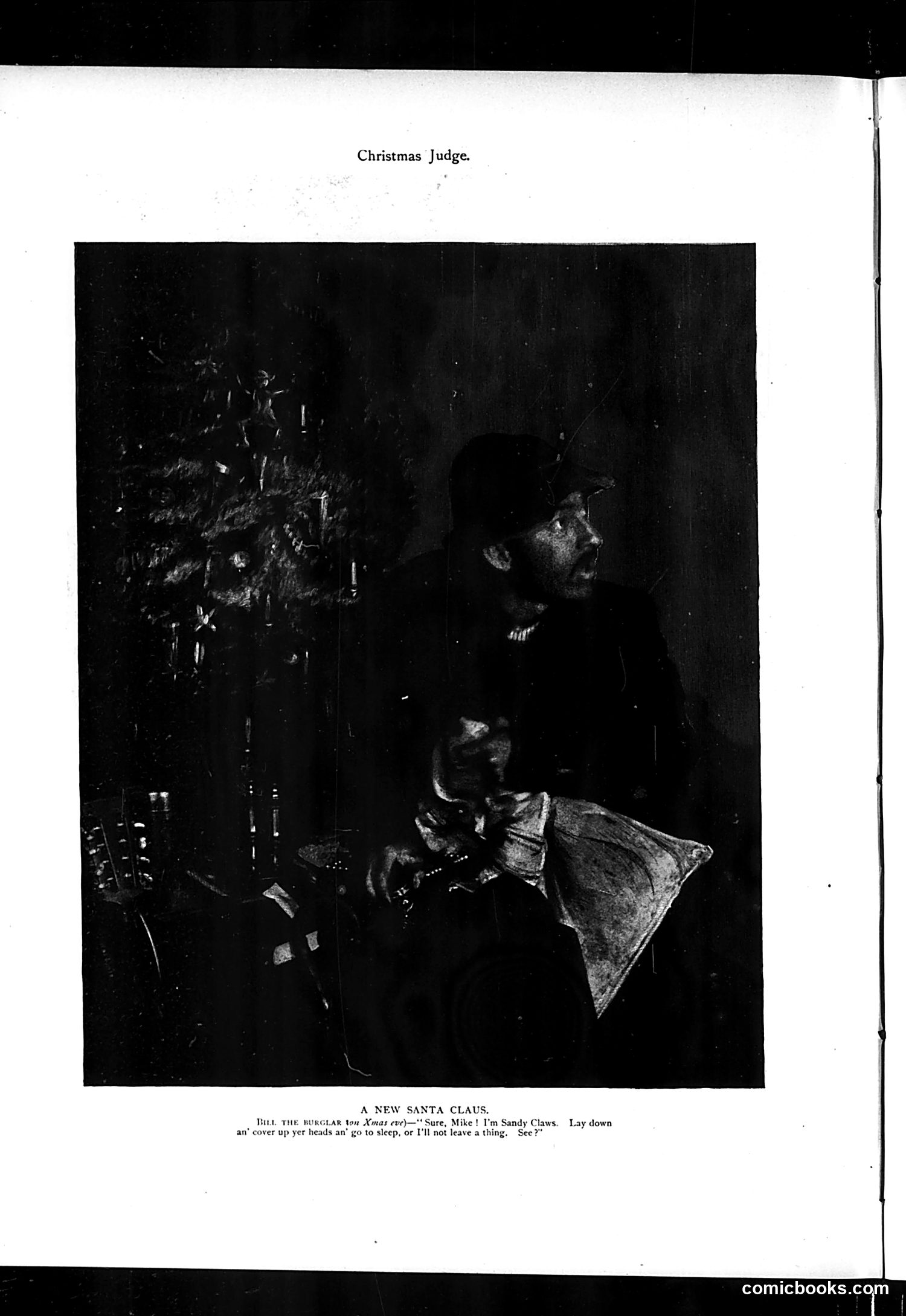
This cartoon presents a darkly comic Christmas satire. Two burglars—identified as "Bill" and "Mike"—have dressed one of themselves as Santa Claus to facilitate a home robbery on Christmas Eve. The disguised burglar mockingly addresses the household, threatening to steal everything unless residents stay in bed and remain quiet. The satire inverts the Santa Claus mythology: instead of a benevolent gift-giver, Santa becomes a thief exploiting the holiday's trusted traditions. The joke targets both the vulnerability of households during Christmas festivities and perhaps contemporary anxieties about urban crime. By treating burglary as comedic rather than criminal, Judge mocks both criminal audacity and the ease with which holiday traditions could be perverted for nefarious purposes—satirizing the breakdown of social order during an otherwise sacred season.
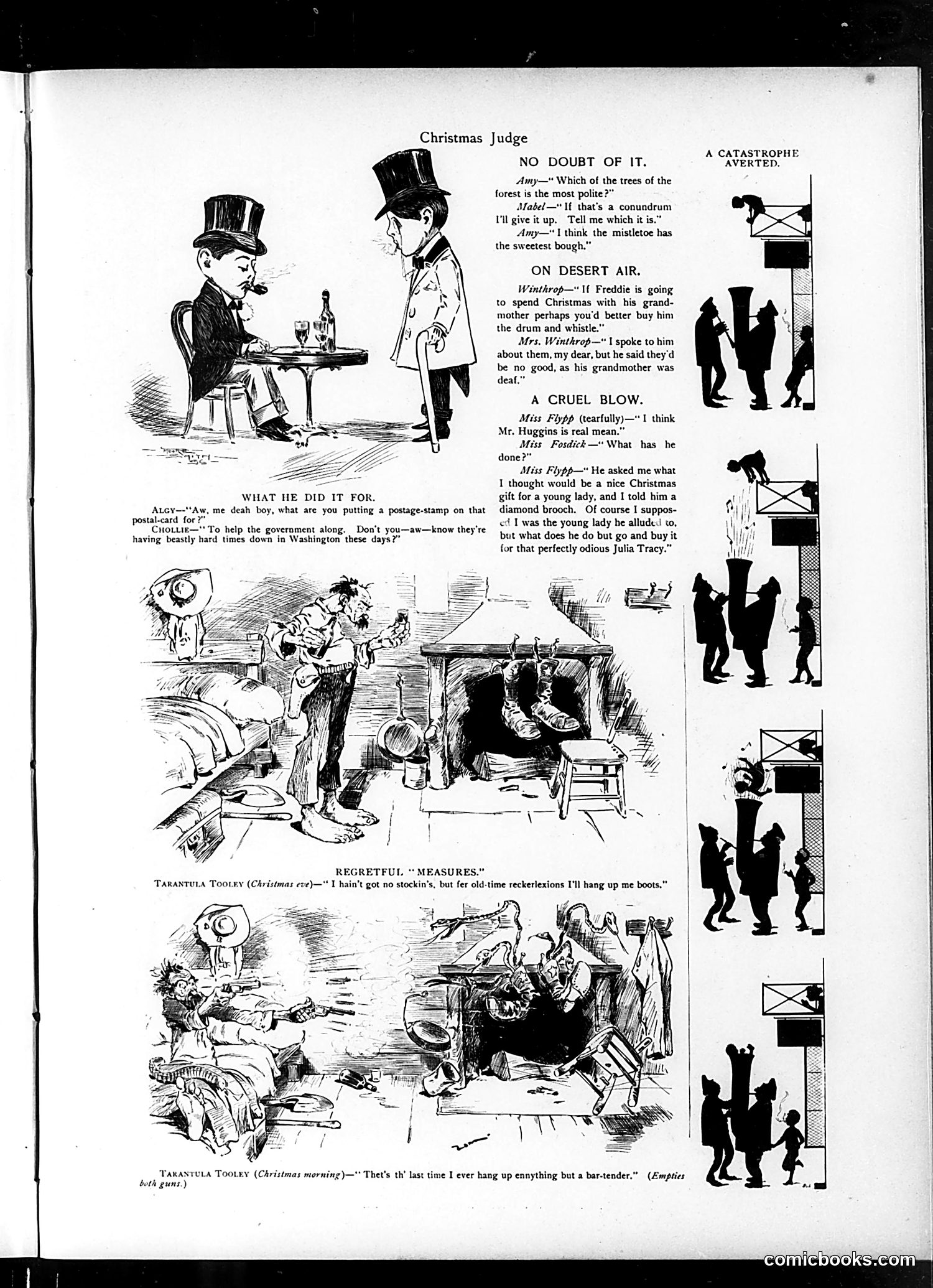
This page contains several standalone comic vignettes satirizing American social life around Christmas: **"What He Did It For"**: Mocks wealthy young men's ignorance—a dandy claims putting stamps on postcards helps the government, apparently unaware of how postal systems work. **"No Doubt of It"** and **"On Desert Air"**: Pun-based jokes typical of the era (mistletoe's "bough"; grandmother too deaf to enjoy noisy toys). **"A Cruel Blow"**: Satirizes miscommunication and romantic disappointment—Miss Flypp hints for a diamond brooch as a Christmas gift for herself, but the oblivious suitor buys it for the wrong woman. **"Regretful Measures"**: Two panels show Tarantula Tooley in messy domestic chaos, complaining about hanging stockings ("last time I ever hang up anything but a bar-tender"), suggesting alcohol-fueled holiday debauchery. The humor relies on period-specific social assumptions about class, gender expectations, and domestic life rather than political commentary.
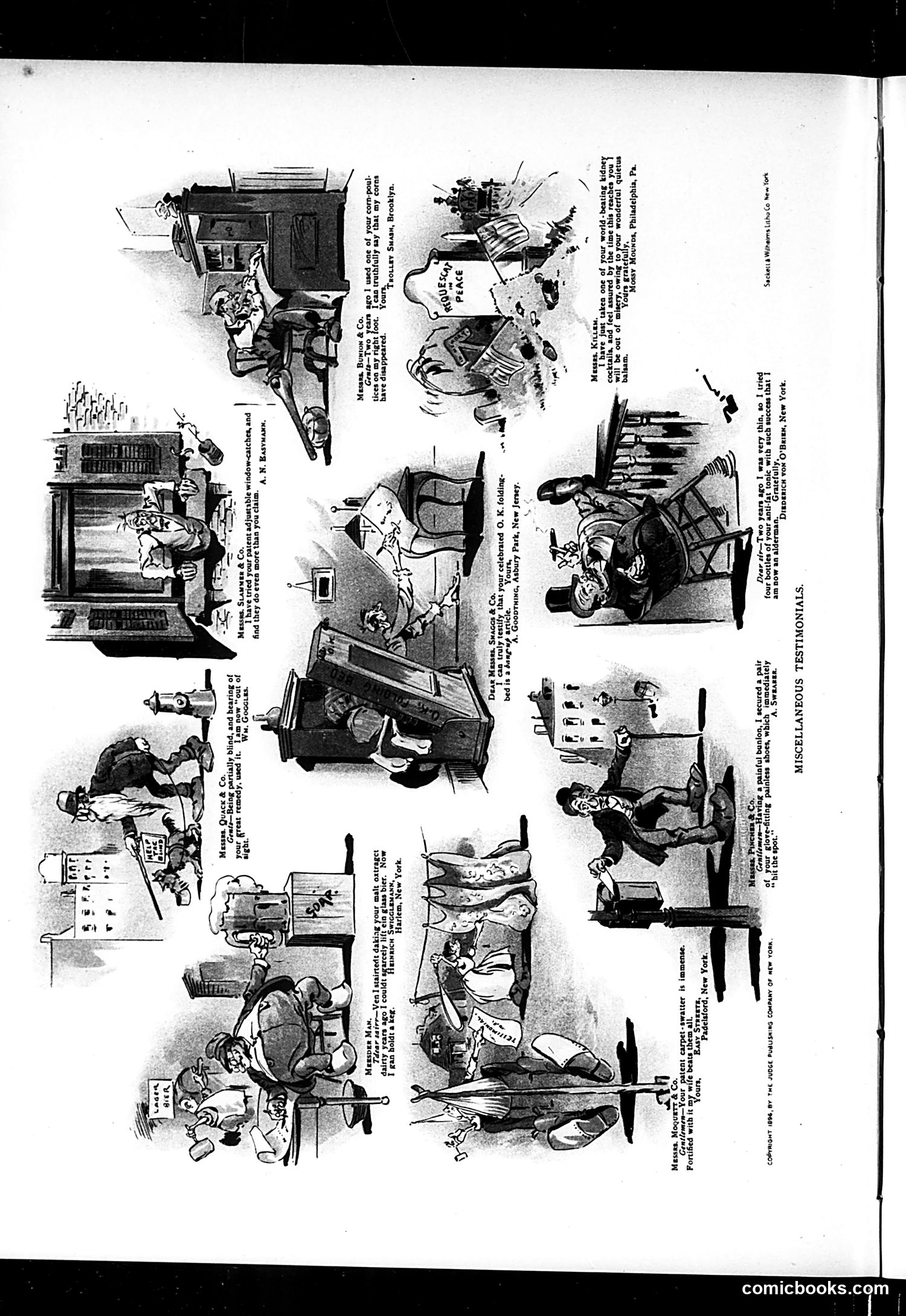
The OCR text is severely corrupted and largely illegible, making it impossible to read the actual captions and dialogue that would explain these cartoons' specific meanings. From the **images alone**, this appears to be a page of miscellaneous illustrated vignettes in the style of early-20th-century American humor magazines. The sketches show various domestic and social scenes rendered in black and white—figures in different situations involving household items, furniture, and everyday activities. Without readable text identifying the subjects, satirical targets, or narrative context, I cannot reliably explain what political or social commentary these cartoons intend. The page may address contemporary issues of its era (labor, gender roles, consumerism, etc.), but **claiming specific meanings would require guessing rather than evidence**. To properly analyze this, a clean OCR or original printed source would be needed.
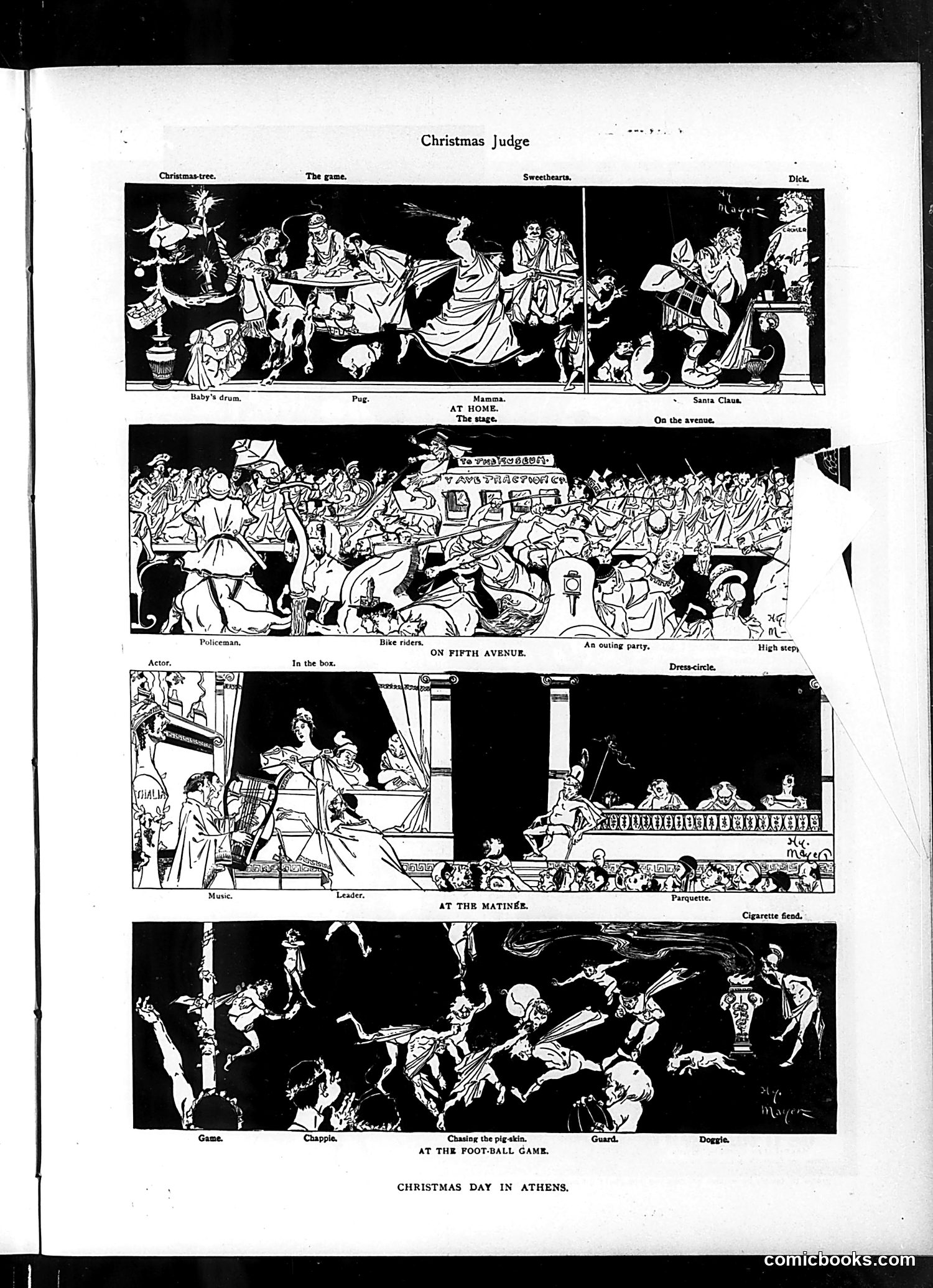
This satirical illustration reimagines Christmas celebrations transplanted to ancient Athens. The page presents multiple panels showing traditional Victorian Christmas activities—Christmas trees, games, theater attendance, parties—rendered in a classical Greek setting with toga-wearing figures. The satire appears to mock either: (1) the pretensions of classical education in American society, or (2) the incongruity of imposing modern Christmas customs onto ancient cultures. By depicting recognizably contemporary holiday traditions (matinee theater, Fifth Avenue crowds, foot-ball games, cigarette cards) as if performed by ancient Greeks, the cartoon suggests absurdity in either venerating classical civilization or forcing modern customs into inappropriate contexts. The bottom caption confirms the Athens setting, making this likely commentary on American cultural assumptions about classical antiquity or holiday commercialism.
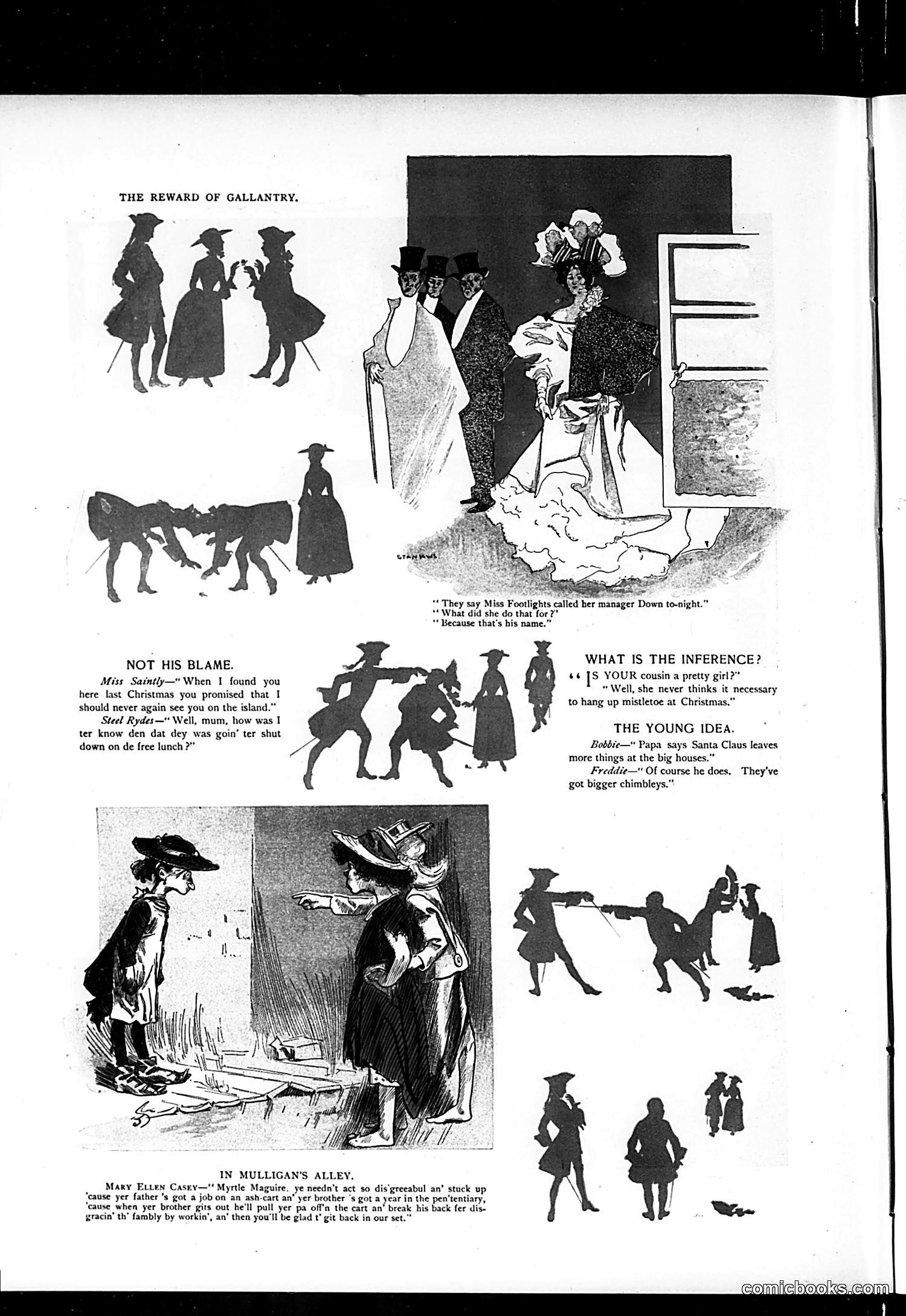
This page contains multiple short comedic strips satirizing working-class and immigrant life in early 20th-century America. **"The Reward of Gallantry"** mocks a man caught in a lie about his whereabouts, blaming economic hardship (closure of free lunch services) rather than admitting infidelity. **"Not His Blame"** presents a Irish immigrant ("Steel Rydes") using dialect humor, portraying working-class men as unreliable. **"In Mulligan's Alley"** depicts Irish-American social pretension: a girl whose father works on an ash-cart looks down on peers, but her brother's imprisonment suggests her family's instability will force her back to her actual social station. **"What is the Inference?"** is a brief joke about avoiding mistletoe with an unattractive cousin. **"The Young Idea"** satirizes children's materialistic logic—bigger houses have bigger chimneys, therefore Santa visits wealthier homes more generously. The page primarily uses ethnic stereotypes and class-based humor typical of the era, mocking immigrant workers and working-class pretension.
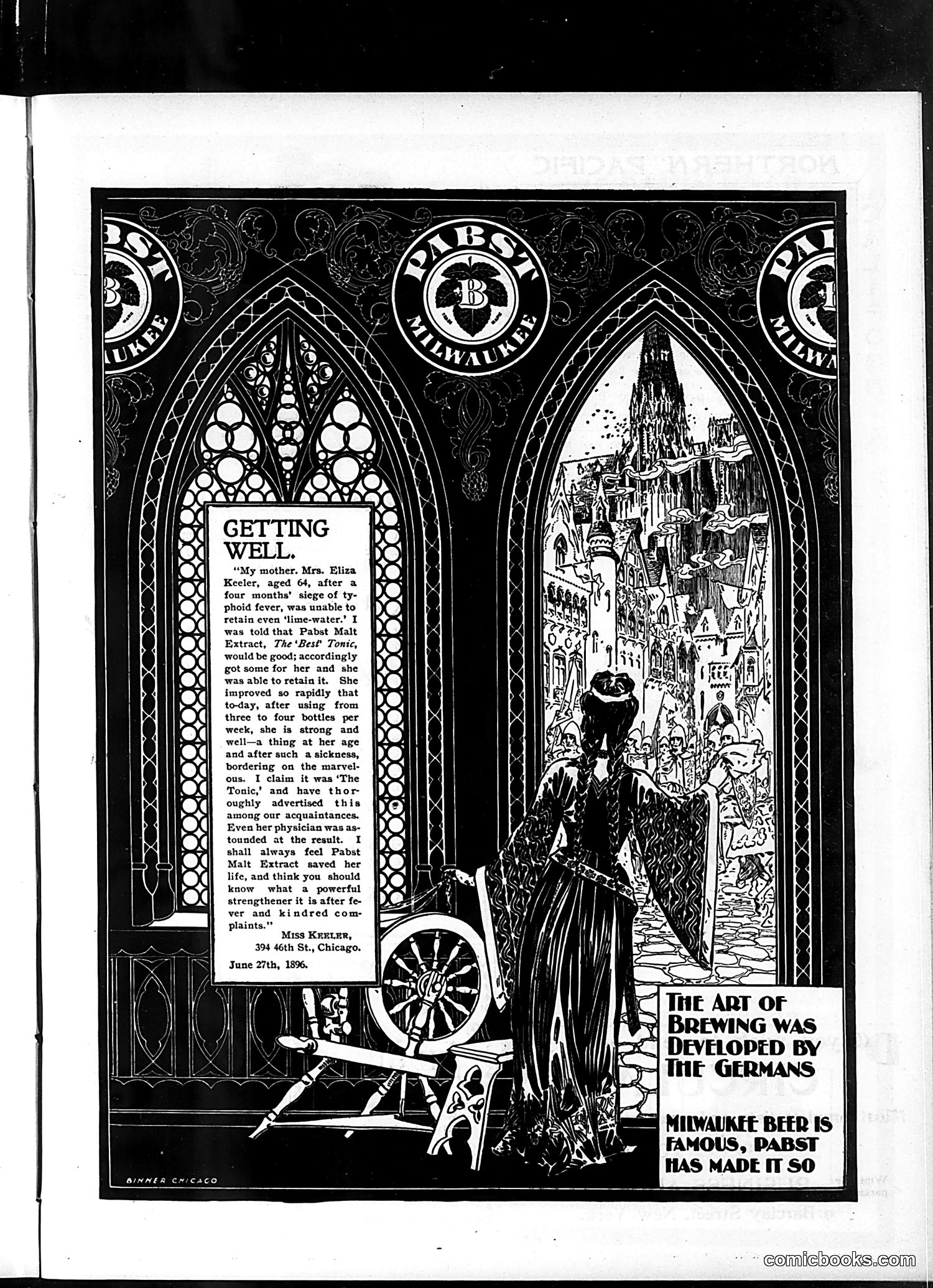
This is a **Pabst beer advertisement** disguised as editorial content in Judge magazine (circa 1896). The page features: **Main Element:** A Gothic-styled illustration of a woman in medieval dress, suggesting elegance and tradition. **The "Testimonial":** A fabricated letter from "Miss Keeler" claiming her 64-year-old mother recovered from typhoid fever using Pabst Malt Extract, consuming "three to four bottles per week." The letter credits the product with near-miraculous healing powers, even astonishing her physician. **The Satire/Point:** This exemplifies late-19th-century patent medicine advertising fraud. Pabst marketed beer as medicinal "tonic," exploiting desperate illness sufferers. The exaggerated claims and fake testimonials were common—and often effective—before FDA regulations. The Gothic framing lends false credibility and class to a dubious product. **For Modern Readers:** This shows how unregulated advertising once made outlandish health claims without evidence, targeting vulnerable people seeking cures for serious diseases.
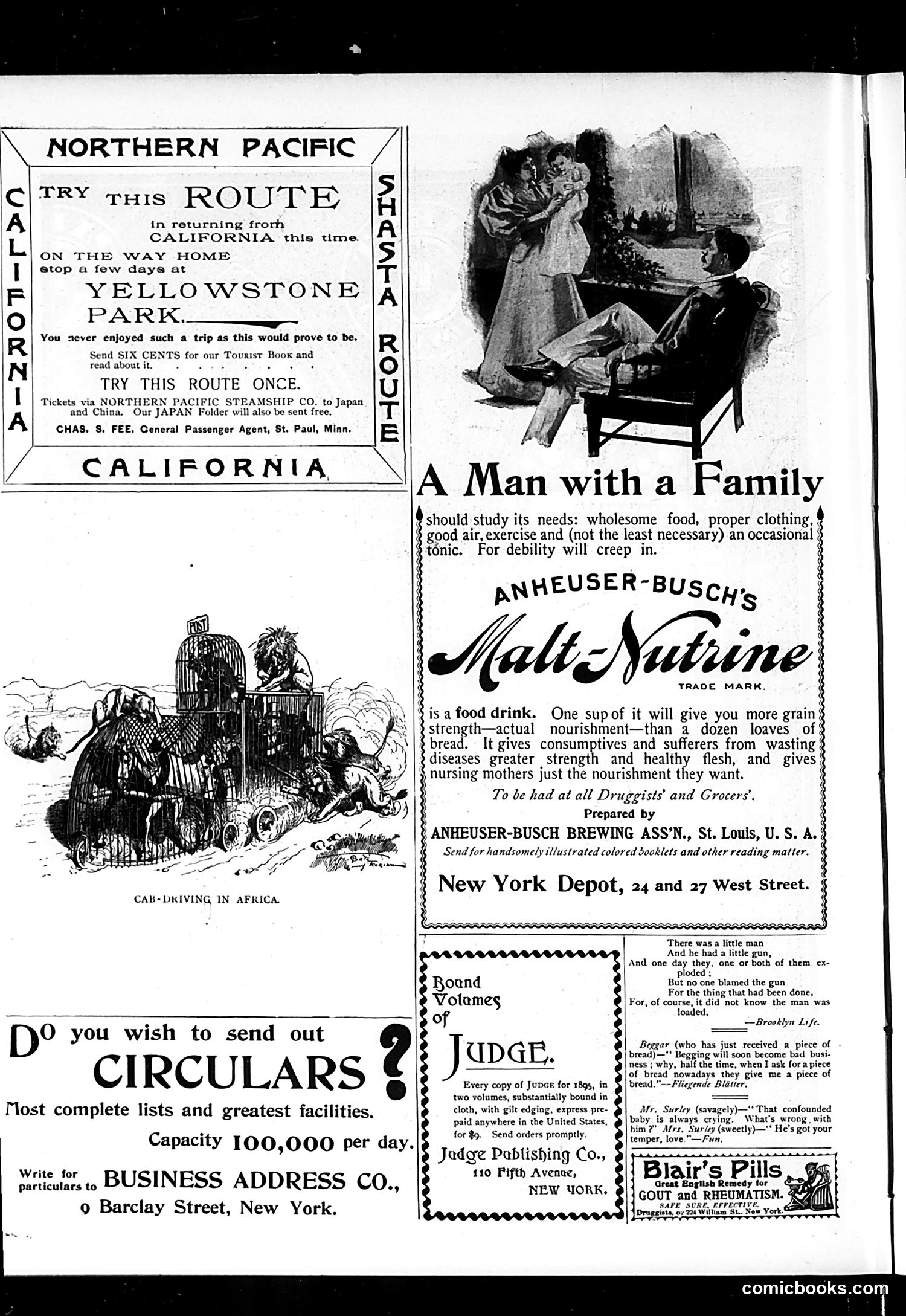
This page is primarily **advertisements and filler content** rather than political satire. The main elements include: **Travel Advertisement** (top left): Northern Pacific Railway promotes California-to-Yellowstone tourism, offering free Japan travel information—typical early 1890s promotional material. **Product Advertisement** (center-right): Anheuser-Busch's "Malt-Nutrine" claims to provide family nutrition and health benefits. The accompanying illustration shows a father with children, appealing to domestic health concerns of the era. **Humorous Fillers**: Brief jokes appear throughout, including a Brooklyn Life piece about a gun and man that's a dark pun on accidental discharge—typical magazine filler humor. **Business Services**: Advertisements for circular printing and bound volumes of Judge magazine itself. There is **no clear political cartoon or satire** on this page. The "Cab-Driving in Africa" illustration appears to be decorative filler rather than commentary. This page represents typical late-19th-century magazine advertising space rather than satirical content.
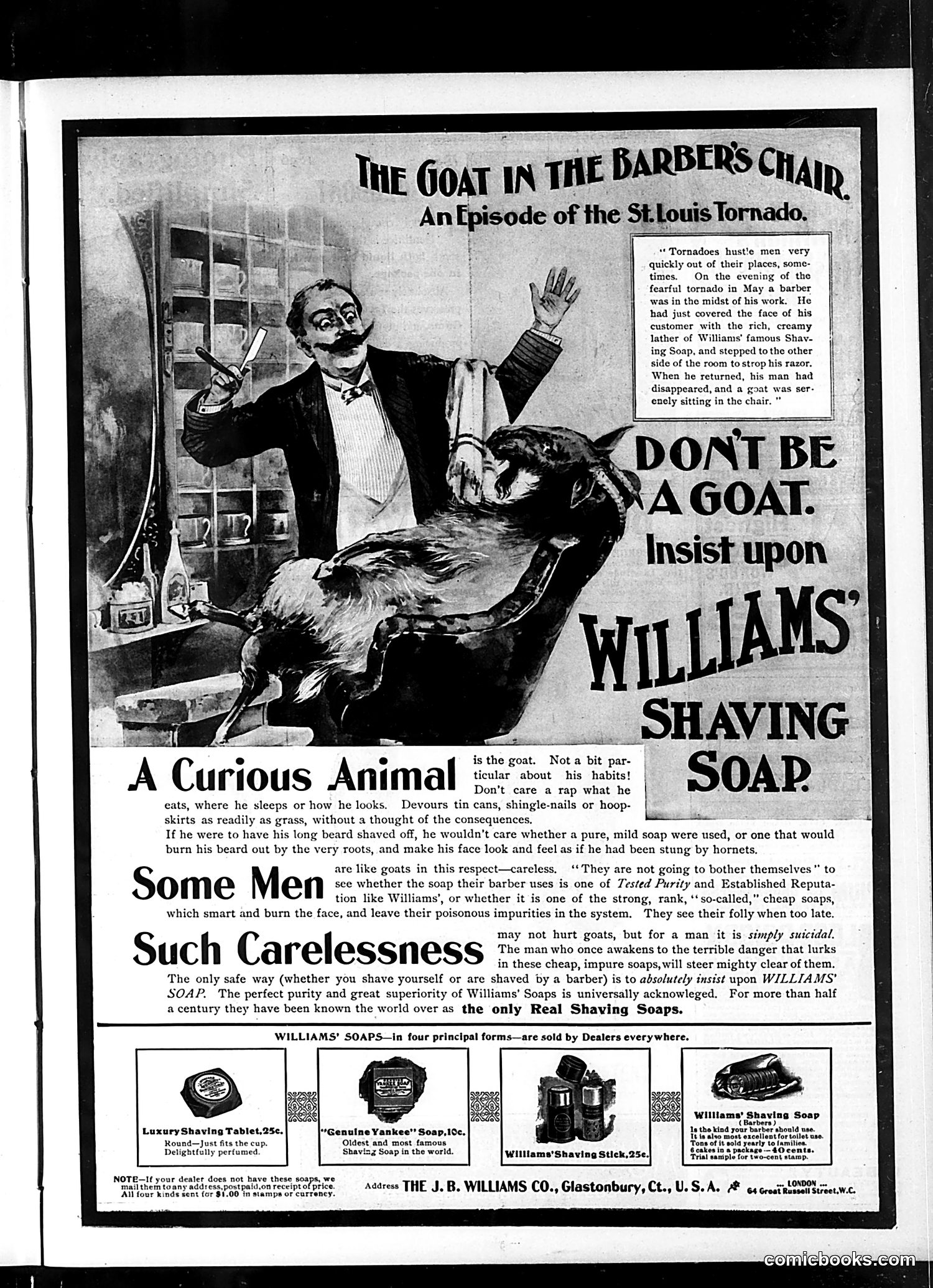
This is primarily a **product advertisement** disguised as humorous editorial content from Judge magazine. The "cartoon" depicts a barber whose customer mysteriously vanished during the 1903 St. Louis tornado, replaced by a goat sitting in the chair. The satire compares careless men to goats—indifferent animals unconcerned with quality. The advertisement's message: just as goats don't care what they eat, careless men don't care what shaving soap they use, unaware that cheap soaps burn and damage skin. The moral: discriminating gentlemen should "insist upon WILLIAMS' Shaving Soap," the only "Real Shaving Soap" for a century. The tornado reference adds topical humor while framing the pitch: unlike the goat who survived the disaster, men must protect themselves through proper grooming choices. The ad emphasizes purity versus harmful "cheap" competitors, positioning Williams' as the sophisticated choice.
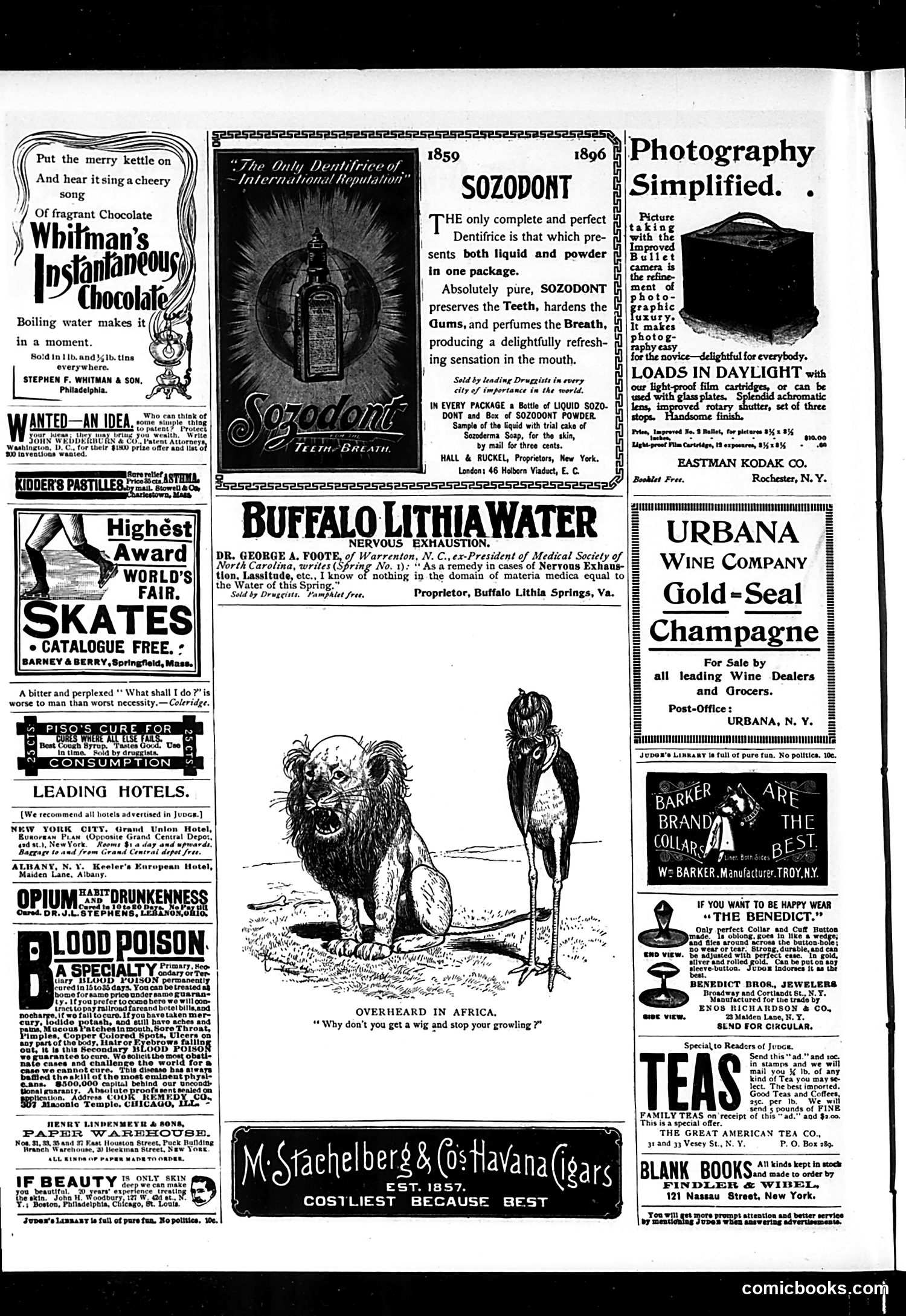
This is primarily an **advertising page** with one cartoon. The main illustration shows two figures "Overheard in Africa"—a bearded man (appearing to be a colonial European) and an African man. The joke's caption asks: "Why don't you get a wig and stop your growling?" The humor relies on **racist stereotypes** common to the 1890s: it mocks African appearance (hair/grooming) while portraying the African figure as perpetually complaining or subordinate. The "colonial Africa" setting reflects the era's imperial attitudes. The page is otherwise filled with period patent medicines and consumer goods (Sozodont toothpaste, Buffalo Lithia Water for "nervous exhaustion," remedies for opium/drunkenness and blood poison) typical of Judge's revenue model. These ads reveal contemporary anxieties about health and social problems. The cartoon represents casual, normalized racism acceptable to Judge's 1890s readership—treating African people as objects of ridicule rather than human subjects.
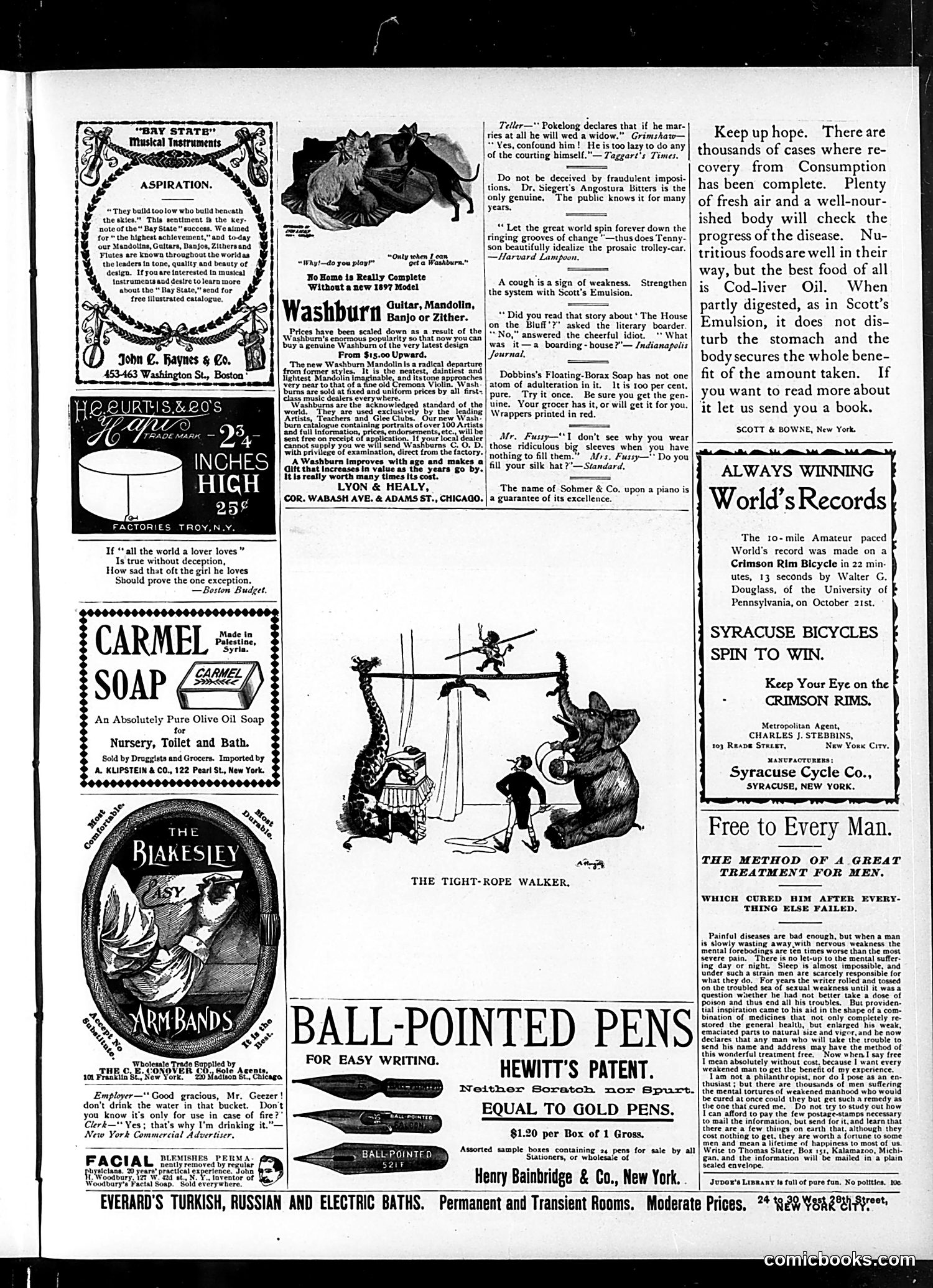
This page is primarily **advertising and filler content** rather than political satire. The dominant feature is "The Tight-Rope Walker," a humorous illustration showing figures (including what appears to be an elephant) on a rope, depicting circus or vaudeville entertainment—a popular American pastime of the 1890s. The surrounding text consists of product advertisements (musical instruments, soap, bicycles, pens) interspersed with brief humorous anecdotes and jokes unrelated to politics. These include workplace humor, domestic comedy, and mild social observations typical of Judge's lighter content. One notable exception: a brief dialogue mocking a character named "Pokelong" for planning to marry a widow to avoid courtship effort—reflecting contemporary attitudes about marriage and gender relations. The page reflects late-1890s American consumer culture and entertainment interests rather than substantive political commentary.
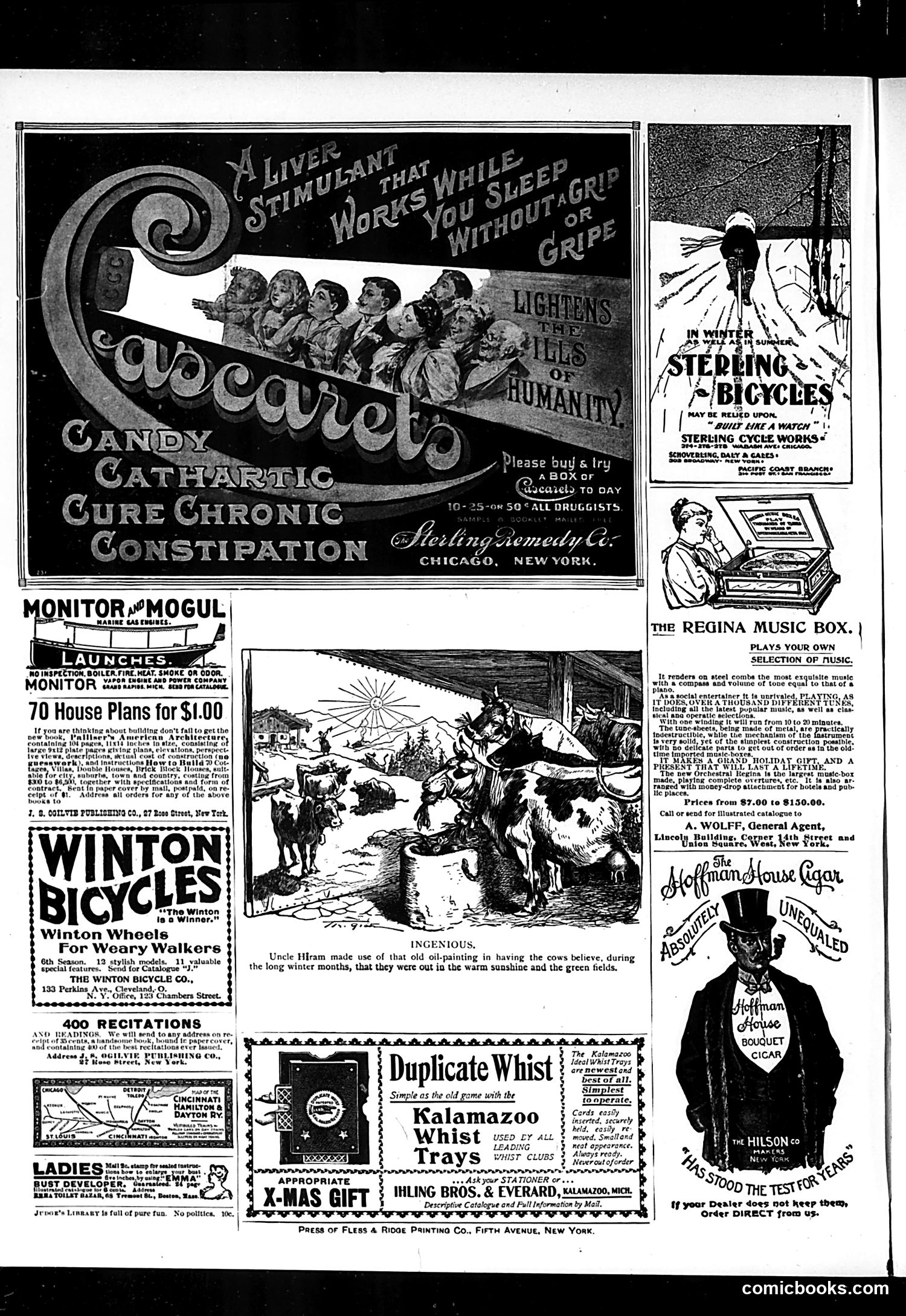
This is primarily an **advertising page**, not a satirical cartoon section. The dominant content consists of period product advertisements from approximately the early 1900s. The one **cartoon present** depicts "Uncle Hiram" using an oil painting to deceive cows during winter—showing the painting to make cattle believe they're in sunny pastures rather than cold barns. The caption labels this "INGENIOUS," suggesting gentle rural humor about farm life ingenuity. The advertisements reveal era-specific consumer goods: Sterling bicycles, the Regina music box, Hoffman House cigars, house plan books, Winton bicycles, the Kalamazoo whist card game, and various patent medicines including one claiming to "cure chronic constipation." **For modern readers**: This reflects pre-WWI consumer culture and the popularity of cycling, mechanical entertainment, patent remedies, and mail-order services. The Uncle Hiram cartoon represents sentimental rural Americana humor typical of the period's nostalgia for farm life amid rapid industrialization.