
A complete issue · 24 pages · 1896
Judge — March 28, 1896
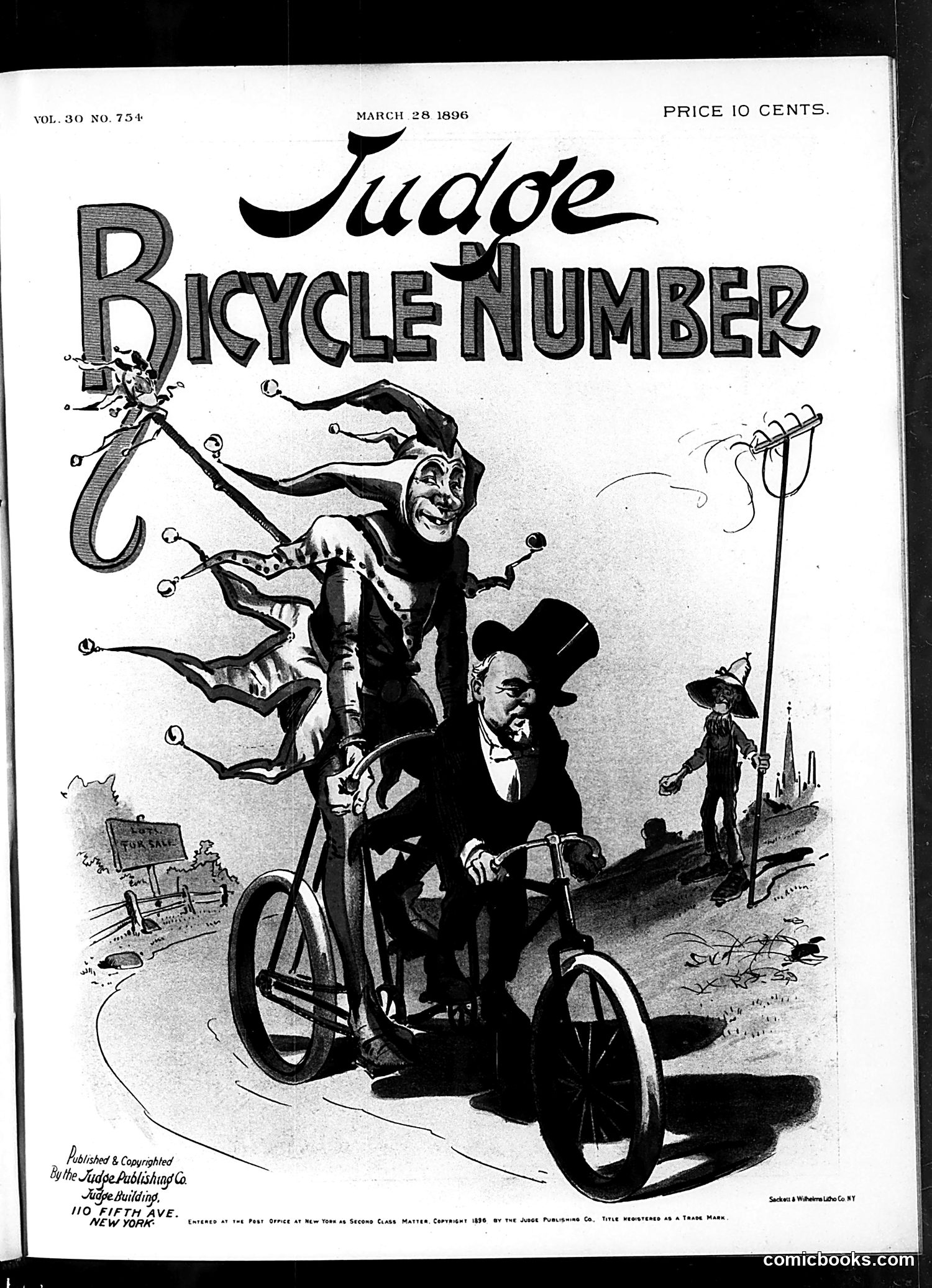
This satirical cover depicts the bicycle craze of the 1890s. The central figure appears to be a demon or jester manipulating bicycle parts like strings, suggesting bicycles were viewed as chaotic or morally suspect novelties. Below, a well-dressed gentleman (possibly representing a cautious or skeptical figure) sits on a tandem bicycle with another character, while a small figure stands to the right with what appears to be surveying equipment. The satire likely mocks the bicycle's rapid popularization and associated social anxieties—particularly concerns about women's independence, improper dress, and changing social norms. The demonic puppeteer figure suggests bicycles were seen as dangerously seductive or corrupting influences on proper Victorian society. The cover is titled "Judge Bicycle Number," indicating this special issue focused on bicycle-related humor and social commentary.
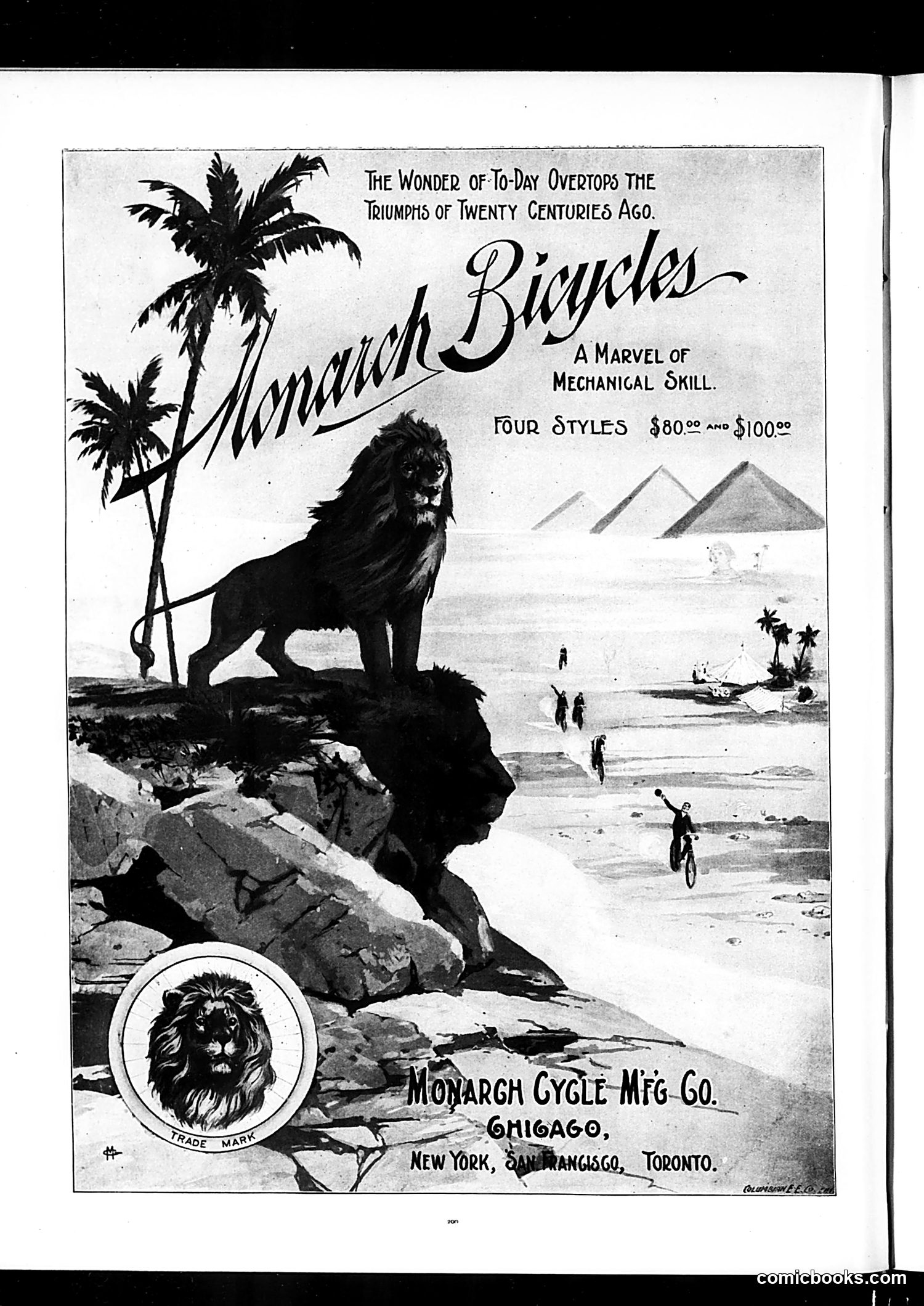
This page is primarily a **product advertisement** rather than political satire. It promotes Monarch bicycles manufactured by Monarch Cycle Mfg. Co., with locations in Chicago, New York, San Francisco, and Toronto. The ad's headline claims bicycles are "a marvel of mechanical skill" and references how they surpass "triumphs of twenty centuries ago"—likely alluding to ancient technologies like the Egyptian pyramids visible in the background imagery. The design uses exotic scenery (Egyptian pyramids, palm trees, beach) and a majestic lion as decorative elements to convey luxury and prestige. Four styles are offered at $80 and $100—substantial prices for the era. The lion functions as a brand mascot/symbol of strength and superiority, not as political commentary.
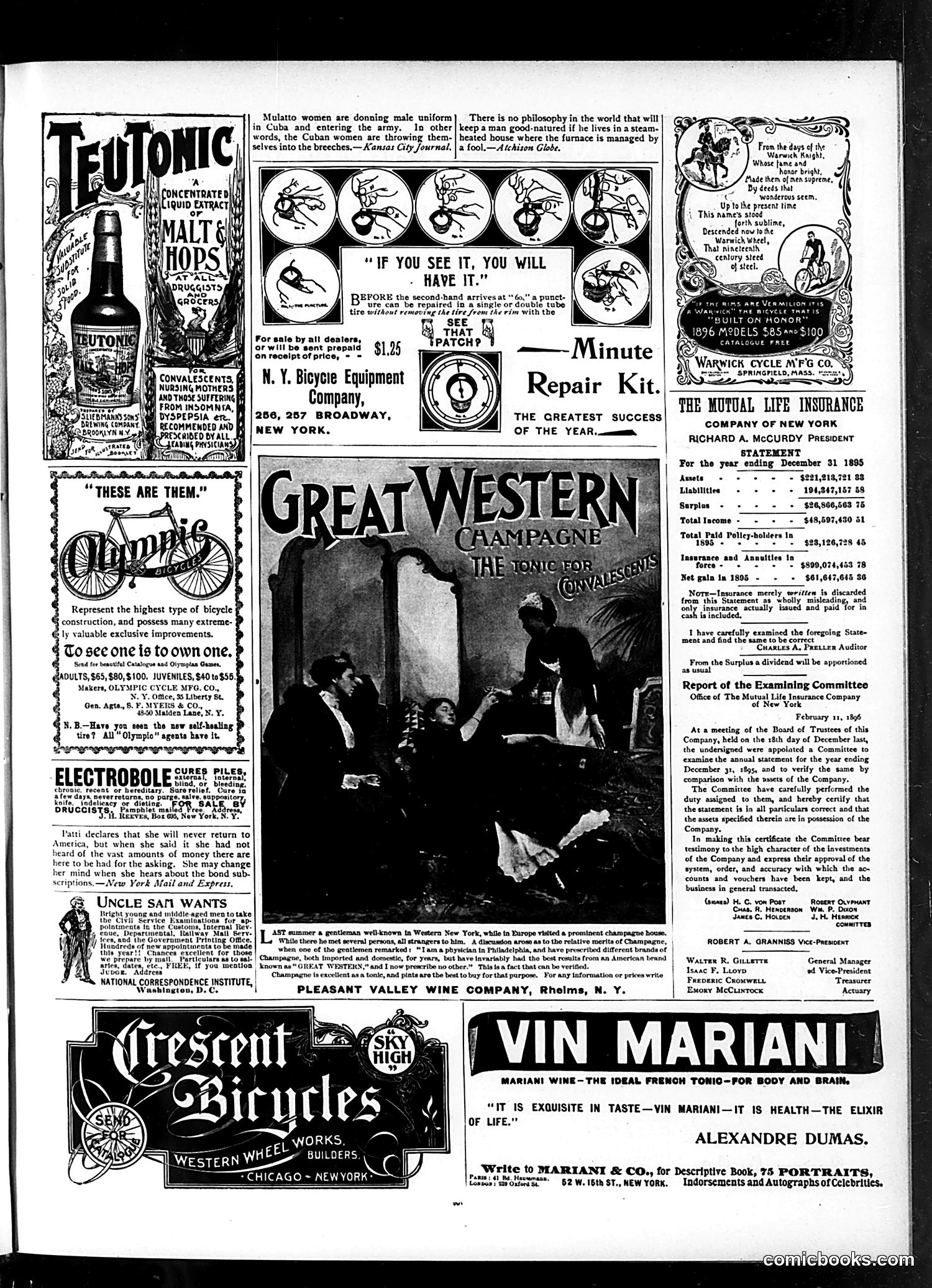
This page is primarily **advertising with minimal editorial content**. The advertisements include: - **Teutonic** (a medicinal liquid extract) - **Olympic bicycles** ("These Are Them") - **Electrole** (medical device for piles) - **Crescent Bicycles** - **Vin Mariani** (a wine tonic, endorsed with a quote attributed to Alexandre Dumas) - Various other patent medicines and products The largest image—a dramatic photograph labeled "Great Western Champagne"—appears to be an advertisement for champagne, showing figures in what seems to be a cellar or cave setting. The only clear editorial content is a brief **Mutual Life Insurance Company statement** (upper right), which is corporate reporting rather than satire. This page reflects the magazine's heavy reliance on patent medicine and bicycle advertising—typical of 1890s American publications.
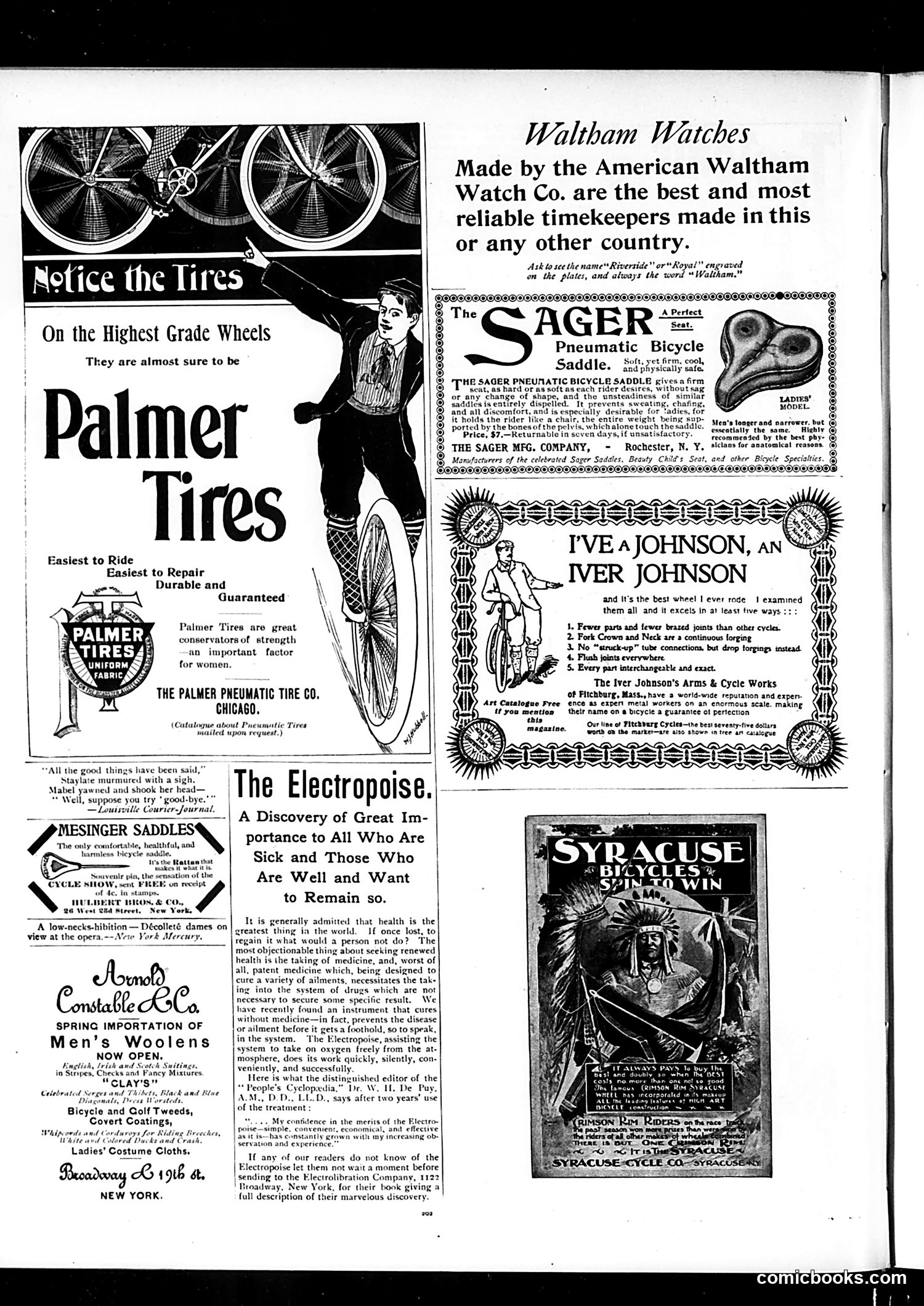
This page is primarily **advertisements**, not satire or political commentary. It features turn-of-the-century product endorsements typical of Judge magazine's revenue model. The ads promote bicycles, bicycle accessories, and watches—consumer goods marketed to middle and upper-class readers. Notable: the "Sager Pneumatic Bicycle Saddle" and "Iver Johnson" bicycle both use testimonial format, claiming superiority through technical specifications and expert endorsement. The "Electropoise" advertisement (bottom right) is particularly revealing of the era's medical quackery—it claims an electrical device cures ailments without medicine, endorsed by a purported doctor. This reflects widespread early-20th-century pseudoscientific health products that exploited public skepticism of patent medicines. The only satirical element is a brief joke about a woman ("Mabel") at the opera, but it's peripheral to the page's commercial purpose. **This page documents consumer culture and advertising practices of approximately 1900-1910**, not political or social satire.
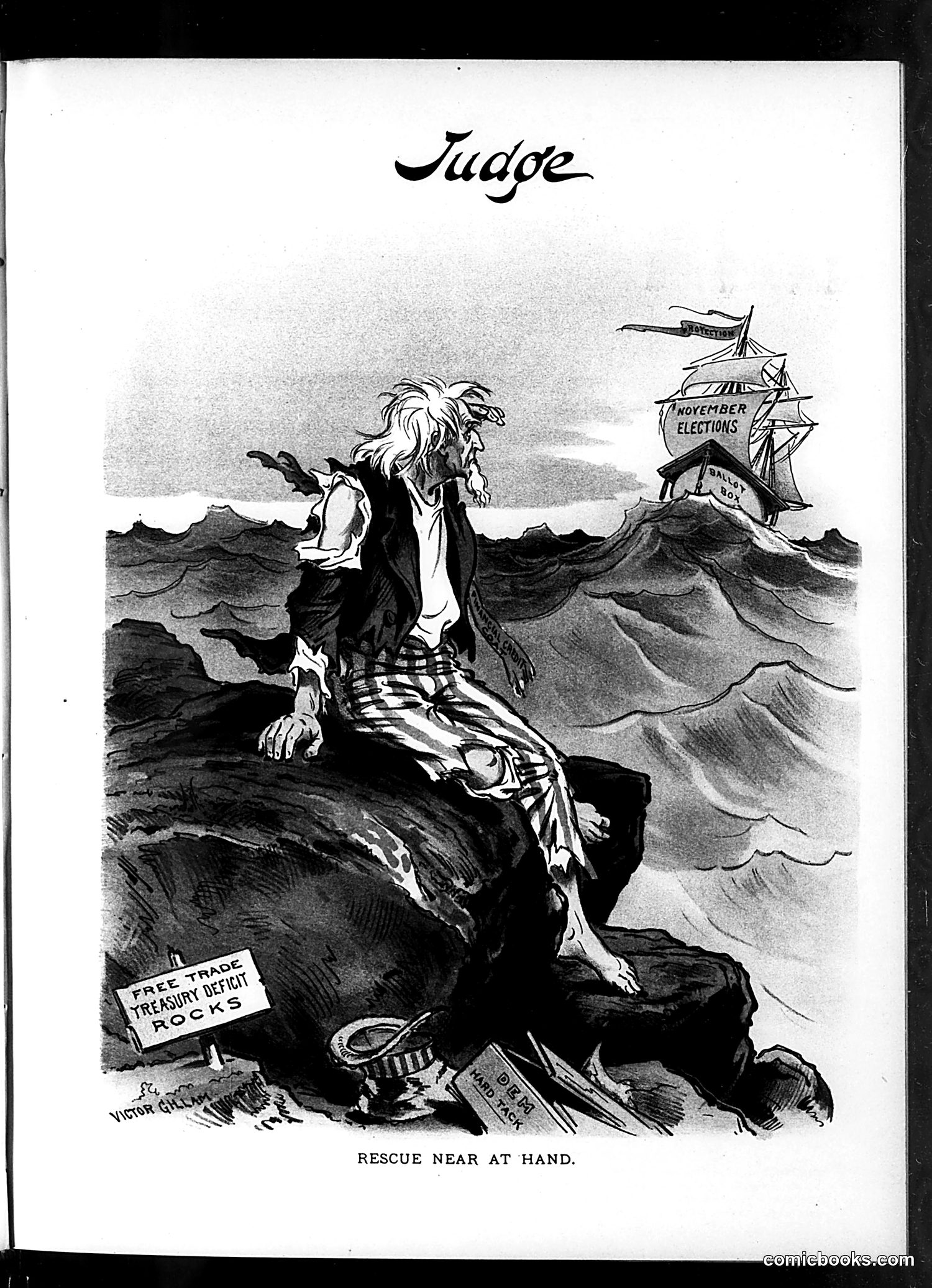
This cartoon depicts Uncle Sam as a skeletal, desperate figure clinging to rocks in turbulent seas, labeled with "Free Trade," "Treasury Deficit," and "Debt." A ship labeled "November Elections" approaches in the distance, offering potential rescue. The satire criticizes the economic hardships of the era—likely from the late 19th century—blaming free trade policies and fiscal mismanagement for financial crisis. Uncle Sam's gaunt appearance emphasizes the nation's suffering. The cartoon suggests that the upcoming November elections represent hope for political change and economic relief through different policies. The "rescue near at hand" refers to voters' opportunity to elect leaders who might reverse these damaging economic conditions.
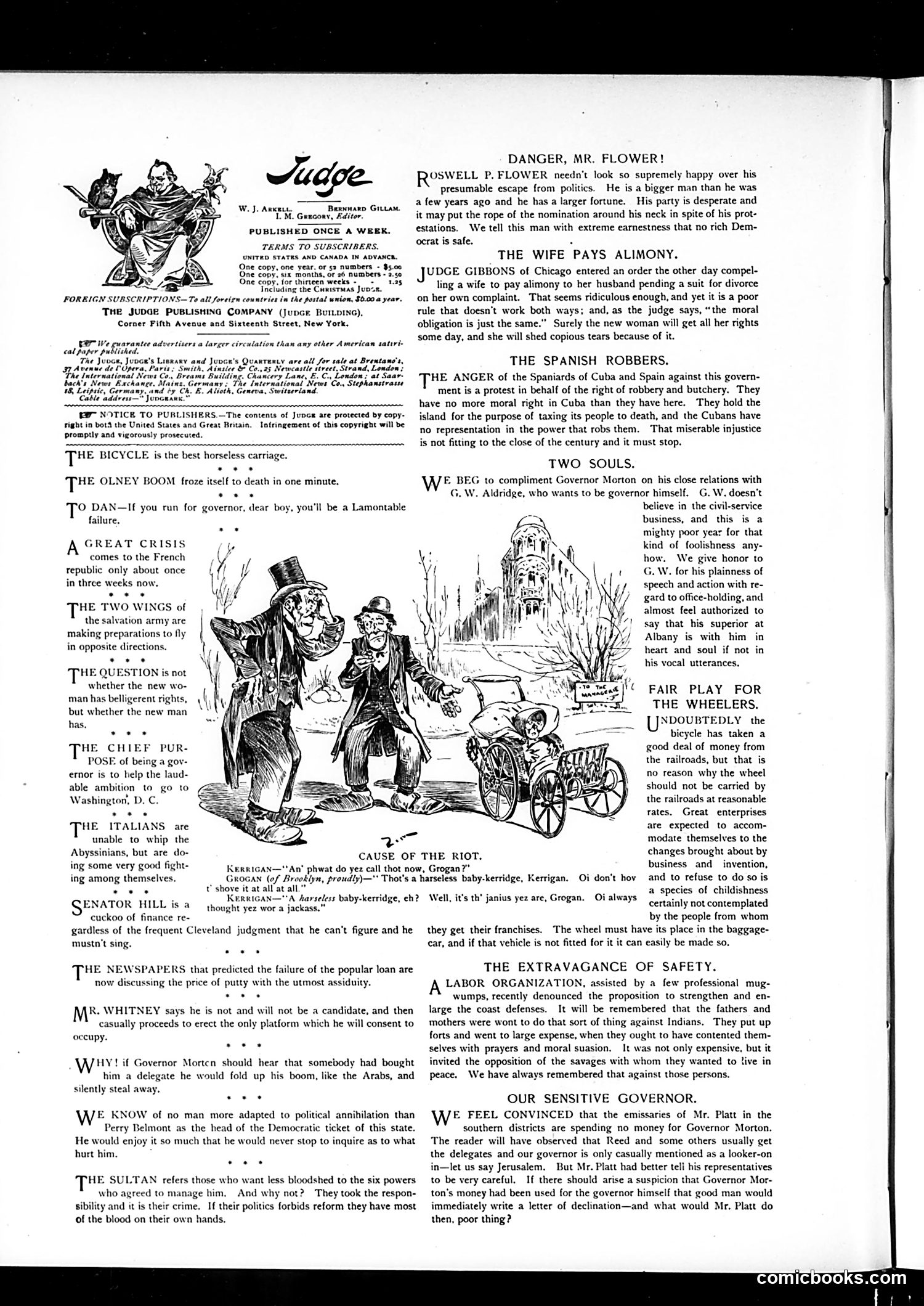
This page from Judge magazine contains brief satirical commentary and one cartoon. Key targets include: **"Danger, Mr. Flower!"** warns Roswell P. Flower (a wealthy New York politician) that despite escaping politics, the desperate Democratic Party may nominate him anyway. The joke: no rich Democrat is safe from party pressure. **"The Wife Pays Alimony"** satirizes Judge Gibbons's Chicago ruling requiring a wife to pay alimony to her husband during their divorce. Judge sarcastically praises this as "fair" to the "new woman," implying it's absurd—she'll eventually win equal rights and then regret it. **The cartoon** shows two Irish immigrants discussing a "horseless baby-carriage" (bicycle), playing on contemporary anxiety about new technology and immigrant bewilderment. Minor items mock French political instability, Italian incompetence, Senator Hill's financial ignorance, and Democratic politician Perry Belmont. The page reflects 1890s concerns: women's rights, technology, immigration, and Democratic Party dysfunction.
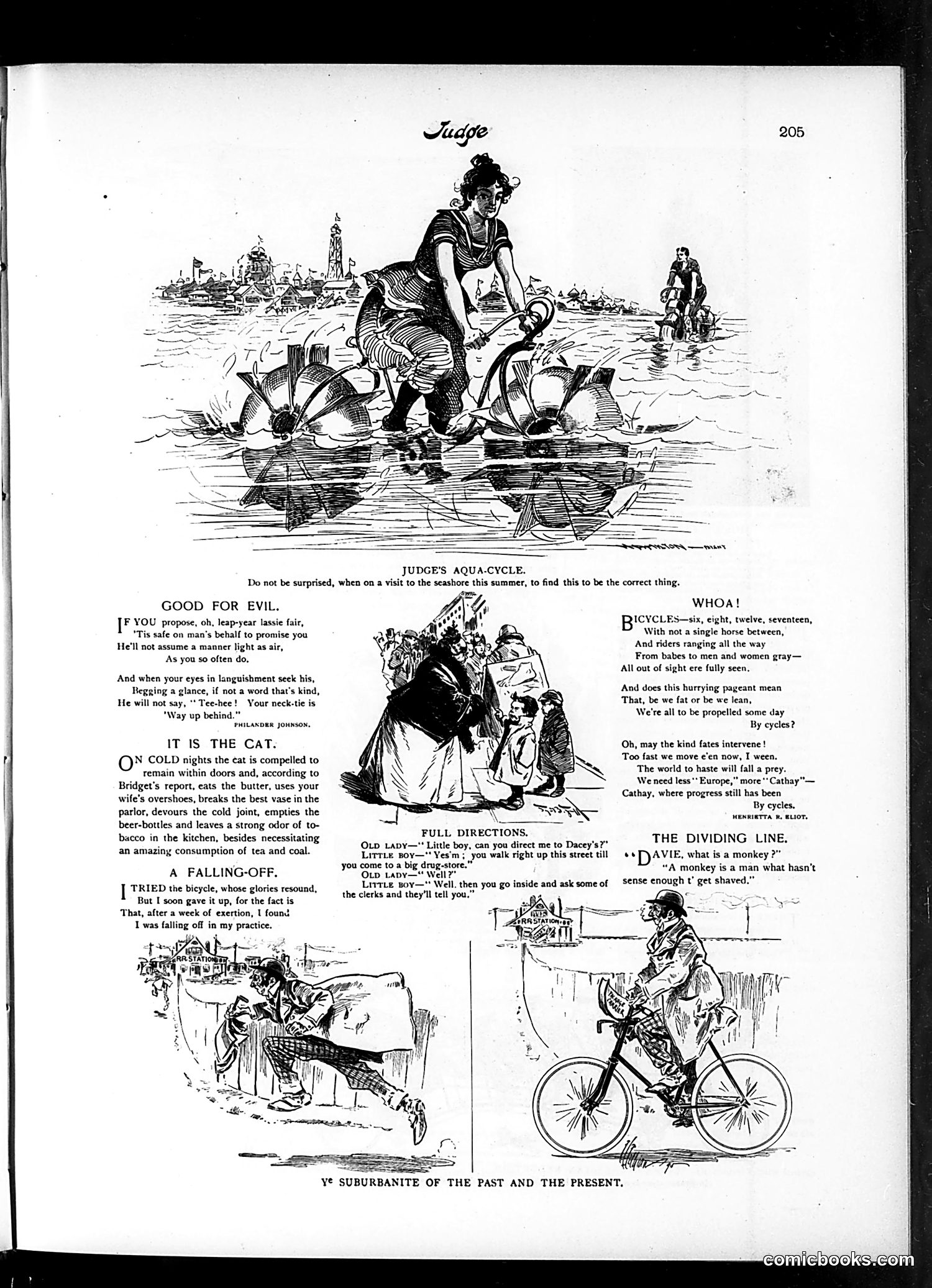
This page satirizes the bicycle craze sweeping America in the 1890s. The top cartoon mocks the ridiculous "aqua-cycle"—a nonsensical contraption supposedly seen at the seashore, poking fun at bicycle mania's absurdity. Multiple pieces lampoon bicycles' social impact: "Whoa!" warns that bicycles are everywhere and moving too fast, threatening society's pace. "The Dividing Line" uses a crude monkey joke to mock the bicycle's association with modernity and "civilization." "A Falling-Off" jokes that cycling practice interferes with other skills. "Full Directions" humorously depicts a child's vague directions, reflecting bicycles' newness to urban navigation. The poetry and prose express anxiety about rapid technological change—bicycles representing unstoppable modernization. The overall tone blends humor with genuine cultural nervousness about how this new technology was reshaping daily life and social norms in the 1890s.
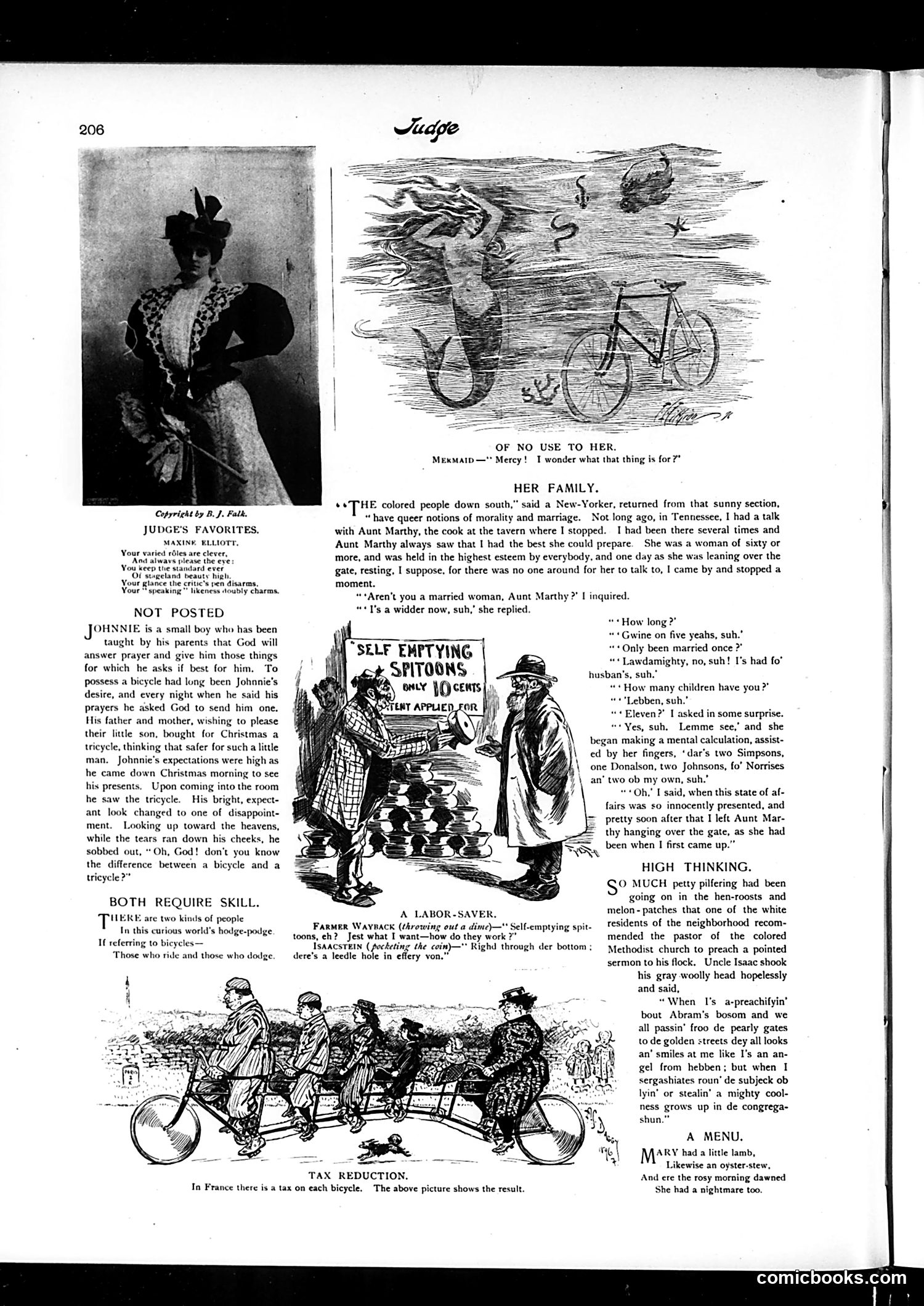
This page contains several satirical pieces reflecting turn-of-the-century American attitudes: **"Not Posted"** mocks childhood prayer and parental disappointment—a boy prays for a bicycle but receives a tricycle, then accuses God of not understanding the difference. **"Both Require Skill"** presents a con artist selling "self-emptying spittoons" to a gullible farmer, claiming they work through holes in the bottom—obvious fraud played for laughs. **"Tax Reduction"** shows the French bicycle tax's result: a multi-seat contraption, satirizing government overreach. **"Her Family"** is a dialect-heavy story featuring stereotypical Southern Black speech patterns, recounting "Aunt Marthy's" multiple marriages and eleven children with different surnames—presented as amusing folk humor reflecting period racial attitudes. **"High Thinking"** similarly uses racial caricature, depicting a Black pastor whose congregants ignore moral sermons about stealing but respond only to ethereal religious imagery—stereotyping Black spirituality. The page reflects Judge's era: crude racial humor, simple cons, and domestic comedy were standard satirical fare.
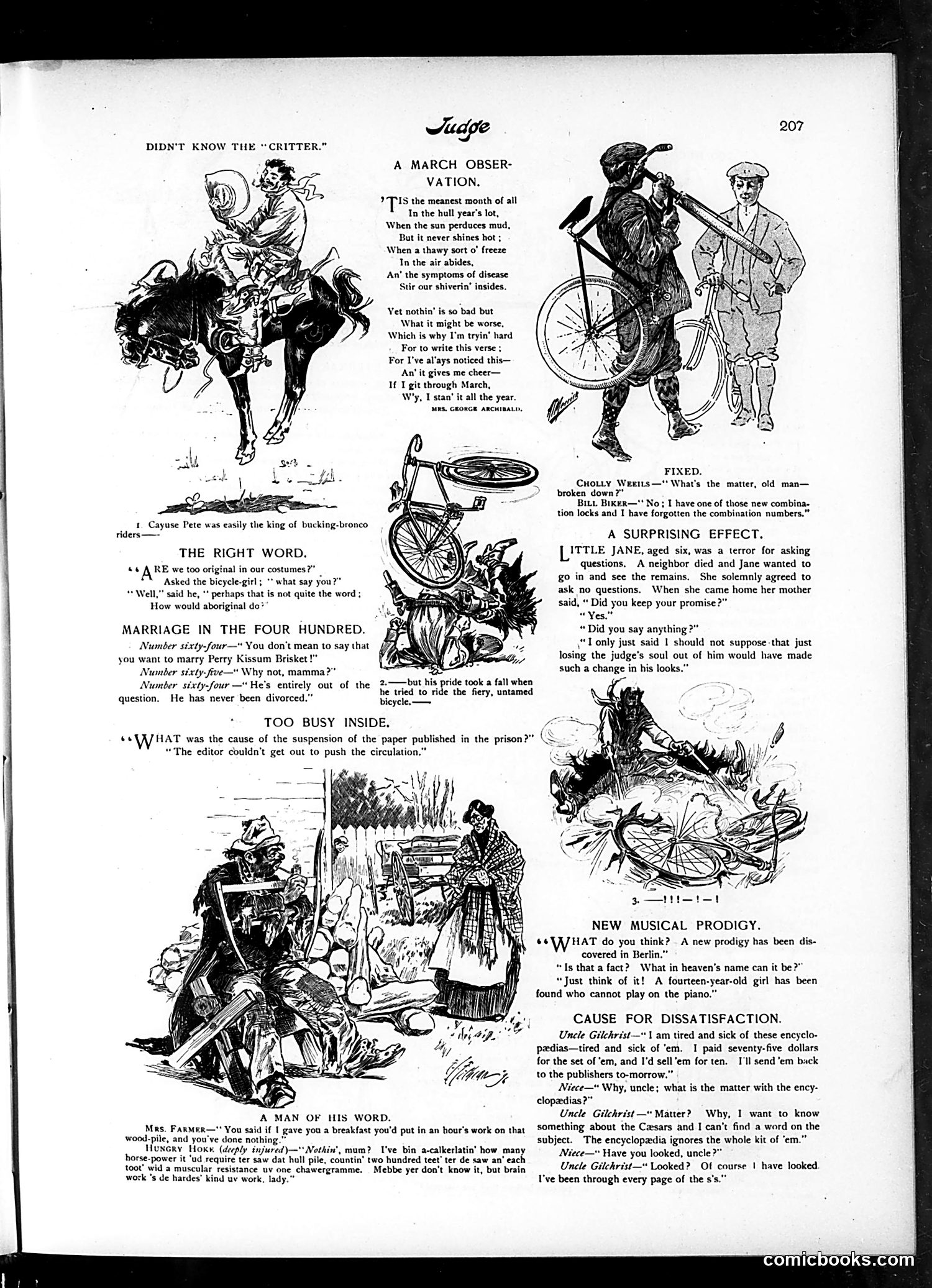
This page contains multiple humorous short pieces typical of Judge's satirical format: **"A March Observation"** presents rustic verse about March's unpleasant weather, using it as a metaphor for endurance through hardship. **"Didn't Know the Critter"** shows a bucking bronco rider, likely mocking frontier/Wild West stereotypes. **Several brief joke items** satirize contemporary social classes and technology: "Fixed" jokes about new combination locks; "Marriage in the Four Hundred" mocks wealthy society's obsession with divorce status as a marker of propriety; "Too Busy Inside" makes a prison editor circulation joke; and "New Musical Prodigy" sarcastically notes a teenage girl who *doesn't* play piano—inverting expectations of child prodigies. **"Cause for Dissatisfaction"** satirizes encyclopedia publishing by showing an uncle frustrated that encyclopedias ignore the Caesars entirely—likely critiquing incomplete or poorly-curated reference works popular in the era. The page reflects turn-of-century American preoccupations with technology, social hierarchy, and consumer goods.
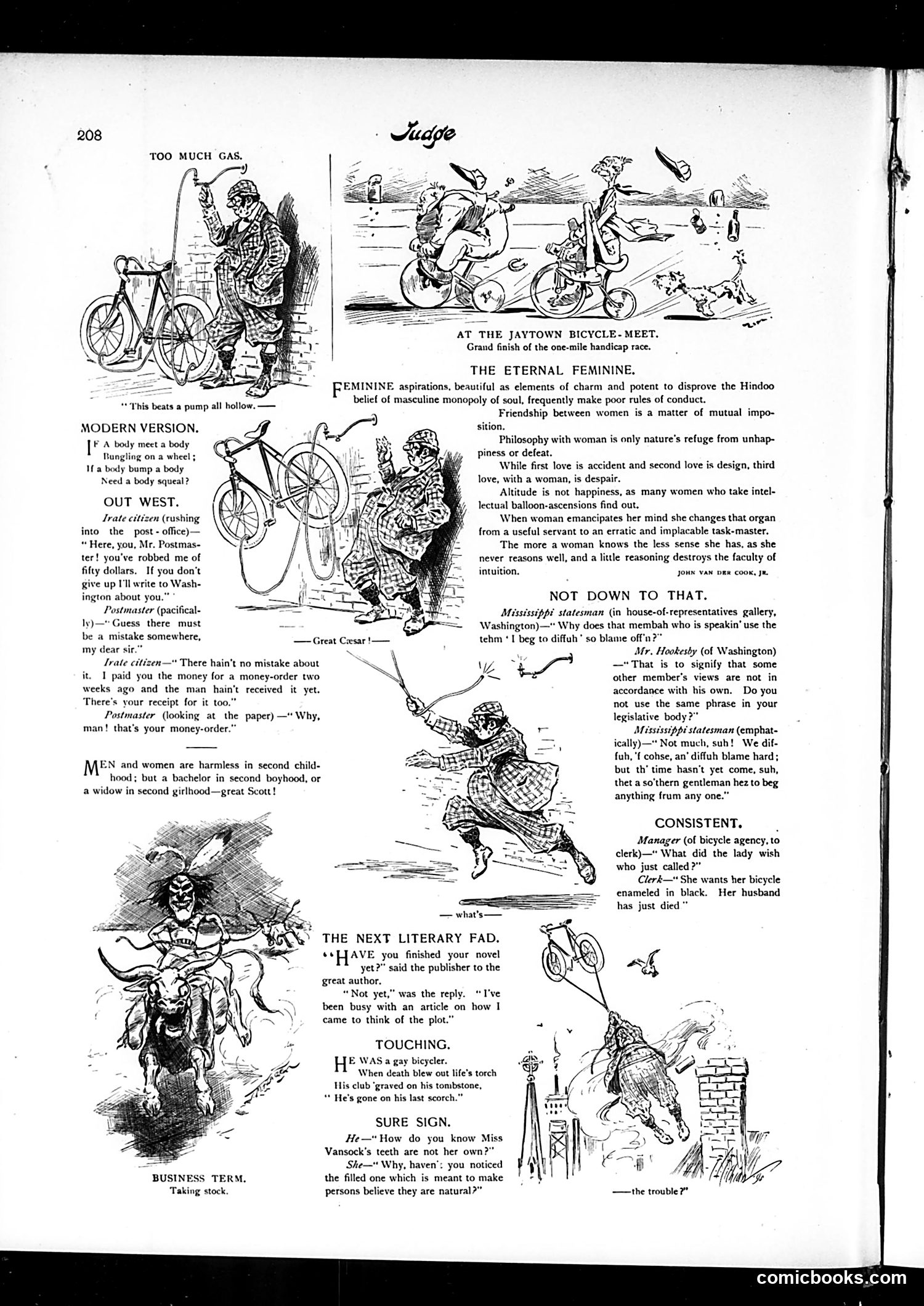
This page from Judge satirizes late-19th/early-20th century American social trends, primarily through bicycle culture humor and misogynistic commentary. **Main cartoons:** - "Too Much Gas" and "Modern Version" mock bicyclists, with "gas" likely referring to affected pretension among cyclists - "At the Jaytown Bicycle-Meet" depicts women competing in a bicycle race, the humor apparently deriving from women engaging in this athletic activity - "The Eternal Feminine" presents a lengthy, bitter screed against women's reasoning, emotion, and ambitions—presenting women's emancipation as destructive to their "natural" intuition **The satire targets:** Women's increasing independence and participation in public life (bicycling symbolized female liberation). The "literary" pieces mock vanity, postal inefficiency, and social pretension. The page reflects period attitudes dismissing women's intellectual capacities while they were gaining freedoms. The humor depends entirely on gender stereotypes now recognized as offensive.
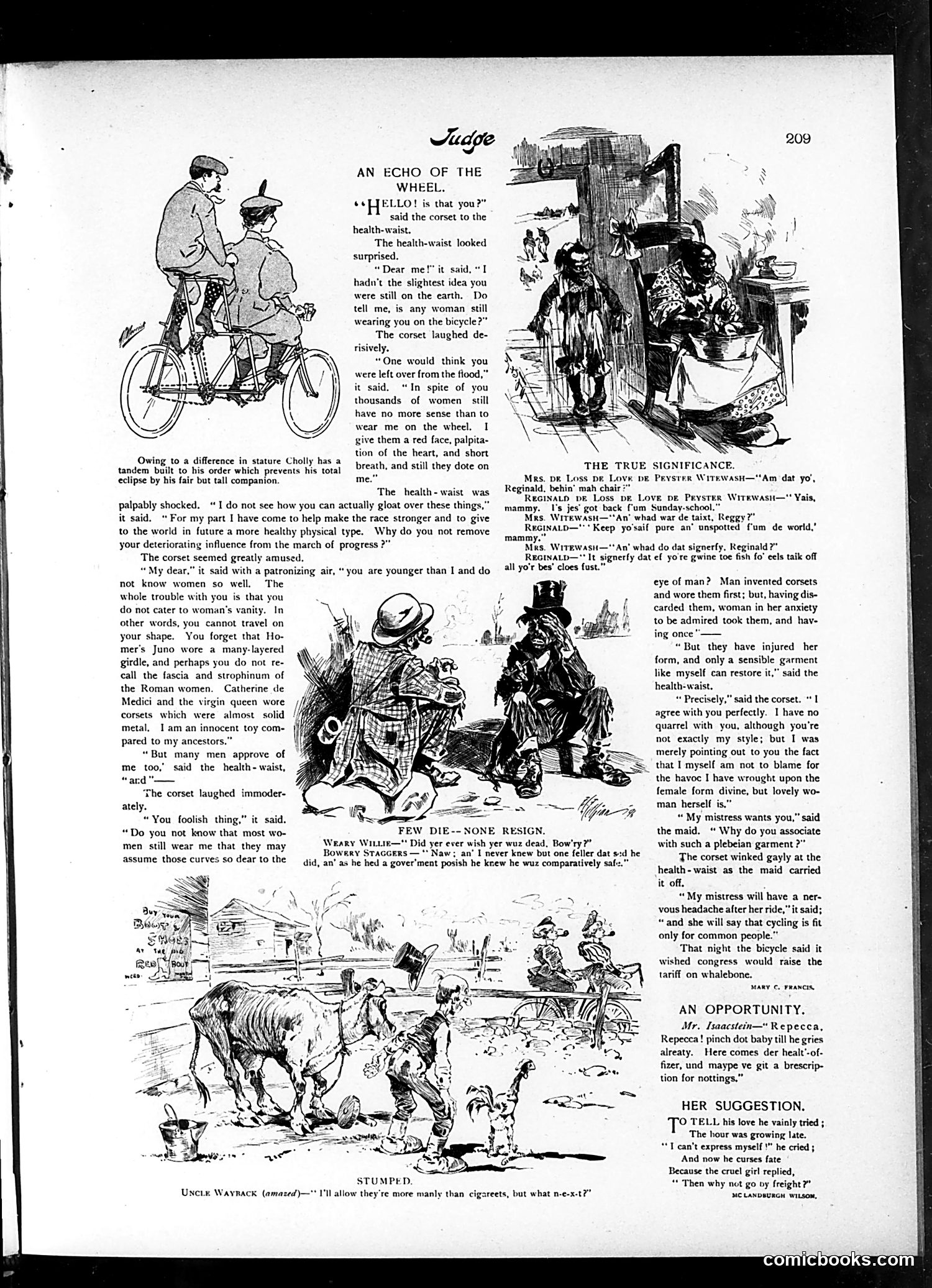
This page satirizes the debate over women's fashion and health during the bicycle craze of the 1890s. The main dialogue presents a personified **corset** and **health-waist** (a looser, reform garment) debating their merits. The **central satire**: The corset—representing tradition and vanity—defends itself by noting women prioritize beauty over health, citing historical precedent (Homer's Juno, Catherine de Medici). The health-waist represents Progressive-era health reformers advocating functional clothing. The corset cynically predicts women will suffer headaches while cycling in corsets, yet continue wearing them for appearance. The cartoon criticizes **women's irrationality** regarding fashion, suggesting they ignore health advice and endure discomfort for vanity. The bicycle serves as backdrop—cycling was controversial for women, requiring reformed dress, yet many resisted change. Supporting comics mock working-class life and racial stereotypes (the "Bowery" and African American dialect pieces appear unrelated). The satire reflects genuine 1890s anxieties about women's liberation through cycling and dress reform, presented from a skeptical, somewhat misogynistic perspective.
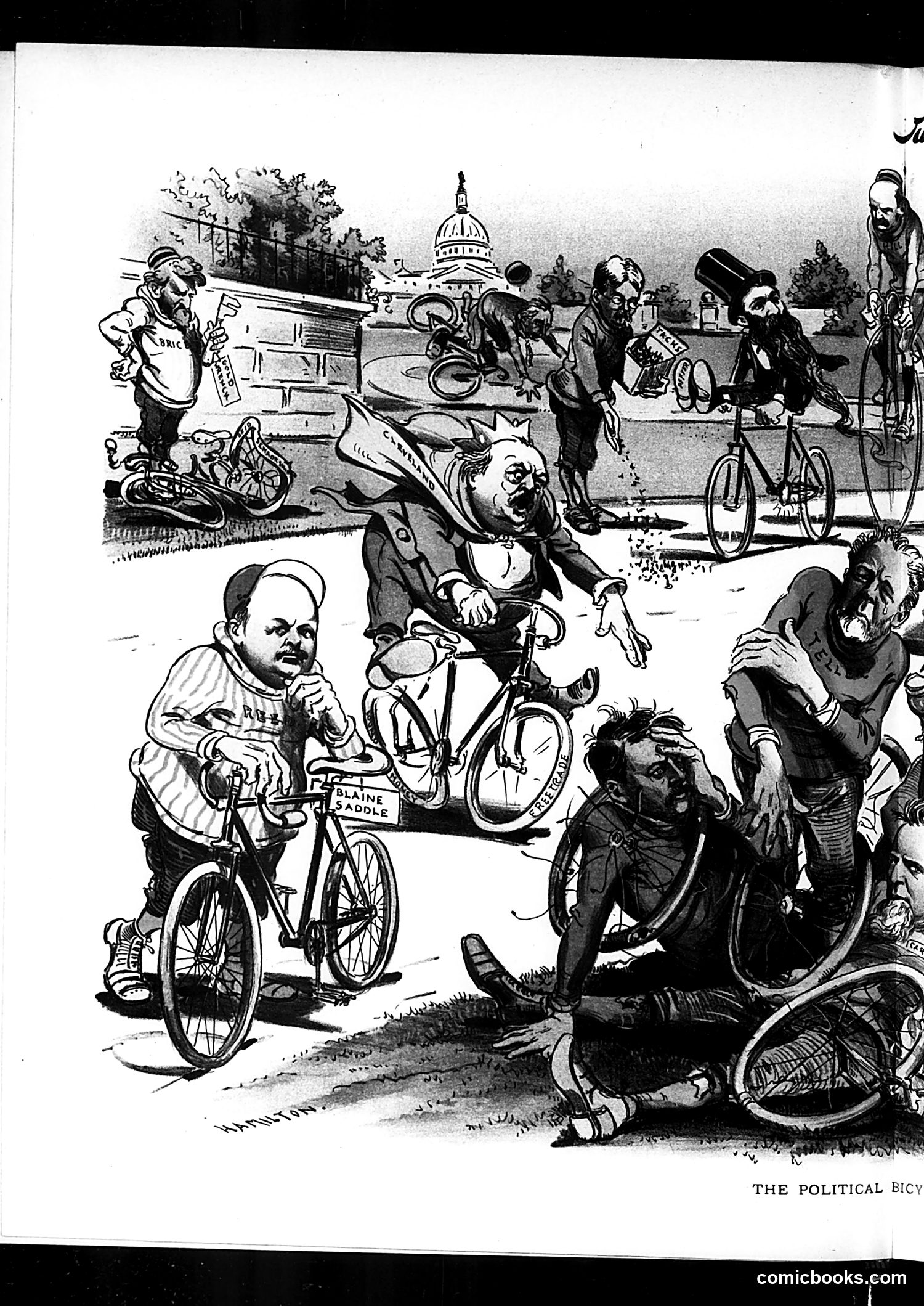
This satirical cartoon depicts political figures as cyclists navigating treacherous terrain near the U.S. Capitol. The title "The Political Bicycle" suggests the instability of political balance and governance. The caricatured figures appear to be prominent politicians of the era, shown struggling to maintain equilibrium on their bicycles. One figure is labeled "Blaine Riddle," likely referencing James G. Blaine, a major political figure. The cartoon satirizes how politicians must carefully balance competing interests and maintain their positions, much like a cyclist must balance to stay upright. The hazardous landscape—with figures falling and struggling—metaphorically represents the precarious nature of political careers and the constant threat of scandal or failure that politicians face. This reflects Judge magazine's tradition of mocking political incompetence and hypocrisy.
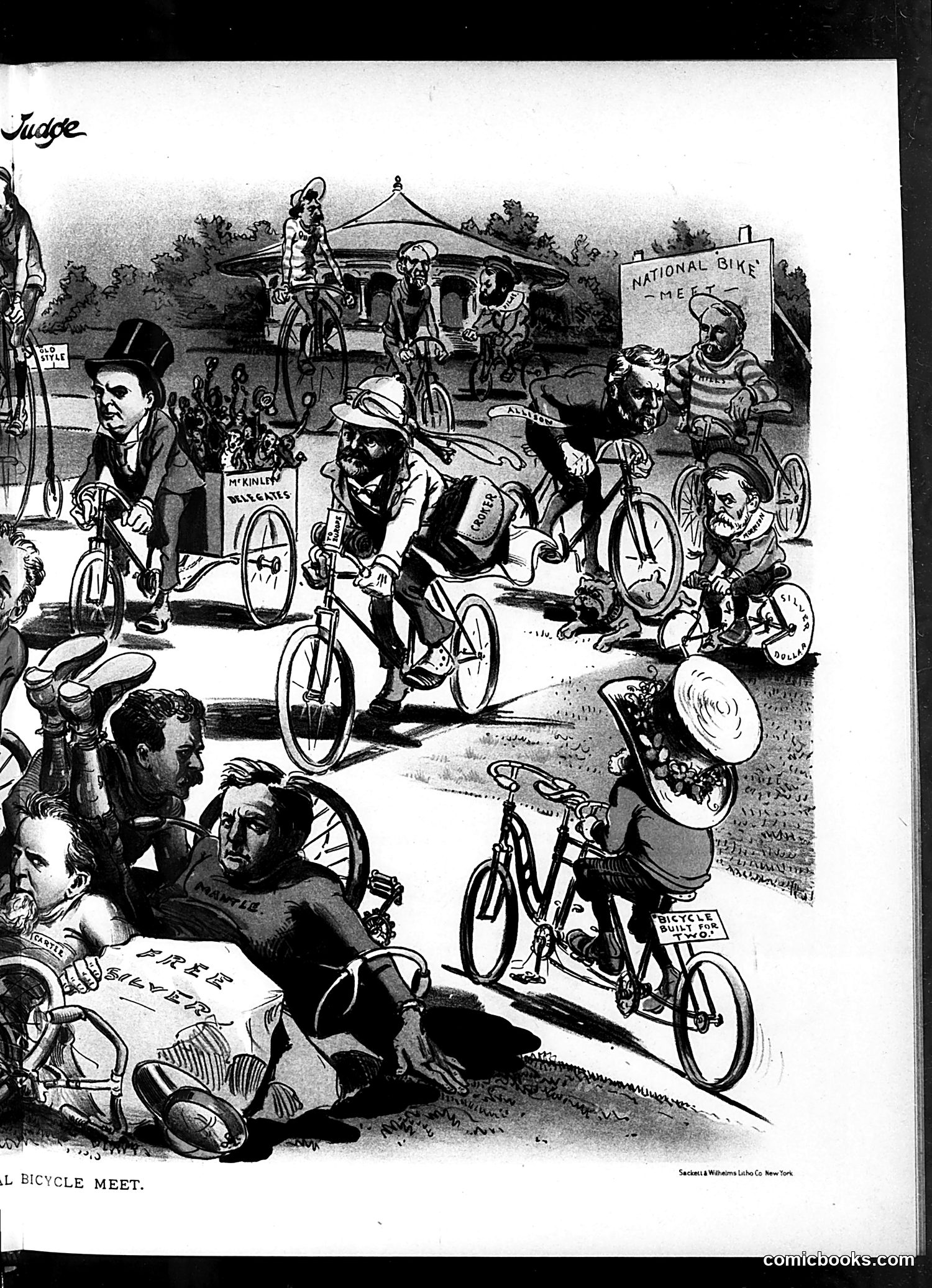
This Judge cartoon satirizes a bicycle meet or racing event. The scene shows numerous cyclists of varying social classes gathered around a bandstand in what appears to be a park setting. The "National Bike Meet" sign is visible on the right. The satire likely mocks the bicycle craze that swept America in the 1890s, when cycling became a popular pastime across social classes. The caricatured figures—including what appear to be working-class riders, well-dressed gentlemen in top hats, and various character types—suggest Judge is poking fun at how bicycles attracted an oddly diverse crowd of enthusiasts, mixing social strata in unexpected ways. The specific political or social commentary remains unclear without additional context about the publication date or contemporary events.
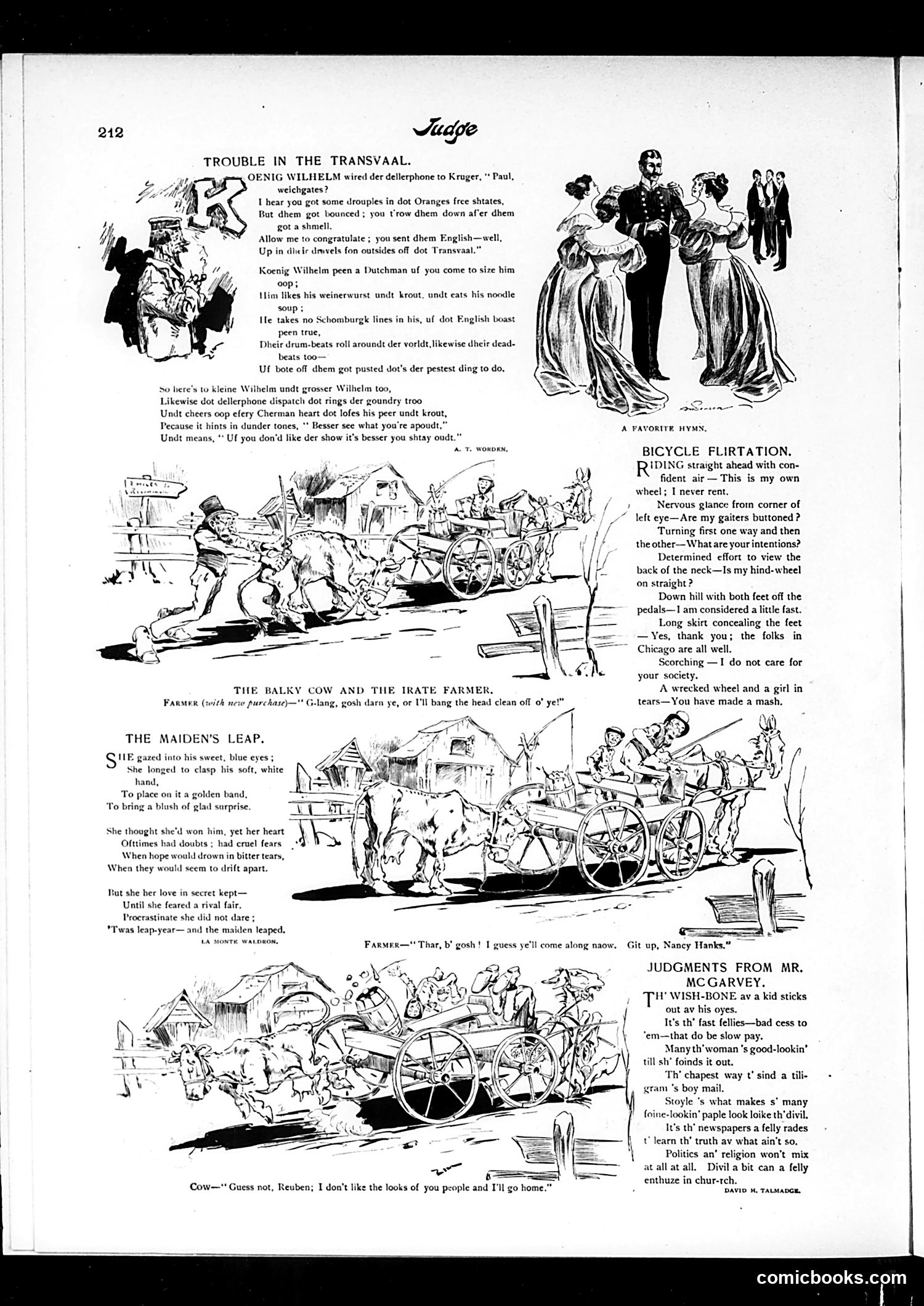
This page satirizes the Boer War (1899-1902) between Britain and the Dutch republics in South Africa. The main cartoon depicts Kaiser Wilhelm II telephoning Paul Kruger, the Boer leader, offering congratulations on fighting the English. Both are portrayed with exaggerated German accents and speech patterns—a common Judge magazine technique for mockery. The satire's point: Wilhelm presents himself as sympathetic to the Boers' anti-British struggle, suggesting German-Boer solidarity. However, the cartoon implies this is mere posturing—Wilhelm celebrates conflict that damages British power without German risk or cost. The crude German-accented dialogue emphasizes Wilhelm as a bluffing, self-interested opportunist rather than a genuine ally. The page also includes lighter humor: "Bicycle Flirtation" satirizes women cyclists' dating anxieties, and "The Maiden's Leap" references leap-year traditions when women could propose marriage.
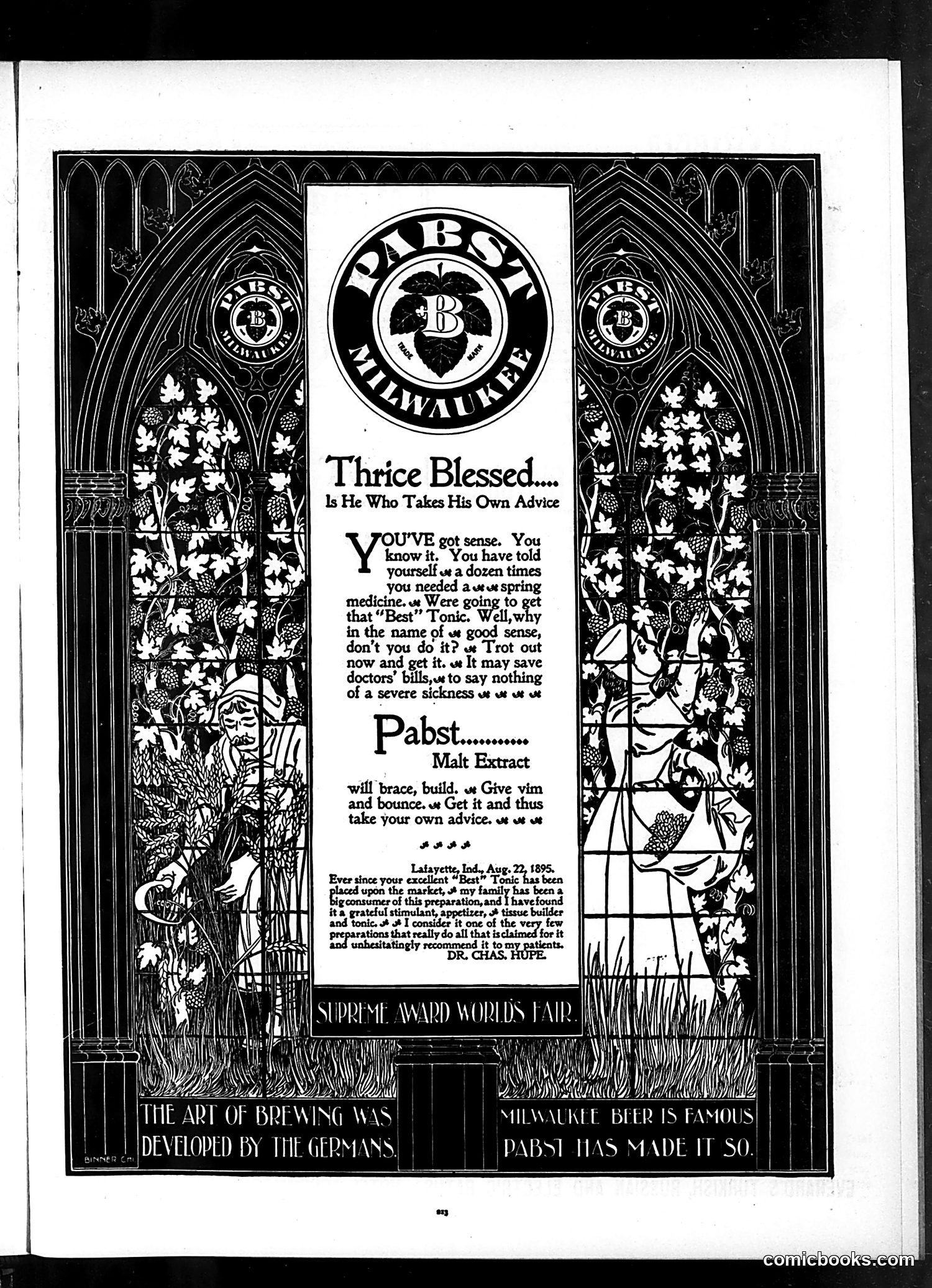
This is a full-page **advertisement**, not a political cartoon. The "Supreme Award World's Fair" branding and ornate Art Nouveau design frame a pitch for Pabst Malt Extract. The satirical angle: The headline "Thrice Blessed is He Who Takes His Own Advice" mocks people who ignore their own good judgment. The ad then pressures readers to take that advice by purchasing Pabst's product—a self-help tonic claiming to prevent illness and avoid doctor's bills. The testimonial from "Dr. Chas. Hupe" (likely fictitious) adds false credibility. The bottom text emphasizes Milwaukee's brewing heritage, positioning Pabst as legitimate German-developed medicine. This reflects late-19th-century patent medicine marketing: vague health claims, pseudo-scientific endorsements, and appeals to self-reliance. Such products were largely unregulated before the 1906 Pure Food and Drug Act.
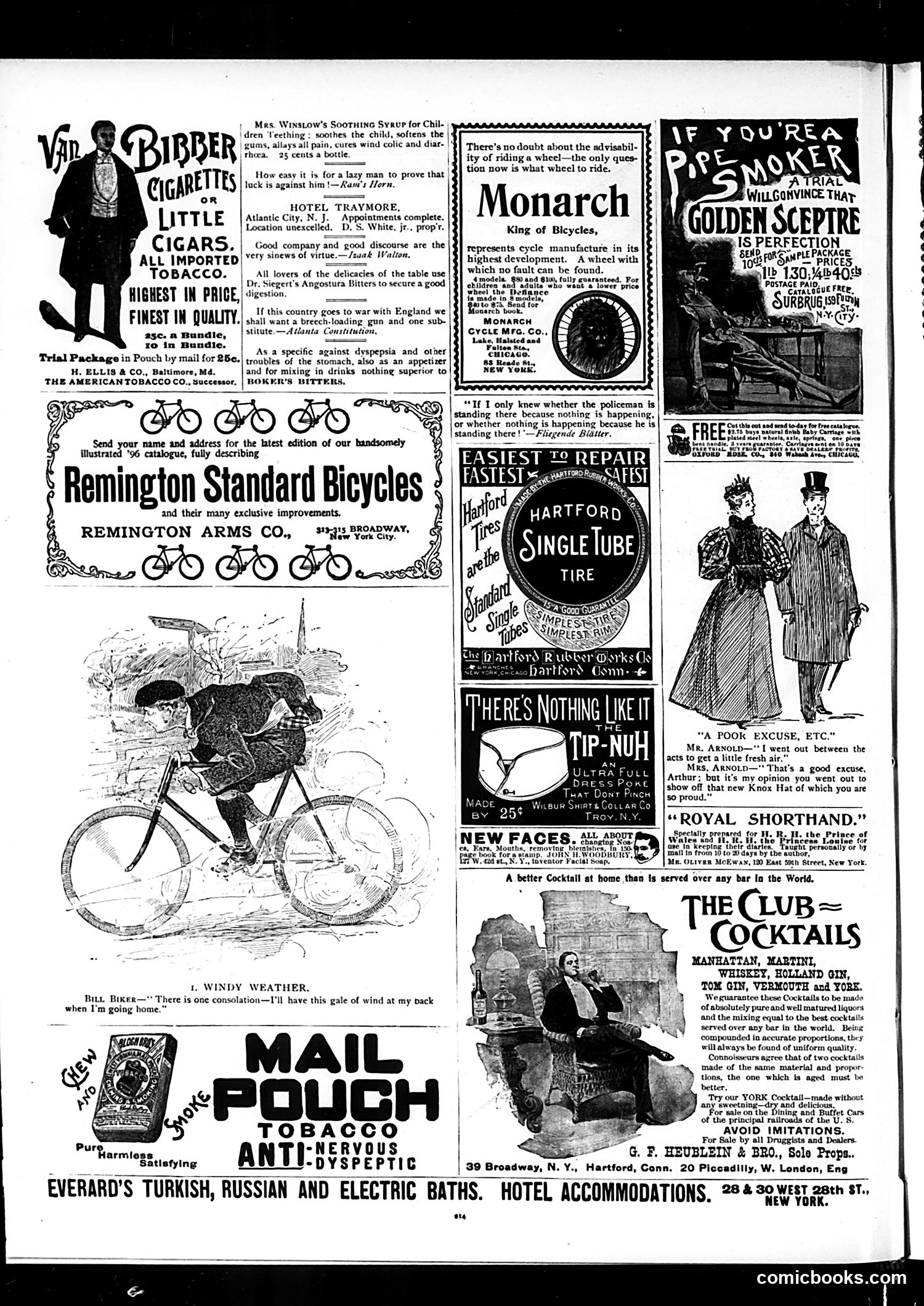
This page is primarily **advertising**, with minimal editorial cartoon content. The advertisements promote late-19th-century consumer goods: bicycles (Remington, Monarch), tobacco products, patent medicines (Mrs. Winslow's Soothing Syrup, Boker's Bitters), tires, and cocktail mixers. The few brief satirical items are short quips rather than developed cartoons: - A joke about lazy men blaming luck - A policeman observation (unclear reference) - "Windy Weather" featuring "Bill Biker" cycling home - Two domestic comedy scenarios about excuses and hat-wearing The one substantial illustration shows a cyclist in wind, but lacks political or social commentary—it's merely humorous commentary on everyday life. **This page demonstrates Judge's mixed format**: advertising revenue subsidized satirical content, so pages often contained far more commercial material than editorial commentary.
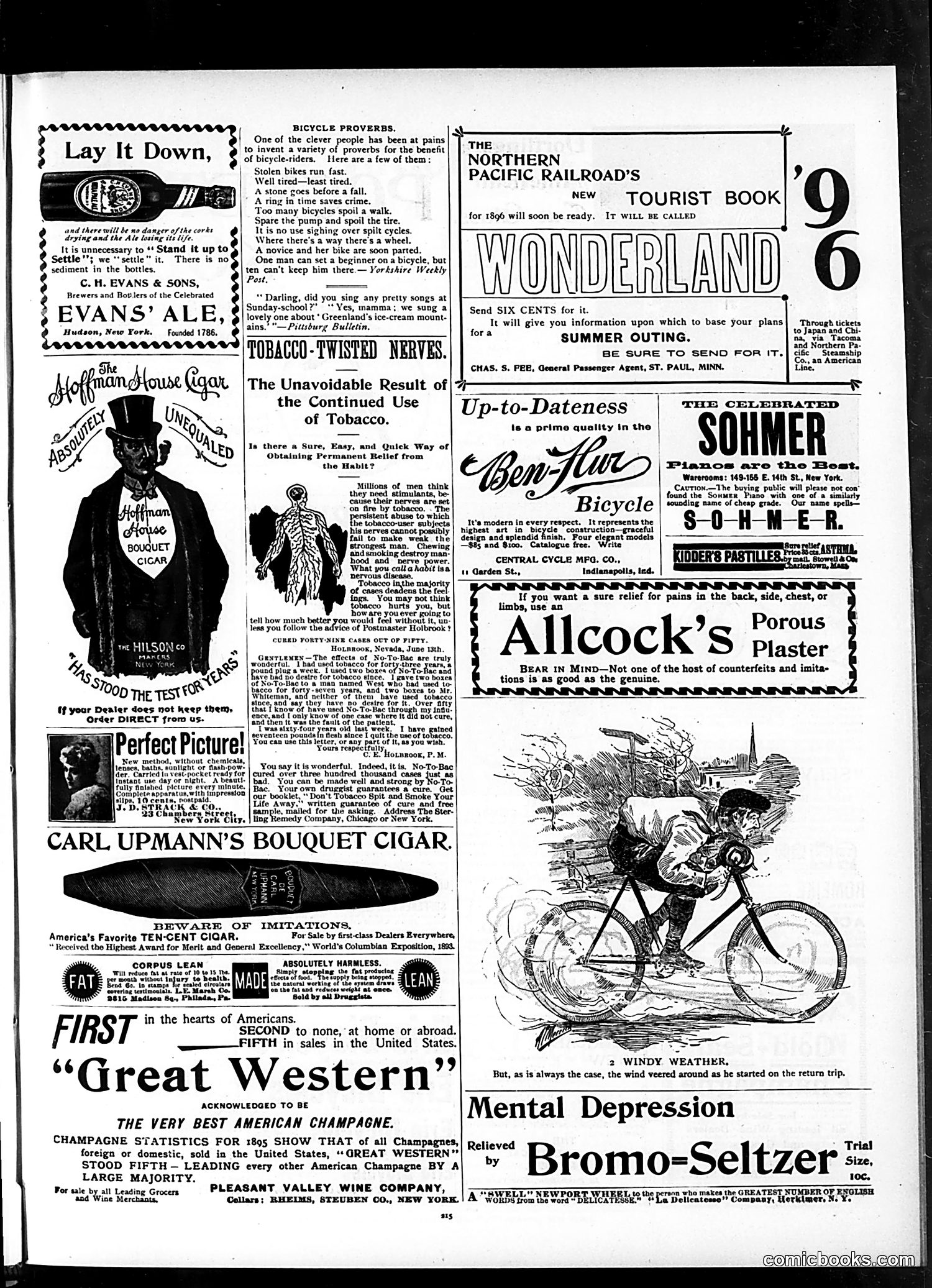
This is primarily a **advertisements page** from Judge magazine (circa 1896), with one notable satirical feature. The main content is product ads: Evans' Ale, Hoffman House cigars, tobacco cessation product "No-To-Bac," Carl Upmann cigars, "Great Western" champagne, and Sohmer pianos. These reflect late-Victorian consumer culture. The **only satirical element** is "Bicycle Proverbs"—a humorous list parodying traditional proverbs but rewritten for bicycle riders: "A stone goes before a fall," "A novice and her bike are soon parted." This jokes about the cycling craze sweeping America in the 1890s, poking fun at both bicycle theft and novice riders' mishaps. The right page features Northern Pacific Railroad's tourist guide advertisement and a sketch of a cyclist in windy weather with caption "WINDY WEATHER"—continuing the bicycle theme. The tobacco addiction testimonials are presented earnestly as medical relief advertising, reflecting pre-regulation attitudes toward patent medicines and addiction treatments.
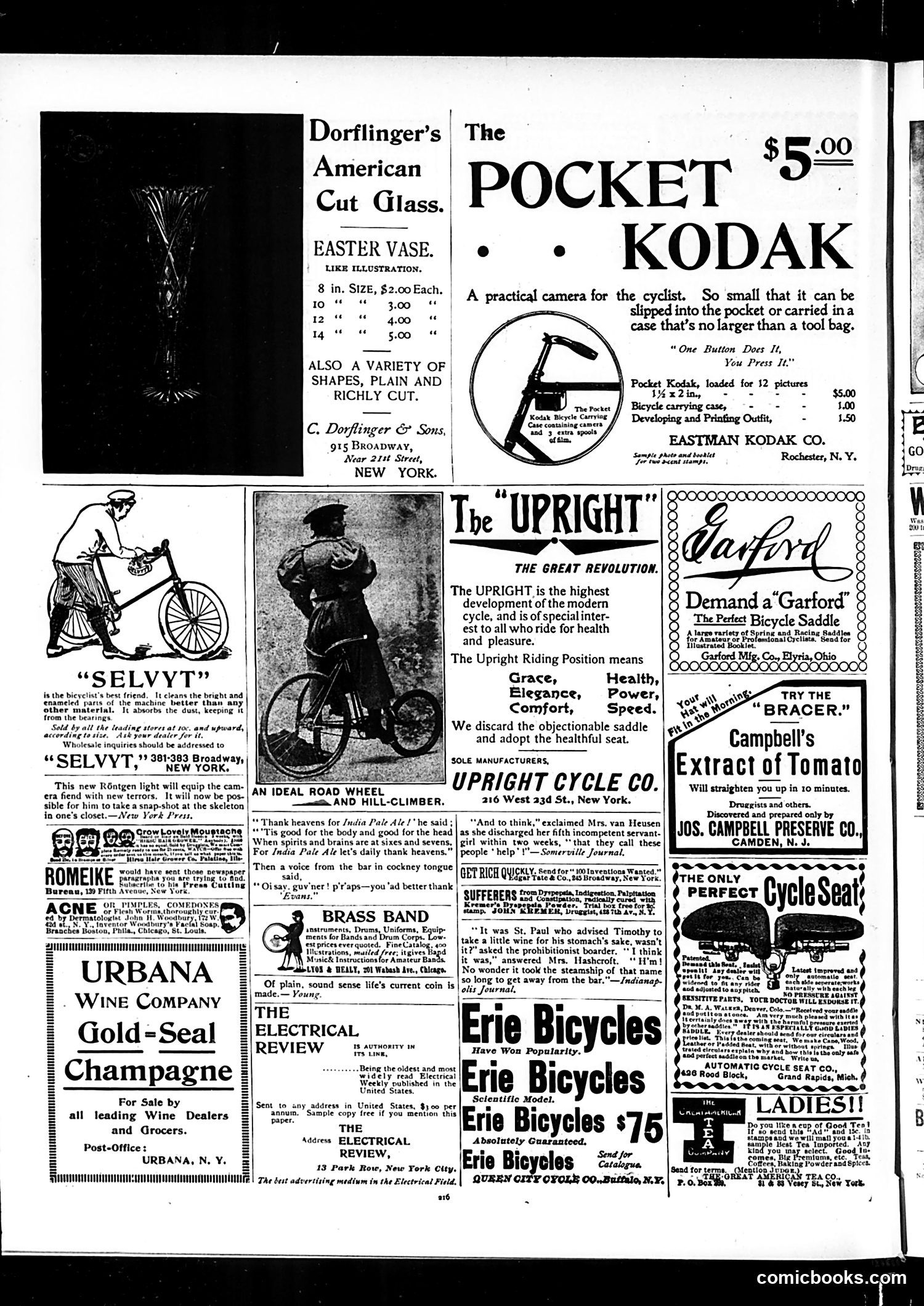
This page is **primarily advertising** with scattered jokes typical of Judge's satirical style. The advertisements showcase late 1890s consumer products: Dorflinger cut glass, the innovative Pocket Kodak camera (marketed as portable for cyclists), the "Selvyt" bicycle cleaning cloth, and various bicycle models and saddles. These reflect the cycling craze of the era. The scattered jokes mock contemporary social situations and emerging technology: - One quip references the new X-ray technology, joking it will let photographers capture skeletons "in one's closet"—a literal take on the idiom about hidden secrets - Another satirizes servant employment troubles (a common upper-class complaint) - A third plays on biblical temperance debates, contrasting St. Paul's advice about wine with working-class cockney dialect The overall tone captures Judge's humor: wordplay, visual puns, and gentle mockery of modern conveniences, fashionable concerns, and class anxieties of the 1890s. There are no political cartoons or caricatures of named figures visible on this page.
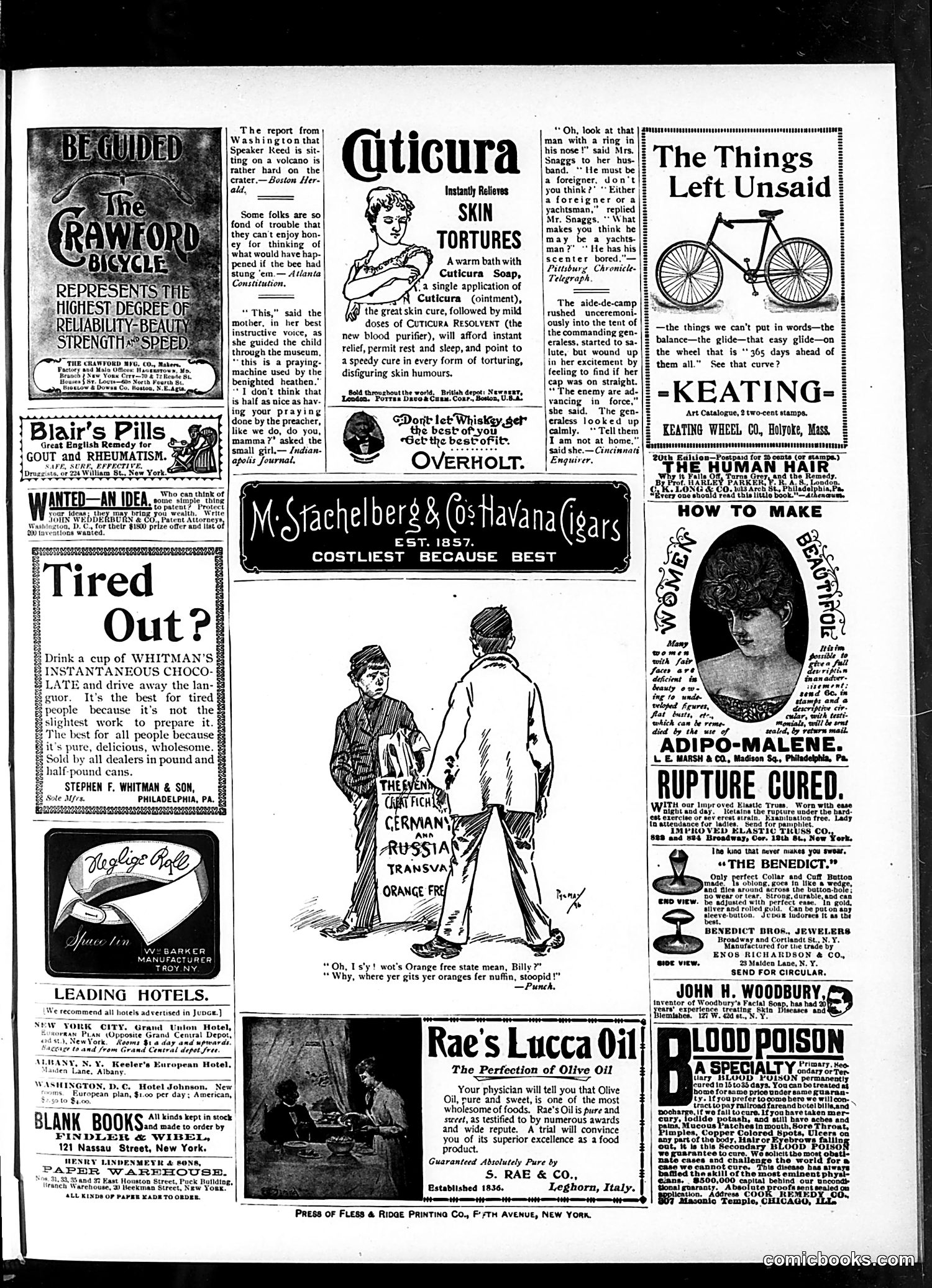
This appears to be primarily an **advertising page** from *Judge*, a late-19th-century American satirical magazine. The page contains scattered political jokes in quotation boxes alongside numerous patent medicine and consumer product advertisements. The one **political reference** is the opening item mentioning **Speaker Reed** sitting "on a volcano"—referring to Thomas Brackett Reed, the powerful Speaker of the House during this era, known for aggressive parliamentary tactics. The joke suggests political instability around him. **Most of the content is commercial advertising**: Cuticura skin treatments, Blair's Pills for gout, Whitman's chocolate, Keating bicycles, and various dubious "remedies" like Adipo-Malene (for hair/appearance) and treatments for rupture and "blood poison." The scattered jokes are generic humor not tied to specific political events—observations about human nature, misunderstandings, and domestic situations. The **Punch cartoon** at bottom attempts a joke about "Orange Free State" (a historical South African territory) being a place to get free oranges, relying on pun-based humor typical of the era.
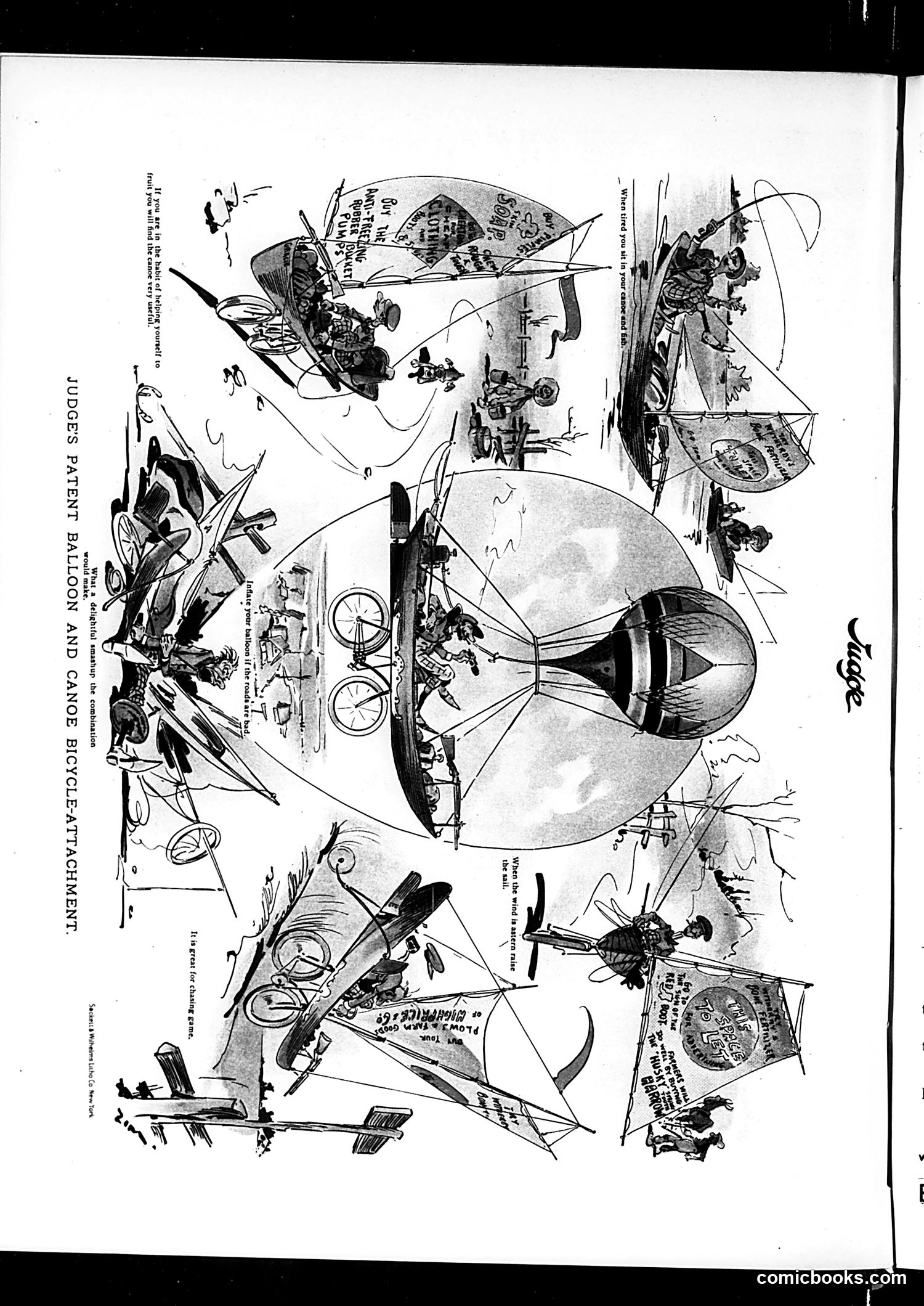
This is a satirical invention drawing mocking impractical contraptions. The central image shows an absurd bicycle hybrid combining a large balloon, canoe, and various mechanical parts—clearly designed to be ridiculous rather than functional. The surrounding vignettes illustrate this "patent" in supposed action: users attempting to navigate using this unwieldy contraption, resulting in comical disasters and collisions. The humor derives from the Victorian era's fascination with mechanical innovation and patent culture, which Judge magazine frequently lampooned. This type of satirical "patent drawing" was a common Judge format—mocking both the proliferation of dubious inventions being patented and the absurdity of trying to solve everyday problems through overly complex mechanical solutions. The joke targets both inventors' overambition and readers' familiarity with useless patent schemes of the period.
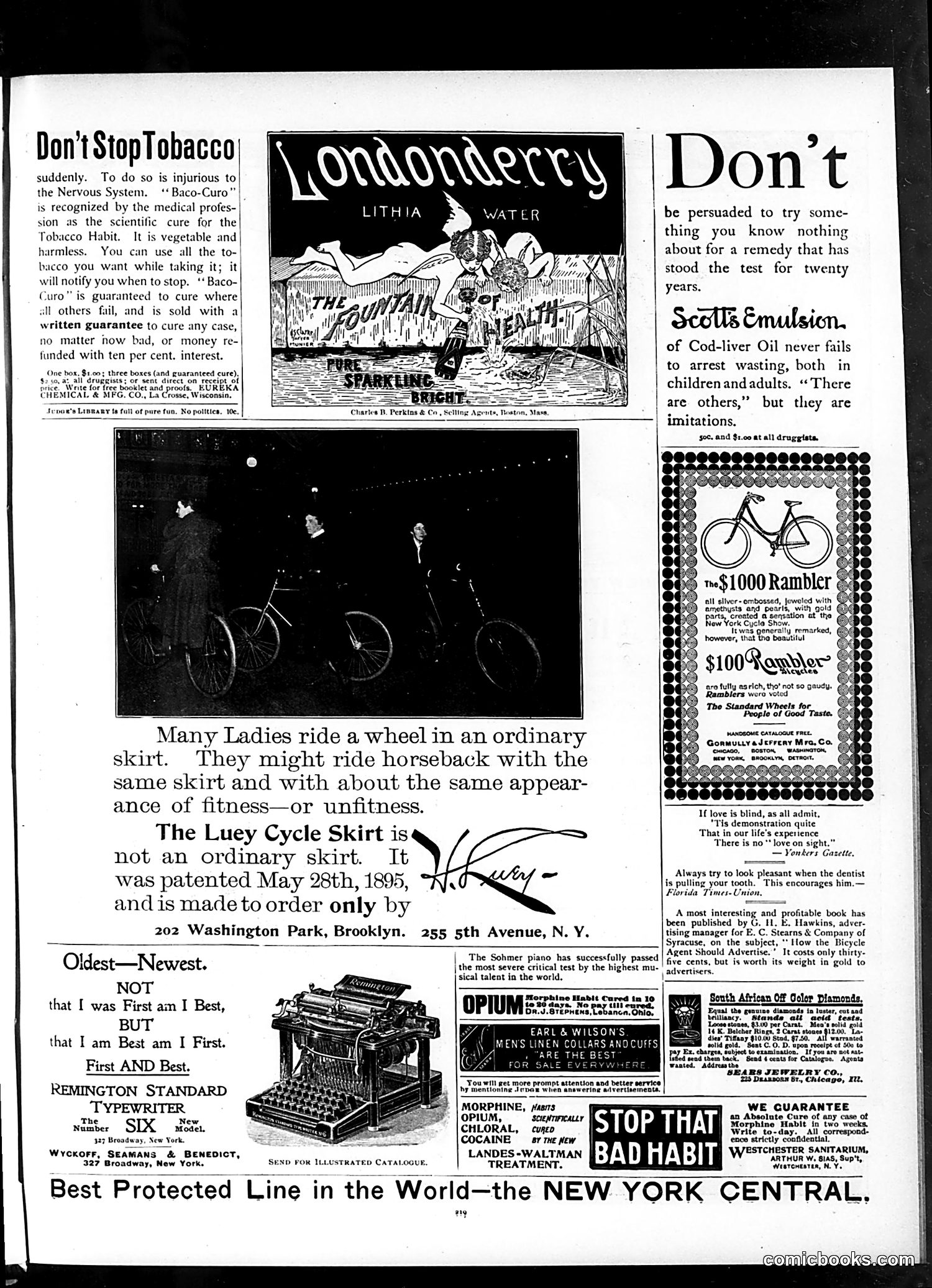
This page is primarily **advertisements with minimal satire or editorial content**—typical of Judge's mixed advertising-content model. Notable ads include: **Products advertised:** - "Baco-Curo" tobacco cessation (claiming medical endorsement) - Londonderry Lithia Water (patent medicine) - Scott's Emulsion (cod-liver oil supplement) - Lucy Cycle Skirt (women's bicycle clothing, patented 1895) - Remington typewriters - Bicycles (Rambler brand) - Piano sales - Drug-addiction treatments (morphine, opium, cocaine) **Historical context for modern readers:** This page reflects turn-of-the-century American anxieties and commercial practices. Patent medicines making dubious medical claims were standard advertising before FDA regulation. The prominence of drug-addiction treatment ads suggests widespread addiction problems. The bicycle-skirt advertisement addresses Victorian-era debates over women's clothing appropriateness during the cycling boom. Overall, the page documents pre-regulatory-era marketing practices now considered misleading or fraudulent.
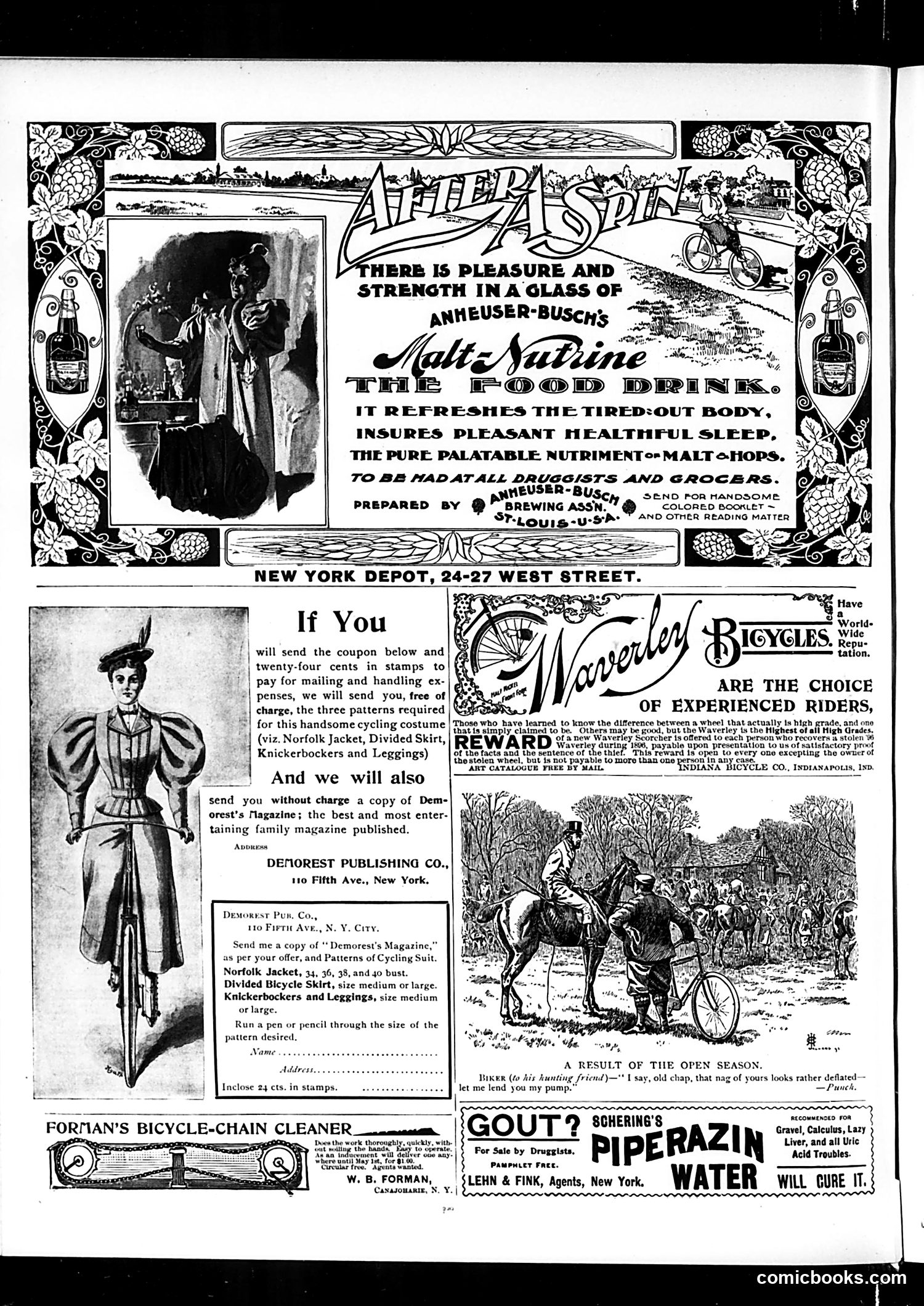
This page is primarily **advertising**, typical of late 19th-century publications. The major content includes: **Malt-Nutrine Advertisement** (top): Anheuser-Busch promotes their malt drink as a health tonic, claiming it refreshes tired bodies and ensures "pleasant healthful sleep"—reflecting the era's marketing of alcohol as medicinal. **Demorest's Magazine Offer**: Free cycling costume patterns (Norfolk jacket, divided skirt, knickerbockers) to encourage women's bicycle participation, a significant social development of the 1890s. **Waverley Bicycles Advertisement**: Emphasizes quality and offers a reward for recovering stolen bikes—indicating bicycle theft was a common problem. **Small Cartoon** ("Result of the Open Season"): A hunting-related joke showing a deflated horse, punning on bicycle pump imagery. **Patent Medicine Ads**: Forman's Bicycle-Chain Cleaner and Schering's Piperazin Water promote dubious health remedies typical of the period. The page reflects 1890s consumer culture, the bicycle craze, and unregulated patent medicine marketing.
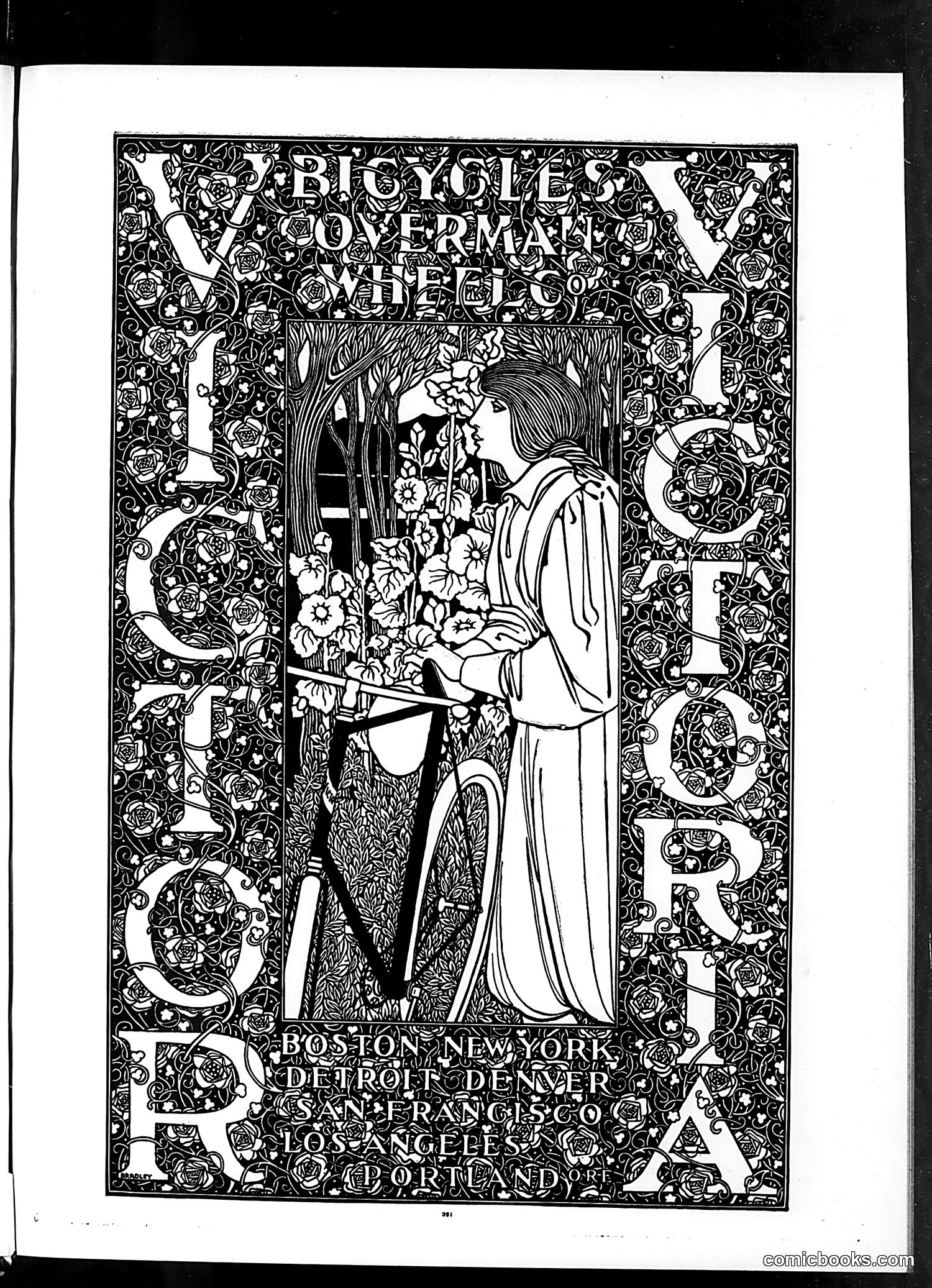
This appears to be a **title page or cover** for *Judge* magazine rather than a satirical cartoon. The image shows an Art Nouveau–styled illustration of a figure in flowing robes holding flowers, surrounded by an ornate border of roses and decorative lettering. The text lists distribution cities: Boston, New York, Detroit, Denver, San Francisco, Los Angeles, and Portland—indicating *Judge*'s national reach during this period. The OCR text "comichooks.com" appears to be a modern watermark, not original content. Without a date, specific caption, or clearer satirical elements, the exact political/social commentary remains unclear. The aesthetic suggests early-to-mid 20th century Art Nouveau styling typical of *Judge*'s design philosophy, but the page's primary function appears **decorative and promotional** rather than satirical.
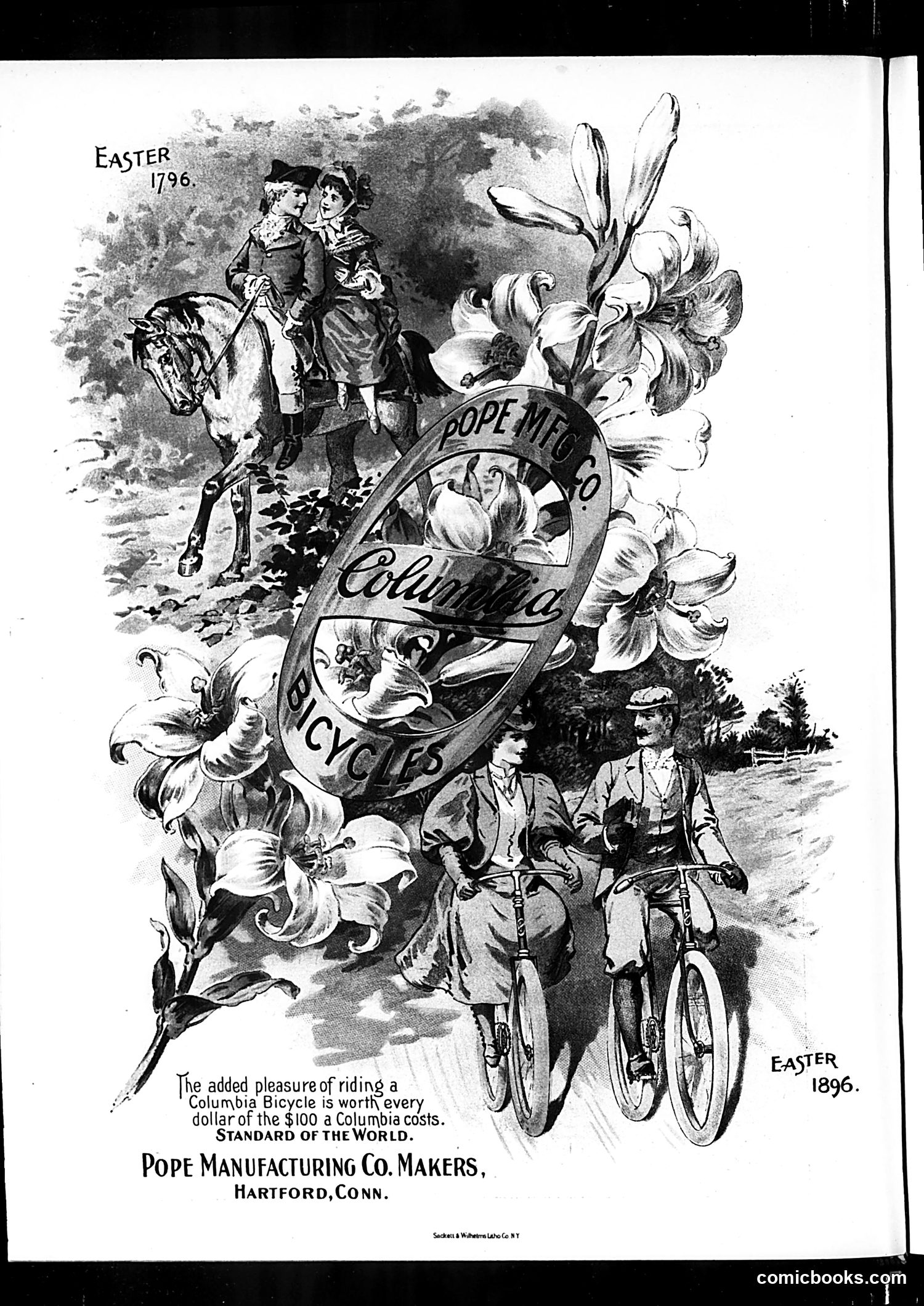
This is primarily an **advertisement** for Columbia bicycles by Pope Manufacturing Co., not a political cartoon. The page dates to Easter 1896 and uses decorative imagery rather than satire. The composition shows two scenes: upper figures on horseback (suggesting traditional/old-fashioned travel) and lower figures riding bicycles (modern transportation). Large lilies frame the design, evoking Easter themes of renewal and springtime. The advertising message claims that despite Columbia's $100 price tag (expensive for 1896), the "added pleasure" of riding one justifies the cost. The "Standard of the World" slogan emphasizes quality and prestige. This reflects the 1890s bicycle craze, when bicycles represented modernity, freedom, and social progress—particularly for women gaining mobility and independence. The elegant aesthetic targets affluent consumers.