
Judge, 1896-03-28 · page 8 of 24
Judge — March 28, 1896 — page 8: what you’re looking at
What you’re looking at
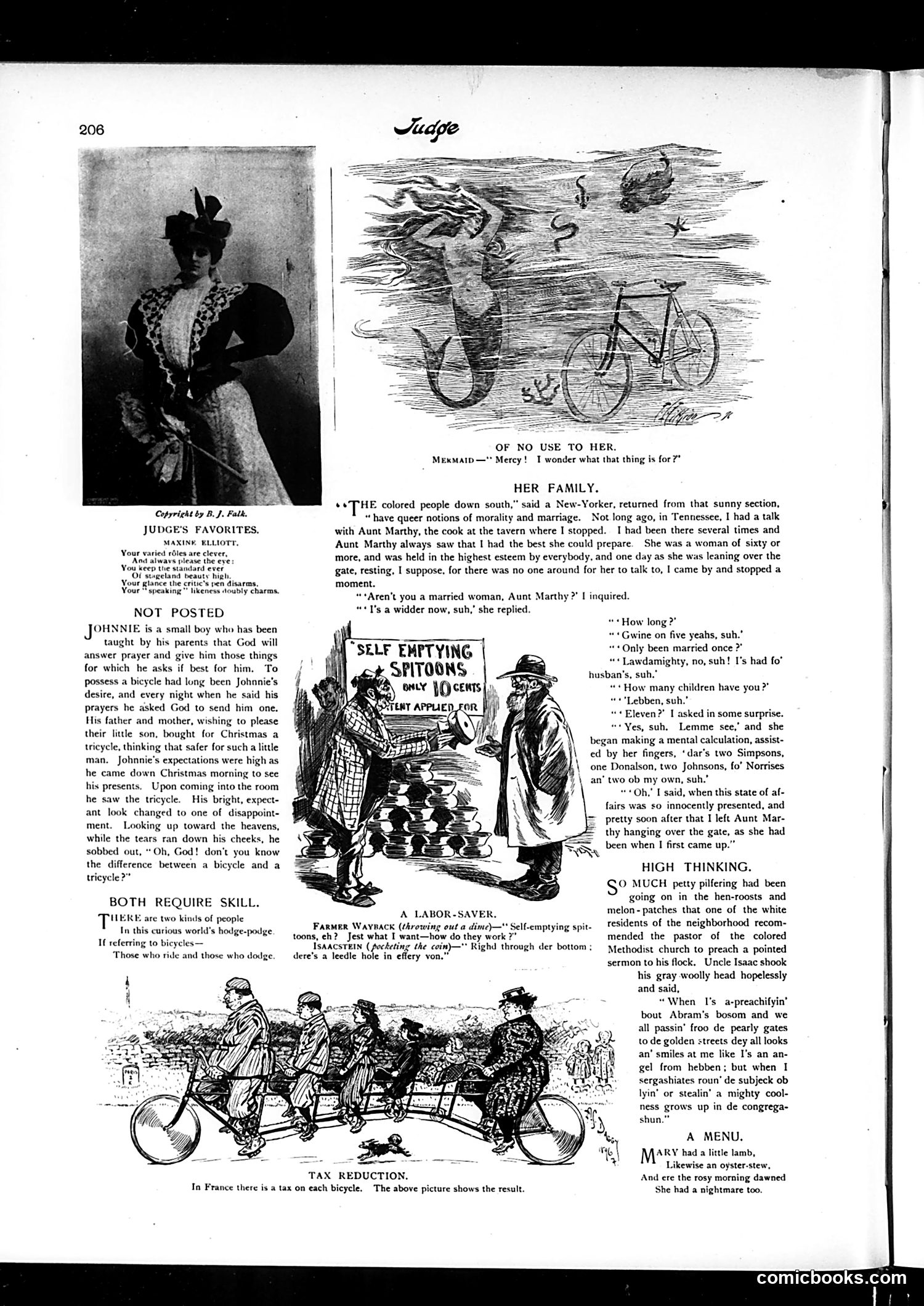
This page contains several satirical pieces reflecting turn-of-the-century American attitudes: **"Not Posted"** mocks childhood prayer and parental disappointment—a boy prays for a bicycle but receives a tricycle, then accuses God of not understanding the difference. **"Both Require Skill"** presents a con artist selling "self-emptying spittoons" to a gullible farmer, claiming they work through holes in the bottom—obvious fraud played for laughs. **"Tax Reduction"** shows the French bicycle tax's result: a multi-seat contraption, satirizing government overreach. **"Her Family"** is a dialect-heavy story featuring stereotypical Southern Black speech patterns, recounting "Aunt Marthy's" multiple marriages and eleven children with different surnames—presented as amusing folk humor reflecting period racial attitudes. **"High Thinking"** similarly uses racial caricature, depicting a Black pastor whose congregants ignore moral sermons about stealing but respond only to ethereal religious imagery—stereotyping Black spirituality. The page reflects Judge's era: crude racial humor, simple cons, and domestic comedy were standard satirical fare.
📄 Transcribed text from this page (OCR, searchable)
Machine-transcribed from the original scan — historical spelling and the odd misread are preserved.
206 Copyright by B. J. Falk. ‘S$ FAVORITES, MAXIN® ELLIOTT, Your varied rdles are clever, ‘And alwavs please the eye: You keep the standard ever Of stageland beauty high. Your glance the critic's pen disarms, Your “speaking” likeness doubly charms. NOT POSTED JOHNNIE is a small boy who has been taught by his parents that God will answer prayer and give him those things for which he asks if best for him. To possess a bicycle had long been Johnnie's desire, and every night when he said his prayers he asked God to send him one. His father and mother, wishing to please their little son, bought for Christmas a tricycle, thinking that safer for such a little man. Johnnie's expectations were high as he came down Christmas morning to see his presents. Upon coming into the room he saw the tricycle. His bright, expect- ant look changed to one of disappoint ment. Looking up toward the heavens, while the tears ran down his cheeks, he sobbed out, “Oh, God! don’t you know the difference between a bicycle and a tricycle?" BOTH REQUIRE SKILL. T! TERE In this curious world's hodge-pouge If referring to bi Those who r re two kinds of people cles— and those who dodge. Farmer WAYBACK (throwing out a dime)—"* Self-emptying spit- toons, eh? Jest what I want—how do they work ?” IsaacstB1n ( pocketing the coin)—" Righd through der bottom ; dere’s a leedle hole in effery von.” TAX REDUCTION. In France there is a tax on each bicycle. The above picture shows the result. OF NO USE TO HER. MexMatp—"* Mercy! T wonder what that thing is for?" HER FAMILY. SS TTHE colored people down south,” said a New-Yorker, returned from that sunny section, “have queer notions of morality and marriage. Not long ago, in Tennessee, I had a talk with Aunt Marthy, the cook at the tavern where I stopped. I had been there several times and Aunt Marthy always saw that I had the best she could prepare. She was a woman of sixty or more, and was held in the highest esteem by everybody, and one day as she was leaning over the gate, resting, I suppose, for there was no one around for her to talk to, I came by and stopped a moment. ‘Aren't you a married woman, Aunt Marthy ?" I inquired. I's a widder now, suh,’ she replied. ** How long?" ine on five yeahs, sub.” Only been married once ?" awdamighty, no, suh! I’s had fo" ah? *How many children have you?" “**Lebben, suh.’ "Eleven?" I asked in some surprise. “*Yes, suh, Lemme see,’ and she began making a mental calculation, assist- ed by her fingers, ‘dar’s two Simpsons, one Donalson, two Johnsons, fo’ Norrises an’ two ob my own, sub.’ “*Oh.' I said, when this state of af- fairs was so innocently presented, and pretty soon after that I left Aunt Mar- thy hanging over the gate, as she had been when I first came up.” HIGH THINKING. SO MUCH petty pitfering had been going on in the hen-roosts and melon- patches that one of the white residents of the neighborhood recom- mended the pastor of the colored Methodist church to preach a pointed sermon to his flock. Uncle Isaac shook his gray woolly head hopelessly and said, “When I's a-preachifyin’ bout Abram’s bosom and we all passin’ froo de pearly gates to de golden streets dey all looks an’ smiles at me like I's an an- gel from hebben ; but when I sergashiates roun’ de subjeck ob lyin’ or stealin’ a mighty cool- hess grows up in de congrega- shun.” “SELF EMPTYING ce SPITOONS husban's, A LABOR-SAVER. A MENU, Ma 8¥ bad a litte lamb, Likewise an oyster-stew, And ere the rosy morning dawned She had a nightmare too. comicbooks.com