
A complete issue · 60 pages · 1894
Judge — December 8, 1894
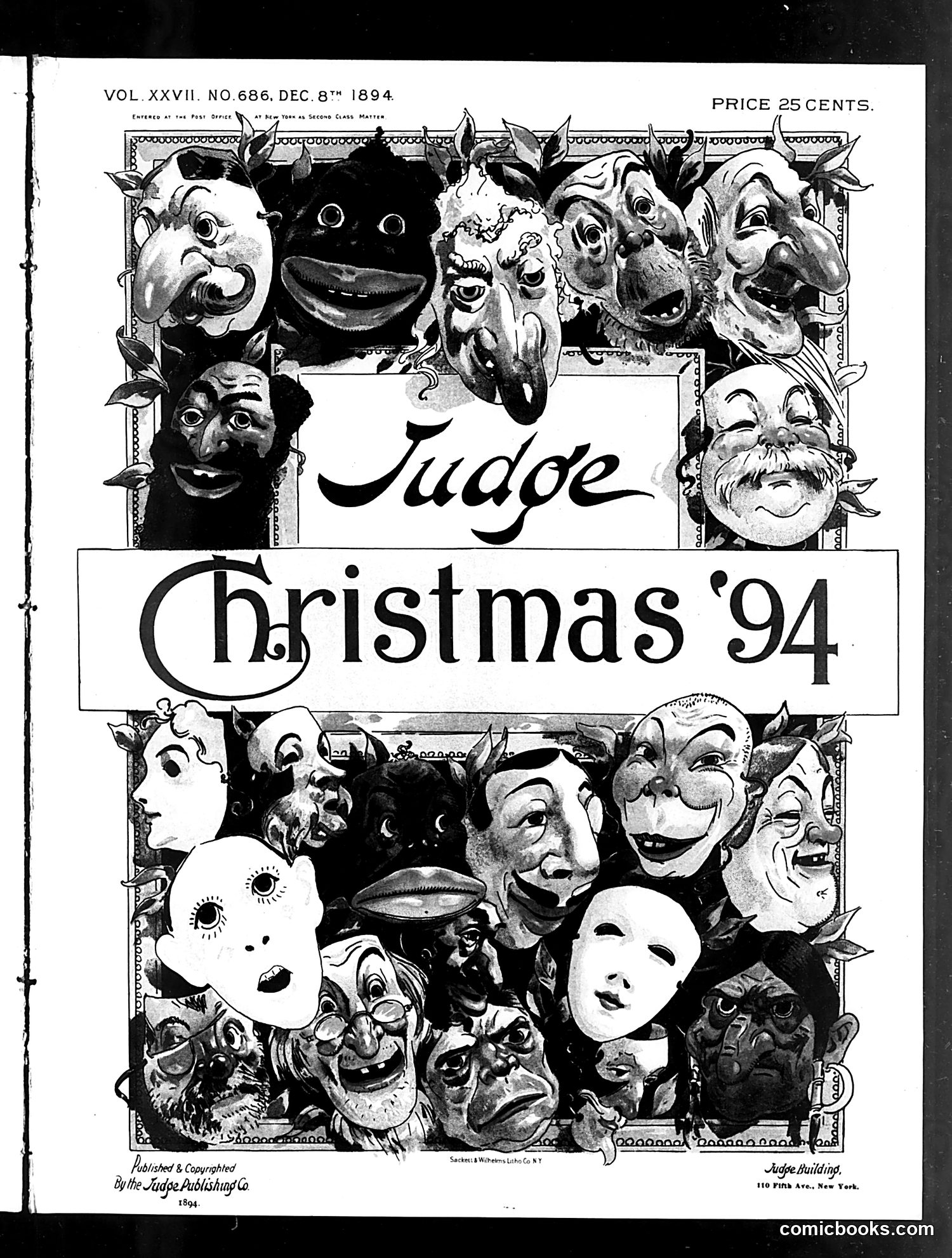
This is the cover of Judge magazine's Christmas 1894 issue. The page features theatrical masks and grotesque character heads arranged decoratively around the title "Christmas '94." The imagery appears to reference **theatrical entertainment and masquerade**—popular Christmas entertainments of the 1890s. The exaggerated facial expressions and variety of mask styles (comedic, tragic, fantastical) suggest satire of theatrical performance and holiday spectacle. The prominent black face in the upper center likely reflects the prevalence of **blackface minstrelsy** in 1890s entertainment, which Judge frequently satirized. The elaborate decorative border of masks suggests commentary on artifice, performance, and social pretense during the holiday season. Without additional context text, the specific political targets remain unclear, though the emphasis on theatrical masks suggests satire of performance and artificiality in contemporary society.
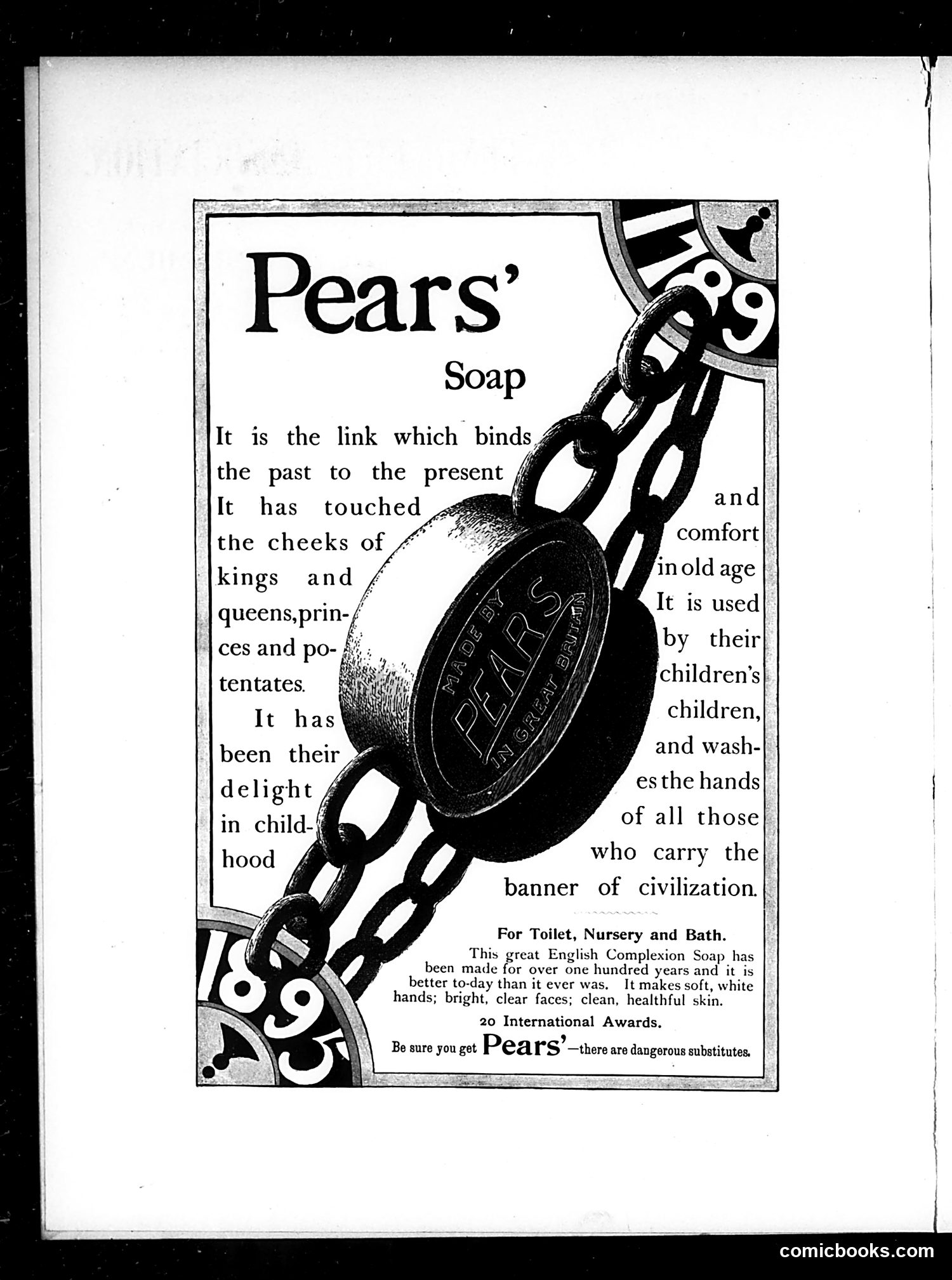
This is a **product advertisement**, not political satire. The page features Pears' Soap, a real English brand still sold today, using elaborate marketing language to promote its soap as a luxury product with historical prestige. The ad employs grandiose rhetoric, claiming the soap has "touched the cheeks of kings and queens" and carries symbolic weight as "the link which binds the past to the present" and "the banner of civilization." This hyperbolic language is typical of early 20th-century advertising—presenting everyday consumer goods as markers of refinement and social status. The ornamental chain imagery and heraldic design elements reinforce themes of tradition and aristocratic approval. The ad concludes with a competitive jab: "Be sure you get Pears'—there are dangerous substitutes," suggesting competing brands were common concerns.
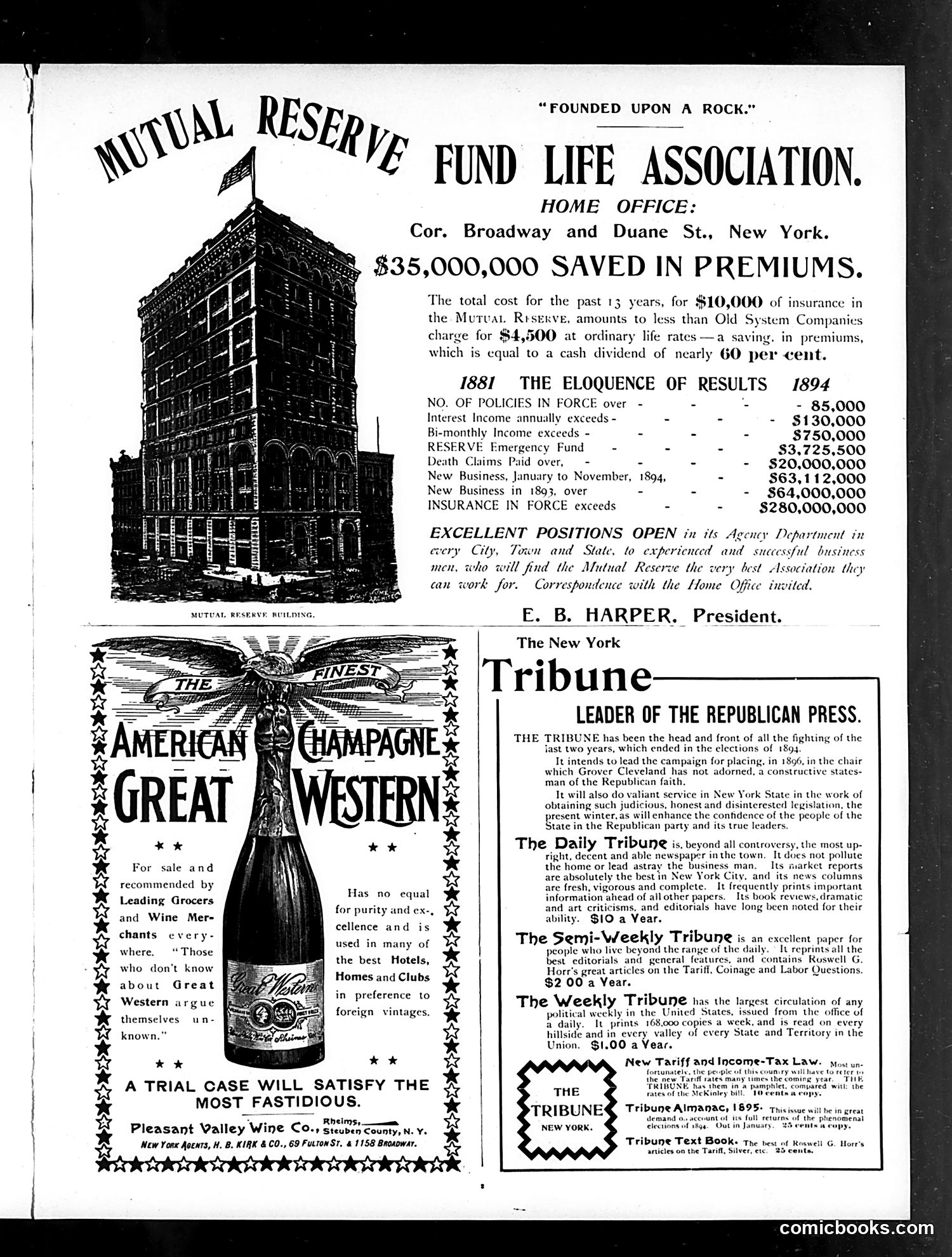
This page is **primarily advertising**, not satire or political commentary. The top half promotes the **Mutual Reserve Fund Life Association**, an insurance company claiming $35 million in premium savings over 13 years compared to traditional insurers. The building illustration and statistics emphasize financial stability ("Founded Upon a Rock"). The bottom left advertises **American Champagne** from Pleasant Valley Wine Company—a domestic wine marketed to grocers and merchants, positioning it against imported alternatives. The right side promotes **The New York Tribune**, describing it as "Leader of the Republican Press" and highlighting its various editions (Daily, Semi-Weekly, Weekly). This is straightforward product promotion rather than political cartoon. No political satire or caricature is present. The page reflects late-1890s commercial advertising conventions in Judge magazine.
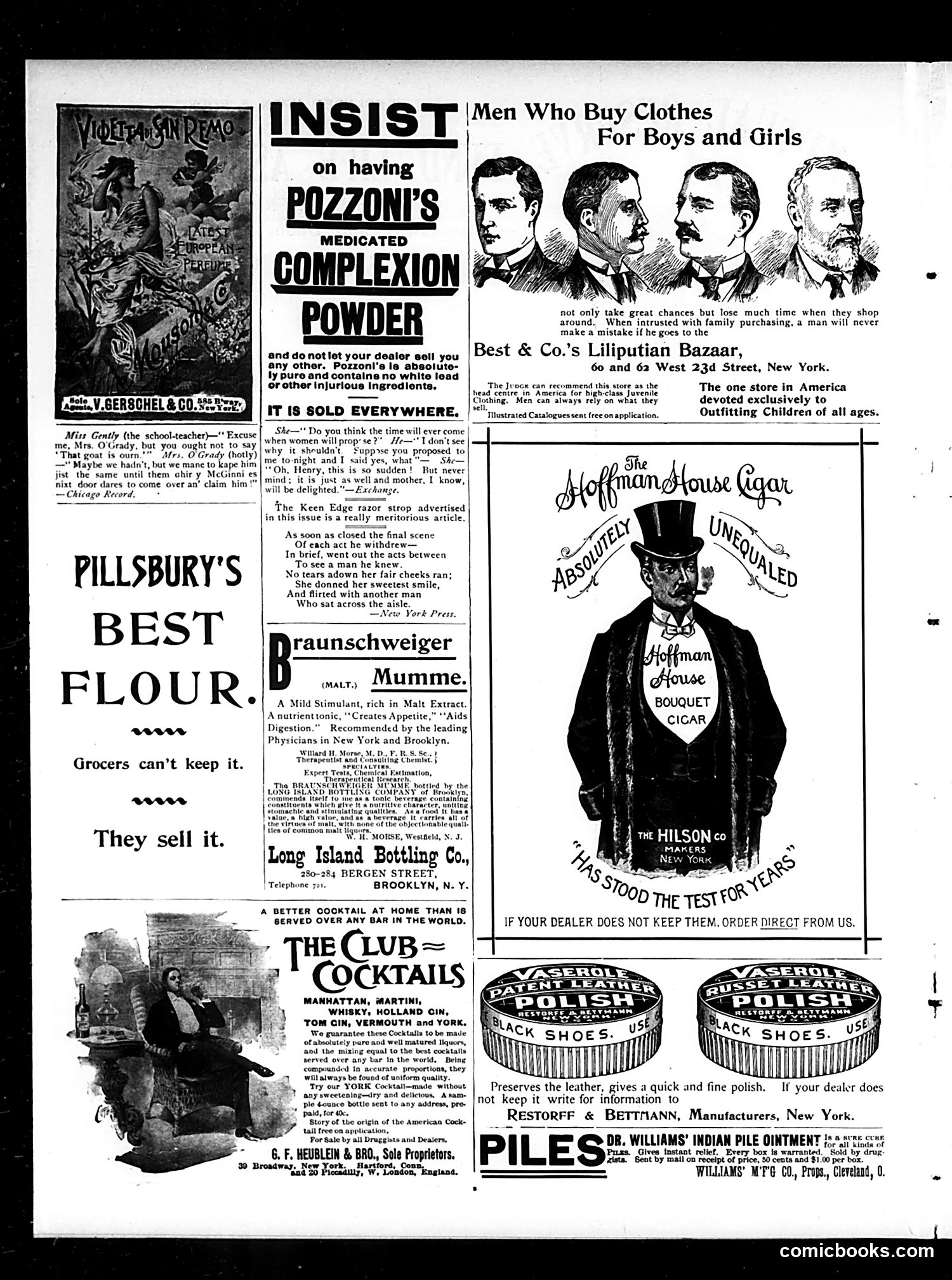
This page is primarily **advertising**, not political satire. It contains multiple product advertisements from circa early 1900s, including: **Notable ads:** - **Pozzoni's Complexion Powder** — insists on "medicated" powder containing no lead (reflecting contemporary concerns about cosmetic safety) - **Best & Co.'s children's clothing store** — features four men's portrait heads, emphasizing that men shopping for children's clothes should visit this reliable retailer - **Pillsbury's Best Flour**, **Braunschweiger Mumme** (malt tonic), **Club Cocktails**, and **Dr. Williams' Indian Pile Ointment** The page also includes brief humorous **exchanges** (mini-jokes), such as one about a woman proposing to a man, reflecting period gender-role humor. **For modern readers:** These ads reveal early 1900s consumer anxieties (cosmetic safety, children's clothing quality) and reflect the era's social norms around masculinity, domesticity, and remedies for common ailments. The "Indian" terminology in the ointment reflects period marketing conventions now recognized as problematic.
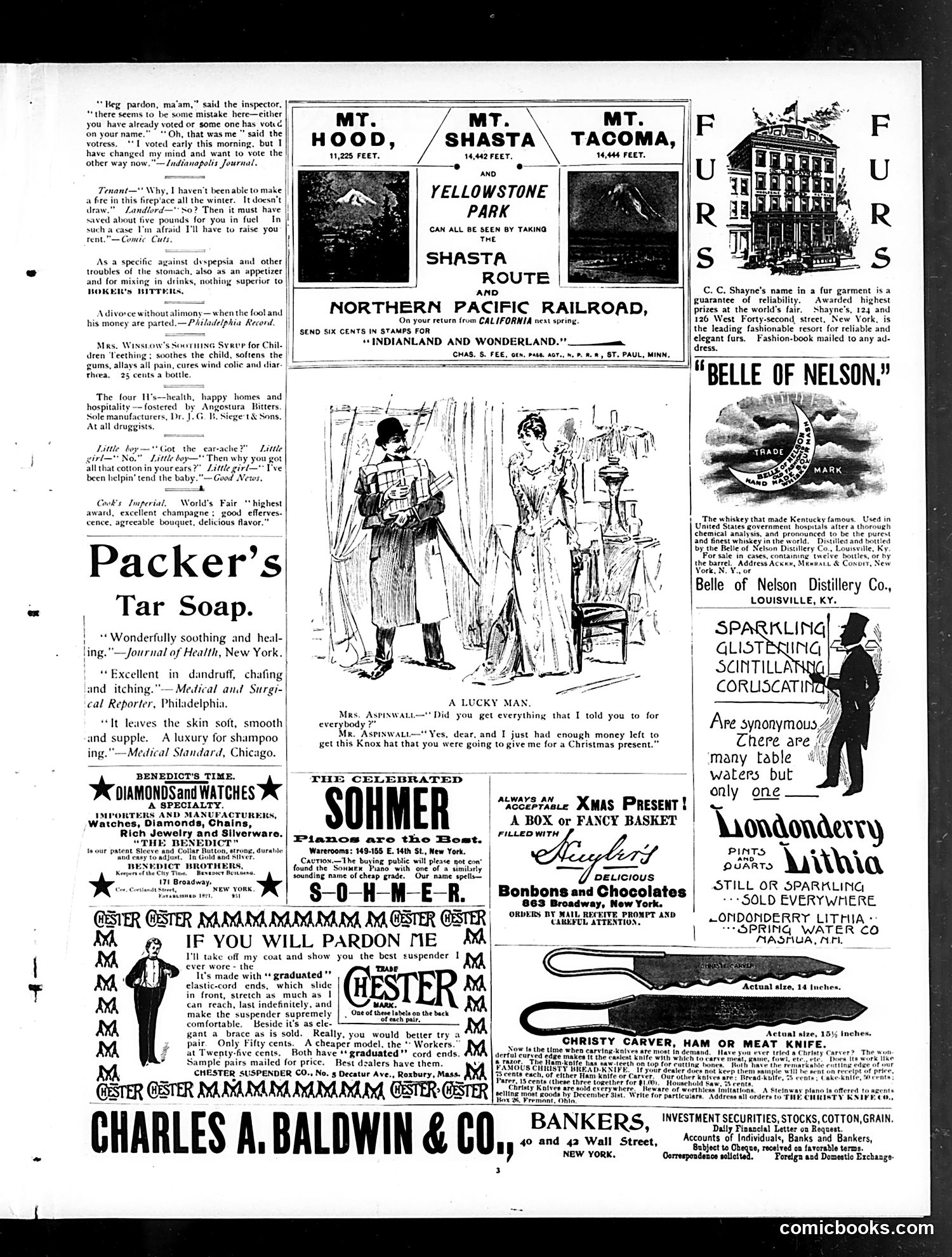
This page is primarily **advertising** with one small political cartoon at the top. The cartoon ("A Lucky Man") shows a conversation between a man and woman: the woman voted early but changed her mind and voted again. This satirizes concerns about **election fraud and voter integrity** in the late 1800s. The joke's dark implication—that voting twice was easy to get away with—mocked loose electoral safeguards. This reflects real anxieties about ballot-box stuffing and repeat voting that plagued American elections of the era. The rest of the page consists of period advertisements for products (Packer's Tar Soap, Sohmer pianos, Chester suspenders, Christy carvers) and services (Northern Pacific Railroad, banking services). No other political content is evident. The page reflects Judge magazine's mixed editorial-advertising model typical of 19th-century publications.
This page is **primarily advertising**, not satirical content. It contains three distinct advertisements from what appears to be a Judge magazine issue: 1. **New York Central Railroad**: Promotes a 442-mile scenic route through New York State, highlighting agricultural, manufacturing, and natural attractions. The decorative illustration shows a woman with grapes, emphasizing the region's bounty. 2. **Urbana Wine Co.**: Advertises "Gold Seal Champagne" produced in Urbana, New York, emphasizing affordability ("less than half the cost of imported") and medicinal applications—a common marketing angle during the Prohibition era or its approach. 3. **Reed & Barton Silversmiths**: Promotes sterling silver holiday gifts and souvenirs for weddings and special occasions. No political satire or caricature is evident here. The page reflects early 20th-century consumer advertising, emphasizing American products, quality standards, and value propositions typical of the era.
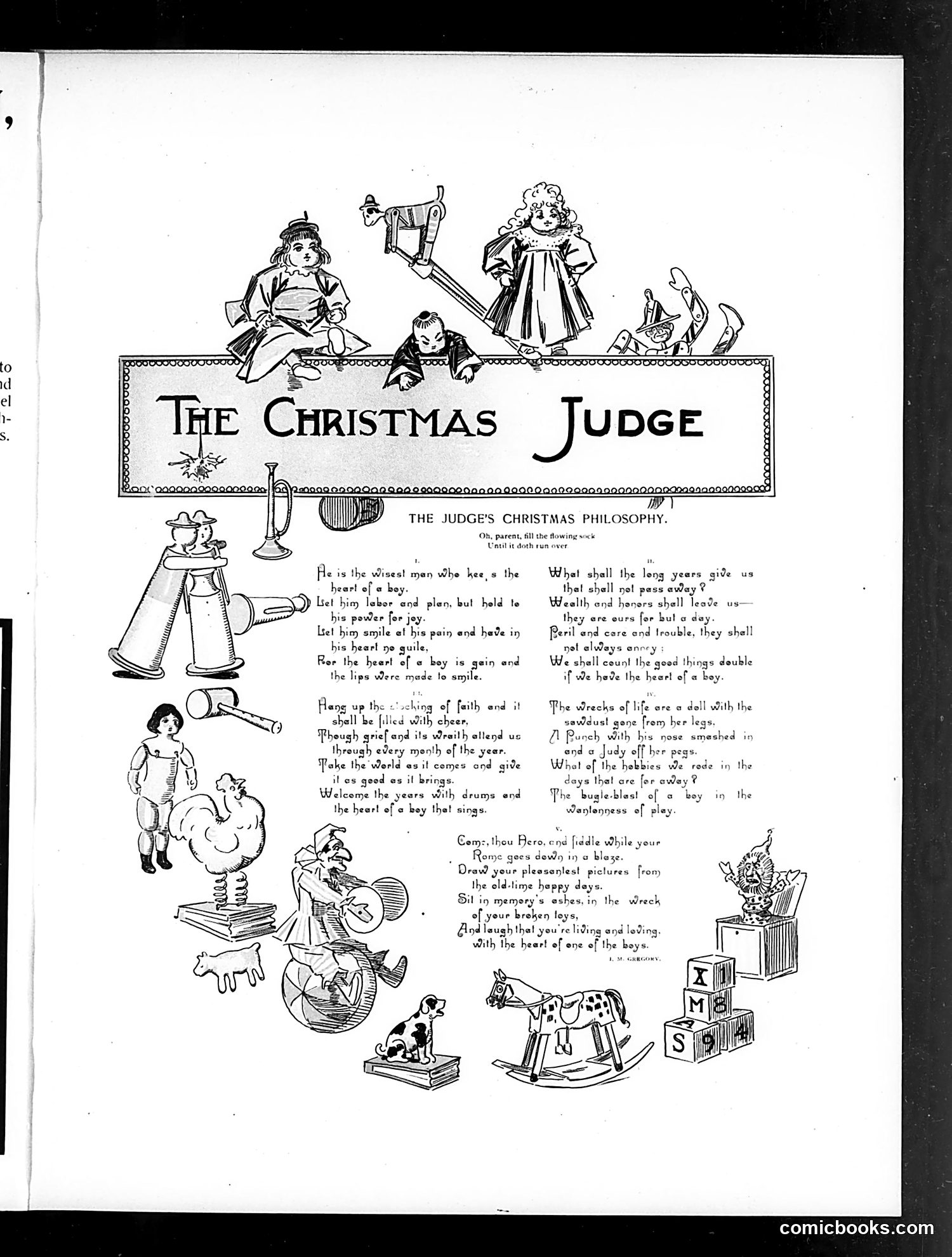
This page presents "The Judge's Christmas Philosophy"—a sentimental moral essay disguised as holiday wisdom. The accompanying illustrations depict idealized children's toys and pastimes (rocking horses, dolls, toy soldiers, hoops). The text advocates for maintaining childlike innocence and joy despite life's hardships. Key phrases like "the heart of a boy" and "welcome the years with drums" emphasize preserving youthful optimism, faith, and playfulness as antidotes to adult suffering. The satire appears gentle rather than cutting: Judge magazine is gently mocking the era's tendency toward syrupy sentimentality and moralizing about childhood virtue. The repeated emphasis on children's simple happiness contrasts ironically with the real struggles ("peril and care and trouble") adults face. This reflects late 19th/early 20th-century American nostalgia for innocent childhood as a spiritual refuge from industrial modernity—a common theme in period magazines.
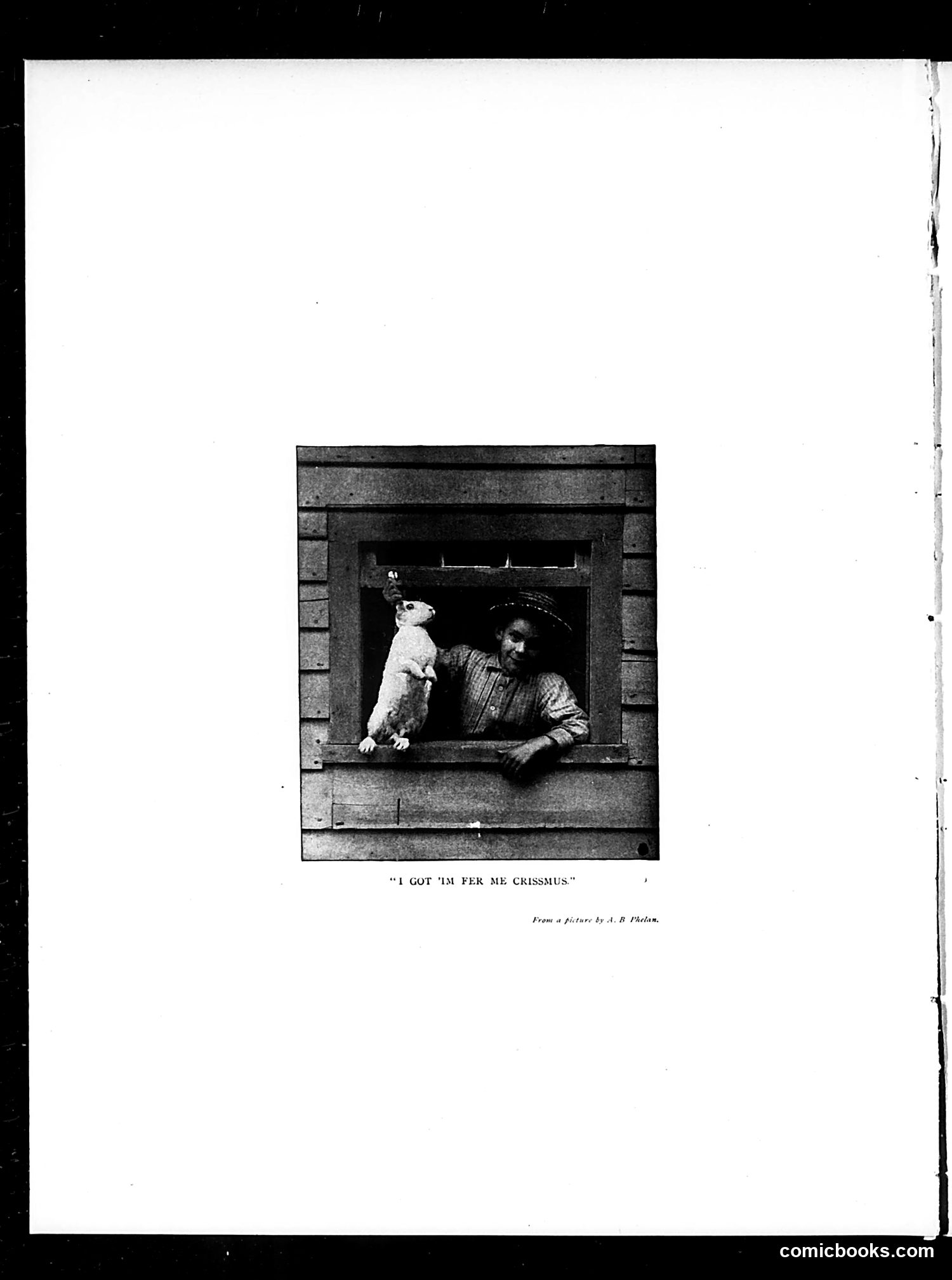
This appears to be a sentimental domestic scene rather than political satire. The image shows a person at a window holding what appears to be a small dog or similar animal, with the caption "I GOT 'IM FER ME CRISSMUS" (dialect for "Christmas"). The humor seems to derive from the informal, working-class dialect and the touching moment of someone proudly displaying their Christmas gift—a pet animal. This reflects turn-of-the-century *Judge* magazine's frequent use of gentle humor about everyday life and domestic scenes, particularly depicting urban working-class characters. The artwork is credited to A.B. Phelan. Without additional context about the original publication date, it's unclear if this references any specific social issue beyond general Christmas sentiment and class-based humor typical of the era.
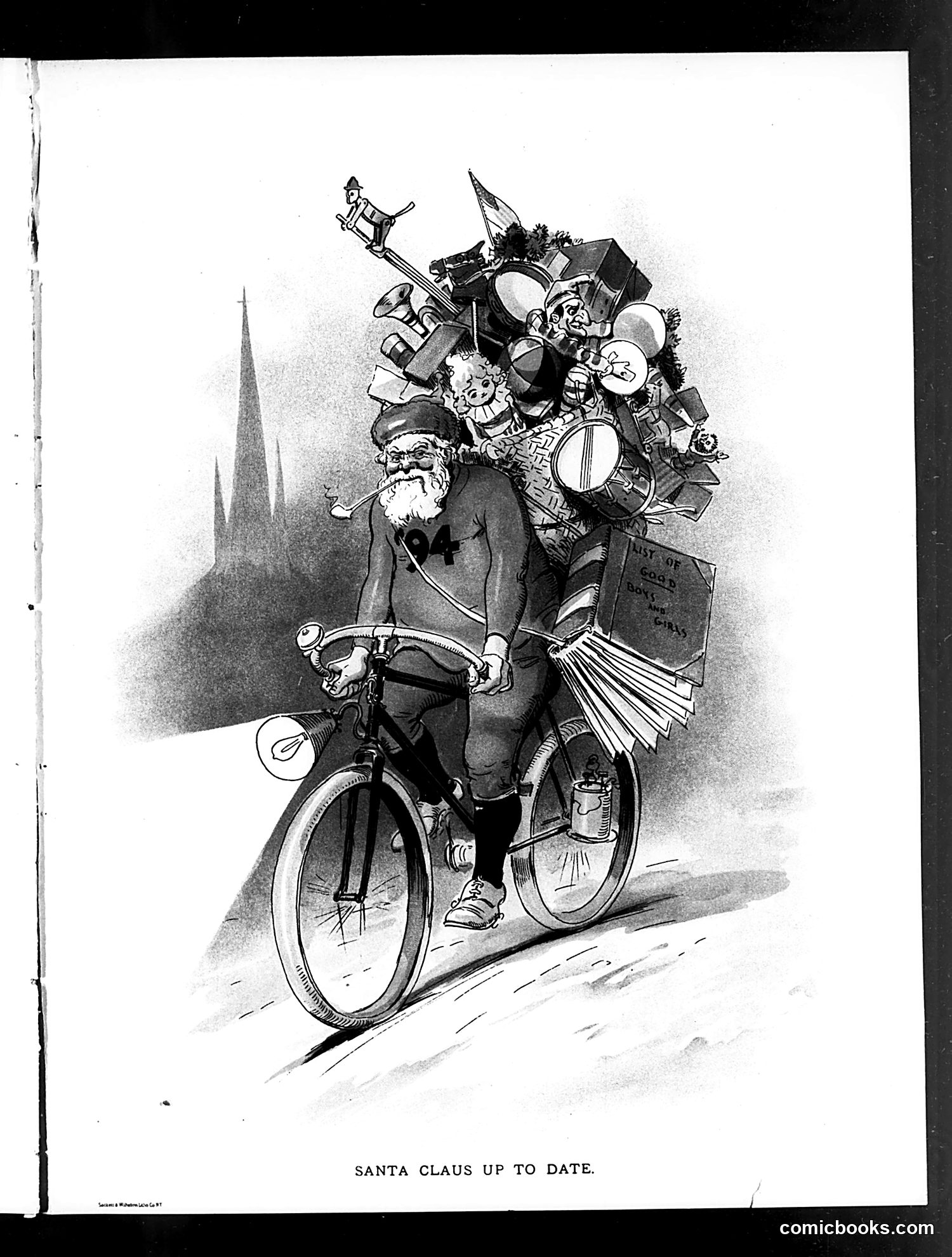
This satirical cartoon depicts Santa Claus as a modern figure riding a bicycle, laden with contemporary goods and innovations rather than traditional toys. The overloaded pack includes what appears to be musical instruments, mechanical devices, books, and other manufactured items—visual commentary on late 19th/early 20th-century commercialization of Christmas. The bicycle itself signifies modernity and progress. Santa's overwhelmed state under his burden likely satirizes how Christmas gift-giving had become increasingly consumerist and complex, departing from simpler traditions. The "up to date" caption suggests ironic commentary on whether progress in commerce and technology actually improved the holiday spirit. The distant church spires in the background may contrast spiritual traditions with material acquisition. This appears to be Judge magazine's social critique of evolving American holiday commercialism.
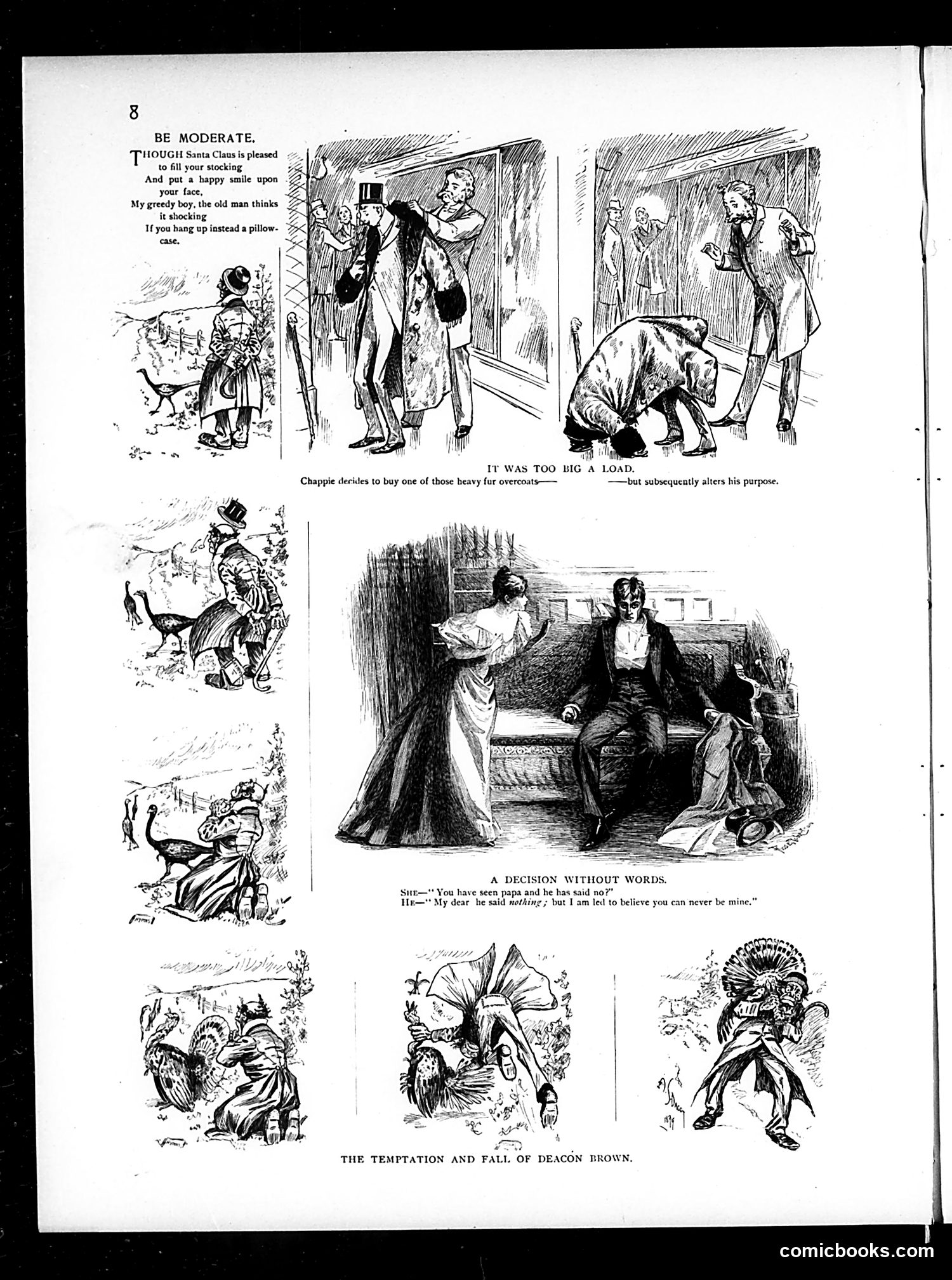
This page contains multiple satirical sketches mocking excessive consumption and poor judgment: **Top panels**: "Chappie" attempts to buy an oversized fur overcoat but finds it too heavy to carry, forcing him to abandon the purchase. The satire targets greedy materialism and the folly of buying beyond one's means. **Middle panel**: "A Decision Without Words" shows a romantic scene where a woman's father has rejected a suitor without speaking, yet she interprets his silence as permanent rejection. This satirizes how assumptions can replace actual communication. **Bottom panels**: "The Temptation and Fall of Deacon Brown" appears to depict moral compromise through sequential images of temptation leading to downfall—likely satirizing hypocrisy among religious figures or the public. The page's title "Be Moderate" unifies these sketches around a theme of excess, greed, and poor decision-making. The humor targets both material overconsumption and social pretension typical of Gilded Age satire.
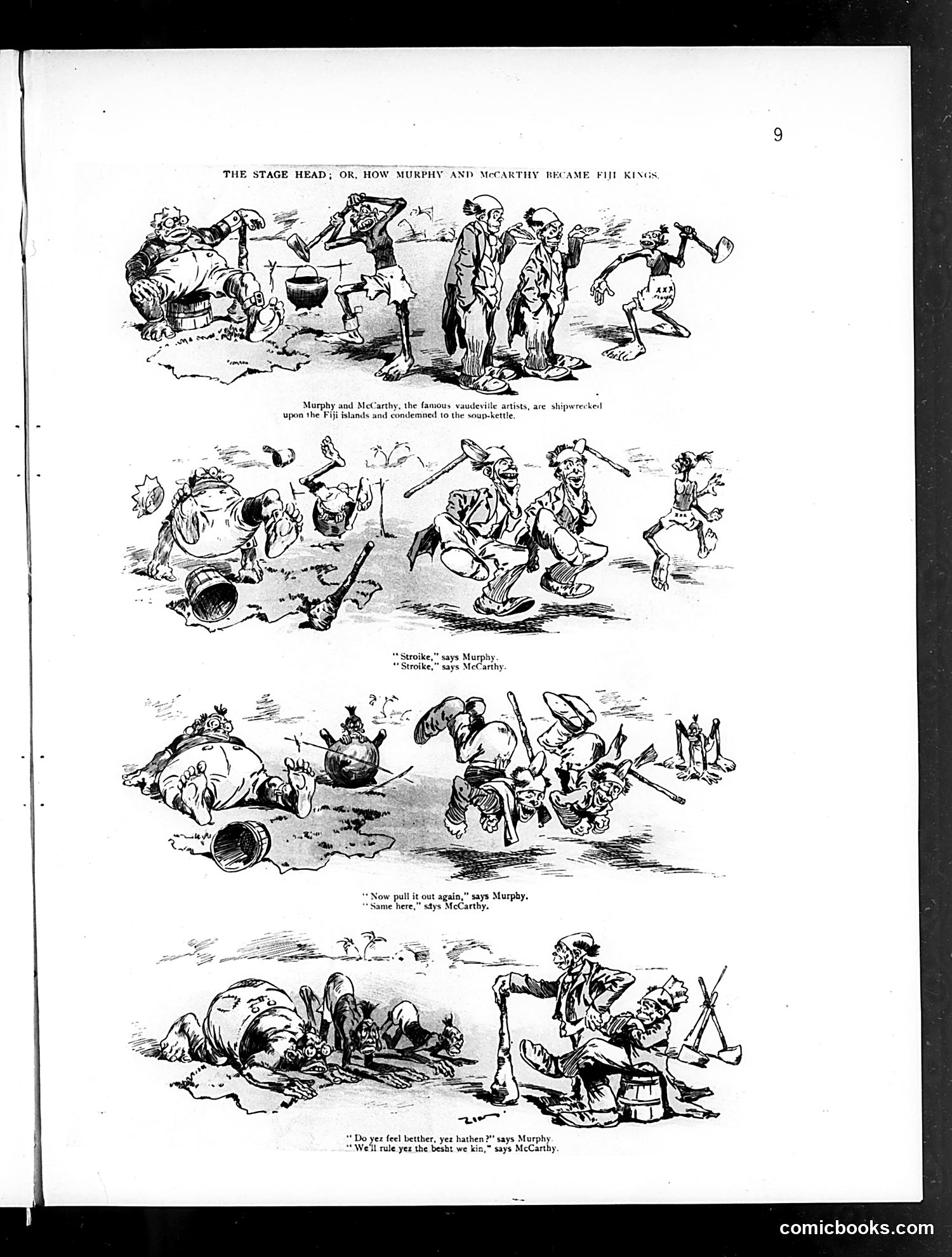
This satirical sequence depicts Murphy and McCarthy—likely Irish-American characters, suggested by dialect spelling—as incompetent vaudeville performers attempting to crown themselves "Fiji Kings." The four-panel narrative shows them repeatedly failing at a simple task: pulling something (possibly a cauldron or pot) while making grandiose claims about ruling and improvement. The satire targets Irish-American politicians or public figures of the period, mocking their pretensions to power and competence. Despite their bumbling failures and lack of qualifications ("yez hathen"), they confidently declare they'll "rule yez the best we kin." The cartoon suggests these figures are theatrical frauds—all show and no substance—using exaggerated Irish dialect for comedic effect. The "Fiji Kings" reference emphasizes their exotic, unearned pretensions to authority. This reflects Judge magazine's typical satirization of immigrant politicians and working-class figures.
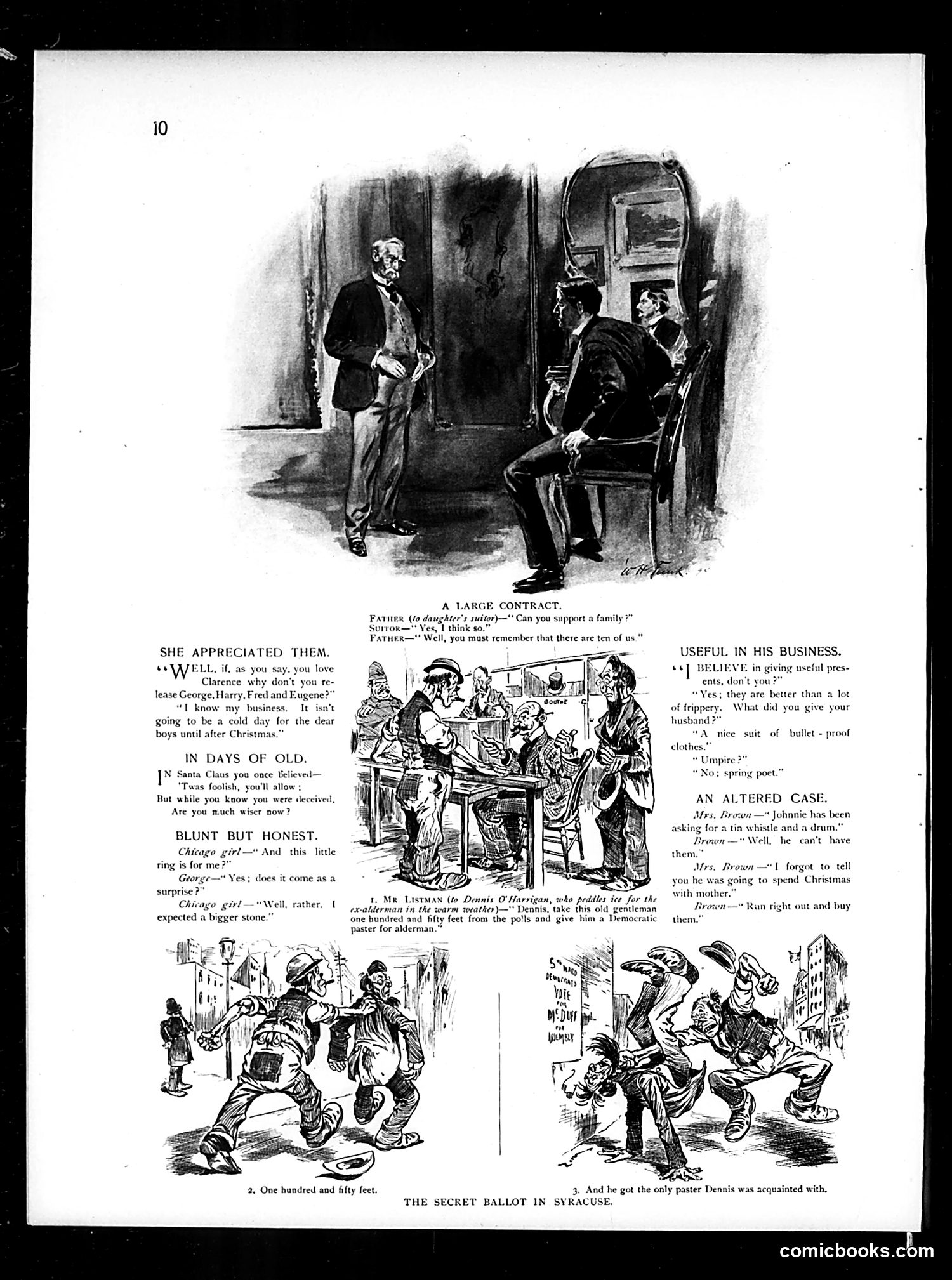
This page contains multiple satirical vignettes mocking American social and political life, likely from the late 19th century. The main cartoon series titled "The Secret Ballot in Syracuse" depicts electoral corruption: a political operative instructs an ice-peddler named Dennis O'Harrigan to physically move a voter "one hundred and fifty feet from the polls" and give him a "Democratic paster" (a beating). The third panel reveals Dennis only understands violence, not voting—so the operative gets the voter removed through brutality rather than persuasion, undermining the democratic process. The surrounding jokes mock family life, Christmas gift-giving expectations, and courtship. "A Large Contract" jokes about a suitor's naïveté regarding supporting a large family. "She Appreciated Them" references someone keeping relatives imprisoned until after Christmas. The satire targets political corruption and electoral fraud while using class-based humor about immigrants (Dennis) and working-class characters to frame these abuses as darkly comic inevitabilities of American politics.

I can see this is a page from *Judge* magazine (as indicated by the watermark "comicbooks.com" at the bottom), but the image is almost entirely black or severely degraded, making it impossible to discern any cartoon illustrations, text content, or satirical figures. Without being able to see the actual artwork or read the OCR'd text clearly on the page itself, I cannot identify: - What figures or caricatures are depicted - What political or social events are referenced - What the intended satire or joke involves To provide an accurate historical analysis, I would need a clearer scan of this page from *Judge* magazine. The current image does not contain legible visual or textual information.

I can see this is a page from *Judge* magazine based on the watermark, but the image is almost entirely black with very minimal visible content. The page appears to be either a blank page, severely degraded/damaged scan, or contains only a very dark illustration that isn't legible in this reproduction. Without being able to discern any visible cartoon panels, text, figures, or caricatures clearly enough to identify them, I cannot reliably explain what political or social satire this page contains. To provide accurate historical context as requested, I would need a clearer or higher-contrast version of this image where the actual content is visible.
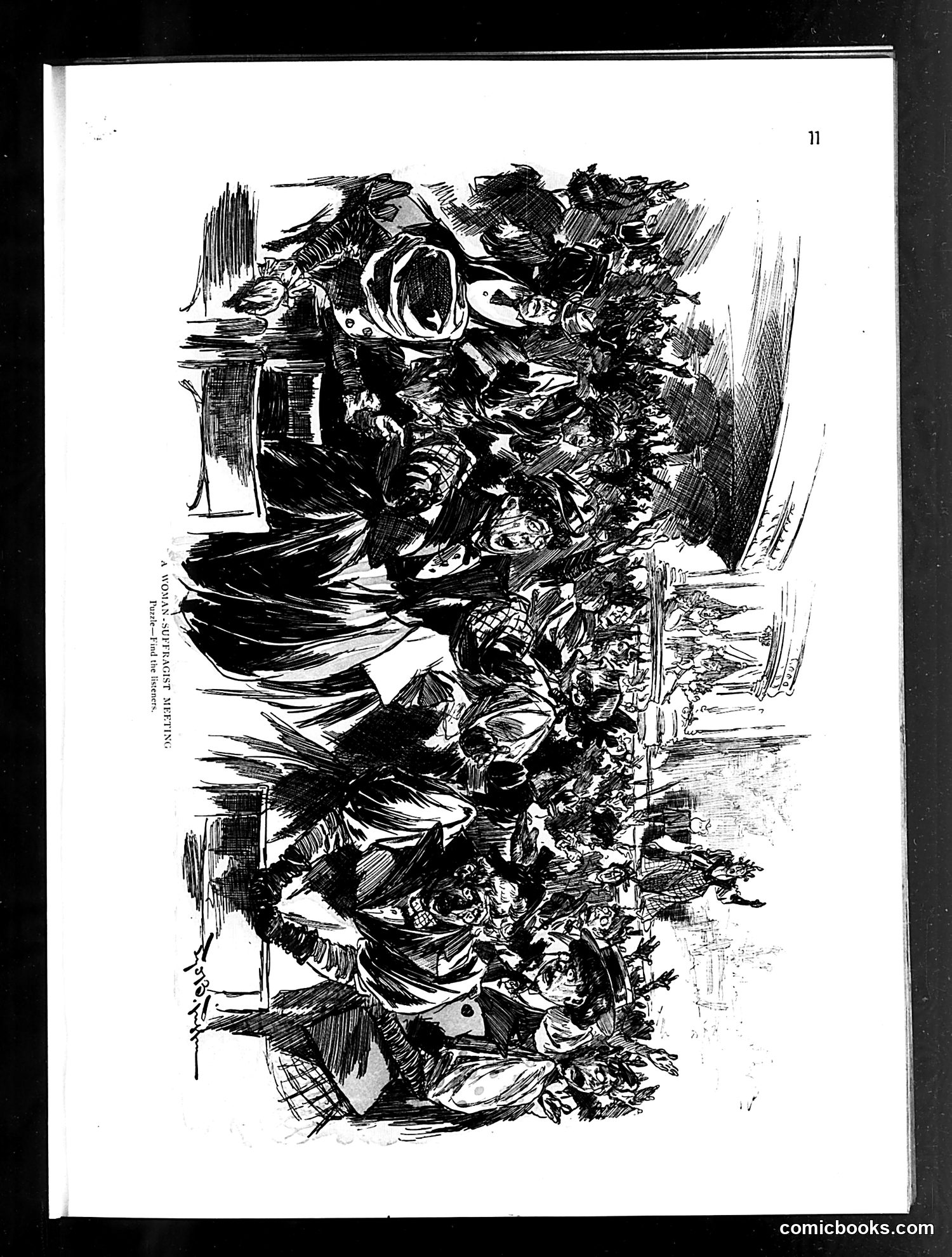
I can see this is page 11 from Judge magazine, containing a detailed political cartoon rendered in black ink with dramatic cross-hatching. The image appears to be rotated and depicts multiple figures in what seems to be a chaotic scene with exaggerated expressions and gestures. However, I cannot reliably read the OCR text accompanying the cartoon, and the image's rotation and artistic style make it difficult for me to identify specific figures or clearly discern the exact political references intended. To accurately explain this cartoon's meaning to a modern reader, I would need either a clearer image orientation or additional caption text that's legible. I don't want to guess at identities or events without clear evidence.
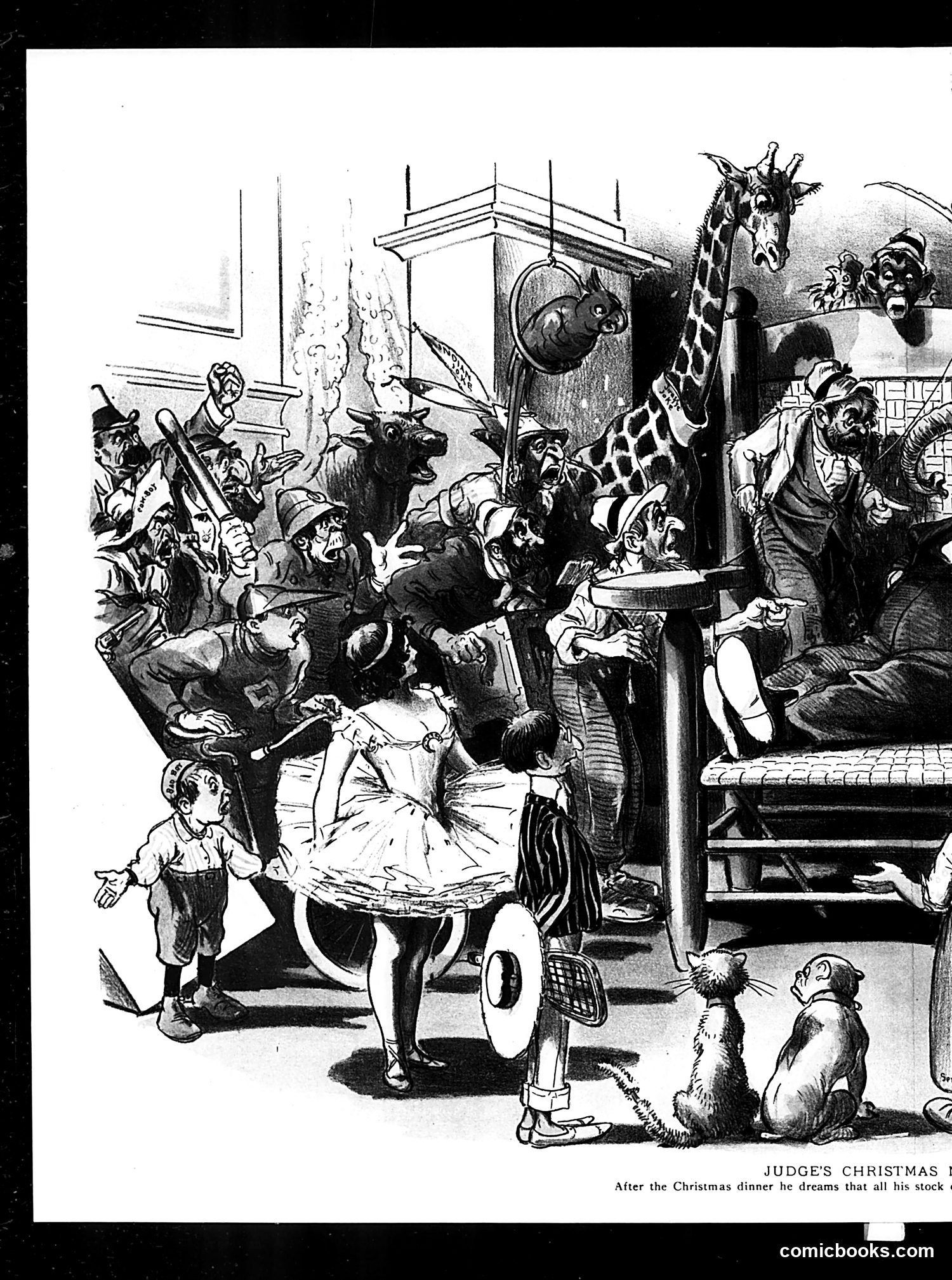
This appears to be a satirical cartoon from *Judge* magazine depicting a chaotic dream sequence. The visible caption indicates "After the Christmas dinner he dreams that all his stock..." but the text is cut off, making the complete satirical point unclear. The illustration shows a surreal, crowded scene with various animals (a giraffe, monkeys) and figures in Victorian-era clothing engaged in pandemonium—suggesting the dreamer's anxieties about his possessions or livestock. The style is typical of 19th-century satirical engravings with exaggerated expressions and detailed cross-hatching. Without the complete caption, I cannot definitively identify the specific political or social reference, though it appears to satirize either merchant concerns about inventory loss or perhaps anxieties about wealth and consumption around the holiday season.
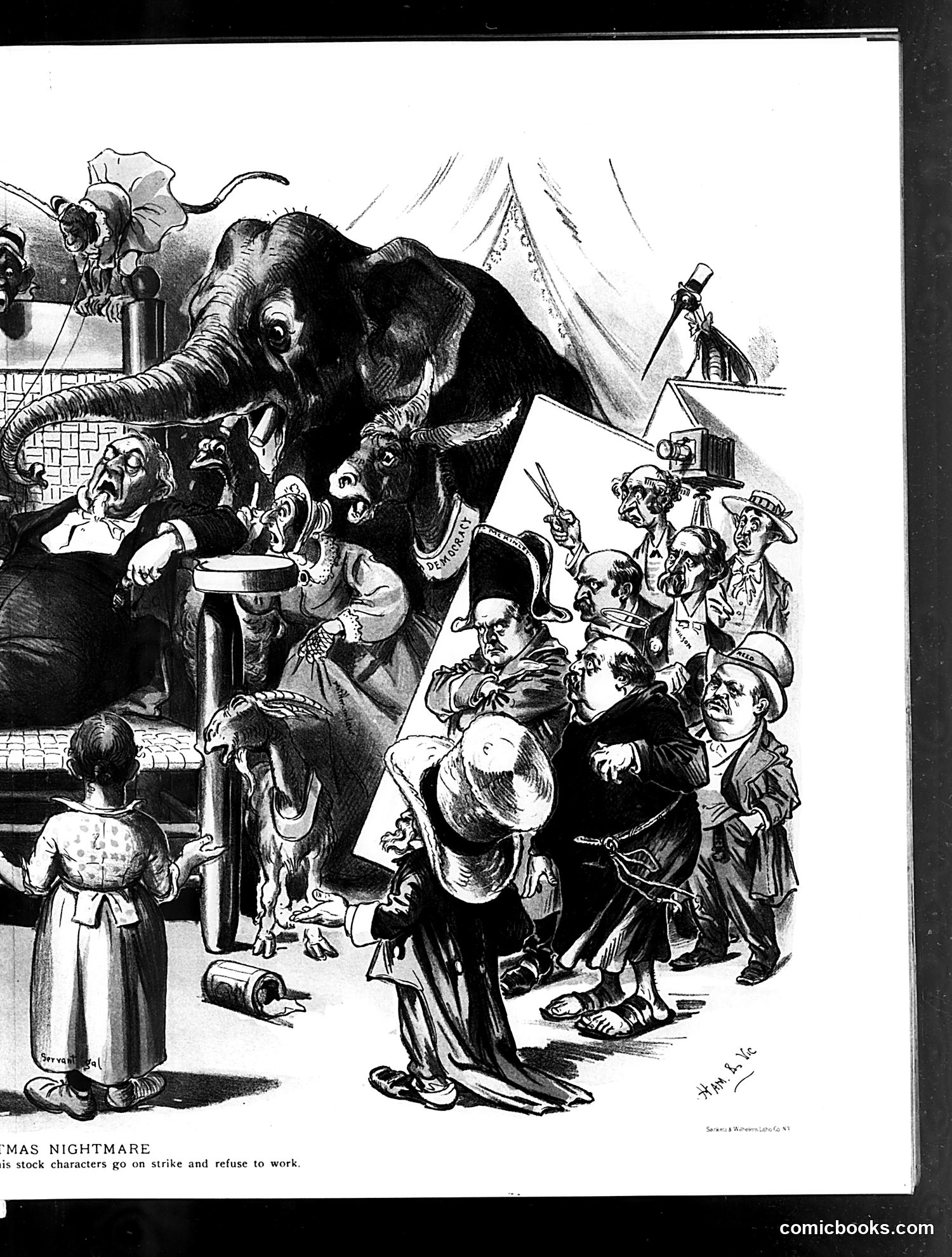
This political cartoon satirizes labor strikes by depicting a circus ringmaster's nightmare. A massive elephant—representing labor unrest or striking workers—looms over a circus tent where stock characters (clowns, performers, managers) appear distressed and unable to work. The caption indicates these "stock characters go on strike and refuse to work," suggesting the cartoon critiques how labor disruptions affect entertainment, commerce, or society broadly. The elephant, a symbol of chaos and danger, threatens the orderly circus operation below. Published in *Judge* magazine, this likely comments on contemporary labor activism, presenting strikers as a disruptive force that destabilizes established institutions. The "nightmare" framing suggests the cartoonist viewed strikes as threatening chaos rather than legitimate worker grievances.
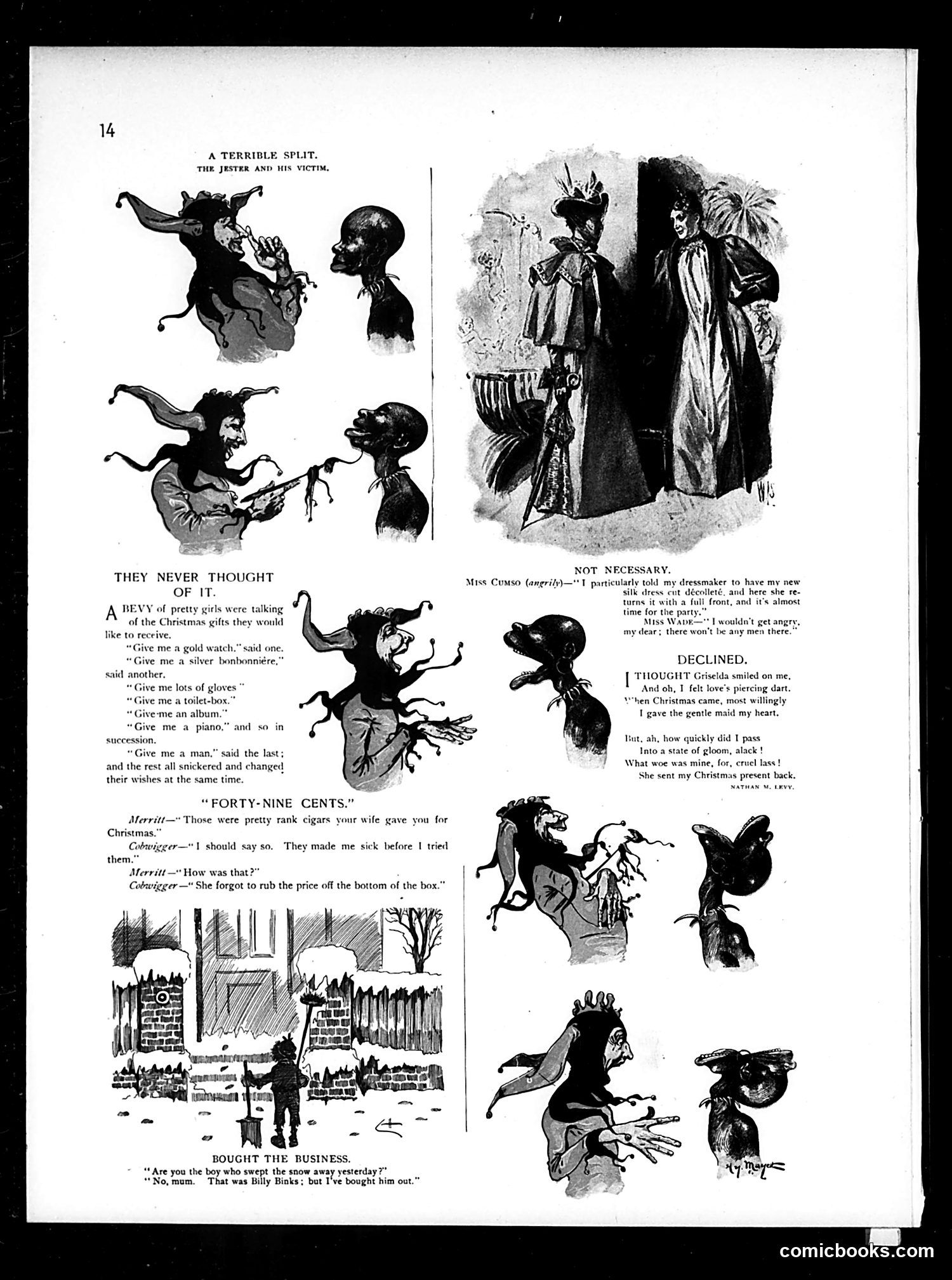
This page contains several disconnected humorous sketches typical of Judge's satirical format: **"A Terrible Split"** depicts jesting demons/imps tormenting a victim—illustrating the concept of internal conflict or being "split." **"They Never Thought of It"** satirizes young women's materialistic Christmas wishes. The girls initially request luxury items (watches, pianos), then the last girl jokes about wanting "a man"—prompting all the others to change their wishes to match, mocking women's supposed obsession with marriage over material goods. **"Forty-Nine Cents"** jokes about cheap cigars: a husband complains his wife's Christmas gift cigars made him sick because she forgot to remove the price sticker (49 cents), implying their low quality was embarrassingly obvious. **"Bought the Business"** features a child claiming he "bought out" another boy's snow-sweeping job—juvenile entrepreneurship humor. **"Declined"** and **"Not Necessary"** offer romantic rejection verses, poking fun at disappointed suitors and female disinterest in relationships. The overall tone mocks consumer culture, materialism, and gender relations through Victorian-era sentimental and comedic conventions.

I can see this is a page from *Judge* magazine (a satirical publication), but the image is almost entirely black or severely faded, making it impossible to discern any cartoon illustrations, caricatures, or readable text content beyond the "comicbooks.com" watermark at the bottom. Without visible imagery or legible OCR text to analyze, I cannot identify the figures, political/social references, or satirical points intended by the cartoonist. The page appears to be either a blank/title page, severely damaged in reproduction, or improperly scanned. To provide accurate historical context as requested, I would need a clearer image where the cartoon and text are actually visible.

I can see this is a page from *Judge* magazine based on the watermark, but the image itself is almost entirely black or blank, with only a white edge visible on the right side. The OCR text only contains "comicbooks.com," which appears to be a modern website attribution rather than original magazine content. Without visible cartoon imagery, text, or recognizable figures, I cannot identify the satirical content, political references, or historical context this page originally contained. The page may be severely degraded, improperly scanned, or blank. To provide accurate historical analysis, a clearer image showing the actual cartoon(s) and legible text would be necessary.
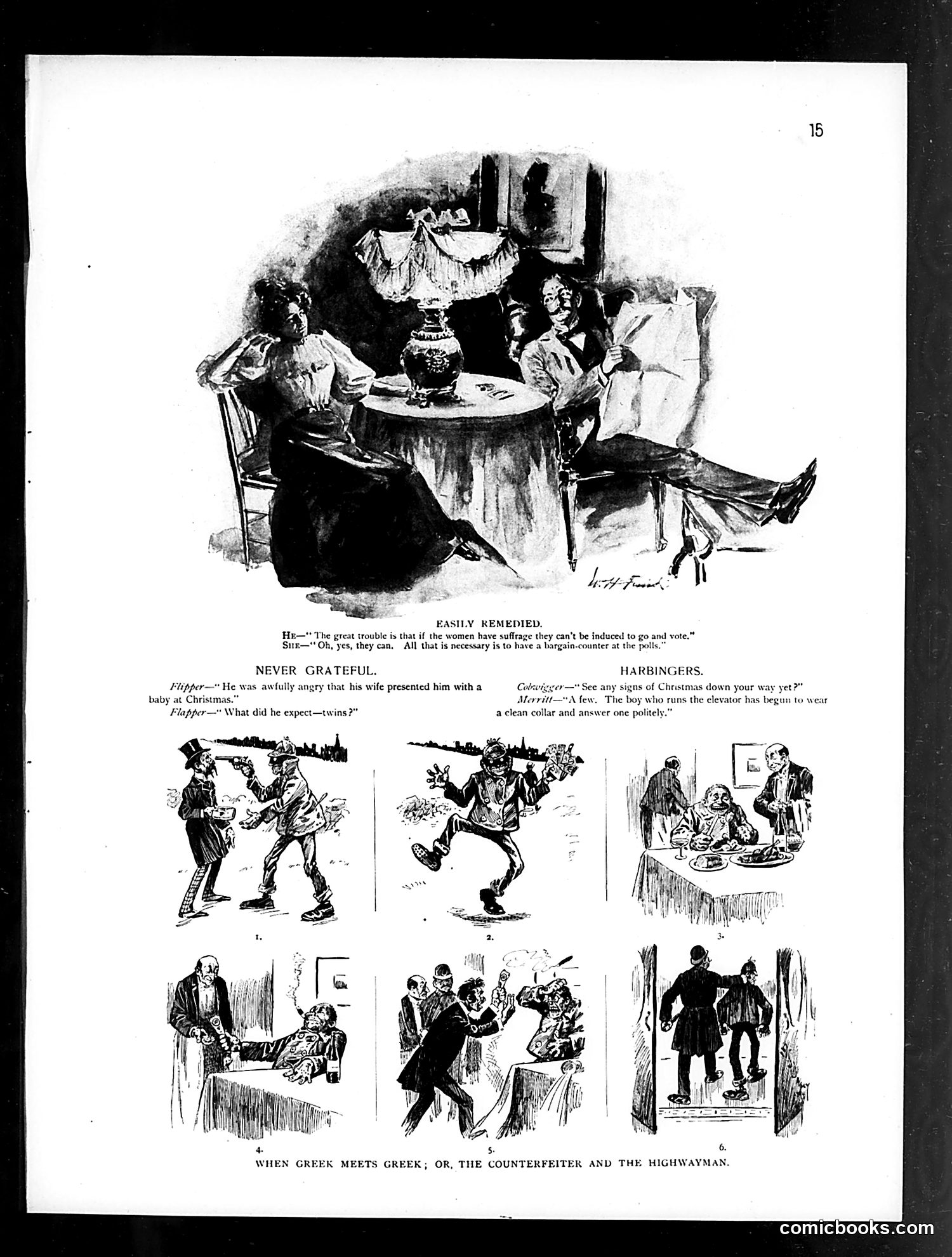
This Judge magazine page contains three separate satirical pieces: **"Easily Remedied"** mocks women's suffrage concerns. A character argues women won't vote if given the right; the solution offered is placing a "bargain-counter" (department store sale) at polling places—implying women are so shallow they'd only show up for shopping deals. This reflects anti-suffrage stereotypes common before women gained voting rights. **"Never Grateful"** and **"Harbingers"** are brief jokes: the first about a husband upset his wife had a baby instead of twins; the second about minimal Christmas signs appearing (only elevator operators becoming polite). **"When Greek Meets Greek"** (bottom) appears to be a multi-panel comic story about a counterfeiter and highwayman encountering each other—the title suggests two criminals of equal cunning meeting, likely for comedic confrontation. The specific narrative is unclear from the partial panels visible, but it's clearly a crime-based humorous story. The page exemplifies Judge's style: political/social satire mixed with domestic humor and crime-based comedy strips.
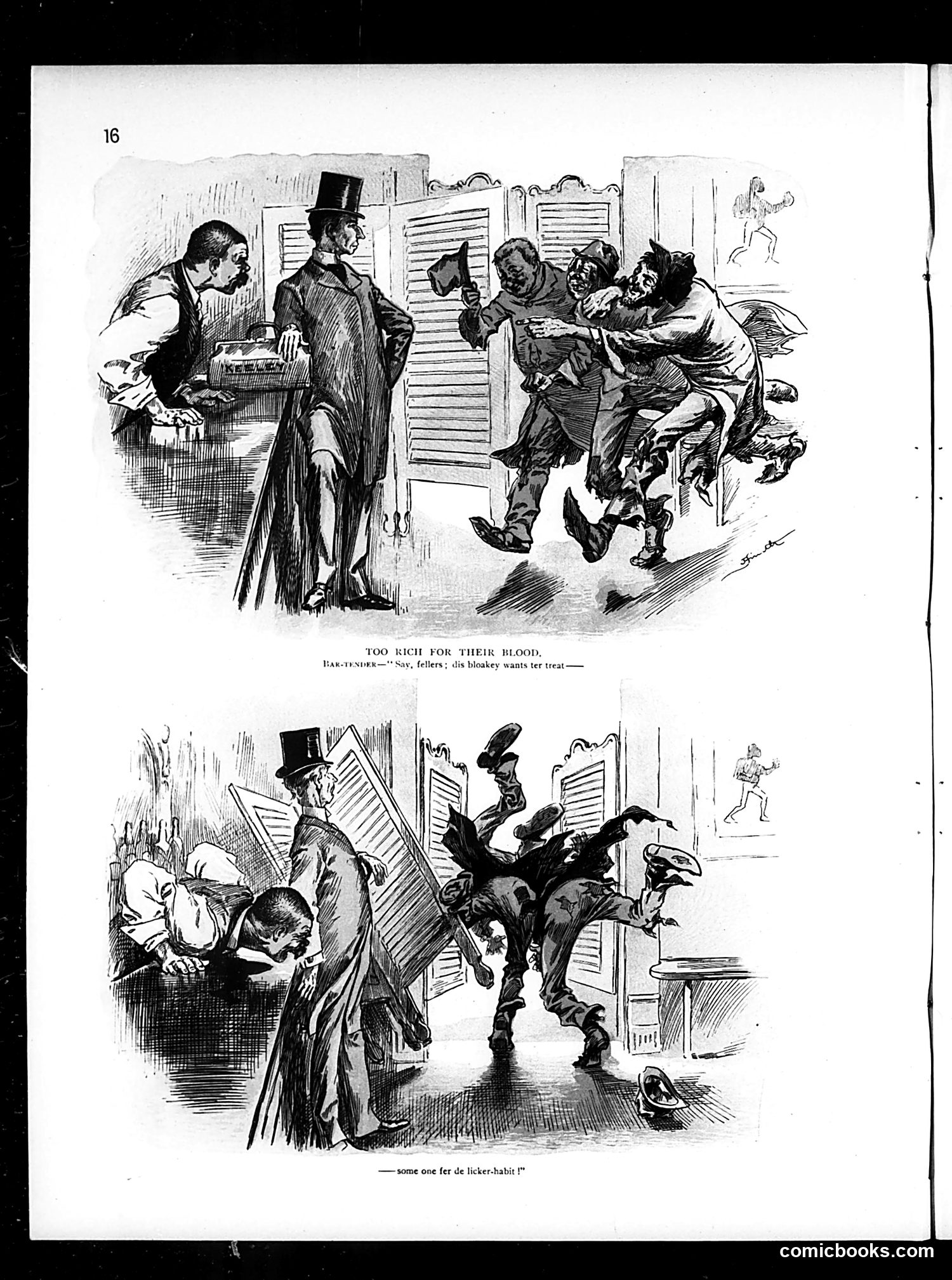
This two-panel cartoon satirizes temperance reformers and their wealthy supporters. The top panel shows a well-dressed gentleman (marked with "K," likely a prominent temperance advocate) offering to treat rowdy working-class men, who react with suspicion and mockery. The bottom panel reveals the joke: the "treatment" is merely a drink, not a cure for alcoholism. The working-class men mock his offer—"some one fer de licker-habit" suggests they sarcastically interpret his generosity as simply buying them alcohol rather than addressing addiction. The satire targets the hypocrisy or ineffectiveness of wealthy reformers' solutions to working-class drinking problems. The crude dialect and caricatures reflect period-typical prejudices. The title "Too Rich for Their Blood" suggests the reformer's approach is too genteel or disconnected from actual working-class concerns.
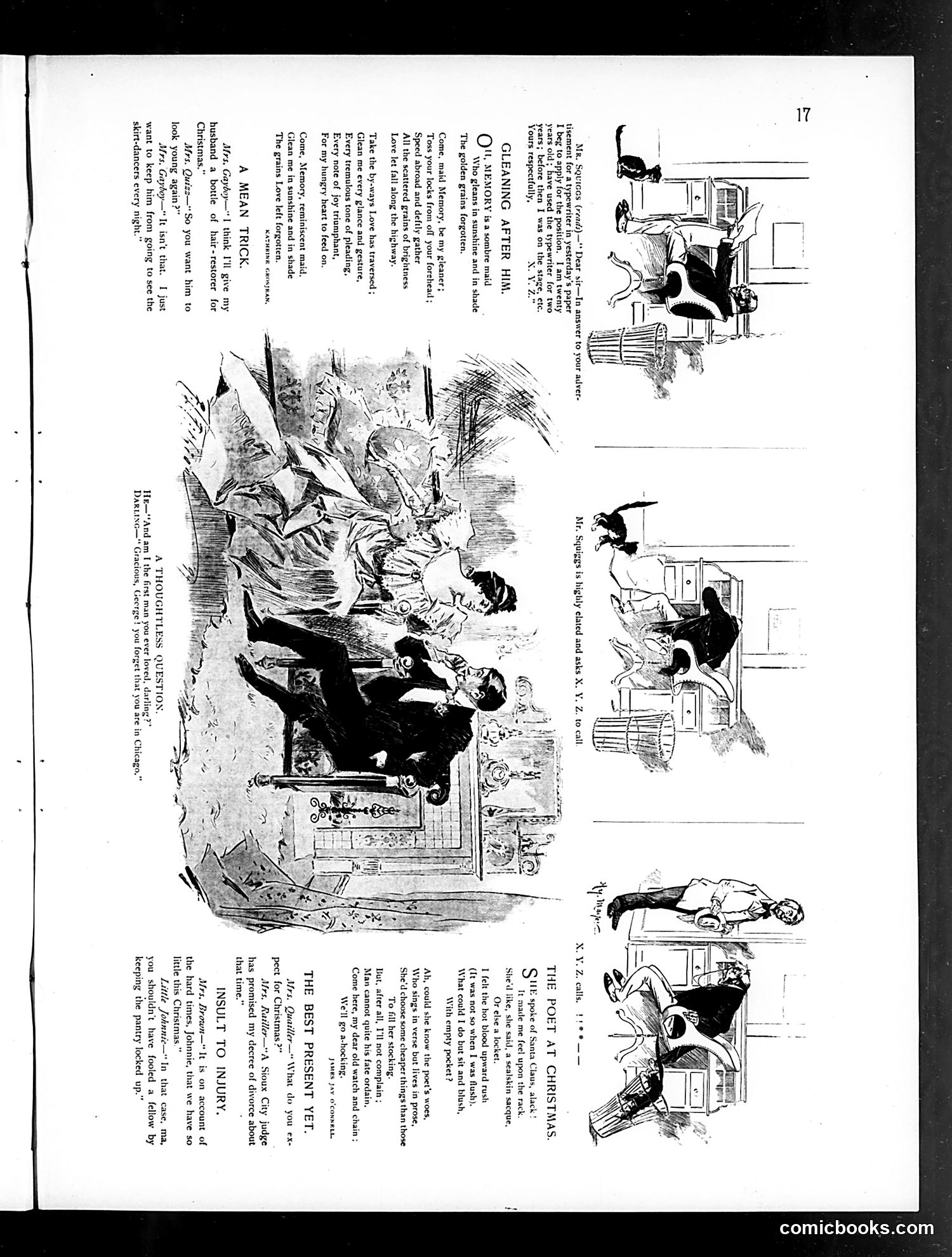
This is a page from *Judge* magazine featuring humorous short pieces and cartoons about Christmas and domestic life, likely from the late 19th or early 20th century. The main items include: **"A Mean Trick"**: A joke about a wife wanting to give her husband hair-restorer—not to help him, but to keep him home instead of going out to see "skirt-dancers" (a period term for performers in scanty costumes). **"A Thoughtless" [question]**: A man asks if he's the first woman loved; she replies he should remember "Z" (an earlier suitor). **"The Poet at Christmas"**: A sentimental poem about an impoverished poet unable to afford gifts for his beloved. **"The Best Present Yet"**: A darkly comic exchange where a woman says her Christmas gift will be a divorce decree from a Sioux City judge—satirizing unhappy marriages. **"Insult to Injury"**: During hard times, a boy sarcastically suggests his mother could economize better by unlocking the pantry she keeps locked. The humor relies on marital discord, poverty, infidelity anxieties, and class commentary typical of the era.
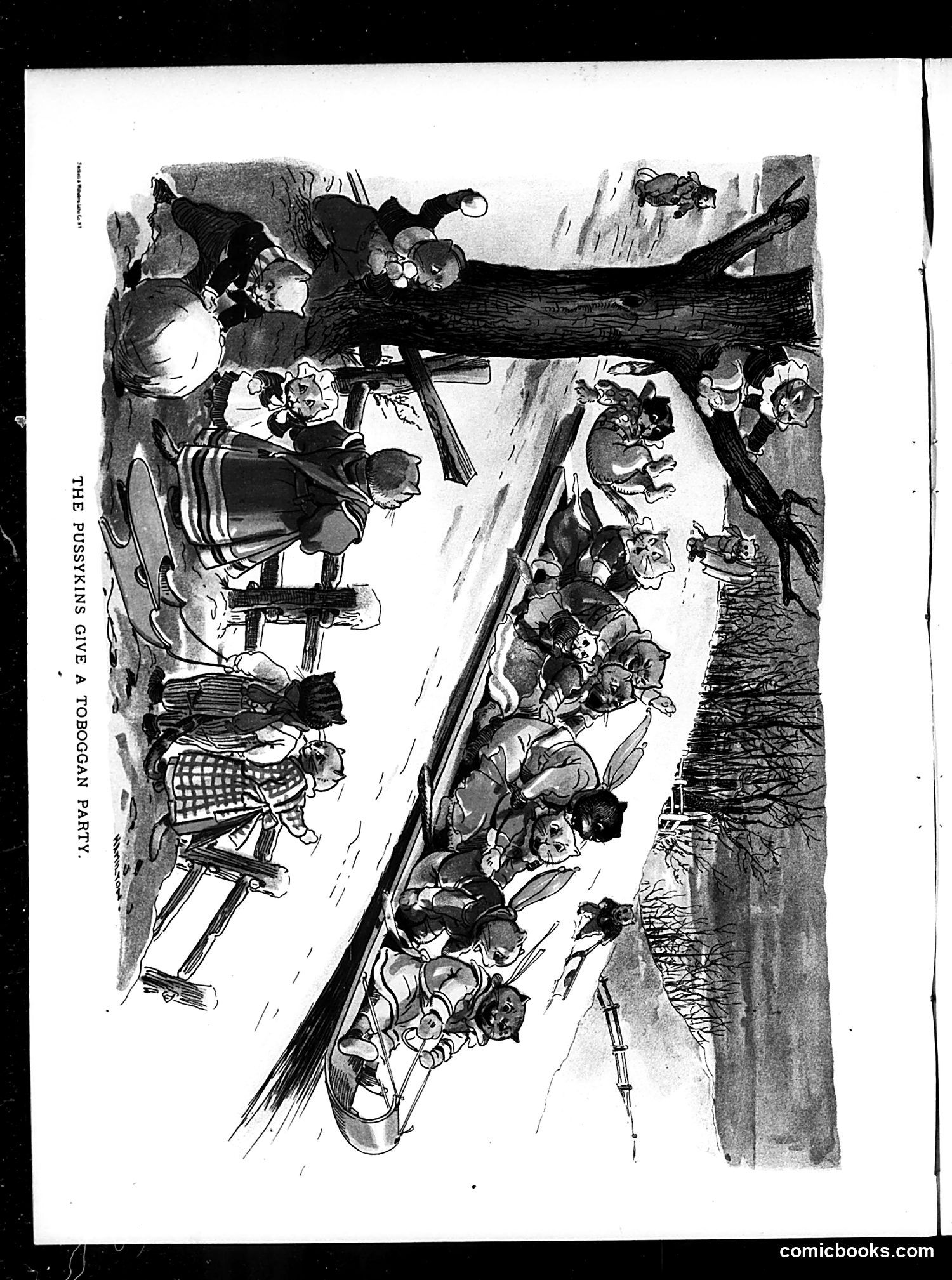
This is a humorous illustration showing anthropomorphized cats enjoying a toboggan ride down a snowy slope. The title "Pussykins" was common Victorian-era slang for cats. The cartoon depicts multiple cats of various sizes crowded onto a toboggan, sliding downhill with expressions of excitement and alarm. The scene plays on the contrast between cats' dignified reputation and their undignified, chaotic behavior in this winter activity—they're tumbling together in an uncontrolled mass. The humor appears to be situational comedy: the absurdity of formally organizing a "party" for animals, the visual chaos of multiple creatures in close quarters, and the implied loss of control as they descend. This type of animal-based slapstick was popular in *Judge* magazine's satirical humor during the late 19th/early 20th century.
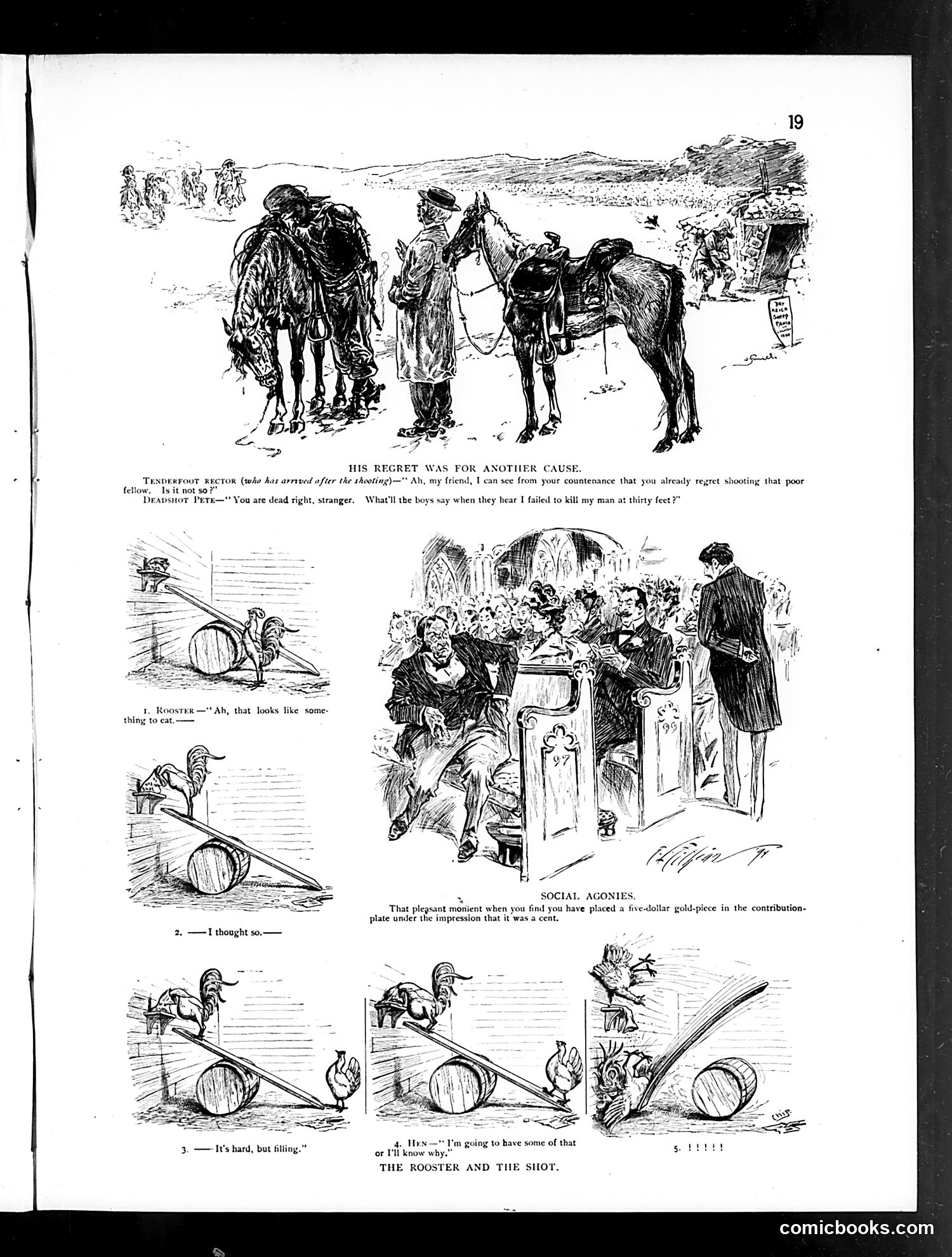
This page contains three separate satirical pieces from *Judge* magazine: **"His Regret Was for Another Cause"** (top): A newly arrived clergyman ("tenderfoot rector") misreads a gunslinger's regret. The cleric assumes the shooter feels guilty about wounding someone, but "Desperate Pete" actually regrets his *marksmanship*—failing to kill at close range. The joke mocks both the naive Eastern religious figure and the crude frontier culture's inverted morality. **"Social Agonies"** (middle): A sequence showing the embarrassment of accidentally placing a five-dollar gold piece in a church collection plate while believing it was a penny. The joke satirizes bourgeois social anxiety and the humiliation of public financial mistakes. **"The Rooster and the Shot"** (bottom): A visual gag showing a rooster's reaction to a rifle shot, depicted through sequential panels. The humor comes from the rooster's increasingly desperate attempts to maintain balance on a seesaw-like device as the explosion affects it. All three pieces reflect *Judge*'s typical late-19th/early-20th-century humor: mocking social pretensions, frontier crudeness, and physical comedy.
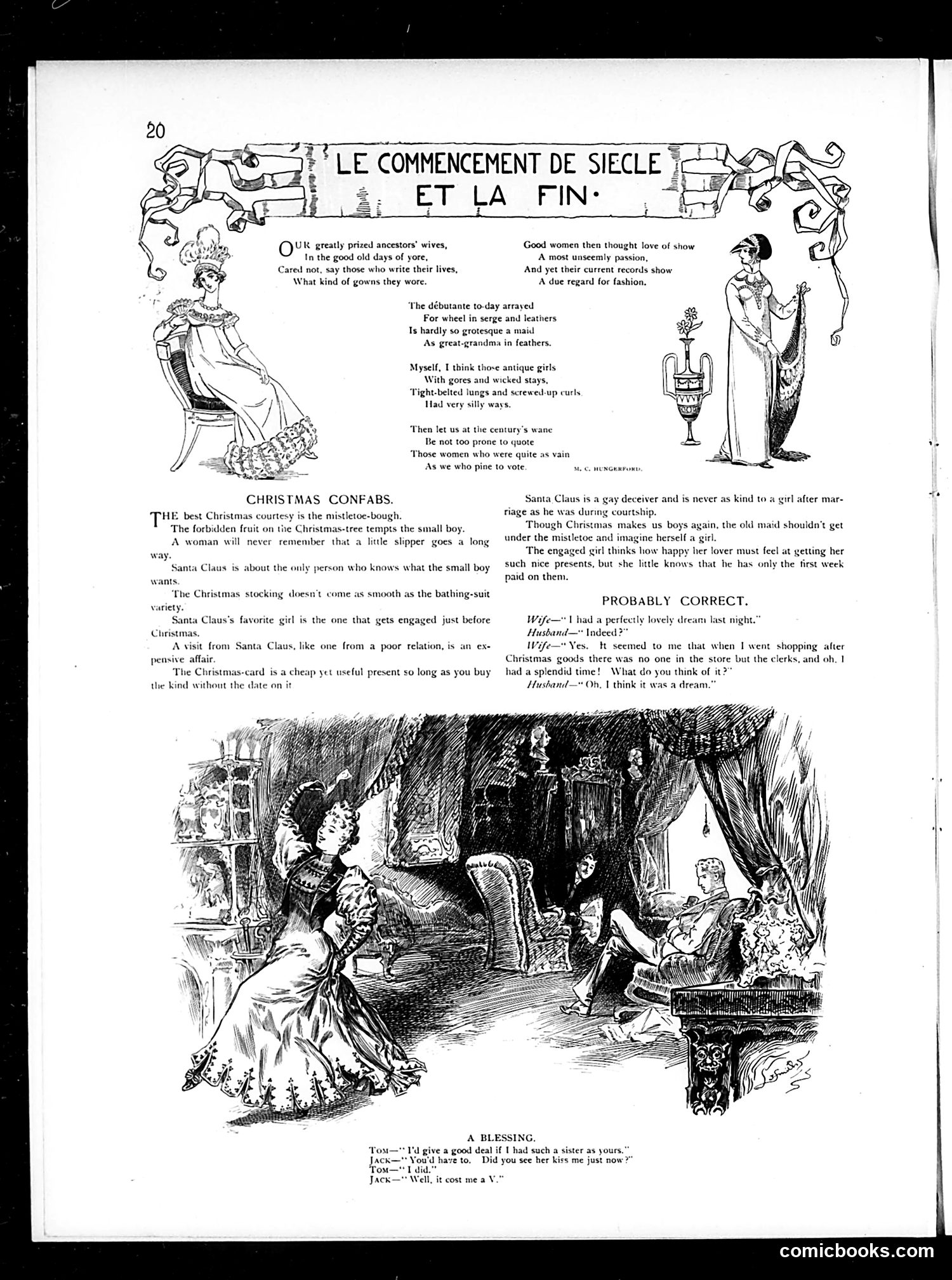
This page satirizes changing female fashion and behavior across centuries. The opening poem contrasts women of past eras (obsessed with elaborate gowns and restrictive corsetry) with modern "New Woman" figures who wear practical "serge and leathers" for activities like cycling—yet are equally vain about fashion and now demand voting rights. The satire's point: women's supposed moral progress is illusory. Whether wearing feathers or modern attire, they remain fundamentally concerned with appearance and social status. The modern woman's pursuit of rights like suffrage is portrayed as just another form of vanity, no more enlightened than her ancestor's obsession with gowns. The Christmas and romance humor below uses similar logic: Santa Claus, mistletoe customs, and engagement gifts reveal women as calculatingly materialistic across all contexts. The tone is mocking toward female ambitions and reformist movements of the era.
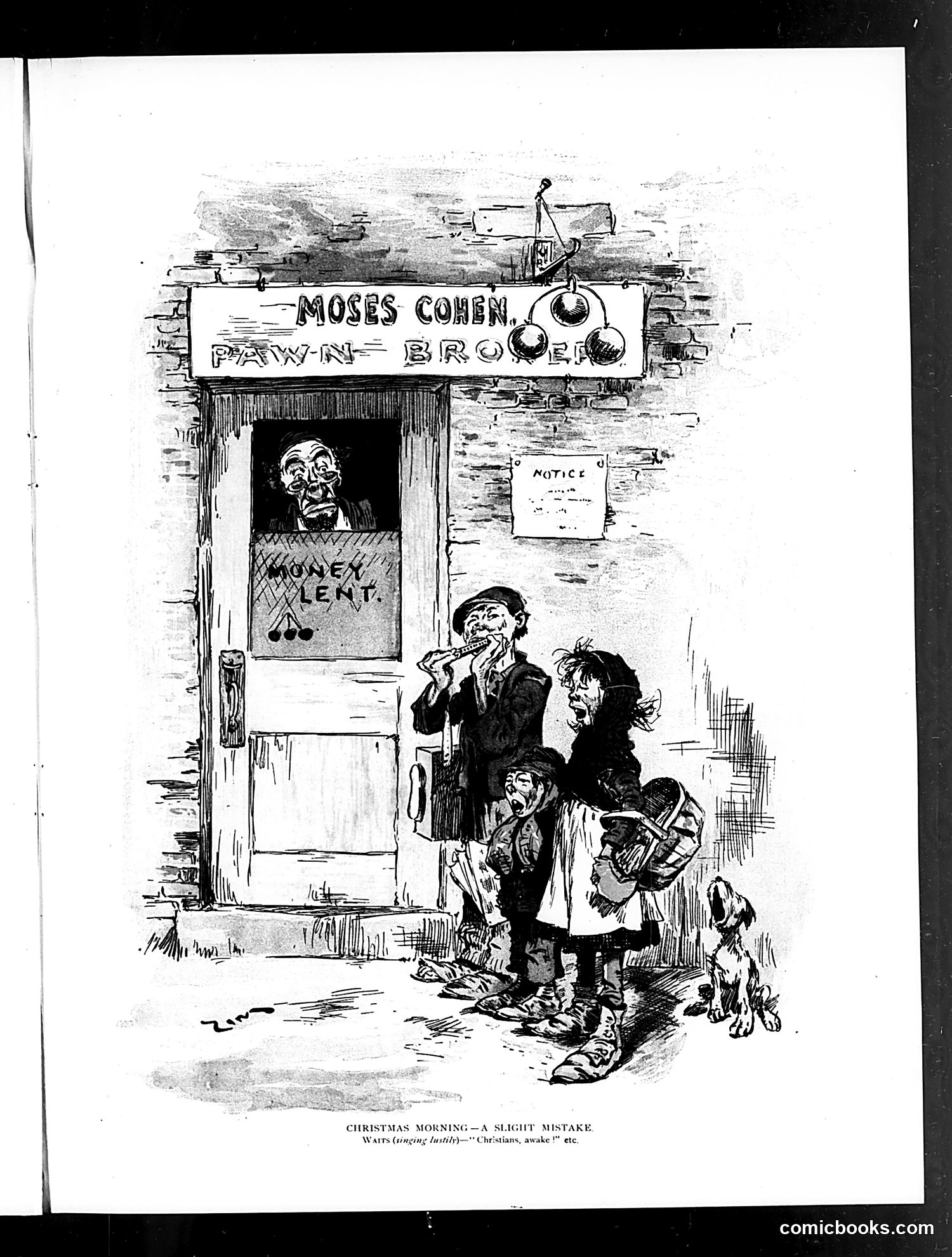
This is a satirical cartoon titled "Christmas Morning—A Slight Mistake." It depicts a pawnbroker's shop ("Moses Cohen, Pawn Broker") where poor families might desperately sell possessions before Christmas. The humor relies on ethnic stereotyping: a Jewish pawnbroker (caricatured with exaggerated features) operates the shop, while impoverished customers—apparently Christian, given the "Christians, awake!" carol reference—stand outside. The "slight mistake" appears to be the irony of singing Christian hymns while patronizing a Jewish pawnbroker out of financial desperation during the holiday season. This reflects late-19th-century prejudices, depicting both poverty and using caricature to satirize religious and ethnic differences. The cartoon mocks the gap between Christmas ideals and harsh economic reality for the poor.
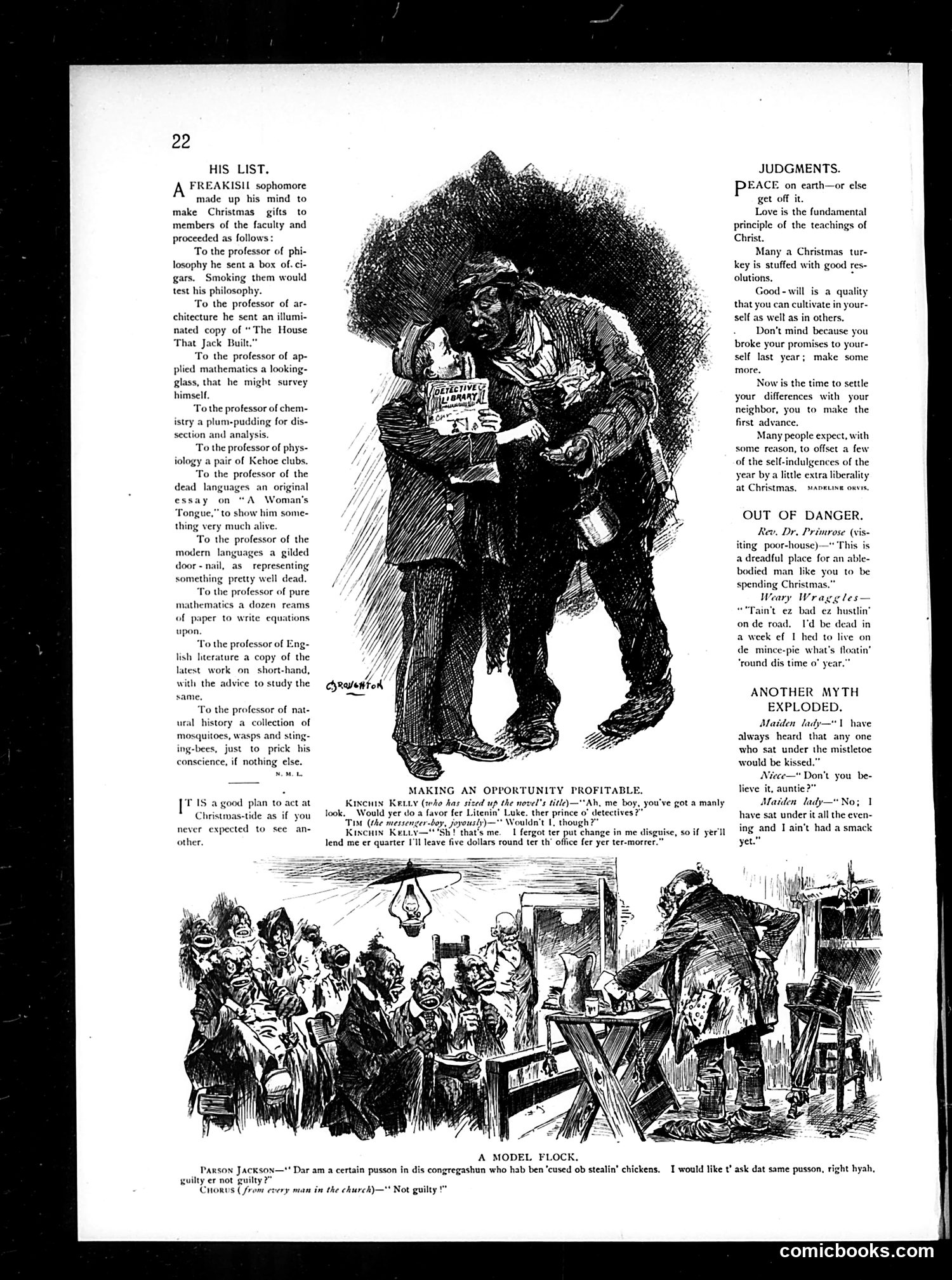
This page contains several separate satirical pieces typical of Judge's mix of humor and social commentary. **"His List"** mocks a sophomore's misguided Christmas gifts to professors—each gift is a clever insult disguised as a present. The looking-glass for the mathematics professor implies vanity; the plum-pudding for chemistry suggests he should dissect rather than think; the essay on "A Woman's Tongue" as something "alive" to the classics professor is a sexist jab. The satire targets both the student's presumption and academic pretension. **"Making an Opportunity Profitable"** depicts a con: a man poses as a detective to borrow money from someone, promising to return it multiplied. **"A Model Flock"** shows a preacher asking his congregation who stole chickens; the chorus's denial ("Not guilty") is darkly humorous—the entire congregation claims innocence, suggesting widespread hypocrisy or guilt. The page reflects late-19th/early-20th-century concerns: academic pomposity, petty crime, and rural/working-class dishonesty.

I can see this is a page from *Judge* magazine (as indicated by the watermark), but the image is almost entirely black or severely underexposed, making it impossible to discern any cartoon imagery, text, figures, or caricatures. The OCR text provided contains only a website URL and no substantive content. Without being able to see the actual cartoon(s) or read legible text on the page, I cannot identify the figures, political references, or satirical intent. To provide accurate historical analysis as requested, I would need a clearer or properly exposed image of the page content.

I can see this is a page from *Judge* magazine (indicated by the "comicbooks.com" attribution), but the image quality is extremely poor—almost entirely black with only a faint curved line visible in the lower center portion. The OCR text provides no readable content beyond the source attribution. Without legible text or clear visual details, I cannot identify specific figures, political references, or the intended satire. The page appears to be either severely degraded, a blank/filler page, or improperly scanned. To accurately analyze this cartoon's meaning and historical context, I would need either a higher-quality image or additional source information about the publication date and intended subject matter.
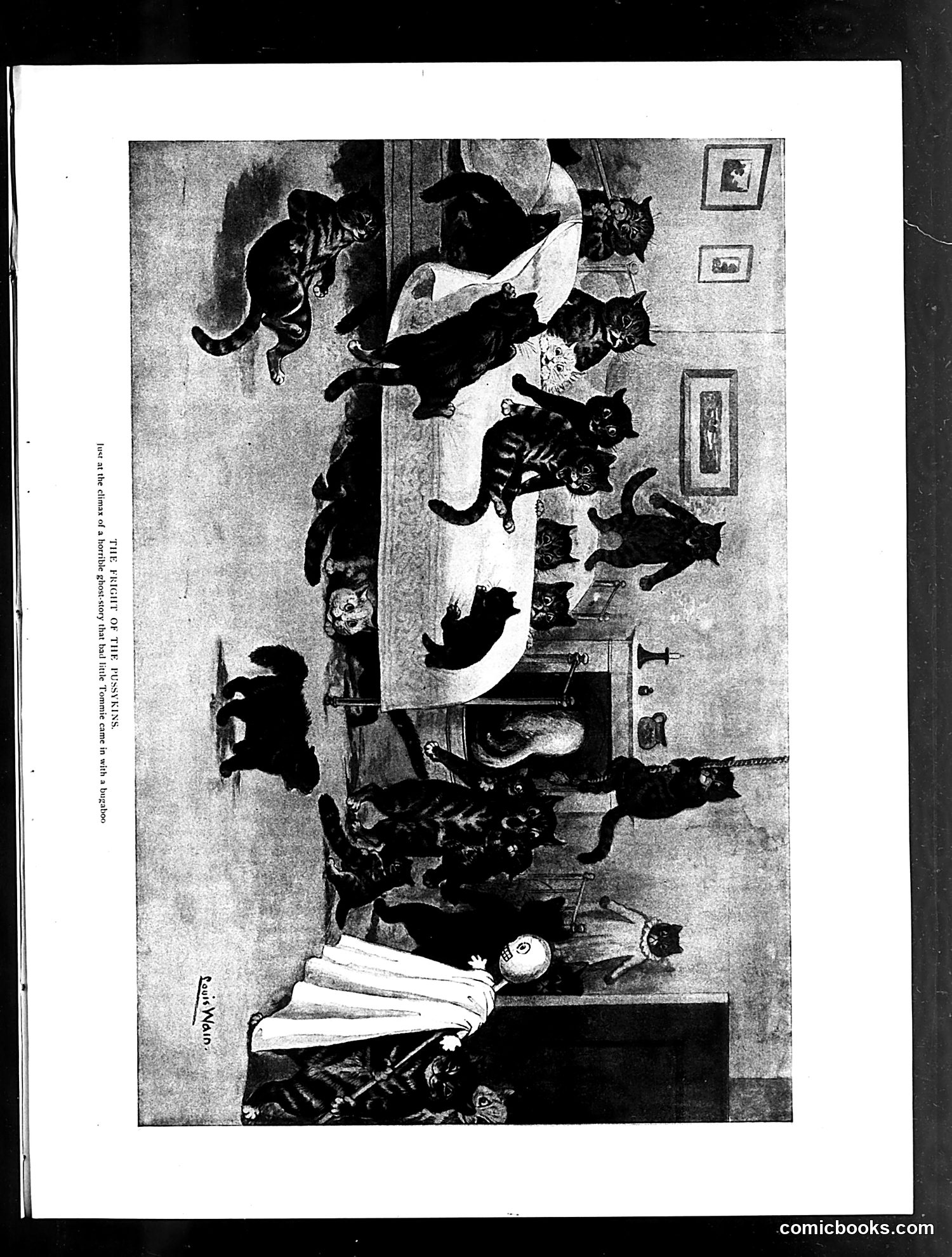
This page shows a single illustration rotated 90 degrees, depicting a woman surrounded by multiple cats in what appears to be a domestic interior. The image is a satirical commentary on the "crazy cat lady" archetype—a stock figure of ridicule in late 19th/early 20th-century American humor. The cartoon mocks excessive pet ownership, suggesting social eccentricity or mental instability through the accumulation of animals. The woman's engagement with her numerous cats satirizes both unmarried women and those perceived as socially isolated. This reflects period attitudes dismissing female independence and non-traditional domestic arrangements. The specific historical context or intended subject remains unclear without visible text attribution or date information on this page.
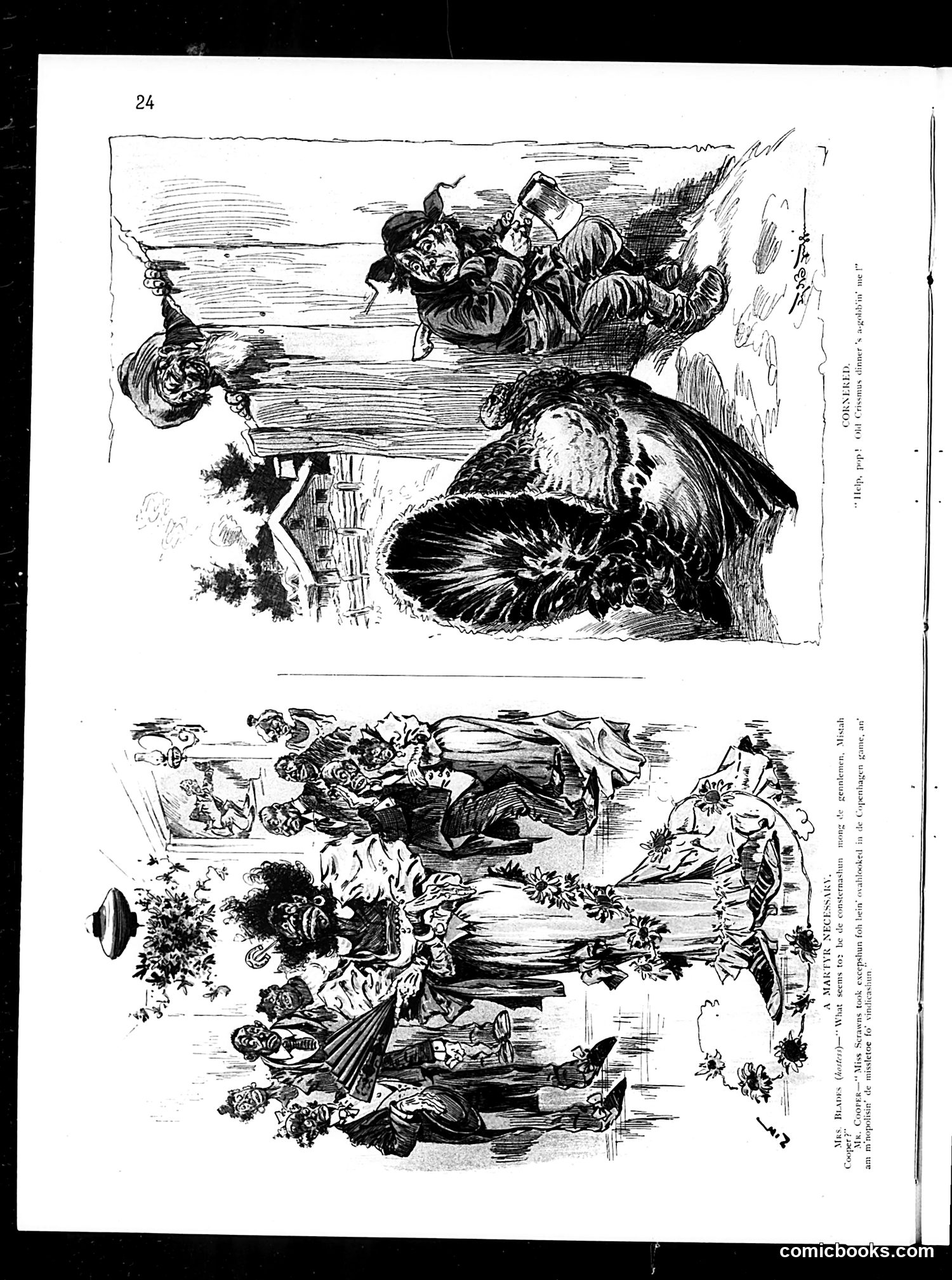
This page contains two political cartoons rendered in black ink sketches typical of late 19th-century satirical illustration. The **upper cartoon** depicts what appears to be a chaotic scene with multiple figures in a boat or vessel, suggesting political turmoil or instability. The style suggests commentary on governmental discord or legislative conflict. The **lower cartoon** shows a group of figures in period dress arranged in a scene, though the specific political reference remains unclear from the image alone without additional caption text that may be illegible in this reproduction. Both cartoons employ caricature and exaggerated physical features characteristic of Judge magazine's satirical approach to American politics and society. Without legible caption text, the precise political figures or events referenced cannot be definitively identified.
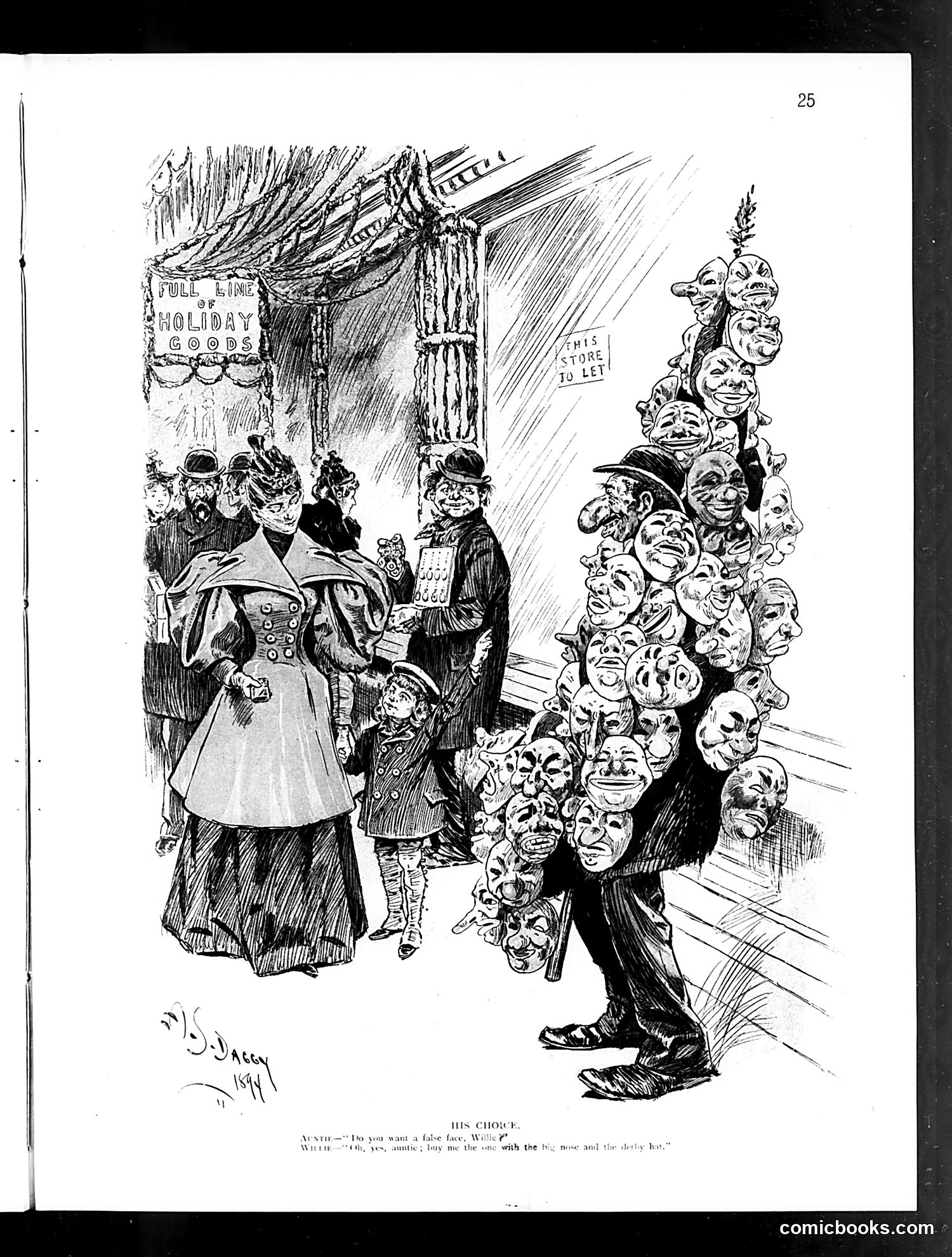
This political cartoon satirizes what appears to be a corrupt political machine or group of unscrupulous politicians. A well-dressed man (likely a political boss or corrupt official) displays a grotesque "choir" of caricatured faces stacked like masks or puppets on his person—suggesting these are politicians he controls or has corrupted. On the left, ordinary citizens (a woman with child and men) stand outside a store advertising "FULL LINE HOLIDAY GOODS," apparently unable to shop while this corrupt display occurs. The dialogue references wanting "false faces," implying these politicians are frauds. The cartoon critiques political corruption and the exploitation of public offices for personal gain, suggesting powerful figures manipulate lesser politicians like puppets while ordinary people suffer economically.
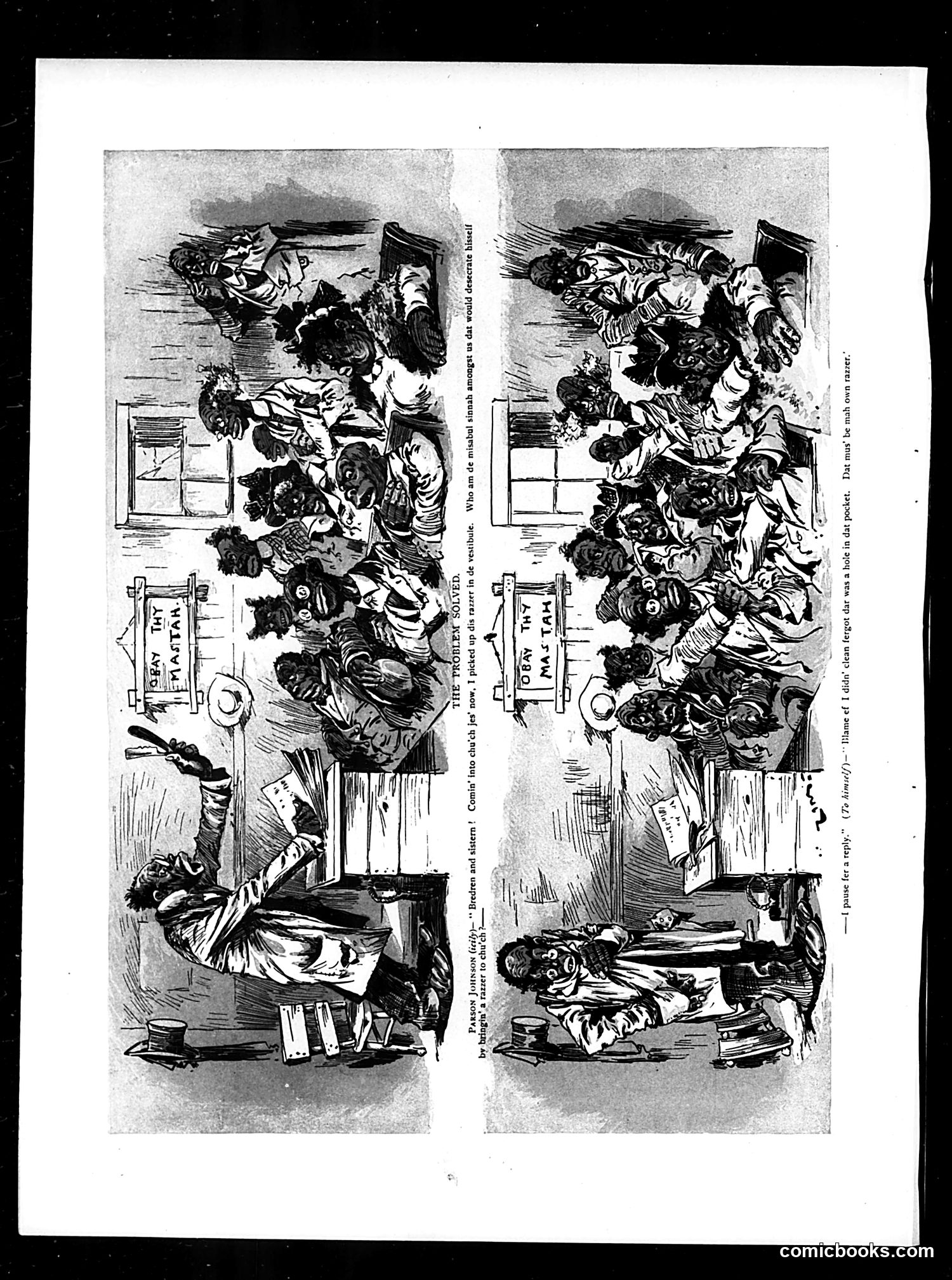
The OCR text is too corrupted to read reliably. However, examining the image itself: this appears to be a two-panel satirical cartoon rendered in black-and-white engraving style, typical of late 19th-century Judge magazine. Both panels depict crowded interior scenes with multiple figures engaged in what seems to be chaotic activity around a central structure or table. The style suggests social or political commentary on urban life, possibly depicting working-class conditions, immigration experiences, or tenement living. Without legible text or clearer identification of specific figures, I cannot confidently identify the particular political figures, events, or social issues being satirized. The craftsmanship and composition suggest significant satirical intent, but determining the exact subject requires more readable source material.

I can see this is a page from Judge magazine (as indicated by the watermark), but the image is almost entirely black or severely degraded, making it impossible to discern any cartoon artwork, text, or satirical content. The only clearly visible element is the "comicbooks.com" credit at the bottom right. Without being able to see the actual illustrations or read the accompanying text clearly, I cannot identify any figures, political references, or explain the satire intended. To provide an accurate historical analysis as requested, I would need a clearer, higher-contrast scan of this page.

I can see this is a mostly blank or extremely dark page from Judge magazine with minimal visible content. The only clearly legible text is the "comicbooks.com" watermark at the bottom right and what appears to be a page number "1" in the upper left. The image quality is too poor and the page too dark to discern any cartoon illustrations, caricatures, or satirical content with confidence. Without being able to read the actual content or see illustrations clearly, I cannot identify specific figures, political references, or the intended satire. This appears to be either a title page, a blank page, or a scanning issue that has rendered the original content illegible.
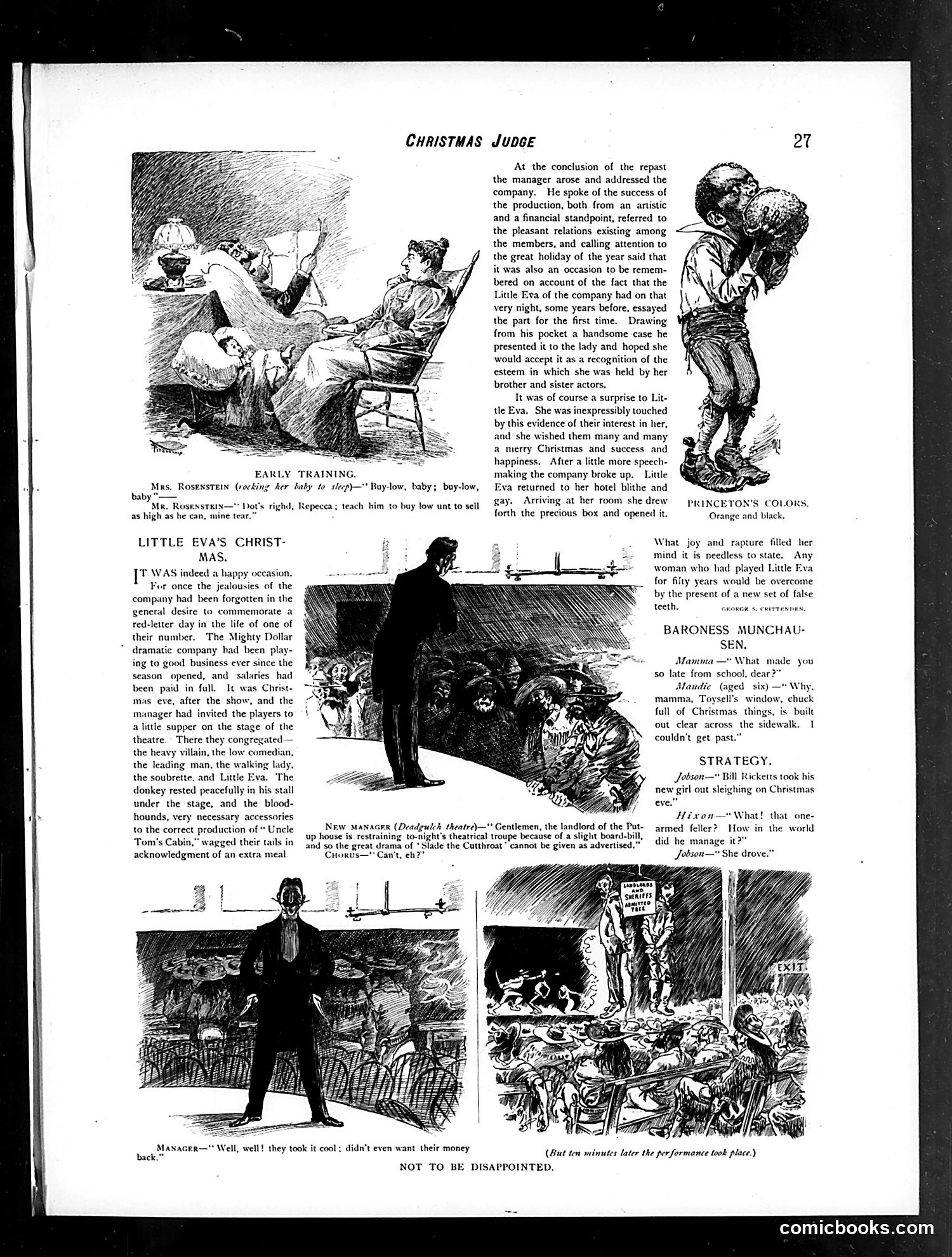
This page presents theatrical Christmas humor circa early 1900s. The main story, "Little Eva's Christmas," depicts a theatrical company celebrating after a performance. The manager presents a gift to the actress playing "Little Eva"—a reference to the famous child character from *Uncle Tom's Cabin*, then a standard stage production. The satire centers on theatrical vanity: an aging actress (who's played this role for fifty years) receives false teeth as a gift, the joke being her obvious physical decline despite her continued employment. The smaller cartoons mock Jewish immigrants ("Rosenstein") and their capitalist instincts, and include jokes about courtship strategies. "Princeton's Colors" references the university's orange and black insignia, likely an advertisement or unrelated item. The overall tone reflects period stereotypes and theatrical in-jokes now largely obscure to modern audiences.
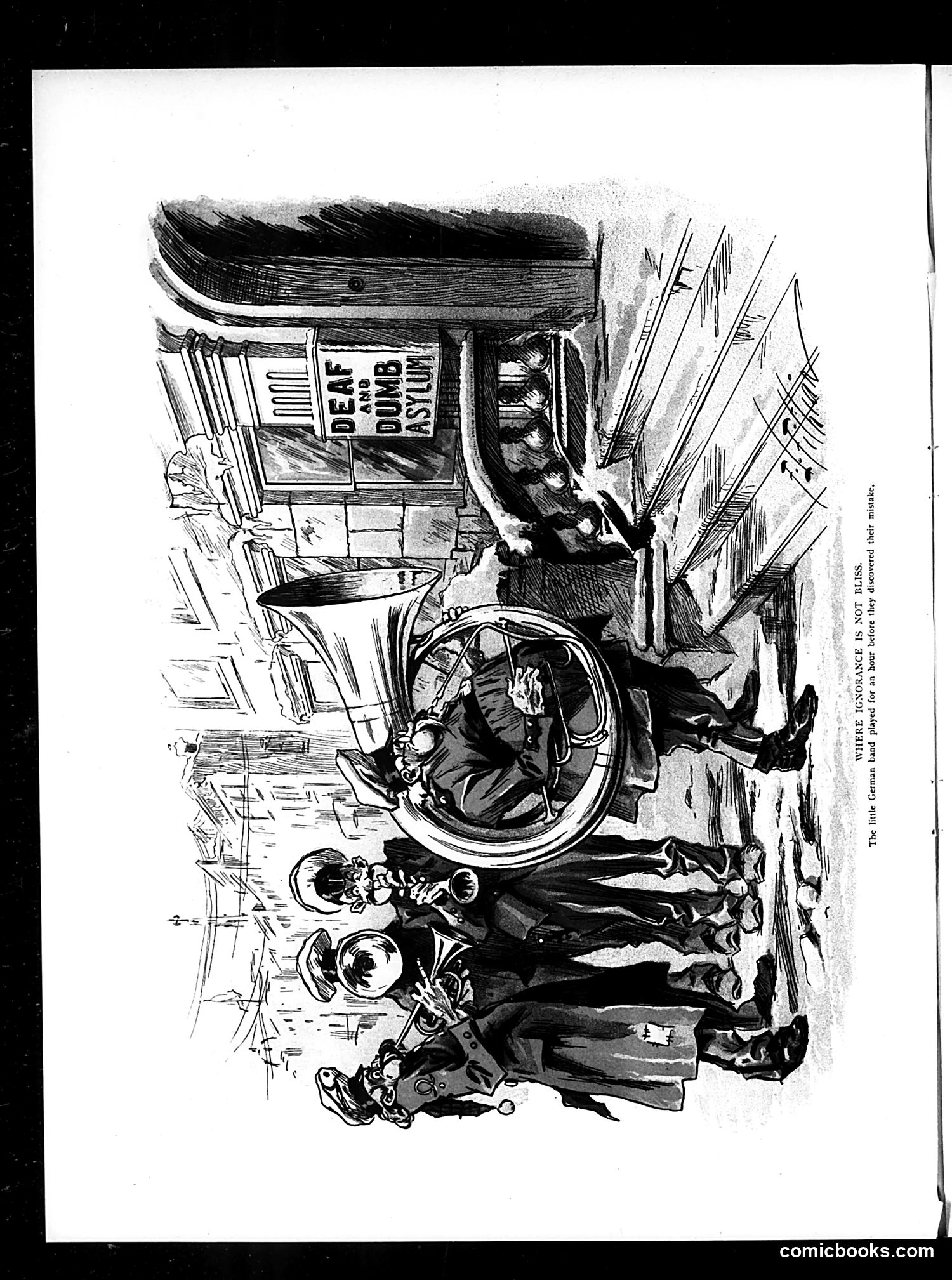
This cartoon appears to depict a street scene with a storefront sign reading "DEAF AND DUMB ASYLUM." The image shows what appears to be a German musical band performing outside the building, with several figures standing nearby. The OCR text references "The little German band played for an hour before th[ey discovered their mistake]," suggesting the joke involves the band unknowingly performing for deaf patrons—hence the irony and humor of their misplaced effort. This likely reflects period anti-German sentiment or stereotypes common in American satire. The specific context and date remain unclear from the visible information, but the cartoon ridicules both the German band's obliviousness and, implicitly, the institution's residents.
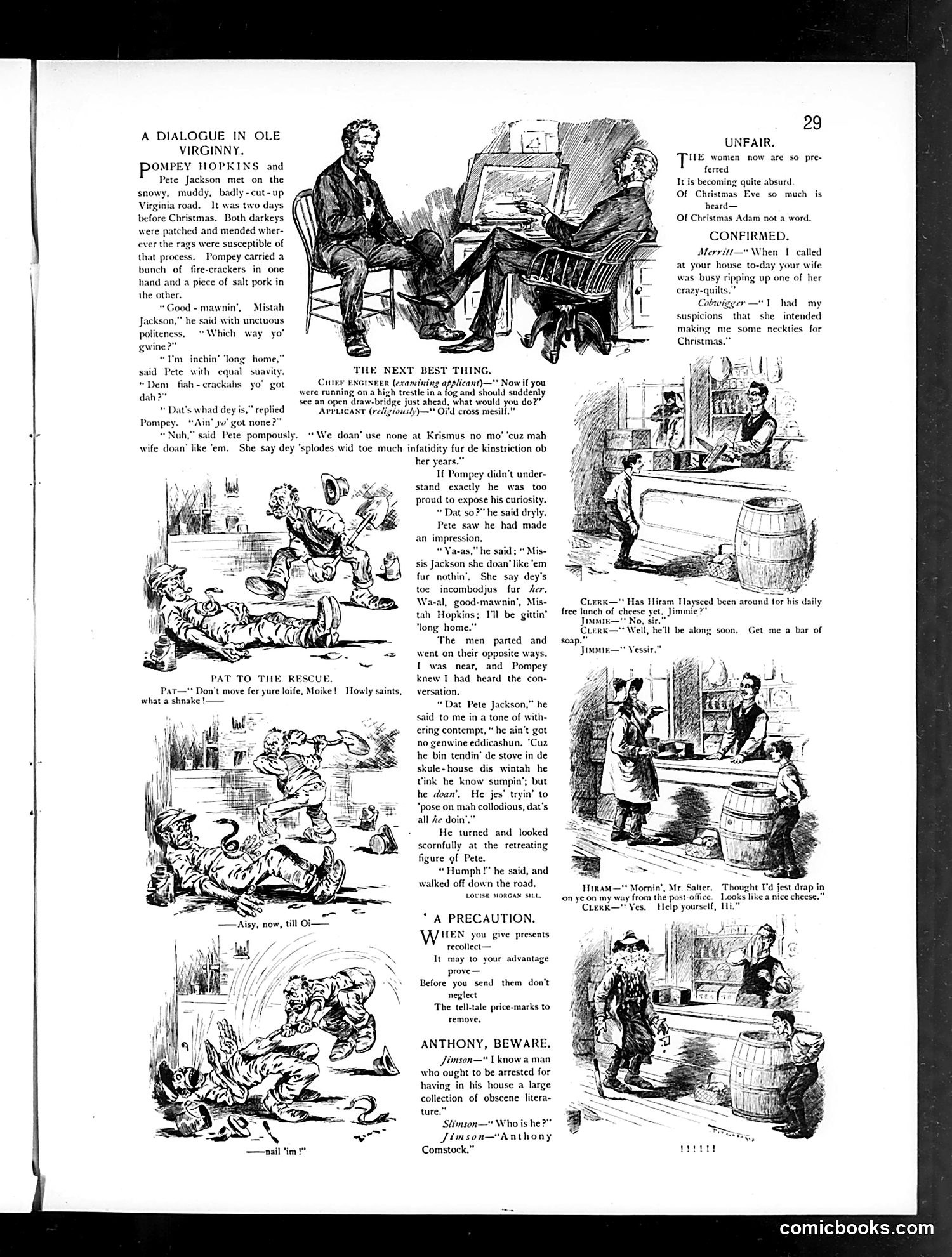
This page contains several satirical pieces typical of Judge's content: **"A Dialogue in Ole Virginny"** depicts two enslaved Black men (Pompey Hopkins and Pete Jackson) discussing firecrackers before Christmas. The satire mocks Pete's pretentious claim that his wife dislikes firecrackers because they cause "infatidity" (likely "infirmity"), when he actually means they're inconvenient. Pompey, overhearing this, ridicules Pete for adopting false sophistication from working at a schoolhouse stove—the joke being that Pete's malapropism reveals his lack of "genuine education." **Other sketches** include: an engineer applicant who crosses himself rather than answering a technical question (ethnic Irish stereotype); a snake-related mishap; a Christmas gift warning about removing price tags; and a jab at Anthony Comstock (the famous anti-obscenity crusader), suggesting he should be arrested for possessing "obscene literature." The page demonstrates Judge's reliance on racial and ethnic stereotyping common to late-19th-century American humor, alongside social commentary and wordplay.
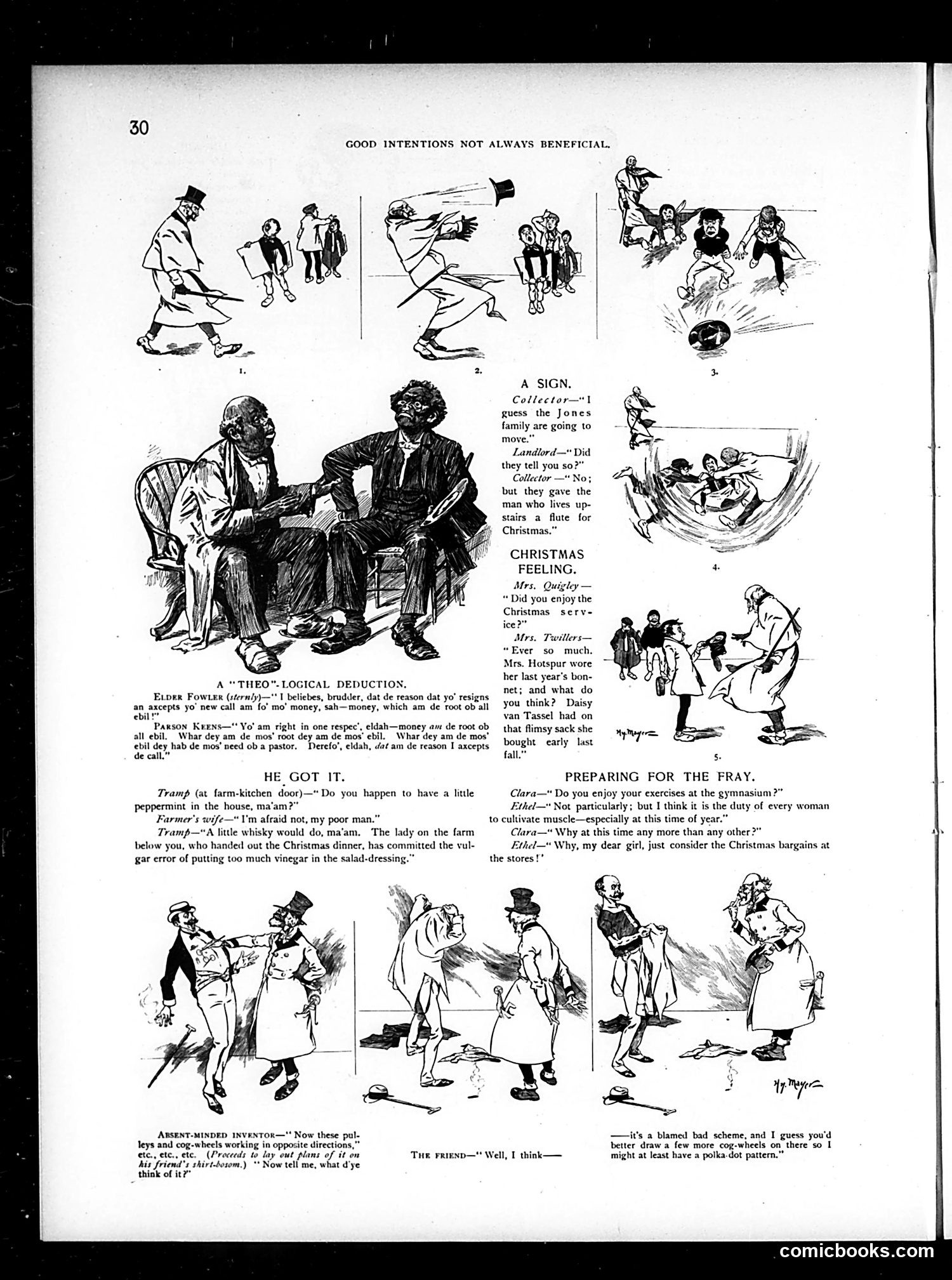
This page contains several unrelated comic sketches satirizing American social life, likely from the early 1900s: **"A Theo Logical Deduction"** mocks a Black minister's circular reasoning about money and evil, using dialect humor typical of the era's offensive racial stereotypes. **"He Got It"** depicts a tramp exploiting a farmer's wife's charity by complaining about vinegar in another woman's salad—suggesting con artists prey on competing female vanity. **"A Sign"** jokes that a tenant family's gift of a flute to upstairs neighbors signals they're moving (implying the gift is meant to apologize for noise). **"Christmas Feeling"** satirizes women gossiping about others' clothing choices at church services rather than attending to worship. **"Preparing for the Fray"** shows women exercising to build strength for Christmas shopping bargains—mocking both female shopping habits and newly fashionable gym culture as motivated by consumerism rather than health. Throughout, the cartoons ridicule human selfishness masked by social convention.
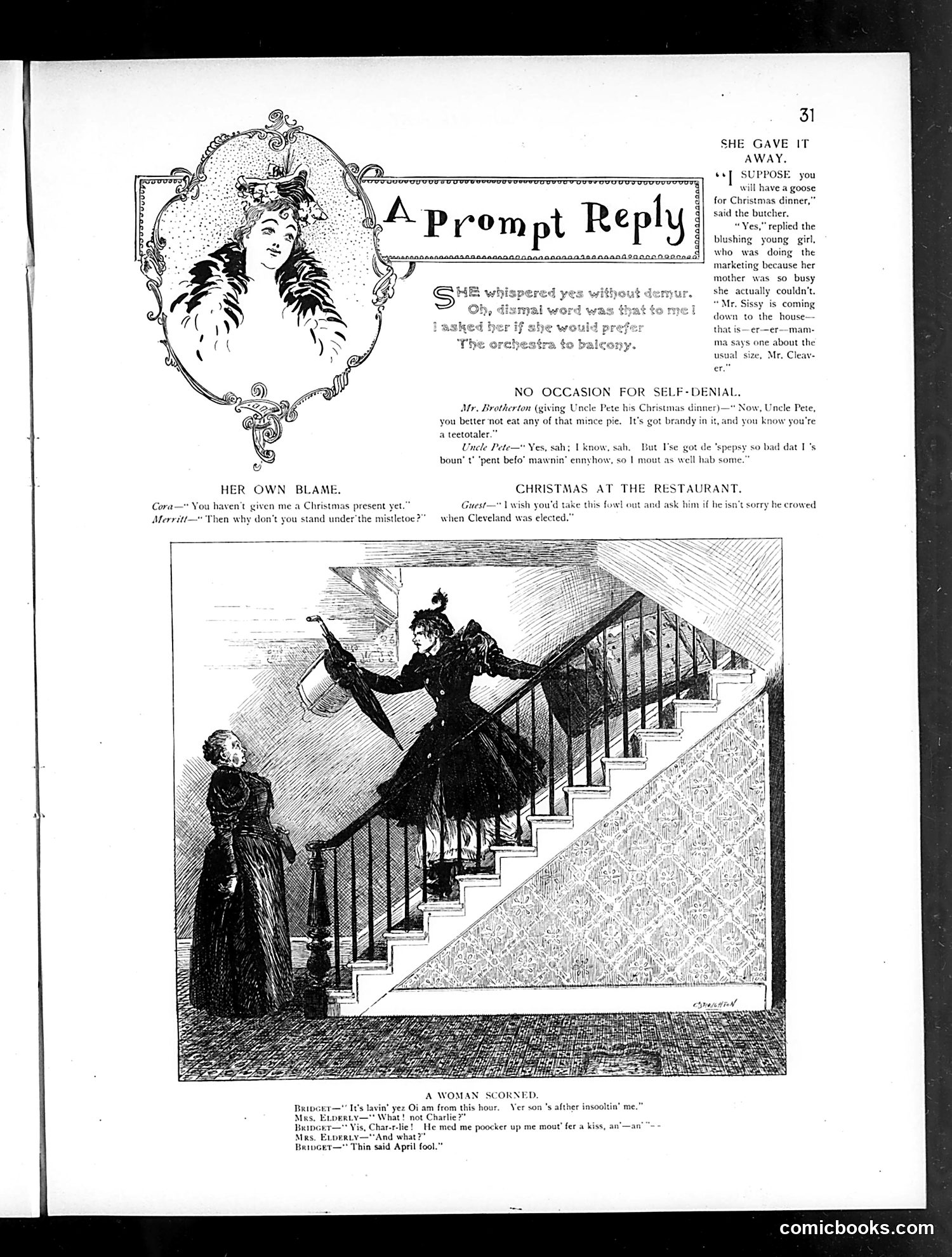
This page contains four separate humorous vignettes satirizing courtship, family dynamics, and social behavior in late 19th-century America. **"Her Own Blame"** mocks a young woman's romantic naiveté—she complains about receiving no Christmas gift while refusing to position herself under mistletoe, the traditional spot for soliciting kisses (and gifts). **"No Occasion for Self-Denial"** features an Uncle Pete character (depicted in dialect suggesting Irish or African American vernacular) who claims indigestion justifies breaking his teetotaler pledge to drink brandy in mince pie—rationalizing hypocrisy. **"Christmas at the Restaurant"** makes a political joke: a guest suggests asking a poorly-cooked fowl if it regrets "crowing when Cleveland was elected," referencing Grover Cleveland's presidency and likely mocking his policies. **"A Woman Scorned"** depicts a woman angry after a man pranked her on April Fool's Day by pretending to kiss her. The page satirizes romantic miscommunication, moral flexibility, and social pretense among middle and working classes.
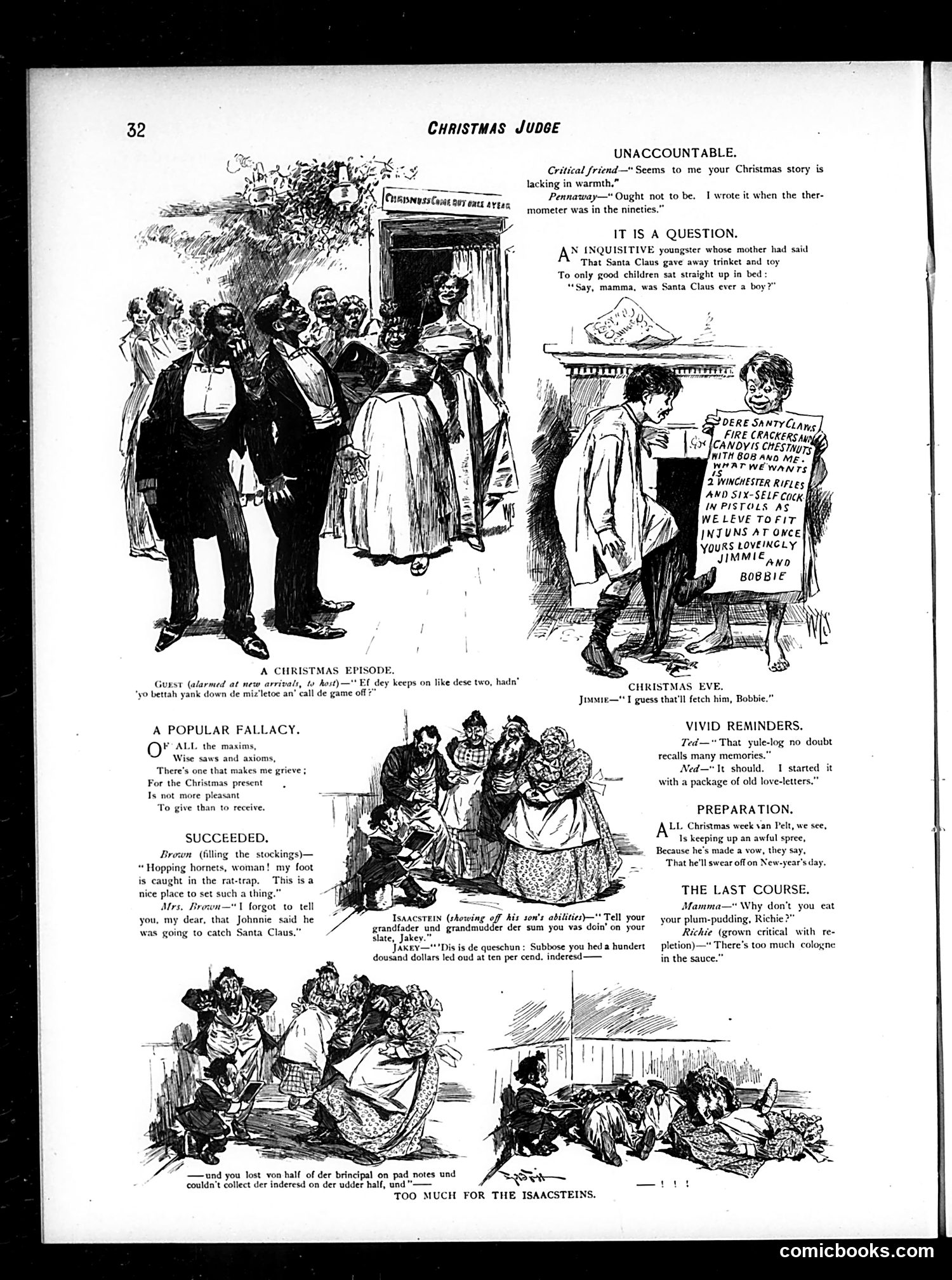
This page from *Judge* magazine contains holiday-themed satirical sketches mocking various Christmas traditions and social types of the era. "It Is a Question" jokes about children's logic regarding Santa Claus—a child wonders whether Santa was ever young himself, exposing the contradiction in the myth. "A Popular Fallacy" sarcastically challenges the saying that giving gifts is more pleasant than receiving them—*Judge* suggests this maxim is false. "Christmas Episode" depicts working-class or immigrant hosts (indicated by dialect) overwhelmed by rowdy guests, using mistletoe removal as an excuse to end the chaos. "A Christmas Epistle" shows children's wish-list escalation, featuring weapons (Winchester rifles, pistols) they hope to receive—satirizing materialistic excess and aggressive play. The Isaacstein sketch uses heavy immigrant dialect and caricature (suggesting a Jewish family) to mock financial incompetence and pretension. The overall tone reflects *Judge*'s satirical approach to middle and working-class American life, sometimes employing ethnic stereotyping common to the period.
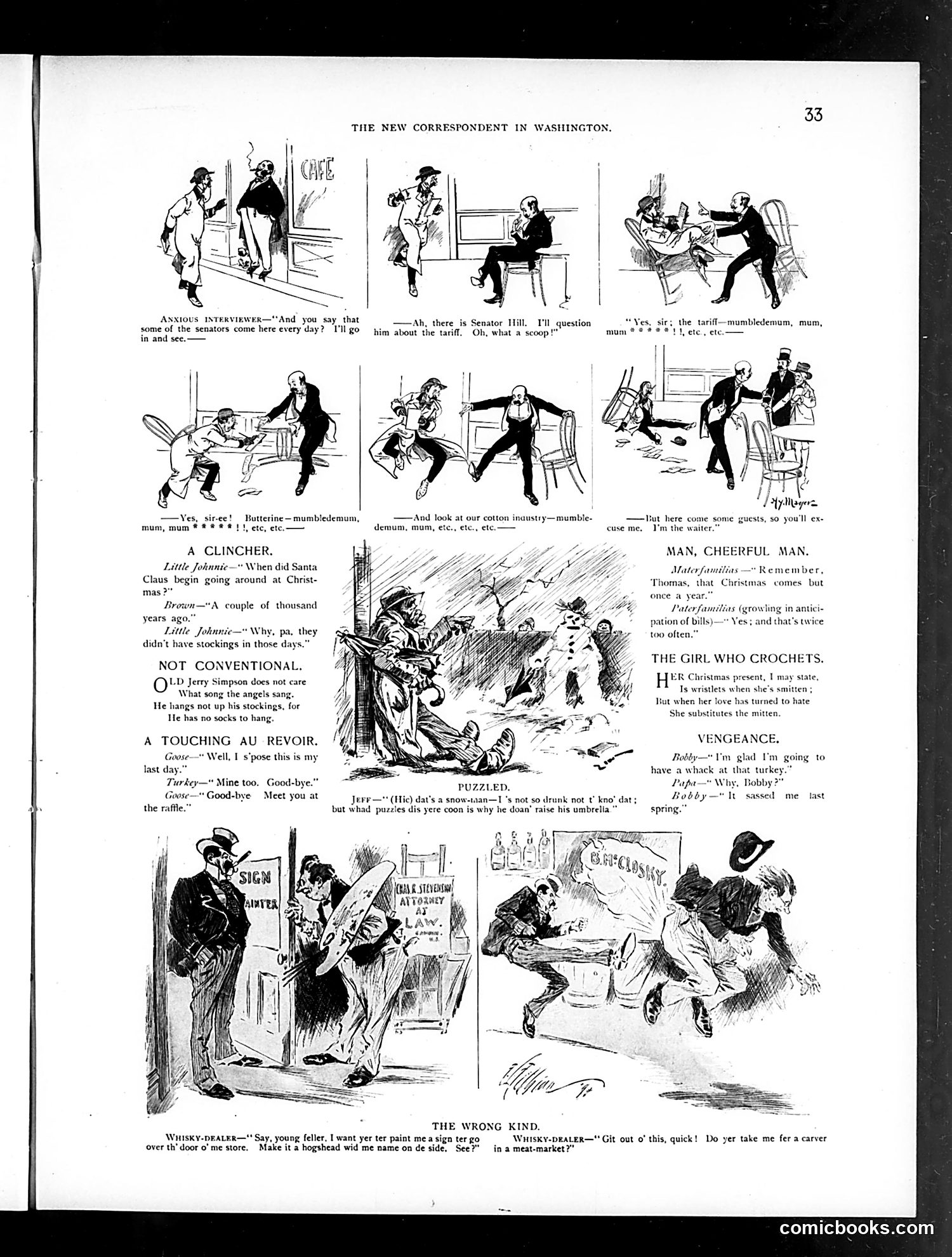
This satirical page mocks a naive newspaper reporter attempting to interview senators about the tariff—a major political issue of the era. The joke: when the reporter finally encounters Senator Hill, the senator's responses are incomprehensible mumbling ("mumbledemum, mum"), rendering the "scoop" useless. This ridicules both senators' evasiveness on substantive policy and journalists' struggle to extract meaningful statements from politicians. The other sketches are unrelated humor vignettes typical of Judge magazine—jokes about Christmas stockings, an unconventional politician (Jerry Simpson) too poor to own socks, and various domestic comedies. "The Wrong Kind" appears to play on misunderstandings between a sign painter and a whiskey dealer. The overall page reflects late-19th-century American political satire targeting protectionist tariff debates and Washington's political theater.
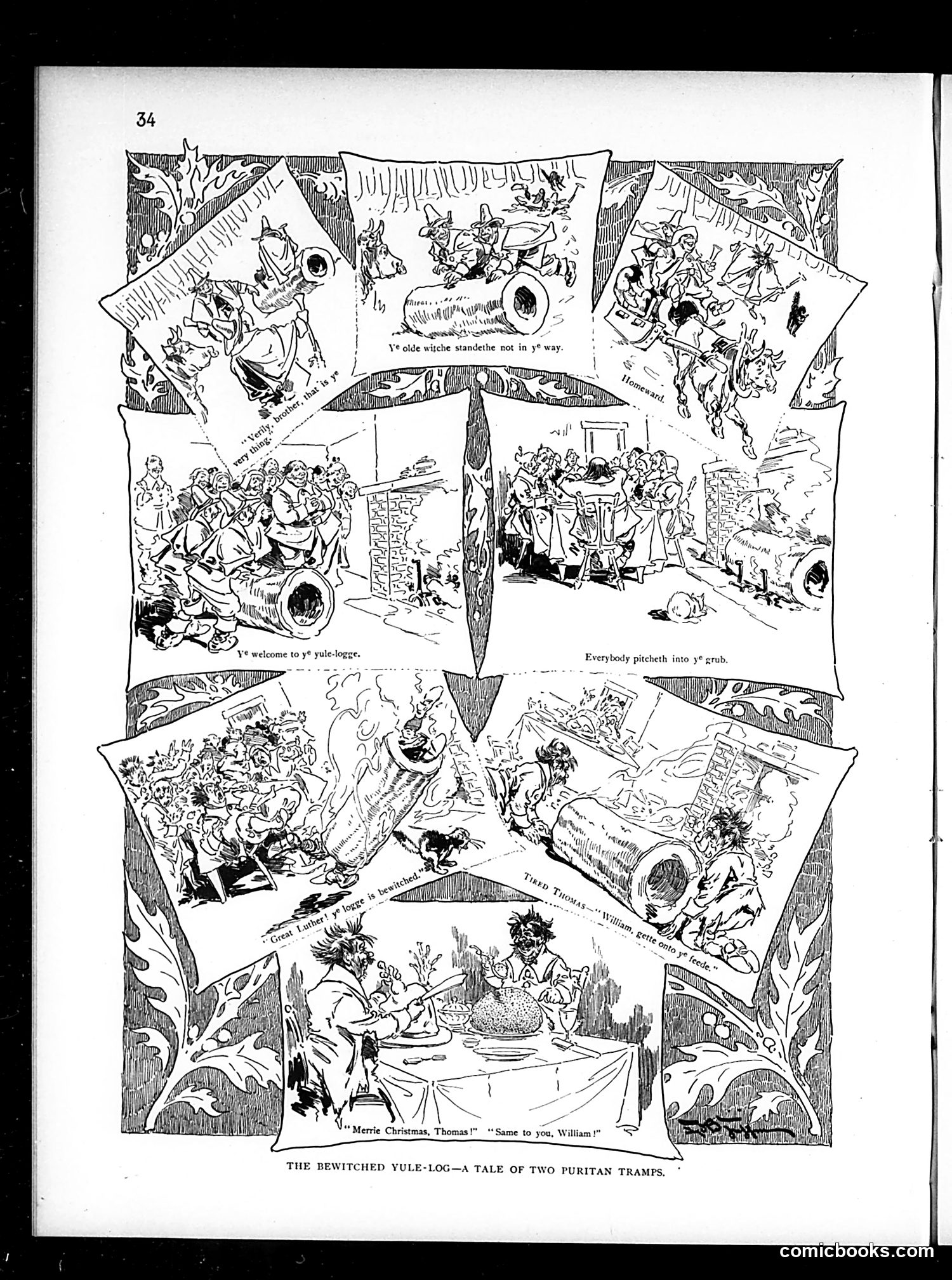
This satirical comic strip mocks Puritan attitudes toward Christmas celebration. The narrative follows two vagrant "Puritan tramps" who encounter a magical yule log that grants wishes. The comic contrasts Puritan sobriety with festive indulgence: the tramps initially resist Christmas revelry (fitting their supposed religious strictness), but the bewitched log compels them into increasingly chaotic holiday debauchery—eating, drinking, and merrymaking. The satire targets the historical Puritan opposition to Christmas observance as frivolous and sinful. By showing the "Puritan" characters helplessly swept into celebration despite their ideology, Judge ridicules Puritan restraint as both hypocritical and futile against human nature's desire for festivity. The comic presents Christmas indulgence as inevitable and desirable, opposing Puritan values as absurdly rigid.
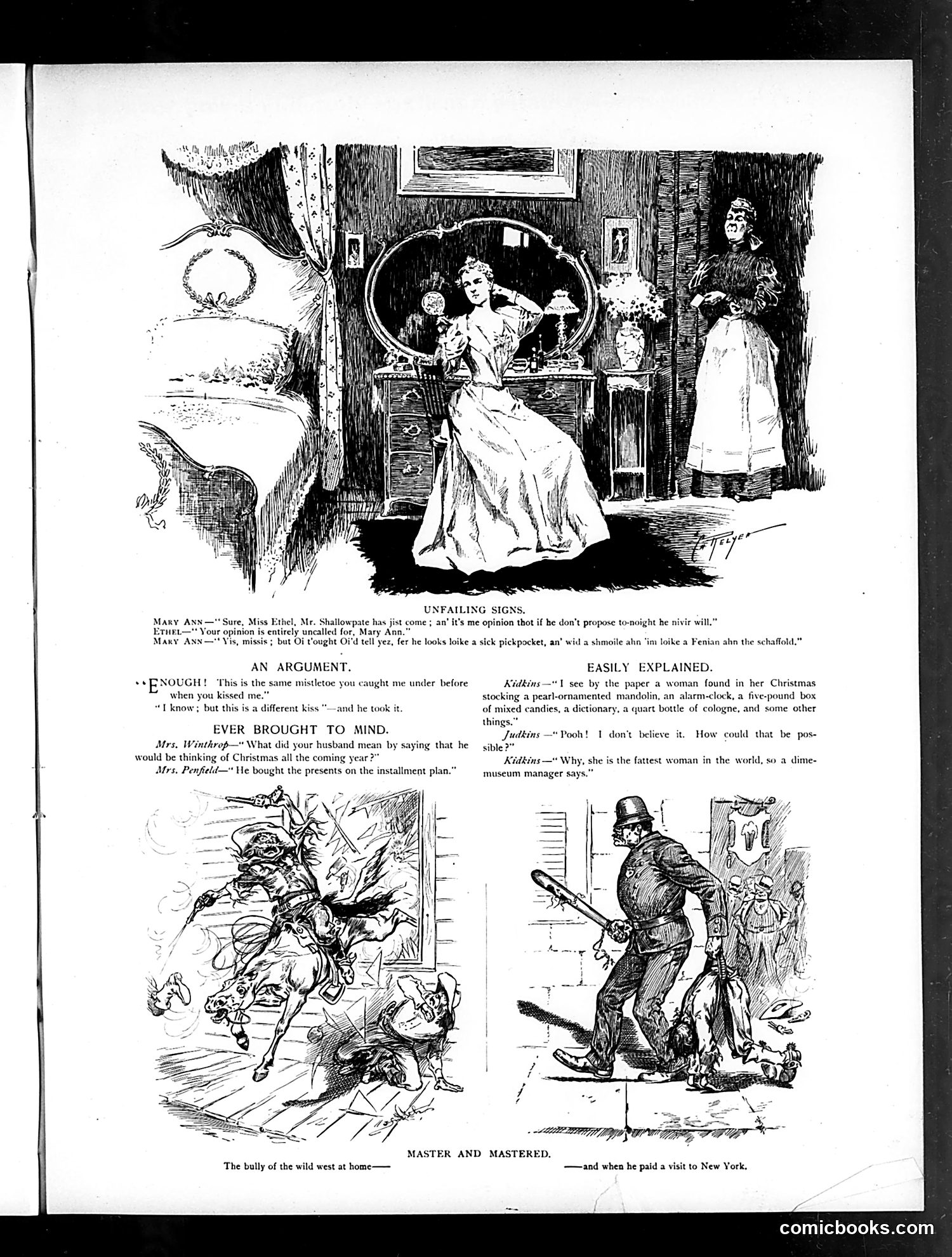
This page collects several brief humorous sketches with accompanying illustrations, typical of Judge's satirical format. **"Unfailing Signs"** depicts a domestic servant advising her mistress that a suitor should propose tonight or never—he looks ill and insincere. The humor relies on Irish dialect comedy (common in period American humor). **"An Argument"** shows a couple revisiting a mistletoe kiss, with the man insisting this kiss "feels different" than before, implying changed feelings or circumstances. **"Ever Brought to Mind"** jokes about installment buying: a husband's comment about thinking of Christmas "all year" refers to ongoing debt payments. **"Easily Explained"** presents an absurd scenario—a woman receiving implausibly large items in her stocking—resolved by revealing she's extremely obese, allowing everything to fit. This relies on fat-shaming humor. **"Master and Mastered"** contrasts a "wild west bully" behaving one way at home versus differently during a New York visit, suggesting frontier roughness versus civilized constraint. The illustrations are typical period line-drawings emphasizing character types and physical comedy.
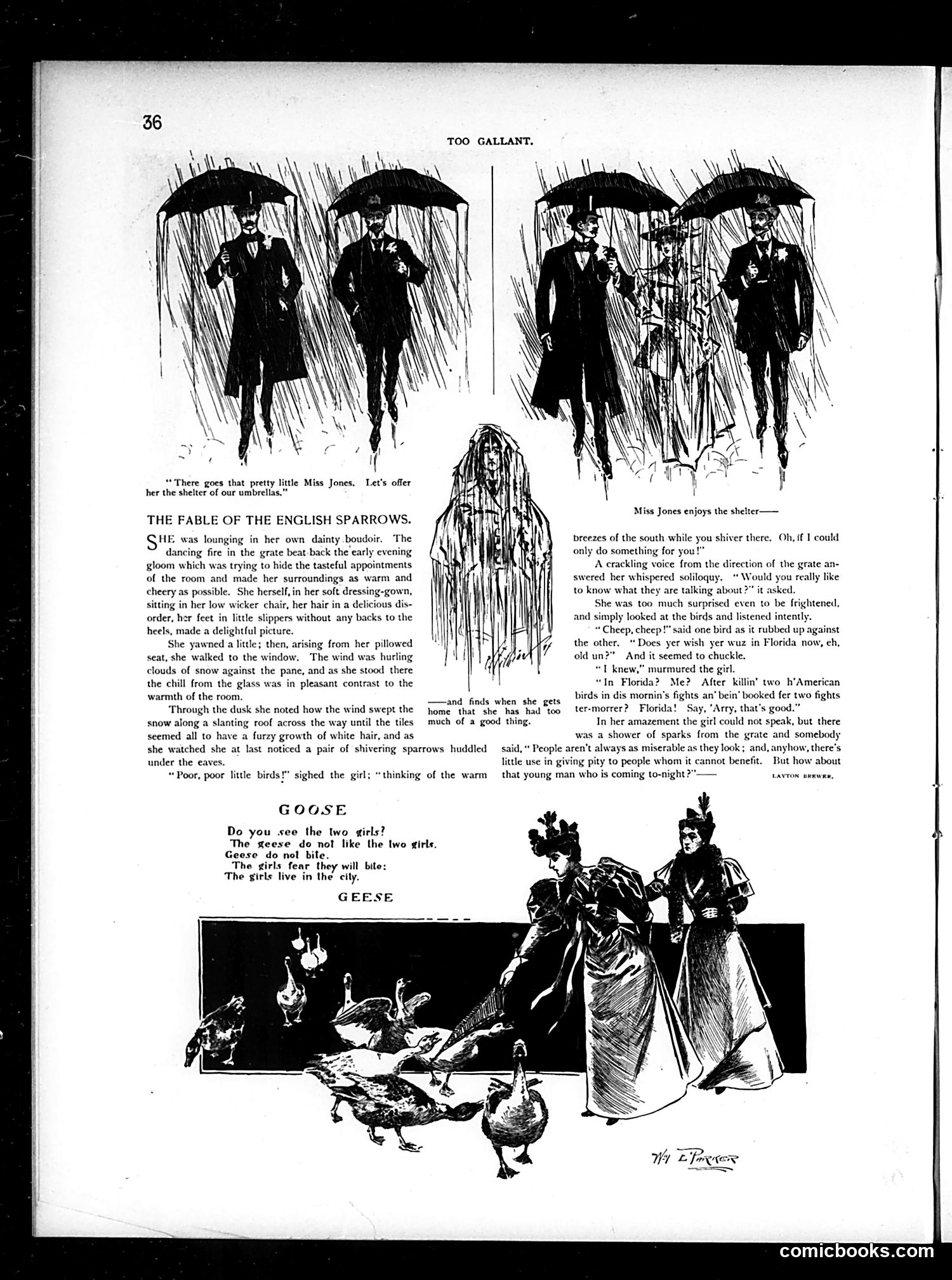
This page contains two satirical pieces: **"The Fable of the English Sparrows"** depicts a sentimental young woman observing shivering sparrows outside her warm window. She wishes to help them, but when the birds miraculously speak, they reveal themselves as tough London street sparrows—brawling, boastful, and uninterested in pity. They mock her sentimentality, having just fought each other and facing court appearances. The satire mocks naive, romanticized compassion for the poor: the "sparrows" represent working-class Londoners who don't need or want sympathy. **"Too Gallant"** is a brief joke about gallant men offering Miss Jones shelter from rain with their umbrellas, only to discover she's enjoying herself too much in the situation—the satire targets insincere chivalry and naive, pleasure-seeking women who misinterpret male attention. **"Goose"** is a short rhyming verse mocking urban girls who fear geese despite geese being harmless, suggesting city dwellers are foolishly fearful of nature.
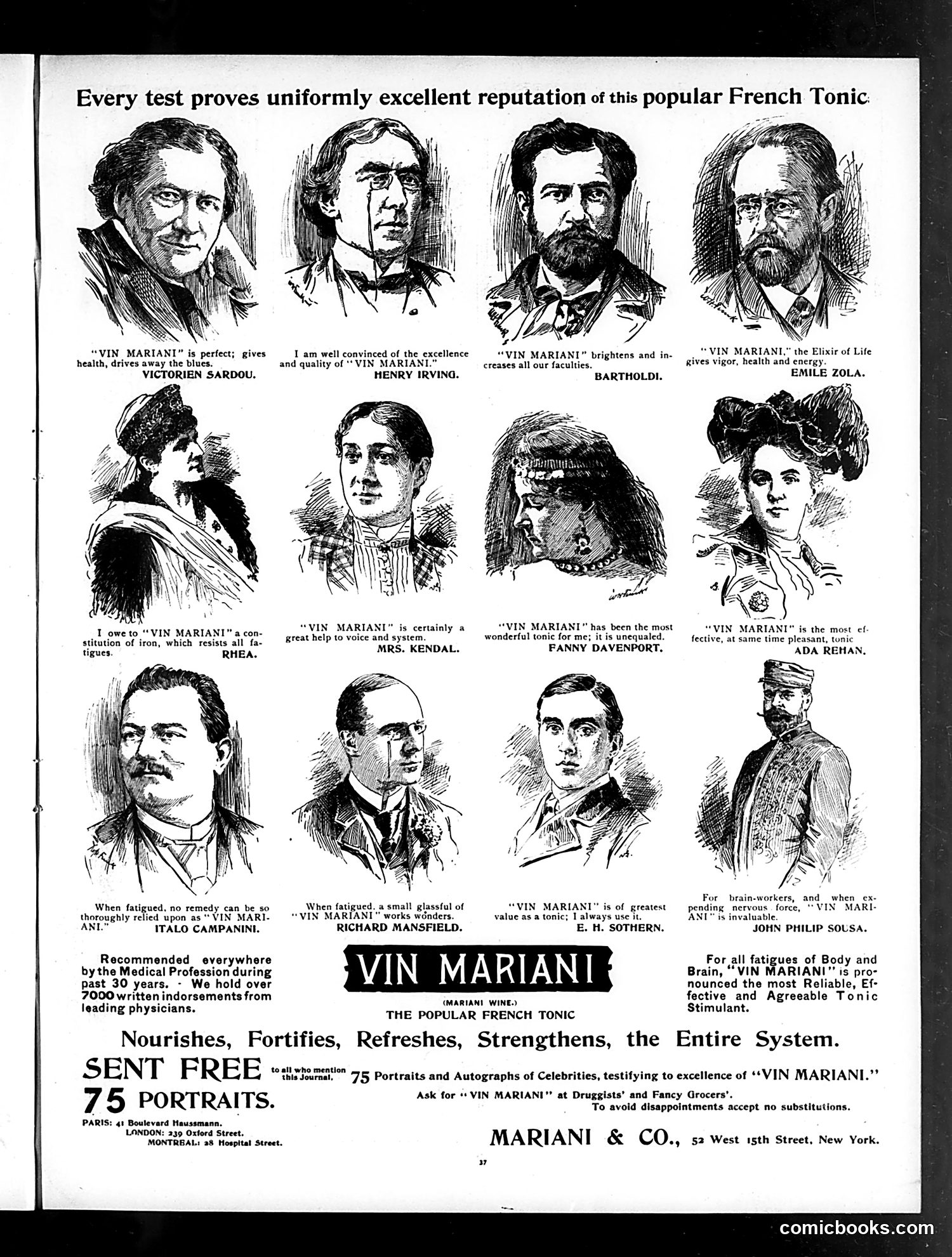
This is not political satire—it's a full-page advertisement for Vin Mariani, a French tonic wine popular in the late 19th century. The page features endorsements from famous celebrities of the era: actors (Henry Irving, Mrs. Kendal, Ada Rehan, Richard Mansfield, E.H. Sothern, Fanny Davenport), composer John Philip Sousa, author Émile Zola, playwright Victorien Sardou, sculptor Bartholdi, and tenor Italo Campanini. Each portrait includes a testimonial claiming the tonic cured fatigue, strengthened constitution, or enhanced mental faculties. The ad promises "75 Portraits and Autographs of Celebrities" free to interested consumers and emphasizes endorsements from "7000 written indorsements from leading physicians." Vin Mariani actually contained cocaine (from coca leaf extract)—a fact not disclosed here but common in patent medicines of this period. The advertisement exploits celebrity culture and medical authority to sell what we'd now recognize as a potentially dangerous product.
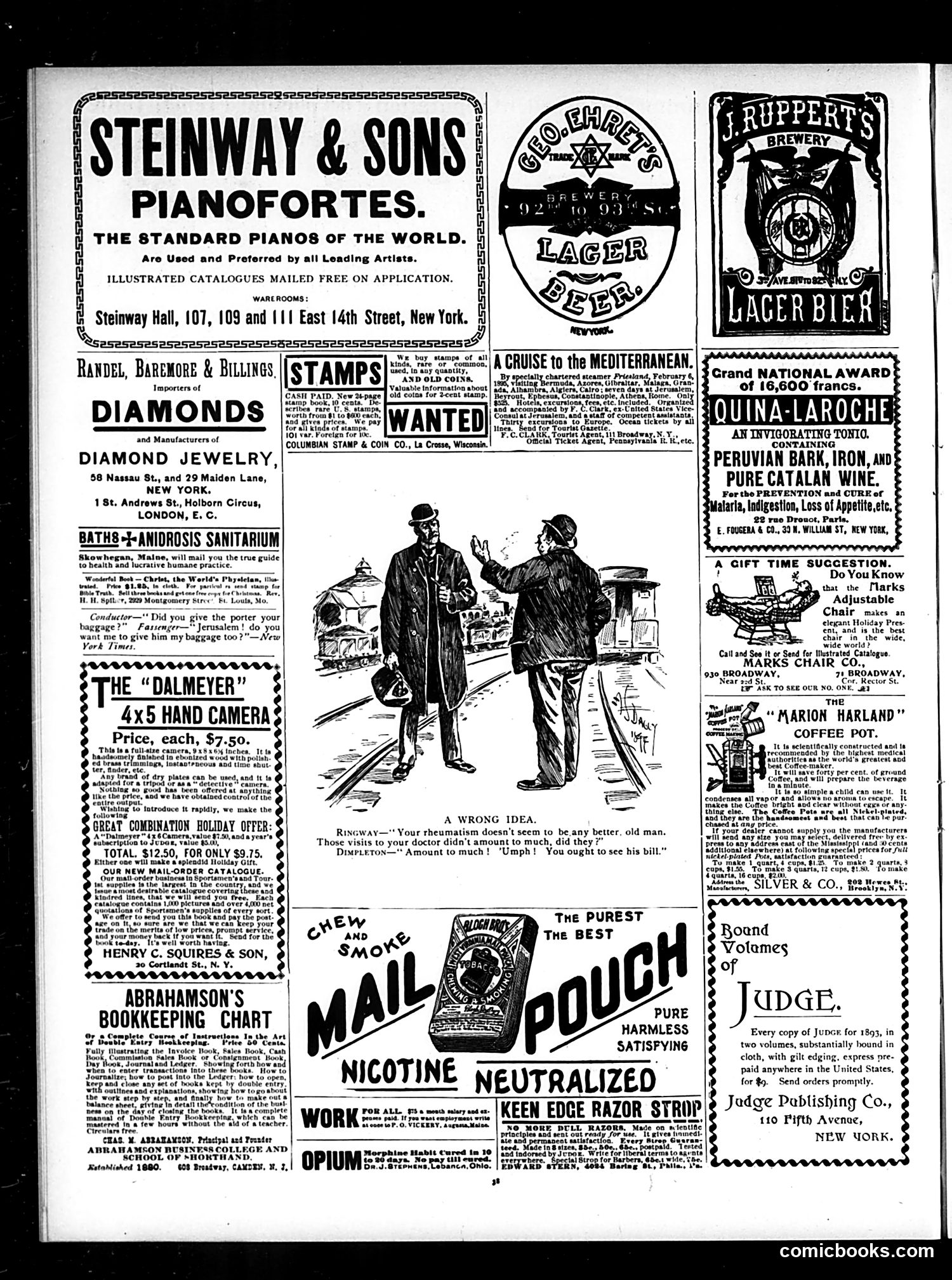
This is primarily an **advertising page** from Judge magazine, typical of late 19th-century publications. The main editorial content is a small cartoon captioned "A WRONG IDEA," depicting two men discussing a doctor's visit. The joke's premise: the patient complains his rheumatism isn't improving despite doctor visits, but the doctor's response—"You ought to see his bill"—suggests the real injury is financial, not medical. This satirizes inflated physician fees of the era. The page is dominated by commercial advertisements for consumer goods (pianos, diamonds, cameras, patent medicines, coffee makers) and services typical of the Gilded Age. These ads reveal period consumer culture: luxury items, health tonics with dubious claims (like "Nicotine Neutralized" products), and mail-order conveniences. The cartoon itself represents Judge's light social satire—poking fun at everyday frustrations rather than explicit political commentary.
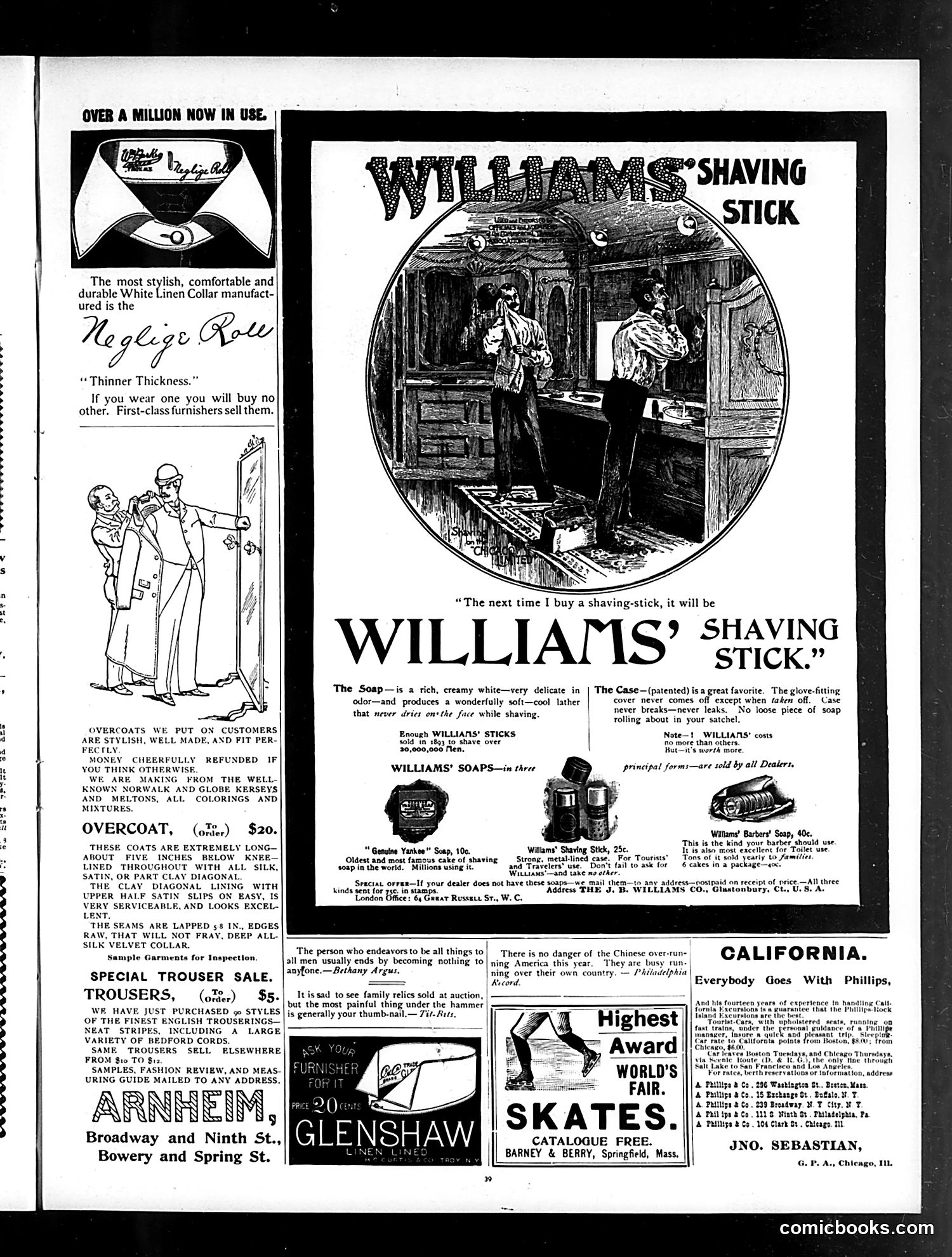
This page is primarily **advertising**, not satirical content. It features: **Main Advertisements:** - **Negligo Roll collar** (top left): a men's linen collar brand claiming superior style and durability - **Arnheim overcoats and trousers** (left): menswear retailer promoting long coats and discounted pants - **Williams' Shaving Stick** (center/right): the dominant ad, featuring a barbershop scene and claiming over 20 million units sold in 1893. Emphasizes the soap's superior case design and lather quality - **Glenshaw Linen Lined collar** (bottom left) - **Barney & Berry skateboard catalogue** (bottom center) - **Phillips company** (right): appears to be a travel/transportation service - **J. Sebastian** (bottom right): likely a business listing The page includes small filler quotes and jokes typical of Judge magazine's satirical style, but these are minor compared to the commercial content. This is essentially a Victorian-era classified/display advertising section with light humor margins.
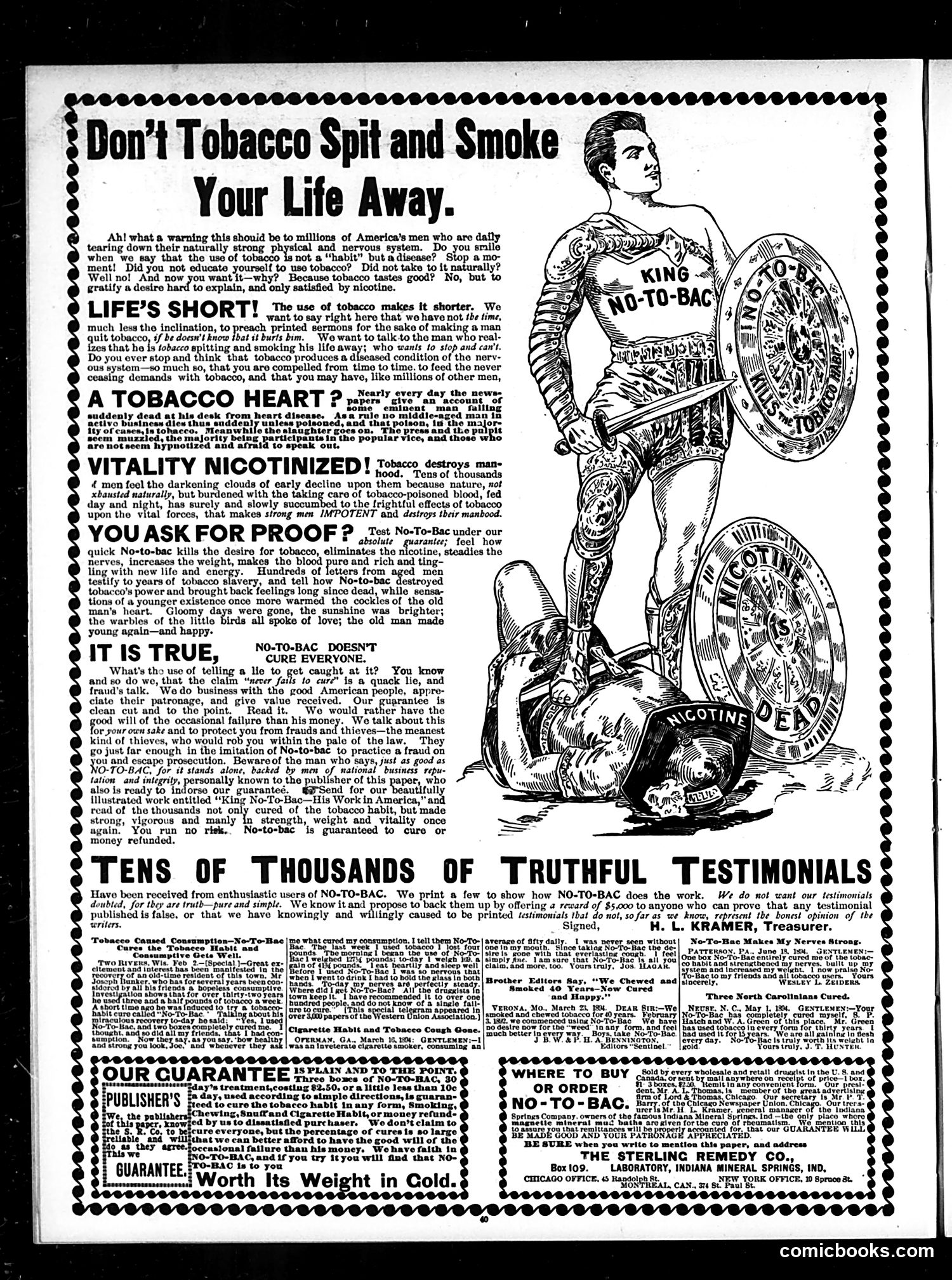
This is primarily a **full-page advertisement for "No-To-Bac,"** a tobacco-cessation product, disguised as public health advocacy from *Judge* magazine. ## What It's Actually About The page uses dramatic anti-tobacco messaging and testimonials to sell a patent medicine cure. Key claims include: tobacco causes heart disease, impotence, early death, and nervous system damage. The advertisement promises No-To-Bac eliminates nicotine cravings and restores vitality. ## Historical Context This reflects **early 1900s patent medicine culture**—an era before FDA regulation when companies made sweeping health claims without scientific evidence. The "guarantee" (promising refunds) and celebrity testimonials were typical marketing tactics. ## The Irony for Modern Readers While the anti-tobacco messaging appears progressive, the real purpose is **commercial exploitation** of health fears. The product's actual effectiveness is unknowable today, but the guarantee's fine print and testimonial authenticity were notoriously unreliable in this era. The satirical *Judge* magazine apparently found this a legitimate advertiser—suggesting even humor publications profited from dubious medical claims.
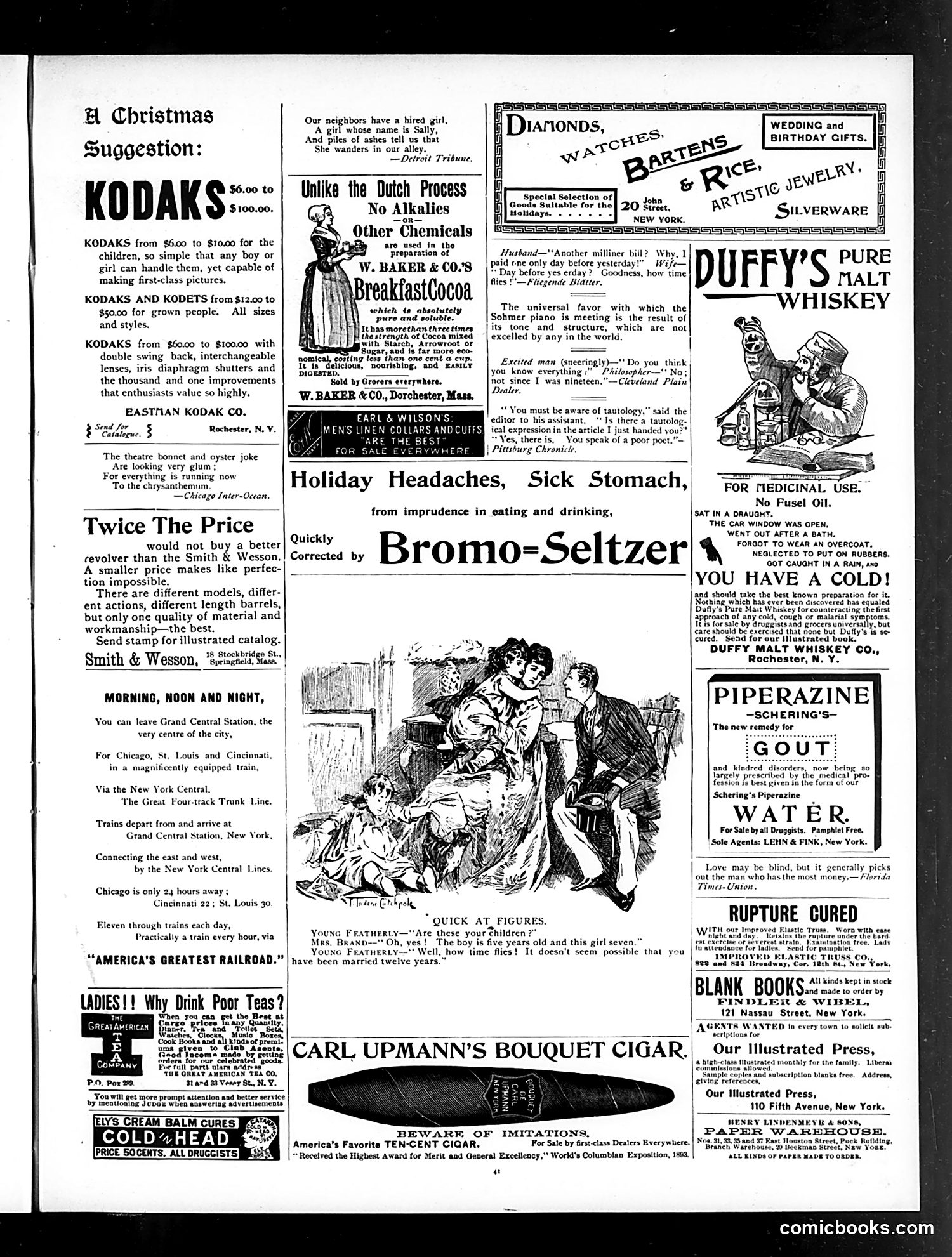
This is primarily an **advertising page** from Judge magazine, not a satirical cartoon page. The layout contains numerous product advertisements typical of early 20th-century magazines. The page includes small **humorous snippets** rather than full political cartoons: - A joke about a "hired girl" named Sally who leaves ashes in neighbors' alleys - A domestic humor piece about a husband complaining about his wife's milliner bills - A joke about "tautology" between an editor and assistant - A "Quick at Figures" vignette showing a young father surprised his child is seven years old These are **lighthearted domestic humor** common to the era—poking fun at marriage, servants, and everyday inconveniences rather than political satire. The **advertisements** promote products like Kodak cameras, Smith & Wesson revolvers, Duffy's Malt Whiskey (marketed as medicinal), Bromo-Seltzer, and various other goods. Several emphasize patent medicines and tonics, reflecting the pre-FDA era when such products made broad health claims without regulation. The page demonstrates Judge's revenue model: satirical content supported by extensive advertising.
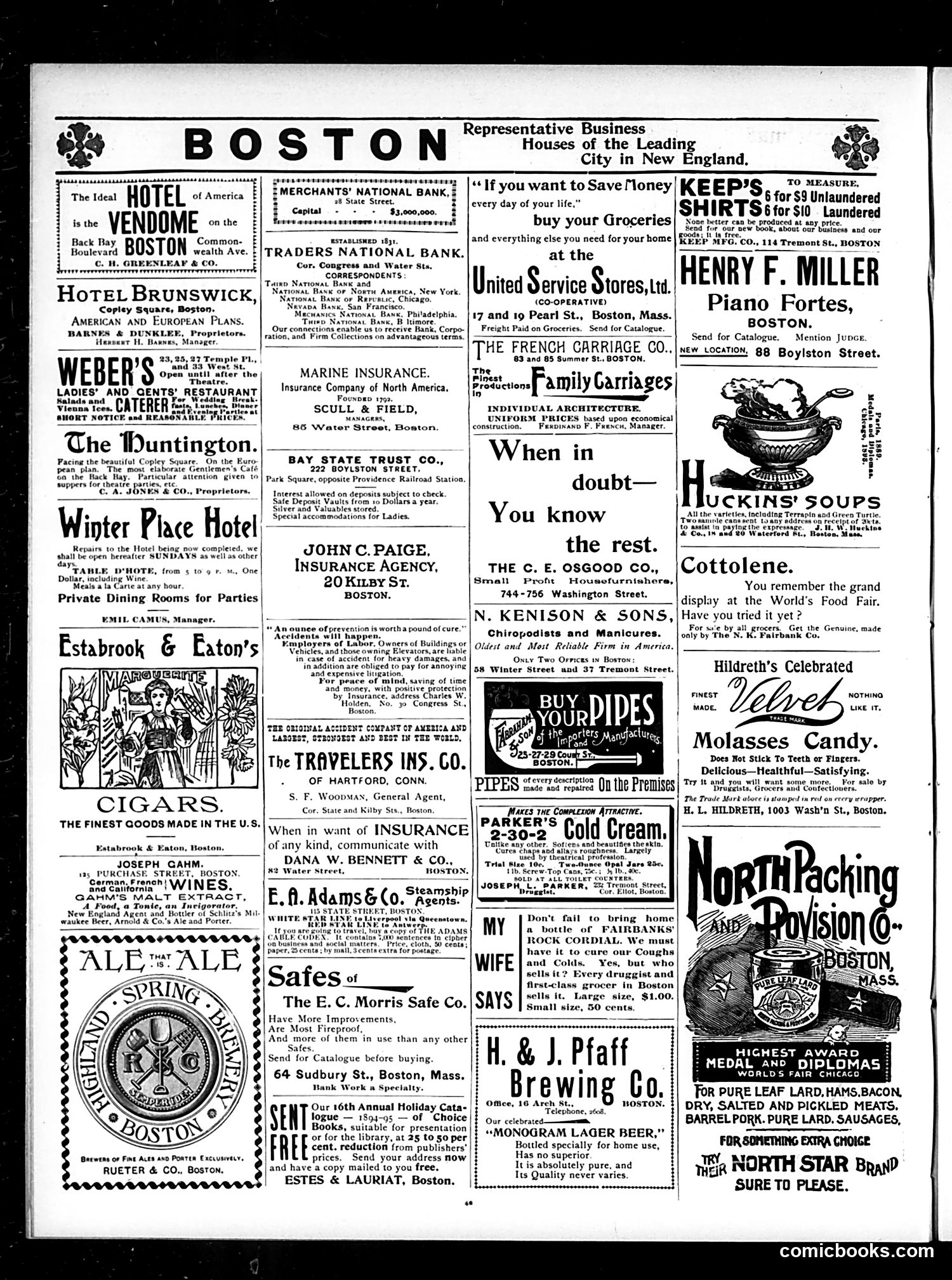
This is primarily a **Boston business directory page** from Judge magazine, featuring local hotels, banks, insurance companies, and retail establishments. Rather than containing political satire, it consists almost entirely of advertisements for Representative Business Houses. The single notable visual element is **Estabrook & Eaton's cigar advertisement** (lower left), which includes a decorative woodcut illustration of a classical female figure among flowers—typical commercial art of the era, not satirical commentary. The page's humor, if any, is implicit in the earnest advertising copy itself—the repetitive claims of "finest goods," "most improved," and "best in the world" that characterize Gilded Age commercial messaging. No specific political figures, events, or social commentary are identifiable. This appears to be a revenue-generating advertisement section rather than editorial content, common in period magazines.
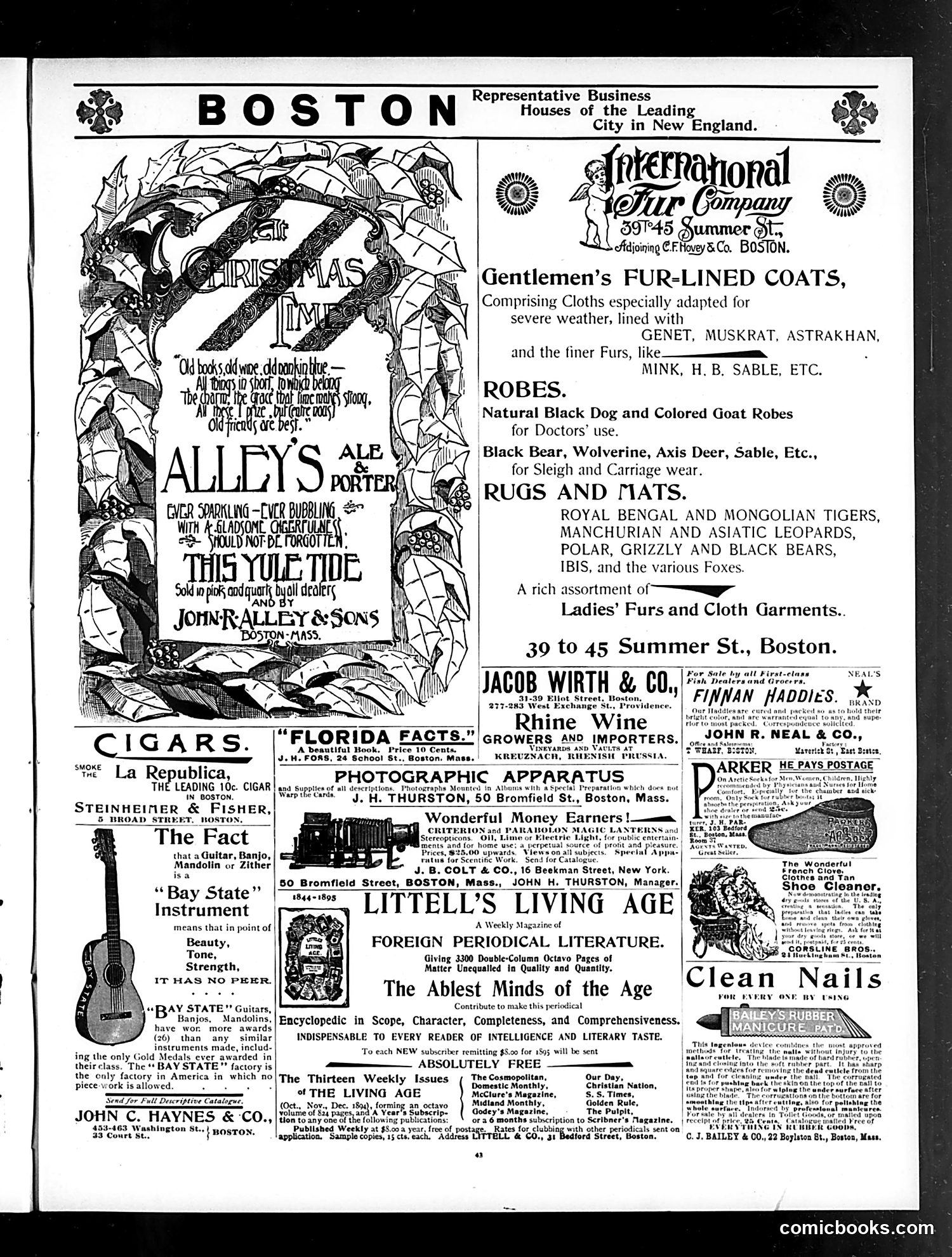
This is primarily a **business directory page** for Boston establishments, not a political cartoon. The page showcases "Representative Business Houses of the Leading City in New England" through advertisements. The main visual element is a decorative **Christmas-themed illustration** on the left (marked "Christmas") featuring holly and ivy with text for Alley's Ale and Porter—a seasonal beverage advertisement typical of the era. The rest of the page consists entirely of **commercial advertisements** for Boston businesses: fur traders, cigar sellers, musical instrument makers (Bay State guitars), wine importers, photographers, and notably Littell's Living Age magazine—a weekly digest of foreign periodicals. There is **no political satire or social commentary** visible. This appears to be a special regional advertising section within Judge magazine, not editorial content. The advertisements reflect late 19th-century Boston commerce: luxury goods (furs), imported products (Rhine wines), and cultural refinement (literary magazines, musical instruments).
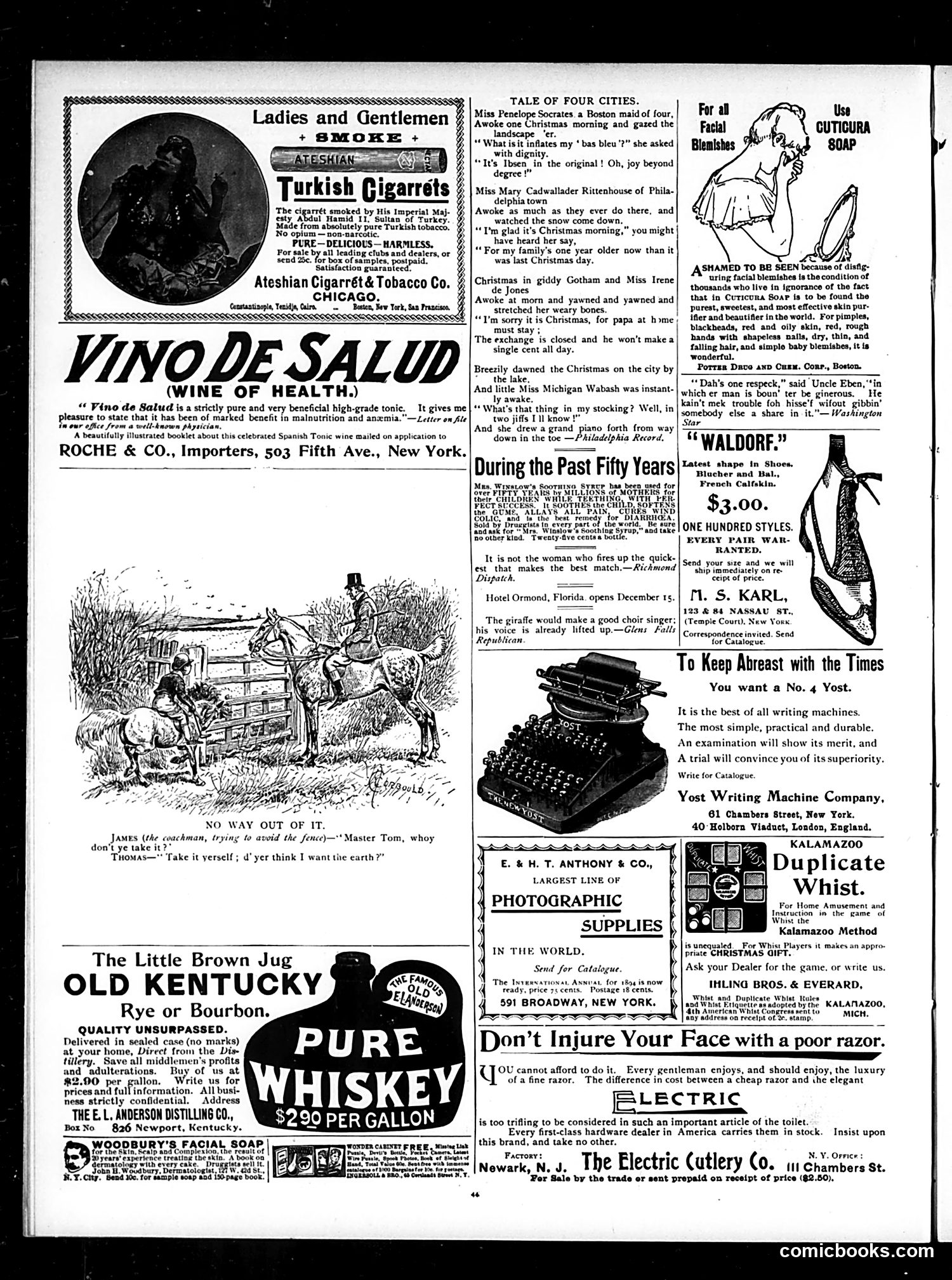
This page is primarily **advertising**, with minimal editorial content. The main cartoons and jokes are brief: ## "No Way Out of It" A coachman and his employer (Master Tom) debate who should navigate around a fence. The joke plays on class hierarchy: the servant refuses the task, sarcastically suggesting the gentleman try it himself—implying jumping a fence is beneath a master's dignity. ## "Tale of Four Cities" A stereotyping poem contrasting Christmas morning reactions across cities: Boston (intellectual snobbery—praising Ibsen), Philadelphia (staid propriety), New York (mercantile anxiety—stock exchange closed), and Chicago (naive excitement). Satire of regional American stereotypes popular in Gilded Age humor. The page is otherwise filled with period advertisements: Turkish cigarettes (endorsed by Ottoman Sultan Abdul Hamid II), wine tonics, whiskey, typewriters, shoes, soap, and razors. The ads reflect early 1900s advertising norms, including dubious health claims.
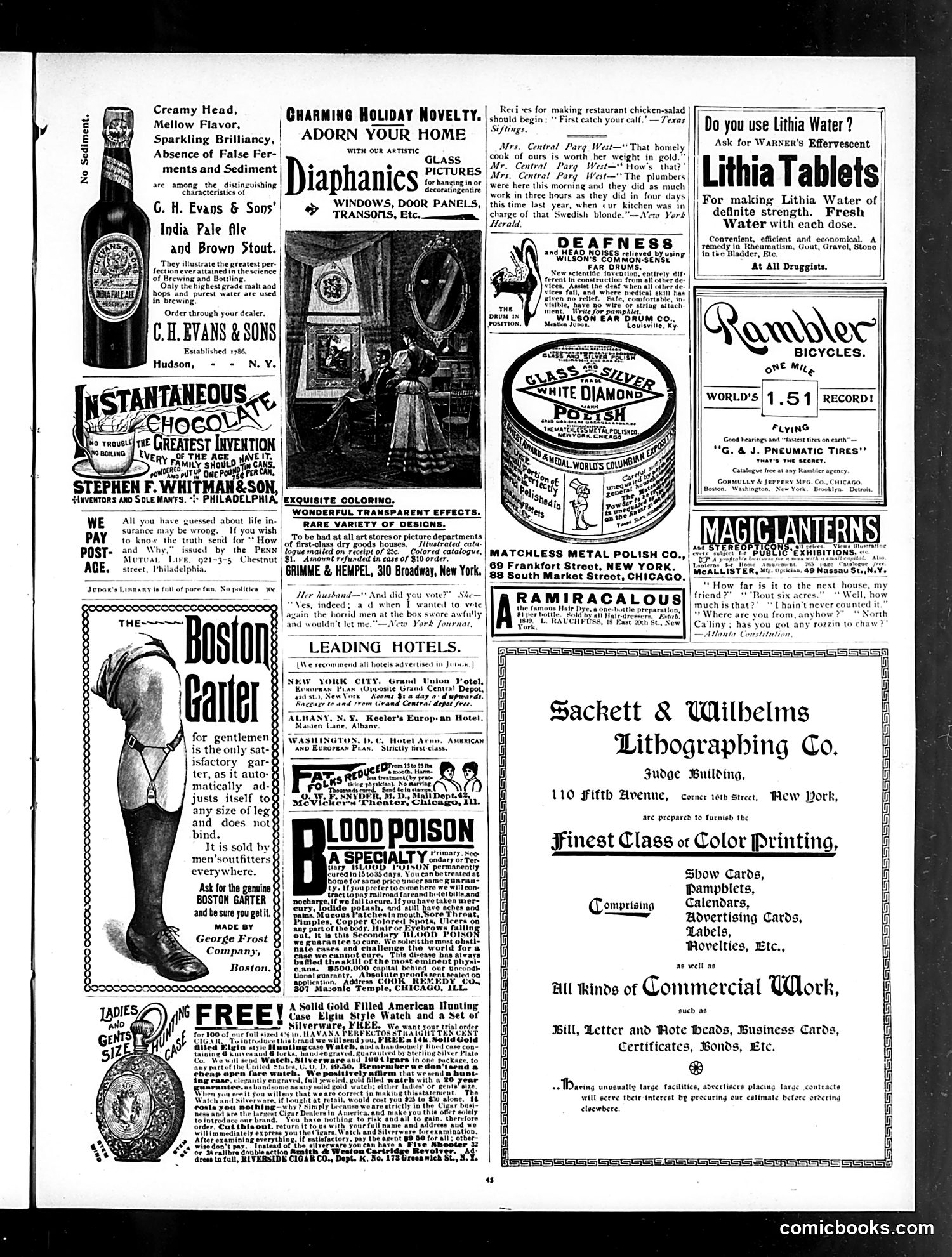
This is primarily an **advertising page** from Judge magazine, with minimal editorial content. The page showcases late 19th-century consumer goods and services through various advertisements. Notable advertisements include: - **G.H. Evans & Sons' beer** (established 1786) — emphasizing purity and quality - **"Diaphanies"** — decorative glass pictures for home decoration, marketed as holiday novelties - **Boston Garter** — an automatic garter for men, humorously illustrated - **Lithia Tablets** — a patent medicine for rheumatism and kidney ailments - **Rambler Bicycles** — advertising pneumatic tires as the "fastest ties on earth" - **Matchless Metal Polish** and other household products The few editorial jokes appear scattered among ads, including period humor about servants and voting. The page reflects the advertising-heavy format typical of Judge during this era, where the magazine subsidized satirical content through commercial placement. The products advertised reveal consumer concerns and available remedies of the 1890s era.
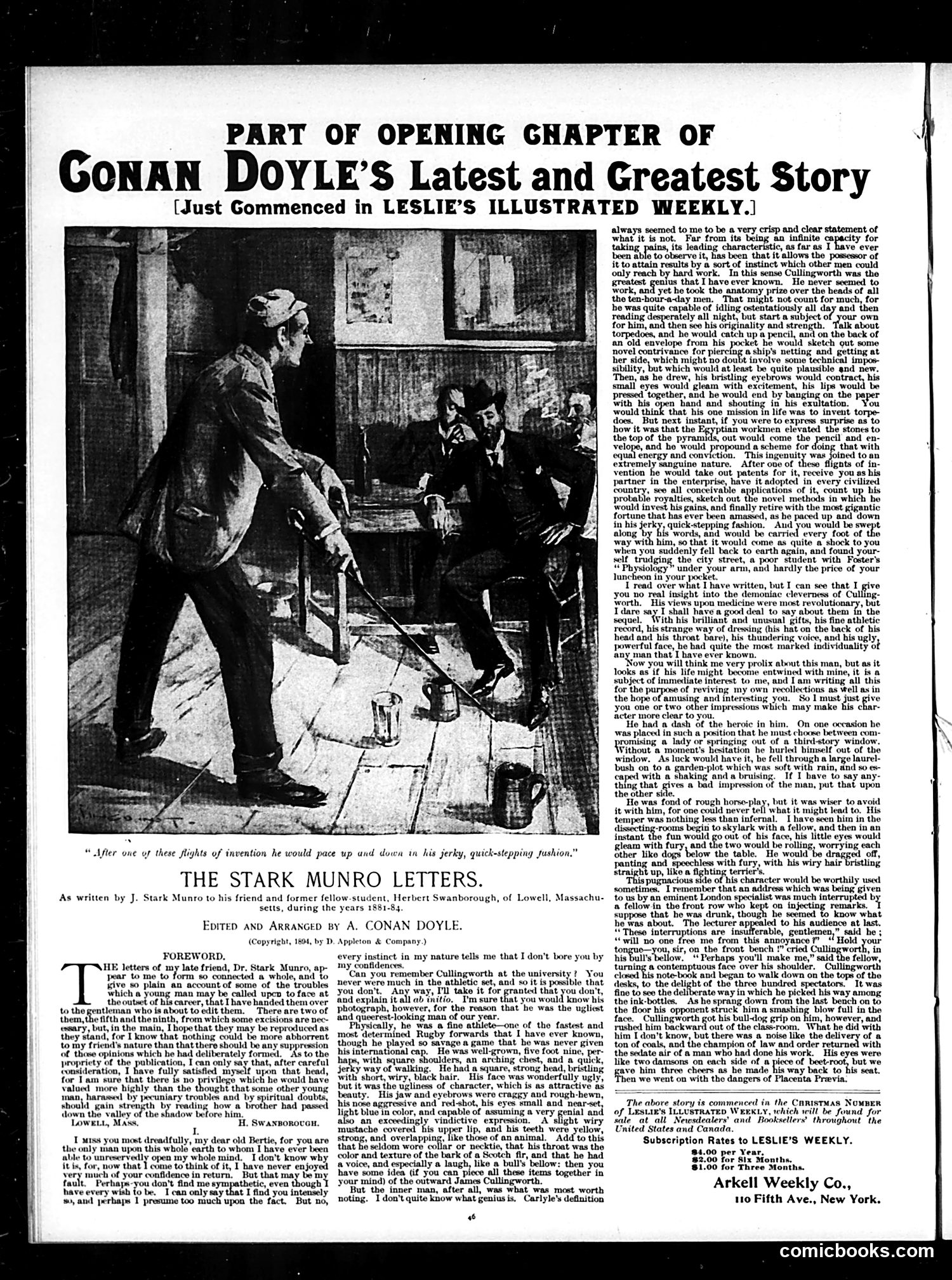
This page presents the opening of a serialized story by Arthur Conan Doyle in Leslie's Illustrated Weekly. It's not satirical political content, but rather a literary publication. **What it is:** The reproduction of Doyle's epistolary novella (told through letters) about a young man named Stark Munro writing to his friend Herbert Swanborough, chronicling troubles and spiritual doubts during his early career (1881-84). **The illustration** shows two men in period dress conversing indoors—likely depicting a scene from the narrative. **The content:** Primarily the editor's foreword and the opening letter, in which Munro asks Swanborough to remember a university acquaintance named Cullingworth—an ugly but physically impressive Rugby player whose character the letter proceeds to describe in vivid detail. This is a straightforward literary excerpt, not satire or political commentary. It represents Judge/Leslie's publishing serialized fiction alongside their editorial content.
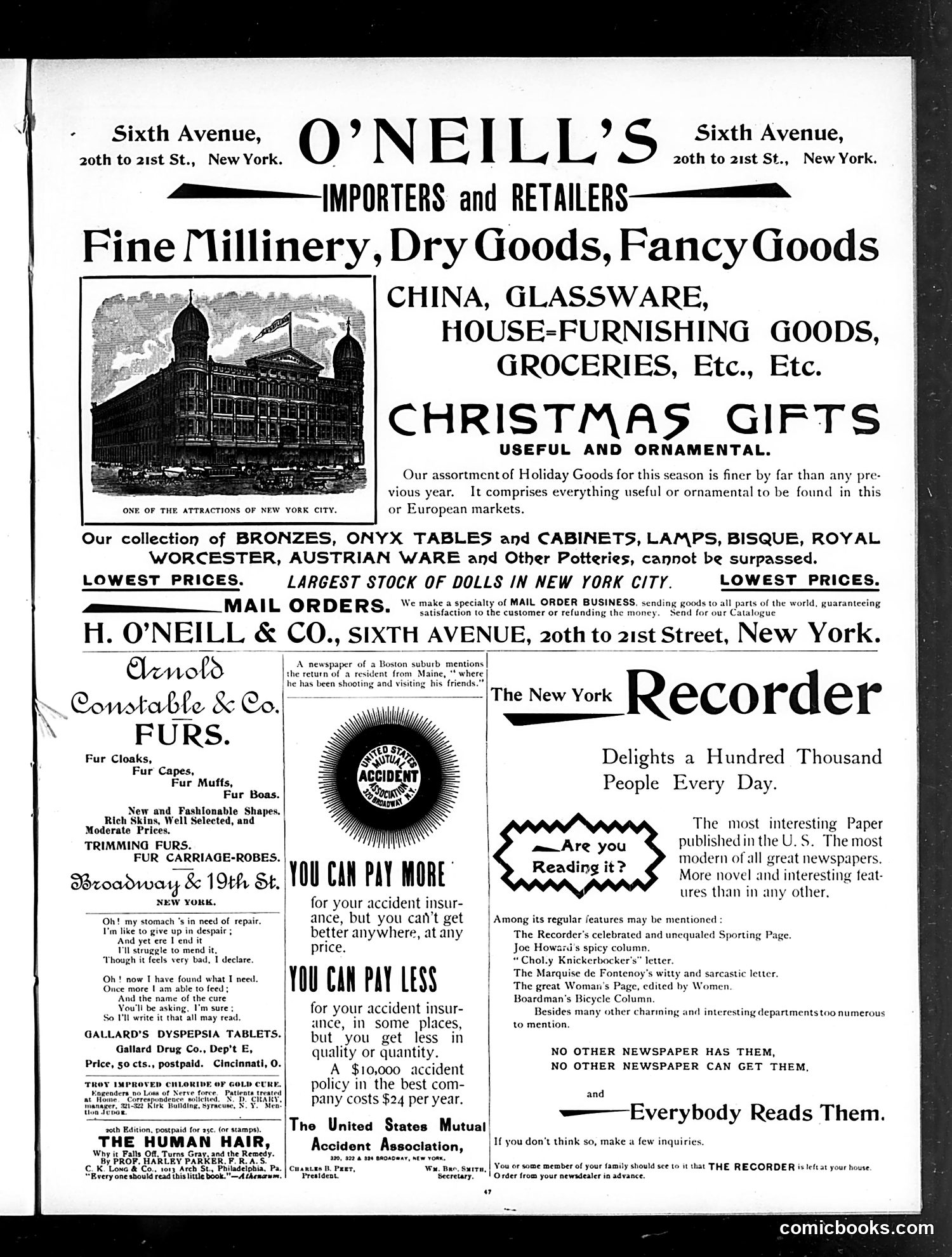
This page is **primarily advertising**, not satire or political commentary. It consists of commercial advertisements from late-19th-century New York businesses, interspersed with a few brief humorous verses. The small cartoon elements include: - **A verse about stomach troubles** accompanying an advertisement for Gallard's Dyspepsia Tablets—a common patent medicine pitch using light humor to sell digestive remedies. - **A Boston newspaper clipping joke** mocking imprecise language ("shooting and visiting his friends" as a euphemism). - **Insurance company advertising** emphasizing value ("You Can Pay More/Less"). The page advertises O'Neill's department store, fur dealers Arnold Constable & Co., and promotes *The New York Recorder* newspaper, claiming superior sports coverage and columns by named writers. There is **no coherent political satire** visible here—this is a commercial page using minor humor as filler between ads, typical of Judge's advertising revenue model in this era.
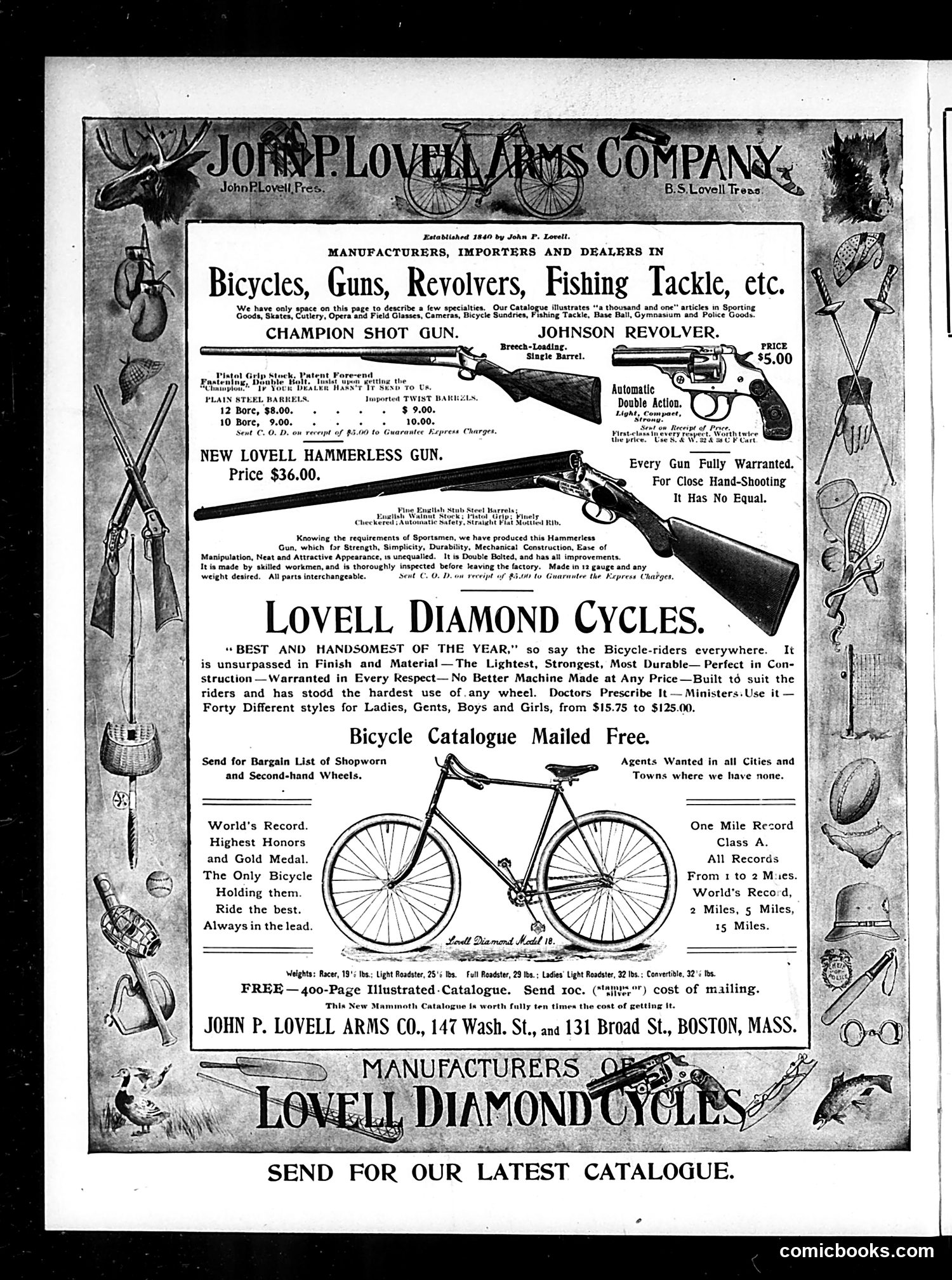
This is **not a cartoon or satire**—it's a straightforward advertising page from *Judge* magazine. The John P. Lovell Arms Company of Boston is promoting their sporting goods inventory: bicycles (their "Diamond Cycles" line), firearms (shotguns and revolvers), and fishing tackle. The page reflects late-19th-century consumer culture, when such catalogs were primary shopping tools and companies advertised heavily in magazines. The decorative borders feature sporting equipment imagery (fish, guns, bicycles, etc.), typical of period advertising design. Notable for modern readers: the casual advertisement of firearms alongside bicycles and fishing gear, and pricing in gold dollars ($15.75–$125 for bicycles; $36 for guns). The claims about doctors and ministers using bicycles reflect cycling's late-Victorian popularity as recreation and transportation. This appears to be a commercial insert or sponsored content rather than editorial material.
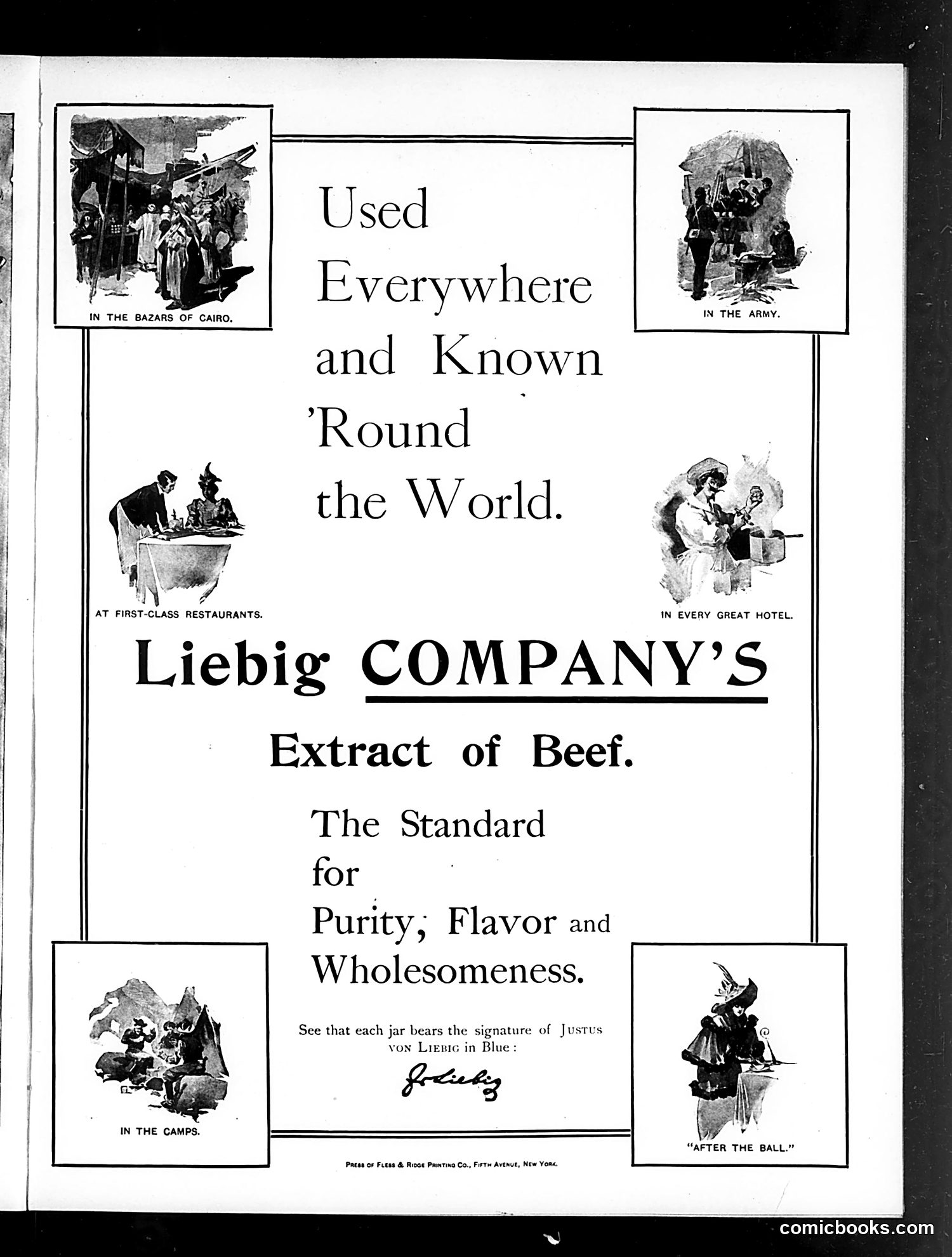
This is a full-page advertisement for Liebig Company's Extract of Beef, not a political cartoon. The ad uses six illustrated vignettes showing the product's supposedly universal popularity: in Cairo's bazaars, the army, first-class restaurants, great hotels, military camps, and after formal balls. Each scene depicts people from different social contexts consuming or using the product. The central claim—"Used Everywhere and Known 'Round the World"—emphasizes global market dominance. The signature of Justus von Liebig in blue purports to authenticate the product's quality and purity. This represents late-19th-century marketing strategy: establishing brand prestige through association with scientific authority and aspirational social settings across international markets.
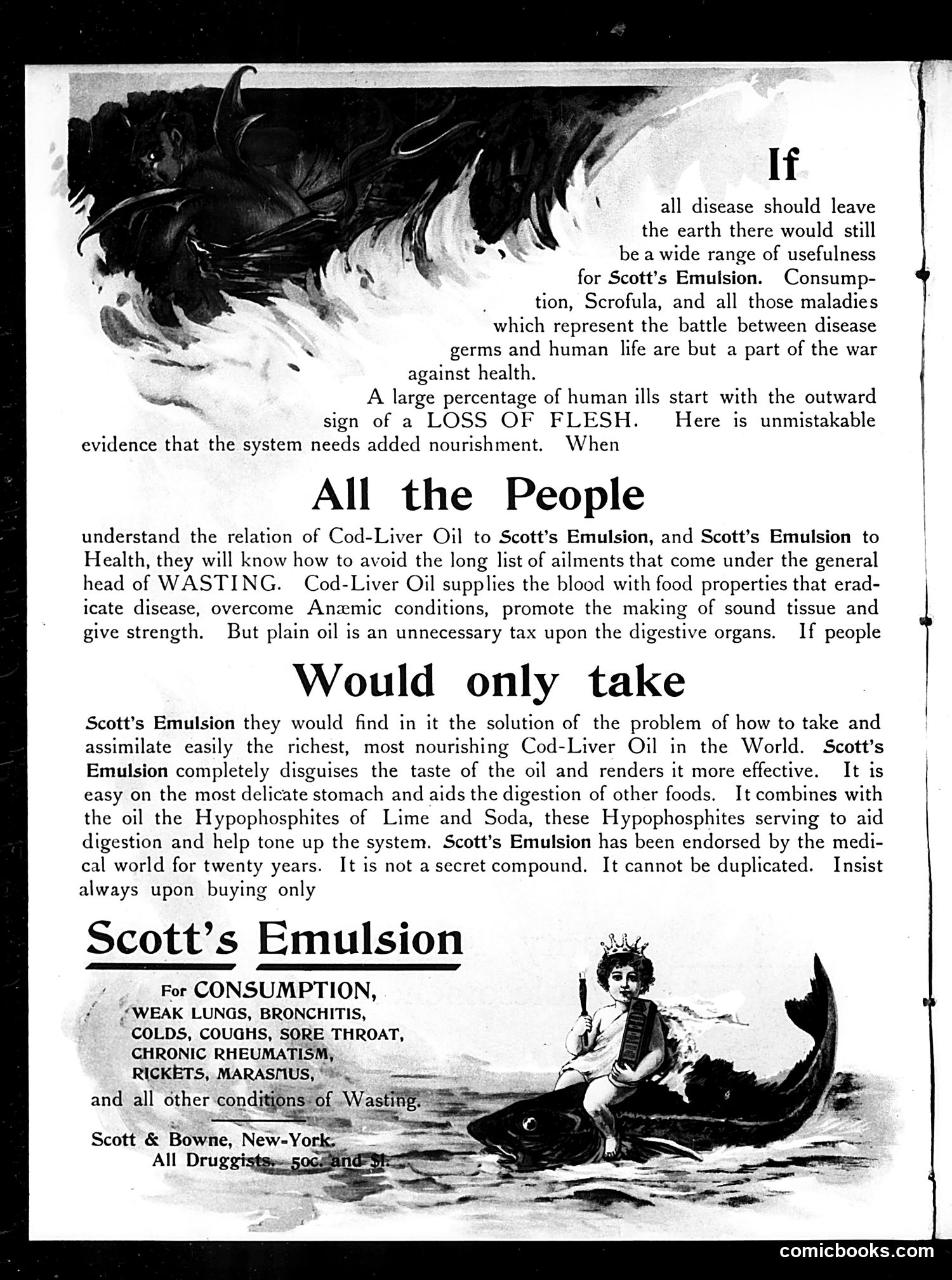
This page is primarily a **patent medicine advertisement**, not political satire. It promotes Scott's Emulsion, a cod-liver oil product marketed for tuberculosis, malnutrition, and general "wasting" diseases. The appeal targets broad anxieties about disease and weakness common in the early 20th century. The text argues that weight loss signals illness requiring nutritional intervention—Scott's Emulsion supposedly solves this by delivering cod-liver oil without its unpleasant taste, enhanced with chemical additives (hypophosphites of lime and soda). The illustration shows a cherub or cupid figure with a fish, reinforcing the product's marine origin. The advertisement's rhetoric reflects the era's optimistic faith in patent medicines and scientific-sounding formulations, before modern FDA regulation. Claims of medical endorsement ("twenty years") and non-duplicability were common marketing tactics designed to justify premium pricing and build consumer loyalty.