
A complete issue · 18 pages · 1893
Judge — January 14, 1893
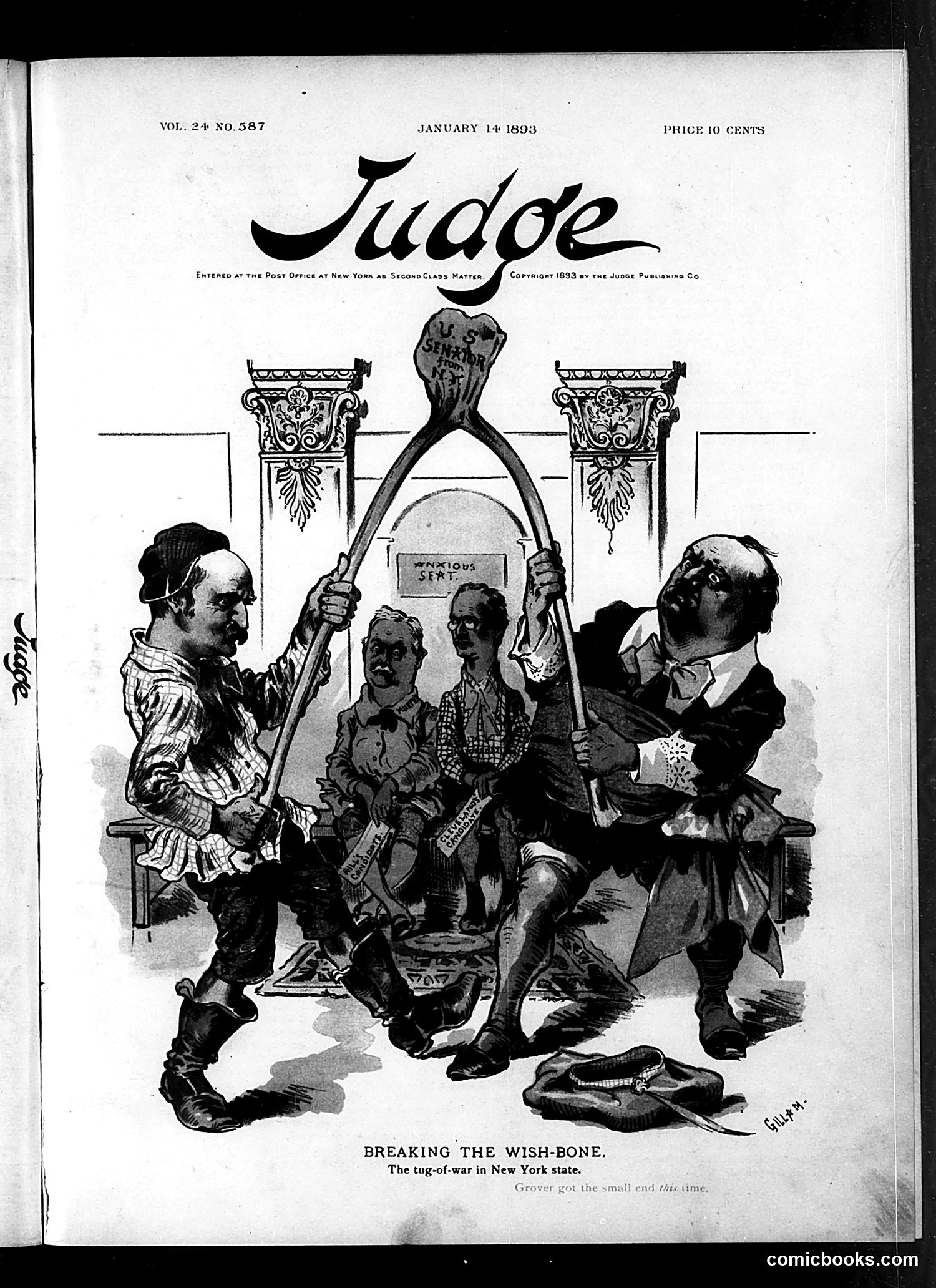
This January 1893 *Judge* cartoon satirizes a political dispute in New York State. Two caricatured figures on the left and right pull opposite ends of a wish-bone (a symbol of competing desires), while three smaller figures in the middle appear caught in the struggle. The caption notes "Grover got the small end this time," suggesting President Grover Cleveland received an unfavorable outcome. The cartoon likely depicts factional infighting within New York's Democratic Party or a broader state political conflict during Cleveland's second term. The wish-bone symbolizes how competing politicians or interests are tearing the state apart through their rivalry, with the "Anxious Sect" label visible on the arch suggesting religious or ideological concerns were at stake in this political tug-of-war.
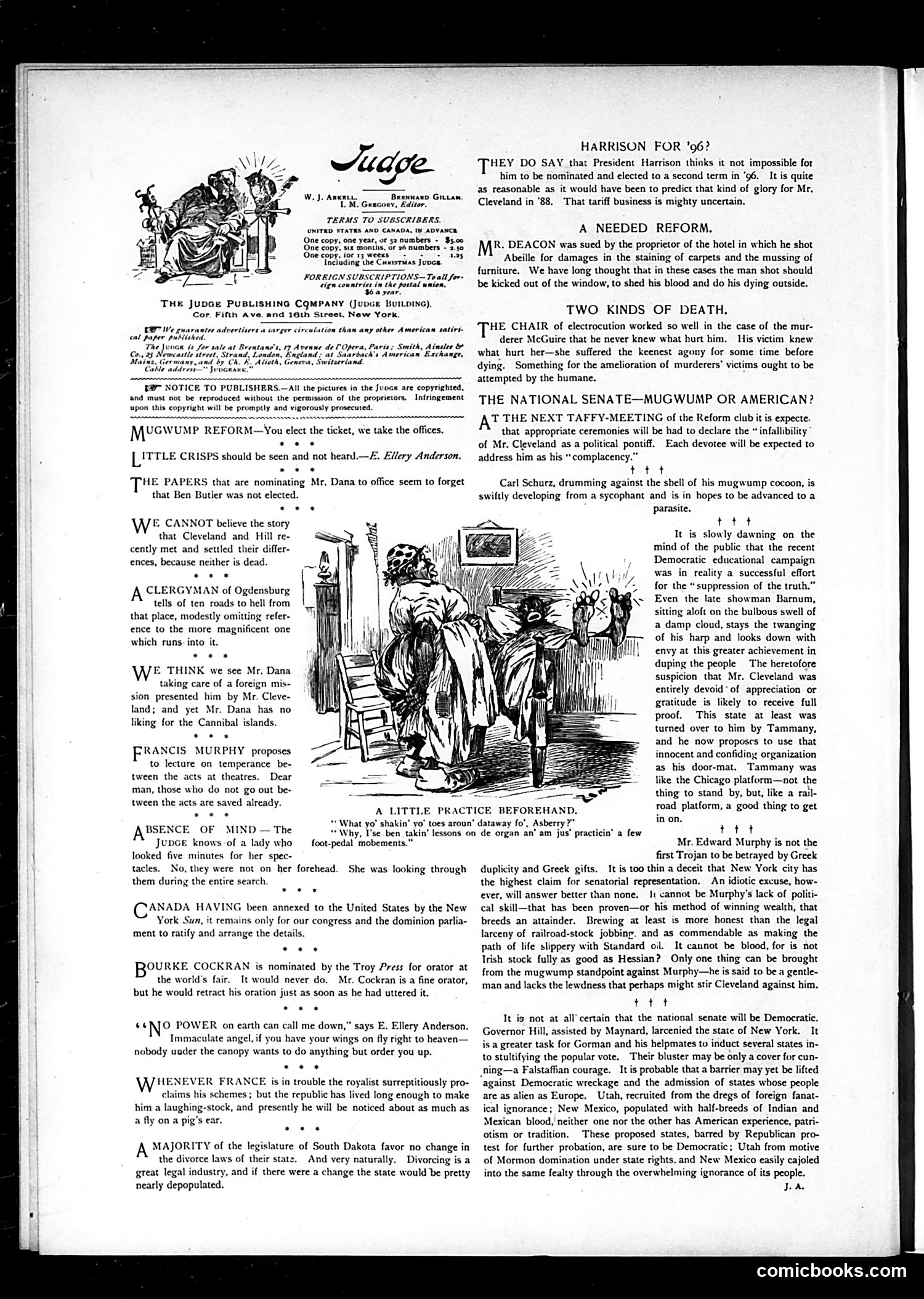
The main cartoon depicts a domestic scene where a woman plays organ while a man sits nearby with a harp. The caption reads: "What yo' shakin' yer bass aroun' doorway fo', Asberry?" "Why, I's jest takin' lessons on de organ an' am jest practicin' a few foot-pedal movements." This appears to be a racist caricature using exaggerated dialect ("yo'," "I's") of African American characters. The humor derives from a crude double entendre about "foot-pedal movements," playing on the instrument's mechanics while making an indecent suggestion. The surrounding editorial content discusses 1880s political matters, including Cleveland's potential nomination and various political reforms, but the cartoon itself represents the offensive racial humor typical of period publications.
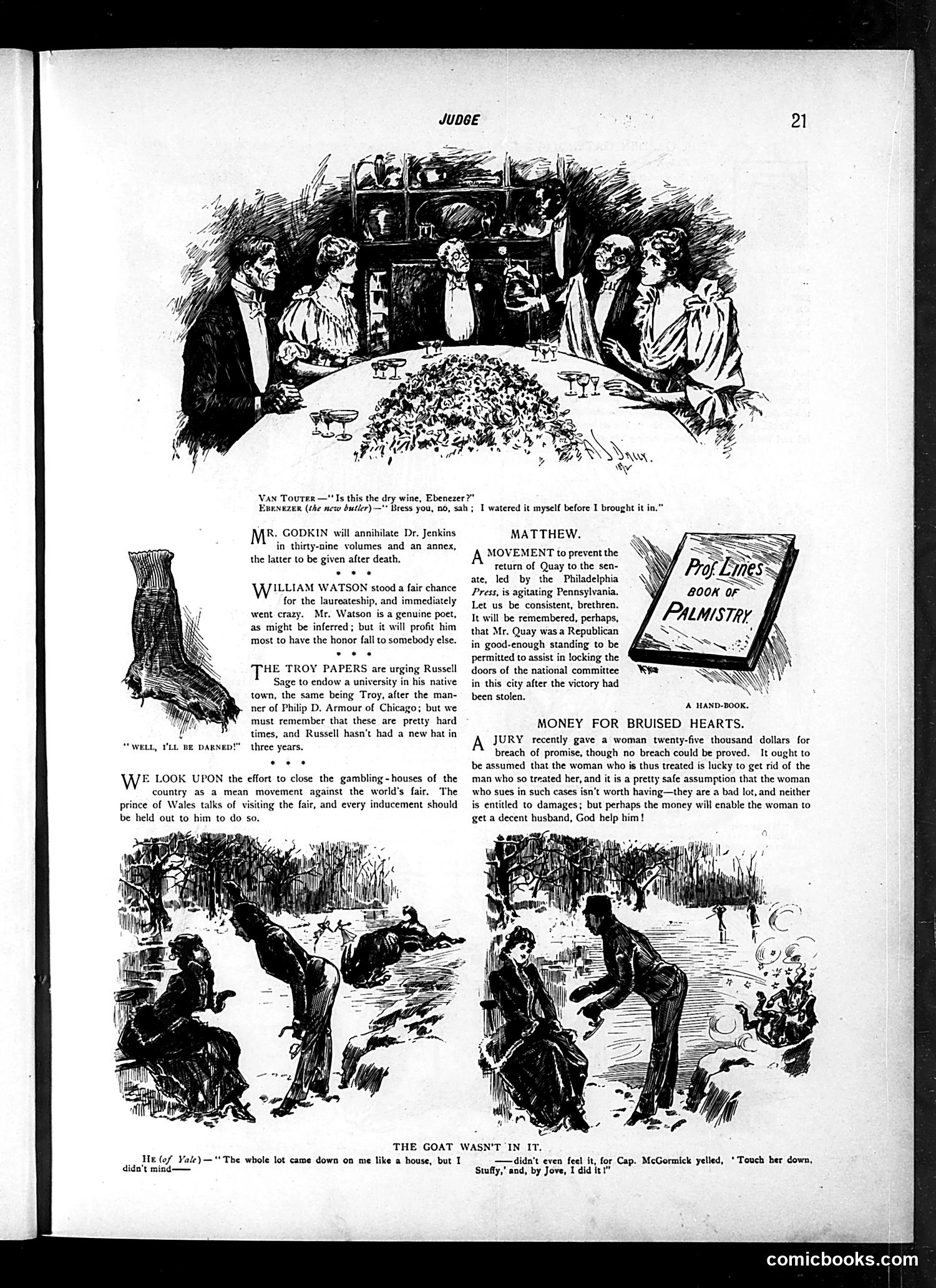
This page contains several satirical items from an early 20th-century American humor magazine: **Top cartoon** depicts a dinner party where a guest questions wine quality—a social commentary on pretension and dishonesty among the upper classes. **Text sections** discuss: - Mr. Godkin's annuity bequest to Dr. Jenkins - William Watson's chance at the bishopric - Russell Sage endowing a university - A movement against returning Quay to the Pennsylvania senate **"Money for Bruised Hearts"** section satirizes a jury verdict awarding $25,000 damages for breach of promise, mocking the notion that money compensates for emotional harm and that women need husbands rather than legal recourse. **Bottom cartoons** titled "The Goat Wasn't In It" appear to depict outdoor mischief or mishaps, likely satirizing class differences or social embarrassment. The page reflects late-Gilded Age concerns: wealth, social climbing, corruption, and gender relations.
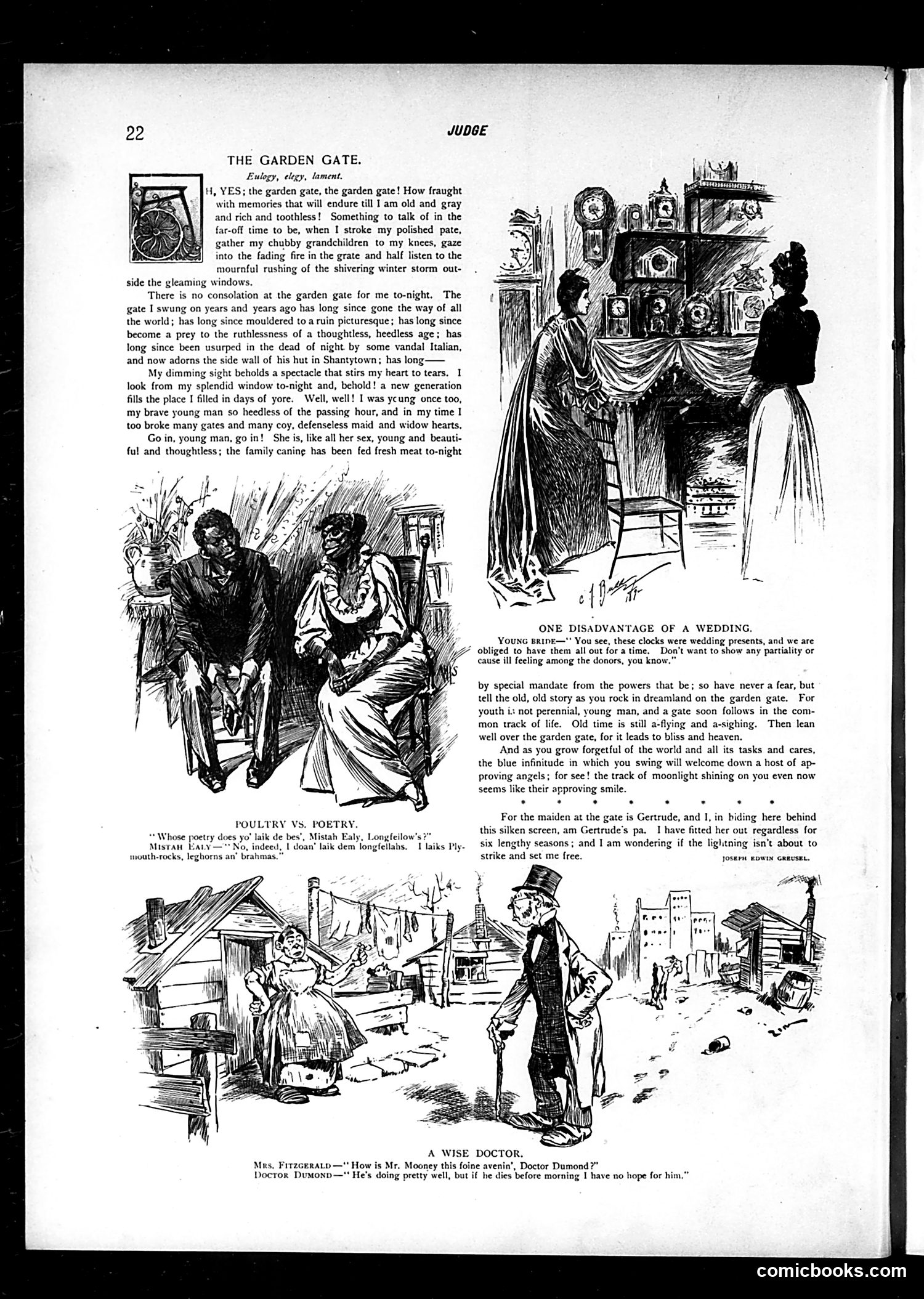
This page from *Judge* contains three separate satirical pieces: **"The Garden Gate"** is a nostalgic lament about lost youth. An aging narrator watches young couples courting at a garden gate—a traditional Victorian courting spot—and reflects on his own youthful indiscretions breaking gates and hearts. The satire mocks sentimental romanticization of the past while acknowledging that youth is temporary and reckless. **"One Disadvantage of a Wedding"** jokes about newlyweds displaying all their wedding gifts simultaneously to avoid offending donors—a petty social obligation that creates cluttered interiors. **"A Wise Doctor"** satirizes a physician's illogical prognosis: saying a patient is doing well *but* expressing hopelessness if he dies—a circular, meaningless statement mocking incompetent or evasive doctors. The dialect humor in the dialogue pieces reflects period-typical ethnic stereotyping common to *Judge*.
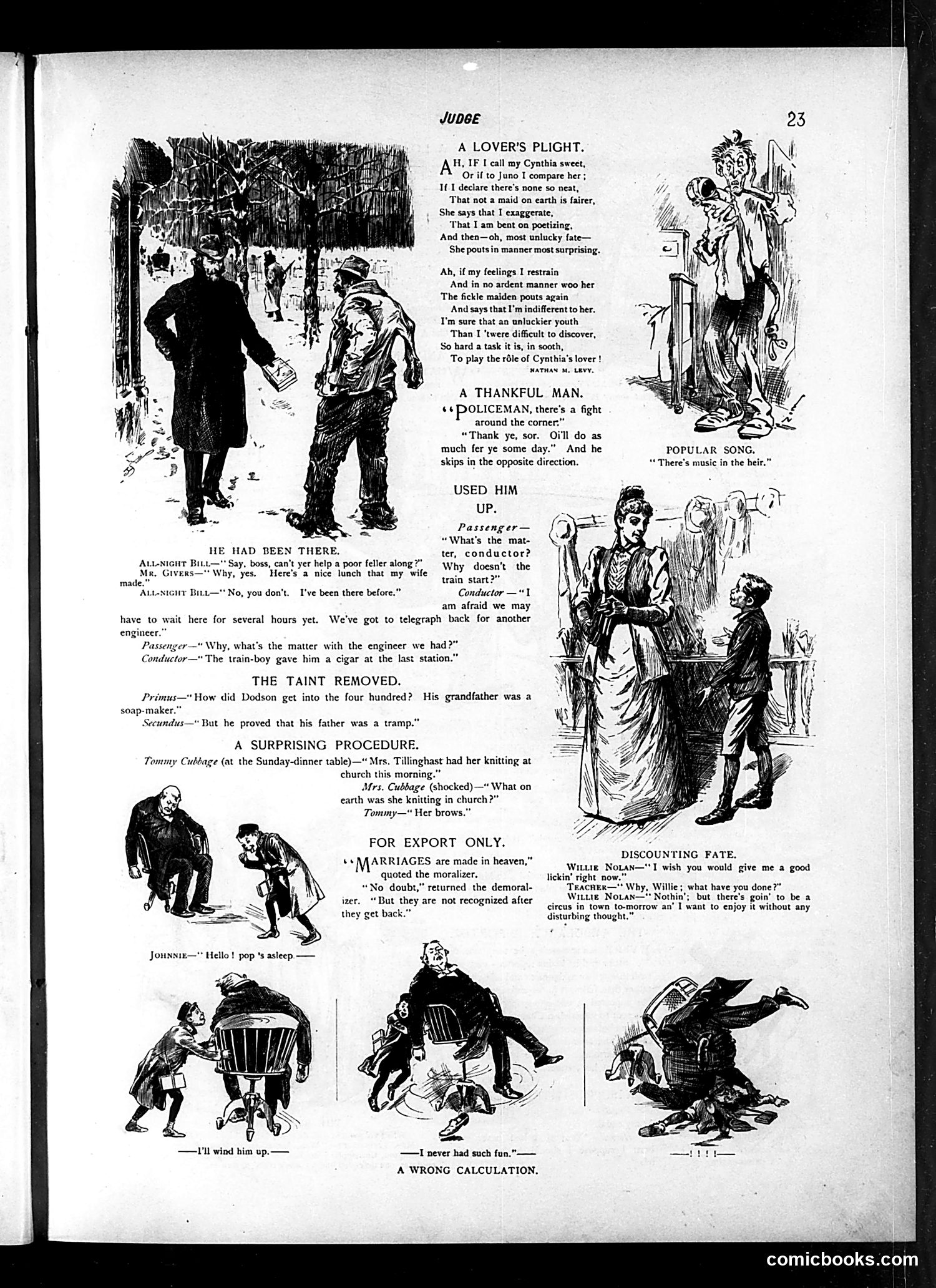
This page from *Judge* contains several short humor pieces typical of late 19th-century American satirical magazines: **"A Lover's Plight"** mocks romantic paradox: a suitor cannot win—compliments make his beloved accuse him of exaggeration, yet restraint makes her think him indifferent. The satire targets both overwrought courtship rhetoric and women's perceived inconsistency. **"A Thankful Man"** jokes about Irish immigrants (indicated by dialect "sor" and "Oi"), depicting a policeman grateful for help but fleeing confrontation. **"Used Him Up"** satirizes commercial exploitation of working-class men: a charity-seeking vagrant rejects food but accepts cigars, which the conductor blames for making the engineer unreliable. **"The Taint Removed"** mocks social climbing: having a tramp father is preferable to a soap-maker grandfather for gaining elite social status. Remaining pieces target workplace incompetence, church etiquette violations, and childhood behavior—all presented as gentle, domestic humor rather than political commentary.
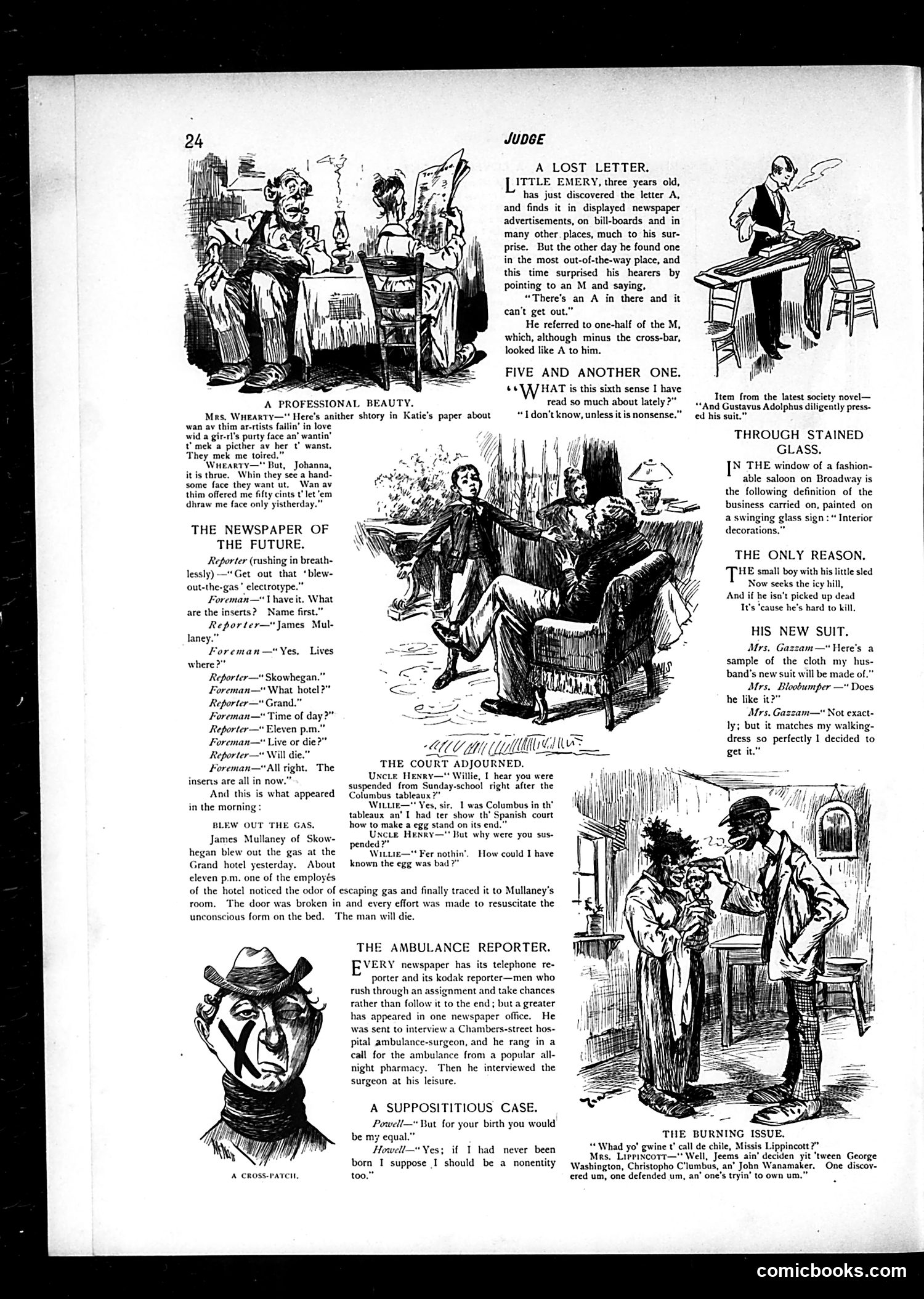
This page from Judge contains multiple satirical pieces typical of the era's humor magazine: **"The Newspaper of the Future"** mocks sensationalist journalism's standardized, formulaic approach to reporting routine incidents. The joke is that newspapers create identical "inserts" (pre-written templates) with variable details—suggesting news is manufactured rather than reported. **"A Professional Beauty"** satirizes how female subjects tolerate being pursued by artists wanting to paint them, reducing women to their appearance. **"A Lost Letter"** is a gentle children's joke about a toddler recognizing the letter A hidden within an M. **"The Ambulance Reporter"** criticizes a new breed of impatient newspaper reporters who manufacture news (calling an ambulance to interview a surgeon) rather than pursuing genuine stories. Other brief items mock courtroom absurdity, fashion, marriage, and social pretension. The cartoons use exaggerated facial features and working-class Irish dialect ("ar-rtists," "toired") typical of period humor. Overall, the page satirizes modern journalism, artistic culture, and social affectation through comedic vignettes and illustrations.
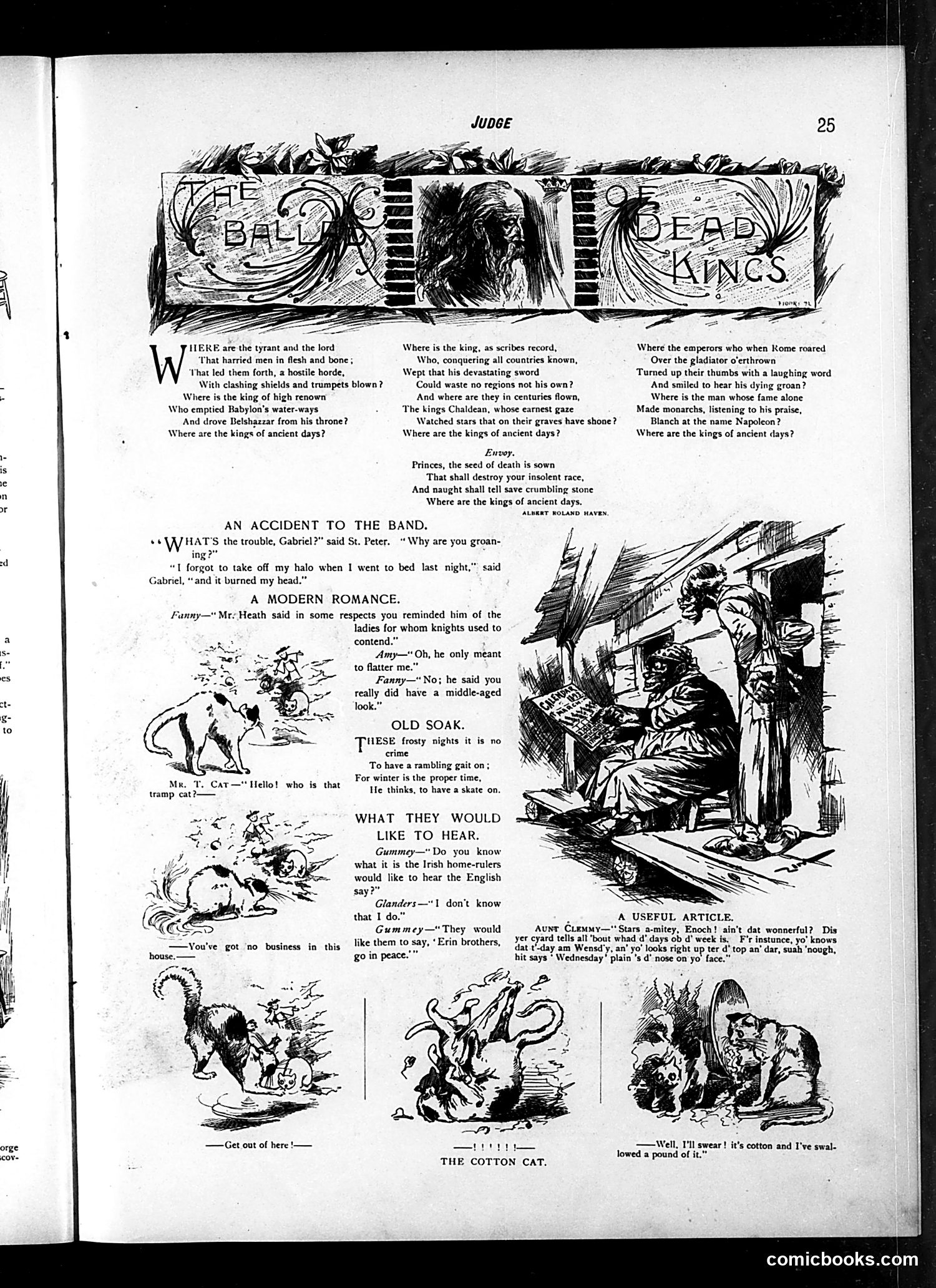
This page contains several unrelated humor pieces typical of Judge's satirical format: **"The Dead Kings"** (top): A serious philosophical poem about mortality's inevitability, contrasting ancient tyrants and emperors (Babylon, Napoleon, Roman gladiators) with their complete erasure from history. The "Envoy" warns princes that death will destroy their legacy—a memento mori meditation rather than political satire. **"An Accident to the Band"**: Light religious humor about the archangel Gabriel burning his head with his halo while sleeping—a simple pun-based joke. **"A Modern Romance" & "Old Soak"**: Brief romantic/character comedies with no apparent political content. **"What They Would Like to Hear"**: References Irish Home Rule (independence from Britain), depicting Irish desire for English acceptance. This reflects late 19th/early 20th-century Irish independence debates. **Lower cartoons**: Mostly genteel domestic humor about cats and cotton, including racial dialect humor typical (and offensive) to the era's mainstream publications. The page is primarily entertainment rather than serious political commentary, showcasing Judge's mixed approach to satire and humor.
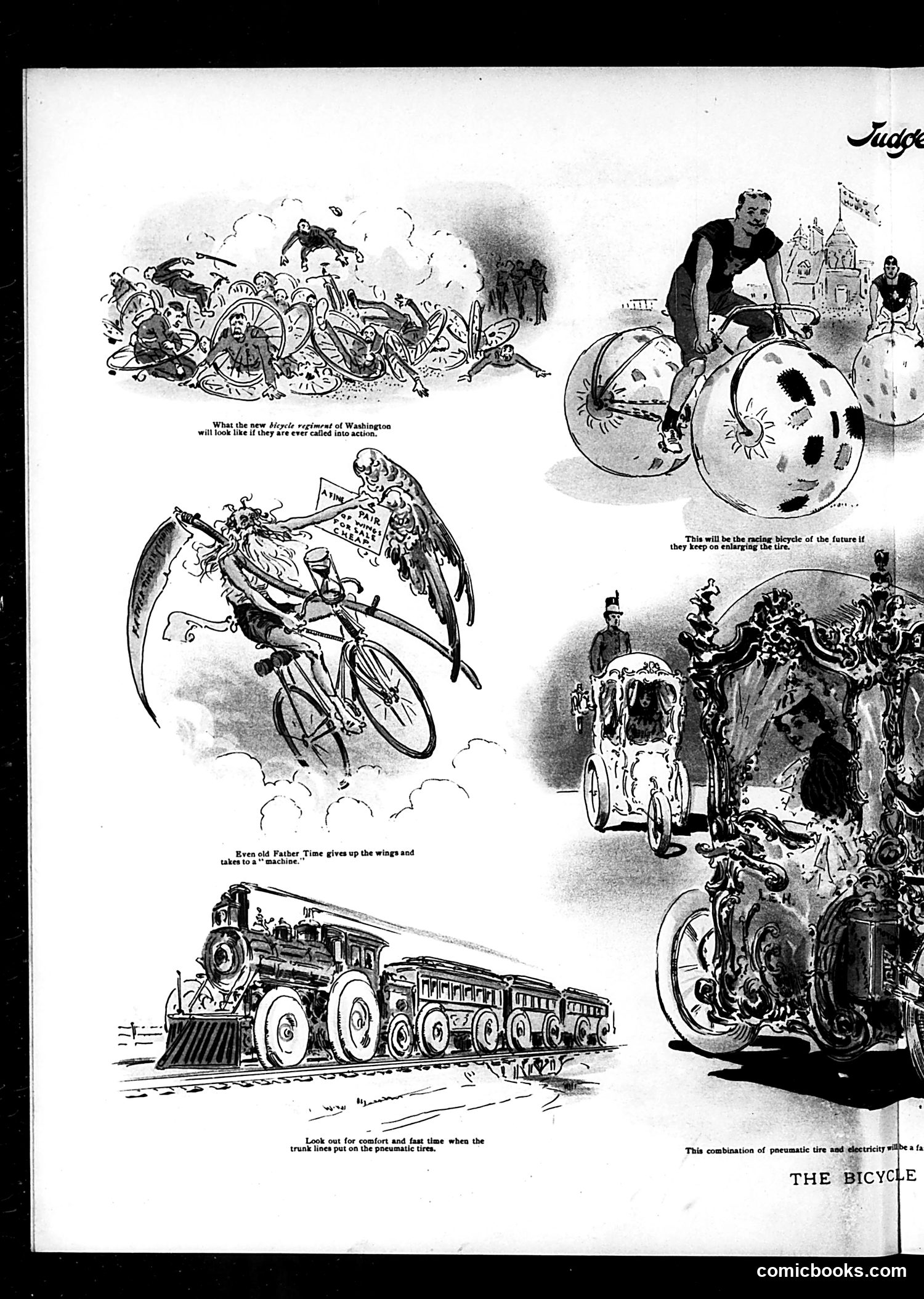
This page satirizes the rapid technological transformation of the 1890s-1900s, imagining bicycles replacing traditional transportation and military power. The top left depicts a chaotic "bicycle regiment," mocking the idea of soldiers on bikes as combat units. Below, "Father Time" abandons his traditional winged identity for a bicycle—suggesting technology's displacement of old ways. The lower panels joke about future transportation: pneumatic (air-filled) tires on trains promising comfort and speed, and an ornate motorized vehicle combining "pneumatic tire and electricity." The satire suggests Americans obsessively believed cycling and emerging automotive technology would revolutionize everything, from warfare to rail travel. The humor targets contemporary technological utopianism and bicycle-mania—the 1890s craze that made bicycles cultural icons.
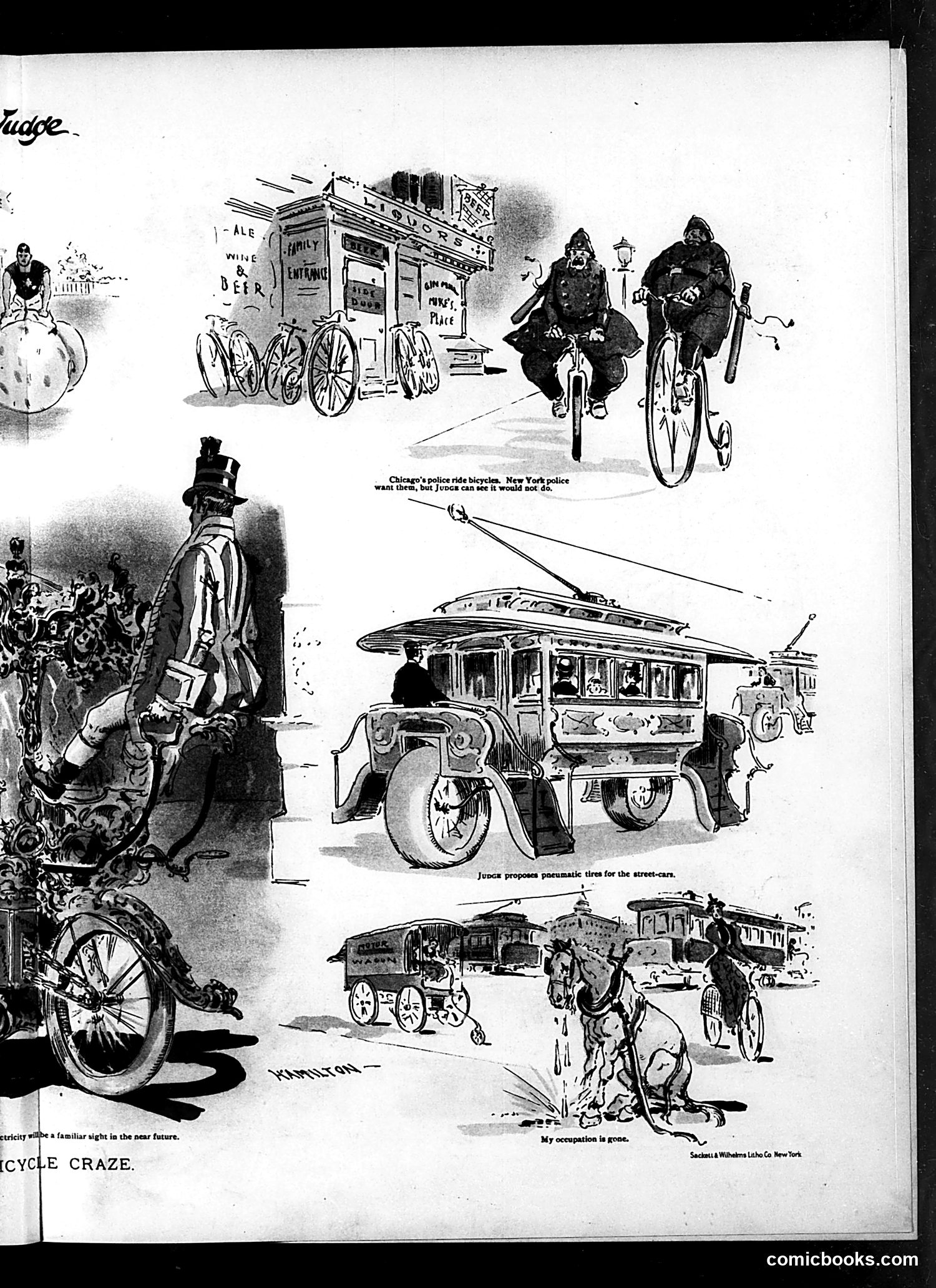
This page satirizes the late 19th-century bicycle craze's impact on urban life. The cartoons depict bicycles replacing traditional transportation: police officers on bicycles (comparing Chicago and New York departments), street-cars converted to bicycle-powered vehicles, and horse-drawn carriages abandoned. The central joke appears to be the absurdity of bicycles becoming the dominant urban transport—showing exaggerated conversions like a motorized streetcar fitted with bicycle wheels and a bicycle-powered taxi. The bottom panel suggests traditional horse-drawn transport ("my occupation is gone") will be obsolete. The satire captures contemporary anxiety about rapid technological change, as the bicycle was genuinely transforming city streets in the 1890s. The artist humorously extrapolates this trend to its logical extreme, suggesting bicycles would eventually replace all other vehicles—a playful commentary on how thoroughly this "craze" was reshaping urban America.
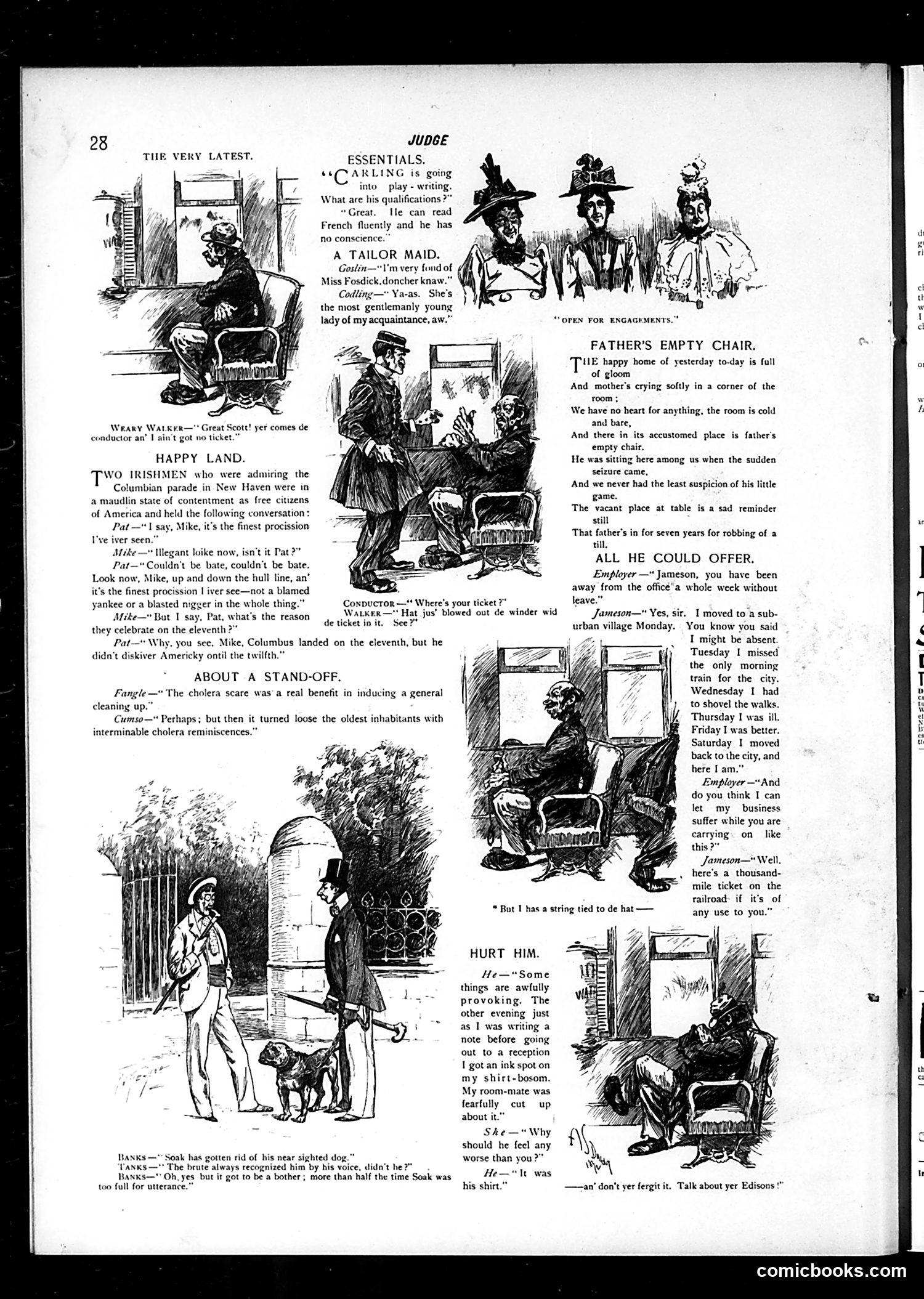
This page from *Judge* contains multiple satirical sketches typical of late-19th-century American humor: **"Essentials"** mocks a would-be playwright named Carling, suggesting his qualifications—reading French and lacking conscience—are sufficient for play-writing, a jab at contemporary theatrical standards. **"A Tailor Maid"** plays on class pretension, with characters using affected speech to discuss a "gentlemanly" young lady. **"Happy Land"** presents Irish immigrants discussing Columbus Day with racist language reflecting the era's casual bigotry. The joke relies on ethnic stereotyping common to period humor. **"Father's Empty Chair"** darkly satirizes a respectable family man imprisoned for embezzlement, contrasting Victorian domesticity with moral failure. **"All He Could Offer"** shows an employee fired for repeated absences offering his boss a railroad ticket as compensation—absurdist humor about employment disputes. The sketches collectively reflect *Judge*'s satirical approach: mocking social pretension, ethnic stereotypes, workplace dynamics, and middle-class morality through short comedic vignettes with accompanying illustrations.
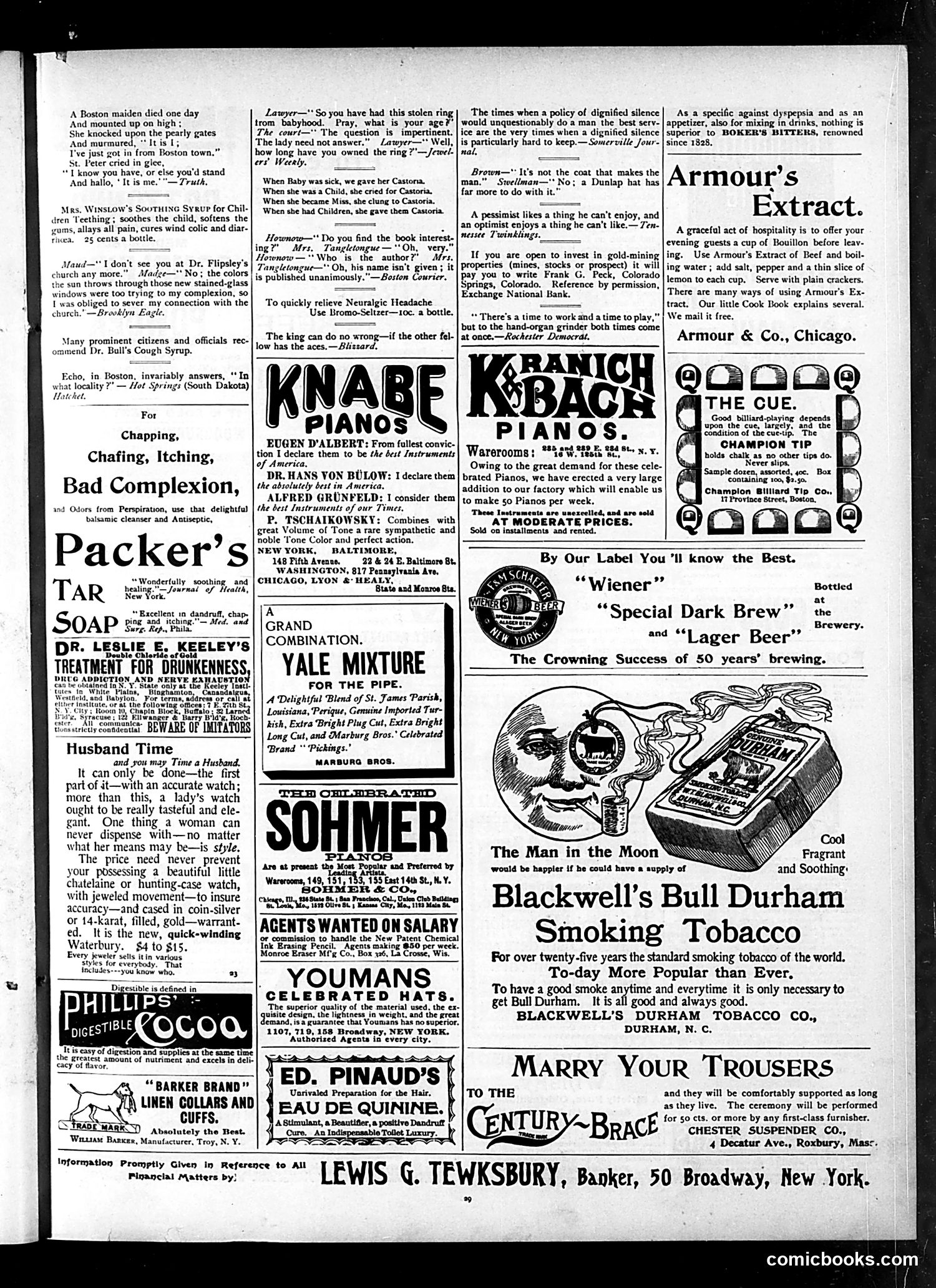
This page is primarily **advertisements with light humor**, typical of Judge magazine's format. The main joke at top depicts a Boston woman arriving in heaven. St. Peter's reaction—"I know you have, or else you'd stand and hallo, 'It is me'"—mocks Boston Brahmin accent and social pretension. The satire suggests Bostonians are so distinctive and self-important that even in the afterlife, they'd announce themselves with characteristic pomposity. The humor relies on recognizing Boston's reputation as an elite, culturally proud city. The remainder of the page consists almost entirely of **product advertisements** (pianos, soap, watches, tobacco, collars) with scattered short jokes from other newspapers interspersed. There are no significant political cartoons or social commentary beyond the opening Boston joke.
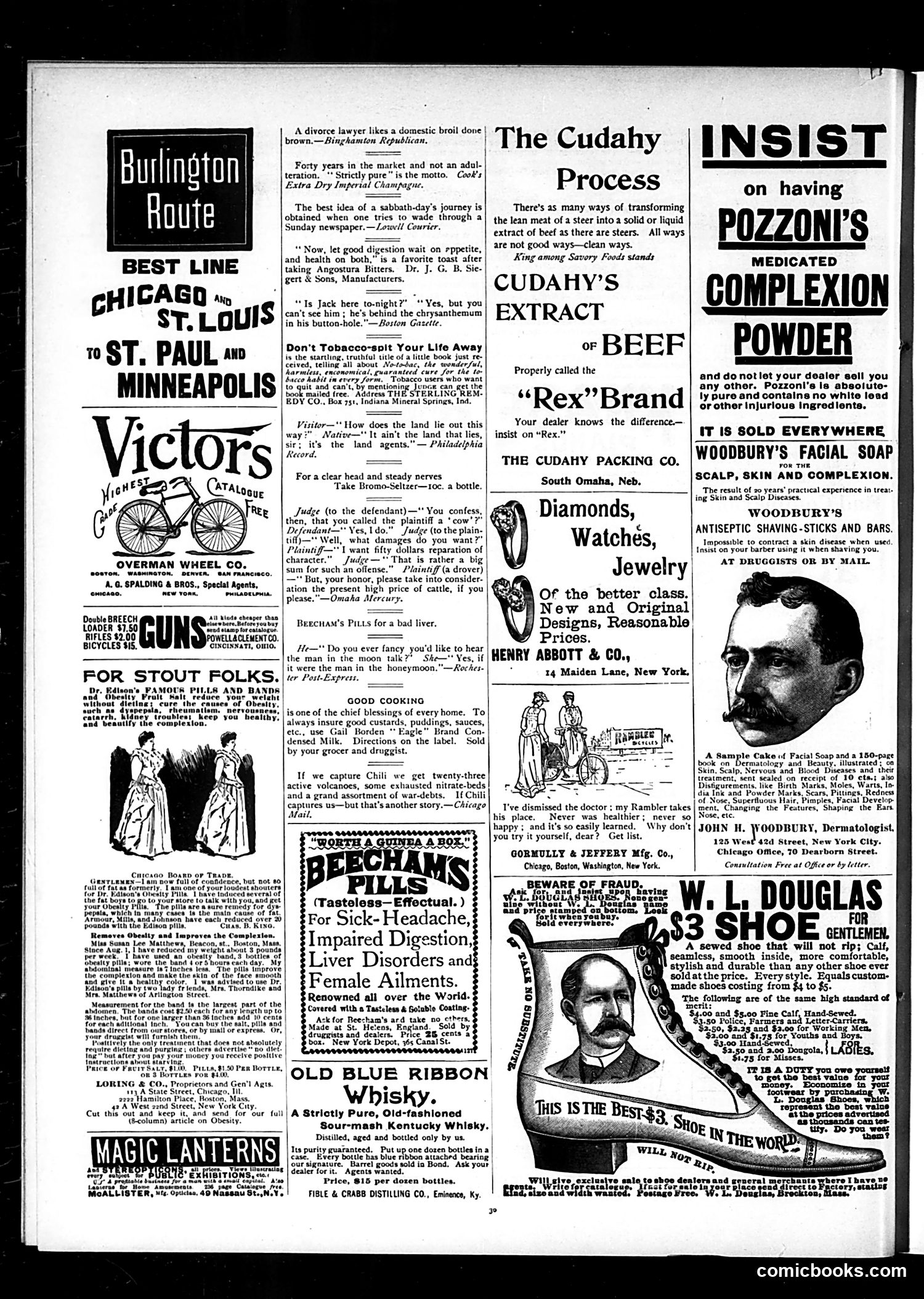
This page is primarily **advertising** with scattered brief humorous quips and jokes typical of Judge magazine's format. The jokes reference familiar late-19th-century concerns: a divorce lawyer's expertise ("domestic broil"), sabbath newspaper reading, tobacco use and quitting, flirtation, and cattle prices. One piece jokes about U.S. imperial ambitions regarding Chile, mentioning "twenty-three active volcanoes" and "war-debts"—likely referencing contemporary American expansionism. The advertisements promote products reflecting period consumer culture: patent medicines (pills for weight loss, liver pills), bicycles, firearms, condensed milk, beef extract, jewelry, and notably W.L. Douglas shoes marketed as economical footwear for gentlemen. **Pozzoni's Medicated Complexion Powder** receives prominent display with a man's photograph—typical advertising for cosmetics targeting both men and women. The "insist on having" language suggests brand competition and consumer awareness. No identifiable political cartoons or caricatures appear on this page; it's a standard magazine advertising/humor layout.
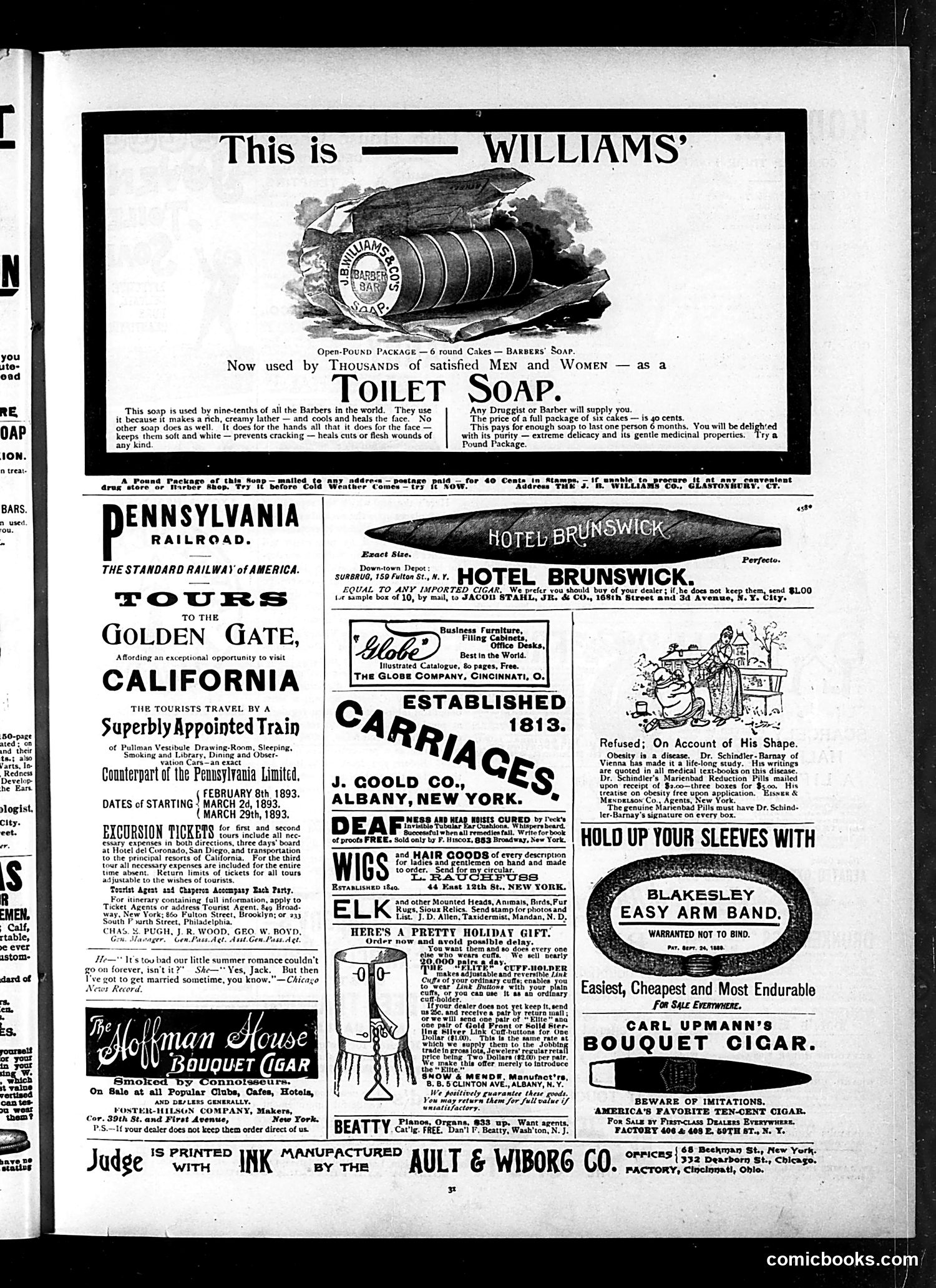
This page is primarily **advertising**, typical of Judge magazine's business model. The content consists of commercial advertisements with minimal editorial satire. The largest advertisement promotes **Williams' Barber Soap**, marketed as suitable for both men and women as toilet soap. It emphasizes practical benefits: rich lather, healing properties for cuts, and affordability. Other notable ads include: - **Pennsylvania Railroad's California tours** (1893), promoting luxury train travel to the Golden Gate - **Hotel Brunswick** in New York - **J. Goold's carriages** from Albany - Various personal care products: wigs, arm bands, cigars, and hair goods The only satirical element is a small **cartoon joke** at bottom-left depicting a brief romantic exchange between a couple, playing on the social expectation that summer romance must end in marriage—a mild commentary on courtship conventions. The page reflects 1890s consumer culture: advertisements dominate, targeting middle-class readers with products emphasizing gentility, health, and leisure travel.
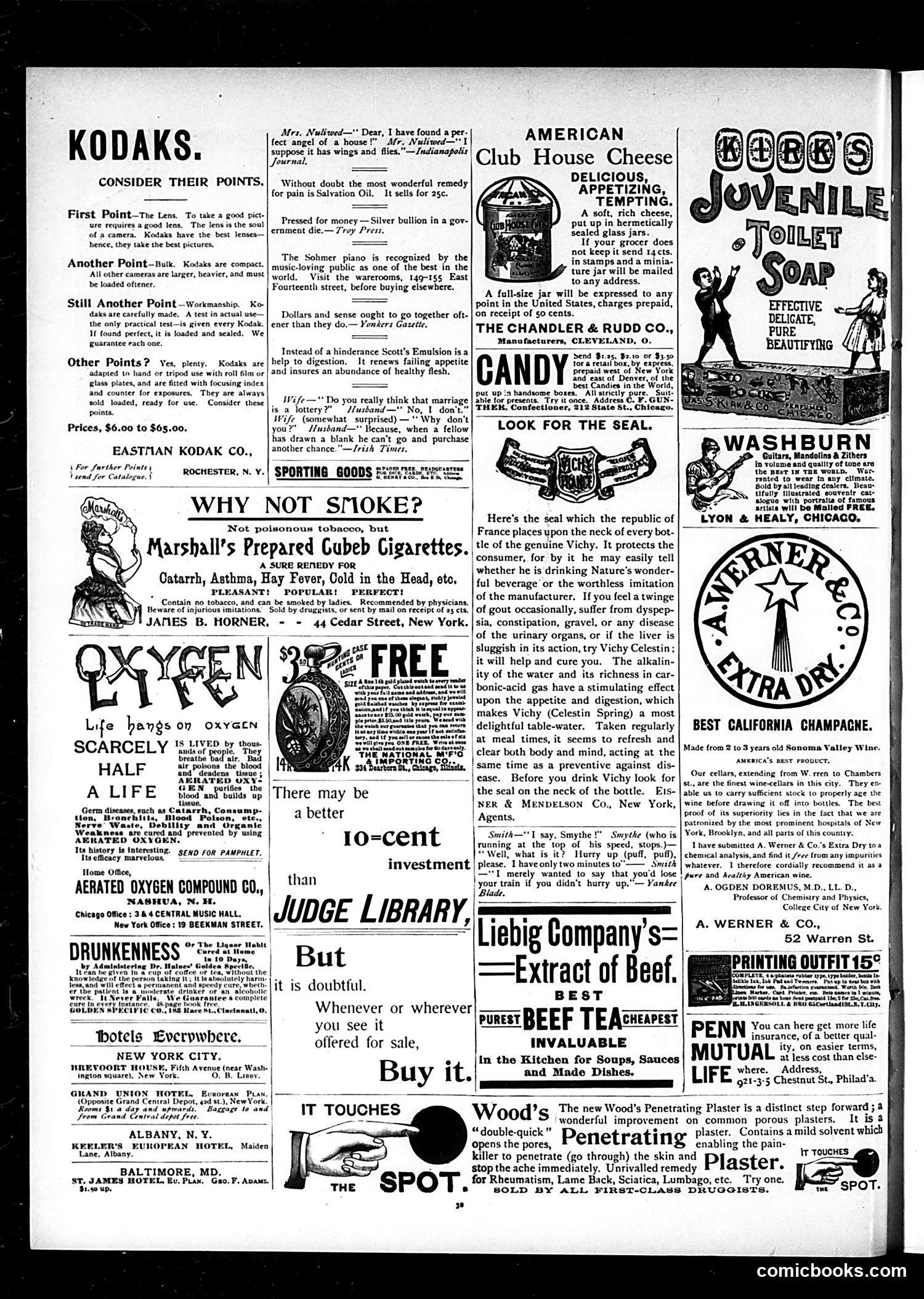
This is primarily an **advertising page** from Judge magazine, with minimal editorial content. The few jokes present are brief filler items between advertisements. The notable editorial content includes: - **"Mrs. Nuliwed" joke**: A play on newlyweds discovering their new house—she calls it "perfect," he jokes it has "wings and flies" (suggesting it's imaginary or will escape). - **Marriage lottery joke**: A husband argues marriage isn't a lottery because "when a fellow has drawn a blank he can't go and purchase another chance"—satirizing the permanence of marriage and inability to remarry after divorce. The page is dominated by **patent medicine and product advertisements** typical of 1890s-era publications: Kodak cameras, Marshall's Gubeb Cigarettes (marketed as respiratory remedies), "Aerated Oxygen" compounds, and various hotel listings. These ads reveal contemporary attitudes toward dubious health claims and unregulated medical products now recognized as ineffective or harmful.
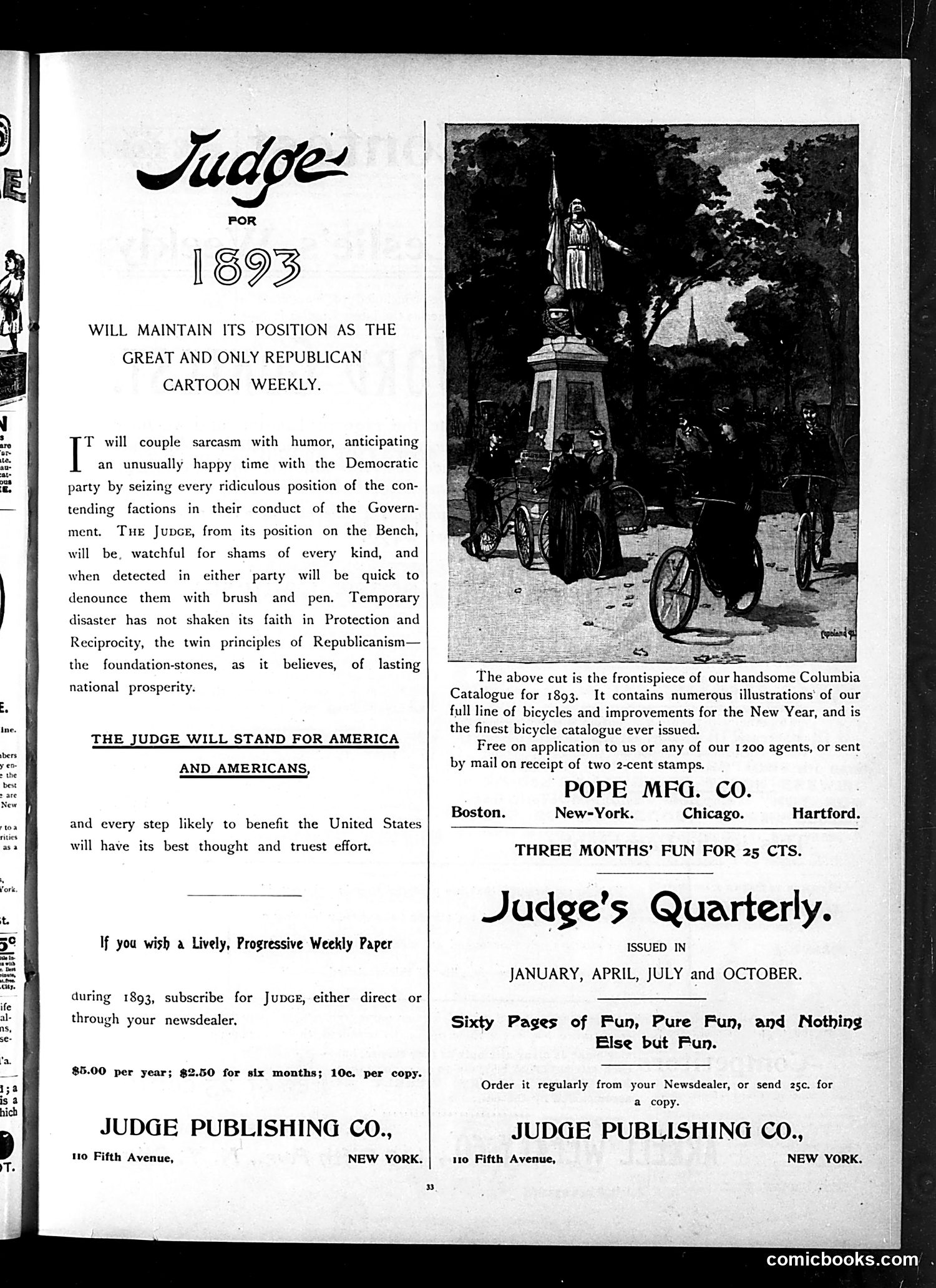
This is primarily a masthead/advertisement page rather than a cartoon. Judge declares itself "the great and only Republican cartoon weekly" and promises to satirize the Democratic party's "ridiculous positions" while championing Republican principles of Protection and Reciprocity. The magazine positions itself as a watchdog ("from its position on the Bench") ready to mock incompetence in government regardless of party—though its Republican allegiance is unmistakable. The page is mostly advertisements: a bicycle catalogue from Pope Manufacturing Company (featuring an illustrated monument scene) and promotions for Judge's Quarterly. Subscription rates and contact information fill the remainder. The 1893 date places this during Cleveland's second Democratic presidency, a period of economic depression—context for Judge's anticipated "happy time" mocking Democratic governance.
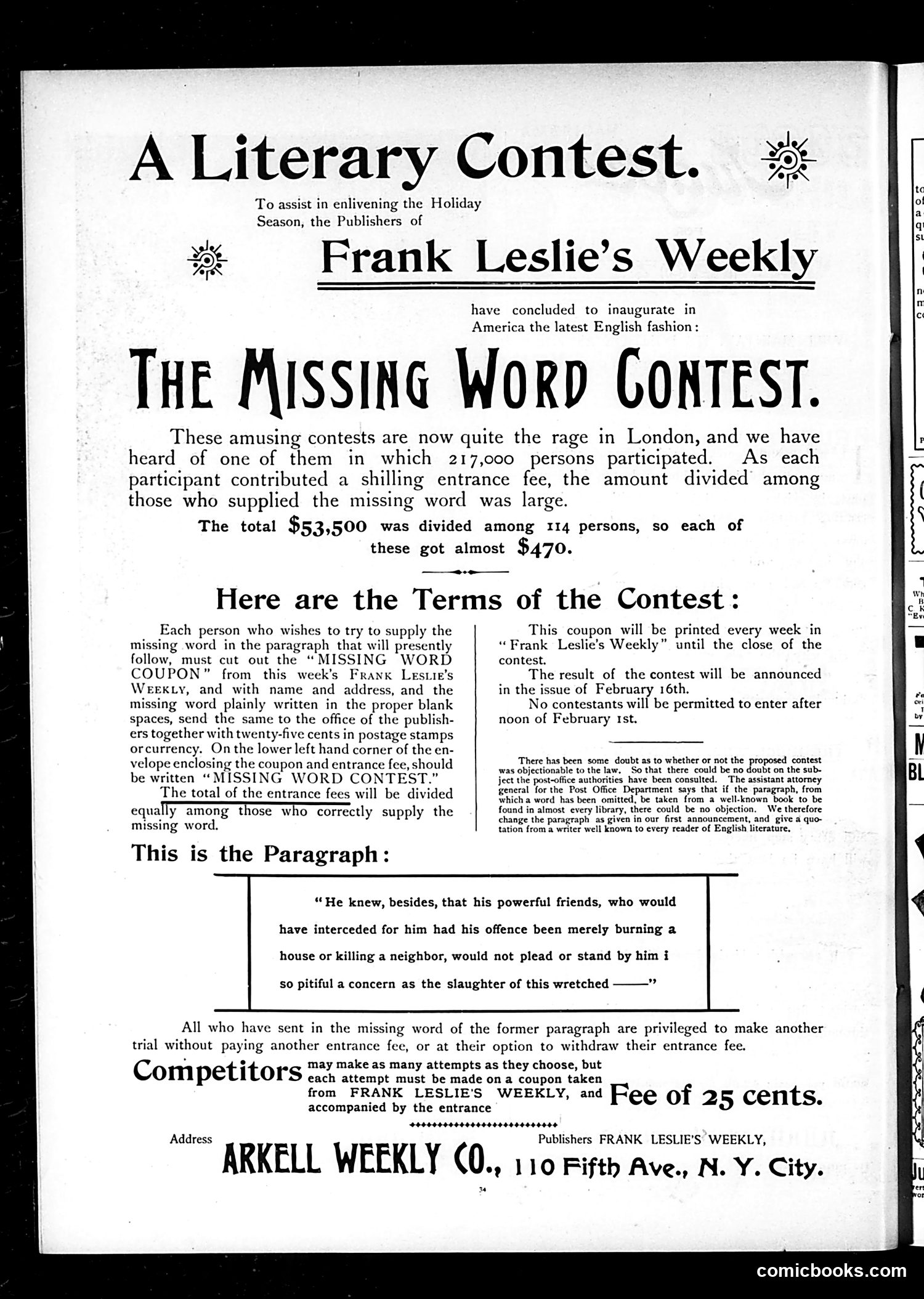
This is a straightforward advertisement for a "Missing Word Contest" run by Frank Leslie's Weekly magazine. It's not satirical or political—it's a promotional page announcing a real literary competition modeled on popular English contests. The contest works like a lottery: readers pay 25 cents per entry to guess a missing word in a printed paragraph (taken from literary sources), and the entrance fees are pooled and divided equally among all correct answers. The advertisement mentions a London precedent where 217,000 people participated and winners split $53,500. The page includes legal disclaimers noting postal authorities approved the contest as non-gambling (since it uses published literature rather than random drawings). This was a legitimate—if somewhat speculative—fundraising scheme for the magazine. There are no political figures or satire here; it's simply a period advertisement for audience engagement and revenue.
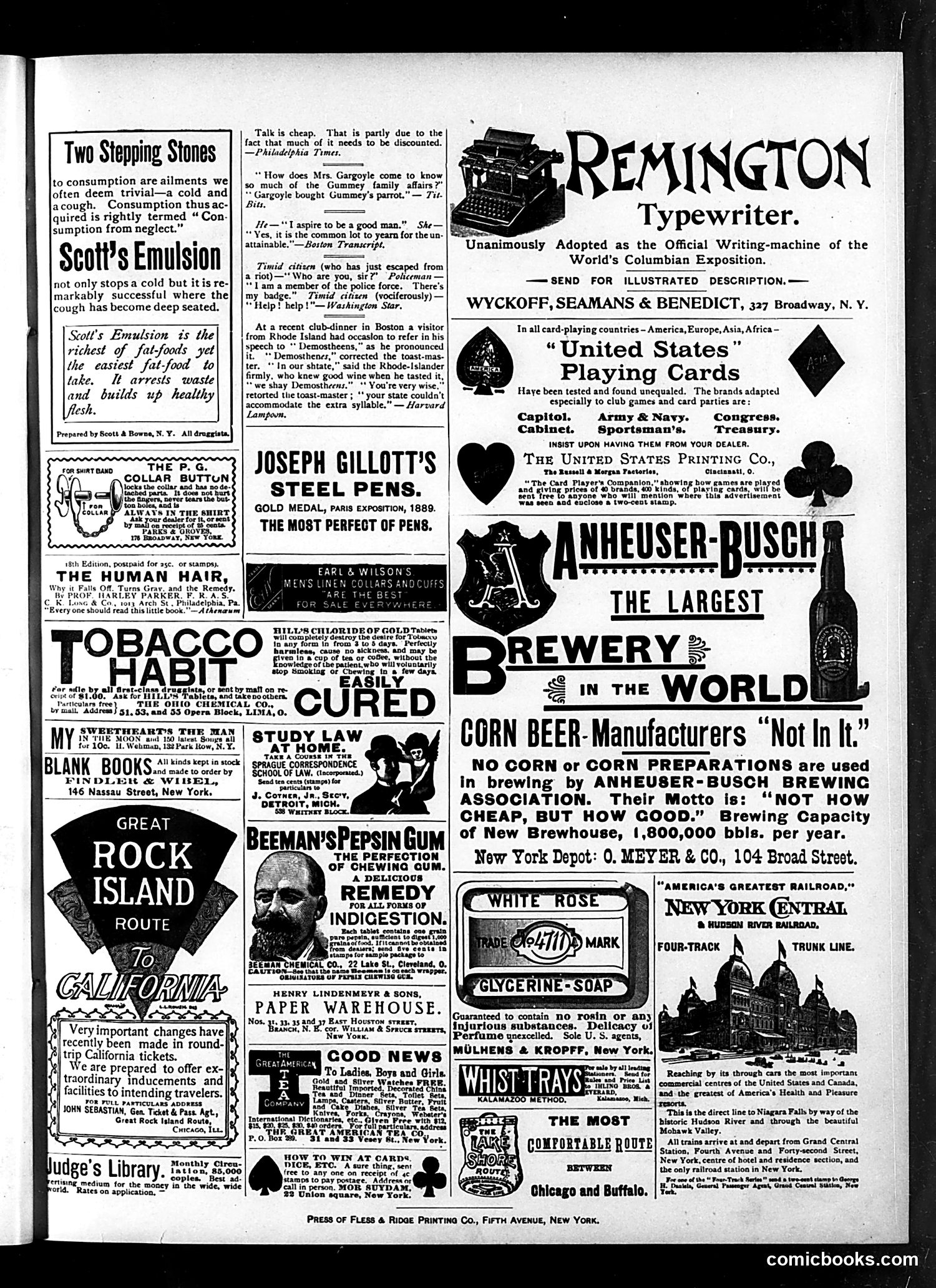
This page is primarily **advertising**, not satirical editorial content. The small text passages at the top are brief humorous anecdotes typical of Judge magazine's humor columns, but they occupy minimal space compared to the commercial advertisements filling the page. The jokes shown include wordplay about talk being "cheap," gossip overheard from a parrot, and observations on human nature. One anecdote mocks a Policeman for unhelpfully identifying himself to a riot victim. Another makes fun of a Rhode Islander's pronunciation of "Demosthenes." The bulk of the page consists of advertisements for period products: Scott's Emulsion (a health tonic), Remington typewriters, Anheuser-Busch beer, playing cards, soap, hair treatments, and tobacco-cure preparations—typical commercial messaging from the 1890s. No significant political or social satire appears here; this is a **revenue page** where advertisements subsidized the magazine's publication.
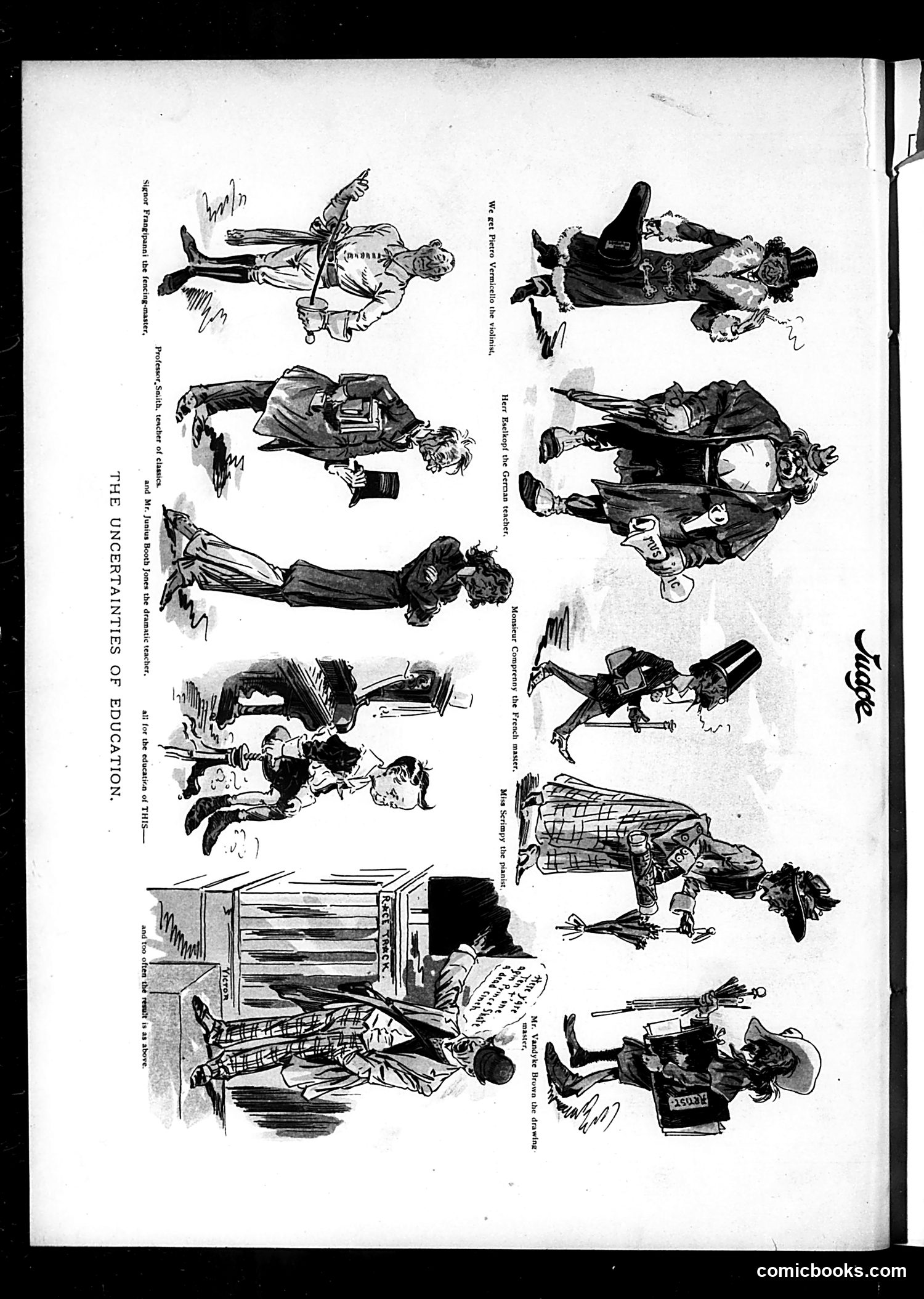
This page from *Judge* magazine contains satirical illustrations about education ("The Uncertainties of Education" appears in the title). The OCR text is heavily garbled and unreliable, making precise dating and specific references difficult to determine with certainty. The cartoons appear to depict various educational scenarios through exaggerated character illustrations—likely showing students, teachers, and parents in situations meant to satirize American schooling practices. The style and presentation suggest early-to-mid 20th century commentary on educational anxieties or bureaucratic absurdities. Without legible text or clear identifying labels in the image itself, I cannot confidently identify specific figures, political figures, or the exact satirical targets. The page likely critiques contemporary education policy or social attitudes toward schooling, but the specific point of the satire remains unclear from the image quality and OCR errors provided.