
A complete issue · 16 pages · 1890
Judge — September 6, 1890
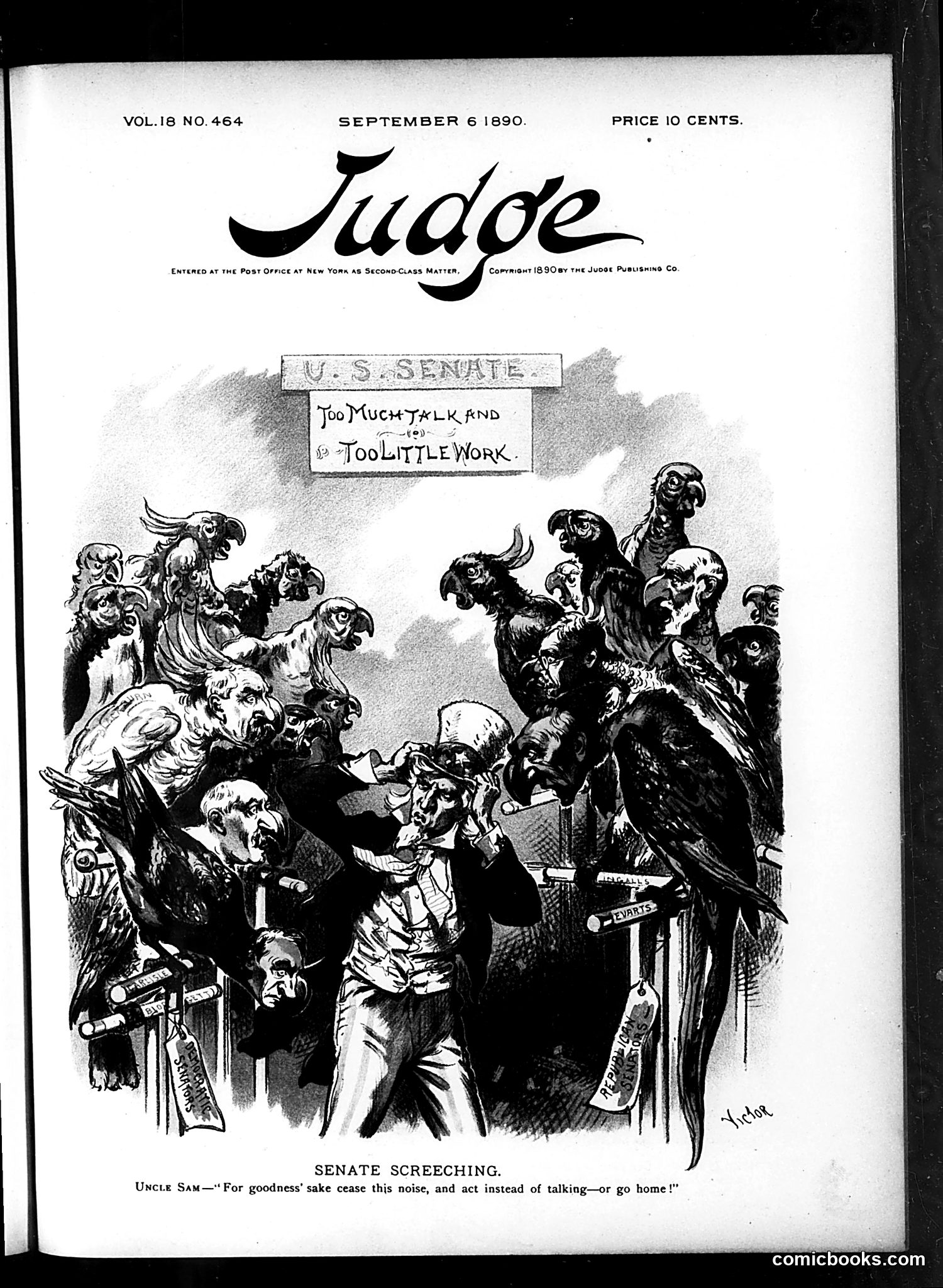
This cartoon satirizes excessive debate in the U.S. Senate. The headline "Too Much Talk and Too Little Work" establishes the complaint. The central figure labeled "Uncle Sam" (representing the nation) is surrounded by donkeys and other animals screeching and braying—visual metaphors for senators making noise rather than conducting business. Uncle Sam's caption—"For goodness' sake cease this noise, and act instead of talking—or go home!"—directly criticizes Senate ineffectiveness. The donkeys represent stubborn, obstinate behavior, a common 19th-century visual trope for foolish politicians. The cartoon reflects contemporary frustration with Congressional gridlock and unproductive debate, suggesting senators prioritized rhetoric over legislative accomplishment.
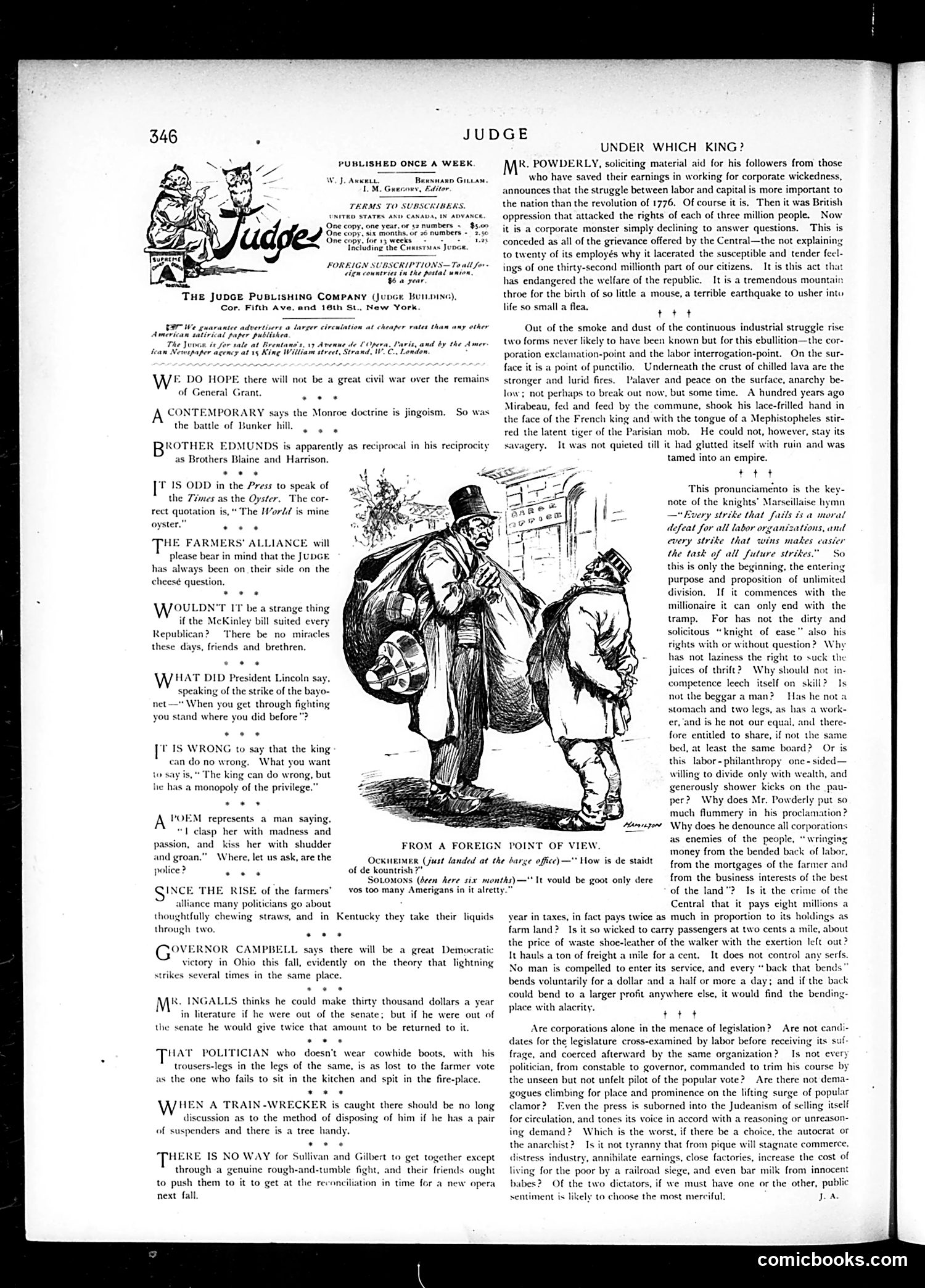
The main cartoon titled "FROM A FOREIGN POINT OF VIEW" depicts a large, rotund capitalist or industrialist figure laden with money bags encountering a small, impoverished child or worker. The illustration satirizes wealth disparity and exploitation. The surrounding editorial commentary criticizes corporate monopolies and labor practices, referencing: - Corporate exploitation of workers - Railroad monopolies (mentions McKinley) - Unfair pricing and shipping costs - Legislative capture by business interests The text argues corporations wield excessive political power, manipulating government to their advantage while workers suffer. This reflects early 20th-century Progressive Era concerns about unchecked corporate power, though specific dates and figures remain unclear from the page alone.
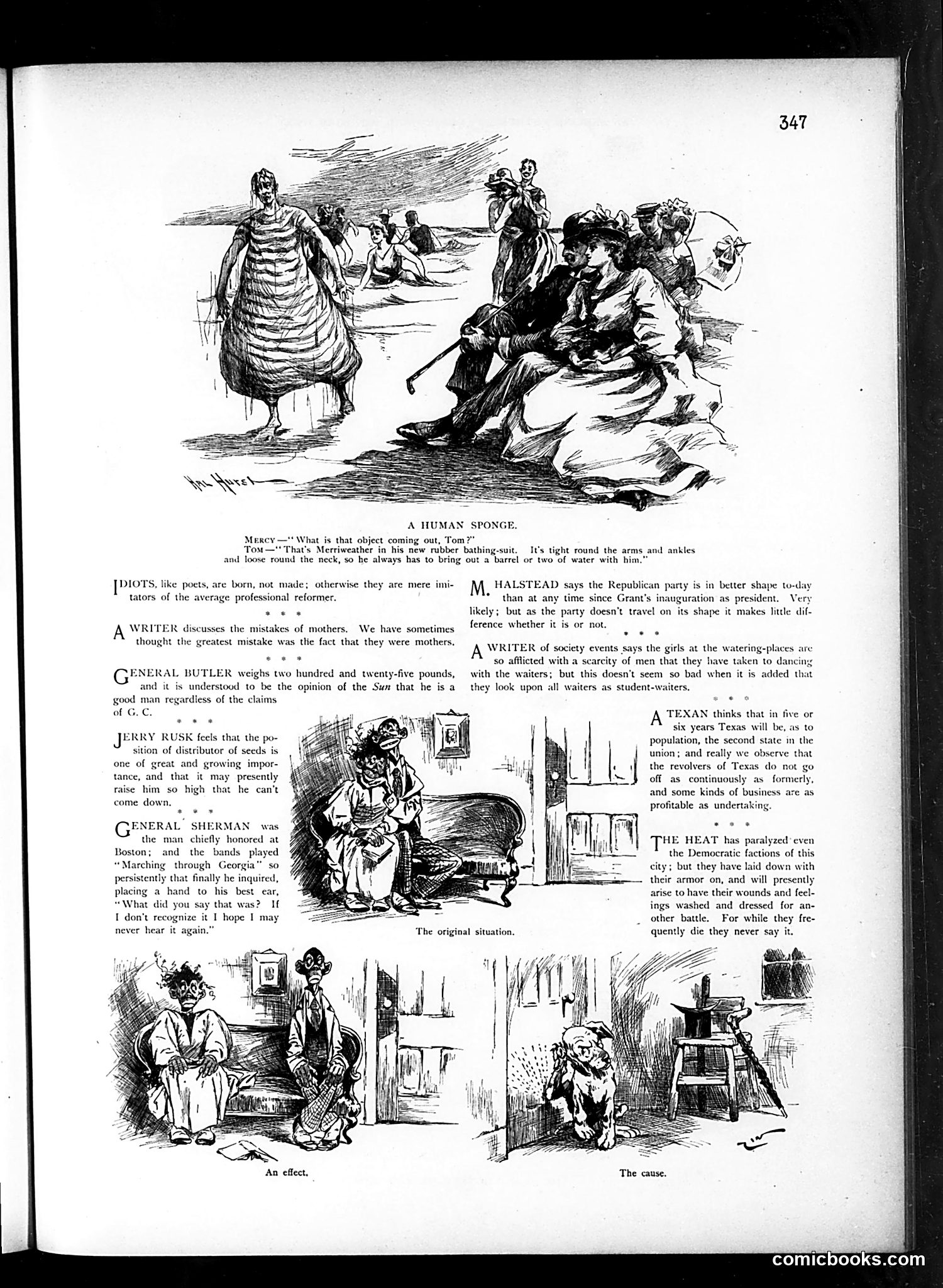
**"A Human Sponge"** (top cartoon) depicts a figure in a striped bathing suit as a literal sponge being wrung out by beachgoers—a metaphor for someone constantly being exploited or drained of resources. The accompanying dialogue references "Merryweather" and his need to repeatedly retrieve water buckets, suggesting this person is habitually squeezed for money or favors. The lower section contains brief satirical commentary on various topics: mothers' mistakes, General Butler's weight, Jerry Rusk's importance, General Sherman's legacy, Republican party shape, Democratic factions' paralysis, and Texas's future population. **"An effect"** and **"The cause"** (bottom cartoons) appear to show cause-and-effect relationships, though the specific political reference remains unclear without additional context.
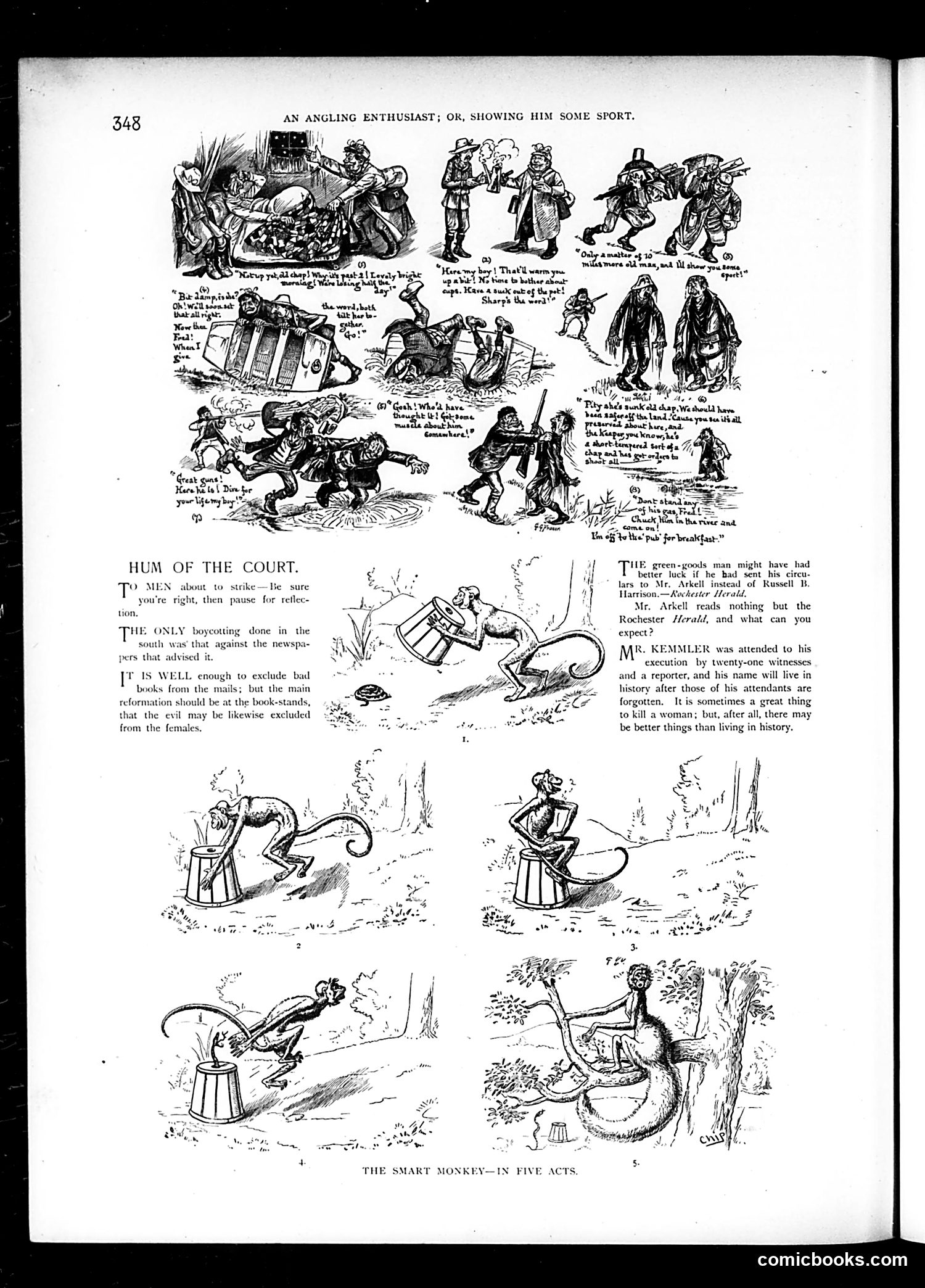
The upper section depicts comic scenes of people fishing and getting into mishaps—a lighthearted satirical take on "angling enthusiasts" encountering unexpected sport (trouble) rather than successful fishing. Below are three separate short satirical commentaries: **"Hum of the Court"** jokes about the inconsistency of Southern boycotts against newspapers advocating boycotts, and proposes that moral reform of literature should focus on booksellers rather than mail censorship. **The green-goods reference** appears to mock a scam artist who targeted the wrong person—sending circulars to someone (Arkell) who reads only one newspaper and thus wouldn't fall for the scheme. **The Kemmler item** references the execution of a murderer (likely the first electric chair execution, 1890). It darkly suggests that while killing a woman might earn notoriety, there are arguably more worthwhile achievements than achieving posthumous fame through execution. "The Smart Monkey—In Five Acts" (bottom) shows a trained monkey performing increasingly difficult tricks, likely satirizing human vanity or gullibility.
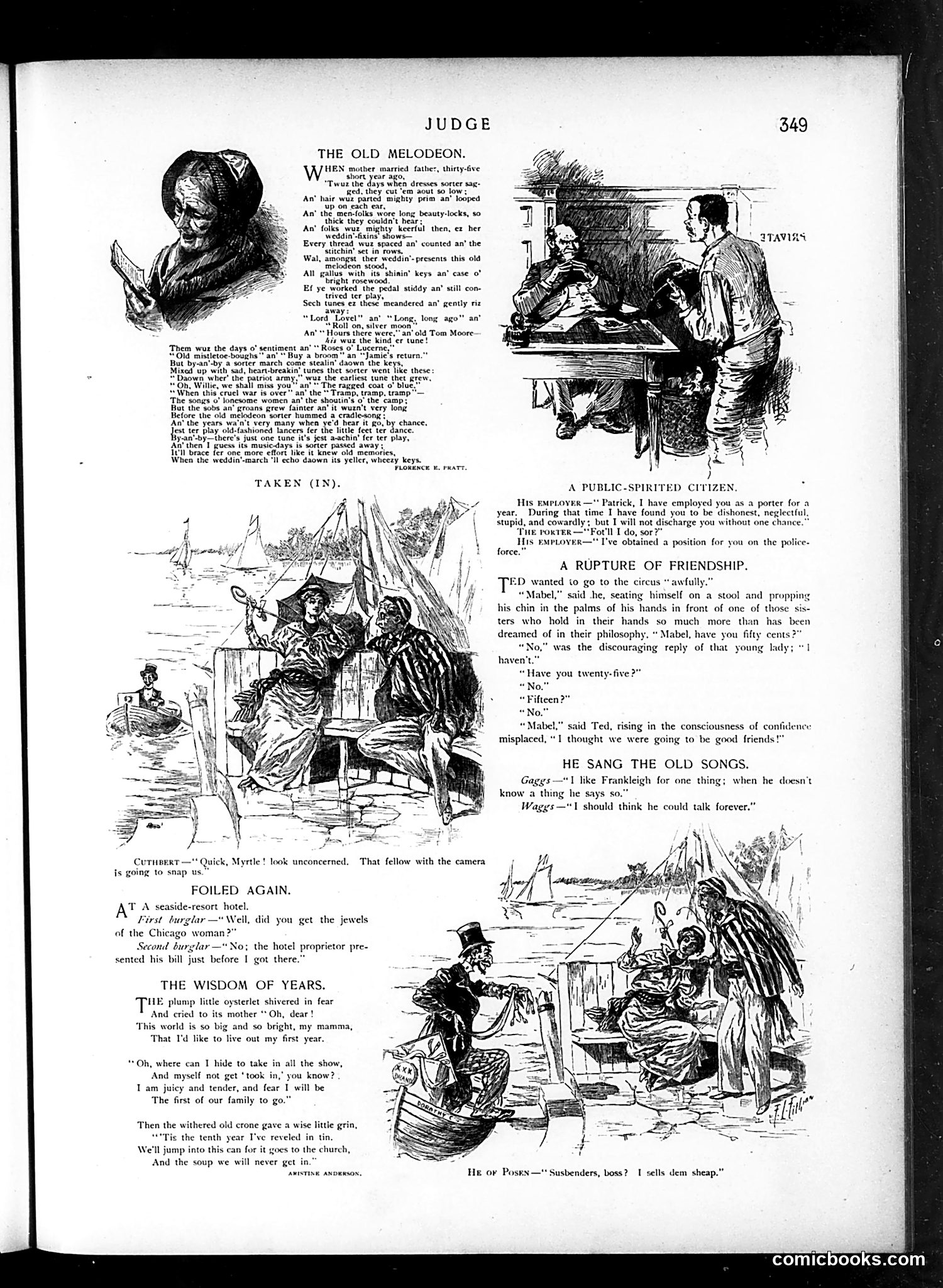
This page contains multiple short satirical pieces typical of late 19th-century Judge magazine humor: **"The Old Melodeon"** is a sentimental poem about a family's melodeon (small organ) that played romantic songs during peacetime, then shifted to Civil War ballads ("When This Cruel War Is Over," "Tramp, Tramp, Tramp"), reflecting how the war disrupted domestic life. **"A Public-Spirited Citizen"** satirizes employment corruption: an employer with a terrible track record ("dishonest, neglectful, stupid, cowardly") gives a porter a second chance—by getting him a police force position, implying the police force accepts society's rejects. **"A Rupture of Friendship"** is a humorous domestic vignette where a boy (Ted) and girl (Mabel) quarrel over circus money, with Ted indignantly declaring their friendship broken over fifty cents. Remaining pieces offer lighter jokes: about forgetful people, seaside hotel theft prevention through bill-collecting, an oyster's existential fears, and street vendors. The illustrations are detailed Victorian-era sketches accompanying each piece.
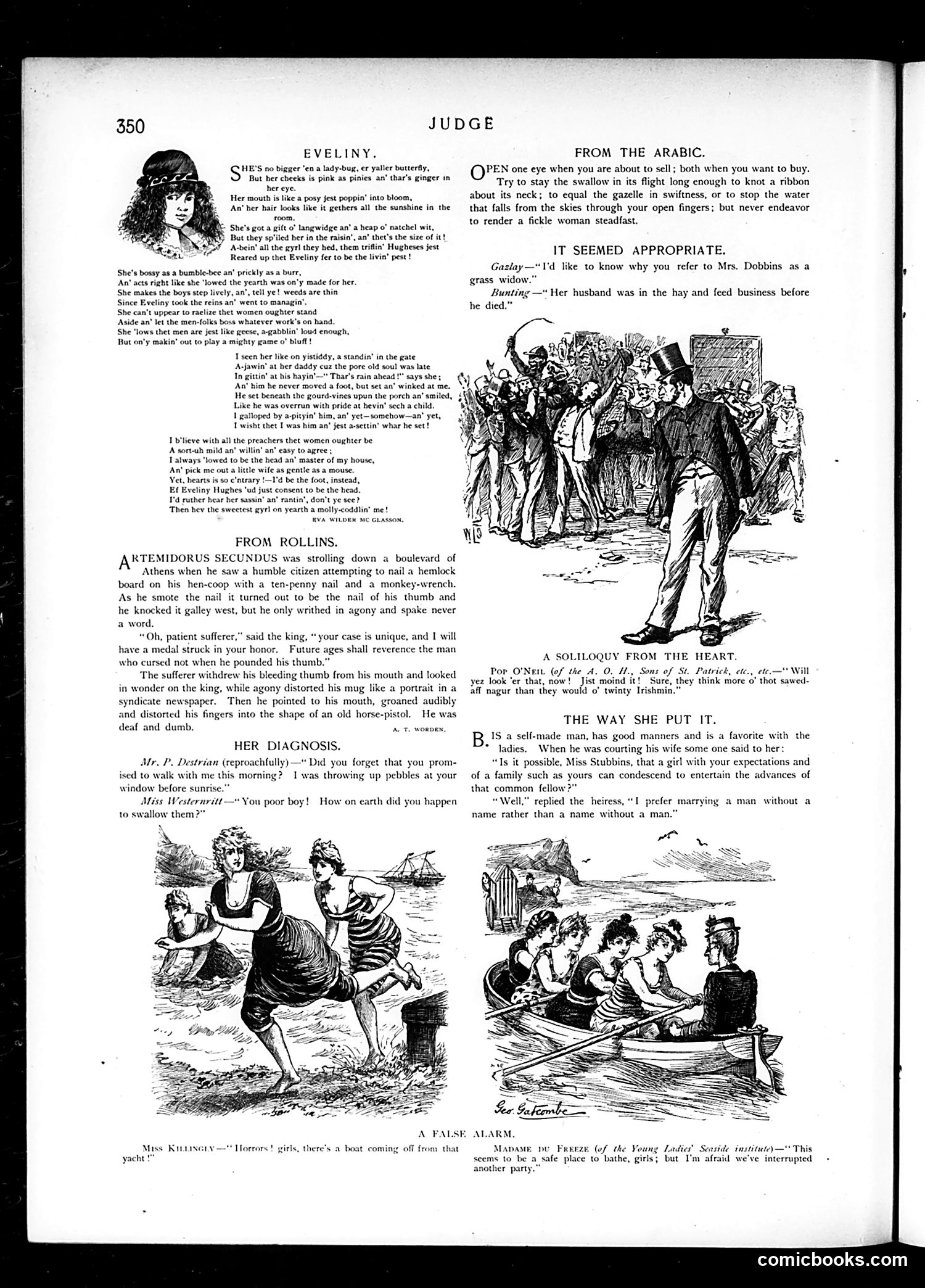
This page contains three distinct satirical pieces: **"Eveliny"** (main poem): A rural dialect poem mocking a young woman who defies traditional gender roles. "Eveliny Hughes" is portrayed as bossy, outspoken, and domineering—she manages farm work and contradicts her father rather than deferring to male authority. The satire targets the narrator's conflicted attitude: he claims to believe women should be submissive, yet admits he'd prefer a woman like Eveliny who "sasses" and leads. This reflects late-19th-century anxiety about women's growing independence and challenges to male authority. **"From Rollins"**: A brief anecdote about a patient Greek who doesn't curse when injuring himself—then revealed to be deaf and dumb, mocking the absurdity of the king's reward. **"Her Diagnosis"** and other short pieces: Light romantic/domestic humor featuring miscommunications and social embarrassments. The page is primarily humorous commentary on gender roles, courtship, and social propriety—typical of Judge's satirical approach to contemporary American life.
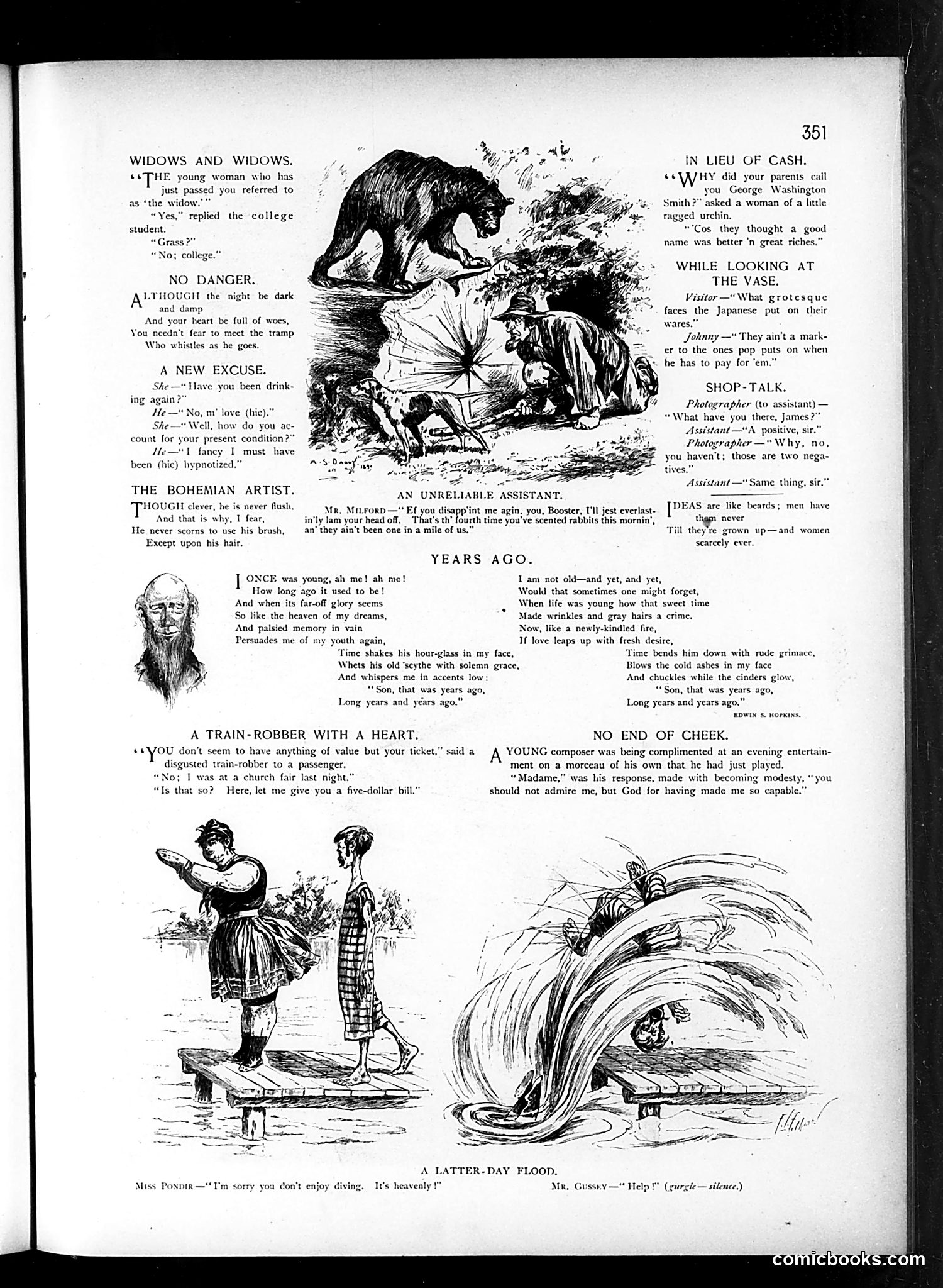
This page from Judge magazine collects short humorous anecdotes and satirical cartoons typical of late-19th/early-20th century American humor. The jokes mock common social situations: a widow avoiding college education, a drunk man claiming hypnotism, a bohemian artist who pays with paintings instead of money, and working-class dialogue (a child named after Washington for moral value rather than wealth). One cartoon shows a photographer confusing "positives" and "negatives"—a darkroom pun. Another depicts a compassionate train robber who gives money to a poor passenger. A nostalgic poem reflects on aging and lost youth. The humor relies on wordplay, class distinctions, and gentle social observation rather than political commentary. "Shop-talk" and "Ideas are like beards" sections offer observational comedy about professional and domestic life. The final cartoon shows someone drowning while dining, captioned as a "latter-day flood." The page is primarily entertaining rather than overtly political satire.
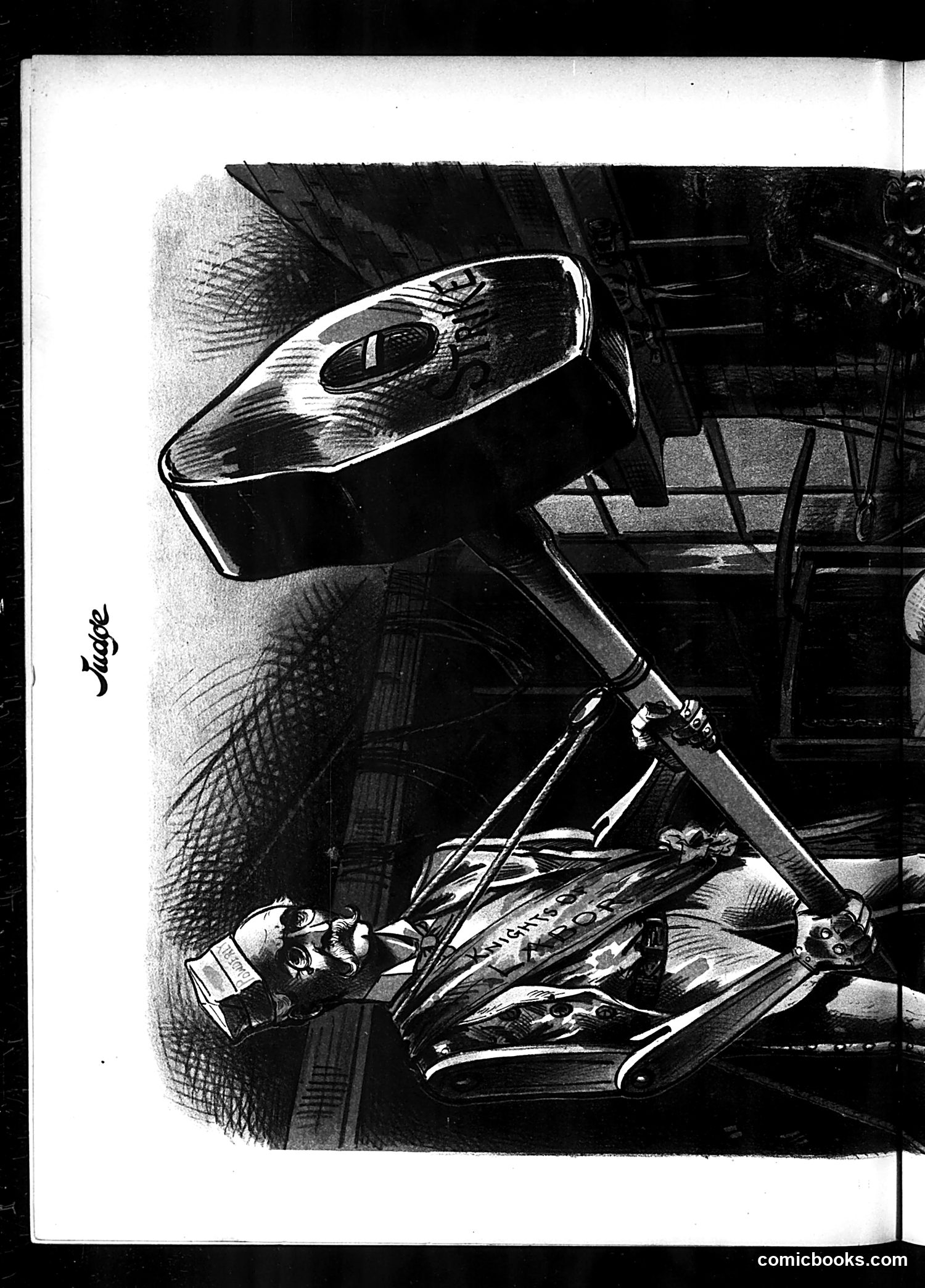
This appears to be a Judge magazine illustration signed by an artist (signature visible on left side). The black and white drawing shows a large mechanical or robotic head/mask with an elongated oval eye opening, positioned above what looks like a human figure operating or controlling it with mechanical arms or levers. The artistic style and composition suggest this is likely satirical commentary on automation, mechanization, or perhaps the relationship between humans and machines during an era when such themes were emerging in popular culture. However, without clearer context from surrounding text or a visible caption, the specific political or social target of the satire is unclear. The dramatic chiaroscuro technique emphasizes the somewhat ominous or unsettling nature of the mechanical device.
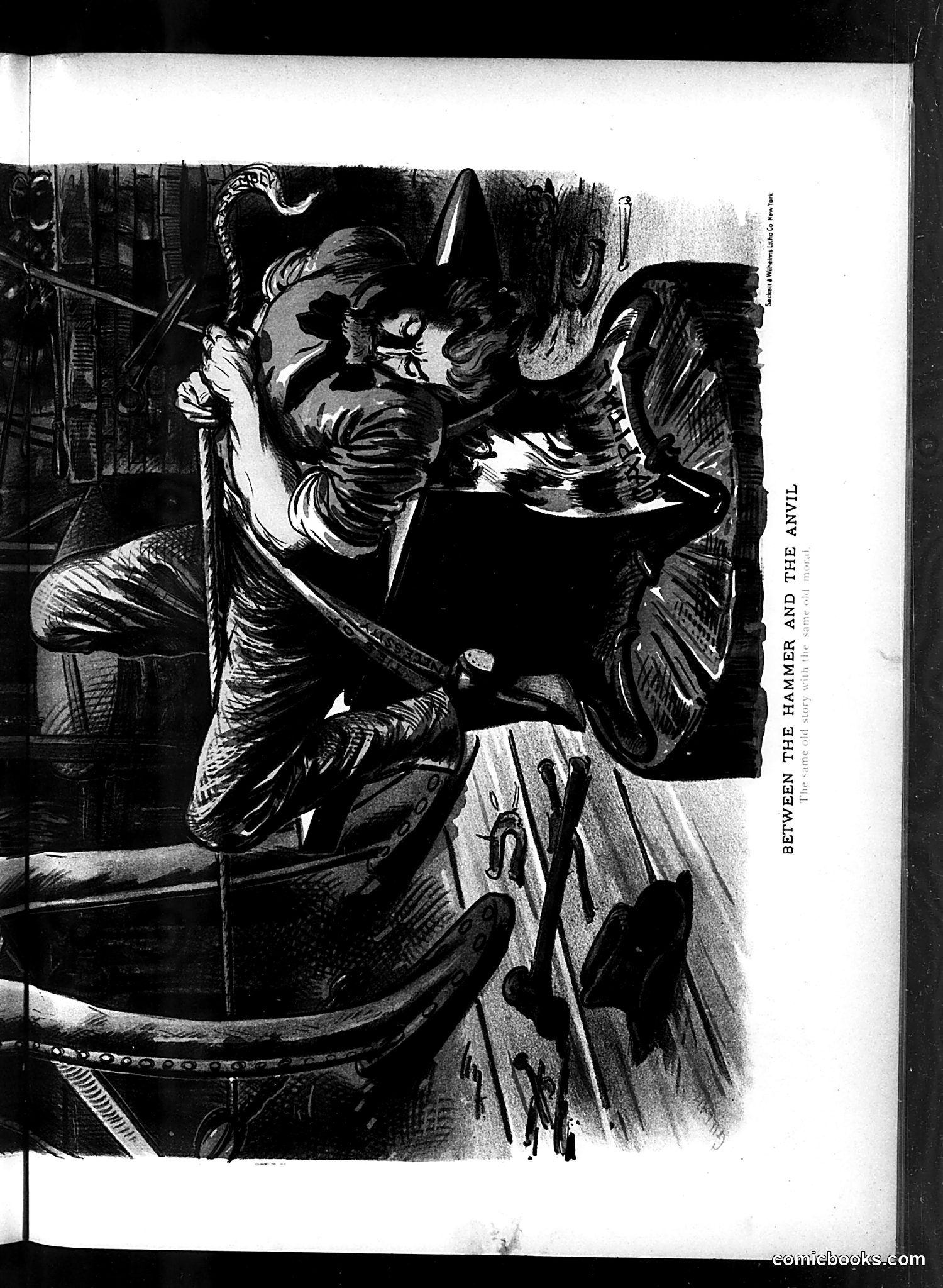
This political cartoon depicts a figure being crushed between two large implements—a hammer and an anvil. The dramatic, expressionistic style emphasizes the subject's distress and vulnerability. The title suggests the figure is caught in an impossible position between two opposing forces with no escape. Without being able to identify the specific figure or date this Judge magazine page, I cannot definitively state which historical conflict or political situation this references. However, the metaphor of being trapped between opposing powers was commonly used in early-to-mid 20th century American political satire to illustrate politicians or groups squeezed between competing interests, factions, or international powers. The expressive woodcut-style rendering emphasizes the severity and inescapability of the situation depicted.
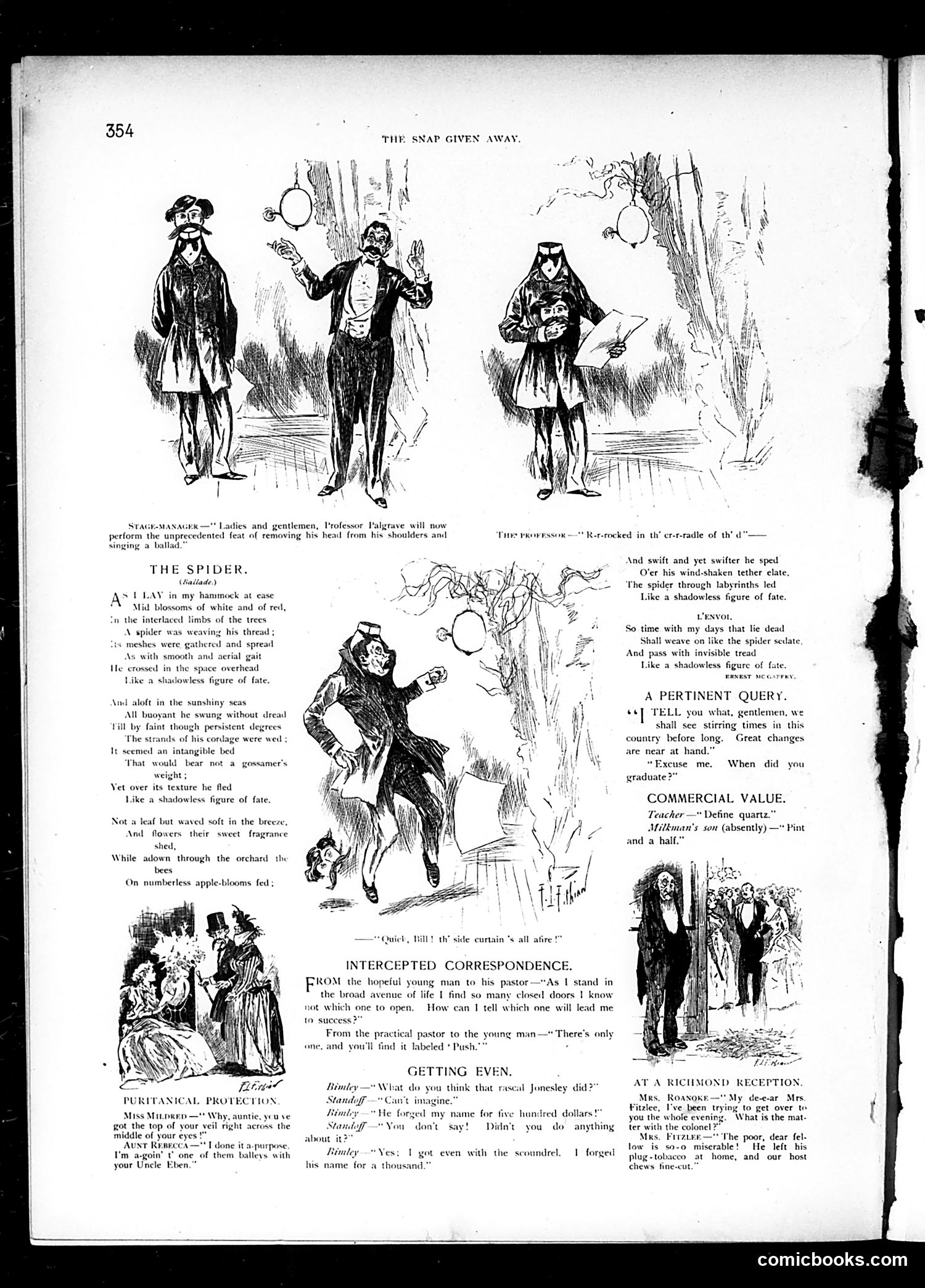
This page contains several unrelated satirical sketches typical of Judge magazine's format. **Top section**: A stage manager announces "Professor Palgrave" will remove his head and sing—a classic magic trick illusion. The professor appears to succeed, but the "snap" (the trick's secret) is revealed: he's simply bent backward in the curtain's shadow, creating the optical illusion of a headless body. The satire mocks both gullible audiences and fraudulent performers. **Middle sections**: Include a sentimental poem ("The Spider"), humorous dialogue snippets ("Commercial Value" jokes about definition of quartz; "Getting Even" depicts petty revenge), and "Intercepted Correspondence" mocking young men seeking life advice. **Lower sketches**: Social commentary on courtship, tobacco etiquette at Richmond receptions, and "Puritanical Protection"—an aunt deliberately obscuring her niece's vision as moral protection. The overall tone satirizes Victorian social pretensions, foolish behavior, and domestic absurdities rather than specific political figures or events.
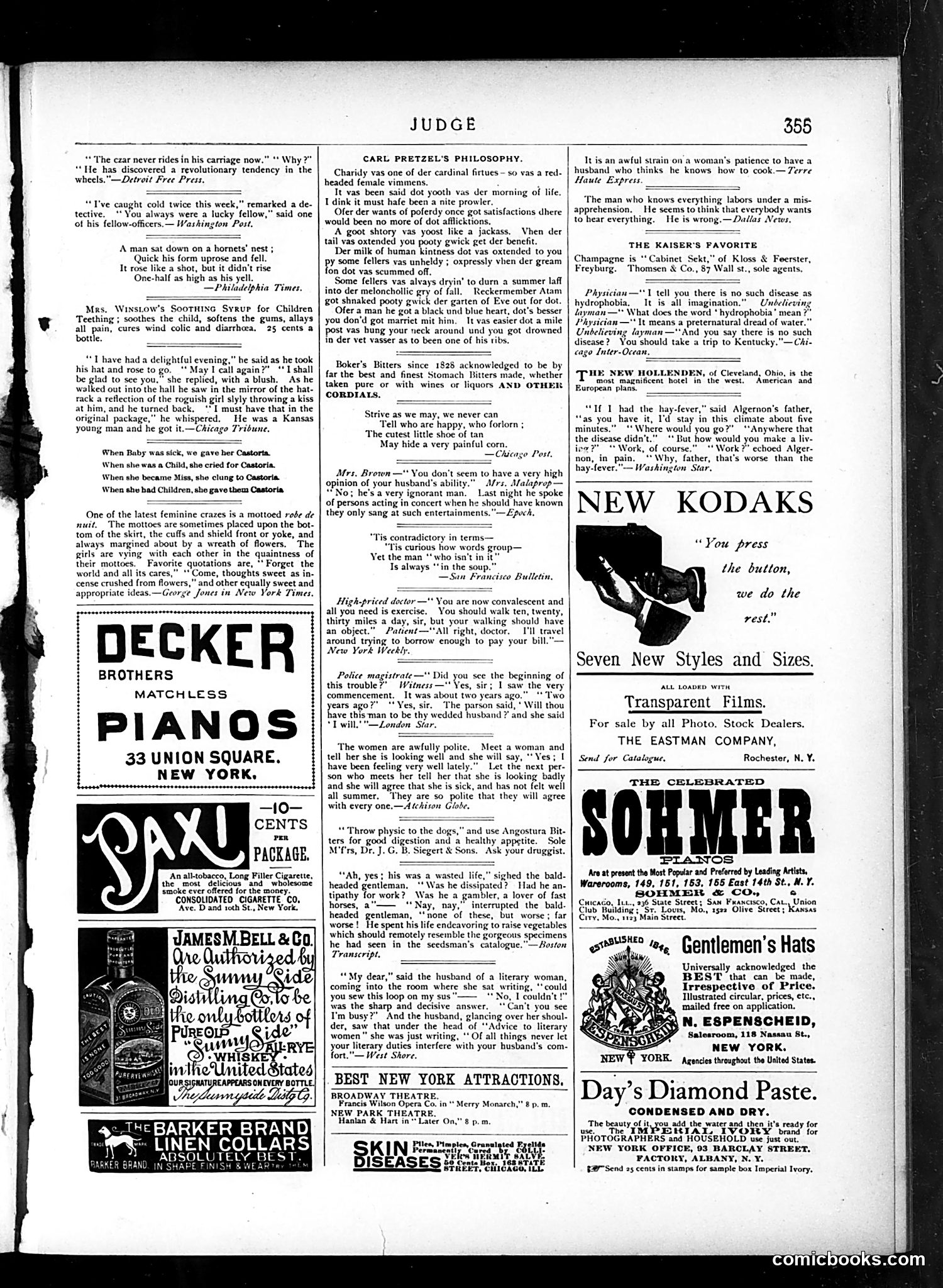
This page is primarily **advertisements and humor shorts** rather than political cartoons. The notable content includes: **"Carl Pretzel's Philosophy"** — A dialect humor column featuring a German-accented character offering folksy observations. This reflects a common turn-of-century American tradition of ethnic stereotype humor, where immigrant characters (particularly German) delivered supposedly humorous wisdom in broken English. The jokes are mild observations about human nature ("a good story is like a jackass"). **Other short jokes** mock everyday situations—a detective catching colds, a man sitting on a hornets' nest, romantic mishaps—typical of Judge's light satirical fare. **Advertisements** dominate: pianos, cigarettes, linen collars, medicinal products (including the famous Mrs. Winslow's Soothing Syrup, a real patent medicine). There are **no identifiable political figures or significant satire** on this particular page. It represents Judge's mixed content of mild humor, ethnic comedy, and commercial ads typical of early 1900s American magazines.
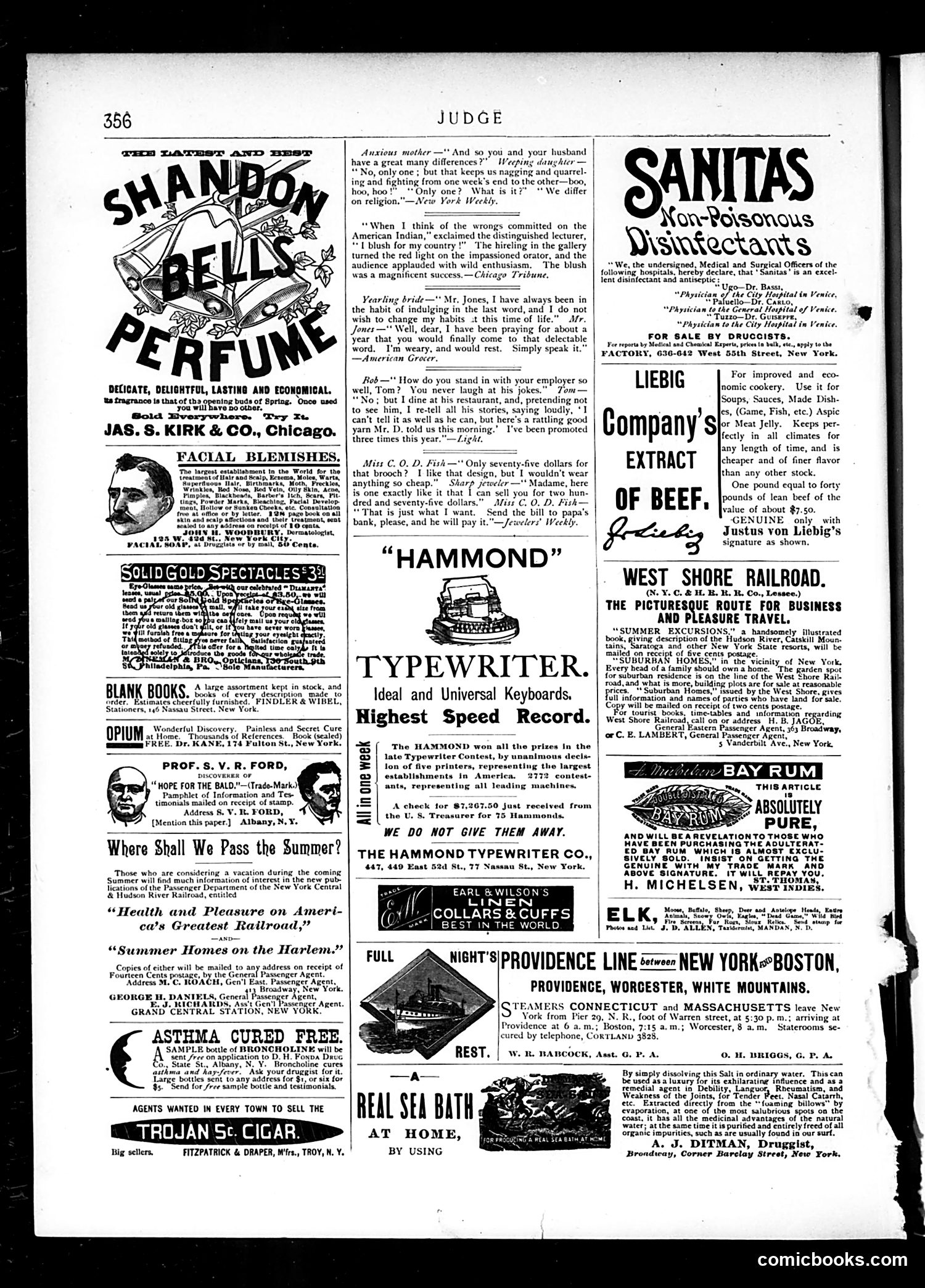
This page is primarily **advertisements and filler comic anecdotes**, not political cartoons. The large illustrated ads dominate (Shandon Bells Perfume, Hammond Typewriter, railroad excursions), interspersed with brief humorous jokes typical of Judge magazine. The small comic pieces satirize **middle-class social behaviors**: a newlywed couple's marital discord over religion; a heckler manipulating stage lighting to make a lecturer "blush" at his own rhetoric about injustices to Native Americans (the satire targets performative outrage); a man flattering his boss by pretending not to recognize him while retelling the boss's own jokes; and a wealthy woman who disdains an affordable brooch but wants an identical expensive one simply for the price tag. These vignettes mock **vanity, hypocrisy, social climbing, and shallow values**—Judge's standard targets for satire of Gilded Age society.
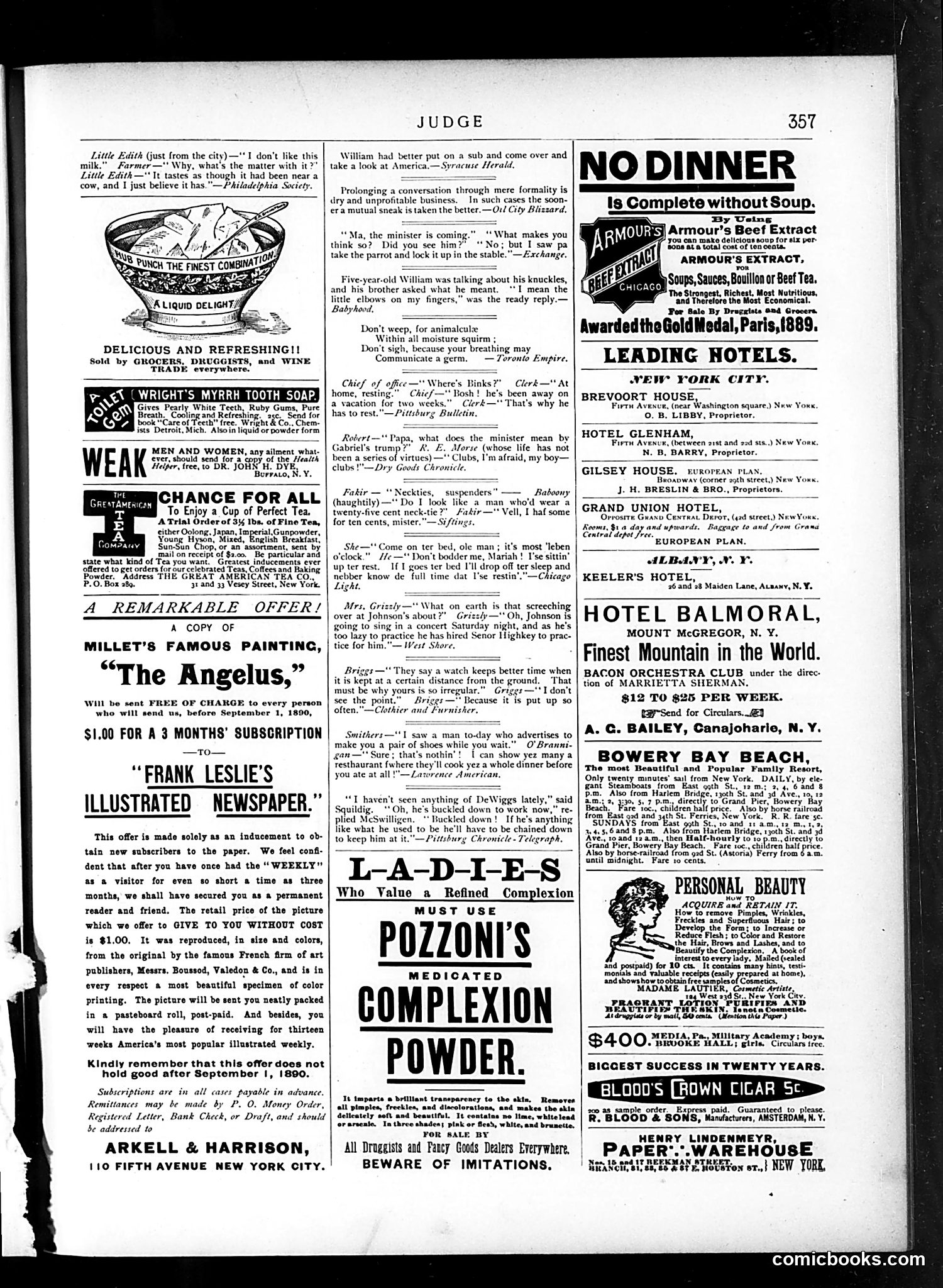
This page is primarily **advertisements and filler content** rather than political satire. The dominant features are: 1. **"NO DINNER" advertisement** for Armour's Beef Extract—a product claiming soup is essential to a complete meal 2. **Hotel and product advertisements** (Pozzonni's Complexion Powder, Blood's Crown Cigars, etc.) 3. **Small humorous anecdotes** scattered throughout, including: - "Little Edith" joke about a city child mistaking condensed milk for cow's milk - Brief exchanges about ministers, neckties, and children's misunderstandings 4. **Subscription offer** for Frank Leslie's Illustrated Newspaper, promoting a reproduction of Millet's "The Angelus" The page reflects late-19th-century magazine culture: light humor mixed with aggressive advertising. The jokes are gentle domestic/family humor rather than political commentary. No identifiable political figures or events appear—this is primarily a commercial page masquerading as editorial content.
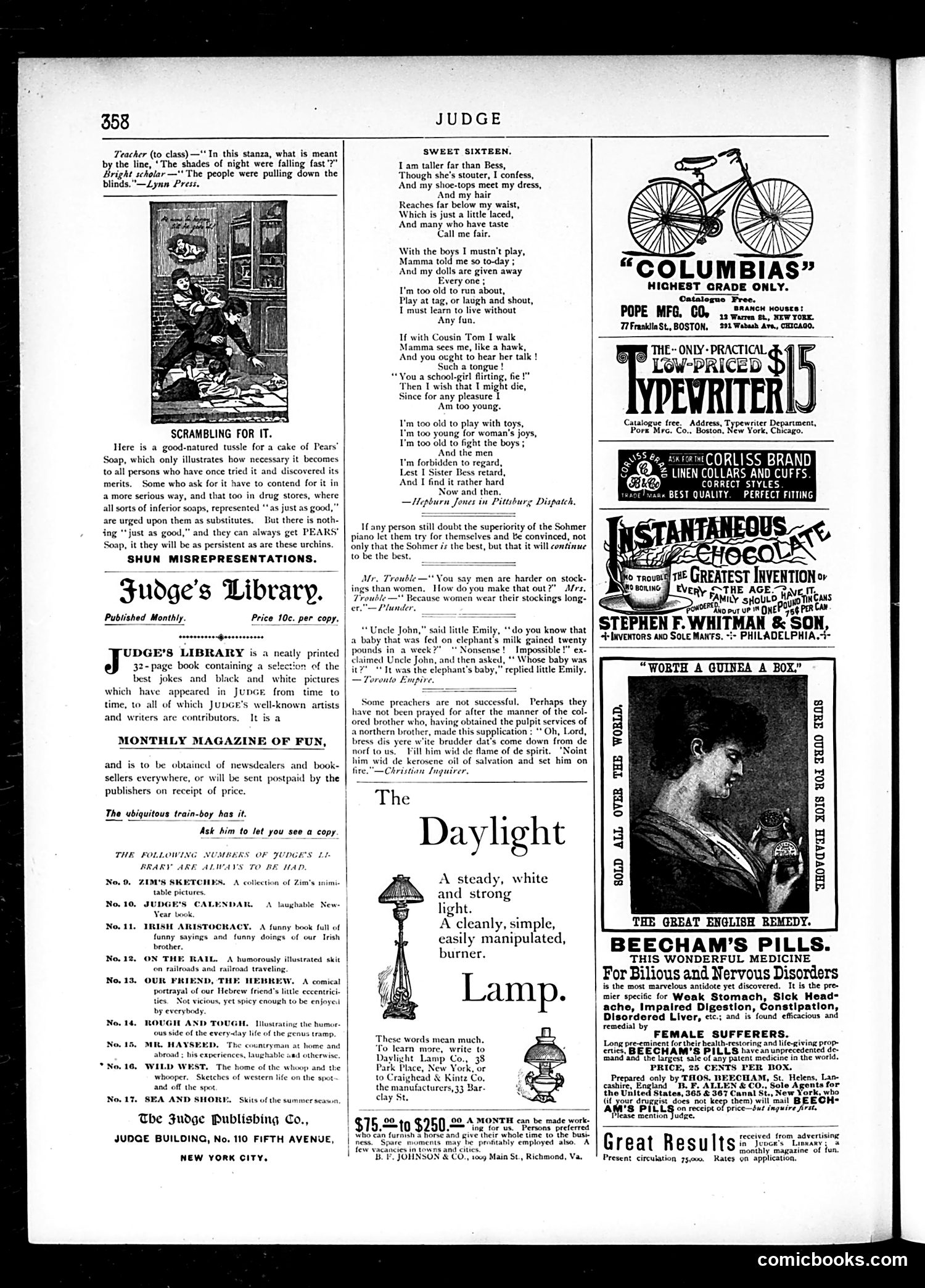
This page is primarily **advertising and editorial content**, not political cartoons. The main illustrated item is "**Scrambling for It**"—a humorous engraving showing children fighting over **Pears' Soap**, a real commercial product advertised on this page. The caption frames this as gentle satire on consumer behavior: soap users become so devoted to the brand (having "discovered its merits") that they scramble to obtain it, unlike inferior substitutes merchants try to push. It's essentially a commercial endorsement disguised as humor. The **"Sweet Sixteen"** poem satirizes the awkward social restrictions placed on adolescent girls—they're too old for toys and play, yet forbidden from socializing with boys or men, creating an absurd limbo. This reflects genuine Victorian-era anxieties about female propriety and coming-of-age. The remainder consists of **advertisements** (typewriters, bicycles, medicines) and notices for *Judge's Library* publications, typical of magazine content from this period.
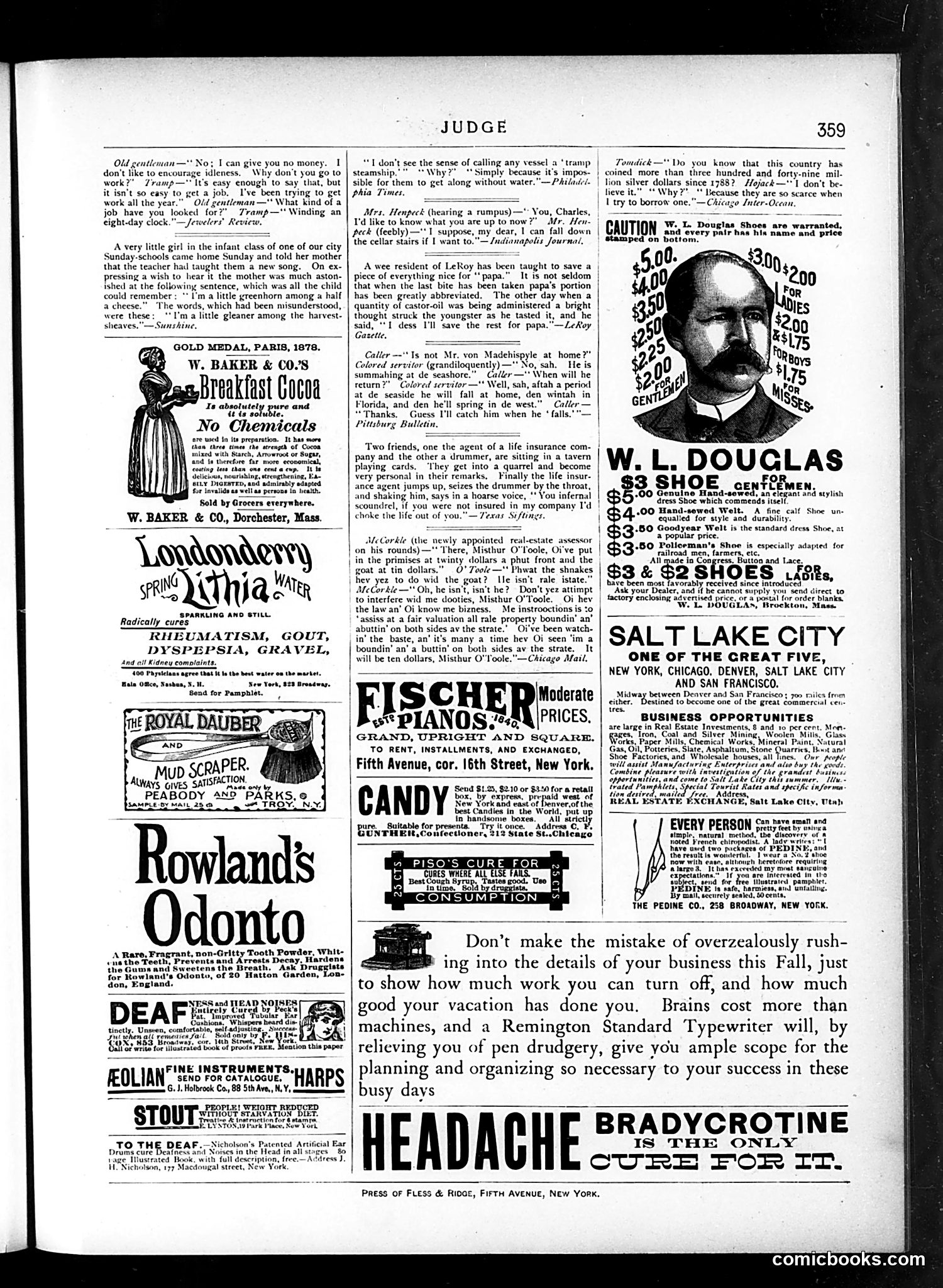
This page is primarily **advertising**, typical of late 19th-century magazines. However, it contains several brief humorous anecdotes that reflect period social attitudes: 1. **"Winding an eight-day clock"**: A vagrant seeks work but can only name an implausibly simple job, satirizing either his incompetence or labor market desperation. 2. **Child's mishearing**: A Sunday school girl mishears "gleaner among the harvest" as "greenhorn among a half a cheese"—gentle humor about childhood innocence. 3. **Insurance company joke**: Two men quarreling; one stops throttling the other because he's "insured in my company"—dark humor about insurance companies' financial interest in keeping customers alive. 4. **Colored servant dialect**: Period-typical racist caricature using exaggerated dialect for comic effect. The advertisements promote remedies for gout, deafness, tooth powder, cocoa, and notably **Bradycrotine for headaches**—reflecting common 19th-century health anxieties and patent medicines.
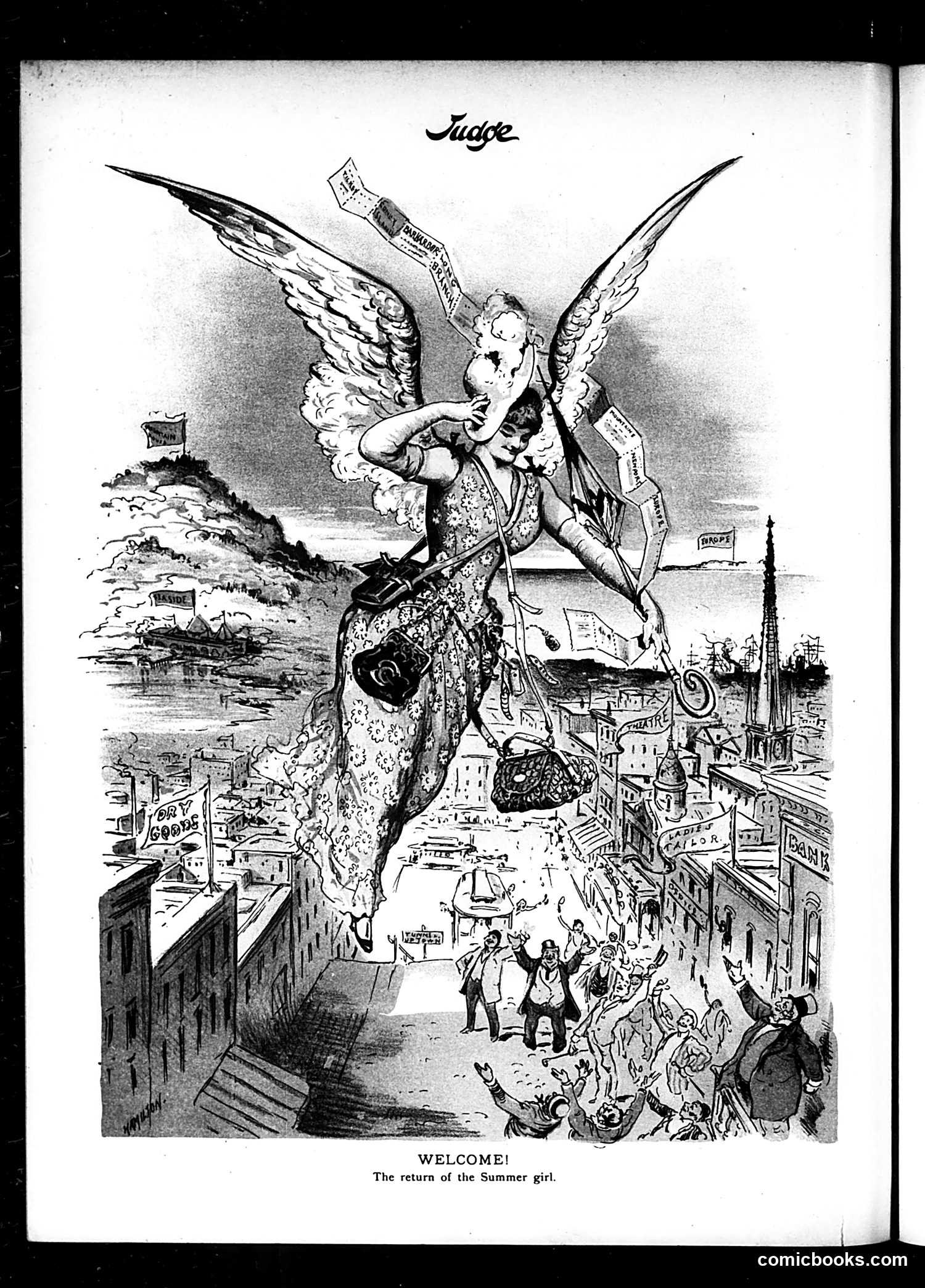
This is a satirical cartoon titled "Welcome! The return of the Summer girl." The central figure is a winged female allegorical character (representing "Summer") descending over a cityscape. She carries items labeled with what appear to be seasonal or commercial references (banners/ribbons are visible on her wings and body). Below, city dwellers look upward—some appear celebratory, others potentially chaotic or disruptive. The detailed urban landscape suggests this depicts a major American city. The satire likely comments on summer's arrival and its social/commercial effects: seasonal tourism, beach culture, or the influx of young women to cities during warmer months. Judge magazine frequently satirized social trends and gender dynamics of the era, so the "Summer girl" probably references contemporary attitudes about seasonal social behavior or fashion. Without a visible date, the specific historical context remains unclear.