
Judge, 1890-09-06 · page 2 of 16
Judge — September 6, 1890 — page 2: what you’re looking at
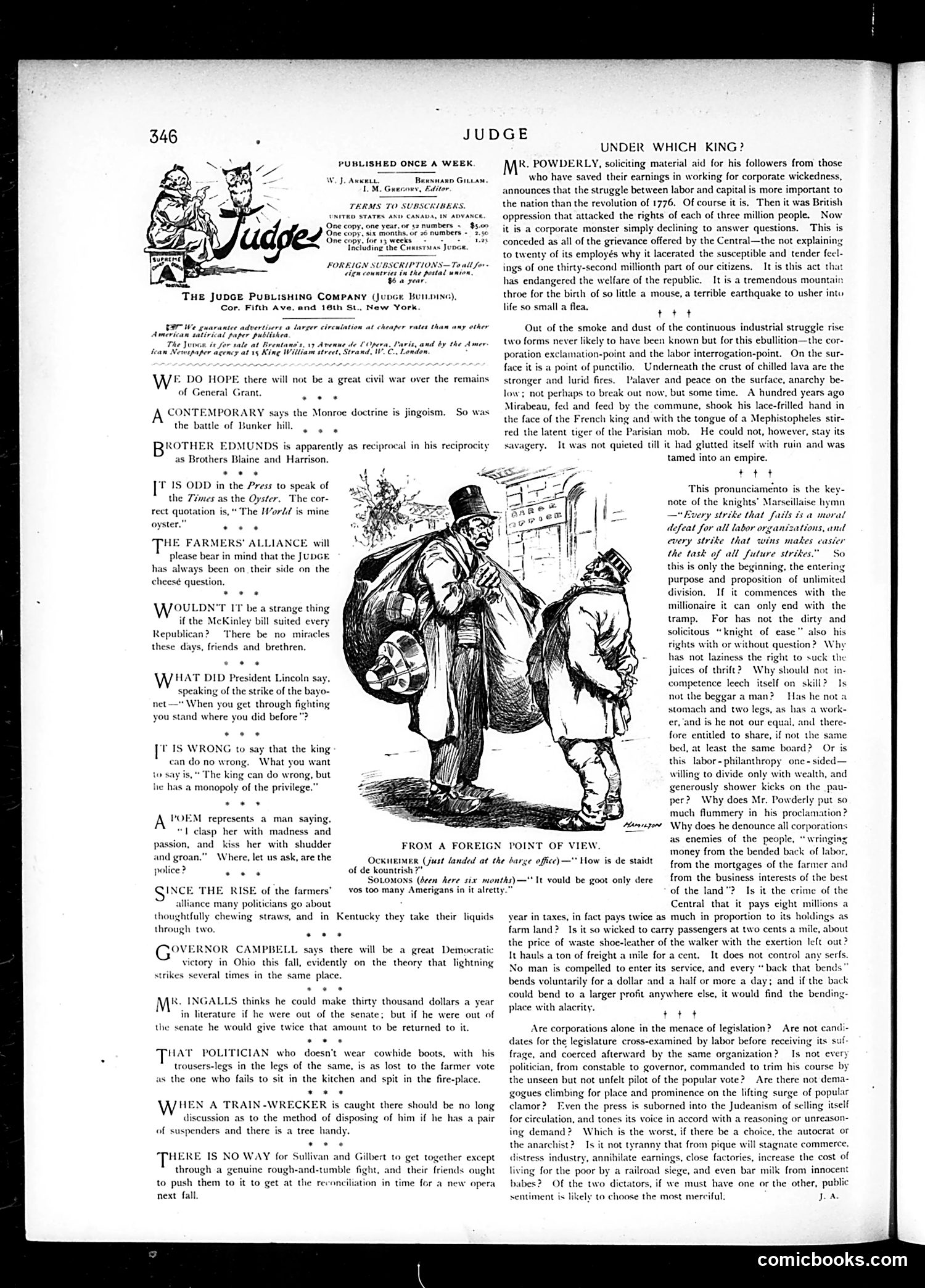
What you’re looking at
The main cartoon titled "FROM A FOREIGN POINT OF VIEW" depicts a large, rotund capitalist or industrialist figure laden with money bags encountering a small, impoverished child or worker. The illustration satirizes wealth disparity and exploitation. The surrounding editorial commentary criticizes corporate monopolies and labor practices, referencing: - Corporate exploitation of workers - Railroad monopolies (mentions McKinley) - Unfair pricing and shipping costs - Legislative capture by business interests The text argues corporations wield excessive political power, manipulating government to their advantage while workers suffer. This reflects early 20th-century Progressive Era concerns about unchecked corporate power, though specific dates and figures remain unclear from the page alone.
📄 Transcribed text from this page (OCR, searchable)
Machine-transcribed from the original scan — historical spelling and the odd misread are preserved.
JUDGE PUBLISHED ONCE A WEEK. W, J, Awenin, Bauxnarn STO SUBSCKIBEKS. $3.00 ‘One copy, one year.or $2 numbers = ‘One cops, six months. or 26 numbers ~ One copy. for 3 weeks + + Including the Cmistaras Jeno, FOREIGN SUBSCRIPTIONS— To all for cign countries in the postal union. $6 a year. THE JUDGE PUBLISHING COMPANY (JupGr Buttnine), Cor. Fifth Ave. and 16th St., New York. G9 We guarantee advertisers a larger cireniatic American satirical paper publishea The Joven it for sale at Brentano's, 17 Avenue de COpera. Paris, and by the Amer Vewspaper acency at 1s King William street, Strand, W.C., London. WE PO HOPE there will not be a great civil war over the remains of General Grant. at cheaper rates than any other A CONTEMPORARY says the Monroe doctrine is jingoism. So the battle of Bunker hill, BROTHER EDMUNDS is apparently as reciprocal in his reciprocity as Brothers Blaine and Harrison. [7 1S ODD in the Press to speak of the Times as the Oyster. The cor- The World is mine oyster.” ei et THE FARMERS" ALLIANCE will please bear in mind that the JUDGE has always been on their side on the cheesé question. OULDN’T IT be a strange thir if the McKinley bill suited every Republican? ‘There be no. miracles these days, friends and brethren. rect quotation is, HAT DID President Lincoln say, speaking of the strike of the bayo- net—When you get through fighting you stand where you did before "? VIS WRONG to say that the king can do no wrong. What you want to say is," The king can do wrong, but he has a monopoly of the privilege. 2M represents a man saying. “1 clasp her with madness and passion, and kiss her with shudder and groan." Where, let us ask, are the police? é FROM A FOREIGN of de kountrish 7" SoLomons (deen here RISE of the farmers’ y politicians go about thoughtfully chewing straws, and in Kentucky they take their liquids through two. GOVERNOR CAMPBELL says there will be a great Democratic victory in Ohio this fall, evidently on the theory that lightning strikes several times in the same place. IN! HE alliance ma INGALLS thinks he could make thirty thousand dollars a year in literature if he were out of the senate; but if he were out of the senate he would give twice that amount to be returned to it. HAT POLITICIAN who doesn’t wear cowhide boots, with trousers-legs in the legs of the same, is as lost to the farmer vote as the one who fails to sit in the kitchen and spit in the fire-place. HEN A TRAIN-WRECKER is caught there should be no long discussion as to the method of disposing of him if he has a pair of suspenders and there is a tree handy his H IS NO WAY for Sullivan and Gilbert to get together except through a genuine rough-and-tumble fight, and their friends ought to push them to it to get at the reconciliation in time for a new opera next fall Ockueimer (just landed at the barge officey—* Mow is de staidt x months) —"'It vould be goot only dere vos too many Amerigans in it alretty.” UNDER WHICH KING? R. POWDERLY, soliciting material aid for his followers from those who have saved their earnings in working for corporate wickedness, announces that the struggle between labor and capital is more important to the nation than the revolution of 1776. Of course it is, Then it was British oppression that attacked the rights of each of three million people. Now it is a corporate monster simply declining to answer questions. TI conceded as all of the grievance offered by the Central—the not explainir to twenty of its employés why it lacerated the susceptible and tender feel- ings of one thirty-second millionth part of our citizens. It is this act that has endangered the welfare of the republic. It is a tremendous mountain throe for the birth of so little a mouse, a terrible earthquake to usher into life so small a flea, ie bad Out of the smoke and dust of the continuous industrial struggle rise two forms never likely to have been known but for this ebullition—the cor- poration exclamation-point and the labor interrogation-point. On the sur- face it is a point of punctilio, Underneath the crust of chilled lava are the stronger and lurid fires. Palaver and peace on the surface, anarchy be- low; not perhaps to break out now, but some time. A hundred years ago Mirabeau, fed and feed by the commune, shook his lace-frilled hand in the face of the French king and with the tongue of a Mephistopheles stir- red the latent tiger of the Parisian mob. He could not, however, stay its savagery. It was not quieted till it had glutted itself with ruin and was tamed into an empire. - This pronunciamento is the key- note of the knights’ Marseillaise hymn Every strike that fails is a moral defeat for all labor organizations, and every strike that wins makes caster the task of all future strikes.” So this is only the beginning, the entering purpose and proposition of unlimited division, If it. commences with the millionaire it can only end with the tramp. For has not the dirty and solicitous “knight of ease” also his rights with or without question? Why has not laziness the right to suck the juices of thrift?) Why should not in- competence leech itself on skill? Is not the beggar a man? — Has he not stomach and two legs, as has a work- erand is he not our eq) fore entitled to share, if not the same bed, at least the this. labor - philanthroj willing to divide only with wealth, and generously shower kicks on the pau- per? Why does Mr. Powderly put so much flummery in hi mation ? Why does he denounce all corporations as enemies of the people, “wringing money from the bended back of labor, from the mortgages of the farmer and from the business interests of the of the land"? Is it the crime of the Central that it pays cight millions a year in taxes, in fact pays twice as much in proportion to its holdings as farm land? Is it so wicked to carry passengers at two cents a mile, about the price of waste shoe-leather of the walker with the exertion left out? It hauls a ton of freight a mile for a cent. It does not control any serfs. No man is compelled to enter its service, and every “back that bends” bends voluntarily for a dollar and a half or more a day; and if the back could bend to a larger profit anywhere else, it would find the bending- place with alacrity. same board? POINT OF VIEW best tp + Are corporations alone in the menace of legislation? Are not candi- dates for the legislature cross-examined by labor before receiving its suf frage, and coerced afterward by the same organization? Is not every politician, from constable to governor, commanded to trim his course by the unseen but not unfelt pilot of the popular vote? Are there not dema gogues climbing for place and prominence on the lifting surge of popul: clamor? Even the press is suborned into the Judeanism of selling itself for circulation, and tones its voice in accord with a reasoning or unreason- ing demand? Which is the worst, if there be a choice, the autocr: the anarchist? Is it not tyranny that from pique will stagnate commerce. distress industry, annihilate earnings, close factories, increase the cost of living for the poor by a railroad siege, and even bar milk from innocent babes? Of the two dictators, if we must have one or the other, public sentiment is likely to choose the most merciful. Juas comicbooks.com