
Judge, 1890-09-06 · page 7 of 16
Judge — September 6, 1890 — page 7: what you’re looking at
What you’re looking at
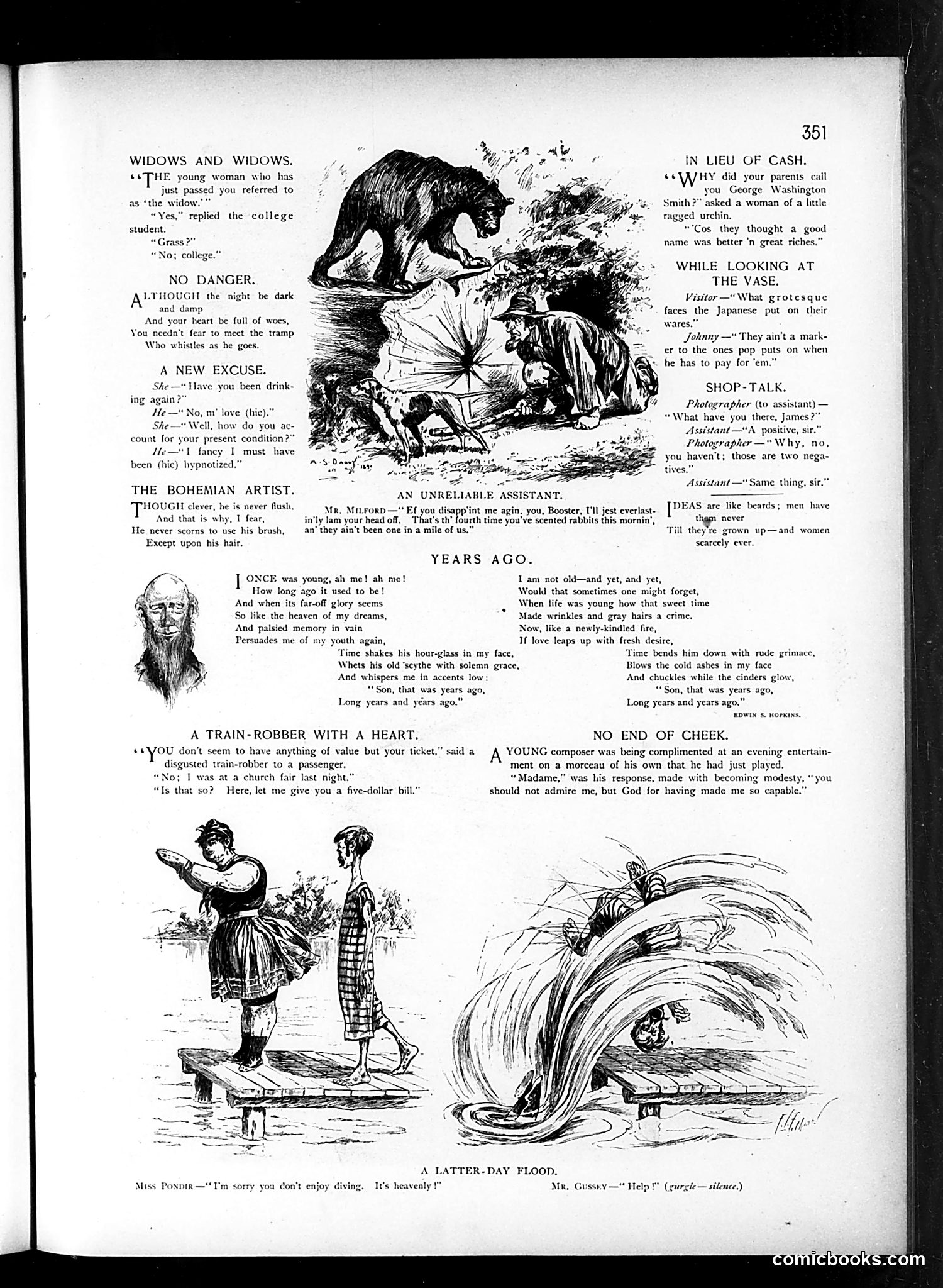
This page from Judge magazine collects short humorous anecdotes and satirical cartoons typical of late-19th/early-20th century American humor. The jokes mock common social situations: a widow avoiding college education, a drunk man claiming hypnotism, a bohemian artist who pays with paintings instead of money, and working-class dialogue (a child named after Washington for moral value rather than wealth). One cartoon shows a photographer confusing "positives" and "negatives"—a darkroom pun. Another depicts a compassionate train robber who gives money to a poor passenger. A nostalgic poem reflects on aging and lost youth. The humor relies on wordplay, class distinctions, and gentle social observation rather than political commentary. "Shop-talk" and "Ideas are like beards" sections offer observational comedy about professional and domestic life. The final cartoon shows someone drowning while dining, captioned as a "latter-day flood." The page is primarily entertaining rather than overtly political satire.
📄 Transcribed text from this page (OCR, searchable)
Machine-transcribed from the original scan — historical spelling and the odd misread are preserved.
WIDOWS AND WIDOWS. 46TTHE young woman who has just passed you referred to as ‘the widow. “Yes,” replied the college student. hrass ?’ 0; coll NO DANGER. ALTHOUGIL the nig and damp And your heart be full of woes, You necda't fear to meet the tramp nt_be dark Who whistles as he goes. A NEW EXCUSE. She —"Mave you been drink- ing agai He — No, m' love (hi She—"Well, how do you count for your present condition ?” He—"1 fancy 1 must have been (hic) hypnotized.” ace THE BOHEMIAN ARTIST. ‘THoucu clever, he is never flush, And that is why, I He never scorns to use his brush, 351 IN LIEU OF CASH. SOYWVHY did your parents call you George Washington Smith?” asked a woman of a little ragged urchin, "Cos they thought a good name was better ‘n great riches.”* WHILE LOOKING AT THE VASE. Visitor “What grotesque faces the Japanese put on their wares,” Johnny —" They ain't a mark- er to the ones pop puts on when he has to pay for em.” SHOP- TALK. Photographer (to assistant) — “What have you there, James. Assistant —"A positive, sir.” Photographer —"Why, no, you haven't; those are two nega- tives.” Assistant me thing, sir.” AN UNRELIABLE ASSISTANT. Mr. Mitrorp —“‘Ef you disapp'int me agin, you, Booster, I'll jest everlast- in'ly lam your head off. ‘That's th’ fourth time you've scented rabbits this mornin’ an’ they ain't been one in a mile of us.” [PEAS are like beards; men have thgm never Except upon his hair. Till they're grown up—and women scarcely ever. YEARS AGO. ] ONCE was young, ah me! ah me! How long ago it used to be! And when its far-off glory seems So like the heaven of my dreams, And palsied memoi Persuades me of y in vain youth again, ‘Time shakes his hour-glass in my face, Whets his old ‘scythe with solemn grace, And whispers me in accents low : "Son, that was years ago, Long years and years ago.” A TRAIN-ROBBER WITH A HEART. + HYOU don't seem to have anything of value but your ticket, disgusted train-robber to a passenger. “No; I was at a chureh fair last night." “Is that so? Here, let me give you a five-dollar bill.” m should A LATTER-DAY F I's heaven “Madame,” was his response, made with becomi I am not old—and yet, and yet, Would that sometimes one might forget, When life was young how that sweet time Made wrinkles and gray hairs a crime, Now, like a newly-kindled fire, If love leaps up with fresh desire, Time bends him down with rude grimace, Blows the cold ashes in my face And chuckles while the cinders glow, “Son, that was years ago, Long years and years ago.” NO END OF CHEEK. YOUNG composer was being complimented at an evening enter ent on a morceau of his own that he had just played. x modesty, not admire me, but God for having made me so capable. Loon. Mr. Gussey—"* Help !" (gurgle— silence.)