
A complete issue · 16 pages · 1890
Judge — March 1, 1890
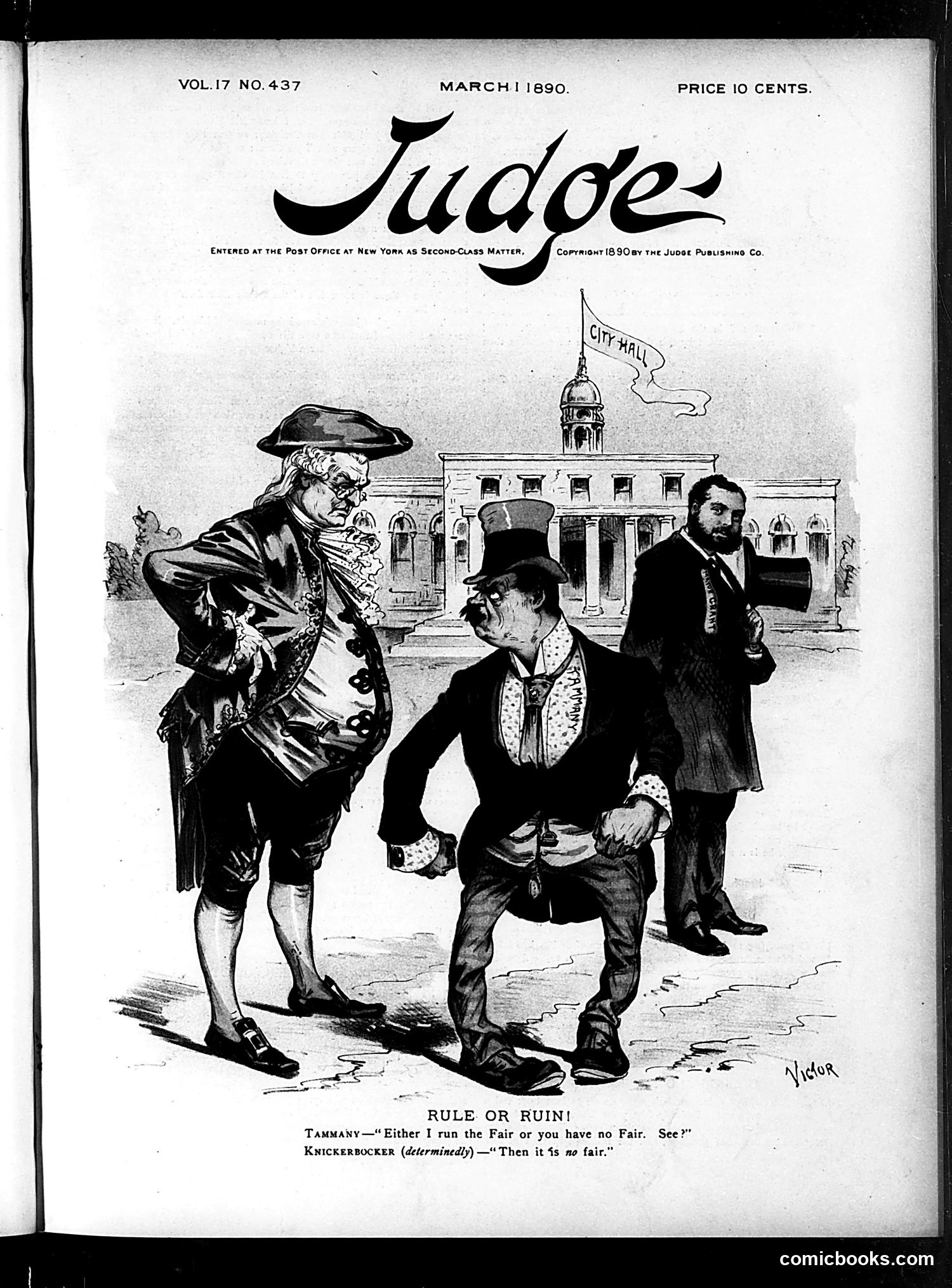
This political cartoon satirizes a dispute over fair administration in what appears to be a municipal election or governance issue. The caricatured figure on the left (labeled "Tammany") is shown confronting another official, declaring: "Either I run the Fair or you have no Fair." The response from "Knickerbocker" (labeled "determinedly"): "Then it's no fair." **The satire targets Tammany Hall**, New York's powerful Democratic political machine, known for corruption and demands for control. The cartoon criticizes Tammany's bullying ultimatum—either they monopolize power or they'll sabotage civic projects entirely. The City Hall backdrop emphasizes this is about municipal governance. The joke hinges on the ironic wordplay: Tammany's threat to eliminate "the Fair" contradicts their claim to fairness itself.
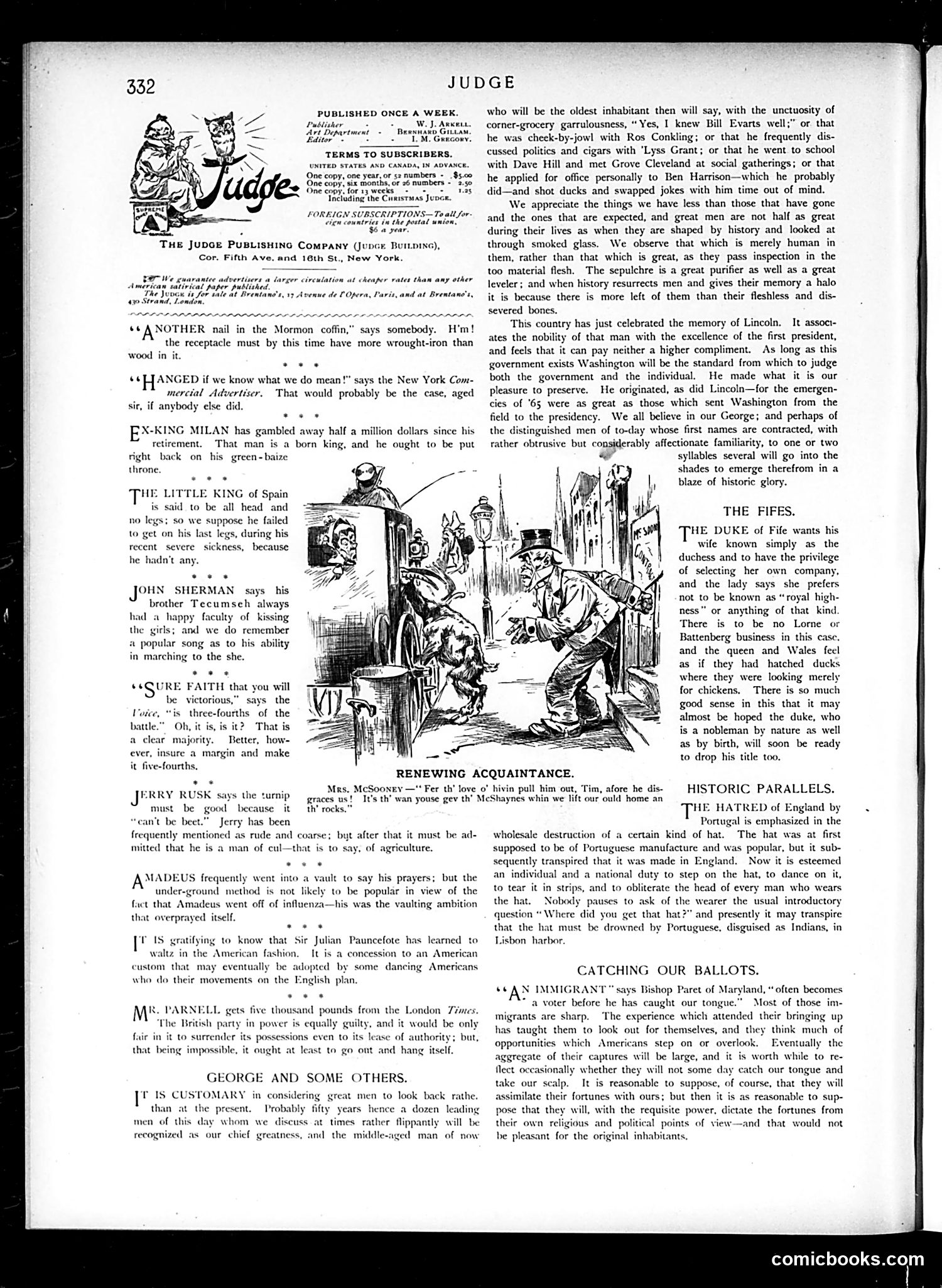
This cartoon depicts an urban street scene with working-class figures, likely immigrants or laborers, in what appears to be a humorous social encounter. The caption "RENEWING ACQUAINTANCE" suggests old friends meeting unexpectedly. The surrounding text commentary includes satirical observations about various social figures—references to Sherman, Milan, and others making humorous points about politics and society. The broader articles on the page ("The Fifes," "Historic Parallels," "Catching Our Ballots") address immigration, Portuguese hats, and immigrant voting practices, indicating this magazine regularly satirized contemporary social anxieties about immigration and political participation in early 20th-century America. The exact identities of cartoon figures remain unclear without additional context.
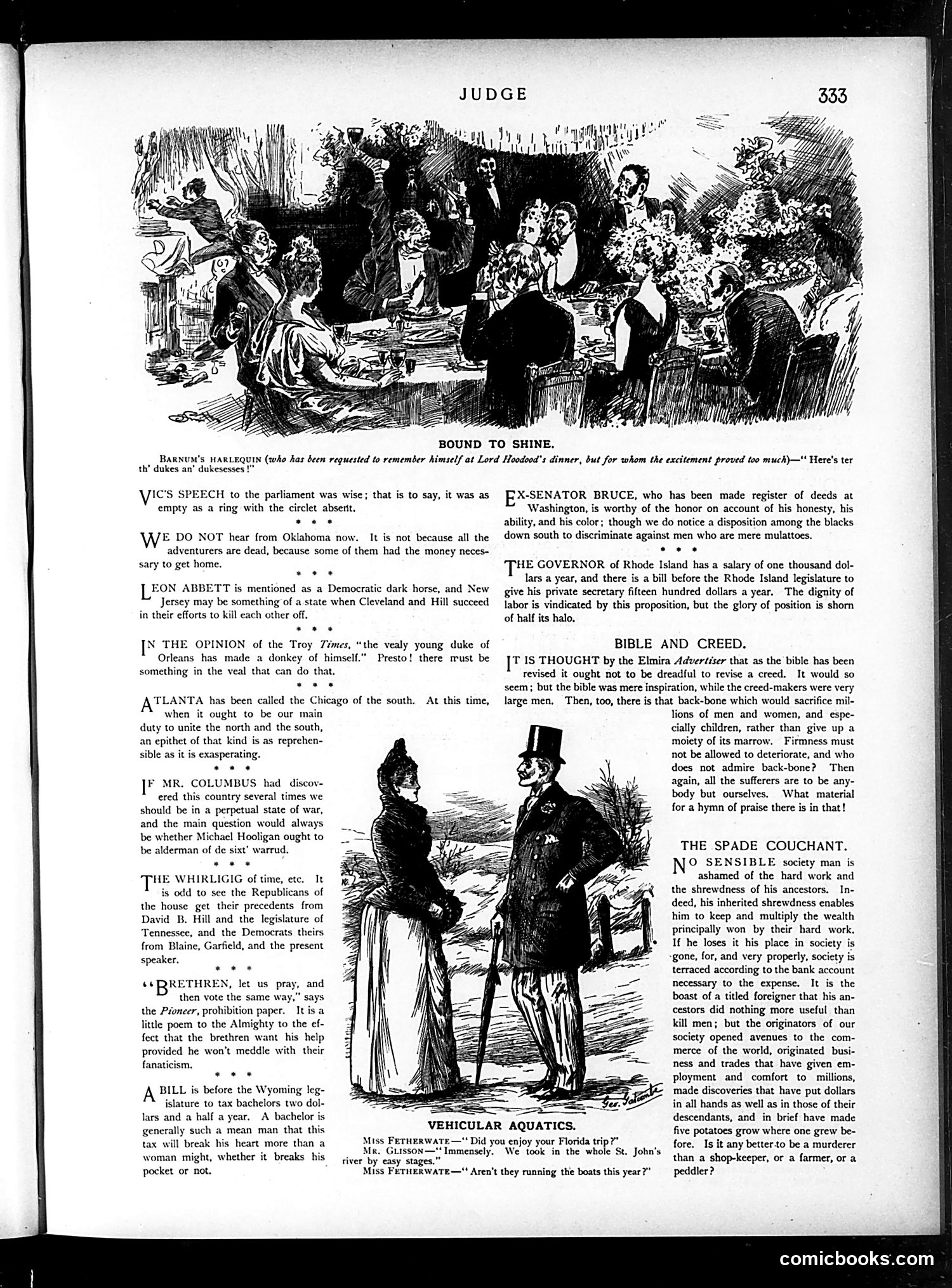
The page contains several brief political commentary items rather than a unified cartoon. Key sections include: **"Bound to Shine"** (top): References Harmon's harlequin at Lord Hood's dinner, suggesting an inside political or social joke about a specific event. **Political Notes**: Comments on Oklahoma, Leon Abbett (a Democratic politician), and Rhode Island's governor's salary—typical of Judge's regular satirical political commentary. **"Bible and Creed"**: Critiques the Ethiopians Advertiser's proposed bible revision, arguing that creeds shouldn't be weakened through revision. **"The Spade Couchant"**: Satirizes inherited wealth and society's pretensions—arguing that titled foreigners contribute nothing, while working-class innovation built actual prosperity. **"Vehicular Aquatics"** (bottom): A light joke about Florida river travel. The page reflects Judge's focus on political satire, class commentary, and contemporary social criticism typical of late-19th-century American humor magazines.
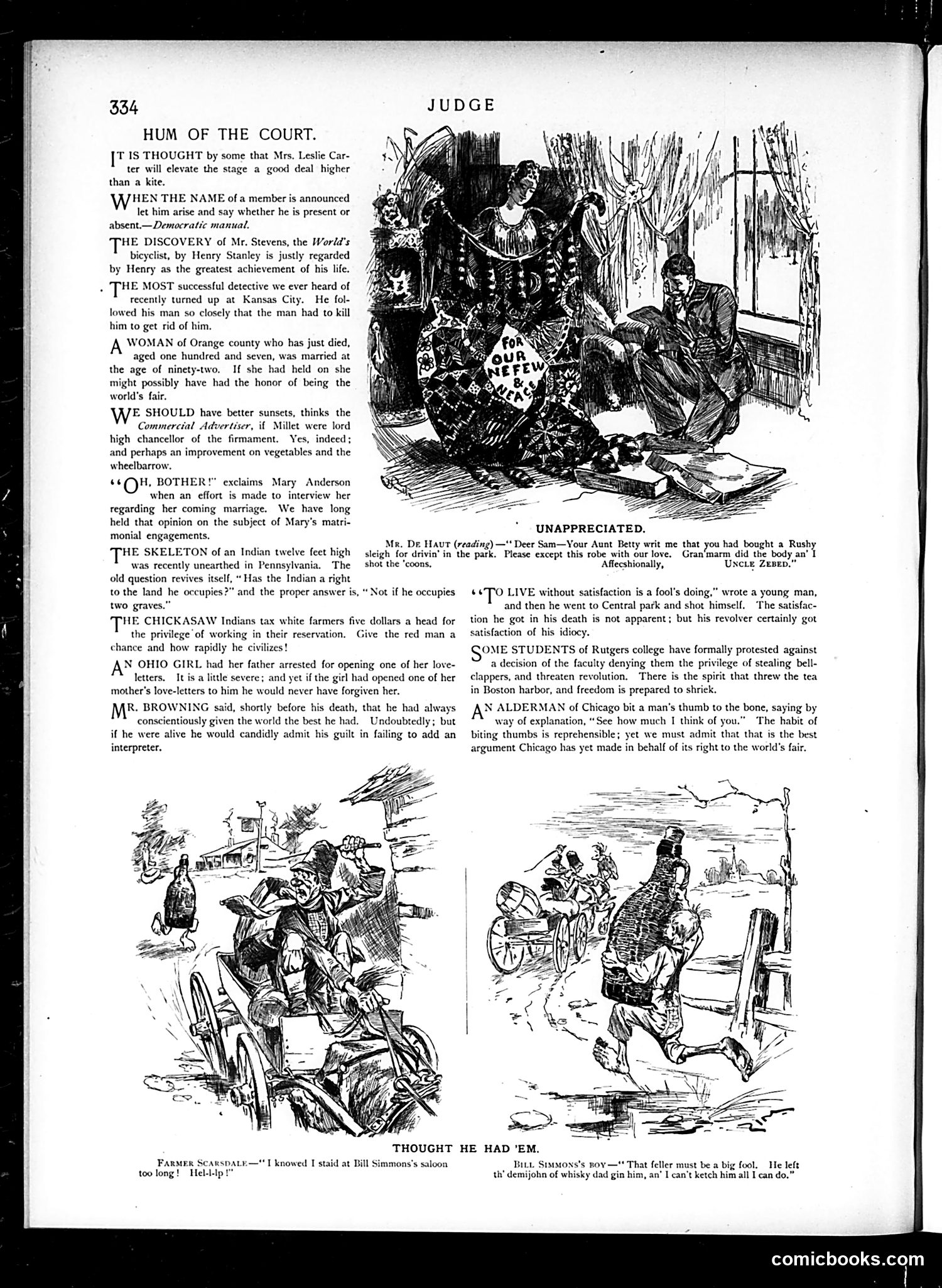
This page contains brief satirical commentary on contemporary figures and social issues, circa 1890s. Key targets include: **Theatre & Culture**: Mrs. Leslie Carter (actress) and Mary Anderson (actress dodging marriage questions) are mocked for their celebrity status. **Exploration**: Henry Stanley's discovery of "Mr. Stevens, the World's bicyclist" is sarcastically praised as his greatest achievement—absurdly reducing exploration to finding a cyclist. **Social Commentary**: Pieces mock Native American rights (the "two graves" quip about Indian remains), gender dynamics (fathers opening daughters' mail), and Chicago's bid for the World's Fair (via the alderman biting incident as proof of civic character). **The cartoons** depict rural/working-class scenes: a farmer confused after drinking, and figures with carts. These illustrate the dialect humor typical of Judge's populist satire. The overall tone is irreverent, brief, and topical—reflecting Judge's role as weekly satirist of American news and society.
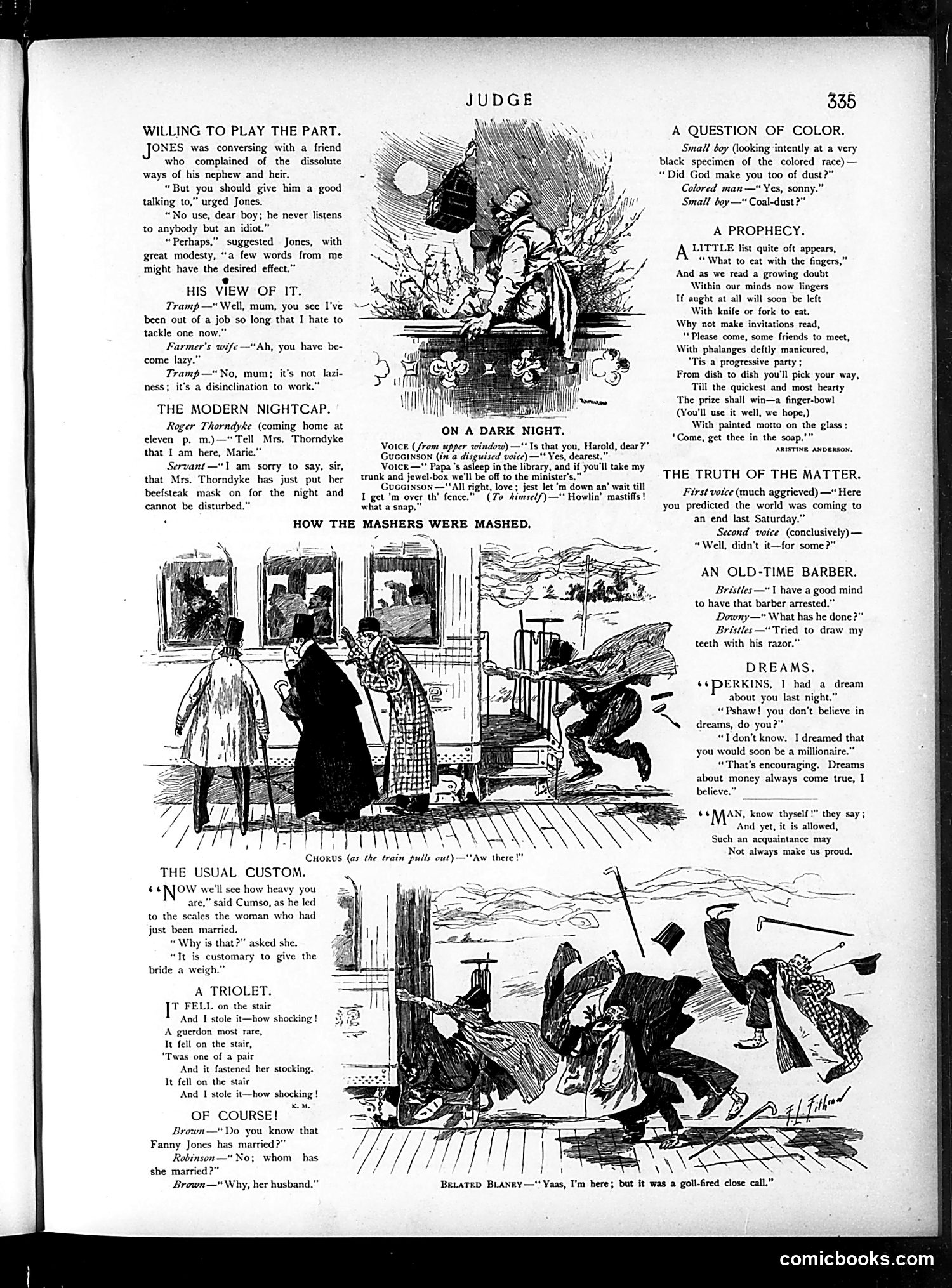
This page from *Judge* magazine contains multiple short humorous sketches typical of late 19th/early 20th-century American humor. The cartoons satirize contemporary social customs and human nature: **Key sketches include:** - **"The Modern Nightcap"**: Mocks the fashionable cosmetic beauty treatments ("beefsteak masks") wealthy women wore—suggesting wives were unavailable even to their husbands due to vanity routines. - **"On a Dark Night"**: A darkly comedic scenario implying an elopement/theft, playing on melodramatic romance tropes. - **"A Question of Color"**: Contains a racist "coal dust" joke reflecting the era's casual racial stereotyping. - **"The Usual Custom"**: A pun-based joke about weighing newlyweds ("give the bride a weigh"). The page exemplifies *Judge*'s style: social commentary through wordplay, gentle domestic satire, and period-specific references to fashionable manners and customs that would puzzle modern readers unfamiliar with Victorian/Edwardian social conventions.
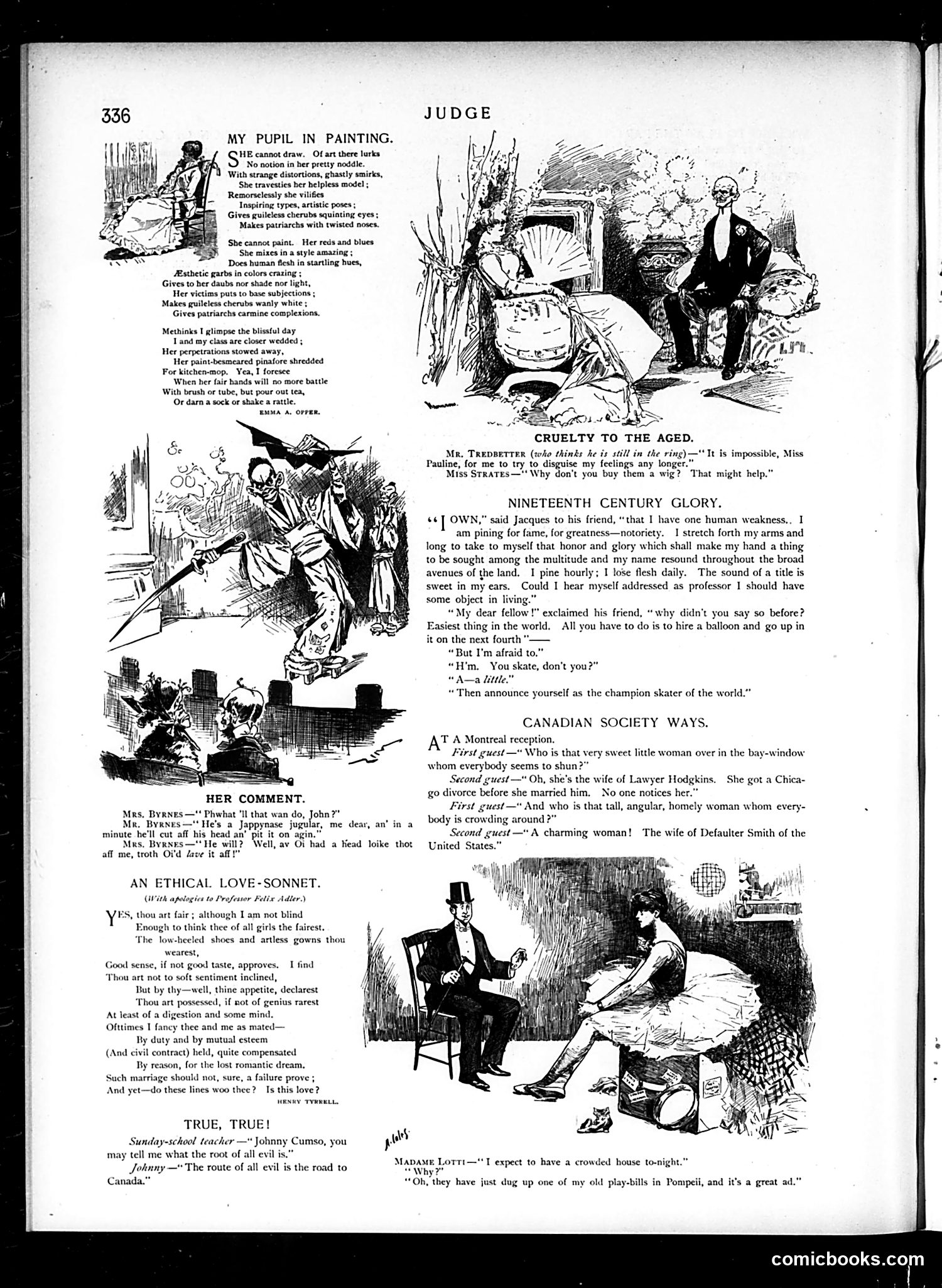
This page from *Judge* satirizes late-19th-century social attitudes through several sketches: **"My Pupil in Painting"** mocks women's artistic pretensions, suggesting a female art student is talentless and should abandon painting for domestic duties (tea-pouring, darning socks). **"Cruelty to the Aged"** jokes about an elderly man (Mr. Tredbetter, "still in the ring"—possibly a boxer reference) attempting romance with a young woman who dismissively suggests he buy a wig. **"Nineteenth Century Glory"** satirizes ambition: a man desperate for fame is told the easiest path is hiring a balloon or claiming to be a skating champion—poking fun at hollow self-promotion. **"Canadian Society Ways"** presents social snobbery at a Montreal reception: a woman is shunned for her previous divorce; another is celebrated simply for being married to a wealthy American, highlighting the superficiality of society gossip. The remaining sketches mock immigrant dialects and offer cynical observations on love and morality—typical *Judge* fare combining social commentary with period prejudices.
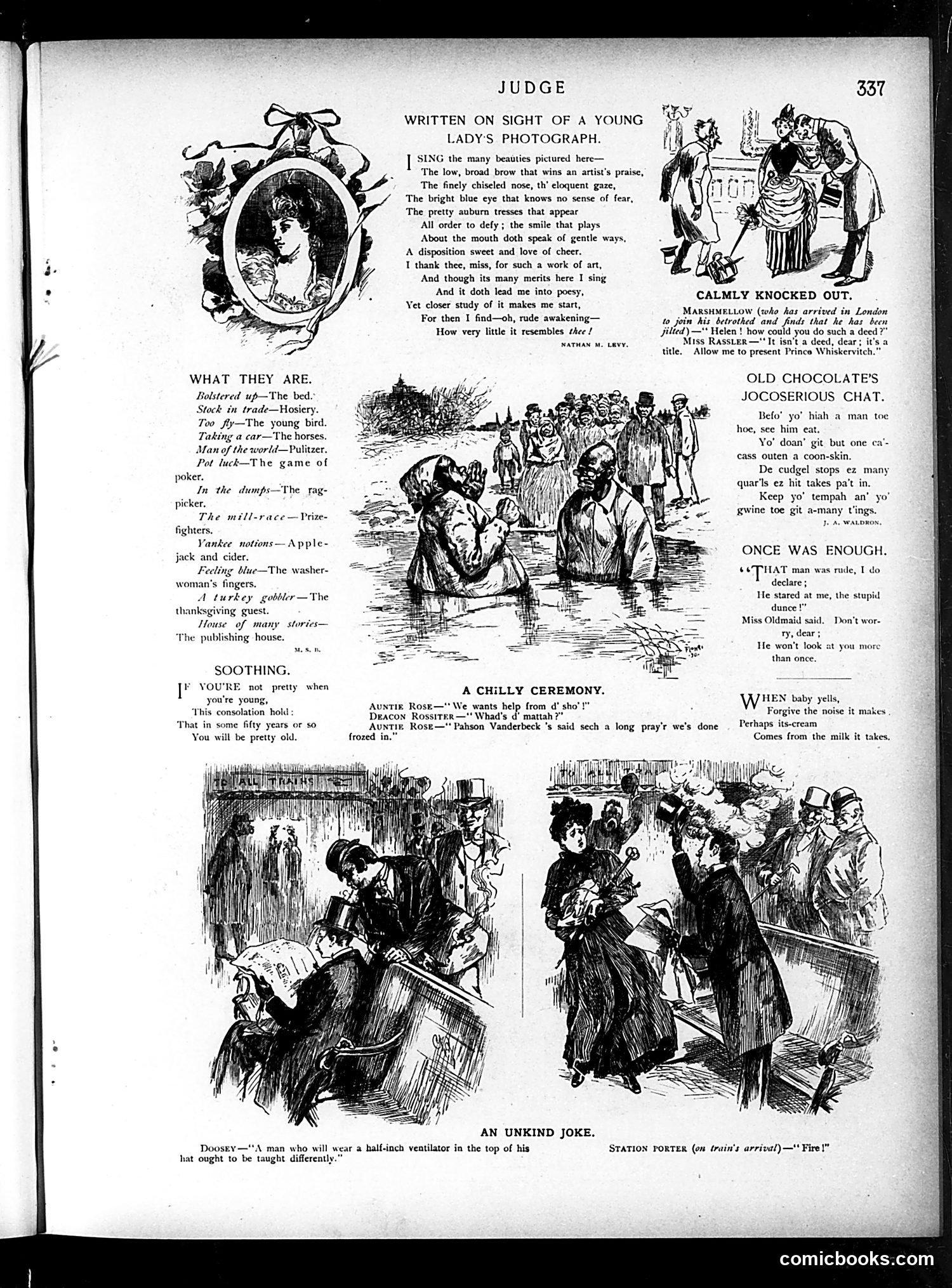
This page contains miscellaneous humor and verse typical of Judge's satirical style, rather than political cartoons. **"Written on Sight of a Young Lady's Photograph"** is a poem by Nathan M. Levy mocking the gap between a photograph's flattery and reality—the speaker praises the subject's depicted beauty extensively, then reveals the actual person looks nothing like her portrait. **"What They Are"** is wordplay defining common terms with humorous alternate meanings (e.g., "Man of the world—Pulitzer," likely referencing publisher Joseph Pulitzer). **Other sections** include brief comic dialogues: a jilted lover discovering his fiancée has taken up with "Prince Whiskervitch"; racial humor in "Old Chocolate's Jocoserious Chat" (written in dialect); and a woman told she needn't worry about appearing unattractive since a rude man won't look at her twice. The illustrations depict these scenes in Victorian-era style. The humor targets vanity, romantic disappointment, and social awkwardness rather than specific political events.
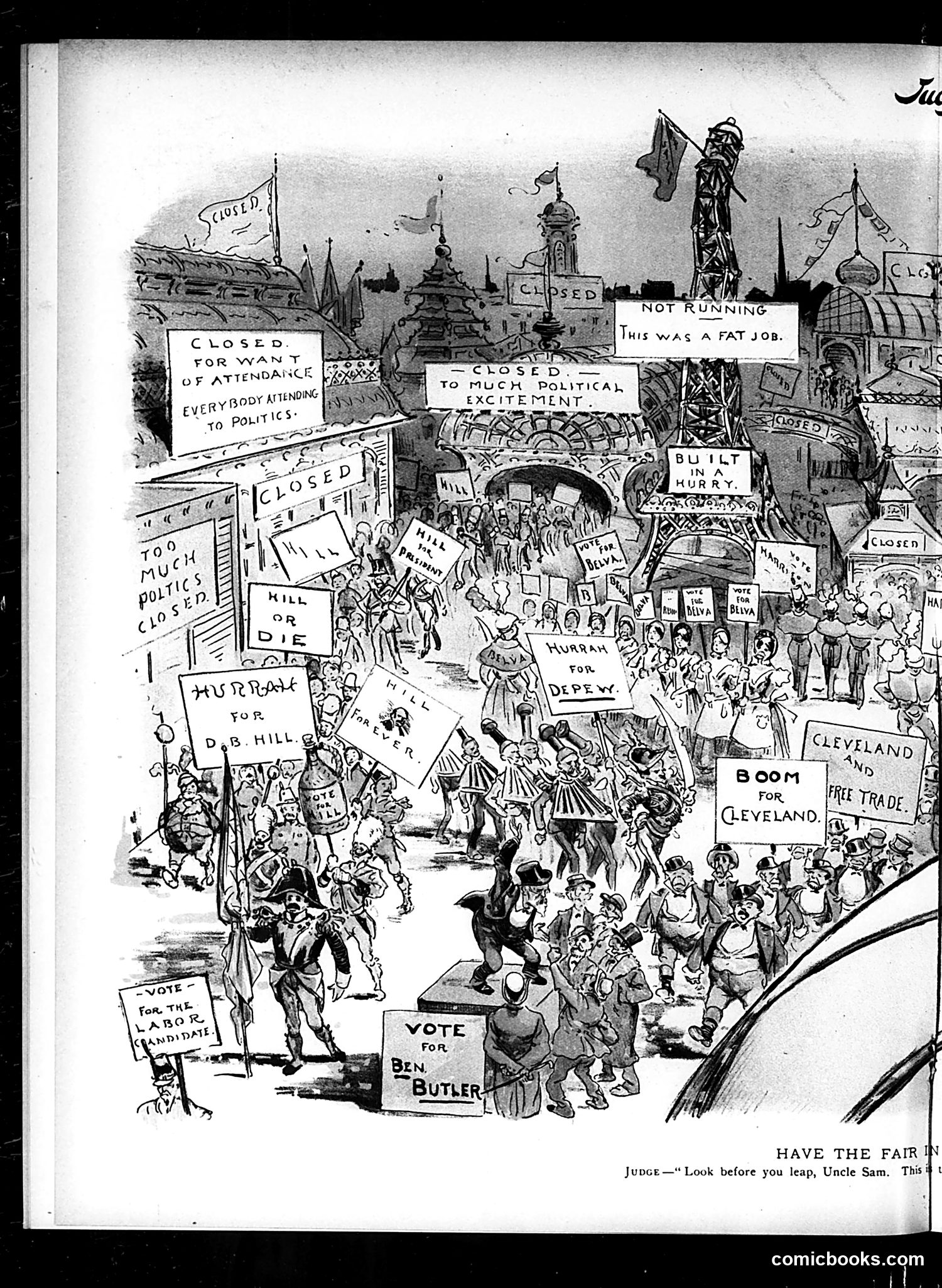
This is a satirical cartoon titled "Have the Fair," depicting a chaotic fair or exposition with numerous closed attractions and political pandemonium. The cartoon critiques American political excitement during what appears to be an election cycle, with signs referencing candidates like "Ben Butler" and "D.B. Hill," plus slogans like "Boom for Cleveland" and "Free Trade." The central message—"Look before you leap, Uncle Sam"—warns against hasty political decisions amid carnival-like chaos. Multiple "CLOSED" signs suggest that political promises are hollow. The satire suggests that Americans are being distracted by political theater ("too much political excitement") while substantive governance suffers. The fair's closed attractions symbolize unfulfilled political promises and the carnival atmosphere mocks electoral fervor as mere entertainment rather than serious civic engagement.
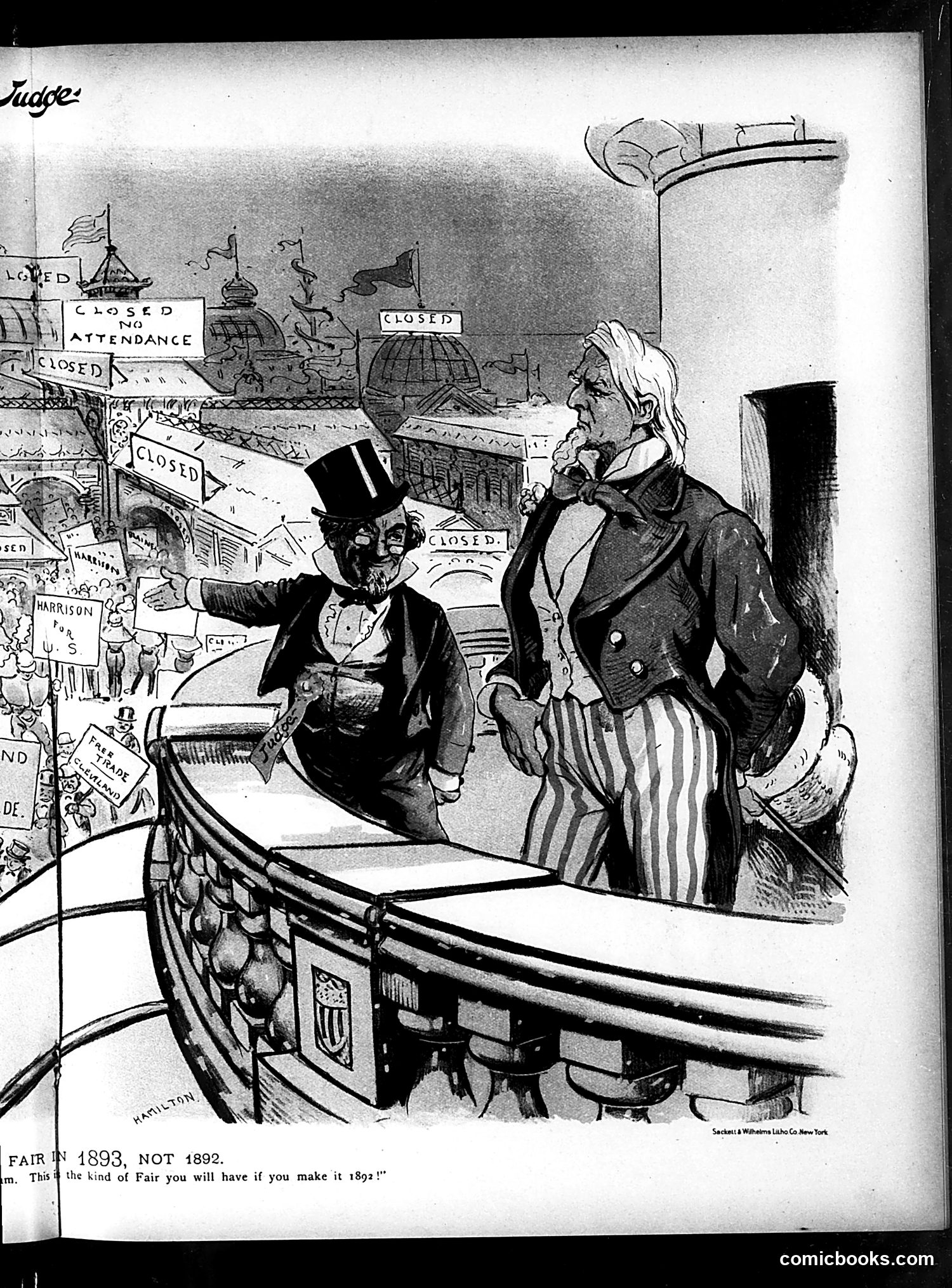
This Judge cartoon satirizes a debate about when to hold the World's Columbian Exposition (Chicago's 1893 World's Fair). The figure on the left, wearing a top hat and skull-face mask, represents the consequences of rushing the fair to 1892—depicting a shuttered, failed exhibition with closed pavilions and abandoned grounds. The older gentleman on the right appears to be a cautionary voice warning against this premature opening. The cartoon argues that attempting the fair in 1892 would result in disaster, whereas waiting until 1893 would produce a proper, successful event. The satire mocks those pushing for an early opening date by presenting a grotesque vision of incompleteness and failure, using the skull-faced personification to emphasize the "death" of the fair's potential if rushed.
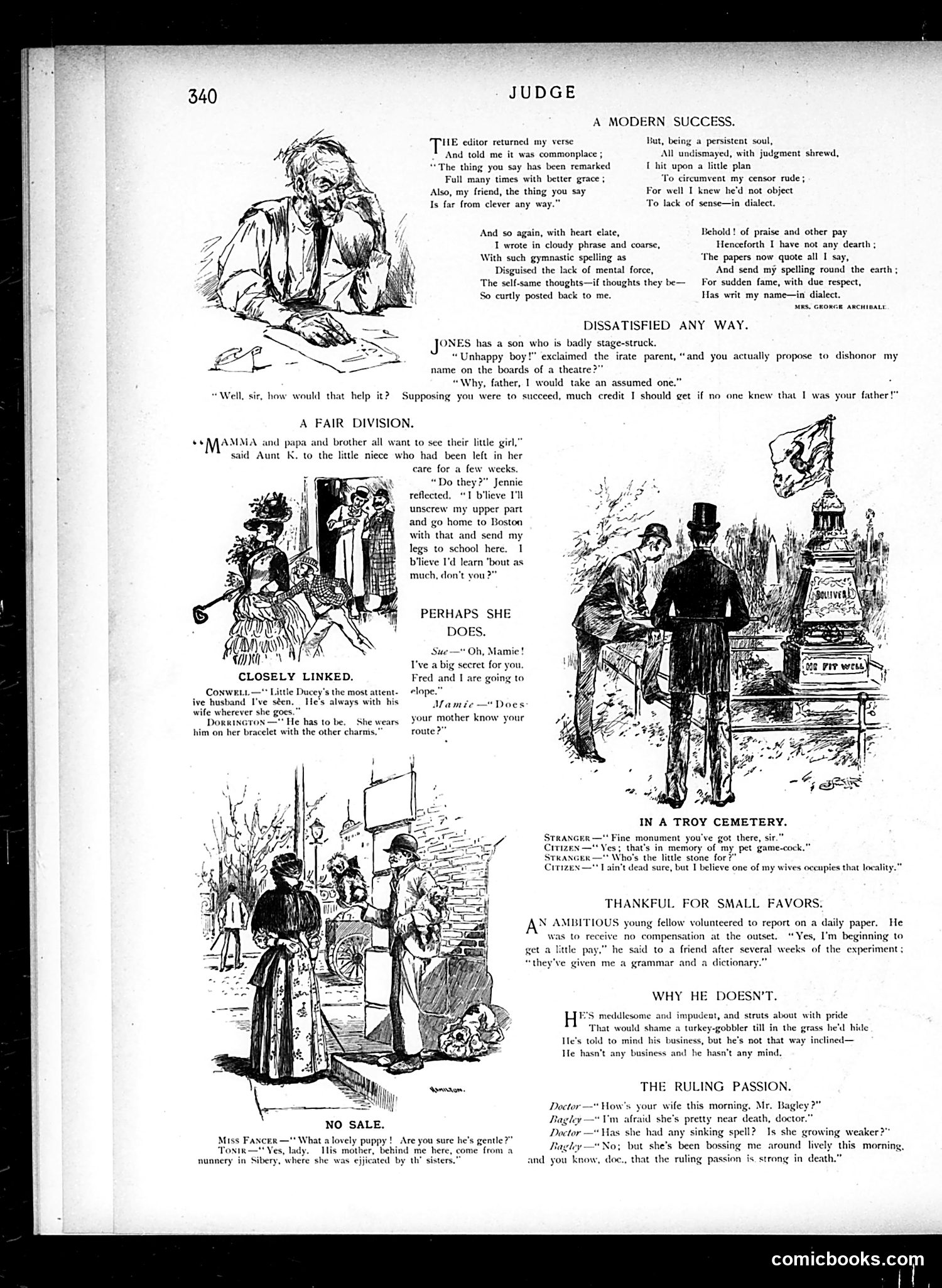
This page collects satirical short pieces typical of Judge's humor: **"A Modern Success"** mocks literary mediocrity—a poet's rejection leads him to deliberately write in obscure dialect and poor spelling, which newspapers then eagerly publish as clever work. The satire targets both pretentious "artistic" writing and uncritical media acceptance. **"Dissatisfied Any Way"** jokes about parental vanity: a father forbids his son from acting under the family name, then realizes that if the son succeeded under an assumed name, the father wouldn't receive credit anyway—trapping himself in his own logic. **Other pieces** include domestic humor ("A Fair Division," where a child suggests literally splitting herself), romantic comedy, and graveyard wit. **"The Ruling Passion"** ends the page with dark humor: a doctor notes his dying patient's wife still "bosses him around," suggesting even death won't stop marital domination—the "ruling passion" persists. The illustrations are pen sketches typical of Judge's style. Overall, the page exemplifies late-19th/early-20th-century American satirical magazine humor: wordplay, social pretension, family dynamics, and cynical observations presented as brief, punchy anecdotes.
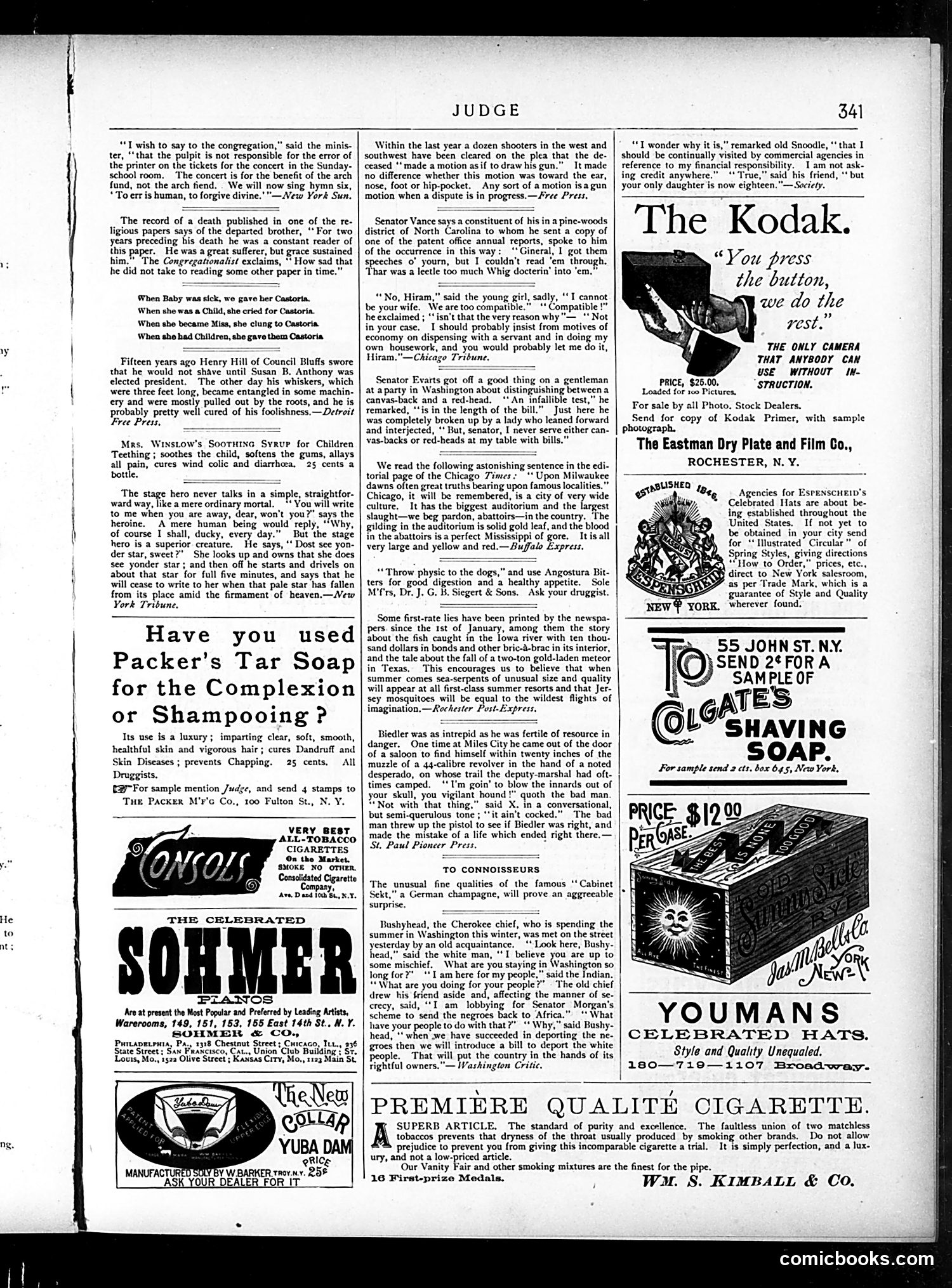
This page is primarily **advertising**, with brief humorous anecdotes interspersed—typical of Judge magazine's format. The notable satirical content includes: 1. **A minister's printing error joke**: A clergyman apologizes for a concert announcement typo ("arch fiend" instead of "arch fund"), finding irony in the hymn about forgiveness. 2. **Susan B. Anthony reference**: A joke about a man who swore in 1873 not to shave until women's suffrage leader Susan B. Anthony was elected president. Fifteen years later (apparently ~1888), his three-foot beard gets caught in machinery—satirizing the absurdity of the pledge and implying women's suffrage remains unlikely. 3. **Stage convention mockery**: Critics mock theatrical heroes who answer simple questions with overwrought, flowery monologues about stars and destiny. The rest is product advertising (Castoria, Packer's Tar Soap, cigarettes, Kodak cameras, etc.). The page reflects late-19th-century American anxieties about gender politics, industrial accidents, and cultural pretension.
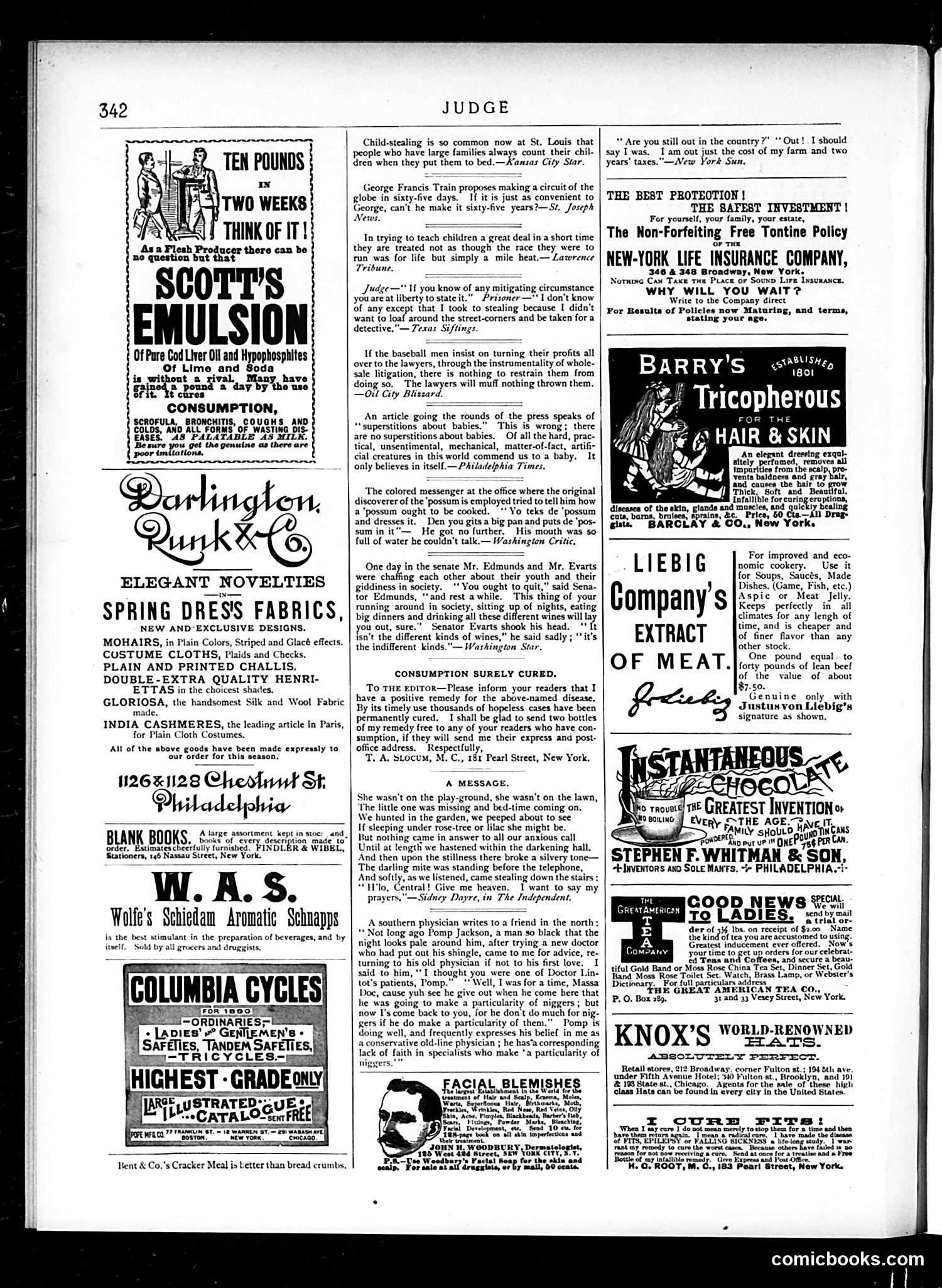
This page is primarily **advertising**, not political satire. It contains various commercial advertisements for patent medicines, textiles, bicycles, and other goods typical of late 19th-century publications. The only satirical content appears as brief **humorous quotations** scattered throughout, including: - A joke about child-stealing being common in St. Louis - Sarcasm about George Francis Train's proposed around-the-world trip - A quip about treating children's education like a "mile heat" rather than a lifelong race - A prisoner's excuse about stealing to avoid looking like a detective - Commentary on babies having no "superstitions" but being entirely practical creatures - A anecdote about a Black servant attempting to cook possum These snippets appear designed as filler content between ads. The page reflects *Judge's* format: a mix of satirical social commentary and commercial advertisements aimed at middle-class readers. The humor targets common social foibles, legal absurdities, and contemporary figures like Senator Evarts rather than specific political events.
This page is primarily **advertising** for various products (mineral pastilles, jams, hotels, pens, oils) with minimal editorial content. The only substantive article is a poem titled "Sebastian Morey on Divorce." The poem presents a rural character (suggested by dialect: "W'en," "nags," "kerridge") offering folksy philosophy on divorce. Morey argues that just as incompatible horses shouldn't be harnessed together, unhappy married couples should be permitted to divorce rather than live in conflict. He acknowledges the concern about children, but argues they're better off raised by charity than in a hostile home. He concludes by suggesting remarriage should be allowed, and that if everyone were as happily married as he and his wife Molly, divorce courts would be unnecessary. The satire appears gentle—using homespun wisdom to advocate for relatively progressive divorce law for the era, likely the late 1800s when divorce remained controversial and restricted.
This is primarily an **advertising page** with scattered humor pieces, not a political cartoon. The page features vintage product ads (cocoa, soap, railroad service, buggies) typical of 1880s magazines. The notable content includes **"Carl Pretzel's Philosophy"**—ethnic humor featuring a German-accented character dispensing folksy wisdom about friendship and virtue. Below that is **"Wing Tee Wee,"** a humorous poem about a Chinese woman and rival suitors, reflecting period stereotypes about Asian characters. Several short jokes follow, including one mocking women's suffrage and another anecdote about Governor Beaver disciplining a German-accented soldier. This ethnic and gender-based humor was standard Judge fare—satirizing immigrants' speech patterns and questioning women's capabilities. The page demonstrates how Judge mixed commercial advertising with lighthearted stereotypical humor rather than sharp political satire.
This page is primarily **advertising and humor filler**, typical of Judge magazine's format. The content includes: **Advertisements:** - Beecham's Pills (patent medicine for digestive complaints) - National Mortgage & Debenture Company (financial services) - Modene (hair removal product) - Hammond Typewriter (won a Paris Exposition gold medal) - Pozzoni's Medicated Complexion Powder **Humor Section:** Several short jokes and anecdotes, mostly featuring working-class or rural characters in humorous situations—a farmer discussing a horse accident, an Irishman named Hobbs arranging a wedding, a man applying for a custom-house job. These appear designed as light entertainment filler. **Overall Context:** This reflects late-19th-century magazine advertising practices: patent medicines, financial investments, and beauty products pitched to readers alongside humor. The jokes employ period dialect and stereotypes typical of era publications but lack specific political satire or commentary.
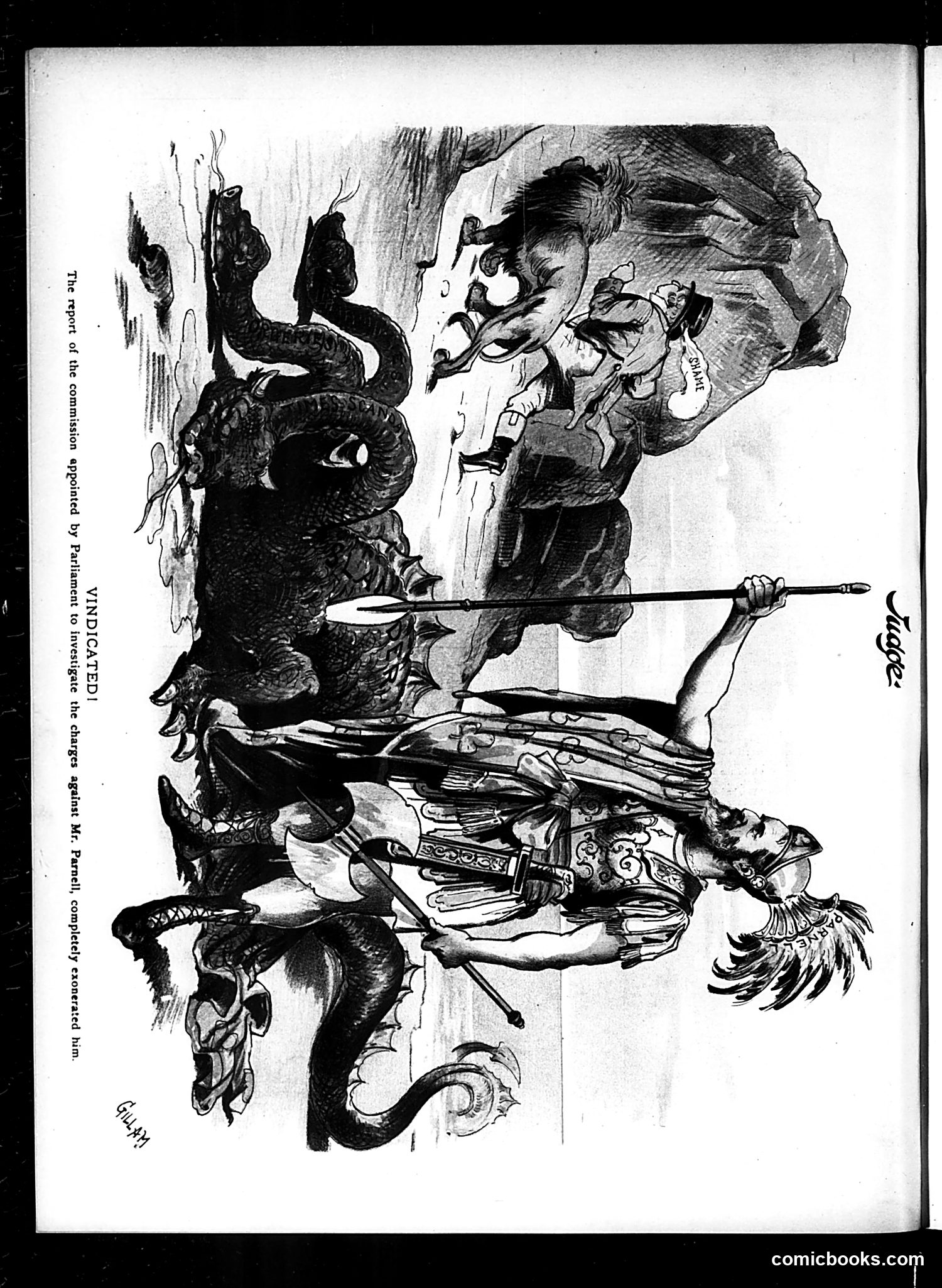
This appears to be a Judge magazine satirical cartoon showing an artist (likely the cartoonist) painting or depicting a monstrous, serpentine creature with multiple grotesque heads. The figure being created appears to represent a political enemy or threat—possibly embodying corruption, tyranny, or a specific political movement the magazine opposed. The caption references "The spirit of the Commission 'sprouted' by Archbishop to redesign the sharp guard of a French company condemned him," though the OCR is garbled and unclear. The imagery suggests this is commentary on French politics, possibly involving religious or institutional authority figures creating or enabling some perceived evil or dangerous force. The artistic style—with dramatic cross-hatching and exaggerated caricature—is typical of Judge's satirical approach. Without clearer text, the specific historical reference remains uncertain, but the cartoon clearly uses monstrous imagery to condemn whatever entity or policy it depicts.