
A complete issue · 16 pages · 1889
Judge — July 20, 1889
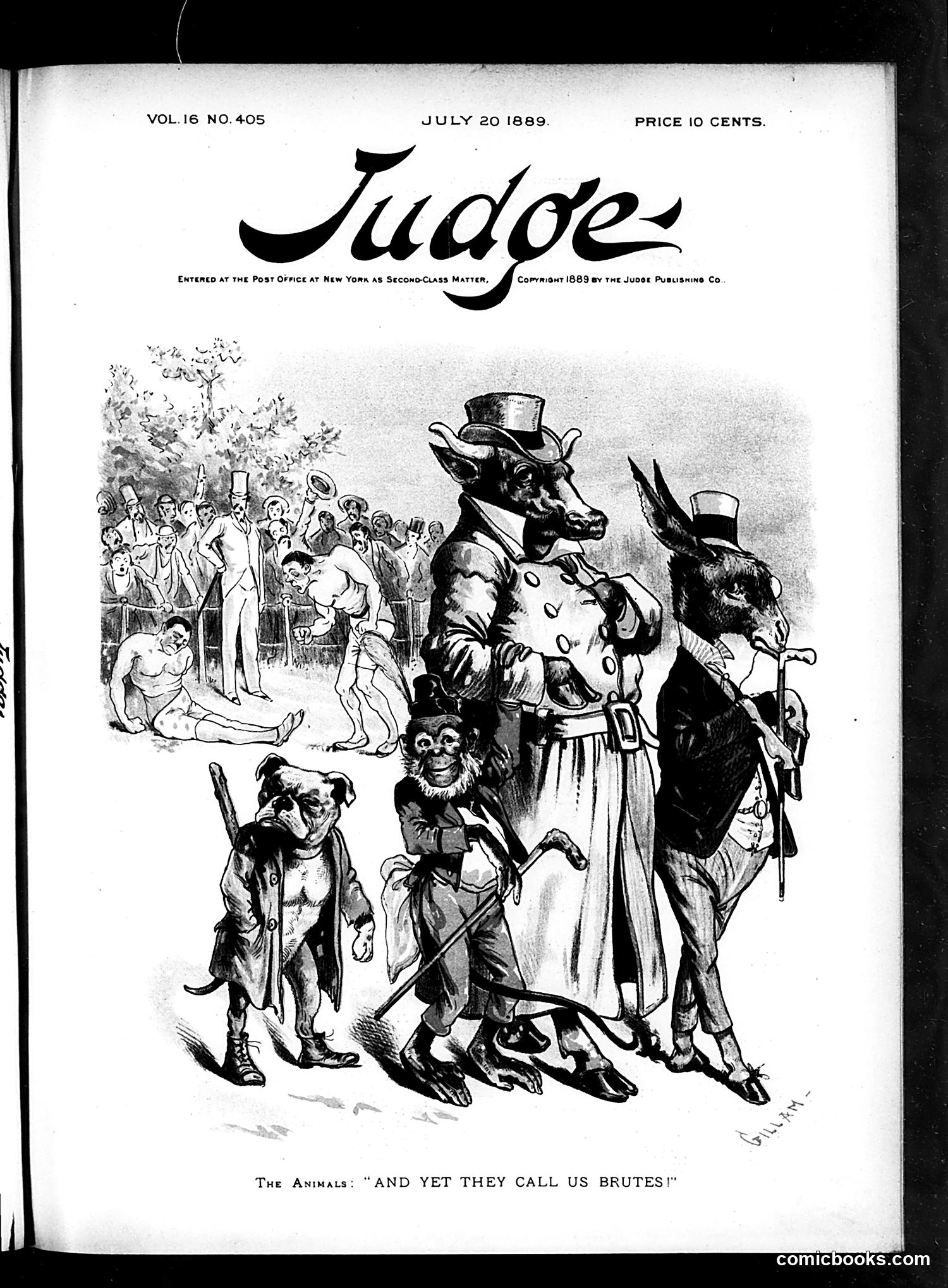
This satirical cartoon depicts anthropomorphized animals dressed as wealthy gentlemen and a woman, with the caption "The Animals: 'And Yet They Call Us Brutes!'" The image appears to be social commentary on human behavior and morality. Animals—dressed in top hats, fine clothing, and carrying weapons—are ironically expressing indignation at being called "brutes." The cartoon suggests that humans, despite their pretensions to civility and refinement, behave as brutishly as animals. The well-dressed figures in the background appear to represent human society, while the animal characters in foreground serve as a mirror to criticize human conduct. The satire mocks the hypocrisy of "civilized" society—that humans adopt formal dress and manners while committing acts as savage as any animal's.
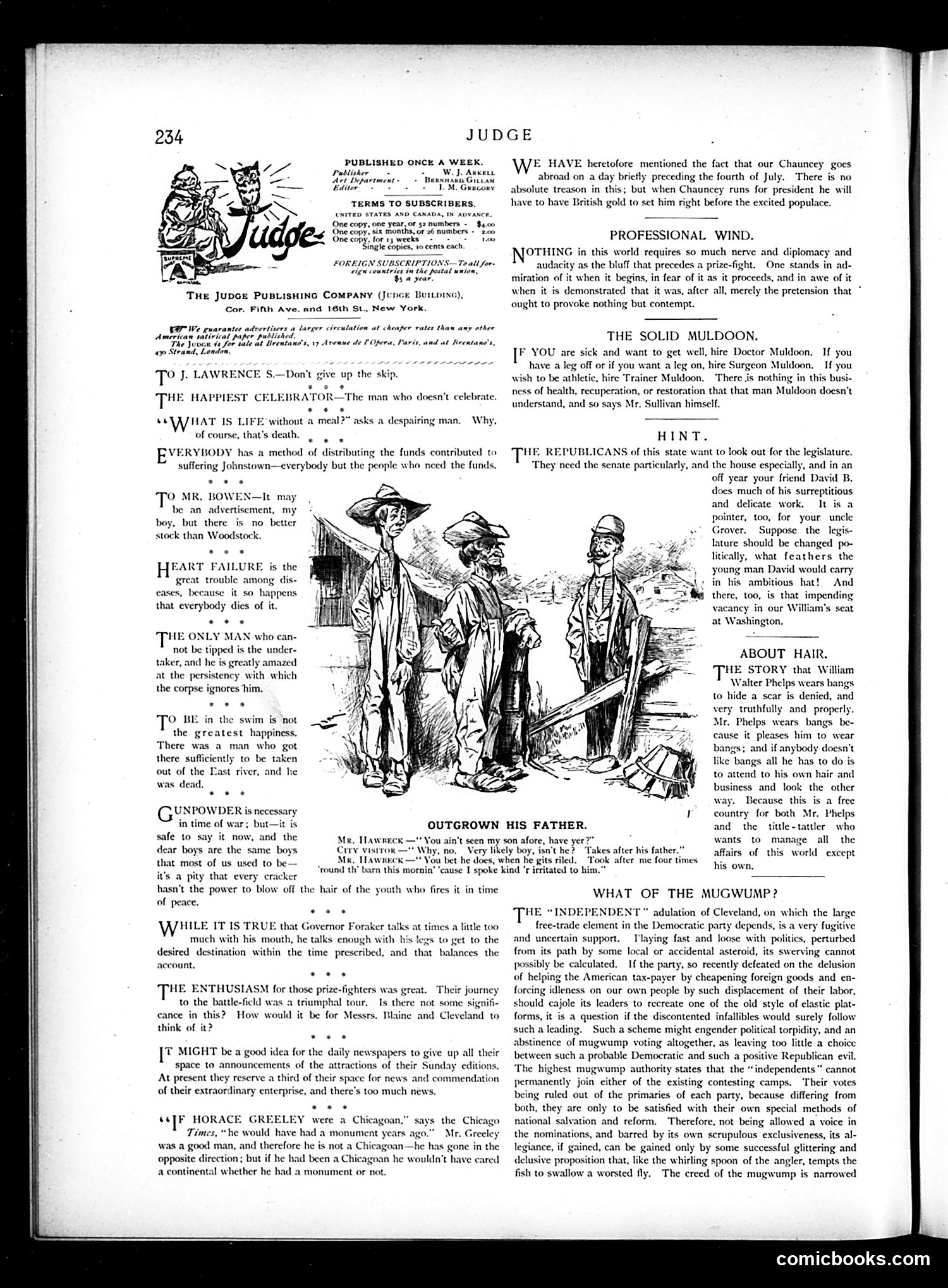
The main cartoon, titled "OUTGROWN HIS FATHER," depicts what appears to be political figures in Western attire. The dialogue references a father-son relationship where the son has "outgrown" the father's influence. Based on the context and era, this likely satirizes a shift in political authority or generational change within a political family or faction. The accompanying text sections include short satirical commentary on various topics—professional deception, a "solid muldoon" (possibly an ethnic reference), political advice about a legislature, and hair-wearing practices. Without clearer identification of specific figures or dates visible on this page, the exact political figures being caricatured remain unclear, though the overall tone mocks political pretension and hypocrisy typical of Judge's satirical approach.
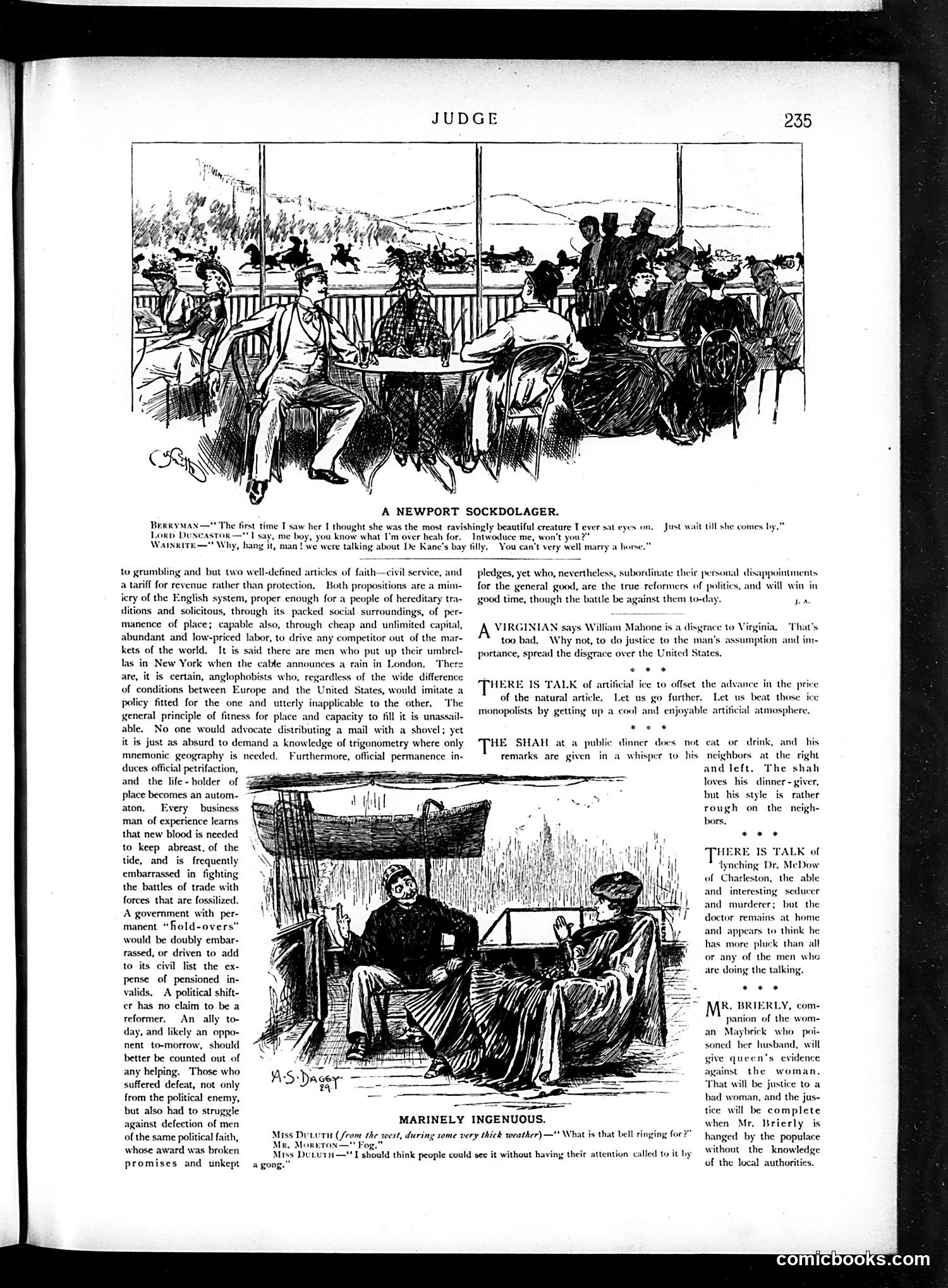
## "A Newport Sockdolager" The top cartoon satirizes wealthy Newport socialites. A man (Berryman) describes a woman as "ravishingly beautiful," while Lord Duncaster eagerly demands an introduction. Wateshire deflates the romantic tension by revealing they were actually discussing a horse ("De Kane's bay filly")—the joke being that these shallow aristocrats mistake social gossip for meaningful conversation. ## "Marinedly Ingenuous" The lower cartoon depicts two women during fog. Miss Duluth asks why a bell is ringing; Miss Deluth responds people should see it without needing auditory attention. The satire mocks illogical reasoning—her suggestion is absurd since fog prevents visibility, making the bell *necessary*. ## Text Content The article discusses civil service reform and tariff policy, critiquing those who blindly imitate English systems without considering American conditions. It also references the Maybrick case (a poisoning scandal involving a woman's infidelity) and the role of witnesses in justice.
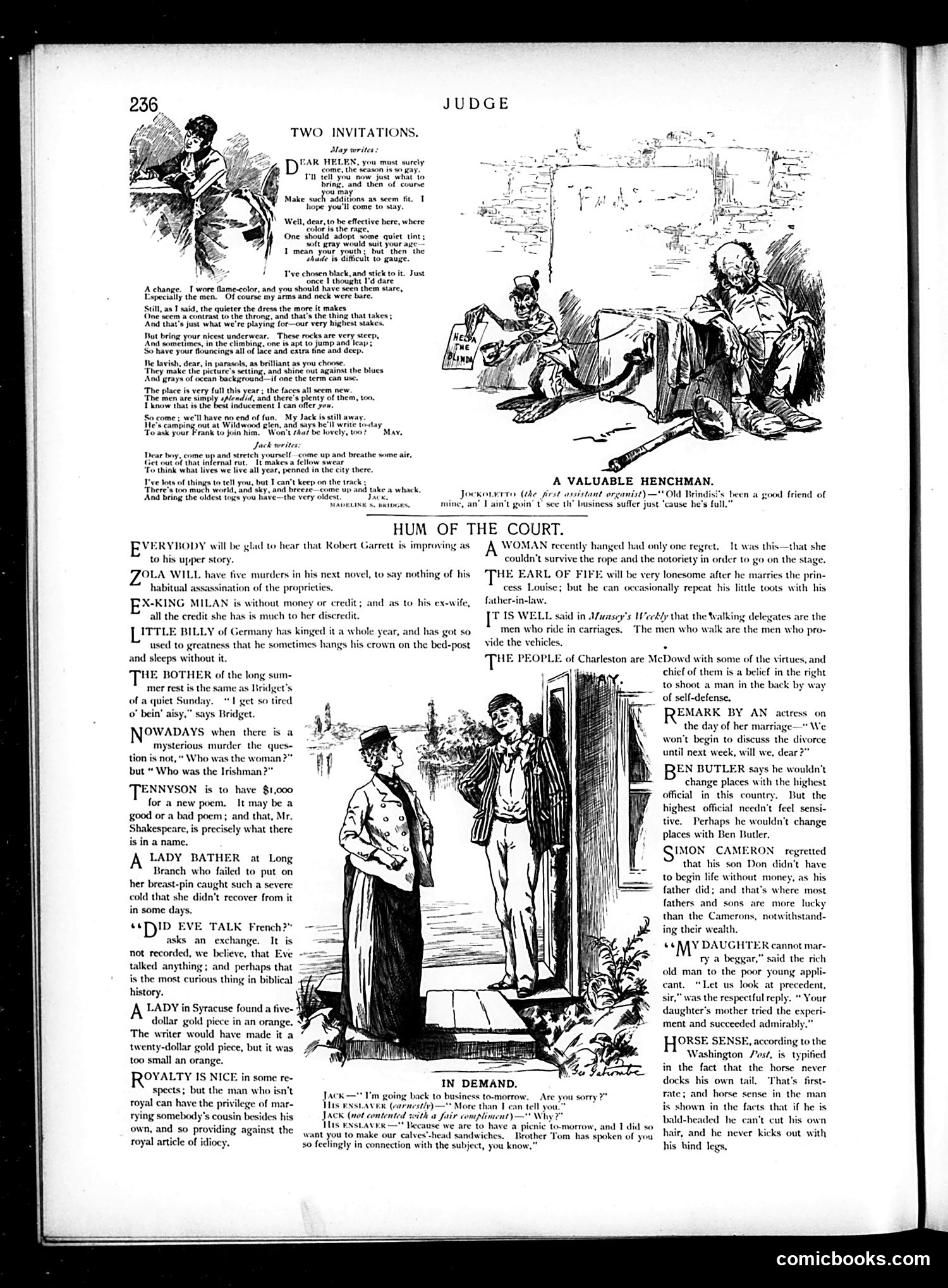
This page from *Judge* magazine contains satirical commentary on upper-class leisure and social conventions circa the 1880s-1890s. **"Two Invitations"** depicts wealthy women's anxious social posturing at seaside resorts (likely Long Branch, a fashionable destination). The satire mocks their obsessive concern with clothing choices, competitive display, and romantic prospects—presenting their vacation as a calculated performance where even "quiet" dress serves strategic advantage in attracting men. **"Hum of the Court"** offers brief gossipy asides on celebrities and social figures, including Robert Garrett's health, tenuous literary valuations (Tennyson's fees), and absurd anecdotes about the wealthy (a woman's breast-pin causing pneumonia). **"In Demand"** (bottom) depicts working-class dialogue about economic anxiety—a man reluctant to leave business, illustrating the contrast between leisured upper classes and those dependent on labor. The cartoons collectively satirize Victorian-era class anxieties: the wealthy's performative leisure and marriage-market maneuvering versus ordinary people's financial precarity. The illustrations use exaggeration and ironic tone to critique both frivolity and economic inequality.
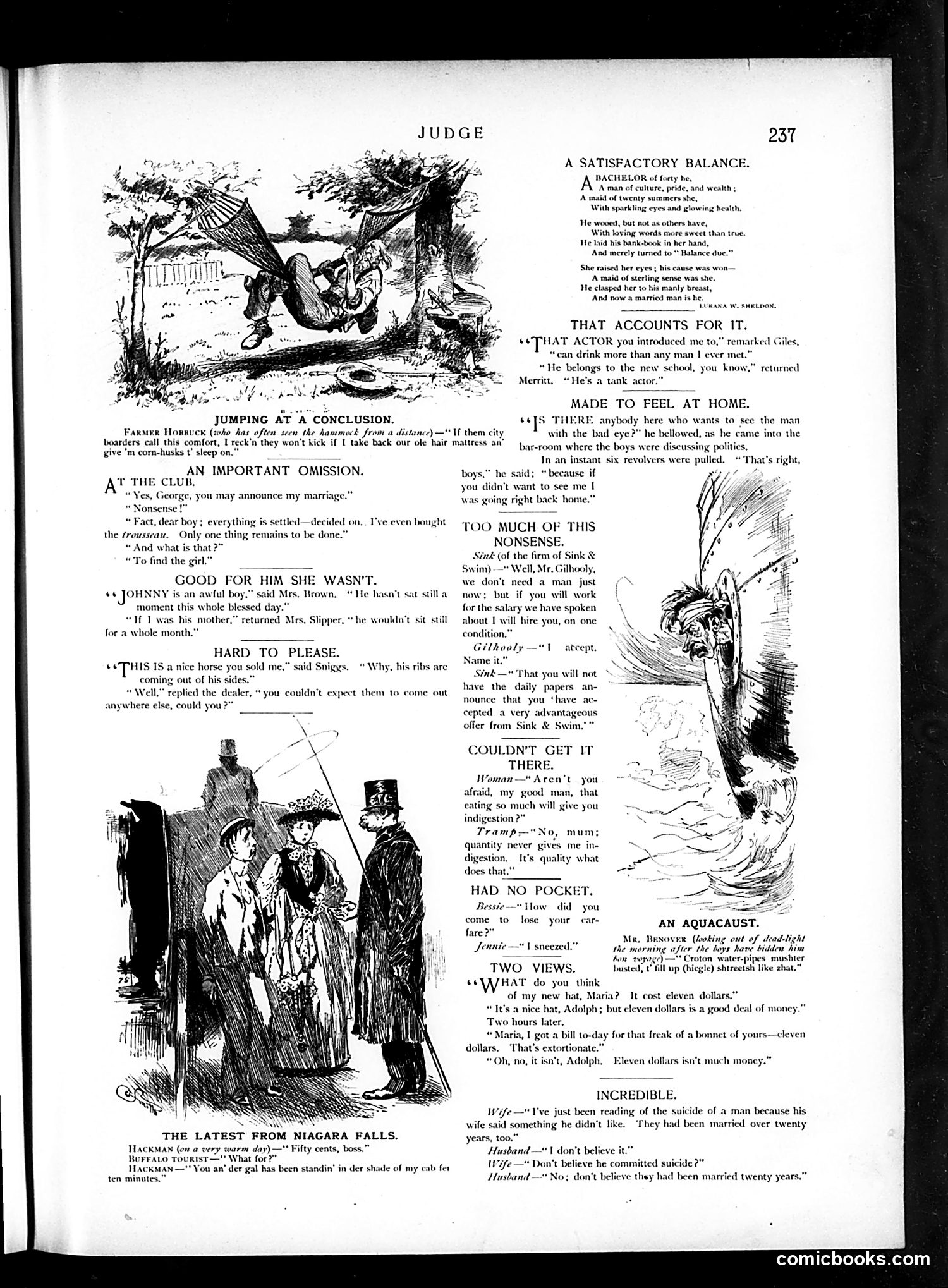
This page collects brief satirical vignettes mocking social conventions and human nature circa early 1900s: **"A Satisfactory Balance"** depicts a cynical courtship where a wealthy bachelor wins a young woman not through romantic words but by showing her his bank account—satirizing mercenary marriages where wealth substitutes for genuine affection. **"That Accounts for It"** jokes that a heavy-drinking actor belongs to the "new school" and is a "tank actor"—a pun on his capacity for alcohol, reflecting turn-of-century theater culture. **"The Latest from Niagara Falls"** shows a cab driver charging tourists for shade, mocking tourist exploitation at popular honeymoon destinations. **"An Aquacaust"** depicts a drunk man on a ship, with the humor in his slurred speech about water pipes—ethnic dialect humor typical of the era. Other brief items mock spousal disagreements over hat prices, job-hunting desperation, and the implausibility of men leaving wives after 20 years—all domestic humor reflecting contemporary anxieties about marriage, class, and employment.
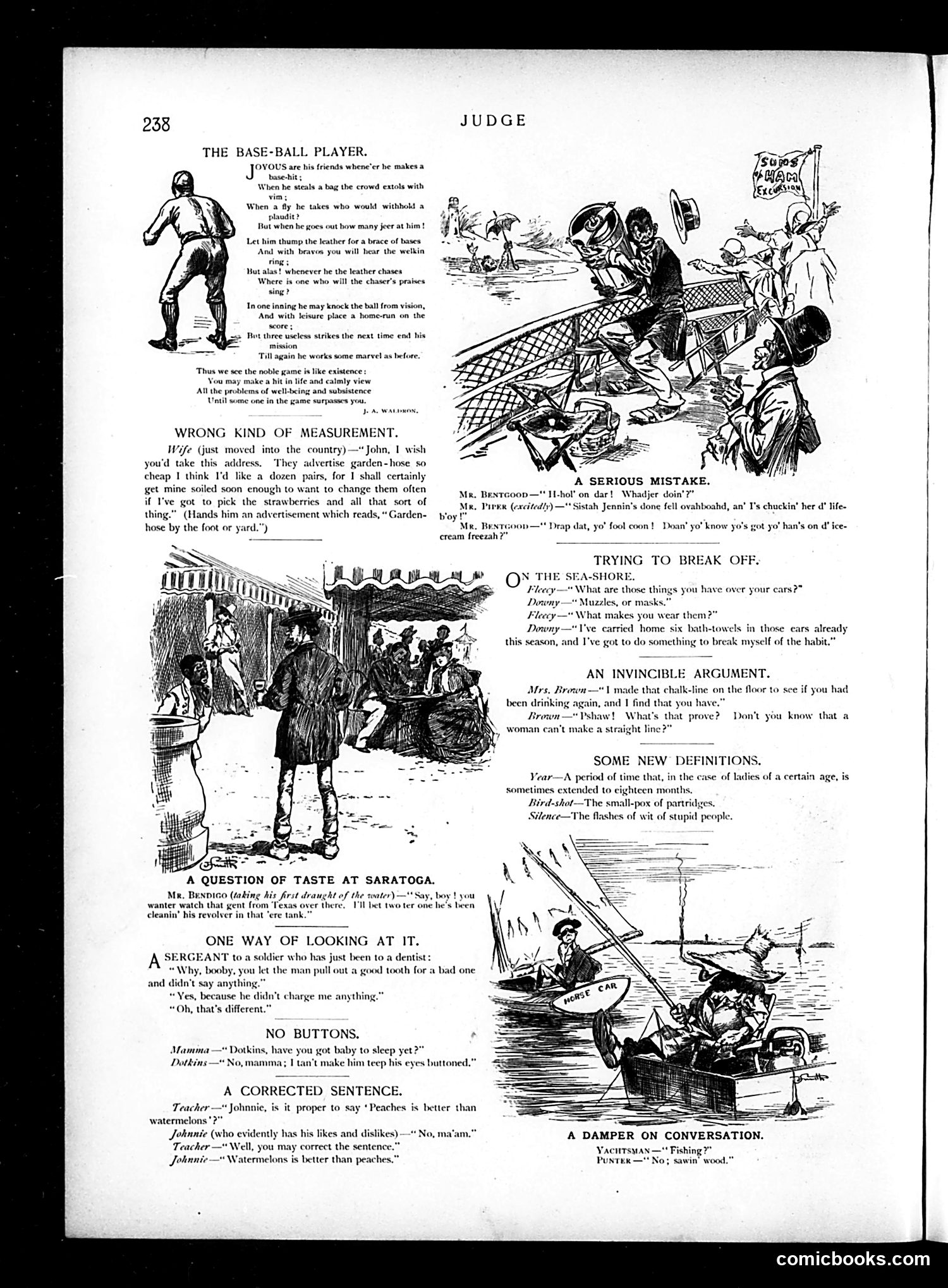
This page from *Judge* presents various short satirical pieces typical of late-19th-century American humor magazines. **"The Base-Ball Player"** uses baseball as a metaphor for life's fickleness—celebrating success while ignoring failure. The poem comments on society's shallow praise and blame. **"Wrong Kind of Measurement"** is a gentle domestic comedy: a newly rural wife misunderstands "garden-hose by the foot or yard," thinking she can buy "pairs" of hose like clothing. **"A Serious Mistake"** uses dialect humor featuring Black characters in a boating accident—typical of the era's problematic racial stereotyping common in *Judge*. **Other brief pieces** include wordplay and observations about human nature: a wife's geometric proof that women can't draw straight lines, children's logic about dentists and teachers, and definitions mocking pretension. The page mixes gentle domestic satire with crude ethnic humor reflecting the publication's intended audience of middle-class white Americans. The baseball poem is the most substantive content; others are quick gags.
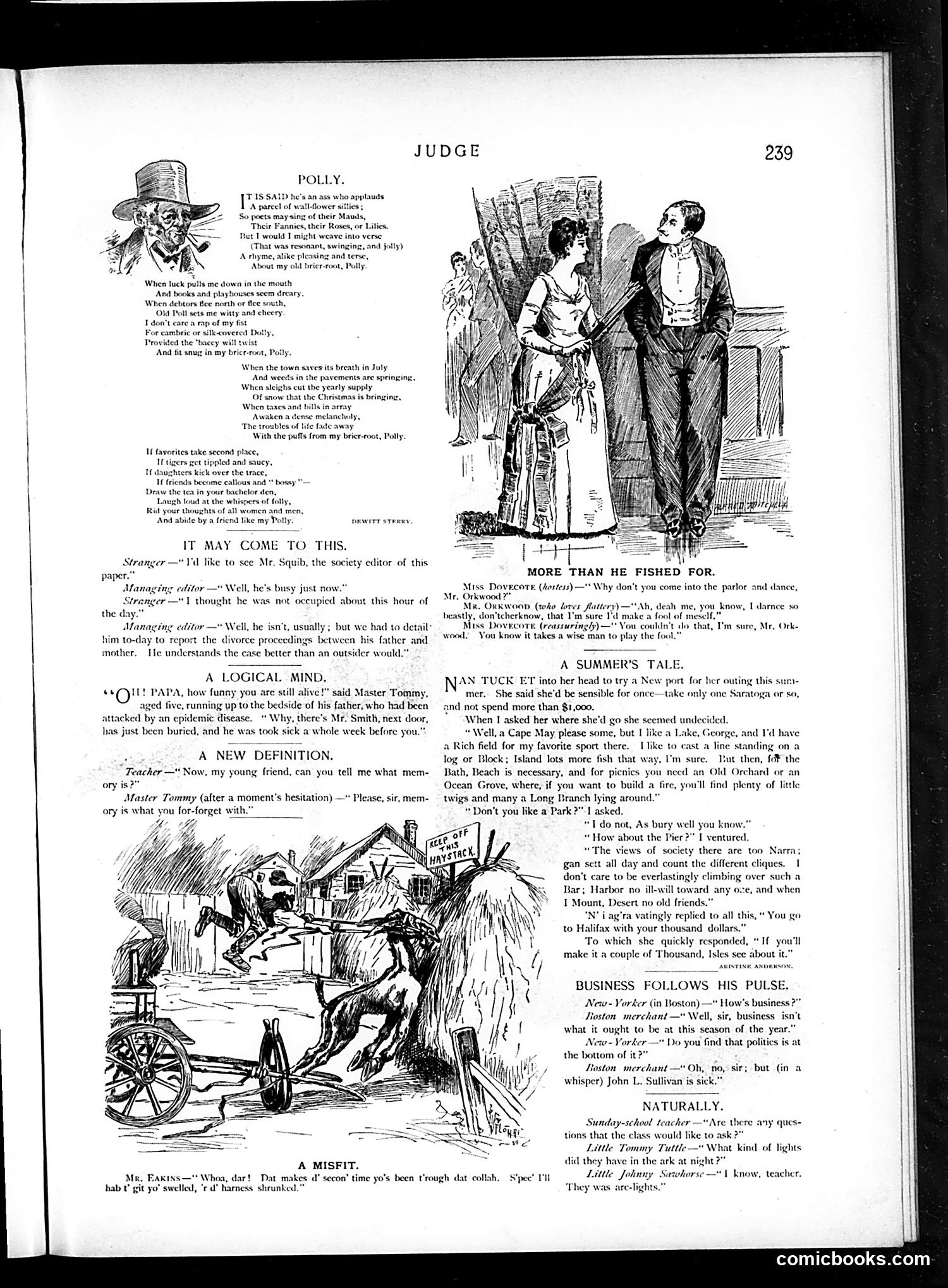
This page contains several short satirical pieces typical of Judge's humor: **"Polly"** is a sentimental poem celebrating a briar-root pipe as a faithful companion through life's troubles—common Victorian-era nostalgia. **"It May Come to This"** satirizes newspaper society editors' obsession with trivial matters. The managing editor must pull the society editor from covering a divorce (serious news) to handle a minor social visit. **"A Summer's Tale"** mocks wealthy women's indecision about vacation destinations, with a woman debating between Cape May, Block Island, and other resorts while spending lavishly. **"A Logical Mind"** is a children's joke: a boy defines memory as "what you forget with"—simple wordplay humor. **"Business Follows His Pulse"** jokes that a Boston merchant blames poor business on politics and boxer John L. Sullivan's illness—trivial concerns masquerading as economic factors. The cartoons and anecdotes target American social pretension, consumerism, and frivolous priorities among the upper and middle classes of the era.
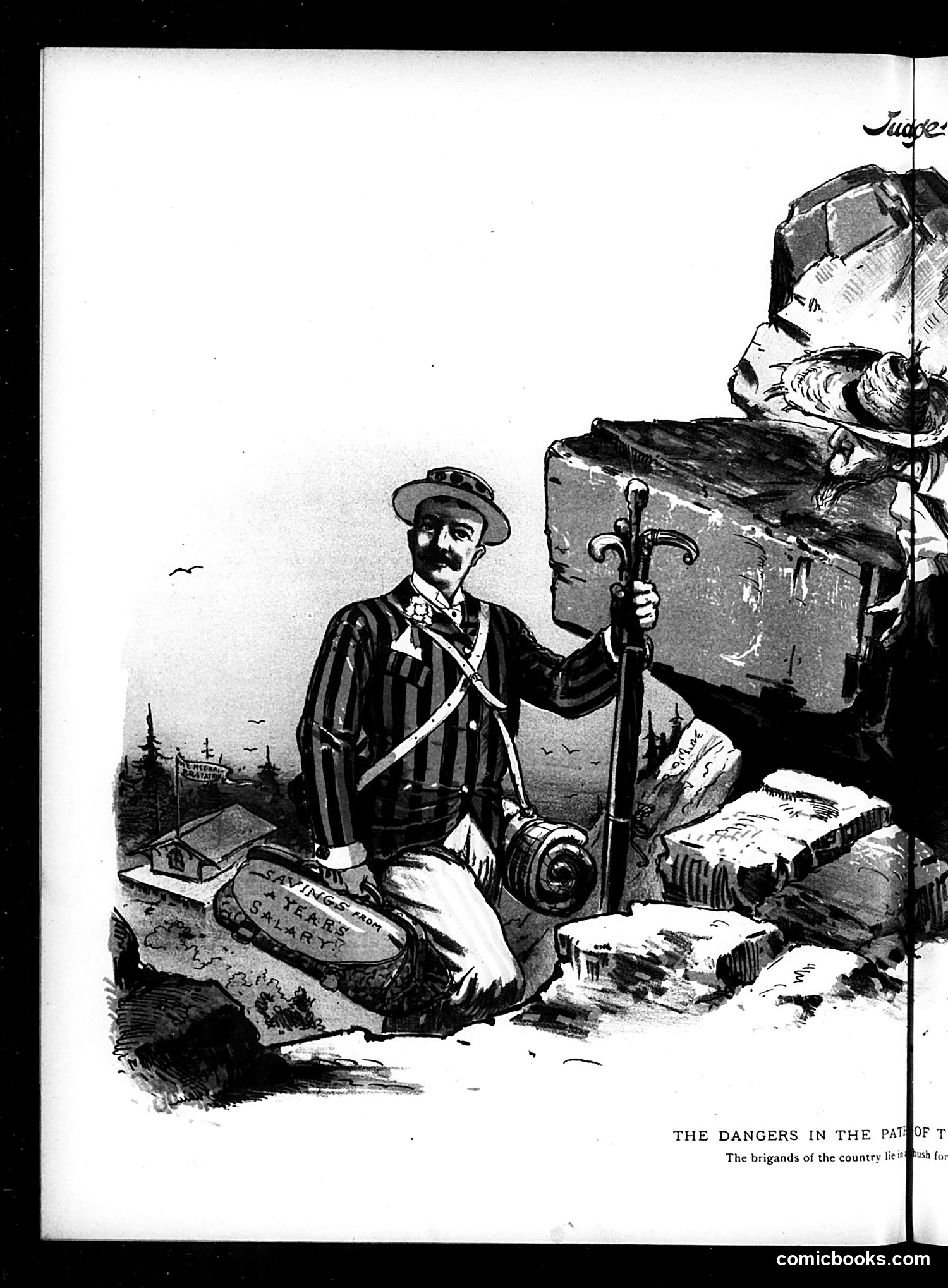
This appears to be a Judge magazine editorial cartoon titled "The Dangers in the Path of T[he]..." (text cut off). The image depicts a well-dressed man in a striped suit and hat, carrying a walking stick and holding a rifle, standing guard over a large trunk and scattered valuables. The caption references "brigands of the country" who "lie in push for[...]" The cartoon seems to satirize **robbery or theft as a social danger**, with the armed figure protecting property/wealth from criminals. The specific political reference is unclear from the fragmentary text, but the visual metaphor suggests commentary on **public safety, crime, or possibly labor unrest** during an era when banditry and property crime were genuine concerns in America. Without the complete caption and context of publication date, the specific target of satire cannot be definitively identified.
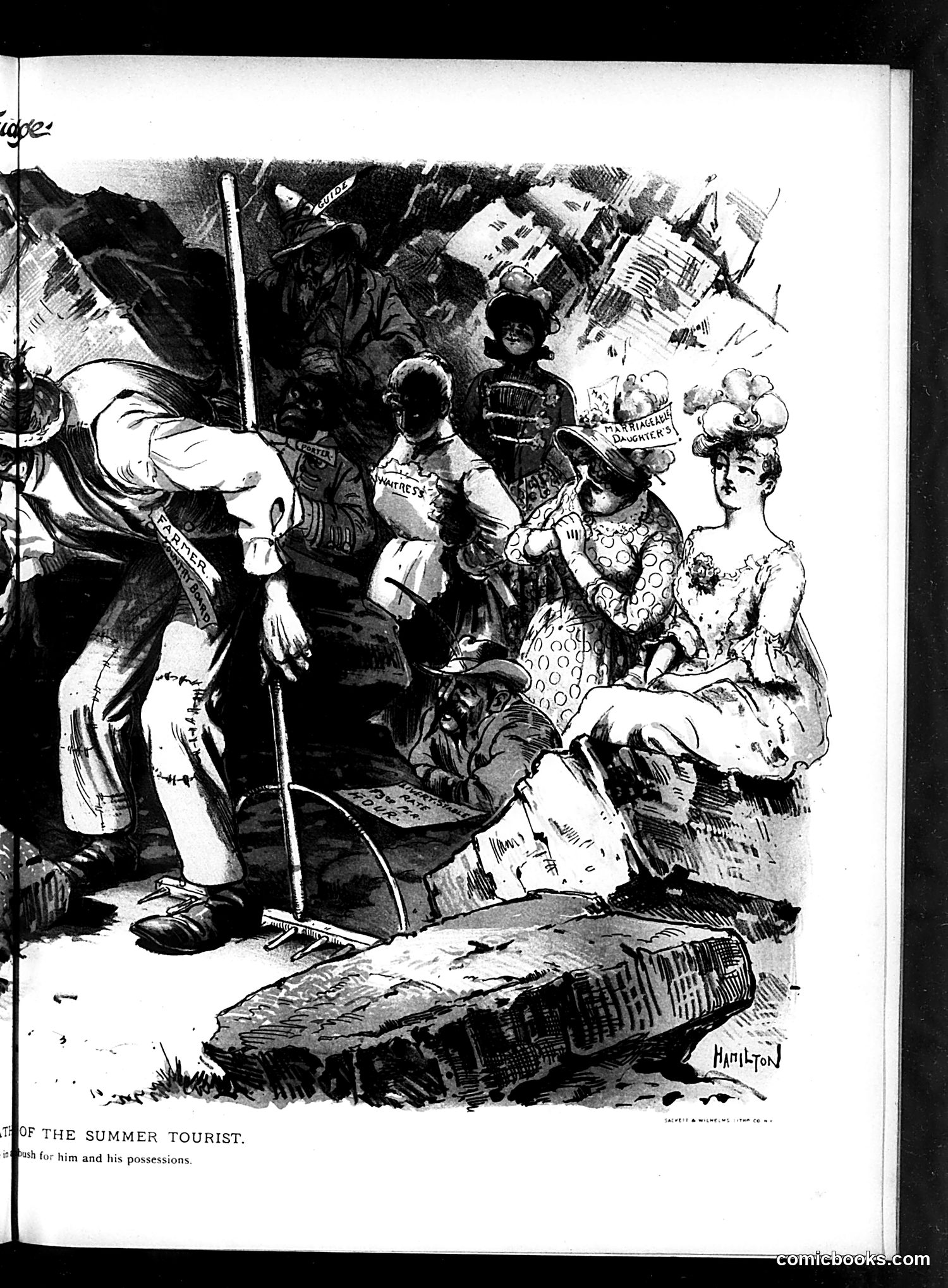
This cartoon by Hamilton satirizes the summer tourist season. The scene depicts well-dressed vacationers arriving at what appears to be a seaside resort or boarding house, their luggage and belongings piled around them. The exaggerated clothing, hairstyles, and affected poses mock the pretensions of upper-class leisure travelers. The visible text fragment ("search for him and his possessions") suggests the cartoon critiques tourists as burdensome—their excessive baggage and demanding nature creating chaos wherever they go. The crowded, chaotic composition emphasizes how tourists descend upon vacation destinations en masse, disrupting local communities. This reflects late 19th/early 20th-century anxieties about mass tourism as an emerging phenomenon, mocking both tourist pretension and their disruptive social impact.
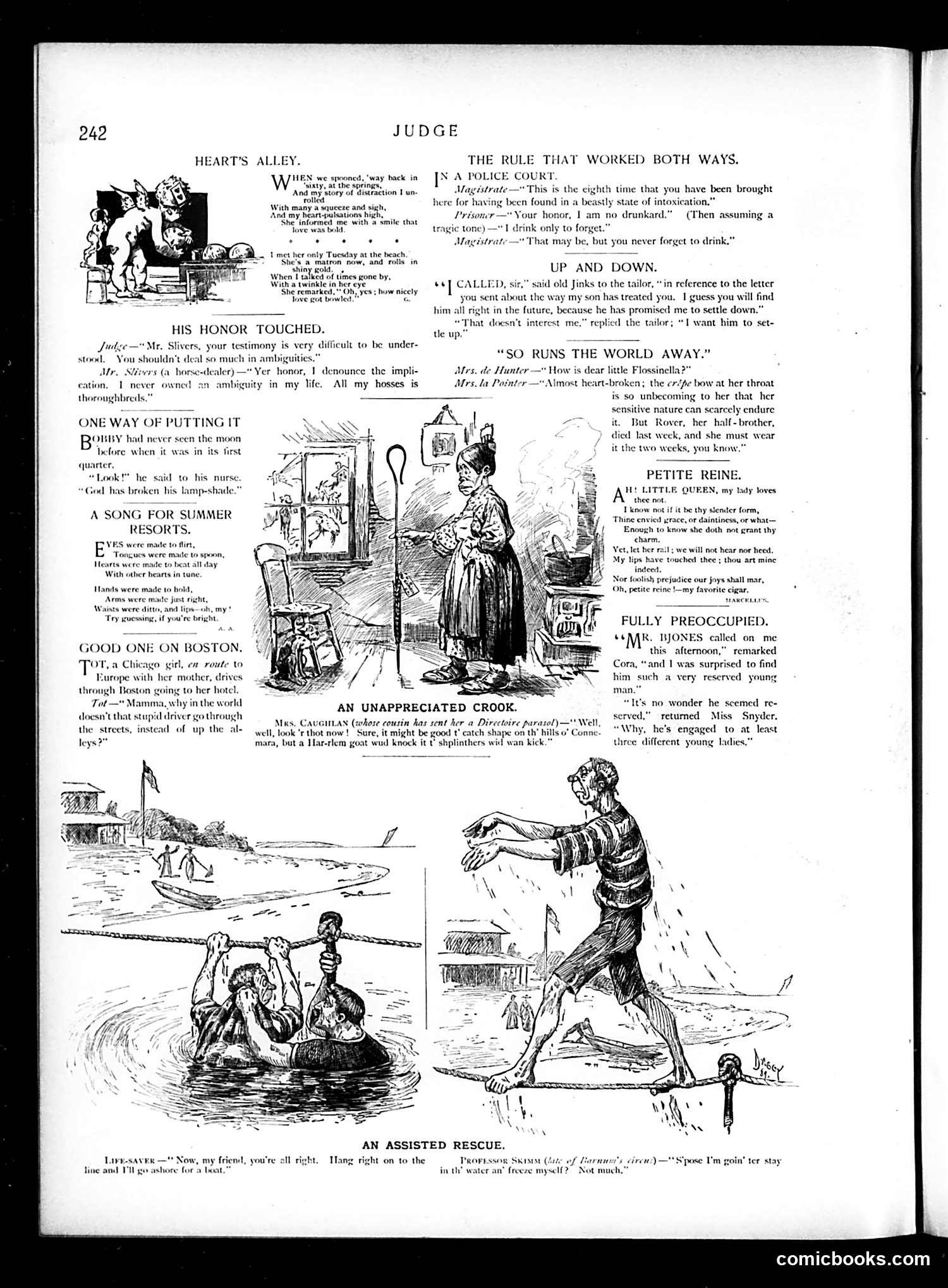
This page contains several unrelated humorous sketches typical of Judge's satirical style: **"Heart's Alley"**: A man reminisces about a romantic encounter from 1860, but the woman—now wealthy and respectable—dismissively recalls he got "bowled" (defeated/rejected). **"His Honor Touched"**: A horse-dealer testifies in court, denying ambiguity while ironically contradicting himself about never owning thoroughbreds. **"The Rule That Worked Both Ways"**: A magistrate traps a drunk defendant—the man claims he drinks only to forget, but the judge retorts he never forgets to drink. **"An Unappreciated Crook"**: An Irish woman receives a Directoire parasol as a gift but dismissively suggests a Harlem goat could destroy it. **"So Runs the World Away"**: Society women fret over fashion details (a bow's unbecomingness) while missing genuine tragedies. **"Fully Preoccupied"**: A man seems reserved because he's engaged to three different women simultaneously. These are light, domestic humor pieces with no apparent political content—standard Judge fare targeting romantic absurdities and social pretension.
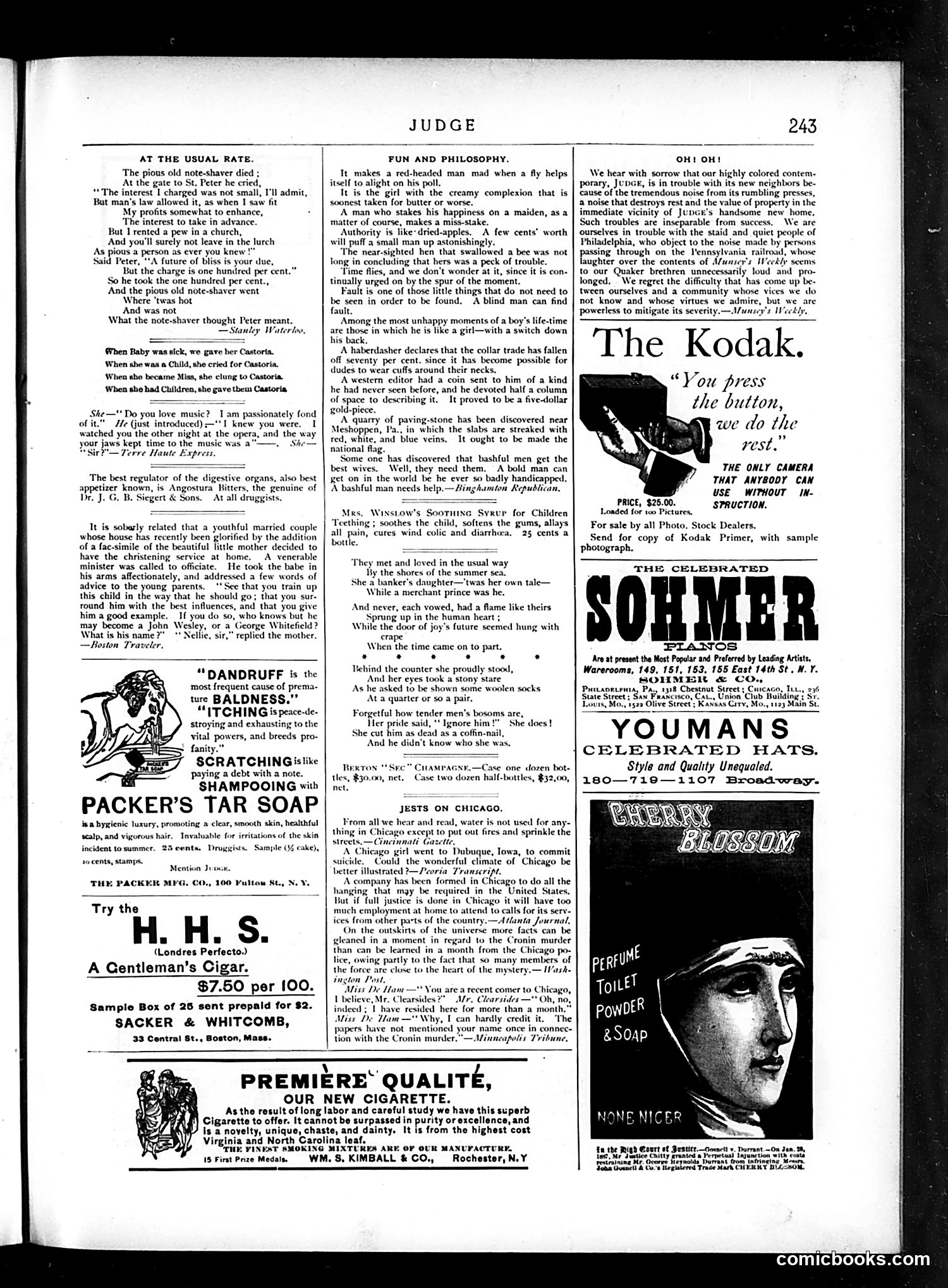
This page is primarily **advertising and humor filler**, typical of Judge magazine's format. The main content includes: **"At the Usual Rate"** — A morality tale satirizing hypocrisy: a usurious moneylender who charged illegal interest rates and rented a church pew believes this piety guarantees heaven. St. Peter charges him 100% interest (the same predatory rate he used on others), and the punchline reveals he goes to hell anyway. The satire targets corrupt financiers hiding behind religious respectability—a common Progressive-era critique. **"Fun and Philosophy"** section — Brief, aphoristic jokes about human nature and current social attitudes (red-headed men, flirtation, authority, fashion trends). The remainder consists of **period advertisements** for patent medicines (Castoria, Angostura Bitters), hair products (Packer's Tar Soap), cigars, and perfume—standard Judge revenue sources. These ads reflect late 19th/early 20th-century consumer culture and medical quackery. No major political figures or specific current events are referenced on this particular page.
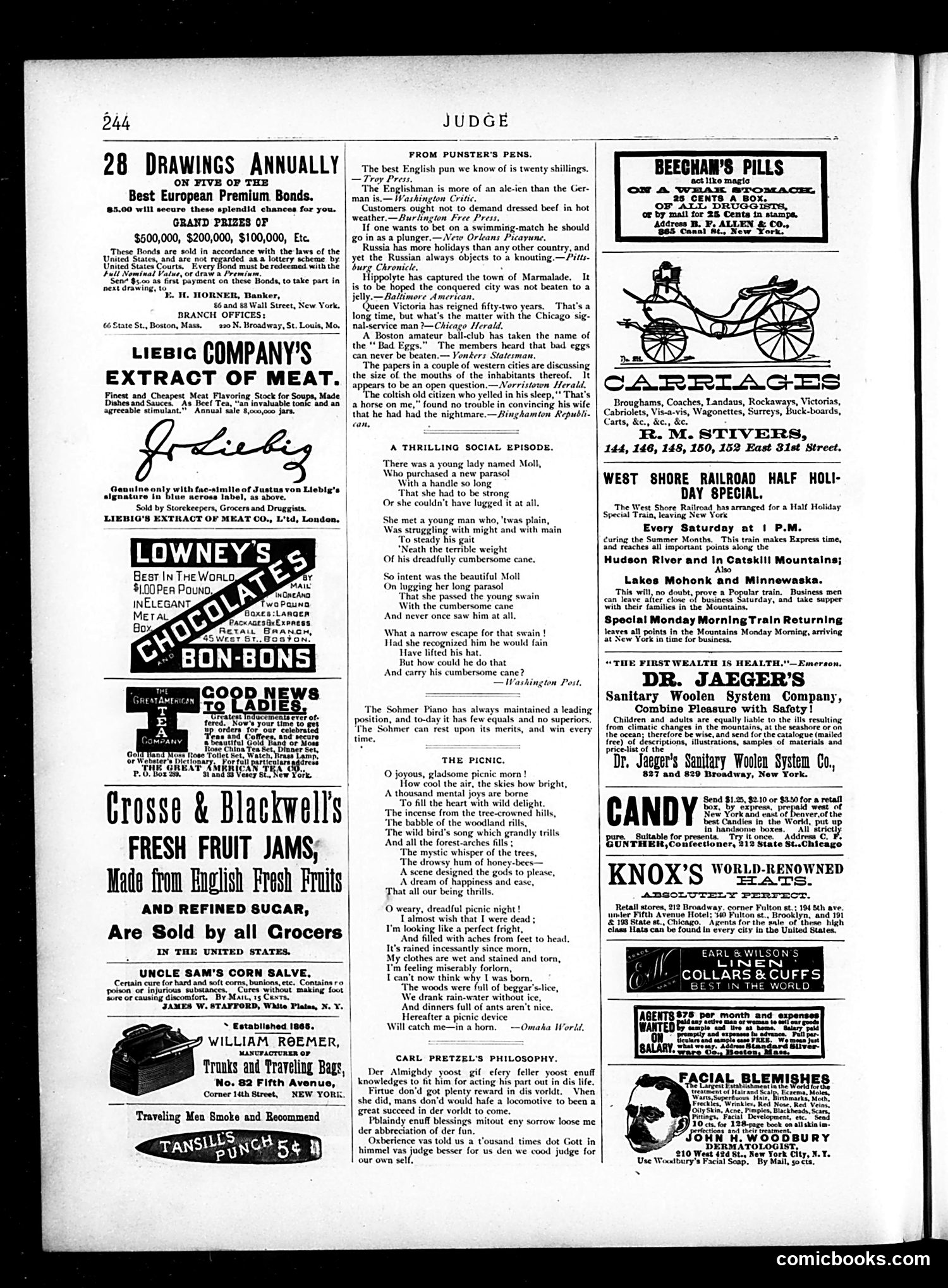
This page is primarily **advertisements and light humor**, not political satire. The content includes: **"From Punster's Pens"**: A collection of terrible puns from various American newspapers—wordplay about English people liking "ale," swimming "plungers," Russian "knouting" (whipping), and other groan-worthy jokes typical of 19th-century newspaper humor. **"A Thrilling Social Episode"**: A humorous poem about a young woman with an oversized parasol and a young man with an unwieldy cane who pass each other without recognizing one another—satire of Victorian awkwardness and social conventions. **The advertisements** occupy most of the page: piano makers, jam companies, travel bags, meat extract, and medical products—typical of Judge magazine's revenue model. There is **no significant political cartoon or social commentary** visible here. The satire is gentle and domestic rather than political.
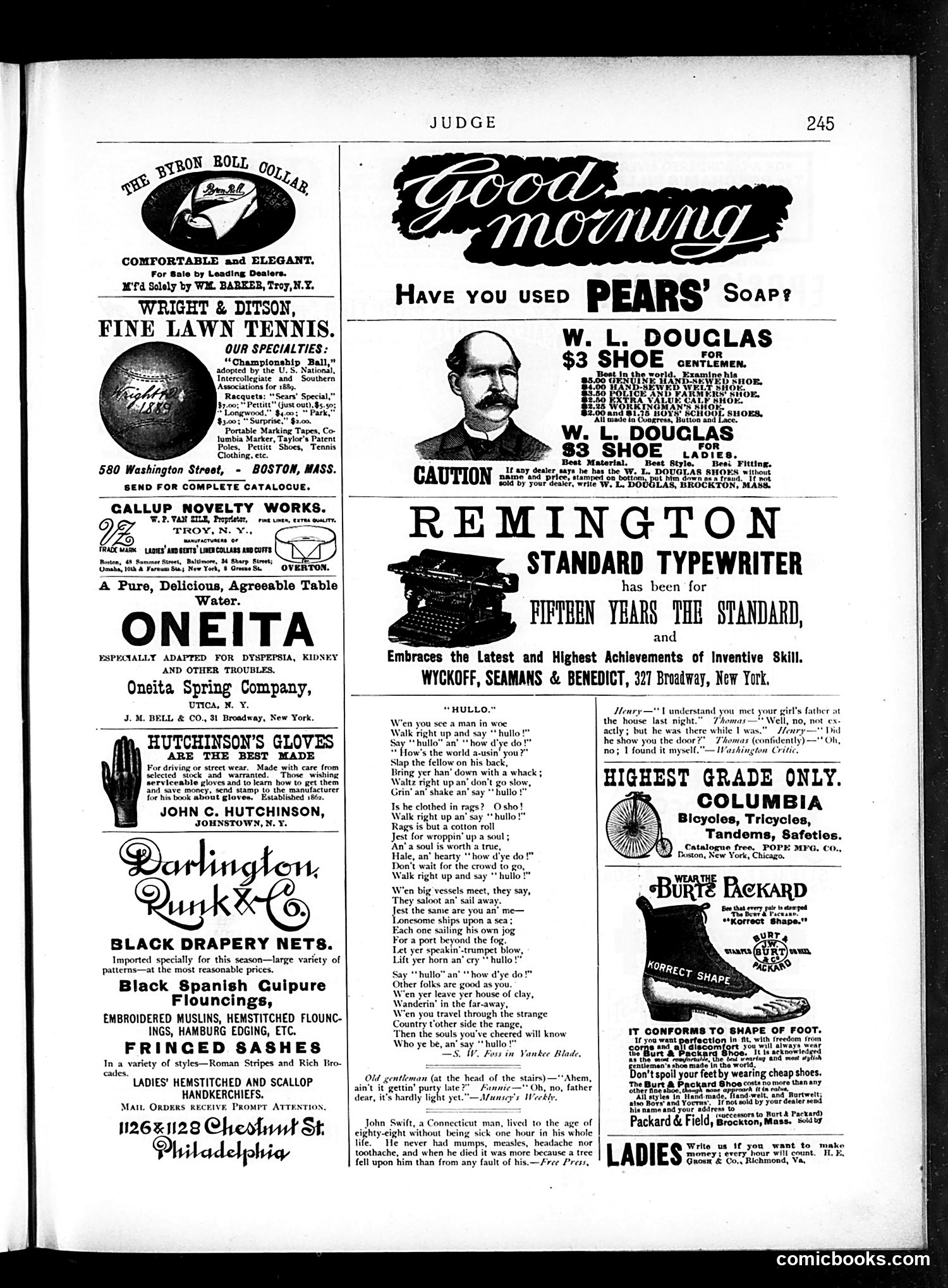
This page is primarily **advertisements** with a small amount of editorial content. The main cartoon appears to be "Hullo," a poem about friendly greetings—emphasizing the social virtue of approaching strangers warmly ("Walk right up and say 'hullo'!"). It's gentle moralistic humor about human connection. There's also a brief anecdote about John Swift of Connecticut, who lived to eighty-eight without illness, presented as a curiosity. The page is dominated by period product advertisements: Pears' Soap, W.L. Douglas shoes, Remington typewriters, tennis equipment, gloves, and various dry goods. These ads reveal what late 19th-century Judge readers purchased—the magazine relied heavily on advertising revenue. **The satire or pointed social commentary is minimal on this page**—it's primarily a commercial vehicle. Judge's actual satirical content likely appears elsewhere in the issue.
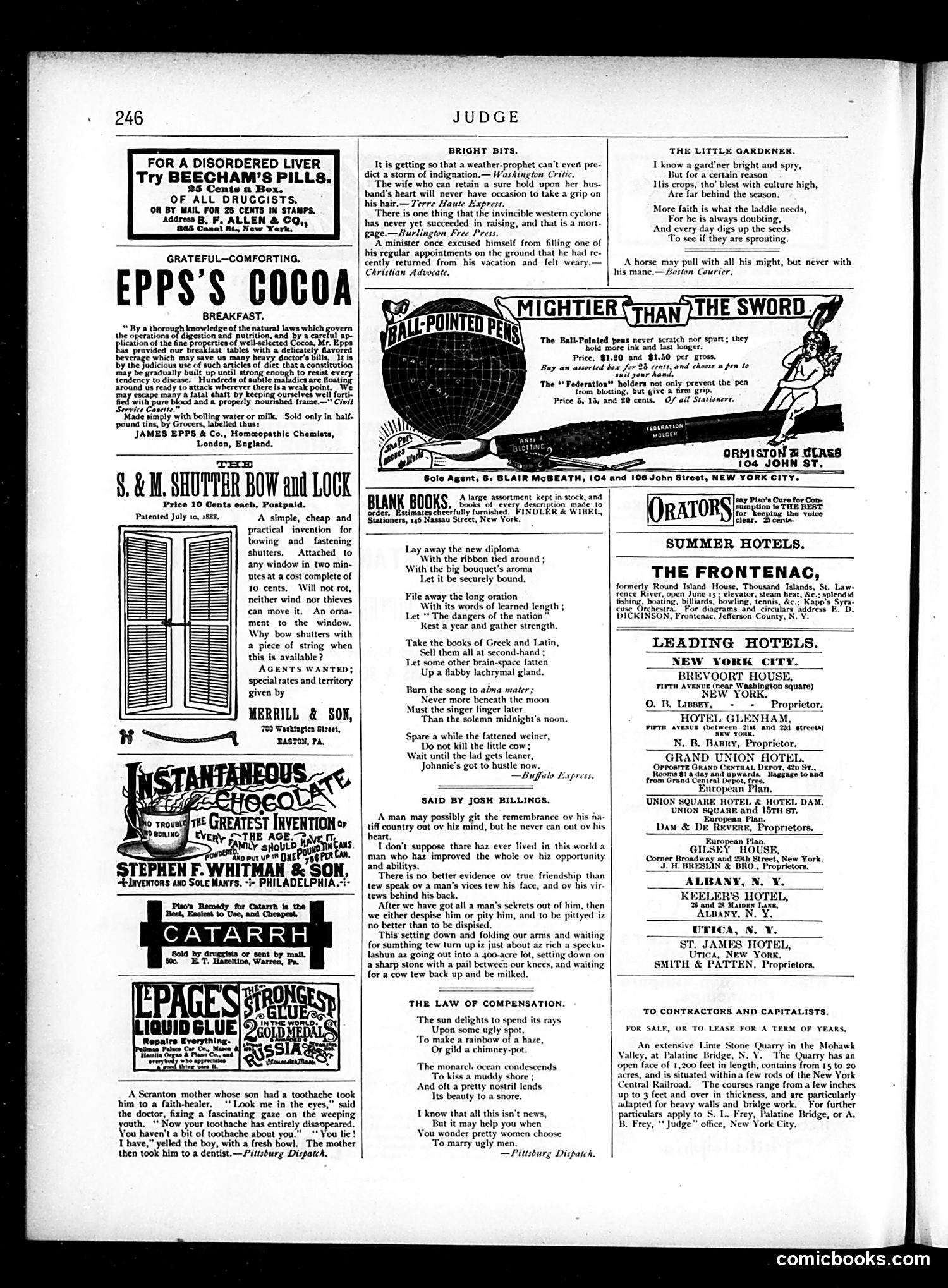
This page is primarily **advertising and light verse**, not political satire. It contains: **Advertisements** for household and office products: Beecham's Pills, Epps's Cocoa, a shutter lock device, writing pens, and various other goods typical of late-19th-century commerce. **Light humor** under "Bright Bits"—short quips mocking weather forecasters, wives, cyclones, and preachers. These are gentle social observations without sharp political edge. **Two poems**: "The Little Gardener" (about an impatient farmer constantly uprooting seeds) and other verse offering moralistic lessons. **Hotel advertisements** for New York establishments. The only potentially satirical piece is the anecdote at bottom about a faith-healer claiming to cure a boy's toothache through mesmerism—which ridicules faith-healing by contrasting it with the boy's physical pain and the eventual recourse to a dentist. This gently mocks pseudoscience masquerading as medicine. The page reflects Judge's mix of humor, advertising revenue, and consumer culture rather than hard political commentary.
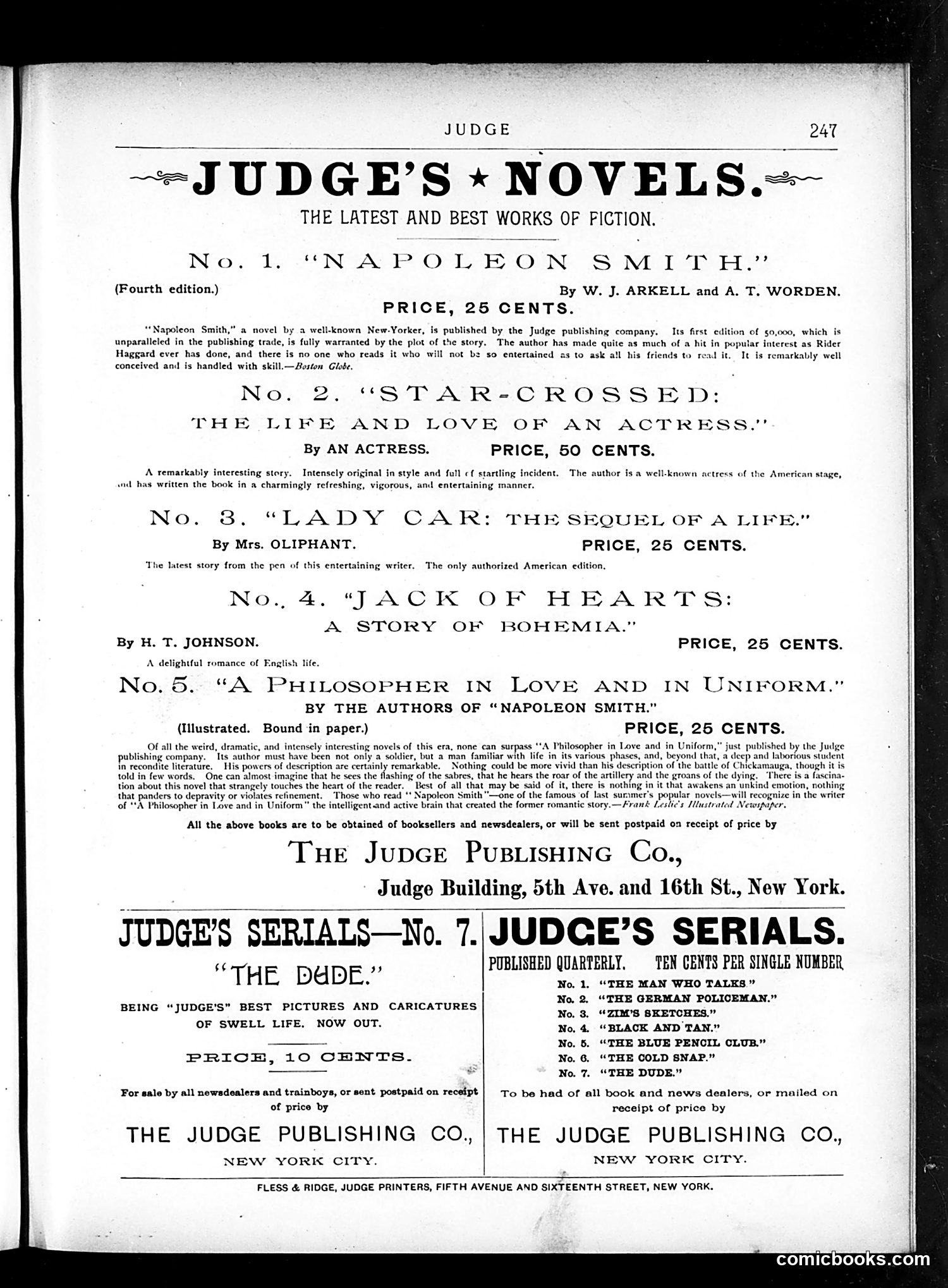
This is primarily an **advertising page**, not a satirical cartoon. It showcases Judge Publishing Company's offerings circa the 1880s-90s. The page advertises five serialized novels (priced 25-50 cents), emphasizing their popularity and literary merit through quoted praise. Notable titles include "Napoleon Smith" (in its fourth edition, apparently a bestseller) and works by established writers like Mrs. Oliphant. Below are advertisements for Judge's serial publications—"The Dude" (10 cents, featuring "pictures and caricatures of swell life") and numbered serials like "The German Policeman" and "The Blue Pencil Club." **The satire is implicit**: Judge, a satirical magazine, published both humorous serials mocking urban "swell" society and serious fiction. "The Dude" serial likely ridiculed fashionable, idle wealthy men—a common Judge target. The page positions entertainment and social commentary as complementary products for the same audience. No specific political figures are caricatured here; this is commercial promotion reflecting Judge's dual identity as satirist and publisher.
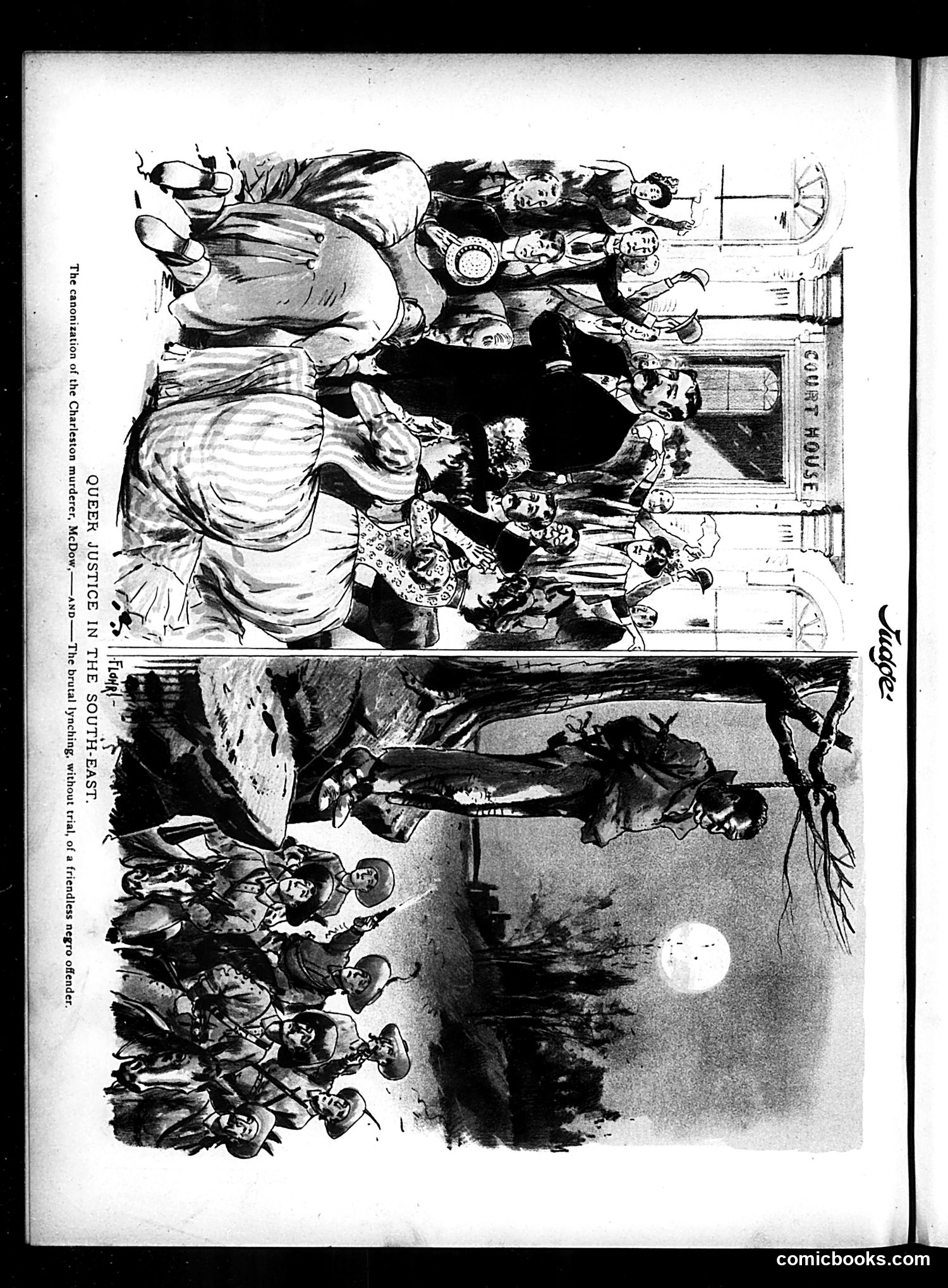
This Judge magazine page presents two contrasting scenes of Southern justice, satirizing the hypocrisy of the legal system. The top panel depicts "Queer Justice in the South-East," showing formal court proceedings where a Charleston murderer named McCDow apparently receives canonical (church-sanctioned) treatment—suggesting he's being celebrated or absolved despite his crime, likely due to social status or race. The bottom panel shows the "brutal lynching, without trial, of a friendless negro offender"—depicting mob violence against a Black person denied legal process. The satire's point is stark: the same system that protects white murderers through formal (if corrupt) justice condemns Black offenders to extrajudicial execution. This critiques the racist double standard in Southern criminal justice, where race determined whether one received a trial or a mob lynching.