
A complete issue · 20 pages · 1889
Judge — March 9, 1889
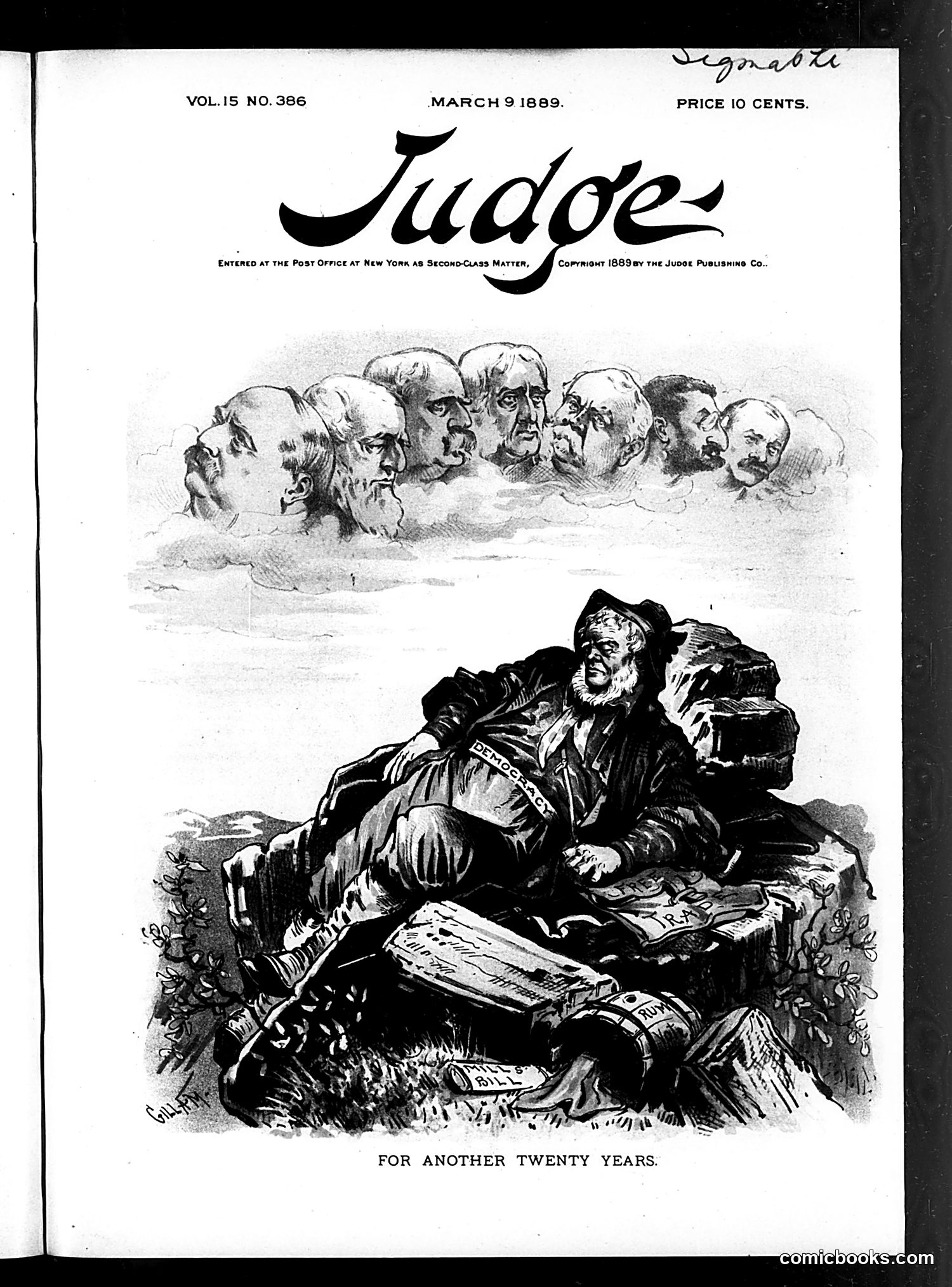
This political cartoon satirizes American political figures facing a long-term challenge. The top panel shows seven male heads in profile—likely prominent politicians or statesmen of the era. The bottom illustration depicts a bearded man (appearing to represent a political adversary or problem) sitting heavily laden with documents and burdens, captioned "FOR ANOTHER TWENTY YEARS." The satire suggests these political leaders must contend with a persistent, troublesome issue or opponent for an extended period. Without additional context identifying the specific figures or the exact political situation of March 1889, the precise target remains unclear, but the cartoon criticizes the apparent inability or unwillingness of these leaders to resolve a significant problem decisively.
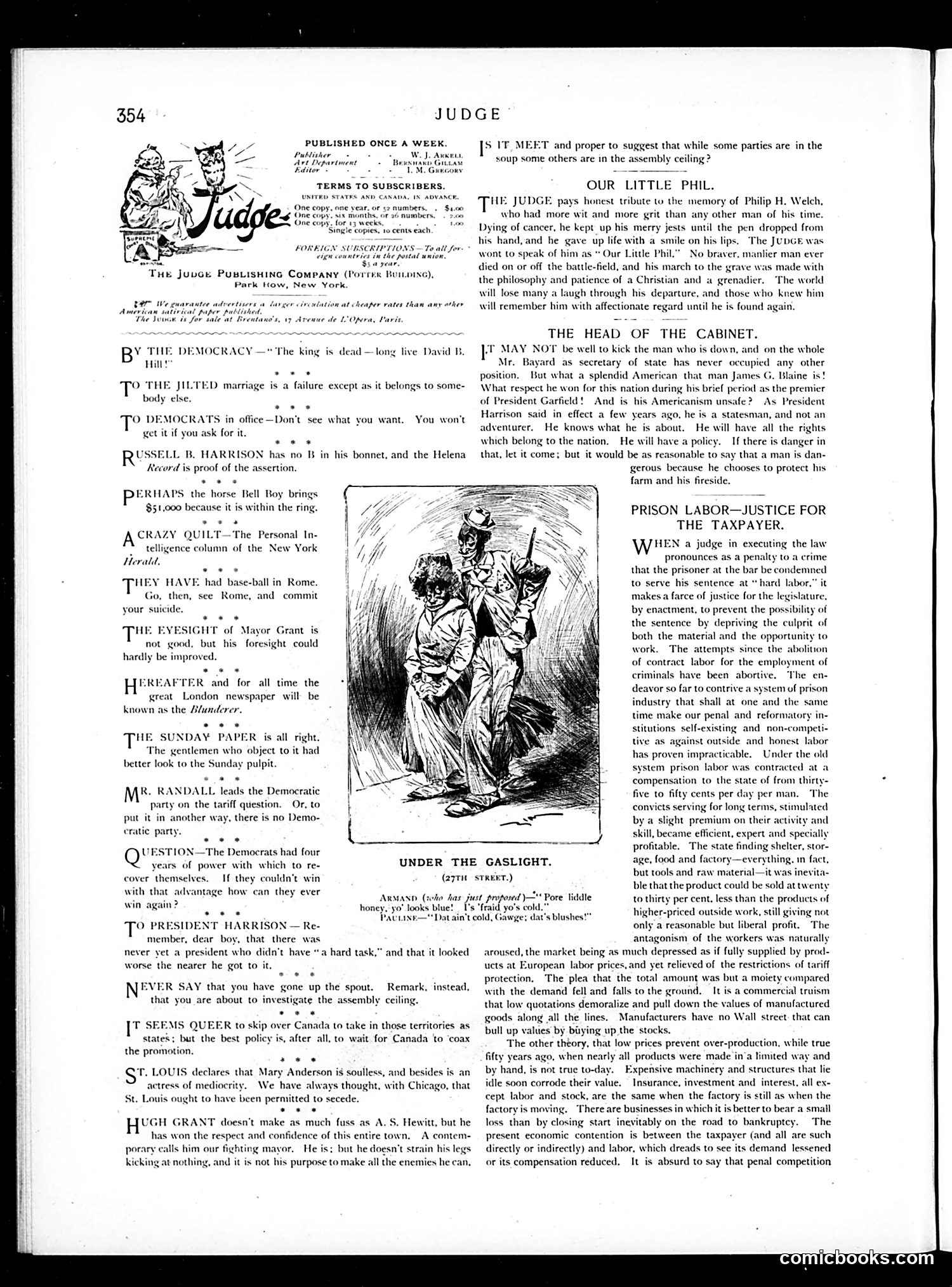
The main illustration depicts a dramatic scene titled "Under the Gaslight" (27th Street), showing figures in distress beneath a street lamp. The woman appears to be in danger while a man intervenes—likely referencing the popular 1867 melodrama "Under the Gaslight" by Augustin Daly, which featured a famous scene of a woman tied to railroad tracks. The cartoon likely satirizes contemporary urban danger or crime in New York City's 27th Street area. By evoking this famous theatrical scene, Judge magazine uses the melodramatic reference to comment on real-world urban perils—possibly commentary on crime, poverty, or public safety issues of the era. The surrounding editorial text discusses labor conditions and economic policy, suggesting the cartoon may relate to working-class vulnerability in industrial America.
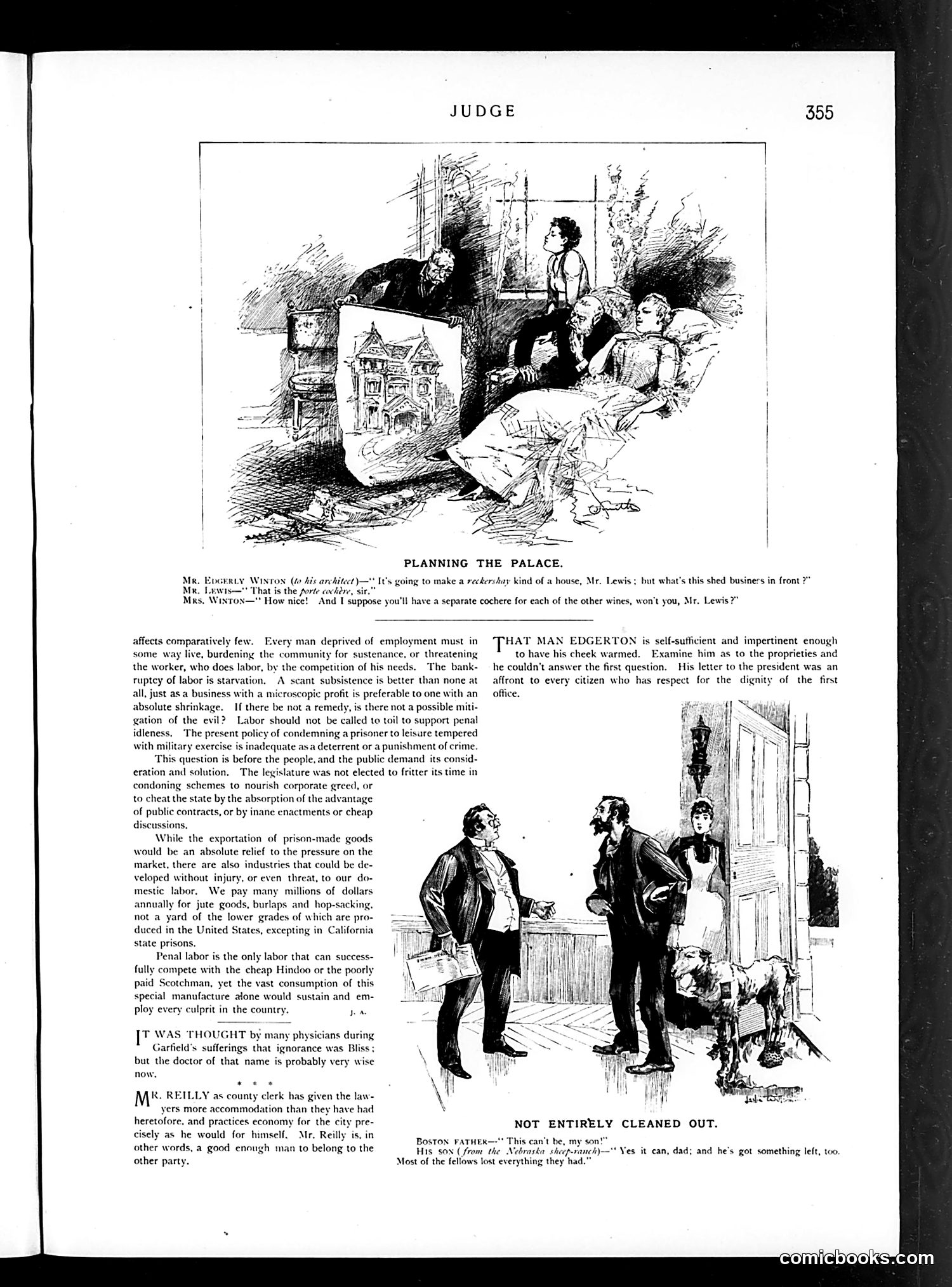
**"Planning the Palace"** satirizes wealthy nouveau riche pretension. Mr. and Mrs. Beverly Winton consult an architect about building an ostentatiously grand house, complete with separate carriage houses ("cocheres") for each of their wine collections. The joke mocks their absurd materialism and the architect's obsequious pandering to such excess. **"Not Entirely Cleaned Out"** depicts a Boston father confronting his son, recently returned from a Nebraska sheep ranch venture that failed catastrophically—the son lost everything like his peers. The humor lies in the son's shameless admission he still has "something left"—implying either hidden reserves or shameful conduct the father suspects. Together, these cartoons reflect *Judge*'s satirical targets: wealthy pretension and get-rich-quick schemes of the Gilded Age. The page also includes substantial editorial text criticizing prison labor policy and corrupt government contracting—typical *Judge* social commentary alongside visual satire.
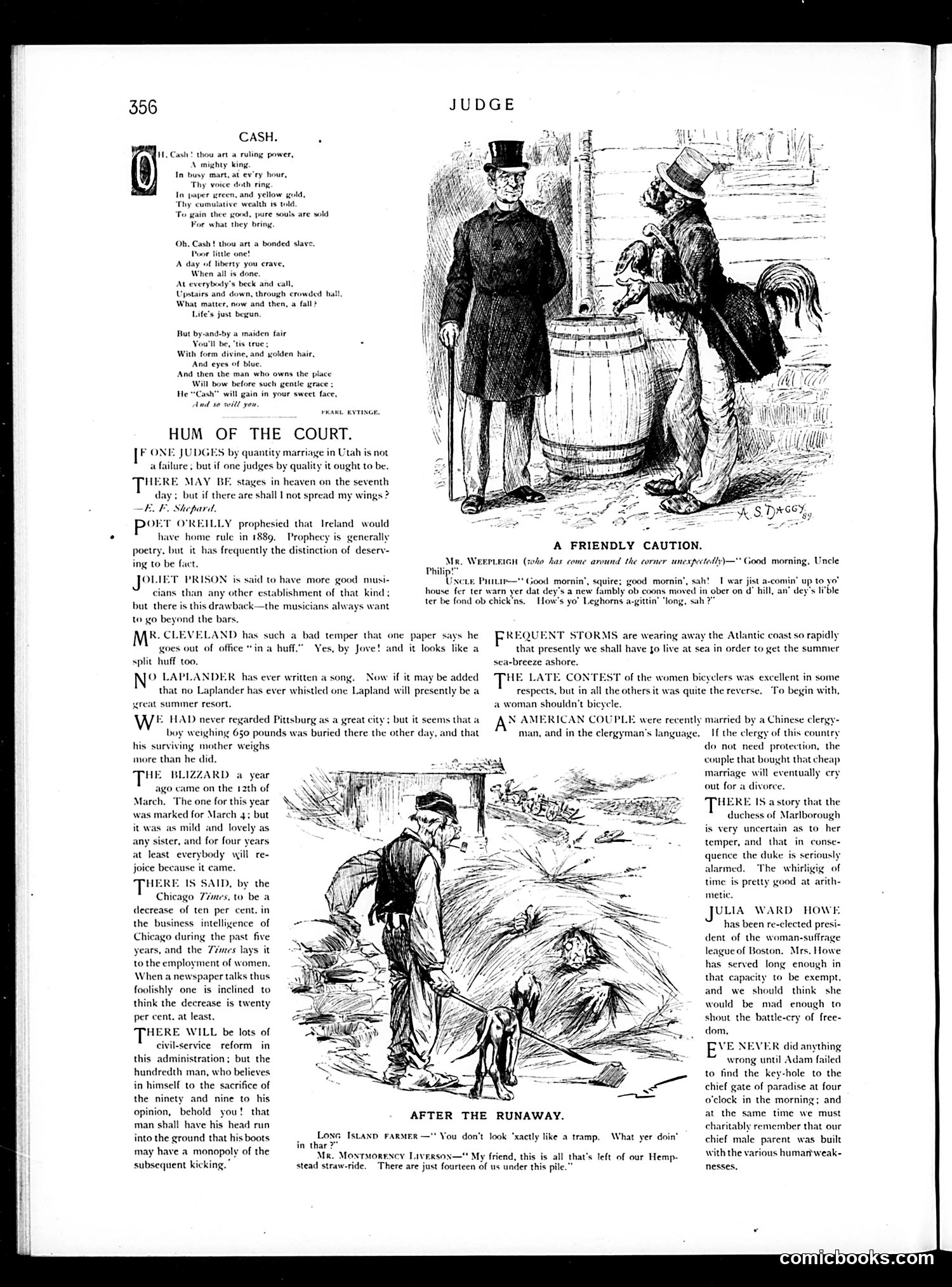
This page from Judge contains several satirical pieces targeting 1880s American social issues: **"Cash" Poem**: Personifies money as both a ruling power and enslaved servant, critiquing capitalism's corrupting influence on human morality. **"Hum of the Court"**: A collection of brief satirical jabs at contemporary figures and policies: - Mocks Utah's polygamous judges - References O'Reilly's failed prophecy about Irish home rule (1889) - Ridicules Chicago newspapers blaming women's employment for declining business intelligence - Attacks civil service reform as hypocritical - Jokes about Laplanders and prison musicians **Cartoons**: "A Friendly Caution" depicts a white man warning an African American about his new Black neighbors—racist stereotyping masked as friendly advice. "After the Runaway" shows aftermath of a social event gone wrong, with class undertones. The page exemplifies Judge's formula: mixing political commentary, social critique, and crude stereotypes typical of 1880s American humor.
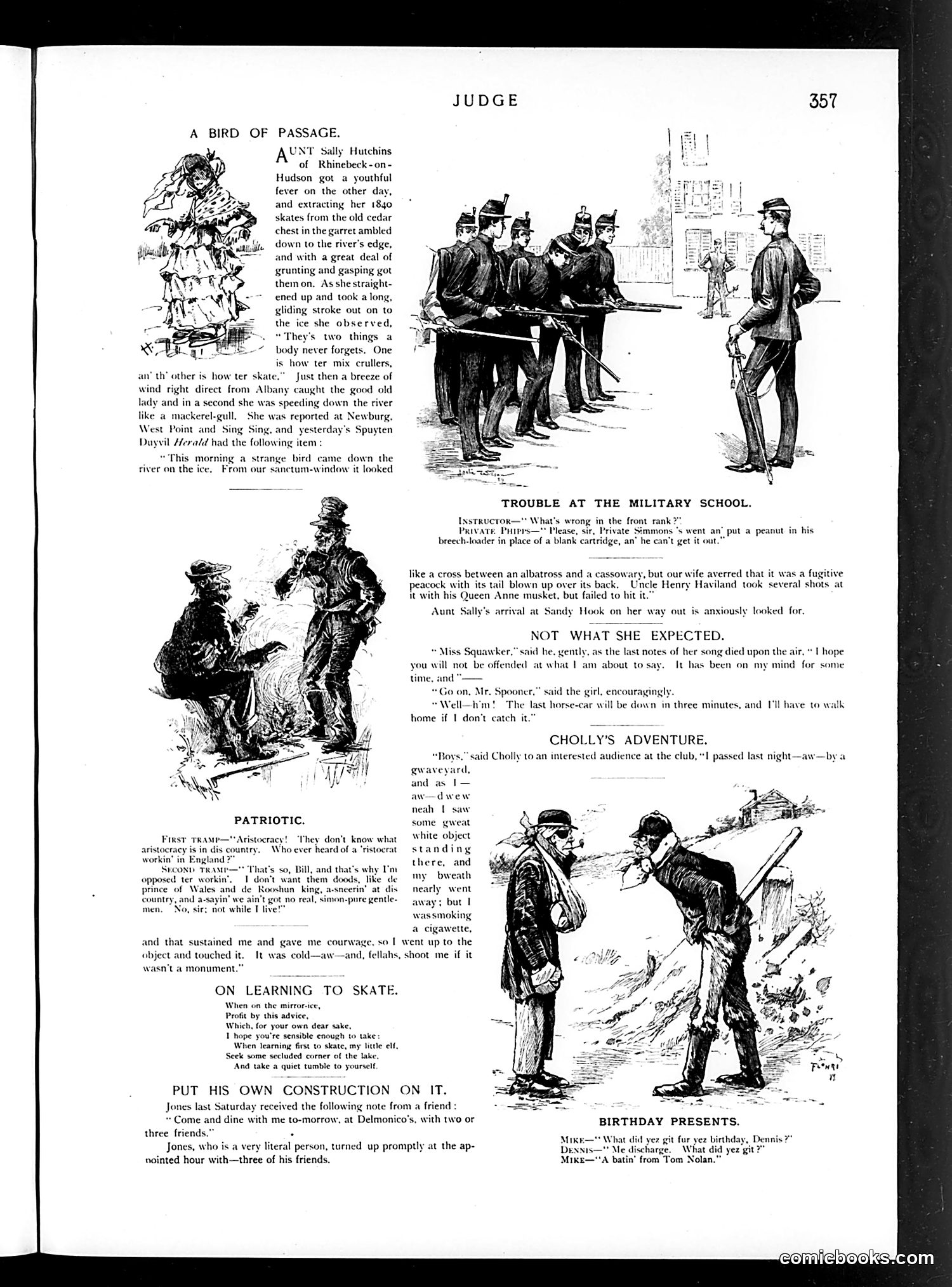
This page contains multiple satirical humor pieces typical of late-19th-century American magazine comedy: **"A Bird of Passage"** mocks elderly rural women through the story of Aunt Sally Hutchins, who retrieves 1840s ice skates and is blown uncontrollably down the Hudson River by wind—a slapstick scenario playing on outdated fashion and physical comedy. **"Trouble at the Military School"** jokes about soldiers' incompetence: a private accidentally loads a peanut into his rifle instead of ammunition and can't remove it. **"Not What She Expected"** uses a bait-and-switch: a man appears to compliment a singer but merely warns her to catch the last streetcar home—subverting romantic expectations. **"Cholly's Adventure"** features a upper-class character ("Cholly") whose affected speech ("gwaveyard," "bweath") marks him as pretentious while he recounts a supposedly thrilling graveyard encounter that turns out mundane. **"Patriotic"** and other brief pieces continue with simple situational humor. The overall tone reflects Judge's satirical approach: mocking rural speech, social climbers, military bungling, and class pretension through exaggerated anecdotes.
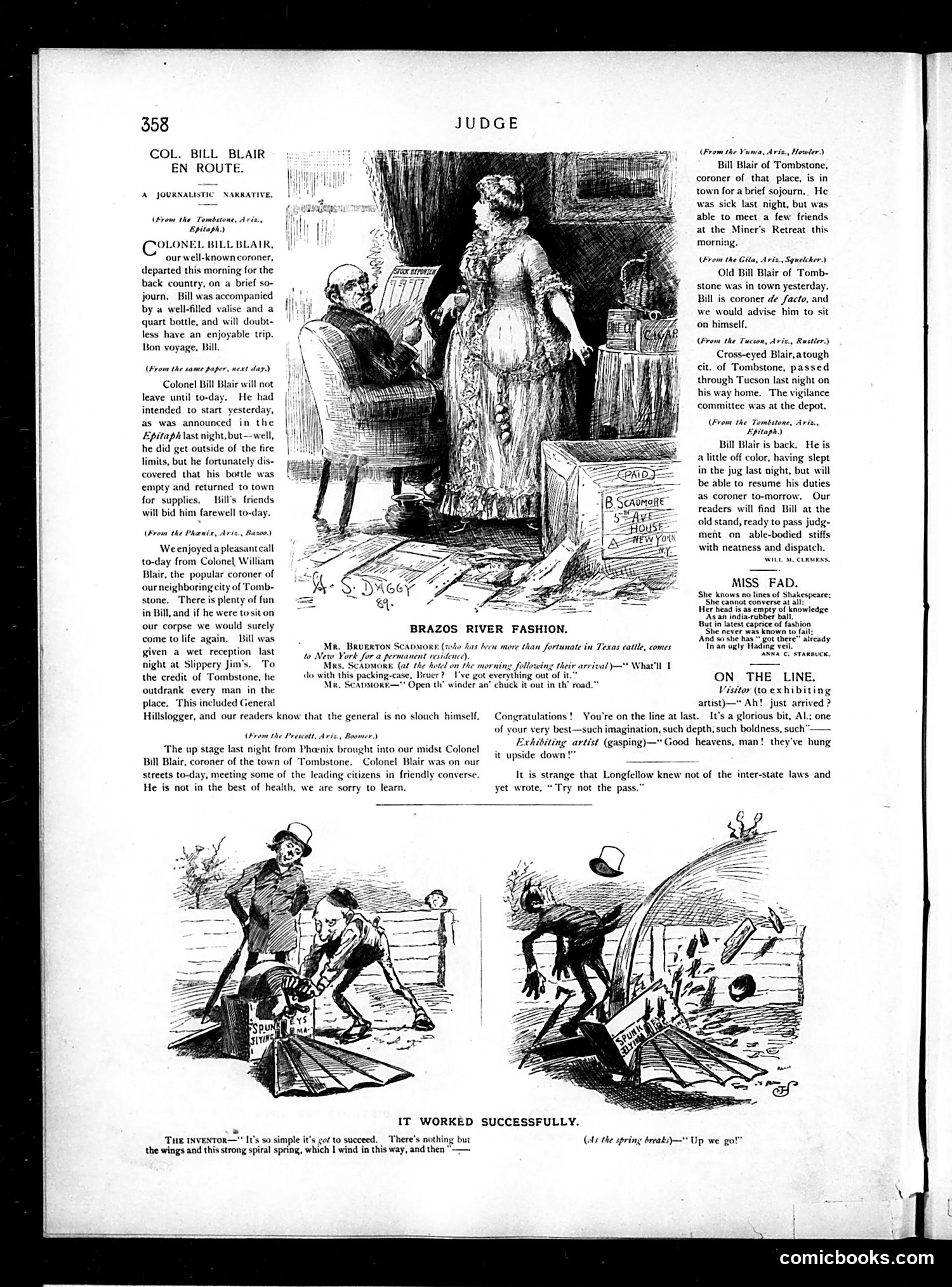
This page satirizes Colonel Bill Blair, a Tombstone, Arizona coroner, through a humorous montage of contradictory newspaper accounts from various Arizona towns. The joke: each paper reports different, increasingly unflattering versions of Blair's travels—he departs, returns for whiskey, arrives drunk, gets jailed overnight, yet somehow resumes his duties. The satire mocks both the subject (a hard-drinking frontier official) and frontier journalism itself, which apparently recycled the same gossip with embellished variations. The competing dispatches from Tombstone, Phoenix, Yuma, Tucson, and Prescott papers create absurdist humor through their conflicting narratives about one man's brief journey. Additional cartoons on the page—"Brazos River Fashion," "Miss Fad," "On the Line," and "It Worked Successfully"—are unrelated vignettes satirizing fashion, art world pretension, and a failed flying machine inventor. The overall tone is characteristic Judge material: ribald, frontier-focused satire aimed at 1880s readers.
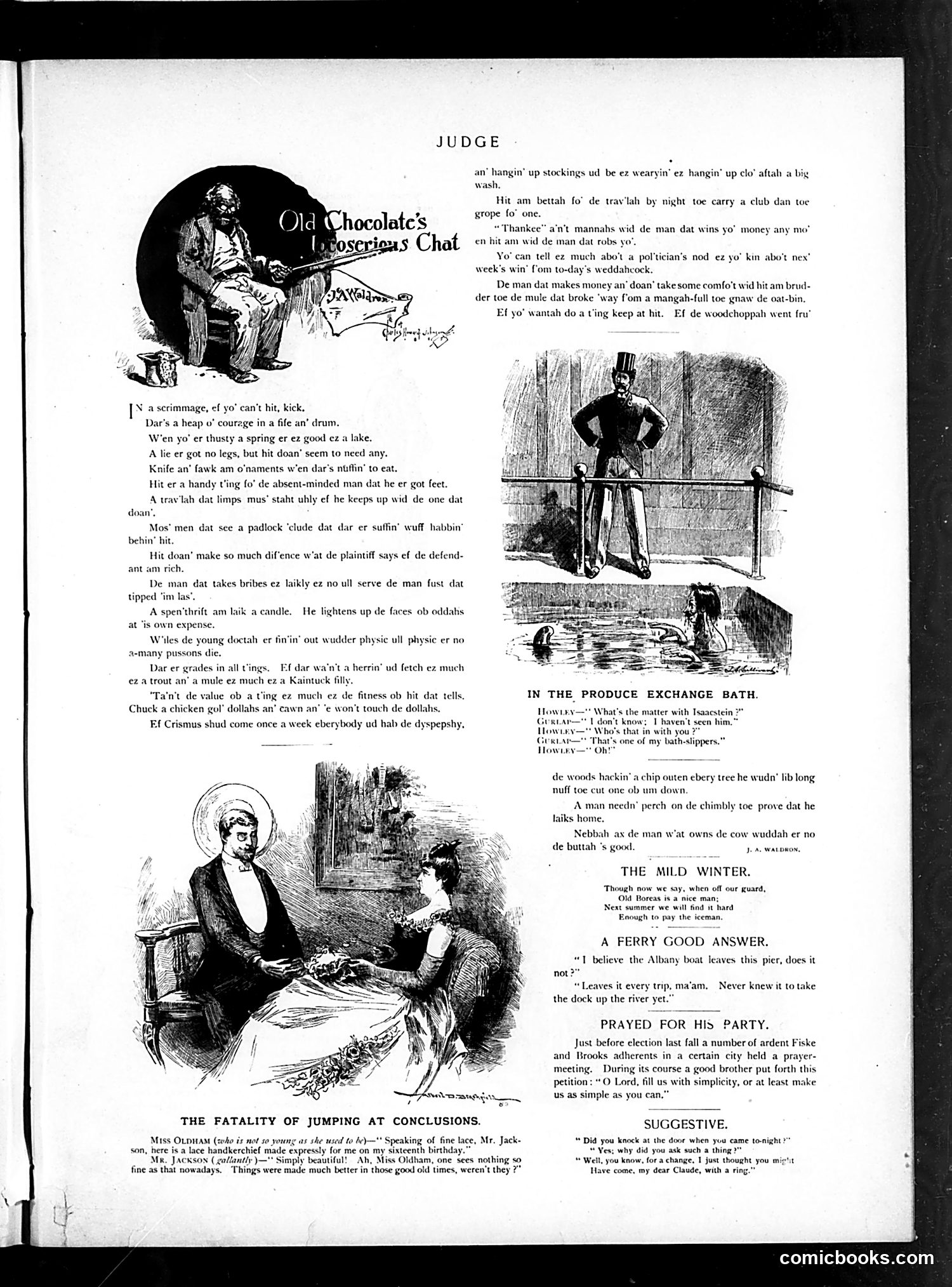
This page contains "Old Chocolate's Proverbs," a dialect-heavy humor column presented as folk wisdom from an African American character. The satirical commentary uses exaggerated Black dialect to offer cynical observations on human nature—politicians, lawyers, the rich, doctors, and domestic life. The accompanying cartoons illustrate related social commentary: "In the Produce Exchange Bath" jokes about mistaken identity; "The Fatality of Jumping at Conclusions" depicts a woman misinterpreting a compliment about old lace as implying she's aged; "A Ferry Good Answer" provides deadpan humor about ferry schedules. The content reflects period stereotyping common in late-19th-century American humor magazines, using exaggerated dialect as a comedic vehicle. While the observations occasionally contain genuine social critique (corruption, wealth inequality), the presentation relies heavily on racial caricature typical of Judge's era.
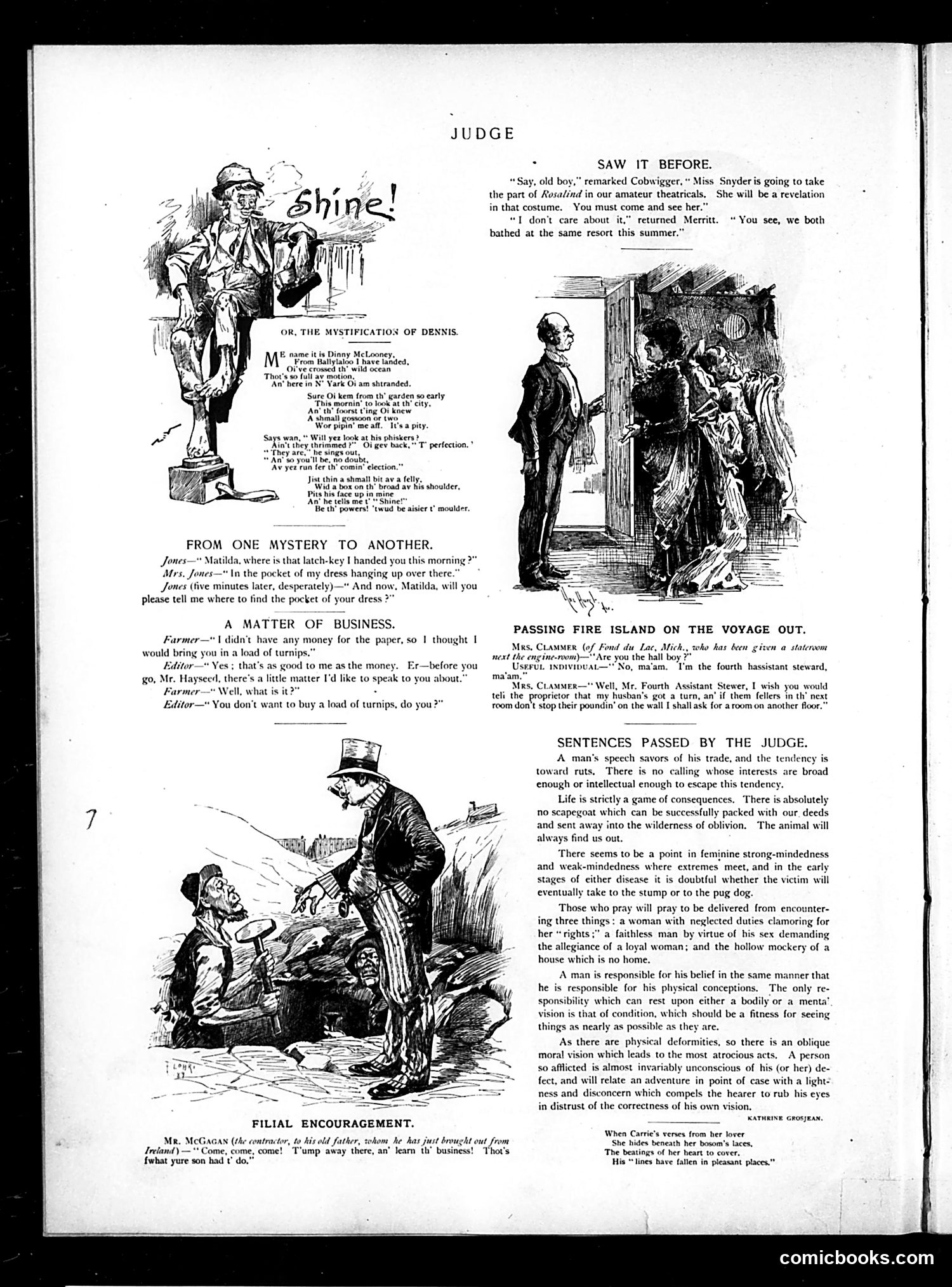
This page from the satirical magazine *Judge* contains multiple short humorous pieces mocking everyday social situations and character types. The cartoons ridicule: 1. **"Shine!"** - A street urchin shoe-shiner, depicted with exaggerated features typical of period working-class stereotypes. 2. **"The Mystification of Dennis"** - A comic poem about an Irish immigrant ("Dinny McLooney") confused by American city life and street children, using heavy Irish dialect for comedic effect—reflecting contemporary immigrant humor common in American magazines. 3. **Various brief comedic scenarios** including domestic mishaps (lost pocket in dress), class awkwardness (a Midwestern passenger annoying ship staff), and business transactions. 4. **"Sentences Passed by the Judge"** - Philosophical observations on human nature, morality, and social pretense, written in Judge's characteristic moralizing tone. The humor relies on contemporary social anxieties: marital confusion, class differences, immigrant confusion, and urbanization. The Irish dialect humor particularly reflects late 19th/early 20th-century American attitudes toward Irish immigrants.

I can see this is a page from *Judge* magazine, but the image shows an almost entirely blank white page with only minimal marks and the "comicbooks.com" watermark visible at the bottom right. There is no discernible cartoon, illustration, text content, or satirical material that I can read or analyze. This appears to be either a blank page, a title page, or an advertising page from the magazine. Without visible content—whether cartoon, caricature, political reference, or joke—I cannot identify figures, explain satire, or provide historical context for a modern reader. If you have a different page from *Judge* with visible content, I'd be happy to analyze that instead.
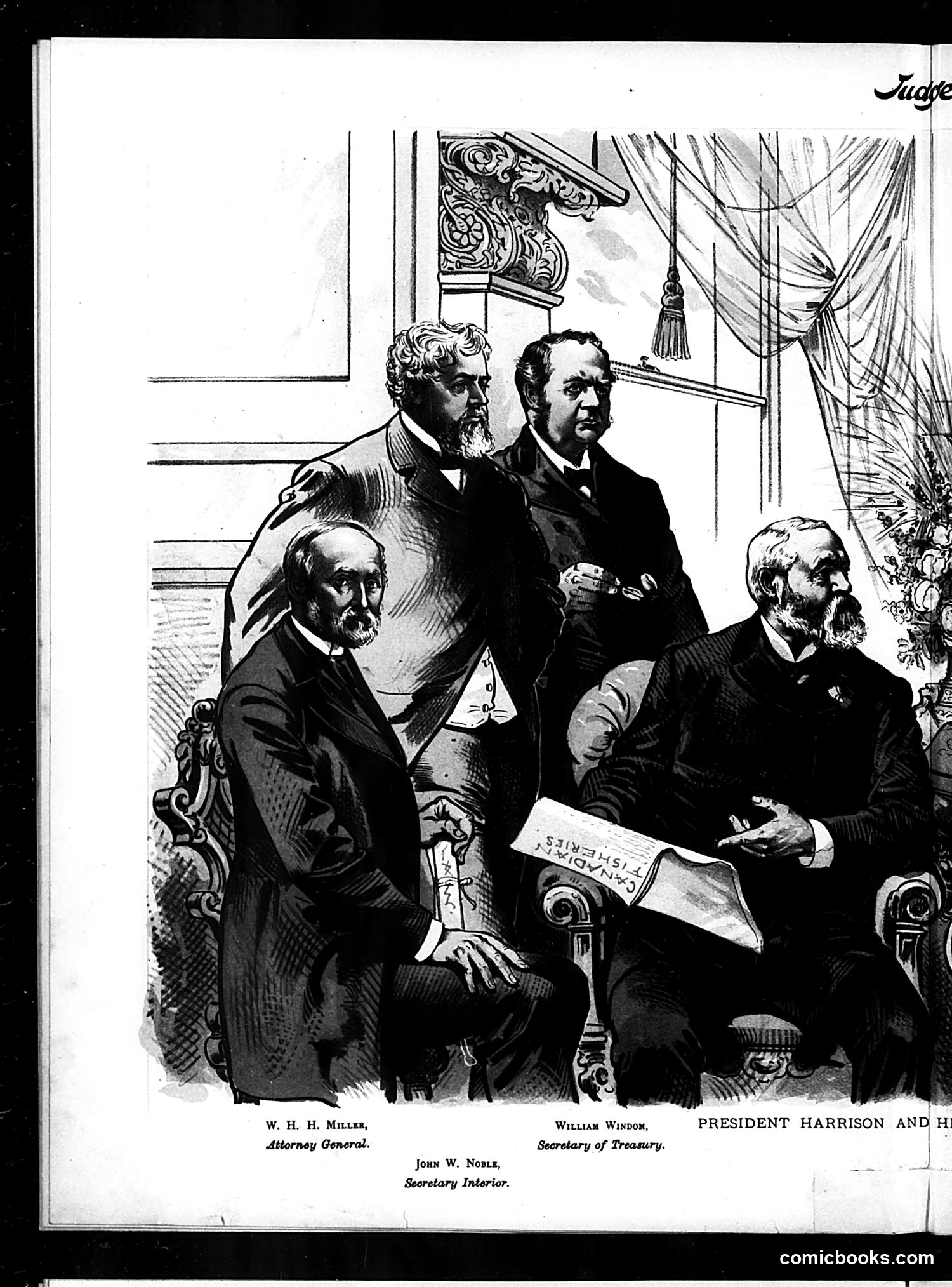
This engraving depicts President Harrison with three members of his cabinet: W.H.H. Miller (Attorney General), William Windom (Secretary of Treasury), and John W. Noble (Secretary of Interior). The formal interior setting with elegant furnishings suggests an official government scene. Without the full caption or surrounding context, the specific satirical point remains unclear. However, Judge typically mocked government incompetence, political favoritism, or policy failures. The composed poses and formal dress suggest these officials are being presented ironically—possibly critiquing their qualifications, decisions, or roles in Harrison's administration (1889-1893). The partial text cut-off at the bottom likely contained the actual satirical commentary that would explain the cartoon's intended criticism.
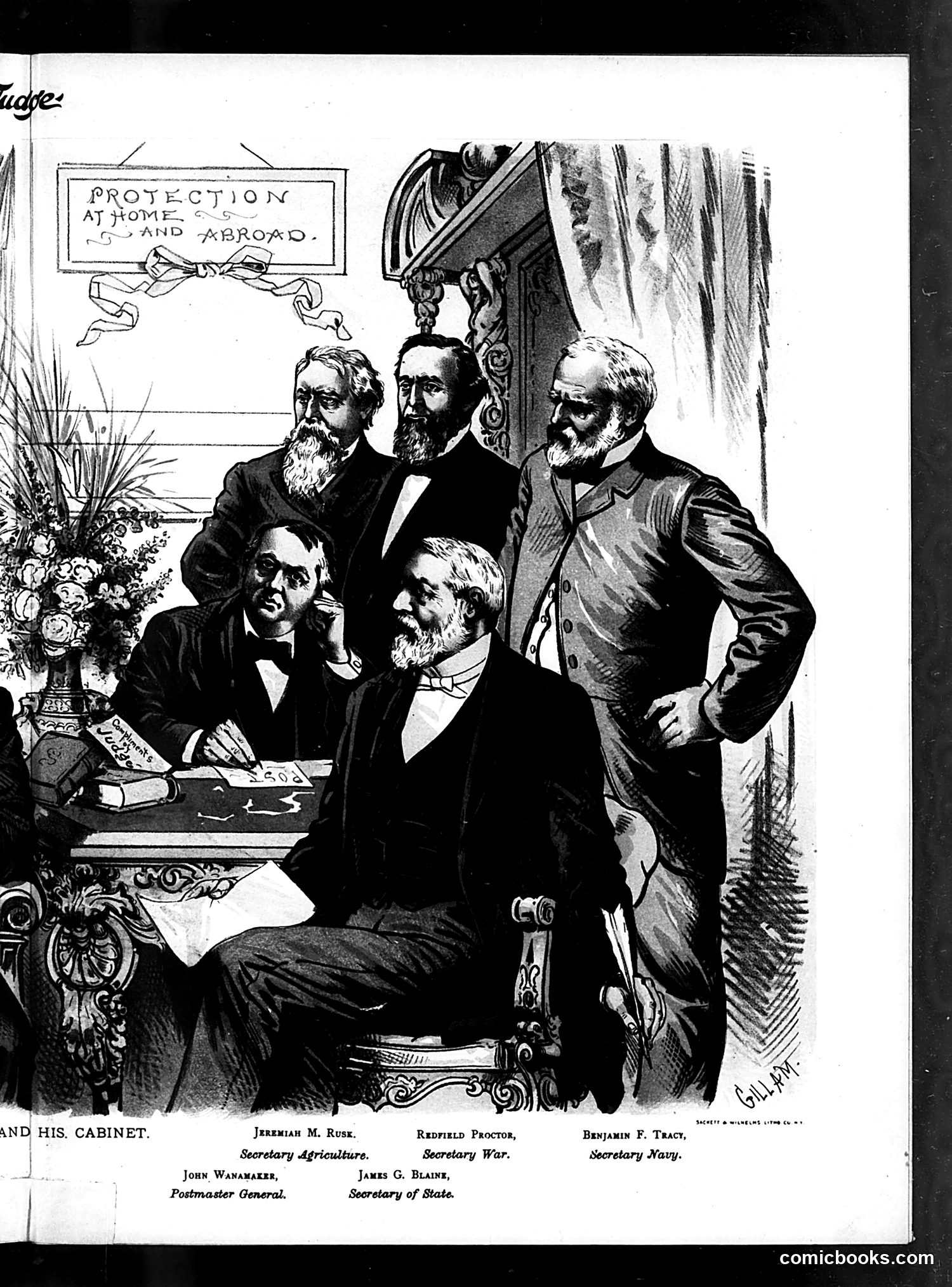
This political cartoon depicts a presidential cabinet, labeled "Projection at Home and Abroad." The five identified officials are: - **Jeremiah M. Rusk** (Secretary of Agriculture) - **Redfield Proctor** (Secretary of War) - **Benjamin F. Tracy** (Secretary of Navy) - **John Wanamaker** (Postmaster General) - **James G. Blaine** (Secretary of State) The satire's title suggests criticism of the administration's domestic and foreign policy "projections" or ambitions. The ornate, formal setting—with flowers and decorative furnishings—contrasts with the serious subject matter, likely mocking the cabinet's pretensions or incompetence. Without the magazine's date visible, the specific policies being satirized remain unclear, though the combination of War and Navy secretaries suggests military or expansionist concerns typical of 1880s-90s American politics.

This page appears to be nearly blank or contains only minimal OCR artifacts (scattered letters and numbers with no coherent meaning). The image shows what looks like a mostly empty page from Judge magazine with only a border frame visible and some faint marks that don't form legible text or clear imagery. Without readable content, cartoons, captions, or advertisements visible on this page, I cannot identify any political figures, social references, or satirical points. This may be a blank page, a title page, or a page where the original content has faded or failed to scan properly. To analyze the cartoon's meaning, a clearer image or legible text would be needed.
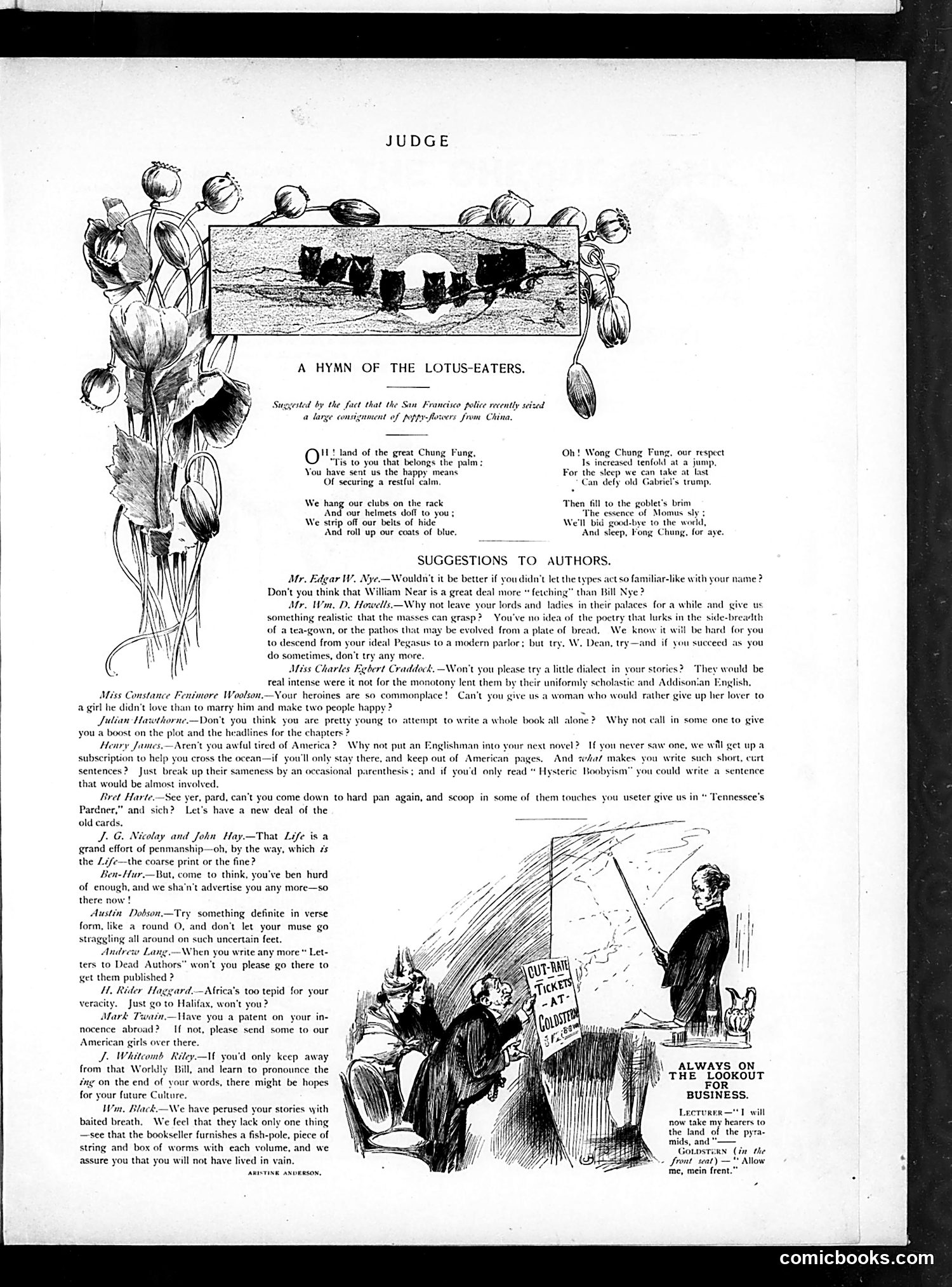
This page satirizes two separate topics: **"A Hymn of the Lotus-Eaters"** (top): References a San Francisco police seizure of opium-containing poppy flowers from China. The poem mockingly celebrates drug use, personifying "Chung Fung" (a Chinese name) as a supplier. "Lotus-eaters" alludes to Homer's *Odyssey*—those who consumed lotus flowers and abandoned all ambition. The satire attacks Chinese immigration and the opium trade crisis affecting American cities, framing drug addiction as a surrender of civic duty (hanging up clubs, removing helmets and belts—symbols of masculine authority). **"Suggestions to Authors"** (bottom): Judge editors humorously critique popular American writers of the era (Edgar W. Nye, William Dean Howells, Bret Harte, etc.), offering tongue-in-cheek "advice" that's actually insulting—mocking their formulaic plots, affected styles, and worn-out themes. The accompanying cartoon shows desperate authors peddling their work to publishers, satirizing the commercial publishing industry's relentless demand for content.
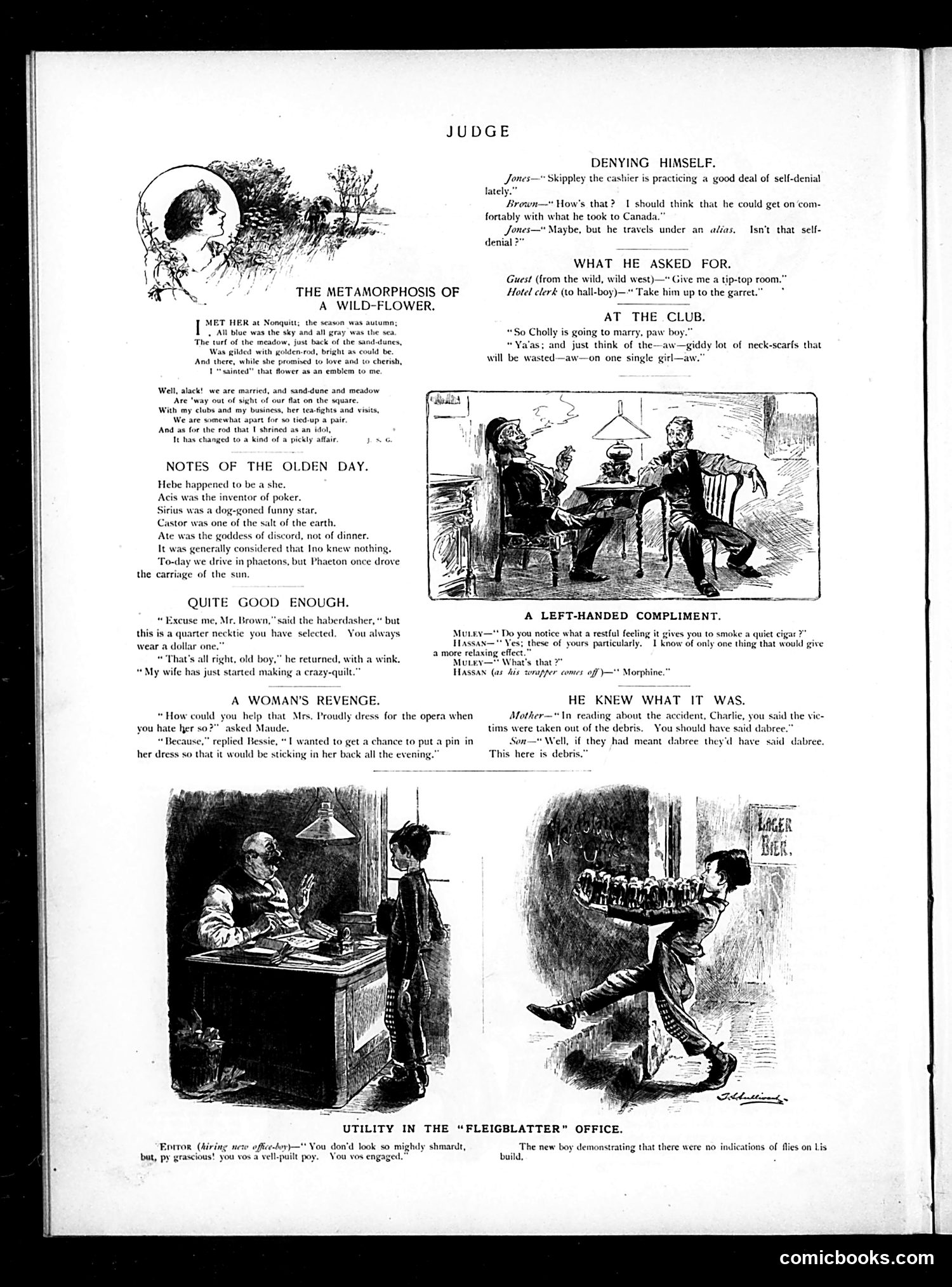
This page collects brief satirical vignettes typical of Judge's humor: **"Denying Himself"** jokes about a cashier who embezzled money to Canada—his "self-denial" is ironic since he left with stolen funds. **"The Metamorphosis of a Wild-Flower"** uses floral metaphor to satirize marriage's disappointment: a man idealizes his bride as a beautiful wildflower, but married life transforms her into something prickly and unpleasant. **"At the Club"** mocks wealthy idlers ("Cholly") complaining about wasting neckties on a single bride—satirizing both nouveau riche wastefulness and frivolous concerns. **"Utility in the Fleigblatter Office"** features ethnic humor (German-accented editor) praising the new office boy's usefulness, concluding he has "no indications of flies on his build"—crude physical comedy. The remaining items are standard short joke formats covering topics like hotel service, morphine addiction, and verbal mishaps. The page exemplifies Judge's mix of social satire, domestic humor, and period comedy conventions now largely obscure.
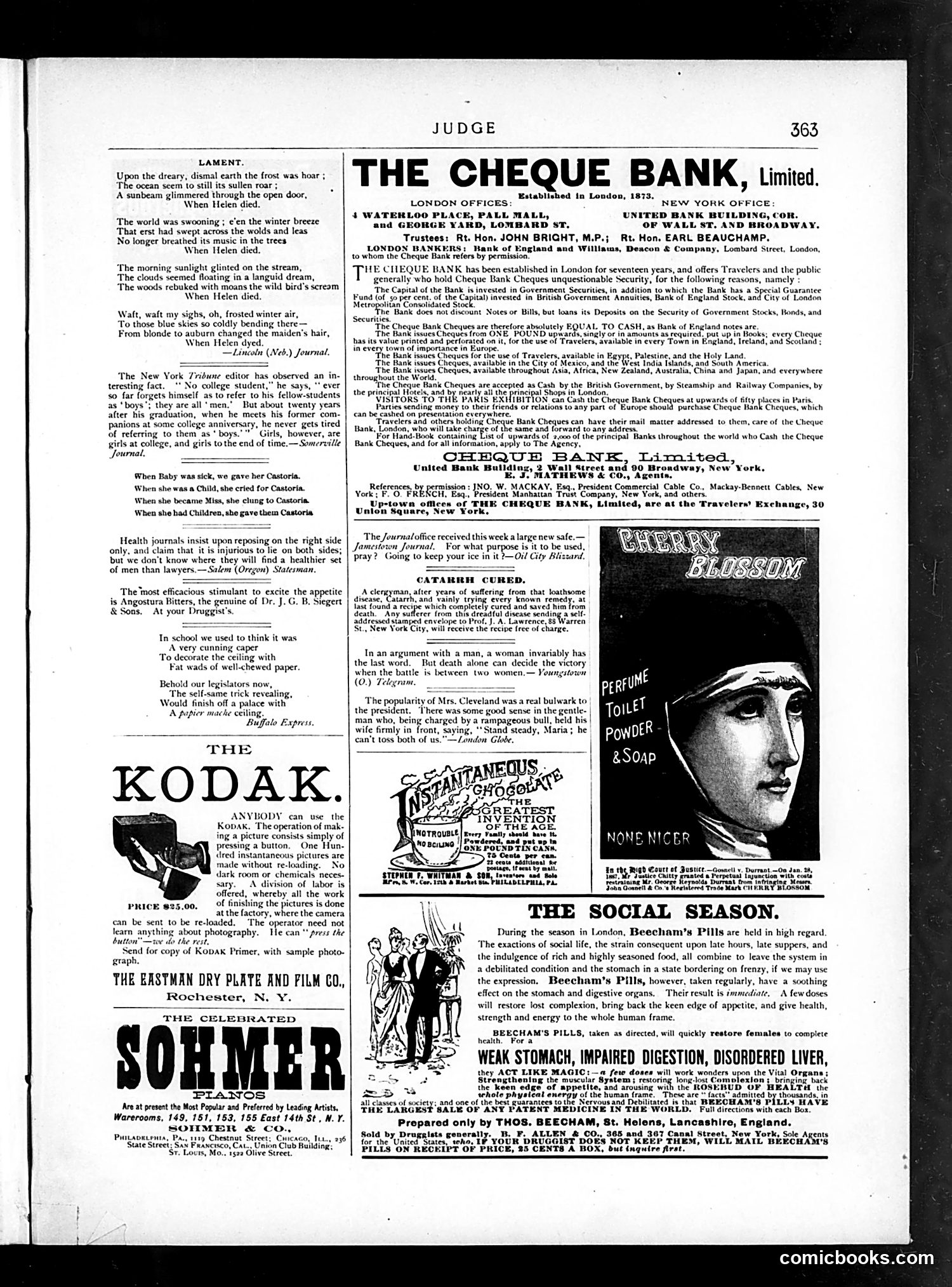
This page is primarily **advertising and filler content**, not political satire. The main elements include: **Poetry Section ("Lament"):** A humorous poem playing on the double meaning of "Helen died" versus "Helen dyed" (changed hair color)—a pun on homophones. **Advertisements:** The page features multiple commercial ads for: - The Cheque Bank (a traveler's check service established 1873) - Kodak cameras (emphasizing ease of use: "press the button—we do the rest") - Sohmer pianos - Various patent medicines and toiletries **Editorial Filler:** Short reprinted quips from other newspapers about college traditions, lawyer health, and legislative inefficiency. **No significant political cartoon or satire appears on this page.** It represents Judge magazine's mixed content model: satirical articles elsewhere, but also substantial advertising revenue and light humor to fill space. The "Instantaneous Chocolate" and "Home Nicer" product ads visible are period patent medicine marketing typical of 1880s publications.
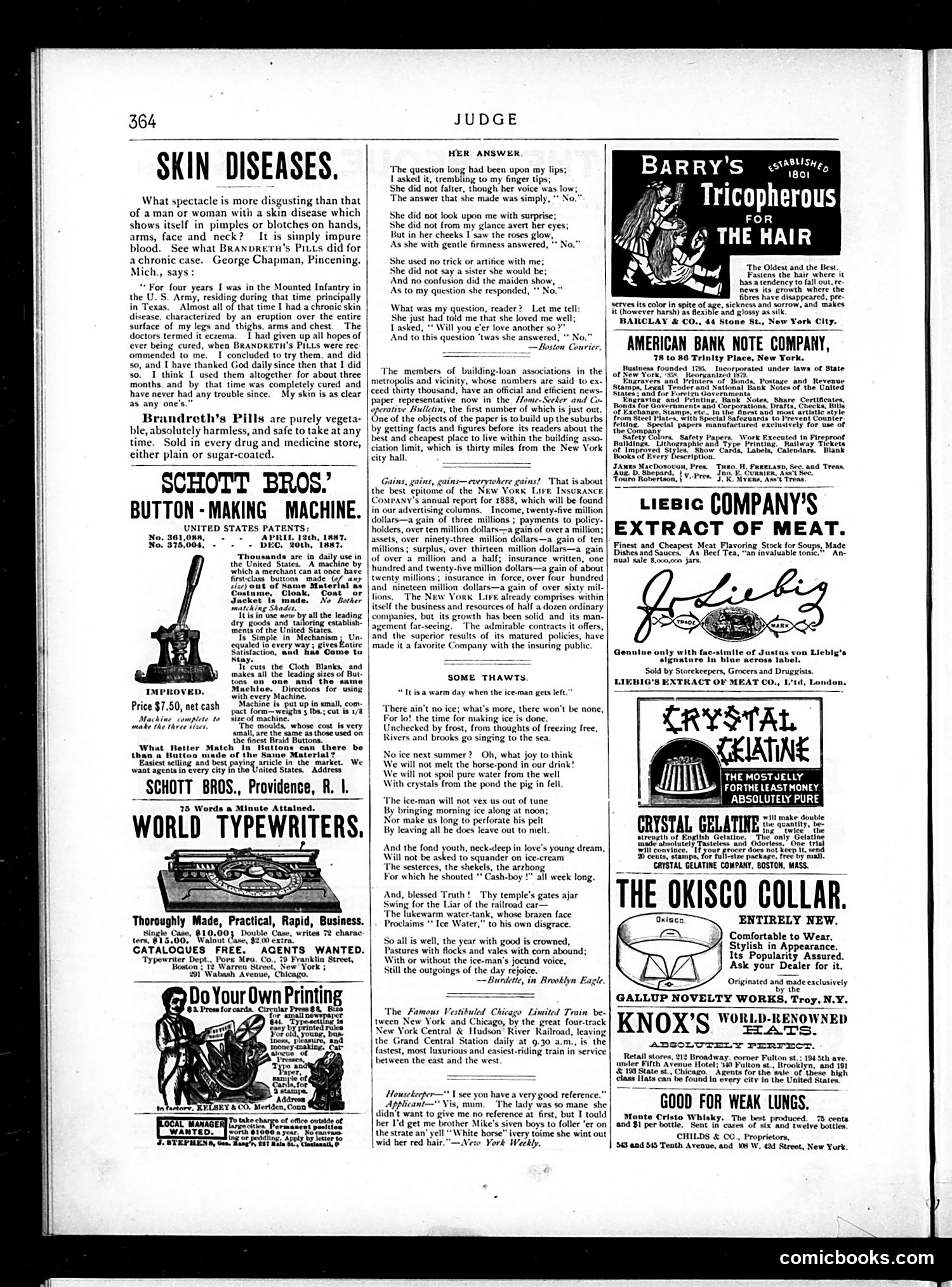
This page is primarily **advertisements and commercial content** rather than political satire. The main text elements are: **"Her Answer"** (a short romantic poem): A man asks his beloved if she'll ever love another as much as him. She answers "No"—a clever reversal where her refusal to promise eternal love becomes reassurance of her current devotion. **Advertisements** dominate the page, promoting: - Brandreth's Pills (for skin diseases) - Schott Bros.' button-making machine - World typewriters - Printing equipment The **Barry's Tricopherous** hair product advertisement features an illustration of a woman with long, flowing hair. The page reflects **late 19th-century consumer culture**, showing everyday products marketed to middle-class Americans. The romantic verse provides light entertainment between commercial pitches. There is **no visible political cartoon or satire** on this particular page—it appears to be filler content typical of Judge's advertising-heavy pages.
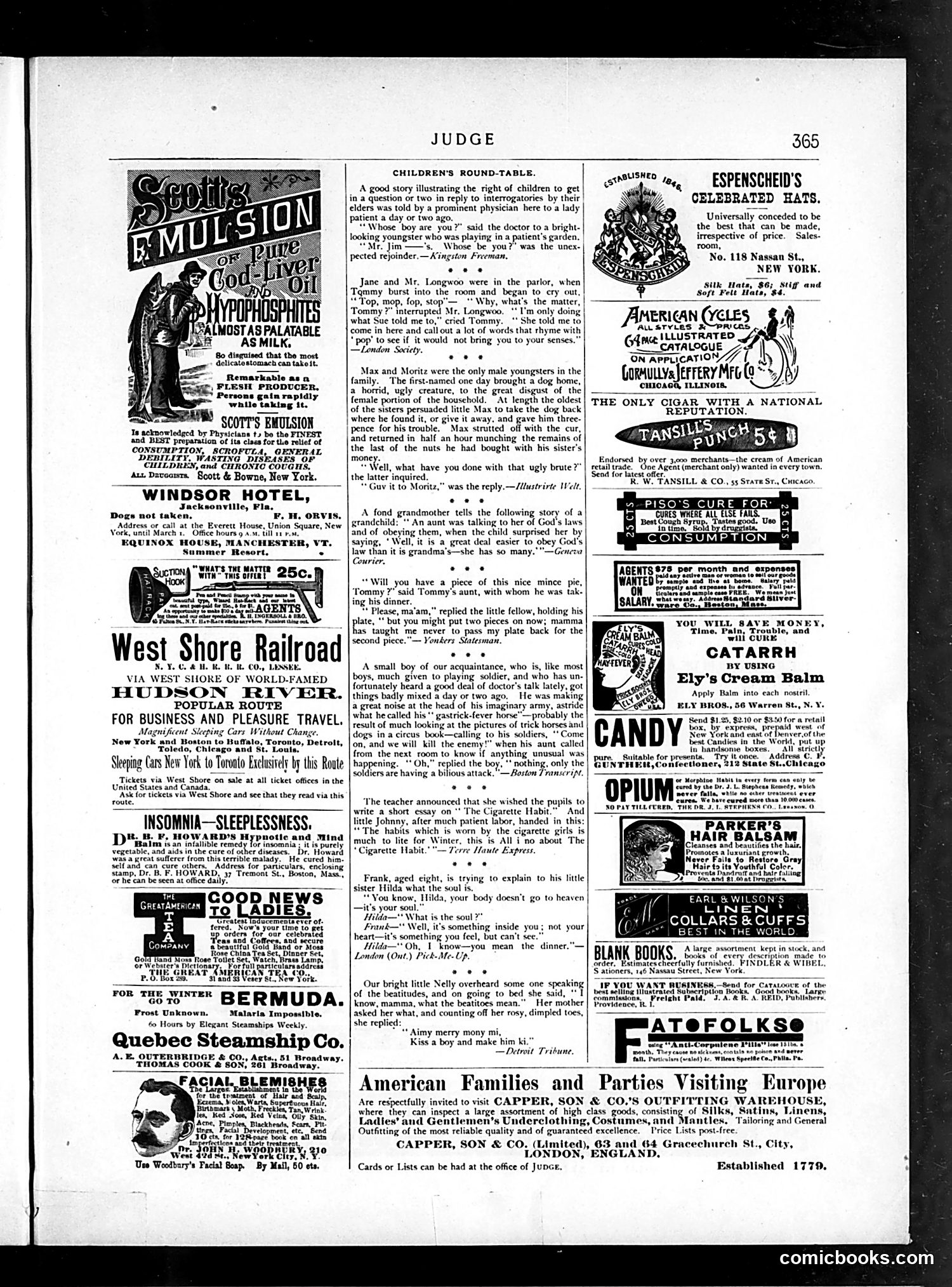
This page is primarily **advertisements and filler content** rather than political satire or comics. The dominant content includes: **Advertisements:** Scott's Emulsion (cod liver oil product), West Shore Railroad, insomnia remedies, steamship lines, and various patent medicines—typical of late 19th-century magazines. **"Children's Round-Table" Section:** The only substantive editorial content consists of brief, gentle humorous anecdotes about children's behavior—not political satire. Examples include a child's cheeky response to a doctor asking "Whose boy are you?" and a story about siblings with a dog. These are wholesome family humor pieces. **No Political Content:** Unlike typical Judge satirical pages, this contains no identifiable political figures, social commentary, or biting satire. This appears to be a filler page emphasizing **commercial revenue** through advertising rather than Judge's usual satirical mission.
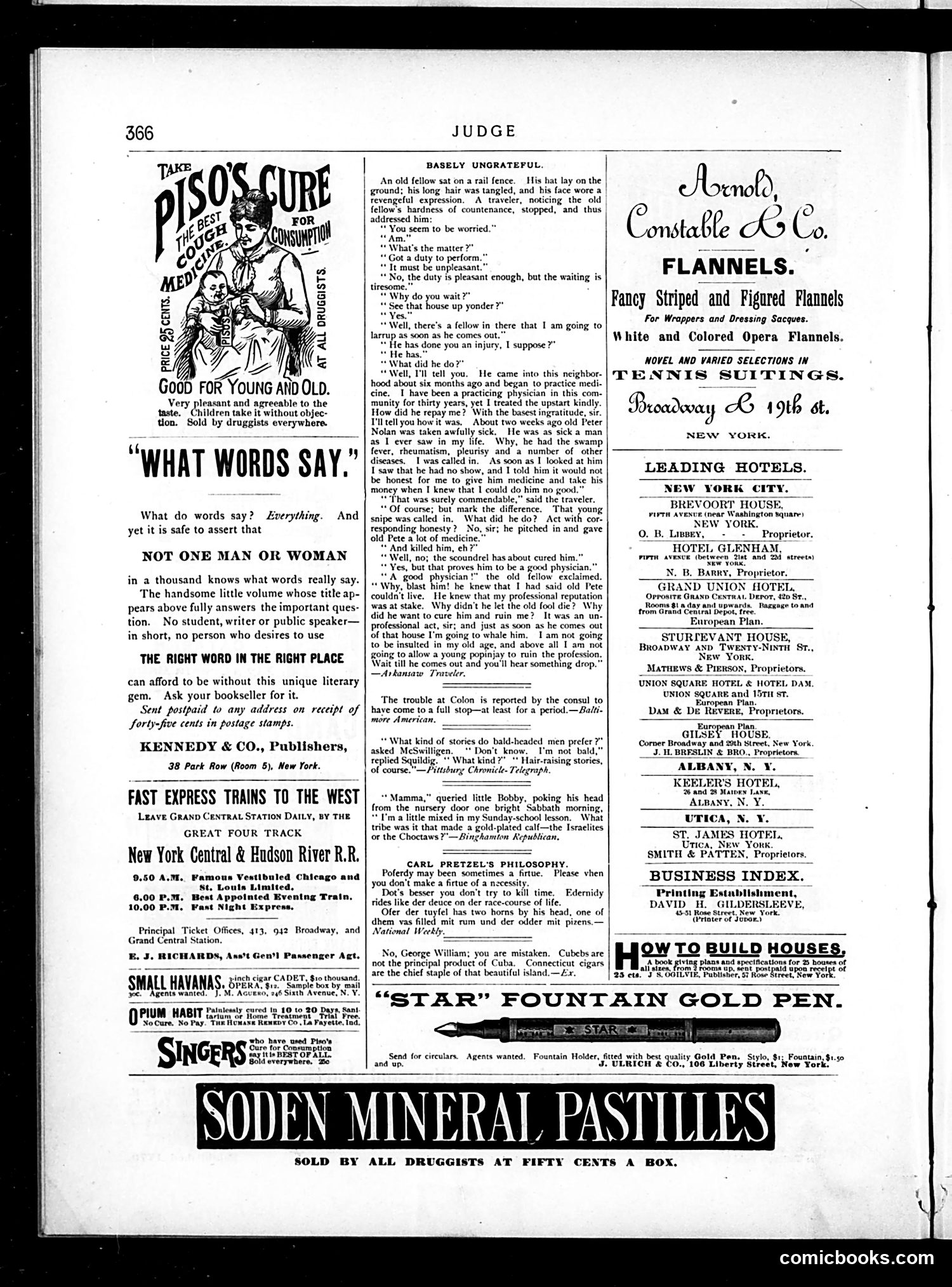
This is a satirical story (not a cartoon) mocking medical competition and professional jealousy in the late 19th/early 20th century. **The Setup:** An old country physician plans to beat up a younger doctor who has recently moved into his community. **The Satire:** The older doctor is angry because the young newcomer *cured* his patient—a man the established physician had declared hopeless. The punchline of the satire is that the old doctor considers this *unethical and professionally ruinous*. He views the young doctor's success as ingratitude and an insult to his reputation, not as a positive medical outcome. **What it means:** Judge is satirizing the closed-minded resistance of established professionals to competition and innovation. The story ridicules physicians more interested in protecting their monopoly and status than in actually healing patients. The old doctor's rage at being upstaged—rather than joy at his patient surviving—exposes the mercenary and ego-driven nature of some practitioners. This reflects real tension in early American medicine between older practitioners and trained newcomers.
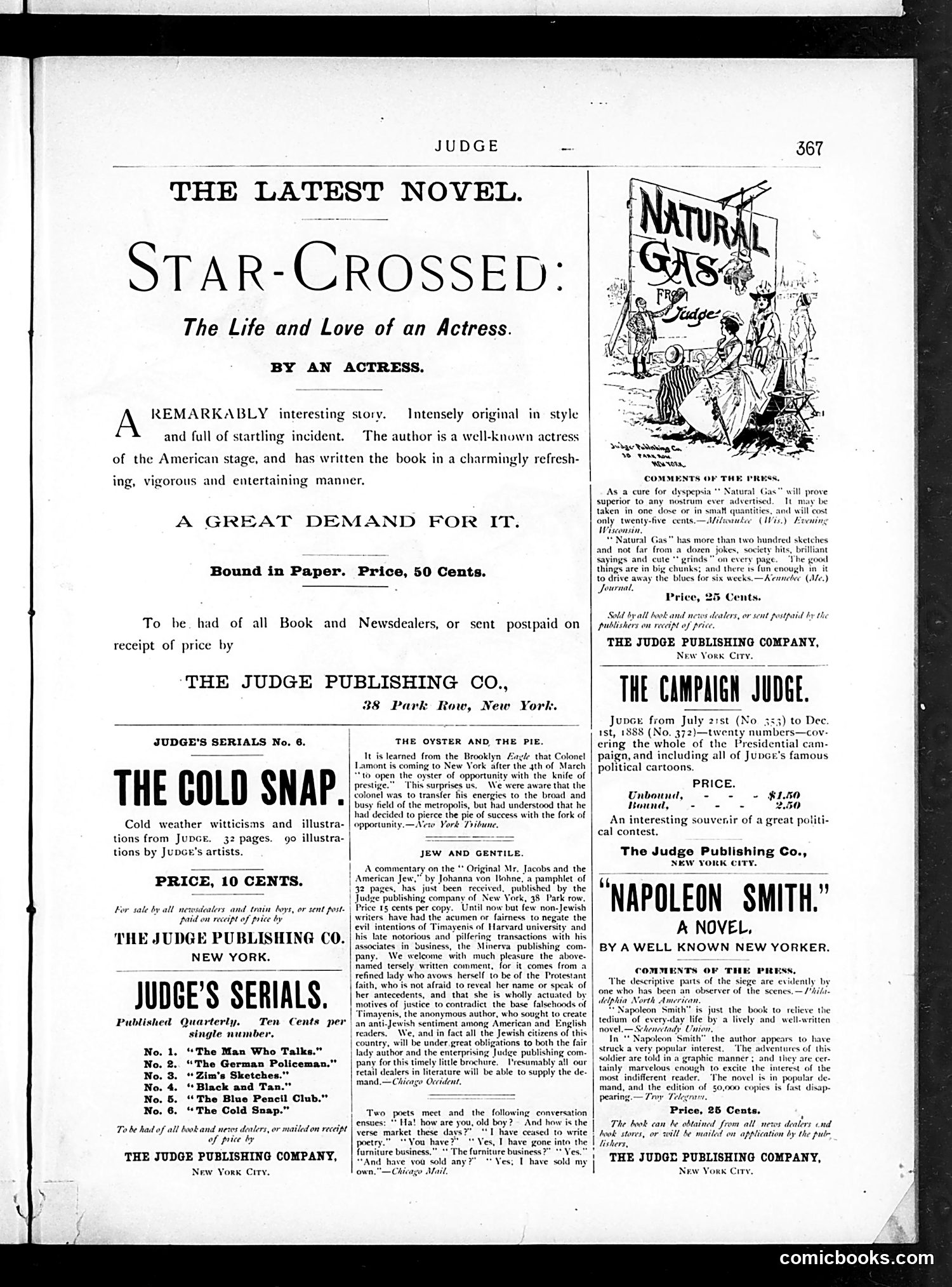
This page is primarily an **advertising section** for Judge Publishing Company's books and serials, not a political cartoon page. The main content advertises: 1. **"Star-Crossed: The Life and Love of an Actress"** — a novel by an unnamed American actress, promoted as "remarkably interesting" and "intensely original." 2. **Judge's Serials** — including "The Cold Snap" (winter humor) and other titles like "The Man Who Talks" and "The German Policeman." 3. **"Natural Gas"** — a humor collection (25 cents). 4. **"Napoleon Smith"** — a novel by an unnamed New Yorker. The page includes brief press comments praising these publications. A small cartoon appears showing "Natural Gas" but is too unclear to interpret specifically. There's also a brief commentary on **"Jew and Gentile,"** praising a pamphlet by Johanna von Mohne for fairly addressing antisemitic falsehoods—notable for acknowledging a Protestant woman defending Jewish citizens against libel. Overall, this is a **book catalogue page**, not satirical content.
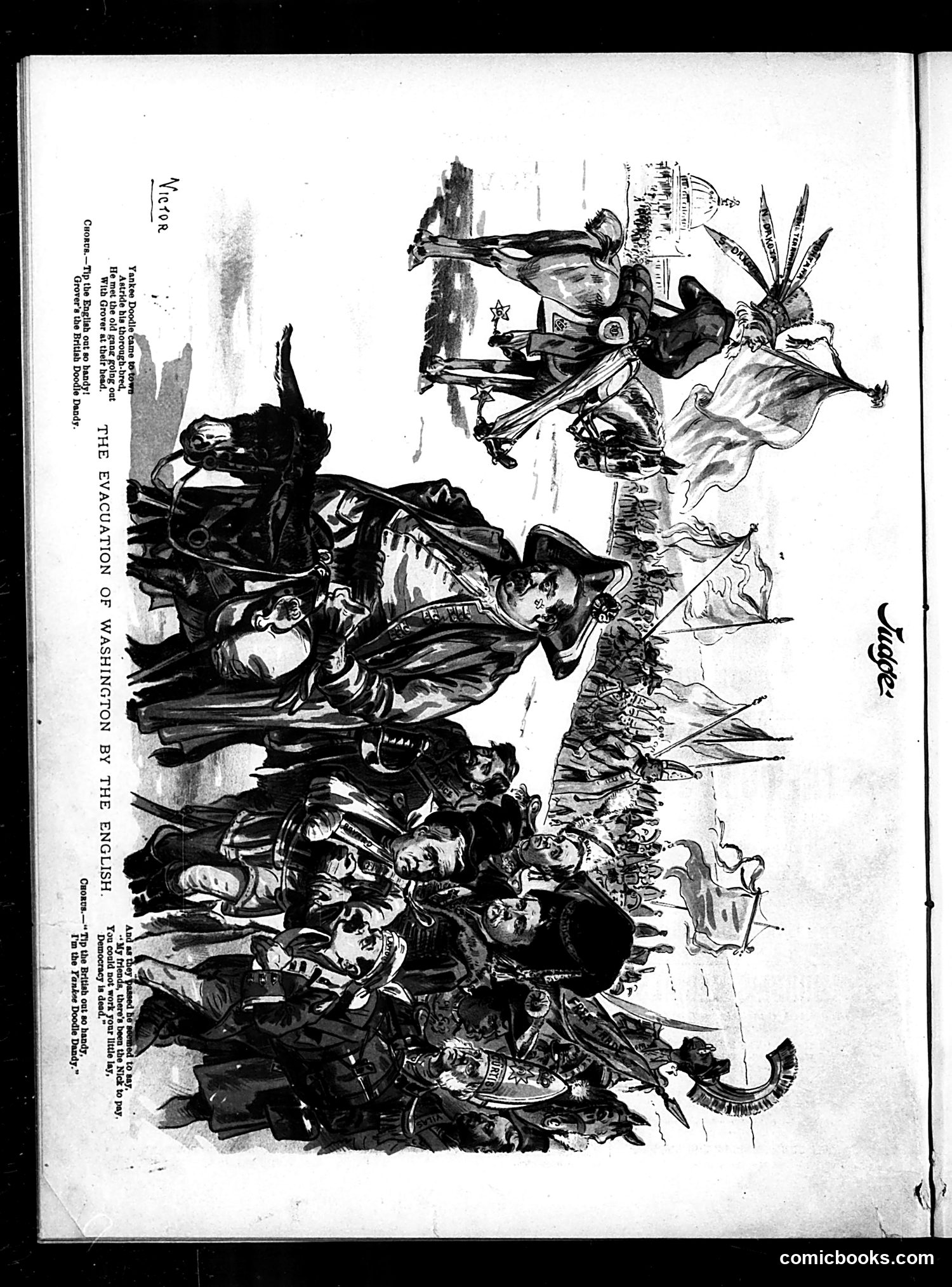
This is a satirical cartoon from Judge magazine satirizing President Grover Cleveland's administration (likely 1880s-90s). The title and verse mock Cleveland by suggesting he's driving out the English from Washington—a patriotic-sounding claim treated as absurd. The chorus "Grover's the British Doodle Dandy" is a pun on the patriotic song "Yankee Doodle," inverting it to mock Cleveland as pro-British rather than patriotic. The cartoon depicts chaotic scenes of figures being expelled or evacuated, likely representing Cleveland's political enemies or those the cartoonist deemed undesirable. The satire appears to criticize Cleveland's policies or appointments as insufficiently American or overly influenced by British interests—a common nativist attack of the era. The garbled, urgent verse emphasizes the cartoon's mocking tone toward Cleveland's claims of patriotic action.